Finnish authorities scramble fighter jets; defence chief says false alarm but warns of potential repeats while Russian war persists.
Finland has stood down its defence forces after sounding an alarm over suspected drone activities in its airspace.
The authorities said on Friday that suspected drone activity above the Helsinki region no longer posed a threat and that the situation was returning to normal hours after launching an emergency response, including the launch of fighter jets and closure of the capital’s airport.
Recommended Stories
list of 4 itemsend of list
The alarm illustrates the tension stalking the region as Finland and the Baltic states eye Russian aggression and daily missile and drone attacks amid Moscow’s continued war on Ukraine.
The Helsinki City Rescue Department had warned the nearly 2 million inhabitants of Finland’s Uusimaa region to stay indoors starting about 4am local time (1:00 GMT), as fighter jets were scrambled. Helsinki’s airport was also closed for about three hours.
Later, President Alexander Stubb wrote on X that authorities had “demonstrated their readiness and capacity to react”, adding that the country was now facing “no direct military threat”.
Kimmo Kohvakka, director general for rescue services at the Ministry of the Interior, called the response a “precautionary measure” and said “daily life can continue.”
The incident arose amid growing concerns about regional spillover from the Ukraine war.
The Baltic states of Estonia, Latvia and Lithuania have reported a series of suspected Ukrainian drones headed for Russia entering their airspace, prompting domestic criticism over their ability to respond to military threats.
The situation has led to a full-blown government crisis in Latvia. Prime Minister Evika Silina resigned on Thursday after a coalition partner pulled support. The move followed the ousting of the defence minister after a drone crashed at a fuel storage facility.
In March, two drones crossed into Finnish territory and crashed after flying low over the sea and southeastern Finland.
Finnish authorities did not indicate the source of Friday’s drone activity.
However, defence forces operations chief Kari Nisula suggested that Finland had received information from Ukraine about drones potentially straying into the country, according to the Reuters news agency.
The military head added that there was no evidence that drones had entered Finland, but that such situations could happen again as long as Russia continues its war on Ukraine.
Prisoner swap
The incident in Finnish airspace unfolded as Ukraine maintained its drone attacks on Russian oil and energy infrastructure, and Kyiv continued counting the costs of a huge strike that killed two dozen people.
Russia’s Ministry of Defence said on Friday that its air defence systems shot down 355 Ukrainian drones targeting Moscow overnight, as well as the border regions of Belgorod, Bryansk and Kursk.
Among the targets was an oil refinery in the central city of Ryazan, about 200km (125 miles) southeast of Moscow, according to the commander of Ukraine’s drone forces.
Fire and a plume of smoke rise in the vicinity of the Ryazan oil refinery, May 15, 2026 [Reuters]
The attack killed three people and wounded 12, regional Governor Pavel Malkov wrote on Telegram. Two high-rise apartment buildings were struck, he said, while debris fell on the grounds of an industrial enterprise.
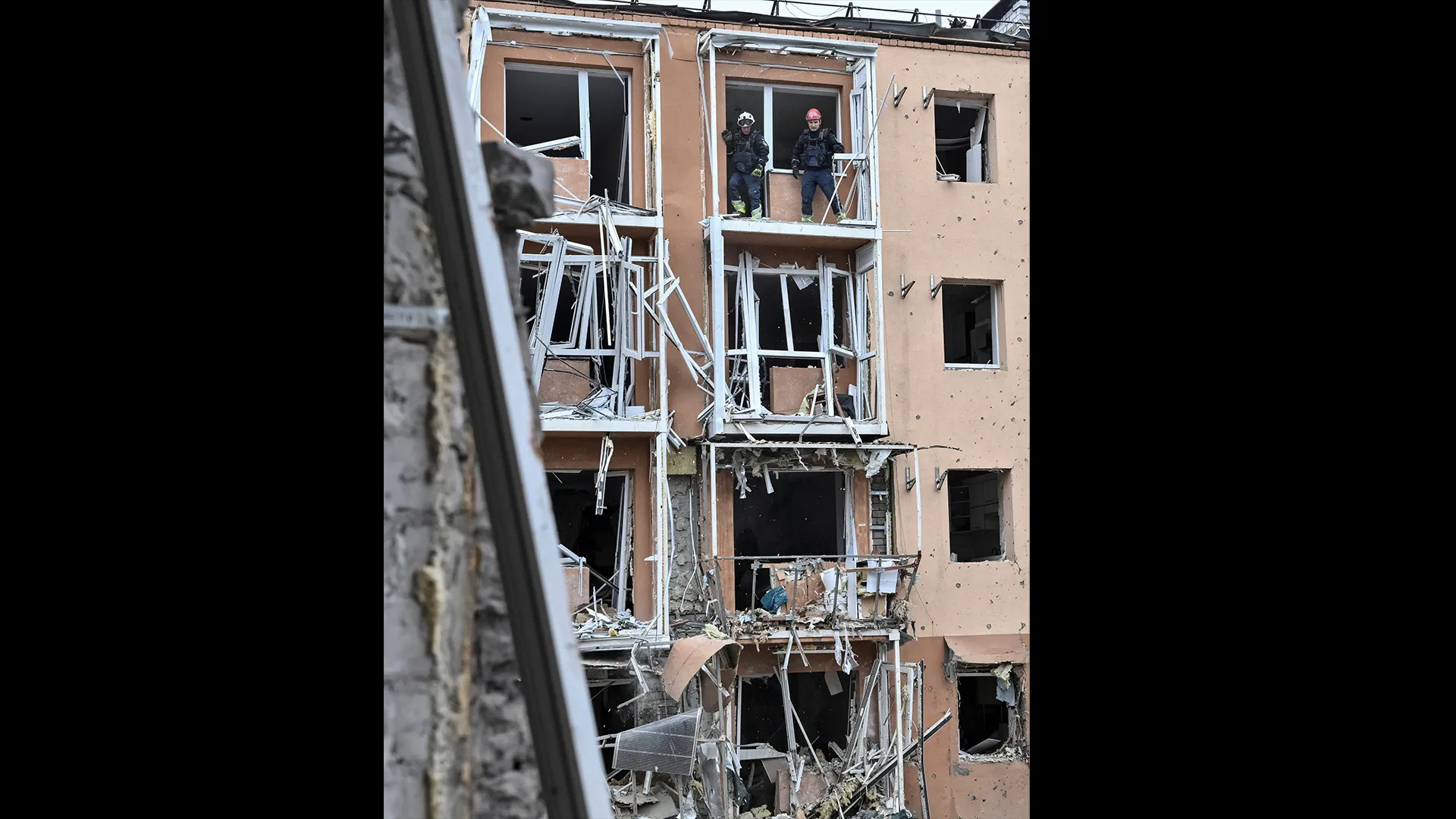
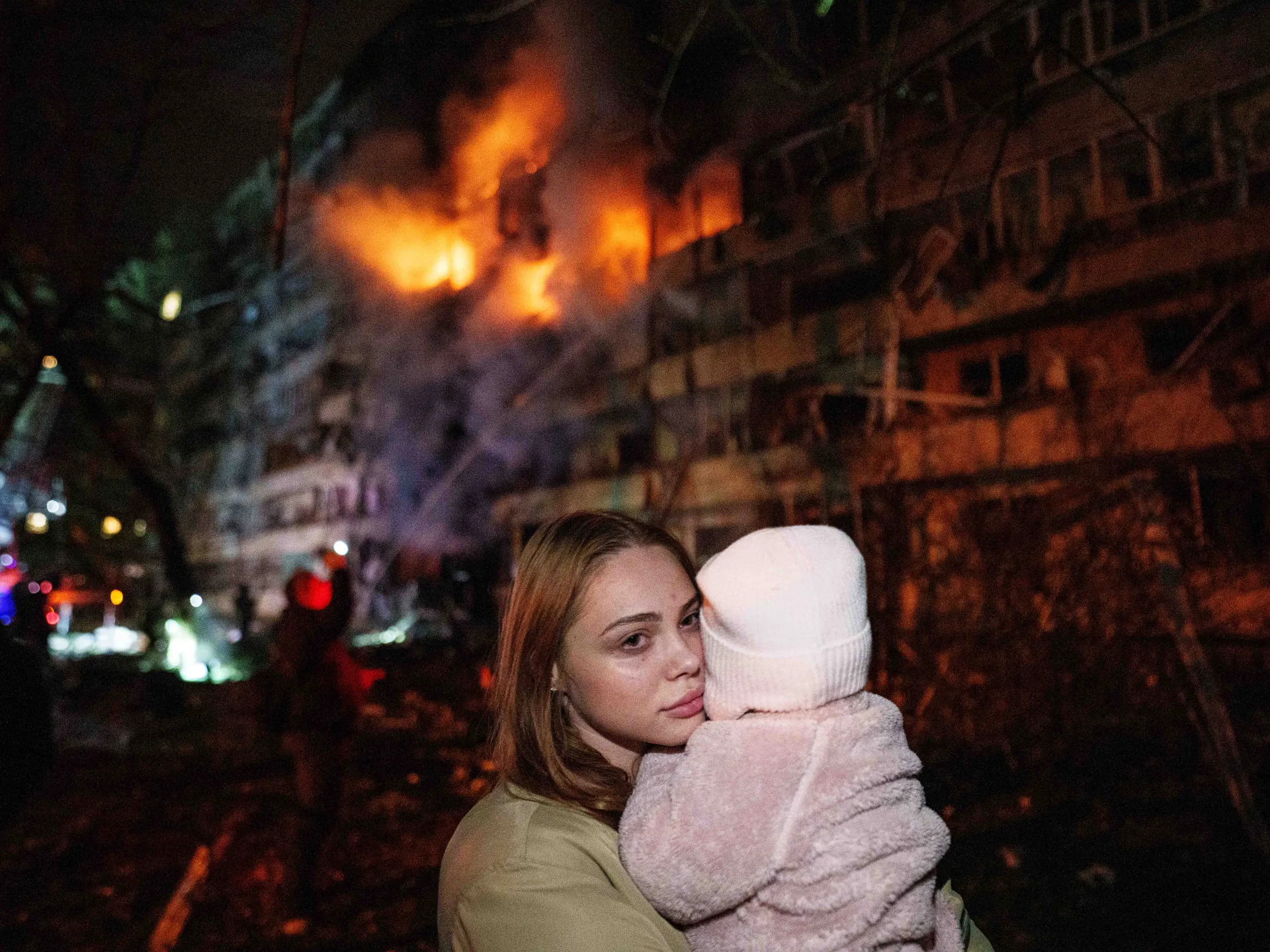
Meanwhile in Kyiv, the death toll from a Russian barrage on an apartment building on Thursday rose to at least 24 people, including three children, Ukrainian President Volodymyr Zelenskyy said. Forty-eight people were wounded.
Amid the ongoing violence, Russia and Ukraine have moved ahead with a prisoner swap that saw 205 POWs repatriated on each side on Friday. It was the first step of a swap that is planned to ultimately see 1,000 people on each side return home.
The two sides also conducted an exchange of those killed in the fighting, with Russia handing 526 bodies to Ukraine and receiving 41 in return. Both Kyiv and Moscow thanked the United Arab Emirates for mediating the swap.
Zelenskyy wrote on social media that most of the prisoners returned to Ukraine had been in Russian captivity since 2022.
“We will continue to fight for every single person who remains in captivity,” he said.
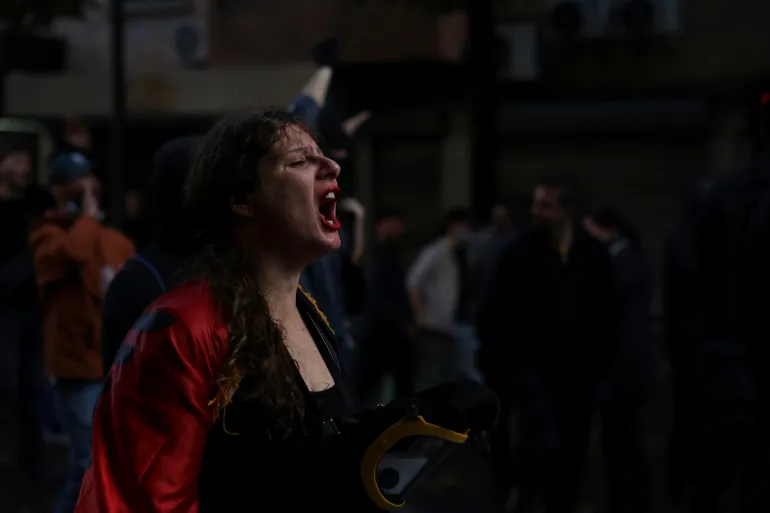
Eurovision is heading towards its grand final, but organisers are bracing for more demonstrations after chants of ‘stop the genocide’ were heard during Israeli contestant Noah Bettan’s semi-final performance. Five countries have withdrawn from this year’s contest after Israel was permitted to compete.
A UN humanitarian convoy delivering aid to the city of Kherson was hit twice by drones, despite prior coordination with Ukrainian and Russian forces. No injuries were reported, and the UN has not attributed the attack to either side.
Latvia’s Prime Minister Evika Silina resigned following criticism of her government’s handling of stray drones, believed to be Ukrainian, crossing into Latvian territory. The controversy deepened divisions within the ruling coalition, causing it to lose its parliamentary majority.
President Zelenskyy says rescue operations continue after Russia used ‘more than 1,560 drones’ during its overnight attacks.
Published On 14 May 202614 May 2026
Russia launched a barrage of missiles and drones targeting Ukraine’s capital Kyiv, killing at least three people and wounding 40 others, Ukrainian authorities have said.
The Ukrainian military said on Thursday that the overnight strikes hit six districts of Kyiv and another six in the surrounding areas. Deputy Prime Minister Oleksii Kuleba said attacks had targeted ports in the southern Odesa region and railways.
Recommended Stories
list of 3 itemsend of list
In a post on X, President Volodymyr Zelenskyy said rescue operations were continuing following an attack on a nine-storey building in Kyiv after Russia launched “more than 670 attack drones and 56 missiles against Ukraine”.
“In total, since midnight yesterday, Russia has used more than 1,560 drones against our cities and communities. These are definitely not the actions of those who believe the war is coming to an end,” he wrote on Thursday.
“It is important that partners do not remain silent about this strike. And it is equally important to continue supporting the protection of our skies,” Zelenskyy added.
The mayor of Kyiv, Vitali Klitschko, said 40 people were wounded in the attacks, including two children, while Ukrainian emergency services said three people had been killed.
Reporting from Kyiv, Al Jazeera’s Audrey Macalpine said people are still feared trapped under the rubble of the building.
Macalpine said it was one of Russia’s largest attacks of the war, “in a single 36-hour period just by sheer number of drones”.
The attack comes as a setback for efforts to end the war after United States President Donald Trump raised faint hopes for peace by brokering a three-day ceasefire between Kyiv and Moscow last week, and Russian leader Vladimir Putin suggested the war could be winding down.
Ukrainian rescuers work at the site of a Russian strike on the nine-storey residential building in Kyiv, Ukraine, 14 May 2026 [Sergey Dolzhenko/EPA]
The truce – put in place as Putin presided over a scaled-down military parade in Red Square to mark the anniversary of World War II victory – was marred by allegations of violations by both sides.
Ukraine and Russia launched long-range drone attacks immediately after it ended on Tuesday.
The Kremlin has poured cold water on the idea that Putin’s vague comments, issued Saturday, about the war “heading to an end” could mean a softening in Moscow’s position.
On Wednesday, it repeated its demand that Ukraine fully withdraw from the eastern Donbas region before a ceasefire and full-scale peace talks can take place.
Kyiv has rejected such a move as tantamount to capitulation.
Russia attacked the Ukrainian capital Kyiv with drones and missiles early on Thursday, officials said, damaging several buildings, including one which partially collapsed with residents likely trapped under rubble.
The decision by five nations to boycott the song contest comes amid Israel’s genocide in Gaza.
Five nations are boycotting Eurovision, citing Israel’s participation. Their action is against Israel’s war in Gaza and allegations of vote manipulation in the song contest.
But why is it so important for Israel to take part? And is the competition’s future under threat?
Presenter: Folly Bah Thibault
Guests:
Steve Wall – Musician, actor and member of the Ireland Palestine Solidarity Campaign
Jonathan Hendrickx – Assistant professor in media studies at the University of Copenhagen
Andriy Yermak, Ukrainian President Volodymyr Zelenskyy’s former chief of staff and close aide, is now at the centre of the country’s biggest corruption investigation since Russia’s full-scale invasion in 2022.
Anticorruption authorities named him an official suspect on Monday in an alleged multimillion-dollar money laundering scheme linked to a luxury housing project outside the capital, Kyiv.
Recommended Stories
list of 3 itemsend of list
Yermak appeared at a Kyiv court on Tuesday for a hearing related to the charges, which are part of a widening probe drawing in other senior figures associated with the president, including his national security chief.
While Zelenskyy is not accused of any wrongdoing, the scandal could potentially threaten Ukraine’s aspirations for European Union membership as it seeks to convince the bloc that its anticorruption drive is on track.
So, what are the charges against Yermak? Are other allies of Zelenskyy also under a cloud of suspicion? And what does this mean for Ukraine’s standing with its Western allies?
What are the charges against Yermak?
Ukraine’s National Anti-Corruption Bureau (NABU) and the Specialized Anti-Corruption Prosecutor’s Office (SAPO) say Yermak is suspected of involvement in an organised criminal group that allegedly laundered about 460 million hryvnias ($10.5m) through a luxury real estate project near Kyiv.
Prosecutors are seeking to impose bail of about $5.4m on the 54-year-old while they continue their investigation.
Yermak, who resigned in November, has firmly rejected the claims. In a post on Telegram after a court hearing on Tuesday, he described the accusations as “unfounded”.
“As a lawyer with more than 30 years’ experience, I have always been guided by the law. And now, in the same way, I will defend my rights, my name and my reputation,” he said.
Ukraine’s former Presidential Office Chief of Staff Andriy Yermak stands in court before a hearing in a money laundering case in Kyiv on May 12, 2026 [AFP]
At one point during the hearing, Yermak told reporters that he “owns only one apartment and one car”.
His lawyer, Ihor Fomin, labelled the allegations against his client “groundless” and denied any role by Yermak in laundering funds through the high-end development. Fomin told Ukraine’s public broadcaster Suspilne that “this entire situation has been provoked by public pressure.”
NABU director Semen Kryvonos defended the proceedings, stating that authorities move to issue formal notices only when they believe they possess enough evidence to sustain charges in court. He clarified that Zelenskyy was not subject to any investigation.
But the case has dragged the shadow of corruption closer to the Ukrainian president than ever before. That’s because it isn’t just Yermak who has been caught up in the accusations of fraud.
Have other Zelenskyy allies been implicated, too?
Timur Mindich, a wealthy businessman who was Zelenskyy’s former partner from the entertainment world – the Ukrainian president is a former comedian – has emerged as another leading figure in the scandal. He left for Israel after corruption allegations surfaced last year.
The probe has also brought Rustem Umerov, the head of Ukraine’s National Security and Defence Council, into the crosshairs of the authorities. Umerov, who until last year was Ukraine’s defence minister, is Zelenskyy’s main representative in United States-backed diplomatic efforts to end Russia’s war on Ukraine.
Prosecutors say Umerov has been interviewed as a witness in the luxury real estate development case.
The case is part of a broader anticorruption operation, dubbed “Midas” and led by NABU and SAPO. The operation was first made public in November, when prosecutors accused Mindich of engineering a $100m kickback scheme at Energoatom, charges the businessman has refuted.
Zelenskyy has yet to publicly respond to the allegations involving Yermak. On Monday, a communications aide said it was premature to comment on the case.
Ukraine’s government in July passed a law in an effort to strip the independence of NABU and SAPO, which were established in 2014 after a pro-democracy uprising against the then-government of President Viktor Yanukovych.
Within days, protests broke out against the move, forcing Zelenskyy to reverse course and sign a new law to restore the anticorruption institutions’ independence.
Why does this matter?
The scandal has emerged at a particularly sensitive moment for Ukraine, as Kyiv continues to make the case for military and financial support from its allies in Western Europe and North America.
Last July, US senators Jeanne Shaheen and Lindsey Graham released a strongly worded statement denouncing the attempt by the government to, at the time, curb the anticorruption work of NABU and SAPO.
“One of the most widely used talking points for ending support for Ukraine is that it was awash with corruption,” they said. “We acknowledge that Ukraine continues to make progress on this front and we urge the government to refrain from any actions that undermine that progress.”
Moreover, Ukraine’s bid to join the EU has increased pressure on Zelenskyy’s administration to demonstrate institutional independence and accountability.
German Chancellor Friedrich Merz last month cautioned against a quick accession of Ukraine to the EU, saying Ukraine cannot join the bloc due to several key concerns, including ending the war and fighting corruption.
Ukrainian opposition politician Oleksiy Goncharenko said the allegations had now reached a point that Zelenskyy “personally cannot ignore”.
However, Olena Halushka, a board member at the Anti-Corruption Action Centre in Kyiv, said the case against Yermak and others was a “clear example that the checks and balances system really works”.
Speaking to Al Jazeera, Halushka said it proved that in Ukraine there are “law enforcement institutions functioning independently and professionally, exercising their powers in defence of democracy”.
“These institutions were protected by the Ukrainian society and European partners from the political attack last summer, and now we see the tangible results of their activities,” she added.
In a survey conducted on May 6 by the Kyiv International Institute of Sociology, 54 percent of Ukrainians said corruption was a bigger threat to the country than the war with Russia.
Europe’s cheapest destination for solo travellers is also rated one of the safest countries in the world according to the Global Peace Index
Research found destinations where the cost of living is lower for a weekend break(Image: gokcenarabul via Getty Images)
As flight prices soar amid the Middle Eastern conflict, holidaymakers face mounting challenges when booking their next getaway. Yet fresh research from Solo Female Travelers has uncovered more affordable destinations where the cost of living is significantly lower for a weekend break.
Researchers examined data from Numbeo covering 49 European destinations, excluding Russia, Belarus, and Ukraine due to the ongoing conflict and unreliable data. Crown Dependencies such as the Isle of Man, Jersey, Guernsey, Gibraltar, and the Faroe Islands were also omitted, as they are not sovereign states. The team then worked out a daily solo basket spanning six spending categories.
The six categories included – an inexpensive restaurant meal, coffee/cappuccino, bottled water (0.33L), local transport (return), a cinema ticket, and a one-bedroom city-centre flat (per night).
The study revealed that a solo traveller could enjoy a weekend in North Macedonia for just €52.38 (£45.33).
Skopje serves as the capital and largest city in North Macedonia, boasting a population exceeding 500,000. The landlocked Balkan nation shares borders with Greece to the south, Albania to the west, Bulgaria to the east, Kosovo to the northwest and Serbia to the north.
A meal at a budget-friendly restaurant in Skopje would set you back €6.51 (£5.63), a regular-sized cappuccino would cost €1.92 (£1.66), and a 0.33L bottle of water would cost €1.05 (£0.91).
Direct flights from London to Skopje are priced at roughly £90 for a weekend trip or approximately £49 if you’ve got flexibility with your dates. According to World Population Review, North Macedonia also ranks among the “safest countries in the world”, with a low risk level based on the Global Peace Index.
Coming in second was Bosnia and Herzegovina, where a solo weekend would run you €54.66 (£47.30). Meanwhile, a weekend in Moldova would cost slightly more at €54.93 (£47.53). Rounding out the top four is Serbia, where a weekend will set a solo traveller back €61.65 (£53.35).
Remarkably, the top four combined would nearly match the priciest destination for solo weekend travel.
Liechtenstein’s weekend cost is 4.25 times higher than the cheapest option, at €222.66 (£192.68). For a combined total of €223.62 (£193.51) – virtually identical to a single weekend in Liechtenstein – travellers could experience all four cheaper alternatives.
Liechtenstein narrowly edged out neighbouring Switzerland €221.70 (£191.85) by less than one euro. Liechtenstein’s daily basket of €74.22 stands as the highest in Europe, with dining expenses exceeding accommodation costs.
Dining in Liechtenstein runs 20% higher than Switzerland at €27.13 (£23.48) and more than double the European average of €14.98 (£12.96).
Mar Pages, co-founder of Solo Female Travelers, commented: “Liechtenstein may be small, but its costs are anything but. What’s interesting is that the premium isn’t driven by accommodation – it’s the everyday spending, from a simple meal to a coffee, that pushes it to the top.
“For solo travellers planning a European trip, this data is a powerful reminder that cost differences across the continent are enormous and the destination you choose makes all the difference.”
UK PM, who is battling to remain in his job amid resignations of ministers, is expected to hold talks with Streeting.
Published On 13 May 202613 May 2026
British Prime Minister Keir Starmer, fighting for his political survival after dozens of his own MPs called for him to resign, promised to press ahead with plans to reform the country before an expected meeting with his potential leadership rival Wes Streeting, the health secretary.
Starmer has so far defied calls to quit from Labour MPs, who blame him for heavy losses in local elections last week and say he has failed to deliver reforms since coming to power in a landslide 2024 election victory.
Recommended Stories
list of 4 itemsend of list
The meeting in Downing Street will take place before King Charles gives a speech at the opening of parliament – a grand ceremony led by him and used by the government to set out its political priorities and legislative agenda for the year ahead.
A public statement is not expected to follow the Streeting-Starmer meeting to keep the attention on the speech, according to British media reports.
Resignations
More than 80, or almost a quarter, of the prime minister’s elected MPs have called for Starmer to go, and four junior ministers have resigned in protest, including prominent MP Jess Phillips, who said she was tired of seeing “opportunities for progress stalled and delayed”; Alex Davies-Jones, who called last week’s election results “catastrophic”; and Zubir Ahmed, who is a Streeting ally.
Miatta Fahnbulleh, who was the first of four ministers to resign on Tuesday, said in a letter to the prime minister, cited by British media: “The public does not believe that you can lead this change – and nor do I.”
Meanwhile, Starmer said in a statement on Tuesday evening: “Britain stands at a pivotal moment: To press ahead with a plan to build a stronger, fairer country or turn back to the chaos and instability of the past.”
Despite the turmoil, Starmer will take part in parliament’s grand opening on Wednesday.
“The British people expect the government to get on with the job of changing our country for the better. Cutting the cost of living, bringing down hospital waiting lists and keeping our country safe in an increasingly dangerous world,” Starmer said.
A package of more than 35 bills and draft bills will focus on measures to improve the economy, strengthen national security and “reform the state to support a more active government that is on the side of British people”, the government said.
After travelling to parliament and donning the Robe of State, Charles will read a speech written by Starmer’s government setting out the planned new laws.
But the implementation of that speech remains as uncertain as Starmer’s political future. If he were to be removed, his successor would not be bound to follow the same plan.
After spending much of Tuesday behind closed doors at his Downing Street office as he sought to rally support, Wednesday’s ceremony will put Starmer’s struggle for power back in public view.
A former top aide to Ukraine’s President Volodymyr Zelenskyy has appeared in court as prosecutors seek his arrest on charges of involvement in a multimillion-dollar money laundering scheme.
Prosecutors allege that Yermak, 54, funnelled about 460 million Ukrainian hryvnias ($10.5m) into a high-end Dynasty housing complex in Kozyn, near Kyiv.
Recommended Stories
list of 4 itemsend of list
Investigators suspect that funds used in the development may have originated from corruption at Energoatom, Ukraine’s state nuclear energy company.
The prosecution has asked the court to remand Yermak in custody, with bail set at 180 million Ukrainian hryvnias ($4m).
Yermak denied the allegations.
The hearing is due to resume on Wednesday.
“The notice of suspicion is unfounded,” Yermak wrote on Telegram following Tuesday’s proceedings. “As a lawyer with more than 30 years of experience, I have always been guided by the law. And now I will likewise defend my rights, my name, and my reputation.”
Earlier, during a break in proceedings, he told reporters: “I own only one apartment and one car.”
The case is part of a broader anticorruption operation, dubbed “Midas”, led by the National Anti-Corruption Bureau of Ukraine (NABU) and the Specialised Anti-Corruption Prosecutor’s Office (SAPO). The operation was unveiled last November, when Timur Mindich, a former business associate of Zelenskyy, was accused of orchestrating a $100m kickback scheme at Energaotom.
Mindich, who denies the allegations, has fled to Israel.
Prosecutors said Mindich and several other senior officials, including former Deputy Prime Minister Oleksii Chernyshov, are “implicated” in the Dynasty case.
They said Rustem Umerov, the head of Ukraine’s National Security and Defence Council and a key negotiator in the United States-led efforts at peace with Russia, has also been questioned and is a witness in the case.
Corruption scandal
Yermak, a one-time film producer who helped engineer Zelenskyy’s unlikely ascent from playing a fictional president on television to leading a country at war, resigned as chief of staff in November after investigators raided his home as part of the Energoatom probe.
NABU chief Semen Kryvonos confirmed on Tuesday that Zelenskyy himself was not the subject of any investigation.
A sitting president cannot legally be investigated.
Zelenskyy has not commented publicly on the charges against his former aide. A communications adviser said on Monday that it was too early to address the matter.
The latest charges come with Ukraine still dependent on critical Western financial aid, contingent partly on anticorruption reforms. The US-backed peace push has stalled in the fifth year of Russia’s invasion of Ukraine.
Ukraine’s government last year attempted to strip the independence of NABU and SAPO, which were established after a pro-democracy uprising in 2014.
The move triggered rare wartime antigovernment protests and forced Zelenskyy to walk back the decision after criticism from the European Union, Kyiv’s key financial and military backer.
Some lawmakers, including members of Zelenskyy’s governing Servant of the People party, saw a silver lining in the case against Yermak, saying it served as an encouraging sign of Ukraine’s drive to fight corruption.
“Partners see that Ukraine has an independent anticorruption system that is performing its function,” said Oleksandr Merezhko, head of the parliamentary foreign-affairs committee.
Zelenskyy’s public approval has remained relatively stable in recent months, despite the heightened focus on corruption, with about 58 percent of Ukrainians trusting the president, the Kyiv International Institute of Sociology said on May 4.
In a May 6 poll, however, it found that 54 percent believe corruption is a greater threat to Ukraine’s development than Russia’s war, when given an option between the two.
Author Oliver Eagleton says British Prime Minister Keir Starmer is fighting for his job because he tried to turn the Labour Party into the ‘new Conservative Party’ and ‘occupy that centre ground’. Dozens of lawmakers are calling for Starmer’s resignation after devastating local elections.
FLIGHT cancellations have dominated the news recently with Ryanair in particular axing millions of seats.
As a result of rising air tax, budget-friendly Ryanair has cut a huge amount of routes over the last year – here’s every destination that’s been impacted as a result.
Sign up for the Travel newsletter
Thank you!
Ryanair has axed lots of routes across the last yearCredit: GettyRyanair has scrapped off-season flights to certain parts of CreteCredit: Getty
Follow The Sun’s award-winning travel team on Instagram and Tiktok for top holiday tips and inspiration @thesuntravel.
At the same time, the airline announced it would be scrapping off-season flights to Chania and Heraklion in Crete and will reduce its Athens services too.
All of this will result in 700,000 fewer seats on sale this winter which works out as a 45 per cent reduction, and resulting in 12 routes being scrapped in total.
The destinations where the airline has closed operations and ceased flights to were Asturias, Vigo, Valladolid, Jerez and Tenerife (North).
At other holiday spots in Spain, Ryanair significantly reduced its flights – this includes Santiago de Compostela, Girona, Vitoria, Zaragoza and Santander.
This is in response to Aena – the state-controlled airport operator in the country – increasing its fees for airlines.
The operator has proposed an increase in passenger fees, meaning airlines would be paying 21 per cent more from 2027 to 2031.
Portugal
Ryanair no longer flies to the Azores off the coast of PortugalCredit: Getty
From Mary 29, Ryanair stopped all services to and from the Azores meaning that six different routes have been scrapped.
This has impacted around 400,000 passengers who visit the islands every year.
Ryanair’s CCO Jason McGuinness said: “As a direct result of rising costs, we have been left with no alternative other than to cancel all Azores flights from 29 March 2026 onwards.”
Germany
Berlin routes have been cut by halfCredit: Getty
While no routes have been completely axed, Ryanair has dropped 24 services to and from Germany from its schedule.
These destinations include Hamburg, Memmingen, Baden-Württemberg, Cologne, Frankfurt-Hahn, Dortmund, Dresden and Leipzig.
Ryanair also revealed plans to close its Berlin hub and slash its 2026 winter timetable to the capital by half.
The airline confirmed it would move seven aircraft to alternative locations.
Passenger figures will as a result drop from 4.5million to 2.2million annually.
Ryanair DAC CEO Eddie Wilson said: “We regret to announce this planned closure of our 7 aircraft Berlin base from October 24, 2026, but we have no alternative following the Airport’s latest 10 per cent fee increase to its already high airport fees.
“This comes on top of the 50 per cent increase in Berlin’s airport fees since 2019.”
France
Ryanair axed its routes completely to Strasbourg in FranceCredit: Alamy
Ryanair cut many services to France in 2025 – with the loss of 25 routes and some 750,000 seats last winter.
The airline decided to drop services completely to both Strasbourg and Brive.
Who: Manchester City vs Crystal Palace What: English Premier League Where: Etihad Stadium in Manchester, England, United Kingdom When: Wednesday, May 13, at 8pm (19:00 GMT) How to follow: We’ll have all the buildup on Al Jazeera Sport from 16:00 GMT in advance of our live text commentary stream.
Second-placed Manchester City kept themselves alive in the Premier League title race with their solid home win over Brentford on Saturday, but league-leading Arsenal’s controversial win at West Ham United the following day again pegged City behind in the two-team fight for the trophy.
Recommended Stories
list of 4 itemsend of list
Al Jazeera Sport previews City’s delayed Matchday 31 contest against Crystal Palace on Wednesday and breaks down the Sky Blues’ championship hopes as the season draws to a close.
Where does the Premier League title race stand?
Frontrunners Arsenal are in a favourable title position on the Premier League ladder; they enjoy a five-point lead over Man City, with the Gunners having two matches remaining in the 38-round season.
City have three games to go, including their home tie with Palace.
A screengrab of the 2025-26 Premier League points table [Al Jazeera]
What happens if City win against Palace?
If City beat Palace on Wednesday, they will reduce the gap on league leaders Arsenal to two points. Both teams will then have two games remaining.
A victory against Palace would keep City alive in the title hunt, but they would need to beat Bournemouth in their penultimate match to continue the title fight to the final round of matches on May 24.
What happens if City draw or lose to Palace?
If City draw, they will end up four points behind Arsenal, and in the event of a defeat, the gap would remain at five points. Dropping any points against Palace would mean City all but bowing out of the title race, even if they still have a mathematical chance to contend heading into the penultimate round.
In such a scenario, Arsenal can be crowned Premier League champions as early as Monday, May 18. A win over already-relegated Burnley in Matchday 37 would mean Arsenal would be at least seven points clear, with City only having a maximum of six points available in their last two fixtures.
If the Gunners are crowned champions of England, it would mark the end of the North London club’s 22-year wait for the honour.
How does City’s and Arsenal’s run-in look?
After hosting Palace on Wednesday, City face sixth-placed Bournemouth on May 19 before facing fifth-placed Aston Villa in their final game of the season on May 24. Both fixtures will be challenging as City’s opponents will be fighting to secure European football qualification next season.
Arsenal, on the other hand, have a much easier run-in to the end of the season. They host already-relegated Burnley on May 18 and play away to Palace on the final day of the season. Palace will likely name a weaker side for that fixture, with their eyes certainly on their first European final: The Conference League final vs Rayo Vallecano on May 27.
Is the Premier League trophy Arsenal’s to lose?
Yes.
Arsenal’s dramatic win on Sunday against their London rivals, West Ham, means they already have one hand on the trophy. Should they win their final two matches of the campaign, they will be crowned champions, regardless of Man City’s results.
But any slip-up would allow their title rivals back in.
Opta’s supercomputer has given the Gunners an 87.2% chance of winning the title from hereon.
Can City and Arsenal end the season on equal points?
Yes, it is possible.
If City win all three remaining matches, and Arsenal draw one of their two games, both teams will end the season level on points.
What happens in this case? Rule C.17 of the Premier League Handbook says the final table placings would be determined by the following criteria, in this order:
goal difference
goals scored
points won in head-to-head matches
away goals scored in head-to-head matches
a playoff match.
Currently, the goal difference between Arsenal and City is very close. Arsenal have a +42 goal difference, and City’s is +40. It could come down to goals scored across the season: City’s current tally is 72, Arsenal’s is 68.
Manchester City’s Norwegian striker #09 Erling Haaland is the leading scorer this season with 26 goals. Can he guide them to a surprise title win? [AFP File]
If the clubs finish level on points, goal difference, and goals scored, City would claim the title on the next criterion – points won in head-to-head matches – because they have won four points against Arsenal this season, thanks to a win and a draw.
The odds of such a scenario are very low, given City are lagging in the title race, but if this were to happen, it would go down as the closest title race ever. The previous closest race was in 2011-12 when City edged their rivals, Manchester United, on goal difference following Sergio Aguero’s stoppage-time winner against Queens Park Rangers on the final day.
City still in the hunt for domestic double
While City’s odds of winning the league title are very slim, they remain on course to complete a domestic double. City, who won the League Cup in March, face Chelsea in the FA Cup final on Saturday. They are bidding for their eighth FA Cup, having last lifted the trophy in 2023.
Manager Pep Guardiola has backed striker Omar Marmoush, who scored off the bench in the last game, to have a key role in the closing stages of the English season.
“We’ve talked many times,” said Guardiola. “I know it’s not easy for them [fringe players], but I’m pretty sure in the next games they’re going to play.
“I want to rotate the team because otherwise we cannot arrive in the final or Bournemouth a little bit (fresh).
“Especially Omar. It’s not easy because normally you just want one striker. He’s a proper striker but Erling (Haaland) is there.
“Erling is so important for us, but the contribution of Omar – the amount of goals for the minutes played – is so high.”
‘I love it’ – Pep Guardiola relishes title run-in
Guardiola said he is “loving” the Premier League run-in, despite his side no longer controlling their own fate in the title race.
“It’s not in our hands now,” Guardiola said. “They have to drop points. The only thing we can do is win again and see what happens.”
Guardiola said win or lose, the thrilling race to the finish has been thoroughly enjoyable.
Arsenal manager Mikel Arteta, left, and City manager Pep Guardiola exchange a hug before a game [File: Carl Recine/Reuters]
He pointed to his team’s consistency, as their unbeaten run in the league stretches back to mid-January. With another major final still to come, City have had plenty to celebrate this season, regardless of how the Premier League finishes.
“I love it. I love to be here again, we’ll finish second again in this season, minimum,” Guardiola said. “Last season, we were fighting to qualify for the Champions League, was so difficult.
“I love too Carabao (League Cup) in our pocket. We play an FA Cup final in Wembley, it is the most beautiful game of the season.”
What happened the last time City played Palace?
In their reverse fixture at Selhurst Park in December, City won 2-0, thanks to two goals from Haaland, including a penalty, and another by Phil Foden.
Head-to-head
Palace and City have faced each other in 75 games in all competitions since 1921.
City have won 40 of those encounters, while Palace won 18. A total of 17 matches ended in a draw.
Man City team news
Defenders Josko Gvardiol and Abdukodir Khusanov, along with defensive midfielder Rodri, are out injured.
Predicted Man City lineup
Gianluigi Donnarumma (goalkeeper); Matheus Nunes, Marc Guehi, Nathan Ake, Nico O’Reilly; Bernardo Silva, Tijjani Reijnders; Antoine Semenyo, Rayan Cherki, Jeremy Doku; Erling Haaland
Palace team news
Edward Nketiah, Cheick Oumar Doucoure, Evann Guessand and Borna Sosa are sidelined with injuries.
Predicted Palace lineup
Dean Henderson (goalkeeper); Chris Richards, Maxence Lacroix, Jaydee Canvot; Daniel Munoz, Adam Wharton, Daichi Kamada, Tyrick Mitchell; Brennan Johnson, Ismaila Sarr; Jorgen Strand Larsen
Acoma makes 100 years of history look like small change. To get there, you veer south from old 66 for 14 miles at the tiny town of Paraje, about an hour west of Albuquerque.
Also known as Sky City, Acoma is a Native community of earthen homes perched atop a 357-foot-high mesa. It has been occupied for roughly 1,000 years by the Acoma Pueblo tribe, which is independent of the nearby Navajo, Zuni and Laguna, with its own language and about 5,000 enrolled members.
Thanks to revenues from their Sky City Casino and hotel along Interstate 40, the Acoma also have a large, handsome Haa’ku Museum and Sky City Cultural Center next to the historic mesa. There, outsiders can gather for escorted tours of 60 to 90 minutes, mostly walking. It’s $30 per adult. Photography, binoculars and note-taking are closely restricted, and outsiders are generally forbidden from the mesa except on tours.
My group of 18 travelers was led by guide Gail Toribio, 27. After a quick bus ride up a steep road built in the 1950s, we found ourselves on top of the mesa, facing one massive church, about 500 homes and several pottery stalls that materialize during tours. The views were spectacular, the pottery was full of painstaking detail, and it was fascinating to see the ancient and modern elements together in the hilltop homes. But the biggest thing and most astonishing story on the mesa is the San Estévan del Rey Mission.
When Spanish troops and missionaries showed up in the 16th century, they forced labor and Christianity upon Native groups, often slaughtering and maiming those who resisted, including many Acoma. By the 1640s, forced labor had produced the church on the mesa, its 40-foot-long ponderosa pine beams dragged from Mt. Taylor, more than 30 miles away. Somehow, when the area’s tribes rose up in the Pueblo Indian revolt of 1680 and killed most of the Catholic priests in New Mexico, the church endured. And over time, Toribio told us, most Acoma families settled into a sort of dual faith, combining their traditional beliefs with Catholic rituals, including Christmas.
After the church, we walked among two-story homes that were here long before the first Europeans showed up. (Only a handful of the homes are still occupied full time.)
“I was actually raised up there,” potter Gwen Patricio, 52, told me back at the visitor center. “No electricity, no running water. They asked the elders if they wanted electricity, but they said no.”
One killed and four others wounded in attacks on Ukraine’s Dnipropetrovsk region, local administration chief says.
Published On 12 May 202612 May 2026
Russia and Ukraine have resumed air attacks after a United States-brokered three-day truce expired, with President Volodymyr Zelenskyy saying more than 200 drones were used to attack Ukraine overnight.
Russian aerial attacks across Ukraine’s Dnipropetrovsk region on Tuesday morning killed at least one person and injured four others, according to regional administration chief Oleksandr Ganzha.
Recommended Stories
list of 3 itemsend of list
Russian drones also hit energy infrastructure in Ukraine’s Mykolaiv region, causing outages, and struck residential buildings and a kindergarten in the Kyiv region, according to local authorities. Russia also carried out attacks on the regions of Kharkiv, Zhytomyr, Sumy and Chernihiv, according to authorities.
More than 200 long-range drones were used in the wave of attacks, Zelenskyy said. “Russia itself chose to end the partial silence that had lasted for several days,” he said in a post on X.
Russia’s military, meanwhile, said its defences downed 27 Ukrainian drones over the regions of Belgorod, Voronezh and Rostov.
The exchange of aerial attacks came after the expiry of a 72-hour truce announced by US President Donald Trump on Friday, which he said he hoped would mark “the beginning of the end” of Russia’s four-year war on Ukraine.
The May 9-11 truce overlapped with Russia’s Victory Day, which celebrates the defeat of Nazi Germany in the second world war.
But even before it expired, both sides accused each other of violating the truce by attacking civilians.
Zelenskyy said Russia was neither observing the truce nor “even particularly trying to”, adding there had been no calm in front-line areas despite a lull in large-scale attacks.
Meanwhile, Russia’s Ministry of Defence accused Ukraine of committing more than 1,000 ceasefire violations. It said Ukrainian forces attacked civilian targets in several Russian regions and carried out strikes against Russian military positions on the front line.
Russia’s military had “responded in kind” to the ceasefire violations, according to the Defence Ministry.
US-backed negotiations on ending the Russia-Ukraine war have made little headway and have been largely sidelined by the crisis in the Middle East amid the US-Israel war on Iran. Trump’s ceasefire announcement had raised some hope that US-led talks to end Russia’s invasion could be resumed.
On Saturday, Russian President Vladimir Putin suggested for the first time that the Ukraine war may be “coming to an end” and expressed a willingness to meet Zelenskyy in Moscow or a neutral country once an agreement to end the war is finalised. He also accused the “arrogant” West of risking a global conflict, warning that Russia’s “strategic forces” are combat-ready.
Russian institutions and officials accused of systemic deportation and indoctrination of children during the war on Ukraine.
Published On 11 May 202611 May 2026
The European Union and United Kingdom have imposed sanctions on Russian institutions and officials accused of systematically deporting and indoctrinating Ukrainian children.
The EU announced measures against 23 state institutions and people on Monday. The UK simultaneously unveiled a broader package targeting 85 people and entities, roughly a third of them linked to what was described as Russia’s campaign to forcibly deport and militarise Ukrainian children.
Recommended Stories
list of 3 itemsend of list
Russia has deported and forcibly transferred nearly 20,500 Ukrainian children since Moscow launched its full-scale invasion in February 2022, an EU statement noted. It branded the actions as grave breaches of international law.
The EU said its designations target institutions and individuals involved in programmes subjecting children to pro-Russian indoctrination, including patriotic events, ideological education and military-oriented activities.
The sanctions, which include asset freezes and travel bans, were approved by the EU’s 27 nations in coordination with Canada and the UK, which announced similar measures.
“Stealing children is not incidental. It is a deliberate Russian policy, a calculated attack on Ukraine’s future,” the EU’s top diplomat, Kaja Kallas, told a news conference.
The UK sanctions announcement named the Centre for Military and Patriotic Training and Education of Youth, known as the warrior centre, a Russian state institution at which Ukrainian children are reportedly subjected to military training and pro-Kremlin ideology.
Also targeted was Yulia Sergeevna Velichko, the Moscow-installed minister for youth policy in the so-called Luhansk People’s Republic, for her role in implementing state-led initiatives.
UK Secretary of State for Foreign Affairs Yvette Cooper said the UK would continue working alongside allies to support every effort to identify and trace children who had been taken.
Russia does not deny taking the children but has said it has done so for their protection, moving them away from front-line areas, and claims it is willing to return them when relatives come forward and can be verified.
The International Criminal Court (ICC) issued an arrest warrant for Russian President Vladimir Putin in 2023 for the war crime of illegal deportation of children from Ukraine.
Responding to the announced sanctions, Ukrainian President Volodymyr Zelenskyy said: “These are the ones who ‘rewire’ the identity of Ukrainian children, help make them hate their homeland, and one day take up arms to fight against Ukraine.”
The UK’s broader sanctions package also took aim at Russian information warfare operations, with the remaining measures targeting individuals and entities linked to alleged Kremlin propaganda campaigns.
Among them were 49 people working for the Social Design Agency, a state-funded Russian organisation accused of running disinformation and interference operations, including attempts to establish pro-Russia organisations in Armenia and influence the outcome of upcoming elections.
Traditionally a strong Russian ally, the Caucasian country has recently been moving away from Moscow’s orbit.
Last week, the Armenian ambassador was summoned to protest what the Kremlin described as “terrorist threats against Russia” made by Zelenskyy in a speech delivered in Yerevan.
Barcelona, Spain — Draped in club flags and with their faces painted blue and maroon, Barcelona fan Max Dour and his father Nico joined thousands of others celebrating their team’s crowning as La Liga champions under the glow of flares lighting up the night sky at the famous Plaza Catalunya in the Catalan capital.
Playing at home, the football giants sealed their second consecutive Spanish league title with a 2-0 win over bitter rivals Real Madrid in a highly-anticipated El Clasico on Sunday.
Recommended Stories
list of 2 itemsend of list
The league triumph was made all the sweeter by a lacklustre performance from Madrid and the tens of thousands of cules – as Barcelona supporters are known – packed inside the Camp Nou stadium.
The iconic venue carried an air of anticipation for what fans believed was an inevitable victory. They chanted “Campeones, campeones (champions, champions)” throughout the match and well past the referee’s full-time whistle.
Come Monday afternoon, Barca fans will once again pack the city streets when the players join their celebrations with an open bus parade through the streets.
“I promised my son if we won La Liga, then we would go to the Canaletas [fountain] to celebrate, so here we are,” said Dour, a businessman who is a Barca season ticket holder, like his 14-year-old son. “How better could you end the season and win La Liga?”
The Canaletas fountain at one end of Las Ramblas, Barcelona’s famous thoroughfare, is where fans traditionally gather to celebrate victories, but it was closed off for works on Sunday.
It is part of Barcelona folklore.
During the 1930s, the main sporting Barcelona newspaper, Las Ramblas, would record the team’s results here on a blackboard if they were playing away. The blackboard has long gone, as has the newspaper, but the tradition of celebrating victories there remains.
Dour, 50, praised the team’s consistency throughout the season and credited that quality for their title win.
“Real Madrid and Atletico Madrid only seemed to play for certain games,” he said.
Such was the pull of the derby – and the chance to see Barca crowned champions – that fans travelled from across the world.
Vance Sterling flew in from Missouri in the United States just for this match, after saving up for the $2,000 match tickets.
With the azulgrana (blue and maroon) colours painted on his cheeks, Sterling, 33, said: “It has been worth the journey. This has been a marvellous experience. Winning La Liga by beating Real Madrid in this stadium – how could you beat it?”
Barcelona’s players celebrate at the Camp Nou stadium after winning their second La Liga title in a row [Nacho Doce/Reuters]
Barca’s win or Real Madrid’s loss?
For other fans, however, their joy at winning La Liga was slightly muted.
“It is great that we have won the title of course, but strangely it has not been so emotional or exciting as it was last year when it was coach Hansi Flick’s first season,” Adrian Fabregat, another Barcelona season ticket holder, said
“I think we may have been a little obsessed with the UEFA Champions League. That is what Hansi said he was determined to win.”
“They dropped points to clubs they never should have drawn with or even lost to, which has helped. We have been more dependable. It is always great to win the title when Real Madrid do not win anything else.”
Flick has now won a third major title, including the Copa del Rey in 2025, in his two years in charge of Barcelona. During the same period, Madrid have finished a second successive season with no major silverware.
Madrid will now limp to the finish of a disappointing season in which Xabi Alonso was fired and – barring a drastic change of events – Alvaro Arbeloa is also expected to be ousted in a summer shake-up.
Spanish football expert Graham Hunter believes the title win does not make for a “good season” for the Catalan club.
“In objective terms, Barcelona have gone backwards this season,” he told Al Jazeera.
“They have conceded in every UEFA Champions League game and were knocked out in the quarterfinals of the competition by local opponents Atletico Madrid, rather than the semifinal like last season. They were also knocked out in the semifinals of the King’s Cup.
“Irrespective of whether their winning margin and the date of their league victory is better than last season, they have not played better football, in fact, they have often played less well.”
However, Hunter said two players shone for Flick.
“Lamine Yamal has been outstanding.”
“He has often carried the team. He is, without any doubt in football terms, a genius. Joan García in goal has played blindingly well,” he added.
Hunter agreed that Barca’s triumph had a lot to do with Real’s poor form.
“It is undeniable that Real Madrid have been chaotic and have often gifted points to minor teams.
Sacking a manager in mid-season and watching his replacement have an even lower win rate was not a good look. The two-horse race was always going to be won by the thoroughbred against the Shetland pony,” he added.
Alberto Martínez, a football journalist for Barcelona-based newspaper La Vanguardia, said Flick and his players pounced on the opportunity presented by the crisis at Madrid.
“Barcelona’s continuity, with the manager and players, were key to their victory” he said.
Thousands of Barca fans celebrate at the Placa de Catalunya in central Barcelona after winning the La Liga title on Sunday [Joan Mateu Parra/AP]
The European Council says the move ‘sends a clear political signal of the EU’s commitment to re-engage with Syria and support its economic recovery’.
Published On 11 May 202611 May 2026
The European Council has terminated the partial suspension of a cooperation agreement with Syria, thereby restoring fuller trade ties with the country as it seeks to emerge from nearly 14 years of war.
The council said on Monday the move marked an important step towards strengthening relations between the European Union and Syria.
Recommended Stories
list of 4 itemsend of list
The decision “sends a clear political signal of the EU’s commitment to re-engage with Syria and support its economic recovery”, the European Council added in a statement.
At the same time, the EU’s foreign ministers met in Brussels with top Syrian diplomat Asaad al-Shaibani, kicking off a high-level political dialogue 18 months after the removal of Syrian strongman Bashar al-Assad.
The 27-nation bloc has launched a new chapter with Syria after al-Assad was swept from power in December 2024.
Meeting in Damascus
European Commission chief Ursula von der Leyen promised after meeting interim Syrian President Ahmed al-Sharaa in Damascus in January that Europe would “do everything it can” to support Syria’s recovery.
The commission proposed that EU states fully reactivate the bloc’s cooperation agreement with Syria last month.
The deal, which abolished duties on imports of most industrial products from Syria, was partially suspended in 2011 when al-Assad’s regime cracked down on antigovernment protests at the start of a civil war.
Syria-EU trade had peaked in 2010 at more than 7 billion euros ($9.1bn at the 2010 exchange rate).
By 2023, EU imports from the country had dwindled to 103 million euros ($120m) while European exports to Syria stood at 265 million euros ($310m).
On the sensitive matter of Syrian refugee returns, Germany, home to the EU’s largest Syrian community at more than a million people, is on the front line.
Chancellor Friedrich Merz has embraced tougher migration policies as he seeks to counter the far right, and he triggered a backlash by declaring during a visit by Syria’s president last month that he hoped 80 percent of Syrian refugees would return home within three years.
He later clarified this was a figure put forward by al-Sharaa himself.
Russian President Vladimir Putin has suggested that former German Chancellor Gerhard Schroeder could coordinate talks with the European Union to secure a peace deal in Ukraine – a proposal met with scepticism by EU officials.
European Council President Antonio Costa said recently he believed there was “potential” for the EU to negotiate with Russia and to discuss the future of Europe’s security architecture.
Recommended Stories
list of 3 itemsend of list
Asked on Saturday whom he would like to see restarting talks with Europe, Putin said he would “personally” prefer Schroeder, who led Germany from 1998 to 2005 and has remained close to the Kremlin leader since leaving office.
A day later, the Russian leader said the four-year-old war may be “coming to an end”, adding that he was ready to hold direct talks with his Ukrainian counterpart, Volodymyr Zelenskyy, in Moscow or a neutral country.
Speaking after Saturday’s celebrations for Victory Day, which marks Russia’s victory over Nazi Germany in 1945 at the end of World War II, Putin added he would be willing to meet Zelenskyy only once the terms of a peace agreement had already been settled.
Russia had announced a unilateral two-day ceasefire on May 8-9 to mark Victory Day, while Zelenskyy countered it with his own proposed pause in fighting starting earlier, on the night of May 5-6.
As part of a broader Washington-led push for peace, United States President Donald Trump on Friday announced a three-day pause in the conflict, but both sides have since accused the other of breaking it.
As US-backed peace talks between Kyiv and Moscow stall, here is a look at who Schroeder is and whether he could be a trustworthy mediator.
Who is Gerhard Schroeder?
The 82-year-old leader of the Social Democratic Party (SPD) served as Germany’s chancellor from 1998 to 2005, focusing his political goals on European integration, reducing unemployment, liberalising German citizenship laws, curbing nuclear power and rebuilding the economy.
Disagreements over the Iraq war caused a serious rift in German-US relations in 2003, when Germany sided with France and Russia in opposing military intervention in the country over claims that the then-Iraqi president, Saddam Hussein, was producing weapons of mass destruction.
After leaving office in 2005, Schroeder almost immediately took a job as chairman of a controversial German-Russian consortium building a gas pipeline under the Baltic Sea. He held key roles in Russian energy projects, including work on the Nord Stream gas pipelines and a seat on the board of Russian oil firm Rosneft, which he gave up in 2022.
While he quit that role, the former chancellor has remained close to Putin, standing apart from most Western leaders since Russia invaded Ukraine in 2022 and facing heavy criticism in Germany.
His failure to publicly condemn Russia’s invasion of Ukraine has cost him several privileges normally granted to former chancellors, including receiving a state-funded office, making him a controversial figure at home.
What is his relationship with Putin?
Schroeder referred to Putin as “a flawless democrat” in 2004, declaring himself “thoroughly convinced that the Russian president wants to transform Russia into a democracy and that he is doing so out of a deeply held conviction”.
The then-German chancellor had little to say about Russian attempts to influence the elections in Ukraine during those years or about the Kremlin’s attacks on press freedom. On the contrary, under his leadership, Germany deepened its economic ties with Russia, grew trade and increased its dependency on Russian oil and natural gas.
In his book Klare Woerter (Straight Talk), Schroeder spoke about his relationship with the Russian leader, who worked as a KGB spy in the then-East Germany in the 1980s and is fluent in German.
“The most important thing for a friendship is a common language,” Schroeder, who has two adopted children from Russia – Viktoria and Gregor – said. “It makes everything easier.”
Their friendship reportedly continued to blossom over the years. Schroeder criticised moves to impose sanctions and eject Russia from the Group of Eight and even backed a Kremlin argument comparing the annexation of Ukraine’s Crimea region with NATO’s intervention in Serbia’s Kosovo province in 1999, which he himself helped lead as the German chancellor.
How are the Russia-Ukraine negotiations going?
The US-backed talks have faltered over the latest Russian offensive to seize the remaining parts of Ukraine’s eastern Donetsk region, which Moscow has demanded Kyiv cede before it considers ending its war. Meanwhile, the two sides continue to carry out strikes against each other, with Ukraine making significant inroads in destroying Russian energy infrastructure in recent weeks.
On Sunday, Ukrainian officials said Russian attacks had killed at least three people, and that close to 150 combat engagements had occurred on the front lines in the previous 24 hours, despite the three-day pause in fighting.
“In other words, the Russian army is not observing any silence on the front and is not even particularly trying to,” Zelenskyy said in his evening address, adding that Ukrainian troops were responding and defending their positions.
On Sunday, Russia’s Ministry of Defence accused Ukraine of violating the pause, saying it had downed 57 Ukrainian drones over the past day and “responded in kind” on the battlefield.
Control of the Russian-occupied Zaporizhzhia Nuclear Power Plant, Europe’s largest, has also been a point of contention.
While Putin suggested the war was “coming to an end” on Saturday, Kremlin spokesman Dmitry Peskov said peace in Ukraine was a “very long way” away.
On Sunday, Russia’s Interfax news agency quoted Kremlin adviser Yury Ushakov saying that US envoys Steve Witkoff and Jared Kushner would visit Moscow “soon enough” to continue talks with Russia.
Are Ukraine and the West likely to trust Schroeder?
EU foreign policy chief Kaja Kallas reacted with scepticism to Putin’s proposal. “If we give the right to Russia to appoint a negotiator on our behalf, you know, that would not be very wise,” she told reporters on Monday in advance of foreign ministers’ talks in Brussels.
“Gerhard Schroeder has been a high-level lobbyist for Russian state-owned companies. So it’s clear why Putin wants him to be the person so that actually, you know, he would be sitting on both sides of the table,” she added.
Germany dismissed Putin’s suggestion on Sunday. The Reuters news agency quoted a German official as saying the offer was not credible because Russia had not changed any of its conditions, stressing that any talks with the EU would need to be closely coordinated with member states and Ukraine.
The official, who spoke on condition of anonymity, said Putin had made a series of bogus offers aimed at dividing the Western alliance.
Barcelona fans filled the streets in wild celebration after a convincing 2-0 El Clasico win over Real Madrid at Camp Nou sealed their 29th LaLiga title. Fireworks, flags and flares lit up the city as supporters marked back-to-back league triumphs under Barca’s manager Hansi Flick.
The annual ritual that is the Victory Day Parade in Moscow serves a dual purpose. It reminds Russia’s citizenry and the Kremlin’s audience across the former Soviet Union of the glorious past. The muscle flexing on May 9 each year benchmarks Russia’s geopolitical fortunes.
Last year on the 80th anniversary of the Soviet triumph over Nazi Germany, Russian President Vladimir Putin was flanked by foreign dignitaries from far and wide: Chinese President Xi Jinping, Brazilian President Luiz Inacio Lula da Silva, Slovak Prime Minister Robert Fico, Serbia’s Aleksandar Vucic, Nicolas Maduro of Venezuela, Abdel Fattah el-Sisi of Egypt and Mahmoud Abbas, the head of the Palestinian Authority.
This year, the lineup was much less impressive. Leaders from Belarus, Kazakhstan, Laos, Malaysia and Uzbekistan attended – with Republika Srpska, Abkhazia and South Ossetia for some added flavour – but no heavy hitters like India or China.
The talk of Russia as a linchpin of a new multipolar world order rings a tad hollow today, not least because no heavy equipment was marched through during the parade out of fear of Ukrainian drone strikes. On top of it, United States President Donald Trump claimed credit for a three-day ceasefire between Moscow and Kyiv.
The relatively dull affair that was this year’s parade speaks volumes about Russia’s current state. On paper, everything is going just fine. Trump has not wholly abandoned the idea of a deal to freeze the war in Ukraine, even at the cost of major concessions by Kyiv. The current US National Security Strategy calls for “strategic stability” with Russia while blasting Europe’s “woke” policies.
The inconclusive war against Iran, meanwhile, has exposed the limits of US military might. Oil prices have jumped, filling Russia’s coffers and improving its fiscal balance. On top of it, Trump has removed sanctions on some Russian oil to increase the global supply. Meanwhile, the Europeans are signalling they want to talk to Moscow.
In reality, the mood is gloomy. The Russian war effort in Ukraine continues to be stalled no matter how much money, materiel and human lives the Kremlin throws into the meat grinder that is the so-called special military operation (SVO). Ukrainian drones have hit deep inside the Russian homeland with even Red Square apparently not being immune to aerial attack.
Trump has lost interest in wooing Putin. With Hungarian Prime Minister Viktor Orban gone, the European Union has consolidated ranks. In Russia itself, economic growth has plummeted from 4 percent in 2024 to a projection of just over 1 percent this year.
The prospects for long-term development, productivity growth and technological innovation are lacklustre. There are modest signs of discontent within the Russian elite. Even Putin’s sky-high popularity ratings are slightly down, according to pollsters.
The stifling of the mobile internet in Moscow and other big cities has been met with dismay. Russians could be excused for puzzling over how the SVO, sold as a glorious repeat of the 1941-1945 Great Patriotic War, has gone on longer than the latter with no end in sight. It is no wonder Putin felt compelled to say on Saturday that “the matter” is coming to an end.
While its resources are focused on Ukraine, Russia is on the back foot in what it still calls its “near abroad” too. The past week showed that Europe is gaining momentum there.
On Monday, Armenia hosted the annual summit of the European Political Community (EPC), where European leaders gathered. Ukrainian President Volodymyr Zelenskyy was in attendance too. Once Moscow’s loyal client and member of the Russia-led Collective Security Treaty Organisation and Eurasian Economic Union, Yerevan is now strengthening ties with the West.
Even if the EPC is dismissed as a pan-European talking shop – or maybe a transatlantic one, given that Mark Carney, the Canadian prime minister, came as well – observers cannot ignore the fact that it was followed by the first EU-Armenia summit. The high-profile meeting signalled in no ambiguous terms that Yerevan sees its future in the EU. Strategically, it is looking at joining the trio of Ukraine, Moldova and Georgia.
The EU is reciprocating: The summit discussed up to 2.5 billion euros ($2.95bn) in investment in Armenia; cooperation on energy, transport and digital infrastructure; and visa liberalisation.
In parallel, both Armenia and Azerbaijan are courting the Trump administration. The two countries have welcomed the US as a peacebroker as they move closer to normalising ties. In August at the White House, Armenian Prime Minister Nikol Pashinyan and Azerbaijani President Ilham Aliyev signed a joint declaration pledging to seek peace.
In February, JD Vance became the first sitting US vice president to visit Yerevan and then hopped over to Baku. Armenians and Azeris are negotiating the opening of the Zangezur corridor running between Azerbaijan proper and its exclave Nakhchivan (from where the Aliyev family hails). The project has a name – Trump Route for International Peace and Prosperity.
In short, the US has scored a couple of points in Russia’s back yard with the help of Pashinyan and Aliyev. Moscow is watching from the sidelines as a former satellite drifts away from its embrace. And the EU but also Turkiye are to benefit because Armenia’s opening and interconnection with its neighbours favours their pro-integration agenda.
Of course, this does not mean that Armenia could simply jump ship from Russia to the West. Moscow retains stakes in the Armenian economy and, therefore, political leverage.
This will be put on display in the June general election, which will pit Pashinyan’s Civil Contract against the Armenia Alliance of former President Robert Kocharyan and Strong Armenia associated with the Russian-Armenian billionaire Samvel Karapetyan. Both Kocharyan and Karapetyan have strong connections to Moscow.
Public opinion is in favour of diversifying relations but not a complete break-up. That is a pragmatic position shared by Pashinyan too despite his focus on deepening ties with the West.
Russia failed to – or was reluctant to – support Armenia against Azerbaijan and prevent the loss of the Nagorno-Karabakh region, and Armenians are right to look for alliances elsewhere. But without a peace treaty with Azerbaijan and without full normalisation with Turkiye, one has to tread carefully and not burn bridges.
The Armenian leadership has to also factor in neighbouring Iran, with whom it enjoys positive ties. An escalation of the US-Israel war on Iran could threaten cross-border energy trade.
Putin would have loved to see Armenia and Azerbaijan attending Saturday’s parade. Ditto for Moldova, where pro-EU forces prevailed in the 2025 parliamentary elections. Or Georgia, which still has no diplomatic relations with Russia despite the rule of the authoritarian-minded Georgian Dream, a party viewed positively in the Kremlin.
The chances of those countries turning up next year are slim too. Even Kazakhstan and Uzbekistan will probably not confirm until the last minute, as they have been doing for years.
These days, Russia’s near abroad is much more abroad than near.
The views expressed in this article are the author’s own and do not necessarily reflect Al Jazeera’s editorial stance.