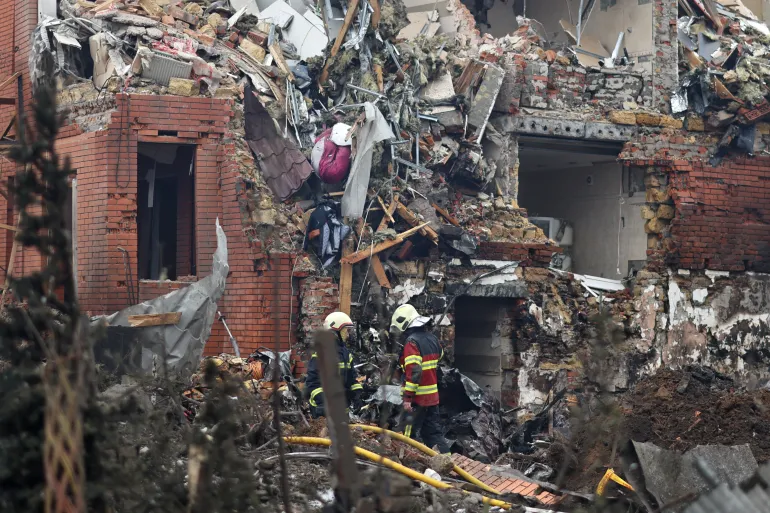
Spain and Portugal are bracing for a new storm, just days after Storm Leonardo’s deadly floods killed at least two people — one in Portugal and one in Spain — and forced more than 11,000 residents to evacuate their homes.
On Saturday, authorities in Portugal mobilised more than 26,500 rescuers as Storm Marta approached, forcing three municipalities to postpone Sunday’s presidential vote until next week due to severe weather.
Recommended Stories
list of 3 itemsend of list
Both countries issued warnings of further flooding after previous heavy rains had submerged roads, disrupted train services, and displaced thousands. Portuguese forecasts warned of heavy rain, strong winds, and rough seas, with alerts active across the country.
In Spain, much of the south, particularly Andalusia, and the northwest were placed on orange alert for heavy rain and violent storms, the national meteorological agency Aemet said.
Other regions, including Castilla‑La Leon, Galicia, Murcia, and the Valencian Community, also received warnings. While rainfall was expected to be less “exceptional” than during Storm Leonardo, authorities cautioned that saturated ground increased the risk of flooding and landslides.
New downpours in Andalusia added to earlier rain that had already caused widespread flooding, landslides, and forced more than 10,000 people from their homes.
Many roads remained closed, and rail services were largely suspended, with officials urging residents to limit travel wherever possible.
Mario Silvestre, commander at Portugal’s civil protection agency, described the forecast as “extremely worrying”.
Juan Manuel Moreno, president of the Andalusia region, wrote on X that the “rivers have hit their limit,” warning of gusts of wind reaching 110 kilometres per hour (68 miles per hour), landslides, and flash floods.
“All the furniture is completely destroyed, the water broke the window, forced the doors open and then burst through the window from the other side,” Francisco Marques, a municipal employee in the central village of Constancia, told the AFP news agency.
After flying over flood-hit areas in southern Spain near Cadiz on Friday, Prime Minister Pedro Sanchez warned that “difficult days” lay ahead for the region as a result of the “very dangerous” weather forecast. Sanchez added he was “bowled over at seeing the endless rain”.
Portuguese Prime Minister Luis Montenegro said the damage exceeded four billion euros ($4.7bn).
Portugal was already reeling from the effects of Storm Kristin, which led to five deaths, hundreds of injuries, and tens of thousands without power, when Leonardo struck earlier this week.
Portugal’s National Meteorological Institute (IPMA) has placed the entire coastline on orange alert due to heavy seas, with waves reaching up to 13 metres (43 feet) high. Eight of the 18 districts on the mainland, mainly in the centre and south, are also on orange alert.
“All river basins remain under severe pressure,” particularly the Tagus River in the Lisbon region and the Sado River further south, a spokesperson for the National Civil Protection Authority told AFP.
One person died during Storm Leonardo in Portugal, and 1,100 people were evacuated across the country. A succession of atmospheric depressions forced Portugal’s dams to release “a volume of water equivalent to the country’s annual consumption” in just three days, Jose Pimenta Machado, president of the Portuguese Environment Agency, said on Friday.
Bryan Mbeumo and Bruno Fernandes score for United while Spurs captain Christian Romero sees red for a wild challenge.
Manchester United profited from Tottenham captain Cristian Romero’s red card to stretch their perfect start under Michael Carrick to four games, with a 2-0 win at Old Trafford in the Premier League.
Goals from Bryan Mbeumo and Bruno Fernandes on Saturday ended an eight-game winless run against Spurs for the Red Devils, who cemented their position in the Premier League’s top four.
Recommended Stories
list of 4 itemsend of list
United close to within two points of third-placed Aston Villa and open up a five-point cushion over Liverpool in sixth.
A place in the top five is likely to secure a spot in next season’s Champions League due to the strong performance of English sides in European competition.
Spurs’ hopes of qualifying for the Champions League through their league position have long since disappeared, as another damaging defeat for Thomas Frank leaves Tottenham in 14th.
But there could be lasting consequences for Romero after his ill-discipline cost his side just days after a social media outburst aimed at the club’s hierarchy.
Frank said the Argentinian international had been “dealt with internally” after he described Tottenham’s threadbare squad as “disgraceful” following the closure of the transfer window.
Romero’s future as skipper had already been called into question, and the 27-year-old will now be suspended for four matches after his second red card of the season and sixth of his Spurs career.
The centre-back lunged in to catch Casemiro on the ankle on 29 minutes after playing himself into trouble just outside the Tottenham box.
Romero is sent off after a wild challenge on Casemiro [Phil Noble/Reuters]
United had been the better side during the opening half hour, even against 11 men, and made their numerical advantage count.
Mbeumo stroked into the bottom corner for his third goal in four games since Carrick took charge, after a clever corner involving Fernandes and Kobbie Mainoo freed the Cameroon international at the edge of the box.
Amad Diallo and Matheus Cunha had goals ruled out for offside as the home side dominated but had to wait until nine minutes from time to make the points safe.
Fernandes showed Romero how to lead from the front with another fine individual display.
The United captain prodded in Diogo Dalot’s cross at the back post for his 200th goal or assist in 314 games for the club.
Carrick said before the game that United cannot afford to rush their choice of a new permanent manager.
But the former midfielder, who enjoyed a stellar playing career at Old Trafford, is making his case for that job as he continues overseeing United’s stunning turnaround in fortunes since the departure of Ruben Amorim last month.
Fernandes had plenty of praise for Carrick in a post-match interview with TNT Sports.
“The energy is different because we are winning games and when you win games, everything is brighter,” Fernandes said.
“Michael came in with the right idea of giving the players more responsibility and freedom to make decisions on the pitch. I was always sure Michael could be a great manager, and he is showing that.”
Meanwhile, it is now two Premier League wins in 16 for Frank and his Spurs side.
“I think the first 30 minutes were a good away performance,” Frank told TNT Sports after the game.
“I’m very proud of the players, the resilience, staying in the game, mentality [to] still be a threat at times, to try to create something. Very proud of them.”
Spurs keeper Guglielmo Vicario told TNT Sports that Romero had apologised to his teammates for the sending off.
“Yeah, of course, he’s disappointed, because he knows that this card could have been avoidable, and so he apologised,” he said.
“He made his mistake, but we know the player he is, and he’ll be back for sure, stronger, and he’s going to help us massively.”
Under the constitution Italy cannot join the board because power would be wielded by one leader standing above other members, minister says.
Published On 7 Feb 20267 Feb 2026
Share
Italy says it’s unable to join US President Donald Trump’s “Board of Peace” owing to a “constitutional limit” marking the latest setback faced by the self-styled “international peace building body”.
Foreign Minister Antonio Tajani told the ANSA news agency on Saturday that conflicts between Italy’s constitution and the charter of the Board of Peace were “insurmountable from a legal standpoint”, but his country would always be “available to discuss peace initiatives”.
Recommended Stories
list of 4 itemsend of list
Italy joins a number of European countries – including France, Germany, and the United Kingdom – that have not joined the controversial board, which was greenlit by the United Nations last year as a transitional governing body for post-war Gaza before expanding its remit in a sweeping charter that made no mention of the war-torn Palestinian enclave.
Italy’s decision comes despite the close relationship between Italian Prime Minister Giorgia Meloni and Board of Peace chairman Trump amid growing concern that the global conflict mediator – launched in Davos, Switzerland last month as the US president made an aggressive play for Greenland – is designed to eclipse the United Nations.
Tajani pointed to Article 11 of the Italian constitution, which precludes the country from joining organisations unless there are “conditions of equality with other states”, which would not be the case under a charter that names Trump as veto-wielding chairman serving as the final authority on its interpretation.
However, speaking after a “very positive” meeting with US Secretary of State Marco Rubio and US Vice President JD Vance on the margins of the Winter Olympics in Milan on Friday, the foreign minister said Italy would be “ready to do our part in Gaza by training the police”.
Tajani’s comments came as the board, which has reportedly demanded members pay $1bn for a permanent seat, leading to criticism it would essentially be a “pay to play” version of the UN, tentatively prepares for its first meeting in Washington, DC, on February 19.
The gathering would come one day after a scheduled meeting between Trump and Israeli Prime Minister Benjamin Netanyahu.
On Saturday, Hungarian Prime Minister Viktor Orban, a key Trump ally, said he would go to Washington for the first meeting of the board “in two weeks”.
Last month, Trump invited some 60 countries to join the board. At the time of reporting, its official website listed 26 countries that have joined, including Gaza mediators Qatar and Egypt.
UN Secretary-General Antonio Guterres slammed Trump’s plans last month, saying “The basic responsibility for international peace and security lies with UN, lies with the Security Council.”
A proposed new consensus between sports leaders across the globe about gender policy would be a first uniform criteria.
Published On 7 Feb 20267 Feb 2026
Share
Global sports leaders have reached consensus on a new set of eligibility criteria for transgender athletes, with the new policy expected to be announced within the first half of this year, the International Olympic Committee (IOC) said on Saturday.
It would be the first uniform policy adopted by the IOC and international sports federations, applying to major events in dozens of sports, including the Games and world championships. Currently, federations have their own rules, which can vary.
Recommended Stories
list of 4 itemsend of list
Details of the new policy are unclear, but it is expected to severely restrict the participation of transgender athletes who compete in women’s categories if they have undergone full male puberty before any subsequent medical transition.
The IOC, under its first female president, Kirsty Coventry, took the lead in June, opting for a uniform approach.
“Protecting the female category is one of the key reforms she wants to bring in,” IOC spokesman Mark Adams told a news conference at the Milan-Cortina Winter Games on Saturday.
“I would say it is going to happen shortly, within the next few months.
“It has been out to consultation phase and we had the ‘pause and reflect’ (period) on it,” Adams said. “Generally speaking, there is consensus within the sporting movement. I think you will have a new policy in the first half of this year. Don’t hold me to it, but that is roughly the timescale.”
In September, Coventry set up the “Protection of the Female Category” working group, made up of experts as well as representatives of international federations, to look into how best to protect the female category in sport.
Before Coventry’s decision, the IOC had long baulked at any universal rule on transgender participation for the Games, instructing international federations in 2021 to come up with their own guidelines. Under current rules, still in force, transgender athletes are eligible to take part in the Olympics once cleared by their respective federations.
Only a handful of openly transgender athletes have taken part in the Games. New Zealand’s Laurel Hubbard became the first openly transgender athlete to compete in a different gender category to that assigned at birth when the weightlifter took part in the Tokyo Olympics in 2021.
Currently, for example, World Aquatics allows transgender athletes who have transitioned before the age of 12 to compete. World Rugby bans all transgender athletes from elite-level competitions.
United States President Donald Trump has banned transgender athletes from competing in school, college and pro events in the female category in the US, as Los Angeles prepares to host the 2028 Summer Olympics.
Trump, who signed the “Keeping Men Out of Women’s Sports” order in February, has said he would not allow transgender athletes to compete at the LA Games.
Who: England vs Nepal What: 2026 ICC T20 World Cup Where:Wankhede Stadium, Mumbai, India When: Sunday, February 8, at 3pm (09:30 GMT) How to follow: We’ll have all the buildup on Al Jazeera Sport from 06:30 GMT in advance of our text commentary stream.
England are undoubtedly among the frontrunners to lift the T20 World Cup title, but, unlike years gone by, they do not start as one of the red-hot favourites.
Recommended Stories
list of 4 itemsend of list
Despite his undoubted ability with the bat, questions surround the captaincy of Harry Brook, while English cricket as a whole is licking its wounds following recent woes – including the Ashes humiliation in Australia.
Al Jazeera Sport takes a look at their open against Nepal.
What have England said about the pressure on Brooks?
All-rounder Will Jacks said on Friday that under-fire England T20 captain Harry Brook had “100 percent” support from the players after going through a “tough time”.
The 26-year-old Brook, in charge at a global tournament for the first time, has recently been in the spotlight for all the wrong reasons.
He had to apologise last month for being involved in an altercation with a nightclub bouncer during England’s white ball tour of New Zealand last year, something that had been a “terrible mistake”.
Jacks has been close to Brook since they were roommates with England Under-19s.
“Obviously, it’s been a tough time, and that’s been well documented in the media,” Jacks told reporters before team training in Mumbai on the eve of the tournament.
“I wasn’t actually in New Zealand, so I didn’t know anything about it.
“He’s obviously made the wrong decision, but he’s accepted that. He’s obviously making amends on the pitch, and we all back him 100 percent.”
Brook, a richly gifted run-scorer, has an early chance to shift the focus back onto his batting in England’s opening match against Nepal in Mumbai on Sunday.
“He wants his cricket to do the talking,” said Jacks.
(Al Jazeera]
What is England and Brook’s T20 form before the World Cup?
England come into the World Cup in good form in T20, heartened by a 3-0 series win in Sri Lanka – one of the tournament co-hosts – this week.
In the preceding ODI series against the same opposition, the explosive Brook bludgeoned 136 off just 66 balls.
“It’s not so much we are taking momentum from that, but team unity, feeling strong within ourselves,” said Jacks.
“We have been performing well over the last 12 months, since Harry’s become captain, and we’re very happy with that.
“What we did in the last few weeks in Sri Lanka is another stepping stone.”
Who else is in England and Nepal’s group?
England are expected to make the Super Eight stage from a Group C that also features two-time winners West Indies, debutants Italy and Scotland.
“We come into here full of confidence and belief that we can go a long way in this tournament.
“But that doesn’t guarantee us anything. We know that there’s amazing teams in this World Cup.”
“India, on home soil, I think everyone knows who’s favourites.”
What is England’s T20 World Cup record?
England are the joint-record winners of the T20 World Cup with two trophy lifts to their name, alongside West Indies and holders India.
Paul Collingwood captained the English to the third edition of the competition, before Jos Buttler’s side sealed their second win in 2022.
[Al Jazeera]
What is Nepal’s T20 World Cup record?
Nepal made their debut at the 2014 edition of the competition, but had to wait until the West Indies and US co-hosted tournament in 2024 to make a second appearance.
On both occasions, the Nepalese were eliminated at the first stage, with 12th- and 17th-placed rankings.
Salt passed fit for England’s opener
Hard-hitting batsman Phil Salt was passed fit as England named their team on Saturday for their first match in the T20 World Cup.
He will open the batting alongside wicketkeeper Jos Buttler against Nepal at Mumbai’s Wankhede Stadium on Sunday in Group C.
Salt missed Tuesday’s third T20 against Sri Lanka with a back spasm, but trained successfully on Friday and will take his place at the top of the order.
Tom Banton, fresh from a sparkling 54 off 33 balls against Sri Lanka five days ago, is preferred to Ben Duckett and will bat at number four.
Left-arm fast bowler Luke Wood gets the nod ahead of Jamie Overton and joins express man Jofra Archer and Sam Curran in the seam attack.
England have opted to have four spinners at their disposal, with spearheads Adil Rashid and Liam Dawson backed up by all-rounders Jacob Bethell and Will Jacks.
England’s starting lineup
Phil Salt, Jos Buttler, Jacob Bethell, Tom Banton, Harry Brook (capt), Sam Curran, Will Jacks, Liam Dawson, Jofra Archer, Adil Rashid, Luke Wood
England squad
Harry Brook (captain), Rehan Ahmed, Jofra Archer, Tom Banton, Jacob Bethell, Jos Buttler (wicketkeeper), Sam Curran, Liam Dawson, Ben Duckett, Will Jacks, Jamie Overton, Adil Rashid, Phil Salt (captain), Josh Tongue, Luke Wood
Who: Liverpool vs Manchester City What: English Premier League Where: Anfield, Liverpool, UK When: Sunday at 4:30pm (16:30 GMT) How to follow: We’ll have all the build-up on Al Jazeera Sport from 13:30 GMT in advance of our live text commentary stream.
Liverpool host City for a match with huge ramifications for the title race and the battle to qualify for next season’s Champions League.
Recommended Stories
list of 4 itemsend of list
City trail leaders Arsenal by six points and could find themselves nine adrift by the time they kick off, with the Gunners hosting Sunderland on Saturday.
Liverpool could also be four points outside the top five, which should secure a place in the Champions League, should Manchester United and Chelsea win on Saturday.
The champions head into the weekend in sixth place on 39 points but in high spirits after a commanding 4-1 win over Newcastle United last weekend, while City dropped points against 14th-placed Tottenham Hotspur, surrendering a two-goal advantage in a 2-2 draw.
Hugo Ekitike and Florian Wirtz, two of Liverpool’s big-money summer signings, are beginning to deliver returns. Ekitike scored twice in the win over Newcastle to take his tally for the season to 15, while Wirtz has netted six times in 10 matches since ending a 22-game wait for his first Liverpool goal.
City’s Erling Haaland, meanwhile, is experiencing an unusual lean spell with just two goals in his last 12 games. He has never scored for City at Anfield.
Ekitike, left, and Wirtz celebrate scoring against Newcastle on Saturday [Jon Super/AP Photo]
Slot targets improved display against City
Liverpool are eager to showcase how far they have progressed after losing 3-0 to City in November, manager Arne Slot said on Thursday.
“I mainly remember the game we played at Etihad, and we were outplayed for large parts in the first half,” Slot told reporters.
“So, this is another moment to see where we are in the development of this team. We know the importance of a result.”
Liverpool have endured a difficult season so far, but have regained some measure of form in recent weeks.
“It’s the end phase of the season, so results matter more,” Slot said.
“We have not found the consistency for the results, but we have shown against all the [teams], that we can compete.”
Liverpool know there has to be ‘life after Virgil’
Slot also explained the club’s decision to recruit four central defenders during the winter transfer window – Jeremy Jacquet, Ifeanyi Ndukwe, Mor Talla Ndiaye and Noah Adekoya – describing it as planning for life after captain and star centre-back Virgil van Dijk, who will turn 35 this year.
“Hopefully, Virgil can stay fit for multiple years, but this club is not stupid,” Slot said.
“We do know, somewhere in the upcoming years, there is life after Virgil, but that is for every position. We don’t think about short term only.”
Slot singled out the Jacquet for extra praise. The France under-21s defender was also linked with Chelsea, but will move to Anfield in July after Liverpool agreed to a big-money deal to sign him from Rennes, where he will finish the season.
“Such a big talent and another example of the model we’re using at this club,” Slot said.
“Young, very talented players, sometimes at the start of their careers or sometimes already a little bit a few years into their career, but always players that are young and can improve us in the short term but also definitely in the long term.”
Van Dijk remains a rock on Liverpool’s defence but will turn 35 this year [Stu Forster/Getty Images]
Guardiola emphasises mental fortitude ahead of tough trip
Manchester City manager Pep Guardiola said mental strength separates elite players from the rest as his team prepares for the game against Liverpool.
“The biggest stages and the biggest games always need big personalities,” Guardiola told reporters on Friday.
“I have said many times, it’s not about the skills of the players in the top leagues. In the top clubs, the skills are there. I never know one player that is not good enough to play in the top clubs, it is how you behave.
“How you play in the latter stages of the biggest competitions is what defines you as a player. The mind of the players you have defines the big teams.”
Guardiola said that despite their travails this season, playing Liverpool at Anfield is still one of the toughest away fixtures in football.
“They remain an exceptional team,” he said. “Top-class manager and an exceptional team, no doubt.”
Haaland leads the top scorer charts with 20 goals, but the striker has not found the net in his last three league games [Oli Scarff/AFP]
City boss lauds Haaland as ‘world’s best striker’ but won’t confirm Liverpool start
Guardiola insisted Haaland is the “best striker in the world” despite refusing to confirm if the misfiring City star will start Sunday’s crucial clash.
“I don’t know until tomorrow. But all I say is Erling is the best. Erling is the best striker in the world,” Guardiola told reporters.
The 55-year-old also doubled down on his comments about the “hurt” he feels for victims of conflicts in Palestine, Ukraine and Sudan after Jewish community leaders told him to “focus on football”.
“To be honest, I didn’t say anything special. I think, why should I not express how I feel just because I am a manager? So I do not agree, but I respect absolutely all opinions,” he said.
“What I said basically is how many conflicts there are right now around the globe or around the world. How many? A lot, right? I condemn all of them. All of them.”
Head-to-head
The two clubs have faced each other on 219 occasions, with Liverpool winning 110 of those games, City winning 61, and 58 ending as draws.
While City comfortably won their home league game against Liverpool this season, their only victory away to Liverpool since 2003 came in an empty stadium during COVID restrictions in 2021.
Liverpool’s team news
Slot confirmed that defender Jeremie Frimpong will miss the game, but Joe Gomez could return to the squad to bolster the defensive line.
Dominik Szoboszlai is expected to continue deputising for Frimpong at right-back.
Alexander Isak, Conor Bradley and Giovanni Leoni all remain on the sidelines with long-term injuries.
Predicted lineup:
Alisson (GK); Szoboszlai, Konate, Van Dijk, Kerkez; Gravenberch, Mac Allister; Salah, Wirtz, Gakpo; Ekitike
City’s team news
City could be without Bernardo Silva, who has a back issue, so Nico O’Reilly could move into midfield to replace him.
Ruben Dias has returned from injury but likely lacks full match fitness and sharpness, so Abdukodir Khusanov will likely start in the centre of defence alongside new signing Marc Guehi.
The Algarve, Portugal – After fierce storms that brought days of torrential rain, the sun is finally out in Portugal’s Algarve.
In the coastal town of Portimao, cafe terraces are busy with people enjoying a respite from the bad weather. In nearby Albufeira, tourists, mostly from northern Europe in search of winter warmth, stroll on the sandy beach. The ocean is gleaming; the cliffs are topped with lush vegetation.
Recommended Stories
list of 3 itemsend of list
But behind the idyllic scenery is an increasingly disaffected population that may be on the cusp of embracing Portugal’s first right-wing nationalist president since the country’s dictatorship ended half a century ago.
The Algarve has long been a popular destination for holidaymakers, and tourism fuels much of the region’s economy. But it also pushes up housing prices and the cost of living, and attracts a high number of foreign workers. Some residents say they are fed up with the situation. Others will tell you wistfully that the Algarve is not what it once was.
Outside a supermarket in Albufeira, a man tells Al Jazeera he knows people who can barely pay their rent because salaries are so low. Another says that the Algarve and Portugal need change and new leadership.
The sense for many people here is that politicians in Lisbon are disconnected from the struggles of people outside of the capital. It is partly why the Algarve has become a stronghold for Andre Ventura’s far-right Chega party. Its anti-establishment and anti-immigration message resonates with voters here who feel unheard and unseen by mainstream parties.
A former TV football commentator, Ventura founded Chega, which means “Enough”, seven years ago. Since then, Chega’s made large gains in a region that has become a springboard for its leader’s ambitions, including the presidency.
Ventura is in the second round of the presidential run-off vote on February 8. He is the first populist candidate in Portuguese history to make it that far. Ventura may well believe that momentum is on his side.
In the 2024 parliamentary elections, Chega grew to become the main opposition to the centre-right government of Luis Montenegro. Its rapid rise has shaken a political landscape long dominated by socialists and liberals. It has also rattled opponents and critics who believed Portugal was immune to the far-right surge seen elsewhere in Europe.
In Portimao and Albufeira, Ventura’s campaign billboards tower over roads and roundabouts. He is also a regular on TV shows and prolific on social media, much like Donald Trump, whom Ventura admires. Like the United States president, Ventura rails against immigration and immigrants. He has even been sanctioned by Portuguese courts for discriminatory comments.
Not everyone in the Algarve would welcome a Ventura presidency. At the Timing temporary employment agency in Albufeira, people come looking for work, mainly in the region’s many hotels and restaurants. Most are from outside Portugal.
Al Jazeera spoke with Tariq Ahmed and Saidul Islam Said from Bangladesh, and Gurjeet Singh from India. They work during the holiday season to save money. All say they like Portugal.
When asked whether they worry about Chega’s rhetoric, Saidul says he is aware of it but isn’t concerned for now. He says that every country has its problems and that he stays focused on work, not politics.
The agency has thousands of workers on its books, and about 70 percent come from abroad, says manager Ricardo Mariano. They work hard and are welcome, he says. He insists the Algarve could not function without immigrant labour and says neither could the rest of Portugal.
The country faces worker shortages in several industries. Portugal has a long tradition of emigration, and a lack of affordable housing, jobs and low wages mean young Portuguese people continue to seek opportunities abroad.
Successive socialist and liberal governments are viewed by some as having failed to reverse the trend. Nevertheless, it is a veteran socialist politician who faces Ventura in the presidential race. Antonio Jose Seguro has served as an MP, a junior minister and a member of the European Parliament.
He had retired from politics to teach but returned with a mission, saying he wanted to unite an increasingly divided country and defend Portugal’s institutions. Seguro says voters will have to choose between democracy and radicalism.
Opinion polls suggest Seguro could win, and several politicians from across the political spectrum are urging their supporters to rally behind him and block a Ventura victory. The presidential role is largely ceremonial, but it has the power to dissolve parliament or veto laws.
Back in Portimao, Chega MP Joao Graca is out campaigning for Ventura. He’s come to a food market wearing a suit jacket over a T-shirt printed with Ventura’s portrait.
He weaves through the stalls, chatting to sellers and shoppers. More than a dozen supporters chant behind him, enthusiastically handing out Chega pens and bags. The reception for them is noteworthy in that it is universally warm.
For some Portuguese voters, a Ventura win would be a disaster, widening divisions in society and destroying Portugal’s image as one of Europe’s most tolerant nations, but for Graca, it would be the best thing that could happen to the country. Portugal, he tells Al Jazeera, needs Ventura.
TikTok calls European Commission probe ‘meritless’, pledges to challenge findings the video platform harms minors.
Published On 7 Feb 20267 Feb 2026
Share
Authorities in the European Union said that the video-sharing platform TikTok is in breach of online content regulations, warning the company to change “addictive” features in order to protect minors from compulsive use.
The European Commission shared the preliminary conclusions of a probe into TikTok on Friday, stating that features such as infinite scroll, autoplay, push notifications, and a personalised recommendation algorithm encouraged addiction.
Recommended Stories
list of 3 itemsend of list
“TikTok has to take actions and they have to change the design of their service in Europe to protect our minors,” EU tech chief Henna Virkkunen told reporters.
European Commission spokesperson Thomas Regnier said the “measures that TikTok has in place are simply not enough”.
“These features lead to the compulsive use of the app, especially for our kids, and this poses major risks to their mental health and wellbeing,” Regnier said, stating that the app is in violation of the Digital Services Act.
The EU regulator has threatened TikTok with a potential fine of as much as 6 percent of the global turnover of ByteDance, the platform’s owner.
TikTok slammed the findings, saying they are without basis.
“The Commission’s preliminary findings present a categorically false and entirely meritless depiction of our platform, and we will take whatever steps are necessary to challenge these findings,” a spokesperson for TikTok said.
The probe comes as EU countries are seeking greater restrictions on powerful tech and social media companies, often with the stated goal of protecting young users.
TikTok stands out among competitors for an algorithm able to craft a precise understanding of the users’ interests, directing related content into their feed.
The investigation into TikTok was first opened in February 2024, with Regnier citing a series of “alarming” statistics compiled during the course of the investigation.
He stated that the app is the most-used social media platform after midnight by children between the ages of 13 and 18, and that 7 percent of children between the ages of 12 and 15 spend four to five hours on the app every day.
Right before the opening ceremony of the Winter Olympic Games, relay participants passed the torch for the final few times in central Milan. The flame began its journey across Italy in December, starting in Rome and travelling through all 110 Italian provinces.
Ukraine braced for more attacks on its energy infrastructure this week as winter temperatures continued to fall to -20 degrees Celsius (-4 degrees Fahrenheit), and sought to adapt its defences against Russian drones.
On Thursday, Ukraine’s energy minister, Denys Shmyal, warned Ukrainians to prepare for more power blackouts in the coming days as Russian air attacks continued.
Prime Minister Yulia Svyrydenko said Russia had struck energy infrastructure 217 times this year. Shmyal said 200 emergency crews were working to restore power to 1,100 buildings in Kyiv alone.
Russia has been targeting Ukrainian power stations, gas pipelines and power cables since mid-January, leaving hundreds of thousands of people without heat or electricity at various points.
On January 29, US President Donald Trump told a cabinet meeting that Russian President Vladimir Putin had agreed to halt strikes on Ukraine’s energy infrastructure for a week, something the Kremlin confirmed.
“I personally asked President Putin not to fire into Kyiv and various towns for a week, and he agreed to do that,” Trump said.
It was unclear when that conversation happened, exactly, but on Tuesday this week, Russia unleashed one of its biggest strikes ever on energy infrastructure in Kyiv and Kharkiv, deploying 71 missiles and 450 drones.
Ukraine’s Air Force spokesperson Yurii Ihnat said Ukraine had only managed to shoot down 38 of the missiles because a very high proportion of them were ballistic.
Russia’s defence ministry claimed it was targeting storage sites for unmanned aerial vehicles, defence enterprises and their energy supply.
The strike coincided with a visit to Kyiv by NATO Secretary-General Mark Rutte, and came a day before tripartite talks among Russia, Ukraine and the US resumed in Abu Dhabi.
“Last night, in our view, the Russians broke their promise,” Ukrainian President Volodymyr Zelenskyy said in his news conference with Rutte. “So, either Russia now thinks that a week is less than four days instead of seven, or they are genuinely betting only on war.”
The strike also came just as Kyiv had managed to reduce the number of apartment buildings without heat from 3,500 three days earlier, to about 500.
At least two people, both aged 18, were killed as they walked on a street in Zaporizhzhia, southeast Ukraine.
Even on relatively quiet days, Russia causes civilian deaths. On Sunday, February 1, Russia killed a dozen miners when a drone struck the bus that was taking them to work in Ukraine’s central Dnipro region.
[Al Jazeera]
Evolving drone tactics
During the few days in which it did observe the moratorium on energy-related strikes, Russia focused on striking Ukrainian logistics instead and made attempts to extend the reach of its drones.
Ukrainian Defence Ministry Adviser on Technology and Drone Warfare Serhiy “Flash” Beskrestnov reported that Russian drones were striking Ukrainian trucks 50km (31 miles) from the front line. He also said Russia had adapted its Geran drone to act “as a carrier” for smaller, first-person view (FPV) drones, doubling up two relatively cheap systems for greater range.
Ukrainian broadcaster Suspilne said Russia had begun these new tactics in mid-January.
Ukraine’s Air Force has managed to down about 90 percent of Russia’s long-range drones, and a high proportion of its missiles – almost 22,000 targets in January alone.
Zelenskyy recently demanded better results, however, and one of the Ukrainian responses to Russian tactics has been a new, short-range “small air defence” force that uses drones to counter drones.
“Hundreds of UAV [unmanned aerial vehicle] crews have already been transferred to the operational control of the Air Force grouping – they are performing tasks in the first and second echelons of interception,” wrote Ukrainian commander-in-chief Oleksandr Syrskii on Wednesday this week.
Ukraine’s second response has been to disable Russian Starlink terminals, which Russia uses extensively on the battlefield, and has recently begun mounting on UAVs.
Starlink uses low-orbit satellites and is impervious to jamming, allowing Russia to change a drone’s intended target while it is in mid-flight.
Ukraine’s newly installed defence minister, Mykhailo Fedorov, has been creating a “white list” of Starlink terminals used by the armed forces of Ukraine, and sent them to Starlink owner Elon Musk, asking him to keep these operational while shutting down all others in the Ukraine theatre.
“Soon, only verified and registered terminals will operate in Ukraine. Everything else will be disconnected,” Fedorov wrote on Telegram.
“Looks like the steps we took to stop the unauthorized use of Starlink by Russia have worked. Let us know if more needs to be done,” Musk wrote on Twitter on Sunday.
Fedorov and Beskrestnov have been asking Ukrainian soldiers and civilians to register any Starlink terminals they acquire privately on the white list.
[Al Jazeera]
More sanctions on the way
On the day of Russia’s large strike, Zelenskyy appealed to the US to pass a bill long in the making that would impose more sanctions on buyers of Russian oil. China is the biggest, followed by India.
The previous day, Trump said Indian Prime Minister Narendra Modi had agreed to stop buying Russian oil. “He agreed to stop buying Russian Oil, and to buy much more from the United States and, potentially, Venezuela. This will help END THE WAR in Ukraine,” he wrote on his social media platform.
A Russian government source told Reuters that an assumed 30 percent drop in oil sales to India, and lower sales to other customers, could triple Moscow’s planned budget deficit this year from 1.6 percent of GDP to 3.5 percent or 4.4 percent. Government data released on Wednesday showed the Kremlin’s revenues from energy at $5.13bn in January, half the level of January 2025.
Zelenskyy also discussed a 20th sanctions package under preparation with European Commission President Ursula von der Leyen. “We can already see what is happening to the Russian economy and what could follow if the pressure is applied effectively,” he said.
Russia has made little headway in its ground war in the past three years, a fact repeatedly documented, most recently by a CSIS report. Despite this, its top officials continued to insist last week on terms of peace that would force Ukraine to give up control of four of its southeastern regions, cut down its armed forces and agree not to join NATO – terms Ukraine refuses.
The resumed talks in Abu Dhabi on Wednesday and Thursday yielded only a prisoner-of-war exchange of 157 a side.
Crypto markets came under pressure this week when the price of the world’s most popular cryptocurrency, Bitcoin, tumbled to its lowest level in more than a year.
On Thursday afternoon, the price of Bitcoin fell below $66,000 and was hovering at about $62,900 on Friday morning.
Recommended Stories
list of 3 itemsend of list
The fall in the price of the digital asset kicked off in the last weekend of January, when it fell below $80,000.
In October last year, Bitcoin hit an all-time peak of more than $127,000 before falling back to about $90,000 in December.
Following its latest tumble, Bitcoin is currently down by about 30 percent more since the start of the year.
Here’s what we know about what’s going on in the world of cryptocurrency:
Why is the price of Bitcoin falling?
Volatility in other markets is one of the main drivers.
“Institutional demand has reversed materially,” CryptoQuant, an organisation which provides analysis of global markets to cryptocurrency investors, wrote in a report on Wednesday.
The report noted that US exchange-traded funds (ETFs) – a form of pooled investment – which had been buying up Bitcoin last year, are selling it this year.
Deutsche Bank analysts wrote in a note to clients this week that these ETFs “have seen billions of dollars flow out each month since the October 2025 downturn”, referring to investors in the funds cashing out of them.
Furthermore, they added that specialised US spot Bitcoin ETFs suffered outflows of more than $3bn in January this year, following outflows of about $7bn and $2bn in November and December 2025, respectively.
“This steady selling in our view signals that traditional investors are losing interest, and overall pessimism about crypto is growing,” the analysts said.
Adam Morgan McCarthy, product specialist at Kaiko, an organisation that provides crypto market data and analyses, told Al Jazeera: “The fall in Bitcoin prices has been largely tied to less interest in the markets and lower trading volumes. This leads to less liquidity, so any move higher or lower is exacerbated.”
He explained that the crypto market relies heavily on “hype-driven” cycles where people buy due to a fear of “missing out” on an opportunity.
“This hype forms the foundation of trading volumes, and that is what we mean by liquidity. Essentially, more trading volumes mean more liquidity, as it makes it easier to quickly buy and sell Bitcoin,” he said.
“Right now, that foundation is disappearing and this tends to happen during bear markets or ‘crypto winters’, making it much harder to effectively trade assets, and they become even less appealing then. So it’s quite a vicious circle that leads to these downward spirals,” he added.
A “crypto winter” is an extended period of declining or stagnant prices, something that can be driven by worsening macroeconomic conditions or tightening market regulations, among other reasons.
Volatility in gold and silver prices in the past two weeks has also dampened market sentiment, affecting the price of cryptocurrencies. Analysts say geopolitical instability and the prospects of a rising US dollar have led investors to sell precious metals, resulting in the sudden downturn.
Then, last week, prices came back sharply, with the price of gold hitting a record peak of almost $5,595 an ounce, while silver hit an all-time high of nearly $122.
But this peak did not last long, and this week, the prices of these precious commodities plunged – again – with gold falling to $4,872.83 per ounce on Thursday and silver falling to $77.36 an ounce.
Other cryptocurrencies like Ether, the second-largest cryptocurrency, have also fallen. The price of Ether has fallen by 19 percent this week, closing at $1,854 late on Thursday.
Does this mean ‘crypto-friendly’ policies in the US aren’t working?
The price of Bitcoin soared after United States President Donald Trump’s return to the White House last year, with analysts expecting he would adopt a “crypto-friendly” regulatory regime.
At a Bitcoin conference in July 2024, as part of his pre-election rally, Trump had said the US is the “crypto capital of the planet” and pledged to also create a Bitcoin “strategic reserve” if he became president.
In March 2025, on taking office, Trump announced his government would create a national strategic crypto reserve which would include five cryptocurrencies – Bitcoin and Ether as well as smaller currencies XRP, Cardano and Solana.
In July last year, Trump also announced the GENIUS Act, a new cryptocurrency legislation that would establish regulations and consumer protections for “stablecoin”, a type of cryptocurrency whose value is linked to a fixed currency or commodity.
Then, last month, the US also unveiled draft legislation that would create a regulatory framework for cryptocurrency, which, if signed into law, would clarify financial regulators’ jurisdiction over the cryptocurrency sector.
The US president has a personal interest as his family owns the cryptofirm World Liberty Financial (WLFI).
Last March, WLFI launched its own “stablecoin” – a dollar-pegged cryptocoin backed by US treasuries – called USD1.
But the president’s personal interest in cryptocurrencies and supportive policies have not shielded the digital asset from external market factors.
Have we seen ‘crypto winters’ before?
Yes.
A crypto winter was triggered after Bitcoin peaked in December 2017 and then tumbled in December 2018 due to intense regulatory crackdowns in the US, Canada and other countries, among other reasons.
Another such winter occurred in November 2022 after a peak in October 2021, due to the FTX currency exchange scandal. In November that year, crypto exchange FTX initiated US bankruptcy proceedings after a liquidity crisis prompted intervention from regulators around the world.
In a Thursday briefing note, analysts at Kaiko said the downward trend in prices “truly accelerated” after Trump appointed Kevin Warsh as the new Federal Reserve Chair.
Warsh will replace Jeremy Powell, who Trump has lambasted for not lowering interest rates.
The Kaiko briefing note stated: “Powell’s recent announcement on January 28th that interest rates would remain unchanged, combined with the appointment of the new Chairman, constituted a true turning point, acting as a catalyst for a sharp acceleration of the decline. The reaction was all the more pronounced given that the crypto market, particularly sensitive to changes in the macroeconomic regime, was already weakened,” the report said.
What will happen next?
Hougan noted that crypto winters typically last for about 13 months and assured investors that the current “winter” will not last for long.
“As a veteran of multiple crypto winters, I can tell you that the end of those crypto winters feels a lot like now: Despair, desperation, and malaise. But there is nothing about the current market pullback that’s changed anything fundamental about crypto,” he said in his report.
“I think we’re going to come roaring back sooner rather than later. Heck, it’s been winter since January 2025. Spring is surely coming soon,” he added.
We visited the Female Artists of the Mougins Museum, in Mougins, a small village on a hill near Cannes. Full of exclusively female artists – from Berthe Morisot in the 19th century and Frida Kahlo in the early 20th to contemporary figures such as Tracey Emin – it houses an incredible collection of often overlooked art and artists. We visited on a rainy October day and it was remarkably quiet and calm. I particularly enjoyed the abstract works – well worth a trip up the hill. James
Secret church in Amsterdam’s red light district
Ons’ Lieve Heer op Solder church, Amsterdam. Photograph: Frans Lemmens/Alamy
Ons’ Lieve Heer op Solder is a bit of a mouthful, but it is the best museum I have ever visited. Our Lord in the Attic is a hidden gem in the centre of Amsterdam and well worth a visit. “Our Lord” is a clandestine church originating after the Reformation when Catholics were no longer allowed to hold public holy masses. It enabled Catholics to worship, but only in private; thus creating an incredibly intimate and secretive experience. The canal house feels like a Tardis as you move from what seems like a labyrinth of rooms, all leading to what appears to be a doll’s house church. A sliver of heaven in the middle of the red light district! Ryan
Berlin’s pioneering socialist artist
Käthe Kollwitz museum. Photograph: Imago/Alamy
I came across the Käthe-Kollwitz Museum only because I was staying nearby, just off Berlin’s glamorous Ku’damm avenue. This small, intimate building houses probably the best collection of Kollwitz’s prints, drawings, posters, sculptures and woodcuts, inspired by and illustrating her lifelong socialist beliefs with real power and poignancy. Her life and work were profoundly shaped by inseparable personal and political tragedies. Leslie
Profile
Readers’ tips: send a tip for a chance to win a £200 voucher for a Coolstays break
Show
Guardian Travel readers’ tips
Every week we ask our readers for recommendations from their travels. A selection of tips will be featured online and may appear in print. To enter the latest competition visit the readers’ tips homepage
–
Turin’s mountain museum
Ski rack with several kinds of skis from 1896 to 2004 at Museo Nazionale della Montagna. Photograph: Mauro Toccaceli/Alamy
We visited the Museo Nazionale della Montagna (National Museum of Mountains) in Turin last summer. Having spent the previous four weeks hiking in the Italian Alps, it was the perfect end to our trip. The staff are knowledgable and there are some excellent exhibits exploring the history of our relationship with mountains along with displays of mountaineering gear and derring-do over the past 150 years. There’s also a rooftop terrace with a great view of the city and mountains beyond. A fantastic way to spend a few hours and a must for any lover of mountains. Samantha McGrady
Captivating artefacts from the far east, Porto
Sculptures in the Museo Nacional Soares dos Rei. Photograph: Hemis/Alamy
Set in a late 18th-century palace belonging to the Porto bourgeoisie, the Museo Nacional Soares dos Reis, founded in 1833, is considered to be Portugal’s oldest art museum. It features an absorbing collection of Portuguese painting dating from the 16th to 20th centuries, but particularly captivating are the rooms displaying Japanese and Chinese artefacts, which arrived in Portugal off trading ships from the far east. Don’t miss the tranquil garden at the back of the museum. Peter
Homage to Copernicus in Kraków
The Collegium Maius at the Jagiellonian dates back to the 14th century. Photograph: John Warburton-Lee/Alamy
The Jagiellonian University Museum has a wonderful collection for those interested in history and science. The university was founded in 1364 and a young Copernicus (who worked out that the sun was at the centre of the known universe rather than the Earth) studied there in the 1490s. Many objects related to its most famous student and his heliocentric theory are showcased, alongside quirky objects related to the history of the university, and the history of Poland. The guides are very knowledgable, the visit is affordable, and it’s conveniently located in Kraków’s beautiful historical city centre. Aline T Marinho
Quiet contemplation and wonder in Barcelona
Caixa Forum, Barcelona. Photograph: Kaprik/Alamy
In a stunningly restored mattress factory (La Casaramona) designed by Catalan modernist architect Josep Puig i Cadafach, you can find the CaixaForum, just up the road from the Plaça d’Espanya in Barcelona. There are some buildings that eclipse the art that’s inside it, but the Caixa specialises in having a revolving display of exhibitions from photography to sculpture to immersive art, in an atmosphere of quiet contemplation and wonder. It is near the Miró Foundation and so many visitors pass it by without realising how great it is. Within its curvy walls there is a cafe for a welcome cold drink. Liz Owen Hernandez
An airship and Trump toddlers in Prague
A steel and wood airship ‘floats’ over the DOX Centre for Contemporary Art. Photograph: Arazu/Alamy
I would really recommend DOX Centre for Contemporary Art in Prague. It’s a little way out of the touristy city centre but is an excellent art gallery within a stunning feat of architecture – a steel and wood airship (built in 2016) seemingly floats out of a postwar factory building. In 2018 I saw a brilliant exhibit, which was a white room filled with giant toddlers with Trump faces. Katherine L
Paris’s ‘most enchanting’ museum
A beautiful spiral staircase links floors at the ornate Musée National Gustave Moreau. Photograph: Jon Lovette/Alamy
For me, the most enchanting museum in Paris is the Musée National Gustave Moreau, located in the former home of the 19th-century symbolist artist. Stendhal syndrome is surely a real risk in this glorious space, as one staggers among the dizzying, gigantic paintings painted in elaborate, decorative detail. Classical mythology and intimate biblical scenes are presented in vast gilt frames alongside looser drawings and watercolours housed in cabinets with pivoting shutters for ease of browsing. A spiral staircase between studio floors adds to the magic and the fascinating private apartments offer insight into a brilliant mind. Truly inspiring. Petra Painter
Winning tip: Bronze gods in Piraeus
Bronze statue of Artemis in the Archaeological Museum, Piraeus. Photograph: World History Archive/Alamy
The Archaeological Museum of Piraeus contains a wonderful collection of artefacts spanning 2,000 years of Greek history and is generally less hectic than bigger museums in Athens. In pride of place are the Piraeus bronzes, a truly staggering collection of statues (including the Piraeus Apollo and bronze statues of Athena and Artemis) that left such an impression on me that I now have tattoos of two of them. It’s only 20 minutes from the centre of Athens by train, and is a wonderful place to explore while you wait for your ferry connection to the islands. Ben Holmes
British Prime Minister Keir Starmer has agreed to reveal the vetting process used by the ruling Labour Party to approve Peter Mandelson’s appointment as the United Kingdom’s ambassador to the United States in December 2024 after new revelations from the Jeffrey Epstein files about the relationship between the diplomat and the billionaire sex offender.
For one, the latest release of files relating to the investigation of Epstein by the US Department of Justice showed that Mandelson maintained his relationship with Epstein after Epstein served a sentence for soliciting prostitution from a minor in 2008. But chief among the claims against Mandelson now are the suggestions he received payments from the late financier and may have shared market-sensitive information with him that was of financial interest to Epstein.
Epstein died in prison by suicide in 2019 before his trial stemming from his second prosecution for sex offences, including allegations of trafficking dozens of girls, could take place.
On Thursday, Starmer apologised to victims of Epstein for appointing Mandelson as ambassador to the US despite knowing of his ties to the disgraced financier.
“It had been publicly known for some time that Mandelson knew Epstein, but none of us knew the depth and the darkness of that relationship,” Starmer said.
“I am sorry. Sorry for what was done to you, sorry that so many people with power failed you, sorry for having believed Mandelson’s lies and appointing him.”
Who is Peter Mandelson and what is he accused of?
Since the release on Friday of the latest tranche of Epstein files, including emails between Epstein and Mandelson, UK media have widely reported that the government suspects Mandelson may have illegally shared market-sensitive information with Epstein 15 years ago.
The newly released files include more than 3 million pages of documents and more than 2,000 videos and 180,000 images.
As a life peer, Mandelson, 72, was a member of the House of Lords before he resigned this week. He was a veteran Labour politician who served in the cabinets of Prime Ministers Tony Blair and Gordon Brown from 1997 to 2010. After Labour swept back into power after 14 years in the opposition in 2024, he was appointed ambassador to the US, taking up his post on February 10 last year.
“I have been further linked this weekend to the understandable furore surrounding Jeffrey Epstein and I feel regretful and sorry about this,” Mandelson said in a letter reported by British media.
“While doing this I do not wish to cause further embarrassment to the Labour Party and I am therefore stepping down from membership of the party.”
Alleged leaks of sensitive information by Mandelson took place in 2009 when he was serving as the UK’s business secretary in the wake of the 2008 financial crisis.
This is not the first time that Mandelson has been embarrassed by his friendship with Epstein. On September 11, the UK fired Mandelson as ambassador to the US over emails between the two men, the British Foreign, Commonwealth and Development Office (FCDO) said.
On Tuesday, UK police launched a criminal investigation into Mandelson over suspected misconduct in public office linked to his relationship with Epstein.
Misconduct in public office is punishable in the UK with a maximum sentence of life imprisonment.
Besides his sacking as ambassador, Mandelson has previously been forced to resign from ministerial posts for alleged misconduct on two occasions – in 1998 and 2001.
Who was Jeffrey Epstein?
Epstein was a billionaire financier born and raised in New York who was known for socialising with celebrities and politicians.
Criminal investigations indicated he may have abused hundreds of girls over the course of his high-profile career. He was arrested in 2019 on federal criminal charges relating to alleged exploitation of underage girls dating back two decades. He died in prison before he could come to trial.
He also was previously accused of sexually assaulting a 14-year-old girl in 2005 after her parents made a report to the police. In 2008, Epstein pleaded guilty to charges of soliciting prostitution and soliciting prostitution from a minor in relation to a single victim.
He spent 13 months in prison on a work-release programme, which allowed him to leave jail to go to work during the day and return at night.
The US attorney in Manhattan also prosecuted Epstein’s former girlfriend Ghislaine Maxwell as a coconspirator in his sexual abuse scheme. Maxwell was convicted in 2021 and is currently serving a 20-year prison sentence, which she received in 2022.
What do we know about Mandelson’s relationship with Epstein?
When Mandelson was fired as ambassador to the US in September, the FCDO wrote: “In light of the additional information in emails written by Peter Mandelson, the prime minister has asked the foreign secretary to withdraw him as ambassador.
“The emails show that the depth and extent of Peter Mandelson’s relationship with Jeffrey Epstein is materially different from that known at the time of his appointment.”
These particular emails were obtained and published by the UK’s Sun newspaper in September. In them, Mandelson told Epstein to “fight for early release” shortly before he was sentenced in 2008.
“I think the world of you,” Mandelson told Epstein before his sentence began.
“I can still barely understand it. It just could not happen in Britain,” Mandelson wrote. “You have to be incredibly resilient, fight for early release and be philosophical about it as much as you can.”
It is now clear from the latest tranche of Epstein files that Mandelson continued his friendship with Epstein for some time after the financier had been convicted of sex offences.
What do the new Epstein files reveal?
From 2003 to 2004, bank records indicated that Epstein made three payments totalling $75,000 to accounts connected to Mandelson or his partner Reinaldo Avila da Silva. Mandelson has said he does not recall receiving any such funds and has pledged to examine whether the documents are genuine.
According to these documents, in 2009, Epstein sent da Silva 10,000 pounds ($13,607, or $20,419 today after inflation) to pay for an osteopathy course. This week, Mandelson told The Times of London: “In retrospect, it was clearly a lapse in our collective judgement for Reinaldo to accept this offer.”
Emails revealed in the latest tranche of files from the US Justice Department also shine a light on the close friendship between the two men.
In October 2009, Epstein wrote in an email to Mandelson: “You can marry princess beatrice, the queen would have a queen as a grandson,” referring to the daughter of Andrew Mountbatten-Windsor, the former prince whose royal titles were stripped last year over his own links to Epstein and allegations of the sexual abuse of Virginia Giuffre, who successfully sued Mountbatten-Windsor.
“does that make it incest, how exciting,” Epstein wrote.
In 2010, Lesley Groff, known to have been Epstein’s long-term executive assistant, emailed his boss: “Mandelson’s holiday plans arc still being sorted out. They hope to be in touch soon.”
In 2013, Epstein emailed Mandelson, saying he knew Mandelson was visiting St Petersburg, Russia. Mandelson described the city as “a rave”, to which Epstein asked whether “its for gays”. Mandelson responded, “Er no, tastey [sic] models and dancing.”
But the emails also suggested Mandelson passed sensitive information to the financier.
On May 9, 2010, Mandelson emailed Epstein, saying: “Sources tell me 500 b euro bailout, almost compelte [sic].” The next morning, European governments approved a 500-billion-euro bailout for banks in the wake of the global financial crisis.
Also in May 2010, Mandelson emailed Epstein, saying, “Finally got him to go today.” It is believed that Mandelson was referring to former Labour Prime Minister Brown.
Epstein replied to this email: “I have faith, the value of some chapters in your book should now increase.”
Brown announced his resignation just hours after this email exchange.
What has Starmer said?
Under mounting pressure from opposition politicians and within his own party this week, Starmer agreed to release information about the process through which Mandelson was appointed ambassador in 2024.
At a question and answer session on Wednesday in the House of Commons dominated by the Epstein revelations, Starmer admitted that he knew of Mandelson’s friendship with Epstein but said Mandelson had “lied repeatedly to my team when asked about his relationship with Epstein before and during his tenure as ambassador”.
“Mandelson betrayed our country, our parliament and my party,” Starmer said. “I regret appointing him. If I knew then what I know now, he would never have been anywhere near government.”
Starmer said he would ensure that “all of the material” is published, except for documents that compromise Britain’s national security, international relations or the police investigation into Mandelson’s activities.
On Tuesday, Starmer told his cabinet he was “appalled by the information” regarding Mandelson and was concerned more details could come to light, according to a Downing Street readout of the cabinet meeting.
Starmer also said he had ordered the civil service to conduct an “urgent” review of all of Mandelson’s contacts with Epstein while he was in government.
“The alleged passing on of emails of highly sensitive government business was disgraceful,” Starmer said, adding that he was not yet “reassured that the totality of information had yet emerged”.
How will this affect Starmer?
Members of parliament expressed their dismay and called on him to step down.
Conservative MP Luke Evans said: “At the end of the day, he [Starmer] made the decision to appoint Mandelson to the post of ambassador, so he must explain his decision-making process.”
Alex Burghart, the shadow chancellor of the Duchy of Lancaster, said: “There is no doubt that the prime minister’s judgement is being called sharply into question at this moment. It is becoming harder to see how any of us can rely on his judgement in future.”
Conservative MP Graham Stuart added: “The fact is that he appointed a person who had already broken all the Nolan Principles before his appointment as well as doing so after it. I think that makes the prime minister’s position untenable.”
The Nolan Principles are a set of ethical standards for all public office holders in the UK.
“I would say that today is the crumbling of Starmer. His judgement is poor, and it is ruining this country and the Labour Party,” Conservative MP Esther McVey said.
What do we know about how Mandelson was approved as US ambassador?
Facing questions from Conservative leader Kemi Badenoch in the House of Commons in September, Starmer maintained that “full due process was gone through” for the purposes of Mandelson’s appointment.
Mandelson’s ties to Epstein, who is said to have nicknamed him “Petie”, had been publicly known for years.
But The Times of London reported that Starmer received just a two-page vetting note from the Cabinet Office’s propriety and ethics team about Mandelson’s appointment.
That document suggested that while Epstein was in prison in 2009, Mandelson stayed at Epstein’s townhouse in Manhattan. The report also contained a photograph of Mandelson and Epstein together.
This indicated that by late 2024, the UK government had documentation showing Mandelson had remained close to Epstein even after his 2008 conviction.
Leonardo is the latest in a series of half a dozen storms to batter the Iberian Peninsula this year.
Published On 5 Feb 20265 Feb 2026
Share
A man has lost his life in Portugal after floodwaters engulfed his car, and in Spain, a girl has been reported missing after being swept away by a river as Storm Leonardo has battered the Iberian Peninsula with torrential rain and gale-force winds.
Leonardo is the latest in a wave of half a dozen storms to sweep across Portugal and Spain this year, causing several fatalities, destroying infrastructure and leaving thousands of homes without power.
Recommended Stories
list of 3 itemsend of list
Portuguese authorities confirmed on Wednesday that a 70-year-old man died in the southern region of Alentejo after floodwaters swept his vehicle off a road near a dam.
In southern Spain’s Malaga province, a girl remains missing after she was dragged away by the Turvilla River in Sayalonga while trying to rescue her dog. The animal reportedly managed to reach safety, and emergency teams resumed the search for the girl at first light on Thursday, according to local and national news reports.
“We spent the whole afternoon and night yesterday searching in the river from the place where the girl fell in until the very end of the river. We found the dog, but not her,” Malaga fire chief Manuel Marmolejo said on Spanish television on Thursday.
Spain’s State Meteorological Agency has warned that Storm Marta, the next front in the ongoing “storm train”, is expected to reach the region this weekend.
Portuguese Economy Minister Manuel Castro Almeida stated that reconstruction efforts after Storm Kristin alone may exceed 4 billion euros ($4.7bn).
In Alcacer do Sal in southern Portugal, residents were forced to wade through waist-deep water after the Sado River breached its banks following a series of storms. Restaurant terraces were submerged, and shopkeepers and homeowners used stacked sandbags in an attempt to protect their properties from the rising floodwaters.
“I’ve never seen anything like this. It’s surreal,” resident Maria Cadacha told the Reuters news agency. “There are a lot of people here, very good people, many shopkeepers, homes with damage. I wouldn’t want to be in their shoes.”
Andalusia’s emergency services reported attending to more than a million incidents by midnight on Wednesday.
Antonio Sanz, head of the regional government’s interior department, confirmed that 14 rivers and 10 dams were at “extreme” risk of overflowing due to the severe conditions.
In Portugal, the National Civil Protection authority registered at least 70 incidents by early Thursday as the region continued to monitor the impact of the storm.
Kremlin spokesperson says Russian forces would continue fighting until Kyiv makes necessary ‘decisions’ to end the war.
The number of Ukrainian soldiers killed on the battlefield as a result of the country’s war with Russia is estimated to be 55,000, Ukrainian President Volodymyr Zelenskyy said, adding that a “large number” were also missing.
President Zelenskyy’s remarks on Wednesday came in the run-up to the fourth anniversary of Russia’s invasion of Ukraine and amid crucial ceasefire talks in Abu Dhabi, where negotiators are trying to end Europe’s largest conflict since World War II.
Recommended Stories
list of 3 itemsend of list
“In Ukraine, officially the number of soldiers killed on the battlefield – either professionals or those conscripted – is 55,000,” said Zelenskyy, in a prerecorded interview with France 2 TV.
Zelenskyy, whose comments were translated into French, added that on top of that casualty figure was a “large number of people” considered officially missing.
The Ukrainian leader did not give an exact figure for those who are still missing.
Zelenskyy had previously cited a figure for Ukrainian war dead in an interview with the United States television network NBC in February 2025, saying that more than 46,000 Ukrainian service members had been killed on the battlefield.
In the middle of 2025, the Center for Strategic and International Studies in Washington, DC, estimated that close to 400,000 Ukrainian troops have been killed or wounded since the war began.
Last month, the United Nations Human Rights Monitoring Mission in Ukraine reported that Russian attacks had killed 2,514 civilians and injured 12,142 in Ukraine in 2025, almost a third higher than the number of casualties in 2024.
Russia has also incurred heavy losses in the ongoing war.
In January, Ukraine’s military commander, Oleksandr Syrskii, was quoted as saying that in 2025 alone, almost 420,000 Russian soldiers were killed and wounded while fighting against Ukrainian forces.
An October 2025 estimate by British defence intelligence put the overall number of Russian soldiers killed or wounded in the war at 1.1 million.
Both Ukraine and Russia rarely disclose their own casualty figures in the war, though they actively report enemy losses on the battlefield.
Analysts say both Kyiv and Moscow are likely underreporting their own deaths while inflating those of the other side.
A woman visits the snow-covered memorial for fallen Ukrainian soldiers and foreign fighters at Independence Square in Kyiv [File: Sergei Gapon/AFP]
Kremlin spokesperson Dmitry Peskov said on Wednesday that Russia would keep fighting until Kyiv made the “decisions” that could bring the war to an end, while in Abu Dhabi, Ukrainian and Russian officials wrapped up a “productive” first day of new US-brokered talks, Kyiv’s lead negotiator Rustem Umerov said.
US President Donald Trump’s administration has been pushing both Kyiv and Moscow to find a compromise to end the fighting, although the two sides remain far apart on key points despite several rounds of talks.
The most sensitive issues are Moscow’s demands that Kyiv give up land it still controls and the fate of the Zaporizhzhia nuclear power plant, Europe’s largest, which now sits in a Russian-occupied area of Ukraine.
Moscow has demanded that Kyiv pull its troops out of all the Donbas region, including heavily fortified cities regarded as one of Ukraine’s strongest defences against Russian aggression, as a condition for any deal to end the fighting.
Ukraine said the conflict should be frozen along current front lines and rejects any unilateral pullback of its forces from territory it still controls.
Russian forces occupy about 20 percent of Ukraine’s territory, including Crimea and parts of the eastern Donbas region seized before the 2022 invasion.
Zelenskyy expects talks to soon lead to another prisoner exchange.
Ukrainian and Russian officials have wrapped up their first day of United States-mediated peace talks and are set to reconvene Thursday, according to Kyiv’s chief negotiator.
Rustem Umerov, the head of Ukraine’s National Security and Defence Council, described Wednesday’s negotiations in Abu Dhabi as “substantive and productive”. Talks are due to continue into a second day, his spokesperson Diana Davityan said, though no major advance towards ending the nearly four-year war was announced.
The positive outlook came despite fears the talks would be marred by a new wave of Russian attacks on Ukraine. Ukrainian authorities said the latest strikes included one that killed seven people at a crowded market, while others further damaged Kyiv’s power infrastructure amid freezing temperatures.
Nevertheless, the talks “focused on concrete steps and practical solutions”, said Umerov.
Employees walk past sections of the Darnytska combined heat and power plant damaged by Russian air strikes in Kyiv, Ukraine, February 4 [Roman Plipey/AFP]
Negotiations must ‘genuinely move towards peace’
Ukraine’s President Volodymyr Zelenskyy, in an evening address, said it was imperative the talks yield concrete results and that he anticipated a prisoner exchange “in the near future”.
“People in Ukraine must feel that the situation is genuinely moving toward peace and the end of the war, not toward Russia using everything to its advantage and continuing attacks,” Zelenskyy said.
The Kremlin said that the “doors for a peaceful settlement are open,” but that Moscow will continue its military assault until Kyiv agrees to its demands.
The central hurdle in ending the war is the status of embattled eastern Ukraine, where Russia continues to make slow, painstaking advances.
Moscow is demanding that Kyiv withdraw its forces from large parts of the Donbas, including heavily fortified cities atop vast natural resources, as a precondition to any deal.
It also wants the world to recognise Russian sovereignty over territory it has seized in the war.
Kyiv is instead pushing for the front lines to be frozen at their current positions and rejects any unilateral troop withdrawal. Polls show that the majority of Ukrainians oppose a deal that hands Moscow more land.
“I think that Ukraine doesn’t have any moral right to give up our occupied territories … because my friends were fighting for that and they died for that,” Sofiia, a resident of Ukraine’s Poltava region, told Al Jazeera.
Unresolved issues ‘diminishing’
US Secretary of State Marco Rubio said it would likely take time to achieve a diplomatic breakthrough but claimed the administration of President Donald Trump had helped “substantially diminish” the number of unresolved issues between the warring parties.
“That’s the good news,” Rubio told reporters Wednesday. “The bad news is that the items that remain are the most difficult ones. And meanwhile the war continues.”
Ukraine’s Ministry of Foreign Affairs spokesperson Heorhii Tykhyi said Kyiv was “interested in finding out what the Russians and Americans really want”.
He added that the talks – only the second direct engagement between Ukrainian and Russian officials in more than three years – focused on “military and military-political issues”.
Russia occupies about 20 percent of Ukraine’s national territory, including Crimea and parts of the eastern Donbas region seized before the 2022 invasion.
Zelenskyy on Wednesday said that the number of Ukrainian troops killed since the start of the war stood at about 55,000, with a “great number” also missing in action.
Maja T was part of a group that attacked participants at Budapest’s ‘Day of Honour’, a major neo-Nazi event.
Published On 4 Feb 20264 Feb 2026
Share
A Hungarian court has jailed a German anti-fascist activist for eight years for attacking participants at a far-right rally in Budapest.
Maja T, 25, was sentenced on Wednesday after being convicted of involvement in violence ahead of the annual “Day of Honour” commemoration in Budapest. The event is one of the biggest neo-Nazi rallies in Europe.
The defendant was accused of attempted aggravated bodily harm causing life-threatening injuries and assault committed as part of a criminal organisation.
“We all know what verdict the prime minister of this country wants,” Maja T told the court before the guilty verdict was given.
Hungarian Prime Minister Viktor Orban has previously designated anti-fascist groups linked to the attacks as “terrorist” organisations.
Orban’s spokesman, Zoltan Kovacs, welcomed the sentence in a message on X, branding Maja T an “antifa terrorist” – a reference to the left-wing protest movement.
Maja T was extradited from Germany to Hungary in December 2024. Supporters of the activist have criticised detention conditions, as well as the chances for a fair trial in Hungary.
Last year, Germany’s Constitutional Court ruled that the extradition was unlawful because it could not be guaranteed that the defendant would not be subject to inhumane or degrading treatment in Hungarian custody.
Maja T’s father, Wolfram Jarosch, said the sentence confirmed his “fears” before the hearing. “This was a political show trial,” he said in a statement.
The conviction can be appealed.
Far-right protest
Prosecutors said Maja T was one of 19 members of a multinational far-left group that travelled to Hungary and attacked nine people, including German and Polish citizens, whom they identified as far-right extremists. Victims of the attack suffered broken bones and head injuries.
The annual rally in the Hungarian capital marks the failed attempt by Nazi and allied Hungarian soldiers to break out of Budapest during the Red Army’s siege of the city in 1945.
A number of people accused of participating in the 2023 “Day of Honour” attacks have been tried in Hungary and Germany. One woman received a five-year prison sentence in Germany.
Italy and France have refused to surrender two suspects to Hungary, with courts in both countries citing the risk of “inhumane treatment” in prison.
New Delhi, India – When US President Donald Trump announced a trade deal with India on Monday this week, he declared that New Delhi would pivot away from Russian energy as part of the agreement.
Indian Prime Minister Narendra Modi, Trump said, had promised to stop buying Russian oil, and instead buy crude from the United States and from Venezuela, whose president, Nicolas Maduro, was abducted by US special forces in early January. Since then, the US has effectively taken control of Venezuela’s mammoth oil industry.
In return, Trump dialled down trade tariffs on Indian goods from an overall 50 percent to just 18 percent. Half of that 50 percent tariff was levied last year as punishment for India buying Russian oil, which the White House maintains is financing Russian President Vladimir Putin’s war in Ukraine.
But since Monday, India has not publicly confirmed that it has committed to either ceasing its purchase of Russian oil or embracing Venezuelan crude, analysts note. Dmitry Peskov, a Kremlin spokesperson, told reporters on Tuesday that Russia had received no indication of this from India, either.
And switching from Russian to Venezuelan oil will be far from straightforward. A cocktail of other factors – shocks to the energy market, costs, geography, and the characteristics of different kinds of oil – will complicate New Delhi’s decisions about its sourcing of oil, they say.
So, can India really dump Russian oil? And can Venezuelan crude replace it?
US President Donald Trump speaks during a news conference on Saturday, January 3, 2026 at his Mar-a-Lago estate in Palm Beach, Florida, the US as Secretary of State Marco Rubio listens [Alex Brandon/AP]
What is Trump’s plan?
Trump has been pressuring India to stop buying Russian oil for months. After Russia invaded Ukraine in 2022, the US and European Union placed an oil price cap on Russian crude in a bid to limit Russia’s ability to finance the war.
As a result, other countries including India began buying large quantities of cheap Russian oil. India, which before the war sourced only 2.5 percent of its oil from Russia, became the second-largest consumer of Russian oil after China. It currently sources around 30 percent of its oil from Russia.
Last year, Trump doubled trade tariffs on Indian goods from 25 percent to 50 percent as punishment for this. Later in the year, Trump also imposed sanctions on Russia’s two biggest oil companies – and threatened secondary sanctions against countries and entities that trade with these firms.
Since the abduction of Maduro by US forces in early January, Trump has effectively taken over the Venezuelan oil sector, controlling sales cash flows.
Venezuela also has the largest proven oil reserves in the world, estimated at 303 billion barrels, more than five times larger than those of the US, the world’s largest oil producer.
But while getting India to buy Venezuelan oil makes sense from the US’s perspective, analysts say this could be operationally messy.
A man sits by railway tracks as a freight train transports petrol wagons in Ajmer, India, on August 27, 2025. US tariffs of 50 percent took effect on August 27 on many Indian products, doubling an existing duty as US President Donald Trump sought to punish New Delhi for buying Russian oil [File: Himanshu Sharma/AFP]
How much oil does India import from Russia?
India currently imports nearly 1.1 million barrels per day (bpd) of Russian crude, according to analytics company Kpler. Under Trump’s mounting pressure, that is lower than the average 1.21 million bpd in December 2025 and more than 2 million bpd in mid-2025.
One barrel is equivalent to 159 litres (42 gallons) of crude oil. Once refined, a barrel typically produces about 73 litres (19 gallons) of petrol for a car. Oil is also refined to produce a wide variety of products, from jet fuel to household items including plastics and even lotions.
Russian President Vladimir Putin, left, and Indian Prime Minister Narendra Modi greet each other before a meeting in New Delhi, India, on December 6, 2021 [File: Manish Swarup/AP]
Under increasing pressure from Trump, last August, Indian officials called out the “hypocrisy” of the US and EU pressuring New Delhi to back off from Russian crude.
“In fact, India began importing from Russia because traditional supplies were diverted to Europe after the outbreak of the conflict,” Randhir Jaiswal, India’s Foreign Ministry spokesperson, said then. He added that India’s decision to import Russian oil was “meant to ensure predictable and affordable energy costs to the Indian consumer”.
Despite this, Indian refiners, currently the second-largest group of buyers of Russian oil after China, are reportedly winding up their purchases after clearing current scheduled orders.
Major refiners like Hindustan Petroleum Corporation Ltd (HPCL), Mangalore Refinery and Petrochemicals Ltd (MRPL), and HPCL-Mittal Energy Ltd (HMEL) halted purchasing from Russia following the US sanctions against Russian oil producers last year.
Other players like Indian Oil Corporation (IOC), Bharat Petroleum Corporation, and Reliance Industries will soon stop their purchases.
A man pushes his cart as he walks past Bharat Petroleum’s storage tankers in Mumbai, India, December 8, 2022 [File: Punit Paranjpe/AFP]
What happens if India suddenly stops buying Russian oil?
Even if India wanted to stop importing Russian oil altogether, analysts argue it would be extremely costly to do so.
In September last year, India’s oil and petroleum minister, Hardeep Singh Puri, told reporters that it would also sharply push up energy prices and fuel inflation. “The world will face serious consequences if the supplies are disrupted. The world can’t afford to keep Russia off the oil market,” Puri said.
Analysts tend to agree. “A complete cessation of Indian purchases of Russian oil would be a major disruption. An immediate halt would spike global prices and threaten India’s economic growth,” said George Voloshin, an independent energy analyst based in Paris.
Russian oil would likely be diverted more heavily towards China and into “shadow” fleets of tankers that deliver sanctioned oil secretly by flying false flags and switching off location equipment, Voloshin told Al Jazeera. “Mainstream tanker demand would shift toward the Atlantic Basin, most likely increasing global freight rates as a result,” he noted.
Sumit Pokharna, vice president at Kotak Securities, noted that Indian refineries have reported robust margins in the last two years, majorly benefitting from the discounted Russian crude.
“If they move to higher-costing, like the US or Venezuela, then raw material cost would increase, and that would squeeze their margins,” he told Al Jazeera. “If it goes beyond control, they may have to pass the excess onto consumers.”
A pumpjack for oil is pictured at the Campo Elias neighbourhood in Cabimas, south of Lake Maracaibo, Zulia state, Venezuela, on January 31, 2026 [File: Maryorin Mendez/AFP]
Can India stop buying Russian oil altogether?
It may not be able to. One of India’s two private refiners, Nayara Energy, is majority-Russian-owned and under heavy Western sanctions. The Russian energy firm Rosneft holds a 49.13 percent stake in the company, which operates a 400,000-barrel-per-day refinery in India’s Gujarat, PM Modi’s home state.
Nayara is the second-largest importer of Russian crude, buying about 471,000 barrels per day in January this year, accounting for nearly 40 percent of Russian supplies to India.
Its plant has relied solely on Russian crude since European Union sanctions were imposed on the company last July.
Nayara is not planning to load Russian oil in April as it shuts its refinery for more than a month for maintenance from April 10, according to Reuters.
Pokharna said the future of Nayara hangs in the balance, with the US unlikely to grant India an overt exemption for the Russia-backed company to import crude.
Can India switch to Venezuelan oil?
India has been a major consumer of Venezuelan oil in the past. At its peak, in 2019, India imported $7.2bn of oil, accounting for just under 7 percent of total imports. That stopped after the US slapped sanctions on Venezuelan oil, but some officials of the government-owned Oil and Natural Gas Corporation are still stationed in the Latin American country.
Now, major Indian refiners have said they are open to receiving Venezuelan oil again, but only if it is a viable option.
For one thing, Venezuela is roughly twice as far from India as Russia and five times further than the Middle East, meaning much higher freight costs.
Venezuelan oil is more expensive as well. “Russian Urals [a medium-heavy crude blend] has been trading at a wide-ranging discount of about $10-20 per barrel to Brent, while Venezuelan Merey currently offers a smaller discount of around $5-8 per barrel,” Voloshin told Al Jazeera.
“Importing from Venezuela and forgoing the Russian discount would be a costly affair for India,” said Pokharna. “From transportation cost to forgoing discounts, it could cost India $6-8 more per barrel – and that is a huge increase in the importing bill.”
Overall, a complete pivot away from Russia could raise India’s import bill by $9bn to $11bn – an amount roughly equal to India’s federal health budget – per year, according to Kpler.
“Venezuelan crude must be discounted by at least $10 to $12 per barrel to be competitive,” argued Voloshin. “This deeper discount is necessary to offset the much higher freight costs, increased insurance premiums for the longer Atlantic voyage, and the somewhat higher operational expenses required to process Venezuela’s extra-heavy high-sulfur crude.”
Without deeper discounts, the longer journey and complex handling make Venezuelan oil more expensive on a delivered basis, he added.
Another major issue is that many Indian refiners simply do not have the facilities to process very heavy Venezuelan oil.
Venezuelan crude is a heavy, sour oil, thick and viscous like molasses, with a high sulphur content requiring complex, specialised refineries to process it into fuel. Only a small number of Indian refineries are equipped to handle it.
“[Venezuelan oil’s heaviness] makes it an option only for complex refineries, leaving out older and smaller refineries,” Pokharna told Al Jazeera. “The shift is operationally difficult and would require blending with more expensive light crudes.”
Then there is the question of availability. Today, Venezuela produces barely a million barrels per day when pushed to its limit. Even if all production was sent to India, it would not match the total Russian oil import.
Where else could India buy oil?
India’s Minister Puri has said that New Delhi is looking to diversify sourcing options from nearly 40 countries.
As India has reduced Russian imports, it has increased them from Middle Eastern nations and other countries in the Organization of the Petroleum Exporting Countries (OPEC). Now, while Russia accounts for nearly 27 percent share in India’s oil imports, OPEC nations, led by Iraq and Saudi Arabia, contribute 53 percent.
Reeling from Trump’s trade war, India has also increased purchases of US oil. American crude imports to India rose by 92 percent from April to November in 2025 to nearly 13 million tons, compared to 7.1 million in the same period in 2024.
However, India would be competing for these supplies with the European Union, which has pledged to spend $750bn by 2028 on US energy and nuclear products.
Meanwhile, for Venezuela to return to higher production, Caracas needs political stability, changes in foreign investment and oil laws, and to clear debts. That will take time, experts say.
Customers refuel their vehicles at a Nayara Energy Limited fuel station, the Russian oil major Rosneft’s majority-owned Indian refiner, in Bengaluru, India on December 12, 2025 [File: Idrees Mohammed/AFP]
Leaked audio from the Epstein files suggests former UK prime minister and ‘Board of Peace’ member Tony Blair was known for earning large sums of money for advisory work after leaving office. Blair’s office told Al Jazeera the figures mentioned in the audio were ‘rubbish’.
FANCY a mini-break but don’t want to spend too much money? Well, how about a short cruise to Europe for the same price as a meal at Pizza Express for a family of four.
Travellers can head off on a two-night cruise between Hull and the Netherlands.
Sign up for the Travel newsletter
Thank you!
A P&O Ferries Mini Cruise costs from just £65 per person from the UK to the NetherlandsCredit: AlamyIncluded in the price you get a two bunk cabin with an ensuiteCredit: P&O
The P&O Ferries mini cruise allows you to travel overnight, usually leaving Hull at around 8:30pm and arriving in the Netherlands around 8:45am.
You can opt between heading to Rotterdam or Amsterdam on a return sailing from Hull to Europoort, with two nights in an en suite cabin, return coach transfers into the city centres and the live entertainment on board.
In between you will also get to explore either Rotterdam or Amsterdam – all for just £65 per person.
For example, one £65pp sailing heads off on March 3 and returns on March 5.
Included in the price you pay is a two-bunk cabin with an en suite shower room with a WC.
Towels and bed linen are included too.
There are of course add-ons, if you wish to include them – such as the kitchen dinner for £25 per person, which is a buffet of international dishes.
If you fancy breakfast on board, that will set you back £13.50 each too.
Or you could get a package for both dinner and breakfast for £35.95 per person.
Though it is worth baring in mind, these prices are all per way.
Coach transfers from the port to either Rotterdam or Amsterdam are listed as £12 per person, per way – though they are included in the £65 per person price.
The cities of Amsterdam and Rotterdam in the Netherlands are both great to explore for a day.
In Rotterdam, you can head to one of the maritime museums to learn about its history as a port city.
Then, you could swing by the Cube Houses, known for their unusual architecture.
In Rotterdam you can visit Markthal, which has around 96 food vendorsCredit: Alamy
Opposite the Cube Houses you will find Markthal, which is a large market hall home to around 96 food stalls.
Alternatively, if you choose to head to Amsterdam you can explore the intricate network of canals that sprawl across the city.
One of the most popular tourist spots in the city is the Anne Frank House, which is a museum inside the actual house where Anne Frank hid during World War II.
To explore the canals further, you can also hop on a canal tour via boat.
If you fancy an even more memorable sailing you can head on a Mini Cruise Live.
These cruises have different entertainment onboard, often including celebrities.
For example, you could head on a Noughties Takeover cruise from February 27 to March 1.
With the family? Then head on the Family Cruise from April 8 to 10, with K-Pop Live and Cirque: The Greatest Show – a circus-musical experience with songs from The Greatest Showman, La La Land, Rocketman and Moulin Rouge.
There will also be face painters on board, and tickets to this sailing also cost from £139 per person.
Fancy something a little different? Head on the Murder Mystery Mini Cruise from March 4 to 6.
On board, passengers will get to enjoy two murder mystery experiences with Cheeky Blinders on night one and 1925-based mystery The Maiden Voyage on night two.