Transparency International says the average global score in its report is at its lowest level in more than a decade.
An anticorruption watchdog has warned in its latest report of worsening corruption in democracies around the world, with the score of the United States slipping to its lowest, raising concerns about developments in the US and the impact of its funding cuts around the world.
Berlin-based Transparency International (TI) said on Tuesday that the average global score in its 2025 Corruption Perceptions Index (CPI) had hit 42 on a scale of zero to 100, its lowest level in more than a decade.
Recommended Stories
list of 3 itemsend of list
The group’s index assigns a score between zero (highly corrupt) and 100 (very clean), based on data reflecting the assessments of experts and business executives.
US President Donald Trump, since returning to the White House early last year, has upended domestic and foreign politics while ramping up pressure on institutions ranging from universities to the Federal Reserve – the US central bank.
Fed Chairman Jerome Powell is currently under investigation by the Department of Justice (DOJ) after resisting pressure from Trump to reduce interest rates.
TI raised concerns over “actions targeting independent voices and undermining judicial independence” in the US.
“The temporary freeze and weakening of enforcement of the Foreign Corrupt Practices Act signal tolerance for corrupt business practices,” it said.
US ranking drops
The Trump administration’s gutting of overseas aid has also “weakened global anticorruption efforts”, it said.
The US’s CPI score has dropped to 64 from 65 in 2024, with the report noting that its “political climate has been deteriorating for more than a decade”. In the past 10 years, it has seen a drop of 10 points.
The report also said “the vast majority of countries are failing to keep corruption under control”, with 122 countries out of 180 posting scores less than 50.
However, it said 31 countries have improved significantly, highlighting Estonia (76 points), the Seychelles (68) and South Korea (63).
The US case illustrates a trend in democracies experiencing a “decline in performance” in battling corruption, according to the report, a phenomenon it also said was apparent in the United Kingdom and France.
While such countries are still near the top of the index, “corruption risks have increased” due to weakening independent checks, gaps in legislation and inadequate enforcement.
“Several have also experienced strains to their democracies, including political polarisation and the growing influence of private money on decision-making,” the report noted.
The worst-performing EU nations
The worst-performing countries in the European Union were Bulgaria and Hungary, both scoring just 40.
The report said the government of Hungary’s nationalist leader Viktor Orban, in power since 2010 and facing a tough battle for re-election in April, “has systematically weakened the rule of law, civic space and electoral integrity for over 10 years”.
“This has enabled impunity for channelling billions – including from European Union funds – to groups of cronies through dirty public contracting and other methods,” the report said.
The highest-ranked nation in the index for the eighth year running was Denmark with a score of 89, followed by Finland and Singapore. At the bottom were South Sudan and Somalia with nine points apiece, followed by Venezuela.
Among the more positive stories of progress in the report was Ukraine, which scored 36.
President Volodymyr Zelenskyy’s government has faced widespread public anger over corruption allegations against those close to him, even as the country has been at war with Russia for nearly four years.
However, the watchdog noted that “the fact that these and many other scandals are being uncovered … shows that Ukraine’s new anticorruption architecture is making a difference”.
It hailed the “civil society mobilisation” last year, which prompted Zelenskyy to backtrack in an attempt to curb the independence of anticorruption bodies.
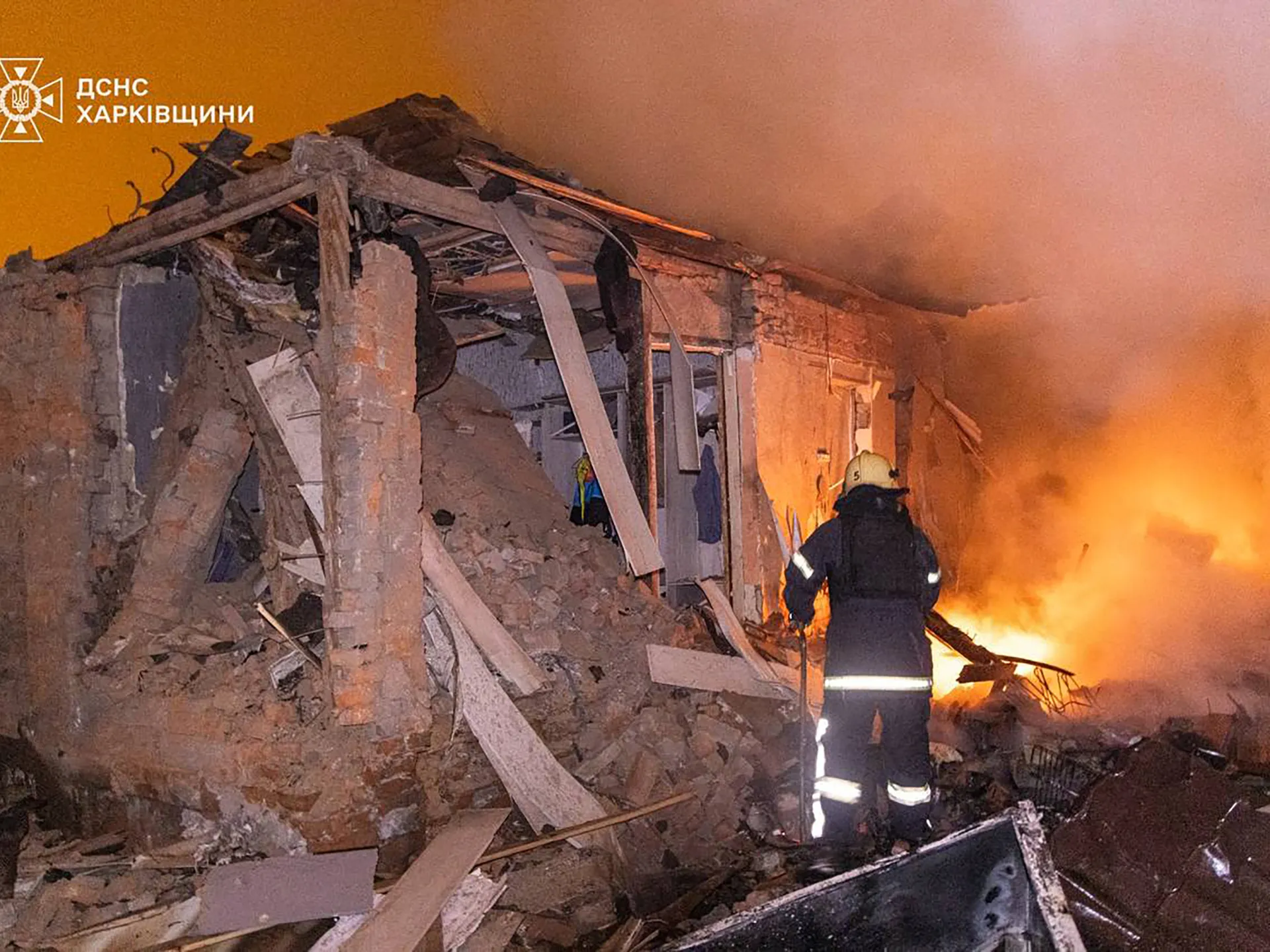
Kyiv, Ukraine – A heavy Russian Geran drone struck a fast-moving train in northern Ukraine on January 27, killing five, wounding two and starting a fire that disfigured the railway carriage.
Such an attack was impossible back in 2022, when Russia started dispatching roaring swarms of Shaheds, the Geran-2’s Iranian prototypes.
Recommended Stories
list of 4 itemsend of list
Ukrainian servicemen ridiculed them for their slow speed and low effectiveness – and shot them down with their assault rifles and machineguns.
But the Geran kamikaze drones have undergone countless modifications, becoming faster and deadlier – and some were equipped with Starlink satellite internet terminals.
The terminals made them immune to Ukrainian jamming and even allowed their Russian operators to navigate their movement in real time.
Western sanctions prohibit the import of the notebook-sized terminals operated by Elon Musk’s SpaceX company to Russia.
But Moscow has allegedly smuggled thousands of them via ex-Soviet republics and the Middle East, notably Dubai, using falsified documents and activation in nations where the use of Starlink is legal, according to Russian war correspondents and media reports.
Russian forces were able to counter the use of Starlink by Ukrainian forces as the terminals linked to SpaceX’s satellite armada orbiting the Earth allowed faster communication and data exchange, as well as greater precision.
In early February, SpaceX blocked the use of every Starlink geolocated on Ukrainian territory, including the ones used by Ukrainian forces.
Only after a verification and inclusion into “white lists” that are updated every 24 hours can they be back online.
But any terminal will be shut down if moving faster than 90km/h (56mph) to prevent drone attacks.
“Looks like the steps we took to stop the unauthorized use of Starlink by Russia have worked,” Musk wrote on X on February 1.
The step is ascribed to Ukraine’s new defence minister, Mykhailo Fedorov, a 35-year-old who had served as the minister of digital transformation. He introduced dozens of innovations that simplified bureaucracy and business, according to a four-star general.
“Fedorov managed to sort it out with Musk – somehow, because we couldn’t do it earlier,” Lieutenant General Ihor Romanenko, a former deputy head of Ukrainian armed forces, told Al Jazeera.
He said the shut-off “significantly lowered” the effectiveness of Russia’s drone attacks and disrupted the communication of small groups of Russian soldiers trying to infiltrate Ukrainian positions.
The effect was so devastating that it made Russian forces “howl” with despair, said Andriy Pronin, one of the pioneers of military drone use in Ukraine.
“They’re like blind kittens now,” he told Al Jazeera.
Russian servicemen in places like the contested eastern town of Kupiansk are now “deprived of any way of getting in touch with mainland”, one of them complained on Telegram on February 4.
Other servicemen and war correspondents decried the shortsightedness of Russian generals who built communications around Starlink and did not create an alternative based on Russian technologies and devices.
However, the shutdown affected Ukrainian users of Starlink that were not supplied to the Defence Ministry but were procured by civilians and charities.
“The communications were down for two days until we figured out the white list procedure,” Kyrylo, a serviceman in the northern Kharkiv region, told Al Jazeera. He withheld his last name in accordance with the wartime protocol.
The effect, however, is short-term and is unlikely to turn the tables in the conflict that is about to enter another year.
“It’s not a panacea, it’s not like we’re winning the war,” Pronin said. “It will be hard [for Russians], but they will restore their communications.”
According to Romanenko, “it’ll take them several weeks to switch to older” communication devices such as radio, wi-fi, fibre optic or mobile phone internet.
Despite undergoing surgery for a fractured left leg, ski icon Lindsey Vonn defended her decision to compete at Games.
Published On 10 Feb 202610 Feb 2026
Share
American ski athlete Lindsey Vonn said on Monday she had suffered a “complex tibia fracture” when she crashed in the Winter Olympics downhill and would need “multiple surgeries”.
“While yesterday did not end the way I had hoped, and despite the intense physical pain it caused, I have no regrets,” Vonn said on her social media, from the hospital in Italy where she is being treated.
Recommended Stories
list of 3 itemsend of list
Vonn, 41, insisted that the ruptured anterior cruciate ligament she suffered in a crash in a World Cup race before the Milan-Cortina Games “had nothing to do with my crash whatsoever”.
“I was simply 5 inches too tight on my line when my right arm hooked inside of the gate, twisting me and resulted in my crash,” she added.
“I sustained a complex tibia fracture that is currently stable but will require multiple surgeries to fix properly.”
In her first statement since the crash, Vonn said: “My Olympic dream did not finish the way I dreamt it would. It wasn’t a story book ending or a fairy tale, it was just life. I dared to dream and had worked so hard to achieve it.
“Because in Downhill ski racing the difference between a strategic line and a catastrophic injury can be as small as 5 inches.”
Vonn crashed heavily just 13 seconds after starting her run. She was winched off the piste by a rescue helicopter and is being treated in a hospital in Treviso.
She had resumed her career in late 2024 after nearly six years in retirement and was considered a strong favourite for the downhill at these Olympics after recording seven World Cup podium finishes, including two wins, before her pre-Olympics crash in Crans-Montana, Switzerland.
Vonn’s crash during the Olympic Women’s Downhill on Sunday is likely to be career-ending for the American Alpine ski athlete [Screengrab by IOC via Getty Images]
Centre-left socialist president is elected, but far-right rival secures record share of the vote.
After decades of being largely immune to political upheaval, Portugal is witnessing what many consider an accelerated shift to the right.
This week’s presidential election is seen as a wake-up call.
It brought to power a centre-left politician – with a big win.
But the strong showing of his rival, the far-right candidate, signals that Portugal could be on a path to joining other European countries in a political move to the right.
The president of this European country is largely a figurehead, but he still wields considerable power.
So, how will this vote shape Portugal’s political future? And how has it been watched across Europe?
Presenter: James Bays
Guests:
Miguel Poiares Maduro – Director of the School of Transnational Governance at the European University Institute
Karel Lannoo – CEO of the Centre for European Policy Studies
Rui Gomes da Silva – Lawyer and former Portuguese parliamentary affairs minister
British police are assessing a complaint that the former prince sent confidential trade reports to convicted US sex offender Jeffrey Epstein.
Buckingham Palace says King Charles III will “support” UK police assessing reports that the former Prince Andrew gave confidential information to convicted sex offender Jeffrey Epstein.
The statement on Monday came after police said they were examining reports that the former prince, now known as Andrew Mountbatten-Windsor, sent trade reports to Epstein in 2010.
Recommended Stories
list of 3 itemsend of list
Thames Valley Police, which serves areas west of London, including the ex-royal’s former home in Windsor, launched the inquiry after news organisations reported on emails that suggest the then-prince sent Epstein reports from a 2010 tour of Southeast Asia he took as Britain’s envoy for international trade.
“The King has made clear, in words and through unprecedented actions, his profound concern at allegations which continue to come to light in respect of Mr. Mountbatten-Windsor’s conduct,” the palace said in a statement.
“While the specific claims in question are for Mr Mountbatten-Windsor to address, if we are approached by Thames Valley Police we stand ready to support them as you would expect.”
Thames Valley Police confirmed earlier on Monday that it has launched an inquiry following a complaint from an anti-monarchy campaigner.
“We can confirm receipt of this report and are assessing the information in line with our established procedures,” the police force said in a statement.
Correspondence unearthed in recent days appears to show that Mountbatten-Windsor forwarded copies of his reports from a 2010 tour of Southeast Asia to Epstein soon after he returned to Britain.
An earlier email appears to show the ex-prince sharing his itinerary for the two-week trip to Hanoi, Saigon, Singapore, Kuala Lumpur and Hong Kong with Epstein.
Thames Valley Police began its inquiry after Graham Smith, chief executive of the anti-monarchy group Republic, reported Mountbatten-Windsor for suspected abuse of public office and violations of Britain’s Official Secrets Act.
The former prince, 65, has faced years of scrutiny over his friendship with Epstein, a relationship that has cost him his role in the royal family, titles and home. Andrew has always denied any wrongdoing, and has not responded to requests for comment since the latest release of Epstein files.
Reporting from London, Al Jazeera’s Milena Veselinovic said Mountbatten-Windsor was acting as the United Kingdom’s international trade envoy when the claims were made that he sent sensitive information to Epstein.
“This [allegedly] includes a confidential memo about investment in the Helmand province in Afghanistan, which was being financed at that time by the UK taxpayer,” she explained.
Royal family faces jeopardy
The British royal family continued its effort to insulate itself from the scandal on Monday, as Prince William and Princess Catherine issued their first statement about the latest batch of Epstein files.
“I can confirm that the Prince and Princess of Wales have been deeply concerned by the continued revelations,’’ a spokesperson said as William travelled to Saudi Arabia for an official visit. “Their thoughts remain focused on the victims.”
The jeopardy faced by the royal family could be seen on Monday when King Charles visited Lancashire, in northwest England. While most of the public clapped, cheered and waved British flags, one person shouted, “How long have you known about Andrew?”
Last week, King Charles forced Mountbatten-Windsor to leave his longtime home at Royal Lodge near Windsor Castle, accelerating a move that was first announced in October but was not expected to be completed until later this year.
The former royal is now living temporarily at Wood Farm Cottage on the king’s Sandringham Estate in eastern England. He is then expected to move into a more permanent home, which is currently undergoing renovations.
For the second straight Winter Olympics, Mathilde Gremaud bests Eileen Gu in the women’s blue ribband freeski event.
Published On 9 Feb 20269 Feb 2026
Share
Switzerland’s Mathilde Gremaud has retained her Olympic title in the slopestyle freestyle skiing competition at the Milano Cortina 2026 Winter Games in a gripping race in the Italian Alpine town of Livigno.
China’s Eileen Gu, who had been hoping to convert her Beijing 2022 silver medal into gold this time, came in second on Monday after tumbling at the start of her last run.
Recommended Stories
list of 4 itemsend of list
Canada’s Megan Oldham, 24, took the bottom step of the podium despite a big crash on her second run.
Earning herself a day-late birthday present, Gremaud skied well above the already very high bar set by Gu on her first run with three spectacular runs of her own, wearing the Swiss flag like a cape as she came down the last time, having already ensured herself the gold medal.
Gremaud competes in the women’s slopestyle final [Kirill Kudryavtsev/AFP]
Gremaud rolls out new trick
On a crisp and sunny day in the high-altitude ski resort close to the Swiss border, Gremaud kicked off the final by performing – for the first time by a woman – an elite-level trick known as the nose butter double cork 1260.
In this trick, the skier presses the tips of the skis on the takeoff to start the spin and then performs a double cork 1260, two distinct off-axis, inverted flips combined with three-and-a-half full, horizontal rotations.
Known for her variety of tricks on the slope, the Swiss champion veered towards the very technical ones, followed by breathtaking acrobatic jumps during her second run, earning her the eventual highest score overall of 86.96, just pipping Gu’s first-run score of 86.58.
Despite the big crash on her second run, Oldham picked up in the third run, soaring through the rails and performing conservative yet still very acrobatic jumps at the end, winning her a score of 76.46.
At the end of the race and during the prize-giving ceremony, the crowd was painted in different hues of red as the flags of the three winning countries – Switzerland, China and Canada – all waved in the air to the beat of loud music and cheering. The medals were handed out by Britain’s Princess Anne, a former Olympic equestrian.
Gu won her second straight Olympic silver medal in the freestyle slopestyle event [Kirill Kudryavtsev/AFP]
High competition
Double Olympic champion Gu, 22, set the bar high on the first run with big tricks on the rails and stunning jumps, adding flair to all of her tricks and putting herself in first place early on.
After a poor second run when she stumbled on the rails at the beginning of the beautifully sculpted piste, Gu knew she would need something special on her final run to grab the title away from Gremaud. But she tumbled into the snow almost immediately, ending her hopes of reclaiming top spot in the competition.
American-born Gu, who represents her mother’s country of China at the Olympics, said last week that she had nothing left to prove after her two gold and one silver medal from Beijing.
She will be defending her big air and halfpipe titles later in the Games.
Tim Allan steps down a day after Starmer’s chief of staff, Morgan McSweeney, quits, adding pressure on the PM.
Published On 9 Feb 20269 Feb 2026
Share
United Kingdom Prime Minister Keir Starmer’s communications chief, Tim Allan, has stepped down as the leader of the governing Labour Party faces fallout from the Jeffrey Epstein scandal.
The move on Monday came a day after Starmer’s chief of staff, Morgan McSweeney, also quit.
Recommended Stories
list of 4 itemsend of list
“I have decided to stand down to allow a new No. 10 team to be built,” Tim Allan said in a short statement.
Starmer has come under criticism for appointing Peter Mandelson as ambassador to the United States despite his known links to Epstein, a convicted late US sex offender.
The prime minister said on Monday politics should be a force for good and emphasised the importance of moving forward after the resignations.
“We must prove that politics can be a force for good. I believe it can. I believe it is. We go forward from here. We go with confidence as we continue changing the country,” Starmer told his Downing Street staff.
Mandelson has been under investigation since his name appeared in files on the Epstein investigations released by the US Department of Justice.
He was sacked by Starmer in September over his friendship with Epstein and last week also quit the Labour Party and House of Lords, the upper chamber of the UK Parliament. The Foreign and Commonwealth Office said it is reviewing an exit payment made to him after he was fired.
LONDON — A prince, an ambassador, senior diplomats, top politicians and other government officials. All brought down by the Jeffrey Epstein files. And all in Europe, rather than the United States.
The huge trove of Epstein documents released by the U.S. Department of Justice has sent shock waves through Europe’s political, economic and social elites — dominating headlines, ending careers and spurring political and criminal investigations.
Former U.K. Ambassador to the United States Peter Mandelson was fired and could go to prison. British Prime Minister Keir Starmer faces a leadership crisis over the Mandelson appointment, and on Sunday, his chief of staff, Morgan McSweeney, resigned over having advised Starmer to appoint Mandelson.
Senior figures have fallen in Norway, Sweden and Slovakia. And, even before the latest batch of files, Andrew Mountbatten-Windsor, brother of King Charles III, lost his honors, princely title and taxpayer-funded mansion.
Apart from the former Prince Andrew, none of them faces claims of sexual wrongdoing. They have been toppled for maintaining friendly relationships with Epstein after he became a convicted sex offender.
“Epstein collected powerful people the way others collect frequent flier points,” said Mark Stephens, a specialist in international and human rights law at Howard Kennedy in London. “But the receipts are now in public, and some might wish they’d traveled less.”
The documents were published after a public frenzy over Epstein became a crisis for President Trump’s administration and led to a rare bipartisan effort to force the government to open its investigative files. But in the U.S., the long-sought publication has not brought the same public reckoning with Epstein’s associates — at least so far.
Rob Ford, a professor of political science at the University of Manchester, said that in Britain, “if you’re in those files, it’s immediately a big story.”
“It suggests to me we have a more functional media, we have a more functional accountability structure, that there is still a degree of shame in politics, in terms of people will say: ‘This is just not acceptable, this is just not done,’” he said.
British repercussions
U.K. figures felled by their ties to Epstein include the former Prince Andrew and his ex-wife Sarah Ferguson, whose charity shut down last week. The former prince paid millions to settle a lawsuit with late Epstein victim Virginia Giuffre, who said she was forced to have sex with Andrew beginning when she was 17, and he is facing pressure to testify in the U.S.
Like others now ensnared, veteran politician Mandelson long downplayed his relationship with Epstein, despite calling him “my best pal” in 2003. The new files reveal contact continued for years after the financier’s 2008 prison term for sexual offenses involving a minor. In a July 2009 message, Mandelson appeared to refer to Epstein’s release from prison as “liberation day.”
Starmer fired Mandelson in September over earlier revelations about his Epstein ties. Now British police are investigating whether Mandelson committed misconduct in public office by passing on sensitive government information to Epstein.
Starmer has apologized to Epstein’s victims and pledged to release public documents that will show Mandelson lied when he was being vetted for the ambassador’s job. That may not be enough to stop furious lawmakers trying to eject the prime minister from office over his failure of judgment, and it has already claimed his top advisor in McSweeney.
American associates
Experts caution that Britain shouldn’t be too quick to pat itself on the back over its rapid reckoning with Mandelson. The U.S. has a better record than the U.K. when it comes to declassifying and publishing information.
But Alex Thomas, executive director of the Institute for Government think tank, said that “there is something about parliamentary democracy,” with its need for a prime minister to retain the confidence of Parliament to stay in office, “that I think does help drive accountability.”
A few high-profile Americans have faced repercussions over their friendly ties with Epstein. Most prominent is former U.S. Treasury Secretary Lawrence Summers, who went on leave from academic positions at Harvard University late last year.
Brad Karp quit last month as chair of top U.S. law firm Paul Weiss after revelations in the latest batch of documents, and the National Football League said it would investigate Epstein’s relationship with New York Giants co-owner Steve Tisch, who exchanged sometimes crude emails with Epstein about potential dates with adult women.
Other U.S. Epstein associates have not yet faced severe sanction, including former Trump strategist Stephen K. Bannon, who exchanged hundreds of texts with Epstein; Commerce Secretary Howard Lutnick, who accepted an invitation to visit Epstein’s private island; and tech billionaire Elon Musk, who discussed visiting the island in emails, but says he never made the trip.
Former President Clinton has been compelled by Republicans to testify before Congress about his friendship with Epstein, and Trump has repeatedly faced scrutiny over his own long friendship with the financier. A New York Times review identified more than 5,300 files in the Epstein documents containing over 38,000 references to Trump, his family or his properties. Neither Trump nor Clinton has ever been accused of wrongdoing by Epstein’s victims.
European investigations
The Epstein files reveal the global network of royals, political leaders, billionaires, bankers and academics that the wealthy financier built around him.
Across Europe, officials have had to resign or face censure after the Epstein files revealed relationships that were more extensive than previously disclosed.
Joanna Rubinstein, a Swedish United Nations official, quit after the revelation of a 2012 visit to Epstein’s Caribbean island. Miroslav Lajcak, national security advisor to Slovakia’s prime minister, quit over his communications with Epstein, which included the pair discussing “gorgeous” girls.
Latvia, Lithuania and Poland have set up wide-ranging official investigations into the documents. Poland’s Prime Minister Donald Tusk said a team would scour the files for potential Polish victims and any links between Epstein and Russian secret services.
Epstein took an interest in European politics, in one email exchange with billionaire Peter Thiel calling Britain’s 2016 vote to leave the European Union “just the beginning” and part of a return to “tribalism.”
Grégoire Roos, director of the Europe program at the think tank Chatham House, said the files uncover Epstein’s “far-reaching” network of contacts in Europe, “and the level of access among not just those who were already in power, but those who were getting there.”
“It will be interesting to see whether in the correspondence he had an influence in policymaking,” Roos said.
Norwegian revelations
Few countries have been as roiled by the Epstein revelations as Norway, a Scandinavian nation with a population of less than 6 million.
The country’s economic crimes unit has opened a corruption investigation into former Prime Minister Thorbjorn Jagland — who also once headed the committee that hands out the Nobel Peace Prize — over his ties with Epstein. His lawyer said Jagland would cooperate with the probe.
Also ensnared are high-profile Norwegian diplomat couple Terje Rod-Larsen and Mona Juul, key players in the 1990s Israeli-Palestinian peace efforts. Juul has been suspended as Norway’s ambassador to Jordan after revelations including the fact that Epstein left the couple’s children $10 million in a will drawn up shortly before his death by suicide in a New York prison in 2019.
Norwegians’ respect for their royal family has been dented by new details about Epstein’s friendship with Crown Princess Mette-Marit, who is married to the heir to the throne, Prince Haakon. The files include jokey exchanges and emails planning visits to Epstein properties, teeth-whitening appointments and shopping trips.
The princess apologized Friday “to all of you whom I have disappointed.”
The disclosures came as her son from a previous relationship, Marius Borg Hoiby, stands trial in Oslo on rape charges, which he denies.
Lawless writes for the Associated Press. AP writers David B. Caruso in New York and Danica Kirka in London contributed to this report.
Milan, Italy – The world’s largest shipping line has been enabling the transport of goods to and from illegal Israeli settlements in the occupied West Bank, as the United States and Europe continue to promote trade despite clear responsibilities under international law, a joint investigation by Al Jazeera and the Palestinian Youth Movement (PYM) reveals.
The Switzerland-based Mediterranean Shipping Company (MSC) has regularly shipped cargo from companies based in Israeli settlements in the occupied Palestinian territory, according to commercial documents obtained through US import databases.
Recommended Stories
list of 3 itemsend of list
Between January 1 and November 22, 2025, lading bills show that MSC facilitated at least 957 shipments of goods from Israeli outposts to the US. Of these shipments, 529 transited through European ports, including 390 in Spain, 115 in Portugal, 22 in the Netherlands, and two in Belgium.
MSC is privately owned by Italian billionaire Gianluigi Aponte and his wife, Rafaela Aponte-Diamant, who was born in the Israeli city of Haifa in 1945, then under British rule as Mandatory Palestine.
“Israeli settlements are widely considered illegal under international law, because they are built on occupied territory, in violation of the Fourth Geneva Convention,” Nicola Perugini, senior lecturer in international relations at the University of Edinburgh, told Al Jazeera. “Commercialising products from these settlements effectively supports the illegal settlements.”
The findings capture a limited portion of the settlement trade, since import and export data from Israel and most European countries is not publicly available. They reveal a reliance on cargo shipping companies and European maritime ports for the transport of a vast range of settlement products, from food items and textiles to skin care and natural stones.
Perugini said states should ban trade with illegal settlements entirely, as it contributes to ongoing violations of international law.
“You cannot normalise the profits of an illegal occupation,” he said.
(Al Jazeera)
US, EU positions on illegal settlements
Under President Donald Trump, the US adopted a permissive stance towards Israeli settlements, reversing decades of policy in 2019. Washington declared them as not inherently illegal under international law and continued this approach upon Trump’s re-election in 2025.
While the EU does not recognise Israel’s sovereignty over West Bank settlements and regards them as an “obstacle to peace”, the findings show that goods were delivered directly from European ports to illegal settlements.
In 2025, MSC facilitated at least 14 shipments from Italy, according to Italian export data. In each case, the cargo originated from the port of Ravenna, which stretches along the Adriatic Sea in central Italy, and openly listed the names and zip codes of Israeli settlements as recipients.
The trade stands in contrast with a landmark 2024 opinion by the International Court of Justice (ICJ) advising that third states are obliged to “prevent trade or investment relations that assist in the maintenance of the illegal situation created by Israel in the Occupied Palestinian Territory”.
The ICJ opinion does not directly address the responsibility of private corporations like MSC.
In April, the UN Human Rights Council urged individual corporate actors to “cease contributing to the establishment, maintenance, development or consolidation of Israeli settlements or the exploitation of the natural resources of the Occupied Palestinian Territory”.
Additionally, a 2024 EU directive on corporate sustainability mandates that large companies working in the bloc identify and address adverse human rights and environmental impacts in their operations.
Israeli Finance Minister Bezalel Smotrich and a woman hold up a map that shows the long-frozen E1 settlement scheme, which would split Israeli-occupied East Jerusalem from the occupied West Bank, on the day of a news conference, near the illegal Israeli settlement of Maale Adumim, in the Israeli-occupied West Bank, on August 14, 2025 [Ronen Zvulun/Reuters]
PYM, a grassroots, international pro-Palestinian movement, last year found that Maersk, Denmark’s publicly owned shipping company, facilitated trade from Israeli settlements.
The world’s biggest container group before being overtaken by MSC in 2022, Maersk is now reviewing its screening process to align with the UN Global Compact, which urges companies to adopt sustainable, socially responsible policies, and guidelines from the Organization for Economic Co-operation and Development (OECD) to the same effect.
MSC told Al Jazeera in a statement that it “respects global legal frameworks and regulations wherever it operates” and applies this “to all shipments to and from Israel”.
Despite insurance companies raising premiums due to security risk as Israel launched its genocidal war on Gaza in October 2023, MSC announced that it would absorb the extra costs rather than impose war surcharges.
It also holds cooperation and vessel-sharing agreements with Israel’s publicly held cargo shipping company, ZIM.
The Spanish and Italian interior ministries were also contacted by Al Jazeera, but did not respond to requests for comment on the shipments.
The Israeli ministry did not respond to requests for comment.
Sustaining settlement economy
According to UN estimates, settlements in Area C – comprising more than 60 percent of the occupied West Bank that Israel controls – and occupied East Jerusalem contribute about $30bn to the Israeli economy each year.
As Israel enforces administrative and physical barriers that severely limit Palestinian businesses, the West Bank’s economy is understood to have suffered a cumulative loss of $170bn between 2000 and 2024.
Israel has recently accelerated efforts to build illegal settlements in the heart of the occupied West Bank, pressing a controversial project known as E1 that could effectively sever Palestinian land and further cut off East Jerusalem.
The plan includes about 3,500 apartments that would be situated next to the existing settlement of Maale Adumim.
Israel’s far-right finance minister, Bezalel Smotrich, said the project would effectively “bury” the idea of a sovereign Palestinian state.
In August, 21 countries, including Italy and Spain, condemned the plan as a “violation of international law” that risked “undermining security”.
Bills of lading obtained by Al Jazeera and PYM show that MSC delivered shipments on behalf of at least two companies, listing their address in Maale Adumim and the nearby Mishor Adumim industrial zone.
Maya, a wholesale supplier for supplement and candy companies, lists Mishor Adumim in the shipper address in 13 out of 14 shipments. Extal, a private company that develops aluminium solutions and holds partnerships with Israeli weapons manufacturers – including Israel Aerospace Industries (IAI) and Rafael Advanced Defense Systems – listed the Mishor Adumim industrial zone in all 38 bills of lading.
Extal is among 158 companies listed by the UN Human Rights Office (OHCHR) in its database of entities officially known to be operating from illegal Israeli settlements.
In at least three other cases, MSC delivered shipments on behalf of settlement-based companies listed in the OHCHR database.
This includes 17 shipments from Ahava Dead Sea Laboratories, an Israeli world-renowned cosmetic brand that has come under intense scrutiny for reportedly pillaging Palestinian natural resources.
A substantial portion of the settlement-based companies listed in the bills of lading were based in the Barkan Industrial Zone, one of the largest in the occupied West Bank. The area was established on confiscated private Palestinian agricultural land and, over the past 20 years, its expansion has led to the fragmentation and isolation of nearby Palestinian villages.
Obligation to uphold human rights
European member states are aware of a gap between the business-as-usual reality on the ground and the mandates of international law.
In June, nine EU countries called on the European Commission to come up with proposals on how to discontinue EU trade with Israeli settlements.
“This is about ensuring that EU policies do not contribute, directly or indirectly, to the perpetuation of an illegal situation,” the letter addressed to EU foreign policy chief Kaja Kallas said. It was signed by foreign ministers from Belgium, Finland, Ireland, Luxembourg, Poland, Portugal, Slovenia, Spain and Sweden.
The European Commission has not fulfilled the request. Currently, products originating from the settlements can be imported into Europe, but do not benefit from the preferential tariffs of the EU-Israel Association Agreement. Since an EU court ruling in 2019, they must be labelled as originating from Israeli settlements.
Hugh Lovatt, senior policy fellow with the Middle East and North Africa programme at the European Council on Foreign Relations (ECFR), said the EU theoretically has an obligation to align its policies with international law.
Whether that happens “comes down to a political decision”.
“Human rights abuses should be a core criterion for deciding what to buy and what to invest in,” he said. “But in the current global attitude, that approach has been increasingly undermined.”
In 2022, restrictions on trade and investment were imposed on Russian-controlled areas of Ukraine following Moscow’s full-scale invasion, but no similar measures were taken towards illegal Israeli settlements.
A few member states have opted to take independent action. Spain and Slovenia last year banned the imports of goods produced in Israeli settlements, while Ireland, Belgium and the Netherlands are working on legislation.
As of January 2026, Spain banned importing goods produced in Israeli settlements, but its measures do not make explicit mention of transshipments through its ports.
Bills of lading obtained as part of this investigation show that the port of Valencia plays a key role, receiving 358 out of a total of 390 shipments transiting through Spain.
Several bills of lading directly reference illegal settlements in the Syrian Golan Heights.
Aquestia Ltd, a company that specialises in hydraulic systems, list Kfar Haruv and Ramat HaGolan in the shipper address. Miriam Shoham, which exports fresh fruit, also lists Ramot HaGolan, while polypropylene manufacturer Mapal Cooperative Society lists Mevo Hama.
PYM said, “MSC’s transfers to and from Israeli settlements are systemic and in violation of both international and domestic Spanish laws.
“MSC provides the infrastructure connecting illegal settlements to global markets, thus encouraging further occupation of Palestinian and Syrian land.”
Interest in gold has skyrocketed in recent weeks, with the price of one ounce hitting an all time high of $5,600 on January 29 before settling back to just under $5,000 on Sunday.
As economic conditions fluctuate and geopolitical tensions rise, more individuals are seeking gold as a secure investment.
In this visual explainer, Al Jazeera breaks down how gold value is determined, the prices of gold coins in different markets, and the countries holding the largest reserves.
How is the value of gold measured?
Understanding the value of a gold item requires knowing its weight in troy ounces alongside its purity in karats.
(Al Jazeera)
Weight (in troy ounces)
The weight of gold and other precious metals like silver and platinum is commonly measured in troy ounces (oz t). One troy ounce is equal to 31.1035 grammes.
At $5,000 per troy ounce, 1 gramme of gold is worth about $160, and a standard 400-troy-ounce (12.44kg) gold bar costs $2m.
Troy ounces are different from regular ounces, which weigh 28.35 grammes and are used to measure everyday items including foods.
Purity (in karats)
Karat or carat (abbreviated as “K” or “ct”) measures the purity of a gold item. Pure gold is 24 karats, while lower karats such as 22, 18, and 9 indicate that the gold is mixed with less expensive metals like silver, copper, or zinc.
To determine the purity of gold, jewellers are required to stamp a number onto the item, such as 24K or a numeric value like 999, which indicates it is 99.9 percent pure. For example, 18K gold will typically have a stamp of 750, signifying that it is 75 percent pure.
Some typical values include:
24 karat – 99.9% purity – A deep orange colour, is very soft, never tarnishes and is most commonly used for investment coins or bars
22 karat – 91.6% purity – A rich orange colour, moderate durability, resists tarnishing and most often used for luxury jewellery
18 karat – 75% purity – A warm yellow colour, high durability, will have some dulling over time and most often used in fine jewellery
9 karat – 37.5%purity – A pale yellow colour, has the highest durability, dulls over time, used in affordable jewellery
Other karat amounts such as 14k (58.3% purity) and 10k (41.7% purity) are often sold in different markets around the world.
When you buy jewellery, the price usually depends on the day’s gold spot price, how much it costs to make, and any taxes.
If you know the item’s exact weight in grammes and the gold’s purity in karats, you can calculate the craftsmanship cost on top of that.
You typically cannot negotiate the spot gold price, but you can often haggle over the craftsmanship costs.
The price of gold has quadrupled over the past 10 years
Gold has been valued for thousands of years, serving various functions, from currency to jewellery. The precious metal is widely regarded as a safe haven asset, particularly in times of economic uncertainty or market volatility.
Up until 1971, the United States dollar was physically defined by a specific weight of gold. Under the classical gold standard, for nearly a century, from 1834 until 1933, you could walk into a bank and exchange $20 for an ounce of gold.
In 1933, amid the Great Depression, the price was raised to $35 per ounce to stimulate the economy.
In 1971, under President Richard Nixon, gold was decoupled from the dollar, and its price began to be determined by market forces.
Over the past 10 years, the price of gold has quadrupled from $1,250 in 2016 to around $5,000 today.
(Al Jazeera)
How is the price of gold determined in different countries?
Gold is priced globally based on the spot market, where one troy ounce is traded in US dollars on exchanges such as London and New York. Local prices vary as the dollar rate is converted into domestic currencies, and dealers add premiums for minting, distribution and demand.
Taxes and import duties further influence the final cost: India adds 3 percent GST, while the United Kingdom and United Arab Emirates impose none on gold investments.
Different countries produce unique gold bullion coins and bars, each with its own distinct features and cultural significance. Notable examples include the Gold Eagle from the US, the Gold Panda from China, and the Krugerrand from South Africa.
Which countries have the most gold reserves?
The US leads global gold reserves with 8,133 tonnes, nearly equal to the combined total of the next three countries. Germany is in second place with 3,350 tonnes, and Italy comes in third with 2,451 tonnes.
The graphic below shows the top 10 countries with the largest gold reserves.
Women’s rights activist Mohammadi was arrested in December while attending a memorial ceremony in Mashhad.
Published On 8 Feb 20268 Feb 2026
Share
Iranian human rights activist and 2023 Nobel Peace Prize laureate Narges Mohammadi has been sentenced to more than seven years in prison, according to her lawyers and a group that supports her.
Mohammadi, 53, was on a week-long hunger strike that ended on Sunday, the Narges Foundation said in a statement. It said Mohammadi told her lawyer, Mostafa Nili, in a phone call on Sunday from prison that she had received her sentence on Saturday.
Recommended Stories
list of 3 itemsend of list
“She has been sentenced to six years in prison for gathering and collusion to commit crimes,” Nili told the AFP news agency.
She was also handed a one-and-a-half-year prison sentence for propaganda activities and is to be exiled for two years to the city of Khosf in the eastern province of South Khorasan, the lawyer added.
She also received a two-year ban on leaving the country, according to the report.
Nili said the verdict was not final and could be appealed, expressing hope that the activist could be temporarily “released on bail to receive treatment,” due to her health issues.
Mohammadi had on February 2 begun a hunger strike to protest the conditions of her imprisonment and the inability to make phone calls to lawyers and family.
“Narges Mohammadi ended her hunger strike today on its 6th day, while reports indicate her physical condition is deeply alarming,” the foundation said.
Mohammadi told Nili she was transferred to the hospital just three days ago “due to her deteriorating health”, it added.
“However, she was returned to the Ministry of Intelligence’s security detention centre in Mashhad before completing her treatment,” the foundation said.
“Her continued detention is life threatening and a violation of human rights laws.”
Mohammadi is the second Iranian woman to win the Nobel Peace Prize after Shirin Ebadi won the award in 2003 for her efforts to promote democracy and human rights.
A prominent writer and journalist, Mohammadi serves as deputy director of the Defenders of Human Rights Center (DHRC), an organisation long dedicated to defending political prisoners and promoting broader human rights reforms in Iran. Beyond her advocacy for gender equality, she campaigns vigorously against the death penalty and corruption.
Her 20-year fight for women’s rights made her a symbol of freedom, the Nobel Committee said in 2023.
Mohammadi was arrested on December 12 after denouncing the suspicious death of lawyer Khosrow Alikordi.
Prosecutor Hasan Hematifar told reporters then that Mohammadi made provocative remarks at Alikordi’s memorial ceremony in the northeastern city of Mashhad and encouraged those present “to chant norm-breaking slogans” and “disturb the peace”.
Mumbai, India — For most of a warm and breezy Sunday afternoon in Mumbai, the Wankhede Stadium felt closer to Kathmandu than India’s southern metropolis as thousands of Nepalese fans sang, danced and dared to dream while their cricket team took on the mighty England in the ICC Men’s T20 World Cup 2026.
A sea of red and blue replica shirts heaved in every nook and corner of the iconic 33,000-capacity venue, with supporters turning the famed Indian stadium into their adopted home.
A banner, saying “Feel the Thrill” stretched across stands and captured the mood perfectly as chants, drums and Nepali tunes echoed throughout the ground.
From children arriving with flags painted on their faces to elderly supporters proudly wearing the traditional Dhaka topi – a traditional Nepalese hat – fans of all ages turned up for what felt like a cricketing festival drenched in Nepali culture.
A sea of red and blue engulfed the Wankhede Stadium as Nepalese fans took over on Sunday [Pankaj Nangia/Getty Images]
‘We almost won’
On the pitch, Nepal’s players delivered one of their most memorable performances in recent years, with the match ending in heartbreak as the team’s spirited chase fell agonisingly short on the final ball.
With the odds stacked heavily against them, Nepal walked out to face two-time champions England fully aware of the vast gulf in experience and pedigree compared to their opponents.
They hoped, though, that their hunger, intensity and fearless approach to the game could keep them firmly in the contest.
Chasing a challenging target of 185, the Rhinos proved why they are one of the most promising teams in associate cricket, as Lokesh Bam’s late heroics, coupled with Rohit Paudel and Dipendra Singh Airee’s onslaughts, pushed the contest to the last ball.
“We almost won but couldn’t go through because the players lack experience,” Nepal fan Subodh Dhakal, who travelled from Kathmandu, told Al Jazeera. “Experience will come with time, but the team played well.”
Dhakal, a doctor and passionate Nepal supporter, planned a quick two-day trip to attend the match with his wife, after watching the Nepal Premier League – the domestic league whose growth has been central to the nation’s progress in the sport.
Like Dhakal, Satyam Pokhrel also made his way to Mumbai from the Nepalese capital. Joined by a group of friends, Pokhrel revealed his plans to stay for the remaining three Nepal games, all of which are scheduled at the same venue.
“Nepal had a really good chance [to win], but were unlucky,” he said. “The match was very close; I’m proud of the team. They showed great energy and are capable of winning the upcoming games.”
Sunday’s heroics against England were not the first time Nepal troubled stronger opponents. Five months before the World Cup, they beat the West Indies 2-1 in a three-match series — their first bilateral series victory over a full member of the International Cricket Council (ICC) — while in 2024 they came within a run of upsetting South Africa at the T20 World Cup.
Nepal’s debut at the tournament, in 2014, led to a famous win over a highly-rated Afghanistan team.
Nepal fans gather outside Wankhede Stadium around Marine Drive in Mumbai [Manasi Pathak/Al Jazeera]
‘Don’t count us out’
For many in the stands, being part of the atmosphere required journeys just as memorable as the match itself.
Bhuvan Rawal travelled from Tikapur in far-western Nepal, spending three days on the road to reach Mumbai by bus.
“I wasn’t bothered by the time or money taken to come here. Watching Nepal play at a World Cup is a once-in-a-lifetime opportunity for me,” said the 26-year-old.
“I’ve come with around 200 to 300 supporters from Nepal. We were aware of the match schedule since last year and were excited to be at Wankhede Stadium… Mumbai is our second home now!”
Rawal, who played cricket in his younger years and works as a gym trainer, believes lowly-ranked teams such as Nepal aren’t just here to make up the numbers at the expanded 20-team T20 World Cup.
“We may be a small country, but Nepal is very beautiful and can play wonderful cricket. I understand there’s a difference between full ICC members and associate teams, but don’t count us out.
“No team is too small to challenge the giants,” he said.
Bhuvan Rawal was among the thousands of Nepalese fans who undertook a long journey to Mumbai from their homeland [Manasi Pathak/Al Jazeera]
With 95 percent of votes counted, 63-year-old Antonio Jose Seguro is on 66 percent.
Published On 8 Feb 20268 Feb 2026
Share
Antonio Jose Seguro of the centre-left Socialist Party has secured a landslide victory and a five-year term as Portugal’s president in a run-off vote, beating his far-right, anti-establishment rival, Andre Ventura, according to partial results.
With 95 percent of votes counted, 63-year-old Seguro has garnered 66 percent. Ventura trailed at 34 percent, still likely to secure a much stronger result than the 22.8 percent his anti-immigration Chega party achieved in last year’s general election. Ballots in large cities such as Lisbon and Porto are counted towards the end.
Recommended Stories
list of 3 itemsend of list
Two exit polls have placed Seguro in the 67-73 percent range, and Ventura at 27-33 percent.
A succession of storms in recent days has failed to deter voters, with turnout at about the same level as in the first round on January 18, even though three municipal councils in southern and central Portugal had to postpone voting by a week due to floods. The postponement affected some 37,000 registered voters, or about 0.3 percent of the total, and is unlikely to influence the overall result.
Portugal’s presidency is a largely ceremonial role, but it holds some key powers, including the ability to dissolve parliament under certain circumstances.
Ventura, 43, who had trailed Seguro in opinion polls, had argued that the government’s response to the fierce gales and floods was “useless” and called for the entire election to be postponed.
However, the authorities rejected the demand.
Seguro, during his last campaign rally on Friday, accused Ventura of “doing everything to keep the Portuguese from turning out to vote”.
Despite his loss on Sunday, Ventura, a charismatic former television sports commentator, can now boast increased support, reflecting the growing influence of the far right in Portugal and much of Europe. He is also the first extreme-right candidate to make it through to a run-off vote in Portugal.
Meanwhile, Seguro has cast himself as the candidate of a “modern and moderate” left, who can actively mediate to avert political crises and defend democratic values. He received backing from prominent conservatives after the first round amid concerns over what many see as Ventura’s populist, hardline tendencies.
But Prime Minister Luis Montenegro – whose minority centre-right government has to rely on support from either the Socialists or the far right to get legislation through parliament – declined to endorse either candidate in the second round.
While the role is largely ceremonial, the head of state has the power to dissolve parliament and call early elections.
The new president will succeed outgoing conservative Marcelo Rebelo de Sousa in early March.
Erling Haaland’s penalty in second-half stoppage time kept Manchester City’s Premier League title challenge alive with a chaotic 2-1 win away at Liverpool.
Haaland’s spot kick sealed a comeback victory for Pep Guardiola’s team in an explosive football game at Anfield on Sunday and brought the gap on first-place Arsenal back to six points.
Recommended Stories
list of 4 itemsend of list
City’s title prospects looked in dire shape when Dominik Szoboszlai crashed a stunning long-range free kick in off the post in the 74th minute.
And even when Bernardo Silva equalised 10 minutes later, second-place City was still looking at ending the match eight points adrift of the leader.
But Haaland sent the away fans wild by firing into the bottom corner from the spot in the 93rd after Liverpool goalkeeper Alisson brought down Matheus Nunes in the box.
Then City substitute Rayan Cherki scored from the halfway line – only for VAR to overrule it and send off Szoboszlai for a foul on Haaland in the process of the ball crossing the line.
These two clubs have combined to win the last eight titles in English football’s Premier League. But both showed the flaws that have opened the door for Arsenal to potentially end their long wait to be crowned champions once again.
Haaland has scored just once from open play in his last 13 games, and an uncharacteristic lack of confidence from the Norwegian showed with the best chance of the first half inside the opening two minutes.
Silva’s clever pass split the Liverpool defence, but Haaland’s shot lacked conviction under pressure from Milos Kerkez, and Alisson Becker was able to save low to his left.
Haaland hooked another effort straight at Alisson among 10 first-half City attempts without a breakthrough.
Second-half slumps have been a consistent feature of City’s season, and the visitors again faded in the second period until a late flurry saved their title challenge.
Hugo Ekitike should have opened the scoring when he completely miscued his header just before the hour mark after a lightning-fast Liverpool break.
Marc Guehi was fortunate to escape with just a yellow card when he dragged down Mo Salah just outside the box.
But it was City who were left fuming at the award of the free kick that led to the opener when Ryan Gravenberch went down under minimal contact.
Szoboszlai scored the only goal with an outrageous free kick when Arsenal visited Anfield in August and produced another stunning strike that clipped the inside of the post before finding the net.
However, the Hungarian went from hero to villain when City levelled six minutes from time.
Szoboszlai played Silva onside as he slid in to volley home Haaland’s header for City’s first second-half goal in the Premier League this year.
Alisson then wiped out Matheus Nunes to concede a penalty and Haaland kept his cool from the spot to put City in front.
Pep Guardiola’s men still needed a stunning save from Gianluigi Donnarumma to tip behind Alexis Mac Allister’s deflected shot.
With Alisson remaining forward from the resulting corner, the Liverpool goal was open when Cherki took aim from the halfway line to roll the ball into an empty net.
However, Haaland and Szoboszlai’s grappling as the ball trickled towards the goal saw the strike ruled out, with a free kick awarded to City instead, and the Liverpool player given his marching orders.
Silva, who was named player of the match, told Sky Sports that it was a vital win for City.
“I feel the whole team knew before the game if we lost it then the title race was probably over. We felt like we needed to win,” he said.
“The hope is there, and we are going to fight until the end. We need to keep doing our job that we haven’t lately.”
Liverpool boss Arne Slot said he was disappointed not to come away with a result and claimed that several key decisions had gone against his side.
“You cannot compare this game with three or four months ago. We have improved so much – but we need to improve the results,” he told Sky.
“So many times this year we haven’t got what I think we deserve, and this is another time.”
Palace end dire run at Brighton
Earlier on Sunday, Crystal Palace ended a 12-game winless run in all competitions by beating rival Brighton 1-0.
Ismaila Sarr scored the only goal of the match at the Amex Stadium to move Palace nine points clear of the relegation zone and leapfrog Brighton into 13th place.
“It was an unbelievable atmosphere and what a way to start my Palace career, a win in a derby,” said Palace’s record signing Jorgen Strand Larsen, who joined from Wolves on deadline day. “It was really important to win, as there has been a run without wins before I joined.
“This is the most intense game I have ever played, so I’m tired now, but it is worth it.”
Sarr’s winner came after running through in the 61st minute and firing past goalkeeper Bart Verburggen. It was his second goal in as many games and his 10th of the season.
Prime Minister Giorgia Meloni slams anti-Olympics protesters as ‘enemies of Italy and Italians’.
Published On 8 Feb 20268 Feb 2026
Share
Italian Prime Minister Giorgia Meloni has condemned anti-Olympics protesters as “enemies of Italy and Italians” after violence on the fringes of rallies in Milan and the alleged sabotage of train infrastructure.
The International Olympic Committee (IOC) also joined the criticism on Sunday, condemning violence linked to the protests in Milan on Saturday, stating such behaviour has no place at the Games.
Recommended Stories
list of 4 itemsend of list
The incidents happened on the first full day of competition in the Winter Games that Milan is hosting along with the Alpine town of Cortina d’Ampezzo.
Meloni praised thousands of Italians who are working to keep the Games running smoothly, many of whom are volunteers.
“Then there are those who are enemies of Italy and Italians. The protesters demonstrate ‘against the Olympics,’ causing these images to end up on televisions around the world. After others cut the railway cables to prevent the trains from leaving,” the prime minister wrote in a statement on Facebook on Sunday.
The Italian Transport Ministry said that an investigation into suspected “terrorism” had been launched after the railway sabotage near the city of Bologna on Saturday and that those responsible would face a multimillion-euro damages claim.
Thousands of people took to the streets in Milan on Saturday to protest against the Olympics’ environmental and social consequences, including concerns over excessive public spending and ecological damage.
The march, which began peacefully, turned tense when some protesters set off smoke bombs and firecrackers near Olympic venues. Milan police responded with tear gas and water cannons to disperse the crowds, leading to clashes in areas close to the Olympic Village and a nearby highway.
International Olympic Committee spokesperson Mark Adams told reporters on Sunday that peaceful protest is legitimate, but “we draw a line at violence”, which “has no place at the Olympic Games”.
Separately, protesters have also rallied against Israel’s participation in the games and against US Immigration and Customs Enforcement, or ICE, which has deployed agents to provide security to the US delegation at the Games.
During Friday’s opening ceremony, Israel’s small delegation marched into Milan’s San Siro Stadium to a smattering of “boos” from the crowds. The four Israeli athletes, waving their national flag and smiling, saw the jeers quickly drowned out by the loud music and overall festive atmosphere.
United States Vice President JD Vance and his wife, Second Lady Usha Vance, received a similar hostile reception when they appeared on the stadium’s big screen.
British Prime Minister Keir Starmer’s chief of staff has quit over the appointment of Peter Mandelson as ambassador to the United States after files revealed the extent of Mandelson’s relationship with the late sex offender Jeffrey Epstein.
“After careful reflection, I have decided to resign from the government. The decision to appoint Peter Mandelson was wrong. He has damaged our party, our country and trust in politics itself,” Starmer’s top aide Morgan McSweeney said in a statement on Sunday.
Recommended Stories
list of 3 itemsend of list
“I advised the Prime Minister to make that appointment and I take full responsibility for that advice,” he added.
Labour members of parliament had called for McSweeney’s resignation after new evidence about Mandelson’s relationship with Epstein was revealed in the latest tranche of documents and photos from the investigation into the American financier were released by the US Department of Justice. The lawmakers blamed McSweeney for the appointment of Mandelson and the damage caused by the publication of the crude exchanges between him and Epstein.
McSweeney, 48, who was a protege and friend of Mandelson, was accused by some Labour lawmakers and his political opponents of failing to ensure that there were proper background checks when the ambassador was appointed.
In a statement on Sunday, Starmer said it had been “an honour” to work with McSweeney, who had held the role of chief of staff since October 2024.
Mandelson’s payout
Mandelson was sacked by Starmer in September over his friendship with Epstein and last week also quit the Labour Party and House of Lords, the upper chamber of the UK Parliament. The Foreign and Commonwealth Office said it is reviewing an exit payment made to him after he was fired.
Mandelson, a pivotal figure in British politics and the Labour Party for decades, received an estimated payout of between 38,750 pounds and 55,000 pounds ($52,000 to $74,000) after only seven months in the job, according to a report in the Sunday Times newspaper.
Documents released on January 30 by the US Justice Department appeared to show that Mandelson had also allegedly leaked confidential UK government information to Epstein when he was a British minister, including during the 2008 financial crisis.
The Foreign Office said in a statement that it has launched a review into Mandelson’s severance payment “in light of further information that has now been revealed and the ongoing police investigation”.
Mandelson’s lawyers have said he “regrets, and will regret until his dying day, that he believed Epstein’s lies about his criminality”.
“Lord Mandelson did not discover the truth about Epstein until after his death in 2019,” said a spokesperson for the law firm Mishcon de Reya, which represents Mandelson.
“He is profoundly sorry that powerless and vulnerable women and girls were not given the protection they deserved,” the law firm added.
Starmer’s political future in peril?
The departure of McSweeney has thrown the future direction of the government into doubt, less than two years after the Labour Party won one of the largest parliamentary majorities in modern British history.
With polls showing Starmer is already hugely unpopular with voters, some in his own party are openly questioning his judgement and future, and it remains to be seen whether McSweeney’s exit will be enough to silence his critics.
Cabinet minister Pat McFadden earlier insisted Starmer should remain in office despite his “terrible mistake” in appointing Mandelson.
The close Starmer ally told broadcasters the party should stick with the prime minister.
“He [Starmer] should be realistic and accept that this has been a terrible story, that this appointment was a terrible mistake,” McFadden, the work and pensions secretary, told BBC television.
He said the real blame lay “squarely with Peter Mandelson”, who put himself forward for the job despite knowing the extent of his relationship with Epstein.
But according to a report by the Sunday Telegraph, Starmer’s deputy, David Lammy, has become the first cabinet minister to appear to distance himself from Starmer.
The deputy prime minister had not been in favour of appointing Mandelson due to his known links to Epstein, the report quoted friends of Lammy as saying.
FOR striped houses that look like giant beach huts and beautiful stretches of coastline – head to Aveiro.
The city in Portugal sits on the west coast and is much less known than its neighbour and is considered to be the country’s ‘Venice‘.
Sign up for the Travel newsletter
Thank you!
One beautiful village in Aveiro, Costa Nova, is famous for its bright buildingsCredit: AlamyIn Costa Nova is Farol da Barra, the tallest lighthouse in PortugalCredit: Alamy
Along with its waterways, Aveiro is known for its beautiful waterfront houses, bars and boat tours along the waterways.
The city is built around water including the Ria de Aveiro which is a shallow coastal lagoon – and throughout Aveiro are lots of canals.
The largest is Canal Central de Aveiro, right in the city centre and it’s here where tourists can hop onto a boat and take a river cruise.
Dotted along the water are the brightly coloured Moliceiro boats which were historically used to collect seaweed.
Now, these are used for leisure tours which you can book from €13 (£11.22).
These start on the Central Canal of Ria de Aveiro before working their way through the waterworks to Canal de São Roque in the north of the city.
On the banks of the canal are lots of bars, restaurants and cafes.
Some of the most popular include Boteco Aveiro, Taberna do Canal, andLuxor Lounge.
A popular drinking spot is Neighbourhood Alavarium Bar which has deckchairs in the courtyard.
A local pint will set you back just €2.75 (£2.38).
Just a short trip from Aveiro is the Bairrada Region Proximity, which produces plenty of sparkling and red wine, so the city is also perfect for wine lovers.
It is an excellent hub for exploring vineyards on reasonably priced tours, and bars and restaurants in the city centre offer glasses from as little as €2.30 (£2).
Aveiro is known for a local delicacy called ‘ovos moles’ – these traditional Portuguese pastries are essentially a sweet, creamy egg yolk and sugar mixture inside a thin wafer shell.
You can pick these up in local cafes or bakeries for around €1.60 (£1.38) each – and if you treat yourself to a coffee, it will cost as little as €2.16 (£1.87).
One of these spots along Central Canal is Café a Barrica.
One visitor even wrote on Tripadvisor: “This is the very place to try the typical local sweet, Ovos Moles. It is a small place, but I recommend a visitor to try.”
A holidaymaker who treated their fiancee to a romantic holiday to the city, told The Guardian: I told my fiancée we were going somewhere where we would drink wine on a gondola so she was a bit surprised when we got on a plane to Portugal and not Italy.
“I had to explain that I meant the Venice south of Porto – the pretty canal town of Aveiro (half the cost of the real Venice and just as nice).
“I risked being dubbed a cheapskate but we both loved it – a great romantic choice for a Valentine break on a budget.”
Ovos moles are a local delicacy – a thin wafer shell filled with creamy egg yolk and sugarCredit: AlamyOn the journey from Porto – make sure to stop by the former train stationCredit: Alamy
Around 10-minutes outside of the city centre is the coastal village of Costa Nova.
The picture-perfect spot has been described by visitors as having “the most adorable houses”.
The waterfront buildings are famous for their brightly coloured stripes.
These were originally called ‘palheiros’ and were used by fishermen and were brightly coloured so that they could see them through the mist.
Its beach, called Praia da Costa Nova, is also considered one of the prettiest in the area, although it does have strong waves thanks to its location on the Atlantic.
It runs for just under one mile and is the perfect sunbathing spot thanks to its fine, white sand.
Costa Nova is also home to Farol da Barra which is the tallest lighthouse in Portugal.
Visitors can climb up the 288 steps for incredible views across the coast.
Aveiro doesn’t have an international airport – the nearest is Porto which is just a 34-minute train ride away.
One-way tickets start from £6 and in February, flights to Porto from Birmingham start from £13 with Ryanair.
And once you get to the station, make sure to check out the former station building.
It’s one of the prettiest in Aveiro covered in beautiful blue and white tiles.
Lokesh Bam’s late heroics with the bat are not enough as Nepal are beaten by two-time champions in their Group C match in Mumbai.
Published On 8 Feb 20268 Feb 2026
Share
Nepal were left heartbroken after they came agonisingly close to pulling off a massive T20 World Cup upset against England but fell short by four runs as the two-time champions won the Group C match in Mumbai.
Lokesh Bam’s heroics with the bat – 39 runs off 20 balls – were not enough to see Nepal over the line at the Wankhede Stadium, which was packed with Nepalese fans on Sunday.
Recommended Stories
list of 4 itemsend of list
Nepal finished on 180-6, handing England a nervy win to kick off their campaign in the controversy-hit cricket tournament.
When England’s captain Harry Brook (53) and teammate Jacob Bethell (55) hit fifties to power England to 184-7, they seemingly did enough to take the match out of Nepal’s reach.
But Rohit Paudel produced a captain’s innings of his own as he, alongside star all-rounder Dipendra Singh Airee, put Nepal on course for a shock win.
The pair’s departure slowed down Nepal’s progress, but Lokesh resumed the big hitting against some wayward bowling by England’s seamers.
Needing 10 off the last over, the Rhinos were unable to get Sam Curran’s accurate bowling over the boundary and could only score six runs.
The Rhinos’ fans, hundreds of whom had travelled from across the border, were left disheartened.
Earlier, electing to bat at the Wankhede Stadium, England slumped to 57-3 in the seventh over to find themselves in a spot of bother.
Sher Malla struck with the first ball on his World Cup debut, dismissing Phil Salt for one, and the pressure mounted on England after Jos Buttler and Tom Banton fell in quick succession.
Bethell had no problem adjusting to the nature of the track, where other batters found shot-making difficult. He and Brook combined in a 71-run partnership during their 45-ball collaboration to rebuild their innings.
Airee (44) and skipper Paudel (39) kept Nepal in the hunt with a stand of 82 from 54 balls.
Curran brought relief to the English camp when he had Airee caught in the deep and Paudel also departed soon afterwards.
Bam hit Jofra Archer for back-to-back sixes to turn the match on its head.
With Nepal needing 10 runs off the last over from Curran, Bam needed to hit the last ball for a six, but he managed only one as England heaved a huge sigh of relief.
Skiing icon Vonn cried in anguish and pain after her awful fall high up the course days after sustaining an ACL injury.
Published On 8 Feb 20268 Feb 2026
Share
Lindsey Vonn’s Winter Olympic dream ended in screams of pain after she crashed out of the women’s downhill, failing in her audacious bid to medal in her favoured discipline at the Milan-Cortina Games.
Vonn’s United States (USA) teammate and world champion Breezy Johnson won the race to claim gold on Sunday.
Germany’s Emma Aicher took the silver medal, 0.04 of a second slower, and Italy’s home favourite Sofia Goggia had to settle for bronze, according to provisional results.
Johnson’s Olympic title, on Cortina d’Ampezzo’s sunlit Olimpia delle Tofane piste, came exactly a year after she won world championship gold at Saalbach, Austria.
American star Vonn had been trying to claim her fourth Olympic medal despite suffering a ruptured anterior cruciate ligament in her left knee just over a week ago, but her race ended early in Cortina d’Ampezzo.
She cried in anguish and pain after her awful fall high up the course, medical staff surrounding the distraught 41-year-old on the Olimpia delle Tofane piste where she has enjoyed much success in the past.
The 2010 Olympic downhill champion hit the firm snow face first after just 13 seconds of her descent. She then rolled down the slope with her skis still attached, which could likely cause further serious damage to her knee.
Vonn’s Olympic dream now lies in tatters after her brave effort to achieve the seemingly impossible, an attempt which ended with her being taken away in a helicopter as fans in the stands saluted her with loud applause.
One of world sport’s most recognisable faces and an alpine skiing icon, Vonn has insisted that she could not only compete but win against the world’s best women skiers, some of whom like Aicher are nearly half her age.
Vonn said ahead of the Games that she was planning on also competing in the team combined event on Tuesday and the super-G two days later.
But that now looks unlikely, a potential long lay-off perhaps heralding the end of her comeback to skiing in her early 40s.
Vonn retired in 2019 but returned to competition in November 2024 following surgery to partially replace her right knee to end persistent pain.
Vonn had finished on the podium in every previous World Cup downhill race this season, including two victories in St Moritz and Zauchensee, and claimed two more top-three finishes in the super-G.
But retirement looms for Vonn following a disastrous end to one of the biggest stories of the Winter Olympics.
The far right’s score will be watched closely, with the vote being held as heavy storms continue to lash the country.
Published On 8 Feb 20268 Feb 2026
Share
Polls have opened in the second round of Portugal’s elections, viewed as a high-stakes choice between the socialists and a resurgent far right.
Voting began at 9am local time (08:00 GMT) on Sunday for the presidential election, with 11 million voters at home and abroad eligible to cast their ballots.
Recommended Stories
list of 3 itemsend of list
Voters are set to choose between the Socialist Party leader, Antonio Jose Seguro, and Andre Ventura, leader of the nationalist party Chega, which means “enough” in Portuguese.
Exit polls are expected by about 9pm local time (20:00 GMT).
Seguro, 63, secured 31.1 percent of the vote in the first round, while outspoken far-right leader Ventura won 23.5 percent.
While Ventura is almost certain to be beaten by Seguro, the far right’s score will be watched closely.
Sunday’s vote will decide who takes on the emblematic, but largely ceremonial, role of the president.
The vote is taking place as heavy storms continue to lash the country. Despite an improvement in the weather overnight from Saturday to Sunday, at least 14 of the most affected constituencies have postponed voting for nearly 32,000 people by one week.
The storms have killed at least five people, triggered flooding, and caused damage estimated at 4 billion euros ($4.7bn).
But Ventura’s call to postpone the whole vote has been rejected.
Prime Minister Luis Montenegro said the storms had caused a “devastating crisis” but that the threats to voting could be overcome.
The last presidential election went ahead five years ago despite the coronavirus pandemic, outgoing President Marcelo Rebelo de Sousa told Ventura on Friday.
These are the key developments from day 1,445 of Russia’s war on Ukraine.
Published On 8 Feb 20268 Feb 2026
Share
Here is where things stand on Sunday, February 8:
Fighting
Russian forces launched more than 400 drones and about 40 missiles in an overnight attack on Ukraine on Saturday, targeting the country’s power grid, generation facilities and distribution substations, according to Ukrainian President Volodymyr Zelenskyy.
Ukrainian Minister of Energy Denys Shmyhal said two thermal power stations in Ukraine’s western regions were hit, and electricity distribution lines were also targeted.
Zelenskyy said more than 1,000 apartment buildings remain without heating in bitterly cold temperatures in the capital, Kyiv, due to the attacks.
The Ukrainian president criticised Moscow’s targeting of energy infrastructure, saying Russia must be deprived of the ability to use the cold winter weather as leverage against Kyiv. “Every day, Russia could choose real diplomacy, but it chooses new strikes,” he said.
Poland suspended operations at the Lublin and Rzeszow airports near the border with Ukraine on Saturday following the Russian strikes. Polish authorities later said there had been no violation of the country’s airspace and reopened the two airports.
The International Atomic Energy Agency said on X that Ukrainian nuclear power plants have reduced output due to the renewed military activity that affected electrical substations and disconnected some power lines.
Ukrainian military and security officials said that Kyiv struck an oil depot in Russia’s Saratov region and a plant that makes missile fuel components in the Tver region in western Russia.
Ukrainian forces also launched a strike on Russia’s Bryansk region, according to the governor there, using long-range Neptune missiles and HIMARS rocket systems. The attacks wounded two people and disrupted power in seven municipalities, the official said.
The Russian TASS news agency said another Ukrainian missile attack on the border region of Belgorod caused power outages at several water supply facilities, and that experts are “investigating the extent of the outage”.
The Russian Defence Ministry said its troops captured the village of Chuhunivka in Ukraine’s eastern Kharkiv region, the state news agency RIA Novosti reported.
Peace talks
Zelenskyy said the United States has given Moscow and Kyiv a deadline of June to reach an agreement on ending the war, after the two countries held two days of talks in Abu Dhabi this week.
Zelenskyy said Washington has proposed talks in Miami in a week, and that Kyiv has agreed.
The US also asked Russia and Ukraine to agree to a new ceasefire covering strikes on energy infrastructure as a de-escalation step during the talks, Zelenskyy said. He added that Kyiv was ready to stop attacks on Russian oil facilities and other energy infrastructure, but Moscow has yet to agree.
The Ukrainian leader said he had reports from Ukrainian intelligence services on discussions in which Russian envoy Kirill Dmitriev had proposed US-Russian cooperation deals worth as much as $12 trillion. Any such agreements between Moscow and Washington must not violate Ukraine’s constitution, Zelenskyy said.
Zelenskyy added that Ukraine and Russia remain far apart in the discussions about territory. He said the US was proposing a free economic zone in Ukraine’s Donetsk region, which Russia mostly occupies, but that neither Ukraine nor Russia was thrilled by this idea.
Earlier, the Ukrainian leader met his negotiating team in Kyiv and said Ukraine “needs results” that ensure “effective security guarantees” for the country.
Kremlin spokesman Dmitry Peskov told reporters in Moscow that a third round of talks aimed at ending Russia’s war on Ukraine should take place “soon”. But he said there is no fixed date yet.
Politics and security
Ukrainian Minister of Foreign Affairs Abdrii Sybiha said Kyiv supports a call for a ceasefire during the Winter Olympic Games after Italy and Pope Leo urged world leaders to use the Milano Cortina games to further peace.
The Russian newspaper Kommersant reported that two suspects in the attempted assassination of top Russian military intelligence official General Vladimir Alexeyev “will soon be interrogated”. It cited a source close to the investigation.
Alexeyev, the deputy head of the GRU, Russia’s military intelligence arm, was shot in his Moscow apartment building and rushed to hospital on Friday. He underwent successful surgery and regained consciousness on Saturday, but remained under medical supervision, Kommersant added.
Russian Minister of Foreign Affairs Sergey Lavrov accused Ukraine of being behind the assassination attempt, which he said – without providing evidence – was designed to sabotage peace talks.
US President Donald Trump has signed an executive order rescinding a punitive 25 percent duty on all imports from India over its purchases of Russian oil, the White House said. The two nations earlier announced a trade deal slashing US tariffs on Indian goods to 18 percent from 50 percent in exchange for India halting Russian oil purchases and lowering trade barriers.
Volunteer Marat Darmenov serves free hot food to Kyiv residents during a blackout caused by Russia’s regular air attacks on the country’s energy system, in Kyiv on Saturday [Sergei Grits/AP]