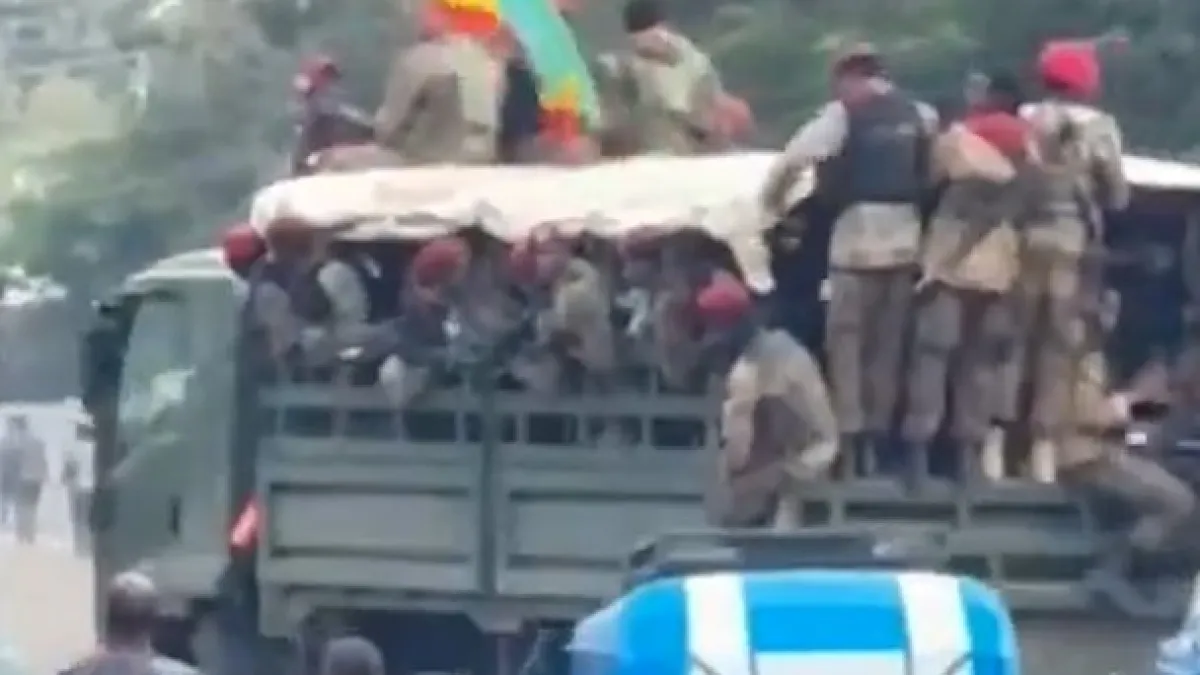
Ethiopia’s government forces say they’ve seized Mekelle from Tigray fighters after a week of intense battles. The fighting has reignited fears of a full-scale war that could draw in neighbouring countries.
Tigray People’s Liberation Front says in a ‘situation of full-blown war’ with Ethiopia’s government.
Published On 24 Sep 202624 Sep 2026
Ethiopia’s army says it has killed at least 272 fighters from the Tigray People’s Liberation Front (TPLF) in a counter-offensive in the country’s northwest Amhara region.
The Ethiopian National Defence Force said on Thursday that another 260 Tigrayan fighters were wounded and several were captured.
Recommended Stories
list of 3 itemsend of list
“Government forces launched a counter-offensive that inflicted heavy personnel and equipment losses on the TPLF” after the group and its allies attacked several areas of North Wollo, a region of Amhara that borders Tigray, the army said in a statement on Facebook.
The intensification came days after TPLF and six other armed groups from across Ethiopia announced the formation of the Ethiopian Peoples’ Forces Alliance for Survival, which committed itself to removing Prime Minister Abiy Ahmed’s government.
The coalition brought together the newly-formed Amhara Fano National Movement, the Oromo Liberation Army and other movements from the Somali, Afar and Benishangul-Gumuz regional states.
Ethiopian Prime Minister Abiy Ahmed [File: Sergei Bulkin/Sputnik via AP Photo]
‘Full-blown war’
“We are in the situation of full-blown war now,” TPLF Vice President Amanuel Assefa told AFP news agency on Thursday.
He confirmed that Tigrayan forces were fighting alongside local armed groups in Afar and Amhara.
The alliance marks a striking realignment that had been almost a year in the making, bringing together armed groups with very different histories and grievances against the central government, including forces with histories of conflict among themselves.
In a statement issued as the fighting widened on Wednesday, the alliance said the federal government was attacking its forces on several fronts and presented their response as part of the broader struggle that had brought the coalition together.
Meanwhile, the escalation has disrupted air travel, as Tigrayan forces seized three local airports in the region.
Flights to Lalibela, a UNESCO-listed site in Amhara known for its medieval rock-hewn churches, were suspended on Thursday, according to Reuters news agency.
AFP also received reports of fighting around Lalibela, causing its airport to close. The area has often been targeted by the Fano, a local armed group that is now operating alongside the TPLF.
Ethiopia’s President Taye Atske Selassie Amde speaks during the United Nations General Assembly, September 23, 2026 [Seth Wenig/AP Photo]
Wider regional rivalries
TPLF last went to war with the Ethiopian federal government in 2020, leading to a devastating two-year conflict that ended with a peace deal in 2022.
In his address at the UN General Assembly on Wednesday, Ethiopia’s President Taye Atske-Selassie Amde blamed the escalation on “the forces of destruction and mayhem” and “interference in our internal affairs by adversarial elements”.
He said Ethiopia had exercised “immense restraint” and made progress with its neighbours.
Analysts say the Tigray rebels have support from Eritrea, which fears landlocked Ethiopia is planning to invade its territory to gain access to the Red Sea.
The TPLF’s Assefa told AFP “we have no information about Eritrea’s plan”. Asked if they would request Eritrean intervention, he said: “Not yet.”
Ethiopia’s domestic conflicts are becoming harder to separate from wider rivalries in the Horn of Africa, particularly Addis Ababa’s deteriorating relationship with Eritrea and Sudan’s civil war.
Sudan’s army chief Abdel Fattah al-Burhan has visited Asmara twice since July for talks with Eritrean President Isaias Afwerki, while Sudan’s paramilitary Rapid Support Forces (RSF) commander Mohamed Hamdan Dagalo, known as Hemedti, reportedly visited Addis Ababa in late August.
Former adversaries say they will settle differences as fears grow of expanding war in Ethiopia.
Published On 21 Sep 202621 Sep 2026
Seven Ethiopian armed groups have formed an alliance aimed at overthrowing the government of Prime Minister Abiy Ahmed.
The groups announced the alliance on Sunday, saying that they would work together to set up an inclusive transitional government.
Recommended Stories
list of 2 itemsend of list
“We have established a joint alliance called the Ethiopian Peoples’ Forces Alliance for Survival, known in short as the Alliance for Survival,” the groups said in a joint statement.
The alliance includes the Amhara Fano National Movement, a coalition of Fano factions that has fought federal forces in the Amhara region since 2023; the Tigray People’s Liberation Front (TPLF), which dominated Ethiopian politics for nearly three decades before Abiy took office; and the Oromo Liberation Army (OLA), which has fought federal forces in Oromia since 2018.
Four smaller groups – the Ogaden National Liberation Front (ONLF), the Afar Revolutionary Democratic Unity Front (Ugugumo), the Benishangul Peoples’ Liberation Movement and the Gumuz Peoples’ Democratic Movement – make up the rest.
Abiy Ahmed has served as Ethiopia’s prime minister since 2018, when he came to power promising sweeping reforms. [File: Reuters]
The groups’ leaders had been talking to form the alliance for about a year, a source close to Fano told Al Jazeera on Sunday.
The announcement comes weeks after clashes in the northern region of Tigray, one of the most serious breaches yet of a 2022 peace deal, deepened fears of a return to full-scale war.
Fighting has gripped parts of Oromia since 2018 and Amhara since 2023.
Abiy came to power in 2018 promising sweeping reforms. He freed journalists, activists and other political prisoners and revoked bans on many political parties after taking power.
But his opponents and human rights activists accuse his government of reversing those gains in recent years.
In the statement, the alliance accuses the government of imposing “dictatorial rule” that has pushed the country towards break-up.
It also says a transitional government guided by a charter would work to end the wars, protect rights and open a national dialogue.
Jaal Marroo, the OLA’s military leader, told a local broadcaster earlier this month that they had met several times before settling on the final announcement.
Zemene Kassie, the Fano leader, first publicly indicated that deals had been reached in an interview with the Swiss newspaper Le Temps, published on August 16.
The government has not publicly commented on Sunday’s announcement.
Fano fought alongside federal forces against Tigray’s fighters in the Tigray war of 2020 to 2022, which killed hundreds of thousands.
Amhara and Tigray also both claim Western Tigray, which Amhara nationalists have administered since the war ended.
Ethiopian academic Eyob Tilahun told Al Jazeera on Sunday that the competing groups had agreed to have a dialogue and form an alliance “in the best interests of the public”.
“Those allied forces believe that they all face a survival threat from the government,” Eyob said.
The 2022 peace agreement, signed in Pretoria, South Africa, ended the war between the federal government and Tigray’s forces but left disputes over disarmament and the TPLF’s legal status unresolved.
In mid-July, the TPLF declared the 2022 Pretoria peace deal “effectively dead”.