Villa had fought since the start of the year to register the 6ft 4in Madjo following his £10m arrival from Metz.
Under-18 players cannot complete international transfers, but the club argued that since Madjo was born in London he should be exempt – despite having three caps for Luxembourg in friendlies.
Since those games, he accepted an England Under-17 call up last year and has four goals in nine appearances, scoring on his debut against Venezuela.
With England searching for their next No9 once Harry Kane eventually retires, Madjo could force himself into the conversation in the coming years.
Fifa does allow some exemptions for minor players to make moves, including if a 16 or 17-year-old transfers within the European Union – something the UK is no longer part of.
The battle was finally won just eight days ago – after Villa took their case to CAS in July – and Madjo was added to the travelling party for Salzburg, having not been included in the initial squad.
With Ollie Watkins rested after World Cup duty and Tammy Abraham left on the bench, the youngster was given the responsibility up front by Emery having scored four pre-season goals.
His strike at the Red Bull Arena, holding off Ecuador international Willian Pacho to volley in John McGinn’s cross, was arguably the hardest chance of the trio he had in a first half full of promise.
It cancelled out Khvicha Kvaratskhelia’s opener for PSG, only for Desire Doue to hit a second-half winner after a video assistant referee (VAR) check.
Before his goal, the hulking Madjo had earlier planted a free header over from three yards and shot wide, but was a constant nuisance for 11-time Ligue 1 winner and Brazilian centre-back and captain Marquinhos.
“He played because he was showing us his capacity to work and be demanding,” said boss Emery. “It is not just about scoring goals, it’s about defending and how he has the commitment and discipline tactically. He was doing that.
“I wanted to play with young players and watch their progression. Brian started scoring goals [in pre-season] against Walsall and Real Sociedad.
“Now the reality is we have shown their capacity, but they have to keep being consistent, demanding and keep performing at the level they were.”
Villa have been looking to sign a new striker – Chelsea‘s Nicolas Jackson has been a summer target – but Madjo’s availability now gives Emery a different option and dilemma before the Premier League season opener at Brighton on 23 August.
“You’ve got a young player coming, especially on a stage like this one, against PSG, getting in those scoring positions and not allowing that disappointment to stay with you,” former Villa striker Dion Dublin told BBC Radio 5 Live.
“I saw Brian Madjo, he had his hands on his head for a couple of seconds and then he got into another scoring position.
“He was brave enough to get back into that scoring position and if he keeps missing it’s not frightening him. He’s happy to have that pressure on his shoulders. I’ve been there, you need to be able to deal with it. At 17, he seems to be doing it easily.”
Madjo – and fellow teenage forward George Hemmings – were given their chance against PSG with Emery insisting he would not rush Watkins, Emi Martinez and Ezri Konsa back for the game.
The trio are due to return next week after being given a month off following the World Cup, with Martinez losing the final with Argentina and Watkins and Konsa helping England to third place.
Madjo expertly deputised for Watkins, despite missing his earlier first-half chances, until he was replaced by Abraham with 18 minutes left.
Villa have already sold Morgan Rogers in a record £117m deal to Chelsea and Youri Tielemans to Manchester United, and Konsa’s departure would be a another bitter blow after winning the Europa League last season and qualifying for the Champions League.
Keeper Martinez will stay, despite interest from Juventus this summer.
Emery added: “We decided to play this match with the players who were ready to play, were fit and trying to avoid some risk with some players. It is very important how we are going to manage the players.
“I am trying to use my experience to avoid some mistakes which i can understand can happen.
“I can feel free with my decision and proud of the players.”
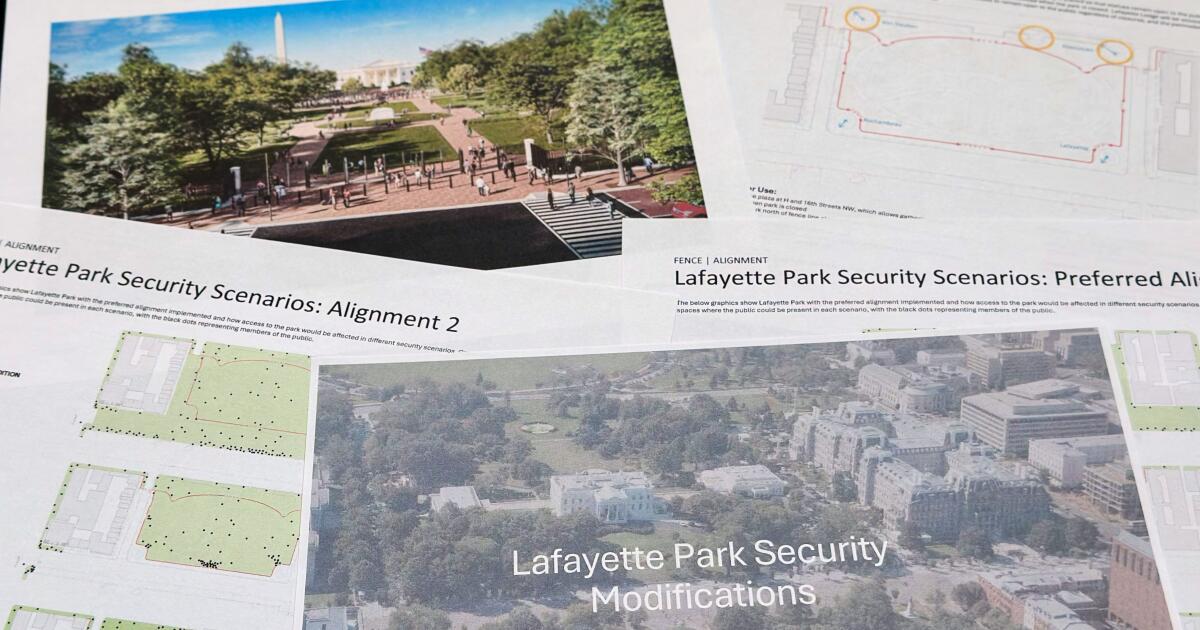
WASHINGTON — The Trump administration is proposing to improve security around the White House by putting up a fence around nearby Lafayette Park to help limit public access when law enforcement authorities determine doing so is necessary.
The proposal is scheduled for consideration on Thursday by the U.S. Commission of Fine Arts, according to a meeting agenda and the plans posted on the agency’s website. The agency has oversight over the design of construction on federal land in Washington.
The commissioners are also set to take another look at the design for an underground facility to screen the thousands of tourists and others who visit or work at the White House. All seven commissioners were appointed by the Republican president.
The proposals are being considered at a time when security for the president has become a top concern. President Trump has been the target of multiple assassination attempts, including two during the 2024 campaign and a third this past April as he attended a dinner in Washington with White House journalists.
Those concerns were heightened the following month after U.S. Secret Service officers fatally shot a man who opened fire near a White House security checkpoint.
The administration says the projects will be an improvement over temporary structures that have long been used to aid perimeter security, like barriers fashioned out of bicycle racks, and for screening the many guests who access the White House and its grounds.
A look at both projects:
Lafayette Park last had a permanent fence in the late 1800s
Trump was accompanied by Interior Secretary Doug Burgum on a recent tour of the park to see updates being made at his direction. The president has worked with the Interior Department and one of its agencies, the National Park Service, to restart dormant park fountains.
“We’re really doing a job at Lafayette Park, which is really the entrance to the White House, and that’s going to be completed very shortly and it’ll be incredible,” Trump said in June.
The administration’s 79-page proposal for the 8-acre (3-hectare) park calls for fencing it all the way around with gates at the north and south entrances to control public access. Options call for either including or excluding four monuments located at each of the park’s four corners.
The proposal, which is backed by the Secret Service and the Executive Office of the President, in coordination with the Interior Department and National Park Service, notes that leaving out the monuments would expose them to vandalism.
The report says the goal of the plan is to “enhance long-term safety,” preserve the Lafayette Park’s identity as a significant National Park Service landscape and “maintain public access to this nationally symbolic space.” Throngs flock to the park to protest or celebrate major events.
Lafayette Park has not had a permanent fence around it since the 19th century. The Secret Service anticipates the fence would start going up sometime next year.
The administration wants similar fencing along Pennsylvania Avenue on the north side of the White House complex, from the Treasury Department building at 15th Street to the Eisenhower Executive Office Building at 17th Street. The report said that will be treated as a separate proposal and submitted to the commission at a later date.
White House visitor screening facility could replace currently used tents
The commission is set to review a revised design for the facility, which would be built beneath Sherman Park, federal land southeast of the White House, to support screening for public tour participants, guests attending large events, White House staff and contractors.
The original design called for locating the facility’s entrance at the southern end of the park, but meetings and consultations led to a revised proposal that shifted the entrance to the western edge of the park to avoid conflicts with infrastructure and minimize the impact on the surrounding views, according to the report submitted for the commission’s review on Thursday.
The administration said the permanent facility will eliminate the need for a series of temporary screening tents currently used for events, improve security on the White House complex and enhance the experience for visitors.
The Secret Service, Interior Department, National Park Service and Executive Office of the President want to start construction in August on the 33,000-square-foot (3,066-square-meter) underground facility. They have set a July 2028 date for it to be operating.
White House visitors would face an initial ID check before they enter the facility through a pavilion located above ground, then head down to a lower level and a second checkpoint. After they are cleared, visitors will ride escalators that will take them up to the White House grounds.
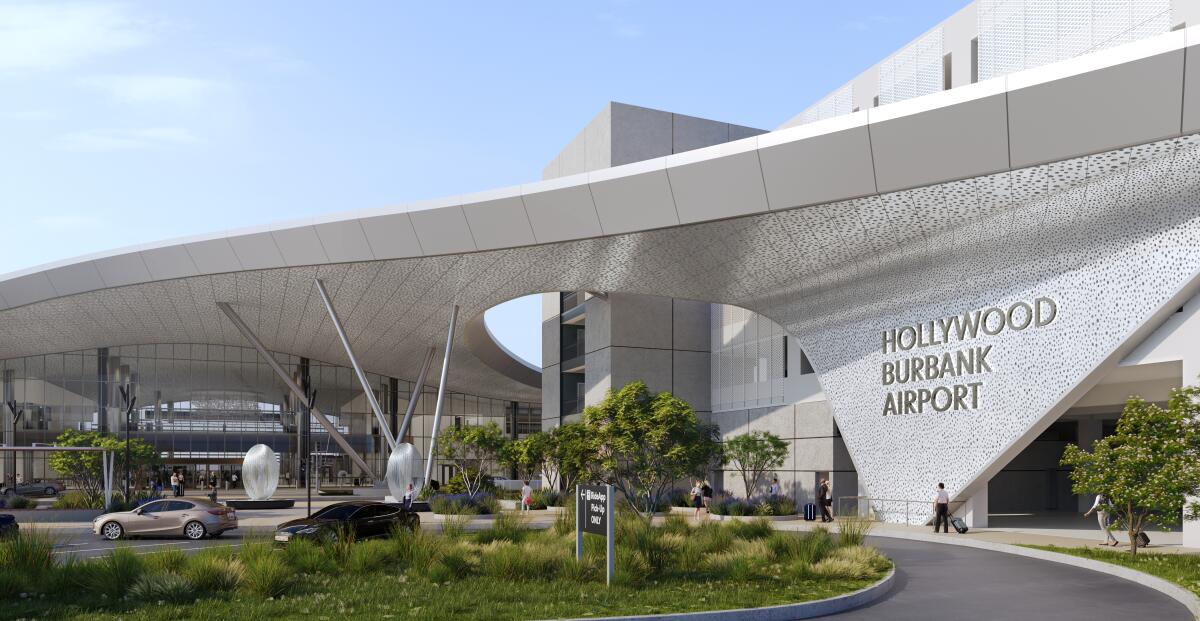
The Hollywood Burbank Airport is due to replace its two terminals with a larger new terminal on Oct. 13. The $1.3-billion project will include 14 gates — the same number the airport has now. But the new structure will be a single terminal that’s about 50% larger than the airport’s current two-terminal layout.
In moving to a 355,000-square-foot terminal, officials say, the airport can give passengers more room and better technology while meeting safety and accessibility standards.
A rendering shows how Hollywood Burbank Airport is designed to look when its new terminal opens in October.
(Hollywood Burbank Airport)
The airport, built in 1930 and run by the Burbank-Glendale-Pasadena Airport Authority, is favored by many local travelers as a simpler, faster alternative to Los Angeles International Airport. The Burbank airport’s site in the San Fernando Valley, however, has often put its leaders at odds with residents of surrounding suburban neighborhoods.
As it stands, the aged Burbank facility doesn’t meet current state seismic standards or Federal Aviation Administration design standards — which has prompted repeated safety warnings. Its nine resident airlines fly to about 30 nonstop destinations. The airport reported about 6.2 million arriving and departing passengers in 2025.
Airport officials say the new design increases the distance between the terminal and the nearest runway, currently as little as 257 feet, soon to be about 880 feet, bringing the airport into compliance with FAA standards.
Meanwhile at LAX, which reported 73.7 million passengers in 2025, the opening of a long-awaited SkyLink automated people mover (an electric train linking terminals to rail service and rental cars) has been delayed by technical and legal issues. In a June 15 report, the SkyLink contractor estimated that its public opening would need to wait until Oct. 6 or later. Asked for a revised timetable, an LAX spokesperson gave no dates, saying only that the airport is focused on “exhaustive testing of all tracks, signaling systems, and vehicles” to ensure safety and dependability.
A rendering shows how Hollywood Burbank Airport is expected to look after a new terminal opens in October.
(Hollywood Burbank Airport)
In Burbank, voters approved the airport terminal replacement project in 2016. Construction began in 2024. At the entrance, travelers will encounter a pair of 16-foot-tall sculptures, “The Two Electras,” by Cliff Garten; inside, a ceiling grid artwork by Glenn Kaino.
The new space is just north of the existing terminal, which is to be demolished. The new entrance will be at Winona Avenue and Hollywood Way. Airport officials say the change will not affect the number of flights or the airport’s operating hours, which are 7 a.m. to 10 p.m.
In the new terminal, airport officials say, the walk from the entrance to the farthest gate will be 1,285 feet, down from 1,600 feet now, with wider corridors and sidewalks and access to power plugs for devices from every seat. Baggage claim carousels will move from outdoors to indoors.
A July 7 photo shows work in progress at Hollywood Burbank Airport, where a new terminal is scheduled to open in October.
(Hollywood Burbank Airport)
The airport project, known as Elevate BUR, has been overseen by the project management company Jacobs. The Design-Build portion of the project is led by Holder, Pankow, TEC, Joint Venture. Corgan provided architectural services in association with CannonDesign.
As it does now, the airport will supply shuttle bus service between the new terminal and Burbank Airport-South Train Station (which connects with Amtrak’s Pacific Surfliner) and the Burbank Airport-North Station at San Fernando Road and Hollywood Way.
Another thing that won’t change: Passengers will continue to walk across the tarmac from terminal to stairs to planes, rather than using the enclosed jetways common in other airports, especially larger ones. It’s something travelers say they appreciate about the airport.
“The second I step onto the tarmac at Burbank, I start acting like I’m boarding a private jet,” wrote one Threads user. “And you’ll never convince me otherwise.”
Some other changes travelers can expect in Burbank:
The new terminal’s 14 food service units are tentatively set to include a Flavor Town, Spring Chicken, Farm Table Bistro, Jones Coffee, Perry’s Joint, Poquito Mas, West Coast Smash Burger, Diane’s Pizzeria, Massis Kebab, Starbucks, Border Grill, Jet Tila’s Asian Table, Santa Canela bakery and a bar with picture-window views of the runways and Verdugo mountains.
The Grand Hall of the soon-to-open terminal at Hollywood Burbank Airport awaits finishing touches on July 7.
(Hollywood Burbank Airport)
A new parking structure next to the new terminal will hold 2,007 parking spots, including 400 valet spots. (The airport’s total number of parking spaces will remain the same at 6,637.)
The distance between the new terminal and the airport’s existing rental car facility and bus stop (Regional Intermodal Transit Center) will be slightly less than a mile by shuttle bus.
Hugh Ryan is an absolute superstar of queer history. His first two books, “When Brooklyn Was Queer” and “The Women’s House of Detention: A Queer History of a Forgotten Prison,” were magnets for awards and accolades. After spending recent years immersed in cultural stories, he’s turned his investigative eye on his own coming of age with the rollicking, raw, funny and sharp memoir “My Bad: A Personal History of the Queer Nineties and Beyond.” Pivoting from scholar of history to student of life, Ryan shares lessons learned from beloved but homophobic middle school teachers (“The nicest mother— I knew could accidentally curb-stomp my heart at any moment”) to ones acquired on the dance floor (“Dancing is sex on a communal level: an embodied ecstatic ritual of union”).
Ryan swung through L.A. on his book tour, and what better place to host a paean to the ’90s than the ASU FIDM Museum, where the exhibit “Obsessed: Fashion and Nostalgia in the ’90s” is serving Westwood plaids, Calvin Klein’s minimalist silk parachute sheath and Donatella’s zipper-slashed, leather mourning dress. A fellow survivor of the era, I interviewed Ryan and the evening was introduced by the exhibition’s sparkling curator, Christina Frank, who cheekily shared period photos of the author alongside images from the museum’s ’90s archives, asking: Who wore it best? Whether it was Ryan channeling designer inspo or fashion-snatching looks from the streets, the display — like the book that inspired it — was colorful and daring, inspired and eccentric and wholly unique. At a time when nostalgia for the ’90s is seemingly everywhere, “My Bad” places the decade into context, including its paradoxical freedoms and oppressions, with the intimate, funny rough language of your freakiest, funnest bestie.
Michelle Tea: Your previous books are this amazing, accessible scholarship. In “My Bad,” your language is so different — you’re cussing! The academic gloves are off — which isn’t to say that it’s not brainy. Was this just the voice that the book wanted? It’s like, “Oh, so we’re just like sitting on the curb having a cigarette together.”
Hugh Ryan: I actually wanted to buy a box of clove cigarettes while I was doing the research, but apparently they’re illegal now because they’re deadly and full of fiberglass.
So much of it is about writing it for people today who are younger, who look up to my books and are like, “I’m going to get my PhD and be just like you!,” and I was like, I didn’t do that, I’ve misrepresented myself somehow, and I want to be really real. Also, I had this job for four or five years where I ghost wrote a kids’ books series, and I was eventually fired, because I took a beloved character — who I am not allowed to name — and made her curse, which she had apparently never done in her 100-year history. When I made her say ‘hell’ and ‘damn’ while solving a mystery, the internet went wild, and you can find the Amazon page where I am ruined. So, the ability to curse in my work and have a real voice was something that, from very early on in my career, I was like, “Oh no, I got to be real careful about being too much myself on the page.”
Ryan in ‘90s Calvin Klein; Dave Navarro walks the Anna Sui Spring/Summer 1997 runway.(Hugh Ryan; Michel Arnaud; Gift of Arnaud Associates, 2000; From ASU FIDM Museum Collection)
MT: You needed to break that pattern of self-censoring. What was it like to shift the focus of your intellectual investigation onto yourself?
HR: Excruciating. At first I really enjoyed it, when it was just this idea. I’ve never really told these stories. In the early versions of it, everything I wrote was jokey, silly, overly stylized, not honest. I wasn’t ready to really dig in. I think that I had a lot of layers of defensiveness that I didn’t even understand I had until I had to write things down. My agent kept being, “No, no, this isn’t real, stop with these jokes, it is funny, but you have to get into the serious issues.” There was a large resistance inside me. Asking, “OK, how did my experiences relate to the ’90s as a whole?” actually let me talk about myself and the time period I emerged from. I needed that scaffolding to feel comfortable.
MT: How do you feel about Gen X’s legacy as basically the coolest generation?
HR: I mean, I kind of love it.
MT: We’re having the most sex, even though we’re so old now. And we’re tough, because we’ve survived so much queer trauma. You write in “My Bad” about having Snapple bottles thrown out windows at you.
HR: If you looked queer and you were out in the world, it was just accepted that at some point during the day someone was going to be violent towards you. Verbally, maybe physically. It just was what it was. Though I will say, having now, later in my life, thrown some Snapple bottles really hard just to feel it, it does feel very good. They’re heavy, they’re glass, they explode. If you can get your hands on some classic ’90s Snapple, just throw them, just try it.
MT: We have to have a queer, Gen X ritual of throwing Snapple bottles, like a rage room.
Ryan in the ‘90s. In his new memoir “My Bad,” Ryan looks back on this time with the intimate, funny rough language of your freakiest, funnest bestie.
(Hugh Ryan)
HR: I do think that it’s easy to forget all of that, because I think we all wanted to forget it to a certain degree. We wanted to let go of our pain. Both the people who were hurt and the people who caused those hurts had some amount of evolution. This is something I think about a lot with my family. If you read the book, in the early chapters it’s rough with my folks. They were loving, but also had no idea what to do with me. I was not just gay, I was weird and trans and confused, and always making noise and acting out and being inappropriate. There’s all this tough stuff, and then we try to forgive each other and let it go, but without saying it. Writing the book was this moment of, “Oh no, am I making us talk about all the bad times again?” It took me sitting with that and realizing — that’s the only way to get to the other side. I’ve seen this change in my family, and it felt important to document how shitty it was, so we could see the change.
MT: What sign are you?
HR: Cancer.
MT: You’re Cancer?!
HR: Yeah, tell me about it. I know so little about astrology. It’s the straightest thing about me, how little I know about astrology.
MT: I don’t even know what to say, because I’m getting such Aquarius-Virgo-Gemini from you that Cancer is just blowing my mind.
HR: I do have a shell, I know that about myself. And that was my first two books. Now I’m trying to invite people in.
MT: Will you talk about the club kid scene in New York City in the ’90s?
HR: I just touched up on the edges of it. The club kid movement really stopped after effective retrovirals come in, in 1996. Suddenly club kids saw a future for themselves, and did not all imagine that they were going to die of AIDS imminently. The ones who I’ve interviewed have said, “That’s the moment at which suddenly, dressing for Friday night no longer felt like what you spend two weeks doing.” But when it was happening, it was amazing. There were these free magazines in New York City, HX and Next, little queer rags full of party promotions and photos of half-naked people in clubs, and ads for those awful viatical companies that would buy up your life insurance if you had AIDS. They were very weird, but they’re like style bibles for me. And then you would go to the clubs.
When you went to Limelight, there would be two entrances, one for straight people and one for gay people. The bouncer at the line for the straight entrance was a giant gay guy, who — this was abusive, and probably wrong, but it was very funny — he’d be like, “You two make out if you’re gonna tell me you’re gay, make out or you don’t come in.” You only got access to half the club if you went in the straight entrance — the other half was only for queer people, and so you would have these straight folks trying to get in. It was amazing, and it was a place where I came to really love my body, because up until then the only things I had been told my body were for were sports, and that was never going to be me. There, I could dance all night.
Limelight was the coolest, but I loved Tunnel. Tunnel was 80,000 square feet of nightclub in a former railway terminal. There was a room entirely designed by the artist Kenny Scharf, and it was covered in fake fur — in a club when smoking was still allowed! It was the worst smelling place I’ve ever been in my whole life. I would sneak down there wearing giant Jnco raver pants, and watch everyone. These giant pants had these huge pockets in them, and I would put a big, gallon Ziploc bag with a clean T-shirt and clean socks inside the pant pocket. When the night was done I would go out, get food, change my clothes, and put the dirty clothes inside the Ziploc bag. I still had to have the pants on. I carried like the smell of 1,000 humid homosexuals with me everywhere I went.
The club, Ryan says, “was a place where I came to really love my body, because up until then the only things I had been told my body were for were sports, and that was never going to be me.”
(Hugh Ryan)
MT: Speaking of being grimy — you were also really affected by Burning Man.
HR: I had met this guy, we totally fell in love. He was a high school dropout computer hacker who was the epitome of the bisexual ’90s — longhaired, androgynous, everything I wanted to be. You know, that very queer thing of: Do I want you, do I want to be you, should we go on a road trip or a killing spree? We were in love and I did not want to go back to school. I had had a terrible junior year, and I was looking to make new mistakes. He was like, “I’m gonna go to this thing called Burning Man, do you want to go? It’s out in the desert, there’s all this art, and it’s super cool,” and I was like, “When is it?” And it was the very first week of classes my senior year, and I was like, “Yeah, absolutely.”
It was amazing. We got adopted by these people who called themselves the Church of Mez, or Mezbians. They were extremely rich Microsoft engineers. We were completely unprepared, because we’d f—ing come in on the Greyhound bus. You’re supposed to bring a gallon of water per person per day, just to start with, and we had nothing. We had a tent and a sleeping bag, and these people thought we were somewhere between pets and aphrodisiacs.
It felt like such an amazing thing to get to touch. And I know that all of those people ended up being like fascist tech bros of today, I’m sure, and I worry about the environmental degradation that I did not know anything about. And it was so white, so many white people with dreadlocks and those terrible tribal tattoos. Like many things in the book, I have to write about it tenderly, even though I know there are so many problems. I don’t think I would be who I was if I didn’t show some tenderness towards those spaces that made me, or at least allowed me to see myself.
Michelle Tea is the author of more than 20 books for grown-ups, teenagers and children.