CEO Saad al-Kaabi says QatarEnergy may have to declare force majeure on long-term contracts for up to five years.
Published On 19 Mar 202619 Mar 2026
Iranian attacks on Qatar have wiped out 17 percent of its liquefied natural gas (LNG) export capacity, causing an estimated $20bn in lost annual revenue and threatening supplies to Europe and Asia, QatarEnergy’s CEO says.
Saad al-Kaabi told the Reuters news agency on Thursday that two of Qatar’s 14 LNG trains, the equipment used to liquefy natural gas, and one of its two gas-to-liquids facilities were damaged in Iranian strikes this week.
Recommended Stories
list of 3 itemsend of list
The repairs will sideline 12.8 million tonnes of LNG production per year for three to five years, he said.
“I never in my wildest dreams would have thought that Qatar would be – Qatar and the region – in such an attack, especially from a brotherly Muslim country in the month of Ramadan, attacking us in this way,” al-Kaabi said in an interview.
His comments came hours after Iran on Wednesday launched a series of attacks on oil and gas facilities across the Gulf region after the Israeli military bombed its South Pars offshore gasfield.
Tehran has been firing missiles and drones across the Middle East in response to the United States-Israeli war on Iran, which began on February 28.
It also has essentially blocked the Strait of Hormuz, a critical Gulf waterway through which about one-fifth of the world’s oil and LNG supplies transit, fuelling soaring petrol prices and global concerns about rising inflation.
Iran’s attacks on energy infrastructure have heightened tensions with its Arab Gulf neighbours, who have condemned the strikes as a violation of international law.
Iranian Foreign Minister Abbas Araghchi said on Thursday that his country would show “ZERO restraint” if its infrastructure is struck again as the Israeli attack on the South Pars gasfield continued to spur condemnation.
“Our response to Israel’s attack on our infrastructure employed FRACTION of our power. The ONLY reason for restraint was respect for requested de-escalation,” Araghchi wrote on X.
“Any end to this war must address damage to our civilian sites.”
‘Stay away from oil and gas facilities’
During Thursday’s interview with Reuters, al-Kaabi said QatarEnergy may have to declare force majeure on long-term contracts for up to five years for LNG supplies bound for Italy, Belgium, South Korea and China due to the two damaged trains.
“I mean, these are long-term contracts that we have to declare force majeure. We already declared, but that was a shorter term. Now it’s whatever the period is,” he said.
QatarEnergy had declared force majeure on its entire output of LNG after earlier attacks on its Ras Laffan production hub, which came under fire again on Wednesday. “For production to restart, first we need hostilities to cease,” al-Kaabi said.
The damaged units cost about $26bn to build, al-Kaabi said. He also told Reuters that the scale of the damage from the attacks has set the region back 10 to 20 years.
“If Israel attacked Iran, it’s between Iran and Israel. It has nothing to do with us and the region,” he said.
“And so now, in addition to that, I’m saying that everybody in the world, whether it’s Israel, whether it’s the US, whether it’s any other country, everybody should stay away from oil and gas facilities.”
The logo of state-owned petroleum company QatarEnergy in front of the headquarters, in Doha, Qatar, March 3. QatarEnergy has halted production of liquefied natural gas and related products due to military attacks on its facilities in Ras Laffan Industrial City and Mesaieed Industrial City. Photo by Hannibal Hanschke/EPA
March 19 (UPI) — Iran on Thursday attacked major energy facilities in Qatar and the United Arab Emirates after vowing to retaliate for Israel striking its gas field a day earlier, escalating a war that is driving up energy prices and rattling global markets.
Qatar said Iranian ballistic missiles struck its Ras Laffan Industrial City, the centerpiece of the nation’s LNG production and export, while the United Arab Emirates said its Habshan gas facilities and Bab field had come under attack.
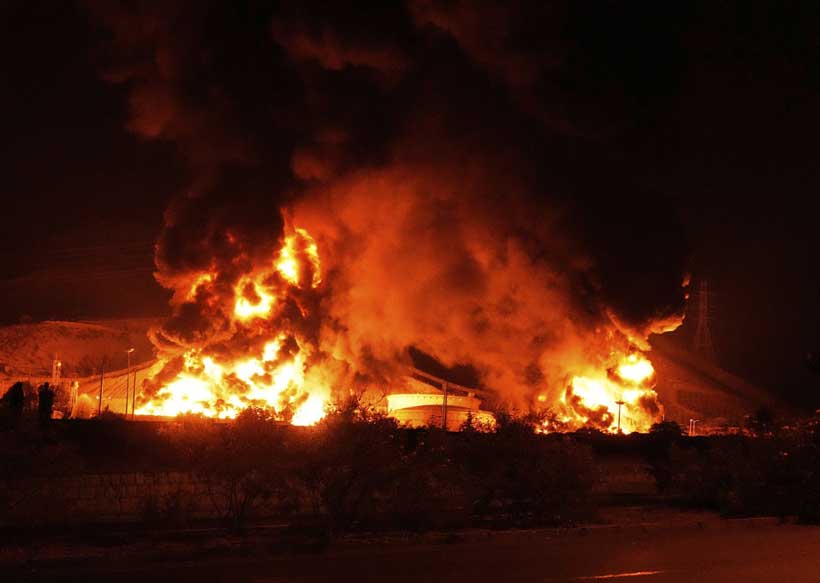
Several liquefied natural gas facilities at the Ras Laffan Industrial City, which is responsible for about one-fifth of global LNG supplies, were struck early Thursday, igniting what state-owned QatarEnergy said in a statement were “sizeable fires.” Extensive damage was reported.
Two of three fires that ignited from the attack were contained as of 5 a.m. local time Thursday, according to a statement from Qatar’s Ministry of the Interior.
Iran attacked the complex’s Pearl gas-to-liquids facility late Wednesday, which was dealt “extensive damage” and prompted emergency teams to be deployed to the site.
Rockets launched at the UAE facilities were successfully intercepted, but falling debris prompted Abu Dhabi authorities to respond to unspecified incidents at the Habshan gas facilities and the Bab gas field, the Abu Dhabi Media Office said in a statement.
The facilities have been shut down in response, it said, adding that no casualties were reported.
Iran also targeted gas facilities in eastern Saudi Arabia, but all projectiles and drones were intercepted, its Ministry of Defense said in a statement.
The attacks mark an escalation in the war, and come after Israel attacked Iran’s South Pars gas field, one of the world’s largest resources of natural gas.
Israel’s attack was condemned by several countries, including Qatar. Foreign Ministry spokesman Majed Al Ansari said it was “a dangerous & irresponsible step amid the current military escalation in the region.”
“Targeting energy infrastructure constitutes a threat to global energy security, as well as to the peoples of the region & its environment,” he said in a statement.
Following Iran’s attack on Wednesday night, Qatar gave Tehran’s embassy officials 24 hours to leave the country.
The targeting of Persian Gulf energy facilities is expected to further drive surging energy costs. On Thursday, Brent crude reached nearly $110 a barrel, up sharply from $71 before the war began in late February.
Iran had vowed to attack the region’s energy facilities after Israel attacked its South Pars gas field.
Oil facilities “associated with America are now on par with American bases and will come under fire with full force,” Alireza Tangsiri, chief of Iran’s Islamic Revolutionary Guards Corps Navy, said on X.
“You have heard a lot about #hell; we will paint its picture for you,” the IRGC said Thursday in a social media statement.
“Stay away from energy facilities…”
Following the attacks, U.S. President Donald Trumpsaid on his Truth Social platform that there would be no more Israeli attacks on the South Pars field.
Trump claimed the United States “knew nothing” about Israel’s plan to attack the gas site and that Qatar was also neither involved.
He said Iran was unaware of that, but warned that if it again attacks Qatar, the United States will join Israel and “massively blow up the entirety of the South Pars gas field at an amount of strength and power that Iran has never seen or witnessed before.”
Iranian strikes come after Israel attacked Iran’s South Pars gasfield, with President Pezeshkian warning of ‘uncontrollable consequences’ that could ‘engulf the entire world’.
Weekly insights and analysis on the latest developments in military technology, strategy, and foreign policy.
The energy war in the Middle East heated up on Wednesday with an Israeli attack on the South Pars gas field Iran shares with Qatar. The strike, which exacerbates the diminishing of oil exports already experienced during the war, was reportedly carried out in coordination with the United States.
“The Israeli Air Force struck a natural gas processing facility in southwestern Iran,” Axios reported, citing two senior Israeli officials. The attack “was coordinated with and approved by the Trump administration,” the outlet noted, adding that a U.S. defense official confirmed that.
Iran’s semi-official Tasnim News Agency reported that several facilities in the South Pars gas field near Bushehr were targeted. According to the report, emergency teams were on the scene and trying to extinguish the fire. The extent of the damage is not yet known.
Things are taking a darker turn.
Israeli airstrikes have hit Iran’s massive South Pars gas field, along with key infrastructure, including the Asaluyeh petrochemical complex.
In response, Tehran has issued an urgent warning, calling for the evacuation of petrochemical sites… pic.twitter.com/KGEjEIgKtl
There are suggestions that the attack on South Pars could interfere with Iran’s refinery capabilities for a long time to come.
I think these are Sulfur Recovery Units (CRUs) in the 6th refinery of the Iranian South Pars onshore fields. The targets are selected to be limited but effective enough to stop to the entire process of the refinery for a long time. https://t.co/XvYj5vC3L9
Qatari officials decried the attack, calling it “a dangerous & irresponsible step amid the current military escalation in the region.”
The Israeli targeting of facilities linked to Iran’s South Pars field, an extension of Qatar’s North Field, is a dangerous & irresponsible step amid the current military escalation in the region.
Targeting energy infrastructure constitutes a threat to global energy security, as…
— د. ماجد محمد الأنصاري Dr. Majed Al Ansari (@majedalansari) March 18, 2026
In the wake of the attack on South Pars, “Iran issued an evacuation warning for several oil facilities across Saudi Arabia, the UAE, and Qatar, saying they would be targeted by strikes ‘in the coming hours,’” Reuters reported, citing Iranian media.
“The warning was directed at Saudi Arabia’s Samref Refinery and Jubail Petrochemical Complex, the United Arab Emirates’ Al Hosn Gas Field, and Qatar’s Mesaieed Petrochemical Complex, Mesaieed Holding Company and Ras Laffan Refinery,” the outlet added.
“These centers have become direct and legitimate targets and will be targeted in the coming hours. Therefore, all citizens, residents, and employees are requested to immediately leave these areas and move to a safe distance without any delay,” the warning said.
Tehran Warns of Retaliation After Attacks on Key Oil and Gas Infrastructure
Iranian officials say U.S. and Israeli strikes damaged parts of the South Pars field one of the world’s largest gas reserves while the IRGC reportedly ordered personnel in regional petrochemical sites to… pic.twitter.com/e4dSYQcEDQ
This event marks a new and dangerous escalation after the U.S. said it would not attack Iran’s energy infrastructure, notes Bismarck Analysis senior analyst Marko Jukic.
Until yesterday, we were assured the U.S. was leaving Iran’s energy infrastructure untouched to prevent escalation or more global energy shocks. Iran pledged to wipe out the Gulf’s energy if its own was attacked.
Now that Israel has crossed the line into hitting Iranian energy infrastructure, Kharg Island could be added to the target list. The facility handles 90% of Iran’s oil exports. The U.S. already attacked the island’s military facilities on March 14, but spared hitting any energy-related targets. That could change and doing so would likely leave Iran with a years-long rebuilding process, crippling the government’s economic lifeline.
U.S. President Donald Trump on Wednesday hinted that America end its role protecting the Strait after Epic Fury ends. Meanwhile, Gulf nations are watching events unfold and have expressed fears that they will be left to defend the Strait on their own.
“I wonder what would happen if we ‘finished off’ what’s left of the Iranian Terror State, and let the Countries that use it, we don’t, be responsible for the so called ‘Straight?’” Trump postulated on his Truth Social site. “That would get some of our non-responsive ‘Allies’ in gear, and fast!!!”
Trump: “I wonder what would happen if we ‘finished off’ what’s left of the Iranian Terror State, and let the Countries that use it, we don’t, be responsible for the so called ‘Straight?’ That would get some of our non-responsive ‘Allies’ in gear, and fast!!! President DJT” pic.twitter.com/pwbF1lYELS
As we previously reported, the U.K., Germany, Luxembourg, Japan and Australia rejected Trump’s demand while other countries were on the fence. In a post on X, Axios reported that the U.K. has drafted a plan for a Strait of Hormuz coalition and shared it with the U.S. and several other countries.
After the allies pushed back, Trump on Tuesday said he no longer wanted their help.
BREAKING: Trump now says he doesn’t need any help for Iran & Strait of Hormuz:
The United States has been informed by most NATO “Allies” that they don’t want to get involved in our military operation against Iran, despite agreeing that Iran must not have a nuclear weapon.
Before Trump’s latest statement on the Strait, a key waterway through which 35% of global crude oil and 20% of global liquefied natural gas used to flow, Gulf Arab nations stated their desire that Iran be “neutered, if not dismantled, when the conflict ends—so the ordeal is never repeated,” The Wall Street Journal reported.
Iran’s decision to interrupt Strait traffic “represents an attack on the entire world rather than just the Gulf states, and will hit low-income nations especially hard,” Sultan al-Jaber, the U.A.E. minister of industry and advanced technology, told the newspaper.
“By taking Hormuz hostage, Iran is committing global economic warfare,” he said. “This is a global economic issue. It is not a regional problem. The disruption is going to increase inflation, it will slow economies, it will affect everyday lives. Families will end up paying more for food.”
Leaving Iran in control of the Strait of Hormuz after the U.S. ends Epic Fury would be a disaster for the Gulf states, said Muhanad Seloom, a professor at the Doha Institute for Graduate Studies in Qatar.
“The Iranian regime has crossed every red line,” he told the Journal. “Now it is in everyone’s interest, and this includes the Gulf countries, to have the U.S. finish the job. Imagine if the war stops now, and Iran declares victory saying that the U.S. has been defeated? Iran would hold the whole region hostage, and every time Iran would be under pressure, it would hit the Gulf countries—because that taboo has been broken, and hitting them worked.”
Leaving Iran in control of the Strait of Hormuz once the guns fall silent would be a disaster for the Gulf states, said Muhanad Seloom, a professor at the Doha Institute for Graduate Studies in Qatar. “The Iranian regime has crossed every red line,” he said. “Now it is in… https://t.co/aFlAql6vcL
A maritime industry official confirmed to us that the Egyptian-owned, Maltese-flagged container ship SAFEEN PRESTIGE was struck again overnight and is burning following an initial attack in the Strait on March 4. The last previous attack on shipping in the region took place on March 11, according to the United Kingdom Maritime Trade Operations (UKMTO) office. UKMTO has received 20 reports of incidents affecting vessels operating in and around the Arabian Gulf, Strait of Hormuz, and Gulf of Oman since Epic Fury began on Feb. 28. That includes 15 reported attacks and five reports of suspicious activities.
BREAKING: Although we can’t say for sure, it appears that the Egyptian-owned, Maltese-flagged container ship SAFEEN PRESTIGE (9593517) may have been struck again overnight as she is suddenly burning following the initial strike on 2026-03-04 in the Strait of Hormuz. pic.twitter.com/jwCYmRYhUe
— TankerTrackers.com, Inc. (@TankerTrackers) March 18, 2026
Though Iran has closed the Strait of Hormuz, some oil tankers are making a safe transit, The Associated Press reported.
About 90 ships, including oil tankers, have crossed the Strait since Epic Fury was launched and Iran “is still exporting millions of barrels of oil at a time when the waterway has been effectively closed,” the wire service reported, citing maritime and trade data platforms.
“Many of the vessels that passed through the strait were so-called ‘dark’ transits evading Western government sanctions and oversight that likely have ties to Iran, maritime data firm Lloyd’s List Intelligence said,” AP noted. “More recently, vessels with ties to India and Pakistan have also successfully crossed the strait as governments stepped up negotiations.”
89 ships got through Hormuz March 1st-15th. “More than one-fifth of the 89 vessels were believed to be Iran-affiliated, while Chinese and Greece affiliated ships are among the rest, it said.” https://t.co/c7DzauV8ya
The effective closure of the Strait of Hormuz following Iranian strikes and fears of Houthi attacks in the Red Sea “have prompted shipping lines to suspend bookings and reroute goods,” Financial Times reported.
There was a bit of positive news when it comes to Iranian attacks on Gulf energy infrastructure. Saudi Arabia’s biggest oil refinery “restarted operations after an attack forced its closure earlier this month,” Bloomberg News reported, citing a person familiar with the matter.
“State oil giant Saudi Aramco, which operates the 550,000-barrel-a-day Ras Tanura plant, shuttered production on March 2 as a precaution after a drone strike in the area,” the outlet added.
Saudi Arabia’s biggest oil refinery has restarted operations after being halted due to a drone attack earlier this month https://t.co/5955jHVM5q
The growing energy war is taking a hit on the global economy, with reduced exports adding to existing problems with limited global spare capacity, the Kpler global trade intelligence firm explained.
“The implications for oil markets are profound,” it stated.
Global oil markets under pressure: Inside the US–Iran supply shock
Day 19 of the US–Iran conflict and the impact on global energy markets is intensifying. From mounting disruptions in the Strait of Hormuz to significant supply shut-ins, we are witnessing one of the largest… pic.twitter.com/blH7pjA46r
In just one example of the war’s impact, Brent Crude, a leading indicator for the oil industry, was trading at nearly $110 per barrel as of Wednesday morning Eastern Standard Time, according to OilPrice.com. While the price has fluctuated wildly, dipping to about $95 per barrel on March 12, it still represents a major increase since the start of Epic Fury. All this has a cascading effect on trucking and shipping, meaning the costs of food and goods are rising as well.
UPDATES
Our coverage has ended for the day. Stay tuned for more.
UPDATE: 5:15 PM EST –
Oil prices shot over $110 per barrel as the energy war in the Middle East heats up.
The publication also reported that Trump doesn’t want any more attacks on Iranian energy infrastructure, saying it got the message. However, the president is not ruling out future attacks, depending on Iran’s actions in the Strait.
Trump knew of South Pars attack and approved of it. But now he’s against strikes on Iranian energy sites, believing Tehran received the message that it must reopen the Strait of Hormuz.
Trump open to future attacks on Iranian energy facilities depending on Iran’s SoH actions. pic.twitter.com/rHfOgtQf6d
Iran’s Masoud Pezeshkian is reportedly resigning over the IRGC freezing him out of all decision making and even access to the new Supreme Leader.
BREAKING 🔴
Channel 14 reports Pezeshkian is weighing resignation. He told aides: “The IRGC blocks me from all military and strategic decisions and won’t even let me speak to the Supreme Leader. I feel useless.” pic.twitter.com/ZmYKYGPxKO
Explosions from either missiles or interceptors were reported in the Saudi capital of Riyadh as the first meeting of Gulf foreign ministers convened since Epic Fury was launched, CNN reported.
“We witnessed the interceptors taking off and we could hear the explosions of the intercepts or the missiles coming down. It’s unusual Iran would make the targeting here when this first high level, face to face meeting is happening.”@NicRobertsonCNN reports from Riyadh pic.twitter.com/xDxGQDANGR
The bodies of five Iranians were found in a house hit by a U.S. airstrike in the Jadriyah section of Baghdad, according to local media. One of the Iranians reportedly supervised attacks on U.S. interests.
In Baghdad, 5 Iranian bodies found at a destroyed house at the site of yesterday’s airstrike on the Jadriyah area. 1 of the Iranians was the adviser to Iranian aligned Iraqi militias. His role was not just advising; he supervised attacks on US interests. https://t.co/lBGGp4RxmX
More footage emerged of Iranian cluster munitions attacking Israel.
UPDATE: 4:32 PM EST –
In addition to the attack on the Qatari refinery, Iran is also striking a liquified natural gas (LNG) refinery in Bahrain, according to the official Iranian FARS News Agency.
IRGC-affiliated Fars News Agency claims that a missile attack is ongoing against the LNG refinery in Bahrain
The FBI announced that it found “possible energetic material” in a suspicious package found outside the MacDill Air Force Base visitor center on March 16. That discovery, as we previously noted, caused the main gate of the base and the visitor center to be shut for several hours. Since then, security at the base was raised to Force Protection Condition Charlie, the second-highest level possible. On Wednesday, the base was on lockdown for several hours after “a threat was made,” according to the base.
MacDill, it should be noted, is the home of CENTCOM, which is running the war in Iran, as well as U.S. Special Operations Command, many other mission partners and two Air Force refueling wings that have been instrumental in supporting Epic Fury.
This is an #FBI Tampa investigative update to the suspicious package found on March 16 outside MacDill AFB Visitor Center: Field screening was conducted on the contents of the package and identified possible energetic materials. Final lab analysis is not yet complete. The… pic.twitter.com/IcMO4fvlME
A top Russian official today honored Larijani’s role in boosting Iran-Russia relations.
Meanwhile, the country’s new Supreme Leader, Mojtaba Khamenei, took to X to offer his condolences.
With deep sorrow, I received the grievous news of the martyrdom of Dr. Ali Larijani, Secretary of the Supreme National Security Council and the Leader’s Representative in that Council, along with the martyrdom of his worthy son and several of his colleagues.
— Ayatollah Mojtaba Khamenei (@MKhamenei_ir) March 18, 2026
The Islamic Resistance in Iraq, a group of Iranian proxies who have battled U.S. forces there for years, released a new video claiming to show a swarm of Murad-5 drones hitting American installations in that country.
Islamic Resistance in Iraq releases coordinated strike footage showing a swarm deployment of Murad-5 drones targeting U.S. installations, with mapped objectives including the Victoria base near Baghdad Airport and additional airbase infrastructure pic.twitter.com/U3qfnCfMcL
Kuwaiti police reportedly uncovered a second Hezbollah cell in the country planning terror attacks.
Kuwait’s Police uncovered a second Hezbollah cell planning terror attacks against vital facilities in the country. The Kuwaiti Interior Ministry said it apprehended 10 citizens belonging to Hezbollah, who sought to spy on its behalf to provide them with coordinates of critical… https://t.co/WgnBK4nbNFpic.twitter.com/Gq5gp4kvet
— Ariel Oseran أريئل أوسيران (@ariel_oseran) March 18, 2026
UPDATE: 3:17 PM EST –
ABC News was given rare access to one of Israel’s Arrow anti-ballistic missile defense batteries. You can read more about Arrow in our deep dive into Israel’s vaunted integrated air defense system here.
A proposal from the UN’s shipping agency on Wednesday calls for a safe maritime corridor to free some 20,000 seafarers stranded in the Gulf by the war, Reuters noted.
“The proposal submitted by Bahrain, Japan, Panama, Singapore and the United Arab Emirates and backed on Wednesday by the United States called for ‘a framework such as a safe maritime corridor,’” the outlet added.
It was submitted at a meeting of the UN’s International Maritime Organization (IMO) governing council in London.
“The purpose of this framework would be to facilitate the safe evacuation of merchant ships,” it said. “This measure aims to protect the lives of seafarers.”
Iranian President Masoud Pezeshkian “strongly” condemned the attack on South Pars.
I strongly condemn attacking Iran’s energy infrastructure. Such aggressive acts will yield nothing for the Zionist–American enemy & their supporters. This will complicate the situation & could have uncontrollable consequences, the scope of which could engulf the entire world. https://t.co/FGtTZZjA6Y
The South Pars attack was designed as a warning to Iran to open the Strait of Hormuz, the Times of Israel reported.
“Israel assisted operationally in order to send an American message,” a senior Israeli official tells Channel 12. “Either…Hormuz will be opened and the mines will be removed…or the entire [natural gas] facility will be destroyed, as will other[s]”https://t.co/hc6DtgfGDj
CENTCOM released more video of its attacks on Iranian targets.
Israel attacked Iranian missile boats in the Caspian Sea, Axios reporter Barak Ravid reported on X. It should be noted that the Caspian Sea is also an important shipping route between Iran and Russia.
🚨Israel conducted strikes against Iranian navy missile boats in the Caspian sea, Israeli official says. More than five vessels were targeted
Trump arrived at Dover Air Force Base in Delaware this afternoon for the dignified transfer of six airmen killed in the March 12 crash of a KC-135 Stratotanker aerial refueling jet in Iraq.
This is the second time the president attended this solemn ceremony. He was there for the dignified transfer of six U.S. service members who were killed by a drone strike at a command center in Kuwait.
FOX: We should point out that at the request of the families, the dignified transfer is going to remain private. There will not be any cameras. pic.twitter.com/y0ivcJuPp6
QatarEnergy confirmed that its Ras Laffan Industrial City was struck by Iranian missiles. As we noted earlier in this story, Iran threatened to hit energy infrastructure in the region after its South Pars gas field was attacked by Israel.
QatarEnergy Statement on Missile Attacks on Ras Laffan Industrial City
QatarEnergy confirms that Ras Laffan Industrial City this evening has been the subject of missile attacks.
Emergency response teams were deployed immediately to contain the resulting fires, as extensive…
The Qatari Foreign Affairs Ministry condemned the attack.
بيان | دولة قطر تدين وتستنكر الاستهداف الإيراني الغاشم لمدينة رأس لفان الصناعية
الدوحة | 18 مارس 2026
تعرب دولة قطر عن إدانتها واستنكارها الشديدين للاستهداف الإيراني الغاشم الذي استهدف مدينة رأس لفان الصناعية، وتسبب في حرائق نتجت عنها أضرار جسيمة في المنشأة، وتعدّ هذا الاعتداء… pic.twitter.com/IFFccWEsFt
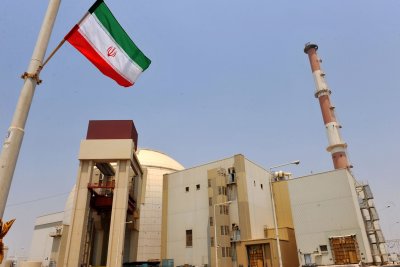
The International Atomic Energy Agency (IAEA) confirmed that a structure 350 meters from Iran’s Bushehr Nuclear Power Plant reactor was hit and destroyed. There was no damage to the reactor or injuries to personnel.
Following information from Iran of a projectile incident on Tuesday evening, the IAEA can confirm that a structure 350 metres from the Bushehr NPP reactor was hit and destroyed.
“Although there was no damage to the reactor itself nor injuries to staff, any attack at or near… pic.twitter.com/HtNXQntEgU
— IAEA – International Atomic Energy Agency ⚛️ (@iaeaorg) March 18, 2026
However, the IAEA does not know the status of the new Iranian enrichment facility in Isfahan that is in an underground nuclear complex, agency chief Rafael Grossi said on Wednesday.
“Grossi said because the inspectors had to cancel their visit, the agency does not know ‘whether it is simply an empty hall’ or hosts concrete pads awaiting the installation of centrifuges – the machines that enriched uranium for power plants and nuclear weapons – or whether…
The U.K. Defense Ministry offered its latest war update.
Riyadh, Saudi Arabia was hit by Iranian missiles.
Researcher Tal Inbar shared dramatic video of an Iranian Khrramshahr missile with about 80 bomblets exploding near his home in Israel.
More images and videos are emerging of damage caused by Iranian attacks to U.S. facilities in the region.
A hangar on the apron area used by the U.S. Air Force at Prince Sultan Air Base in Saudi Arabia was hit.
The U.S. Navy Fifth Fleet headquarters in Bahrain appears to have been heavily damaged.
New images show heavy damage inside NSA Bahrain, headquarters of the U.S. Navy’s 5th Fleet, after weeks of pummeling by Iranian drone and missile attacks. pic.twitter.com/NUevp2lfvp
can be heard as it strafes Iranian-backed militias in Kirkuk, Iraq.
During her testimony to the Senate, Gabbard reminded that the U.S. intelligence community last year warned that Iran had the capacity to shut down the Strait.
Wyden to Gabbard: “Last year, your agencies testified that ‘Iran’s large conventional forces are capable of inflicting substantial damage to an attacker, executing region strikes and disrupting shipping, particularly energy supplies through the Strait of Hormuz.’ In other words,… pic.twitter.com/mjHZvpt3Ce
At the same hearing, CIA Director John Ratcliffe testified that Iran has been a constant threat and “posed an immediate threat at this time.”
In prepared written remarks for the U.S. Senate Intelligence Committee hearing into the war, Director of National Intelligence Tulsi Gabbard wrote that as “a result of Operation Midnight Hammer, Iran’s nuclear enrichment program was obliterated. There has been no efforts since then to try to rebuild their enrichment capability.”
She added that “the entrances to the underground facilities that were bombed have been buried and shuttered with cement. We continue to monitor for any early indicators on what position the current or any new leadership in Iran will take with regard to authorizing a nuclear weapons program.”
‼️ Tulsi Gabbard: Even if the regime remains intact, the IC is that internal tensions are likely Tom increase as #Iran’s economy worsens .. If a hostile regime survives, it will likely seek to begin a years long effort to rebuild its military, missiles and UAVs. pic.twitter.com/SdgCmh3GX7
“Overnight (Wednesday), the Israeli Air Force, acting on IDF intelligence, eliminated the Iranian terrorist regime Minister of Intelligence, Esmaeil Khatib, in a targeted strike in Tehran,” the IDF stated.
Khatib had been appointed Minister of Intelligence by Supreme Leader Ali Khamenei in 2021, the IDF explained. In his role, Khatib oversaw the Iranian Ministry of Intelligence, the regime’s primary intelligence organization.
There was no immediate response from Iran and The War Zone cannot independently verify this claim.
🔴ELIMINATED: Esmaeil Khatib, the Iranian terrorist regime Minister of Intelligence, in a targeted strike in Tehran.
Khatib played a significant role during the recent protests throughout Iran, including the arrest & killing of protestors and led terrorist activities against… pic.twitter.com/654lpYCZ1c
The killing of two top Iranian leaders in an Israeli airstrike on Tuesday. won’t affect the regime, say officials in Tehran who confirmed the deaths and vowed revenge.
“Iran’s response to the assassination of the secretary of the supreme national security council will be decisive and regrettable,” Iranian Army commander Amir Hatami said after Tehran confirmed Larjani’s death.
Iranian Foreign Minister Abbas Araghchi told Al Jazeera that the Islamic Republic is built to withstand shocks and no single figure can destabilise the system.
Iran’s FM Abbas Araghchi is pushing back after the killings of top officials Ali Larijani and Basij commander Gholamreza Soleimani, saying the Islamic Republic is built to withstand shocks and no single figure can destabilise the system.
Israel said it will ramp up attacks on Iranian leaders.
“We have authorized the IDF to eliminate any Iranian official once a “targeting circle” has been closed on them, without the need for additional approval,” said Israeli Defense Minister Israel Katz.
Israeli Defense Minister Katz:
Significant surprises are expected today across all fronts that will escalate the war to a new level.
We have authorized the IDF to eliminate any Iranian official once a “targeting circle” has been closed on them, without the need for additional… pic.twitter.com/MqyrTsHskS
Bloomberg News posited that Iran “is running on autopilot” in the wake of attacks on its leadership.
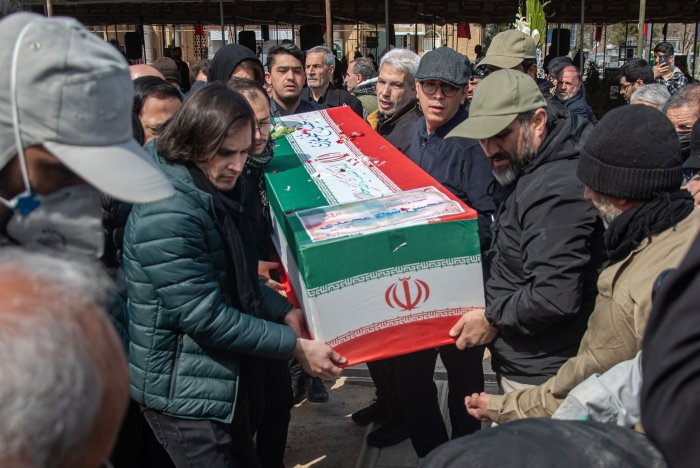
Larijani’s funeral drew huge crowds in Tehran.
Iran’s Basij paramilitary forces, whose leader was recently assassinated by Israel as we noted above, continues to hide under bridges, according to a video submitted to Iran International, the London-based, Persian language media outlet.
A Basij checkpoint on the Karaj-Tehran highway was operating under a bridge in western Tehran over fears of Israeli strikes, a citizen said in a video sent to Iran International. pic.twitter.com/J2TWO5d4Xd
— Iran International English (@IranIntl_En) March 18, 2026
Israel also said it killed a Hamas commander in Gaza.
The IDF says it killed a Hamas commander in the Gaza Strip yesterday who advanced the terror group’s “precision missile project.”
The strike killed Yahya Abu Labda, a commander in Hamas’s supply and logistics department.
— Emanuel (Mannie) Fabian (@manniefabian) March 18, 2026
With future Iranian threats in mind, NATO is deploying a second Patriot missile-defense system to Turkey’s Incirlik Air Base to bolster the alliance’s air defenses.
“In addition to the measures taken at the national level to ensure the security of our airspace and citizens, another Patriot system assigned by the Allied Air Command in Ramstein/Germany to the existing Spain Patriot system stationed in Adana is being deployed in Adana,” Turkey’s Defense Ministry announced. Adana is the home of Incirlik.
Since March 4, NATO air-defense systems in the eastern Mediterranean have intercepted three missiles launched from Iran toward Turkish airspace,Bloomberg News noted. “The attacks were likely designed to test the alliance’s capacity to respond,” people familiar with the matter told Bloomberg earlier.
“NATO can confirm that it has deployed another Patriot air defence system to Türkiye. It joins two others, including one Spain has deployed there for over a decade,” a NATO official told us. “While we cannot provide additional details about the deployment for operational security purposes, the system provides additional capability to further strengthen NATO’s defensive posture against any potential threat, as Iran continues its indiscriminate attacks across the region.”
Hava sahamızın ve vatandaşlarımızın güvenliğini sağlamak amacıyla millî düzeyde alınan tedbirlerin yanı sıra Adana’da konuşlu mevcut İspanya Patriot sistemine ilave olarak Ramstein/Almanya’daki Müttefik Hava Komutanlığı tarafından görevlendirilen bir Patriot sistemi daha Adana’da… pic.twitter.com/FmO8NuK0ti
— T.C. Millî Savunma Bakanlığı (@tcsavunma) March 18, 2026
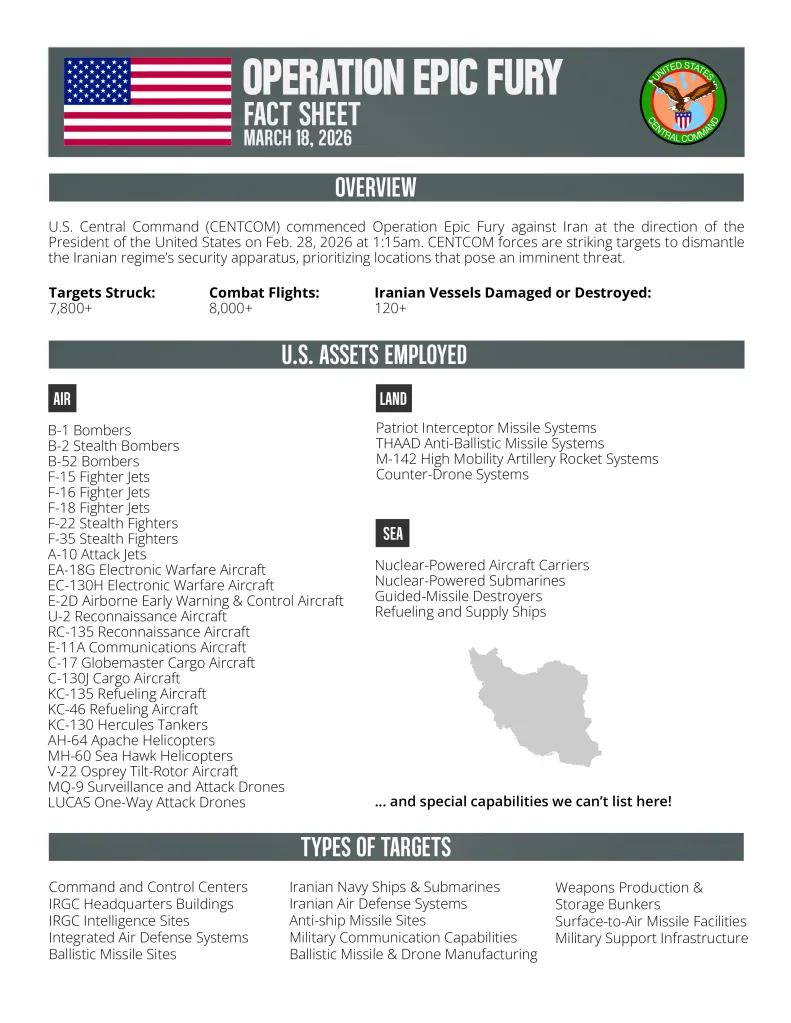
CENTCOM released its latest update on Epic Fury. The command said that so far, it has struck more than 7,800 targets, flown more than 8,000 combat sorties and destroyed or damaged more than 120 Iranian ships.
CENTCOM
CENTCOM released video showing targeting pod footage of a U.S. combat aircraft dropping bombs on the entrance of an Iranian missile base tunnel.
Targeting pod footage of an American fighter dropping a stack of bombs into the entrance of an Iranian missile base tunnel last Friday night. pic.twitter.com/c4MKweiRD1
The U.S. Navy’s America class amphibious assault ship USS Tripoli and San Antonio class amphibious warfare ship USS New Orleans were most recently spotted off the coast of Malaysia near Port Klang, according to open source investigator MT Anderson.
The ships were “pushing NW through the Strait of Malacca completely unescorted,” he noted.
As we previously reported, the Tripoli was ordered by the Pentagon to head toward the Middle East. The vessel is the centerpiece of an Amphibious Ready Group (ARG) that typically includes an assault ship, two transport docks, and a support vessel that carries an embarked Marine Expeditionary Unit (MEU) of at least 2,200 Marines.
THE NAKED SPRINT: Tripoli ARG Transits Malacca Unescorted
OSINT Update (MAR 17): The USS Tripoli (LHA-7) and USS New Orleans are currently off the coast of Malaysia near Port Klang, pushing NW through the Strait of Malacca completely unescorted.
Though the deployment of the Tripoli has sparked speculation that the U.S. could invade Iran’s Kharg Island or attempt to recover enriched uranium from Pickaxe Mountain, officials in Jerusalem are downplaying such possibilities.
“Despite numerous reports in recent days about a potential imminent and multi-sided US invasion of parts of Iran, including plans to retrieve 60% enriched uranium, The Jerusalem Post understands that these reports are exaggerated,” the publication reported. “It is still possible that the US could use ground forces in some fashion. But the images of a large-scale invasion and specifically the idea of an extended mission in Isfahan to retrieve the 60% enriched uranium, which is part of Iran’s nuclear program, do not appear to be in the cards, the Post has learned.”
EXCLUSIVE: Reports of large US invasion to seize Iran’s 60% enriched uranium buried under rubble at Isfahan which could be potentially used for nuclear weapons likely overblown: https://t.co/319qC42nn0
An Iranian strike “impacted an area at the Al Minhad Air Base in the United Arab Emirates, where the Australian Defense Force (ADF) has a long‑standing presence,” Australia’s Defense Ministry announced on X. “No ADF personnel were injured in the incident, and all ADF personnel deployed to the Middle East are safe and accounted for. The strike resulted in minor damage to an accommodation block and medical facility in the Australian section of the base.”
Statement on strikes on Al Minhad Air Base
On the morning of 18 March 2026 (AEDT), an Iranian strike impacted an area at the Al Minhad Air Base in the United Arab Emirates, where the Australian Defence Force (ADF) has a long‑standing presence.
Brent crude oil prices reached $110 a barrel on Wednesday afternoon, after Iranian state media reported that part of the South Pars gas field, the largest plant in Iran, and the Asaluyeh oil facility were struck by Israel.
ADVERTISEMENT
ADVERTISEMENT
Moreover, the US oil benchmark WTI also rose and is trading at $98 a barrel at the time of writing.
In response to the latest Israeli attacks, the IRGC announced that some Gulf energy sites are once again “legitimate targets”.
The prospect of escalation and prolongation of the conflict in the Middle East, resulting in further destruction of energy infrastructure, and consequently disruption to global markets, has sent oil prices higher once again.
The climb occurs despite other positive news that would normally have a dampening effect on energy markets.
Saudi Arabia confirmed on Wednesday that its biggest oil refinery, Ras Tanura, restarted operations on 13 March.
Additionally, the Trump administration officially announced a 60-day waiver of the Jones Act, a century-old maritime law that restricts the movement of cargo between US ports to vessels that are American-built, American-owned, American-flagged and crewed.
However, in the face of increased tensions and more attacks on oil infrastructure, these potentially mitigating developments have not had any effect in taming prices.
Trump administration confirms Jones Act waiver
The White House Press Secretary, Karoline Leavitt, confirmed the Trump administration’s decision to issue a 60-day waiver of the Jones Act.
The measure lifts the restriction on the movement of cargo between US ports, allowing foreign tankers temporarily and cheaply to transport vital resources such as oil, gas and fertilisers along the US coastline.
In a post on X on Wednesday, Leavitt explained that the decision is “just another step to mitigate the short-term disruptions to the oil market as the US military continues meeting the objectives of Operation Epic Fury.”
The last Jones Act waiver was issued in October 2022 for a tanker supplying Puerto Rico after Hurricane Fiona.
Before that, the Biden administration temporarily eased the law in 2021 for refiner Valero Energy, after a cyberattack crippled a major East Coast fuel pipeline.
Trump renews pressure on allies to secure the Strait of Hormuz
In a separate development, US President Donald Trump has renewed pressure on allies to join a naval escort mission in order to secure the Strait of Hormuz and normalise the circulation of vessels in the region.
In a post on Truth Social, President Trump argued that allied countries need to use the Strait of Hormuz while the US does not, and warned that they could be left managing it on their own in the aftermath of the war.
Since President Trump’s original request, no firm commitments have emerged, but on Monday, the Wall Street Journal reported that the White House plans to announce as early as this week that multiple countries have agreed to join the escort mission.
The report also stated that officials are still deliberating whether such an operation would start before or after the war ends.
After meeting in Brussels, EU foreign ministers discussed extending the bloc’s Aspides naval mission to the Strait of Hormuz, but ultimately declined to participate.
March 17 (UPI) — An unidentified projectile struck the premises of Iran’s Bushehr nuclear power plant on Tuesday evening, the U.N.’s nuclear watchdog said, raising fresh concerns about the risks the U.S.-Iran war poses to nuclear facilities in the region.
Little information about the strike was made public in the carefully worded and brief statement from the International Atomic Energy Agency, which said it had been informed that “a projectile hit the premises of the Bushehr NPP on Tuesday evening.”
“No damage to the plant or injuries to staff reported,” it said.
The IAEA’s director general, Rafael Grossi, reiterated his call “for maximum restraint during the conflict to prevent risk of a nuclear accident,” the agency said.
Located near Bushehr city on Iran’s southwest Persian Gulf coast, the Bushehr plant began construction in 1975, but its original German contractor abandoned the project following the Islamic Revolution four years later. In the mid-1990s, Russia agreed to complete Bushehr Unit 1, Iran’s first reactor, which began operating in 2011, according to the U.S. Congressional Research Service.
Rosatom, Russia’s state atomic energy corporation, said the projectile struck near the metrology service building in the vicinity of the plant’s operating power unit at 6:11 p.m. local time, according to Russian state-run TASS news agency.
“There were no casualties among personnel of the Rosatom State Corporation. Radiation levels at the site are normal,” Rosatom General Director Alexei Likhachev said.
The strike was the first on the premises of the nuclear power plant since the war between Iran and the United States and Israel began late last month, he noted.
The national power grid comes back on after Cuba’s 10 million people were plunged into darkness overnight.
Published On 18 Mar 202618 Mar 2026
Cuba has reconnected its power grid and brought online its largest oil-fired power plant, energy officials said, putting an end to a nationwide blackout that lasted more than 29 hours amid a United States move to choke off the island’s fuel supply.
After the country’s 10 million people had been plunged into darkness overnight, the Caribbean island’s national power grid had fully come back online by 6:11pm (22:11 GMT) on Tuesday. However, officials said power shortages may continue because not enough electricity is being generated.
Recommended Stories
list of 4 itemsend of list
In addition to cutting off oil sales to Cuba, US President Donald Trump has escalated his rhetoric against the Communist-run island, saying on Monday he could do anything he wanted with the country.
A US State Department official blamed the Cuban government for the grid collapse, calling blackouts a “symptom of the failing regime’s incompetence”.
Cuban President Miguel Diaz-Canel fired back at Washington, criticising its “almost daily public threats against Cuba”.
“They intend to and announce plans to take over the country, its resources, its properties, and even the very economy they seek to suffocate in order to force us to surrender,” Diaz-Canel wrote on social media on Tuesday night, shortly after power returned nationwide.
Cuba has yet to say what caused Monday’s nationwide grid failure, the first such collapse since the US cut off the island’s oil supply from Venezuela and threatened to slap tariffs on countries that ship fuel to the nation.
By midday on Tuesday, grid workers successfully fired up the Antonio Guiteras power plant, a decades-old behemoth that underpins the country’s power grid.
Daily blackouts
Electricity generation, hampered by dire fuel shortages and antiquated power plants, is still far below what is necessary to meet demand, providing scarce relief for Cubans already exhausted from months of blackouts.
Most Cubans, including those in the capital, Havana, were seeing 16 or more hours of blackout daily even before the latest grid collapse.
“It affects every aspect of our lives,” said Havana resident Carlos Montes de Oca, noting that the outages had thrown simple necessities such as food and water supply into disarray. “All we can do is sit, wait, read a book… otherwise the stress gets to you.”
Much of Cuba was overcast through the afternoon on Monday as a cold front neared the island, casting shadows on the solar parks that account for a third or more of daytime generation.
Cuba has received only two small vessels carrying oil imports this year, according to LSEG ship tracking data seen by Reuters on Monday. On Tuesday, a Hong Kong-flagged tanker that could be carrying fuel to Cuba resumed navigation after suspending its course weeks ago in the Atlantic Ocean, the data showed.
Cuba and the US have opened talks aimed at defusing the crisis, among the most acute since 1959, when Fidel Castro forced a US ally from power on the island.
Neither side has provided details of the ongoing negotiations, although Trump has portrayed Cuba as desperate to make a deal.
Cubans, no strangers to hardship, saw little choice but to stay calm.
“We still don’t have power at my house,” said Havana resident Juana Perez. “But we’ll take it in stride, as we Cubans always do.”
US President Donald Trump has reacted to the resignation of the US National Counterterrorism Centre’s director, Joe Kent, saying that he couldn’t work with somebody who didn’t believe Iran was a threat. Trump also said his decision to bomb Iran avoided a ‘nuclear holocaust’.
March 17 (UPI) — U.S. gasoline prices have surged by 27% and diesel by 34% since the start of U.S. attacks on Iran last month, fuel costs reported Tuesday indicate.
AAA reported that the national average cost for a gallon of gas in the United States was $3.79 Tuesday morning. Diesel was $5.044 per gallon, topping the $5 threshold for the first time in three years, CNBC reported.
A year ago, those prices were $3.078 and $3.592, respectively. A month ago, they were $2.917 and $3.651.
Fuel prices have been on the rise globally since the United States and Israel launched attacks on Iran on Feb. 28 amid negotiations over Iran’s nuclear program. The attacks, which killed Iran’s supreme leader, Ayatollah Ali Khamenei, prompted Tehran to effectively close down the Strait of Hormuz by banning ships linked to the United States or Israel. About 20% of the world’s oil runs through the waterway that separates Iran and Oman.
Brent Crude, the benchmark price for oil worldwide, rose about 2% to $102 a barrel Tuesday, The New York Times reported. The West Texas Intermediate, the U.S. benchmark, rose to $95 a barrel.
Diesel prices are particularly tied to the U.S. economy, which depends on it for the transportation of goods via trucks, trains and barges. Recent surges in prices could have a cascading effect.
Andy Lipow, president of Lipow Oil Associates, said Tuesday that trucking and rail companies have begun increasing their fuel surcharges in response to the fuel hikes.
“One should really be worried about higher diesel prices,” he said in a note published by CNBC.
President Donald Trump this week put pressure on other nations that rely on oil shipped through the Strait of Hormuz to join a coalition to police the transit route and reopen traffic.
Speaking aboard Air Force One on Sunday, Trump said the United States doesn’t need to be involved in reopening the Strait of Hormuz because little of its oil passes through the waterway. About 7% of the United States’ crude oil and condensate imports passed through the strait in the first half of last year, the U.S. Energy Information Administration said.
He said the United States was protecting it “almost like we do it for habit” and to help “some very good allies that we have in the Middle East.”
Patrick De Haan, head of petroleum analysis at GasBuddy, said Monday, “until we see a meaningful resumption of oil flows through the Strait of Hormuz, upward pressure on fuel prices is likely to persist.”
Iranians attend a funeral for a person killed in recent U.S.-Israel airstrikes at Behesht-e Zahra cemetery on the southern outskirts of Tehran in Iran on March 9, 2026. Photo by Hossein Esmaeili/UPI | License Photo
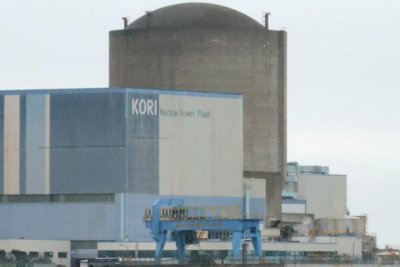
A view of South Korea’s first commercial nuclear reactor, Kori-1, in the southeastern port city of Busan. YONHAP / EPA
March 17 (Asia Today) —This commentary is the Asia Today Editor’s Op-Ed.
South Korea’s ruling Democratic Party and the government have decided to raise the operating rates of nuclear and coal-fired power plants to respond to rising oil prices triggered by the war in the Middle East, a move critics say marks a late reversal of the party’s long-standing opposition to nuclear energy.
Ahn Do-geol, secretary of the party’s economic task force on the Middle East crisis, said Monday the government will expand electricity generation from nuclear and coal plants to manage supplies of liquefied natural gas, or LNG, which has relatively limited reserves.
Under the plan, the government will lift a cap limiting coal-fired power generation to 80% of installed capacity and accelerate repairs on six nuclear reactors currently under maintenance. Two reactors are expected to return to service by the end of this month and four more by May, raising nuclear utilization rates from the current high-60% range to about 80%.
The decision signals a clear shift for the Democratic Party, which long supported a phase-out of nuclear energy.
Former President Moon Jae-in formally declared a nuclear phase-out policy in 2017, pledging to abandon nuclear-centered electricity generation after attending a ceremony marking the permanent shutdown of the Kori Unit 1 reactor.
At the time, Moon argued South Korea should move toward a nuclear-free era and halted or scrapped most plans to build new nuclear plants.
The party’s stance began to soften after the outbreak of the Russia-Ukraine war in 2022, which triggered global energy supply disruptions. Near the end of his presidency, Moon said nuclear power would need to remain a major baseload energy source for decades and called for delayed reactors including Shin Hanul Units 1 and 2 and Shin Kori Units 5 and 6 to begin operations as soon as possible.
The latest shift reflects renewed energy concerns linked to instability in the Middle East, which has pushed oil prices higher.
Supporters of nuclear power argue it remains a critical energy source despite safety risks highlighted by past disasters such as the Fukushima accident in Japan.
Opponents warn that nuclear accidents can cause catastrophic damage, pointing to the Zaporizhzhia nuclear plant in Ukraine, which has faced repeated safety concerns amid the ongoing war.
However, critics of the phase-out policy argue that abandoning nuclear energy without reliable alternatives risks creating energy shortages.
South Korea currently has only about nine days’ worth of LNG reserves, raising concerns about energy security during geopolitical crises.
Supporters of the policy shift say governments must adjust energy strategies as global conditions change but argue that long-term policies on energy and food security should be developed with careful planning rather than reactive decisions.
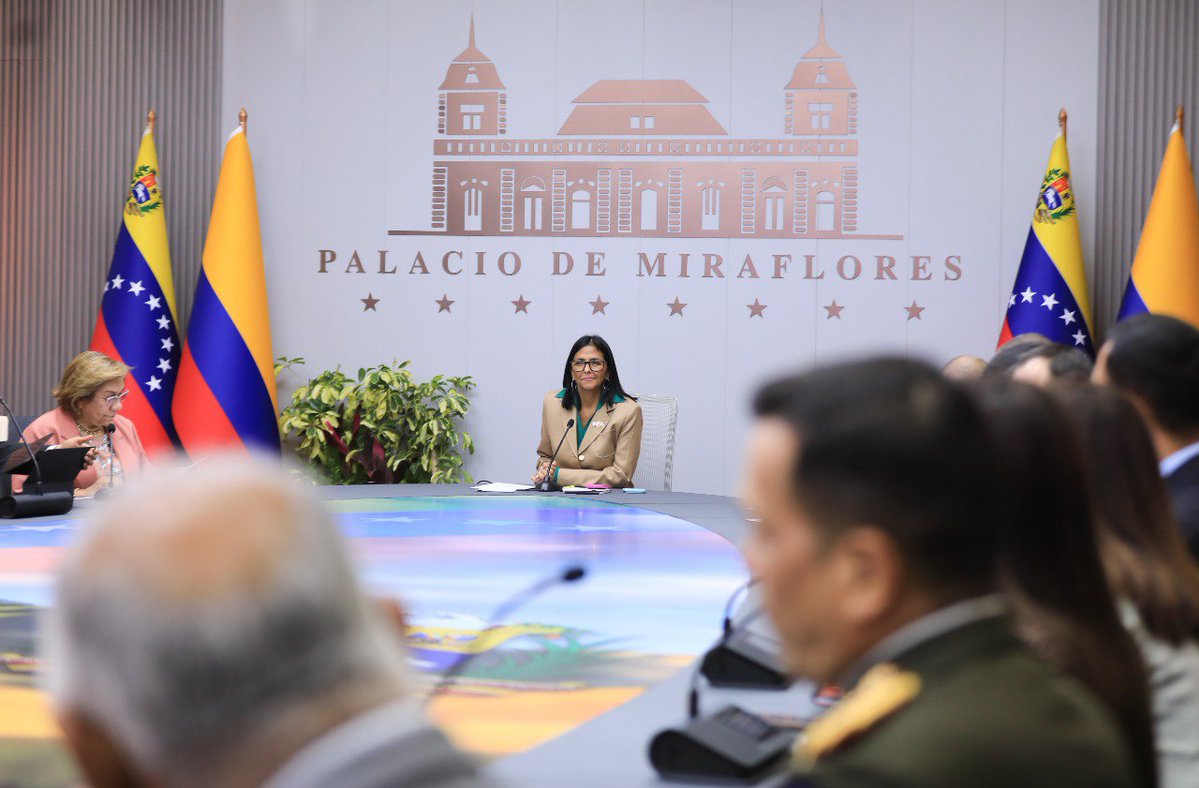
Acting President Delcy Rodríguez announced progress on the new bilateral agenda. (Prensa Presidencial)
Mérida, March 16, 2026 (venezuelanalysis.com) – Venezuelan and Colombian high-level delegations met at the Miraflores Palace in Caracas on Friday, March 13, to advance a strategic roadmap for binational integration.
The summit, which focused on bilateral trade, energy, and security, culminated in the announcement of Venezuela’s first-ever export of liquefied petroleum gas (LPG) to its western neighbor.
Acting President Delcy Rodríguez led the Venezuelan delegation in the talks, overseeing a satellite broadcast of the first trucks from state oil company PDVSA carrying butane gas across the Simón Bolívar International Bridge from Táchira to Norte de Santander.
“This is the first step… the first LPG export from Venezuela to Colombia,” Rodríguez stated to reporters, characterizing the shipment as a symbol of the “Bolivarian spirit” of integration.
Beyond the immediate truck shipments, officials announced plans to revitalize the Antonio Ricaurte transnational gas pipeline. The project aims to facilitate the direct export of Venezuelan natural gas to Colombian markets, a move described by both governments as essential for regional energy security.
However, Colombian President Gustavo Petro noted via social media that full interconnection remains contingent on the lifting of US sanctions given the need for infrastructure repair works. For her part, Rodríguez reiterated calls for the Trump administration to remove unilateral coercive measures against the Caribbean nation.
“Unilateral coercive measures against the Venezuelan people affect the peoples of Latin America,” she said.
The 225-kilometer Ricaurte pipeline was completed in 2007 and was initially used for Colombian gas shipments to Venezuela. Plans to reverse the flow beginning in 2016 were hampered by US sanctions.
The Caracas summit also saw delegations review the recovery of commercial ties since the reopening of the border in 2022. According to figures shared during the meeting, binational trade has grown from US $220 million in 2020 to over $1.135 billion at the close of 2024.
To sustain this momentum, officials announced that the Administrative Commission of the Trade Agreement will be formally installed on March 18. The agency’s agenda will focus on achieving “zero tariffs” for specific goods and promoting binational tourism.
The Colombian delegation also emphasized the importance of the Monómeros petrochemical company, noting that its operation at full capacity is vital for Colombia’s food security. The agrochemical producer was placed under the control of the US-backed Venezuelan opposition by former Colombian President Iván Duque. The company was plagued by corruption scandals before being returned to the Venezuelan government’s control in 2022.
Monómeros, a major supplier of fertilizer for Colombian potato, coffee and palm oil producers, remains restricted by US sanctions, with Venezuelan plans to sell the company to the Colombian state contingent on US Treasury approval.
The two countries’ delegations likewise addressed joint security concerns during the Friday talks, activating an immediate coordination mechanism for sharing military and police intelligence.
The stated objective is to dismantle drug trafficking networks and counter irregular armed groups operating along the 2,200-kilometer border region. Petro described the goal as a the creation of a “Binational Zone of Peace,” emphasizing the importance of integrated military efforts to protect the territory.
The Caracas summit took place following the suspension of a planned meeting between Rodríguez and Petro at the Atanasio Girardot Bridge on Friday due to “force majeure.” Colombian outlets reported security concerns but offered no specifics.
Despite the setback, the Venezuelan government reaffirmed that the presidential invitation remains open and that the working groups at Miraflores had secured the “roadmap” for the coming months.
Colombian Foreign Minister Rosa Villavicencio, who led the Petro government’s delegation, praised the Caracas summit as a “great success” and vowed that “no one can split the Colombian and Venezuelan peoples” due to their shared history.
In the wake of the meeting with Colombian counterparts, Rodríguez announced the appointment of Admiral Orlando Maniglia as the new Venezuelan Ambassador to Colombia. Maniglia, who previously served as Minister of Defense and Ambassador to Germany, will replace Carlos Eduardo Martínez.
The two countries’ integration agenda will continue with the meeting of a bilateral commission on April 23 and 24 in Maracaibo, Zulia state. The upcoming summit will focus on migration, citizen rights, and the facilitation of free circulation across the border.
United States President Donald Trump has called for a naval coalition to deploy warships to secure the Strait of Hormuz, through which one-fifth of world oil shipments transit, as oil markets reel from supply disruptions caused by the US-Israeli war with Iran.
What is essentially the closure of the Strait of Hormuz by Iran in response to the attacks by the US and Israel has sent oil prices soaring to more than $100 per barrel.
Iran’s new supreme leader, Mojtaba Khamenei, has promised to keep the maritime artery closed while another top official in Tehran warned that oil prices could shoot up beyond $200 per barrel.
Trump said he hoped a naval coalition could secure the vital waterway, which connects the Gulf to the Gulf of Oman and the Arabian Sea. Iran has struck more than a dozen ships trying to sail through the narrow waterway since the hostilities started two weeks ago.
But will Trump’s solution work?
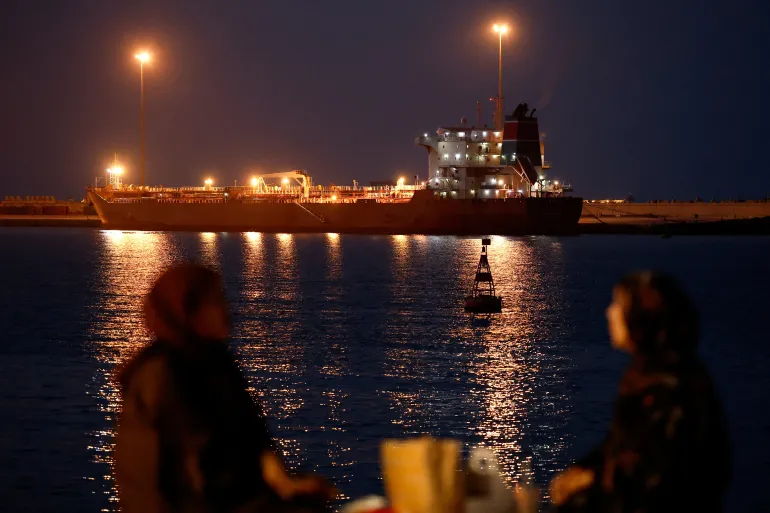
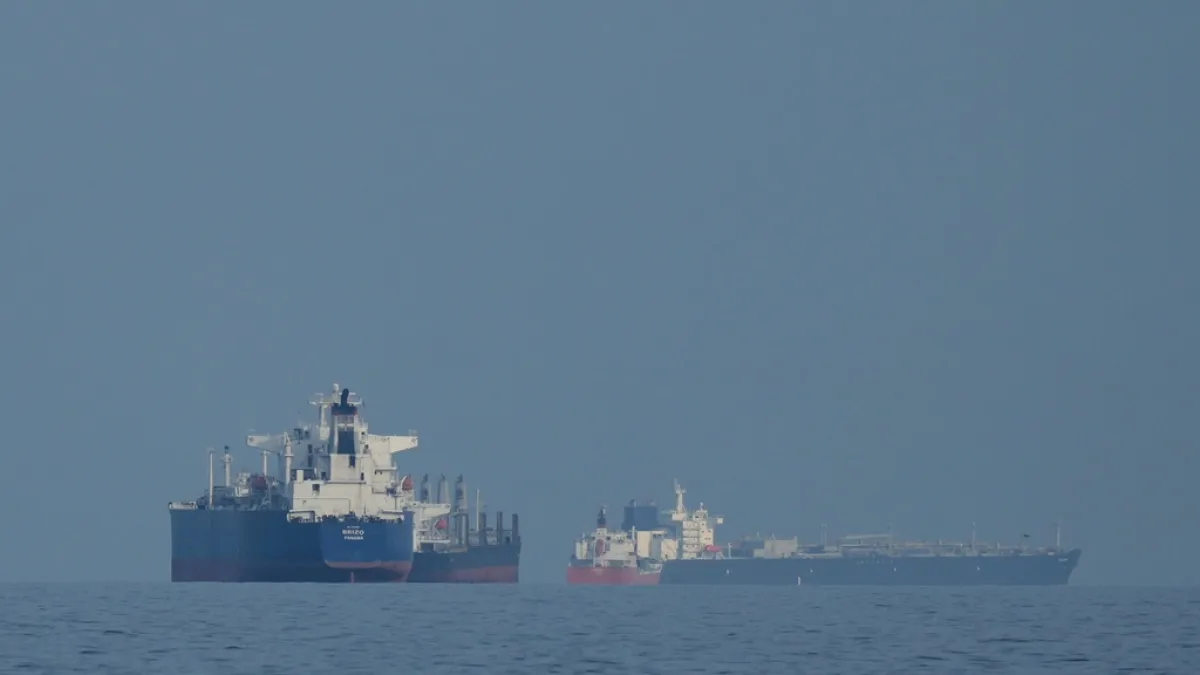
A tanker sits at anchor in Port Sultan Qaboos in Muscat, Oman, as oil shipments through the Strait of Hormuz have plummeted [File: Benoit Tessier/Reuters]
What has Trump said?
The US president has been facing domestic pressure over starting the war alongside Israel with no endgame or off-ramps in sight.
“On the strait of Hormuz, they had NO PLAN,” US Democratic Senator Chris Murphy wrote in a post on X. “I can’t go into more detail about how Iran gums up the Strait, but suffice it [to] say, right now, they don’t know how to get it safely back open.”
After threatening to bomb Iran more, Trump called on China, France, Japan, South Korea and the United Kingdom to send warships to secure the strait.
Trump claimed “100% of Iran’s military capability” had already been destroyed but added that Tehran could still “send a drone or two, drop a mine, or deliver a close-range missile somewhere along, or in, this waterway”.
“Hopefully China, France, Japan, South Korea, the UK, and others, that are affected by this artificial constraint will send ships to the area so that the Hormuz Strait will no longer be a threat by a nation that has been totally decapitated,” Trump wrote in a post on his Truth Social platform.
“In the meantime, the United States will be bombing the hell out of the shoreline, and continually shooting Iranian Boats and Ships out of the water. One way or the other, we will soon get the Hormuz Strait OPEN, SAFE, and FREE!”
Not long after, Trump returned to the keyboard, extending the invitation to all “the Countries of the World that receive Oil through the Hormuz Strait” to send warships, adding that the US would provide “a lot” of support to those who participated.
Israeli soldiers walk by a billboard commissioned by the evangelical Christian group Friends of Zion during the US-Israel war on Iran in Tel Aviv, Israel [File: Nir Elias/Reuters]
What has Iran said?
Alireza Tangsiri, commander of the Islamic Revolutionary Guard Corps Navy, said in a statement that claims by the US about destroying Iran’s navy or providing safe escort for oil tankers were false.
“The Strait of Hormuz has not been militarily blocked and is merely under control,” he said in a statement.
Iranian Foreign Minister Abbas Araghchi later doubled down on this, saying the strait remained open to international shipping except for vessels belonging to the US and its allies.
“The Strait of Hormuz is open. It is only closed to the tankers and ships belonging to our enemies, to those who are attacking us and their allies. Others are free to pass,” Araghchi said.
Khamenei – son of the late Supreme Leader Ali Khamenei, who was killed on the first day of the US-Israeli strikes – suggested in his first statement since taking power that the Strait of Hormuz would remain closed to provide leverage for Iran during the conflict.
F-18 combat aircraft are parked on the deck of the USS Abraham Lincoln aircraft carrier in the Gulf of Oman near the Strait of Hormuz during a 2019 deployment [File: Ahmed Jadallah/Reuters]
What are the challenges in the Strait of Hormuz?
The strait, which is just 21 nautical miles (39km) wide at its narrowest point, is the only maritime passage into the Arabian Gulf (known as the Persian Gulf in Iran). Shipping lanes in the waterway are even narrower and more vulnerable to attacks.
It separates Iran on one side from Oman and the United Arab Emirates on the other.
In brief, there is no way in or out by sea when the Strait of Hormuz is closed.
Alexandru Hudisteanu, a maritime security expert who served 13 years in the Romanian navy, told Al Jazeera that in the type of coalition that Trump is hinting at, “interoperability is the biggest hurdle.”
“That’s the ability of cruises to work together or with different units and different doctrine when basic communication would be an issue,” he said.
Then, there is the geography of the Strait of Hormuz: “a very unforgiving environment to sail with this type of wartime threats”, Hudisteanu said. “Especially difficult under missile threats and these asymmetric potential mines or unmanned systems that could damage or destroy ships.”
Providing escorts to ships would be a costly option, and it would pose risks to participating foreign warships from possible Iranian attacks, which would likely further drag more countries into the ongoing war.
From Iran’s point of view, “the fact that the shoreline is so close and the actual maritime passage is highly congested and confined is an advantage by default,” Hudisteanu added. Geographically, Iran keeps it as a gauntlet, with no way out for the ships unless Tehran allows it.
Another major challenge for any naval coalition trying to secure the passage would be the timeline of any operation. ”The security of the strait could be achieved. It’s just a matter of how much time you need and how many assets you need,” the analyst said. Rushing through it “could have negative implications for the security of the mission and the region”.
Smoke rises from the Thai bulk carrier Mayuree Naree near the Strait of Hormuz after an attack on March 11, 2026 [Handout/Royal Thai Navy via AFP]
How have countries responded?
No country has so far publicly agreed to Trump’s call to send warships to secure the Strait of Hormuz.
London said it is “intensively looking” at what it can do to help reopen the maritime passage. British Energy Secretary Ed Miliband said: “We are intensively looking with our allies at what can be done because it’s so important that we get the strait reopened.”
Chinese Ministry of Foreign Affairs officials said Beijing is calling for hostilities to stop and “all parties have the responsibility to ensure stable and unimpeded energy supply.”
Japan said the threshold is “extremely high” to send its warships on such a mission. “Legally speaking, we do not rule out the possibility, but given the current situation in which this conflict is ongoing, I believe this is something that must be considered with great caution,” said Takayuki Kobayashi, policy chief of Japan’s ruling Liberal Democratic Party.
France also confirmed that it will not send ships. The Ministry for Europe and Foreign Affairs said in a statement on Saturday: “Posture has not changed: defensive it is,” in reference to President Emanuel Macron’s assertion that France will not join the war against Iran.
South Korea, which imports 70 percent of its oil from the Gulf, said it was “closely monitoring” Trump’s statements and “comprehensively considering and exploring various measures … to ensure the safety of energy transport routes”.
(Al Jazeera)
Are countries negotiating with Iran?
Some countries have been negotiating with Iran to secure passage for their petroleum shipments.
Two Indian-flagged tankers carrying liquefied petroleum gas (LPG) have sailed through the Strait of Hormuz. New Delhi depends on this passage for 80 percent of its LPG imports.
The war on Iran has caused a critical shortage of cooking gas for India’s 333 million households. New Delhi has long had ties with Iran, but the government of Prime Minister Narendra Modi has not condemned the killing of Ali Khamenei. It has condemned Iran’s retaliatory attacks on Gulf countries, where millions of Indian citizens work and send $51bn in remittances home every year.
Iran’s ambassador to India, Mohammad Fathali, said Tehran had allowed some Indian vessels to pass through the Strait of Hormuz in a rare exception to the blockade but did not confirm the number of vessels.
A Turkish-owned vessel was similarly granted permission last week after Ankara negotiated passage directly with Tehran. Fourteen more Turkish vessels are awaiting clearance.
France and Italy also reportedly opened talks with Iranian officials to negotiate a deal to allow their vessels through the strait, but there has been no official confirmation yet.
“Iran is affecting maritime supply,” Hudisteanu said. “It’s affecting the maritime security of the region and the entire ecosystem and bringing the entire world to the table as the global price for oil and gas increases.”
Hundreds of tankers sit idle on both sides of the Strait of Hormuz as Iran has effectively closed the waterway, pushing oil prices above $100 – the highest since 2022, after the start of the Russia-Ukraine war.
Oil tanker traffic in the strait, through which one-fifth of global oil passes, has plunged after Israel and the United States launched attacks on Tehran on February 28. Asian countries, including India, China and Japan, as well as some European countries, source large portions of their energy needs from the Gulf. A disruption in supply will rattle the global economy.
With an aim to cushion from the shock, the International Energy Agency (IEA) has decided to release 400 million barrels of oil from emergency reserves, the largest coordinated drawdown in the agency’s history. But it has failed to push the prices down.
The agency had released about 182 million barrels after Russia’s invasion of Ukraine to stablise the oil prices.
According to the agency, oil shipments through the strategic waterway have fallen to less than 10 percent of pre-war levels, threatening one of the most critical arteries in the global energy system.
IEA members collectively hold about 1.25 billion barrels in government-controlled emergency reserves, alongside roughly 600 million barrels in industry stocks tied to government obligations.
A large number in a massive market
The figure may appear vast, but it shrinks quickly against the scale of global energy demand.
“This feels like a small bandage on a large wound,” energy strategist Naif Aldandeni said, describing the world’s largest coordinated emergency oil release as governments scramble to steady markets shaken by war.
The US Energy Information Administration (EIA) estimates world consumption of petroleum and other liquids will average 105.17 million barrels per day in 2026. At that rate, 400 million barrels would theoretically cover just four days of global consumption.
Even when compared with normal traffic through the Strait of Hormuz – around 20 million barrels per day – the released oil equals only about 20 days of typical flows.
Aldandeni told Al Jazeera that emergency reserves can calm panic in markets but cannot replace the lost function of a disrupted shipping corridor.
“The release may soften the shock and calm nerves temporarily,” he said, “but it will remain limited as long as the fundamental problem — the freedom of supply and tanker movement through Hormuz – remains unresolved.”
Oil prices reflect those anxieties. Brent crude ended trading on Friday at $103.14 per barrel, after surging to nearly $120 earlier as fears of disrupted production and shipping intensified.
Geopolitical risk premium
Oil expert Nabil al-Marsoumi said the price surge cannot be explained by supply fundamentals alone.
“The closure of the Strait of Hormuz added roughly $40 per barrel as a geopolitical risk premium above what market fundamentals would normally dictate,” he told Al Jazeera.
From that perspective, releasing strategic reserves serves primarily as a temporary tool to dampen that premium rather than fundamentally rebalance the market.
Prices above $100 per barrel are uncomfortable for major consuming economies already struggling to curb inflation and protect economic growth.
Recent EIA projections suggest global demand has not yet declined significantly because of the war, remaining close to 105 million barrels per day. The market pressure, therefore, stems less from falling consumption and more from fears of supply shortages and delays in deliveries to refineries and consumers.
Threats to oil infrastructure
The latest escalation could deepen those fears.
United States President Donald Trump said on Friday that the US Central Command (CENTCOM) had “executed one of the most powerful bombing raids in the History of the Middle East and totally obliterated every MILITARY target in Iran’s crown jewel, Kharg Island”.
He added that “for reasons of decency” he had “chosen NOT to wipe out the Oil Infrastructure on the Island”, but warned Washington could reconsider that restraint if Iran continues to disrupt shipping through the Strait of Hormuz.
CENTCOM confirmed the operation, stating US forces had struck “more than 90 Iranian military targets on Kharg Island, while preserving the oil infrastructure”.
Iranian officials have meanwhile warned they would target energy facilities linked to the US across the region if Iranian oil infrastructure comes under direct attack.
Kharg Island is not simply a military location. It serves as the primary export terminal for Iranian crude, making it a critical node in the country’s oil supply network.
If attacks move from obstructing shipping to targeting export infrastructure itself, the crisis could shift from a chokepoint disruption scenario to one involving direct losses of production and export capacity.
In such circumstances, the oil released from emergency reserves would act only as a temporary bridge rather than a lasting solution to lost supply.
Major oil companies such as QatarEnergy, the world’s largest producer of liquefied natural gas (LNG), Kuwait Petroleum Corporation and Bahrain state oil company Bapco have shut production and declared force majeure, while Saudi Aramco, the world’s largest oil producer, and UAE state oil company ADNOC have shut down their refineries.
Limits of emergency reserves
Even under a less severe scenario – where maritime disruption persists but infrastructure remains intact — the ability of strategic reserves to stabilise markets remains constrained by logistics.
The US Department of Energy said the US Strategic Petroleum Reserve held 415.4 million barrels as of 18 February 2026. Its maximum drawdown capacity is 4.4 million barrels per day, and oil requires about 13 days to reach US markets after a presidential release order.
That means even the world’s largest emergency stockpile cannot flood the market with crude immediately. The release must move through pipelines, shipping networks and refining capacity before reaching consumers.
Aldandeni said the current intervention would likely produce only a temporary stabilising effect, while al-Marsoumi warned that prolonged disruption in the Strait of Hormuz – or the spread of threats to other chokepoints such as the Bab al-Mandeb Strait in the Red Sea could quickly send prices further higher.
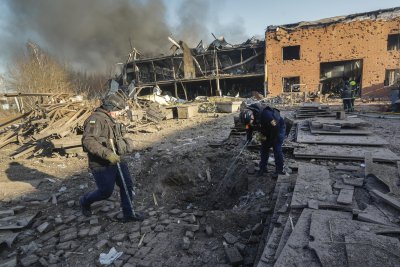
Ukrainian experts inspect a shell crater at the site of a Russian strike in Brovary near Kyiv, Ukraine, on Saturday amid the Russian invasion. Photo by Sergey Dolzhenko/EPA
March 14 (UPI) — Russian attacks on Kyiv overnight left at least four people dead and 15 injured, Ukrainian President Volodymyr Zelensky announced Saturday.
The missile and drone attacks hit four districts in the capital, bringing damage to schools, residential buildings and critical infrastructure, regional officials said, as reported by EuroNews. Zelensky said the attacks caused damage in Kyiv, Sumy, Kharkiv, Dnipro and Mykolaiv.
“The main target for the Russians was the energy infrastructure of the Kyiv region, but unfortunately, there were also direct hits on and damage to ordinary residential buildings, schools and civilian businesses,” Zelensky said in a post on X.
Zelensky said Russia used 430 drones and about 68 missiles to carry out the attacks, 58 of which were intercepted by Ukraine’s air defense system.
The president said the number of weapons used in the attack is a reminder to Ukraine’s partners that air defenses and missiles are a “daily necessity.”
“Every agreement on missile supplies cannot wait — everything must be implemented as quickly as possible,” Zelensky said. “Our agreements to increase the production of air defense missiles are a critical direction, and this direction requires one hundred percent attention.”
NBC News reported that Ukraine is waiting for the Trump administration to approve a major drone production deal.
He said Russia will attempt to take advantage of the new war in Iran and will benefit a surge in oil prices and from the United States easing sanctions on Russian oil to balance supply drops through the Hormuz Strait.
Russian officials said, meanwhile, that Ukrainian drones hit an oil refinery in the southern Krasnodar region.
March 14 (UPI) — President Donald Trump announced that U.S. forces “totally obliterated” every military target on Iran’s Kharg Island, a key port that exports the vast majority of Iran’s oil.
In a post on Truth Social on Friday evening, Trump described the attack as “one of the most powerful bombing raids in the History of the Middle East.”
He said he directed U.S. Central Command to carry out the bombings after Iran halted ships’ passage through the Straight of Hormuz. About 20% of the world’s crude oil passes through the strait.
“For reasons of decency, I have chosen NOT to wipe out the Oil Infrastructure on the island,” Trump wrote.
“However, should Iran, or anyone else, do anything to interfere with the Free and Safe Passage of Ships through the Strait of Hormuz, I will immediately reconsider this decision.”
Kharg Island is about 15 miles south of the Iranian mainland through which about 90% of the country’s oil exports pass, The Washington Post reported. It’s a critical piece of Iran’s economy and a full attack on the oil infrastructure there could hinder Iran’s ability to pay its military.
Iranian officials said the site was “proceeding normally” after the U.S. attack.
In response to Friday’s bombings on Kharg Island, Iran threatened its own attack on key oil infrastructure in the United Arab Emirates, CNN reported.
Oil has been a key factor in the war in Iran, which began Feb. 28 with surprise U.S. and Israeli airstrikes on dozens of Iranian sites. AAA reported Saturday that the average price of a gallon of gasoline was $3.68 in the United States, up 23% since the start of the war.
This could, in turn, have a dramatic impact on other aspects of the U.S. economy, including food prices, jet fuel and fertilizer.
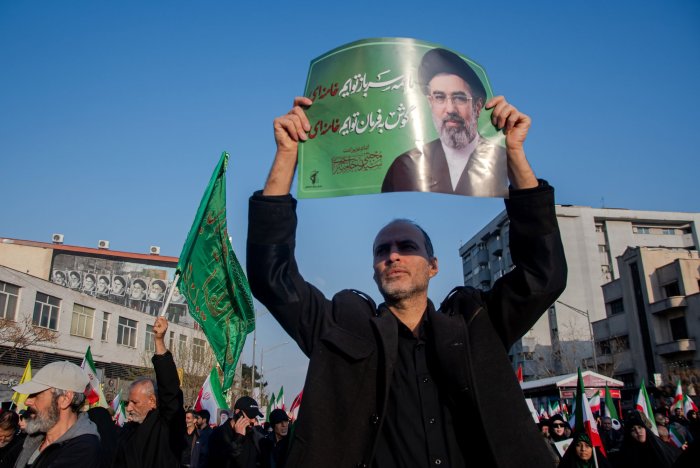
An Iranian man raises a portrait of new supreme leader Mojtaba Khamenei during a rally on Revolution Street in Tehran on March 9, 2026. Photo by Hossein Esmaeili/UPI | License Photo
Miguel Diaz-Canel says discussions held to find solutions ‘through dialogue’ as Washington tightens oil blockade.
Published On 13 Mar 202613 Mar 2026
Share
Cuban officials have held talks with the United States government to seek solutions to the crippling blockade imposed by Washington, President Miguel Diaz-Canel said, as the Trump administration’s threats to take over the Caribbean nation escalate.
“These talks have been aimed at finding solutions through dialogue to the bilateral differences we have between the two nations,” Diaz-Canel said in a video aired on national television on Friday.
Recommended Stories
list of 3 itemsend of list
Diaz-Canel said “international factors have facilitated these exchanges”.
He said no petroleum shipments have arrived on the island in the past three months, which he blamed on the US energy blockade.
Critical oil shipments from Venezuela were halted after the US attacked the South American country and abducted President Nicolas Maduro.
Cuba’s western region was hit by a massive blackout last week, leaving millions without power.
The talks come days after President Donald Trump levelled his latest threat at Cuba, saying the White House’s plans for the Caribbean nation may include a “friendly takeover”.
‘Impact tremendous’
Diaz-Canel added that Cuba, which produces 40 percent of its petroleum, has been generating its own power but that it hasn’t been sufficient to meet demand.
He said the lack of power has affected communications, education and transportation, and that the government has had to postpone surgeries for tens of thousands of people as a result.
“The impact is tremendous,” he said.
The president added that the aim was “to determine the willingness of both parties to take concrete actions for the benefit of the people of both countries”.
“And in addition, to identify areas of cooperation to confront threats and guarantee the security and peace of both nations, as well as in the region,” he said.
For decades, severe US economic sanctions on Cuba have crippled its economy and cut it off from global trade. In response, Cuba has depended on oil supplies from foreign allies, including Mexico, Russia and Venezuela.
Energy markets remain on tenterhooks as the prospect of prolonged war in the Middle East grows.
Published On 13 Mar 202613 Mar 2026
Share
Oil prices have again risen above $100 per barrel as energy markets see little relief amid the biggest disruption to global energy supplies in a generation.
Brent crude, the international benchmark, surged more than 9 percent on Thursday as traders weighed the prospect of weeks, or even months, of turmoil in energy markets as the United States and Israel wage war on Iran.
Recommended Stories
list of 4 itemsend of list
Brent futures, which are traded outside of regular market hours, were priced at $101.13 as of 03:00 GMT.
Asian stock markets, including exchanges in Tokyo, Seoul and Hong Kong, opened sharply lower on Friday, following steep losses on Wall Street overnight.
The latest surge in oil prices came after Iran’s Supreme Leader Mojtaba Khamenei pledged to maintain the effective closure of the Strait of Hormuz, which normally transports about one-fifth of global oil supplies.
In a statement read out on his behalf on Iranian state television, Khamenei described Tehran’s threats against shipping in the waterway as a “lever” that “must continue to be used”.
US President Donald Trump struck a similarly defiant tone on Thursday, posting on Truth Social that stopping Iran from getting nuclear weapons was of “far greater interest and importance” than rising oil prices.
‘Lack of tangible goals in this war’
Traffic through the strait has effectively ground to a halt due to Iranian threats, with only a handful of vessels passing through each day, many of them claiming links to China, Iran’s key economic partner.
According to the United Kingdom Maritime Trade Operations (UKMTO) centre, no more than five ships have passed through the waterway each day since the US and Israel launched joint strikes on Iran on February 28, compared with an average of 138 daily transits before the war. At least 16 commercial vessels have been attacked in the region since the start of the conflict, according to the UKMTO.
Tehran has claimed responsibility for several of the attacks, including a strike on Wednesday that crippled a Thai-flagged vessel off the coast of Oman.
Efforts to bring calm to the market have so far done little to tame prices, which are up nearly 40 percent compared with before the start of the war.
The International Energy Agency’s (IEA) announcement on Wednesday that member countries would release 400 million barrels of oil from emergency stockpiles drew a tepid response among traders eyeing a daily shortfall in global supplies estimated at 15-20 million barrels.
The US Department of the Treasury’s issuance on Thursday of a temporary licence authorising countries to purchase sanctioned Russian oil that has been stranded at sea also failed to move the market, with Brent crude staying above $100 a barrel after the Treasury announcement.
“The key problem is a lack of tangible goals in this war,” said Adi Imsirovic, an energy security expert at the University of Oxford.
“It makes it hard for oil traders to see the light at the end of the tunnel,” he said.
Trump has repeatedly floated the possibility of using the US Navy to escort commercial shipping through the strait, but the Pentagon has yet to conduct such operations amid concerns about the risks posed by Iranian attacks in the narrow waterway.
In an interview with CNBC on Thursday, US Energy Secretary Chris Wright said that Washington was “not ready” to provide navy escorts but that such operations could begin by the end of the month.
“It’ll happen relatively soon but it can’t happen now,” Wright said.
The United States military is “not ready” to accompany oil ships through the Strait of Hormuz, a top official in President Donald Trump’s administration says as Iran continues to block the strategic waterway.
US Energy Secretary Chris Wright told the CNBC business news channel on Thursday that the markets are experiencing a “short-term disruption”, predicting that the war would go on for “weeks, not months”.
Recommended Stories
list of 3 itemsend of list
Despite Trump’s repeated threats, Iran has largely succeeded in shutting down the strait, which links the Gulf to the Indian Ocean. The closure has sent oil prices soaring.
Wright described the effects of the crisis as “short-term pain for long-term gain”, arguing that the US is “destroying” Iran’s ability to threaten the energy market.
Last week, Trump suggested that the US Navy would escort ships through the Gulf, but Wright said on Thursday that the move “can’t happen now”.
“We’re simply not ready. All of our military assets right now are focused on destroying Iran’s offensive capabilities and the manufacturing industry that supplies their offensive capabilities,” the energy secretary said.
“We don’t want this to be a brush-off for a year or two. We want to permanently destroy their ability to build missiles, to build roads, to have a nuclear programme.”
His comments came as Iran’s new supreme leader, Mojtaba Khamenei, affirmed in his first public comment since being selected to succeed his assassinated father, Ali Khamenei, that the Strait of Hormuz should remain closed during the war.
“The will of the people is to continue effective and deterrent defence,” Khamenei said in a written statement. “The tactic of closing the Strait of Hormuz must also continue to be used.”
The Iranian military has said it would “welcome” the US Navy escorting oil ships, suggesting it is prepared to strike US forces in the narrow waterway.
On Wednesday, three commercial vessels were attacked near the strait.
Wright announced earlier this week on social media that the US Navy had escorted an oil ship through the strait, then quickly deleted the post. The White House subsequently confirmed that the claim was not true.
It is not clear why the statement was released and then retracted.
Assurances by US officials that Washington would open the strait have temporarily calmed markets, only for prices to spike again.
The price of a barrel of oil peaked at about $120 on Sunday, up from about $70 before the US and Israel launched the war on February 28. It has been yo-yoing between $80 and $100 for the past few days.
In addition to the marine blockade, Iran has targeted oil installations across the Gulf.
As one of the world’s largest oil producers, the US is largely self-sufficient. But possible shortages in Asia and Europe have put a strain on prices globally.
According to data from the American Automobile Association, the average price of one gallon (3.78 litres) of petrol in the US is now $3.60, up from $2.94 last month.
Rising energy prices could fuel inflation and affect the cost of basic goods, including food.
But Trump suggested on Thursday that the US is benefitting from skyrocketing oil prices.
“The United States is the largest Oil Producer in the World, by far, so when oil prices go up, we make a lot of money,” the US president wrote in a social media post.
“BUT, of far greater interest and importance to me, as President, is stopping an evil Empire, Iran, from having Nuclear Weapons, and destroying the Middle East and, indeed, the World.”
Iran denies seeking a nuclear weapon, and Trump reiterated for months before the current conflict that US strikes against Iranian facilities in June had “obliterated” the country’s nuclear programme.
Iranian President Masoud Pezeshkian has laid out terms for ending the war with the United States and Israel in what analysts say is a possible sign of de-escalation from Tehran as the US-Israel war on Iran entered its 13th day on Thursday.
In a post on Wednesday on social site X, Pezeshkian said he had spoken to his counterparts in Russia and Pakistan, and that he had confirmed “Iran’s commitment to peace”.
Recommended Stories
list of 4 itemsend of list
“The only way to end this war – ignited by the Zionist regime & US – is recognizing Iran’s legitimate rights, payment of reparations, and firm int’l guarantees against future aggression,” Pezeshkian wrote.
This is a rare posture from Tehran, which has maintained a defiant stance and initially rejected any possibility of negotiations or a ceasefire when war broke out nearly two weeks ago.
Pezeshkian’s statement comes as pressure mounts on the US to halt what has become a very costly mission. Analysts say speculation from Washington that Iran would quickly submit after the killing of Supreme Leader Ayatollah Ali Khamenei were misguided.
Tehran is likely going to determine the end of this war, not the US or Israel, because of its ability to inflict economic pain broadly, they say.
Amid a military pummelling by the US and Israel, Iran has launched heavy retaliatory strikes at US assets and other critical infrastructure in Gulf countries, upsetting global supplies. It has also adopted what analysts call “asymmetric” tactics – such as disrupting the critical Strait of Hormuz and threatening US banking-linked entities – to inflict as much economic pain on the region and wider world as it can.
This is what we know about Pezeshkian’s stance and what the pressures are on both sides to draw the conflict to a close, quickly.
A building lies in ruins after a strike, amid the US-Israeli conflict with Iran, in Tehran, Iran, on March 12, 2026 [Majid Asgaripour/WANA (West Asia News Agency) via Reuters]
What has the war cost so far?
Economically, both sides have weaponised energy. Israel first targeted Iran’s oil facilities in Tehran on March 8, prompting an outcry from global health experts over the potential risk of air and water pollution.
Iran has, meanwhile, tightened its chokehold on the Strait of Hormuz shipping route – the only route to open sea for oil producers in the Gulf – with its military promising on Wednesday that it has the capabilities to wage a long war that could “destroy” the world economy.
Attacks on ships in the strait, through which about 20 percent of global oil and gas traffic normally passes, have effectively closed the route.
Oil prices rocketed above $100 per barrel late last week, up from around $65 before the war, with ordinary buyers feeling the increases at pumps in the US, Europe and parts of Africa.
On Wednesday, Iran upped the ante, saying it would not allow “a litre of oil” to pass through the strait and warned the world to expect a $200-per-barrel price tag.
“We don’t know how quickly it’ll revert back,” Freya Beamish, chief economist at GlobalData TS Lombard, told Al Jazeera. “We do think it’ll revert back to $80 in due course, but the ball is to some degree in Iran’s court,” she said, adding that because Iran needs oil revenue, the price hikes are expected to be time-limited.
The International Energy Agency agreed on Wednesday to release 400 million barrels from the emergency reserves of several member states but it is not yet clear what impact that will have, nor how quickly this quantity of oil can be released.
Tehran has also been accused of directly attacking oil facilities in neighbouring countries this week. Iraq shut all its oil port operations on Thursday after explosive-laden Iranian “drone” boats appeared to have attacked two fuel tankers in Iraqi waters, setting them ablaze and killing one crew member.
A drone was filmed striking Oman’s Salalah oil port on Wednesday, although Tehran has denied involvement.
What are Iranian officials saying about ending the war?
There has been conflicting messaging from the Iranian leadership.
Iran’s elite army unit and parallel armed force, the Islamic Revolutionary Guard Corps (IRGC), continues to show defiance, issuing threats and launching attacks on Israel and US military assets and infrastructure in neighbouring Gulf countries.
However, the political leadership has appeared more inclined towards diplomacy, analysts say. On Wednesday, President Pezeshkian said that ending the war would take the US and Israel recognising Iran’s rights, paying Iran reparations – although it’s unclear how much is being asked for – and providing strong guarantees that a future war will not be waged.
In a video recording last week, he also apologised to neighbouring countries for the strikes and promised that Iran would stop hitting its neighbours as long as they do not allow the US to launch attacks from their territory.
“I personally apologise to the neighbouring countries that were affected by Iran’s actions,” the president said, adding that Tehran was not looking for confrontations with its neighbours.
However, it is not known how much sway the political leadership has over the IRGC. Hours after the president’s apology last week, air defence sirens went off in Saudi Arabia, Qatar, the UAE and Bahrain, as strikes continued on the Gulf.
So, what is Iran’s actual position?
“Iran wants to go to the end to make sure that the United States and Israel never attack Iran again … so this has to be the final battle,” Al Jazeera’s Resul Serdar Atas explained.
Indeed, the IRGC sees this as an existential war, but the timing of Pezeshkian’s statement about ending the conflict also shows Tehran is pressured economically, politically and militarily, Zeidon Alkinani of Qatar’s Georgetown University told Al Jazeera.
“These differences and divisions [between IRGC and political leaders] always existed even prior to this war but we may notice it now more, given the fact that the IRGC believes that it has the right to take the front seat in leading this regional war, which is why a lot of the statements and positions are contradicting with the official ones from Pezeshkian,” he said.
The IRGC reports directly to Iran’s Supreme National Security Council (SNSC) and not to the country’s political leadership. That council is led by Ali Larijani, a top politician and close aide to the late supreme leader, Ali Khamenei, who analysts describe as a “hardliner”.
In a post on X on Tuesday, Larijani responded to threats from Trump about attacks on the Strait of Hormuz, saying: “Iranian people do not fear your hollow threats; for those greater than you have failed to erase it … So beware lest you be the ones to vanish.”
The newly elected supreme leader, Mojtaba Khamenei, was once in the IRGC and was put forward by the unit as the next ayatollah after his father was killed on the first day of the war, analysts say. He is thus not expected to follow the reformist, diplomatic ideals of President Pezeshkian and other political leaders which his father managed to marry with the IRGC militarised stance, they say.
Mojtaba Khamenei, son of Iran’s late Supreme Leader Ayatollah Ali Khamenei, attends a gathering in Tehran on March 2, 2016. Iran marked the appointment of Ayatollah Mojtaba Khamenei to replace his father as its supreme leader with a barrage of missiles against Israel and the Gulf states [File: Rouhollah Vahdati/ISNA via AFP]
What do the US and Israel say about ending the war?
There have also been conflicting messages from the Trump administration and Israel regarding when the war mission on Iran, codenamed Operation Epic Fury, is likely to end.
Trump told US publication Axios on Wednesday that the war on Iran would end “soon” because there’s “practically nothing left to target”.
“Anytime I want it to end, it will end,” he added. He had said earlier on Monday that “we’re way ahead of our schedule” and that the US had achieved its goals, even as speculation mounts about a possible US ground mission.
On the other hand, Israel’s Defence Minister Israel Katz said on Wednesday that the war would go on “without any time limit, for as long as necessary, until we achieve all the objectives and decisively win the campaign”.
Analysts say Trump’s stance that the conflict will be quick reflects increasing pressure on his administration ahead of upcoming mid-term elections in November.
Trump’s advisers privately told him this week to find a quick end to the war and avoid political backlash, according to reporting by The Wall Street Journal. That came as polls from Quinnipiac University and The Washington Post suggested that most Americans are opposed to the war in Iran.
In his 2024 presidential campaign, Trump promised to lower prices, and inflation had stabilised at 2.4 percent ahead of the war, according to government data released on Wednesday. Analysts speculate the conflict will likely push it back up.
The US spent more than $11.3bn in the first six days of the war, Pentagon officials told lawmakers in a classified briefing on Tuesday, Reuters reported this week – nearly $2bn a day.
The Washington-based think tank, Center for Strategic and International Studies (CSIS), estimated that the war cost Washington $3.7bn in its first 100 hours alone, or nearly $900m a day, largely due to its expenditure on costly munitions.
“It’s quite ironic that [Trump] chose a war that would make affordability worse, not better,” Rebecca Christie, a senior fellow at the Bruegel think tank, told Al Jazeera’s Counting the Cost.
“Every time the US loses even one object, air defence or a plane or something like that, that represents an awful lot of money that could have been used on some of these issues that have an impact on people’s day-to-day lives in the United States.”
The surge in oil prices triggered by the war in Iran is increasingly becoming a major concern for global central banks, which are closely monitoring the potential economic and financial consequences of the shock.
More than a week of conflict in the Middle East has disrupted energy supply routes and pushed crude prices sharply higher, raising fresh fears about inflation. For policymakers already grappling with fragile economic conditions, the oil spike presents a complex policy dilemma.
Historically, oil shocks have posed a difficult challenge for central banks. Rising energy prices can drive inflation higher while simultaneously weakening consumer spending and business activity by raising costs. In such circumstances, policymakers face an uncomfortable choice: tighten policy to control inflation or ease financial conditions to support economic growth and employment.
The current situation could potentially produce both outcomes at once, creating a scenario where inflation rises even as economic demand weakens a combination that complicates monetary policy decisions.
Inflation Versus Economic Growth
Central banks traditionally respond to inflationary pressures by raising interest rates or maintaining tighter monetary policy. Some policymakers argue that responding quickly to inflation triggered by an oil shock can prevent inflation expectations from becoming entrenched and reduce longer-term economic damage.
Others, however, advocate “looking through” temporary energy-driven price spikes, arguing that aggressive tightening could unnecessarily damage economic growth. This approach gained prominence after the pandemic, when many central banks initially viewed inflation as temporary a judgment widely criticised in hindsight.
The decision facing policymakers now depends on several uncertainties, including how long the conflict lasts, how severely energy supplies are disrupted, and whether governments intervene with subsidies or price caps to protect consumers.
Given these unknowns, many central banks may prefer to adopt a cautious approach, waiting to see how markets and economic conditions evolve before making significant policy adjustments.
Financial Stability Risks Enter the Picture
Beyond inflation and growth concerns, central banks must also consider a third responsibility that has gained prominence since the global financial crisis: financial stability.
Senior policymakers worry that the oil shock could expose vulnerabilities that have been building in global financial markets for years. A large macroeconomic disturbance involving energy prices, inflation, interest rates and currency volatility could trigger a broader financial stress event.
Much of the concern centres on the growing role of “shadow banking” institutions, financial intermediaries operating outside traditional banking regulation. These entities have become increasingly important providers of credit to companies and governments.
One major area of focus is the rapid expansion of private credit funds, which now manage more than $3 trillion globally. These funds allow asset managers to lend directly to businesses, often outside the scrutiny of public markets or traditional banking standards.
Regulators worry that during a major shock, investors could rapidly withdraw funds from these vehicles, potentially creating liquidity problems for borrowers and spillover risks for banks that help finance or manage the funds.
Pressure in Bond and Repo Markets
Another major source of concern lies in government bond markets, where highly leveraged hedge funds have become increasingly active. Many of these funds use repurchase agreements, or “repo” markets, to borrow money and finance large trades involving government bonds.
These strategies often rely on exploiting small price differences between cash bonds and futures contracts, but they involve substantial leverage. While such activity can help smooth government financing, it can also create systemic vulnerabilities during periods of market stress.
The Financial Stability Board, which monitors risks to the global financial system for the G20, warned earlier this year that sudden deleveraging in repo markets could disrupt sovereign bond markets.
More than $16 trillion in repo transactions backed by government bonds were outstanding last year, with about 60% concentrated in the United States. A sudden withdrawal of leveraged investors could therefore have significant ripple effects across global financial markets.
New Fragilities: Stablecoins and Technology Stocks
Regulators are also monitoring emerging risks linked to digital finance. Stablecoins cryptocurrencies pegged to traditional currencies such as the U.S. dollar have grown rapidly and are increasingly investing reserves in government bonds.
With the stablecoin market now worth roughly $300 billion and expanding, any loss of confidence in these assets could trigger large-scale sales of the bonds that back them. Such an event could add stress to already volatile financial markets.
At the same time, some investors remain concerned about high valuations and heavy market concentration in the rapidly growing artificial intelligence sector, which could amplify market volatility during periods of economic uncertainty.
Analysis: Oil Shock Could Trigger Wider Financial Stress
The Iran war oil shock illustrates how geopolitical crises can interact with financial vulnerabilities to create broader economic risks.
Higher energy prices directly increase inflation and strain household finances. At the same time, they can force central banks to reconsider interest-rate policies, potentially leading to higher borrowing costs and greater volatility in financial markets.
Such conditions could expose weaknesses in highly leveraged sectors of the financial system, particularly in shadow banking, hedge funds and digital financial markets.
Although previous shocks including the economic turmoil following Russia’s invasion of Ukraine did not ultimately trigger a major financial crisis, policymakers remain cautious. The brief turmoil in the U.S. regional banking sector in 2023 demonstrated how quickly financial stress can emerge when economic conditions shift.
If oil prices remain elevated and central banks are forced to respond aggressively, the resulting tightening of financial conditions could amplify existing vulnerabilities across markets.
For now, the disturbances appear manageable. But the combination of geopolitical conflict, energy market disruption and financial fragility ensures that central banks will continue to watch the situation with increasing concern.
The war involving Iran, United States and Israel is increasingly affecting energy supplies far beyond the Middle East, with Bangladesh now scrambling to secure fuel imports after disruptions to regional shipping routes.
Bangladeshi officials say the country has begun receiving diesel shipments from suppliers including China and India, allowing authorities to secure enough fuel to meet roughly one month of national demand. Arrangements are also being made to secure supplies for an additional month.
The South Asian nation of about 175 million people depends heavily on imported energy, with roughly 95% of its fuel requirements sourced from abroad. The disruption of Middle Eastern oil flows following the war has therefore exposed Bangladesh to severe supply risks.
Fuel Rationing and Economic Disruptions
To manage the supply shortage, authorities have introduced emergency measures including fuel rationing for vehicles, restrictions on diesel sales and the temporary closure of universities.
Energy shortages are also affecting Bangladesh’s critical export industries. The country is the world’s second-largest clothing exporter after China, and many garment factories rely on diesel-powered generators during power outages.
Industry leaders say the situation has worsened since the conflict began in late February. Power cuts have doubled to as much as five hours per day, forcing factories to rely more heavily on backup generators.
Mahmud Hasan Khan, president of the Bangladesh Garment Manufacturers and Exporters Association, said many companies are struggling to obtain sufficient diesel to keep their operations running during electricity outages.
The shortages threaten to disrupt production in one of Bangladesh’s most important economic sectors, which accounts for the majority of the country’s export earnings.
Emergency Diesel Shipments Arrive
To stabilise supplies, the state-run Bangladesh Petroleum Corporation (BPC) has arranged diesel shipments from international traders.
Energy officials say around 60,000 metric tons of diesel are currently being delivered by three trading companies, with another 90,000 metric tons expected to arrive later this month.
A cargo of approximately 27,000 metric tons from PetroChina has already arrived at Chittagong Port, while another shipment of roughly 28,000 metric tons from Vitol is waiting at the port’s outer anchorage.
Additional supplies are also arriving through a cross-border pipeline from India’s Numaligarh Refinery, which is currently providing about 5,000 metric tons of diesel. Officials said negotiations are underway to secure a further 30,000 metric tons from Indian Oil Corporation.
Bangladesh typically consumes about 380,000 metric tons of diesel each month. However, officials estimate that rationing measures have reduced current demand to around 270,000 metric tons per month.
Oil Imports Threatened by Hormuz Disruptions
While refined diesel cargoes have continued to arrive, Bangladesh faces greater risks in securing crude oil shipments for its domestic refineries.
The country imports about 1.4 million metric tons of crude oil annually under long-term supply agreements with Saudi Aramco and Abu Dhabi National Oil Company.
However, shipments from these suppliers must travel through the strategically vital Strait of Hormuz, which has been heavily disrupted by the war. Officials say at least one cargo of around 100,000 tons from Saudi Aramco has already been delayed in the Gulf due to the ongoing crisis.
The Strait of Hormuz is one of the world’s most important energy transit routes, and any prolonged disruption could have far-reaching consequences for countries heavily dependent on imported fuel.
Gas Shortages Add to Energy Crisis
Bangladesh’s energy difficulties extend beyond diesel shortages. Severe natural gas shortages have already forced the closure of four of the country’s five state-run fertiliser factories.
Authorities have redirected the available gas supply toward electricity generation in an effort to stabilise power production during the crisis.
The combination of diesel shortages, disrupted oil imports and limited gas supplies is placing growing pressure on Bangladesh’s energy system at a time when global fuel markets are already experiencing heightened volatility.
Analysis: Energy Dependence Exposes Economic Vulnerability
Bangladesh’s struggle to secure diesel supplies illustrates how the war involving Iran is affecting energy-importing economies far beyond the immediate conflict zone.
Countries that rely heavily on imported fuel are particularly vulnerable to disruptions in global energy shipping routes, especially those linked to the Strait of Hormuz. Even temporary interruptions can lead to fuel shortages, higher prices and broader economic disruption.
For Bangladesh, the situation highlights the structural risks created by its dependence on imported energy. Industries such as garments, which rely on stable electricity supplies and backup diesel generators, are especially exposed to supply shocks.
Although emergency shipments from China and India have temporarily stabilised supplies, the situation remains fragile. If the conflict in the Middle East continues to disrupt oil shipments or drive up prices, Bangladesh could face prolonged energy shortages with significant implications for its economy and export industries.