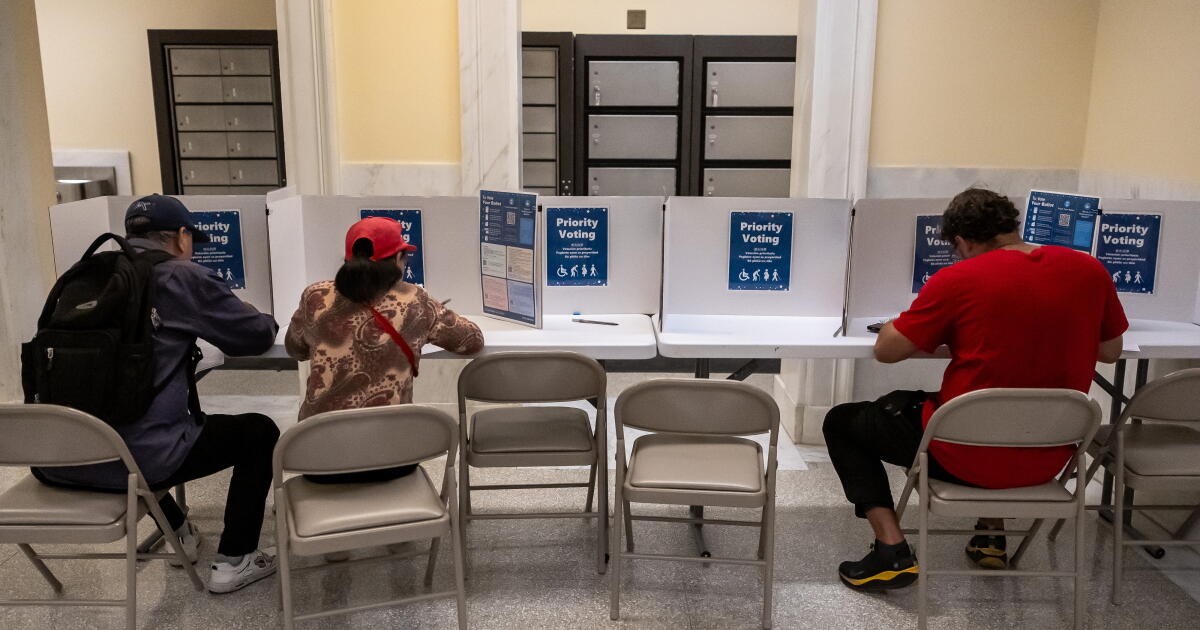
Los Angeles County voters are concerned about a host of voter fraud issues that could disrupt the Nov. 3 general election, even though they have a high degree of confidence in local elections officials, according to a new poll funded by the nonprofit California Community Foundation.
Nearly three-quarters of respondents expressed concern that false rumors and misleading information online could confuse voters or make them believe that their vote won’t count, the poll found. Other top concerns included politicians interfering with the election and mail-in ballots getting lost, stolen or delayed.
Still, most of the voters surveyed expressed confidence in the county’s handling of election proceedings, with 68% saying L.A. County does an excellent or good job at running elections and counting ballots.
Once presented with information about how the county handles elections, that number rose to 72%. Around three-quarters of respondents also believe that the upcoming election will be fair, secure and accurate, the poll found.
The online poll was conducted from Sept. 30 to Oct. 6 by Tulchin Research, a San Francisco-based public opinion firm. It surveyed 500 voters in L.A. County considered likely to cast ballots in the Nov. 3 election and has a margin of error of 4.4%.
“Voters feel good about the local officials running their elections. So, reinforcing the fact that that is who’s in charge of the election and how the process works is reassuring to folks,” said Ben Tulchin, the polling company’s president. “It … reduces their anxiety about some of the outside criticism that California, L.A. County faces.”
The poll was funded by the California Community Foundation, which awards millions of dollars in grants to local charitable groups, to support the “A Count You Can Trust Coalition,” an initiative aimed at enhancing trust in local elections.
Recent polling has suggested that potential federal interference in the Nov. 3 election is a top concern statewide for California voters. The local poll was administered to shed light on how L.A. County voters feel, said former Los Angeles Mayor Antonio Villaraigosa, who co-chairs the A Count You Can Trust group with Miguel Santana, who leads the California Community Foundation.
“This is the epicenter of the California vote,” Villaraigosa said. “The concern is not as great as it is statewide. Here in L.A. County, people seem to trust the vote to a greater degree.”
A recent poll by the UC Berkeley Institute of Governmental Studies, co-sponsored by The Times, found that 61% of California voters identified interference by the Trump administration as a “major concern.” President Trump has fueled doubts over election integrity, spreading unverified claims of widespread voter fraud in blue states such as California.
Young voters and Latino voters expressed the lowest levels of confidence in how the county runs elections, the new poll found. The findings suggest those demographics need “a lot more reassurance” that elections are safe and that their votes matter, Tulchin said.
“It’s not surprising at all, and it means we’ve got work to do,” Villaraigosa said. “We got a lot of work to do to communicate to those people and to make it clear that, in fact, this vote can be trusted.”
Villaraigosa said he plans to focus his efforts on social media engagement and creating video content with poll workers to speak on how vote-counting works in the county.
The poll also asked respondents whether “things in Los Angeles County are going in the right direction or do you feel things have gotten pretty seriously off on the wrong track?” Most — 62% — said wrong track, and 26% said right direction.
Among voter concerns in the upcoming election, 18% listed the economy, the cost of living and inflation as their biggest worry, followed by election integrity, fraud and interference at 17% of respondents. Concerns about Republicans and Trump “winning or retaining power” came in third, with 16% of respondents saying that is their biggest concern.
Homelessness and immigration, two issues that have been prominent the L.A. mayoral race between incumbent Karen Bass and Councilmember Nithya Raman, ranked low in the list of concerns for the surveyed voters. Tulchin noted that the focus of the survey was on election integrity, which could have had an effect on what issues were top of mind of respondents.
The survey findings indicate that L.A. County voters seem to trust the county more than voters statewide. Still, just over 30% of surveyed voters have a fair or poor view of how the county runs elections, Villaraigosa said.
“They’re concerned, but what we found in this poll is that there are a number of people who, while concerned, do trust this county,” he said.
The U.S. Department of Justice has ratcheted up its pressure campaign on California election officials to ferret out alleged voter fraud ahead of the Nov. 3 midterm election, demanding that officials statewide prove the U.S. citizenship of thousands of voters flagged by the federal government as potential noncitizens, or withhold or set aside their ballots.
Acting Deputy Atty. Gen. Trent McCotter made the demand — which experts called highly questionable at a time when votes are already being cast — in letters to state election officials Tuesday, including Secretary of State Shirley Weber and Dean Logan, head of the L.A. County Registrar-Recorder/County Clerk’s office.
The letters, reviewed by The Times, call on the state officials to respond to the Justice Department within 48 hours.
McCotter wrote that the Justice Department had provided Logan’s office with a “password-protected thumb drive with a list of names the Federal Government believes are likely noncitizens who were sent a vote-by-mail ballot” for the Nov. 3 election.
“We request that you review the list within 48 hours to determine whether any citizens are listed. For individuals whom you cannot independently confirm citizenship status, we request that you immediately instruct the appropriate elections officials to segregate — not cancel — those individuals’ vote-by-mail ballots until their citizenship status can be determined,” McCotter wrote to both Weber and Logan.
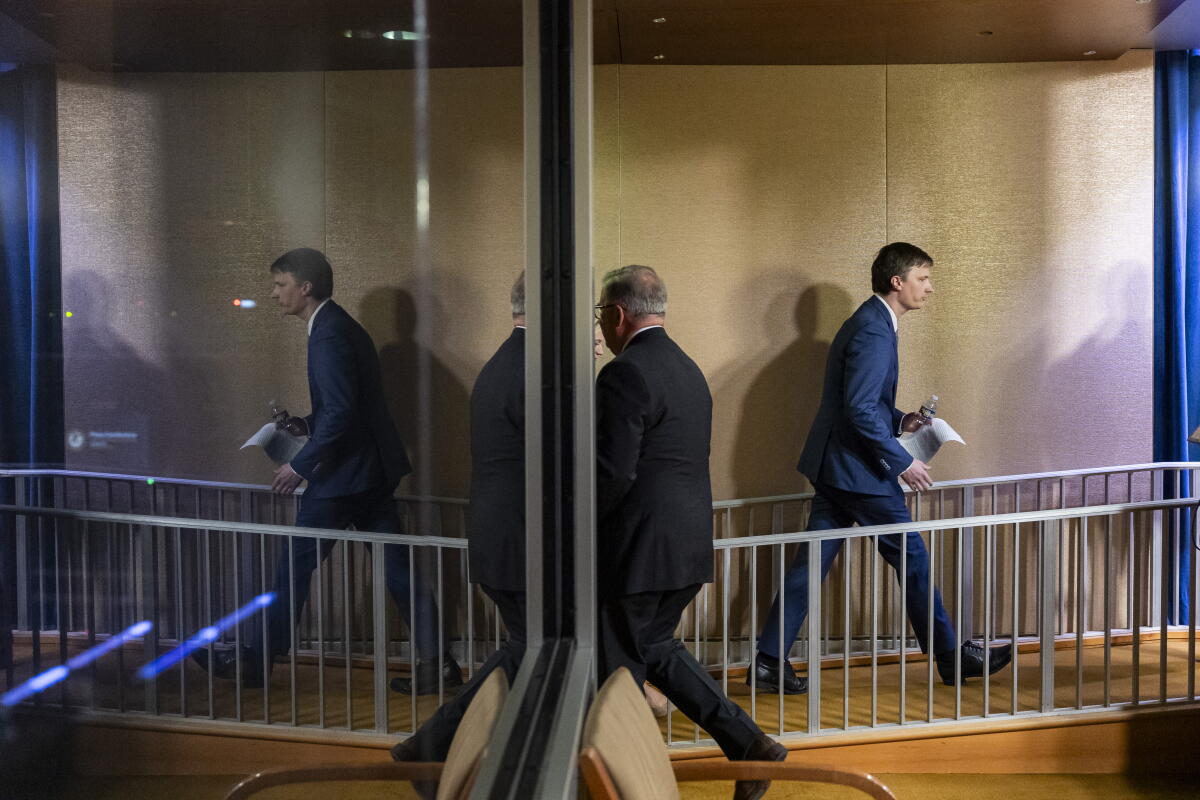
The demand letter came from U.S. Acting Deputy Atty. Gen. Trent McCotter, shown entering a news conference in September 2026 in Washington.
(Finn Gomez / Getty Images)
Voters on the federal list who haven’t already been sent a ballot should not be sent one until their citizenship is verified, while ballots already returned by voters on the list should not be counted until their citizenship is verified, McCotter wrote.
Weber’s office in a statement late Wednesday criticized the Justice Department for telling it to obtain a list of an unknown number of voters it hadn’t been given directly from Logan’s office, investigate all of those voters and “take action” all within 48 hours, based on inaccurate federal data that has led to U.S. citizens being purged from rolls in other states, and under threat of litigation despite the Justice Department providing no legal authority for the demand.
Weber said the Justice Department’s “relentless efforts to unlawfully gain access to states’ protected voter data and purge voter rolls serve only to cause chaos and fuel public distrust in our elections,” and that California already has “robust state law requirements” to ensure only U.S. citizens vote.
Logan said his office was reviewing the Justice Department letter in coordination with Weber and California Atty. Gen. Rob Bonta, but had not accessed the USB drive because state officials “do not consider the device a secure medium” and accessing its contents “would conflict with established data privacy and information security protocols.”
He said that maintaining accurate voter records is a fundamental responsibility of his office, but also that federal and state laws “are clear on how voter eligibility is established — and any action to remove a voter from eligibility must be based on verifiable information, not assertions of unconfirmed data matching.”
Weber previously questioned the basis for a claim by Homeland Security Secretary Markwayne Mullin in July that there may be more than 190,000 noncitizen voters on California rolls, and rebuffed Trump administration offers to work with her office to purge state rolls of such ineligible voters ahead of November without additional information on how it reached its conclusions.
Similar Trump administration lists have been shown in other states to be substantially inaccurate, and to include many voters who are indeed citizens. Election experts say that makes the demand on California — where ballots have already been mailed out — even more concerning.
“One must question why the DOJ would violate its own rules about investigating elections close to election day, and over a week after they knew the state had already mailed ballots out, particularly when their past claims have been full of errors,” said David Becker, executive director of the nonpartisan Center for Election Innovation & Research.
Becker noted the Trump administration alleged that there were nearly 16,000 noncitizens registered in Nevada, later reduced that number to 185 after additional scrutiny, and then determined all of them were in fact citizens.
A Justice Department spokesperson, in a statement to The Times, defended the agency’s demands to California — saying it “should not be controversial, as the criminal statute is clear: only American citizens may vote in federal elections. It is a federal crime for noncitizens to vote in U.S. elections, and the DOJ is asking California to ensure that is not occurring.”
The spokesperson said the agency could not provide the exact number of voters whose citizenship is being questioned, but that it is in the thousands.
California Secretary of State Shirley N. Weber speaks during the state Democratic Party convention in Anaheim on May 31, 2025.
(Damian Dovarganes / Associated Press)
McCotter wrote that if Weber cannot implement his demands for how to segregate ballots and verify voter citizenship for those on the federal list, the Justice Department “will have no choice but to seek emergency relief” — an apparent reference to seeking court intervention.
McCotter copied on the letters First Assistant U.S. Atty. Bill Essayli, the lead federal prosecutor in Los Angeles whose office previously sent Logan’s office a series of grand jury subpoenas for individual voter records as part of a criminal investigation into illegal voting.
Essayli’s office referred questions to the Justice Department. Bonta’s office referred questions to Weber and Logan.
Rick Hasen, director of the Safeguarding Democracy Project at UCLA School of Law, said that he is “not aware of anything like this ever happening this close to an election,” and that it may in fact be illegal under the National Voter Registration Act, which “prevents systematic purges of voters 90 days before the election.”
He said that the question of whether that preclusion against purges applies to the removal of noncitizens is an issue that is currently before the U.S. Supreme Court, in an Arizona case the high court will hear in December, but that the Justice Department’s actions strike him as “legally questionable.”
Hasen said the “whole point of that 90-day rule is to prevent the inadvertent disenfranchisement of eligible voters by mistake in the rush before the election,” and that risk is increased by the inaccuracies of similar lists presented by the Trump administration in other states. “So if there is an attempt to go to court — if DOJ tries to sue over this — they might have a hard time getting a judge to agree that this is something that the registrar must do or even can do.”
The fact that election officials are already busy receiving and preprocessing ballots would only bolster the state’s position in such a case, Hasen said.
“It’s obviously not a convenient time,” he said. “And given the fact that the lists have proven to be wildly inaccurate, at least in other states, it might be sending the registrar on a wild goose chase, when they have more relevant things to do in the election.”
But that “chaos” may be the point, Hasen said. “This is potentially another example of DOJ just making the work of state and local election administrators — which is already quite difficult and stressful — even harder,” he said.
Attorneys with the UCLA Voting Rights Project filed a lawsuit last month on behalf of the Coalition for Humane Immigrant Rights, or CHIRLA, and a California voter named Pedro Trujillo, in which they challenged the Trump administration’s use of unproven federal databases to allege registered California voters are not citizens.
On Wednesday, they told the Justice Department that they would be seeking emergency relief from such practices, given McCotter’s letters.
“The federal government’s attempt to pressure California election officials into acting on lists that may misidentify eligible voters is an alarming abuse of power as election season gets underway. This puts our communities and our fundamental rights at risk,” said Carl Bergquist, a CHIRLA attorney.
The Justice Department in recent weeks has announced scattered arrests of alleged noncitizen voters around the country, and Trump administration officials — including Essayli — have pointed to such arrests as proof that noncitizens are voting illegally.
Such voting does happen, Hasen said, but after months of the administration aggressively searching for such voters, the relatively small number of arrests “belies the contention that it’s widespread” or criminal, with many of the few cases identified the result of “administrative error or misunderstanding” rather than an intent to illegally cast ballots.
In his letters to Weber and Logan, McCotter wrote that allowing “noncitizens to vote cancels citizen votes,” and that ferreting out illegal noncitizen voters is a joint responsibility of state and federal officials.
“States are responsible for voter registration, and the Federal Government is responsible for maintaining immigration records to enable verification of citizenship,” he wrote. “Working together, we can more effectively protect against voter dilution and promote election integrity.”
Lagos, Nigeria – As Israelis prepare to vote on October 27, African governments from Pretoria to Rabat are weighing what the result could mean for their own foreign and domestic policies.
The war on Gaza has exposed sharp differences across the continent, with some governments pursuing diplomatic measures against Israel while others maintain commercial and security ties.
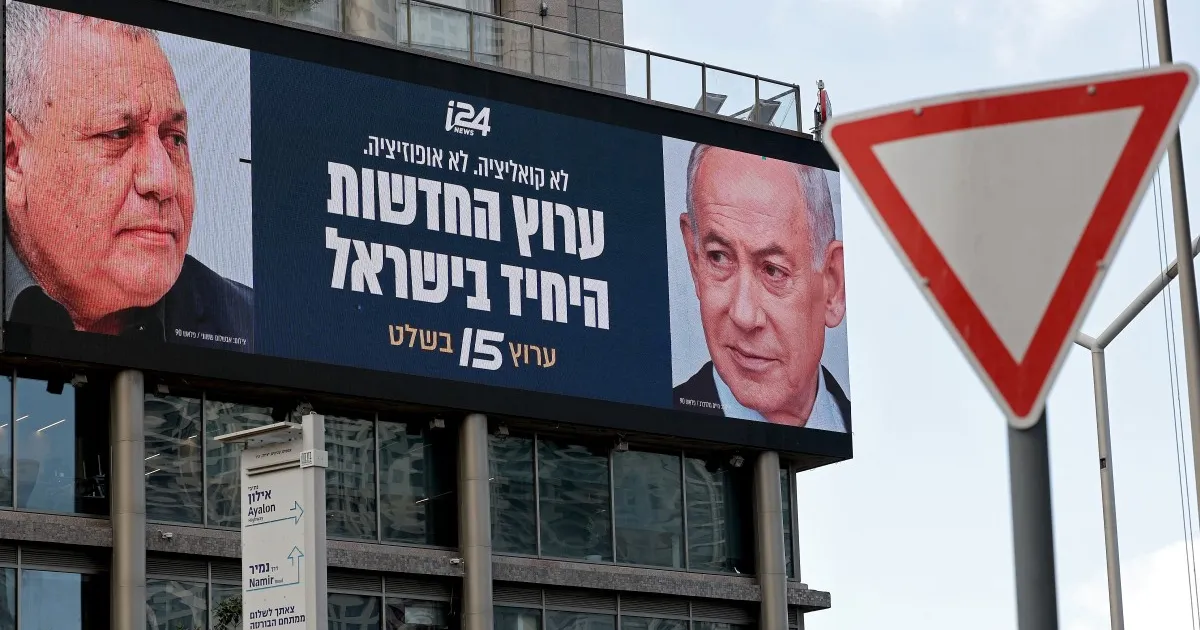
Recent polling has shown a closely contested race between Prime Minister Benjamin Netanyahu’s Likud party and the far-right coalition it leads and a bloc of Jewish-led opposition parties.
Neither is projected to win the 61 seats needed for a majority in the 120-seat Knesset, with a protracted period of coalition talks expected to follow the vote.
The next government’s approach to Gaza and the Palestinian question could influence Israel’s efforts to preserve and expand its partnerships across the continent.
Israel’s relationships across Africa are shaped by competing priorities. While the Gaza war has intensified diplomatic pressure and public opposition in many countries, security needs, commercial interests and longstanding bilateral partnerships continue to influence government decisions.
Diplomatic strain vs closer ties
Since the war began in October 2023, South Africa has emerged as one of Israel’s most vocal critics in Africa. Its government brought a case against Israel at the International Court of Justice (ICJ), alleging violations of the 1948 Genocide Convention. Israel rejects the allegations. The court’s so-called provisional measures in 2024, including an order for Israel to take action to prevent acts of genocide, are not a final ruling on whether genocide has occurred.
In November 2023, South Africa’s National Assembly adopted a motion calling on the government to close the Israeli embassy and suspend diplomatic relations. The motion did not itself implement those measures, but it underscored the strength of political opposition to Israel’s military campaign.
Other African governments have taken different approaches that reflect national political priorities and foreign policy calculations rather than a single continental position.
Chad recalled its ambassador to Israel in November 2023, while some countries have maintained relations despite criticism of Israel’s military campaign in Gaza.
Morocco offers a contrasting example. It restored relations with Israel in 2020 under a US-backed arrangement linked to Washington’s recognition of Moroccan sovereignty over Western Sahara. Despite public demonstrations opposing normalisation, Rabat has continued to pursue closer ties.
On September 16, Israeli Foreign Minister Gideon Sa’ar and Moroccan Foreign Minister Nasser Bourita met in New York at a trilateral summit hosted by US Ambassador to the United Nations Mike Waltz. The three countries reaffirmed plans to upgrade diplomatic relations, elevate their respective missions to embassies and appoint ambassadors.
They also agreed to conclude investment protection and double taxation agreements by the end of this year, expand flights to include Moroccan airlines and arrange reciprocal high-level visits in the coming months. These were announced commitments, rather than confirmation that the changes had already been implemented.
For Idowu Johnson, associate professor of international relations at the University of Ibadan, the diversity of African states makes it difficult to predict a uniform response to Israel’s election.
“Africa’s heterogeneity means individual states have handled relations with Israel separately. Since the October 7, 2023 attacks, African criticism has focused on Israel’s denial of Palestinian statehood.
“The October 27 election will therefore be pivotal, as a new government’s stance on the Palestinian cause will shape how far Africa cooperates on agriculture, trade, security and technology, guided by self-determination and international law as well as bilateral interests,” Johnson said.
Israel’s relationship with the African Union (AU) also reflects these divisions. In 2021, the AU Commission chairperson accredited Israel’s representative to the organisation, prompting objections from member states.
In February 2022, the AU Assembly established a committee of heads of state and government to consult on Israel’s observer status. The dispute continued into 2023, when the AU moved to suspend Israel’s accreditation pending further consideration.
The disagreement has reflected wider divisions over Israel’s treatment of Palestinians and the organisation’s approach to the conflict.
A new Israeli government could seek to ease those tensions, but any change would depend on its policies as well as the positions of AU member states.
Security ties may outlast diplomatic tensions
Security cooperation has been a significant part of Israel’s relationships with some African governments. Israeli companies have pursued defence and security contracts involving equipment, surveillance technology and training.
But the nature and scale of those relationships vary by country and claims about particular agreements or technologies should be tied to documented cases rather than treated as evidence of a uniform Israeli security presence across the continent.
The Democratic Republic of the Congo offers a recent example of efforts to deepen cooperation. Congolese President Felix Tshisekedi visited Israel on August 31 and September 1, meeting Prime Minister Benjamin Netanyahu and President Isaac Herzog. Discussions covered security, defence, agriculture, infrastructure, energy and high technology. Both sides expressed a desire to strengthen their strategic partnership and expand cooperation across several sectors.
The visit followed memorandums of understanding signed on July 27. Congolese officials said the visit would review those agreements and explore further Israeli investment, including opportunities linked to the Lobito Corridor. The meetings demonstrate the potential scope of bilateral cooperation, but do not establish that a specific new security contract has been concluded.
For governments confronting armed groups, insecurity can create incentives to seek equipment, intelligence and training from foreign partners. Yet the importance of Israeli cooperation differs between countries and diplomatic tensions will not necessarily have the same effect on every security relationship.
The limits of Israel’s diplomatic outreach were also evident after it recognised Somaliland as an independent state on December 26, last year, the first country to do so. Somalia and other critics rejected the move, arguing that it undermined Somalia’s territorial integrity. The decision triggered demonstrations in Somalia and Somaliland.
Speaking to Al Jazeera this month, President Hassan Sheikh Mohamud said Somalia will not accept Israeli presence in the country “under any circumstances”. He added that Israel was planning to establish a naval base in Berbera and use the city’s airport, adding that its real aim was to get closer to the Gulf states and Iran.
According to the Armed Conflict Location & Event Data project (ACLED), 110 demonstrations directly linked to Israel’s Somaliland recognition had been recorded by the time of its February 2026 Africa overview. Only seven supported the move, all in Somaliland; the others opposed it. The figures cover demonstrations linked to that particular decision, not all African views of Israel, and should not be treated as a continent-wide measure of public opinion.
Hossamaldeen Ibrahim, an Africa analyst at the Bloomsbury Intelligence and Security Institute, argues that public opposition can constrain governments even when they see strategic value in maintaining ties.
“The strongest constraint, however, may come from African publics rather than governments: the Somaliland recognition drew widespread opposition, the African Union and many governments reaffirmed Somalia’s territorial integrity, and ACLED logged 110 related demonstrations, only seven in support.
“Depending on its approach, the next Israeli government could therefore either deepen strategic cooperation in Morocco, Sudan and the Red Sea, or face a legitimacy problem if it continues policies seen as tied to the Gaza war, widening the gap between state-level cooperation and public sentiment,” Ibrahim told Al Jazeera.
The Somaliland episode shows how a diplomatic move can provoke opposition when it is perceived to challenge a core principle of sovereignty.
It does not, by itself, establish that African governments will abandon security agreements with Israel. The consequences will depend on the countries involved, the terms of their cooperation and the domestic political costs of maintaining them.
Trade, agritech and the contest for influence
Trade and development cooperation offer Israel another route to maintaining relationships in Africa. Israeli firms and officials have pursued partnerships in areas including agriculture, irrigation, water management, health and technology.
Such cooperation can offer practical benefits to governments seeking investment and technical expertise, but commercial ties do not necessarily translate into public support for Israel’s policies.
Zambia illustrates Israel’s efforts to deepen bilateral engagement. Israel opened a resident embassy in Lusaka in August last year, after a 52-year absence. Agriculture, water management, health, education and technology have been identified as potential areas for closer cooperation. The move formed part of Israel’s broader effort to strengthen its engagement with African countries.
Some analysts have interpreted Israel’s renewed engagement with Zambia as an attempt to cultivate partners who could counterbalance South Africa’s influence in the region. That remains an interpretation, not an established explanation for the relationship.
Zambia has its own reasons for seeking investment and cooperation, particularly in agriculture, water management and technology; closer bilateral ties alone do not prove that countering South Africa is Israel’s objective.
Professor Iwebunor Okwechime, of Obafemi Awolowo University, points to the historical roots of South Africa’s position towards Israel.
“If we trace the stance South Africa took, it goes back to the apartheid era, when Israel backed the apartheid regime and refused to support the struggle against the minority government. This historical context is important for understanding South Africa-Israel relations today,” Okwechime told Al Jazeera.
For African governments, the challenge will be to balance security and commercial interests against public opposition, commitments to Palestinian rights and positions on international law. For Israel, the upcoming election will test whether a new government can ease diplomatic tensions across Africa without fundamentally changing the policies that have fuelled them.
As Okwechime told Al Jazeera, “There won’t be a radical change in sentiments regardless of the government in power”.
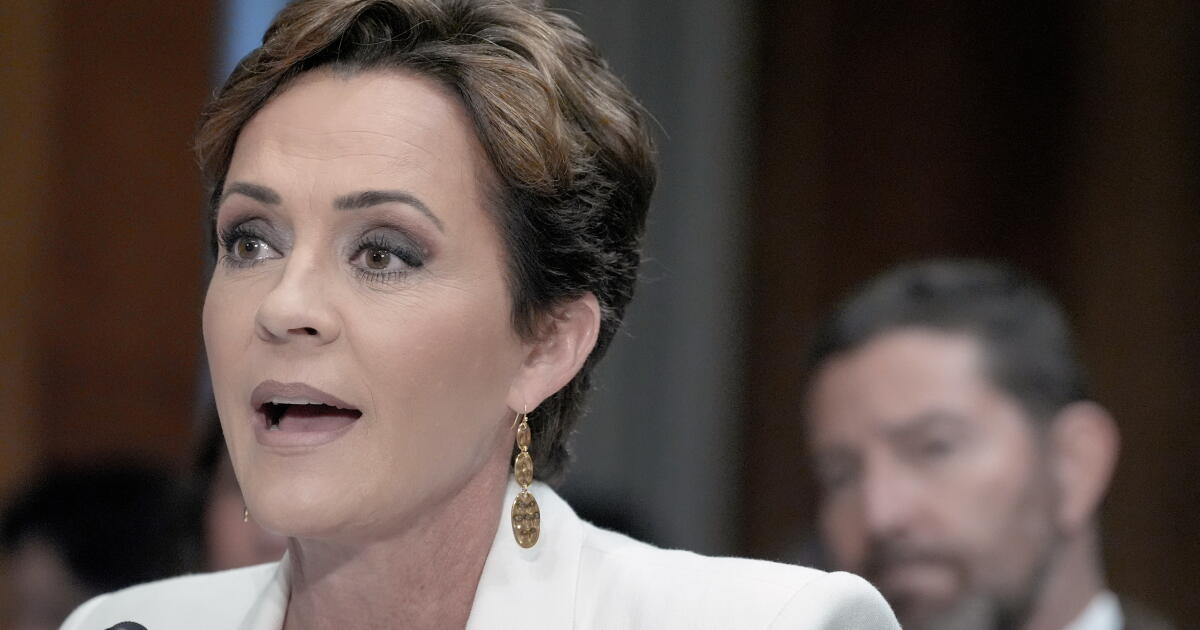
PHOENIX — The U.S. Supreme Court has refused to toss out $122,000 in legal costs that lawyers for former Arizona gubernatorial candidate Kari Lake were ordered to pay for false and misleading statements they made in a lawsuit that sought to require a hand-count of all ballots in the 2022 midterm elections.
The nation’s highest court on Tuesday denied a request from Andrew D. Parker, an attorney who represented Lake in the lawsuit, to review a lower-court decision over the legal costs arising from the unsuccessful litigation.
The lawsuit by Lake and state lawmaker Mark Finchem sought to ban electronic tabulation devices. It was dismissed by a judge who found Lake and Finchem lacked standing to sue and that their lawsuit was filed too close to the election.
In 2022, Lake lost the governor’s race to Democrat Katie Hobbs and Finchem was defeated in the secretary of state’s race by Democrat Andrian Fontes. Both Republicans had promoted the narrative that the 2020 election was marred by fraud.
Maricopa County had sought sanctions against Lake, Finchem and their lawyers, alleging they broke a court rule by making unfounded allegations and by not conducting the necessary research before filing the lawsuit.
U.S. District Judge John Tuchi later concluded the lawsuit’s claims lacked an adequate basis in fact, that the standard inquiry attorneys must make before pressing litigation hadn’t been done and that the lawyers acted recklessly in seeking a court order based on frivolous claims.
The requirement to pay the legal fees applies to the lawyers who pressed the lawsuit, not to Lake and Finchem.
The 9th Circuit Court of Appeals rejected appeals over the lawsuit’s dismissal and the awarding of the legal fees.
The Associated Press left phone and email messages Tuesday for Parker, whose firm is based in Minneapolis.
Earlier this year, Parker asked the Supreme Court to throw out the requirement to pay Maricopa County’s legal fees in the case, arguing such sanctions would deter attorneys from bringing aggressive or novel legal claims.
Maricopa County said lawyers for Lake and Finchem had disregarded a letter that identified false allegations they had made in their lawsuit and relied on some of those claims in a later court filing. The county’s attorneys said those who brought the lawsuit failed to present evidence to support their allegations and falsely alleged that Arizona didn’t use paper ballots and that its electronic voting systems hadn’t been subjected to expert analysis.
The former head of Israel’s domestic security agency Shin Bet has sued Prime Minister Benjamin Netanyahu for defamation over claims of his responsibility in the October 7, 2023 Hamas-led attack.
Coming just before Israel’s close-fought October 27 election in which Netanyahu is fighting for his political life, the case filed on Wednesday is set to ramp up the country’s political drama.
Ronen Bar, the former director of Shin Bet, accused Netanyahu of “lying to cover himself” and said it was slanderous of the prime minister to have accused him of “criminal failures” over the attack, in a 134-page court document.
Bar said he telephoned the prime minister’s military secretary as soon as signs of a possible attack became apparent, but that he did not have Netanyahu’s direct number.
Netanyahu has said he was not alerted by Bar on the morning of the Hamas-led assault, insisting that he could have stopped the attack had the Shin Bet’s then-director or military leaders called to wake him up the day of the early-morning attack.
Bar’s lawsuit says Netanyahu made accusations “that he knew to be false, with the aim of diverting the debate from his own responsibility for the events of October 7”.
Instead, it was Netanyahu’s policies over several years that had “increased the dangers posed by terrorist organisations in Gaza”, it said.
Likud response
On Wednesday, Netanyahu responded to Bar’s accusations in a statement issued by his Likud party saying, “Ronen, are you serious?”
“You had my number on the red line and could have called me immediately, as all security chiefs do,” Netanyahu asked, adding, “How many lives could we have saved if only you had called in time?”
Bar resigned as head of Shin Bet in June 2025 amid recriminations over the deadliest attack in Israel’s history, while insisting he had informed Netanyahu of the threat in advance.
He is seeking three million shekels (about $968,500) in damages from Netanyahu.
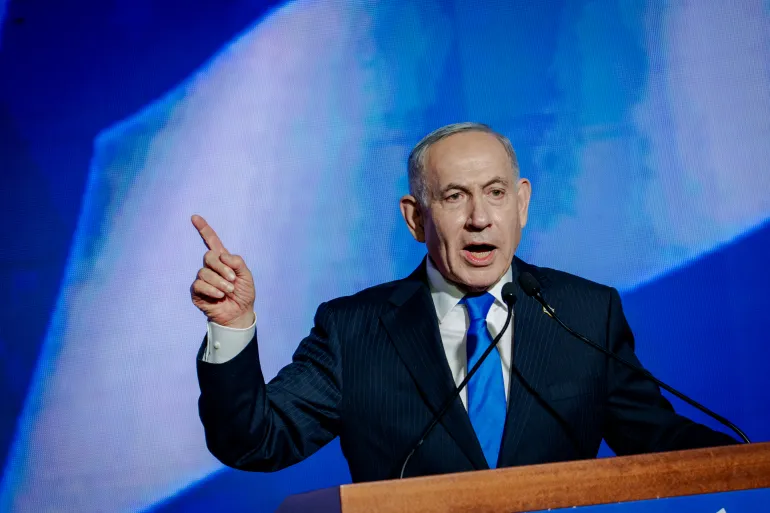
Israeli Prime Minister and Likud party leader Benjamin Netanyahu speaks at the lectern to supporters during a party campaign rally at Expo Tel Aviv on September 17, 2026 in Tel Aviv, Israel [Erik Marmor/Getty Images]
Warnings, lies, manipulation
The allegations in Bar’s lawsuit come days after Netanyahu’s former military secretary, Avi Gil, told Israel’s Channel 12 that the prime minister’s office had “falsified records related to October 7, 2023”, including altering the recorded time of a key phone call.
Gil, who served as Netanyahu’s military secretary from July 2021 to May 2024, said a stenographer in the prime minister’s office approached him in January 2024 with instructions from Netanyahu’s chief of staff to change the time of a four-minute call from 6:40am local time (03:40GMT) to 6:29am (03:29 GMT).
“She told me, I’m not allowed to change it,” said Gil, accusing the head of Netanyahu’s office of manipulating telephone records, adding, “Those are facts, and there is no dispute about them.”
Last month, the Wall Street Journal reported that Netanyahu had been warned of the attack by Egypt’s intelligence chief, Abbas Kamel.
In a rare move, Kamel reportedly phoned the prime minister just days before the attack, underscoring previous warnings in September 2023, when he is said to have flown to Israel to warn security officials in person that Hamas was planning an attack.
Polls show Netanyahu is in a tight race to stay in power in the October 27 election, after being hammered by former staff and government officials as well as the opposition for failing to prevent the bloodshed.
At least 1,221 Israelis were killed on October 7, 2023, after Hamas broke through the fence separating Israel and Gaza, according to Israeli official figures.
Also, 251 Israelis were taken captive, including the bodies of 44 Israelis killed that day.
In the three years since, Israel has killed more than 74,300 people in Gaza, according to the Health Ministry in the enclave.
More than 1,400 Palestinians in Gaza have been killed in Israeli attacks since a tentative “ceasefire” backed by the US was reached last year.
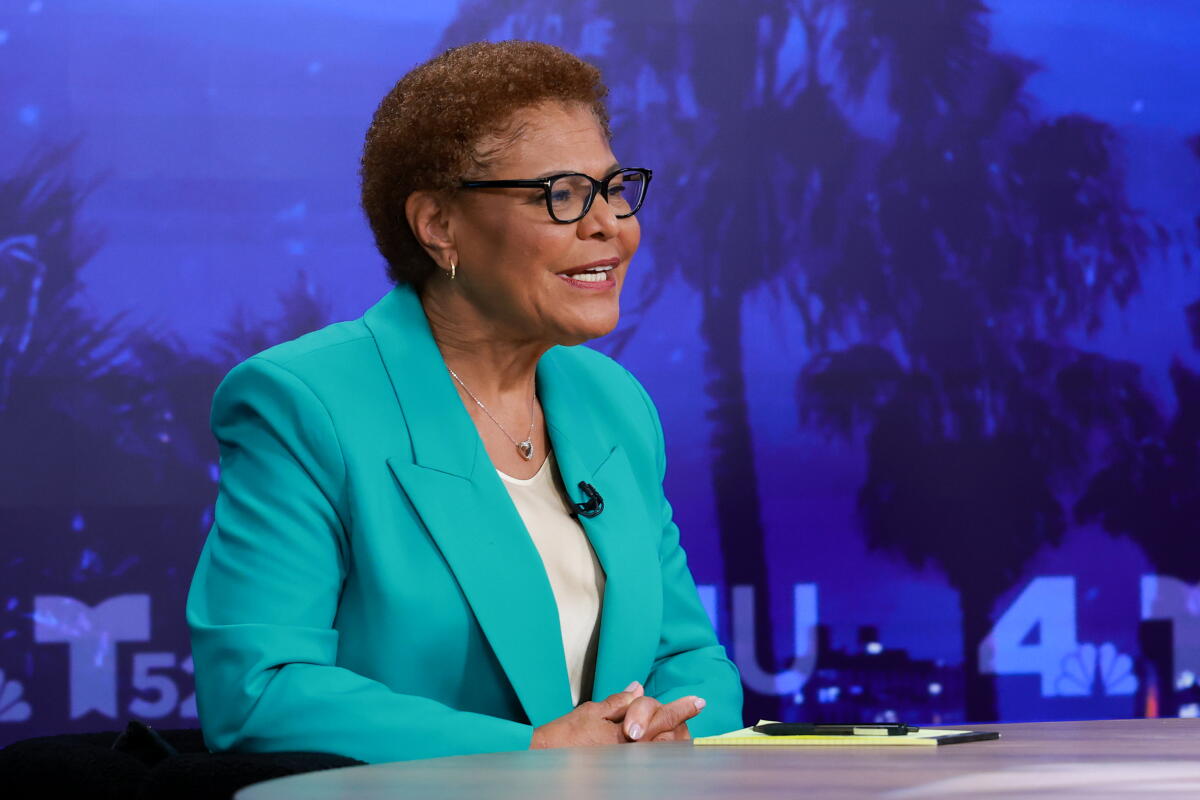
Karen Bass and Nithya Raman faced off Tuesday night in a debate hosted by NBC4 and Telemundo52 in Universal City. It was the L.A. mayoral candidates’ last head-to-head before the Nov. 3 election.
Times columnists Lorraine Ali, Gustavo Arellano and Steve Lopez weigh in on the highlights and lowlights.
Arellano: Raman had the line of the night at the very beginning, channeling — of all politicians — Ronald Reagan, one of the last people you’d think of as an Angeleno, even though he absolutely was.
“Are you better off than you were four years ago?” she asked while looking directly into the camera.
For the vast majority of L.A. residents, the answer is a resounding no.
Up until tonight, Raman has done a good job of communicating a message of hope and change, while Bass, as the incumbent, has repeatedly tripped on her record over the biblically bad four years of her first term.
But I didn’t hear that Raman tonight — partly because Bass made her play defense, from her first answer to her closing statement.
The mayor won the debate, if we’re judging by forensics. She rarely looked down at her notepad, unlike Raman. It’s something I’ve never noticed about Raman before — either a new nervous tic, or an indication that the city councilmember can’t seem to speak with conviction, which has been a frequent critique against her.
Bass’ barrages got to Raman more than a few times, leading her to talk over the NBC and Telemundo moderators or even shush them. A whining Raman is not a good Raman, which her advisors need to drill into her sooner rather than later.
But Raman’s answers never meandered and weren’t too elliptical, even when she was pressed by the able moderators. Since she’s ahead in most reputable polls, Raman’s job for the night was not failing — and she cleared that low, low hurdle.
Bass, meanwhile, needed to deliver a knockout punch. Instead, as a politico friend who cares for neither candidate texted me after the debate, she won one round. There are only so many more rounds before Election Day for her to catch up — and Bass can’t rely on just winning on points anymore, especially with an opponent who’s now running like she’s ahead.
During closing remarks, Raman hearkened back to her Reagan shout-out, stating, “We cannot afford another four years of decline, of mismanagement, of excuses.” She then pivoted to her positivity message, smiling while proclaiming, “We can be joyful and ambitious again.” The more she sticks to that upbeat vibe, the better she comes off to a voter base tired of the doom and gloom that has fallen over L.A. under Bass.
Bass, meanwhile, came off as funereal, beginning with, “It has been the honor of a lifetime to serve in the city that I was born and raised.” That’s how you start a retirement announcement, not another four-year term. Let’s see what the voters say on Election Day.
Incumbent Karen Bass during a mayoral debate against City Councilmember Nithya Raman Tuesday night.
(Eric Thayer/Los Angeles Times)
City Councilmember Nithya Raman during Tuesday night’s debate against Mayor Karen Bass.
(Eric Thayer/Los Angeles Times)
Lopez: After watching the debate, I don’t think this thing is over.
Yes, Raman has been ahead in polling, and Bass is saddled with high negativity ratings, the baggage of the Palisades fire and the continued challenge of homelessness.
But this debate could have been a knockout punch for Raman, and instead, I think Bass won the night, not just by touting her achievements and responding sharply to criticism, but by seeming to have a better command of the moment.
My colleague Lorraine Ali made a good point — how many people were actually watching this debate? Probably not many, so it’s not like this one-hour back-and-forth tips the scale.
But as has been noted, a huge percentage of likely voters remain undecided. Maybe that’s because they’re not in love with either candidate. Or maybe they’re ready to move on from Bass but aren’t sure about who Raman really is. If they watched tonight, looking for an answer, I’m not sure they got one.
Raman came into elected office as a darling of the Democratic Socialists of America and was a high-profile member of that wing on the City Council. But even the council’s DSA members didn’t endorse her bid for mayor. In fact, Bass has gotten support from 13 of the 15 council members.
So how will Raman build a coalition in a city where mayoral power is shared with the council, and matters like homelessness are the joint responsibility of the city and the county, and any progress is stymied without strong mayoral relationships in Sacramento and D.C.?
It’s possible that the council will come around to her if she’s elected, because just as the mayor needs the council to get much done, the council needs the mayor.
But I’d like to know more about who Raman is and why she’s flip-flopped so much (on support for the LAPD, on the mansion tax, on the Inside Safe homeless initiative, etc., etc.), as my colleague David Zahniser reported just the other day.
Learning and evolving can be a good thing. But voters need to know who Raman is, what her vision is for the city and how she expects to lead.
I didn’t get that in this debate. Bass, whose first term works against her as much as for her, is still hanging on and hanging in.
It may come down to whether older voters, who are likely to favor Bass, turn out in greater numbers than younger voters, who are likely to favor Raman.
But from where I sit, it ain’t over. Except maybe for the Dodgers.
Ali: Raman was ahead in the polls headed into tonight’s mayoral debate, so her job wasn’t quite as hard as Bass’, who is fighting for her political life. Raman just needed to knock the mayor off balance — then keep her there for an hour. But that didn’t happen.
Bass came off composed, confident and in command of the conversation, while Raman appeared less sure of herself, frequently looking down to check her notes while defending her work on key concerns such as homelessness (until recently, she was chair of the city’s housing and homelessness committee) and attacking Bass for leaving the city “leaderless” during crises such as the Palisades and Lineage fires.
The overall tone of the debate was less heated than when the two candidates met in August to battle it out sans Spencer Pratt, the former reality TV personality and Republican contender who lost in the primary.
But there were moments Tuesday when the women’s history as colleagues — and onetime allies — informed their attacks on one another.
Bass said Raman was “not ready for prime time” and that she had a “contemptuous” relationship with her constituents. Raman continually pointed out that Bass had failed to remedy L.A.’s homelessness crisis, and did so from the perspective of someone who had worked closely with the mayor.
There’s still a question around how many folks actually watched the debate, and if the candidates’ points will resonate in subsequent clips or memes. Neither contender has the charm or spark of, say, New York Mayor Zohran Mamdani, and as vapid as it may sound, charisma matters.
Three weeks out from the election and there still isn’t a lot of excitement over the mayoral choices on the ballot. This debate didn’t help that cause, or juice the race.
Lucky for Bass, she has the presence of a leader, and that gave her the edge over Raman tonight. But was anyone watching beyond my fellow columnists Gustavo Arellano and Steve Lopez?
President Trump has pushed Congress to pass a proof-of-citizenship law, signed an executive order seeking a national voter ID requirement and tried to limit mail voting through U.S. Postal Service changes.
None of those moves succeeded in time to affect this year’s midterm elections. It’s a different matter in the states.
More than three dozen voting laws passed in Republican-controlled states are taking effect for the first time this year, many of them containing elements of Trump’s stalled proposals. They include changes to what IDs are acceptable to register for the first time and requirements to show proof of citizenship, an issue the Republican president has tried but failed to get through Congress.
“Trump’s attacks on our elections are deeply damaging, but they are not happening in isolation,” said Sophia Lin Lakin, director of the American Civil Liberties Union’s Voting Rights Project. ”Across the country, states are also advancing restrictions that make it harder for eligible voters to cast a ballot.”
Republican lawmakers who support the tighter voting laws, especially around voter ID, describe them as common sense changes that help build trust in elections.
Trump and other Republicans have been pushing for more restrictive rules since the president’s false claims of widespread fraud in his 2020 election loss to Democrat Joe Biden. Trump’s false claims have resonated with Republican voters, a majority of whom believe Biden was not legitimately elected despite all evidence to the contrary. Trump lost dozens of court challenges, his own attorney general found no evidence of widespread fraud, and reviews, audits and recounts in the battleground states where he contested his loss all affirmed Biden’s victory.
Among the changes confronting voters as early voting gets underway: Students in New Hampshire can no longer use student IDs; Utah voters returning mail ballots must include more information on the envelope; and some voters in Mississippi might need birth certificates or passports to verify their identities.
Changes to voter ID requirements are challenged
New Hampshire state Rep. Donald McFarlane said he sponsored the bill to eliminate student IDs as acceptable for voting because colleges don’t have the same controls when issuing those cards as government agencies.
“The change removes a special exception and applies the same government-issued ID standard to all voters,” he said, adding that his bill had bipartisan support.
Students, he said, can still get state IDs free of charge.
The new requirements have not gone unchallenged.
In South Dakota, the ACLU has filed a lawsuit seeking to halt a new law that includes requiring voters registering for the first time to present the most common forms of ID — driver’s licenses, Tribal IDs and non-driver state IDs. They must be presented in person at places that accept registration.
“Proof of citizenship in itself is not terrible,” said Kathryn Johnson, president of the League of Women Voters of South Dakota.
Her concern is the requirement to present the IDs in person.
“We’re kind of a remote state, so sometimes it takes a drive, and you have to coordinate, you have to take off work, and all of these kinds of things,” she said.
Some Democrats also have expressed support for voter ID during recent debates. Pennsylvania Gov. Josh Shapiro said he was open to the idea as long as it wasn’t based on “conspiracy theories.” When legislatures change their state’s voting laws, they typically give election offices and voters time to adjust. Trump wanted federal voter ID and proof-of-citizenship legislation to take effect immediately, forcing election officials and voters to comply in the middle of the midterms.
Ohio seeks to scrub voter rolls
Ohio has a proof of citizenship requirement in effect for the first time this year for those registering to vote or updating their voter registration information at a Bureau of Motor Vehicles location. The state also eliminated its four-day grace period for mail ballots, which now must be received at local election offices by Election Day.
Yet the biggest concern for voting rights groups is an ongoing purge of the state’s voter rolls. The databases used to check citizenship against voter registration lists can be outdated, said Freda Levenson, legal director of the ACLU of Ohio, which has sued to overturn the law.
“Vast numbers of perfectly eligible voters are vulnerable to being disenfranchised,” she said.
Republican state Sen. Theresa Gavarone, one of the primary sponsors of the bill, challenged the ACLU’s legal action and said the problem it addresses is a real one.
“In the past two years, hundreds of noncitizens have been removed from Ohio’s voter rolls,” she said in an email. “Every single vote cast by a noncitizen disenfranchises a lawful Ohio voter.”
Voters have mixed views on the changes
Outside an early voting center in Wayne County, Ohio, retired steel worker Dan Walter, an independent voter, said he opposes requiring documentary proof of citizenship to vote.
“It’s to keep people from voting, it sounds to me like,” he said.
His wife, Jody, a retired aerospace executive and a Democrat, said she felt the same way about Ohio’s new requirement for registering to vote.
“A driver’s license doesn’t prove citizenship, and that’s all they ask for now,” she said. “It’s going to be an obstacle for so many people.”
Genia Fortune had a different view. A nurse, the Millersburg resident described herself as an independent and said she voted for President Barack Obama, a Democrat, and later for Trump. She believes Trump’s false claims that the 2020 election was stolen and sees requiring documentary proof of citizenship as a necessary precaution.
“I just feel like you need to be a citizen and show proof of ID,” she said.
Voting and election laws have become a regular target for legislatures
The Trump administration has pushed multiple strategies to influence this year’s midterm elections, most of them stymied by Congress or the courts.
Chris Diaz, director of legislative tracking at the Voting Rights Lab, said the group has seen several versions of the Republican president’s proposals passed by his allies in the states.
A recently released report by the group highlighted some of the key areas drawing Republican lawmakers’ attention, including mail balloting, voter ID and the hunt for noncitizens on voter rolls.
Noncitizen voting has been a focus of the Trump administration despite it being a rare problem. The U.S. Department of Justice recently announced it had brought charges in roughly 90 cases for various types of election misconduct, including 50 against people who are alleged to have voted as noncitizens. The U.S. had 227 million registered voters for the 2024 presidential election.
The Brennan Center for Justice has identified nearly 40 laws in 21 states taking effect this election season that will make it harder for eligible voters to register, stay on the rolls or cast ballots.
The report from the center, part of the New York University School of Law, found that many of the new laws target subsets of voters.
“What I want voters to take away from this is that elections are still run by the states and there are still people in many states who are trying to make it harder for you to vote,” said Sean Morales-Doyle, senior director of the center’s Voting Rights and Elections Program. “But that’s all the more reason to go make a plan to vote and participate.”
Fields and Smyth write for the Associated Press. Fields reported from Washington and Smyth reported from Wooster and Millersburg, Ohio.
In rural Modoc County, in California’s remote northeast corner, Republican gubernatorial candidate Steve Hilton donned a beige cowboy hat and climbed atop a horse.
Riding through a grassy field, with his dress shoes in the stirrups, Hilton lamented to a camera that California was “completely being ruined by killjoy bureaucrats” who put too many rules on fun stuff like beach fire pits and bars that stay open extra late.
In coastal San Luis Obispo County, Hilton boarded a bright yellow dune buggy at the Oceano Dunes State Vehicular Recreation Area and called the California Coastal Commission “idiots” for trying to end off-road beach driving.
And in the Central Valley, he waved the ceremonial green flag at a stock car race at the Madera Speedway, where he was named grand marshal of the annual Harvest Classic. (The designation caused a minor uproar, prompting the operator of the racetrack to make a fake online concession menu that offered a hot dog and soda for $6 for Republicans and $17.50 for Democrats.)
If it seems like Hilton — the British immigrant and former Fox News talk show host — is just about everywhere, taking just about every media interview that comes his way, well, that’s the point, he says.
He has logged thousands of miles on the proverbial campaign trail, visiting all 58 counties in his quest to lead the nation’s most populous state, where no Republican has been elected to statewide office in 20 years.
Meanwhile, his heavily favored — and far more staid — opponent, Democrat Xavier Becerra, has kept a comparatively low profile, agreeing to just one debate with Hilton and holding few public events, mostly in urban areas.
In a phone interview while driving through Los Angeles, Hilton said: “Whether I’m in Humboldt or Del Norte or Siskiyou County, my joke is, when people say, ‘Where do you live?’ I say I live in the Hampton Inn somewhere in California because we’re basically in a different place every night.”
The odds are against him.
Sure, California produced GOP presidents Richard Nixon and Ronald Reagan. But today, Democrats outnumber Republicans nearly 2 to 1 in the state, and the current White House occupant shares a mutual disdain with the vast majority of Golden State voters.
Hilton was endorsed during the primary by President Trump, who suggested at a campaign rally this month that Iran could “take out” Los Angeles and San Diego, drawing swift outrage from both Democrats and Republicans.
Hilton has tried to walk a fine line, appealing to the 6 million Californians who voted for the president in 2024 while simultaneously downplaying Trump’s support.
This summer, Hilton took out full-page ads in The Times and the San Francisco Chronicle asking: “Can you be anti-Trump and still vote for me?”
“Yes, I’m the Republican,” it said. “The ‘Fox News guy.’ Endorsed by Trump. But this election is not about who you hate in Washington. It’s about what you love here.”
Corrin Rankin, chairwoman of the California Republican Party, said that 16 years after the state’s last Republican governor, Arnold Schwarzenegger, left office, “it’s safe to say Democrats own all the problems in California.”
“You can’t blame Trump for what’s going on here in California,” she said. “We feel really good about Steve Hilton’s campaign. He is working so hard, up and down the state.”
Hilton has blasted California Democrats as entitled, saying they assume Becerra will cruise to victory in the race to replace termed-out Gov. Gavin Newsom simply because he has a “D” beside his name on the Nov. 3 ballot.
Hilton frequently quotes a September podcast interview by Los Angeles’ Democratic mayor, Karen Bass, who mocked his British accent and said: “The governor’s race right now is over. Our governor’s name is Xavier Becerra. You don’t need an election on Nov. 3. A Republican cannot win in this state.”
Hilton told The Times that Democrats “feel they don’t have to earn your vote. … They can deliver results that are bad as ever, and they don’t need to work hard to deliver results for people or earn their support. And I think it’s that attitude that is going to be their downfall.”
Steve Hilton has the support of 33% of likely California voters, according to a recent poll, while rival Xavier Becerra has 58%.
(Jason Armond / Los Angeles Times)
Becerra is a former member of Congress who represented Los Angeles, and he was the California attorney general and U.S. Health and Human Services secretary under President Biden. He has the backing of 58% of likely California voters, compared with 33% who support Hilton, according to a poll released late last month by the UC Berkeley Institute of Governmental Studies and co-sponsored by The Times.
The poll showed that voters’ top concern was reducing the state’s high cost of living — followed by fighting Trump administration policies.
“Hilton is trying to win an election, so he tries to frame himself as someone who can appeal to the broader electorate,” Underland said. “But at the end of the day, he has the albatross around his neck, which is Trump, who is openly hostile to California.”
Hilton cuts a colorful and pugnacious figure on the campaign trail. He eschews ties and jackets, favoring T-shirts with punchy phrases like, “$ave With Steve” and “WAKE UP” superimposed on a California license plate — a reference to his proposal to eliminate the state’s Department of Motor Vehicles and slash vehicle registration fees, which would cut billions in state revenue.
He wears one bracelet with the name of slain right-wing activist Charlie Kirk, whom he called an “incredibly close friend.” Another reads, “Save Girls’ Sports,” calling back to this spring, when he traveled to the state high school track and field championship in Clovis to protest the participation of a transgender athlete.
Republican nominee Steve Hilton protests transgender athletes’ participation in girls’ sports during a May 29 news conference in Clovis, Calif.
(Tomas Ovalle / For The Times)
Hilton, 57, was born in London to parents who fled conflict in their native Hungary during the 1956 uprising against the Soviet-controlled communist government and later anglicized their surname, Hircsák, to Hilton.
He was a senior advisor to British Prime Minister David Cameron, a member of the Conservative Party, though the men’s once-close friendship never recovered from Brexit, Britain’s withdrawal from the European Union. Hilton supported it; Cameron did not.
Hilton earned a reputation as eccentric but savvy, pushing the Conservative Party to embrace same-sex marriage and more climate-friendly policies. Dubbed “the barefoot revolutionary” for his refusal to wear shoes, Hilton was satirized on the BBC political sitcom “The Thick of It” as Stewart Pearson, the Tories’ “eco-friendly, media-savvy, blue-sky-thinking” communications director.
He and his family moved to California in 2012 after his wife, Rachel Whetstone, was promoted to lead global communications at Google. For six years, he hosted “The Next Revolution,” a weekly Fox News show from which Trump regularly tweeted clips.
In 2015, the couple purchased their home in the Silicon Valley city of Atherton, one of the wealthiest ZIP Codes in the U.S., for $12.5 million, property records show.
Whetstone now leads communications for Sierra, an AI startup founded by OpenAI board Chairman Bret Taylor and Clay Bavor, who met while working at Google. Hilton and Whetstone’s 2024 tax returns show they had a combined household income of $7.5 million, which included his reported earnings of $250,000 from Fox News and her $6.7 million from her then-employer, Netflix.
Hilton became a U.S. citizen in 2021 and last year renounced his British citizenship.
He finished second in the June 2 primary behind Becerra. Under California’s top-two primary system, the first- and second-place finishers, regardless of party, advance to the general election.
The pack of Democratic candidates was so large that party leaders initially urged struggling candidates — including Becerra — to drop out to avoid splitting the vote. Becerra shot to the top of the polls when then-Rep. Eric Swalwell, a front-runner at the time, dropped out of the race after he was accused of sexual assault and misconduct.
Republicans coalesced around Hilton after the president endorsed him over his GOP rival, Riverside County Sheriff Chad Bianco, a staunch Trump supporter who later said the endorsement made Hilton unelectable.
Kim Nalder, director of the Project for an Informed Electorate at Sacramento State, said it is exceedingly difficult for Hilton to distance himself from Trump and the Fox News brand.
“If you had a different brand of Republican they might have a shot,” given the discontent in the state over myriad issues, she said. “But Trump is so politically radioactive in California right now that it is an effective technique to tie this particular candidate to him.”
California’s population growth is stagnant after years of pandemic-era losses, with immigration lagging amid the Trump administration’s crackdown and many residents leaving the state for more affordable parts of the country.
Greg Perrone, past president of the conservative Greater Bakersfield Republican Assembly, said he was impressed with Hilton’s policy knowledge and the amount of detail in his economic plans.
Steve Hilton, right, chats with Sir Richard Branson before a White House dinner with then-British Prime Minister Cameron and President Obama in 2012. Hilton was an advisor to Cameron.
(Susan Walsh / Associated Press)
“There’s a real concern that the current state of the economy is worse than people expected,” Perrone said. “A lot of people hung their hat on Donald Trump saying he was going to bring down prices, and that just has not happened. There’s a lot of angst.”
Perrone said he remains a Trump supporter, though he has been frustrated by the frenetic roll-out of tariffs that, he said, hurt many businesses. While he has been annoyed that Becerra, in his view, has focused more on the president than laying out his own detailed economic plans, he acknowledged that the strategy plays well in blue California.
Christopher Cole, former chairman of the Lassen County Republican Party, said that in his rural corner of the state, he has seen Trump banners that have hung since 2016 start to come down because people are angry about the Iran war, the high cost of fuel and the economy.
“When Trump stupidly endorsed Hilton, it was the kiss of death for any down-ticket Republican,” said Cole, whose county voted for Trump on 76% of the ballots in 2024, the highest percentage in the state, and was the only one to support Bianco in this year’s primary.
“Hilton is a carnival barker and a very wealthy man,” said Cole, who supported Bianco. “You can’t run a multimillionaire when people are struggling to put food on the table.”
Hilton has made a slew of campaign promises to lower the cost of living, including having no taxes on income below $150,000, lowering energy bills by slashing climate-friendly regulations imposed by Democrats, and having $3 gasoline (though governors cannot directly set the price at the pump, which is driven largely by global crude oil supply and demand).
He has tried to channel the state’s discontent into persuading voters to “try something different” by voting Republican.
During the gubernatorial race debate on CNN last month, Hilton quoted a former Biden domestic policy advisor who reportedly called Becerra a “bitch-ass,” and his campaign promptly launched a website, bitchassbecerra.com, outlining alleged failures of the politician known for his calm demeanor and decades of government experience.
“I think Hilton got dealt a bad card with Becerra making the runoff,” said Rob Stutzman, a Republican strategist who was Schwarzenegger’s spokesman. “It’s difficult to get anyone outraged about Becerra because he is perfectly boring. He worked for Joe Biden — maybe that upsets some people? — but you can’t associate him with any bizarre, woke policies like you could Kamala Harris or Gavin Newsom.”
Hilton’s campaign this month released a provocative, sexually suggestive ad titled “Just Try It!” in which two young women sit on a bed in a candlelit room. An LGBTQ+ pride flag hangs on the wall, and they’re seemingly talking through one’s first romantic encounter with another female.
In a recent poll, voters rated California’s high cost of living as their top concern, followed by fighting Trump administration policies. Above, people gather in North Hollywood to watch the Sept. 30 gubernatorial debate.
(Jason Armond / Los Angeles Times)
Wearing a T-shirt that says, “RESIST,” the anti-MAGA mantra, the first-timer nervously says: “I’ve just never done anything like this before. Like, what if my dad finds out?”
The other woman holds her hand as she fills out a ballot for Hilton then says, “Now lick it,” referring to the mail ballot envelope.
Some conservatives condemned the ad, saying it promoted lesbianism. Liberals criticized it, too, saying it was insensitive to the LGBTQ+ community.
The day the ad launched, he told The Times: “I think there’s a very strong sense that things aren’t working in California, and my argument is: ‘OK, let’s try something different.’”
Later, he said he never meant to offend anyone with the risqué ad, which did, after all, do its job in racking up millions of views online — coveted and invaluable publicity for a long-shot California Republican.
New Delhi, India — India’s main opposition leader Rahul Gandhi has returned to the streets of central New Delhi, leading dozens of members of parliament demanding the election chief’s resignation, as protests gather momentum.
Gandhi, heir to India’s most influential political dynasty, is seeking to turn a summer youth uprising into a broader challenge to Prime Minister Narendra Modi’s decade-long dominance of Indian politics, putting the Hindu nationalist government under growing pressure.
In a press briefing on Monday, Gandhi said the Modi government had put the capital city “in jail”.
The youth-led “Cockroach” movement that forced out the education minister in July has also threatened to protest on Tuesday if it is not allowed to rally at Jantar Mantar in central Delhi, which was the focus of summer demonstrations.
Joining Gandhi’s Congress party, other opposition forces and the Cockroach Janta Party (CJP) are thousands of students from left-wing organisations. As the government braces for further protests, security forces have been detaining thousands of students every day, with allegations of custodial violence casting a climate of fear over the capital.
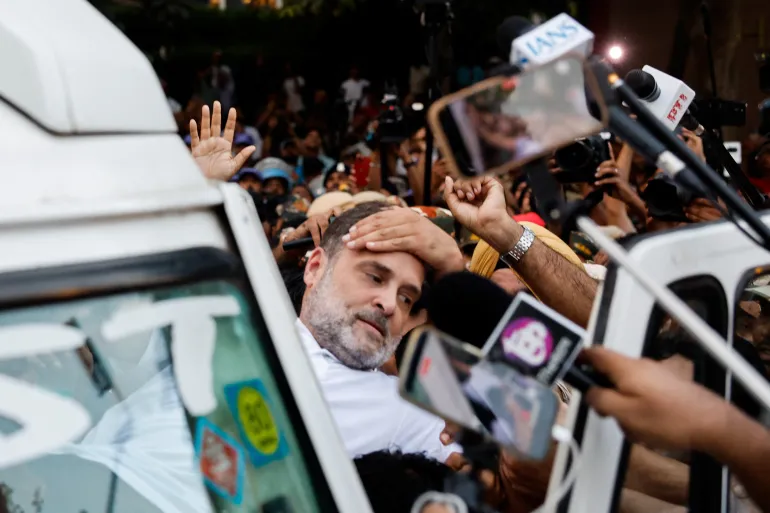
Indian opposition leader Rahul Gandhi is detained by police during a protest organised by opposition parties demanding the resignation of Chief Election Commissioner Gyanesh Kumar, in New Delhi, India, October 7, 2026 [Adnan Abidi/Reuters]
‘No constraints on Modi’
India’s Election Commission, a supposedly autonomous body tasked with overseeing the world’s largest electorate, has been criticised after revelations that its chief, Gyanesh Kumar, frequently overruled concerns raised by the other two election commissioners about the integrity of changes to the voter database.
For months, India’s opposition parties have argued that the election commission is compromised, sabotaging elections at the behest of Modi’s Hindu majoritarian Bharatiya Janata Party (BJP) for its electoral benefit. The BJP denies the allegations.
Since June last year, the commission has been revising and updating statewide voter lists. It has since removed more than 130 million names, which critics say has disproportionately deprived minorities and other vulnerable groups in India of the right to vote.
Gandhi has called for the Chief Election Commissioner to be tried for treason. “We will not spare you,” he said, referring to Kumar, at his Monday press briefing.
Opposition politicians allege that protest rallies by leaders including Gandhi have been met with violent and brutal force, as seen in videos showing them being detained.
“[The protesters] came with love in their hearts, not hatred or anger,” Gandhi said, referring to a protest on Saturday. “They were beaten, both by cops and BJP goons.”
“Narendra Modi … cannot silence India’s voice. These cowards cannot intimidate us. They will have to step aside,” he wrote on X, calling on people from all walks of life to join the protest on Monday.
Analysts say circumstances this time around are starkly different to the summer protests, when CJP-led demonstrators demanded the resignation of then-Education Minister Dharmendra Pradhan.
Asim Ali, a political analyst in New Delhi, told Al Jazeera that the mobilisation of the wider opposition would not stop, but the Modi government was unlikely to back down.
“The crackdown this time on students is making it apparent that it would be tougher for young protesters this time, and students can’t get beaten up and dragged violently daily,” he said. “Going forward, the opposition parties stand to be the front face of the protests, and they need to lead from the front.”
Since 1975, when then-Prime Minister Indira Gandhi imposed a state of national emergency suspending civil liberties, “India saw more civil politics grow into mainstream, where opposition parties were allowed space,” Ali said.
He added that after five decades, “those democratic gains have vanished – and there are no constraints on this government by independent institutions.”
Rasheed Kidwai, a political analyst, said he has seen New Delhi at the centre of “several big opposition political rallies, held in areas near the parliament, hosting hundreds of thousands of people,” when the police did not interfere, unlike the crackdowns this year.
Kidwai said that the violent detention of members of parliament, in particular, was worrying.
“We are seeing a big change from when politicians were more tolerant of dissent,” he added.
Neha Bora, National President of the All India Students’ Association (AISA), is detained by police during a protest demanding the resignation of Chief Election Commissioner Gyanesh Kumar in New Delhi, India, October 4, 2026 [Bhawika Chhabra/Reuters]
Cat-and-mouse chases
With an unprecedented security deployment in central New Delhi designed to prevent protest, youth leaders are turning to new tactics.
Neha Bora, the president of All India Students’ Association (AISA), a left-wing group affiliated with the Communist Party of India, has often tricked Delhi police in order to stage protests.
Bora, a post-doctoral student of theatre, came to national prominence for her fiery speeches in the July protests, becoming a leading face of the Gen Z movement challenging Modi’s Hindu nationalist politics.
Aditi Thakur, a 23-year-old student in the capital, has turned on notifications for all of Bora’s posts on social media. “A call to protest can come anytime, anywhere,” she told Al Jazeera.
Bora does not reveal when or where she is going to stage a protest until just 30 minutes before, to avoid detentions by the police. Her supporters are alerted via social media to join her at a given location in the capital.
On Sunday, she picked a congested street near central Delhi — and was able to jump several barricades to reach the heavily secured Parliament Street, before being chased down and dragged into a police van.
Even Thakur couldn’t catch her, she told Al Jazeera, laughing. “These are guerrilla times, but peacefully. If the government cracks down on us, we also need to adapt,” she said. “It is a fun cat-and-mouse chase every day. I’m hooked on it.”
The Gandhi-led Congress is also adopting similar measures, holding flash rallies at unannounced venues, then running away from police.
A man walks past members of the Rapid Action Force (RAF) standing guard ahead of a protest planned by the Cockroach Janta Party (CJP) seeking the resignation of India’s Chief Election Commissioner Gyanesh Kumar, in New Delhi, India, October 10, 2026 [Adnan Abidi/Reuters]
The mood is changing
A defining feature of the July protests – a watershed moment for wrestling concessions from the government – was Gen Z’s humour in the face of police brutality.
Now, protesters are prepared for a more serious confrontation, even if demonstrations remain peaceful, say analysts.
“We are seeing that humour changing more into anger this time,” Asim Ali said.
The biggest challenge for the government is disruption in central New Delhi, which, Ali said, the government cannot allow on a daily basis. The area is home to most federal government offices, as well as being a major business hub.
Protesters know that too, and that gives them leverage.
“We are seeing this movement grow into a bigger anti-government, anti-Modi movement,” Ali said.
Palestinians have reacted to President Mahmoud Abbas’ decision to postpone the Palestinian legislative elections to September 2027, citing Israeli restrictions and conditions in Gaza and the occupied West Bank.
As Israel entered the final month before its October 27 election, Prime Minister Benjamin Netanyahu had a chilling warning to share.
Israel’s enemies, he said on September 29, were plotting an attack on the country before the vote. Without providing any evidence, he then quickly referred to continuing attacks by Israeli troops in the Gaza Strip, where he said they had killed more than 100 “terrorists” in recent weeks.
That link drawn by Netanyahu – between the genocidal war on Gaza that began after the Hamas-led October 7, 2023 attacks, the upcoming elections, and Israel’s national security – was not coincidental, say analysts.
Netanyahu’s insistence that he alone can secure Israelis from a range of threats they face from across the country’s borders, they say, lies at the heart of his re-election campaign, even as his alleged failures during the attack three years ago and in securing the quick release of captives have offered his opponents ammunition.
When a Flydubai flight packed with Israeli passengers on their way from Dubai to Tel Aviv a day after his recent warning nearly crashed after a co-pilot attacked his pilot with an axe in the cockpit, Netanyahu was quick to seize on the incident to argue that he is still man for the country’s top job.
Polls suggest that he faces a stiff test in what is the first general vote since the 2023 attacks, which led to the killing of 1,139 people in Israel and triggered the genocidal war on the Gaza Strip, where Israeli have attacks have since killed more than 74,000 Palestinians.
Three years later, the war has become inseparable from the domestic debate over Israel’s direction while also accelerating a political shift to the right – with once-fringe positions on Palestinians now very much the mainstream view.
Few embody this transformation more than Israel’s far-right financial Minister Bezalel Smotrich, sanctioned by a number of Western countries and known for his incendiary and racist language and policies towards Palestinians.
In one of his characteristically inflammatory statements, Smotrich told Israeli outlet Ynet late last month that the Israeli army should “go to war” in the occupied West Bank and “do there what we did in Gaza”.
Less than two weeks later, Smotrich’s electoral ally Moshe Feiglin added fuel to the fire.
“The enemy is Gaza, not Hamas”, he told the Jerusalem Post, calling for the annexation of the besieged territory after the election. “The baby that will be born tomorrow in Gaza will do exactly the same,” he said, in reference to the 2023 attacks.
Palestinian political analyst Ahmed Najar said these are not “stray comments” from marginal figures but an electoral message from power-seeking politicians aimed at portraying Palestinians as “not a people with rights, but a demographic and security problem to be expelled, conquered or destroyed”.
He added: “The frightening reality is that the coming election risks becoming a competition not over whether Palestinian life should be protected, but over who can promise to erase it most aggressively.”
‘This is madness’
Following October 7, the younger generation in particular slid rightwards, said Ahron Bregman, an Israeli security analyst and senior teaching fellow at King’s College London.
He said the forces driving Israel to the right had been gathering for decades.
“The trend toward the right began after the Yom Kippur War in 1973, but it has intensified dramatically since October 7,” Bregman told Al Jazeera, referring to the bloody 19-day October War, or the 1973 Arab-Israeli War – a conflict between Israel and a coalition of Arab states led by Egypt and Syria.
More recently, the far right has been emboldened through electoral politics as part of Netanyahu’s government since 2022 – the most right-wing government in Israeli history.
Another outspoken cabinet member alongside Smotrich is Minister of National Security Itamar Ben-Gvir, a far-right provocateur who has previously been convicted of inciting racism and of supporting a terrorist organisation.
“Netanyahu’s greatest mistake – among many – was bringing figures like Ben-Gvir and Smotrich into his coalition,” said Bergman. “By doing so, he legitimised them as influential forces in Israeli politics.”
Ben-Gvir has been so cemented into Israel’s political system, he has hopes pinned on becoming the next Israeli defence minister, the analyst pointed out.
“This is madness. But that’s contemporary Israel,” said Bergman.
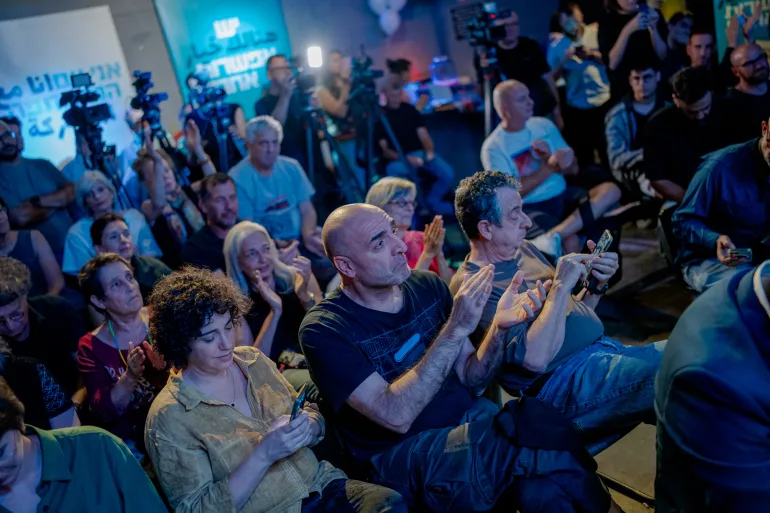
Attendees listen and applaud during an election campaign meeting on October 5, 2026 in Tel Aviv, Israel [Erik Marmor/Getty Images]
Analysts also pointed out that several parties running, including ones that are currently in power and a number that are challenging the current coalition, all advocate for the expulsion of Palestinians from Gaza, as one of the examples of the shift to the right.
Omar Baddar, director of Palthink for Strategic Studies, said the messaging from across the Israeli political and military spectrum in the lead-up to the election shows that there is “a consensus” to continue the attacks on Gaza, where nearly 1,500 have been killed since a “ceasefire” last year.
“They’re using the threats to get more votes,” he said, pointing out to what he described as the radicalisation of the society.
With the election approaching, added Baddar, Israeli leaders are seeking to undo one another: “Who[ever]’s more radical is more likely to get more votes.”
As Ehab Jabareen, a Palestinian political analyst and researcher from inside Israel, writes, “what it means to be ‘right-wing’ in Israel today is above all to take a harder line on Palestinian national claims, security and territorial control.”
He adds: “On security and the Palestinians, a large part of Jewish Israeli politics already works from assumptions that would have been treated as right-wing a generation ago: Deep suspicion of a sovereign Palestinian state, a high tolerance for prolonged military control, and a stronger insistence on Jewish sovereignty as the starting point rather than one value among others.”
Observers and rights groups say the disparity is even evident in the electoral process. A prominent politician and Palestinian citizen of Israel, Sami Abu Shehadeh, has been forced to withdraw from the election over his remarks about the Gaza war, while Israeli far-right leaders have remained untouched despite their violent rhetoric against Palestinians.
Netanyahu’s security credentials endure
Recent polling indicates that the events of October 7 are top of mind for Israelis, who also have questions about who was responsible for the security failures of that day.
Just last month, reports surfaced indicating that Netanyahu had received two separate warnings about an imminent Hamas attack in 2023, from Egypt’s intelligence chief, Abbas Kamel, and United Arab Emirates President Sheikh Mohamed bin Zayed Al Nahyan.
Netanyahu’s two main rivals in the race for prime minister have cited the alleged warnings to call the prime minister “unfit” to remain at the helm of the country.
But Netanyahu has denied suggestions that he had been forewarned about the attack, and the reports do not appear to have had a significant effect on opinion polls.
While October 7 represents a profound rupture in Israelis’ sense of security, public trust in the Netanyahu government had already been badly shaken by its controversial judicial overhaul, introduced when the prime minister’s current coalition first came to power, said Mairav Zonszein, an Israel-Palestine analyst at the International Crisis Group based in Tel Aviv.
Despite these breaches of trust, the Israeli leader retains support.
“Israelis in general still see Netanyahu as kind of the guy on security. And more to the point, they don’t really see an alternative,” Zonszein told Al Jazeera.
A June survey by Mitvim – the Israeli Institute for Regional Foreign Policies found that the Israeli public supports its government’s military and security solutions, and rejects resolving the Palestinian issue and ending the Israeli occupation of Palestinian territory. This is the case even while it has been concerned about international isolation and the decline of Israel’s international standing since the beginning of the genocidal war on Gaza, the survey reported.
Yet Israelis are also increasingly war-weary, even as they back the use of more force. Its troops – stretched between six fronts of war in the last few years – are bearing the brunt of this fatigue in Israeli society.
Israel’s Ministry of Defence said on Tuesday that nearly 30,000 soldiers and security personnel are facing psychological trauma since the war.
The ministry said its rehabilitation department’s budget has increased by 88 percent over the past three years to 10 billion shekels ($3.3m), with the majority supporting treatment for mental health conditions and post-traumatic stress disorder.
As Israel expands, the two-state solution fades
Still, Israel in recent months has been more and more vocal about its expansionist vision, with officials brazenly stating the goal of “Greater Israel”. The claim for the conquest is based on a biblical verse (Genesis 15:18-21).
For decades, Israel has ignored international law in its continuous occupation of Palestinian and Syrian land, and has shown little respect for its neighbours’ sovereignty, occupying more land in Syria, as well as in Lebanon in more recent years.
According to Najar, the political economist, the “complete dehumanisation” of Palestinians as evidenced during the campaign reveal that Gaza “is being presented to Israeli voters not as a catastrophe or a crime for which there must be accountability, but as a blueprint to be repeated elsewhere”.
In southern Lebanon, where Israel has been carrying out near daily attacks and and has occupied large swathes of land, residents have told Al Jazeera they expect little to change even if Netanyahu is defeated in the election.
Netanyahu’s main political challenger, Gadi Eisenkot – head of the Yashar party and former army chief of staff – is the father of the so-called Dahiyeh Doctrine, and is just as hawkish about expansion. That doctrine, since Israel’s war with the Lebanese group Hezbollah in 2006, calls for the use of huge force, even against civilian infrastructure, as a deterrent against enemies and was deployed in Israel’s recent wars, particularly in Beirut’s southern suburbs.
If it were up to Eisenkot, the Lebanon front of war would have never scaled down: He has accused Netanyahu of bowing to US pressure to halt operations in Beirut, and has insisted that the military should be able to attack Hezbollah anywhere in Lebanon.
For Israelis still reeling from the events of October 7, Eisenkot could fill the security void many are feeling, said Zonszein.
“They really … see the world as kind of very hostile towards them, the world not understanding what they went through on October 7, and [therefore why] the need to have these security buffer zones in Lebanon, in Syria, and Gaza,” she said.
A two-state solution to the Israel-Palestine conflict is therefore out of the question, said the analysts – and has not even made a blip of an appearance in campaigning before the election.
The idea first emerged during the Oslo Accords more than 30 years ago, which set out a negotiating process aimed at resolving the Israeli-Palestinian conflict, predicated on the belief that the creation of a Palestinian state alongside Israel was imperative to forge peace.
But since the Oslo process began in 1993, the number of Israeli settlers in the West Bank has ballooned from about 260,000 to more than 700,000, embedded deep inside West Bank areas that would be needed for a contiguous Palestinian state.
“The concept of a two-state solution is currently irrelevant and likely will remain so for another decade or two, if not longer,” said Bergman. “It is unlikely to become a reality in the foreseeable future, as no Israeli leader can propose it to the Israeli public after the events of October 7.”
The only way it could regain prominence is if there is substantial international pressure, including severe sanctions on Israel, and a non-violent intifada, or an uprising by Palestinians, he said.
The outright rejection of Palestinian statehood has simply become much more “acceptable”, said Zonszein.
“There’s several parties who advocate these views, whereas there isn’t a single Jewish Zionist Party that puts the need for a two-state solution or a Palestinian political process at the forefront,” she said.
Taken all together, Israel’s election appears less a demand for change than a further entrenchment of the jingoism that surged after October 7, 2023.
“[There’s] more and more movement towards more military force, more need for pushing the borders … out of a lot of fear that another October 7 could happen,” said Zonszein.
Under an existing state appropriations restraint, also known as the Gann Limit, lawmakers cannot spend more in the state budget than an amount determined by a formula that takes annual tax proceeds, changes to the population and cost of living into consideration.
Tax revenue above the limit must be divided between schools and refunds to taxpayers. More recent carve-outs in the law also allow leaders to direct excess funds to infrastructure and local government.
The limit applies to most other appropriations of tax revenue, including money that lawmakers tuck away into the “rainy day” fund and other reserves.
California voters also have capped the amount of money lawmakers can set aside in the rainy day fund at 10% of general fund proceeds in a given year.
The proposed changes would exempt deposits into the rainy day fund and a short-term reserve, called the Projected Surplus Temporary Holding Account, from the state appropriations limit. The cap on the rainy day fund would grow from 10% of general fund tax revenue to 20%.
In effect, the measure would allow the governor and the Legislature to put more money into budget reserves, creating another option to avoid triggering rebates.
For example, if the spending limit is $400 billion for the year, and revenue hits $410 billion, the measure would give lawmakers the option to deposit the $10 billion above the spending limit into the rainy day fund, direct the money to infrastructure or give it to local governments, instead of returning the funding to taxpayers and increasing funding for schools.