Ebola Virus

Hundreds protest U.S.-run Ebola field hospital in Kenya

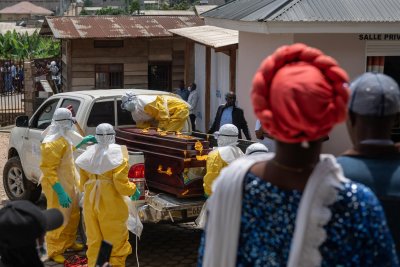
Health workers wearing full personal protective equipment prepare May 23 to transport the body of an Ebola victim for a safe burial at Sofepadi Hospital in Bunia, Democratic Republic of the Congo. On Monday, hundreds of people in Kenya protested plans for a nearby field hospital to quarantine and treat Americans exposed to Ebola. Kenya has no Ebola cases thus far. Photo by Stringer/EPA

June 1 (UPI) — Hundreds of residents in central Kenya marched Monday in protest of plans for a U.S.-run field hospital in which Americans exposed to Ebola would be treated and quarantined.

Officers from the U.S. Public Health Service would run the facility at Laikipia Air Base near Nanyuki, Kenya. The hospital was supposed to open last Friday. However, a Kenyan court blocked that opening, with another hearing set for Tuesday, The Washington Post reported.

Kenya has had no cases of Ebola in this outbreak thus far, but there have been about 1,000 cases worldwide, with about 200 suspected deaths, mostly in the Democratic Republic of Congo. Kenya has increased screening and security measures to lessen the risk of the disease spreading to the country.

Nanyuki residents said the hospital facility would endanger the lives of those living nearby.

“If it is not good for America, why is it good for us? Why does the U.S. only care about itself?” Gibson Maina, 25, said to The Washington Post. “The moment we get sick people here, how sure are we that we will be able to contain the disease and that we will be able to survive it?”

The protests were largely peaceful with “localized disruptions,” Capital News in Kenya reported. The Post, however, said some demonstrators set fires and “clashed with the police.”

Officials have said the hospital would keep U.S. citizens with Ebola from returning to the United States for treatment. Katiba Institute, a constitutional rights advocacy group in Kenya, filed the lawsuit that blocked the facility from opening.

The Law Society of Kenya has also opposed the hospital, Capital News reported. Charles Kanjama, leader of the society, said that Ebola treatment centers should be closed to the outbreaks and not in countries with no cases.

“We owe patients human solidarity, but public health requires facilities to be placed near outbreak epicenters,” Kanjama said.

Sarah Korere, a local leader, also said such a hospital should be closer to the problem areas.

“As residents of Nanyuki, we have said we do not want the Ebola rescue center in Nanyuki,” she said to Capital News. “And it’s not just Nanyuki; we’ve said we do not want it in Laikipia, and not yet Laikipia, we don’t want it in Kenya.”

Kenyan Health Cabinet Secretary Aden Duale said any international agreement for Ebola treatment facilities must comply with Kenyan laws and public health protocols. The United States said in a statement last week that it was in talks with Kenyan officials after the lawsuit.

Source link

Foreign Office issues travel warning for 3 countries amidst Ebola outbreak

The Foreign Office has updated its travel advice for Brits to a number of destinations as a new Ebola outbreak has been declared in the Democratic Republic of Congo

The Foreign Office has updated its travel advice for a number of countries after an Ebola outbreak earlier this month in the Democratic Republic of Congo (DRC).

On May 15, the country’s Ministry of Health confirmed an outbreak of Ebola Bundibugyo in the North-Eastern Ituri Province, while cases have also been confirmed in Uganda. The World Health Organisation (WHO) has since declared Ebola in the Democratic Republic of Congo and Uganda a Public Health Emergency of International Concern.

As a result, a number of destinations to introduce stricter measures for travellers from health screenings for foreign nationals to quarantine for residents in certain cases.

For example, Kenya has introduced enhanced health screenings for passengers arriving from Uganda, Ethiopia, and DRC, while Tanzania has also introduced increase public health measures for incoming travellers.

Now the Foreign Office has updated its travel advice for Uganda, Angola and the Central African Republic, with warnings around new health screenings and entry requirements for anyone travelling to those destinations.

In its Angola advice, it warns: “On 15 May the Democratic Republic of Congo Ministry of Health announced an outbreak of Ebola Bundibugyo in the North-Eastern Ituri Province. Read more about the Ebola outbreak on TravelHealth Pro and see information on Ebola and similar diseases. World Health Organisation (WHO) have declared this a Public Health Emergency of International Concern.

Due to the outbreak, you may experience heightened health screening at international borders in the region. Check entry requirements for the country you’re travelling to or transiting.”

The Foreign Office has already been advising “against all travel to parts of Central African Republic” before the Ebola outbreak in the DRC and Uganda, but has updated its advice due to the country sharing a border with the DRC.

Virginia Messina, Group CEO of African Travel and Tourism Association (ATTA), said: “Established protocols are in place within countries bordering the DRC and as a result tourism operations and business trips across the wider African continent continue normally. As of 27 May, no other cases have been detected outside of Uganda and DRC. The risk to travellers on standard itineraries outside affected areas remains very low, and it’s important to highlight that Ebola is not easily transmitted through casual contact.

“However, travel rules and screening measures may change quickly. The WHO (World Health Organisation) and the European Centre for Disease Prevention and Control (ECDC) are scaling up efforts to contain the virus but continue to advise against blanket travel restrictions and neither the UK, nor any European country has introduced entry bans.”

Source link

U.S. to build quarantine facility in Kenya for Ebola-exposed Americans

A Liberian man walk pass an ebola awareness painting on a wall in downtown Monrovia, Liberia, in 2015. The United States wants to build a quarantine facility for exposed Americans in Kenya. File Photo by Ahmed Jallanzo/EPA

May 27 (UPI) — The United States and Kenya are in talks to create a quarantine facility in Kenya for Americans exposed to Ebola, unnamed officials told multiple media outlets Wednesday.

The U.S. Public Health Service would staff the planned field hospital and isolate and monitor Americans exposed to or at risk of the ongoing outbreak of Ebola in the Democratic Republic of Congo, Uganda and South Sudan.

The Kenyan government has not yet approved the plan, The Star, Kenya, reported.

The plan is to have the facility built with 50 beds within a week, with the potential to expand to 250 beds later, The Washington Post reported.

The staff at the Public Health Service has begun training at Joint Base Andrews in Maryland to staff the Kenya facility, two people familiar with the response told The Post. But one person said they were concerned that the training was only three days.

The plan could keep U.S. citizens from re-entering the United States, a former official from the Centers for Disease Control and Prevention who has worked on the Ebola response told CBS News.

“It would be unbelievably unethical and irresponsible to maroon Americans, given Kenya doesn’t have a proper Level 4 containment facility or much experience” in dealing with Ebola.

Nahid Bhadelia, director of Boston University’s Center on Emerging Infectious Diseases who has cared for Ebola patients in multiple outbreaks, told The Post that creating a makeshift quarantine hospital overseas brings risks.

“My biggest concern would be that you cannot re-create the same quality of care or training among healthcare staff at an ad hoc center that you would at any of the well-trained and established hospitals that the U.S. has set up since 2014 to take care of these types of patients,” Bhadelia said. “I’m also concerned what this does is effectively discourage Americans and American organizations from working in the area if they know it will be difficult for them to come back in case of an emergency.”

Bhadelia added that if quarantined people contract the disease, staff “would need to be able to provide ICU-level care.”

Meanwhile, the American Foreign Service Association is calling on the State Department to send affected Foreign Services workers and their families home, saying they can be repatriated and monitored at the same U.S. facilities where Americans exposed during previous outbreaks were admitted.

“Those facilities still exist, and the government has the ability to transport people safely and without endangering other travelers,” the AFSA said in a statement.

“Foreign Service employees are there because the U.S. government sent them. They are entitled to the same standard of care that has always applied, including the right to come home.”

More than 220 people have died in the DRC in the latest outbreak of the rare Bundibugyo strain of Ebola. The World Health Organization has declared it a public health emergency of international concern. WHO and partner agencies have reported more than 900 suspected cases in Congo and Uganda as of Tuesday.

The WHO reported Wednesday that fighting in Congo is also making it difficult for aid workers to respond to the outbreak.

Source link

CDC expands Ebola screening program for Americans returning to the U.S.

Health workers wearing full personal protective equipment on Saturday prepare to transport the body of person who died of Ebola for a safe burial at Sofepadi Hospital in Bunia, Ituri province, in the Democratic Republic of the Congo. Photo by EPA

May 23 (UPI) — The Centers for Disease Control and Prevention on Saturday added two more airports that travelers to the United States can be routed through for Ebola screening when entering the country.

The enhanced travel screening announced earlier this week by the CDC and the Department of Homeland Security is meant to screen people for the virus on entry to the country if they have been in the Democratic Republic of Congo, South Sudan or Uganda.

The outbreak, which started in the DRC and has spread to neighboring South Sudan and Uganda, is estimated to have 750 suspected cases and 177 suspected deaths, the World Health Organization on Friday said, adding that the “real scale of the outbreak is likely far larger.”

The CDC first issued restrictions on Thursday for Americans returning to the United States to be screened at Washington Dulles International Airport in Washington, D.C., before continuing on to their final destinations.

The two additional airports will be Hartsfield-Jackson Atlanta International Airport, which started to accept travelers at 11:59 p.m. EDT on Friday, and George W. Bush Intercontinental Airport in Houston, which will start to accept travelers on Tuesday, May 26, at 11:59 p.m. EDT, the CDC said on Saturday.

“These travelers will have their air travel re-routed to arrive at select airports,” CDC officials said in the update.

The enhanced health screening includes being escorted to a designated screening area; completing a questionnaire about their travel history and symptoms; having their temperatures checked using non-contact thermometers; and observation by CDC staff for signs of illness.

“Travelers with fever or other symptoms that could be Ebola will receive additional evaluation by a CDC public health officer,” the agency said.

“If the assessment shows that a traveler may be sick with Ebola, the traveler will be transferred to a hospital for further medical evaluation,” it said.

The WHO on Friday raised the national risk assessment during the outbreak in the DRC to “very high,” but officials said that global risk for infection with the Bundibugyo strain of the Ebola virus, for which there is no approved vaccine.

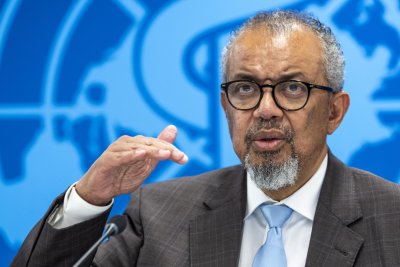
WHO Director-General Tedros Adhanom Ghebreysus during a meeting on Friday thanked the efforts of neighboring nations in Africa who have assisted during the outbreak, as well as the various regional and global health agencies that also have done so.

Although the United States last year pulled out of the WHO, the U.S. State Department said on Saturday that it has activated a dedicated Ebola Response Task Force that is led by “senior experts with direct experience managing prior Ebola outbreaks” in 2014 and 2018.

The department also has deployed a Disaster Assistance Response Team and provided $32 million in assistance to U.S. partners in the region, it said in a press release.

Kevin Warsh takes the oath of office as he is sworn-in as the new chairman of the Federal Reserve by Supreme Court Associate Justice Clarence Thomas in the East Room of the White House on Friday. Photo by Yuri Gripas/UPI | License Photo

[kicker]

Source link

U.S. issues restrictions for Americans traveling from Ebola-affected nations

The U.S. State Department will now require all U.S. citizens and legal residents traveling back to the United States from three African countries experiencing an Ebola outbreak must enter the country through Washington, D.C., for an enhanced security screening. EPA-EFE/Stringer

May 21 (UPI) — Americans traveling back to the United States who have recently been in Democratic Republic of the Congo, Uganda or South Sudan will be required to enter the country through Washington, D.C.

Citizens and lawful permanent residents who have been in any of the countries in the last 21 days will be required to fly to Washington Dulles International Airport for enhanced health screenings before continuing on to their final destination, the U.S. Department of State announced.

The announcement follows an Air France flight bound for the United States on Wednesday afternoon being redirected to Montreal Trudeau International Airport after a passenger on board was determined to be from the DRC.

The U.S. Centers for Disease Control and Prevention on Monday already had blocked non-U.S. passport holders from entering the United States if they had been to any of the three African nations in the last 21 days.

An American doctor, one of several exposed in the DRC, was also confirmed to be infected with the Bundibugyo strain of Ebola on Tuesday and flown to Germany for treatment.

“The Dulles requirement applies to all passengers, including U.S. citizens and lawful permanent residents, who were present in those countries,” the State Department said in a travel advisory.

“Please be prepared for flight changes or cancellations,” the department said.

World Health Organization Director-General Tedros Adhanom Ghebreyesus said during a press conference that there have 51 confirmed cases of Ebola among the three countries, with nearly 600 suspected cases and 139 suspected deaths.

Tedros said the scale of the epidemic is “much larger” in the DRC, and that there have been deaths reported among health care workers, which suggests health care-associated transmission.

The U.S. Centers for Disease Control and Prevention has reported that the doctor whose case was confirmed this week, with officials flying him to Germany because of their previous experience in handling Ebola cases.

Although contacts linked to the doctor also have been moved to Germany and Czechia for observation, there have been no additional cases in Americans, the CDC said.

President Donald Trump turns to photographers in the press pool after greeting guests during the Congressional Picnic on the South Lawn of the White House on Tuesday. Photo by Samuel Corum/UPI | License Photo

Source link

CDC restricts people traveling to U.S. from three African nations amid Ebola outbreak

Local officials the Democratic Republic of the Congo on Sunday updated reporters on the Bundibugyo Ebola virus outbreak there, which has caused the WHO to declare it a health emergency of international concern and the United States to enacte travel restrictions. Photo by Marie Jeanne Munyerenkana/EPA

May 18 (UPI) — The U.S. Centers for Disease Control and Prevention on Monday restricted non-U.S. passport holders from entering the United States if they have been in Uganda, the Democratic Republic of the Congo or South Sudan in the past 21 days.

The agency made the announcement as there have at least 346 cases and 88 deaths in the DRC, on top of several cases that have been confirmed in nearby nations in people who been there, the CDC said over the weekend.

The CDC said that is coordinating with various agencies and companies to manage travelers who have been exposed to Ebola as it also deploys employees to support containment of the outbreak in the three nations.

“CDC assess the immediate risk to the general U.S. public as low, but we will continue to evaluate the evolving situation and may adjust public health measures as additional information becomes available,” the agency said in a situation summary.

In the last five days, the World Health Organization confirmed that the Ebola virus circulating in the three countries right now is the Bundibuyo virus, one of four known strains that have affected humans since Ebola was discovered in mid-1970s.

Although there is an approved, licensed vaccine against Ebola which has successfully been used to quell outbreaks, the vaccine — called Ervebo — only protects against acquisition of the Zaire species of Ebola virus, making it useless in the current outbreak, according to the CDC.

WHO on Saturday declared the outbreak a public health emergency of international concern.

In its update, WHO said that there are “significant uncertainties to the true number of infected persons and geographic spread associated with this event at the present time. In addition, there is limited understanding of the epidemiologic links with known or suspected cases.”

Ebola spreads from wild animals to humans and from human to human through direct contact with blood or other bodily fluids from infected individuals, and carries a case fatality rate of roughly 50%.

A number of affected Americans have reportedly been exposed to the virus during the outbreak.

The CDC has recommended that people who have traveled through the two countries in the last 21 days should immediately seek medical attention if they develop Ebola symptoms, which can include fever, weakness, vomiting, diarrhea or unexplained bleeding.

In addition to roughly 30 CDC employees dispatched to the region, and will join officials from several other global and regional health agencies, the WHO is expected to convene an emergency committee to advise the agency’s director-general on its response the outbreak.

Source link

WHO declares Ebola health emergency in the DRC, Uganda

Medical workers check temperatures at the Mpondwe border point with DR Congo, near Bwera, Uganda, on May 9, 2019. File Photo courtesy the WHO

May 17 (UPI) — The World Health Organization has declared a public health emergency of international concern in reaction to an Ebola outbreak in Uganda and the Democratic Republican of the Congo.

Health officials believe the disease, also known Ebola hemorrahagic fever, has killed dozens of people in the two countries in recent days. In the DRC’s Ituri province, there have been 336 cases and 88 deaths possibly linked to the disease. Eight cases have been confirmed.

Cases have also been suspected in Kampala, Uganda.

The WHO declared the public health emergency Saturday, one day after confirming the existence of an outbreak. The international health organization, which is an arm of the United Nations, said the outbreak doesn’t meet the criteria of a pandemic, but the spread of the virus could be bigger than currently known.

“There are significant uncertainties to the true number of infected persons and geographic spread associated with this event at the present time,” the WHO said.

This Ebola outbreak has been linked to the Bundibugyo virus, making it particularly challenging to treat. Unlike the Ebola-zaire strains of the virus, there are no approved approved therapeutics or vaccines for the Bundibugyo strain, the WHO said.

Source link

Democratic Republic of Congo declares Ebola outbreak; 65 people killed

A handout photo made available by the World Health Organization shows temperature screening at Mpondwe border point with the Democratic Republic of Congo, near Bwera, Uganda, in May 2019. The Democratic Republic of Congo declared an Ebola outbreak on Friday as 65 people have died from the disease in the country’s eastern region. File Photo by the World Health Organization/EPA-EFE

May 15 (UPI) — The Democratic Republic of Congo declared an Ebola outbreak on Friday as 65 people have died from the disease in the country’s eastern region.

There have been about 246 cases reported, many of them in the Ituri province’s small mining towns of Mongbwalu and Rwampara. The Africa Centres for Disease Control and Prevention said in a statement Friday that it is meeting with DRC, Ugandan and South Sudanese leaders to prepare a response to the outbreak.

Uganda and South Sudan border the Ituri province.

Africa CDC said that the DRC’s national research laboratory has detected Ebola in 13 of 20 samples it has tested.

There have been 16 prior Ebola outbreaks in the DRC since 1976 when it first identified the virus within its borders. Vaccines are available for the Zaire strain. Africa CDC said that early testing indicates the current strain is not the Zaire strain.

“Africa CDC stands in solidarity with the government and people of the Democratic Republic of the Congo as they respond to this outbreak,” Dr. Jean Kaseya, director general of Africa CDC, said in a statement. “Given the high population movement between affected areas and neighboring countries, rapid regional coordination is essential.”

The mining towns where the outbreak is centered experience a lot of inbound and outbound traffic, raising concerns about the disease spreading further.

Ebola is a severe illness with a high fatality rate in humans, reaching as high as 90% in some cases, the World Health Organization says.

Infection can be spread by direct contact with a person who is infected or object surfaces that are contaminated with bodily fluids from a person who is sick or has died from the disease.

The Ebola virus can incubate between two and 21 days. Symptoms include fever, fatigue, malaise, muscle pain, headache and sore throat, before progressing to vomiting, diarrhea, abdominal pain, rash and symptoms related to impaired kidney and liver functions.

There were 64 cases of Ebola reported in the DRC last year, with 45 deaths, a 70% rate of fatality, the U.S. Centers for Disease Control and Prevention said. That outbreak occurred from September to December in the remote Bulape health zone in the Kasai province, which has a relatively low population density.

Source link