June 26 (UPI) — President Donald Trump said Friday that Iran has attacked ships in the Strait of Hormuz and that it’s a violation of the cease-fire between the United States and Iran.
A cargo ship in the strait was attacked Thursday, but it’s unclear if this is the attack about which the president was speaking.
“The Islamic Republic of Iran shot at least four One Way Attack Drones at Ships transversing the Strait of Hormuz. One of the Drones solidly hit the upper deck of a large and very expensive Cargo Carrying Ship. Damage was done, but the Ship was able to proceed on its way. We knocked down three other Drones. Obviously, this is a foolish violation of our Ceasefire Agreement. President DONALD J. TRUMP,” the post on Truth Social said.
Trump did not address the negotiations with Iran.
Iranian Deputy Foreign Minister Kazem Gharibabadi posted a statement on X Friday emphasizing Iran’s control of the strait.
“Safe passage through the Strait of Hormuz, with ambiguous arrangements, parallel routes, or decision-making outside of Iran’s considerations as the coastal state, cannot be guaranteed. Any credible framework must be based on coordination with Iran and the provisions of paragraph five of the Islamabad Memorandum of Understanding. Otherwise, the outcome will be the suspension of the designated parallel route,” the post said.
The memorandum of understanding that Trump and Iran’s president signed on June 17 established the cease-fire and opened passage through the strait. In the fifth paragraph, it said Iran will use its “best efforts” to ensure the safe passage of commercial vessels with no charge for 60 days, The Hill reported.
On Thursday, the United States issued a joint statement with the Gulf Cooperation Council saying that “free, unconditional, and unrestricted navigation” through the strait is guaranteed under international law.
“The Ministers rejected any tolls, fees, or attempts to assert control over the strait,” the statement said. The council includes Bahrain, Kuwait, Oman, Qatar, Saudi Arabia and the United Arab Emirates.
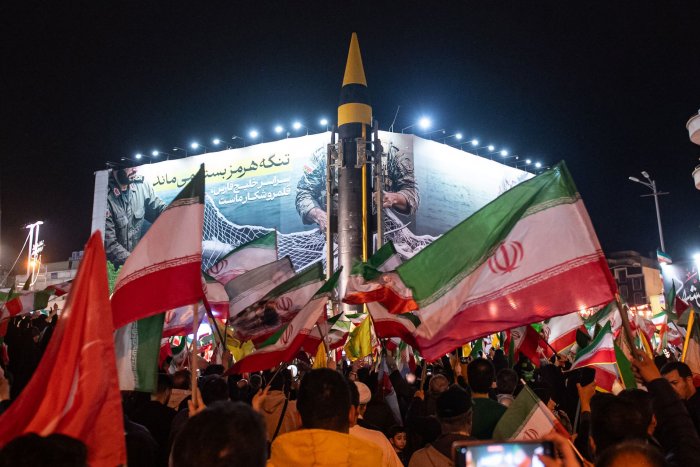
A missile identified as “Khorramshahr-4” was on display during a public rally in Tehran’s Enghelab Square on April 21, 2026. Photo by Behnam Tofighi/UPI | License Photo
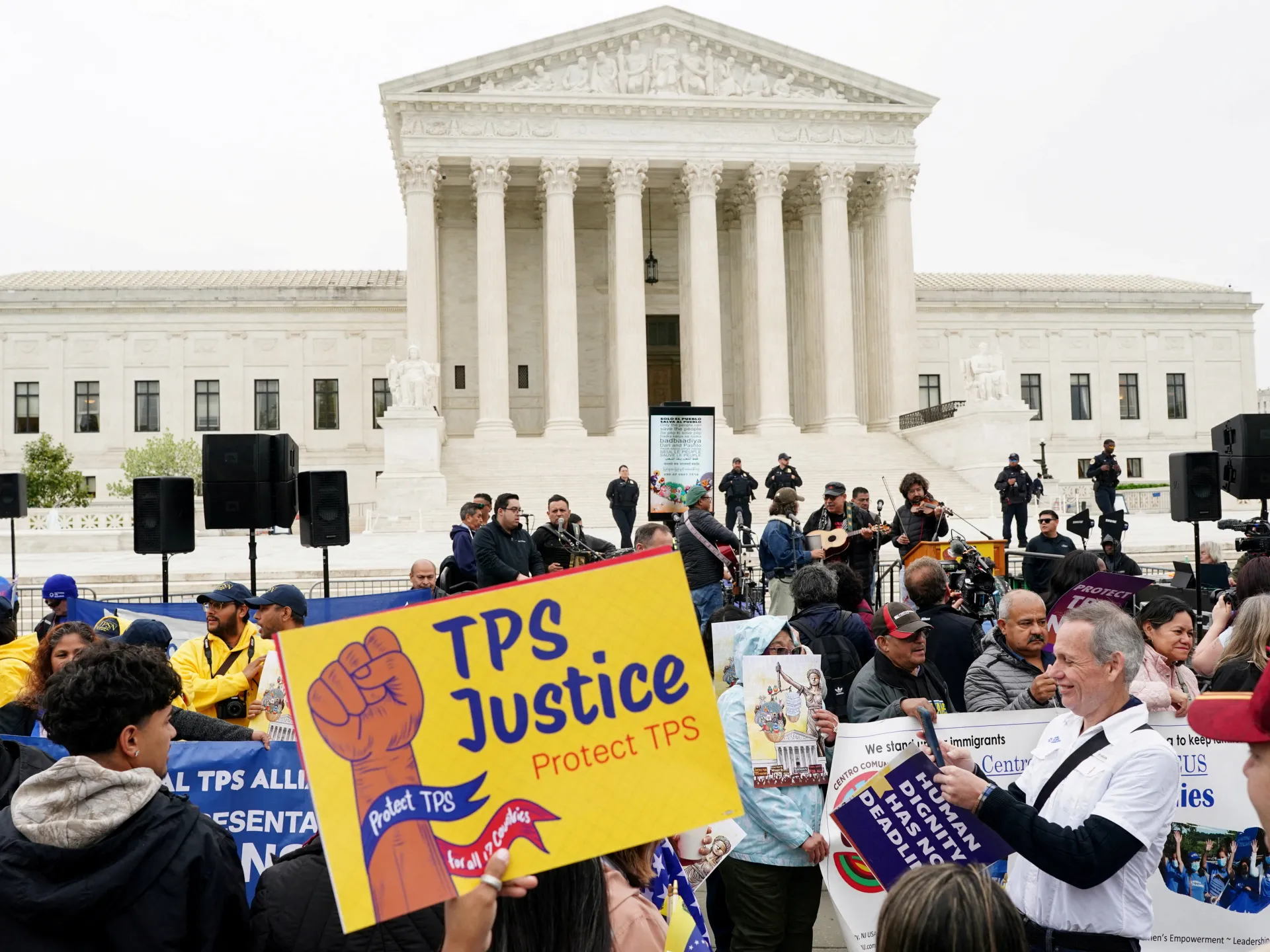
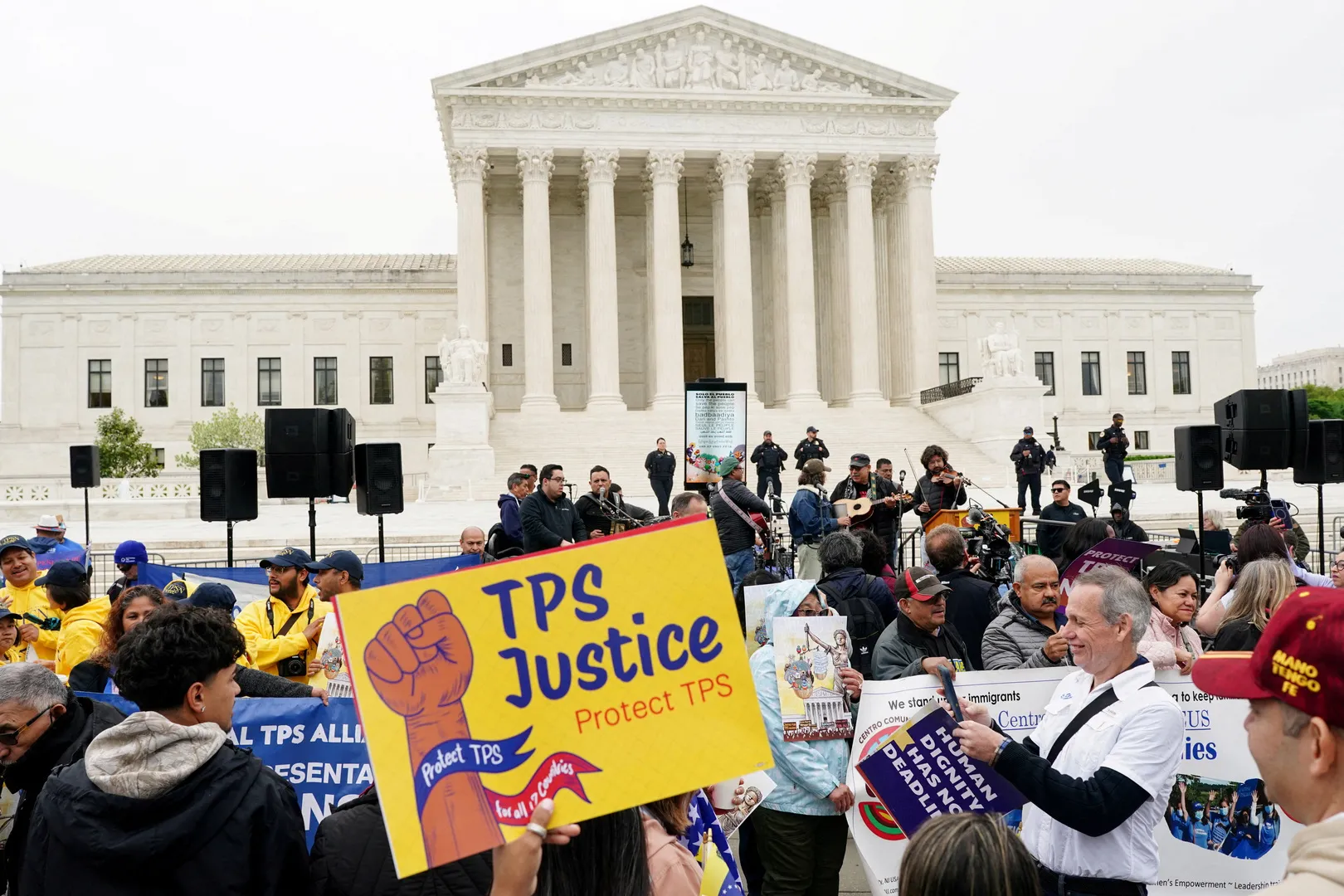
The Supreme Court’s ruling allowing the administration of US President Donald Trump to do away with a special legal status for Haitians and Syrians has sent shockwaves through communities across the country.
Immigration advocates say the 6-3 majority decision allowing the Trump administration to terminate Temporary Protected Status (TPS) will have a resounding impact on nationals of Haiti and Syria, raising the spectre of deportation and family separation, while likely leaving US employers in the lurch.
Recommended Stories
list of 3 itemsend of list
But the ruling is set to have more far-reaching implications, advocates have warned, creating a new tool to “empower Trump’s ICE deportation machine to take away legal protections and work permits from hundreds of thousands of people”, according to Hector Sanchez Barba, the president of the Mi Familia Vota advocacy group.
“This has been a defining element of the Trump- [White House adviser Stephen] Miller campaign of cruelty, revoking legal or temporary status, taking away work permits and forcing immigration judges to dismiss cases to accelerate detentions and deportations,” Barba said in a statement following Thursday’s ruling.
Here’s what to know.
What does the ruling mean for Haitians and Syrians on TPS?
Temporary Protected Status (TPS) was created by Congress as part of the Immigration Act of 1990. It allowed the executive branch, particularly the Secretary of Homeland Security, to declare that it is unsafe for foreigners to return to their home countries in light of extraordinary temporary conditions, such as armed conflict, natural disasters or other internal crises.
When a country is designated under TPS, its nationals are granted temporary legal status to reside and work in the US.
Haiti was first designated for TPS following the devastating earthquake in 2010, which killed over 250,000 people. The status has been repeatedly renewed as the Caribbean nation has suffered overlapping political, security and humanitarian crises.
Syria has been designated for the status since 2012, after the start of the civil war which lasted almost 14 years.
All told, about 350,000 Haitians and about 6,000 Syrians are believed to be in this status.
Immigration advocates say the ruling will send TPS recipients scrambling to find other legal pathways to stay in the US or become deportable under Trump’s mass deportation drive.
Given that both countries have been designated for TPS for over a decade, the decision also raises the spectre of family separation, particularly for parents with children born in the US.
“Ending these protections for hundreds of thousands of Haitians and thousands of Syrians will tear families apart, disrupt workplaces and communities and place vulnerable individuals at risk,” Council on American Islamic Relations (CAIR) national executive director Nihad Awad said.
“Many TPS holders have lived in our nation for years, raised American children, built businesses, contributed to our economy and become integral members of their communities.”
What does it mean for US employers?
Several labour organisations and unions have underscored the impact the sudden change in status could have on US industries.
Neidi Dominguez, the executive director of Organized Power in Numbers, called the ruling a “gut punch that requires workers, immigrant communities and the employers who rely on them to hit back together through our organising”.
“They work in hospitality, food service, education, construction, health care and every industry,” Dominguez said. “These are our coworkers, our neighbours and the backbone of the economy across this country, from service to construction and healthcare.”
The healthcare industry is expected to be particularly hard-hit by the decision, with the Migration Policy Institute finding that Haitian immigrants held over 103,000 healthcare jobs in 2021.
“This unconscionable ruling will leave thousands more immigrants – not just registered nurses and healthcare workers, but also teachers, airport workers, hard-working people – vulnerable to the Trump administration’s deadly, money-making deportation machine,” the National Nurses United union said in a statement.
“This decision will further strain our healthcare workforce and worsen the nurse staffing crisis,” it said.
Why does this extend beyond Haitian and Syrian TPS?
Lower courts had previously ruled that the Trump administration did not follow proper procedures, including conducting an inter-agency review to determine that conditions in both countries had improved, in terminating TPS for Haiti and Syria.
But, as Aaron Reichlin-Melnick, a Senior Fellow at the American Immigration Council, explained, the Supreme Court’s majority ruling did not even address whether the Department of Homeland Security Secretary had followed the legally mandated procedures in terminating TPS.
“Rather, the Court said that questions of whether the DHS secretary followed the law cannot be heard by courts in the first place,” he wrote, “meaning that in the future even an openly unlawful decision to grant or terminate TPS could be entirely insulated from judicial review”.
The ruling will further allow the Trump administration to “return to federal court in other cases and overturn decisions ruling against the termination of TPS for countries such as Venezuela, Somalia, Ethiopia and others”, he added.
Angelica Sedgwick Oun, a US immigration researcher at Human Rights Watch, said the ruling “leaves the DHS secretary with unfettered power to make a life-and-death decision about whether it is safe enough to send someone back to a country facing rampant violence, like Haiti, or conflict, like Syria, without meaningfully consulting on human rights conditions there”.
What comes next?
Because the Supreme Court is the top appellate court in the US, there is little recourse available through the judiciary.
But an array of advocacy groups have called on Congress to intervene.
In a rare bipartisan move on immigration, the US House of Representatives in April passed an extension to Temporary Protected Status for Haitians until 2029. The Senate has not yet taken up the measure.
Others have called on Congress to pass legislation to assert a process for courts to review any TPS terminations.
The US Supreme Court has sided with the Trump administration in its bid to end Temporary Protected Status (TPS) for Haitians and Syrians. The ruling allows the policy to take effect before the courts have reached a final decision on its legality.
June 25 (UPI) — The U.S. Postal Service plans to refuse delivery of mail-in ballots in states that don’t turn over their voter lists to the federal government, the postmaster general told Congress.
Postmaster General David Steiner told the Homeland Security and Governmental Affairs Committee about the proposed rule on Wednesday.
“Yes or no — if a state refuses to turn their absentee voter list over to the federal government, will the Postal Service still mail their ballots under this proposed rule?” Sen. Gary Peters, D-Mich., asked Steiner.
“Under our proposed regulation, no. We would tell the state that we need the manifest,” Steiner said.
Steiner argued the policy is to make sure ballots are delivered “securely, efficiently, and accurately.” But President Donald Trump has repeatedly demanded states’ voter lists over the past year and has been suing states to get them.
The proposed rule says that states would have to give the Postal Service the names, addresses and ballot barcode numbers for the people who are to get ballots in the mail. The proposal follows Trump’s executive order from March 31 that requires the federal government to compile state citizenship lists and for the Postal Service to refuse to mail ballots to those the federal government has determined are ineligible to vote.
The proposed rule is posted on the Federal Register, and the public can comment until July 2.
Democrats have pushed back, arguing the rule shows that Trump is trying to federalize elections and said the Postal Service doesn’t have the authority to enforce that rule. The Constitution says states are responsible for running elections.
“Just because President Trump wants to do this does not make it law, doesn’t make it right, doesn’t make it constitutional. There is certainly a massive difference between general mail requirements and regulating elections,” Peters said.
Steiner admitted that his agency doesn’t have the authority to enforce elections but said the rule is a precaution to be sure that only eligible voters will get ballots.
“I would think that states would want the information to ensure that the ballots that they think they’re sending out are the ballots that are actually getting sent out,” Steiner said.
Sen. Elissa Slotkin, D-Mich., said the rule is part of a broader strategy.
“The U.S. Postal Service is now part of this bigger story of this president desperate to federalize our elections. He has tried every which way to say that if he and his party don’t win in these November elections, they were rigged.”
Slotkin asked Steiner directly to stop the plan.
“Please push back on being a pawn in this authoritarian playbook,” she said. “The Postal Service is one of the most important institutions in our country. Don’t taint it with the obsession of this one man.”
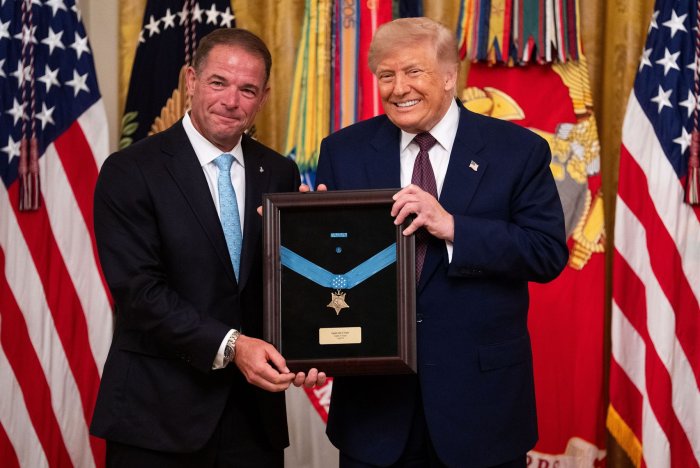
President Donald Trump presents a Medal of Honor to Tom Ripley on behalf of his father, John W. Ripley, during a Medal of Honor award ceremony in the East Room of the White House on Thursday. Photo by Aaron Schwartz/UPI | License Photo
US President Donald Trump has made his first comment on the UK’s likely next leader describing Andy Burnham as ‘extremely liberal’. He also declared that Britain is ‘dying’ and urged greater oil drilling in the North Sea. The comments came after Keir Starmer announced plans to step down, with Burnham the only candidate to succeed him.
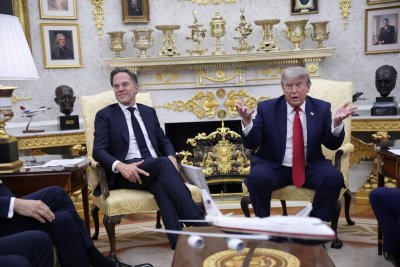
NATO chief Mark Rutte visited the White House to ease tensions with US President Trump ahead of next month’s NATO summit. Trump has said NATO isn’t doing enough, ordering a review of US forces in Europe after saying allies did not support the US war on Iran.
June 24 (UPI) — Democratic lawmakers accused the Trump administration Wednesday of seeking to push through a multimillion-dollar arms deal with Turkey by bypassing congressional review, the latest executive action critics say usurps the lawmakers’ authority.
Rep. Gregory Meeks, D-N.Y., ranking member of the House Foreign Affairs Committee, said he was informed by the Trump administration late Tuesday that it would bypass congressional review of an arms sale to Turkey worth more than $700 million.
“The State Department did not even attempt to justify its decision,” Meeks said in a statement.
“It did not invoke any emergency authority, did not present a written rationale and for months refused to make a good-faith effort to brief me on implications of the sale for the U.S.-Turkey relationship, Turkey’s continued possession of the Russian S-400 system and other regional security concerns,” he continued.
“It simply informed my office that it would immediately proceed with a formal notification of the sale.”
The United States and NATO opposed Turkey’s adoption of the S-200 system, and Washington removed Turkey from the F-35 fighter program in 2019 during Trump’s first administration.
Meeks called the decision to bypass congressional review “yet another deeply troubling example of this administration’s open contempt for Congress’ oversight authority.
“There can be no pretense that this was urgent or unavoidable,” he said, stating the items will not be delivered to Turkey for years.
“This was a deliberate choice to shut Congress out and to treat legitimate oversight as an inconvenience to be brushed aside.”
Trump is scheduled to visit Turkey early next month. During a White House press conference alongside NATO Secretary-General Mark Rutte on Tuesday, he praised Erdogan as “a great friend.”
Erdogan is known to be seeking to acquire U.S.-made fighter jets, including the F-35. Asked if he was planning to announce a potential deal when he visits Ankara, Trump replied: “I’m going to probably do something that’s going to make him very happy.”
It was unclear if jets were part of the arms deal.
UPI has contacted the State Department for comment and to detail the contents of the sale.
Democrats and other critics of President Donald Trump have repeatedly accused his administration of bypassing Congress through executive orders and unilateral decisions, particularly in its use of the military.
The Trump administration has faced staunch criticism from opponents for launching a war against Iran in late February without congressional authorization. Democrats have frequently argued that the Constitution gives Congress, not the president, the power to declare war.
Democrats have also criticized the administration’s use of the military to attack suspected drug-trafficking boats in the Pacific and Caribbean without congressional authorization.
Presidential candidate Ivan Cepeda accepted the victory of his opponent Abelardo de la Espriella.
Published On 24 Jun 202624 Jun 2026
Bogota, Colombia – Colombian presidential candidate Ivan Cepeda officially conceded defeat to hard-right populist Abelardo de la Espriella this morning following a tight run-off race.
While Cepeda had recognised the legitimacy of the preliminary results on Sunday, which gave de la Espriella a less than 1 percent lead, he said he would wait for the final, legally binding vote count, known as the scrutiny, before accepting defeat.
Recommended Stories
list of 3 itemsend of list
“I have decided to accept the result of this process, which indicates that Abelardo de la Espriella is the new president of the Republic,” said Cepeda in a livestreamed address on Wednesday.
While the voting verification process has not been fully completed, the National Registry, which oversees the elections, said yesterday that Sunday’s preliminary vote count was “99.997 percent” accurate after revision by judges at the municipal level. The vote must now be verified at the departmental and national levels.
There had been doubts among the Cepeda camp about the legitimacy of the vote process, with President Gustavo Petro – who was closely involved in the leftist candidate’s campaign – openly alleging fraud and foreign interference before and after the election.
“Electoral manipulation has been proven; I cannot say for certain that what has been uncovered guarantees an electoral victory [for Cepeda], but it is a fact,” wrote Petro on Monday.
For months, the president has warned about vulnerabilities in vote-counting software and clashed with the National Registry.
The president’s mistrust is largely based on the 2022 legislative election, in which his Historic Pact coalition recouped roughly half a million votes following the scrutinised vote count.
The recent memory of that vote led Petro and many Cepedistas (supporters of Cepeda) to believe that the roughly 250,000-vote margin between Cepeda and de la Espriella on Sunday could be overturned.
But the National Registry recorded high accuracy in both the preliminary count for March’s legislative election and the first round of the presidential race on May 31.
Petro also said that Washington’s interference in the election undermined the final result because President Donald Trump had endorsed Abelardo, breaking with tradition.
“President Donald Trump’s direct intervention nullifies the elections in Colombia,” wrote Petro in an X post yesterday.
But Cepeda’s concession appears to put distance between him and the president, who founded the Historic Pact movement.
“This suggests some sort of schism between Petro and Cepeda. While Petro’s term is sunsetting, Cepeda will likely become the leader of the opposition,” said Sergio Guzman, director of political risk consultancy Colombia Risk Analysis.
Cepeda, who is now expected to lead the Historic Pact party in the Senate, struck a conciliatory tone in his speech this morning: “I am doing this as an act of democratic responsibility, to contribute to harmony, peace and dialogue among Colombians.”
The United States Senate has voted in favour of invoking its war powers to force President Donald Trump to halt his military campaign against Iran or seek congressional approval before any further action is taken.
Here is a closer look at Tuesday’s vote – the 10th attempt Congress has made to rein in the US-Israel war on Iran – and what this means for the US government.
Why did this vote take place?
A similar measure had already been approved in the House of Representatives on June 3 by a vote of 215 to 208, and on Tuesday, the Senate passed it in a 50-48 vote. Trump’s Republican Party has slim majorities in both chambers.
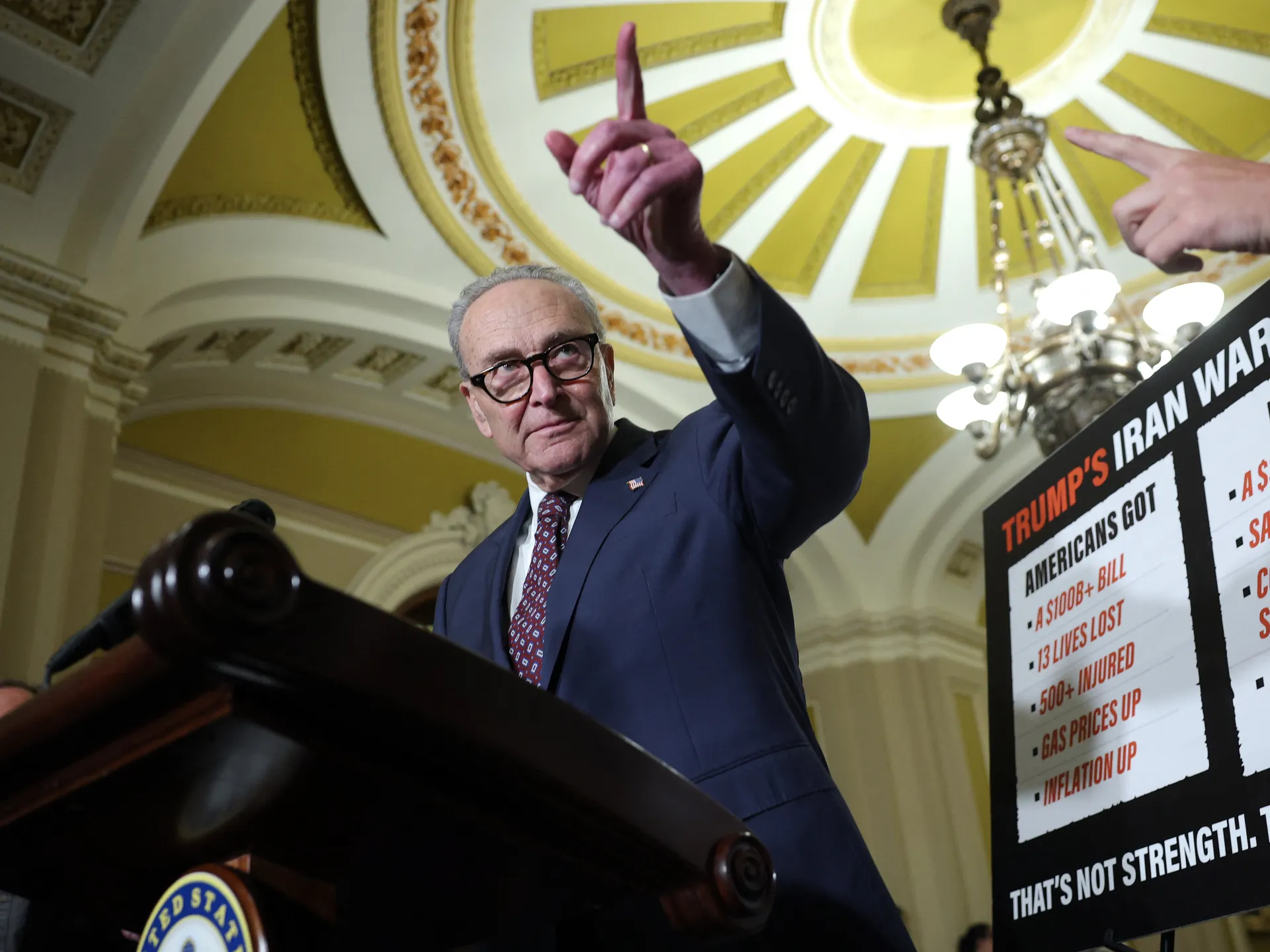
Speaking on the Senate floor before the vote, top Democrat Chuck Schumer advocated for the war powers resolution as he criticised Trump’s military campaign against Iran.
“For years, Trump promised to put maximum pressure on Iran, but he ended up delivering maximum confusion, maximum chaos, maximum cost to the American people with his disastrous war,” Schumer said.
“Time after time, the vast majority of Senate Republicans sided with Trump and his war instead of the American people. The American people have paid the price for Trump’s historic blunder in Iran. It’ll go down in the history books as one of the worst foreign policy forays America has ever made.”
The war against Iran has proved highly unpopular in the US. A poll released on Tuesday by the news agency Reuters and the research firm Ipsos found that 24 percent of respondents felt the war had been worth the cost.
Four Republican senators crossed party lines to vote for the resolution, and all but one of the chamber’s Democrats also voted in favour.
Tuesday’s breakaway Republicans were Bill Cassidy of Louisiana, Lisa Murkowski of Alaska, Susan Collins of Maine and Rand Paul of Kentucky. A further two Republicans did not vote: Mitch McConnell of Kentucky and Dave McCormick of Pennsylvania.
The lone Democrat to vote against the measure was Pennsylvania’s John Fetterman.
What does the resolution say?
The war powers resolution “directs the President to remove United States Armed Forces from hostilities against the Islamic Republic of Iran”.
Only if “explicitly authorised by a declaration of war or a specific congressional authorisation” would Trump be allowed to use further military force against Iran, it says.
The resolution, however, does allow for a limited military presence to remain in the Middle East to prevent any “imminent attack” against the US or its allies.
What is the significance of the vote?
The vote reflects growing unease even among some of Trump’s Republican supporters about the unpopular conflict, which began with US-Israeli air strikes on Tehran on February 28.
This is the first time both chambers of Congress have passed a resolution directing a president to remove US armed forces from a warzone under the War Powers Act although it was not immediately clear how the votes might affect the conflict.
Technically, the Trump administration should now seek explicit congressional approval for further strikes on Iran. However, previous administrations have found routes around this by securing more limited authorisations for the use of military force (AUMFs) instead.
For example, in the wake of the 9/11 attacks in 2001, Congress passed an AUMF that gave then-President George W Bush broad powers to conduct what would become the global “war on terror”.
And one year later, it passed another AUMF, allowing the use of the military against the government of Saddam Hussein in Iraq, which became the basis of the 2003 invasion.
The two authorisations remain in place, and presidents continue to rely on them to carry out strikes without first seeking congressional approval. The assassination of top Iranian General Qassem Soleimani in 2020 in Baghdad was authorised by Trump under the 2003 AUMF.
In addition, a resolution does not have the force of law. Experts said, therefore, that while the Senate vote is viewed as a rebuke to Trump, it is largely symbolic.
What effect will this have on US-Iran talks in Switzerland?
Before the vote on Tuesday, some Republican senators had warned that the war powers resolution would weaken Trump’s standing in the Switzerland negotiations.
“If this passes, the Iranians are going to simply stand up and walk away from negotiations,” Senator James Risch of Idaho told the Senate on Tuesday.
“They’re going to say: This thing’s over. The Congress has told the president of the United States, ‘Leave us alone. We can do whatever we want to do,’ and they will walk away.”
How will the Trump administration respond?
Risch also argued that the resolution is essentially useless, given its symbolic nature. “It’s going to have no effect. The president isn’t going to pay any attention to it,” he said.
The US Constitution gives Congress the sole power to declare war, but that division of power has eroded over the past 75 years as successive presidents alone have committed US forces to overseas conflicts.
Trump has pointed to that precedent to argue that he does not need congressional authorisation at all.
In an appearance on The Axios Show last week, Trump denied learning any “lesson” about the limits of his executive powers during the Iran war. “There are no limits,” he said.
The last time Congress voted to go to war was during World War II although it has passed AUMFs in the decades since, which allow for limited military engagement without congressional approval for all-out war.
During Trump’s first term, there were concerns that he could use the 2001 AUMF to strike Iran under the unfounded claim that Tehran supports al-Qaeda.
Some critics pointed out that Republicans may be more willing to confront Trump over the issue of congressional authorisation now as they defend their seats before November’s midterm elections.
June 24 (UPI) — Senate lawmakers have approved a war powers resolution directing President Donald Trump to halt U.S. hostilities with Iran or seek congressional authorization.
The Senate voted 50-48 on Tuesday, with four Republicans — Sens. Bill Cassidy of Louisiana, Susan Collins of Maine, Lisa Murkowski of Alaska and Rand Paul of Kentucky — joining their Democratic colleagues in passing H.Con.Res. 86. Sen. John Fetterman, D-Pa., was the only Democrat to vote against the measure.
The measure’s legal force was disputed. Though concurrent resolutions are non-binding, Democrats argue H.Con.Res. 86 is binding because it was adopted under the War Powers Resolution.
Either way, the measure shows the deepening fissure in support among Trump’s Republican Party for the war his administration unilaterally launched in late February.
Democrats have been forcing repeated war powers resolution votes for months, most of which have been stonewalled by Republicans. But GOP support for the war has waned as it has dragged on, culminating Tuesday when the Senate approved the measure that the House narrowly passed 215-208 earlier this month.
“Both chambers have now made clear that the president cannot continue this war of choice and must cease all hostilities against Iran,” Rep. Gregory Meeks, the resolution’s sponsor and ranking member of the House Foreign Affairs Committee, said Tuesday after the vote.
“Regardless of what President Trump says, this measure is binding under the War Powers Resolution, and I will explore all legal avenues to ensure the Executive complies with the will of Congress.”
Democrats argue that the U.S. war with Iran — as well as other military actions taken by Trump, including attacks on suspected drug-trafficking boats in international waters — is illegal as Congress has not authorized war, a power the Constitution gives to Congress.
Trump has responded that he does not need authorization, and any war powers resolution is moot due to the fragile U.S.-Iran cease-fire that went into effect in early April.
Amid the cease-fire, Trump has been seeking an agreement to end the war, and his administration was actively negotiating terms with Iran when the vote was held Tuesday.
In a social media statement, Trump lambasted Congress over the vote, saying it was informing Iran that the United States does not support him while hee has “Iran on the ‘ropes,’ ready to go down for the fall.”
“Four Republican Losers voted with the Dumocrats,” he said, while calling the measure “poorly timed and meaningless.”
“These Senators have just made my job more difficult, but I will get it done, one way or the other, because I always get it done.”
June 23 (UPI) — Mamdani-backed progressives scored big wins Tuesday night in New York state’s Democratic primary, as voters cast ballots across the Empire State, Maryland, Utah and South Carolina.
New York State
Of the four states holding primaries, New York state’s was being closely watched to gauge the influence of New York City Mayor Zohran Mamdani, who had endorsed three progressive candidates in competitive Democratic races — all of whom appeared poised late Tuesday to win their races.
Brad Lander, a former city comptroller, was running against Goldman in New York District 10 with the endorsements of other big-name progressives, including Sen. Bernie Sanders, I-Vt., and Rep. Alexandria Ocasio-Cortez, D-N.Y.
Lander said he was drawn to challenge Goldman because Goldman had called for increasing U.S. support for Israel. Their differing views on support for Israel have been a key issue in the race. Goldman and Lander are both Jewish.
Preliminary results showed Lander with an overwhelming 65.3% vote share, compared to Goldman’s 33.7%, with all 417 districts reporting.
Lander claimed victory Tuesday night.
After being introduced by Mamdani, Lander told supporters that he believes he and Goldman have more in common than they have differences. And to Goldman’s supporters, he said he knows that they want to “rescue our country back from Trumpism,” renew U.S. democracy and find a humane path for the country on the world stage.
“Solidarity is the force that we need to vanquish Trump’s fascism, to abolish ICE and to stand up to the billionaires who are rigging our economy against us,” he said.
“This campaign here was born out of solidarity.”
In New York District 7, Mamdani-endorsed Claire Valdez appeared poised to succeed outgoing Rep. Nydia Velazquez, who backed Brooklyn Borough President Antonio Reynoso.
With all 393 election districts reporting, preliminary election results showed Valdez had secured 55.5% of the vote to Reynoso’s 35.4%.
And in New York District 13, Mamdani endorsed Darializa Avila Chevalier, who late Tuesday appeared to be edging out incumbent Rep. Adriano Espaillat.
Chevalier, who was a field organizer for Mamdani, had secured 48.59% of the vote to Espaillat’s 45.2%, according to preliminary results.
Mamdani did not endorse a candidate in District 12 in a stacked field that consisted of state lawmakers Alex Bores and Micah Lasher, Lincoln Project co-founder George Conway, President John F. Kennedy‘s grandson Jack Schlossberg, attorney Laura Dunn and health researcher Nina Schwalbe.
Former House Speaker Nancy Pelosi had endorsed Schlossberg and former New York City Mayor Michael Bloomberg had endorsed Lasher.
Artificial intelligence has been a central topic in the District 12 race. The Leading the Future super PAC, funded by the heads of OpenAI and venture capital firms supporting the AI industry, funneled more than $10 million to a super PAC opposing Bores’ campaign. Bores has been supportive of establishing regulations on AI.
With all 410 precincts reporting, Lasher had secured nearly 39% of the vote, followed by Bores with 34.82% and Schlossberg with 10.7%.
South Carolina
The big race in South Carolina was the GOP gubernatorial runoff between notable candidates, South Carolina Lt. Gov. Pamela Evette and state Attorney General Alan Wilson.
Preliminary results indicate Wilson stormed his way to the nomination and likely the South Carolina governor’s mansion.
With all counties reporting, Wilson netted 68.5% of the vote to Evette’s 31.44%.
Wilson has claimed victory, and Evette has conceded defeat.
The runoff followed a dramatic turnaround by President Donald Trump, who had initially endorsed Evette, before rescinding his support.
Trump gave his “Complete and Total Endorsement” to Evette ahead of the state’s primary earlier this month. But after it was determined to be a runoff between Evette and Wilson, Trump, rather than continue his support for Evette, told voters that they “can’t go wrong” with either candidate.
Evette finished less than two percentage points ahead of Wilson in the Republican primary but neither candidate cracked 30% of the vote, let alone 50%. While Trump endorsed Evette, the other candidates who ran in the primary — Reps. Ralph Norman and Nancy Mace — have endorsed Wilson. Sen. Tim Scott, R-S.C., also gave Wilson his endorsement on Friday.
“I’ve proudly stood with President Trump from the very beginning, defended him when others would not, and fought alongside him against the radical left,” Wilson said in a news release after Trump posted his support on social media. “I am deeply honored to have his support because he understands I am focused on making South Carolina more affordable for families and profitable for businesses.”
Wilson will face Democratic state Rep. Jermaine Johnson in November.
Maryland
In Maryland, Adrian Boafo was poised to succeed Rep. Steny Hoyer in the Democratic primary for District 5.
From among the two dozen candidates in the running, Boafo, Hoyer’s former field director, had nearly 32% of the vote, according to preliminary results, far exceeding healthcare CEO Quincy Bareebe, who was sitting second with 18% and former police officer Harry Dunn in third with 13.4%.
Dunn was among those defending the U.S. Capitol from attacks by pro-Trump rioters on Jan. 6, 2021. He is also a co-plaintiff in a lawsuit seeking to stop the Trump administration from establishing an “anti-weaponization fund” to pay rioters for being “targeted” by the Department of Justice.
Boafo had received Hoyer’s endorsement.
Utah
Former Rep. Ben McAdams appeared poised Tuesday night to win the Democratic nomination for Utah’s new District 1, created under Utah’s new congressional map.
Largely made up of Salt Lake City, the district went to Vice President Kamala Harris in the 2024 presidential election.
Preliminary results show McAdams with 60.2% of the vote, state Sen. Nate Blouin with 24.04% and Utah Democratic convention winner Liban Mohamed with nearly 12%.
President Donald Trump presents a Medal of Honor to Tom Ripley on behalf of his father, John W. Ripley, during a Medal of Honor award ceremony in the East Room of the White House on Thursday. Photo by Aaron Schwartz/UPI | License Photo
June 23 (UPI) — Lawmakers in the U.S. House of Representatives on Tuesday overwhelmingly approved a sweeping bipartisan housing package that seeks to lower housing costs and expand homeownership access, sending the legislation to President Donald Trump to be signed into law.
On Monday, the Senate passed the bill in a similarly overwhelming 85-5 outcome.
“This bill speaks to the real change that our constituents have been demanding, where everyone can afford a dignified place to call home, where tenants are protected and where working Americans can finally get ahead,” Rep. Maxine Waters, D-Calif., ranking member of the House Committee on Financial Services, said from the House floor on Tuesday.
The vote follows months of haggling over the bill’s content by the House and Senate and Democrats and Republicans. In the end, the sweeping bill includes more than 60 pieces of legislation, 36 of which were sponsored by bipartisan lawmakers, according to the Bipartisan Policy Center.
The bill aims to increase housing supply while lowering costs, limiting corporate and institutional ownership for rental purposes and expanding financing for lower-income individuals.
Provisions target bureaucracy to hasten development while seeking to modernize federal housing programs and banking regulations to expand local lending and offer incentives to local governments that prioritize more housing.
Habitat for Humanity, the global nonprofit aimed at helping families build homes, applauded the legislation’s passage on Tuesday, saying it “will bring homeownership within reach for more Americans by tackling longstanding barriers in the housing system.”
“With the passage of this major legislative package, Congress has demonstrated strong, bipartisan leadership by coming to an agreement and taking a critical step in addressing the nation’s housing affordability challenge,” Jonathan Reckford, chief executive officer at Habitat for Humanity International, said in a statement.
The steeply divided Congress came together to pass legislation as the United States faces what some have called a housing affordability crisis.
The United States is facing a housing shortage that is disproportionately affecting lower-income individuals.
According to theNational Low Income Housing Coalition, the United States is experiencing a shortage of 7.2 million affordable units for low-income renters, with only 35 such rental homes in existence for every 100 low-income renter households.
The nonprofit said extremely low-income renters face the shortage in every state.
House Speaker Mike Johnson, R-La., described the 21st Century ROAD to Housing Act as “transformational legislation” that will “help the housing affordability problem, reduce regulations so builders can build, limit institutional investing in the housing market and bring the American Dream back into reach for millions of young and working families.”
“Congress is paving a path back to homeownership for American families who have been locked out for far too long,” he said in a social media statement Tuesday night.
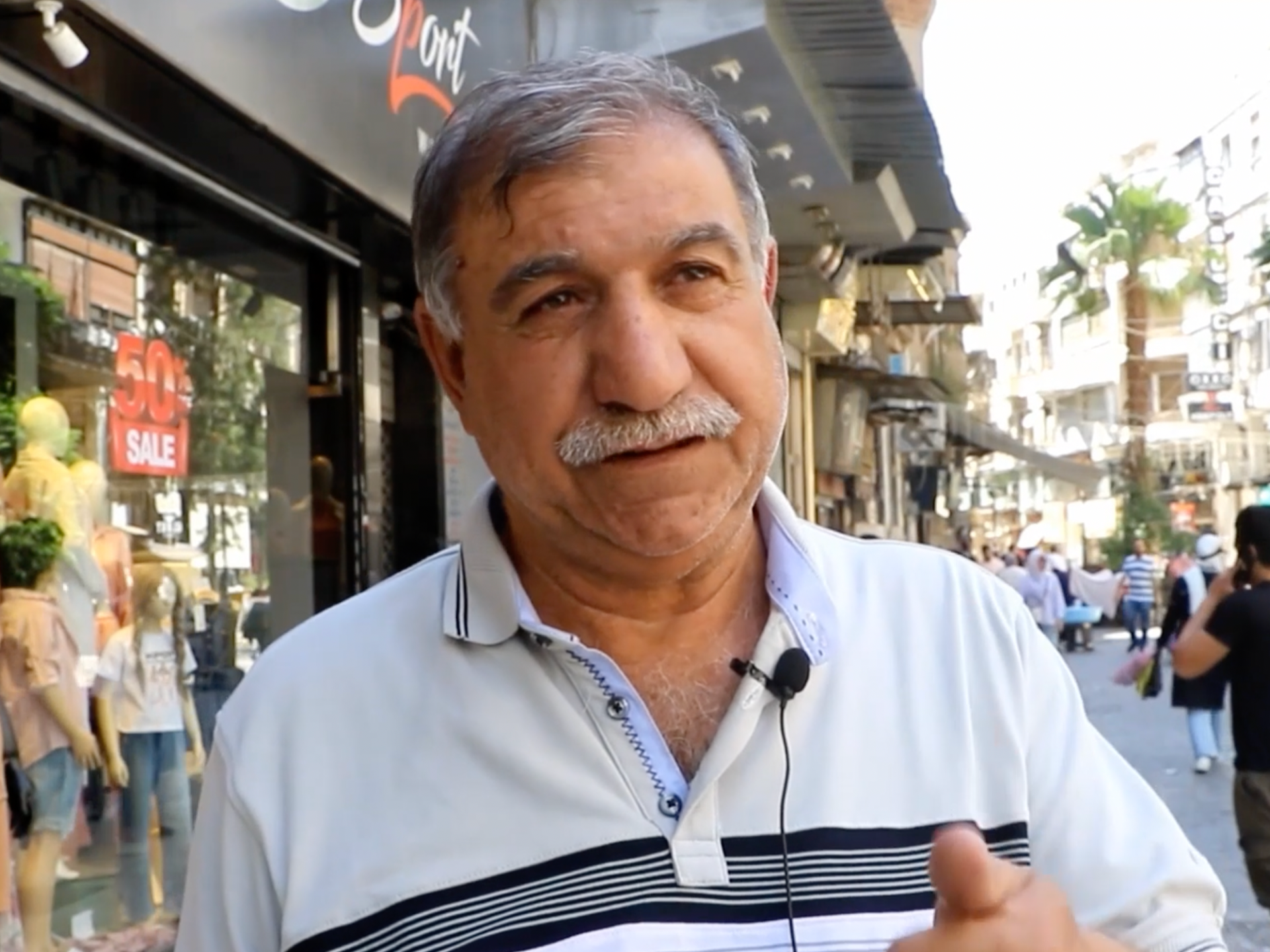
Residents in Damascus rejected US President Donald Trump’s suggestion that Syria should confront Hezbollah in Lebanon. They say Syria should avoid being drawn into new regional conflicts. In a rare critique, Trump told Israel to let Syria take on Hezbollah.
Sen. Rand Paul, R-Ky., questions Director of the National Institute of Allergy and Infectious Diseases Dr. Anthony Fauci during a Senate Health, Education, Labor and Pensions committee hearing at the U.S. Capitol in Washington, D.C., on September 14, 2022. On Monday, Paul issued a subpoena to Fauci to testify on allegations he covered up the cause of the COVID-19 pandemic. File Photo by Bonnie Cash/UPI | License Photo
June 23 (UPI) — Sen. Rand Paul, R-Ky., said he has subpoenaed Dr. Anthony Fauci after the former infectious diseases official backed out on an agreement to testify on the COVID-19 pandemic.
The Hill reported that this is the first subpoena issued by Paul as chairman of the Senate Homeland Security and Governmental Affairs Committee.
“Last week, Anthony Fauci notified us that he will not voluntarily testify before the Senate Homeland Security and Governmental Affairs Committee, even though he had previously agreed to do so,” Paul wrote in a post on X on Tuesday. “Therefore, today we have issued a subpoena for him to publicly testify.”
The post on X included a photo of Rand appearing to sign the subpoena.
Last week, Anthony Fauci notified us that he will not voluntarily testify before the Senate Homeland Security and Governmental Affairs Committee, even though he had previously agreed to do so. Therefore, today we have issued a subpoena for him to publicly testify. pic.twitter.com/r9CS0z5UnC— Senator Rand Paul (@SenRandPaul) June 22, 2026
Paul has repeatedly clashed with Fauci over policies and recommendations during the COVID-19 pandemic. The senator accused Fauci of covering up U.S. research at a lab in Wuhan, China, which he said caused the coronavirus outbreak.
“We’ve been negotiating with him for material and for testimony,” Paul said in an appearance on CNBC on Tuesday.
“This has gone on for some time. He slow-walked us and slow-walked us. Finally agreed to come in voluntarily … then last week he says he’s not coming in.
“With this subpoena power, we will bring him in, unless he fights this in court.”
Fauci was the head of the National Institute of Allergy and Infectious Diseases during the COVID-19 outbreak until 2022. He was also a top medical adviser to Presidents Donald Trump and Joe Biden during the crisis.
A U.S. intelligence analysis initially found there was insufficient evidence to prove COVID-19 was leaked from a research lab in Wuhan. In 2025, the CIA adjusted its stance.
“CIA assesses with low confidence that a research-related origin of the COVID-19 pandemic is more likely than a natural origin-based on the available body of reporting,” an unnamed CIA representative said in a statement in January 2025.
During testimony in 2024, Fauci said he was open to both perspectives.
“I have repeatedly stated that I have a completely open mind to either possibility and that if definitive evidence becomes available to validate or refute either theory, I will readily accept it,” he said during his opening statement before a House committee hearing.
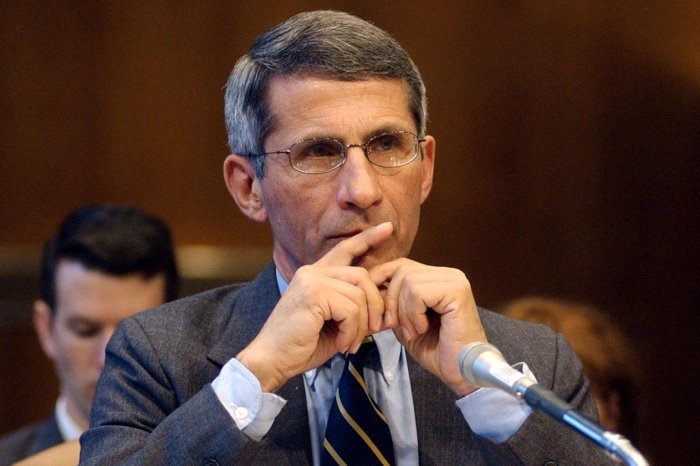
Dr. Anthony Fauci, director of the National Institute of Allergies and Infectious Diseases, testifies before a Senate committee hearing on the National Immunization Program’s preparedness for future public health challenges on Capitol Hill in 2001. Photo by Roger L. Wollenberg/UPI | License Photo
June 23 (UPI) — U.N. Secretary-General Antonio Guterres called for AI companies to disclose what the environmental impact of data centers will be by 2030 during a speech Tuesday at London Climate Action Week.
Guterres said that the AI boom and the world’s dependence on oil are driving the climate crisis and laid out plans to curb the damage.
“These crises may seem separate but they share the same destructive origin: fossil fuels,” Guterres said. “And they demand the same answer: a fast, fair transition to clean energy and a surge in adaptation, resilience and climate justice for those already facing climate harm.”
The United Nations’ seven-point plan for energy independence includes quickly cutting emissions to reach net zero emissions by 2050. This would mean the amount of greenhouse gases emitted into the atmosphere are balanced out by the amount of greenhouse gases removed from the atmosphere.
The plan also calls for an acceleration of developing and adopting clean energy, transparency from AI firms on their environmental impact by 2030, ensuring the transition to clean energy is equitable in its job creation and community support, investment in early warning systems, expanding funding for developing countries and combatting climate disinformation.
The United Nations said scientists it supports are warning that average annual temperatures are likely to exceed the 1.5-degrees Celsius above pre-industrial levels target set out by the Paris Climate Accords adopted in 2016. It notes that the United States withdrew from the agreement for the second time under President Donald Trump.
“Every fraction of a degree matters,” Guterres said.
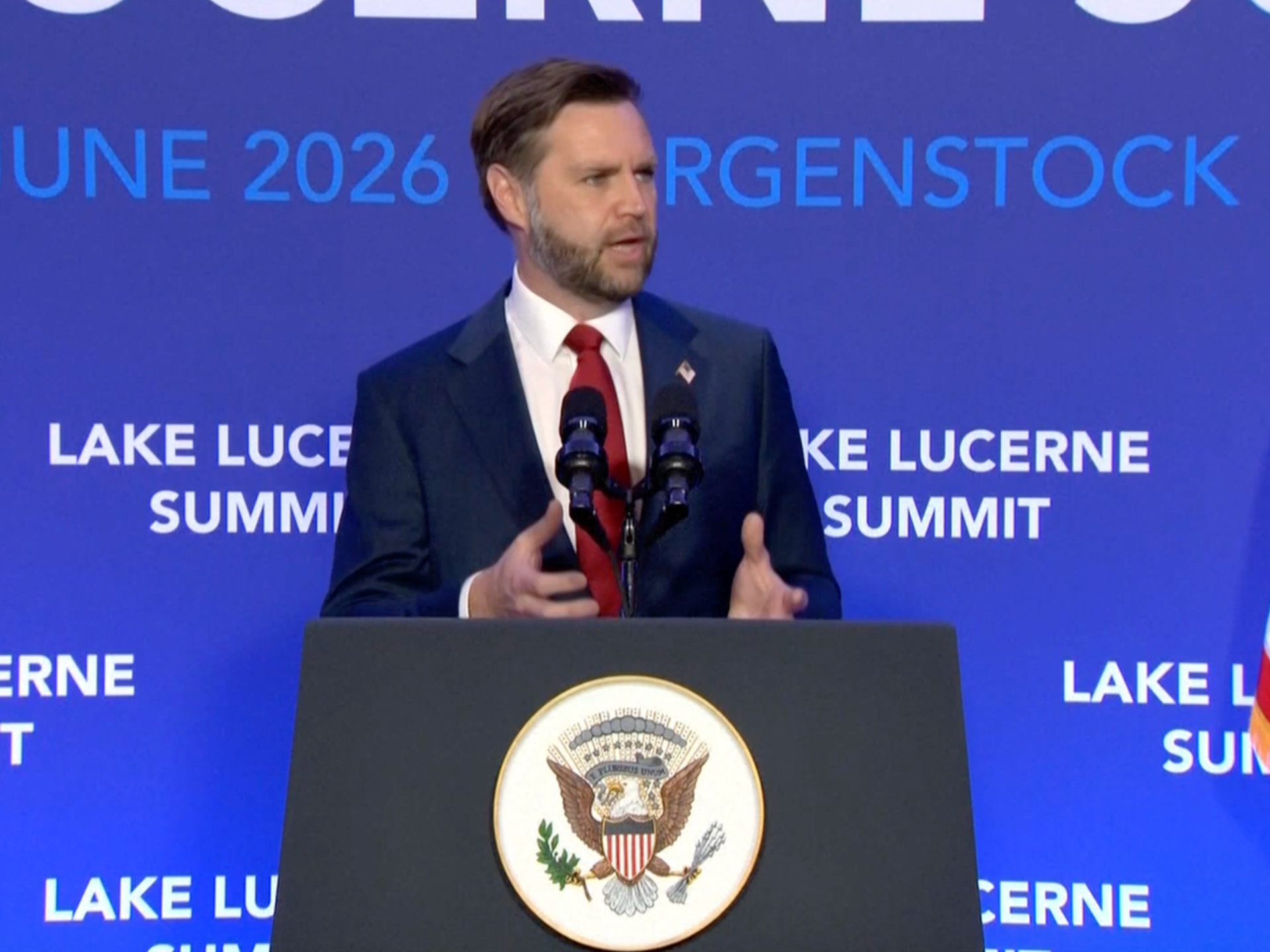
Vice President JD Vance, Pakistani Prime Minister Shehbaz Sharif and Qatari Prime Minister Mohammed bin Abdulrahman bin Jassim Al Thani speak ahead of talks between the United States and Iran at the Buergenstock resort in Obbuergen, near Lucerne, Switzerland, Sunday. The U.S. has waived Iran sanctions Tuesday. Photo by Urs Flueeler/EPA
June 23 (UPI) — President Donald Trump lifted sanctions on Iran releasing millions into the Iranian economy Monday,
President Donald Trump presents a Medal of Honor to Tom Ripley on behalf of his father, John W. Ripley, during a Medal of Honor award ceremony in the East Room of the White House on Thursday. Photo by Aaron Schwartz/UPI | License Photo
allowing American dollar trade for the first time since 1979.
The U.S. Treasury on Monday issued a 60-day exemption allowing Iran to produce and sell crude oil, petrochemical and petroleum products in U.S. dollars through Aug. 21.
Under this general license, boats and entities that were sanctioned are also cleared to operate. The waiver could also open up allowing U.S. imports of Iranian oil, which hasn’t happened since the 1990s.
Trump defended the move on Truth Social Tuesday morning, saying that the money to Iran is to be used for food and supplies purchased from the United States.
“Despite their protestations and false statements to the contrary, coupled with the drumbeat of the Fake News, which is doing everything possible to make the U.S. Victory as small and insignificant as possible, Iran has fully and completely agreed to highest level Nuclear inspections long into the future (Infinity!!!). This will insure ‘Nuclear Honesty.’ If they did not agree to this, there would be no further negotiations!” the president posted.
“Based on this and other major concessions being made by Iran, I have agreed to allow the Hormuz Strait to remain OPEN, with no further Naval Blockade. However, all ships are remaining in place should it be necessary to reinstitute the Blockade, which seems, at this point, highly unlikely. The Money and/or Sanctions that the U.S. Treasury is releasing goes into escrow, controlled by the U.S.A., and will be used for the purchase of food and medical supplies, exclusively from the United States, including Corn, Wheat, and Soybeans from our great American Farmers. These are things that are desperately needed by Iran. This is a humanitarian crisis, and I feel it is necessary to help, NOW, before it is too late. Talks are going well!” he said.
Vice President JD Vance said Monday that during peace talks on Sunday, Iran agreed to invite the International Atomic Energy Agency back into the country for inspections.
Colombia’s outgoing leftist president, Gustavo Petro, has alleged electoral fraud after preliminary results from a presidential run-off saw his handpicked candidate lose by a small margin.
In a barrage of posts on the social media site X on Monday, Petro alleged that the opposition bought votes and Israel and the United States interfered to help opposition far-right candidate Abelardo de la Espriella win.
Recommended Stories
list of 4 itemsend of list
Petro has refused to recognise the results and has called for an investigation by the judiciary.
The president, who was barred by the constitution from running for a second term, was Colombia’s first leftist president, putting him at odds with the US.
His administration is praised for reforms that boosted social spending, raised the minimum wage and redistributed land to poorer families. Petro also cut ties with Israel over Israel’s genocidal war on Gaza and distanced himself from US President Donald Trump’s administration.
However, critics said his refusal to accept the election results risks inflaming political tensions – and violence. Here’s what we know:
Presidential candidate Abelardo de la Espriella of the opposition Defenders of the Motherland movement and his vice presidential running mate, Jose Manuel Restrepo, ride inside a bulletproof enclosure towards a victory rally in Barranquilla on June 21, 2026 [Rodrigo Abd/AP]
What are the election results?
The first round of the presidential election was held on May 31. Neither of the two leading candidates – Abelardo de la Espriella of the right-wing Defenders of the Homeland movement and Senator Ivan Cepeda of the ruling Historic Pact – secured at least 50 percent of the vote, leading to a run-off on Sunday.
De la Espriella narrowly won with 49.66 percent over Cepeda’s 48.7 percent, according to preliminary results released on Monday by the National Registry, which manages vote numbers.
The razor-thin difference amounts to less than 1 percent of the vote and represents one of Colombia’s closest elections.
Trump-backed de la Espriella, 47, is to take office on August 7. The criminal lawyer is a multimillionaire who campaigned on tougher security and anti-leftist policies. He also has US citizenship.
De la Espriella’s win is part of a recent trend of Latin American countries electing far-right, populist leaders who are pro-Trump. Argentina’s Javier Milei, Honduras’s Nasry “Tito” Asfura, El Salvador’s Nayib Bukele and Costa Rica’s Laura Fernandez Delgado all have close ties to the Trump administration.
Why is Petro alleging fraud?
Petro took to X to denounce in a series of posts what he said was voter fraud committed with the help of Israel and Prime Minister Benjamin Netanyahu.
Petro said there was evidence of manipulation of Form E-14, the official, handwritten tally of sheets filled out by poll workers at each voting station.
The form is a physical record of the vote count and is meant to prevent electoral fraud. It is filled out by hand, and digital scans are also uploaded to the National Registry’s portal for public auditing. If found to have errors, parties may request a recount.
Petro alleged that foreign actors accessed the National Registry’s website and rewrote voting data on some E-14 forms.
“Today we have evidence of a change in IP addresses of several servers of the national registry,” he posted.
“This means that the software was compromised and others wrote data for polling stations and voting posts. The only entity in the world capable of doing that is the state of Israel,” Petro added without providing evidence of Israel’s alleged involvement.
Petro said his party had requested a “technical audit” of the voting software before the elections and asked authorities to retrieve the digital footprints of all digitally transmitted documents to avoid modification. He claimed those requests were ignored.
The outgoing president shared videos of what he alleged captured the “premeditated” modification of E-14 forms. He also claimed the manipulation was done “from the offices of the Bautista brothers”.
Electoral workers, observers and party delegates attend the official vote count the day after the presidential run-off in Bogota on June 22, 2026 [Fernando Vergara/AP]
Who are the Bautista brothers?
Petro was referring to Thomas Greg & Sons, an influential private logistics and security printing firm that runs Colombia’s electoral infrastructure. Until recently, it also printed Colombian passports.
It is run by brothers Fernando and Camilo Bautista Palacio. The duo was convicted of bank fraud in the US in the 1980s.
Thomas Greg & Sons, which was founded by their father, Gregorio, has been contracted by the National Registry for more than a decade to manage election logistics, preliminary vote counting and vote-tallying software.
Petro in April accused the Bautista brothers of negotiating a deal with de la Espriella that would see them secure the presidency for the far-right candidate in return for clinching passport printing contracts once more.
At the time, de la Espriella refuted the claims, and his lawyers threatened Petro with a lawsuit.
What are authorities saying?
Attorney General Gregorio Eljach has dismissed the allegations and told reporters there is “no evidence of fraud” with more than 99 percent of the votes counted.
De la Espriella, meanwhile, has so far not responded directly to Petro.
Is de la Espriella linked with Israel?
Yes, de la Espriella has consistently voiced support for Israel and campaigned in Colombia’s Jewish community, making pro-Israel promises and saying his government would “defend Judeo-Christian principles”.
He pledged to reverse Petro’s 2024 decision to cut ties with Israel and has promised to relocate the Colombian embassy to Jerusalem.
Netanyahu congratulated de la Espriella on Monday, saying: “I look forward to working with you to strengthen the bond between Israel and Colombia.”
How has the US reacted?
In his posts, Petro also blamed Trump for interfering in the elections by publicly endorsing a candidate and thus swaying voters.
Trump endorsed de la Espriella on his Truth Social platform weeks before the run-off.
Trump and US Secretary of State Marco Rubio also congratulated de la Espriella on his preliminary win, and Trump took credit for the far-right candidate’s victory.
“He was in 10th place. I endorsed him, and he won the election. He called me last night and thanked me for the endorsement,” Trump told reporters at the White House on Monday.
Rubio wrote on X: “The Trump administration looks forward to working closely with your incoming administration to advance regional security cooperation, end illegal immigration to the United States, and strengthen our economic ties.”
Petro has invited Trump to make a statement on the electoral fraud allegations.
“I formally invite President Donald Trump to speak,” Petro wrote, adding that the US president bears responsibility for “having supported a candidate and not the freedom of the Colombian people”.
What is the US-Colombian relationship like?
Although both countries have close trade ties, diplomatic relations have often been strained over drug trafficking policies and relations with Israel, among other issues.
But relations essentially collapsed under the Trump and Petro administrations.
Petro in January last year refused to allow US migrant deportation planes to land in his country and said on X that the US “cannot treat Colombian migrants like criminals”.
In October, the US sanctioned Petro, his family and key officials in his government based on unproven allegations of involvement in the drug trade.
In January this year, the US military abducted leftist Venezuelan President Nicolas Maduro from his Caracas home after the Trump administration accused him of “narcoterrorism”.
June 22 (UPI) — Federal authorities have arrested two additional suspects allegedly involved in last week’s foiled attack targeting the Ultimate Fighting Championship bout at the White House, prosecutors said Monday.
Both suspects made their initial court appearances Monday, the Justice Department said in a release. Jordan Rincker, 28, of St. Joseph, Mo. appeared in a Kansas City court, and William Lee Spartacus Falkner appeared before a judge in Tacoma, Wash.
They each have been charged by criminal complaint with one count of conspiracy to commit murder.
Prosecutors said Falkner was arrested midday Friday, while Rincker was arrested Sunday.
A total of seven people have now been arrested and charged in a sprawling scheme that federal authorities have said involved 23 people conspiring to attack the White House’s Freedom 250 event on June 14, staged in celebration of the United States’ 250th anniversary and the birthday of President Donald Trump.
According to federal prosecutors, the alleged conspiracy planned to attack the north side of the event with explosive-carrying drones, which would force an evacuation to the south side of the event, where snipers would be deployed to open fire on the fleeing crowd, court documents state.
Authorities learned of the alleged attack from the parents of Tycen Proper, who alerted police to their son’s purchase of weapons and online activities. Proper, 19, was among the initial batch of five suspects arrested and charged last week.
The court documents state the group’s alleged grievances appear to be purported government corruption and involvement of U.S. lawyers with Israel.
FBI agents reviewing Proper’s communications were able to identify several alleged co-conspirators, including Falkner.
Prosectuors alleged that Falkner indicated in those communications that he had experience manufacturing and piloting drones and discussed loading them with explosives.
Online communications reproduced in the criminal complaint against Falkner allegedly show discussions on logistics of the attack, including potential flight costs, 3D printing and shipping of the drones.
“I can fly 40+ drones at the same time at the same target,” Falkner is alleged to have said.
Federal prosecutors alleged that just two days before the alleged attack, Rincker met Abraham Alvarez, 31, who was arrested and charged last week along with Proper, in person and accepted $1,200 from him. Rincker then allegedly sent a $100 CashApp payment from the money he received to another previously arrested and charged suspect, Bryan Roa, 24, to pay for his drive from California to Washington, D.C.
Authorities identified Rincker as an alleged member of the conspiracy through information they received from Alvarez following his arrest, according to court documents. Authorities also learned that Rincker allegedly gave a 12-gauge shotgun to Alvarez during an in-person meeting they had in Omaha.
The FBI executed search warrants for Rincker’s residence and storage unit, uncovering a trove of weapons and related paraphernalia, such as a gas mask with cartridge, night vision goggles, ballistic plates, a 3D printer and more.
No attack occurred at the UFC event, at which Trump and other members of his Cabinet were in attendance.
Asked about the thwarted attack a day after the event, Trump told reporters that he had heard about it.
“The attack that I watched were the fighters,” he said, to laughs.
“They were as good a fights as I’ve ever seen. The best.”
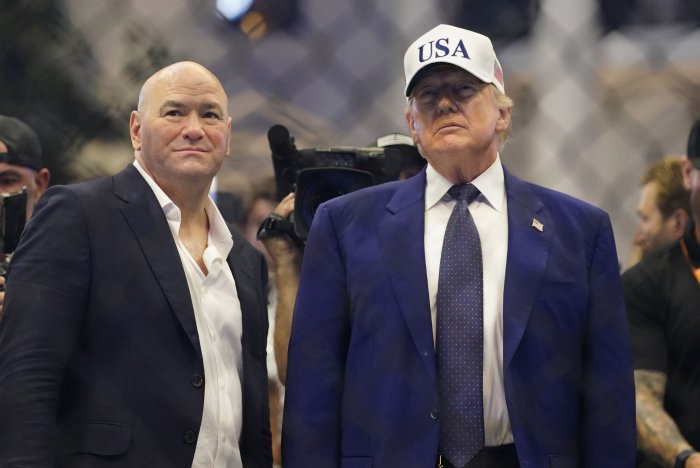
President Donald Trump and UFC CEO Dana White stand in the octagon after the UFC Freedom 250 event on the South Lawn of the White House in Washington, on June 14, 2026. Photo by Bonnie Cash/UPI | License Photo
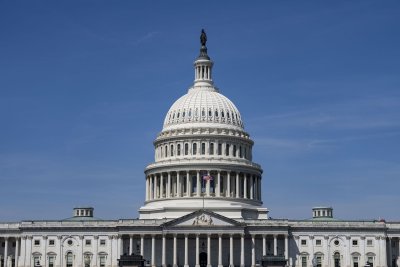
The U.S. Capitol building is seen in Washington, D.C. The Senate passed a bipartisan bill Monday aimed at lowering housing costs, sending it to the House of Representatives. File Photo by Bonnie Cash/UPI | License Photo
June 22 (UPI) — The U.S. Senate on Monday passed a bipartisan bill aimed at lowering housing costs, sending it to the House of Representatives for a final vote.
The Senate voted 85-5 to pass the 21st Century ROAD to Housing Act. Several senators missed the vote because of severe thunderstorms that affected Ronald Reagan International Airport, NBC News reported.
A deal on the act was negotiated by a bipartisan group including Sen. Tim Scott, R-Ariz.; Sen. Elizabeth Warren, D-Mass.; Rep. French Hill, R-Ark., and Rep. Maxine Waters, D-Calif.
Scott and Warren both said before the vote that it showed that common ground is possible.
“Today’s vote proves that it is possible to find bipartisan, common ground on legislation that actually helps the American people,” Warren said on the Senate floor, The Hill reported. “And, importantly, it proves that bipartisan legislation doesn’t have to be the weakest, most milquetoast agreement that doesn’t offend anyone or do too much to help anyone either.”
The bill’s provisions include measures that encourage renovating older homes, encourage communities to build more housing through funding and grant programs, cut some red-tape issues around building housing and effectively ban private equity from buying up single-family homes. It restricts companies that already own more than 350 single-family homes from buying more.
The act had been stranded for a time after the Senate passed one version in March and the House of Representatives passed a different version in May. The final bill includes provisions sought by the House and drops a provision it objected to that would have required large investors that own or construct at least 350 single-family homes to sell them after seven years.
Those voting against it included Sen. Rick Scott, R-Fla., who told The Hill that housing is “a local issue.” Scott said he wanted to see Congress balance the budget and drive interest rates down.
If the House votes to approve the bill this week as expected, it will go to President Donald Trump, who is expected to sign it.
US Vice President JD Vance has touted significant progress in talks with Iran over its nuclear programme and Israel’s war on Lebanon, while refusing to commit to an Israeli withdrawal from Lebanese territory. He said Trump is trying to bring ‘permanent peace’ to a region that’s been ‘a basket case for a long time’.
This photo, taken Monday, shows the trading room of Hana Bank in Seoul as South Korean stocks closed above the 9,100-point mark on a semiconductor rally and optimism over a U.S.-Iran deal. Photo by Yonhap
South Korean stocks finished at an all-time high Monday on a continued rally in semiconductor shares amid signs of progress in U.S.-Iran talks to end their monthslong war in the Middle East. The local currency lost against the U.S. dollar.
After opening 1.08 percent lower, the benchmark Korea Composite Stock Price Index (KOSPI) added 62.13 points, or 0.69 percent, to 9,114.55 after rising as high as 9,253.00.
Trade volume was moderate at 377.2 million shares worth 41.4 trillion won (US$26.9 billion) with losers outnumbering winners 739 to 148.
Retail investors and institutions were net buyers, purchasing 2.15 trillion won and 308.4 billion won, respectively, while foreign investors sold a net 2.55 trillion won.
On Sunday, Washington and Tehran wrapped up their first talks and agreed on a road map to reach a final deal within 60 days, according to a statement issued by the mediating countries of Qatar and Pakistan.
The negotiations had been at risk of breakdown as Tehran said it had closed the Strait of Hormuz and U.S. President Donald Trump had repeated his threats to resume attacks on Iran.
“Negotiations went smoothly in general despite some aggressive messages, which were considered short-lived noises,” said Kang Jin-hyeok, an analyst from Shinhan Securities.
Semiconductor shares ended in positive territory.
Chip giant SK hynix jumped 5.61 percent to 2.92 million won, surpassing Samsung Electronics in terms of market capitalization for the first time.
SK Square, the parent of SK hynix, surged 10.67 percent to 1.97 million won, and Hanmi Semiconductor, a leading chip manufacturing equipment provider, increased 2.2 percent to 301,500 won.
Defense giant Hanwha Aerospace advanced 0.27 percent to 1.13 million won, and Korea Aerospace Industries (KAI) climbed 1.43 percent to 148,600 won.
However, Samsung Electronics dropped 0.14 percent to 353,500 won, and Samsung Electro-Mechanics, an electronic components manufacturing affiliate of Samsung Electronics, lost 1.85 percent to 2.23 million won.
Top carmaker Hyundai Motor decreased 5.22 percent to 581,000 won, and leading battery maker LG Energy Solution dipped 4.7 percent to 385,500 won.
Samsung Life Insurance slid 9.36 percent to 450,500 won, and pharmaceutical giant Samsung Biologics retreated 5.75 percent to 1.3 million won.
The Korean won was quoted at 1,537 won against the U.S. dollar, down 10 won from the previous session.
Bond prices, which move inversely to yields, closed lower. The yield on three-year Treasurys rose 2.6 basis points to 3.810 percent, and the return on the benchmark five-year government bonds added 3.9 basis points to 4.044 percent.
Copyright (c) Yonhap News Agency prohibits its content from being redistributed or reprinted without consent, and forbids the content from being learned and used by artificial intelligence systems.
June 21 (UPI) — President Donald Trump said Sunday that work will begin “immediately” to repair the Lincoln Memorial Reflecting Pool, blaming vandalism for problems at the newly renovated Washington, D.C. landmark.
Trump repeatedly claimed over the weekend on social media that there had been arrests in connection with vandalism at the Reflecting Pool, which has been plagued by issues since undergoing a $15 million restoration ordered by the president.
From algae blooms to blue coating peeling off its bottom, the Reflecting Pool has been a target of criticism of the Trump administration, which has defended the restoration as necessary while blaming vandals for at least some of the damage.
In a social media statement on Sunday, Trump said he inspected the Reflecting Pool and was in disbelief at what he saw.
“I just inspected it, and could only say to myself, and those gathered around me, WOW, who would do such a thing? SICK, DERANGED PEOPLE!” he said.
It was unclear exactly what damage Trump was attributing to vandalism.
In a Saturday post, Trump referenced the need to drain the pool in order to conduct vandalism-related repairs, which was in addition to alleged vandalism to landscaping.
“They took some form of knife or blade, and put a 250 foot long gash into the beautiful facade of what took so much work, competence and money to build and complete,” he said.
“They also poured corrosive and destructive chemicals into the Pool.”
Trump first commented on the pool Saturday evening, saying in a statement that U.S. Park Police had arrested “multiple individuals for vandalizing our Nations magnificent Reflecting Pool.”
He then said hours later that “many additional people have been arrested having to do with the disgraceful Vandalism of our beautiful Reflecting Pool.”
UPI has asked U.S. Park Police for confirmation of arrests and damage to the pool caused by vandalism.
Trump first announced plans to restore the pool in November. Atlantic Industrial Coatings Limited was awarded $6.89 million in April to paint the bottom of the pool. The broader restoration has since been reported to cost about $15 million.
He announced June 6 that work on the pool was complete ahead of celebrations marking the 250th anniversary of the United States to be held alongside Trump’s 80th birthday.
But within days of the completion, the pool began experiencing issues. Videos posted online show the pool’s surface green with algae, while others show individuals reaching into the pool to handle the peeling blue paint.
On Friday, three-time U.S. Olympian David Hearn was arrested for allegedly damaging the pool. He has claimed in interviews with multiple news organizations that he only touched the edge of hardened paint that was peeling off the pool’s floor.