
data

Newsom’s stance on controversial data centers will be tested. Again.

Gov. Gavin Newsom vetoed legislation to require proposed data centers to provide estimates of their water usage last year, saying he was “reluctant to impose rigid reporting requirements” without understanding the impact on businesses and consumers.

Opposition to the mammoth tech hubs and their massive thirst of water, power and land has only escalated throughout the state and nation ever since. In just a matter of months, Newsom again could find himself in the political crosshairs.

Several bills to regulate the facilities and increase public transparency on their impacts are progressing in the California Legislature, which could create a conundrum for a governor who has long aligned with the tech industry but also paints himself as an environmental and social justice advocate.

“I think the governor is in a fragile position,” said Megan Mullin, a public policy professor at UCLA. “Tech has been a long backer of his, but at the same time there is this growing national outcry against data centers.”

Data centers have existed for decades but are rapidly expanding due to the worldwide boom in artificial intelligence. The newer centers built to power AI are far larger than their original counterparts and require immense amounts of water and energy.

The facilities also contribute to fossil fuel emissions, with Cornell University researchers estimating last year that AI growth could add 24 to 44 million metric tons of carbon dioxide to the atmosphere annually by 2030. Fossil fuel emissions are drivers of climate change and linked to a range of health conditions, including asthma, various cancers and birth defects.

Environmental Protection Agency Administrator Lee Zeldin announced last week that the Trump administration will not set national environmental requirements or recommendations for the data center industry, leaving it to state lawmakers to determine best policies.

Thad Kousser, a political science professor at UC San Diego, said the nation will likely look to the Golden State for guidance.

“California’s laws will create a national model,” he said. “We’re the home of Silicon Valley and we’re just a massive state — the way we regulate data centers will set the tone.”

The political landscape around data centers has since changed since Newsom’s veto in October, said Dan Schnur, a political science professor who teaches at UC Berkeley and USC.

“No one should assume he will automatically act in the same way,” Schnur said. “Newsom is an incredibly savvy politician so he is clearly aware that voters are a lot more upset or concerned about data centers than they were a year ago.”

A Gallup poll released last month found 7 out of 10 Americans oppose data centers being built in their area.

The facilities can create thousands of jobs for construction workers and generate significant revenue for local governments due to sales and property taxes. The artificial intelligence they power is also — at least temporarily — boosting the stock market, leading to more tax dollars for California.

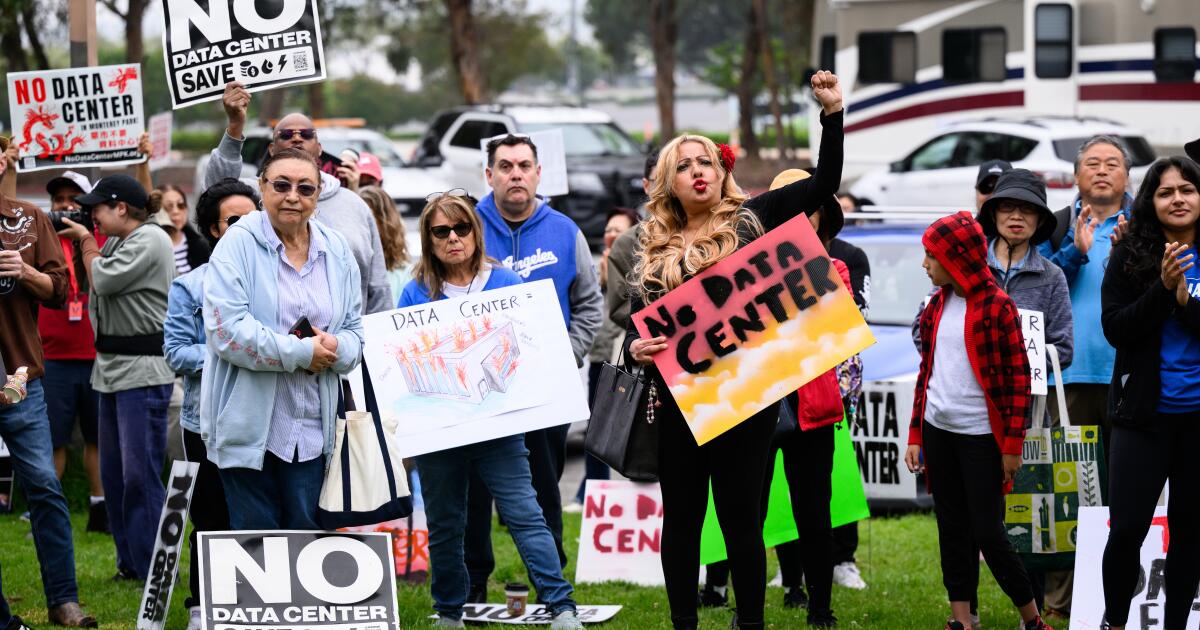
But residents who live near hyperscale centers have expressed outrage over a range of issues, including health impacts, spiking utility bills, constant noise, dropping water pressure and concerns about potentially losing their land through eminent domain. Meanwhile, community meetings about data centers are growing contentious, with police arresting a farmer in Oklahoma, three women in Wisconsin and a man in California.

Earlier this month, residents of Monterey Park voted overwhelmingly to ban data centers, making the San Gabriel Valley city the first in the nation to do so by public vote.

“Six months ago, politicians of both parties were falling all over each other to bring data centers into their states,” Schnur said. “Now that the public backlash has erupted, they are working just as hard to distance themselves from these projects.”

With Newsom eyeing a presidential bid in 2028, he might be reluctant to brand himself as a defender of an increasingly unpopular industry.

But Schnur said the governor likely also has concerns about angering one of his biggest backers.

“The tech community is a critical part of Newsom’s donor base, so he has to keep fundraising in mind when he makes these decisions,” Schnur said.

A spokesperson for the governor’s office declined to comment on data centers or pending legislation.

Newsom, during an interview at a Center for American Progress conference in May, said the concern that data centers may drive up electricity costs for Californians is a “legit issue,” but not the main one.

“The tech genie is not going to go back in the bottle,” Newsom said. “Just saying that you should not or cannot build a data center is not going to slow this technology down. What can be, will be. Nature of technology. And so we just have to steer it and not make the mistakes we made with social media.”

Among the measures in the Legislature are two bills from Sen. Steve Padilla (D-San Diego). SB 886 would create a corporate tariff to cover the cost of data center-related grid upgrades. SB 887 would ban data centers from receiving ministerial exemptions from the California Environmental Quality Act, known as CEQA.

Neither bill picked up support from Republicans, but both cleared the Senate and were recently referred to the Assembly Utilities and Energy Committee.

Padilla represents Imperial County, a farming community near the border of Mexico where plans for a 950,000squarefoot data center face fierce opposition from residents. The county exempted the proposal from CEQA, which requires projects to undergo an extensive state environmental review before breaking ground.

The city of Imperial sued the county earlier this year, arguing the project should not have received an exemption. The San Diego Chapter of the Sierra Club joined the lawsuit last month. The county board of supervisors last week approved a 45-day moratorium on all new data centers to allow the county to evaluate proposed data center development.

Two other data center-related bills recently passed the Assembly, each picking up support from a few Republicans. They now await action from the Senate.

AB 2619 from Assemblymember Diane Papan (D-San Mateo) would require data center owners to provide an estimate under penalty of perjury about expected water usage and sources before applying for a business license. AB 1577 from Assemblymember Rebecca Bauer-Kahan (D-Orinda) would require data center owners to submit monthly information to a state commission about water and fuel consumption.

Ben Green, an assistant public policy professor at the University of Michigan who is researching how data centers impact communities, said reporting requirements are a “bare minimum” type of regulation, making it especially noteworthy that Newsom vetoed a similar measure last year.

For comparison, several states are weighing more restrictive bills — New York recently sent legislation to the governor’s desk that would enact a one-year moratorium.

“It seems that there was a ton of lobbying pressure that he was getting,” Green said. “The tech industry doesn’t want to have any restrictions.”

Green said data centers could be a hot topic in upcoming elections, as Americans on both sides of the aisle are expressing valid concerns.

“There’s not an easy fix for getting the public on board with data centers because their critiques are grounded in reality,” he said. “This is not just some sort of reactionary NIMBY-ism or pearl clutching.”

Source link

Hotel guests’ urgent warning as 6-month cyberattack on major chain shares booking data

The chain confirmed information exposed in the breach includes ‘certain guests names, email addresses, telephone numbers, and/or home addresses, along with other reservation details’

Hotel guests have been warned to watch out for convincing scam messages after a data breach at a major hotel chain. Data including personal details of people booked to stay at one of the chain hotels was exposed over a six month period.

BWH Hotels, the parent company for WorldHotels, Best Western Hotels & Resorts, and Sure Hotels notified customers of the breach in an email when it said “certain guests’ names, email addresses, telephone numbers, and/or home addresses, along with other reservation details” had been accessed between October 14, 2025 and April 22. It added: “Importantly, payment and other financial information was not stored in the affected system and therefore was not accessed.”

It confirmed the firm had taken action to stop the unauthorised access and that it was also taking steps to strengthen safeguards to stop any further breaches. And they urged any affected customers to take steps to ensure any scammers did not take advantage of them, warning them to be extra vigilant about unexpected emails, texts, WhatsApp messages or calls referencing hotel stays.

Now privacy experts have warned the concern is not only what was stolen, but how that information could be used next. Hotel booking data can make follow-up scams look far more believable because criminals may be able to reference real stays, dates, locations or reservation numbers.

Peter Nguyen, a privacy expert from Protect My Data, says travellers should not dismiss this kind of breach just because payment details were not exposed. “A hotel reservation contains more useful information than people realise.

“A scammer does not always need your card number to target you. If they know your name, phone number, hotel, stay dates and booking reference, they can make a fake message look extremely convincing.

“That is the risk with travel data. It gives criminals context. Instead of sending a vague scam, they can contact you with details that feel personal and accurate.”

Nguyen says guests should be especially careful with any unexpected message claiming there is a problem with a booking, payment, refund or reservation. He warned a scammer could pretend to be from the hotel, a booking platform, customer support team or payment department.

The message may claim a card needs to be reverified, a stay could be cancelled, a refund is waiting, or extra information is needed before arrival. He said: “The most dangerous message is one that sounds helpful. It might say your booking needs confirming, your payment failed, or your refund is ready. Because it references a real hotel stay, people are more likely to click.

“If the message asks for payment, codes, logins or verification, do not engage through that message. Go directly to the hotel or booking platform yourself.”

Nguyen says WhatsApp and SMS messages are particularly risky because they feel more direct. “A text or WhatsApp message creates urgency. It feels like someone is dealing with your booking right now. That pressure makes people act faster than they would with an email.”

BWH Hotels’ own warning urged customers not to engage with suspicious communications asking for payment, codes, logins or verification, even if they reference a BWH Hotels property or an upcoming reservation.

Why reservation data is so valuable

Many people worry most about card details in a breach, but Nguyen says contact and booking information can still create serious risk. He explained: “Names, phone numbers and email addresses are the starting point for phishing. Add reservation details and the scam becomes much more targeted.”

“A criminal could send a message saying, ‘Your stay at this property on this date needs confirmation.’ That feels completely different from a generic scam email because it contains something real.”

He said postal addresses can also make scams more credible. He explained: “If a scammer has your address, they can make a fake message feel more official. They might use it in a fake invoice, refund notice, complaint response or identity check.”

Special requests may also reveal details guests did not expect to become part of a security issue. “People sometimes include personal information in hotel requests, such as accessibility needs, arrival times, family arrangements or reasons for travel. Even small details can help scammers tailor their approach.”

What guests should do now

Nguyen says anyone who has stayed with, or booked through, a BWH Hotels property during the affected period should be alert, but not panic. He added: “The first step is awareness. If you receive a message about a Best Western, WorldHotels or SureStay booking, slow down and verify it independently.”

He advised guests to avoid clicking links in unexpected messages. “Open the official hotel website yourself, use the original booking confirmation, or contact the property through a trusted number,” he said. “Do not use a number or link sent in a suspicious message.”

Guests should also be careful if they are asked to confirm personal information, he said. “A genuine hotel may need basic details to find your booking, but they should not ask for banking codes, account passwords or card security codes through an unexpected message.”

If someone has clicked a suspicious link or shared card details, Nguyen says they should contact their bank immediately. He warned: “Speed matters. If you entered payment details, call your bank straight away. If you entered a password, change it immediately, especially if you use it anywhere else.”

He also recommends securing email accounts, as email is often the route scammers use to reset other accounts. “Your email account is the front door to much of your digital life,” he said. “Use a strong, unique password and switch on two-factor authentication.”

Why this warning matters for summer travel

The breach comes as many travellers are booking summer stays, weekend breaks and last-minute trips. Nguyen says that makes hotel-related scams especially dangerous.

“Travel season gives scammers a huge advantage. People are expecting hotel messages, payment reminders and booking updates. That makes fake messages easier to hide among real ones.”

He says guests should be particularly wary of messages close to their check-in date. “A message sent shortly before a stay can create panic. If it says your room will be cancelled unless you act now, that is exactly when you need to stop.”

The safest rule, Nguyen says, is to treat unexpected booking messages as suspicious until proven otherwise. He said: “If a message knows your hotel and dates, that does not automatically make it real. It may simply mean the scammer has booking data. Do not let accurate details rush you into clicking. Verify through the official route every time.”

In its email, signed by Bill Ryan Chief Technology Officer of the hotel chain and sent last month, it said: “BWH Hotels, the parent company for WorldHotels, Best Western Hotels & Resorts, and Sure Hotels, takes the privacy and security of our guests’ personal information very seriously. We are writing to let you know that on April 22, 2026, we identified unauthorised activity in one of our web applications that houses certain guest reservation data.

“We have learned that certain guests’ names, email addresses, telephone numbers, and/or home addresses, along with other reservation details (e.g., reservation numbers, dates of stay, and any special requests) for reservations in our system were accessed by an unauthorised third‑party between October 14, 2025 and April 22, 2026, including yours. Importantly, payment and other financial information was not stored in the affected system and therefore was not accessed.

“Upon discovering the incident, we immediately took the application offline and revoked the unauthorised access. We have engaged leading external cybersecurity experts to support our incident response efforts and to assist with the further strengthening of existing safeguards.

“We advise guests to be extra vigilant when viewing any unexpected or suspicious communications about hotel stays. If you receive a suspicious communication such as an unexpected email, text, WhatsApp message, or telephone call that asks for payment, codes, logins, or “verification,” even if they reference a BWH Hotels property or an upcoming reservation, do not engage. Navigate to sites directly rather than clicking links.

As part of protecting your personal information and to prevent payments to fraudulent parties, here are some precautions you can take:

  • Stay alert for suspicious sender addresses, urgent or unexpected unsolicited requests, and strange links, especially any unexpected request for payment or personal information. Treat any suspicious request with caution. If you have a question regarding a suspicious request, please contact our customer service team
  • Scammers may create webpages that closely resemble legitimate hotel booking pages. Always review the web address before entering payment details. If a page looks unexpected or unfamiliar, stop and verify it with our customer service team before proceeding. If you entered or shared any payment (credit card) information in response to a scam, please immediately report it to your financial institution and follow security steps they recommend. If you have any questions, please contact BWH Hotels’ data protection office at dpo@bwh.com

Source link

South Korea turns master workers’ know-how into AI data

Trade, Industry and Resources Minister Kim Jung-kwan addresses the first general congress of the Manufacturing AX Alliance at the headquarters of the Korea Chamber of Commerce and Industry in Seoul, South Korea. The government-led alliance groups businesses and organizations working for the artificial intelligence transformation of manufacturing industries. Photo by YONHAP / EPA

June 12 (Asia Today) — South Korea’s Trade Ministry is accelerating a project to convert master workers’ tacit manufacturing knowledge into artificial intelligence data as the country seeks to preserve industrial skills threatened by aging and labor shortages.

Tacit knowledge refers to experience and know-how that skilled workers often use without writing it down. In manufacturing, it can include judgment used in process optimization, quality control, welding, equipment checks and other work that depends on years of experience.

The Ministry of Trade, Industry and Energy held the fourth M.AX conference Friday at the Korea Chamber of Commerce and Industry in central Seoul. The conference focused on development and cooperation strategies for using master workers’ tacit knowledge in manufacturing AI transformation.

Officials and experts discussed how to build AI systems that can capture knowledge from industrial sites and how labor and management can cooperate in the process.

The ministry said skilled manufacturing experience is becoming a core asset in the AI era. Officials warned that if the know-how of retiring workers is lost, companies could face weaker process control, lower quality management and reduced manufacturing competitiveness.

The government is using 48 billion won, or about $31.2 million, from this year’s supplementary budget to support pilot projects for 30 manufacturing processes. The projects will build tacit knowledge datasets and develop AI models.

The ministry plans to prioritize processes with high safety risks or severe labor shortages. AI models developed through the project are also expected to be used to train new workers.

The conference included examples of AI already being applied in manufacturing. Sungwon, a stainless steel pipe maker, said it is using AI in welding work where skilled workers previously relied on visual judgment to support operators’ decision-making.

Participants said the project’s success will require data standardization, verification systems, proper compensation for workers who share their knowledge and sufficient communication with employees before implementation.

Some participants also proposed creating an advisory group of national quality masters so the project can better reflect expertise from actual manufacturing sites.

Kim Sung-yeol, head of the ministry’s industrial growth office, said the project is designed to protect South Korea’s manufacturing base.

“This project is about protecting manufacturing and manufacturing sites, which are among our core assets,” Kim said. “Because it is a project to preserve and transfer the tacit knowledge of master workers, we will do our best to help solve difficulties at manufacturing sites.”

— Reported by Asia Today; translated by UPI

© Asia Today. Unauthorized reproduction or redistribution prohibited.

Original Korean report: https://www.asiatoday.co.kr/kn/view.php?key=20260612010004392

Source link

About 8% of the country lacked health insurance in 2025, new data shows. That could rise next year

The proportion of Americans without health insurance held steady at around 8% of the population in 2025, according to new findings from the U.S. Centers for Disease Control and Prevention.

The national survey results, released Thursday, show the all-ages uninsured rate has stayed significantly down from where it was several years ago, but the ranks of the uninsured could soon expand as the Trump administration’s sweeping changes to the health landscape begin to take hold.

Massive changes to Medicaid, the government’s safety-net health program for low-income Americans, passed into law last year could result in 10 million more uninsured individuals over a decade, according to Congressional Budget Office estimates.

And the expiration this year of certain Affordable Care Act subsidies — which had offset premium costs — is also contributing to reduced participation in marketplace health programs. Around 5 million fewer people are expected to enroll in those plans in 2026 compared with 2025, according to the healthcare research nonprofit KFF.

The government has multiple programs for tracking Americans’ insurance status, which can give different numbers depending on factors like timing and question wording. Many researchers consider the U.S. Census Bureau to be “the official scorekeeper,” said David Howard, an Emory University health policy and management professor.

But the CDC survey results tracks closely with that, and they offer the first complete data for all of 2025 — the first year of President Trump’s second term in office.

The Trump administration has sought to expand access to low-premium catastrophic health insurance plans and lower drug prices for Americans who don’t have health insurance. It has also suggested that projected insurance enrollment declines indicate a drop-off of fraudulent and ineligible enrollees, rather than eligible Americans.

Although the share of insured and uninsured stayed roughly the same in 2025 as the year before, the number of uninsured grew by about 800,000 — 300,000 of them children. The growth of the overall U.S. population helps explain that.

The survey results also suggest a possible increased insured rate among Hispanic Americans. But that may in part reflect the effects of the Trump administration’s immigration crackdown, if uninsured members of that group left the country, Howard said.

Most Americans 65 and older have health insurance through the federal Medicare program. It’s different for younger Americans, many of whom are covered through a patchwork of public and private insurance programs.

The percentage of Americans under 65 who were uninsured rose in the 1980s, 1990s and early 2000s — from 12% in 1980 to more than 18% in 2010. It fell following passage of the Affordable Care Act in 2010, which expanded Medicaid programs and enacted measures to make affordable health insurance available to more people.

By 2016 it dropped nearly to 10%, before rising to 11 to 12% during Trump’s first administration, according to historical survey data from the CDC’s National Center for Health Statistics.

The COVID-19 pandemic saw the rate of uninsured fall again, as a result of government policies put in place to preserve coverage as people faced disruptions related to the pandemic. The rate hit an all-time low in 2023, falling below 9%.

It’s not clear yet how big the increase in uninsured Americans will be this year, but experts agree it will likely rise in the coming years as a result of changes to the Affordable Care Act and Medicaid.

“The decisions being made now — in Congress, state legislatures and state Medicaid agencies — will determine what happens next,” Nancy Brown, chief executive officer of the American Heart Association, said in a statement Thursday.

“Policymakers should act immediately to protect and expand access to affordable coverage, strengthen Medicaid and maintain pathways that make coverage and care accessible,” she said. “Without deliberate action, including reversing dramatic cuts to coverage, uninsured rates will continue to rise, putting quality health care further out of reach.”

Stobbe and Swenson write for the Associated Press.

Source link