cuts

LIV Golf cuts ties with Saudi PIF, announces plan to stay afloat

Two weeks ago, LIV Golf did its best to conceal the fact that the Saudi Public Investment Fund would cease to bankroll the league after the current season, only to have LIV CEO Scott O’Neill let the truth slip during a television interview.

This week, the intentions of PIF and consequences to LIV are known by all.

LIV Golf announced Thursday that it has established a new independent board that will attempt to keep the league afloat utilizing a “diversified, multi-partner investment model.” In other words, a model that doesn’t include PIF.

PIF Governor Yasir Al-Rumayyan no longer will serve as LIV Golf chairman, another unmistakable signal that the Saudi sovereign wealth fund worth an estimated $1 trillion is cutting ties with financially troubled LIV.

LIV Golf was supposed to be a key component in Saudi Crown Prince Mohammed bin Salman’s “Vision 2030” plan to diversify the kingdom’s economy away from oil. PIV lured megastar golfers Phil Mickelson, Jon Rahm, Bryson DeChambeau, Dustin Johnson and others away from the PGA Tour by shoveling hundreds of millions of dollars into their bank accounts.

Al-Rumayyan, Prince bin Salman’s trusted technocrat, was charged with implementing the plan, but LIV Golf has failed to attract significant viewership or commercial sponsors despite innovations such as a 54-hole format and a team model.

When LIV and the PGA Tour came to a short-lived, tentative agreement to end pending litigation and potentially join forces in 2023, Al-Rumayyan was a key figure in the negotiations.

A last-ditch effort to broker a merger between the rival leagues took place in the White House in February 2025 when President Trump hosted Al-Rumayyan, PGA Tour commissioner Jay Monahan and Tiger Woods. No agreement was reached.

Now, apparently, PIF will attempt to turn its attention to initiatives that don’t bleed billions. The fund has invested more than $5 billion into LIV Golf since it was launched in 2022 and is reportedly spending $100 million per month this year.

The wealthy but suddenly unmoored LIV golfers have been left to scramble like a weekend hacker trying to salvage a bogey after chipping into a sand trap.

LIV Golf Louisiana announced that the tournament scheduled for June 25-28 in New Orleans has been postponed. A new date hasn’t been set. However, an official told ESPN on Thursday that next week’s tournament at Trump National Golf Club outside Washington, D.C., will take place as planned.

Six other tournaments remain on the schedule that concludes with LIV team championships on Aug. 27-30 at The Cardinal at Saint John’s in Michigan. Tournaments outside the United States are scheduled for South Korea, Spain and Great Britain.

Hired Thursday to come up with a financial model to keep LIV afloat sans PIF are Gene Davis and Jon Zinman, described in a LIV statement as “seasoned experts with proven track records of navigating complex situations and unlocking value for global organizations.”

LIV Golf’s contorted spin on acknowledging that PIF will no longer subsidize the league was a statement saying it will focus on ”securing long-term financial partners to support its transition from a foundational launch phase to a diversified, multi-partner investment model.”

Davis, the newly appointed chairman of the LIV Independent Directors Committee, sees opportunity in the face of a PIF-less future.

“LIV Golf has built something truly differentiated — a global league with passionate fans, world-class talent, and demonstrated commercial momentum,” he said in a statement. “The executive leadership team, along with Jon and I, see a clear opportunity to help the league formalize its structure, attract and secure long-term capital, and position the business for growth while continuing to promote the game across the world.

“ We look forward to positioning LIV Golf for future success.” 

Source link

National parks brace for summer surge as Trump administration proposes more staff cuts

When families flocked to Yosemite National Park during their recent spring breaks, some met two-hour waits at the entrance gates. At a lakeside spot in the North Cascades in Washington state, there hasn’t been enough staff to open the visitors center. And in Death Valley, water was shut off at two campgrounds.

National parks staff and advocates fear that such issues could only worsen this summer, as the park system faces the busy season with a dramatically reduced staff. At Yosemite, concerns are compounded by the National Park Service’s recent elimination of the park’s timed-entry reservation system, which led to the long spring-break lines.

“We’re definitely really nervous and anxious about the upcoming season, especially with the staff shortage we already have,” said a National Federation of Federal Employees union member at Yosemite who requested anonymity to speak candidly.

The National Park Service has lost nearly a quarter of its staff to buyouts, early retirements and other departures since the Trump administration took office last year, according to an estimate by the National Parks Conservation Assn. This month, the administration proposed cutting nearly 3,000 more positions in its 2027 budget. It also offered a recent new round of buyouts.

The push to cut the park system even further — ahead not only of peak season but of America’s 250th birthday, which the Trump administration has promoted in relation to national parks — has underscored ongoing questions about how smoothly parks can operate as warm weather and summer vacations draw tourists.

Interior Secretary Doug Burgum defended the budget proposal on Capitol Hill last week, telling senators that the visitor experience to parks can be improved even while spending and staff reductions are made.

He said the agency plans to hire 5,500 seasonal workers and asked Congress to approve funding for those employees to work for nine-month stints rather than six months.

“All of that’s going to help us get this thing in shape, even with an overall reduction,” Burgum said Wednesday.

He was met with skepticism by Democrats, who confronted him over the spending proposal.

“That is just a recipe for disaster,” Sen. Patty Murray (D-Wash.) told Burgum.

Congress will have the final say on the proposed cuts, but in the meantime, the reductions that have already occurred presented challenges last season and appear likely to do so again, said Cheryl Schreier, a retired superintendent of Mount Rushmore National Memorial and chair of the Coalition to Protect America’s National Parks.

Whether the parks will get enough qualified candidates to hire the number of seasonal workers needed is also “a really big concern,” she said. “It’s really important to have all of those individuals to be able to operate a park in a good fashion.”

Campers prepare food in Yosemite Valley last December. 9, 2025 in Yosemite, CA.

Campers prepare food in Yosemite Valley last December. 9, 2025 in Yosemite, CA.

(Eric Thayer/Los Angeles Times)

The lower staffing has prompted worry about parks’ capacity for emergency response, protection of the natural landscape and custodial maintenance. Fewer rangers could mean, for instance, fewer people to reach dehydrated, stranded or lost hikers, said Chance Wilcox, California desert director for the National Parks Conservation Assn.

A park service spokesperson said Friday that staffing decisions are made based on local conditions at each park and that the agency is “focused on ensuring parks remain open, accessible, and safe for visitors.”

About 323 million people visit America’s national parks annually, according to the Interior Department. While the parks can expect heavy traffic, a drop in international tourism and the rise in gas prices has injected additional uncertainty into the tourism industry this year.

The number of Canadians visiting the United States has dropped since Trump took office, according to the Canadian government — with the number of Canadians making car trips to the United States this March declining by 35% compared with March 2024.

The Interior Department also instituted a new $100-per-person fee for non-Americans entering 11 of the most popular parks, a move to raise money for the parks but an extra squeeze for Canadians coming across the border and other international visitors.

At the Senate and House hearings on the Interior budget, Burgum presented a vision of the national parks system as one where most employees should be working at a park and interacting with visitors, and said he was more focused on filling those roles than jobs in regional offices.

“Our goal is to have more people actually working in the parks,” he told senators.

An Interior Department spokesperson said the agency was “advancing high-priority improvements” across the system.

“Secretary Burgum has been clear that resources should be prioritized toward visitor-facing services, public safety, maintenance, and projects that improve the experience for the American people,” an Interior Department spokesperson said in a statement Friday.

Critics say that strategy displays a misunderstanding of how the 109-year-old agency functions. Employees who work on contracts, human resources, IT, communications and other organizational and administrative jobs are essential to keeping the parks running, Wilcox said.

“If everything were visitor- or front-facing, the entire agency would collapse from behind,” said Wilcox, of the National Parks Conservation Assn.

The decision to discontinue the reservation system at Yosemite — as well as at Arches and Glacier national parks — is another part of Interior’s mission to bring more people into the parks. The concept was “designed to expand public access” this summer, the park service said in announcing the policy in February. It kept the timed-entry reservation system in Rocky Mountain National Park for the peak season.

Visitors take pictures while walking through Muir Woods

Visitors take pictures while walking through Muir Woods National Monument on July 24, 2025 in Muir Woods National Monument, California.

(Justin Sullivan / Getty Images)

In addition to causing long lines, cramming too many people into the parks at once could lead to environmental damage, particularly if people park cars in natural areas, said Don Neubacher, a retired Yosemite superintendent and member of the Coalition to Protect America’s National Parks.

“It’s going to be mass chaos,” he said.

On a Saturday at the end of March, Jon Christenson of Coarsegold, Calif., drove to the park with his 38-year-old son. They were surprised to encounter a two-hour wait to get into the park, plus at least a half-hour hunt for parking after they made it through the gates, he said.

“It was almost like Disneyland. It was really uncomfortable from the standpoint of just so many people,” said Christenson, 82. “It’s kind of troubling to see that they’ve opened up the floodgates and now it’s kind of ruining the experience for everybody.”

Rangers there are doing multiple jobs, and last summer they helped clean bathrooms in the absence of custodial staff, the Yosemite union member said. Now they, too, are concerned about the potential for gridlock.

The worker asked summer visitors to bring patience: “The folks at the National Park Service … they will be grateful for any compassion and empathy.”

Source link

AI Cost Cuts Could Unlock $22 Billion for Gaming Industry -Morgan Stanley

Advanced artificial intelligence tools could significantly reduce video game development costs, potentially saving nearly half of expenses and unlocking around $22 billion in annual profits for game makers, according to Morgan Stanley analysts. AI can automate tasks like creating game environments, generating dialogue, and testing software, making production faster and cheaper. However, these financial gains may not be evenly spread across the gaming industry.

Morgan Stanley estimates that global spending on video games will reach $275 billion this year, with 20%, or about $55 billion, reinvested into game development and operations. Game development, which is typically costly and labor-intensive, could become more efficient as AI allows for smaller teams and quicker enhancements post-launch. A prime example is Take-Two Interactive’s Grand Theft Auto VI, in development since 2018 and expected to launch in November 2026.

Potential winners from this AI integration include major gaming platforms like Tencent, Sony, and Roblox, along with large publishers such as Take-Two and Electronic Arts, which can utilize AI across multiple titles. Conversely, companies with weaker franchises may struggle, facing increased competition as AI reduces costs for making mid-scale games. The report also discusses how AI could enhance revenue by keeping games engaging, encouraging spending on add-ons, in-game purchases, and subscriptions. Publishers may increasingly focus on enhancing existing franchises rather than relying solely on new game releases.

With information from Reuters

Source link

European airline Lufthansa cuts 20,000 flights to save money, fuel

April 21 (UPI) — European airline Lufthansa announced Tuesday that it will chop 20,000 “unprofitable” short-haul flights through October, a move the company says will save more than 40,000 metric tons of jet fuel.

The company, which is based in Germany, said fuel costs have doubled since the start of the conflict in Iran. This follows a move last week to retire the 27-plane fleet of its CityLine subsidiary ahead of schedule, Politico reported.

Lufthansa canceled the first 120 flights, which were to take place through the end of May, on Monday and said it had alerted affected passengers.The 20,000 cancelations include the former CityLine flights and affect the airline’s hubs in Frankfurt, Munich, Zurich, Vienna, Brussels and Rome.

“Passengers will therefore continue to have access to the global route network, particularly long-haul connections,” Lufthansa said in its announcement. “However, due to the increase in jet fuel prices, this will be achieved significantly more efficiently than before.”

The airline said that it will post the schedule “optimizations” from June onward in late April.

Politico reported that other airlines, including SAS Scandinavian Airlines and Air France- KLM, have turned to similar measures to deal with fuel costs.

Source link

Major airline cuts flights to and from UK as fuel crisis bites ahead of busy summer period

NINTCHDBPICT001068125239

RISING fuel costs linked to the war in Iran have forced a major airline to slash more than 100 flights – including services to and from London.

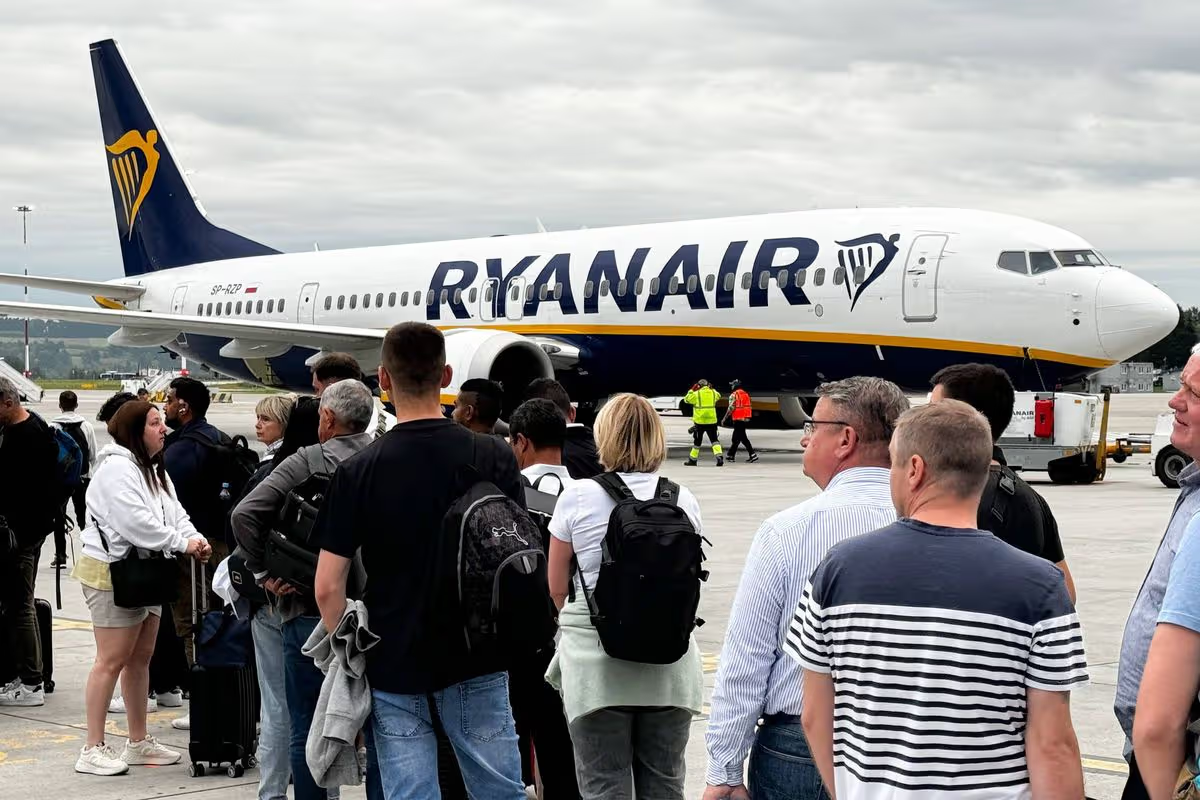
Dutch company KLM is axing 160 flights across Europe over the next month as soaring fuel prices pile pressure on the industry ahead of the busy summer period.

KLM is set to cancel more than 100 flights due to the fuel crisis sparked by the war in Iran Credit: Alamy
Flight cancellations are coming if the Strait of Hormuz remains closed Credit: Reuters

The cuts will hit routes in and out of Amsterdam’s Schiphol Airport, with departures and arrivals split evenly .

Despite the disruption, the airline insists there is no shortage of jet fuel, saying the move is purely down to spiralling costs.

A KLM spokesperson said: “Passengers affected by these changes will be rebooked onto the next available flight.

“As these are destinations KLM serves multiple times a day, such as London and Düsseldorf, travellers can usually be accommodated quickly.

MAJ-ESTIC

Play Majorca’s iconic golf course on budget-friendly 7-night break for under £600


HOLS HORROR

Jet2 holiday flight forced to make emergency landing after ‘smoke filled cabin’

“KLM expects a busy May holiday period and is making sure passengers can travel to their holiday destinations as planned.”

KLM’s flight cancellations comes after the head of the International Energy Agency Fatih Birol said mass flight cancellations will begin “soon” if the Strait of Hormuz remains closed.

“In the past there was a group called ‘Dire Straits.’ It’s a dire strait now, and it is going to have major implications for the global economy”, Birol told AP.

Adding: “And the longer it goes, the worse it will be for the economic growth and inflation around the world.”

Birol’s deadline means airports could face critical fuel shortages by May, causing travel chaos for Brits heading abroad during the school May half-term holidays.

Oil prices have soared since the start of March after Iran closed off the Strait in response to US-Israeli forces bombing.

The Persian Gulf chokehold sees around 40 per cent of the world’s jet fuel supply pass through.

It comes after ACI Europe, which represents European airports, said the key trade route must open within three weeks or fuel reserves will run drastically low on Friday.

A number of airports in Italy have already warned that they were running out of fuel.

According to local reports earlier this week, Brindisi-Casale Airport confirmed that Jet A1 fuel was not available for a short period of time.

And British Airways has announced it will permanently axe its service from London Heathrow to Jeddah in Saudi Arabia from April 24.

The airline had been operating a four flights a week service since November 2024.

But a shift in demand, due to the conflict in the Middle East, has led to the airline terminating the service.

KLM stressed the cancellations make up just one per cent of its European schedule.

But the move will still spark concern for Brits planning trips abroad as airlines battle rising operating costs.

It comes as carriers across Europe scramble to balance the books amid the fuel crisis.

Earlier this month, UK airline Skybus pulled the plug on all future flights between London Gatwick and Newquay.

The route, which launched in November 2025, had been backed by Cornwall Council and the Department for Transport under a public service scheme due to run until the end of May.

However, a slump in passenger numbers combined with higher fuel costs forced the airline to ground the service early, with its final flights taking off on April 2.

The latest cuts raise fresh fears of further disruption for holidaymakers as the peak summer season approaches.

Meanwhile other vital UK services could also face shortages if a deal to end the Middle East war is not struck soon.

Medicines UK, which represents companies making 85 per cent of NHS prescriptions, said NHS patients could face prescription shortages within weeks.

This could place “significant pressure for the NHS as early as June”, the organisation warned.

And Brits could even face shortages of supermarket staples such as beer and meat as officials fear the blockade of the Strait could cut vital carbon dioxide supplies.

CO2 is used in food packaging to improve the shelf life of salad, packaged meats and baked goods – and also slaughtering nearly all pigs and most chickens.

Tim Lang, professor of food policy at the University of London, who has been a member of several government bodies including the UK Council of Food Policy Advisors, told The Sun that the UK has “next to no food storage”.

The cuts will hit routes in and out of Amsterdam’s Schiphol Airport Credit: Alamy
The blockade of the Strait of Hormuz is holding up major supply chains Credit: AFP

Source link