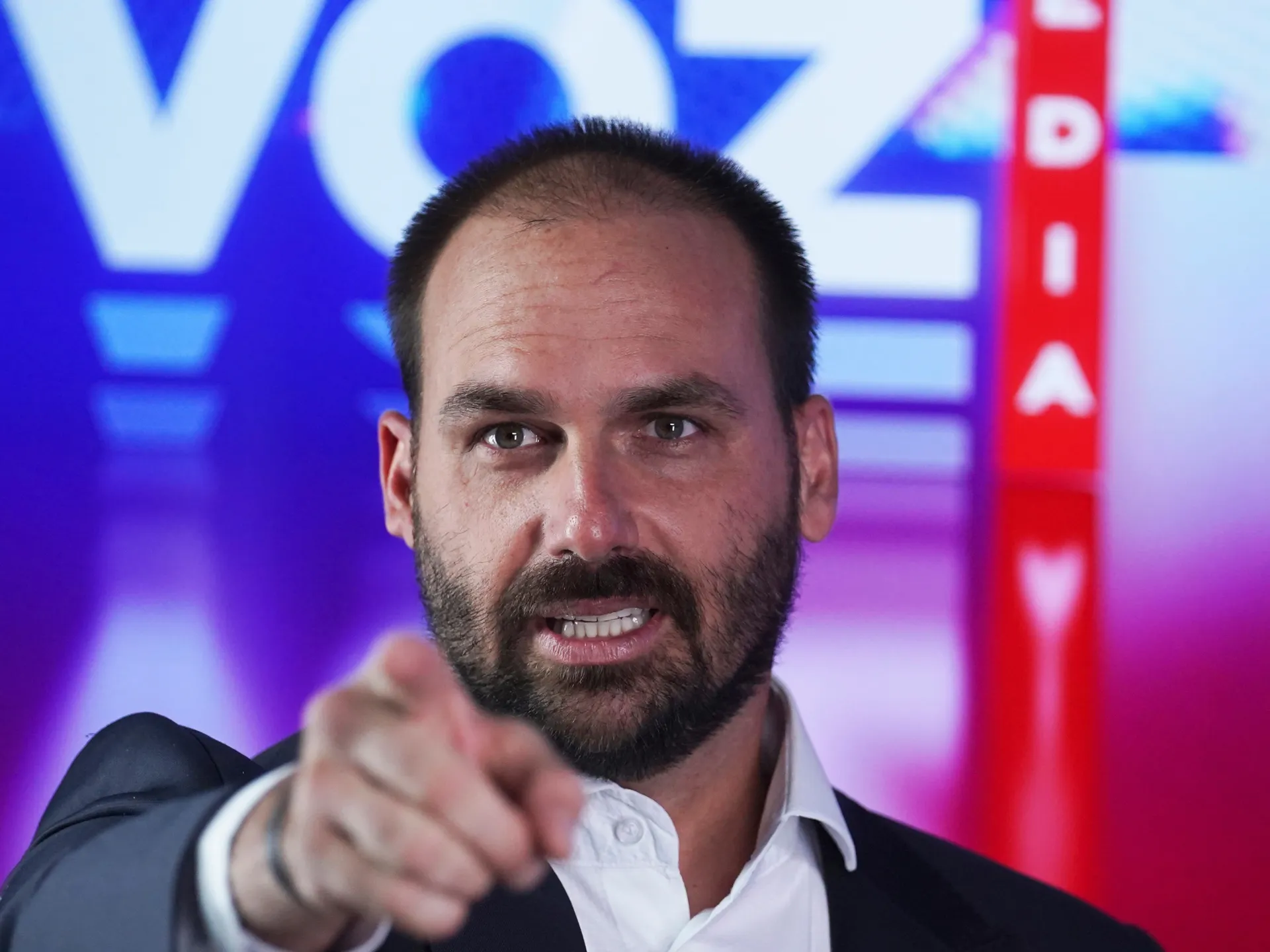
A panel on the Brazilian Supreme Court has voted to convict Eduardo Bolsonaro of lobbying the United States to interfere in the trial of his father, former right-wing President Jair Bolsonaro.
On Tuesday, three of the four justices on the panel voted in favour of conviction, with one remaining justice yet to vote.
Recommended Stories
list of 3 itemsend of list
They determined that Eduardo Bolsonaro’s actions amounted to coercion against Brazil’s justice system and sentenced him to four years and two months in prison.
“It wasn’t merely an expression of opinion or a political stance, but rather conduct that clearly threatened Brazilian authorities and Brazilian citizens themselves,” Justice Cristiano Zanin said, calling Eduardo Bolsonaro’s actions “illegitimate and criminal”.
The conviction is the latest legal setback for the Bolsonaro family, which remains a dominant force on Brazil’s political right.
Jair Bolsonaro is serving a 27-year prison sentence for his efforts to remain in power after losing the country’s 2022 election.
Prosecutors described his actions as an attempted coup. Bolsonaro and his family have portrayed the trial as a political witch-hunt.
The ex-president’s third son and a member of Brazil’s Chamber of Deputies, Eduardo Bolsonaro has been active in his father’s defence.
In March 2025, he pledged that he would move to the US full time to “focus 100 percent” of his energy on “a single cause”: freeing his father.
Prosecutors accused him of mounting an illegal campaign to court US President Donald Trump and use foreign influence to pressure Brazilian officials to drop the case against Jair Bolsonaro.
Trump, an ally of Bolsonaro, had likewise tried to remain in office despite his loss in the 2020 election and has accused Brazilian officials of persecuting right-wing voices like Bolsonaro.
In July 2025, Trump issued a letter announcing 50 percent tariffs on certain Brazilian products, citing Jair Bolsonaro’s trial, specifically, as a reason.
“This Trial should not be taking place,” Trump wrote at the time. “It is a Witch Hunt that should end IMMEDIATELY.”
Trump also issued an executive order sanctioning one of the Brazilian Supreme Court justices involved in the Bolsonaro case, Alexandre de Moraes, on the basis that he worked to “target political opponents” and “suppress dissent”.
He called de Moraes a “threat” to the US, and his administration later expanded the sanctions to include the justice’s family members, as well as other Brazilian judicial officials.
Brazil’s current president, Luiz Inacio Lula da Silva, has denounced those actions as an attempt to interfere in Brazil’s domestic affairs.
As relations with Lula grew more cordial, the Trump administration relaxed its tariffs against Brazil. In December, it also repealed the sanctions against de Moraes and his family.
Lula, meanwhile, visited the White House in May and praised what he described as a productive meeting with his US counterpart.
But it remains unclear what role Trump may seek to play in Brazil’s upcoming presidential elections.
The left-wing Lula is campaigning for a fourth term, and he is likely to face his stiffest competition from Jair Bolsonaro’s eldest son, Senator Flavio Bolsonaro.
A CNT/MDA poll released on Tuesday projected that Lula would receive 49.3 percent of the vote in a run-off election against the senator’s 40.2 percent.
Flavio Bolsonaro has faced his own legal trouble in recent months, with police opening a probe in April into whether he defamed Lula. His connections to a disgraced banker have also raised media scrutiny.
Jair Bolsonaro, meanwhile, faced questions this week about the presence of a firearm in his home in Brasilia, where he is serving three months of his sentence on medical grounds.
Justice de Moraes likewise asked the elder Bolsonaro’s legal team to explain the presence of the weapon, which police discovered during a routine inspection on Monday.
A security guard for Bolsonaro initially said the 9mm Glock pistol was his own, but it was later revealed to be the ex-president’s.
De Moraes gave Bolsonaro’s legal team 24 hours to explain why “the convicted man kept a firearm at home”.
The lawsuit originally filed in September focused on broader alleged misappropriation of confidential information.
Published On 15 Jun 202615 Jun 2026
A United States federal judge has dismissed a lawsuit by Elon Musk’s artificial intelligence company xAI that accused rival Sam Altman’s OpenAI of stealing trade secrets for chatbots.
US District Judge Rita Lin in San Francisco said on Monday that xAI failed to show that OpenAI induced former xAI senior engineer Xuechen Li to divulge confidential information related to its Grok chatbot, or that OpenAI engineers knew Li might have disclosed any.
Recommended Stories
list of 4 itemsend of list
Lin dismissed the lawsuit with prejudice, saying it would be “futile” to continue. She dismissed an earlier version in February. The lawsuit originally filed last September focused on broader alleged misappropriation of confidential information, including source code, by xAI employees who left for jobs at OpenAI.
Monday’s decision is Musk’s second legal loss against OpenAI in four weeks.
On May 18, a federal jury ruled against Musk, the world’s richest person, in his $150bn lawsuit accusing OpenAI and Altman of “stealing a charity” by betraying the company’s original mission as a nonprofit to enrich themselves.
The xAI business is part of Musk’s rocket, satellite and AI company SpaceX.
Lawyers for xAI did not immediately respond to requests for comment. OpenAI and its lawyers did not immediately respond to similar requests.
Discussing past work
The amended complaint focused on a presentation that Li gave while OpenAI was recruiting him.
Musk’s company said OpenAI wanted secrets related to the July 2025 release of Grok 4, knowing its forthcoming update to ChatGPT “could not compete” on complex reasoning, and because OpenAI was “lagging” in reinforcement learning and post-training techniques that Li understood.
But the judge said asking job candidates to discuss their prior work was routine, and one could not infer that OpenAI pushed Li to leak anything confidential.
“To hold otherwise would potentially expose employers to liability any time they inquire about a candidate’s past work,” Lin wrote.
OpenAI has said Li never worked for the company and that it never acquired xAI secrets.
In seeking dismissal, lawyers for OpenAI wrote: “OpenAI does not need or want anyone’s trade secrets, especially not from xAI, which is failing in the marketplace and hemorrhaging talent.”
Li is being sued separately by xAI and has denied wrongdoing.
The United Kingdom’s Court of Appeal has ruled that the British government was right to proscribe the Palestine Action activist group as a “terrorist” organisation last year.
Palestine Action is a British protest group which was founded six years ago and describes itself as a movement “committed to ending global participation in Israel’s genocidal and apartheid regime”.
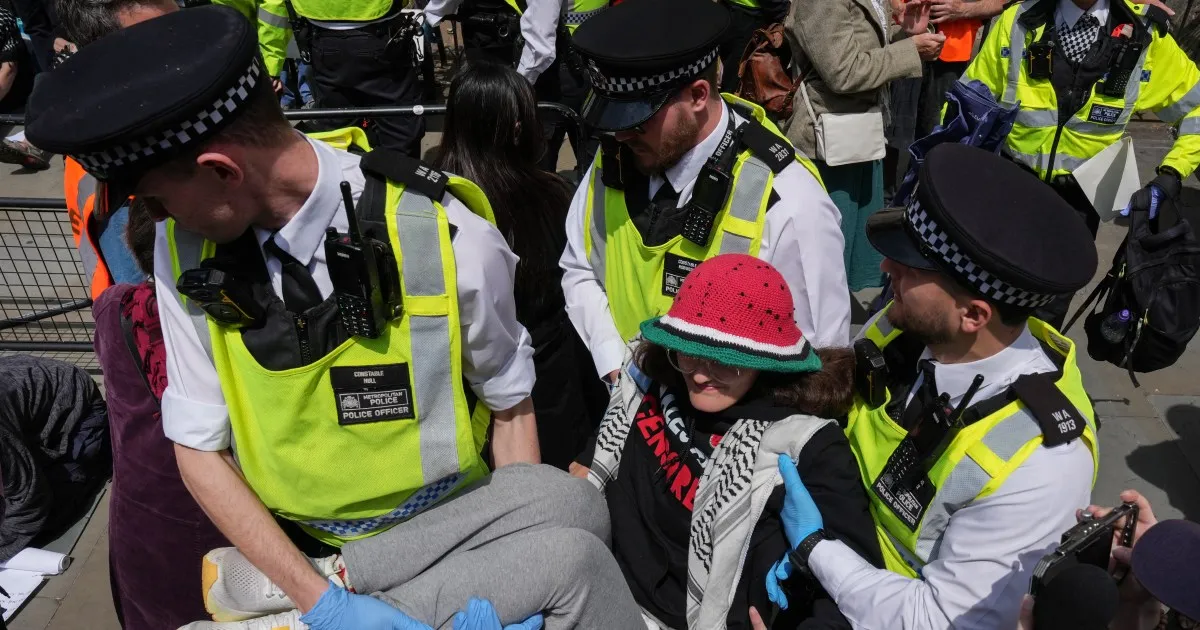
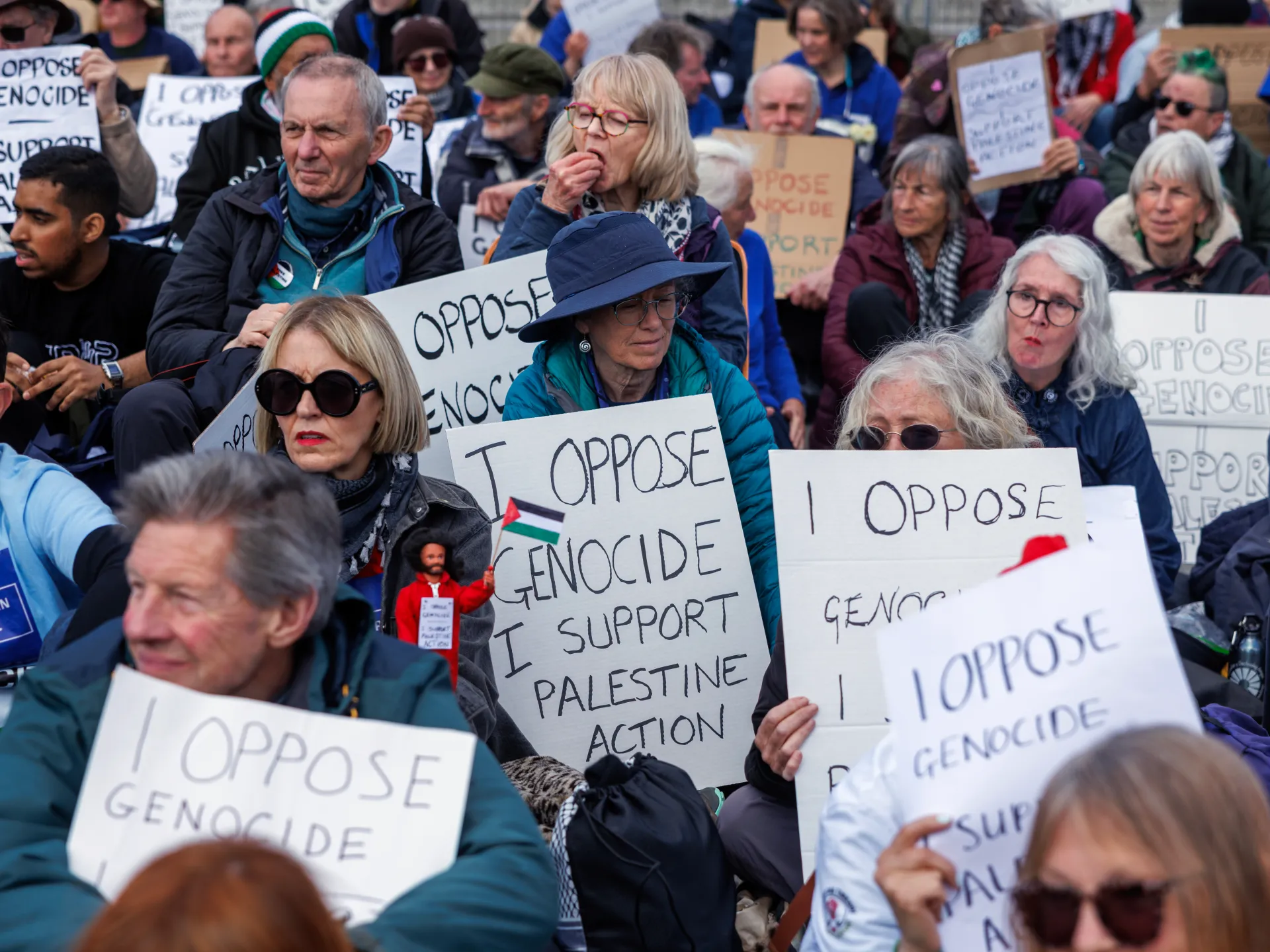
On Monday, police made more arrests of protesters demonstrating in support of Palestine Action outside the Court of Appeal in London.
Since the group’s proscription, which also bans support for proscribed groups, about 3,000 people have been arrested.
The Metropolitan Police welcomed the ruling and said it would continue to arrest those who protest in support of the group.
Here is what we know about the ruling:
What has the Court of Appeal ruled?
The judgement released on Monday states: “The proscription of an organisation like Palestine Action is highly controversial. But it is a fundamental mistake to overlook the fact that Palestine Action overtly promotes unlawful violence amounting to terrorism”.
The ruling was made by a five-strong panel, including the two most senior judges in England and Wales.
Palestine Action, which was formally proscribed by the UK last July, is a British protest group founded six years ago. It says it uses “disruptive tactics” to target “corporate enablers” and companies involved in the manufacture of weapons for Israel, such as Israeli group Elbit Systems, Italian aerospace company Leonardo, French multinational Thales and Teledyne from the United States. The group has targeted British facilities linked to those companies.
In all, British police say action by the group has resulted in millions of pounds of criminal damage.
A court in London ruled on June 12 that four Palestine Action members convicted of criminal damage at a British facility owned by Israeli weapons group Elbit Systems near Bristol, west England, would be sentenced on the basis that their actions had a “terrorist connection”.
Why was this case brought?
Following the proscription of Palestine Action last year, the group’s co-founder, Huda Ammori, challenged the decision in the High Court. In February, the High Court ruled that the government’s “terror group” ban was unlawful and disproportionate.
The government immediately said it would appeal. “I am disappointed by the court’s decision and disagree with the notion that banning this terrorist organisation is disproportionate,” Home Secretary Shabana Mahmood said.
The judgement on Monday agreed with her. Its ruling states: “The Home Secretary had the institutional competence and the democratic accountability to make the decision. The Proscription Decision was consistent with the Home Secretary’s Proscription Policy and was proportionate. It was not unlawful.”
Days after the Brize Norton attack, members of parliament voted in favour of proscribing the group. That classified Palestine Action as a “terrorist” organisation, bringing it into the same category as armed groups such as al-Qaeda and ISIL (ISIS).
Critics decried the vote, arguing that while members of the group have caused damage to property, they have not committed violent acts that amount to terrorism. More than 130 high-profile public figures have spoken out against the proscription.
Other previous actions the group has taken include:
In 2021, members protested for six days on the roof of Elbit Systems’ subsidiary, UAV Tactical Systems in Leicester, until some were arrested by police.
In 2022, the group broke into a Thales equipment factory in Glasgow, causing damage to weapons worth more than a million pounds ($1.3m).
In 2024, 10 months into Israel’s genocidal war on Gaza, Palestine Action activists broke into an Elbit Systems UK facility near Bristol in southwest England, causing another million pounds of damage.
How has Palestine Action responded to the ruling?
In a statement read by a representative following the ruling, Palestine Action’s Ammori said the group will challenge the judgement in the UK’s Supreme Court.
“We will fight this all the way. We will seek permission to appeal to the Supreme Court and, if need be, take this to the European Court of Human Rights,” Ammori said.
The European Court of Human Rights (ECHR), established by the Council of Europe, allows individuals to hold member states accountable for rights violations through a dedicated court. When the ECHR finds a violation, its judgements are legally binding on the state concerned under the European Convention on Human Rights.
“We will not stop fighting to overturn one of the most extreme attacks on free speech and the right to protest in modern British history,” Ammori added.
“This unprecedented abuse of power has devastated the lives of thousands of people while silencing dissent over Israel’s slaughter of the Palestinian people during the genocide, when that dissent could not be more urgent.”
How have others reacted to the ruling?
Anas Mustapha, Head of Public Advocacy at CAGE International, said: “This ruling tells us exactly what these powers are for. They are not safeguards against violence, they are authoritarian tools for crushing dissent.”
Mustapha added: “No ruling from any court is going to convince people that their conscience is wrong, and no amount of legislation will make support for Palestine disappear. The only sustainable outcome is the abolition of these laws in their entirety.”
Thomas Bell, acting UK Director of Human Rights Watch, said: “This disastrous decision further cements the UK’s place among countries that are backsliding on human rights by classifying acts of protest as terrorism.”
“When Palestine Action members have committed criminal damage, that should be dealt with under normal criminal laws, not by misusing overbroad and poorly defined terrorism powers. Defining a protest group as terrorists has created an absurd situation where thousands of people peacefully holding up signs have been arrested,” Bell added.
The US president has sought to reshape the capital city’s image and institutions through series of plans and projects.
Published On 12 Jun 202612 Jun 2026
President Donald Trump’s name is set to be removed from the facade of the Kennedy Center, an entertainment and cultural institution in Washington, DC, after a judge rejected a last-minute request to keep it in place.
US District Judge Christopher Cooper dismissed an effort by the centre’s board, whose members were handpicked by Trump, to reverse a previous order taking his name off the building by Friday.
Recommended Stories
list of 3 itemsend of list
The saga is yet another example of Trump’s effort to make changes to major sites and institutions across the nation’s capital, on which he has sought to impose himself through a series of planned projects that include an enormous triumphal arch and a White House ballroom.
Many of those efforts have faced legal challenges.
Trump dismissed the centre’s previous leadership and appointed a board that named him chairman.
Cooper had ruled last month that the addition of Trump’s name to the exterior of the John F Kennedy Center for the Performing Arts was illegal and ordered its removal.
“Unfortunately, Judge Cooper and the Radical Left would rather see it DIE than have President Trump transform it into something that everyone could be proud of,” Trump wrote in a 580-word social media post at the time, slamming the decision, referring to himself in third-person.
A June 4 memo from the centre’s Office of General Counsel had instructed staff to use the name “The John F Kennedy Center for the Performing Arts” or “Kennedy Center” in email signatures, letterhead and other documents. The centre’s website also dropped Trump’s name.
But the board attempted to salvage the change in an appeal on Thursday, appealing a previous ruling that denied their request for a stay. Cooper rejected that request on Friday.
Justice Department had walked back controversial plan after meeting backlash from lawmakers and lawsuits.
Published On 12 Jun 202612 Jun 2026
A federal judge in the United States has indefinitely blocked the Trump administration from moving forward with plans for a $1.8bn “anti-weaponisation” fund, meant to offer payments to those who experienced alleged “lawfare” and “weaponisation” of the government.
The ruling on Friday represents another setback for the scheme, which has faced heavy resistance from lawmakers and has been walked back by the Department of Justice previously.
Recommended Stories
list of 3 itemsend of list
Judge Leonie Brinkema of the US District Court for the Eastern District of Virginia had issued a temporary halt to the fund last week and issued a preliminary injunction as it was set to expire on Friday.
The fund was the product of a settlement between Trump and the Justice Department of a $10bn lawsuit the president had brought against the Internal Revenue Service (IRS).
The Justice Department set up a $1.776bn fund that would have been helmed by a five-member commission to distribute funds to those they deemed victims of “weaponisation”, a term that Trump has used to describe investigations and criminal cases into himself and his allies.
Attorney General Todd Blanche walked back the plans earlier this month amid growing criticism, and government attorneys have argued that lawsuits challenging the scheme are now irrelevant.
Even before the administration announced it was dropping the fund, the Justice Department did not form the five-member commission to decide on payout criteria, so no money was paid out or claims accepted.
Many of the Republican president’s allies are opposed to compensating rioters who stormed the US Capitol on January 6, 2021. In May, however, Blanche would not rule out the possibility that Capitol rioters who engaged in violence could be eligible to apply for payments from the fund.
Trump issued mass pardons to Capitol rioters on his first day back in the White House last year. More than 1,500 people were charged in the January 6 attack before Trump erased every case with his sweeping act of clemency.
Plaintiffs who sued to block the plan argued that the scheme diverted taxpayer funds into what was essentially a slush fund and have expressed doubt about Blanche’s assurances that the fund will not move forward.
While the administration has moved away from the scheme, Trump himself has not endorsed its cancellation and has continued to discuss it positively in comments to the press.
Four activists from the Palestine Action group face sentencing in the United Kingdom as “terrorists” on Friday, despite only being convicted by a jury of other criminal charges.
Palestine Action was formally proscribed as a “terrorist” organisation in the UK last July.
Last month, four of six activists on trial were convicted at Woolwich Crown Court in London of criminal damage during a 2024 raid on a factory in Filton, Bristol, operated by Israeli defence firm Elbit. One of the defendants was also found guilty of striking a police officer with a sledgehammer.
The possibility that the judge will rule that the offences have a “terrorist connection” for sentencing purposes has prompted protests.
What is Palestine Action?
The protest group Palestine Action, launched in July 2020, describes itself as a movement “committed to ending global participation in Israel’s genocidal and apartheid regime”.
It seeks to use “disruptive tactics” to target “corporate enablers” and companies involved in the manufacture of weapons for Israel, such as Israel-based Elbit Systems, Italian aerospace company Leonardo, French multinational Thales and Teledyne from the United States. The group has targeted British facilities linked to those companies.
The UK parliament voted in favour of proscribing the group on July 2, 2025, classifying it as a “terrorist” organisation, and bringing it into the same category as armed groups such as al-Qaeda and ISIL (ISIS). The proscription came days after its activists sneaked into an air force base in southern England.
Critics decried the move by MPs, arguing that while members of the group have caused damage to property, they have not committed violent acts that amount to terrorism.
What were they convicted of?
In August 2024, Palestine Action activists raided a factory in Filton near Bristol in southwest England, operated by Israeli arms manufacturer Elbit Systems. They entered the site and caused extensive damage in an attempt to disrupt the production of weapons and drone components they say would be used by Israel in Gaza.
The raid, which prosecutors said caused about one million pounds ($1.36m) of damage, happened 10 months into Israel’s genocidal war on Gaza that began in October 2023.
Last month, jurors at Woolwich Crown Court convicted Charlotte Head, 30, Samuel Corner, 23, Leona Kamio, 30, and Fatema Zainab Rajwani, 21, of criminal damage. The four activists have become known as “the Filton 4”.
Corner was also found guilty of striking a police officer with a sledgehammer and convicted of inflicting grievous bodily harm.
Two other Palestine Action activists, Zoe Rogers, 22, and Jordan Devlin, 31, were found not guilty.
The verdict followed an earlier trial, at which all six defendants were acquitted of aggravated burglary, while the jury was unable to reach verdicts for the criminal damage charges.
Each of the defendants gave evidence, admitting that they damaged Israeli military drones and equipment inside Elbit’s research and development facility in Filton – in order to “save lives in Palestine”, according to a statement by their lawyers.
What would a terrorism sentencing mean?
The jury was not told that, if they convicted, the four could be sentenced under terrorism laws. Criminal damage is not usually a terrorism offence, but in England and Wales judges can decide to treat an offence as having a “terrorist connection” at sentencing, even when the charge itself is not a terrorism offence.
If the court decides there was a terrorism connection, the activists would have to serve their entire sentences in prison, unless they have already completed at least two‑thirds of the sentence and a parole board decides they can be released.
Conversely, non-terrorist prisoners usually serve about 40 percent of their sentence in custody and are released early, but under conditions and supervision, sometimes called licence conditions. If they break those conditions, they can be sent back to prison to finish their sentence.
Additionally, if the activists are sentenced in this way, they can be recorded as “terrorists” for the rest of their lives, would be required to register new mobile devices, email addresses and bank accounts with the police for their lifetime, and face being returned to prison if they breach their licence conditions or reoffend.
What has the reaction to all this been?
On Wednesday, a group of more than 50 lawyers and law professors published an open letter denouncing plans to sentence the four Palestine Action members as terrorists.
The letter highlights that damage to property has been a recurring feature of protest campaigns from the Suffragettes who fought for women to have the right to vote, to environmental protest group Extinction Rebellion.
“It has never previously even been suggested that those taking such action should be treated as terrorists. Blurring the distinction between principled direct action and terrorism is the hallmark of authoritarian regimes,” the open letter stated.
The letter has been signed by law professors from universities in the UK, the Netherlands, Norway and Canada as well as by dozens of practising barristers and solicitors.
According to local news reports, a protest is expected at Woolwich Crown Court on Friday against the potential judgement.
Judge Emily Marks had previously allowed the execution to proceed, arguing that no execution is entirely without pain.
Published On 9 Jun 20269 Jun 2026
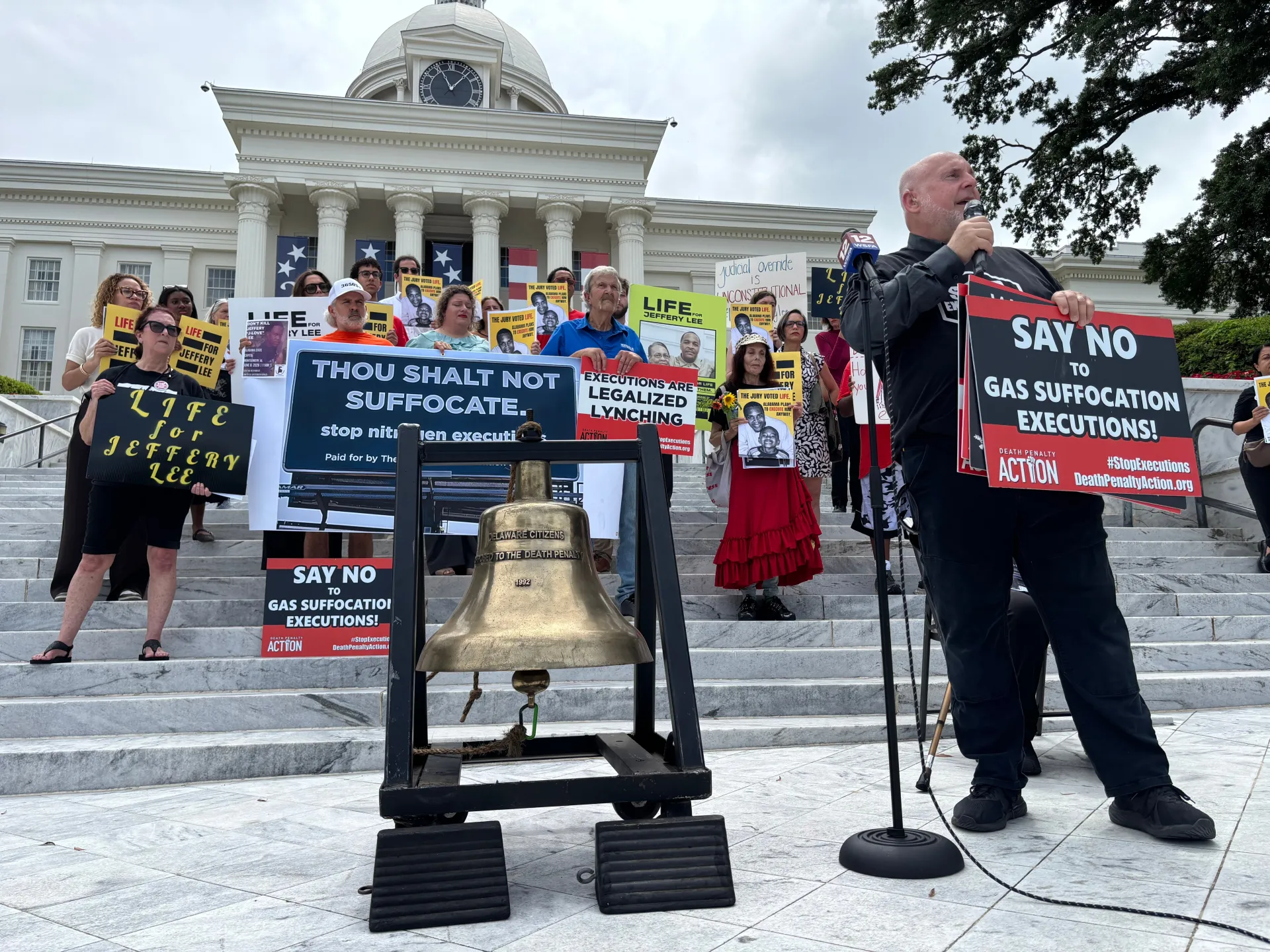
A federal judge in the United States has permanently blocked Alabama from executing an inmate with nitrogen gas, after declaring that the method violates the ban on cruel and unusual punishment.
On Tuesday, US District Judge Emily C Marks permanently enjoined the state from executing Jeffery Lee by nitrogen gas. Lee was scheduled to be executed Thursday at an Alabama prison.
Recommended Stories
list of 3 itemsend of list
Her decision came a day after an appeals court reversed her earlier ruling that the method is constitutional.
The case centres on how to interpret the US Constitution’s Eighth Amendment, which bars the government from inflicting “cruel and unusual punishments”.
A spokesman for Alabama Attorney General Steve Marshall said the state is reviewing the decision and considering next steps, including an appeal. The case will likely end up before the US Supreme Court, which has previously let nitrogen executions proceed.
A spokeswoman for Lee’s legal team said they did not have an immediate comment.
In her 26-page ruling, Marks said litigation is a constant in death penalty cases.
“Were Alabama to adopt firing squad as a method of execution, that method would likely be challenged as well. Indeed, there is likely no method — no matter how humane — that would be immune to constitutional challenge,” Marks wrote.
“But the Constitution does not guarantee a painless death, and human life cannot be purposefully extinguished without some risk of pain. The Court, the condemned, and the State must all confront that sobering reality.”
Marks noted that the state has two other authorised execution methods: lethal injection and the electric chair. She said Lee is “not entitled to an injunction barring the State from executing him using one of those methods”.
Marks also ruled that the state could switch to Lee’s preferred method, a firing squad. Inmates challenging execution methods are required to suggest an alternative method.
“The State can readily obtain rifles, ammunition, and other materials necessary to carry out a firing squad execution,” Marks wrote.
“Additionally, the State would be able to modify space at Holman to carry out executions by firing squad. The State is also able to source and train volunteers willing to carry out such an execution.”
Lee is currently housed at Holman Correctional Facility in Atmore.
Donald Trump’s appearance courtside at Madison Square Garden was supposed to be a historic moment, as, for the first time, a sitting president of the United States was attending an NBA Finals game.
Instead, his arrival became part of the story, drawing boos from sections of the crowd and triggering a massive security operation that reshaped the atmosphere around the storied New York arena on Monday night.
Trump watched from an executive suite as the New York Knicks hosted the San Antonio Spurs in a series that gripped the city and revived memories of the Knicks’ glory years.
When his image flashed up on the big screen during the national anthem, many fans jeered, underlining how sharply divided the country remains even in a space usually reserved for shared celebration.
Outside, Manhattan’s streets were locked down. Metal fencing, airport-style screening and a heavy Secret Service and police presence kept ticketless fans blocks away.
Long queues formed as supporters queued early, while others gathered at public viewing areas across the city.
Inside, however, the spectacle went on. Hollywood actors, musicians, former players and New York fixtures filled the front rows, turning the event into a star-studded night out.
Between the celebrity sightings, the political undertones and a tense 115-111 Spurs win, this was a New York basketball night unlike any other – on and off the court.
CONVICTED murderer Mackenzie Shirilla showed tell-tale signs she was trying to force emotion during her arrest and in her bombshell Netflix interview, a body language expert has claimed.
Shirilla, 21, has been languishing behind bars in Ohio after being found guilty of murdering her boyfriend, Dominic Russo, and their friend, Davion Flanagan.
Her case has sent true crime fans into a tailspin after the success of the Netflix documentary, The Crash, in which she broke her silence and maintained her innocence.
Shirilla’s TikToks and Instagram posts have resurfaced, showing her regularly posing in the mirror, showing off designer clothing, and even smoking weed in her car.
Text messages revealed by police showed her toxic relationship with Dominic, her boyfriend of four years, whose family claims had tried more than once to break up with her.
She reportedly threatened to harm him during arguments before purposefully plowing into a brick wall while driving her Toyota Camry on July 31, 2022.
Renowned body language expert Logan Portenier, host and creator of the popular YouTube channel Observe, spent hours breaking down her movements in dozens of social media clips and footage.
Here he gives The U.S. Sun his biggest takeaways from the case.
TikTok star
Shirilla was a social media-obsessed teen before the crash and shared daily posts on TikTok of her and Dom, both at home and out and about, as she was often the center of attention.
Reviewing one clip of them in the car together, Logan said, “He doesn’t seem to be as stoked for this video that she’s filming as she does.
Most read in Entertainment
“It didn’t seem as though they were quite on the same page emotionally.
“She’s doing her different poses and expressions for the sake of the video and for his side of things, he seems much more reserved and subdued.
“Because he’s not performing as much for the camera as she is, we’re seeing a fair bit of synchronization across the upper half of his face and the lower half of his face, which lets us know that anything that we’re kind of seeing on that is probably going to be forced. It’s performative.
“And he does, a little lackluster kind of asymmetrical smile on the bottom half of his face.”
Mackenzie Shirilla pouts in a TikTok video with her boyfriend, Dominic RussoCredit: TikTok/kenzshirillaThe then-teenage Shirilla is seen posing in a mirror as her boyfriend Dominic stands awkwardly in the backgroundCredit: TikTok/kenzshirilla
Uncomfortable posing
In another clip from Shirilla’s TikTok, the couple is at home, and she is trying to get him to pose in a full-length mirror as he is seen hiding behind her.
“Mackenzie is doing a lot of the posing,” Logan said. “She’s hitting her different looks that she wants to do during this.
“In the background, you could see initially Dom’s nonverbal communication.
“He’s doing a self hug. You can see him holding both of his arms there.
“That is misconstrued in a lot of areas as exclusively defensive,” but Logan feels this is more about comfort.
“What I do find more interesting is that he does shift later on to holding both hands in front.
“So both of those clusters there, he has one in front and then he has his hands clasped in front like that. Both of those signal a level of discomfort.”
Logan added, “We’re seeing again this dichotomy between the two of them.
“He’s kind of there and he’s being present, albeit uncomfortable, reserved, and needing to do a little bit of self-soothing to be able to make it through.”
Distracted driving
Shirilla, who made no secret of being image-conscious before her arrest, frequently posed for TikTok videos — even when she should have been concentrating on the road.
In hindsight, clips showing her filming herself while driving are especially unsettling, given that two young men would later lose their lives in a crash while riding in a car with her behind the wheel.
“It’s very focused on the phone and what she appears like on it, hitting her specific facial expressions as well,” Logan said.
Mackenzie Shirilla is seen in shades posing while driving her car in one disturbing clipCredit: TikTok/kenzshirillaMackenzie Shirilla looks distressed as she is cuffed in the back of a police carCredit: Strongsville Police Department
“And on those facial expressions, this helps us understand how she will behave and appear when she’s performing.
“There might be some of that lip pursing that we kind of see in there.
“There are some head tilts in there as well as she’s trying to be perceived in a very specific way, so that performative non-verbal communication comes in handy in future situations, because then you can keep an eye out for some of those patterns that may or may not show up in the future.”
Cuffed and anxious
Shirilla survived the crash and police launched an investigation, as evidence slowly proved it was not an accident and she recovered from multiple surgeries.
Fast-forward to November 2022, and Shirilla’s life blows up in smoke as she’s finally arrested and later charged with murder.
“I don’t know that she’s aware that there’s a camera pointed at her, that she’s going to be perceived in this area, and so what we’re going to be able to see is more of her unfiltered nonverbal communication,” Logan pointed out.
“And with this, she is feeling what would be considered in that vein of the universal emotion of sadness.
“There’s grief, there’s panic, and stress, everything that can go into that.
“What really gives it away is the action in her forehead area.
“What we’re seeing predominantly is unit one activation, which is the middle portion of your eyebrows when they go upward during genuine sadness and grief.
“You can see that happening symmetrically, but if it’s more performed, a lot of people will end up having light asymmetrical activation because it’s not genuine.”
Frozen with fear
In further footage of Shirilla in the back of a police car after her arrest, Logan said she appears frozen with fear despite not shedding a tear as she heads to the station.
“She has fairly relaxed eye positioning in general when she’s not panicked,” he said.
“And so this widening of her eyes, it indicates, genuinely, that she’s feeling anxious. This would be considered fear.”
Logan added that while Shirilla “might not be terrified, it would at least trigger as fear to the anxiety levels” as she rides in the police car.
“So we’re seeing both the combination of the grief across the upper half of her forehead and her eyes are showing the fear as well,” Logan said.
She relaxed before suddenly looking distressed again, but Logan feels it may not have been genuineCredit: Strongsville Police DepartmentMackenzie Shirilla is seen in a mugshot after her arrest in November 2022Credit: ohio.gov
“Then when we get down to the rest of her face, some things that show more physiology rather than just physical movements, is a lot of the inflammation around her nose and upper lip,” which Logan claims “[lets] us know that this is coming from an authentic place.”
Putting on an act
Logan explained that emotional states have a profile, and things can usually shift after around four and a half seconds.
During the journey, Shirilla seems to relax, despite the situation that she’s in, and is seen rolling her head back and looking bored.
But as they approach the station, Logan feels she starts to perform as she realizes she should be more upset than she is if she’s not guilty of murder.
“When you’re watching somebody who’s performing, you’ll see a lot of crashes in between,” he told The U.S. Sun.
“So they’ll be emoting a specific way and then it’s almost like they remember like, ‘Oh, I should be sad right now.’ And then they’ll crash into sadness, something like that.
“You can see it start to kind of creep through the cracks of her rather reserved expression beforehand.”
This is where Logan returns to Shirilla’s “eyebrow activation.”
He claims Shirilla’s outer and inner eyebrows are working together at this point to show sadness, stress and anxiety.
Again, the corners of her nose are also activated, not in disgust, but trying to show she is upset, something he says he doesn’t often see.
Oscar-worthy performance
She is later seen sobbing during her trial before being locked up for 15 years to life on murder charges.
Shirilla starts to mix with people from different walks of life, and it’s years later when we see her sit down with film producers for her bombshell interview.
She is seen walking into the frame and sitting down at a table wearing her prison scrubs, her hair tied up in a large bun.
“The fact that she’s sitting down, crossing her arms, immediately lets us know that she’s probably feeling uncomfortable about what’s about to happen there and needs to block off and self-soothing a little bit,” Logan said.
Shirilla then activated her glabella – the smooth area of skin on her forehead located directly between the eyebrows and just above the bridge of her nose, Logan said.
He claims this was to give the impression she is empathetic, but instead of it being symmetrical, she delivered asymmetrical activation.
“Her right eyebrow does not have the same activation as her left eyebrow.
“Her left eyebrow is doing the exact same expression that we saw in the cruiser. Her right eyebrow is not.
“It’s an asymmetrical expression which lets us know this isn’t authentic empathy.
“This isn’t authentic pain or fear or grief that she’s feeling here. It’s forced.”
Logan said this was also visible further down the vein on the bottom half of her face.
She also began pursing her lips – something she would do in her performative TikTok videos, where she wanted to control how she was being perceived.
He said she is trying to convince the audience she is upset about the situation she is in, and victims’ deaths, but “her body is betraying her.”
“And then when we get to this specific interview she’s talking at a lower register, she has a little bit more husky to her voice,” he said.
“Some of the verbal tics that she uses as well have shifted. And my immediate thought was, this has to be something about the performance that she’s obviously performing.
“She wants people to feel a certain way. And so she shifted her tone, her speaking differently as well to perhaps support that.”
He feels not only her voice will have changed in prison, but her body language as she mixes with other inmates.
“I have no doubt in my mind that she’ll be adjusting her overall nonverbal behavior as well to better fit in and get to where she wants to be in that social circle as well,” he said.
To see the full interview with Logan, and other exclusive videos on Mackenzie Shirilla, visit our YouTube channel.