Watch this discussion between Ross Harrison and Hassan Ahmadian on US strategy regarding Iran. They conclude the US is still negotiating with old talking points, while Iran has moved on.
Belarusian President Alexander Lukashenko gifted North Korean leader Kim Jong Un a gun after the two countries signed a friendship treaty during the Belarusian’s first official state visit.
President Trump on Thursday continued projecting confidence in the U.S. war effort in Iran, suggesting online and during a high-level Cabinet meeting that Iran has been “obliterated,” that its leaders were “begging” for a deal, and that the U.S. is “roaming free” over Iran and “NEEDS NOTHING” from its European allies.
His description of the war as all but finished — he actually said “we’ve won” — stood in contrast to the facts on the ground, where Iran continued to launch attacks and threaten oil tanker traffic in the vital Strait of Hormuz, and the U.S. continued sending troops and warships to what is already the largest U.S. military buildup in the Middle East in decades.
Trump’s framing of the conflict also contrasted with that of Iranian officials, who have remained publicly defiant, downplayed negotiations and outwardly rejected several of Trump’s conditions for ending the war — as Trump himself acknowledged, accusing them of saying one thing in private and another in public.
“They better get serious soon, before it is too late,” the president wrote on social media, “because once that happens, there is NO TURNING BACK, and it won’t be pretty.”
“They are begging to make a deal, not me,” Trump reiterated later Thursday, while hosting his first Cabinet meeting since the war began. “Anybody that sees what is happening understands why they are begging to make a deal.”
Trump asserted that Iran’s military capabilities have been destroyed, and that the American mission is “ahead of schedule.” He said American forces were operating without opposition over Iran, and “there’s not a damn thing they can do about it” because they’ve been “beat to s—.”
Trump’s outward confidence, a defining feature of the war campaign that has been consistently echoed by Secretary of Defense Pete Hegseth and other administration loyalists, continued despite growing concerns this week in Congress — and not only from Democrats.
Several Republicans emerged from a classified war briefing Wednesday clearly frustrated with the administration for not providing a clearer picture of the path out of the now monthlong war, or clear answers on whether it planned to deploy ground troops.
“We want to know more about what’s going on,” said Rep. Mike Rogers (R-Ala.), chairman of the House Armed Services Committee. “We’re just not getting enough answers.”
“I can see why he might have said that,” said Sen. Roger Wicker (R-Miss.), chairman of the Senate Armed Services Committee.
Democrats have hammered the president — contrasting the war and its massive budget with rising fuel costs for average Americans and lamenting the deaths of U.S. service members.
“Thirteen American lives lost and tens of billions of taxpayer dollars spent in just three weeks since Donald Trump plunged us into war without congressional authorization. There is still no plan, no clear justification, and no end in sight,” Sen. Alex Padilla (D-Calif.) said. “Americans called for lower prices, not endless wars.”
For weeks, Trump, Hegseth and other war leaders such as Gen. Dan Caine, the chairman of the Joint Chiefs of Staff, have focused on U.S. wins in the conflict — tallying up Iran’s sunken ships and grounded planes, assassinated leaders and undermined missile capabilities.
In recent days, Trump has suggested that, because of those wins, Iran is buckling and its leaders reaching out for a deal. He has said the U.S. is pushing a 15-point plan that will forever block Iran from developing a nuclear weapon or threatening the U.S. or its allies. And he and others in his administration have accused the media of ignoring tremendous battlefield wins to harp on losses instead.
Israel, America’s major partner in the conflict, has projected similar confidence while showing no signs of slowing its attacks on Iran. On Thursday it announced it had killed several senior Iranian naval commanders, including Commodore Alireza Tangsiri, the head of Revolutionary Guard’s navy.
Israel’s Defense Minister Israel Katz said the deaths should send a “clear message” that Israel will continue to hunt down top Iranian military officials. Iran did not immediately acknowledge Tangsiri’s death.
The head of U.S. Central Command, Adm. Brad Cooper, praised Tangsiri’s killing, said U.S. strikes would continue, and called on Iranian fighters to “immediately abandon their post and return home to avoid further risk of unnecessary injury or death.”
Meanwhile, death, destruction and environmental and economic damage from the war spread far beyond Iran, where officials recently increased their estimated death toll to nearly 2,000.
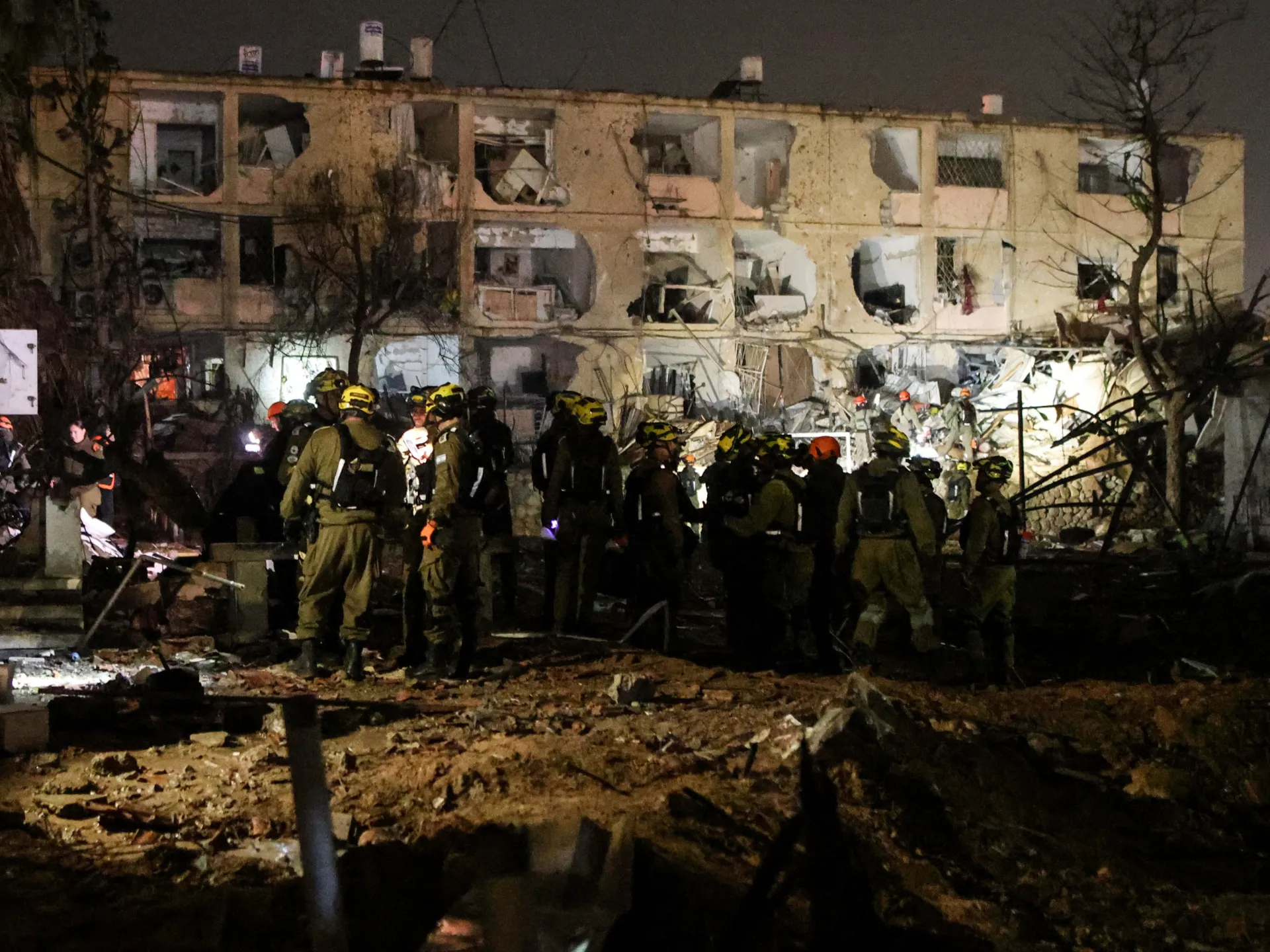
Israel was fighting off a barrage of incoming missiles Thursday, with booms heard in Tel Aviv and Jerusalem and an impact reported in the central town of Kafr Qassem. Iraqi Defense Ministry spokesman Maj. Gen. Tahsin al Khafaj on Thursday said 23 people had been wounded in a Wednesday strike on a military clinic in western Iraq’s Anbar province.
Israeli soldiers grieve during the funeral of Staff Sgt. Ori Greenberg, 21, at the Mount Herzl military cemetery in Jerusalem on Thursday.
(Odd Andersen / AFP via Getty Images)
Thousands of additional U.S. troops are on their way to the region, while many of the tens of thousands already stationed there have been displaced into hotels and other temporary housing — diminishing their war-fighting capabilities — by Iranian attacks that have left the 13 regional military bases they normally live on “all but uninhabitable,” the New York Times reported.
Iran announced Thursday that it had launched drone and missile attacks on a U.S. military base in Kuwait and a separate air base used by American forces in Saudi Arabia.
Jasem Mohamed al-Budaiwi, the secretary-general of the Gulf Cooperation Council, accused Iran of charging fees for ships to safely transit the Strait of Hormuz, continuing the economic toll on global oil supplies. Environmental experts warned of massive pollution from burning oil and gas fields.
Russia, emboldened by the Iran war, which has drawn resources away from Ukraine and led the U.S. to ease sanctions on Russian oil, has launched a renewed spring offensive against Ukraine.
The distance between U.S. and Iranian messaging about the war and their negotiations to end it — which foreign officials have said are occurring through intermediaries — has contributed to the tensions and the reluctance of allies to get involved, with some citing similar frustrations as Republicans in Congress this week.
Many allies have largely stayed out of the conflict despite Trump vacillating between demanding their help and insisting it isn’t necessary.
In one of his posts to social media Thursday morning, Trump blasted allies in the North Atlantic Treaty Organization, or NATO, for having “DONE ABSOLUTELY NOTHING TO HELP” in the conflict, and said the U.S. would “never forget.”
During his Cabinet meeting, Trump said that when the “right deal” is made with Iran, the Strait of Hormuz will reopen — while insisting that Iran no longer has any “mine droppers” that would threaten merchant vessels passing through the key oil route.
Steve Witkoff, one of Trump’s top advisors leading the negotiations in the Middle East, said the Iranians were looking for an “offramp,” that Pakistan is serving as a mediator between Washington and Tehran, and that the U.S. has presented a 15-point plan that “forms the framework for a peace deal.”
“These are sensitive, diplomatic discussions and you have directed us to maintain confidentiality on the specific terms and not negotiate through the news media, as others do,” Witkoff said. “We will see where things lead and if we can convince Iran that this is the inflection point, with no good alternatives for them other than more death and destruction.”
Trump has also declined to say whom Washington is negotiating with in Iran, but described them as “very smart,” “not fools,” and “very lousy fighters, but great negotiators.”
He also said he knows they are “the right people” for the U.S. to be dealing with because they had given him a “present” — and proved they are in control — by allowing “eight big boats of oil” travel through the strait this week.
Asked if he intended to send U.S. troops into Iran to take its enriched uranium, he called it a “ridiculous question” that he wouldn’t answer.
Treasury Secretary Scott Bessent said he is confident that more merchant vessels will soon be able to safely pass through the Strait of Hormuz. He also told the president that he believed the oil market is currently “well supplied” and that once the war ends, energy prices will drop.
Hegseth repeatedly slammed the media for falsely framing the war effort as floundering or unfocused, saying Iran’s “air defenses are gone,” its leaders hiding in “underground bunkers,” and its fighters losing morale.
He said Iranian officials in private are admitting “very heavy losses,” and that the U.S. and the world are benefiting from having Trump, whom he called the “ultimate deal maker,” working toward a peace deal.
In the meantime, he said, the U.S. military will “continue negotiating with bombs.”
Details of a plan submitted by Board of Peace Director General Nickolay Mladenov for the disarmament of Hamas and other Palestinian groups in Gaza have been seen by Al Jazeera.
The plan would see disarmament – one of the components of the October ceasefire to end Israel’s genocidal war on Gaza – implemented gradually over an eight-month, multiphase process.
Recommended Stories
list of 3 itemsend of list
The process would see disarmament in exchange for Israel fulfilling its own obligations, including allowing reconstruction materials into Gaza to begin the work of rebuilding the enclave after Israel’s devastation of the territory since October 2023. Israel would also allow an increase in humanitarian aid entering Gaza, and the plan envisions the transfer of the administration of the Palestinian territory to a national committee.
Mladenov referred to the plan in general terms in a speech to the United Nations Security Council on Wednesday. There he said the plan had been “presented to relevant armed groups” that were urged to accept the framework “without delay”.
“Decommissioning [arms] proceeds in parallel with staged withdrawal,” Mladenov said.
The disarmament of groups in Gaza has been a controversial topic, particularly as Israel has continued to attack the enclave during the ceasefire, killing hundreds of Palestinians. Israel has also not stopped restricting aid into Gaza, driving up prices, even as many in the territory remain displaced and unable to afford basic items.
Hamas has repeatedly refused to give up its arms as long as Israel’s occupation of Gaza continues. Israeli forces maintain a presence in Gaza in areas beyond a “yellow line”, giving it a de facto buffer zone that Palestinians cannot approach without risking being shot. Hamas has also said disarmament is an internal Palestinian matter that should be discussed between factions rather than imposed from the outside.
Hamas and Israel have so far not officially reacted to the details of the Mladenov plan. But Palestinian experts have previously told Al Jazeera that the plan in effect means the “political surrender” of Hamas.
The Board of Peace, created by United States President Donald Trump in the wake of the ceasefire his government brokered, has assumed oversight of Gaza’s administration.
Step-by-step process
The Mladenov plan operates on a step-by-step formula, with transitions between phases only taking place once both sides have fulfilled their obligations.
The first phase, spanning the first two weeks of the deal, would see a complete cessation of military operations by Israel and Hamas as well as the implementation of humanitarian protocols that Israel committed to under the ceasefire. Representatives of the Palestinian national committee – a technocratic body established after the ceasefire with the aim of administering Gaza – would also be allowed into Gaza during this phase to assume all security and administrative responsibilities.
The second phase of the proposal, which would take place between day 16 and day 60, represents the central element of the plan with the beginning of the disarmament process. Hamas and other Palestinian factions would cooperate to remove heavy weapons initially from areas controlled by Israel and then, before 90 days, from areas still controlled by Hamas.
Hamas would also destroy its tunnel network before day 90 of the plan.
For its part, Israel would be required to allow temporary prefabricated residential units to be constructed in locations approved by the Palestinian national committee.
Once all sides have met their obligations in the first three months of the plan, they would move on to the next phase, in which Israeli forces would gradually withdraw to the perimeters of Gaza after a monitoring committee determines that Palestinian factions in Gaza have been disarmed.
Security forces answerable to the Palestinian national committee would be tasked with gathering weapons. That task should be completed by day 251, and if it is, then Israel would withdraw from Gaza with the exception of an undefined security perimeter “until Gaza is secured … from the potential for a return of any terrorist threat”.
Full reconstruction would also be permitted at this stage as well as the lifting of restrictions on the entry of “dual-use materials”, such as concrete, steel, fertilisers and fuel, which Israel has severely restricted, arguing that they can be used for military purposes even as humanitarian groups emphasise their importance to civilian life.
Scepticism
The plan, if implemented, would mark a final end to the war and to Hamas’s almost two-decade-long rule of Gaza.
But stumbling blocks remain, including whether Israel is truly prepared to withdraw from Gaza, fulfil its commitments and not attempt to spoil any deal, as it has in the past.
Hamas and other Palestinian factions are deeply sceptical of Israel’s adherence to any deal and to the idea of giving up their weapons, seeing them as a vital part of Palestinian national resistance.
Hamas would also give up all control of Gaza as part of what the plan envisions as “one authority, one law, and one weapon” in the territory under the Palestinian national committee.
Mladenov referenced that principle at the UN, adding that “the people of Gaza want reconstruction, and reconstruction requires the decommissioning of weapons.”
Yields on government debt across European countries and the United States have been rising since the start of the Iran war.
ADVERTISEMENT
ADVERTISEMENT
Investors are demanding higher yields as confidence in the global economy has cratered due to the severe negative impact of the conflict on energy markets, supply chains and Middle Eastern infrastructure.
The 2-year notes, sensitive to near-term rate expectations, have risen faster than their 10-year counterparts in a classic bear-flattening move, while longer-dated yields reflect worries over the economic drag caused by more expensive energy.
Speaking to Euronews, BCA Research’s Chief Fixed Income Strategist, Robert Timper, explained that “the aggressive bear flattening of yield curves reflects a hawkish monetary policy repricing in response to inflation fears stemming from the Iran war”.
“The front-end [2-year yields] is more sensitive to changes in monetary policy and has therefore risen more than the long-end [10-year yields] in response to investors’ anticipation of more hawkish central bank policy,” Timper added.
Historically, this specific curve behaviour often precedes an inverted yield curve, which is a well-recognised indicator of a potential economic recession.
European bonds bear the brunt of the sell-off
The repricing has been most pronounced in Europe, with the UK bond market feeling the biggest pressure.
Since the start of the conflict, the 10-year UK gilt yield has risen from 4.2% to a high of over 5% while the 2-year note yield jumped from 3.5% to a peak of 4.6%.
Timper explained to Euronews that past inflation experience has proved decisive, stating that “rate hikes in the UK are more likely than elsewhere because inflation has been more elevated than elsewhere, and the risk of inflation expectations unanchoring is therefore higher.”
On Wednesday, AJ Bell’s investment director Russ Mould highlighted the UK-specific implications in a detailed press release, noting that the 10-year gilt yield is hovering near 5% for only the third time since 2008 while the 2-year gilt yield comfortably exceeds the Bank of England base rate.
Mould also explained that the gap between the 10-year gilt yield and the FTSE 100 dividend yield has widened to more than one-and-a-half percentage points, making UK equities relatively less attractive.
Elsewhere in Europe, bond yields experienced similar surges.
Germany’s 10-year bund yield increased from 2.65% to around 3%, nearing 15-year highs, while the 2-year note yield climbed from roughly 2% to 2.65%.
In France, the 10-year OAT yield jumped from 3.2% to above 3.7%, approaching 17-year peaks, while the 2-year note yield has risen from 2.1% to over 2.8%.
As for Italy, the 10-year BTP yield was at around 3.3% before the Iran war and has now surpassed 3.9%, approaching two-year highs, while the 2-year note yield has increased from roughly 2.15% to 3%.
In every single one of these bond markets, the yield on the 2-year notes has risen faster than their 10-year counterparts.
The 30 and 20-year bond yields are also all trading higher which denotes deteriorating confidence in the long-term growth prospect of the respective European economies.
US Treasuries face comparable headwinds
Across the Atlantic, US Treasuries have followed a similar trajectory, though the sell-off has been less severe than in the UK for example.
The 10-year note yield has risen from around 3.9% to a peak of 4.4%, reached on Monday, and is currently trading at 4.37%.
Meanwhile, the 2-year note yield increased from 3.35% to a high of over 4%, and it is hovering 3.9% at the time of writing.
The yields on both notes have hit an 8-month high.
Timper’s analysis places US bond performance close to that of the euro area, reflecting broadly comparable inflation histories and policy outlooks. There is scant evidence of investors fleeing European bonds for US Treasuries as a safe-haven trade.
Speaking to Euronews, Timper explained that such shifting flows would be more visible in currency markets as the US dollar benefits from being the predominant denominator for energy exports.
For now the message from bond markets on either side of the Atlantic is consistent, the Middle East conflict has rewritten the near-term outlook for inflation, monetary policy and borrowing costs.
The US and Israel’s war on Iran is intensifying, as Trump again claims Iranian leaders want to ‘make a deal’.
Published On 26 Mar 202626 Mar 2026
The United States and Israel’s war on Iran continues, with an Al Jazeera correspondent in Tehran reporting strikes are “increasing in number and in intensity” amid conflicting claims about whether negotiations are taking place.
US President Donald Trump says talks are happening, but Iran rejects the talks, saying it will continue to “resist” US aggression.
On Thursday, Iran carried out retaliatory strikes against Israel and several Gulf countries, as the Middle East conflict sees no signs of ending, and global energy and food prices continue to rise.
In Iran
Intensifying attacks: US-Israeli attacks on Iran are “increasing in number and in intensity”, according to Al Jazeera correspondent, with Israel announcing extensive strikes on central Isfahan. Alongside US forces, Israel has launched a “wave of extensive strikes” across Iran.
Civilian casualties reported: Iranian media reported that two teenage boys were killed in a recent US-Israeli strike on a residential area in a village in the county of Shiraz.
Iran talks: US President Donald Trump insisted that Iran was taking part in peace talks.
Iran chooses ‘resistance’: Foreign Minister Abbas Araghchi said Tehran will continue its “resistance” and does not intend to negotiate.
US targets missile capacities: The US has hit two-thirds of Iran’s production facilities for missiles and drones, a top officer said.
Threat to Iranian island: Tehran warned enemies may try to occupy one of its islands with support from an unnamed regional country.
Iran’s leverage: Jane Foley, an analyst from Rabobank, noted that Tehran’s position on negotiations leaves the ball firmly in their court. Because the critical Strait of Hormuz remains effectively closed, she suggests Iran could have the power to dictate the terms of any resolution.
New toll legislation: The Iranian parliament is preparing a draft law that would mandate the collection of tolls and duties from ships and tankers transiting the Strait of Hormuz, treating the waterway like a standard transit corridor.
In the Gulf
Hezbollah plot uncovered in Kuwait: Authorities arrested six people allegedly linked to Hezbollah, accused of planning assassinations in the Gulf state, the Interior Ministry said.
Saudi Arabia: Saudi Arabia’s Defence Ministry on Thursday morning announced the interception and destruction of a drone in the Eastern Province. Its air defence systems intercepted and destroyed at least two dozen drones targeting the Eastern Province, home to the majority of the kingdom’s oil facilities, on Wednesday.
Bahrain: A fire broke out at a facility in the Muharraq Governorate due to what the Interior Ministry described as “Iranian aggression”.
United Arab Emirates: The UAE’s Defence Ministry said on Thursday that its air defence systems have been actively responding to and intercepting incoming missiles and drones from Iran.
In the US
Trump says Iran wants a deal: Trump again claims Iranian leaders want to “make a deal so badly” but are afraid to say so “because they figure they’ll be killed by their own people”.
Trump threatens ‘hell’ if no deal: Trump is ready to “unleash hell” on Iran if Tehran does not accept a deal to end the war, the White House warned on Wednesday.
Strategic posturing: Jason Campbell, a former Pentagon official, said US threats to “hit Iran harder” are more about signalling than intensifying attacks.
Intentional vagueness: Campbell told Al Jazeera that Trump is deliberately omitting specific details because he wants the Iranian regime to believe the US is fully capable and willing to execute these harsher attacks.
In Israel
Missile salvoes: Israel’s army on Thursday morning said it had detected a wave of missiles from Iran heading towards the country, the second salvo in less than 30 minutes.
Rockets and missiles targeting Israel: Iranian missiles continue to target central and northern Israel. Additionally, Hezbollah has fired volleys of rockets into the Western Galilee region.
In Iraq, Lebanon
Gulf issues Iraq demand: Gulf states and Jordan have urged Iraq to stop attacks by pro-Iran armed groups from its territory.
Ground clashes with Hezbollah: Israeli troops have crossed the border into Lebanese territory and are actively engaging in ground combat. Hezbollah says its fighters are continuing to clash with invading Israeli troops in south Lebanon.
Defending Lebanese soil: Hezbollah’s Secretary-General Naim Qassem stated that the group is now in a war against both the US and Israel and will do everything it can to defend Lebanese territory.
Oil markets and food
Oil prices climb: Oil prices have climbed higher amid fading hopes of de-escalation in the Iran war following Tehran’s rejection that talks with the US are under way.
Food supply shocks: Antony Currie, a columnist for Breakingviews, warned that the Iran war will likely have a more severe impact on global food security than Russia’s 2022 invasion of Ukraine.
A week into the United States-Israeli war on Iran, and Iran’s attacks on its Gulf neighbours, Jaya Khuntia spoke – as he often did – to his Doha-based son Kuna on the phone.
It was March 6, about 10pm, and Khuntia and the family were worried. “He told me, ‘I am safe here, don’t worry,’” the father recalled from the conversation with Kuna.
It was the last time they spoke.
The next day, the family in Naikanipalli village of India’s eastern Odisha state received a phone call from Kuna’s roommate telling them that the son had suffered a heart attack after hearing the sound of missiles and debris from interceptions falling near their residence. He collapsed and was later declared dead. Kuna’s body reached home days later.
Al Jazeera cannot independently confirm the cause of Kuna’s death, but the family of the 25-year-old, who worked as a pipe fitter in Qatar’s capital, is among millions across South Asia directly affected by the war in the Middle East.
Of the eight people killed in the United Arab Emirates in Iranian attacks, two were Emirati military personnel, a third a Palestinian civilian, and the remaining five were from South Asia: Three from Pakistan, and one each from Bangladesh and Nepal. All three people killed in Oman were from India. An Indian national and a Bangladeshi national are the only deaths in Saudi Arabia.
Migrant workers from South Asia total nearly 21 million people in the Gulf nations, a third of the total population of the region. At stake, for their families back home, is the safety of their loved ones and the future of their dreams.
The Khuntia family had taken on a 300,000-rupee ($3200) debt in 2025 for the marriages of their two daughters. Kuna’s income in Doha – where he had moved only in late 2025 – of 35,000 rupees ($372) was helping them collect what they needed to pay back the loan. Kuna had been sending back about 15,000 rupees ($164) every month.
“We thought our suffering was finally ending,” Jaya said, his voice trembling. “My only son would say, ‘Baba, don’t worry, I am here.’ He was our only hope… our everything.”
That hope is now extinguished. “That one call finished us,” Jaya cried. “He promised to return after clearing our debts … but he came back in a coffin. We have nothing left now. Losing our only son is the biggest debt we have to live with.”
Kuna Khuntia, a 25-year-old pipe fitter from India’s Odisha, who died of a heart attack in Doha, Qatar [Photo courtesy the Khuntia family]
‘I thought we would be next’
In all, Bahrain, Kuwait, Oman, Qatar, Saudi Arabia and the UAE – the six Arab countries in the Gulf – host 35 million foreign nationals, who form a majority of their total population, 62 million.
They include 9 million people from India, 5 million each from Pakistan and Bangladesh, 1.2 million from Nepal, and 650,000 from Sri Lanka. Most of them are engaged in blue-collar work, building or supporting the industries and services that are at the heart of the Gulf’s success and prosperity.
But since the US and Israel launched their war on Iran, these migrant workers have often been among the most vulnerable. That vulnerability extends beyond deaths and injuries to the very nature of their work: Oil refineries, construction areas, airports and docks, where many work, have been targeted in Iranian attacks.
The suspension of work at many of these facilities, coupled with fears of a major economic downturn in the region, has also left many workers and their families worried about the future of their jobs.
Hamza*, a Pakistani migrant labourer working at an oil storage facility in the UAE, recalled a recent attack that he witnessed. “A drone struck a storage unit right in front of us. We were completely shaken. Most of us there are from India, Pakistan and Bangladesh.
“We couldn’t sleep for nights after that. The drone was so close that it could have killed us, too,” Hamza added. “For a moment, I thought we would be next.”
Despite these dangers, he said, leaving is not an option.
“We want to go back, but we can’t,” Hamza said. “Our families depend on us. It’s dangerous here, but if we stop working, they will have nothing to eat. We have no choice.”
Experts say Hamza’s sentiment is common across South Asian blue-collar workers in the Gulf, because of poverty and limited employment opportunities back home.
Imran Khan, a faculty member at the New Delhi Institute of Management working on migration economics, said migrant labourers from South Asia are often driven by desperation to take up jobs in the Middle East. He said Western countries have, in recent years, dramatically raised entry barriers for less-educated blue-collar foreign workers.
“These workers are the worst affected during crises – whether war or natural disasters,” he says. “I have been speaking to several migrant labourers, particularly Indians in the Middle East, and many are living in distress since the conflict began.”
But, like Hamza, most cannot afford to leave, Khan said.
“They cannot simply quit. Their income would stop immediately, and there are very limited opportunities back home,” he explained. “They have families to support, and without these jobs, survival becomes difficult.”
Indian labourers work at the construction site of a building in Riyadh, November 16, 2014 [Faisal Al Nasser/Reuters]
Families – and societies – that depend on remittances
Middle Eastern countries remain a key source of remittances for South Asian nations such as India, Pakistan, Bangladesh, Sri Lanka and Nepal. The remittances these five countries receive from the region, $103bn, are comparable to Oman’s total gross domestic product (GDP).
Just the remittances that India receives from the Gulf, $50bn, are more than Bahrain’s entire GDP. Pakistan receives $38.3bn in remittances, Bangladesh $13.5bn, Sri Lanka $8bn, and Nepal $5bn.
With the recent escalation of conflict in the Middle East, experts warn these flows could be significantly affected, especially if Gulf economies contract and layoffs follow.
Faisal Abbas, an expert in international economics and director at the Centre of Excellence on Population and Wellbeing Studies, a Pakistan-based research institute, said remittances from the Middle East form a crucial economic backbone for South Asian nations, not just families.
“Remittances are a critical pillar for Pakistan and other South Asian economies, and a large share comes from Middle Eastern countries,” he explained. “If the situation worsens, it will not be a positive development for the region.”
Pakistan’s remittances from the Gulf constitute nearly 10 percent of its GDP, about $400bn.
Abbas added that the effect may extend beyond remittance flows. “Migration patterns could also be disrupted. Many workers may return home, while those planning to migrate might reconsider,” he said. “This could further increase unemployment in a region already facing job shortages.”
Unlike Hamza, a number of South Asian workers are planning to return home.
Noor*, a migrant worker from Bangladesh employed at an oil facility in Saudi Arabia, said he no longer feels safe and plans to return home once his contract ends.
“I will never come back here again,” he said. “It’s too dangerous. We can’t even sleep at night. The fear never leaves us.”
Noor said drone attacks had occurred close to his workplace. “We saw it happen in front of us,” he said. “That fear stays with you… It doesn’t go away.”
His family, too, is deeply affected. “My children cry every time they call me. They are scared for my life,” he added.
He said he knows that returning to Bangladesh would mean more economic hardship for his family. But Noor said he had made up his mind.
“I would rather go back and struggle to survive with my family than live here in constant fear,” he said. “At least there, I will be with them.”
*Some names have been changed at the request of workers who fear retribution from contractors for speaking to the media.
WASHINGTON — The Trump administration has offered Iran a 15-point ceasefire plan aimed at temporarily halting the war in the Middle East, as the Pentagon simultaneously orders thousands of Marines, paratroopers and a warship to the region.
The plan presented to Iranian leadership Tuesday broadly included a 30-day ceasefire and sanctions relief for Iran in exchange for a laundry list of U.S. demands, according to the Associated Press and other outlets.
But Iran dismissed the proposal Wednesday, criticizing the White House’s terms as “excessive” and out of step with reality, according to Iranian state-run media.
Those terms included limitations on Tehran’s missile stockpiles, and the permanent end to its nuclear program, its support for regional militias including Hezbollah, and of its blockade of the Strait of Hormuz, various outlets reported, citing Pakistani officials mediating the negotiations.
Several of those provisions have long been considered nonstarters for Iran, which sees its missile stockade and regional alliances as central to national security.
Iranian officials responded with defiance and skepticism.
“Iran will end the war when it decides to do so and when its own conditions are met,” an Iranian official told state media. “Not when Trump envisions its conclusion.”
The official outlined the Islamic Republic’s terms for ending the conflict, which included a halt to “aggression and assassinations,” an end to fighting on all fronts, enforceable guarantees that hostilities will not resume, compensation for war damages and a formal recognition of Iran’s sovereignty over the Strait of Hormuz.
Iranian Foreign Minister Abbas Araghchi has stated that Iran is not interested in a ceasefire but rather a comprehensive “end of war” on all fronts, including the lifting of sanctions and guarantees to allow Iran to pursue peaceful nuclear enrichment for energy and medical applications.
Iranian officials told state media that they believed the Trump administration’s diplomatic efforts were deceptive.
“You have reached a stage where you are negotiating with yourselves,” Iranian military spokesman Ebrahim Zolfaqari said in a televised address Wednesday. “Do not call your defeat an agreement.
Since the start of the conflict, Iranian leaders have voiced suspicion of any diplomatic talks with the Trump administration, pointing to prewar diplomatic efforts as evidence they were “tricked.” The Islamic Republic says it made clear in those talks that it had no interest in developing nuclear weapons, but Trump launched his military campaign nonetheless.
There have been conflicting media reports over Tehran’s exact position. Statements from Iranian officials and state-linked outlets have left open the possibility that elements of the proposal are still under review, while some reports frame the response as an outright refusal.
The Iranian response also conflicts with President Trump’s insistence that negotiations were progressing.
“We have had very, very strong talks,” he said Sunday in Florida. “We have points, major points of agreement. I would say almost all points of agreement will at some point very, very soon meet.”
Compounding the issue, Israel — which continues to carry out routine bombing campaigns over Iran — has stayed out of the talks.
Trump and Israeli Prime Minister Benjamin Netanyahu spoke about the peace deal in a phone call Tuesday. In a televised address, Netanyahu said that Trump “believes there is an opportunity” to realize U.S.-Israeli war objectives in an agreement “that will safeguard our vital interests.”
“At the same time, we continue to strike both in Iran and in Lebanon,” Netanyahu said. “We will safeguard our vital interests in any scenario.”
The negotiations are being facilitated by Pakistan, with support from Egypt and Turkey — countries that have pushed to contain a conflict that has killed more than 2,400 people, further destabilized the embattled region and disrupted global oil markets.
As Washington pursued a diplomatic end to the conflict, the Pentagon deployed an additional 2,000 troops from the 82nd Airborne Division to the Mideast. An additional 5,000 Marines and thousands of sailors are already en route to the region, where 50,000 more Marines are currently stationed.
House Speaker Mike Johnson (R-La.) told reporters on Wednesday that the deployment “sends a signal to Iran that they need to get their act together,” but denied any coming escalations by the American side. Johnson instead said that he believes “Operation Epic Fury is almost done.”
Now in its fourth week, the operation began with a series of intensive airstrikes that killed Iran’s Supreme Leader, Ali Khamenei, and dozens of other high-ranking officials. Since then, the U.S. and Israel have carried out over 9,000 strikes targeting Iranian military infrastructure and nuclear program.
Defense Secretary Pete Hegseth told reporters in the Oval Office Tuesday that while the president’s diplomatic envoys seek a peace deal, his department of war will continue to “negotiate with bombs.”
“The president has made it clear that you will not have a nuclear weapon. The War Department agrees,” Hegseth told reporters Tuesday in the Oval Office. “Our job is to ensure that, and so we’re keeping our hand on that throttle.”
Iranian retaliatory strikes have hit Gulf infrastructure and halted energy production and shipping in the region, spurring global fears of an enduring supply crunch. Meanwhile, Israel has expanded operations in Iran and sought to expand its borders into Lebanon.
Oil prices, which had surged above $120 per barrel earlier in the conflict, fell sharply this week on hopes that a ceasefire could ease supply woes.
In a statement Wednesday, U.N. Secretary-General António Guterres demanded an end to the fighting, which he said “has broken past limits even leaders thought imaginable.”
He specifically called on the U.S. and Israel to end the war, as “human suffering deepens, civilian casualties mount, and the global economic impact is increasingly devastating.”
Times staff writers Ana Ceballos, in Washington, D.C., and Nabih Bulos, in Beirut, contributed to this report.
As the United States-Israeli war on Iran rages on, schools across Israel have been closed, cultural venues shuttered and large gatherings cancelled under police orders.
Dissent against the war, if there is much at all, has little chance of being aired.
Recommended Stories
list of 4 itemsend of list
A few demonstrations against the war, such as those staged by the Israeli-Arab activist group Zazim, still flicker through central cities, but they do so under heavy supervision, with officers warning crowds to disperse when sirens sound or when assemblies grow beyond what commanders deem safe.
The effect is a public sphere constrained less by decree than by the constant threat hanging overhead.
“Kids aren’t going to school, while employers are insisting their parents go to work,” Zazim’s co-founder and executive director, Raluca Ganea, says. Everyone is too overwhelmed by the daily grind to voice any dissatisfaction, she adds.
“We’re enduring multiple missile attacks daily, which means people aren’t sleeping. It’s like a manual for tyrants. It’s how you suppress protest or opposition and it’s working so far,” she added.
“We’ve attempted a couple of protests, but people are just too tired to engage,” Ganea says of Zazim’s efforts to resist the war. “It’s not so much that people are telling you that you can’t so much as protesting becomes impossible when a missile attack could happen at any time.”
Support for the war on Iran has remained strong in Israel, a fact borne out by polls. But as exhaustion grows and resentment builds over having their fates decided by often distant leaders such as Israeli Prime Minister Benjamin Netanyahu and US President Donald Trump, who have shown little investment in their welfare, the societal fractures that came to define the war on Gaza are almost inevitable, she warns.
“It’s depressing,” she says. “The only response people have is to feel helpless when their fate is in the hands of people like Trump and Netanyahu, who really don’t care about them.”
Those who have put their heads above the parapet to object openly to the war are shunned anyway, as 19-year-old Itamar Greenberg knows only too well. People spit at him in the street.
“It comes in waves,” he says of the criticism he faces for his opposition to the war on Iran on the streets of his hometown, near Tel Aviv. “Sometimes they follow me, shouting ‘traitor’ or ‘terrorist’.”
Itamar is clear enough that he isn’t a terrorist, though he seems ready to accept the label of traitor if it means halting the war on Iran.
“At my university, everywhere, they say my opposition to the war on Iran is somehow crossing a red line. For instance, because of the [danger to the Israeli] hostages, some people could understand opposition to the genocide on Gaza, but opposing the war on Iran, the great evil, is somehow too much,” he says.
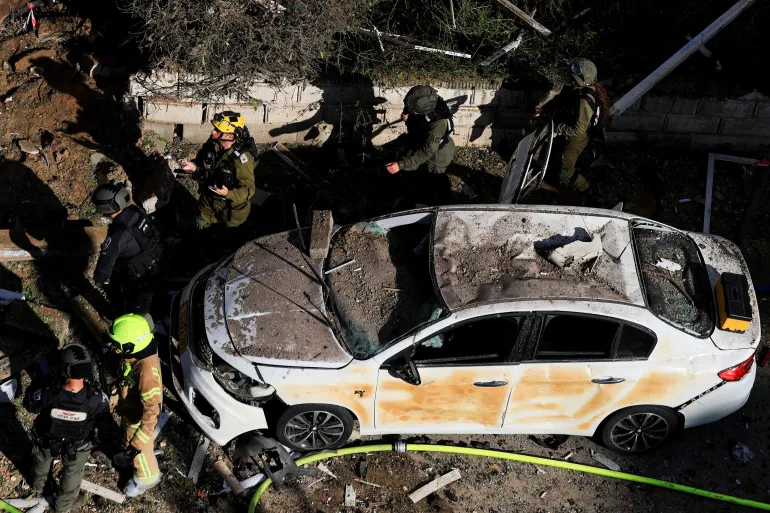
Emergency personnel work next to a damaged car at a site following Iranian missile barrages in central Israel, amid the US-Israel conflict with Iran, in Tel Aviv, Israel [Ronen Zvulun/Reuters]
Rising censorship
Across Israel, journalists and activists like Itamar describe a pervasive atmosphere of self-policing and censorship that, they say, has left people less informed about the consequences of the war than the citizens in Iran, whom many in their media encourage them to pity.
In a country largely unified against a threat that, for generations, politicians have told them is existential, criticism, dissent or opposition is, for the majority, beyond the pale.
This way of thinking is baked into Israeli society. The systems employed by the country’s military censor today to curtail media reporting predate the establishment of Israel in 1948.
Furthermore, new wartime restrictions on what can and cannot be broadcast of the Iranian missile barrages targeting Israel, where they land and what damage they have done – introduced on March 5 – mean these largely go entirely unreported, Israeli journalists say.
Reporting on the new media restrictions in mid-March, the Israeli magazine +972 documented one instance when journalists were permitted to report on debris that had hit an educational facility, but did not mention the actual strike by an Iranian missile, which had successfully hit its intended target nearby. Nor were they allowed to examine the site.
In another case reported by +972, journalists photographing damage to a residential block said they were approached by a man they believed to be linked to a security agency. He asked police to stop reporters from recording the real target of the attack, which was located behind them. The police officer replied that the journalists would not have noticed that site at all had it not been pointed out, since the visible destruction was concentrated on the civilian building.
The censorship, which had been growing more relaxed in recent years, had been tightened once more during the current war, Meron Rapoport, an editor at +972’s sister paper, Hebrew language Local Call, told Al Jazeera, “We don’t really know what is being or with what explosives,” he said, “The IDF [Israeli army] announcements always refer to strikes being on ‘uninhabited areas,’ which is peculiar, because there aren’t that many uninhabited areas in Tel Aviv. It’s a very compact city.”
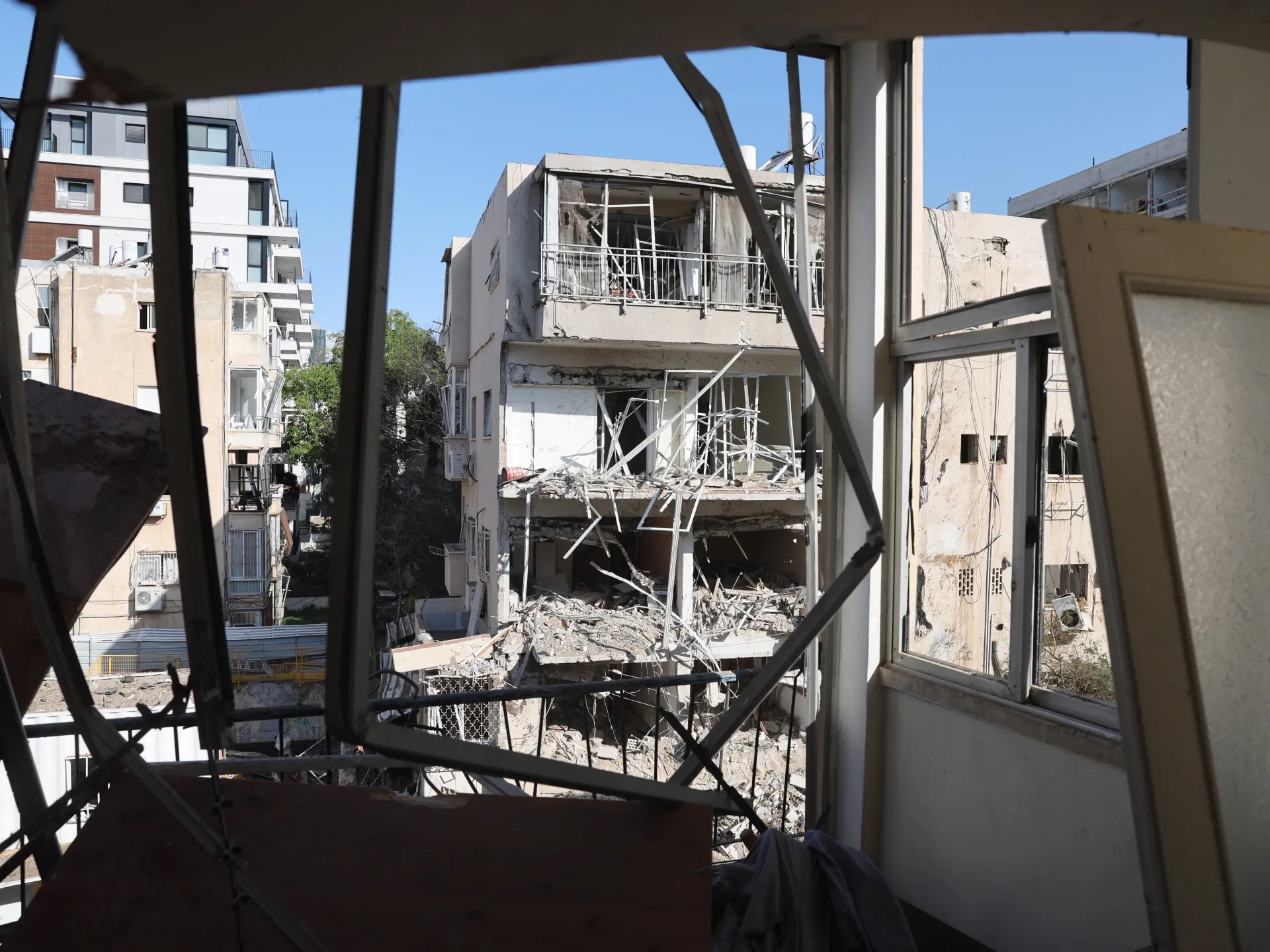
Indeed, Iran has launched multiple missiles at Tel Aviv, some of which have resulted in damage and injuries – either by the missiles themselves or by debris falling following interception. Most recently, on Tuesday, missiles triggered air raid sirens in the city, where gaping holes were ripped through a multistorey apartment building.
Israel’s Magen David Adom emergency medical service said: “Six people were lightly injured at four different sites.”
“It’s curious,” Rapoport says. “Israeli commentators are always saying how the Iranian public has no real idea how badly they’re being hit. The irony is that they probably have a better idea of how hard Israel is being hit than most Israelis.”
Iran has launched a round of missiles targeting Israel, causing damage and injuries in Tel Aviv, as uncertainty swirled over possible talks to end the three-week US-Israel war on Iran.
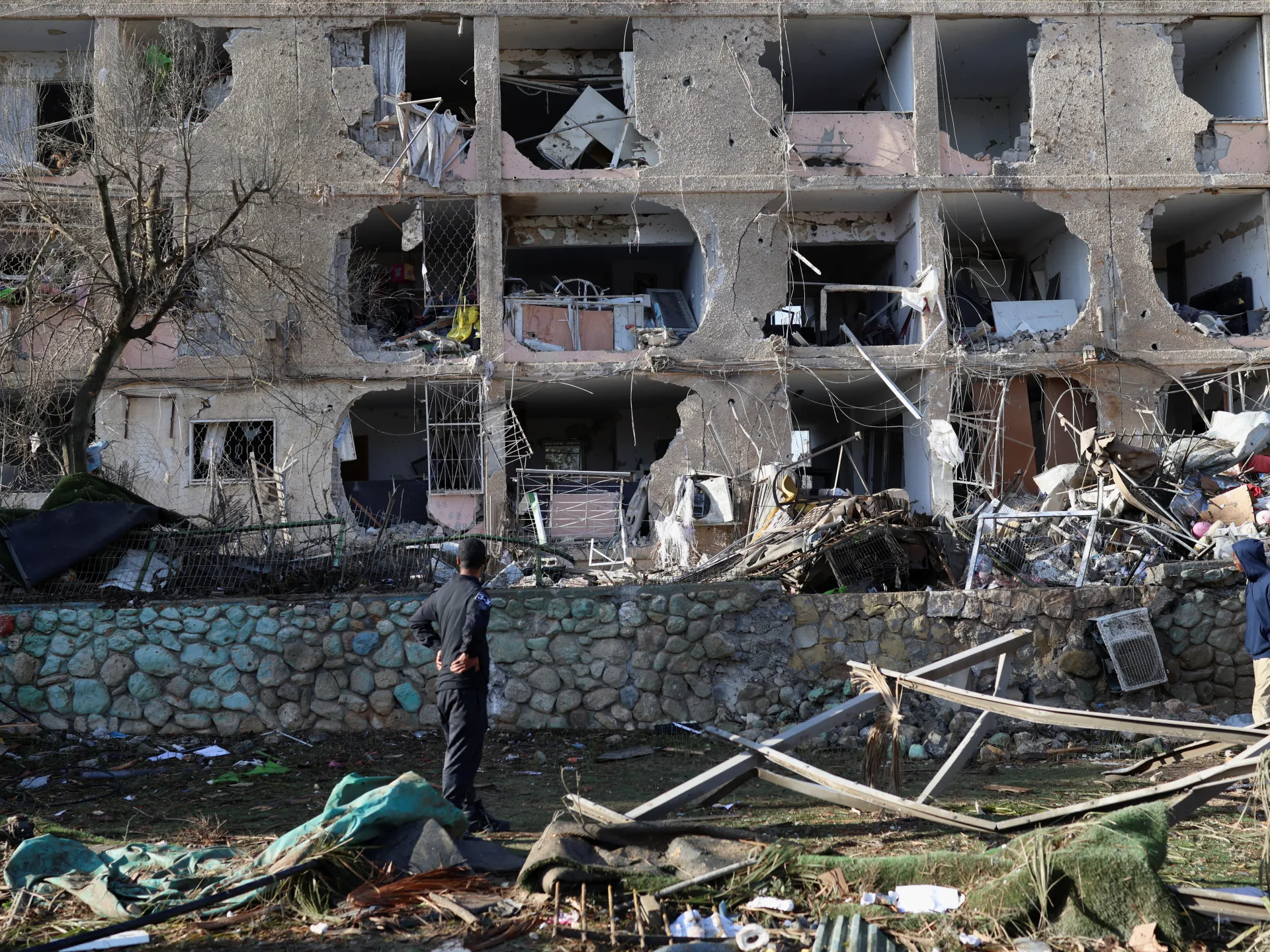
The missiles triggered air raid sirens in Israel on Tuesday, including in Tel Aviv, where gaping holes were torn through a multistorey apartment building. It was not immediately clear whether the damage was caused by a direct hit or debris from an interception.
Israel’s Magen David Adom emergency medical service said: “Six people were lightly injured at four different sites.”
Police in Tel Aviv said they were dealing with “several impact sites of munitions”.
Israel’s National Fire and Rescue Authority said the search was on for people trapped in one building in Tel Aviv, adding that civilians were found in a shelter in another damaged building.
Meanwhile, the Israeli military said on Tuesday that its jets carried out a wave of strikes in central Tehran on Monday, targeting key command centres, including facilities associated with the Islamic Revolutionary Guard Corps’ intelligence arm and the Iranian Intelligence Ministry. It said more than 50 additional targets were hit overnight, including ballistic missile storage and launch sites.
Iran’s Revolutionary Guard Corps calls Trump a ‘deceitful American president’, saying his ‘contradictory behaviour will not make us lose sight of the battlefront’.
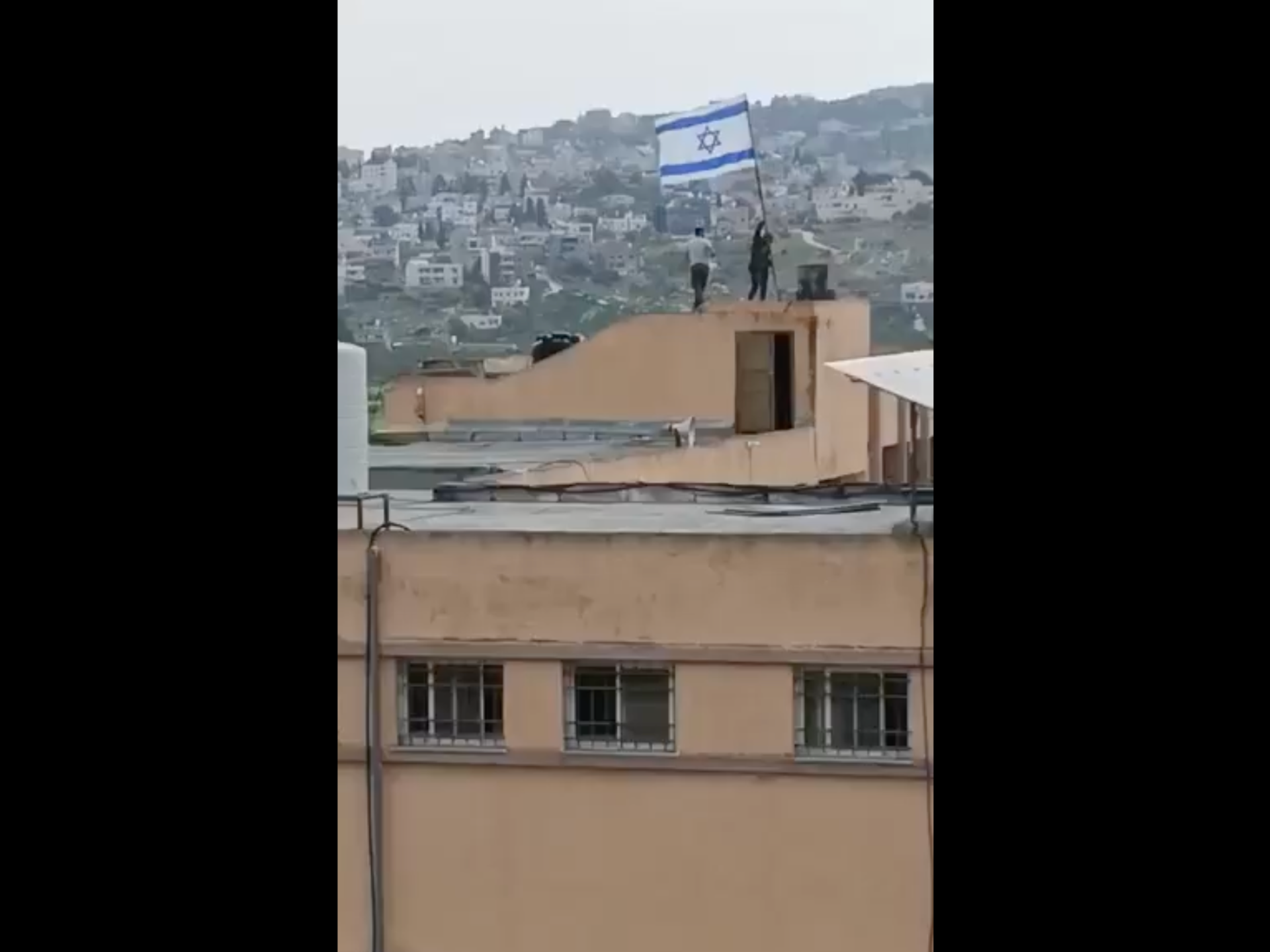
Israeli settlers have been filmed vandalising a boys’ school in Huwara, spray-painting racist graffiti and raising an Israeli flag on the roof. The attack comes as settler violence intensifies across the occupied West Bank with homes and cars set on fire, leaving at least nine Palestinians injured.
In the final hours of her life on January 29, 2024, Hind Rajab’s feeble voice could be heard desperately pleading with her mother and emergency workers for help, as she was trapped in a car surrounded by the bodies of six of her relatives.
After finally getting clearance from the Israeli military in Gaza City, a Red Crescent ambulance raced to save the five-year-old girl. But two paramedics were killed when their marked vehicle – whose sirens were blaring – came under Israeli tank fire. The remains of the nine victims were recovered 12 days later.
Recommended Stories
list of 4 itemsend of list
Two years after the tragedy, a report claims this was a “double tap” attack by the Israeli army. A double-tap strike essentially means carrying out two strikes on the same target, often wounding or killing medics and civilians who are coming to the aid of people harmed in the first attack.
Analysis by the legal campaign group Avaaz has found evidence that the killings contravened international combat law under the Geneva Conventions and the Rome Statute.
“By reconstructing the coordination and timing around the approved ambulance mission, it shows that there is substantial evidence of a deliberate ‘double-tap’ tactic – an initial military strike followed with a deliberately timed second strike targeting emergency responders and medical personnel who arrive to help,” Avaaz says in its report exclusively shared with Al Jazeera. “The brief brings together the timeline of events up to and beyond Hind’s death, showing what Israeli forces must have been aware of at each stage, and the frequent opportunities they had to pull back from murder.
“It documents over 40 human rights violations and ties together how those violations are evidence of a double-tap attack on the hospital workers. Each violation builds to an alarming possibility: Israel is not only killing Palestinians – it is systematically killing those who try to save them. The message is clear: If the medical community tries to help, it will be extinguished.”
More than 1,500 healthcare workers have been killed during Israel’s genocidal war on Gaza, including several since a so-called “ceasefire” came into effect in October.
Avaaz, building on previous investigations by Al Jazeera in partnership with the Hind Rajab Foundation and other media organisations, claims there is clear evidence that this double strike constituted a war crime. The campaign group is now urging the International Criminal Court (ICC) to bring those responsible to justice.
At the time of publishing, the Israeli military had not responded to Al Jazeera’s request for comment.
‘I am absolutely convinced that this is another case of double tap’
Al Jazeera, in partnership with the Hind Rajab Foundation, last year revealed evidence of deliberate killings.
The Israeli government initially claimed that none of its forces was present at the time, later asserting that the 335 bullet holes found in the family’s car were the result of an exchange of fire between Israeli soldiers and Palestinian fighters.
However, a subsequent investigation of satellite imagery and audio from that day by the multidisciplinary research group Forensic Architecture, based at Goldsmiths, the University of London, identified only the presence of several Israeli Merkava tanks in the vicinity of the family’s car and no evidence of any exchange of fire.
The Avaaz report highlights that the ambulance obtained permission from COGAT, an arm of the Israeli military, to go to Hind’s aid, so Israeli forces knew exactly when the first responders would arrive and the route they would take. About three hours passed between the initial shooting of the family vehicle and the attack on the ambulance, indicating the Israeli army had ample opportunity for “situational awareness, communication, and command decision-making”, the report adds.
Avaaz says the ambulance was attacked by a tank in a way that could not have been a warning shot if the military had any reason to believe it was not there to rescue Hind. Instead, the assault “points to lethal targeting”.
The Israeli army gave no warning before attacking the ambulance, previous investigations have found.
“I have taken the investigations done by a number of independent journalistic outfits. I was really struck by the evidence at the end of the whole horrendous incident,” said Sarah Andrew, legal director of Avaaz, who added that as a mother, Hind’s death made her think of her own daughter. “In particular, the kind of weaponry that was used on the ambulance, the timing and the fact that no warning was given – it immediately triggered a question in my mind, and I am absolutely convinced that this is another case of double tap.”
She told Al Jazeera: “It is something that has not had attention, and we would like to take this with [an independent legal] partner to the ICC.”
“What I have done is establish a legal framework for the previous investigation. I think it is very important that we also look at what happened to the ambulance workers as well as what happened to Hind and her family.”
The report says, “Even where an attacking force claims it suspects misuse of a medical vehicle, international humanitarian law requires warnings and an opportunity to comply before an attack can be lawful.”
Andrew said the Israeli military has yet to explain why a tank fired on an ambulance.
“We have not heard from the people responsible. I want them to appear before the ICC and hear what on earth was in their mind when they ordered 120mm tank rounds to be fired into an ambulance,” she said. “Justice is first of all bringing the light of attention into this crime and secondly seeing the persons responsible being accountable for their actions.”
Professor James Sweeney, from the University of Lancaster, who is an expert on human rights and conflict, said in double-tap attacks, the second strike is usually within five to 10 minutes.
It can also mean letting off a small explosion to induce rescuers to respond, then exploding another bomb once they are near.
“The [Avaaz] brief says that the attack on the ambulance should be considered a double tap, but usually the second attack would be within five to 20 minutes and would be considered a trick,” he told Al Jazeera. “It would seem that [in this case] the passage of time was greater, but that does not take anything away from the fact that the attack on the ambulance was so unlawful. You could see it as a form of double-tap, but it is not my normal understanding of it. But in any case, it does not take away from the fact that these were war crimes.”
The Hind Rajab Foundation said in a statement, “The double tap arguments are consistent with our analysis as well. We are continuously preparing for new filings against responsible soldiers in various jurisdictions.
“We have 24 names of responsible perpetrators. We are open to work together with Avaaz on a filing specifically regarding the attack on the ambulance.”
The violence comes as Israel continues its push to expand control over Palestinian territories in violation of international law.
Published On 23 Mar 202623 Mar 2026
At least nine Palestinians have been injured as Israeli settlers rampaged through towns and villages in the occupied West Bank for a second night in a row.
A 45-year-old man was shot in the foot late on Sunday during a confrontation with Israeli settlers in Deir al-Hatab, east of Nablus, the Wafa news agency reported.
Recommended Stories
list of 3 itemsend of list
The Palestinian Red Crescent reported that a 47-year-old Palestinian man was attacked by settlers in Jabal al-Arma in Beita, while others were beaten.
Earlier, Israeli settlers set fire to homes and cars in two areas south of Jenin and vandalised property across the occupied West Bank.
Simultaneous attacks took place on Saturday night in at least six communities, including the villages of Silat al Dahr and Fandaqumiya, both near Jenin; in Jalud and Salfit, both south of Nablus; and in the agricultural regions Masafer Yatta and the Jordan Valley.
The Palestinian news agency reported that homes and cars were set ablaze, Palestinians were pepper-sprayed and at least five people were wounded in the assaults, which took place during the Eid al-Fitr holiday marking the end of Ramadan.
Sunday night’s attacks came after Israeli settlers in the settlement of Elon Moreh held a funeral for 18-year-old Yehuda Sherman, who was killed in a collision with a Palestinian vehicle in an area north of the villages attacked.
Israeli police said they were investigating the settlers’ claims that the collision was deliberate.
Israel’s government is pressing ahead with new settlements in the occupied West Bank as attention shifts to the Iran war.
According to the United Nations Office for the Coordination of Humanitarian Affairs, 25 Palestinians have been killed by Israeli settlers and soldiers so far this year.
Israel’s security cabinet last month ratified a series of decisions pushed by Finance Minister Bezalel Smotrich and Defence Minister Israel Katz, enabling Israel to claim large areas of the occupied West Bank as “state property” if Palestinians cannot prove ownership.
The Palestinian presidency condemned the decision in a statement, calling it a “grave escalation and a flagrant violation of international law” that amounts to “de facto annexation”.
Amnesty International said the expansion of illegal settlements and state-backed settler violence in the occupied Palestinian territories were “a direct indictment of the international community’s catastrophic failure to take decisive action.”
The International Court of Justice (ICJ) ruled in 2024 that Israel’s continued presence in the occupied Palestinian territory is unlawful and should come to an end “as rapidly as possible”.
The judges pointed to a wide list of policies – including the building and expansion of Israeli settlements in the West Bank and East Jerusalem, use of the area’s natural resources, the annexation and imposition of permanent control over lands and discriminatory policies against Palestinians – all of which it said violated international law.
Asian stock markets saw major declines on Monday as gold futures dropped 8% and crude oil prices continued to climb amid heightened uncertainty in the Middle East.
ADVERTISEMENT
ADVERTISEMENT
As the effective closure of the Strait of Hormuz continues to choke global supply, benchmark US crude rose above $100 a barrel on Monday morning in Europe.
Brent crude, the international standard, went up to more than $113 a barrel. The price of Brent crude has zigzagged lately from about $70 per barrel before the war began to as high as $119.50.
European stock indexes opened with losses, with the FTSE in London losing 1.5%, the CAC-40 in Paris being down by 1.6%, and the DAX in Frankfurt dropping by 2% at the opening.
Earlier on Monday, the International Energy Agency warned that the global economy faces a “major, major threat” because of the Iran war and that at least 40 energy assets across nine countries were damaged.
Meanwhile, the de-escalation of the conflict is nowhere near in sight.
Trump warned over the weekend that the US would “obliterate” Iran’s power plants if it does not fully open the Strait of Hormuz within 48 hours, prompting Tehran to say it would respond to any such strike with attacks on US and Israeli energy and infrastructure assets in the region.
“Trump’s ultimatum and Iran’s retaliatory warnings point to a widening conflict that keeps energy disruption and market volatility elevated, with no clear off-ramp in sight,” said Ng Jing Wen, analyst at Mizuho Bank in Singapore.
In Europe, the benchmark natural gas futures were trading above €60 per MWh at the market open.
This follows last week’s gains as escalating threats to Middle Eastern energy facilities heightened fears of deeper supply disruptions.
In Asia, stock markets were also significantly impacted by the uncertainty around the Middle East crisis, with Japan’s benchmark Nikkei 225 dropping 3.5%. In Taiwan, the Taiex shed 2.5%, South Korea’s Kospi dropped 6.5%, Hong Kong’s Hang Seng slipped 3.8% and the Shanghai Composite declined 3.6%.
Higher oil prices, which also shook stock markets on Friday, dashed hopes for a possible upcoming cut in interest rates by the Federal Reserve, analysts said. Before the war, traders were betting that the Fed would cut rates at least twice this year. Central banks in Europe, Japan and the United Kingdom also recently held their interest rates steady.
The S&P 500 fell 1.5% Friday to close its fourth straight losing week, its longest such streak in a year.
The Dow Jones Industrial Average dropped 443 points, or 1%, and the Nasdaq Composite tumbled 2%.
On Wall Street, roughly three out of every four stocks in the S&P 500 fell on Friday.
Stocks of smaller companies, which can feel the pinch of higher interest rates more than their bigger rivals, led the way lower. The Russell 2000 index of smaller stocks fell a market-leading 2.3%.
In the bond market, the yield on the 10-year Treasury finished last week with a jump to 4.38% Friday from 4.25% late Thursday and from just 3.97% before the war started.
The two-year Treasury yield, which more closely tracks expectations for what the Fed might do, rose to 3.88% from 3.79%.
In currency trading, the US dollar rose to 159.53 Japanese yen from 159.22 yen. The euro cost $1.1526, down from $1.1571.
US President Trump, who cut off oil supplies to Cuba after abducting Venezuela’s President Maduro, has threatened to take over the island-nation.
Published On 22 Mar 202622 Mar 2026
The Cuban government has said it is prepared for any potential United States attacks as the island-nation begins to recover from yet another blackout under a punishing oil blockade imposed by Washington that has pushed its economy to the brink.
Deputy Foreign Minister Carlos Fernandez de Cossio responded on Sunday to US President Donald Trump’s threats this week to take over Cuba, insisting that it had “historically been ready to mobilise as a nation for military aggression”.
Recommended Stories
list of 3 itemsend of list
“We don’t believe it is something that is probable, but we would be naive if we do not prepare,” de Cossio told NBC’s Meet the Press.
His comments were aired a day after the latest collapse of the country’s ageing nationwide grid that had left millions of people in the dark. Saturday’s outage was the second in the past week and the third in March.
The state-run Electric Union and the Ministry of Energy and Mines said some 72,000 customers in the capital, Havana, including five hospitals, had electricity again early on Sunday. But the number represented only a fraction of Havana’s total population of approximately two million.
The Cuban Electric Union, which reports to the Ministry of Energy and Mines, said the total disconnection of the national system was caused by an unexpected shutdown of a generation unit at the Nuevitas thermoelectric plant in Camaguey province, without providing details on the specific cause of the failure.
People gather in the dark during a blackout in Havana, Cuba, on March 21, 2026 [Ramon Espinosa/AP Photo]
Trump, who started blocking oil from reaching the island after abducting Cuba’s ally, Venezuelan President Nicolas Maduro, early this year, has warned potential oil exporters that they could face high tariffs.
According to President Miguel Diaz-Canel, Cuba has not received oil from foreign suppliers for three months. The country produces barely 40 percent of the fuel it needs to power its economy.
On March 16, Trump escalated his rhetoric against Cuba, arguing the leadership was on the verge of collapse and saying he expected to have the “honour” of taking the country.
De Cossio denied that the nature, structure, or makeup of the Cuban government was up for negotiation in what Havana has called a “serious and responsible” dialogue with Washington launched earlier this month. He added that a change of the ruling system was “absolutely” off the table in discussions.
This week, General Francis Donovan, head of the US Southern Command overseeing armed forces in Latin America, told lawmakers at a US Senate hearing on Trump’s military action in the region that troops were not rehearsing for an invasion of Cuba or actively preparing to take over the Communist-run island.
But, he added, the US stood ready to address any threats to the US embassy, to defend its base at Guantanamo Bay, and aid US government efforts to address any mass migration from the island, if needed.
The Cuban government reportedly refused a request by the embassy in Havana to allow it to import diesel for its generators in response to the oil blockade, The Associated Press reported on Saturday, citing two US officials.
As the United States-Israeli war on Iran enters its fourth week, the conflict seems to have escalated beyond President Donald Trump’s control.
The Iranian government has been able to endure the killings of its top political and military leaders and has launched retaliatory attacks on Israel and Gulf countries despite weeks of air strikes.
Recommended Stories
list of 4 itemsend of list
Tehran has also been able to impose a de facto blockade of the Strait of Hormuz, a narrow waterway through which a fifth of the world’s oil and liquefied natural gas supplies pass, sending oil prices soaring. Analysts said the conflict risks unleashing a global recession. And that has put pressure on Trump, prompting his administration to allow the sale of sanctioned Russian oil to try to ease the energy crisis and pressure allies to police the strait, so far unsuccessfully.
Trump’s response in how to deal with the situation has been anything but coherent.
On Saturday, Trump upped the ante, issuing a threat to “obliterate” Iran’s power plants if Tehran does not reopen the Strait of Hormuz within 48 hours. This came a day after he said the US was “winding down” its military operations in Iran.
Analysts said Trump launched the war without a clear goal and misjudged how Tehran would respond. The conflict has expanded across the Middle East.
So is Trump looking to exit the war – or escalate it?
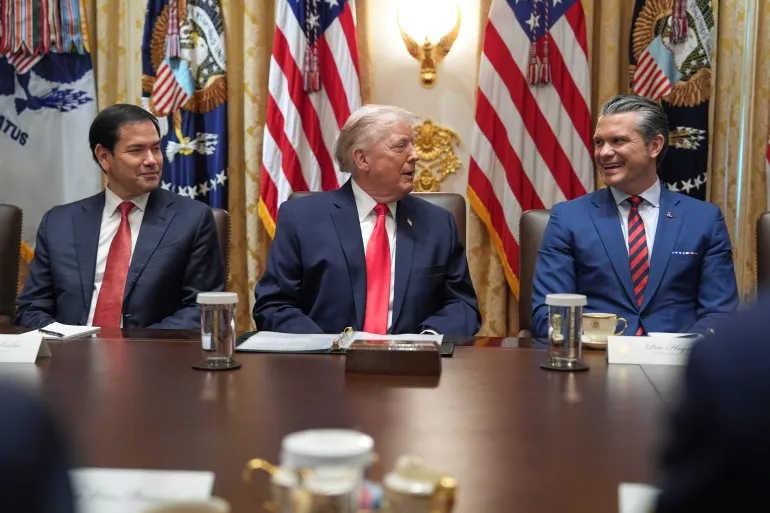
From left, US Secretary of State Marco Rubio, President Donald Trump and Defense Secretary Pete Hegseth attend a cabinet meeting at the White House [File: Evan Vucci/AP]
Trump’s mixed messaging on the Iran war
Here’s a brief look at the changing statements from Washington:
Is the war winding up or widening?
While one statement from Trump signalled that the US is considering “winding down” the war on Iran, another one indicated that the conflict would widen in the coming days.
On Saturday, Trump posted on his Truth Social platform that Washington was “very close to meeting our objectives as we consider winding down our great Military efforts in the Middle East with respect to the Terrorist Regime of Iran”.
Trump listed the goals of the war as: completely degrading Iran’s missile capability, destroying its defence industrial base, eliminating the Iranian navy and air force, never allowing Iran to get even close to having nuclear weapons, protecting Middle Eastern allies, and guarding and policing the Strait of Hormuz.
Both Trump and Israeli Prime Minister Benjamin Netanyahu have claimed repeatedly in the past few days that Iranian military capabilities have been “completely destroyed” even as Tehran continues to retaliate against Israel and strike countries in the region.
US military officials said they have carried out heavy bombardments of Iran’s coast, including with bunker buster bombs, but still have not been able to limit Tehran’s capacity to disrupt the Strait of Hormuz.
On Saturday, Trump said the US “has blown Iran off of the map” and insisted that he has “met my own goals … and weeks ahead of schedule!” He also reiterated that Iran’s “leadership is gone, their navy and air force are dead, they have absolutely no defense, and they want to make a deal”.
Iranian leaders have consistently denied reaching out to the US with a ceasefire offer.
Just an hour later, Trump returned to his Truth Social platform with a warning for Iran.
“If Iran doesn’t FULLY OPEN, WITHOUT THREAT, the Strait of Hormuz, within 48 HOURS from this exact point in time, the United States of America will hit and obliterate their various POWER PLANTS, STARTING WITH THE BIGGEST ONE FIRST!” Trump wrote.
Iran has since responded by saying it will hit energy sites across the Middle East if its power facilities are targeted. It has already fired hundreds of missiles and drones on Gulf countries, targeting US assets as well as energy facilities.
Between Trump’s claims to be “winding down” operations and upping the ante later, his administration announced it is sending three more warships to the Middle East with about 2,500 additional Marines.
The US military said about 50,000 military personnel are already deployed for the war against Iran.
(Al Jazeera)
When will the war on Iran end?
That has been among the foremost questions posed to US officials, including Trump, since the war on Iran was launched on February 28.
The next day, Trump told the Daily Mail that “it will be four weeks or so. It’s always been about a four-week process.” A day later, Trump said at the White House: “We projected four to five weeks, but we have capability to go far longer than that.”
On March 8, Defense Secretary Pete Hegseth told the CBS TV network’s 60 Minutes programme: “This is only just the beginning.” The next day, the US president told the same channel that he thinks “the war is very complete, pretty much.” And the US military operation was “way ahead of schedule”.
Then, on March 9, Trump said one could say the war is “both complete and just beginning”. Later the same day, the president said: “We’ve already won in many ways, but we haven’t won enough” and promised to go further and harsher against Iran.
On March 11, Trump said: “We don’t want to leave early, do we? We’ve got to finish the job.”
Why did US and Israel launch strikes on Iran?
Responses to this question are perhaps the most telling about US posturing in the war against Iran.
On March 2, Hegseth said the attacks were aimed at ending “47 long years” of war by “the expansionist and Islamist regime in Tehran” and were launched because Iran refused to negotiate with the US.
Hours later, Marco Rubio, the secretary of state, told reporters the US knew Israel was about to strike Iran, adding that the Trump administration believed the US needed to launch a pre-emptive strike before Iran’s retaliation potentially targeted US forces. “We went proactively in a defensive way to prevent them from inflicting higher damage,” he said.
This sparked a massive row in Washington with critics saying Israel had forced the US into war with Iran. Soon Trump rebutted his top diplomat, saying: “They [Iran] were going to attack. If we didn’t do it, they were going to attack first. … So if anything, I might have forced Israel’s hand.”
The next day, the White House press secretary, Karoline Leavitt, concluded that Trump just had a “good feeling” that Iran would strike so Washington attacked Tehran.
The launch of the war came as Washington and Tehran were scheduled to meet for another round of talks that were started late last year. Before the war, their Omani mediator said a deal was “within reach”.
The US and Israeli assertion that Tehran was on the verge of making a nuclear bomb has not been backed up by the United Nations nuclear watchdog. Last week, US Director of National Intelligence Tulsi Gabbard also told Congress that Iran was not in a position to make an atomic bomb.
Some analysts said the Trump administration was convinced to go to war by Netanyahu, who has been seeking US military intervention in Iran for decades. They said Trump was buoyed by a swift US military operation in Venezuela and did not think through Iran’s strengths before going into the war. In January, the US military abducted President Nicolas Maduro in a military operation in Caracas that took two and a half hours.
US President Donald Trump, left, greets Israeli Prime Minister Benjamin Netanyahu at the White House on September 29, 2025, on the fourth of his six visits to the US during Trump’s second term, which began in January 2025 [Alex Brandon/AP]
What does the conflicting messaging mean for US strategy?
Analysts said the moving goalposts in the Iran war show the policy limits of the current Trump administration as well as its strategy, to some extent, of keeping off-ramps available.
Zeidon Alkinani, a Middle East analyst at the Arab Perspectives Institute, told Al Jazeera that in the earlier days of the hostilities, there appeared to be clearer targets and limited objectives.
“There now seems to be a more chaotic reaction,” he said. He described the attacks as increasingly reciprocal, suggesting strikes on oil or energy facilities could prompt further escalation.
Last week, Iran attacked energy facilities in Qatar and caused “significant damage”, knocking out 17 percent of Qatar’s liquefied natural gas (LNG) export capacity. Qatar produces 20 percent of global LNG supplies. Iran said the attack was in retaliation for Israeli attacks on a gas plant.
Paolo von Schirach, president of the Global Policy Institute, told Al Jazeera that Trump changes his mind “very quickly” and it is hard to predict what his next step could be in the war on Iran.
The analyst said it was unclear to him what “tools” Trump has to end the war.
“We look at his message saying the war is winding down. OK, good. Things are quiet. Maybe there is an off-ramp somehow. But now he says that if the Iranians don’t open the Strait of Hormuz, then we [the US] are going to unleash hell and what have you,” von Schirach noted.
“It is not quite clear to me what he wants and what the tools are to accomplish this.”
Von Schirach added that it would be difficult to predict whether the US could force Iran into submission, given its size and population. Using as a reference Iraq, where 150,000 American soldiers were deployed during the Second Gulf War, the analyst predicted that the US might need as many as half a million soldiers if Trump “wants to take over Iran”.
Iranian missiles struck two communities in southern Israel, leaving buildings shattered and dozens injured in dual attacks not far from Israel’s main nuclear research centre.
The Iranian strikes late on Saturday came after Tehran’s main nuclear enrichment facility at Natanz was hit earlier in the day. Israel denied responsibility for the strike on Natanz, nearly 220km (135 miles) southeast of Tehran.
The Pentagon declined to comment on the strike on Natanz, which was also hit during the first week of the war and the 12-day war last June. Russian Ministry of Foreign Affairs spokesperson Maria Zakharova said such strikes posed a “real risk of catastrophic disaster throughout the Middle East”.
Iran retaliated hours later.
Israel’s military said it was not able to intercept missiles that hit the southern cities of Dimona and Arad, the largest near the centre in Israel’s sparsely populated Negev desert. It was the first time Iranian missiles had penetrated Israel’s air defence systems in the area around the nuclear site.
The Israeli Ministry of Health said at least 180 people were wounded in the missile attacks on the southern city of Dimona and nearby Arad.
Dimona is about 20km (12 miles) west of the nuclear research centre, and Arad is around 35km (22 miles) to the north.
Israel is believed to be the only Middle East nation with nuclear weapons, though its leaders refuse to confirm or deny their existence. The UN nuclear watchdog said on X it had not received reports of damage to the Israeli centre or abnormal radiation levels.
US President Donald Trump has threatened to ‘obliterate’ Iran’s power plants if Tehran fails to open the Strait of Hormuz to all vessels within 48 hours. This major escalation comes as Trump faces pressure over skyrocketing domestic energy prices due to the now three-week-long war.
Brazilian President Luiz Inacio Lula da Silva has criticised what he called the return of a colonial approach towards developing nations during a summit in Colombia.
But while Lula did not mention United States President Donald Trump in his remarks, he gestured at actions undertaken by the Trump administration, including the January 3 abduction of Venezuelan leader Nicolas Maduro and the fuel blockade in Cuba.
Recommended Stories
list of 3 itemsend of list
“It’s not possible for someone to think that they own other countries,” Lula said, in an apparent reference to US policy.
“What are they doing with Cuba now? What did they do with Venezuela? Is that democratic?”
Lula delivered his remarks at Saturday’s summit for the Community of Latin American and Caribbean States (CELAC), which featured a high-level forum with delegates from Africa.
He told delegates that their countries had already experienced being plundered for gold, silver, diamonds and minerals.
“After taking everything we had, now they want to own the critical minerals and rare earths that we have,” Lula said, without specifying who “they” might be. “They want to colonise us again.”
The left-wing Brazilian president also criticised the ongoing war launched by the US and Israel against Iran.
He drew a parallel between that conflict, which began on February 28, and the US-led Iraq war, which began in 2003 on the pretext of eliminating “weapons of mass destruction”.
“Iran has been invaded under the pretext that Iran was building a nuclear bomb,” Lula said, before pivoting to the US campaign in Iraq, which resulted in the overthrow of Iraqi leader Saddam Hussein.
“Where are Saddam Hussein’s chemical weapons?” Lula asked. “Where are they? Who found them?”
A history of intervention
Washington’s history of intervention in Latin America goes back more than 200 years to when then-President James Monroe claimed the hemisphere as part of the US sphere of influence.
While large-scale, overt US involvement in the region mostly petered out after the Cold War, Trump has rekindled the legacy.
Since assuming office last year, Trump has launched boat strikes against alleged drug traffickers in the Caribbean, ordered a naval blockade on Venezuelan oil exports, and gotten involved in electoral politics in Honduras and Argentina.
Trump imposed a 50 percent tariff on Brazilian goods last year, citing the trial against the country’s former president, Jair Bolsonaro, as a motive. The US has also shown keen interest in Brazil’s rare earth deposits.
Then, on January 3, US forces abducted and imprisoned Venezuelan leader Nicolas Maduro, flying him to New York to face drug and weapons charges.
While such actions have thrilled right-wing leaders across the continent, they have raised fears among left-wing politicians, who have voiced grave concerns over what they see as US bullying.
“We cannot allow anyone to interfere and violate the territorial integrity of each country,” Lula said Saturday.
Frustration with the UN
Lula, who has said he will run for a fourth, nonconsecutive term in Brazil’s upcoming October elections, also criticised the United Nations for its inability to stop multiple conflicts around the world.
“What we are witnessing is the total and absolute failure of the United Nations,” he said, pointing to the situations in Gaza, Ukraine and Iran.
He called, once again, for reform of the UN Security Council, which is mandated with ensuring international peace and security. But it has failed to stop major conflicts because of the veto power of its five permanent members: China, France, Russia, the United Kingdom and the United States.
There have been decades of efforts to reform the Security Council. But they have all been unsuccessful.
Colombian President Gustavo Petro, whom the US Drug Enforcement Administration has designated a “priority target”, echoed Lula’s condemnation of the UN.
The body “is acting in impotence, and that is not what it was created for. It was created after World War II precisely to prevent wars. And yet, what we have today is war,” Petro said at the summit.
But the world needs the UN to provide climate solutions and curb global warming, Petro said.
“The more serious humanity’s problems become, the fewer tools we have for collective action. And that path leads only to barbarism.”
Relatively few presidents and prime ministers from Latin America and the Caribbean attended the summit in Colombia, a sign of the continent’s deep divisions.
Those present included the presidents of Brazil, Uruguay, Burundi and Colombia, as well as the prime ministers of Guyana and Saint Vincent and the Grenadines, along with deputy ministers, foreign ministers and ambassadors.
An Iranian missile has struck the southern Israeli cities of Dimona, home to the country’s main nuclear facility, and nearby Arad, wounding dozens of people and causing significant damage, in one of the most dramatic escalations since the US-Israel war on Iran began.
Iranian state television quickly reframed Saturday’s strikes as a “response” to what it said was a strike on Iran’s Natanz nuclear enrichment complex earlier in the day, marking a stark new phase of tit-for-tat targeting in the conflict, now in its fourth week.
Recommended Stories
list of 2 itemsend of list
Nearly 100 people were wounded in the attacks, according to Israel’s emergency services, including a 10-year-old boy who paramedics said was in critical condition with multiple shrapnel wounds. Seven others are also in critical condition.
An Israeli military spokesman said Israel’s air defence systems activated during the attacks, but failed to intercept some of the missiles, even though they were not “special or unfamiliar”.
The country’s Prime Minister Benjamin Netanyahu, addressing the attacks which wounded nearly 100 people, called it a “difficult” evening for Israel, and again vowed to continue attacking Iran.
The International Atomic Energy Agency (IAEA) said it had received no indication of damage to the Shimon Peres Negev Nuclear Research Center at Dimona itself, and that no abnormal radiation levels had been detected in the area.
The nuclear watchdog said it was closely monitoring the situation, with Director General Rafael Grossi urging that “maximum military restraint should be observed, in particular in the vicinity of nuclear facilities”.
Al Jazeera’s Nour Odeh, reporting from Ramallah in the occupied West Bank, said that three separate impact sites had been identified across Dimona, with one three-storey building having completely collapsed and several fires breaking out.
Witness footage verified by Al Jazeera, which is banned from operating inside Israel, showed a missile striking the city, followed by a large explosion.
Arad, another town near the nuclear facility, was also directly attacked, Israel’s firefighting service said in a statement, with extensive damage reported in the city centre.
“In both Dimona and Arad, interceptors were launched that failed to hit the threats, resulting in two direct hits by ballistic missiles with warheads weighing hundreds of kilograms”, firefighters said.
School in the surrounding Ramat Negev Regional Council was cancelled for the following day.
Earlier on Saturday, the Israeli military announced it had struck a research and development facility at Tehran’s Malek Ashtar University, which it said had been used to develop components for nuclear weapons and ballistic missiles.
The military said it “will not allow the Iranian regime to acquire nuclear weapons”.
Iran said that the US and Israel had targeted its Natanz enrichment complex that morning, though it reported no radioactive leakage.
An unnamed Israeli official, quoted by the Associated Press news agency, denied that Israel was responsible for the Natanz strike, but the Israeli army has not released a full statement on the matter.
Dimona has been at the heart of Israel’s nuclear programme since its research centre, built in secret with French assistance, opened there in 1958.
Eye-for-an-eye approach
Israel is believed to have developed nuclear weapons by the late 1960s. Its policy of deliberate ambiguity, neither confirming nor denying their existence, was part of a deal quietly struck with Washington, which judged that an open declaration would risk triggering a regional arms race.
Abas Aslani, a senior fellow at the Centre for Middle East Strategic Studies in Tehran, told Al Jazeera that Iran has been pursuing an eye-for-an-eye approach designed to re-establish deterrence.
“Tehran wants to reduce the gap between words and actions,” he said, adding that Iran’s goal was to make its threats credible enough to underpin a new long-term security arrangement, not to simply force a ceasefire, but establish deterrence.
The attacks came as the broader war grinds through its fourth week.
More than 1,400 people have been killed in Iran since the US and Israeli strikes began on February 28, including more than 200 children.
Iran has retaliated across the region, launching what it described as its 70th wave of attacks on Saturday, targeting Israeli and US military positions, as millions of Iranians marked the Persian New Year, Newroz, and Eid al-Fitr under the shadow of war.
Day of intense hardship as mothers mourn children lost in war and children face day without their mothers.
While much of the Middle East celebrated Mother’s Day with flowers and gifts this weekend, in Gaza, the occasion served as a painful reminder of precious lives lost.
Sitting in her tent in Gaza City on Saturday, Em Rami Dawwas remembered the three sons she lost in Israeli attacks, two of whose bodies are still being withheld by the authorities.
Recommended Stories
list of 3 itemsend of list
“I miss my sons on Mother’s Day. They used to bring me gifts, flowers, sweets, and ask me about my needs. They were the light of my life,” she said, sitting among boxes filled with their clothes, which she cannot bring herself to throw away.
Palestinian children have borne the brunt of Israel’s genocidal war on Gaza that began in October 2023, with UNICEF estimating in October last year that 64,000 children have been killed and wounded in Israeli attacks.
Reporting from among the tents in Gaza City, Al Jazeera’s Hind Khoudary said Dawwas kept the photos of her sons under her pillow, looking at them every day, “as if holding on will keep their memory alive”.
Many mothers spend the day in graveyards, sitting in the only place they can feel close to their dead children, said Khoudary.
‘I just wanted to make her happy’
Maram Ahmed faced a second Mother’s Day without her mother, who she lost in an Israeli air attack that killed her entire family. Her mother was her closest friend, said Khoudary.
“On Mother’s Day, even if I didn’t have money, I would buy my mum a gift from my allowance, even if it was for less than a dollar. I just wanted to make her happy,” said the 14-year-old, sitting in her sparse tent.
“I feel so sad when I see other children with their mothers, but I don’t show it,” she said.
A report published by rights group Amnesty International this month highlighted the “brutal price” women and girls have paid during the war, which started in October 2023. Two years later, Israel and the Palestinian group Hamas agreed to a fragile “ceasefire” that the former has repeatedly violated.
“Amid Israel’s deliberate imposition of conditions of life calculated to bring about the physical destruction of Palestinians in Gaza, Palestinian women face compounded and life-threatening consequences,” said the report.
It cited ongoing mass displacement, the collapse of reproductive, maternal and neonatal healthcare, the interruption of treatment for chronic illness, heightened exposure to disease and unsafe and undignified living conditions faced by women, as well as “profound physical and mental harm”.
Since the October 2025 “ceasefire”, Israeli attacks have killed more than 650 Palestinians, many of them women and children, according to recent figures from the Ministry of Health.
Overall, Israeli attacks have killed more than 72,000 people since the start of the war.
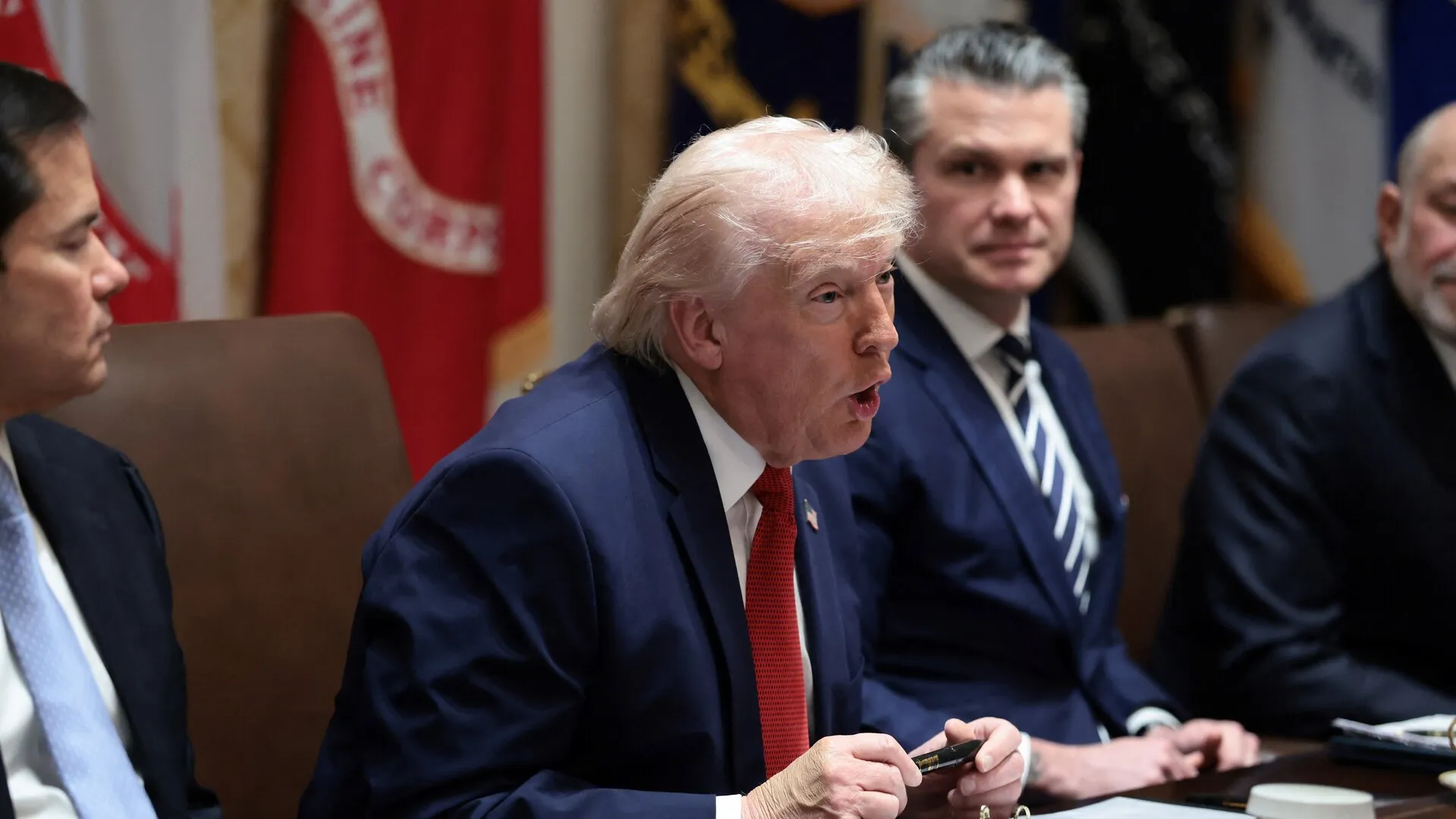
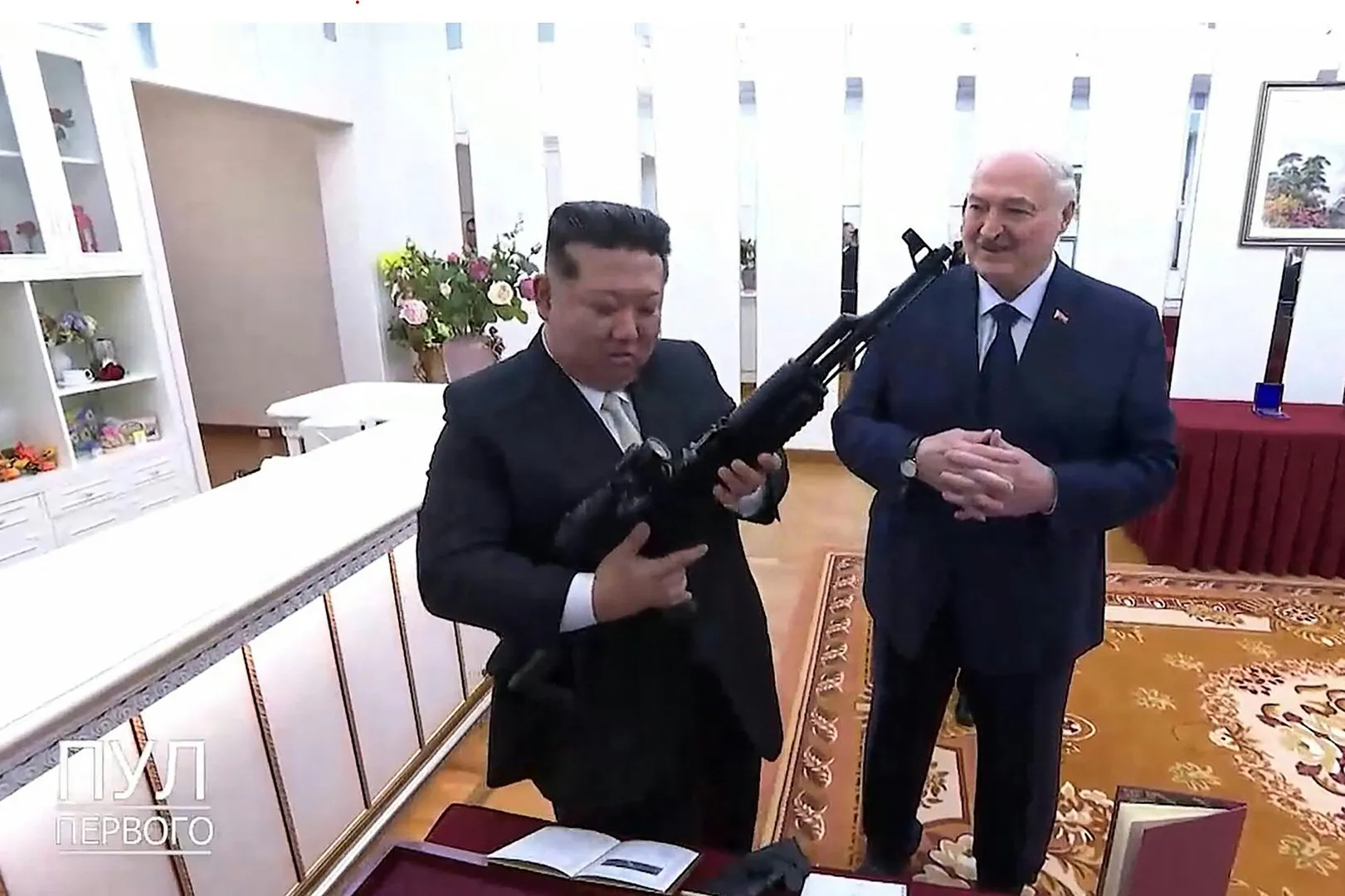
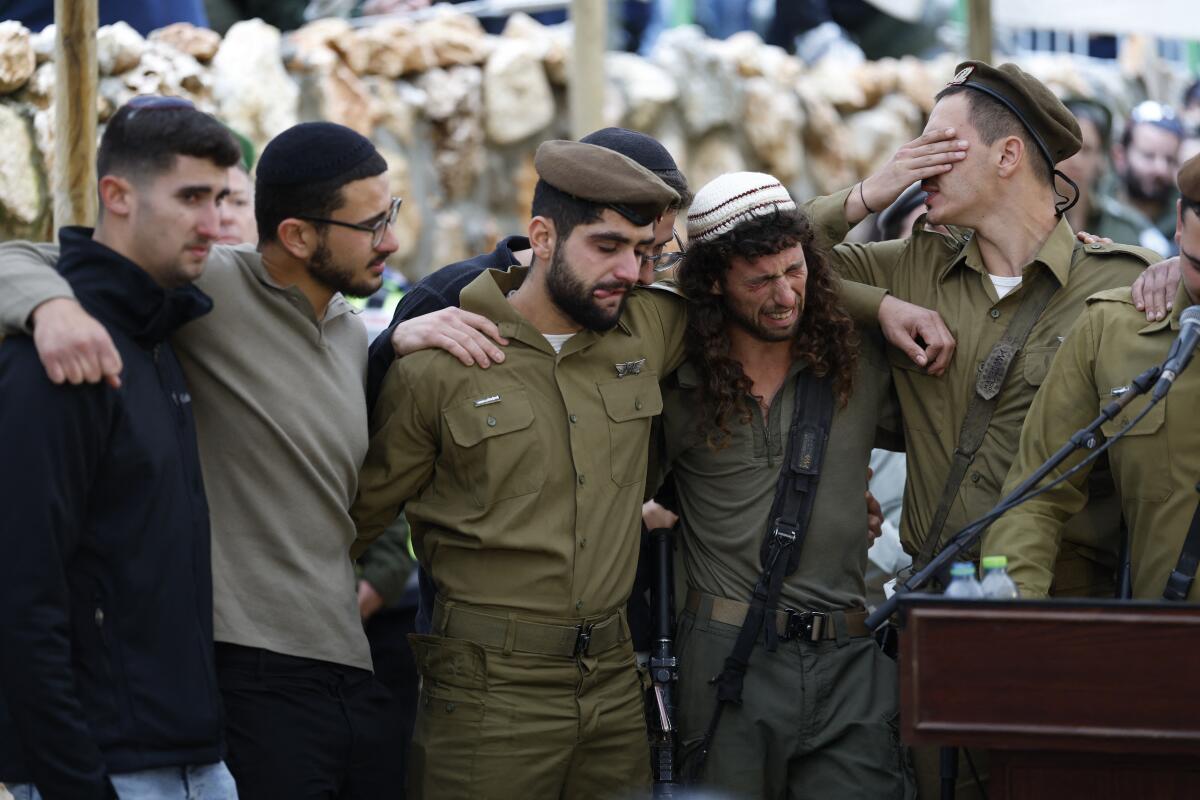

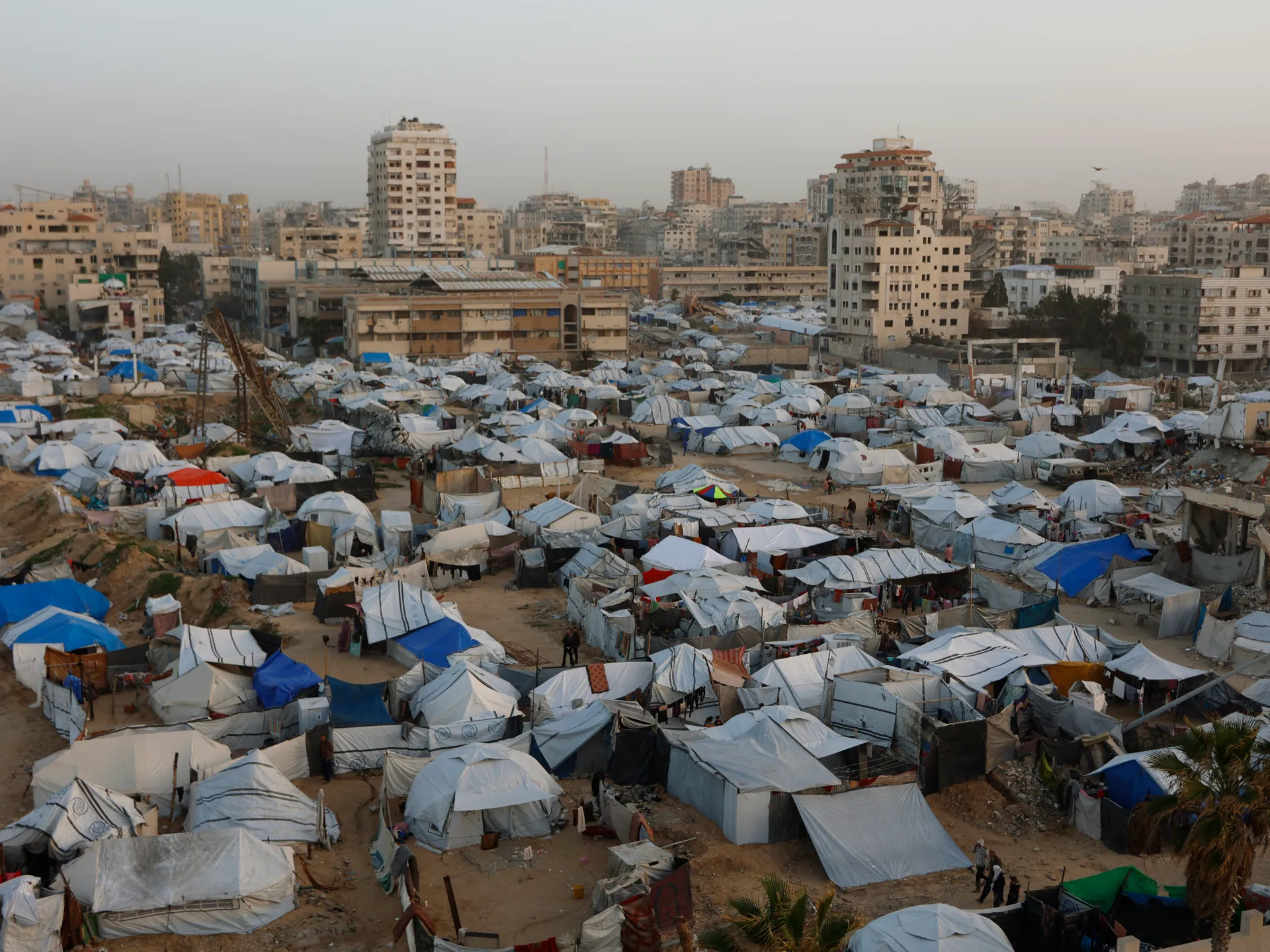



![Kuna Khuntia, a 25-year-old pipe fitter from India's Odisha, who died of a heart attack in Doha Qatar [Photo courtesy the Khuntia family]](https://i0.wp.com/www.aljazeera.com/wp-content/uploads/2026/03/Kuna-Khuntia-1774503793.jpeg?w=640&ssl=1)