communication

AT&T can phase out California copper landlines, FCC says

California’s long-running battle to save traditional telephone landlines has suffered another blow.

The Federal Communications Commission on Friday gave AT&T a green light to discontinue copper landline service to an estimated 184,000 residential customers and 15,000 business customers in California beginning in June.

The Dallas phone giant has struggled for years with California regulators, who have prevented the company from phasing out its copper wires in areas where customers have few other options. Residents and some lawmakers have long advocated for copper lines, saying they are the most reliable form of communication during a power outage, earthquake or wildfire.

Advocates insist traditional landlines are a matter of public safety.

AT&T appealed to federal regulators, arguing that California’s requirement that it continue providing copper landline service was a burden. AT&T separately filed a federal lawsuit against California’s Public Utilities Commission and the state attorney general’s office, requesting a court order declaring the state cannot stop AT&T from hanging up on its landline service.

Those cases are pending.

But, on Friday, the FCC weighed in, saying it had the authority to set communications policy, and that AT&T should be allowed to discontinue its legacy copper service at 360 wire centers in California.

FCC rules “preempt specific state legal requirements” that had kept California’s landline service in place, the FCC order said.

“California’s Carrier of Last Resort framework may have made sense when it was established 30 years ago,” FCC Chairman Brendan Carr said Friday in a statement. “Those rules were designed for a bygone era and no longer make sense in today’s competitive, advanced marketplace.”

The agency reaffirmed its June decision to allow AT&T to wind down the landline service, despite a California order that it must continue offering it.

“We appreciate Chairman Carr’s leadership and the FCC’s continued focus on modernizing our nation’s communications infrastructure,” Rhonda Johnson, AT&T executive vice president for federal regulatory relations, said Friday in a statement.

AT&T has said that about 3% of households it serves in California use the copper system, and that maintaining those lines costs an estimated $1 billion a year.

Increasingly, copper thieves have become a problem. Replacing stolen copper lines significantly adds to maintenance costs for providers.

“AT&T spends tens of millions of dollars annually responding to copper theft in the state,” FCC Commissioner Olivia Trusty said in a statement, joining Carr in supporting AT&T’s petition.

The company sought the FCC’s ruling, arguing that ending its legacy service would free up resources to provide additional homes with advanced fiber and wireless technology.

The FCC’s lone Democrat, Anna M. Gomez, cast a dissenting vote, saying customers depend on landline service and California regulators should be given time to develop a transition plan.

“I welcome modernizing our networks,” Gomez said. “The question in front of us today is how to do that while keeping consumers at the center, and whether this Commission should override California’s rules before California has finished deciding how to update them.”

The Utility Reform Network advocacy group vowed to continue the fight to preserve landlines.

“Today, the FCC handed AT&T, and every other provider in California, hope that the telecommunications industry will be relieved from state oversight,” Mark Toney, the group’s executive Director, said in a statement.

“If sustained, this Order will result in California Residents losing their legal right to phone service, access to first responders and emergency services, to family and loved ones, and to reliable connectivity,” Toney said.

The California Public Utilities Commission was not immediately available for comment.

“No customer will be left without access to voice or 911 service, and we’re committed to working with our customers every step of the way during this transition,” AT&T’s Johnson said.

Staff writer Jennie Jarvie contributed to this report.

Source link

What caused the national ground stop? Here is what we know

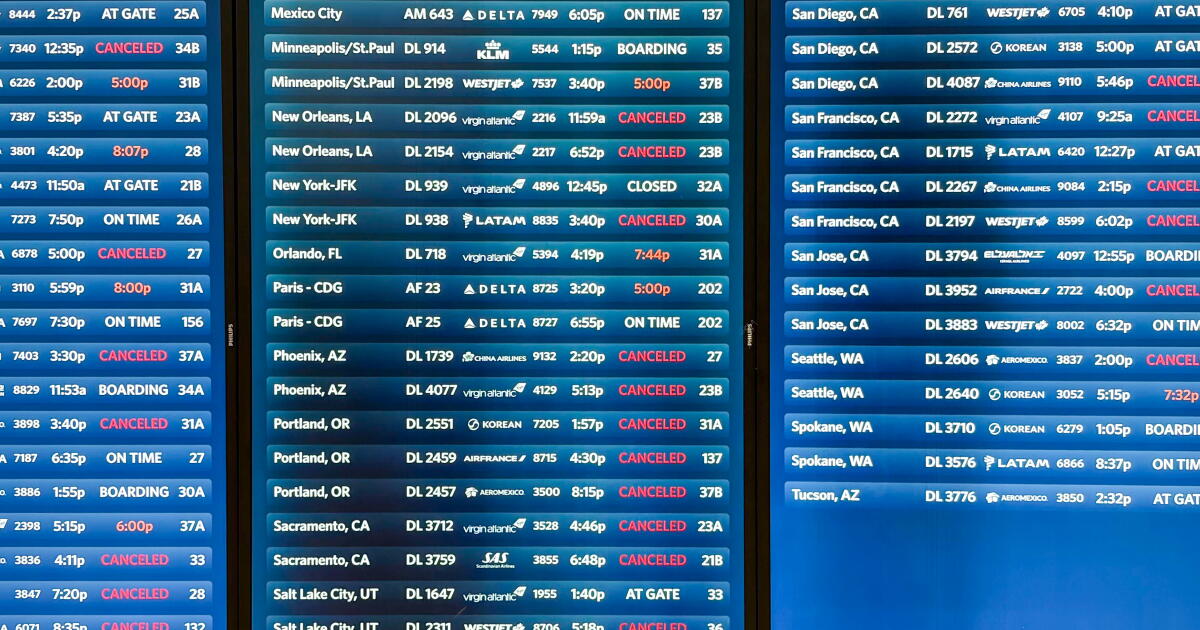
For more than four hours, a ground stop of virtually all aircraft in the United States brought unprecedented chaos and delays that are expected to last days.

Here is what we know about what went wrong.

What caused the stop?

Secretary of Transportation Sean Duffy said switches and routers on the Federal Aviation Administration’s analog air traffic control system became overloaded with data, causing inconsistencies in communication with airlines. As a result, the decision was made to shut the system down shortly after 12:30 p.m.

“We have old, old switches, old routers, we use 1980s little copper lines,” he said. “It’s an old system that went down and went down everywhere.”

The ground stop ended around 5:15 p.m. Duffy said the FAA was able to deploy fixes to reduce the overloading and bring its towers and air traffic control facilities known as TRACONs back online.

Duffy said the problem was with the TDM — time-division multiplexing — a dated, still mostly copper-wire technology used to transmit air traffic control voice and radar data. He said there was no evidence to suggest a cyberattack or the involvement of foreign adversaries.

What problems did this cause?

The technological breakdown led to intermittent communication and radar, but not a complete blackout, Duffy said.

“We were able to keep some of those communications going, but when you have issues and you can’t immediately communicate and immediately see where aircraft are at — that’s a risk that we’re unwilling to tolerate,” he said.

What do we know about the technology?

Duffy lambasted the aging infrastructure that the FAA relies on and said that President Trump is pushing for the funding needed to update the equipment.

“None of your networks run on 1980 technology,” he said to the gaggle of reporters at a Friday evening news conference. “You have all got fiber, state-of-the-art, high-speed networks that cover all of your stations, but not the FAA.”

He said the FAA was in the process of upgrading its air traffic control system thanks to $12.5 billion in funding secured through Trump’s Big Beautiful Bill, but called on Congress to approve an additional $50 billion to complete the modernization of the system.

“I believe that should be a priority,” he said. “America, Congress, let’s make this system more safe.”

Homeland Security Secretary Markwayne Mullin noted that the communications failure was caused as the FAA was performing upgrades.

“That new equipment, new technology — It was overwhelming the older system,” he said. “The patchwork doesn’t work. We need one complete system.”

What is the impact?

There were more than 3,500 airplanes flying across America when the decision to close the airspace was made, Duffy said.

Tens of thousands of travelers were left stranded and FEMA was mobilized to ensure lifesaving medication was not being missed by passengers, said Mullin. Some college football teams were left scrambling to find alternative transportation to this weekend’s games.

Duffy said that air traffic control would try to move as many planes as possible Friday night, but noted that this will depend on the availability of flight crews and pilots.

Source link

US grounds all flights after ‘communication issue’ | Aviation News

DEVELOPING STORY,

US Transportation Secretary Sean Duffy said the US aviation agency was investigating.

The United States has grounded flights across the country after a “communication issue” impacted traffic control centers, US Transportation Secretary Sean Duffy said.

“FAA [Federal Aviation Administration] technicians are investigating the issue. We will provide immediate updates as we have them,” Duffy wrote on social media.

Around 7,000 flights have been either delayed or canceled due to the stop, according to FlightAware.

The disruption is the latest sign of strain on the US air traffic control system, which has ⁠been beset by equipment failures, communications problems and ⁠shortages of controllers while the FAA tries to replace aging infrastructure. Congress approved $12.5bn for the overhaul last year, and the FAA and White House asked lawmakers on Friday for ⁠another $30.1bn.

This is the first nationwide US ground stop since January 2023, when a key FAA computer system malfunctioned. Before that, the last time had been after the September 11, 2001, attacks.

This story is developing…

Source link

Communication services sector declines in October; Reddit leads losses (XLC:NYSEARCA)

The communication services (XLC) declined over 9% in October amid a turbulent sell off fueled by growing investor scrutiny over the massive AI-related investments and disappointing results from big names including Alphabet and Meta Platforms.

Communication Services Sector October Scorecard

Source link