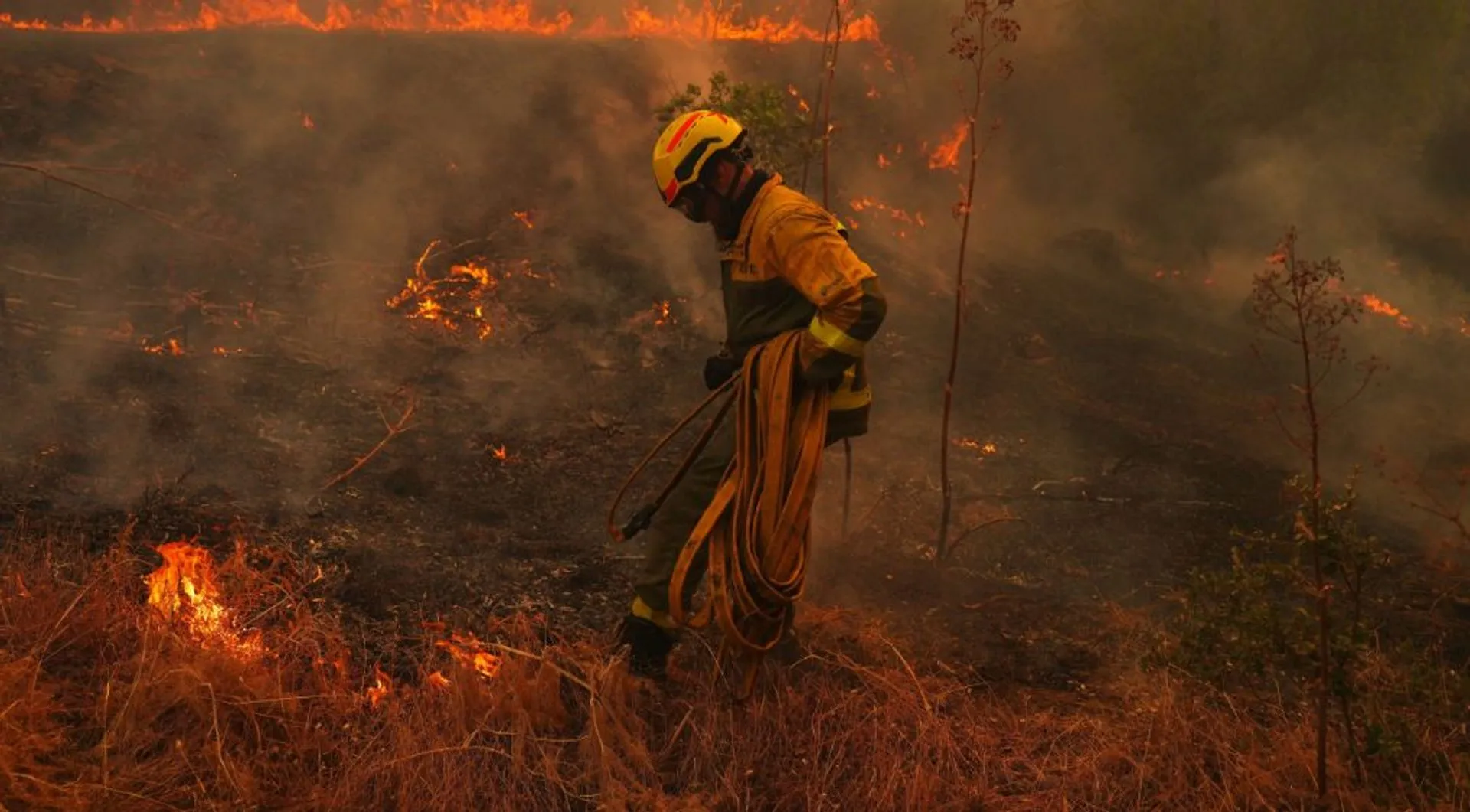
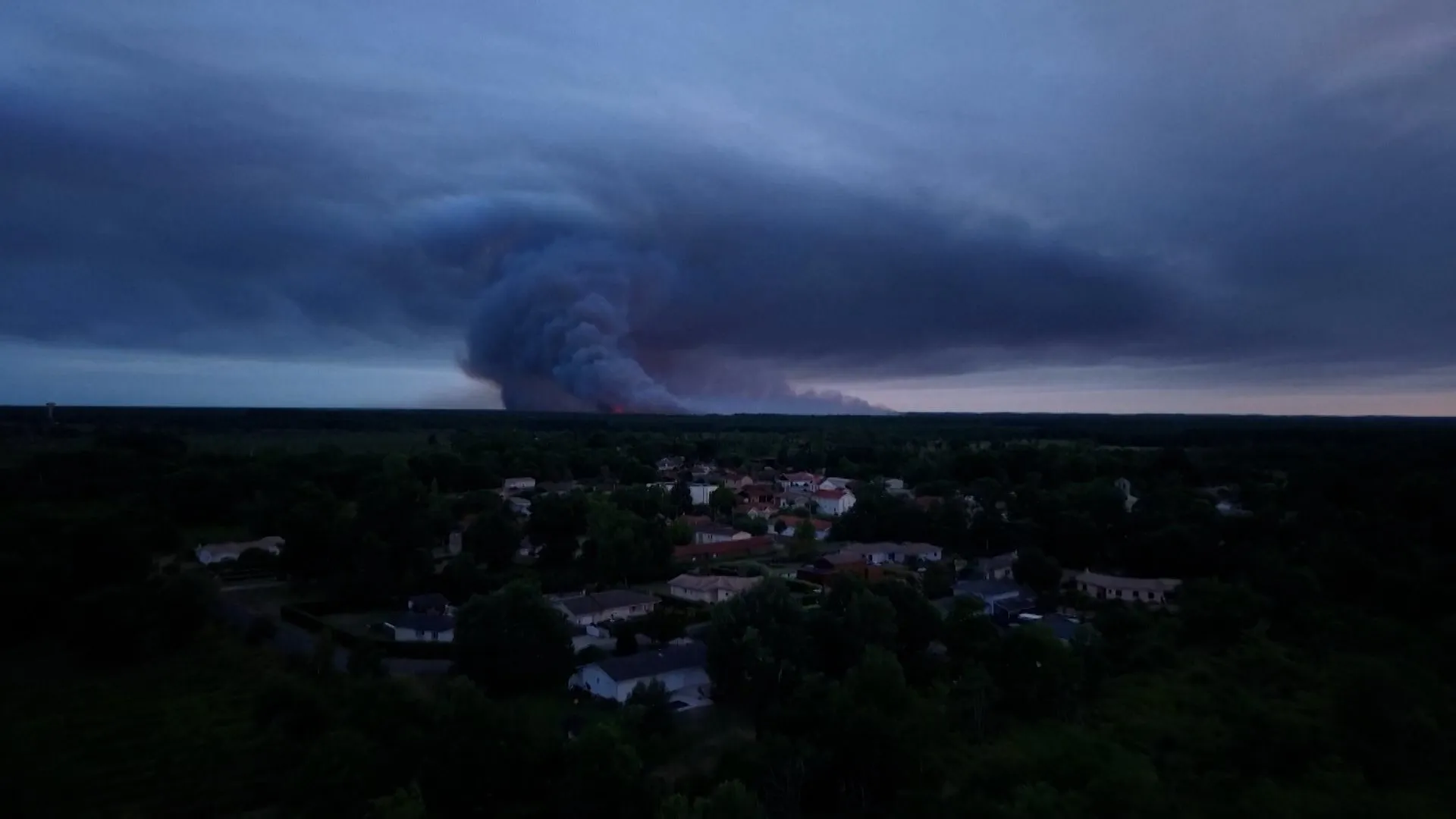
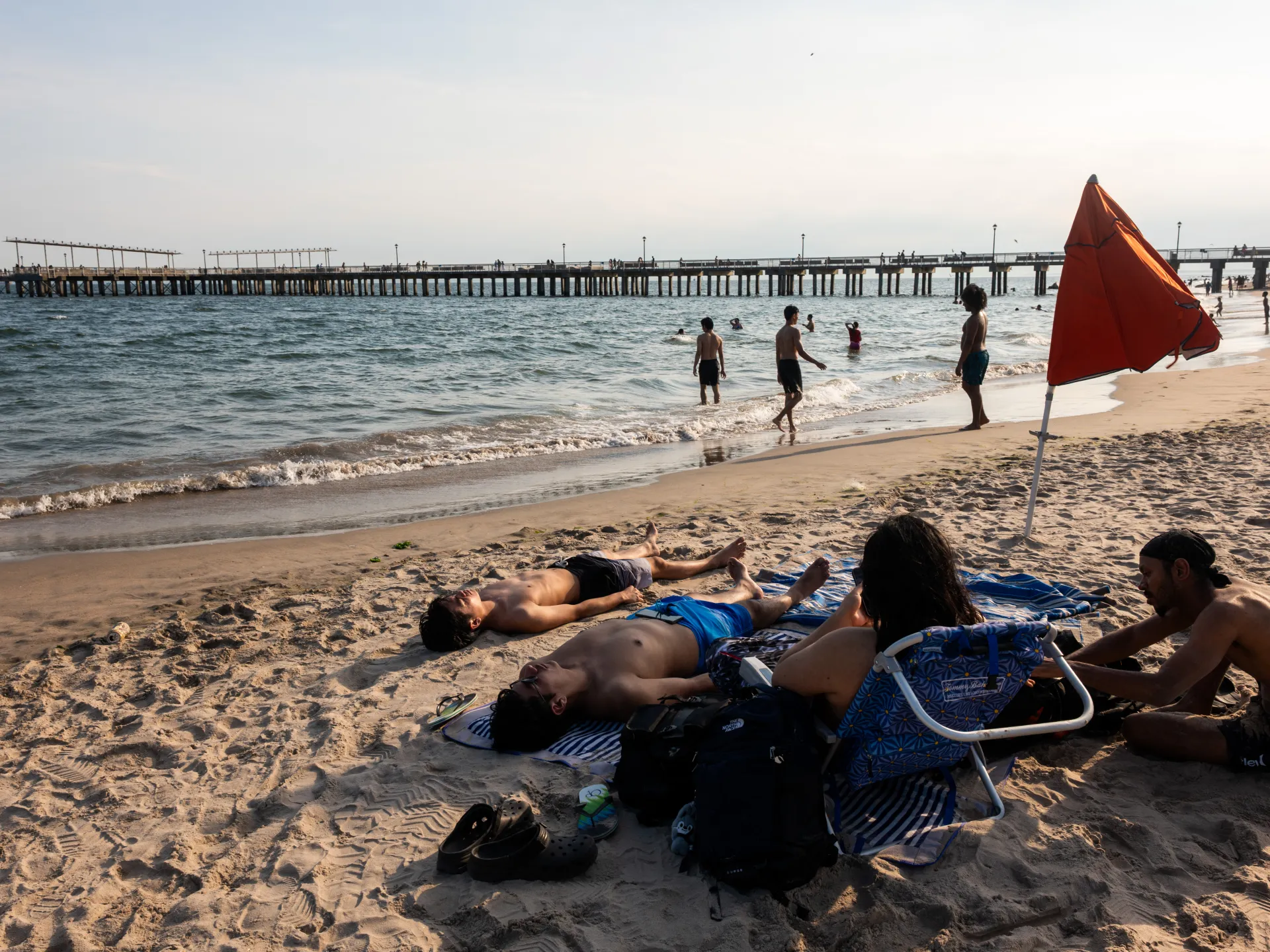
French wildfires show signs of easing, with containment efforts holding in Var and Gironde after destructive blazes.
By Al Jazeera Staff, AP and Reuters
Published On 1 Aug 20261 Aug 2026
Gale-force winds have fanned flames across multiple parts of Greece, intensifying a new front in Europe’s wildfire emergency, while major fires in France and Spain show signs of easing, with blazes either not advancing or under control.
Hundreds of firefighters, backed by water-dropping planes and helicopters, worked with emergency workers to protect Porto Germeno, a popular resort on the Gulf of Corinth, as heavy winds drove flames through the coastal area west of Athens on Saturday.
Recommended Stories
list of 3 itemsend of list
The fire broke out on Friday near the neighbouring village of Agios Vasileios. About 300 people were evacuated by sea, and authorities issued further evacuation orders for the regions, according to The Associated Press.
Greek authorities issued emergency alerts for several areas for Saturday and warned of extreme wildfire risk in the regions of Attica and Evia.
A Greek newspaper, Protothema, reported the fire in Porto Germeno split into three fronts and many houses caught fire in the area, prompting authorities to issue evacuation orders for nearby towns of Agia Paraskevi, Kryo Pigadi and Agios Nektarios.
Theodore Giannaros, a wildfire meteorologist at the National Observatory of Athens, told The AP an estimated 15 to 19 square miles (39 – 50sq km) had been affected, although authorities had not issued an official burned-area figure.
Fires ‘under control’ in France
The wildfires that have ravaged France are “today under control”, French Prime Minister Sebastien Lecornu said on Saturday, more than a week after the largest wildfire since 1949 flared up.
“Overall, the fires are now under control in our country” and, in Gironde, in the southwest, “we have returned to a more stable situation,” he said in an interview with the La Tribune Dimanche weekly.
French Interior Minister Laurent Nunez said flames that left a trail of destruction across villages have eased. In a post on X, he said fires in Gironde were now under control while “significant work has been done to contain the fire’s progression by the 1,500 firefighters” in the mountainous southeastern Var department, where fire burnt through 1,500 additional hectares (3,700 acres) of land.
In the Var, defensive lines around the Gros Bessillon fire held overnight, and no additional ground burned, Var Prefect Simon Babre told French media on Saturday.
Portugal’s major wildfire was declared under control, while Spain’s largest fires were no longer making sustained advances and most evacuation orders had been lifted.
Spanish conditions mixed
Spain continued battling several wildfire hot spots on Saturday, two days after the government declared the end of a national emergency caused by huge fires in the country’s central provinces.
However, fires worsened overnight in Leon.
Europe is Earth’s fastest-warming continent, heating at more than twice the global average since the 1980s, according to the European Union’s Copernicus climate service. Rising temperatures and prolonged drought leave vegetation drier and more combustible, allowing fires to spread faster and burn more intensely.
Climate change has helped southern Europe’s likelihood of wildfires double since 1981, say researchers.
Published On 30 Jul 202630 Jul 2026
Southern Europe is “becoming more flammable,” with the number of summer days featuring conditions likely to produce fires having more than doubled since 1981, according to a new report.
The study, published on Thursday in the Scientific Reports journal, said that this “major intensification” of fire-prone weather is driven by climate change. It noted that these effects are especially pronounced in France and Spain, which have been battling some of their largest blazes since records began in recent weeks.
The steep increase in the frequency of fire weather – characterised by searing temperatures, low humidity, dryness, and strong winds – “can only be attributed to global warming,” said study co-author Raul Cordero.
European countries are enduring an above-average season for wildfires, and have already overtaken 2025, which was a record-breaking year for destructive blazes.
Cooling weather and rain helped to calm the worst of the fires in France and Spain on Thursday.
France told 84,000 evacuees in the southwest of the country that it was now safe to go home, as France’s largest wildfire since 1949 pulled back.
Spain ended its state of national emergency as wildfires threatening areas near Madrid – the largest Spain has experienced since records began in 1961 – began to come under control.
However, as high temperatures moved eastwards, fires were being fought in Greece, Turkiye, and the United Kingdom.
In Greece, two firefighters died on the island of Crete on Wednesday, the fire department said, as several fires started around the country, fanned by gale-force winds. Another died in a separate fire in the Peloponnese region as the blazes continued into Thursday.
“We have difficult days ahead of us,” Greek Prime Minister Kyriakos Mitsotakis said.
Firefighters in Turkiye have been battling at least 115 fires across the country, although at least 110 were under control, according to the country’s agriculture minister.
An enormous wildfire has forced evacuations and prompted road closures in eastern England. The fire at Dunwich Heath, a significant biodiversity site, is one of the largest the region has seen.
Both countries expect to see temperatures soar into Wednesday, which could cause the blazes to spread.
Published On 28 Jul 202628 Jul 2026
The spread of wildfires in France and Spain that had come dangerously close to the cities of Bordeaux and Madrid appears to be slowing, authorities say, but they are bracing for yet another stifling heatwave this week, which could fan the flames of current blazes and ignite new ones.
Nearly 4,000 people were evacuated from tourist sites in the Lacanau area of the Gironde region in southwestern France on Tuesday, bringing the total number who have fled Gironde to well over a quarter of a million. The wine-growing region, which includes the historic city of Bordeaux is the worst affected in France by the wildfires
Recommended Stories
list of 3 itemsend of list
“We are at a point of fragility,” Eric Brocardi, spokesperson for France’s national firefighters federation, told BFMTV on Tuesday. “We will continue attacking this fire despite the forecast rise in temperatures.”
Images posted by the French newspaper Le Figaro showed ash on a beach in Lacanau. Sophie Brocas, Gironde’s prefect, has banned all sporting and cultural events until August 8.
France’s fourth heatwave of 2026 is expected to begin on Tuesday as temperatures are forecast to reach as high as 40 degrees Celsius (104 degrees Fahrenheit) in the coming days. When the heatwave reaches Spain on Wednesday, temperatures are expected to be even hotter there.
In Spain, 116,000 people have had to leave their homes since the wildfires began, but some have since been able to return. In the central province of Toledo, people from nine of 11 evacuated towns were allowed to go back to their homes on Tuesday.
Interior Minister Fernando Grande-Marlaska said people “can be a little more at ease” after progress overnight in tackling the many blazes in the country, which are mostly concentrated in central Spain.
Firefighters are also dealing with blazes in the neighbouring provinces of Avila and Toledo. About 800sq km (310sq miles) of land have burned.
One Spanish evacuee from the east of the country told the Reuters news agency he had witnessed “total chaos”.
“It was like in the movies where hell cracked the ground open, and you see the red hell.”
The scorching heat has renewed concerns about climate change with Spanish Prime Minister Pedro Sanchez describing the fires as “the most painful expression of a climate emergency”.
Sanchez said authorities are beginning “to see the light at the end of the tunnel in the fight against wildfires” but cautioned that the upcoming heatwave still has to be dealt with.
Wildfires are rampaging through vast areas of land in southwestern Europe, forcing France and Spain to evacuate more than 325,000 people from their homes.
Some of the worst fires in France since World War II come just weeks after record-breaking heatwaves scorched Europe. Authorities have deployed thousands of firefighters to battle the blazes.
Recommended Stories
list of 3 itemsend of list
On Sunday, France’s Interior Minister, Laurent Nunez, said about “115,000 hectares (284,171 acres) have burned in wildfires in France since the start of the year”. In Spain, 119,458 hectares (295,187 acres) of land have been burnt as of July 22 , according to data from the Copernicus European Forest Fire Information System (EFFIS).
More than 150,000 hectares have burned across Spain since January, said Prime Minister Pedro Sanchez – that’s six times the area destroyed during the same period last year.
Wildfires destroyed 2.2 million hectares (5.4 million acres) of land in Europe in 2025 – up from 1.4 million hectares (3.5 million acres) in 2022, according to the United Nations.
What is the main cause of the wildfires and why are authorities struggling to contain them?
What has happened?
Since early July, wildfires have been burning across southern and western Europe, with France and Spain being the worst hit.
About 220,000 people have been evacuated from their homes in France, about 75,000 people in Spain, and around 30,000 others there ordered to shelter in place, according to authorities.
In Spain, a fast-moving wildfire in the Andalusia region killed at least 12 people on July 10 . By July 20 , the fires had spread hundreds of kilometres to the capital, Madrid. At least 10,000 people have been evacuated following wildfires in the central region of Madrid. On July 24 , Spanish authorities declared a national emergency, saying two major blazes were “out of control”.
Over the weekend, a separate blaze in Spain’s eastern Castellon province ravaged more than 4,300 hectares (10,625 acres), regional authorities said.
“The fire is out of control, it’s very difficult to extinguish from a technical standpoint, especially because of the adverse weather conditions that will continue throughout the day,” the regional leader of Valencia, Juanfran Perez, told reporters near the site.
The wildfire in Spain has now entered the Sierra de Espadan natural park, containing large forests of pine trees and cork oaks.
In France, the wildfires are among the country’s worst since World War II and have particularly ravaged the Cap Ferret peninsula, an exclusive holiday destination on France’s southern Atlantic coast about 70km (43 miles) from Bordeaux.
Reporting from Maubec, near Toulouse, Al Jazeera’s Nina Montagu-Smith said: “When I visited Arcachon, a seaside town just across the bay from Cap Ferret on Thursday last week, we could see the fires on the peninsula. Within hours, the sky had blackened and the smoke was thick over Arcachon town.”
“All trains from Arcachon were cancelled, apparently due to an ‘electrical fault’,” she added. “Fire engines were lining the A63 from Bordeaux towards Arcachon on Thursday evening as I drove eastwards to Libourne, which is 100km from the fires in the Gironde region,” she said.
Our correspondent noted that after the wind picked up on Thursday evening, smoke from the blaze reached Libourne, where ash was falling from the sky.
“We have since relocated further east in France towards Toulouse, where the sky is very grey and we could still smell the smoke on Sunday night,” she added.
Fires on the Cap Ferret peninsula in southwest France, as seen from across the bay in Arcachon, a town on the French Atlantic coast [File: Courtesy of Nina Montagu-Smith]
The wildfires have now spread through areas surrounding Bordeaux, where firefighters were trying to prevent the flames from reaching the regional capital.
Bordeaux Mayor Thomas Cazenave said the fire was just 15km (nine miles) from entrances to the main city.
“We have a fire that is not under control and which is moving in the direction of the city area,” Interior Minister Laurent Nunez told France 2 TV on Sunday evening. “The overall situation is very unfavourable, we are in a situation that is unprecedented.”
So far, authorities have moved 197,000 people from areas around Bordeaux – including popular holiday spots which are generally crowded at this time of the year.
The Bordeaux region is famed for its vineyards and the city is one of the main transport hubs for tourists visiting nearby holiday resorts on the Atlantic coast.
Cazenave said earlier on Sunday that there were no plans yet to evacuate Bordeaux, whose wider metropolitan area has a population of about 850,000. Nunez said authorities would continue to assess the situation calmly and realistically, and the government has warned against road or rail travel to the area.
The wildfires disrupted Sunday’s Tour de France finale in Paris, which organisers shortened from 133 to 89 kilometres (83 to 55 miles) after security forces originally assigned to the race were redeployed to fight the fires instead.
Why are these fires so bad?
Scientists are warning that pyrocumulonimbus clouds – unprecedented in southwest Europe – are forming.
According to the British Royal Meteorological Society, these are thunder clouds “created by intense heat from the Earth’s surface”. They can make conditions almost impossible for firefighters.
They are formed similarly to normal clouds, but “the intense heat that results in the vigorous updraft comes from fire, either large wildfires or volcanic eruptions”, the society said. It explained that there may be a burst of rain because of them but warned that this rain “can then carry embers from the fire, igniting spot fires away from the source. In some cases, dry lightning from these storms can strike without rain, further spreading the wildfire”.
A spokesman for France’s National Firefighters Federation of France (FNSPF) told the AFP news agency: “Lightning forms within the cloud, striking the embers on the ground and further fuelling the fire … It produces a low, rumbling sound. While this type of fire occurs regularly in Canada and Australia, it is unprecedented in France,” he said on Sunday.
“We have reached a point of ‘operational impossibility’ that requires us to accept the need for strategic retreat – to understand and acknowledge a natural force beyond our control,” he said.
“It calls for … knowing what can be done and, above all, what cannot. The situation on the ground is defensive rather than offensive; it is a war-like scenario where we are under constant bombardment and must get everyone to safety,” he added.
What are authorities doing now?
Spanish and French authorities say firefighters alone cannot fight the blaze and have appealed for international help.
On Sunday, Spanish PM Pedro Sanchez visited fire-hit areas in Avila, one of three central provinces affected by major blazes alongside Madrid and Toledo, where more than 45,000 hectares (111,000 acres) have burned.
“We have a window of opportunity this weekend to fight the wildfire and, therefore, to protect lives, protect population centres and, ultimately, to bring this very serious wildfire under control as far as possible,” he said.
Sanchez said his government will declare a civil protection emergency for the central provinces plagued by the wildfires on Tuesday, unlocking additional recovery funding.
French Prime Minister Sebastien Lecornu wrote on X on Saturday: “The fires which are hitting our country have reached a level that has never been seen before”.
Lecornu called another government crisis meeting on Saturday for ministers to discuss the response to the emergency, the second such meeting in as many days.
The European Union’s civil protection mechanism is monitoring the situation and has been assisting. Under the mechanism so far, Greece and Italy have sent firefighting aircraft to Spain, while Portugal has deployed more than 100 military personnel, along with equipment.
Two more aircraft will arrive “as soon as possible” from Turkey, the Spanish interior ministry added on X.
Why are these fires becoming so much harder to contain?
Wildfires have been a common occurrence in Europe in recent years, but authorities have increasingly been struggling to contain them.
Sanchez said the growing scale of the fires and their intensity, fuelled by increasingly extreme weather such as the heatwaves this summer, require policies grounded in climate science.
Eduardo Rojas, chairman of the Board at the Programme for the Endorsement of Forest Certification told Al Jazeera’s Inside Story programme on Sunday that there are multiple factors causing the wildfires which also need attention.
He said the fires in the wild lands of the country have occurred where the “urban interface is extraordinarily complex”. He noted that some areas were “built up in the 60s, 70s and 80s without a proper city plan and with lack of infrastructure, lack of water availability…and with a lack of knowledge of the neighbourhoods.” When a fire occurs, therefore, there is a “lack of knowledge” about how to deal with them.
“The fire in west Madrid is a kind of fire that doesn’t burn a huge area but creates a lot of hesitation,” he said.
“We also have farms where cereals are harvested and even [with] a small lightning [strike], the cereal can start to burn and at the end a big agricultural area ends up burning which is a big damage for farmers,” he noted.
“These kinds of fires need to be tackled in a totally different way because their cause and their environment and conditions are incomparable with one another,” he added.
Laurie Laybourn, executive director of Strategic Climate Risks Initiative, a non-partisan thinktank told Al Jazeera that governments across the continent are unable to cope with the pace at which climate change is occurring.
“All governments develop what are called reasonable worst-case scenarios to inform their planning and in many instances the events that we’re seeing are going beyond even those. So what that tells us is that the tools that we’ve got, the analysis that is informing government planning is a step behind how fast climate change and its supercharging of disasters is,” he said.
So is this all mainly because of climate change?
According to the European Forest Institute, a wildfire “is a chemical reaction of combustion, which requires a source of heat (lightning, an agricultural “burn” which escapes, or a spark originating in an electric line), oxygen and fuel (forests, shrubs or pastures) to get started.”
“Wildfire risks are increasing worldwide because of climate change and land use change,” the institute added in a July 9 report.
In a recent report, the World Health Organization’s regional director for Europe issued a warning about climate change, saying it is directly responsible for intensifying wildfires and their increasing frequency.
There are clear indications that climate change is “supercharging” incidents such as wildfires, Laybourn told Al Jazeera.
“Any disaster is very complex. The causes are multilayered, including how we build and how we use land…But climate change is supercharging the conditions that make us vulnerable to things like wildfires and that has been something that’s been predicted now for many decades and tragically becoming true in front of our eyes,” he said.
According to Copernicus, the European Union’s climate change service, Europe is now the fastest warming continent on Earth, with temperatures increasing twice as fast as the global average since 1980.
Laybourn explained that this summer’s heatwaves were also caused by climate change.
He warned and stressed that governments need to prioritise tackling the issue.
“This should be a moment of profound alarm and reflection, particularly for governments.”
Ifugao, Philippines – At first light, the village of Batad begins to stir to life beneath the towering cliffs surrounding its amphitheatre-like rice terraces, a UNESCO World Heritage Site.
Apu Penneng, an Ifugao elder who owns one of the village’s largest tracts of ricefields, struts with youthful confidence along a narrow and steep path in this highland community 1,100 metres (3,608ft) above sea level.
Dressed in a traditional loincloth, shawl and headgear, he is heading for the Tanig, an elaborate morning ritual before the harvest begins. At a courtyard next to rows of huts, dozens of village women also gather for the Bullogan chi Munbotoh, the procession to the harvest site.
Against the glow of the rising sun, the centuries-old terraces finally come in full view as if cascading from the sky. The fields of Tinawon rice grains, moist from the drizzle the night before, glimmer like morsels of gold ready for picking.
But the otherwise majestic landscape is punctuated by the sight of collapsed earth and boulders, right in the middle of the terraces.
Village elder Apu Penneng, who is regarded as the custodian of his family’s vast rice paddies in Batad, heads to the harvest site during this year’s Tinawon rice harvest festival [Ted Regencia/Al Jazeera]
In November last year, Super Typhoon Fung-wong triggered a landslide that killed two locals and demolished one of the centuries-old canals irrigating the rice paddies. About 2.2 hectares (5.4 acres) of rice fields were damaged, affecting 150 farmers.
“It was the worst we’ve seen here,” Apu Penneng calmly said, as he pointed to a deforested patch of land above the terraces. From afar, it looked like it had been slashed with a giant blade.
The wreckage has been an unwelcome reminder for villagers of the destructive nature of extreme weather conditions, which have been increasing in frequency in recent years.
Batad was also struck with landslides in 2011, 2023 and 2025. With the emerging threat of this year’s Super El Nino, a climate phenomenon that increases global temperatures and drives more extreme weather and rainfall patterns, the Ifugao people worry about more damage to come.
A wide crack marking the path of a deadly landslide in November 2025 remains visible in the upper left corner of the terraces, as dozens of female residents of Batad join in the Bullogan chi Munbotoh, the traditional procession to the harvest site [Ted Regencia/Al Jazeera]
Across the world, 80 percent of UNESCO’s World Heritage Sites are facing climate-induced stress, according to an August 2025 study published in the scientific journal Nature.
The study found that UNESCO sites in low and middle-income countries receive the least conservation support, making them even more vulnerable to harsh climatic conditions. It added that in tropical monsoon areas, those conditions include record-breaking heatwaves, extended droughts and sudden drenching rainfall – much like what struck Batad in November 2025.
“Climate change is really aggravating the situation on the ground,” said lawyer Marlon Martin, head of the Save the Ifugao Terraces Movement (SITMO).
For the rice terraces to stay intact and stable, the soil needs to maintain a certain level of moisture year-round. But because of recent bouts of dry spells, deep cracks have developed, making the terraces prone to erosion, said Martin.
“When sudden bursts of rain occur, the water would seep into the cracks too abruptly, resulting in erosion” and even soil collapse, he added, warning that the Super El Nino could only mean more trouble ahead.
Batad resident Joel Langihon, 52, arranges piles of rocks and mud to fortify a damaged portion of his family’s rice paddy that was washed out as a result of Super Typhoon Fung-wong last November [Ted Regencia/Al Jazeera]
According to Steve Baccay, head of Ifugao’s Provincial Agriculture and Environment Office, an equivalent of $500,000 is needed for the restoration work in Batad following last November’s landslide.
Since the disaster, Batad residents themselves have come together a few times to do voluntary communal work called bachang to fix the demolished irrigation canal.
The social welfare and labour departments have also extended emergency food and cash assistance to affected farmers. However, additional national government aid is unlikely until the next fiscal year.
Climate change is nothing new, and for centuries people in Ifugao have adapted to the changes using Indigenous engineering techniques to protect the terraces, said Martin. But for Batad to withstand more frequent and more extreme weather, national intervention is needed, he added.
Batad village chairman Romeo Heppog (standing left) said it is crucial for the Philippine government to allocate enough funds to speed up the repair of the rice terraces [Ted Regencia/Al Jazeera]
For Batad village chief Romeo Heppog and his family, the rice terraces are not just a source of their livelihood, but part of their identity and their way of life.
Organising the annual rice harvest festival is his way of honouring their ancestors and renewing their “sacred oath” to preserve the terraces for the generations to come, he said.
At the Tanig pre-harvest sacred ritual, Heppog watches closely alongside Apu Penneng as Apu Buy-a Nadyug, Batad’s chief Indigenous priest known as Mumbaki, leads the harvest rituals, including the pouring and drinking of fresh rice wine.
Tinawon, meaning ‘once a year’, is Batad’s heirloom organic rice harvested only once annually [Ted Regencia/Al Jazeera]
Hunched on the ground next to a pair of wooden Bulul, which embody invisible spiritual beings of the Ifugaos, the octogenarian Apu Buy-a Nadyug recites verses seeking blessings and protection for the harvest.
With the help of another village elder, Apu Penneng then leads the slaughter of chickens as a symbolic offering to Ifugao ancestors and the spiritual beings.
In one of the final acts of the hour-long sacred ritual, Mumbaki Apu Buy-a Nadyug then scrutinises the guts of the chicken, and pronounces another year of “bountiful harvest”.
Apu Penneng and Heppog then lead the banging of gongs signifying merriment and the start of the joyful harvest.
Apu Buy-a Nadyug [centre], the chief Indigenous priest of Batad, joins two other village elders during the Tanig, a blessing ritual before the start of the harvest festival [Ted Regencia/Al Jazeera]
For a moment, the worries of the villagers of Batad are drowned out by the loud rhythmic sound that has been passed from generation to generation.
Apu Penneng then proceeds to his ricefield for the harvest. Amid the uncertainties for his community, his face beams with pride as he gazes at the panoramic view of Batad.
From a distance, the 2,702 metres (8,865ft) Mount Amuyao, the country’s 10th highest peak, towers over Batad, as if guarding it from the threats of nature.
“We will get through this,” said Apu Penneng.
Marlon Martin, head of the Save the Ifugao Terraces Movement, said Batad farmers need regular subsidies to encourage them to continue farming while also financially sustaining their families [Ted Regencia/Al Jazeera]
France and Spain have deployed thousands of firefighters, and neighbouring countries have sent help.
Wildfires are ravaging many parts of western and southern Europe, with France and Spain among the hardest hit.
The World Health Organization has warned that climate change is contributing to the frequency and intensity of the fires. This is clear in the record temperatures and successive heatwaves seen across the continent since May. France and Spain have deployed thousands of firefighters, and neighbouring countries have sent assistance. Authorities say the situation is unprecedented.
Recommended Stories
list of 4 itemsend of list
So, what will it take to extinguish the flames?
Presenter: Per Nyberg
Guests:
Eduardo Rojas – chairman of the board at the Programme for the Endorsement of Forest Certification
Soraya Fettih – global campaigns coordinator at 350.org, an international environmental organisation focused on addressing the climate crisis
Laurie Laybourn – executive director of Strategic Climate Risks Initiative, a non-partisan think tank
Noul hit southern Guangdong province and neighbouring Hong Kong, bringing strong winds and heavy rain to the region.
Published On 26 Jul 202626 Jul 2026
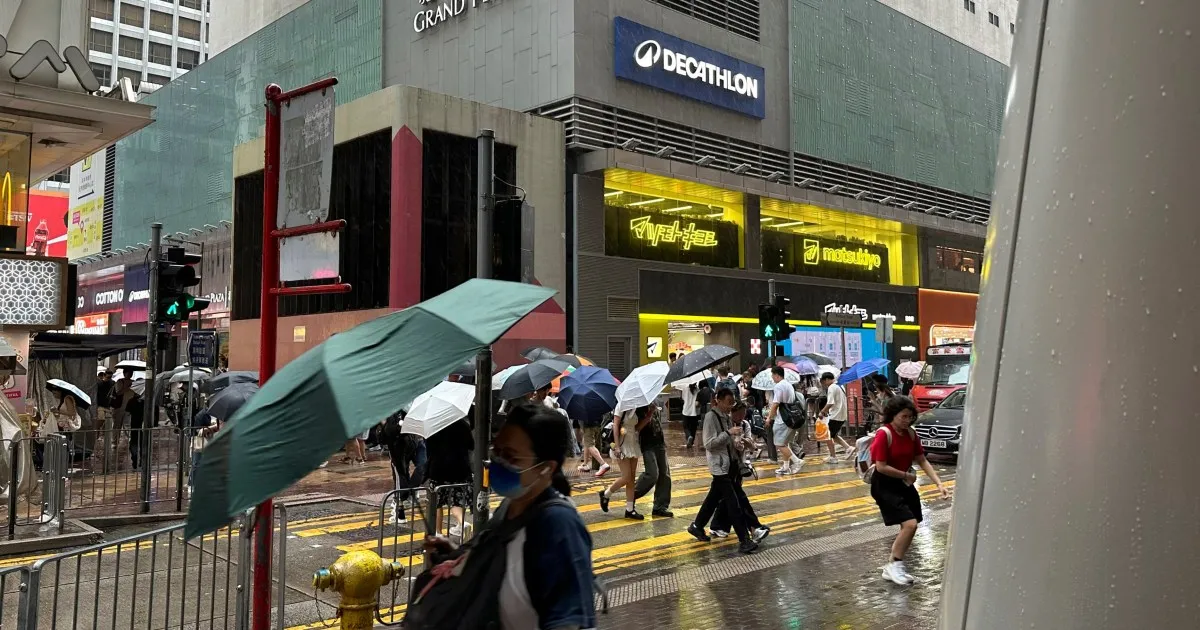
Typhoon Noul has hit southern China, including Hong Kong, bringing strong winds and heavy rain to the region and prompting the evacuation of hundreds of thousands of people in Guangdong province.
China’s national weather centre said Noul made landfall on the coast of Huidong county in Huizhou, southern Guangdong province, at approximately 3:50am local time on Sunday (19:50 GMT on Saturday).
Recommended Stories
list of 3 itemsend of list
China’s official Xinhua News Agency said Noul was the strongest typhoon to make landfall in China so far this year.
Hong Kong’s Observatory said Noul, with maximum sustained winds of 110 kilometres per hour (68 miles per hour) near its centre, was moving Sunday into inland Guangdong and weakening progressively, bringing strong winds and heavy rain to parts of the region.
More than 715,000 people had been relocated for safety by early Sunday in Guangdong province, according to state-owned China National Radio. On Saturday, authorities said some 340,000 people were evacuated.
China’s National Meteorological Centre expected parts of southern Guangdong and southeastern Fujian provinces to experience heavy rain and strong winds over the weekend.
Many trees were seen uprooted in Huilai county, located on the coast of Guangdong province, state broadcaster CCTV reported.
Hong Kong’s airport authority said about 350 flights were cancelled on Sunday. At least nine people were injured across the city during the typhoon period, according to Hong Kong authorities.
As Noul approached Hong Kong, parts of a large scaffolding on a high-rise building collapsed on Saturday afternoon, local police said, although initial reports indicated there were no injuries.
Taiwan’s Central Weather Administration said Noul was bringing rainfall to parts of southern and eastern Taiwan. It was passing over waters south of Taiwan and was moving away from the island Saturday.
Earlier this month, Typhoon Bavi brought strong winds and rain to eastern China, leading to the evacuation of more than two million people. It made landfall on July 11. Another, Maysak, made landfall in southern China on July 3.
Thousands of people are being evacuated from areas of southern France as firefighters battle huge wildfires. Researchers say climate change is intensifying heat and drought, creating conditions for larger and more destructive wildfire seasons across Europe.
Global hunger declined for the third consecutive year in 2025, offering a rare piece of positive news for food security after years of setbacks caused by the COVID-19 pandemic, conflict and economic instability. Yet the United Nations warns that the gains remain fragile, with climate change, geopolitical tensions and disruptions to global trade threatening to reverse recent progress.
According to the latest State of Food Security and Nutrition in the World report, jointly produced by five U.N. agencies, approximately 645 million people or 7.8% of the global population experienced hunger last year. That marks an improvement from 8.1% in 2024 and 8.6% in 2022, continuing a gradual downward trend.
While the figures suggest the world is moving in the right direction, U.N. experts caution that achieving the goal of ending hunger by 2030 remains far from guaranteed.
Hunger Declines Across Every Continent
For the first time in several years, every continent recorded improvements in hunger levels, including Africa, where progress has historically been the slowest.
Stay ahead of the geopolitical week.
MD Briefing delivers expert analysis across five global fronts — the Indo-Pacific, energy, geoeconomics, European security, and the Middle East — every Monday morning. Free.
Asia accounted for much of the global improvement, led by significant gains in India, while Latin America and the Caribbean continued building on earlier successes. Several African nations—including Ethiopia, Tanzania, Zambia, Zimbabwe and Senegal—also reported improvements after years of deteriorating food security.
Despite these advances, Africa remains the world’s most food-insecure region. Around 309 million people, or roughly one in every five Africans, continue to suffer from chronic undernourishment.
U.N. officials described the continent’s improvement as encouraging but modest, emphasizing that much more investment will be needed to sustain progress.
India Emerges as a Key Driver
India played a central role in reducing global hunger statistics.
Home to nearly one-fifth of the world’s population, the country has lowered hunger levels to below 10%, driven by expanded welfare programs, increased agricultural productivity and improvements in food distribution.
The country’s progress demonstrates how targeted government policies combined with economic growth can substantially improve food security even in densely populated developing economies.
Elsewhere, the Dominican Republic also achieved sufficient progress to be removed from the global hunger map.
Climate and Geopolitical Risks Persist
Despite encouraging trends, the U.N. warns that several emerging risks could quickly undermine global food security.
One of the most immediate concerns is the disruption to shipping through the Strait of Hormuz, where escalating tensions in the Middle East have increased transportation costs and driven up prices for fuel and fertilizers—critical inputs for agricultural production worldwide.
Higher energy costs inevitably translate into more expensive food production and distribution, placing additional pressure on consumers already facing elevated food prices.
Meanwhile, forecasters are monitoring the possible emergence of a strong El Niño weather pattern, which could reduce crop yields across many vulnerable regions through droughts, floods and extreme temperatures.
Together, geopolitical instability and climate shocks threaten both food availability and affordability.
Hunger Is Falling, But Healthy Diets Remain Unaffordable
The report also highlights an important distinction between reducing hunger and improving nutrition.
Although fewer people are experiencing chronic hunger, 2.69 billion people still cannot afford a healthy diet.
The U.N. estimates that a nutritious daily diet costs an average of $4.28 per person when adjusted for purchasing power—well beyond the reach of many households in low-income countries.
The affordability gap is especially severe in Africa, where 66.1% of the population cannot afford healthy food, more than double the levels recorded across much of Asia and Latin America.
Poor transport infrastructure, inadequate cold-storage facilities and fragmented regional trade continue to make nutritious foods such as fruits, vegetables, dairy and meat significantly more expensive across the continent.
Nutrition Challenges Extend Beyond Hunger
The report also warns that improving calorie intake alone is not enough.
Child malnutrition remains widespread in many developing countries, while anemia among women continues to worsen. At the same time, adult obesity is increasing globally, illustrating the growing “double burden” of malnutrition in which undernutrition and unhealthy diets coexist.
This reflects broader structural problems within global food systems, where inexpensive calories are often more accessible than balanced nutrition.
What’s Next?
U.N. experts remain cautiously optimistic that global hunger can continue declining through 2030, provided governments maintain investments in agriculture, strengthen international trade and improve resilience against climate shocks.
However, the outlook depends heavily on geopolitical stability. Continued conflict in the Middle East, disruptions to major shipping routes, worsening climate events or prolonged trade barriers could rapidly increase food prices and slow or reverse recent gains.
Analysis: Progress Is Real, But Food Security Remains Fragile
The latest U.N. report demonstrates that coordinated public policies, agricultural investment and social protection programs can reduce hunger on a global scale. India’s progress, alongside improvements across Latin America and parts of Africa, shows that meaningful change is possible even amid economic uncertainty.
Yet the report also highlights a growing challenge: food security is increasingly shaped by forces beyond agriculture itself. Climate change, global shipping disruptions, energy prices and geopolitical conflicts now influence what people eat as much as farming does. While hunger is declining, access to affordable, nutritious food remains out of reach for billions. Sustaining progress will therefore require not only producing more food, but building more resilient supply chains, improving regional trade and adapting agricultural systems to an increasingly volatile global environment.
With the World Cup final less than 24 hours away, an unlikely factor is grabbing the attention of organisers, fans and players alike.
The lingering smoke from the Canadian wildfires sparked earlier this week has engulfed the northeastern region of the United States, raising questions about its impact on the Spain vs Argentina final in New Jersey on Sunday.
A visible haze hung over the twin World Cup host states of New York and New Jersey on Saturday, with inclement weather causing disruptions.
At one point on Friday, New York rated as the city with the worst air quality in the world.
The World Cup final between the European champions and current title holders kicks off at 3pm local time (19:00 GMT) on Sunday in East Rutherford, New Jersey.
Here’s what we know about the smoke, weather and World Cup final:
Is there a haze in New York and New Jersey before the World Cup final?
Smoke from the Canadian wildfires is hanging over the region, reducing visibility and affecting air quality in most northeastern US states.
Warnings of unhealthy air quality remained in effect across a wide area of the US east coast on Saturday.
However, experts predict conditions will improve for the big showdown in New Jersey tomorrow.
The air quality index forecast shows an improvement from unhealthy air to “moderate” air quality for sensitive groups from Saturday to Sunday in East Rutherford, which means little to no health risk for the general public on the day of the final.
How is the weather and what’s the forecast in New Jersey before the Spain vs Argentina final?
A thunderstorm passed through the area on Saturday afternoon, causing heavy rain and loud thunder at the New York New Jersey Stadium, renamed from MetLife Stadium.
State police urged people to leave the stadium seating bowl and field and take shelter. Volunteers and staff dashed inside for cover as ponchos were handed out. The sky was the same thick, soupy grey it had been for days.
New Jersey Governor Mikie Sherrill warned residents about the potential for damaging winds, tornadoes, flash flooding and large hailstones.
FIFA said it was in close contact with local authorities as it continues to monitor the impacts from the wildfire smoke and the storms on the stadium conditions for the final.
Have the weather and smoke disrupted preparations for Spain or Argentina?
Spain’s last training session ahead of the final at a nearby Melanie Lane Training Ground was suspended because of storms and lightning in the area.
The Spanish football federation (RFEF) said that was in accordance with US storm safety protocol.
“The players are currently taking part in a warm-up session indoors,” RFEF added.
FIFA said that there would not be another time slot for the team to train.
Argentina had an outdoor training session at their scheduled time of 1:30pm (17:30 GMT), with players showing no concerns about air quality or the weather.
Lionel Messi and the Argentina squad unaffected by the weather on the eve of the World Cup final, July 18, 2026. (AP Photo/Ashley Landis)
Will the wildfire smoke affect the World Cup final?
The haze will mostly clear from New Jersey just in time for the final, thanks to thunderstorms passing through the area, meteorologists say.
“This storm front will largely move the smoke out of the northeast before the final between Spain and Argentina,” said Tyler Roys, a senior meteorologist at online weather service AccuWeather.
“There could be some lingering smoke that would make things hazy, but very faint,” Roys said. “In terms of the thickest smoke, the smoke that has really been eye-popping and leads to poor air quality, that is not expected across New York City or much of the northeast.”
Jeff Berardelli, chief meteorologist and climate specialist at WFLA-TV, echoed the forecast, saying the storm front would “sweep the atmosphere clean”, leaving only a thin smoke that World Cup spectators may still smell in the air.
“It won’t be dangerous anymore,” Berardelli said. “It’s going to be dramatically better.”
Temperatures are forecast to be around 27C (80F) with light breezes and low humidity for kick off.
“You couldn’t have asked for much better weather for the World Cup,” Berardelli added.
Both experts expect the heavier smoke on Sunday to be concentrated closer to the fires, hanging over parts of the Midwest and Great Lakes region.
Berardelli said they are burning longer and faster because of climate change.
Plumes of smoke from wildfires in Canada are pouring into major US cities across the Midwest, Northeast and mid-Atlantic. Polluted air is affecting more than 100 million people and is creating concern ahead of Sunday’s World Cup final.
United States President Donald Trump has threatened to impose additional tariffs against Canada, as a penalty for the wildfire smoke that has clouded cities across North America.
On Friday, Trump complained about the air quality on social media, as officials in Canada continue to battle 896 active blazes across the country.
Recommended Stories
list of 3 itemsend of list
Roughly 200 are burning in the province of Ontario, where Premier Doug Ford said 81 are still out of control. Trump, however, blamed the fires on Canadian governance.
“We are holding Canada responsible for the fact that they are not properly maintaining their Forests, and Brush,” Trump wrote.
“The United States is being unnecessarily invaded by filthy, polluted, and unhealthy air, the quality of which is dangerous, and totally unacceptable!”
He pledged to call Prime Minister Mark Carney, accusing the Canadian leader’s government of negligence.
“The cost is incalculable,” Trump added, saying the expense would be added to existing tariffs against Canadian exports to the US.
The post is the latest example of the US president wielding the threat of heightened tariffs to impose a wide range of demands on foreign countries.
Since returning to the White House for a second term in January 2025, Trump has ratcheted up pressure against Canada, using tariffs as a means of pressuring the country to increase border security and change trade practices he considered unfair.
Trump has also pushed Canada to cede its sovereignty and become the “51st” US state.
Scientists have attributed the proliferation of wildfires across North America to a range of factors, including hot and dry conditions worsened by climate change.
But the right-wing Trump has repeatedly blamed left-leaning and centrist politicians for mismanagement when powerful wildfires erupt.
Trump, for example, repeatedly attacked California Governor Gavin Newsom when his state was fighting wildfires around the city of Los Angeles in 2025.
He blamed the fire destruction on the state’s approach to water management and its endangered species protections.
“I will demand that this incompetent governor allow beautiful, clean, fresh water to FLOW INTO CALIFORNIA! He is the blame for this,” Trump wrote at the time, though experts say his accusations had little basis in fact.
During his first term, Trump also attacked California, saying that the state should have raked its forest floors to prevent wildfires.
“I said, you’ve got to clean your floors. You’ve got to clean your forests,” Trump told a rally in 2020.
Scientists say that multiple factors can contribute to large wildfires, including heightened heat, drought and overly repressive fire policies that prevent natural burns, resulting in overgrown landscapes.
The risk of damage is also heightened by the increasing number of people living in areas where the wildlands meet urban development.
In mid-July, Ontario saw its largest conflagration of the year so far, when several smaller fires merged in Wabakimi Provincial Park, destroying First Nations communities.
Ford, Ontario’s premier, said on Friday morning that 10 communities had been evacuated.
He thanked leaders across Canada, as well as in US states like Massachusetts and Minnesota, for providing support.
“Neighbours have each other’s backs, which is why Ontario has always been there for our American partners in their time of need,” he wrote on social media.
But Republicans, including Trump and US Representative Bill Huizenga of Michigan, have used the recent blazes to criticise Canada for its fire policy.
“Canada’s inability to mitigate, contain, and prevent its wildfires must be addressed,” Huizenga wrote on social media on Thursday. “These annual fires significantly harm not only our health and quality of life, but also our economic prosperity.”
On Friday, Trump reiterated his position that Canada’s fires could have been prevented through debris removal.
“Canada has refused to engage in basic Forest Management and Debris Removal, knowing that such refusal will lead to exactly this result,” Trump wrote.
“This is Willful Negligence, and becoming a yearly occurrence, costing the United States Billions of Dollars, which cost of this pollution must of necessity be added to the TARIFFS Canada is currently paying.”
The wildfire smoke has prompted concerns about the viability of hosting the FIFA World Cup final in New Jersey this weekend.
But the Trump administration itself has faced pushback over its wildfire preparedness.
The New York Times reported on Friday that the Trump administration had slashed funding for wildfire research, including laboratories that study the effects of wildfire smoke on human health.
Monitor ranks Toronto as having the worst air quality on earth, surpassing Kinshasa, DR Congo, and New Delhi, India.
Published On 16 Jul 202616 Jul 2026
Toronto’s air quality has ranked the worst among all major cities in the world as smoke from wildfires in northwestern Ontario blankets the skies and spreads into the northeastern United States, triggering multiple health warnings and evacuations.
Wildfires continued burning through sparsely populated areas hundreds of miles from Toronto, Canada’s largest city, on Wednesday, sending smoke over a wide area, although cities in the area are not being threatened.
Recommended Stories
list of 3 itemsend of list
Environment Canada reported an Air Quality Health Index reading of 10+, classified as “very high risk”, for Toronto. Forecasts suggested that hazardous conditions could persist through Thursday night.
IQAir, a Swiss air quality technology company, ranked Toronto as having the worst air quality across the globe, surpassing the Democratic Republic of the Congo’s Kinshasa and India’s New Delhi.
“The biggest contributor to Toronto’s spike in air pollution right now is wildfires, though the higher-than-average temperatures are also playing a role,” Armen Araradian of IQAir told the AFP news agency.
While this year’s wildfire season in Canada has been fairly muted compared with recent years, there are more than 800 active fires nationwide.
A video that went viral on social media showed a Canadian National train surrounded by fire near Armstrong, Ontario. Canadian National employees in the area and residents of Armstrong were evacuated on Monday night, the railroad operator said in a statement. It suspended rail operations near Armstrong as a precaution.
Smoke from the wildfires also worsened air quality across the border in the US, with the states of Pennsylvania, New York, Connecticut, Massachusetts, Maine and New Hampshire particularly affected.
Authorities in New York City have issued an alert over unhealthy air quality, urging residents to reduce strenuous outdoor activity and take extra breaks if they are outside on Wednesday and Thursday.
The National Weather Service said smoke could linger until the end of the week.
“We probably haven’t seen the worst of it yet for New York City. We probably haven’t seen the worst of it yet for the Great Lakes and upstate, and New England yet either,” Dan Westervelt, Lamont associate research professor at Columbia University, told the Reuters news agency.
More than 80,000 people are expected to attend the FIFA World Cup final at an open-air stadium in New Jersey on Sunday, with another 50,000 planning to watch the game from New York City’s Central Park, where skies appeared hazy.
New York Governor Kathy Hochul urged people, especially those with health conditions, to exercise caution.
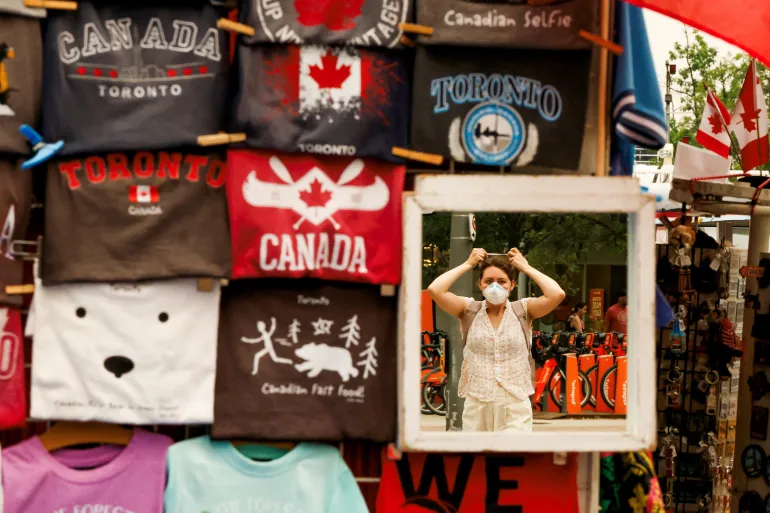
A person puts on a mask as reflected in a souvenir shop mirror, as wildfire smoke from northwestern Ontario fills the sky, in Toronto on Wednesday [Carlos Osorio/Reuters]
The Canadian government has said that wildfire season began more slowly this year than in 2023 or 2025 – the two worst seasons for wildfires – but warned that fires were likely, due to warmer-than-usual temperatures across the country.
It said some 835 active fires were burning across the country on Wednesday, with 112 considered out of control, and most in the central provinces of Manitoba, Saskatchewan and Ontario.
They have burned 1.9 million hectares (4.7 million acres) so far.
Greg Evans, a professor of chemical engineering and applied chemistry at the University of Toronto, said the city had been simultaneously hit with severe heat and wildfire smoke.
“I expect that this will occur more frequently over the coming decades, so cities and residents need to prepare for this in the future,” he said.
The UK has experienced two record heatwaves this year, with temperatures in England reaching 35.1C in May and 37.7C in June.
Published On 13 Jul 202613 Jul 2026
More than 2,700 deaths across England and Wales have been linked to unprecedented heatwaves in the United Kingdom in May and June, according to new research.
There were 550 heat-related deaths between May 21 and 29, and nearly 2,200 people died between June 18 and 28, scientists estimated in the study published on Monday.
Recommended Stories
list of 3 itemsend of list
Researchers from Imperial College London, the Met Office and the London School of Hygiene and Tropical Medicine used weather data, climate models and studies on excess deaths during the extreme weather to arrive at their estimate.
The UK Health Security Agency (UKHSA) said it would publish its official estimate of heat-related deaths in the coming weeks, based on death records from recent heatwaves.
Climate change driving heatwaves
The UK and much of Europe have already experienced two record-breaking heatwaves this year, with temperatures in England reaching 35.1C (95.2F) in May and 37.7C (99.9F) in June.
“They were extreme heatwaves for the UK, and for all parts of Western Europe, and they’re particularly exceptional for the timing and how early in the year they occurred,” said Mark McCarthy, the science manager at the Met’s climate attribution team.
Scientists emphasised the role of climate change in making heatwaves more intense and frequent.
They estimated that maximum daytime temperatures were up to 4C (7.2F) higher than they would have been without global warming.
The Climate Change Committee (CCC), the body responsible for advising the British government on climate change, warned last year that the UK was “not ready” to deal with the consequences of climate change.
Lea Berrang Ford at UKHSA’s Centre for Climate and Health Security says the study released on Monday would “help illustrate the scale of risk associated with extreme heat and the growing threat climate change poses to our wellbeing”.
In a report published in May, it estimated that 92 percent of British homes could be too hot by 2050.
It said the government should set maximum temperature limits in the workplace, as well as invest in air conditioning for public buildings such as hospitals and schools in preparation for extreme weather.
The research on heat-related deaths in the UK comes as data showed that more than 10,000 excess deaths were recorded across Europe during the heatwaves across the west of the continent in late June.
EuroMOMO, a network backed by the European Centre for Disease Prevention and Control and the World Health Organization, said most of those deaths were among people aged 65 and above, with 9,000 excess deaths reported in that age range.
Scientists pooled national mortality statistics from 27 European countries in June and concluded that, without other notable factors such as COVID-19 outbreaks, the heatwave is most likely to have contributed to the spike of 10,650 excess deaths between June 22 and 28.
Paris and Chamonix, France – Ibrahim Doukanthi prepares to plunge into the Canal Saint-Denis. It is almost noon, and the temperature in the Paris region is nearing 30 degrees Celsius (86F).
He grew up just north of Saint-Denis, one of France’s poorest municipalities, and now lives in La Plaine, hundreds of metres from the Stade de France, the country’s national stadium.
Recommended Stories
list of 4 itemsend of list
“The water here is completely normal,” he said. “It’s just that it’s green, so you don’t know what’s in it – that’s what makes it a bit scary.”
He has been jumping into the canal – technically not open to swimmers – to cool off during the recent heatwaves.
Like many residents of Paris’s sprawling, historically disinvested suburbs, Doukanthi had to be creative to beat the heat while living in an apartment building without air conditioning.
“What I do is take the spray bottles – I call them ‘pshit-pshit’ – fill them with water, spray myself down, then sit in front of the fan,” he said. “It cools you off like crazy.”
Ibrahim Doukanthi has been trying to cool off in a canal during France’s heatwave [Phineas Rueckert/Al Jazeera]
Sitting in the shade at a flea market in Saint-Denis, Natifa Segli, a municipal employee, criticised the government’s response to the heatwave.
“I don’t feel like we learned the lesson from the 2003 heatwave. Here we are in 2026, and this heatwave was horrible,” she said. “Even at work, we weren’t sheltered. The temperatures in the offices were very, very hot.”
For Segli, the only consistent solution is to avoid the sun. “We’re going to stay in the shade,” she said of an upcoming heatwave, expected later this week.
‘We really have nothing to cool off with’
In areas like Saint-Denis, access to cooling infrastructure is unevenly spread, Louiza Ammari, a childcare worker who lives in social housing, told Al Jazeera.
In her building, police banned residents from setting up an inflatable pool for children. As renters, her family is not allowed to install air conditioning. Though one municipal pool opened free swimming hours, she could not go because it does not allow burkinis.
“We really have nothing to cool off with,” she said.
Louiza Ammari tries to protect herself from the blazing sun under an umbrella [Phineas Rueckert/Al Jazeera]
In France, there were 2,025 additional deaths during the last heatwave, the week of June 22 – a week-over-week increase of 30 percent nationwide and 62 percent in the Paris region, according to the national public health agency.
Extreme heat highlights existing inequalities, according to Bruno Villalba, a political science professor at AgroParisTech Paris-Saclay, specialising in political ecology and environmental policy.
“The heatwave is merely a symptom of social vulnerability, particularly in terms of housing,” Villalba told Al Jazeera.
Wealthier people can insulate their homes, afford a portable air-conditioning unit, eat fresh produce, or even leave the city for vacation when it gets too hot, options that are unavailable to many others.
“It’s up to the government to step in,” Villalba said.
“They tell us, ‘Stay hydrated, don’t stay in the sun, drink water,’” he said. “The French government did not sufficiently anticipate the acceleration of climate change.”
‘We are not all equally exposed’
There is a pervasive misconception of “universality” when it comes to climate deregulation, noted Mael Ginsburger, a lecturer at Universite Paris Cite focused on inequalities linked to the ecological transition.
Although experienced by everyone, more vulnerable populations have limited resources to mitigate heatwave conditions.
“We are not all equally exposed, just as we are not all equally responsible. There are significant inequalities in carbon emissions,” Ginsburger said. “Not everyone is equally capable of adapting, and there are certain groups that face multiple vulnerabilities linked to poor health, for example.”
Among wealthy households in France, 70 percent consider their homes properly insulated to combat heat, compared with 46 percent of lower-income households, according to Ginsburger’s research. More people report now suffering from heat in the summer – 66 percent – than cold in the winter, 46 percent.
“Overcrowded housing is much more likely to be in poor condition and have extremely poor insulation,” Ginsburger said. “These are populations facing a combination of overcrowding in dilapidated housing located in areas like Marseille and Lyon that are particularly vulnerable to heat.
“We’re sticking with this same approach of small steps rather than a structural approach that would actually require a more far-reaching overhaul of [building] infrastructure.”
For the homeless, the ramifications of heatwaves can be even worse.
“People who are outside don’t have a moment’s respite. They are suffocating in a concrete jungle where there is no simple, effective way to escape the intense heat. On asphalt, the perceived temperature can often rise to 45-50 degrees,” Paul Alauzy, at NGO Medecins du Monde, or Doctors of the World, told Al Jazeera.
He is a member of Le Revers, an activist group that formed during the 2024 Paris Olympics to bring awareness to the conditions faced by unhoused people in the Paris region.
“We’re asking for long-term policies designed to protect as many people as possible and reduce the number of people living on the streets, precisely to shield them from the harsh weather,” Alauzy said. “Once again, the authorities are stubbornly resorting to reactive, weather-dependent management.”
During heatwaves and cold snaps, French officials usually add a few emergency shelters and install temporary water stations.
“This is obviously not nearly enough,” Alauzy said.
Not all parks and natural spaces, essential for cooling down, are accessible to all.
“Trees, which are natural tools for regulating temperatures, have been effectively pushed out of our cities,” Villalba said, especially in deprived areas.
In places like Saint-Denis, schools and other public infrastructure are insufficiently equipped, said Ammari, the childcare worker.
‘Definitely an advantage to be at an altitude’
Even in the mountains, temperatures rose above 30C during the last heatwave, about 10C (18F) above normal end-of-June temperatures.
In Chamonix, the Bossons Glacier above town visibly shrank and conditions along popular routes up Mont Blanc and neighbouring peaks are becoming dangerous due to rockfall risks.
But nights are not stifling, and locals and visitors in the Alps sleep comfortably.
There are forested trails and a river fed by glacial melt that cools the surrounding area.
“In Chamonix, like in many mountain towns, it’s definitely an advantage to be at an altitude of 1,000 metres [3,280 feet] and to have the forest a few minutes from home,” Jean-Michel Bouteille, who recently retired from his role as director of municipal services in Chamonix, told Al Jazeera. “We’re a town of 9,000 people, but we still have nearby green spaces that are free and easily accessible.”
Although the mountain weather is not oppressive, climate change is felt in Chamonix.
“We have temperatures much higher than in previous years, which is leading to significant consequences. The Bossons Glacier is a disaster,” said Bouteille, who has lived in the valley for 26 years.
World Meteorological Organization forecasts more likelihood of heatwaves, droughts and heavy rainfall due to El Nino.
Published On 3 Jul 20263 Jul 2026
The United Nations’ weather watchdog is warning governments and humanitarian organisations to brace for “extreme weather events” including heatwaves, droughts and heavy rainfall due to the El Nino weather phenomenon.
The World Meteorological Organization (WMO) said in a statement on Friday that El Nino conditions had already set in and are “forecast to strengthen rapidly” between July and September.
Recommended Stories
list of 3 itemsend of list
El Nino typically peaks between November and February.
The UN agency has activated climate information services and early warning systems to help governments and humanitarian agencies prepare support plans for farmers and vulnerable communities.
“El Nino conditions are already under way and are forecast to strengthen rapidly into a strong event – as accurately anticipated by WMO forecasts,” said WMO Secretary-General Celeste Saulo.
“This will intensify the chances of drought and heavy rainfall and the risk of heatwaves on land and marine heatwaves in many regions of the world.”
Saulo added that “advanced seasonal forecasts and early warnings are vital to save lives and cushion the impact on our economies and our communities.”
El Nino is a natural climate phenomenon that warms surface temperatures in the central and eastern equatorial Pacific Ocean, bringing worldwide changes in winds, pressure and rainfall patterns.
El Nino events typically occur every two to seven years and usually last between nine and 12 months. Not all regions of the world are affected.
Conditions oscillate between El Nino and its opposite La Nina – both phases of the El Nino-Southern Oscillation (ENSO) – with neutral conditions in between.
Even when ENSO is neutral, extreme weather can still occur.
On Thursday, the WMO reported that global ocean temperatures hit a new high in June, partly driven by El Nino.
The last El Nino contributed to making 2023 the second-hottest year on record and 2024 the all-time high, at about 1.55 degrees Celsius (2.79 degrees Fahrenheit) above the 1850-1900 pre-industrial average.
Temperatures in Europe hit a new high this summer, with hotter early-summer heatwaves triggering illness, deaths and the collapse of infrastructure across the continent.
Transport buckled on Sunday as temperatures hit 40C (104F) across Germany, the Czech Republic and Poland. In France, days averaging 29.8C (85.6F) – spiking to 44C (111.2F) in one town – gave way to storms, leaving an estimated 1,000 excess deaths behind.
Scenes like this may well be the new normal.
Last summer’s heatwave alone caused an estimated 2,300 climate-related deaths in 12 European countries, WWA says.
A study by World Weather Attribution (WWA) has found that intense heat on this level is now tens to hundreds of times more likely than it was in 2003, and was unheard of 50 years ago.
“Heat-related mortality is likely to remain a feature of Europe’s warming climate,” warns Dr Hans Kluge, the World Health Organization (WHO)’s regional director for Europe. Deaths have already risen by an average of 52 per million people annually since the 1990s, he told Al Jazeera – a trend he says shows little sign of reversing on its own.
So what does this mean for the future? Are these temperatures the new normal, and if so, why?
We asked the climate experts:
Is this really the new normal?
Yes, it certainly looks that way. According to WWA, heatwaves were generally about 3.5C cooler in June 1976, and 2C cooler even in 2003.
“Think of it like a race where the starting line has been moved much closer to the finish,” Dr Akshay Deoras of the University of Reading told Al Jazeera. Ultimately, this is down to global warming, he says.
Europe has warmed at roughly twice the global average since the 1980s, according to the European Commission’s climate change service, Copernicus.
Deoras says this amounts to “loading the dice” towards once-rare extremes.
WWA’s modelling goes further: at current emissions rates, an event of the magnitude of this summer’s heatwave is expected to occur every couple of decades – and today’s extremes are effectively a preview of what an ordinary summer could look like by the middle of the century.
Why is this happening in Europe now?
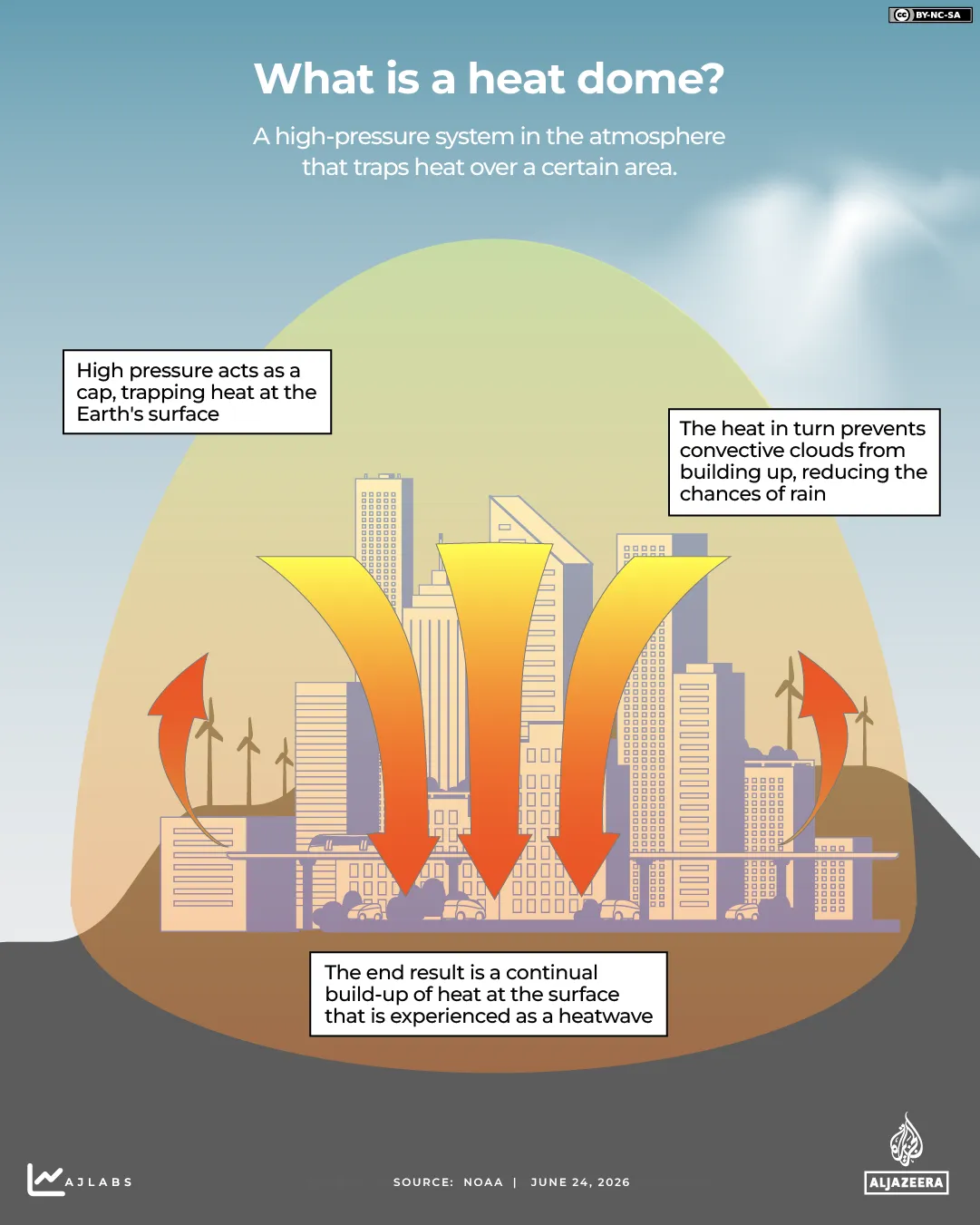
The immediate trigger is a stalled high-pressure system, or a “heat dome”, which traps heat in one concentrated area for days or weeks.
Heat domes aren’t new, but Europe’s already-shifted baseline means the same pattern now produces far hotter outcomes than decades ago, Deoras told Al Jazeera.
Professor Hannah Cloke of the University of Reading told Al Jazeera that’s because the warming behind new, extreme weather patterns comes from emissions released decades ago, and the climate system takes time to respond – so we’re feeling the effects now of pollution from the past.
Copernicus’s European State of the Climate 2025 report confirms this: more than 95 percent of the continent saw above-average annual temperatures last year, alongside record Alpine glacier loss and the highest sea-surface temperatures ever measured in Europe.
And because Europe is warming roughly twice as fast as the rest of the planet, that gap with the global average is projected to keep widening – meaning whatever the world experiences on average in the coming decades, Europe will likely see first, and worse.
Is this trajectory irreversible?
Partly. Some of the damage is permanent. Some of it isn’t – yet.
Take glaciers. Because the effects of pollution from decades ago are cumulative, “some of what we are experiencing this summer is already locked in”, Cloke says.
Alpine glaciers, which feed major European rivers, she says, have already shrunk past the point of recovery, and their contribution to summer river flow is “permanently reduced”.
Not everything is set in stone, however. “Every tonne of emissions avoided changes the odds of what comes next,” Cloke says.
What we do now, therefore, will decide the difference between summers that are simply hard to live with in the future, and summers that become “genuinely beyond our ability to cope with”.
Some resources, like groundwater in northern Europe, can still recover – “but the window to act is narrowing with each dry year”, she says.
What is this doing to human health?
The toll is already severe and likely to worsen.
The Lancet Countdown Europe calculates that there were 62,000 heat-related deaths across the region in 2024 alone, with projections showing a steep further rise by 2050 if we don’t make changes.
Much of the problem, Kluge told Al Jazeera, is architectural and largely unaddressed.
“Most of the housing stock across this region was designed for a colder climate – to retain heat, not shed it,” he said, warning that without large-scale retrofitting, deaths could keep climbing past 2050 regardless of how good warning systems become.
His prescription: treat heat as predictable, not an emergency.
“Governments need to plan for heat the way they plan for winter flu – as a recurring, predictable challenge requiring permanent infrastructure, not a one-off crisis requiring emergency improvisation.” The highest-return step, he added, is identifying who’s most at risk – often older people living alone – and reaching them before a heatwave hits, not after.
What else can be done?
Cloke points to two priorities: early warning systems that reliably reach the people who most need to be protected, and an overhaul of water infrastructure in Europe which has been built for rainfall patterns that no longer exist.
Deoras says emissions also still matter: cutting them won’t eliminate heatwaves, which are “a natural part of the climate system”, but doing so would make them “less intense, less frequent and shorter-lived”.
None of the experts who spoke to Al Jazeera describe this as hopeless.
They do warn that the window of opportunity for addressing the issue is narrowing: infrastructure can still be retrofitted, emissions can still be cut, warning systems can still be improved – if the decisions to do so are made now, rather than after the next heatwave.
What a “normal” European summer looks like in 2050 is still being written, they say.
Last week, the U.S. Forest Service and Department of the Interior expanded the situations in which their firefighters are allowed to wear N95 masks.
Starting in September, the federal government began allowing firefighters to wear the masks, but not when they were working on the fire line, only at times such as in camp and sitting in vehicles. Now they’ll be allowed to wear them during some work battling wildfires, including patrolling for areas where the blaze has jumped past fire lines and putting out smoldering remains after a fire is contained.
Masks are still prohibited during firefighters’ most grueling tasks — digging lines to stop fires and directly attacking flames. And the masks they’re using, N95s, do not protect against all of the toxic substances in wildfire smoke.
Nonetheless, health experts applauded the move as a step in the right direction.
Here’s why it took so long to get here:
You’re reading Boiling Point
The L.A. Times climate team gets you up to speed on climate change, energy and the environment. Sign up to get it in your inbox every week.
By continuing, you agree to our Terms of Service, which include arbitration and a class action waiver. You agree that we and our third-party vendors may collect and use your information, including through cookies, pixels and similar technologies, for the purposes set forth in our Privacy Policy such as personalizing your experience and ads.
Research has linked wildfire smoke to a range of long-term health issues, including respiratory problems, cardiovascular diseases and cancers.
“The fire service knows that,” said Rachael Jones, professor and chair of environmental health sciences at UCLA’s Fielding School of Public Health. “They all have stories” of lung damage or cancer, either their own or their coworkers’.
But this wasn’t always common knowledge.
“The verbiage was that wildland smoke was benign,” one firefighter told Jones’ colleagues for a recent study on firefighters’ thoughts on mask use. “It was like sitting around a campfire.”
Even as scientists and fire officials came to terms with the very real long-term health risks, some firefighters still had concerns that masks could muffle communication, make it hard to breathe and interfere with other equipment. That slowed adoption.
Missing crucial orders because a voice is muffled, or struggling to pull out an emergency fire shelter because a mask is in the way, could be the difference between life and death.
“These are not trivial things when the fact is that they reflect life safety outcome,” Jones said.
Deciding on the right type of mask or respirator has slowed adoption too. There are no commercially available respirators that protect against all of the dangerous pollutants in wildfire smoke.
Scientists have not even fully determined which pollutants pose the greatest risks to firefighters, further complicating a choice.
N95s filter for solid particles in the air but not dangerous gases. Heavy smoke or sweat can cause them to clog.
Half-face respirators — often gray rubber with pink canisters — offer different filters for different gases, but none can filter all of the concerning gases in wildfire smoke. The masks and backup canisters are also much bulkier to carry around than N95s.
Respirators that can filter out all of the “literally hundreds” of concerning compounds in smoke “just simply don’t exist,” said Matt Rahn, research director for the Wildfire Conservancy, a nonprofit dedicated to protecting firefighters.
The result: “In our pursuit for perfection in finding the best respiratory devices for firefighters, we’ve basically fallen into a decision paralysis of doing nothing,” Rahn said. “It’s been that way for years.”
The federal government acknowledges the limitations of N95s in its educational material for firefighters. In a statement to The Times, the Forest Service said it will begin studying different respirators in a small pilot program to “determine if their use will be suitable for the wildland fire environment.”
The Forest Service said that N95s are already “readily available” to its firefighters and that it has more than 30,000 of them.
More recent wildfire news
Many in the western United States will have to celebrate the country’s 250th birthday with fewer fireworks due to heightened wildfire risk. Utah’s governor restricted fireworks statewide through July 5 as multiple wildfires raged in the state and the National Weather Service issued a rare “Particularly Dangerous Situation” warning, Kathy McCormack reports for the Associated Press. California officials, meanwhile, warned of zero tolerance for illegal fireworks, with some local governments recently increasing fines, Kassia Bonesteel reports for CBS News.
Three federal wildland firefighters were killed and two were injured by the fast-moving Knowles fire in Colorado on Saturday. As a ground crew began some of the first attacks on the fire, an order came over the radio to “get out of there now,” CNN reported. Within minutes, the crew was forced to deploy their emergency shelters, a desperate last line of defense when escape is impossible. Firefighters lined the streets of Grand Junction, Colo., on Sunday in a procession for their fallen colleagues.
Much of the western U.S. is facing above normal fire potential after one of the hottest and driest winters in recent years. Coastal Southern California, conversely, is facing average wildfire potential, fire weather analysts say, thanks to monsoon breezes bringing damp air from the tropics.
A few last things in climate news
A pair of hazardous chemical crises in Greater Los Angeles — at an aerospace facility in Garden Grove and a warehouse in Boyle Heights — have left Californians questioning why environmental and public health agencies such as the South Coast Air Quality Management District and the state’s Division of Occupational Safety and Health failed to address known risks, a team from CalMatters and the LA Local reports.
The Boyle Heights warehouse fire coincided with a spike in emergency room visits for smoke inhalation and throat pain, my colleague Hayley Smith found. Meanwhile, the water used to fight the toxic blaze ended up in the Los Angeles River, The Times’ Mack Baysinger reports. Local organizers collected water samples for testing as L.A. County public works deployed floating barriers to contain the runoff.
The headwaters of the Colorado River, a vital source of water for 35 million people and 5 million acres of farmland, is drier than anyone can remember, my colleague Ian James reports. As seven U.S. states and Mexico remain gridlocked in complex debates over use of the river, it’s a stark reminder that the climate of the 21st century will leave less for everyone.
Europe is facing its second major heat wave of the year, with France recording its hottest day ever, Lauren Dalban reports for Inside Climate News. As residents struggled to handle the extreme heat, worsened by climate change, so did climate infrastructure championed to combat it. Trains were halted as the heat risked buckling tracks and nuclear reactors were slowed or powered off as the cooling water they discharged became too hot, the New York Times’ Chico Harlan reported.
This is the latest edition of Boiling Point, a newsletter about climate change and the environment in the American West. Sign up here to get it in your inbox. And listen to our Boiling Point podcast here.
A punishing heatwave affected many parts of the country during the last week of the month.
Published On 1 Jul 20261 Jul 2026
Last month was provisionally the warmest June in England since records began, as well as the second-warmest for the United Kingdom, according to figures published by the country’s Met Office.
Rare extreme heat warnings were issued for several days last month, with “exceptionally warm overnight temperatures”, the weather agency said on Wednesday.
Recommended Stories
list of 4 itemsend of list
England registered an average temperature of 17.1C (62.78 degrees Fahrenheit) last month – the highest since records began in 1884.
“The exceptional warmth was driven by an intense and record-breaking heatwave at the end of the month,” the Met Office said in a statement.
The previous record of 16.9C (62.4F) was set in June 2025, nearly 3C (5.4F) above the long-term average. It means England’s top three warmest Junes since data began in 1884 have all occurred this decade, with the third being in 2023.
A punishing heatwave affected many parts of the country during the last week of the month, with temperatures topping 30C (86F) at some places in the UK for seven days in a row from June 21-27.
A peak of 37.7C (99.86F) was provisionally reached at Lingwood in Norfolk on June 26 – the highest maximum temperature ever recorded for the month.
This was more than 2C higher (3.6F) than the previous June record of 35.6C (96.08F), set in 1957 at Camden Square in London and equalled in 1976 at Mayflower Park in Southampton.
Last month also saw a provisional new June record for the highest overnight minimum, with temperatures at Cardiff Bute Park dropping no lower than 23.5C (74.3F) on June 25.
More than 1,000 schools and nurseries were closed during the heatwave, and there was disruption to public transport with overhead wires and signalling strained because of the heat.
Critics felt the country was ill-prepared to deal with the sweltering heat. Climate experts have urged the UK government to adapt its infrastructure to warming summers, with a surge in demand for fans and air conditioners, which remain rare in British homes.
The heatwave has also affected many countries in Europe, including France, Germany, Slovakia, Serbia, Croatia, Italy, Austria and western Ukraine, with more than 1,000 deaths linked to the scorching heat reported in France alone.
A group of scientists blamed climate change for the dangerous weather blazing across Europe. In a report by the World Weather Attribution, experts warned that the phasing out of fossil fuels is essential to reverse the extreme weather trend.
An intense heatwave is set to blanket much of the central and eastern United States this week as a “heat dome” settles over the region, bringing days of oppressively high temperatures and humidity ahead of the Fourth of July weekend and FIFA World Cup matches in several US cities.
Forecasters say in some places it could feel as hot as 46 degrees Celsius (115 degrees Fahrenheit). Dozens of temperature records could be broken, according to the National Weather Service (NWS), which called the conditions “dangerous”. More than 60 million people are currently under heat alerts.
Recommended Stories
list of 4 itemsend of list
At the centre of this week’s forecast is a weather phenomenon known as a heat dome. What is it, and why does it make heatwaves even more intense and unbearable?
What is a heat dome?
A heat dome is a large area of high pressure, formed when warm air flows northward, that acts like a lid over the atmosphere, trapping hot air close to the ground.
As the air sinks, it compresses and warms even more. At the same time, the pressure system helps prevent cooler air and storms from moving in, allowing heat to build at the surface and remain trapped there. With few clouds and little wind, the sun has more direct access to the ground, creating a heat feedback loop.
Heat domes are linked to prolonged heatwaves that can last for days.
How long will it last?
The heat dome is already building and is expected to strengthen over the coming days, spreading from the central US towards the east coast, with dangerous heat lasting several days into early July.
The hottest conditions are expected Thursday and Friday, according to the NWS, and are set to continue through the Fourth of July weekend, which marks the 250th anniversary year of the US, and forecasters say some areas across the Great Plains, the southeast, and the mid-Atlantic are likely to remain unusually hot into next weekend.
What will the highest temperatures be?
Many places are expected to see daytime temperatures in the high 30s Celsius (low 100s Fahrenheit), but humidity will make it feel much hotter. In parts of the central and eastern US, the heat index – a measure of how hot it feels when humidity is factored in – could climb between 40C and 46C (100F and 115F).
“That’s heat that’s impactful to anyone,” said NWS meteorologist Bryan Putnam. “It’s not just older adults or younger children or people who are spending a ton of time outdoors, maybe straining themselves a little more than normal. This is heat that really could impact everyone, especially with people outdoors going into the holiday weekend.”
The nights won’t bring much relief either, with temperatures expected to stay in the 20s Celsius (70s Fahrenheit) overnight, creating potentially miserable sleep conditions for those without air conditioning and making it harder for people to cool down.
“Even after the sun goes down, it’s still going to be very hot,” said AccuWeather senior meteorologist Alan Reppert. “We’re at a pattern that’s really going to be hot during the good portion of the afternoon and even into the evening hours.”
Which parts of the US will be hit the hardest?
The most dangerous conditions are expected in a broad corridor stretching from the Great Lakes to the East Coast, where several cities could experience their hottest day of the year so far. New York City, Philadelphia, Washington, Baltimore, Chicago, Indianapolis, Detroit and St Louis are all expected to be affected, with temperatures also soaring farther south in Dallas, Little Rock and Memphis.
Several of those cities are also hosting FIFA World Cup events. In Philadelphia, organisers have already changed Fan Festival hours to start later in the day.
Cities across the US are rolling out emergency measures as temperatures climb.
Chicago said it would open cooling centres and send city workers to check on vulnerable residents.
In New York City, Mayor Zohran Mamdani’s office announced what it called an “unprecedented” response to the heat, including hydration vans and pop-up cooling stations equipped with misting fans and cooling towels.
Washington, DC, where temperatures are expected to exceed 38C (100F) from Thursday through Saturday, the heat will coincide with Fourth of July celebrations, including what organisers say will be the largest fireworks display ever held on the National Mall.
What are some ways to stay cool?
The NWS says people should stay hydrated, avoid strenuous outdoor activity during the hottest part of the day and seek air conditioning or cooling centres where possible. If you’re spending time outside, wear loose, lightweight clothing and stay near shady areas.
Experts say one of the biggest risks during a prolonged heatwave is that the body doesn’t have time to cool down overnight, which can make the effects of the heat build up from one day to the next. They also recommend drinking water before you feel thirsty and limiting alcohol, which can increase the risk of dehydration.
“If somebody realises that they’re hot, but they’re not sweating, or if they begin to feel a little bit dizzy, those are some signs that they really need to take a break, get inside, find some cooling, and drink plenty of water,” said Geoff Cornish, assistant chief video meteorologist for the weather forecasting company AccuWeather. “And if they really begin to experience significant symptoms, they need to seek medical attention right away.”
Grid operators warn the US heatwave could send electricity demand near record levels before the Fourth of July holiday.
Power grid operators in the United States are warning that a dangerous heatwave could put more strain on an electric grid already under pressure from surging energy consumption.
A stretch of extreme heat is expected to intensify across much of the central and eastern parts of the country this week, peaking from Tuesday through Thursday.
Recommended Stories
list of 3 itemsend of list
That heatwave is likely to continue through one of the busiest travel weekends of the year, as millions of Americans prepare for Fourth of July celebrations on Saturday.
Temperatures this week are forecasted to climb above 38 degrees Celsius (100 degrees Fahrenheit) from Boston to Washington, DC, pushing up demand for air conditioning.
The heatwave coincides with two major events on the US calendar. Saturday’s holiday marks the 250th anniversary of the US’s independence, and millions are expected to gather for barbecues, parades and fireworks.
The extreme temperatures also come as the FIFA World Cup has reached the knockout stage, with many host cities, including New York, Boston, Philadelphia and Washington, expected to feel the heat.
Humidity could push the heat index as high as 46 degrees Celsius (114 Fahrenheit) in some places, while overnight temperatures will offer little respite.
The US’s largest regional grid operator, PMJ Interconnection, is forecasting record summer electrical demand of 166.3 gigawatts for Thursday evening, surpassing the previous summer peak set two decades ago, in 2006.
The New York Independent System Operator (NYISO), the state’s grid operator, is also expecting electricity demand to approach record highs, while the Midcontinent Independent System Operator (MISO), which covers 15 states in the Midwest and South, could also see its peak demand record challenged.
Authorities at MISO say they will rely on PMJ for support in covering consumer needs.
In a May report, PMJ’s executives warned of a “fundamental mismatch between how fast demand is growing and how quickly new supply can be built and connected to the grid”.
New power plants, they said, now take twice as long to build and cost twice as much as they did a decade ago.
Meanwhile, there has been increasing pressure on electrical grids from new technology like data centres and electric vehicles.
In May, PMJ said hyperscale data centres were “adding load at an unprecedented pace”.
Experts say the artificial intelligence (AI) boom is colliding with climate change, with tools like ChatGPT, Gemini and Claude being processed in vast, energy-hungry data centres.
The most energy-intensive are the hyperscale facilities that require between 100 and 300 megawatts of electricity, enough to power hundreds of thousands of homes.
Many of those are concentrated in northern Virginia, which sits within PJM’s service territory and is widely described as the world’s largest data centre hub.
Researchers have also identified what they call a “data heat island effect”, finding that land surface temperatures around AI data centres rise by an average of 2 degrees Celsius (3.6 degrees Fahrenheit), with some locations seeing increases of up to 9 degrees Celsius (16.2 degrees Fahrenheit).
The National Weather Service in the US warns that long periods of extreme heat create significant stress on the body.
It has urged people to limit outdoor activity, stay hydrated and keep close to air conditioning or cooling centres.
A 2024 report from the Journal of the American Medical Association (JAMA) found that 21,518 deaths in the United States from 1999 to 2023 were heat-related.
The highest number came in the final year of the report’s analysis, 2023. That year, 2,325 people died from causes attributed to high temperatures.
Every morning Marisol Winfrey Herrera’s three-and-a-half-year-old daughter Jo reminds her to turn off the tap while washing her hands and brushing her teeth.
When they leave home, she reminds her mother to keep a bottle of ice with them to offer it to homeless people, who they sometimes find wilting in the Tucson heat. At first, they press the ice-filled bottles on the homeless folks to help them revive, then they offer the water to drink and hydrate. At her daycare, Jo is taught water-saving habits to combat Tucson’s soaring heat.
It is what prompted Herrera to join No Desert Data Center, a residents’ group that opposes two large data centres coming up on either side of Tucson – the $3.6bn project on the city’s southeast edge and a $5bn project on its northwest side in the town of Marana, together known as Project Blue.
The group believes these would consume more water and power than the city set in the Sonoran Desert can afford.
“We are in the middle of a 30-year drought, which is now an extreme drought,” says Lisa Shipek, co-executive director of the Watershed Management Group, a Tucson-based nonprofit.
“Water was a unifying theme in our campaign. The Colorado River cuts are looming, and this project would take water away,” Herrera told Al Jazeera.
Water flows in the Colorado River, which provides much of Tucson’s water through the Central Arizona Project canal system, have dropped by 20 percent since the year 2000 compared with water flows in the 20th century due to climate change, melting snow caps and warmer weather, making water cuts to Tucson imminent as the state could face as much as 77 percent water cuts.
“We say Not One Drop for data centres,” says Herrera, speaking of the campaign’s particularly emotive appeal for residents as water cuts get deeper and temperatures rise, with Tucson recording the warmest weather in 125 years last July and August.
Beale Infrastructure, a San Francisco-based company that is owned by investment management company Blue Owl in New York, had asked the city of Tucson to acquire 290 acres that were outside city limits for Project Blue. That would make it the city’s largest water consumer and among its largest power consumers. Beale did not respond to an emailed request for comment.
But at city council meetings, City Councillor Kevin Dahl began seeing hundreds of residents turn up to express their opposition to the project.
“Not for many issues do we get so much response,” he said. Herrera was among those who went.
Pitting environment against unions
At council meetings, Beale executives proposed that Project Blue could be the economic engine the city needed. It would create a few thousand jobs for construction workers, ironmongers, plumbers and other such workers during the construction of the project and a few hundred after that.
“Sometimes people travel as far as Phoenix for work,” Dahl said about Arizona’s largest city, which is nearly a two-hour drive from Tucson.
The project could bring jobs closer. Beale also expected the project to generate nearly $250m in taxes for the city, county and state in the first 10 years.
This left councillors with a difficult decision to make, weighing the project’s economic benefits against allocating it a share of the city’s increasingly scarce water and power.
Tucson residents raised questions in a town hall about whether proposed rate hikes by TEP, their power utility, is due to capacity expansion for data centres [Photo Courtesy Kathleen Dreier]
Activists also raised concerns about whether Tucson Electric Power (TEP), the power utility, would raise rates for consumers so it could expand capacity to provide power for Project Blue. After raising rates by 10 percent in 2023, TEP proposed a 14 percent rate hike in June 2025 for grid upgrades made in the previous year.
Lee Ziesche, an activist from the Democratic Socialists of America who is campaigning to make TEP a public utility, said Project Blue could “lead to higher temperatures and higher rates” because of the heat island effect of the air conditioners and higher rates for power.
She often hears from residents that a rate hike would make it hard to pay bills or put on air conditioning, even as the number of 100-degree Fahrenheit (37.8 degree-Celsius) days has increased in Tucson, which is among the hottest cities in the United States.
The same concerns of needing ramped-up air conditioning would plague data centres too, experts say.
“The viability of data centres in Arizona will always be subject to climate change and heat risks,” says Kate Gordon, chief executive of California Forward, a think tank that works on a sustainable economy.
“The heat in Arizona makes energy less efficient, and servers heat up, so projects will need higher amounts of water and cooling, which developers have to balance against a possibly lower real estate and labour cost,” she said. “I am always amazed at how climate does not figure in business plans.”
Dahl and Andres Cano, a supervisor in Pima County, in which Tucson is located, had discussions with Beale representatives.
“We thought they would go elsewhere if the city did not acquire the land” for the project, Dahl said. Cano also came away with the same impression.
In August 2025, Tucson councillors voted unanimously not to acquire the land for the project or provide it with water and power. In December, Cano became one of only two supervisors in Pima County to oppose the project, and it was approved for construction in an unincorporated part of the county.
“It will create short-term construction jobs for what will ultimately be a project with few wins,” Cano said. “This pitted the environment and unions, but industry is not for unions. This will have just about 100 jobs when it is done.”
With no access to Tucson’s water supply, Beale decided to cool its servers with air conditioners rather than water and use a closed-loop water system, so it would recycle and reuse water.
But Vivek Bharathan, a spokesperson for the No Desert Data Center, said using air conditioners would increase power usage.
Nearly half of TEP’s power comes from fracking, he says. Data centre demand will only mean “more fracking somewhere else, climate and health consequences all along the way”.
The state’s largest data centre
Even as Project Blue was making its way through a fraught approval process, Beale announced another data centre project in the neighbouring farming town of Marana. It was to be spread over 600 acres (242 hectares), twice the size of Project Blue. The area was spread over two farm plots, one owned by the Mormon church and the other by a family trust of city council member, Herb Kai.
This project, too, is slated to bring thousands of construction jobs to a farming town as well as tax revenues.
Tucson residents are protesting upcoming data centres [Photo courtesy Kathleen Dreier]
But when Jackie McGuire, a mother of three and former Wall Street banker, heard about it, she and other residents launched a campaign to stop the land from being rezoned for a data centre. Residents wanted Marana to stay a farming town.
McGuire, who works as a research analyst, said the data centres’ servers and large air conditioners that would be installed to keep them running would raise the project’s cost and make Marana unbearably hot.
Temperatures rose by up to 2.2F (1.22C) downwind from data centres in the Phoenix area, a study published in May had found.
“The heat generated will be like one to two million space heaters,” McGuire says. “It can go up to 112 degrees [44.4C] here already. The heat island effect could make Marana uninhabitable.”
The Marana data centre will be provided power by TEP and Trico, which announced a 7.23 percent rate hike in January.
McGuire and other residents campaigned to have a referendum on whether the land could be rezoned for a data centre. Their plea was not successful, and the city council approved the rezoning of the land.
But the experience of the campaign had invigorated McGuire, and she decided to run for city council herself. The central issue of her campaign is to bring transparency to the data centre’s functioning.
Even as the campaigns in Pima County and Marana raged on, La Osa, the state’s largest data centre project, took shape in Tucson’s neighbouring Pinal County. The 3,300-acre project by the Vermaland real estate group was expected to house 59 data centres and two of its own natural gas facilities, as well as a utility-scale battery storage system.
But residents worried about noise pollution from protracted project construction and a possible increase in power costs.
“I’m worried about the constituents in that area, about the power bills going up, even though you’re saying that they’re going to pay for it,” Pinal County Supervisor Rich Vitiello said in a board of supervisors meeting on May 27.
In the face of such opposition, a La Osa lawyer spoke at the meeting to say the project had been scaled down and would now house 11 data centres from the 59 planned earlier.
‘A straw to the aquifer’
Sharing limited water has long been an emotive issue in the state, and the looming Colorado River cuts and data centre projects have brought such concerns to a head.
Arizona fought one of the longest-running cases, stretching more than three decades, in the US Supreme Court over the sharing of Colorado River water with California. Eventually, Congress adjudicated to provide California with a greater share of the water, which turbocharged its economic growth.
“No water can flow into Tucson and Phoenix unless California gets its full share,” says Jason Robison, co-director of the Gina Guy Center for Land and Water Law at the University of Wyoming College of Law. “Arizona has always been in a tough spot.”
It strengthened the state’s long-held tradition of conservation.
“Arizona communities have been preparing for the drought conditions we see today since 1980,” a spokesperson for the Arizona Department of Water Resources said in an emailed response.
Authorities have curtailed lawns in Tucson, he said, and educational campaigns of the kind Herrera’s daughter underwent are the norm.
It has meant that groundwater reserves go deep, and homeowners are assured of a water supply before it is given to data centres or farms.
“The use by data centres is low compared to farm use, especially alfalfa and hay,” says Eric Kuhn, retired general manager of the Colorado River Water Conservation District and co-author of Science Be Dammed: How Ignoring Inconvenient Science Drained the Colorado River.
However, “data centres are not under the same rules to replenish water” as other industries, says Sharon Medgal, director of the Water Resources Research Center at the University of Arizona. “So it adds a straw to the aquifer.”
Arizona’s governor, Katie Hobbs, who is up for re-election in November, has represented to the Bureau of Reclamation that the state is home to essential industry, including semiconductors, space and data centres, and so needs a higher share of water from the Colorado River. Water, as well as its use for data centres, has been an important issue in primary races across the state.
Construction began for Project Blue at the end of April. No Desert Data Centers’ activists arrived just after dawn to protest. Within days, they found subcontractors bringing in water to control dust on site from construction. County authorities cited Beale.
Then Beale began digging wells on site after reportedly receiving permits allowing that from the Arizona Department of Water Resources. This is likely for 31,000 gallons (more than 117,000 litres) a year, which is just enough for toilets and kitchens and will likely be recycled for reuse after.
“This may not yet be a winning story,” Bharathan, the spokesperson for the No Desert Data Center, said. “But it is a continuing story.”
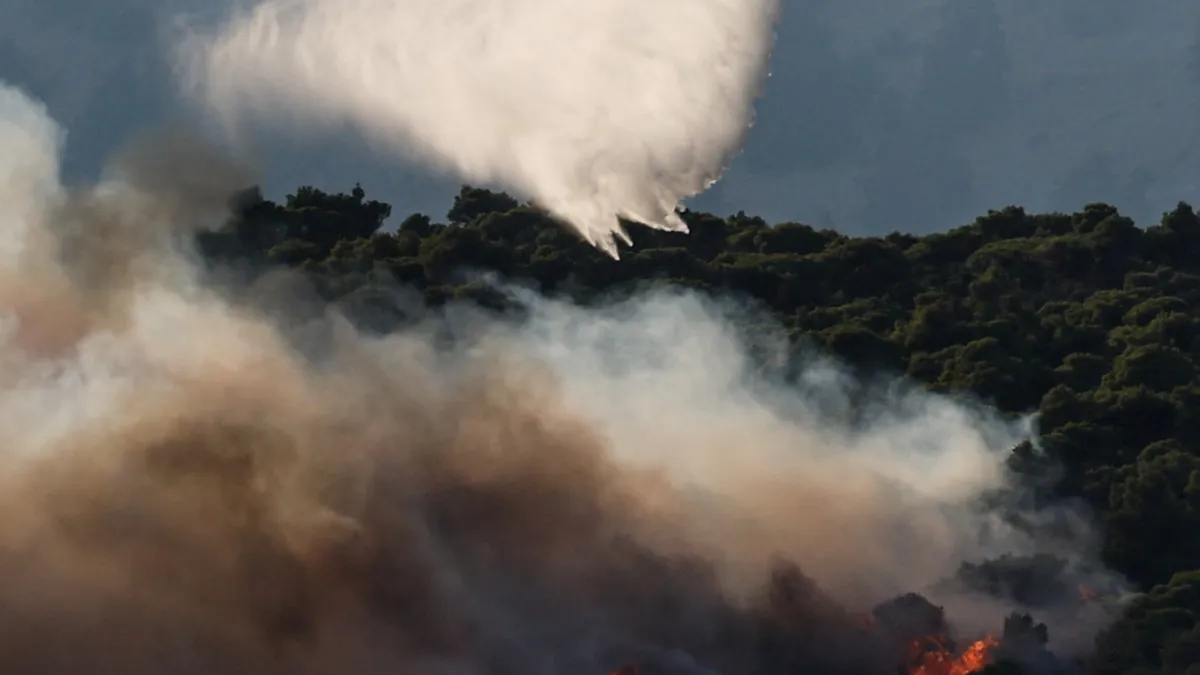
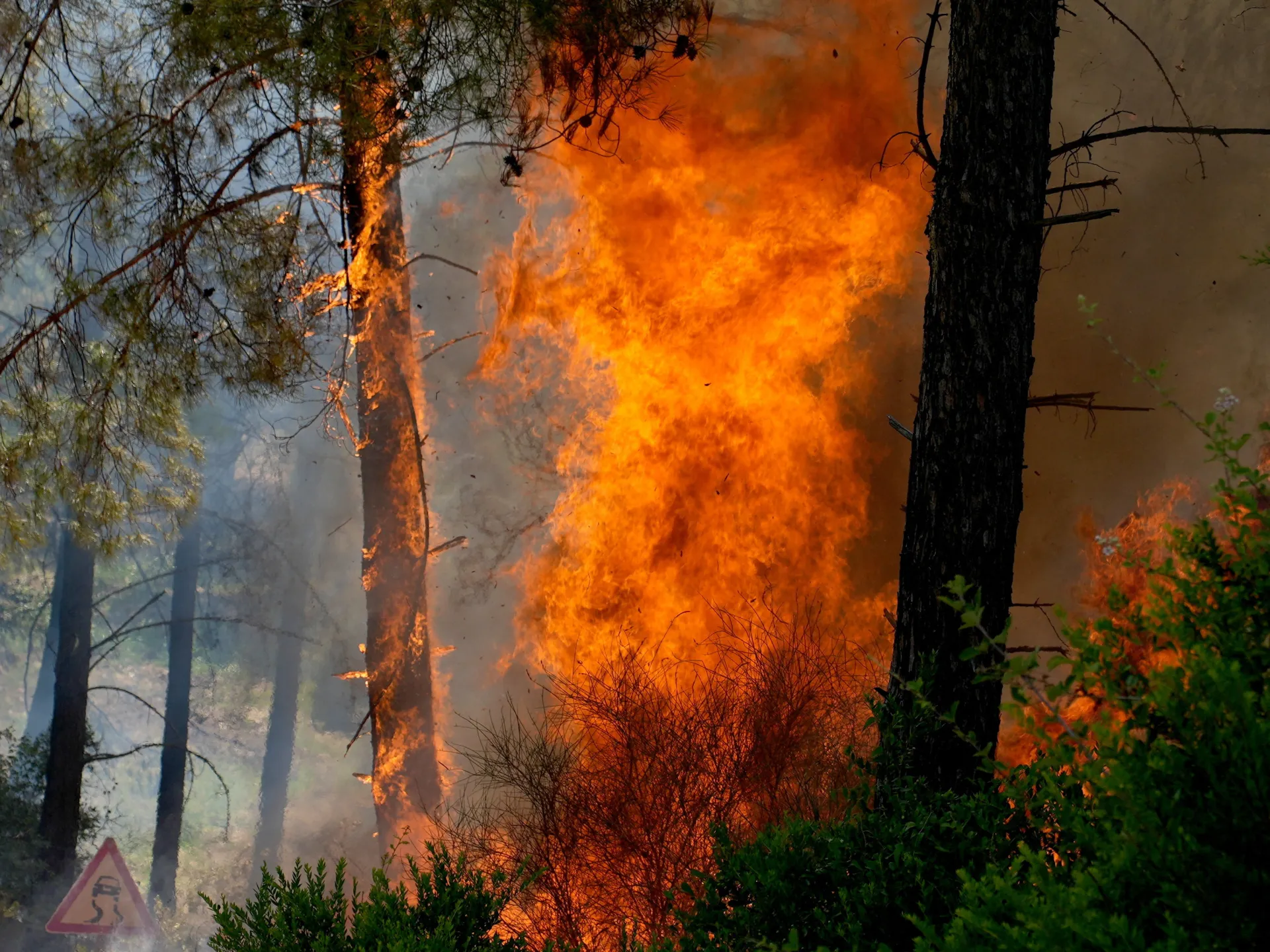

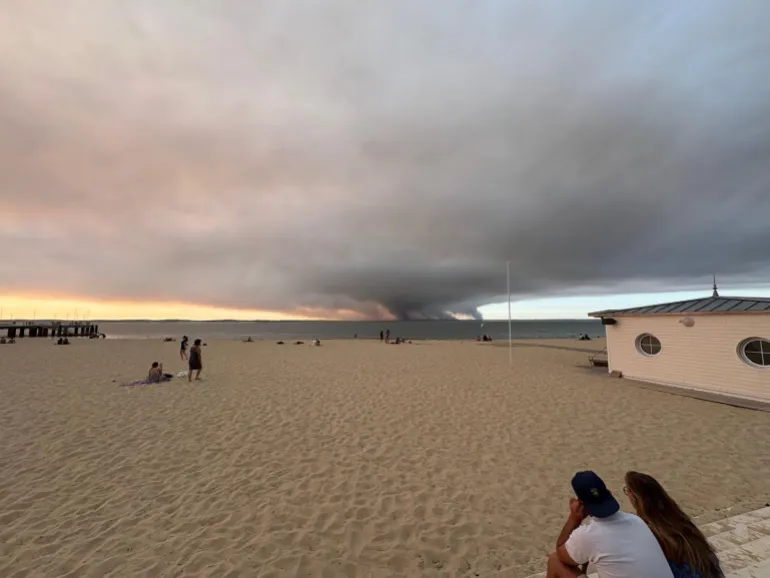

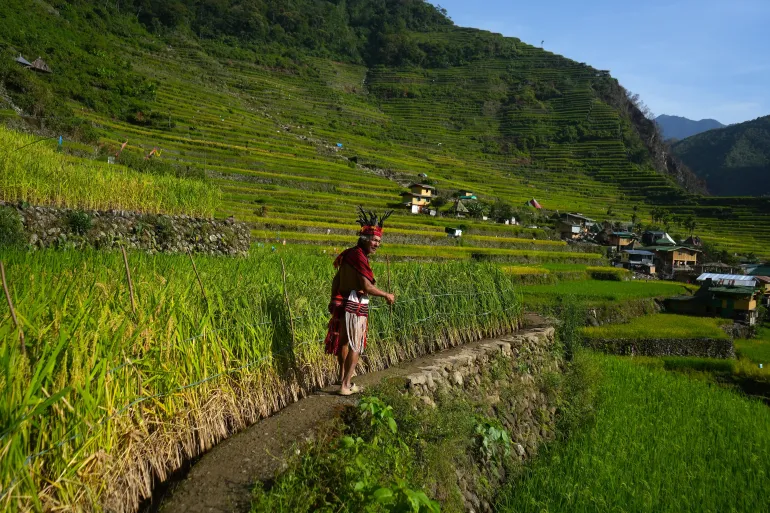


![Batad village chairman Romeo Heppog [standing left] said it is crucial for the national government of the Philippines to allocate enough funds in order to speed up the repair of the rice terraces following the November 2025 landslide.](https://i0.wp.com/www.aljazeera.com/wp-content/uploads/2026/07/PHOTO5-1784532889.jpg?w=640&ssl=1)

![Apu Buy-a Nadyug [centre], the chief indigenous priest of Batad, joins two other village elders during the Tanig, a blessing ritual before the start of the harvest festival.](https://i0.wp.com/www.aljazeera.com/wp-content/uploads/2026/07/PHOTO2-1784532893.jpg?w=640&ssl=1)