climate crisis

Climate change the culprit for Europe’s ‘most severe’ heatwave: Report | Climate News

The extreme June temperatures would have been ‘virtually impossible’ 50 years ago, says the World Weather Attribution group.

The historic heatwave gripping Europe is part of a dangerous weather trend that can only be explained by human-caused climate change, scientists have said.

The extreme temperatures sweeping across much of Europe mark the region’s “most severe” heatwave ever tracked for the month, and would have been “virtually impossible” half a century ago, the World Weather Attribution group of scientists said in a report released on Friday.

Recommended Stories

list of 3 itemsend of list

Millions in France, Italy, Spain, the United Kingdom and elsewhere in Europe have been experiencing blazing heat this week, with daytime temperatures topping 40 degrees Celsius (104 Fahrenheit) in many places.

The heatwave was reported on Friday to be moving eastwards, threatening Germany and central Europe with similar conditions to those which killed dozens in the western reaches of the continent, strained medical services and stressed the economy.

The World Weather Attribution estimated that a heatwave with similar characteristics occurring in the climate of June 1976 – when Europe was also hit by persistently high temperatures – would have been about 3.5 degrees Celsius cooler.

During another episode in 2003, temperatures would have been about 2 degrees Celsius cooler, the research suggests.

The analysis shows that intense heat is increasing rapidly, even within living memory, “with such events tens to hundreds of times more likely since only 2003 and virtually impossible just 50 years ago,” the study says.

“This event would not have been possible in June without climate change,” the study’s lead author, Theodore Keeping from Imperial College London, told reporters.

Phasing out fossil fuels ‘critical’

The planet has warmed about 1.4C above pre-industrial times, driven by the burning of coal, oil and gas.

Scientists agree this is making extreme weather events like heatwaves more frequent and intense, and that limiting warming is vital to avoid the worst impacts of climate change.

Of the nearly 850 cities the World Weather Attribution’s study analysed in Europe, some 45 percent had broken – or were expected to break – their all-time heat stress records in June.

“The weather pattern itself is not particularly unusual, but the temperatures are – or at least they used to be without human-induced climate change,” said Friederike Otto, the cofounder of World Weather Attribution.

The June heatwave in Europe is the second such episode this year. An early-season period of heat in May brought temperatures more typical of high summer to central and western parts of the continent.

World Weather Attribution said the rapid phase-out of fossil fuels is “critical if we are to avoid even higher temperatures and their consequences in the future”.

Source link

Venezuela struggles to respond to devastating twin earthquakes | Earthquakes

NewsFeed

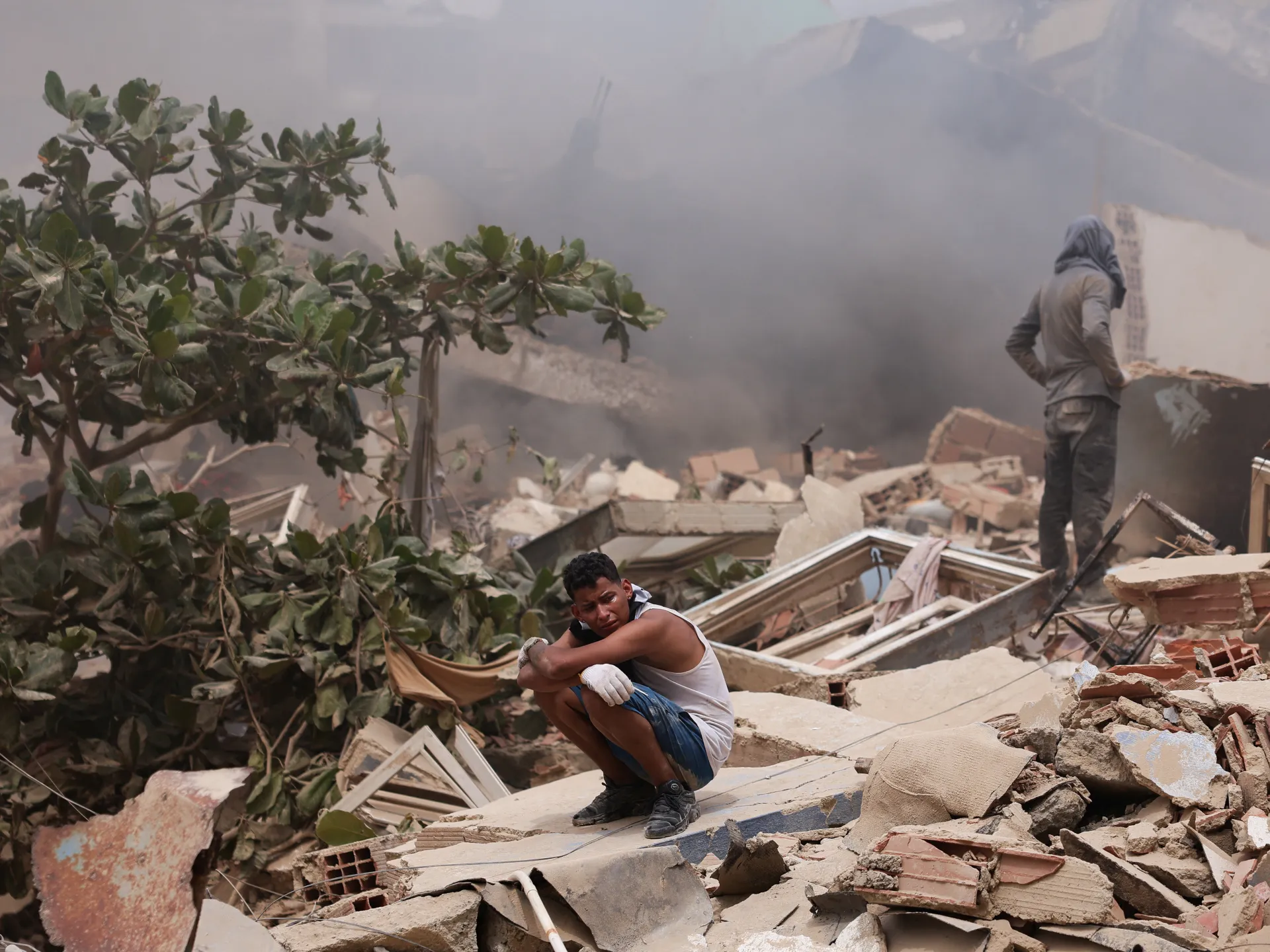
Reporting from Caracas for Al Jazeera, Noris Soto says authorities appear to lack a clear response plan in the aftermath of two powerful earthquakes. The recovery is being hampered by severe damage to communication systems, as displaced residents are housed in hotels.

Source link

How technology is revealing ‘Hidden Nations of Animals’

As the destructive Bobcat fire sent plumes of smoke billowing from the Angeles National Forest in 2020, Ryan Huling recalled that at the time news reports claimed the blaze caused “no injuries” and that no homes had been destroyed.

That irked the Sierra Madre writer, who watched from his cabin as flames incinerated the home of bears, coyotes, pumas and squirrels. He believes countless critters were killed or maimed by flames, and points to accounts of mountain lions emerging with singed paws and bears scrambling into communities.

“Anonymity has done them no favors, in the sense that people don’t know where they live, they don’t know what landmarks are important to them, they don’t know what areas carry special significance to bears and other animals,” Huling said.

Yet through his research he discovered that rapidly advancing technology — including artificial intelligence, GPS tracking and crowdsourcing — is revealing more about animal “societies” than ever before. The revelation launched him on a worldwide tour of non-human communities, culminating in his debut book, “The Hidden Nations of Animals.”

The cover of Ryan Huling's first book, published in June.

The cover of Ryan Huling’s first book, published in June.

(Penguin Random House)

Published this month, the book’s first chapter takes readers to North America’s “beaver belt,” roughly 1,100 miles in northern Canada that are jam-packed with beaver dams. According to Huling, the sheer density of those dams only became apparent thanks to technology that allows researchers to analyze high-resolution satellite imagery and identify them from space. One analysis found 2,700 dams surrounding a town of only about 1,000 people.

Another stop took him to Zambia, where African mole-rats dig complex tunnel systems that include designated nurseries, pantries and bathrooms. Just before Huling arrived, a researcher had used radio trackers to determine that the subterranean animals operate on a biological clock that has them alternate between a few hours of activity and a few hours of napping — not a bad work schedule!

Some of Huling’s other adventures include exploring a tornado of Mexican free-tailed bats outside of San Antonio and red-crowned cranes that have found refuge in the Korean Demilitarized Zone.

But uncovering these hidden worlds isn’t just left to the experts anymore. While the expense or difficulty of tracking wild animals has resulted in knowledge voids in the past, crowdsourcing is helping to fill in the gaps.

Today, any smartphone-toting nature lover can snap a photo of a great horned owl or a ground squirrel and upload it to a citizen science app such as iNaturalist. Some platforms are specialized, for example Merlin for birds and Happywhale for marine mammals. All that data is a rich playground for scientists. According to an article published last year in BioScience, iNaturalist data in peer-reviewed research grew tenfold in the previous five years.

Now, AI is making it so humans don’t have to necessarily look at the raw material. Instead, AI can mine images, videos or sound clips for the appearance of an animal of interest — or even catalogue individual critters. Happywhale has an AI feature that identifies particular humpbacks by unique patterns and shapes on their tails.

Technology is advancing so fast that Huling said it was hard to stay current. In his prologue, he mentions a researcher showing him a prototype of a teeny solar-powered radio tag for monarch butterflies. By the time the book hit the shelves, the concept was already live — harnessed, in one instance, to study how the brilliant orange insects use overwintering groves along the California coast. Just this week on Instagram, the California Department of Fish and Wildlife highlighted a study in which rare bumblebees are tagged with minute QR codes that can be read by remote cameras.

After about a half-year of travel, Huling returned home with a heightened awareness of what he calls “inconspicuous abundance” — that the world is teeming with more life than meets the eye. He puts this new lens to the test by venturing to the storm-battered shores of San Miguel Island off the coast of Santa Barbara. Considered “uninhabited” in the traditional sense, he finds that the rarely visited corner of Channel Islands National Park is a haven for lumpy seals, glimmering fish and squawking seabirds. Sharks lurk beneath the waves.

“For them, as now for me, this distinctive island remains anything but deserted,” he writes.

An illustration of seals on San Miguel Island for "The Hidden Nations of Animals"

On San Miguel Island, Huling saw and heard hundreds of sunbathing seals and sea lions.

(Oliver Uberti / Penguin Random House)

In other animal news

  • Earlier this month, in Big Bear Lake, a memorial service was held for Sandy Steers, the late conservationist who was best known for turning two bald eagles into an international phenomenon by livestreaming their nest. It was a touching gathering, where Steers’ friends and colleagues got personal about a woman who they said was willing to go to the mat for her beloved raptors.
An illustration for "Hidden Nations" depicts author Huling at home, surrounded by the natural environment.

An illustration for “Hidden Nations” depicts author Huling at home, surrounded by the natural environment — including a black bear.

(Oliver Uberti / Penguin Random House)

  • For decades, Steers battled a planned development near the nest of famed eagle couple Jackie and Shadow, and helped to negotiate an agreement in which a land trust could buy the site for $10 million. The nonprofit she led is now racing to raise the money by July 31 so it can be bought and conserved.
  • In the desperately needed good-news department, endangered steelhead trout that scientists feared had perished in last year’s Palisades fire unexpectedly survived — and even had babies. It’s a big deal: they represent the last known population of steelhead in the Santa Monica Mountains.
  • A civil grand jury has found that the L.A. Zoo needs new leadership, citing deterioration of its facilities and rapidly declining membership. In less than a year, membership dropped 23% and exhibits for lions, bears, sea lions and pelicans have closed because they need major renovations.
  • Last summer, researchers made an astonishing discovery off the Sonoma County coast — 18 sunflower sea stars, a species decimated by disease and all but gone from California waters. SF Gate writes that the finding was only just announced, with scientists now racing to learn all they can about the survivors. As previously reported, the stars with up to 24 arms could hold the key to restoring the state’s ravaged kelp forests.

And news about the environment

This is the latest edition of Boiling Point, a newsletter about climate change and the environment in the American West. Sign up here to get it in your inbox. And listen to our Boiling Point podcast here.

For more wildlife and outdoors news, follow Lila Seidman at @lila_seidman on X and @lilaseidman.bsky.social on Bluesky.


Source link

When Paris is hotter than Mecca: How Europe’s heatwave compares globally | Climate Crisis News

Paris and other European cities are experiencing temperatures above 40C (104F), reaching levels normally seen across the Middle East.

A blistering heatwave has gripped much of Europe, prompting the highest-level red alerts in parts of the United Kingdom, France, Spain and Italy.

Authorities have warned of health risks, wildfires and travel disruptions as extreme temperatures persist.

Recommended Stories

list of 3 itemsend of list

With temperatures approaching record highs, officials have taken emergency measures, including a localised alcohol ban in parts of France under red alert, nationwide heat warnings in Germany and the cancellation of a World Cup fan zone screening in Madrid, where temperatures hit 39C (102F).

Why is it so hot in Europe?

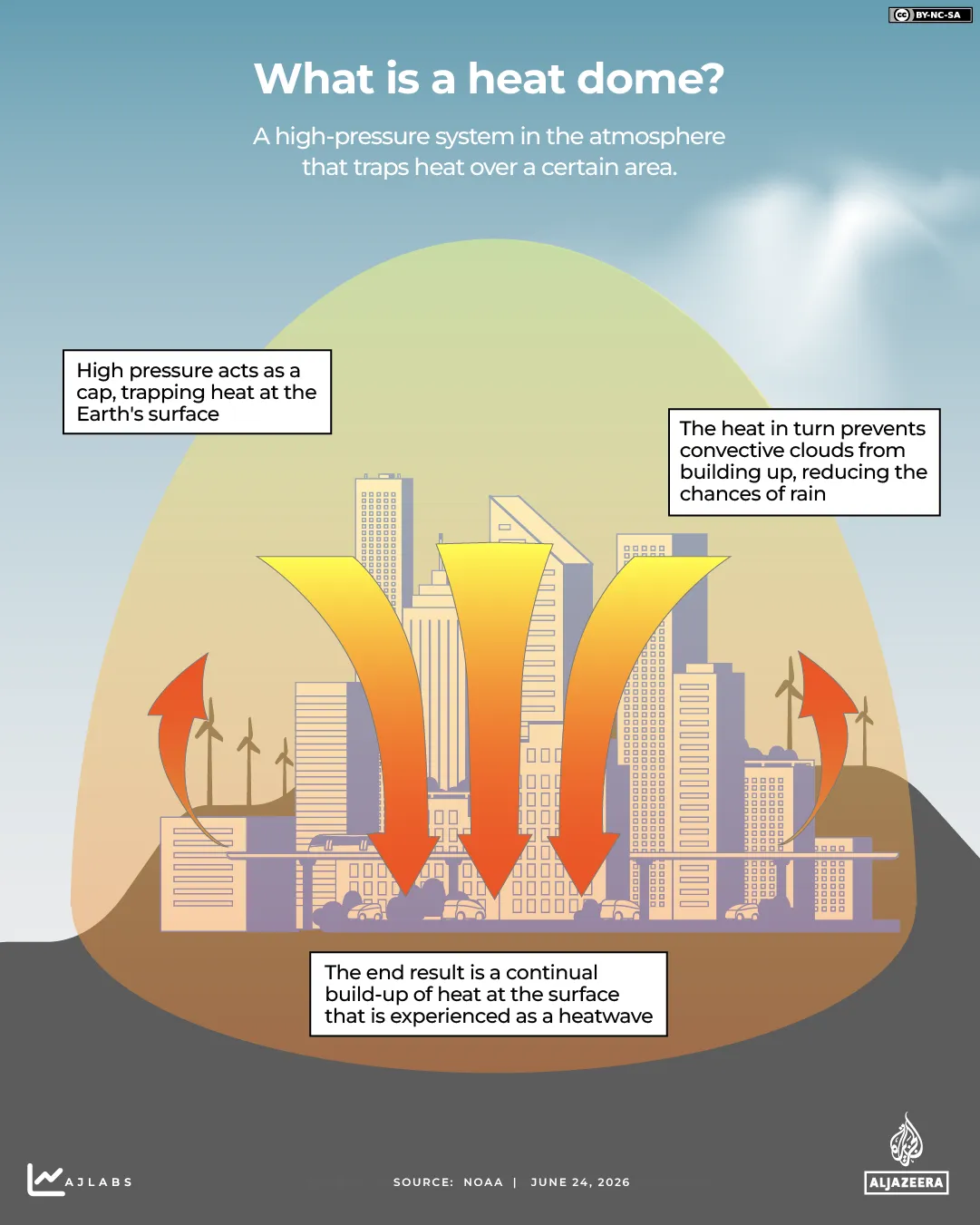
A persistent area of high pressure, known as a heat dome, has trapped hot air over Western Europe, bringing clear skies, weak winds and prolonged sunshine. Hot air moving north from North Africa has added to the extreme temperatures.

interactive- Heat dome-june24-2026-1782302509
(Al Jazeera)

Unusually warm seas around the UK, Ireland, France and the western Mediterranean have also helped keep coastal areas hot, especially at night. Coastal waters around Spain have reached record warm levels, according to Spain’s port authority.

In the worst-affected areas – western France, England and Wales – daily average temperatures have soared more than 12C above the 1991-2020 baseline, according to Copernicus data.

interactive-Europe is hotter than usual -june24-2026 copy-1782302382
(Al Jazeera)

Scientists say the early-season heatwave is part of a broader warming trend. Europe is the world’s fastest-warming continent, with temperatures rising by approximately 0.56C per decade since the mid-1990s, more than double the global average.

Climate change is making heatwaves more frequent, more intense and likely to occur earlier and later in the year.

How hot are European cities today?

To contextualise the temperatures Europe is dealing with, Al Jazeera looked at the maximum temperatures in five European capitals on June 24 and compared them with cities across the Middle East, North Africa and Asia, where high temperatures are more typically experienced.

Europe is particularly vulnerable – much of its housing and infrastructure was not built for prolonged extreme heat, and only about 20 percent of European homes have air conditioning.

The graphic below shows how European cities’ maximum temperatures today compare with some other cities around the world:

interactive-How hot are European cities today-june24-2026 -1782302387
(Al Jazeera)

How is temperature measured?

The temperature you see on the news or the weather app on your phone relies on a network of weather stations positioned around the globe.

To ensure accurate readings, weather stations typically use specialist platinum resistance thermometers placed inside shaded instruments known as a Stevenson screen.

Measurements are taken at a standard height of 1.25-2 metres (4-6.5 feet) above the ground. This provides a reading that reflects the air temperature that people actually feel.

INTERACTIVE How temperature is measured-1782301089
(Al Jazeera)

There are two well-known scales used to measure temperature: Celsius and Fahrenheit.

Only a few countries, including the United States, use Fahrenheit as their official scale. Most of the world uses the Celsius scale, named after Swedish astronomer Anders Celsius, who invented the 0-100 degree freezing and boiling point scale, although originally inverted, in 1742.

Why does the temperature feel hotter than the forecast says?

Air temperature alone often doesn’t match how hot it feels to your body. That is why forecasts report a “feels like” temperature, which adjusts air temperature based on factors like humidity, wind speed and sun exposure.

INTERACTIVE Why does the temperature feel hotter than the forecast says-1782301086
(Al Jazeera)

Humidity

Humidity measures how much water vapour is in the air. This moisture slows the evaporation of sweat, so your body can’t cool itself as effectively.

Wind speed

In hot weather, a light breeze can help evaporate sweat, making it feel cooler.

Sun exposure

Even if the thermometer reads the same, direct sunlight adds extra warmth, which is why shaded areas feel cooler.

Source link

Trump strips away Nixon-era safeguards on off-road battle

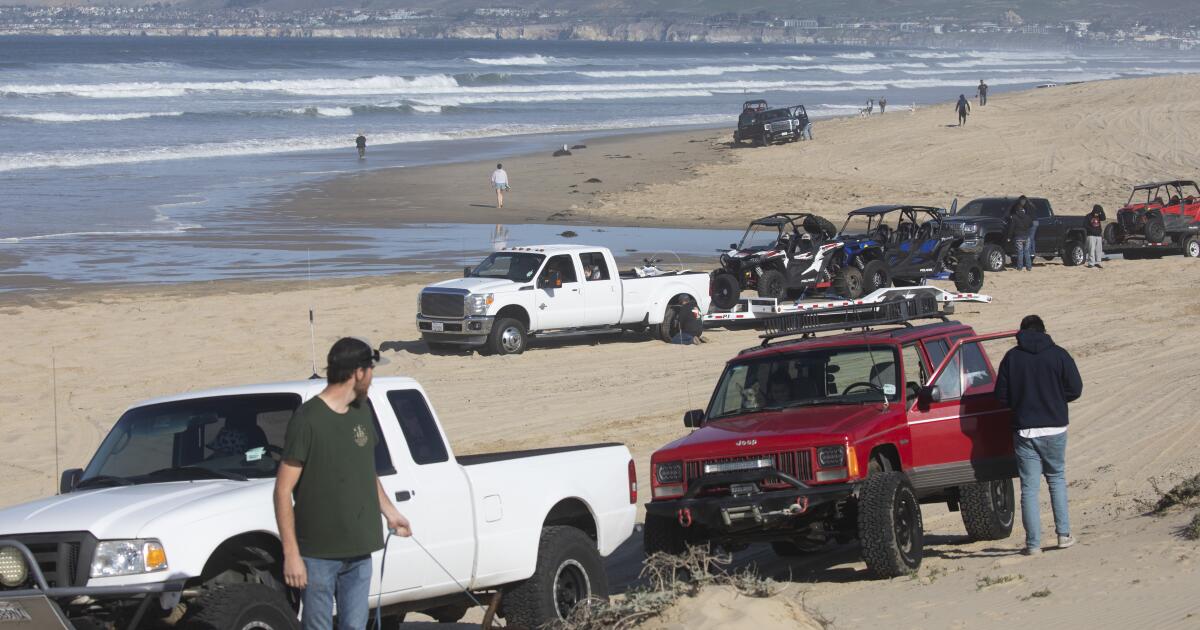
President Trump recently took action that could pave the way for opening many more federal lands to recreational off-road enthusiasts. When I heard about it, I immediately thought of the battle over off-highway vehicle access in California’s Mojave Desert.

Earlier this year, a judge ordered the Bureau of Land Management to close roughly 2,000 miles of off highway vehicle trails in the western Mojave to reduce ongoing harm to the endangered desert tortoise, a keystone species of the local ecosystem whose numbers are in steep decline.

That court decision capped off a decadeslong legal fight led by environmental groups including the Center for Biological Diversity and the Desert Tortoise Council.

Under the ruling, which the BLM has appealed, the agency has roughly three years to redraw the network of Mojave off-road trails.

You’re reading Boiling Point

The L.A. Times climate team gets you up to speed on climate change, energy and the environment. Sign up to get it in your inbox every week.

In the latest action, Trump has rescinded a pair of 1970s executive orders that directed federal land managers to minimize damage to wildlife and natural resources, as well as conflicts between off-roading and other types of recreational land use, when choosing where to locate OHV trails.

He described them as “excessive regulation” that used “ill-defined criteria” to minimize vehicle impacts. “These vague, subjective criteria often result in barriers to energy and timber production and utility maintenance, permit delays, and de facto bans on hiking and other forms of recreation that require accessing remote areas, all while doing little to benefit multiple use of Federal lands,” he wrote.

I called up Lisa Belenky, who’s representing the Center for Biological Diversity in the Mojave proceedings, to ask whether Trump’s order changed anything about the case, or the rules the BLM must follow as it revises the trail network.

The short answer, she said, is no.

Each federal land management agency has its own regulations with criteria for managing off-road vehicle use — for instance, the BLM uses travel management plans to determine where vehicles are allowed on specific pieces of land. Trump’s order rolled back the executive directives that guided those regulations, but the regulations themselves remain in place.

Still, Trump’s order directs federal agencies to reexamine their regulations.

In some cases, such a reexamination appears to be already underway, said Paul Sanford, director of policy analysis at The Wilderness Society. The administration last year signaled its intent to repeal the rule that governs motorized access to Forest Service lands, he noted, the Travel Management Rule.

“The rescission of the executive orders makes that easier,” he said.

The Forest Service said in a statement that the rule is expected to be addressed later this year.

“It’s absolutely irresponsible and stupid,” said Jim Baca of Trump’s order. The former BLM director said it was already hard enough to regulate OHV use when he led the agency from 1993 to 1994. “It was difficult to do anything, especially if oil and gas people, mining people and others wanted to get into an area,” he said. To Ryan “Cal” Callaghan, president and CEO of Backcountry Hunters and Anglers, the order reflects “the prioritization of one set of user groups over all others.”

Increasing vehicle access in remote areas can cause erosion, stress animals and transport weeds into the backcountry, where they can outcompete native plants, and there’s a strong correlation between roads and human-caused fires, he said. Plus, there’s no indication that any increase would mean funding for more personnel to handle enforcement and lessen negative consequences, he said.

To the contrary, between the end of 2024 and the end of last year, the BLM lost nearly 20% of its staff, and the Forest Service and National Park Service each lost roughly 16%, according to an analysis of Office of Personnel Management data by Hawk Eye Strategies and Prospect Partners. Together, those three agencies responsible for managing more than half a billion acres of public land — about 23% of the United States — count fewer employees than the Hartsfield-Jackson Atlanta International Airport, per the figures provided by the consulting firms.

The staffing cuts and regulatory rollbacks — which also include the recent rescission of the public lands rule that put conservation on equal footing with other uses of BLM land — are part of a strategy to “suffocate” federal land management agencies, said Jora Fogg, public lands policy associate director at the Conservation Lands Foundation.

“There’s an effort to undo regulations and protections on public lands because there is a push for this energy dominance and extractive uses,” she said.

I’ve met plenty of OHV enthusiasts who care deeply for public lands. I’ve also encountered degradation and damage.

Earlier this year, tortoise biologist Ed LaRue told me he could show me a corner of the desert that had been scarred by off-roaders departing from designated routes. In the tawny hills of the Ord Rodman Natural Area, a smattering of legal trails had widened into a thick braid so intertwined that it was difficult to tell which were authorized. And while the area was once among the most densely populated tortoise spots in the western Mojave, on that warm February afternoon, LaRue could find no evidence of them.

Reached by phone last week, he said he found some comfort in the fact that certain restrictions on off-roading still remain in place, and that the public will be given the opportunity to weigh in should agencies seek changes.

Still, he said, it’s not clear whether anyone will listen.

More recent land news

Republicans have introduced an amendment to a federal wildfire bill that would repeal the 2001 Roadless Rule protecting certain national forest lands from logging and roadbuilding, reports Brooke Larsen of the Salt Lake Tribune. That comes nearly a year into the Trump administration’s effort to rescind the rule via the rulemaking process, which has faced public opposition.

The Forest Service has cited cost savings as the impetus for a reorganization that will shutter dozens of research facilities. But much of the agency’s research is already inexpensive, and closing these local facilities could make it less so while encouraging workers to leave, according to Chiara Eisner of NPR.

Why is Agriculture Secretary Brooke Rollins dead set on saving a failing Northern California dam? Grist’s Jake Bittle and Ayurella Horn-Muller report this tale, which also includes a ranch-animal veterinarian and his daughter, a Riverside County water district and an X post from county Sheriff Chad Bianco.

New proposed grazing rules appear to prohibit Indigenously managed bison from grazing on federal public lands. That has tribes urgently seeking government-to-government talks with Interior Department officials in a bid to win an exemption, according to Blaine Harden of Inside Climate News.

A few last things in climate news

As a historic El Niño supercharges the Pacific Ocean, a crumbling Pacifica pier has become a climate battleground over what to save — and who pays, my colleague Susan Rust reports.

The Times’ Grace Toohey visited Santa Rosa Island to learn how a recent wildfire has affected a piece of North America’s so-called Galapagos. Here’s what she saw.

Clean water advocacy groups say recent changes to California’s “cap-and-invest” climate program could mean less help for hundreds of thousands of people who live with contaminated water, our water reporter Ian James writes.

This is the latest edition of Boiling Point, a newsletter about climate change and the environment in the American West. Sign up here to get it in your inbox. And listen to our Boiling Point podcast here.

For more land news, follow @phila_lex on X and alex-wigglesworth.bsky.social on Bluesky.
Source link

Nearly all children globally exposed to at least one climate hazard: Report | Climate Crisis News

Report highlights the growing threats posed by climate change and calls for the green transition to be accelerated.

Almost all children across the globe are exposed to at least one climate hazard and the situation is expected to worsen unless greenhouse gas emissions are urgently reduced, says a report by UNICEF.

The report, published on Tuesday, warns that climate hazards pose a threat to children on multiple fronts, with nearly half of the world’s children exposed to at least three such hazards, putting their health, education and survival at risk.

Recommended Stories

list of 3 itemsend of list

“The lives of children continue to be upended by the impact of heatwaves, wildfires, droughts, and floods,” said UNICEF Executive Director Catherine Russell. “Half of the world’s children are now living with at least three overlapping climate threats shaping their daily lives.”

The report highlights the growing threats posed by climate change and calls on governments and business leaders to accelerate the transition to renewable energy.

According to UNICEF’s report, 1.8 billion children are currently at risk from drought, while 1.2 billion are exposed to extreme heat, as warmer temperatures wreak havoc on the world’s water cycle.

Countries across Western Europe experienced a record-breaking heatwave last month, reaching temperatures not typically expected until the summer.

UNICEF also says that nearly every child is exposed to air pollution, while one billion are exposed to malaria.

Scientists have repeatedly warned that global warming must be limited to 1.5C (2.7F) above pre-industrial levels to avoid the worst effects of climate change.

Nearly 200 countries signed the Paris Agreement, aiming to curb global warming to that 1.5C mark. The accord came into force in November 2016.

Since then, scientists have repeatedly warned that the target is unlikely to be met.

In January, the United States formally withdrew from the Paris Agreement for a second time, following an order by President Donald Trump.

Source link

How extreme weather and heat could affect players at World Cup 2026 | World Cup 2026

Sweaty, shirtless football players lying on the pitch have seldom raised eyebrows as they did last week when photographs of European players struggling to train in the heat sparked concerns over sweltering US summer temperatures at the World Cup.

Scientists have long cautioned that extreme heat could disrupt sporting events. Last month, climate experts warned that one in four World Cup games could be played in very hot conditions, affecting fans and players alike.

Recommended Stories

list of 4 itemsend of list

Those warnings materialised last week; social media was abuzz with sunburnt players — mostly from European teams used to cooler climates — dousing themselves with water to cool off. Norway’s team even opted to wear ice collars around their necks during the friendly against Morocco.

But England captain Harry Kane quickly dismissed speculation over how much the heat would affect players, saying it “won’t be a factor”, thanks to his team’s World Cup training regimen.

So, how much will higher temperatures actually affect players at the World Cup? Al Jazeera takes a look.

What have experts said about heat during World Cup matches?

Th 2026 World Cup could be the hottest on record since the tournament began in 1930 due to a sharp rise in global temperatures, explained Al Jazeera weather presenter Everton Fox.

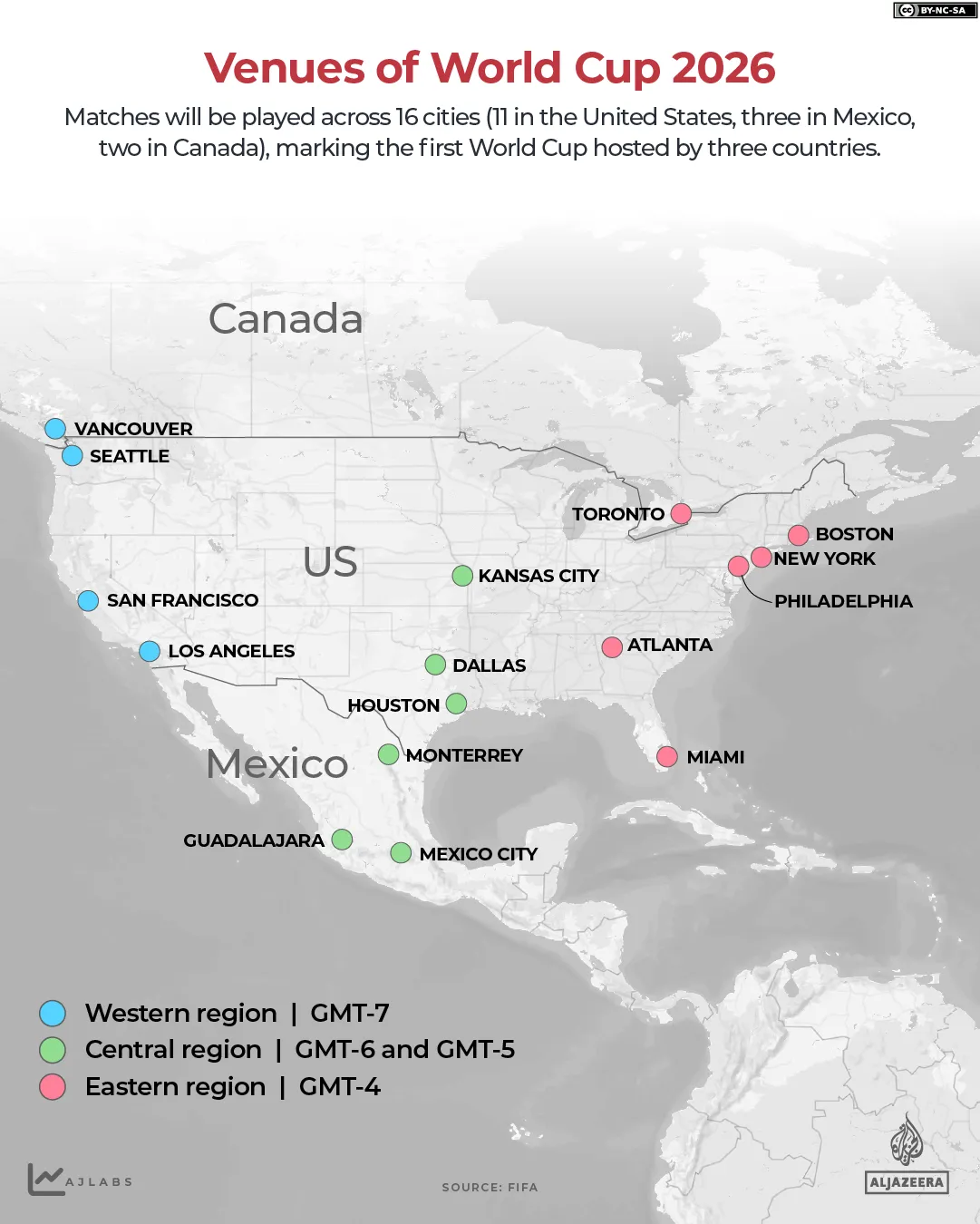
“Around half a dozen of the venues are prone to extreme heat; places like Dallas, Houston, Miami and the Mexican venues are all likely to swelter,” Fox said.

Daytime temperatures there are expected to average 28C, though the stadiums in Dallas, Houston and Atlanta have air conditioning.

Approximately 26 of the 104 matches could reach at least 26C in the Wet Bulb Globe Temperature (WBGT) index — which measures how effectively the body can cool itself — while five games are expected to be played in conditions of 28C WB or higher, according to World Weather Attribution (WWA), a network of climate scientists.

Of those 26 matches, 17 will be played in stadiums with cooling systems, reducing risks for players and fans.

But more than a third of the games with a one in 10 chance of exceeding 26C will be in venues without air conditioning.

How do hotter temperatures impact athletes’ performance?

Heat stress due to increased humidity, exposure to solar radiation and the effects of wind speed will impact players running around in direct sunlight, Fox said.

“All this makes it harder for the body to cool down as it becomes harder for sweat to evaporate as quickly,” said Fox, a senior meteorologist with more than 30 years of experience.

Physical performance coach Raiyan Abbasi explained that, although the body sweats to achieve thermoregulation – a process that allows the body to maintain its core internal temperature – excessive sweating due to heat could lead to dehydration, cramps and increased fatigue.

Are athletes used to such high temperatures?

“Yes, the majority of athletes will know how to deal with this kind of heat since they’re elite players training and competing in various conditions,” said Abbasi, who has worked as a physical performance coach for British clubs Swansea and West Ham, as well as the Pakistan national side.

Teams will have a performance coach and medical staff to make sure players are ready for the tournament, including through acclimatisation, Abbasi explained – echoing what Kane said over the weekend after his side beat New Zealand 1-0 in Tampa, Florida, where temperatures soared beyond 30C.

INTERACTIVE-Football FIFA Venues of World Cup 2026-1776670771

Do athletes from hotter nations have an advantage?

World Cup nations whose players train in hotter climates may have a slight advantage when it comes to adjusting to high temperatures in the US.

“But essentially, countries that prepare and perform well can minimise that difference,” Abbasi said, adding that heat can be used positively too.

“Heat is a significant factor in creating good athletes; one way to improve athletic capabilities is to train in the heat.

“It can make big adaptations in your body to improve body temperature.”

Could the World Cup have been held before or after summer in the US?

Fox noted that international tournaments are traditionally in the European domestic off season, which is when the 2026 World Cup is being held.

“Ideally, US weather is most conducive in the spring and autumn, but you’d then be looking at the tornado season in spring and hurricane late summer through autumn before you even begin to think about their domestic sports which locals have more interest in,” Fox said.

What measures has FIFA taken for players and fans?

FIFA said it has carried out heat-risk planning, with measures including three-minute hydration breaks in each half of games, cooling infrastructure for fans and players, adapted work-rest cycles, and enhanced medical readiness that scale according to real-time conditions.

“The hydration breaks probably need to be longer to gain full benefit, but then you risk turning it into a game of four quarters,” Fox said jokingly, although he argued that FIFA could have confined games to northern parts of the US and Canada.

FIFA has also delayed kickoff times for some matches to start outside the hottest afternoon hours.

Source link