Sheriff’s deputies in San Bernardino County arrested a Hesperia wrestling coach Tuesday as part of a child sex investigation.
Gene Richard Griffith III, 36, a wrestling coach at Hesperia High School and resident of the city, faces a charge of lewd and lascivious acts with a child, the San Bernardino County Sheriff’s Department said in a statement.
Hesperia High School officials did not immediately respond to an email seeking comment Saturday.
Griffith was booked into the High Desert Detention Center in San Bernardino on Wednesday.
A representative for the San Bernardino County Sheriff did not immediately return a request for further information about the alleged incident or possible bail terms.
Detectives from the Sheriff’s Department’s Crimes Against Children unit said in a statement they believe there might be additional victims, and ask anyone with information to contact Detective Victoria Twardowski at 909-890-4904.
Bad Bunny’s halftime show at this year’s Super Bowl was largely embraced as a milestone for Latin music and Puerto Rican culture on America’s most prominent pop-cultural stage.
The Federal Communications Commission has released a massive trove of viewer complaints against the musician, the show’s broadcast partner NBC, and the NFL.
Many of them expressed outrage at the supposed bawdiness of Bad Bunny’s Spanish-language lyrics and dancing on a broadcast watched by children.
“That was the most disgusting inappropriate show. I had to make all of my children go into the next room!” wrote one traumatized Las Vegas viewer. “The none use [sic] of inappropriate language should stand no matter what language it’s in. This is the most disturbing thing I’ve witnessed on live TV in a long time.”
“NFL halftime show showed 2 men in act of intercourse while behind a pickup truck door,” wrote one aghast Ohioan. “The ratings for NFL [sic] made it safe for my children to watch but they witnessed this and became disturbed.”
Another viewer from Charlotte, NC who, to their credit, seemed familiar with Bad Bunny’s catalog, wrote that they “take issue with the vocal performances of ‘Safaera,’ which is a track widely known for explicit sexual references and graphic lyrical content, and ‘Yo Perreo Sola,’ which had choreography featuring overtly sexualized movements, including widespread twerking, grinding, pelvic thrusts and other sexually suggestive conduct.”
Those viewers were likely not sated by the FCC’s February review of the performance, which found that the songs’ lyrics had been appropriately altered for the broadcast.
Rep. Randy Fine (R-FL) had called for the FCC to investigate the broadcast.”What Americans witnessed during the Super Bowl halftime show with Bad Bunny was despicable and never should be allowed to be shown on television again,” Fine told the New York Post.
Many of the viewer complaints mirror President Trump’s post-show social media criticism, calling the performance “one of the worst EVER!”
“Nobody understands a word this guy is saying, and the dancing is disgusting, especially for young children that are watching from throughout the U.S.A., and all over the World,” the president wrote at the time.
Just before the Super Bowl, Bad Bunny had won the Grammy for album with “Debí Tirar Más Fotos,” and joined a wave of artists speaking out against violent ICE raids in speeches at the ceremony. The superstar demurred on performing in the continental U.S. for similar fears, instead performing a lengthy Puerto Rican residency.
WASHINGTON — Most U.S. adults say the United States is no longer a great place for immigrants, according to a new AP-NORC poll, as about one-third of Americans report knowing someone impacted by the Trump administration’s aggressive immigration enforcement.
A new survey from The Associated Press-NORC Center for Public Affairs Research of more than 2,500 U.S. adults finds about 6 in 10 say the country used to be a great place for immigrants but is not anymore. About one-third of U.S. adults — and more than half of Hispanic adults — say that over the last year they, or someone they know, have started carrying proof of their immigration status or U.S. citizenship, been detained or deported, changed travel plans, or significantly changed routines, such as avoiding work, school or leaving the house, because of their immigration status.
The poll comes as the Supreme Court is considering whether the Trump administration should be allowed to restrict birthright citizenship, as well as following months of sweeping immigration enforcement and mass deportations of immigrants.
Missouri retiree Reid Gibson, an independent, is furious about the Trump administration’s treatment of immigrants. He hopes America eventually becomes more welcoming to immigrants again, but he worries “it may take many years to reverse the damage that the Trump administration has inflicted” with its policies.
The poll finds that many Americans know someone who has been affected by Trump’s approach. That includes Gibson’s stepdaughter, who he says started carrying her passport because of concerns that her darker skin would make her a target in immigration crackdowns.
“It’s just plain wrong,” Gibson, 72, added. “This is not a good country for immigrants anymore.”
Americans’ personal connections to immigration enforcement
Many U.S. adults have adapted their lives to heightened immigration enforcement over the last year, as Trump increased detentions and sought to conduct the largest deportation operation in American history.
Democrats are more likely than independents or Republicans to know someone affected, and those with a personal connection are more likely to say the U.S. is no longer a great place for immigrants.
Kathy Bailey, a 79-year-old Illinois Democrat, has seen the administration’s immigration policies seep into the small-town swim class she regularly attends. She said two women in the class — both naturalized U.S. citizens — have begun carrying their passports when they leave home. Bailey says one of the women, who is from Latin America, has been especially worried about sticking out in an overwhelmingly white community.
“She’s an American citizen now, but she’s so scared that she has to carry her passport,” said Bailey. “She’s just another sweet old grandmother swimming at 5 in the morning.”
About 6 in 10 Hispanic adults say they or someone they know has been impacted by immigration enforcement in this way, much higher than among Black or white adults.
“This is terrible for these women!” Bailey said. “I’m just stunned at what we are coming to.”
Most believe the U.S. used to be a great place for immigrants
Nick Grivas, a 40-year-old from Massachusetts, said his own grandfather’s immigration to the U.S. from Greece has made him feel the impact of the president’s policies. It’s part of why he believes the U.S. stopped being a promising place for people seeking a new life.
“We can see how we’re treating children and the children of the immigrants, and we’re not viewing them as potential future Americans,” Grivas said.
Roughly 3 in 10 U.S. adults say the U.S. is a great place for immigrants, according to the poll, while about 1 in 10 say it never was. The belief that America is no longer great for immigrants is more common among Democrats and independents, as well as among those born outside the U.S.
Grivas, a Democrat, worries that federal policies against immigration could stunt the country by discouraging new arrivals from investing in their local communities, especially if they don’t believe they will be allowed to remain.
“You’re less willing to commit to the project if you don’t think that you’re gonna be able to stay,” he said.
Most support birthright citizenship, but also hold nuanced views
The Supreme Court recently heard arguments in President Trump’s efforts to restrict birthright citizenship by declaring that children born to parents who are in the country illegally or temporarily are not American citizens.
About two-thirds of U.S. adults in the poll say automatic citizenship should be granted to all children born in the country, a view that most Democrats and independents back. Republicans are more doubtful: just 44% support birthright citizenship. The poll also shows that some people are conflicted, saying in general that they support birthright citizenship but also that they oppose it in some specific circumstances.
Among those who object to automatic citizenship is Linda Steele, a 70-year-old from Florida, who believes that only children born to American citizens should be granted citizenship. Steele, a Republican, does not believe foreigners living legally in the U.S. — whether for work or other reasons — should be able to have a child who automatically becomes a U.S. citizen.
“That shouldn’t be allowed,” she said. “They’re just here visiting or going to school.”
When asked about some specific circumstances, about 6 in 10 U.S. adults say they support birthright citizenship for children born to parents on legal U.S. tourist visas, while only about half support it for those born to parents who are in the country illegally. An even higher share, 75%, support automatic citizenship for children born in the U.S. to parents who are in the country legally on work visas, with much of that increased support coming from Republicans saying this was an acceptable situation.
Kevin Craig, a 57-year-old from Wilmington, North Carolina, does not believe citizenship should be automatically granted. Craig, who leans conservative, believes there should be “at least some opportunity for intervention by a human being who can make some sort of a judgment.”
But he added: “I think my personal opinion is that I can’t think of a situation where it would not be granted.”
Sanders, Sullivan and Catalini write for the Associated Press. Sullivan reported from Minneapolis. Catalini reported from Morrisville, Pa. The AP-NORC poll of 2,596 adults was conducted April 16-20 using a sample drawn from NORC’s probability-based AmeriSpeak Panel, which is designed to be representative of the U.S. population. The margin of sampling error for adults overall is plus or minus 2.6 percentage points.
While the specter of la migra continues to haunt the city, far more crushing are problems that affect everyone — affordability, housing, traffic, pollution. Maybe Soto-Martínez and his colleagues should double down on fixing those things first and sell their message better to voters instead of picking up a new issue?
I know the first-term council member comes from a good place. His parents were formerly undocumented, just like my dad, and he has been a fierce advocate for immigrants going back to his labor organizing days. I have friends without legal status and others in the DACA program for people who came to the U.S. illegally as children. I think giving them, as well as green card holders and others with papers, a chance to participate in elections is a righteous idea.
But to paraphrase the Book of Ecclesiastes, there’s a time and a place for everything. In 2026, Angelenos should be focused on electing people and approving initiatives that will improve the city for everyone, not a narrow plank benefiting a slice of the population.
So I called up Soto-Martínez and challenged him to convince this doubting Tomás.
He hopes his proposal will reach the City Council later this month for a vote on whether to place it on the November ballot. If voters pass the measure, it goes back to the council to decide when — if ever — to enfranchise the immigrants.
The proposal, already vilified in conservative media, isn’t as radical as it seems. Noncitizens are already prohibited from voting in federal elections, but there’s a well-established history of their participation in local ones, including in Vermont and Maryland. They can already vote in L.A. neighborhood council elections, and in San Francisco school board elections if they have a child in the district.
Besides, L.A. has long led the way in weaving undocumented immigrants into the fabric of civic life.
This is a sanctuary city where Mayor Karen Bass has stood up to President Trump’s xenophobia. Where eight of the 15 council members are immigrants or the children of immigrants. Where LAUSD Supt. Alberto Carvalho — himself formerly undocumented — has striven to make local schools as welcoming as possible (Carvalho is on paid leave after the FBI raided his home and office earlier this year). Even the LAPD learned decades ago that it’s better to embrace undocumented immigrants than castigate them for their lack of legal status.
“If you’re contributing to this economy, you should have the right to decide who represents you,” Soto-Martínez told me.
Fair point. But isn’t thumbing our noses at Trump asking for more of what he has already inflicted on L.A., making life even more miserable for undocumented immigrants? Could he use the noncitizen voter rolls as a list of whom to deport? Besides, doesn’t extending the franchise to noncitizens give fuel to his crazy conspiracies about stolen elections?
“You always hear, ‘Don’t poke the bear, don’t instigate them,’ but that’s not how you deal with a bully,” Soto-Martínez replied. “They’re coming at us already. While they’re removing people’s right to vote in the Supreme Court, we’re expanding it. … And it has nothing to do with Trump. It’s about fairness.”
Tell that to Trump.
I mentioned that Santa Ana — a city far more Latino than Los Angeles, though not as liberal — decisively rejected a similar measure in 2024. Soto-Martínez’s fellow Democratic Socialist council members, Ysabel Jurado and Eunisses Hernández, have voiced their support for his measure. But I wonder whether the full council will move it along to voters in a year when some members, including Soto-Martínez, are running for reelection.
I couldn’t get a comment from Bass. Councilmember Nithya Raman, who’s running against her, said in a statement that Soto-Martínez’s push “is worth taking seriously” but that it’s “critical to getting this right, and we must not make decisions lightly or quickly.”
“We’re going to have to organize,” Soto-Martínez acknowledged. “But we live in a political moment where it’s the right conversation to have about what this city stands for.”
Avance Democratic Club President Nilza Serrano at Mariachi Plaza in Boyle Heights in 2022.
(Irfan Khan / Los Angeles Times)
He’s going to have to convince people like Nilza Serrano. She’s president of Avance, L.A. County’s largest Latino Democratic club, and heads the California Democratic Party’s Latino caucus. Serrano is no wokosa — she supported Rick Caruso in the last mayoral election and is now siding with Bass.
While Serrano thinks Soto-Martínez is on to something, she said that voting rights for noncitizens are a nonissue for the people she’s trying to get to the polls for the June primary and November general elections. The economy and Trump’s deportation deluge are more on their minds.
I asked if Soto-Martínez’s proposal would cheapen citizenship for people like her. Serrano and her family came here legally from Guatemala in the 1980s before becoming U.S. citizens, a process that took years.
“Not for me,” she replied. “But it’s hard to say for others. I’d have to do a little bit more research.”
“Isn’t San Francisco already doing it?” the Navy veteran cracked.
I thought Hernandez would go on an anti-liberal rant, but.…
“I believe there’s a strong argument,” he said, “that if someone has established residency and is a member of the community and suffered the consequences of whatever local policies will be enacted, they should have a say in who gets elected.”
Did the ghost of Joaquin Murrieta, California’s original avenging Latino, suddenly possess Hernandez? To make sure I was hearing right, I asked again if noncitizens voting in L.A. elections is a good thing.
How could he support that, as a Trump-voting Republican?!
“We have to be pragmatic,” he replied. He approves of noncitizens voting in L.A. neighborhood council elections, because that’s true local control.
He understands that allowing them to vote in municipal elections might come off as an insult to the memory of civil rights activists who lost their lives fighting for that right for Black Americans. But U.S. citizens are already taking it for granted, he noted — turnout in the November 2022 L.A. mayoral election was a pitiful 44%.
“Maybe noncitizens will appreciate voting more than citizens,” he said.
I’m still not fully convinced that Soto-Martínez’s push is wise right now, but I like that he’s being careful.
“We need to get in the weeds of this,” he said of the City Council’s deliberations, which he characterized as attempting to ensure maximum benefit and minimum fallout.
But that’s not always how she felt decades ago during her time as a student at the Claremont school.
“I grew up very sickly,” Brown told The Times last month while visiting Vista del Valle for a mural unveiling ceremony. “I had asthma. I had pneumonia, bronchitis. … I never thought I’d be running because I just was not the person that would be running. I was told to stay inside, not go outside.”
U.S. sprinter Brittany Brown celebrates winning the bronze medal in the women’s 200-meters at the 2024 Paris Olympics.
(Christian Petersen / Getty Images)
Former Vista del Valle Elementary student Brittany Brown wears her 2024 Paris Olympics bronze medal at the school’s district track and field competition April 24.
(Etienne Laurent / For The Times)
Brown’s family also faced housing uncertainty and financial struggles during that time. They moved around a lot, and sometimes Brown and her family — mother Yo-Landa, father Wayne, older sister Brandi, twin brother Brandon and younger brother Bryan — found themselves living in a hotel room near the elementary school.
Her mother told The Times that the school and the community provided invaluable support during those trying times.
“I think emotionally, it took a toll on her,” Yo-Landa Brown said. “But, of course, she was always joyful. She was very observant. She was kind. I could tell she used to cry a lot, but we all just tried to keep things calm and collected around her.”
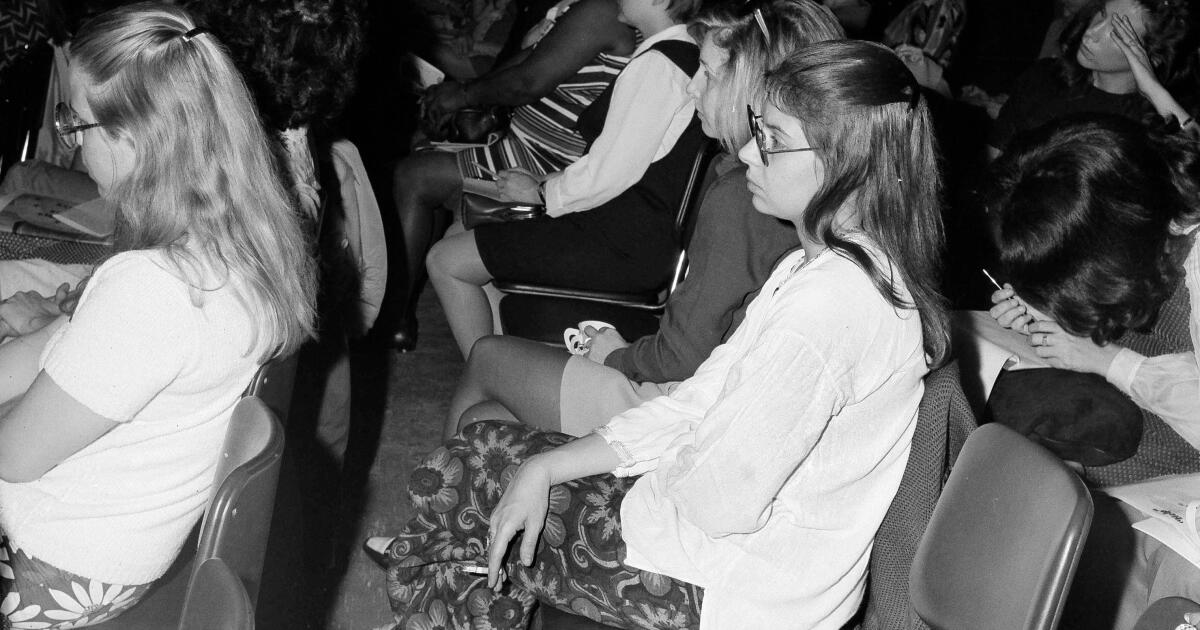
U.S. sprinter Brittany Brown, a bronze medalist at the 2024 Paris Olympics, is all smiles after winning a ribbon in the Vista del Valle track meet as a fourth grader in 2007.
(Brandi Brown)
The mural ceremony was held April 24 immediately after the school’s 50th annual district track meet, where Brown interacted with the participants and handed out ribbons. Vista del Valle Elementary hosts all seven elementary schools in the district each year for the meet. It was as a fourth-grade participant at the same event nearly 20 years ago that Brown discovered she loved to run — and also that she was very good at it.
“I remember running just felt very freeing. Like it just felt like, ‘OK, I’m not the sick kid. I can just try and do something,’” said Brown, who holds the Claremont High School record in the girls 100-meter and 200-meter races. “And I was also winning, so that helped as well. … Running has brought me opportunities I never thought I would ever experience.”
The mural was painted by local artist Xiucoatl Mejia, who attended Claremont Unified School District schools from kindergarten (Sumner Elementary) through high school (Claremont High). He has painted several murals at district schools in recent years and was already working with first-year Vista del Valle principal Charles Boulden to start an after-school art club for the students.
The two men thought it would be great to have a mural on campus to tie in with the half-century anniversary of the district track meet. The realization that one of the country’s top sprinters was a Vista graduate who got her start at the same meet served as further inspiration.
The mural depicts an adult Brown running while wearing a Vista track uniform and carrying a torch. A large group of children runs behind her, with some of those kids resembling students from the art club.
People gather in front of a mural featuring U.S. sprinter Brittany Brown prior to its unveiling ceremony April 24 at Vista del Valle Elementary in Claremont.
(Etienne Laurent / For The Times)
“It just made sense to include some of the kids who were in the class and make it a little bit more custom to the school and personal to these kids,” Mejia said.

Third-grader Levi Adams said being depicted in a mural on a school wall is “special because when you’re older you can go back and look at it.”
Second-grader Holland Ly agreed that “it’s pretty special” to be featured in a painting that “many people” will see through the years.
Art club students also helped paint the mural.
“I had the kids lay out the whole track,” Mejia said. “I wanted them to do that very specifically, because I wanted them to understand that that’s the foundation for the race in our scene. … I wanted them to have that part in it, and be able to look back on it and see it.”

The theme of the piece initially was victory, Mejia said, but it evolved.
“As it progressed, the theme kind of changed into carrying the torch and paving the way for a better future for our youth and for our communities,” Mejia said. “It became a lot bigger than what initially it was. It became something that is a little bit more powerful than any singular victory. It was a collective victory with everyone.”
Boulden thinks the mural ended up being a tremendous success.
U.S. sprinter Brittany Brown holds up her bronze medal from the 2024 Paris Olympics surrounded by, from left: mother Yo-Landa Brown, twin brother Brandon Brown, brother Bryan Brown, grandmother Jeanette Royston and sister Brandi Brown.
(Brandi Brown)
“I couldn’t be happier with how it is — the colors, how vibrant it is and what it represents to me,” the principal said. “I see perseverance in there, and I see chasing dreams, and I see kids chasing after somebody who’s chasing their dreams as well.”
Brown is also thrilled with how the first mural in her honor turned out.
“I think it’s really good! I’m really, really happy with it,” said Brown, who is currently training in Los Angeles with the long-term goal of competing for the U.S. again in the 2028 Summer Olympics. “I love the colors. It even has my choker — I wear a choker when I run a lot. It has the little, fine details, so I think that was really cool.”
Her mother said she thought it was “really touching” that Mejia included images of current Vista students in the painting.
“Yes, Brittany is the Olympian, but now you have the next generation involved,” Yo-Landa Brown said. “Their stories will continue to live on and they will remember that. And that will give them the inspiration to be better and to do better in their lives. I thought that was phenomenal. I felt so thankful that he was able to capture that.”
Wearing her Olympic medal around her neck, Brown addressed the student body at the mural ceremony and became emotional while talking about the hardships she overcame while attending the school.
Olympian Brittany Brown hands out ribbons and high-fives to participants in Vista del Valle’s annual district track and field meet April 24 in Claremont.
(Etienne Laurent / For The Times)
“I really just want them to know you can create beautiful stuff, even in the struggle,” Brown told The Times afterward. “It’s going to be a lot harder, but you can still create beautiful stuff in the struggle. And I definitely have created a different life for me. …
“I never thought the little girl in the hotel would freaking have a mural. I never thought, like a little asthma girl, you know, someone who wasn’t allowed outside, that this would be my story. So it’s definitely crazy. That’s what I want them to know.”
Brown’s message seems to have resonated with the students. Fifth-grader Kaylee Mency said Brown’s story of her childhood struggles “really meant a lot to me because she still kept going even though her life wasn’t as good.”
Fifth-grader Eliana Ocegueda added: “She went to this school and now she’s an Olympian. It’s really inspiring and it kind of makes you think about you can be anything you want to be.”
The singer is accused of grooming, sexually assaulting and impregnating 16-year-old Julia Misley in the 1970s. The suit, first filed in 2022 in Torrance, claims he “used his role, status, and power as a well-known musician and rock star” to exploit Misley. The complaint also argues Tyler admitted to the alleged crimes in his own memoir, “Does the Noise in My Head Bother You?,” where he refers to her as his “teen bride.”
Earlier this week, a judge dismissed most of the case, citing the statute of limitations in Massachusetts, where the pair lived during their three-year relationship. But they allegedly crossed state lines while Tyler toured the country with his band, including to California, according to the complaint. Because of California’s Child Victims Act — a 2020 statute that allowed a “lookback window” where alleged victims can file lawsuits regardless of a statute of limitations — a portion of the case will still be tried.
“This is a massive win for Steven Tyler. Today, the Court has dismissed with prejudice 99.9% of the claims against Mr. Tyler in this case,” Tyler’s lawyer, David Long-Daniels, said in a statement to The Times. “The court has decided that only one night, 50-plus years ago, out of a three-year relationship is allowed to remain.”
New York has a similar statute that was recently employed by singer Casandra “Cassie” Ventura in her case against Sean Combs. She filed a sex-trafficking and sexual assault lawsuit against the music mogul in 2023, in the U.S. District Court for the Southern District of New York, just days before the expiration of a lookback window.
The lawsuit against Tyler, who previously appeared as a judge on “American Idol,” claims he and Misley first met at an Aerosmith concert in 1973. According to the document, he “performed various acts of criminal sexual conduct upon Plaintiff that night.” At the time, Tyler was in his mid-20s and Julia was 16.
The alleged encounter was the first of many, the lawsuit claims. In 1974, Tyler was named Misley’s legal guardian and took her on tour with the band.
According to the complaint, he described the nature of the relationship in his 2011 memoir, writing, “She was 16, she knew how to nasty … with my bad self being twenty-six and she barely old enough to drive and sexy as hell, I just fell madly in love with her. … She was my heart’s desire, my partner in crimes of passion. … I was so in love I almost took a teen bride. I went and slept at her parent’s house for a couple of nights and her parent’s fell in love with me, signed paper over for me to have custody, so I wouldn’t get arrested if I took her out of state. I took her on tour with me.”
The lawsuit also describes Misley’s alleged pregnancy with Tyler’s child, which ended in a “pressured” abortion.
“This reflects years of resilience and courage by Ms. Misley, driven by an unwavering pursuit of truth and justice. It is time for justice and for Tyler to be held accountable by a jury,” Misley’s attorney, Jeff Anderson, said in a statement.
It will be more than a “Star Wars” bonanza when the Lucas Museum of Narrative Art opens to the public Sept. 22. The highly anticipated $1-billion museum on Thursday announced about 20 inaugural exhibitions curated by George Lucas across more than 30 galleries — and only one is related to cinema, with a focus on “Star Wars” memorabilia, including large-scale vehicle installations, production designs, props and costumes.
The full scope of the 1,200-plus objects will only be revealed when guests step through the museum doors into more than 100,000 square feet of gallery space on the first day of fall.
The futuristic-looking 300,000-square-foot museum in L.A.’s Exposition Park was designed by Ma Yansong of Mad Architects with executive architect Stantec and includes 11 acres of park space that extend to the museum’s roof, designed by Mia Lehrer of Studio-MLA. Co-founded by Lucas and his wife, Mellody Hobson, the museum will rotate the famous filmmaker’s vast collection of narrative art, which contains objects not found in more traditional museums, including manga, comics and children’s tales. The idea is to present the myriad ways images are used to tell an endless variety of stories. Lucas has called his collection “the people’s art.”
Dorothea Lange, “Migrant Mother,” Nipomo, Calif., 1936. Gelatin silver print, 18 3/4 x 14 1/2 in.
(Lucas Museum of Narrative Art, PKY.1062)
Exhibitions currently on deck include a variety of themed shows such as one on the architecture of the building; one titled “Everyday Life,” dedicated to visual stories about “childhood, community, family, love, motherhood, play, school, sports and work”; another titled “Civic Life” featuring “artists’ portrayals of experience in the courthouse, the polling place, the political headquarters”; an exhibit titled “Narrative Forms” highlighting “narrative art across genres of adventure, fantasy, romance and science fiction” by artists including Julie Bell, Boris Vallejo, Ken Kelly, Georges Méliès, John C. Berkey and Jeffrey Catherine Jones; and children’s literature illustrations by Beatrix Potter, Leo Politi, E.H. Shepard and Jacob Lawrence.
George Hughes, “Home at Last,” cover for the Saturday Evening Post, Sept. 1, 1951. Oil on board, 30 x 24 in.
There will also be exhibitions devoted to the work of individual artists and genres such as comics and graphic stories from illustrators Mœbius, Marie Severin, Jack Kirby, Alison Bechdel, Jim Lee, Frank Miller and Rafael Navarro; illustrations and book covers by Frank Frazetta; the work of fairy tale and children’s illustrator Jessie Willcox Smith; the lush art of Maxfield Parrish; a selection of work by iconic American artist Norman Rockwell; selected works of Thomas Hart Benton; and early 20th century book illustrations by N.C. Wyeth.
A news release about the inaugural exhibitions noted that they are drawn from the museum’s founding collection of more than 40,000 works.
“The exhibitions trace the evolution of human culture through storytelling, from ancient sculptures of gods and goddesses to Renaissance paintings to photographs, comics and modern cinema,” the release says. “Many exhibitions are organized by theme, focusing on myths about love, family, community and adventure that connect every generation. These shared stories, told over and over in many forms, bind us together and define our human experience.”
Ernie Barnes, “The Critic’s Corner,” 2007. Acrylic on canvas, 23 1/2 x 35 3/8 in.
Lucas’ role at his namesake museum has also not always been clear, and the museum’s development has been marked by a series of high-profile staff shakeups. The museum’s original director and chief executive, Sandra Jackson-Dumont, stepped down from her role in early 2025 after less than five years. She didn’t speak publicly about her departure but the museum issued a statement that her decision was based on a “new organizational design” that would split her job into two positions, with Lucas responsible for content direction.
Three months later, the museum laid off 15 full-time employees, a number of whom were from the education and public programming team. Seven part-time, on-call employees were also eliminated. The layoffs were described to The Times in harrowing terms by two employees who asked to remain anonymous.
In December — soon after the museum announced its opening date — news broke that chief curator Pilar Tompkins Rivas had stepped down from her role.
To date, no new chief curator has been named, but a rep for the museum wrote in an email that Lucas “is responsible for curatorial and content direction for the museum and continues to work closely with the curatorial team on his decades-long vision to celebrate storytelling and narrative art.”
MINNEAPOLIS — Federal agents executed multiple searches in Minnesota on Tuesday, seizing records and other evidence in an ongoing fraud investigation by the Trump administration of publicly funded social programs for children, authorities said.
Few details were released, though armed agents were seen at child-care centers in the Minneapolis area. KSTP-TV said one crew even had a battering ram.
Democratic Gov. Tim Walz, who has been on the defensive amid Trump administration claims that he hasn’t done enough to root out fraud, welcomed the raids. The state child welfare agency said it shared key information with law enforcement to “hold bad actors accountable.”
“We catch criminals when state and federal agencies share information. Joint investigations work, and securing justice depends on it,” Walz said.
The searches were being conducted at daycares, businesses and some residences, according to a person familiar with the matter who spoke to The Associated Press on the condition of anonymity because they were not authorized to publicly discuss the investigation.
Tensions between Minnesota officials and the federal government were high during an extraordinary immigration crackdown that led to the deaths of two people before Operation Metro Surge was eased in February.
Before that crackdown, the government had brought fraud charges against dozens of people, many of them Somali Americans, who were accused of fleecing a federal program that was meant to provide food to children. The investigation began during the Biden administration. More than 60 people have been convicted.
Various state and federal agencies, including the Department of Homeland Security, participated in searches Tuesday. Officers from Minnesota’s Bureau of Criminal Apprehension were removing boxes at some sites.
“The American people deserve to know how their taxpayer money was abused. … No stone will be left unturned,” DHS said.
Jason Steck, an attorney who represents childcare centers, said the names of targeted businesses that were shared with him show they’re operated by Somali immigrants. They were not his clients.
“A few childcare centers, a few autism centers, a few healthcare agencies of some type,” Steck said, adding that it appeared to be a “particular sweep for fraud.”
The executive director of Child Care Aware of Minnesota, a nonprofit that serves childhood educators, said the publicity will be unflattering.
“The majority are in business to do good business. You’re going to come across individuals who try to capitalize on systems that are broken and need to be fixed,” Candace Yates said.
Right-wing influencer Nick Shirley posted a video in December that caught the attention of the Trump administration. He alleged that members of Minnesota’s Somali community were running fake child care centers so they could collect federal subsidies, fueling suspicions on top of the food aid scandal. The claims were disproven by inspectors.
President Trump, meanwhile, has used dehumanizing rhetoric, calling Somali immigrants “garbage” and “low IQ.”
In February, Vice President JD Vance said the government would temporarily halt $243 million in Medicaid funding to Minnesota over fraud concerns. Minnesota sued in response, warning it may have to cut healthcare for low-income families, but a judge on April 6 declined to grant a restraining order.
Walz told Congress in March that he wanted to work with the federal government in fraud investigations, but that the immigration surge had made it more difficult.
“The people of Minnesota have been singled out and targeted for political retribution at an unparalleled scale,” he said at the time.
Vancleave and Richer write for the Associated Press. Durkin Richer contributed from Washington. AP reporters Steve Karnowski in Minneapolis and Corey Williams and Ed White in Detroit contributed to this story.
MOLLY-MAE Hague appears to have confirmed her second child may be her last.
Back in February, the businesswoman and influencer revealed she was expecting a sibling for her and partner Tommy Fury‘s three-year-old daughter Bambi.
Sign up for the Showbiz newsletter
Thank you!
Molly-Mae Hague has suggested her second child may be her lastCredit: Youtube/MollyMaeIt came as the influencer, 26, celebrated her second pregnancy with a special baby brunchCredit: InstagramShe told her YouTube fans she wanted to celebrate because ‘this might be my last baby’Credit: InstagramMolly-Mae and Tommy Fury revealed they were adding to their family in FebruaryCredit: Instagram
Though now Molly-Mae has hinted this pregnancy could be her final maternity journey.
In her new YouTube clip entitled A Week With Me and Prepping For My Baby Shower, she told how she had originally planned her celebrations to be an outdoor cinema event at her home.
Yet she changed things up after thinking she would be “dreading” it and feeling “anxious” about bringing friends together from different groups.
She said: “I thought no it’s just a lot, so I thought just swerve it basically.
“So I ended up swerving it – sorry I have really got verbal diarrhrea – but I also was like well this might be my last baby.
“I really want to do something to celebrate it”.
Molly-Mae then planned a baby brunch event in Manchester, with a jeans and a nice top dress code.
Though her family plans might have poured cold water on Tommy’s dreams of a bigger brood.
Previously, Tommy told a Love Island spin off show: “In 10 years’ time I’d definitely like to see myself married with kids; four kids, five kids, 20 kids – whatever.”
During the chat, Molly’s mouth then dropped open as she exclaimed: “FIVE kids?”
He smiled: “Yeah, I want an army of kids.”
Molly-Mae and Tommy Fury’s relationship timeline
From Love Island to a diamond ring and baby – we look at how Molly and Tommy have got to where they are today.
But the influencer refused to entertain the idea, and told him: “Well that’s not happening, we’re not doing five kids. Two, maximum.”
In another chat, he explained: “Apart from boxing, having a family is what I’m really looking forward to”.
Tyson admitted: “My love life’s thriving, I’m having sex at least four or five times a week.
“Paris, she is that ride-or-die chick. The woman’s been my wife for 20 years near on.
“Is she the luckiest lady on Earth? One hundred per cent.”
The pair share daughter Bambi, aged threeCredit: Refer to sourceShe previously told boxer Tommy two kids would be a maximumCredit: instagram/mollymaeTommy’s big brother Tyson Fury has revealed his dream of 10 kidsCredit: Splash
MOLLY-MAE Hague just revealed that a fire broke out at her £5million mansion ahead of her giving birth to her second child.
The influencer and TV personality, 26, shared the scary ordeal over on her YouTube channel.
Sign up for the Showbiz newsletter
Thank you!
Molly-Mae Hague revealed that a fire broke out at her £5million mansionCredit: YouTube / MollyMaeIt comes as the star is preparing to welcome her second childCredit: InstagramMolly-Mae already shares daughter Bambi with her partner Tommy FuryCredit: Instagram
However, the sweet anecdotes suddenly took a terrifying turn when she recounted her home security team contacting her about a fire at her property.
She shared: “The security company is calling me and are like, ‘Just to ask you a question, is the fire in your skip on purpose, is there meant to be a fire in your skip?’
“I’m like, ‘Give me a second’, run to my builder Glen and I’m like, ‘Glen, there’s a fire!’
Gone were the warm cream and brown tones, in favour for a more cool grey aesthetic.
Bambi was born in 2023Credit: Instagram
Molly-Mae replaced the wooden four-poster bed with a standard double bed and giant leather headboard, behind which sat a wall-to-wall mirror.
She also replaced the shell inspired circular ceiling fixture with a more sleek metallic and glass version.
At the other end of the room, Molly-Mae removed the inset arched shelves and cabinets for two floor-to-ceiling mirrors which sat on either side of the new, darker fireplace.
Molly-Mae also removed the TV from above the cream and black veined marble fireplace and replaced it with a stunning piece of artwork.
Two grey chaise lounges sat on either side of the room, replacing the cream one-seater armchairs that were there before.
Even the old bedroom was gorgeous, Molly explained why she felt the need to overhaul it completely.
“There was absolutely nothing wrong with the space before but because we’re planning to be here for a long time, we really wanted to make it feel completely like us… you all know how much I love my neutral, calming spaces,” she wrote.
“I honestly couldn’t be happier with how it’s turned out… I’m so excited to keep making more special updates to our new home.”
The best coming-of-age stories derive their power from being endings as much as beginnings. There’s often a clarifying, poignant harshness in the losses they depict. That applies — with sobering grace — to the memory ballad “Amrum,” set on Germany’s titular North Sea island in 1945, when the winds of a world war’s conclusion blow into a 12-year-old boy’s life with unexpected consequences.
The movie bears a curious credit: “A Hark Bohm film by Fatih Akin.” Bohm, who died last year at 86, was a highly respected film writer, actor and academic, a veteran of Germany’s New Wave. Realizing he’d be unable to direct his fictionalized childhood remembrance, he entrusted it to his mentee Akin, the firebrand behind modern German classics such as “Head-On” and “In the Fade.” The project became, according to Akin, like “adopting a child.”
In story terms, that child, a stand-in for Bohm himself, is wide-eyed, sensitive Nanning (well-cast newcomer Jasper Billerbeck), who works in the potato fields of local farmer Tessa (Diane Kruger, in a small but key role). At home, he has a pregnant mother, Hille (Laura Tonke), aunt Ena (Lisa Hagmeister) and two younger siblings, but not the high-ranking Nazi officer patriarch who relocated them from bombed-out Hamburg to an ancestral house on this tiny, beachy outpost. Pejoratively dubbed a mainlander by even the friendliest neighbors and generally viewed with suspicion for his family’s Nazi ties, Nanning is assured by his ideology-soaked mom that their roots, their “bloodline,” make them real Amlumers.
The boy’s first real lesson in the shifting sands comes when, at dinner, he remarks that the war will soon be over, intending it as good news — Dad could come home. Yet his mother reacts as if he’d sided with the enemy by wishing defeat. Later, with the news of Hitler’s demise, she sinks into a depression, refusing food unless it’s white bread, butter and honey, all in scarce supply. So Nanning sets out to secure her the necessary ingredients, as if the fabric of his world depends on it.
What follows is a tightly told fable-like journey built around the war-battered realities of survival when everyone’s tired, hungry and irritated. There are brutal truths in store for Nanning about what his family represents. It’s an evolving boyhood, framed with unshowy elegance by cinematographer Karl Walter Lindenlaub against the island’s flat, grassy, weather-rich horizons. “Amrum” avoids the sentimentality baked into so many childhood-during-wartime stories. Akin, as if inspired by the unfussy youthfulness that marked Italian neorealism and the New Waves in both France and Iran (there are shout-outs to “Bicycle Thieves” and “The 400 Blows”), zeroes in on the steady accumulation of detail rather than the trappings of cuteness or melodrama.
That measured approach, exemplified in star Billerbeck’s arresting simplicity and the many fine supporting turns around him, allows us to clock Nanning’s growing awareness of what matters to others, what’s impossible to ignore and how to interpret an unjust world that’s still full of beauty and kindness if you know where to look. Which, of course, includes inside himself.
Near the end, “Amrum” serves up a wonderfully understated moment: Nanning is invited to celebrate the war’s end with a small group of dancing, drinking islanders. He hangs back, though, as if not quite ready to choose their joyous relief over obediently tending to his broken family. But you can see this dutiful son’s wish to be one of them. For all of us wondering when an ugly time will fade, the moment will resonate like a cautious, dawning hope.
‘Amrum’
In German, with subtitles
Not rated
Running time: 1 hour, 33 minutes
Playing: Opens Friday, April 24 at Laemmle Royal and Laemmle Town Center, Encino
LOGAN, Utah — President Trump’s administration took the unusual step this week of sending a government plane to Cuba to return a 10-year-old from Utah who is at the center of a complicated and contentious custody fight involving the child’s gender identity.
The child’s parent, Rose Inessa-Ethington, a transgender woman, is accused of taking the child to Cuba without the permission of the biological mother. Federal and state authorities sought the return of the child after a family member expressed concern that Inessa-Ethington went to Havana to get the child gender transition surgery.
Inessa-Ethington, who had run a popular Utah political blog in the 2010s, was arrested along with her partner, Blue Inessa-Ethington, and charged in the U.S. with international parental kidnapping.
The couple traveled with the child to Canada ostensibly for a camping trip in late March with Blue’s 3-year-old child. However, the two adults turned off their phones after telling the older child’s mother they had arrived in Canada. They flew from Vancouver to Mexico and then to Cuba on April 1, according to a criminal complaint filed Monday in federal court in Utah.
The charges don’t say if the couple actually planned on getting the child gender-affirming surgery in Cuba or how they would get it because that surgery isn’t legal for children in Cuba.
The FBI said that Blue Inessa-Ethington withdrew $10,000 from her checking account before leaving. Agents also found at their home a note with instructions from a mental health therapist in Washington, D.C., “to send the therapist the $10,000.00 and instructions on gender affirming medical care for children.” That note didn’t mention Cuba.
The use of the Department of Justice plane in a parental kidnapping investigation comes after the Trump administration sought to block access to gender-affirming care for minors and pressured healthcare providers over the issue.
The Associated Press left telephone and email messages with the court-appointed attorneys who represented Blue and Rose Inessa-Ethington in Virginia. The defendants will be returned to Utah to face one count each of international parental kidnapping, according to court filings.
Search began after child wasn’t returned as scheduled
The search for the child began on April 3 when they were not returned to the mother in Utah as scheduled, court documents show.
The 10-year-old’s mother, who was divorced from Rose Inessa-Ethington and had shared custody of the child, filed a missing-person report with police in Logan, Utah, a college and dairy farming town about 70 miles north of Salt Lake City.
Logan City Police Chief Jeff Simmons said his department’s initial focus was on the custodial interference allegations in the case, and he said investigators did not learn until later about concerns over gender-affirming surgery.
Logan police spokesperson Sgt. Brandon Bevan said those concerns were raised by one family member. He declined to say who.
“They just had the concern about it, no actual physical evidence,” Bevan said.
A Utah state judge ordered the return of the 10-year-old to the child’s mother on April 13. Three days later, a federal magistrate judge issued an arrest warrant for the Inessa-Ethingtons. On the same day, Cuban law enforcement located the group. They were deported to the U.S. aboard the government plane Monday and arraigned in federal court in Richmond, Va.
The 10-year-old was returned to the child’s biological mother, First Assistant U.S. Atty. Melissa Holyoak in Utah indicated in a statement. Representatives of the FBI and U.S. attorneys office in Utah declined to say what happened to the 3-year-old child who had been with the group.
Parents engaged in custody dispute
The custody dispute between the parents does not appear to be a new development. An online fundraiser created five years go by Blue Inessa-Ethington titled “Help a Trans Mother Keep Custody of Her Child” raised $9,766.
“Last week, Rose’s ex relocated several counties away, negatively impacting Rose’s parent-time with the child,” she wrote on the fundraising page. She said the money would be used to seek a court order that would keep the child “safe and stable throughout this process.”
Anyone who has spent time with Rose knows “how much care and thought she puts into parenting her gender open child,” she wrote.
Family members said the child was assigned male at birth but identifies as a girl because of what they believed to be “manipulation” by Rose Inessa-Ethington, according to an April 16 affidavit from FBI Special Agent Jennifer Waterfield.
Gender-affirming care for minors has been limited
The Trump administration moved in December to cut off gender-affirming care for minors, prompting a third of states to sue.
It was the latest in a series of clashes between an administration that says transgender healthcare can be harmful to children and advocates who say it’s medically necessary.
Gender-affirming surgery is rare among U.S. children, research shows. Guidance from several major medical organizations calls for caution around surgery for minors and says decisions about treatments are case-by-case. Fewer than 1 in 1,000 U.S. adolescents receive gender-affirming medications, such as hormones or puberty blockers.
In Cuba, gender-affirming surgeries are banned for minors and performed only for adults through the public health system under strict supervision in designated public hospitals for Cuban citizens. They must be authorized by a medical commission after a comprehensive review of the patient’s file. That process often takes years because it requires a wide range of medical and psychological evaluations.
Brown, Boone and Schoenbaum write for the Associated Press. Brown reported from Billings, Mont., and Boone from Boise, Idaho. AP journalists Eric Tucker in Washington, Cristiana Mesquita in Havana and Devi Shastri in Milwaukee contributed to this report.
A cellphone belonging to David Anthony Burke, better known as the singer D4vd, contained “a significant amount of child pornography,” a prosecutor said in court Thursday morning.
Los Angeles County Deputy Dist. Atty. Beth Silverman made the claim during a court proceeding to schedule a preliminary hearing on murder charges in the killing of 14-year-old Celeste Rivas Hernandez. The images were uncovered as part of a broad series of search warrants executed on Burke’s phone and iCloud account, Silverman said.
Burke’s attorneys have insisted he is innocent and are demanding his preliminary hearing begin next week, meaning evidence in the closely followed case could become public as soon as May 1. He appeared in court Thursday in an orange jail jumpsuit and walked into court with his hands in his pockets.
A status hearing was set for April 29. Silverman and a district attorney’s office spokesperson declined to comment outside the courtroom. The singer’s attorney, Blair Berk, also declined to comment.
The D.A.’s office spokesperson declined to say if the child sex abuse material allegedly found on Burke’s phone was related to Hernandez or another victim.
Defendants have a right to have a preliminary hearing, in which a judge determines whether prosecutors have enough evidence to bring a case to trial, within 10 business days. But Berk’s push to move quickly is unorthodox. She has publicly grilled Silverman about needing access to more discovery materials, and the medical examiner’s report detailing how Hernandez died was not made public until Wednesday.
Joshua Ritter, a former L.A. County prosecutor, said Berk was playing a “hell of a game of chicken” but she may be aiming to pressure test the prosecution’s case.
“The defense might want to put the D.A. on their heels if they feel for some reason there was a rush to make an arrest. But this case is nearly the opposite of that,” he said. “They’ve had more than adequate time … this does not seem like a situation where the D.A. made a hasty decision to file.”
Silverman said police amassed “40 terabytes” of digital evidence in the case, which has made uploading and transmitting materials to the defense difficult. Silverman also said police had conducted a wiretap operation in the case, but did not disclose the nature of it. The veteran prosecutor said even she had “not received anything” related to that operation.
She also confirmed prosecutors convened three secret grand jury hearings after Hernandez’s death — two in November and December in 2025 and one in February. Those were investigative grand jury hearings, meaning prosecutors could use them to enshrine testimony against Burke, but could not use the proceedings to secure an indictment against Burke. Transcripts from all three hearings will also need to be unsealed.
L.A. County Superior Court Judge Charlaine Olmedo also warned Berk that if she does push for the immediate preliminary hearing, she may not have access to the entire compendium of evidence before May 1.
Ritter also mused that Burke could be pushing his attorneys to fight the case without delay. Beyond that, he said, the approach “makes no sense.”
“The defense is seven months behind the eight ball on this. They not only have the grand jury transcripts to catch up on but who knows what kind of digital forensics and wiretaps and everything else,” he said.
Silverman also seems intent on bringing the case to trial as soon as possible. Silverman noted Thursday marked the one-year anniversary of the date prosecutors believe Hernandez was killed, and said she intended to put the case before a jury within 60 days of the completion of a preliminary hearing.
The singer allegedly began sexually abusing Hernandez in September 2023, when she was just 13. Burke’s attorneys have said the case cannot stand up to scrutiny and pushed for the immediate preliminary hearing.
Hernandez was reported missing from her family’s Lake Elsinore neighborhood three times in 2024, and she was spotted at some of D4vd’s concerts during that time frame.
Prosecutors allege Hernandez was last seen at Burke’s Hollywood Hills residence on April 23. She “threatened to expose his criminal conduct and devastate his musical career,” according to L.A. County Dist. Atty. Nathan Hochman, though the prosecutor has not answered questions about whether Hernandez was going to report Burke to police.
Burke surged in popularity after one of his tracks was included in the wildly popular video game “Fortnite,” and he has also collaborated with artists like 21 Savage. He was beginning to tour in support of his debut album, “Withered,” when reports surfaced linking him to Hernandez’s death. He quickly canceled all shows.
The details of the crime echoed some of the violent imagery associated with Burke’s songs. The Queens-born vocalist has appeared in a music video filled with violent imagery: a young woman with an apparent chest wound lies on a bed as the singer hovers over her, blindfolded, his white shirt spattered with blood. In another video, “One More Dance,” D4vd drags a person — who bears the singer’s likeness — to a car, where a couple stuffs the person into the trunk.
Hernandez’s badly decomposed body was found in the trunk of a Tesla at a Hollywood tow yard last September. An autopsy report made public this week revealed she died from a pair of stab wounds to the chest and abdomen. When police arrived on the scene, they found Hernandez’s body was “dismembered” and two of her fingers had been amputated, according to the medical examiner’s report.
Prosecutors charged Burke with murder with special circumstances, including allegations that Hernandez was a witness to a crime — her own sexual abuse — and that Burke killed her for financial gain to protect his ascendant music career. If convicted as charged, he faces life in prison without the possibility of parole or the death penalty. Prosecutors have yet to decide if they will seek capital punishment in the case.
I have a “big” birthday coming up. It’s the big 70 (gulp!). I’d like to throw myself a party, but one that might seem more fit for a 7-year-old than a 70-year-old (except when it comes to the food). I would like for there to be activities or games such as scavenger hunts, escape rooms, billiards, pinball, karaoke, pin-the-tail-on-the-donkey — you name it. But my friends and I also appreciate gourmet-quality food like the stuff that’s served at Providence, Crustacean and Mélisse. Is there any way to combine all of that into a party for 20-30 people? — Marla Levine
Looking for things to do in L.A.? Ask us your questions and our expert guides will share highly specific recommendations.
Here’s what we suggest:
Marla, I love that you want to celebrate your milestone birthday in a playful way that sparks your inner child. Who says you can’t run around and play games with your friends just because you’re a “grown-up”?
Similar to you, I prefer fun activities over stuffy, formal parties. I’ve celebrated my birthday at a go-kart racing track and a bowling alley. One year, I hosted an adult field day at the park with sack races, water balloons and snow cones, so I have some fun ideas for you. While many of these spots don’t offer gourmet-level cuisine — unless you consider chicken tenders and fries fancy — I’ve paired them with nearby restaurants that you can walk to. Depending on your vibe, you can do the activity first then walk to dinner, or vice versa.
One of my favorite adult-only barcades in Los Angeles is EightyTwo in the Arts District. Not only is it nestled between an array of bars, shops and restaurants, it is home to more than 50 vintage pinball and arcade machines. They have all of the classics like “Donkey Kong,” “Galaga,” “Mario Bros.,” “Ms. Pac-Man” and “Mortal Kombat.” On certain nights, you can catch live DJ sets as well. For a meal, consider the Michelin-recommended restaurant Manuela, which received a stamp of approval from the late Times restaurant critic Jonathan Gold. Tucked inside of the Hauser & Wirth complex, Manuela is a farm-to-table establishment with a variety of modern American bites to choose from. Whatever you do, be sure to order cream biscuits for the table.
An activity that instantly makes me feel like a kid again is singing — OK, more like belting — my favorite song into a microphone while surrounded by loved ones. One of the coolest karaoke spots in L.A. is Break Room 86, a nostalgic speakeasy hidden inside Koreatown’s Line hotel, which has private karaoke rooms, live DJs (and sometimes dancers, including a Michael Jackson impersonator) and an ice cream truck that serves boozy ice cream and Jell-O shots. Times senior food editor Danielle Dorsey says, “Entering the bar feels like you’ve stepped through an ’80s time machine with vintage arcade games, stacks of box TVs with static-fuzzy screens and tape cassettes decorating the walls.” Break Room 86 doesn’t open until 9 p.m., so check out Openaire for a sunset dinner. Led by Michelin-starred chef Josiah Citrin (the same guy behind one of your favorites, Mélisse), the rooftop restaurant offers elevated American fare such as a brick-pressed jidori chicken and grilled branzino — and it’s inside a glorious light-filled greenhouse.
Another spot that would make for an enjoyable birthday celebration is Highland Park Bowl, the oldest functioning bowling alley in L.A. Built in 1927 during the Prohibition era, the venue still has that vintage aesthetic with old pinsetters that serve as chandeliers, a revamped mural from the 1930s and eight refurbished bowling lanes. There’s also a billiards room and a full bar (with a tasty cocktail menu that rotates twice a year). When you get hungry, take a quick walk to Checker Hall, a neighborhood bar and restaurant that serves California-Mediterranean food such as skewers, turkish chicken and chicken schnitzel. Actor-comedian Hannah Pilkes told The Times it’s her “favorite bar in all of L.A.” How she described it: “It has the best cocktails and it almost feels like you’re in New Orleans when you step inside. It has a beautiful patio overlooking Highland Park. The decor is funky and kitschy yet classy; it’s magical.” Afterward, you can take another short walk to Jeni’s Splendid Ice Creams for a sweet treat (if you don’t have a cake).
My colleague Todd Martens, who writes about theme parks and immersive experiences, says it’s difficult to find escape rooms that can accommodate 20 to 30 people, but if you don’t mind splitting up and staggering your start times, check out Hatch Escapes near Koreatown. The venue can accommodate about 10 people at a time. Martens wrote about their room called “the Ladder,” which he describes as a “90-minute interactive movie with puzzles, taking guests through five decades, beginning in the 1950s, in which they will play an exaggerated game of corporate life.” The room “incorporates a wide variety of games, puzzles, as well as film and animation,” he adds. If this theme doesn’t spark your interest, there are three other options, including “Lab Rat,” which can accommodate 12 people.
You sound like a fun person, so I have a feeling that anything you do will be a good time. I hope that these suggestions are helpful in planning your special day. If you end up visiting any of these spots, please send us a photo. We’d love to see it. Happy birthday!
The actor is pregnant with her third child, the first with partner Tanguy Destable. The Oscar winner told Harper’s Bazaar that she and Destable, a French music producer who goes by the stage name Tepr, are “very excited.”
“I’m just very grateful,” she told the outlet. “I know it’s such a privilege and a miracle.”
Portman, 44, said that she grew up hearing about how difficult it can be to become pregnant. As the child of a fertility doctor, the actor said she has many loved ones who’ve struggled in their journey and she wants to be considerate and respectful. “I know how lucky it is,” she continued. “I’m very aware, and I’m very grateful. I have deep appreciation and gratitude.”
The “Black Swan” actor has two children from her marriage to ex-husband Benjamin Millepied — a son Aleph, 14, and daughter Amalia, 9 — and told Harper’s that knowing this is “probably the last time,” she is cherishing every moment.
The actor also said she’s been enjoying the spring weather in Paris, where she has lived on and off for years. One other perk of being pregnant in Paris? “In France, they consider full term to be 41 weeks rather than 40, so I guess I get an extra week to be pregnant this time around.”
Portman split from Millepied in 2024 after more than a decade of marriage. The two met on the set of Darren Aronofsky’s 2010 film “Black Swan.” Millepied — a former principal dancer with the New York City Ballet — served as a choreographer on the movie. In 2023, French outlet Voici claimed Millepied had an extramarital affair with a climate activist. Shortly after, Portman quietly filed for divorce in Paris, where the two lived.
Last year, she told Jimmy Fallon during an appearance on “The Tonight Show” that an unexpected encounter with Rihanna at Paris Fashion Week in 2024 helped get her through the split.
“I think every woman going through a divorce should get to have Rihanna say to her that she’s a bad b—,” she joked to Fallon. “It was exactly what I needed.”
Fallon played a clip of the actor’s exchange with the “Diamonds” hitmaker in which Rihanna hugs Portman and says, “You are one of the hottest b— in Hollywood forever.”
Portman replies, “Excuse me? I’m going to faint.”
Portman has been romantically linked to Destable since March 2025.
Victoria Beckham is speaking out about her rift with son Brooklyn Peltz Beckham.
In an interview with WSJ Magazine, the former Spice Girl shared insight into her relationship with her son, although she did not refer to him by name.
“I think that we’ve always — we love our children so much,” Beckham said. “We’ve always tried to be the best parents that we can be. And you know, we’ve been in the public eye for more than 30 years right now, and all we’ve ever tried to do is protect our children and love our children. And you know, that’s all I really want to say about it.”
The response comes after Peltz Beckham took to his Instagram Story in January to accuse his parents of “endlessly trying to run” his relationship with his wife, Nicola Peltz Beckham. The 27-year-old claimed his parents “repeatedly pressured and attempted to bribe” him into signing away the rights to his name, that his mother “hijacked” the first dance during his wedding and that his family “values public promotion and endorsements above all else.”
“My wife has been consistently disrespected by my family, no matter how hard we’ve tried to come together as one,” Peltz Beckham wrote. “Family ‘love’ is decided by how much you post on social media, or how quickly you drop everything to show up and pose for a family photo opp, even if it’s at the expense of our professional obligations.”
Peltz Beckham ended the post writing, “I do not want to reconcile with my family. I’m not being controlled, I’m standing up for myself for the first time in my life.”
After the Instagram bombshell, fans believe David Beckham broke his silence while speaking about the power of social media during an interview in January on CNBC’s “Squawk Box.”
“They make mistakes, but children are allowed to make mistakes. That is how they learn. That is what I try to teach my kids,” David Beckham said. “You sometimes have to let them make those mistakes as well.”
During Peltz Beckham’s birthday in March, his parents wished him happy birthday and shared that they love him on their Instagram Stories.
Europe, Middle East and Africa President of Snap, Ronan Harris (L), and Wifredo Fernandez, director of global government affairs at X, leave No. 10 Downing Street in London on Thursday morning after meeting Prime Minister Keir Starmer to discuss ways to protect children safe when they are on social media . Photo by Neil Hall/EPA
April 16 (UPI) — British Prime Minister Keir Starmer put the big five social media firms on notice Thursday that he was considering state intervention, including the nuclear option of a ban, if they did not do more to protect children from being harmed by their products.
Starmer warned executives from Meta, Snap, Google, TikTok and X at a meeting in Downing Street that something had to give, saying a ban on children accessing their platforms would be “preferable to a world where harm is the price” for social media use.
“Things can’t go on like this, they must change because right now social media is putting our children at risk. In a world in which children are protected, even if that means access is restricted, that is preferable to a world where harm is the price of participation,” said Starmer.
“I am determined we will build a better future for our children, and look forward to working with you on this. I do think this can be done. I think the question is not whether it is done, the question is how it is done,” he added.
Executives attending the meeting included Google U.K. managing director Kate Alessi, Markus Reinisch, a public policy principal at Meta, and X’s global government affairs director Wifredo Fernandez.
TikTok was represented by Alistair Law, director of public policy for northern Europe, while Snap was represented by Europe president Ronan Harris.
Starmer put to the firms the negative impacts of social media use on children’s ability to concentrate, their sleep, relationships and the way they view the world that have been flagged by parents and child experts.
“It’s clear to me that parents aren’t asking us for tweaks at the edges, they’re asking us whether a system that clearly isn’t working for children should be allowed to continue at all. Companies have to grip this and work with us to do better by British children,” he said.
No. 10 had earlier acknowledged that some of the tech firms had “stepped up” by disabling autoplay of videos for children by default and providing better tools to parents to limit the amount of time their children spend looking at screens, but took a much tougher line at Thursday’s meeting.
Starmer’s Labour administration has previously pushed back on pressure from parents, educators and child safety advocates for an Australia-style ban for children younger than 16 on fears it could drive them onto the dark web and make them more vulnerable when they eventually begin using the apps by hindering development of their digital skills.
Most social media sites operating in Britain do not permit children younger than 13 to use their products.
However, in the past three months, Starmer’s administration has twice been forced to use its House of Commons majority to override two efforts by the House of Lords, the upper chamber of Parliament, to amend a government bill to include a ban for children younger than 16.
The most recent of these was on Wednesday in which the government defeated the Lords’ latest attempt to force through a ban, but with a reduced majority from the previous vote on March 10. More than 240 of 650 MPs either failed to show or abstained.
In January, 60 Labour Party backbenchers signed a letter urging Starmer to bring forward a ban.
The government managed to fend off the first challenge in March by launching a three-month public consultation on how to proceed with anticipation inside his administration growing that Starmer will yield to pressure for a ban when the findings are published in the summer.
Children race to push colored eggs across the grass during the annual Easter Egg Roll event on the South Lawn of the White House in Washington on April 21, 2025. Easter this year takes place on April 5. Photo by Samuel Corum/UPI | License Photo
Kyiv’s mayor says the attacks hit Podilskyi and Obolonsky districts, causing large fires and damage to residential buildings.
Published On 16 Apr 202616 Apr 2026
Russian forces have bombed the Ukrainian capital, Kyiv, killing a 12-year-old child and wounding at least 10 people, including several doctors, according to the city’s mayor.
The child was killed early on Thursday in Kyiv’s Podilskyi district, where rocket fragments hit a 16-storey building and caused a fire at a residential building, Mayor Vitaliy Klitschko wrote in a post on Telegram.
Recommended Stories
list of 4 itemsend of list
He said rescuers have pulled another child and her mother were pulled from the rubble in Podilskyi.
The attack also hit Kyiv’s Obolonsky district, with falling rocket debris causing a large fire at a non-residential building. “Cars are also on fire,” Klitschko wrote.
Anyone who has jumped out of a plane with a parachute deserves respect, but to do it 36 times, that’s worthy of a salute.
Saul Pacheco, who turns 88 in November, is sitting in a lawn chair at the Arcadia Invitational with his friends, the starters dressed in red suits who fire pistols to begin races.
That’s when he mentions how he was in the 82nd Airborne Division and jumping out of planes in the 1960s after graduating from Wilmington Banning High and UCLA.
“I was a jump master who became in charge of the parachute troopers,” he said.
Then he talks about becoming a teacher and wanting to return to his alma mater, Banning, which had no openings, so he ends up at rival Carson and coaching the offensive line for Hall of Fame coach Gene Vollnogle for more than two decades. Vollnogle was football coach from 1963 to 1990, winning eight City titles.
Pacheco also became a track starter in 1977. He was already well trained to fire a pistol. It was learning all the rules required in track and field that needed to be mastered.
He apparently did just that, because he’s been at it for 49 years and plans to retire as a track starter this spring. For 25 years, he was a starter for the Arcadia Invitational. Then he became the meet referee to settle any disputes. The respect he has earned can be seen in the way other starters appreciate him for helping them learn the ropes.
He’ll be inducted into the Carson Hall of Fame this fall for his contributions as a coach and athletic director.
His story is pretty amazing. He was one of 13 children. His parents apparently wanted enough siblings to form a football team. His father was a carpenter helping build minesweepers at Terminal Island for the Navy. His mother stayed home and took care of everyone. The first seven kids born were boys. He was No. 5. Imagine the competition for food at dinner time.
“Everbody came in to eat at different times,” Pacheco said. “My mother did a great job having stuff ready.”
But what about 13 children together for Thanksgiving?
“We had a lot of laughs. We all got along.”
Five of the brothers are still alive, including a 90-year-old. All three sisters are alive. One of his brothers, Henry, was football coach at San Pedro for 12 years. Henry was drafted and ended up in the Vietnam War, where environmental issues might have led to the illness, lymphocytic leukemia, that took his life in 1991.
Two of his brothers worked for the LAPD. Two other brothers became firefighters. He has a grandson who’s a deputy sheriff in Riverside.
Pacheco has worked five state track championships and numerous City Section championships.
Like an umpire in football who calls a holding penalty, the only time anyone notices a starter in track is when there’s a false start.
“If there’s a false start, someone complains,” he said.
So why spend 49 years as a track starter?
“The fun part is watching all the athletes compete and being around all the other officials,” he said. “The officials are tremendous and dedicated trying to do a good job.”
All this came out by just happening to stop by and say hello to the starters who are always pleasant and enjoy talking. Unless you ask a question, you’ll never find out about someone’s background.
So why wasn’t Pacheco wearing a red suit like the rest of his friends at Arcadia?
“I brought it just in case,” he said. “I was an alternate.”
Pacheco is always prepared, whether jumping out of planes or teaching life lessons to football players.
GEMMA Arterton has revealed she secretly welcomed a second child.
The actress – who is set to headline the new big budget ITV drama Secret Service later this month – has revealed she kept her entire pregnancy a secret last year.
Sign up for the Showbiz newsletter
Thank you!
Gemma Arterton has revealed she secretly welcomed her second child last yearCredit: GettyThe new mum looked incredible as she sported some bright red trousers earlier this week in the London sunshineCredit: BackGridGemma stepped out with her co-star Rafe Spall while promoting their new thriller Secret ServiceCredit: BackGrid
As reported by the Mirror, speaking on the Dish podcast with hosts Nick Grimshaw and Angela Hartnett, Gemma casually revealed she is now a mother of two.
Asked how she is on the latest podcast, she told the hosts: “I’m happy to be let out for the day.
When I was a child, I watched “The Jetsons” and “Lost in Space” and imagined my adult self living in a world of high-tech ease: flying cars, self-cleaning rooms, high-speed trains, personal jetpacks and wise-cracking robotic companions capable of solving any problem in a trice.
Instead I got Google (now with an irritating and frequently wrong AI feature), increased gridlock, Roombas, far too many passcodes/two-factor authenticator systems and a bunch of motorized ice chests cluttering up the sidewalks.
The last of which were recently banned, mercifully if temporarily, in Glendale. Reading about the city’s upcoming moratorium on delivery robots, I literally cheered. I hate them so much.
I know, I know, they’re adorable, with their wide “eyes” and squat toddler-like determination as they trundle along, pausing in careful recalculation whenever they encounter a curb, street sign, a sidewalk cafe table. Hating them makes me feel a bit like those folks who ban children from weddings or make snarky comments about dogs showing up just about everywhere (two things I would never do).
A Serve Robotics delivery robot heads to work Feb. 13. They navigate autonomously using LiDAR and only require human intervention if they get stuck, damaged or are heavily vandalized.
(Myung J. Chun / Los Angeles Times)
But though I am happy to accommodate dog walkers, stroller-pushers and other slow-moving/space-requiring pedestrians, I am less happy to do so for a tricked-out little metal box as it picks its way over potholes and sidewalk cracks on a “heroic” mission to deliver takeout to someone who, presumably, lives less than a mile away from its source.
And it isn’t just cranky-pants impatience. I recently became part of a face-off between two opposite-running Coco bots on the small strip of sidewalk in front of Cafe Figaro. The minutes-long standstill forced several people into the street; many more, including my husband and his cane, engaged in a potentially perilous stutter-step around the two knee-high, randomly moving yet noncommunicative vehicles.
One of which was, for reasons of its own, sporting an American flag — maybe it wants to be a Mars rover when it grows up.
Delivery bots, including those made by Coco, a company begun in 2020 by two UCLA graduates, have been around for a while. Early rollouts, however, were small and often plagued by trouble. Stranded or struggling robots became the new Bird scooters — nifty ideas that proved more problematic in practice.
The Coco 1, left, alongside the new Coco 2 (Next-Gen) at the Coco Robotics headquarters in February in Venice. Coco Robotics launched its next-generation, fully autonomous delivery robot, Coco 2.
(Kayla Bartkowski / Los Angeles Times)
Many people love Coco and other delivery robots, which partially replace traffic-clogging, exhaust-spewing delivery drivers with a more environmentally friendly alternative.
Others do not, viewing the bots as sidewalk lice that create hazards and take jobs from humans. Several cities, including Chicago, Toronto and San Francisco, have already instituted bans; Glendale is, as Long Beach recently did, taking a less draconian approach, putting the robots on pause while city officials figure out a regulatory framework.
Good luck with that. The e-bike craze, which is putting many people, including kids, in the hospital at an alarming rate, has thus far defied similar regulatory frameworks. As with delivery robots, the possible benefits of e-bikes — environmentally friendly, traffic-decreasing, super fun to ride — created a demand that ignores the dangers created by popularity.
Unlike e-bikes, or the electric scooters that preceded them, delivery robots aren’t yet causing widespread physical harm. Even my own feelings for those motorized metal coolers are fueled by existential disappointment as much as personal irritation.
In many ways, the high-tech future I envisioned as a child has come to pass — we have computers in our pockets, driverless cars, thumbprint and face ID, and voice-activated remote controls for everything. We may not be able to teleport, either physically or via hologram, but we can Zoom or video chat with pretty much anyone anywhere. ChatGPT is not exactly J.A.R.V.I.S., but it’s something. High-speed trains, and pretty much any mass transportation improvement, continue to elude the United States, but one can experience them elsewhere.
Matt Wood, Serve Robotics supervisor, drives a robot to a holding area earlier this year in the company’s parking lot where it and 26 others were to be transported by delivery truck to a farther service location.
(Myung J. Chun / Los Angeles Times)
The problem is, of course, that reality is much more complicated than futuristic visions sold by “The Jetsons,” “Minority Report” or the cultural marketers of Silicon Valley. Like e-bikes, every advancement creates a host of new problems — hackers, identity theft, system failures, increased energy demands. Labor-saving devices are rarely that — instead labor is shifted, from one department to another, from the body to the brain, or standards are raised — when laundry is done by a machine, its operator must ensure that all clothing is bright, soft, sweet smelling and stain-free just as those who have been given a company smartphone must be available 24/7. After all, how hard is it to answer a text?
Delivery robots are both disappointing in their reality and alarming in their symbolic implication. With all manner of industries constricting and AI threatening entry-level positions, many people have become delivery drivers, full-time or as an economically necessary side gig. Are robots coming for them as well? And are we all going to step around them and post photos on Instagram as they do?
It’s a lot to put on a relatively new and small industry that remains, thus far, a cute and novel way to receive a salad or a few groceries. Those who fear imminent robotic world domination can actually take heart — like the AI actor Tilly Norwood, these little geezers have limited abilities. They don’t go very far, or move very fast; they are easily damaged and disabled (especially in Philadelphia). If they are the vanguard of a sentient nonhuman enemy, we don’t have much to fear yet.
Still, as these robots grow in number and size, those big innocent “eyes” and the cutesy design take on an unnerving air. As Albert Brooks said in “Broadcast News”: “What do you think the devil is going to look like if he’s around … he will be attractive, he’ll be nice and helpful.”
Prior to the Supreme Court’s 2015 Obergefell decision, opponents raised alarms about the severe and immediate harms that would surely occur if marriages between same-sex couples were recognized nationally. Afterward, when those harms failed to materialize, those voices grew quieter, but some have been returning with renewed vigor, in hopes that the current Supreme Court, after overturning Roe vs. Wade, may be willing to overturn the Obergefell decision as well — though the justices declined to do so in November.
To build public support for rolling back marriage rights, new campaigns have been repeating the claims that legal recognition of same-sex marriages may harm children or even the stability of different-sex marriages. These are some of the same concerns that were raised in the years prior to the Obergefell decision. They were groundless then, and, more than 10 years later, the data confirm these fears to be unfounded.
In 2024, for the 20th anniversary of the first legal marriages of same-sex couples (in Massachusetts), my lab at UCLA joined with a team of researchers at Rand Corp. to review what social scientists learned over those two decades about the consequences of legalizing same-sex marriage.
We addressed this question in two ways. First, we searched through the research literature to find every published study that had examined the consequences of legalizing same-sex marriage. Prior to 2015, states legalized and prohibited same-sex marriage at different times, and social scientists tracked a wide range of outcomes, including the well-being of children, national trends in marriage and divorce, and the physical and mental health of same-sex couples. Opponents of legalizing same-sex marriage predicted, in the strongest terms, that people would suffer after same-sex couples were granted the right to marry.
After 20 years of legalized marriage for same-sex couples, 96 independent studies confirm there is no evidence for the harms critics predicted. Our review identified not a single study that observed significant negative consequences of legalizing same-sex marriage. Instead, the research literature identified many significant positive consequences.
For same-sex couples, legal recognition of their marriages was followed by more stable relationships, increased mental and physical health, greater financial stability, and stronger connections to family. For the children of those couples, our review found no documented negative outcomes, but legal recognition of their parents’ marriages did result in more children obtaining access to health insurance. And what about the rest of the country? States that recognized same-sex marriages prior to Obergefell experienced economic gains and considerable savings in healthcare costs relative to states that did not.
One of the most striking predictions of the opponents of same-sex marriage was that recognizing marriage among same-sex couples would weaken commitment to the institution of marriage among different-sex couples. That did not happen either.
To address this question, our report conducted new analyses, drawing on census data and other sources to determine whether state-level rates of marriage, cohabitation and divorce changed in the states that recognized same-sex marriage, compared with states that did not. No matter how we conducted the analyses, we could find no effects of recognizing same-sex marriage on any of these outcomes. It makes sense: When different-sex couples are making personal decisions about their own relationships, they are not paying much attention to what same-sex couples are doing.
If any harm resulted from allowing same-sex couples to marry, it ought to be well documented by now. The fact that there has been no evidence of harms despite considerable effort to find some suggests that the predictions made by opponents of legalizing same-sex marriage were unwarranted at the time. Now that we have 20 years of research and experience, those predictions remain unwarranted now.
Benjamin Karney is a professor of social psychology at UCLA.
Insights
L.A. Times Insights delivers AI-generated analysis on Voices content to offer all points of view. Insights does not appear on any news articles.
The following AI-generated content is powered by Perplexity. The Los Angeles Times editorial staff does not create or edit the content.
Ideas expressed in the piece
The article argues that research from over two decades demonstrates same-sex marriage legalization produced substantial benefits for same-sex couples, including more stable relationships, improved mental and physical health, greater financial stability, and stronger family connections[1][2].
The piece contends that children of same-sex couples experienced no documented negative outcomes following legal recognition of their parents’ marriages, while gaining increased access to health insurance[2].
The column suggests that states recognizing same-sex marriages prior to the 2015 Obergefell decision experienced measurable economic gains and considerable healthcare cost savings compared to states that did not recognize such marriages.
The article maintains that one of the primary concerns raised by opponents—that legalizing same-sex marriage would weaken commitment to marriage among different-sex couples—failed to materialize, with analyses showing no effects on state-level marriage, cohabitation, or divorce rates.
The piece contends that approximately 96 independent studies confirm there is no evidence for the harms critics predicted would result from legalizing same-sex marriage, and that not a single study documented significant negative consequences.
Different views on the topic
Historically, some researchers suggested potential concerns about children raised by same-sex parents, with the New Family Structures Study initially concluding that people with same-sex parents faced greater risks of adverse outcomes including unemployment and lower educational attainment[3].
Some research has indicated that same-sex couples, particularly female-female couples, experience higher divorce rates compared to different-sex couples, with a 2022 study finding female-female marriages had 29% higher divorce rates relative to female-male marriages, and that lesbian unions demonstrate considerably less stability than gay male unions[4].
Hesperia High School wrestling coach arrested in child sex investigation
Sheriff’s deputies in San Bernardino County arrested a Hesperia wrestling coach Tuesday as part of a child sex investigation.
Gene Richard Griffith III, 36, a wrestling coach at Hesperia High School and resident of the city, faces a charge of lewd and lascivious acts with a child, the San Bernardino County Sheriff’s Department said in a statement.
Hesperia High School officials did not immediately respond to an email seeking comment Saturday.
Griffith was booked into the High Desert Detention Center in San Bernardino on Wednesday.
A representative for the San Bernardino County Sheriff did not immediately return a request for further information about the alleged incident or possible bail terms.
Detectives from the Sheriff’s Department’s Crimes Against Children unit said in a statement they believe there might be additional victims, and ask anyone with information to contact Detective Victoria Twardowski at 909-890-4904.
Source link
Bad Bunny Super Bowl complaints: FCC compalints over ‘disturbing’ show
Bad Bunny’s halftime show at this year’s Super Bowl was largely embraced as a milestone for Latin music and Puerto Rican culture on America’s most prominent pop-cultural stage.
Not everyone thought so, though.
The Federal Communications Commission has released a massive trove of viewer complaints against the musician, the show’s broadcast partner NBC, and the NFL.
Many of them expressed outrage at the supposed bawdiness of Bad Bunny’s Spanish-language lyrics and dancing on a broadcast watched by children.
“That was the most disgusting inappropriate show. I had to make all of my children go into the next room!” wrote one traumatized Las Vegas viewer. “The none use [sic] of inappropriate language should stand no matter what language it’s in. This is the most disturbing thing I’ve witnessed on live TV in a long time.”
“NFL halftime show showed 2 men in act of intercourse while behind a pickup truck door,” wrote one aghast Ohioan. “The ratings for NFL [sic] made it safe for my children to watch but they witnessed this and became disturbed.”
Another viewer from Charlotte, NC who, to their credit, seemed familiar with Bad Bunny’s catalog, wrote that they “take issue with the vocal performances of ‘Safaera,’ which is a track widely known for explicit sexual references and graphic lyrical content, and ‘Yo Perreo Sola,’ which had choreography featuring overtly sexualized movements, including widespread twerking, grinding, pelvic thrusts and other sexually suggestive conduct.”
Those viewers were likely not sated by the FCC’s February review of the performance, which found that the songs’ lyrics had been appropriately altered for the broadcast.
Rep. Randy Fine (R-FL) had called for the FCC to investigate the broadcast.”What Americans witnessed during the Super Bowl halftime show with Bad Bunny was despicable and never should be allowed to be shown on television again,” Fine told the New York Post.
Many of the viewer complaints mirror President Trump’s post-show social media criticism, calling the performance “one of the worst EVER!”
“Nobody understands a word this guy is saying, and the dancing is disgusting, especially for young children that are watching from throughout the U.S.A., and all over the World,” the president wrote at the time.
Just before the Super Bowl, Bad Bunny had won the Grammy for album with “Debí Tirar Más Fotos,” and joined a wave of artists speaking out against violent ICE raids in speeches at the ceremony. The superstar demurred on performing in the continental U.S. for similar fears, instead performing a lengthy Puerto Rican residency.
Source link
How Trump’s immigration crackdown is affecting everyday Americans, according to a new AP-NORC poll
WASHINGTON — Most U.S. adults say the United States is no longer a great place for immigrants, according to a new AP-NORC poll, as about one-third of Americans report knowing someone impacted by the Trump administration’s aggressive immigration enforcement.
A new survey from The Associated Press-NORC Center for Public Affairs Research of more than 2,500 U.S. adults finds about 6 in 10 say the country used to be a great place for immigrants but is not anymore. About one-third of U.S. adults — and more than half of Hispanic adults — say that over the last year they, or someone they know, have started carrying proof of their immigration status or U.S. citizenship, been detained or deported, changed travel plans, or significantly changed routines, such as avoiding work, school or leaving the house, because of their immigration status.
The poll comes as the Supreme Court is considering whether the Trump administration should be allowed to restrict birthright citizenship, as well as following months of sweeping immigration enforcement and mass deportations of immigrants.
Missouri retiree Reid Gibson, an independent, is furious about the Trump administration’s treatment of immigrants. He hopes America eventually becomes more welcoming to immigrants again, but he worries “it may take many years to reverse the damage that the Trump administration has inflicted” with its policies.
The poll finds that many Americans know someone who has been affected by Trump’s approach. That includes Gibson’s stepdaughter, who he says started carrying her passport because of concerns that her darker skin would make her a target in immigration crackdowns.
“It’s just plain wrong,” Gibson, 72, added. “This is not a good country for immigrants anymore.”
Americans’ personal connections to immigration enforcement
Many U.S. adults have adapted their lives to heightened immigration enforcement over the last year, as Trump increased detentions and sought to conduct the largest deportation operation in American history.
Democrats are more likely than independents or Republicans to know someone affected, and those with a personal connection are more likely to say the U.S. is no longer a great place for immigrants.
Kathy Bailey, a 79-year-old Illinois Democrat, has seen the administration’s immigration policies seep into the small-town swim class she regularly attends. She said two women in the class — both naturalized U.S. citizens — have begun carrying their passports when they leave home. Bailey says one of the women, who is from Latin America, has been especially worried about sticking out in an overwhelmingly white community.
“She’s an American citizen now, but she’s so scared that she has to carry her passport,” said Bailey. “She’s just another sweet old grandmother swimming at 5 in the morning.”
About 6 in 10 Hispanic adults say they or someone they know has been impacted by immigration enforcement in this way, much higher than among Black or white adults.
“This is terrible for these women!” Bailey said. “I’m just stunned at what we are coming to.”
Most believe the U.S. used to be a great place for immigrants
Nick Grivas, a 40-year-old from Massachusetts, said his own grandfather’s immigration to the U.S. from Greece has made him feel the impact of the president’s policies. It’s part of why he believes the U.S. stopped being a promising place for people seeking a new life.
“We can see how we’re treating children and the children of the immigrants, and we’re not viewing them as potential future Americans,” Grivas said.
Roughly 3 in 10 U.S. adults say the U.S. is a great place for immigrants, according to the poll, while about 1 in 10 say it never was. The belief that America is no longer great for immigrants is more common among Democrats and independents, as well as among those born outside the U.S.
Grivas, a Democrat, worries that federal policies against immigration could stunt the country by discouraging new arrivals from investing in their local communities, especially if they don’t believe they will be allowed to remain.
“You’re less willing to commit to the project if you don’t think that you’re gonna be able to stay,” he said.
Most support birthright citizenship, but also hold nuanced views
The Supreme Court recently heard arguments in President Trump’s efforts to restrict birthright citizenship by declaring that children born to parents who are in the country illegally or temporarily are not American citizens.
About two-thirds of U.S. adults in the poll say automatic citizenship should be granted to all children born in the country, a view that most Democrats and independents back. Republicans are more doubtful: just 44% support birthright citizenship. The poll also shows that some people are conflicted, saying in general that they support birthright citizenship but also that they oppose it in some specific circumstances.
Among those who object to automatic citizenship is Linda Steele, a 70-year-old from Florida, who believes that only children born to American citizens should be granted citizenship. Steele, a Republican, does not believe foreigners living legally in the U.S. — whether for work or other reasons — should be able to have a child who automatically becomes a U.S. citizen.
“That shouldn’t be allowed,” she said. “They’re just here visiting or going to school.”
When asked about some specific circumstances, about 6 in 10 U.S. adults say they support birthright citizenship for children born to parents on legal U.S. tourist visas, while only about half support it for those born to parents who are in the country illegally. An even higher share, 75%, support automatic citizenship for children born in the U.S. to parents who are in the country legally on work visas, with much of that increased support coming from Republicans saying this was an acceptable situation.
Kevin Craig, a 57-year-old from Wilmington, North Carolina, does not believe citizenship should be automatically granted. Craig, who leans conservative, believes there should be “at least some opportunity for intervention by a human being who can make some sort of a judgment.”
But he added: “I think my personal opinion is that I can’t think of a situation where it would not be granted.”
Sanders, Sullivan and Catalini write for the Associated Press. Sullivan reported from Minneapolis. Catalini reported from Morrisville, Pa. The AP-NORC poll of 2,596 adults was conducted April 16-20 using a sample drawn from NORC’s probability-based AmeriSpeak Panel, which is designed to be representative of the U.S. population. The margin of sampling error for adults overall is plus or minus 2.6 percentage points.
Source link
How I learned to stop worrying about noncitizens voting in L.A. elections
¿Qué en la fregada?
What the hell?
That’s what I muttered after learning that Los Angeles Councilmember Hugo Soto-Martínez wants to allow noncitizens to vote in city and school board elections.
Talk about a solution in search of a problem, considering everything Angelenos are facing right now.
While the specter of la migra continues to haunt the city, far more crushing are problems that affect everyone — affordability, housing, traffic, pollution. Maybe Soto-Martínez and his colleagues should double down on fixing those things first and sell their message better to voters instead of picking up a new issue?
I know the first-term council member comes from a good place. His parents were formerly undocumented, just like my dad, and he has been a fierce advocate for immigrants going back to his labor organizing days. I have friends without legal status and others in the DACA program for people who came to the U.S. illegally as children. I think giving them, as well as green card holders and others with papers, a chance to participate in elections is a righteous idea.
But to paraphrase the Book of Ecclesiastes, there’s a time and a place for everything. In 2026, Angelenos should be focused on electing people and approving initiatives that will improve the city for everyone, not a narrow plank benefiting a slice of the population.
So I called up Soto-Martínez and challenged him to convince this doubting Tomás.
He hopes his proposal will reach the City Council later this month for a vote on whether to place it on the November ballot. If voters pass the measure, it goes back to the council to decide when — if ever — to enfranchise the immigrants.
The proposal, already vilified in conservative media, isn’t as radical as it seems. Noncitizens are already prohibited from voting in federal elections, but there’s a well-established history of their participation in local ones, including in Vermont and Maryland. They can already vote in L.A. neighborhood council elections, and in San Francisco school board elections if they have a child in the district.
Besides, L.A. has long led the way in weaving undocumented immigrants into the fabric of civic life.
This is a sanctuary city where Mayor Karen Bass has stood up to President Trump’s xenophobia. Where eight of the 15 council members are immigrants or the children of immigrants. Where LAUSD Supt. Alberto Carvalho — himself formerly undocumented — has striven to make local schools as welcoming as possible (Carvalho is on paid leave after the FBI raided his home and office earlier this year). Even the LAPD learned decades ago that it’s better to embrace undocumented immigrants than castigate them for their lack of legal status.
“If you’re contributing to this economy, you should have the right to decide who represents you,” Soto-Martínez told me.
Fair point. But isn’t thumbing our noses at Trump asking for more of what he has already inflicted on L.A., making life even more miserable for undocumented immigrants? Could he use the noncitizen voter rolls as a list of whom to deport? Besides, doesn’t extending the franchise to noncitizens give fuel to his crazy conspiracies about stolen elections?
“You always hear, ‘Don’t poke the bear, don’t instigate them,’ but that’s not how you deal with a bully,” Soto-Martínez replied. “They’re coming at us already. While they’re removing people’s right to vote in the Supreme Court, we’re expanding it. … And it has nothing to do with Trump. It’s about fairness.”
Tell that to Trump.
I mentioned that Santa Ana — a city far more Latino than Los Angeles, though not as liberal — decisively rejected a similar measure in 2024. Soto-Martínez’s fellow Democratic Socialist council members, Ysabel Jurado and Eunisses Hernández, have voiced their support for his measure. But I wonder whether the full council will move it along to voters in a year when some members, including Soto-Martínez, are running for reelection.
I couldn’t get a comment from Bass. Councilmember Nithya Raman, who’s running against her, said in a statement that Soto-Martínez’s push “is worth taking seriously” but that it’s “critical to getting this right, and we must not make decisions lightly or quickly.”
“We’re going to have to organize,” Soto-Martínez acknowledged. “But we live in a political moment where it’s the right conversation to have about what this city stands for.”
Avance Democratic Club President Nilza Serrano at Mariachi Plaza in Boyle Heights in 2022.
(Irfan Khan / Los Angeles Times)
He’s going to have to convince people like Nilza Serrano. She’s president of Avance, L.A. County’s largest Latino Democratic club, and heads the California Democratic Party’s Latino caucus. Serrano is no wokosa — she supported Rick Caruso in the last mayoral election and is now siding with Bass.
While Serrano thinks Soto-Martínez is on to something, she said that voting rights for noncitizens are a nonissue for the people she’s trying to get to the polls for the June primary and November general elections. The economy and Trump’s deportation deluge are more on their minds.
I asked if Soto-Martínez’s proposal would cheapen citizenship for people like her. Serrano and her family came here legally from Guatemala in the 1980s before becoming U.S. citizens, a process that took years.
“Not for me,” she replied. “But it’s hard to say for others. I’d have to do a little bit more research.”
So I continued with my own research, calling someone I was sure would have a fit about the idea: Los Angeles County Hispanic Republican Club President David Hernandez.
“Isn’t San Francisco already doing it?” the Navy veteran cracked.
I thought Hernandez would go on an anti-liberal rant, but.…
“I believe there’s a strong argument,” he said, “that if someone has established residency and is a member of the community and suffered the consequences of whatever local policies will be enacted, they should have a say in who gets elected.”
Did the ghost of Joaquin Murrieta, California’s original avenging Latino, suddenly possess Hernandez? To make sure I was hearing right, I asked again if noncitizens voting in L.A. elections is a good thing.
How could he support that, as a Trump-voting Republican?!
“We have to be pragmatic,” he replied. He approves of noncitizens voting in L.A. neighborhood council elections, because that’s true local control.
He understands that allowing them to vote in municipal elections might come off as an insult to the memory of civil rights activists who lost their lives fighting for that right for Black Americans. But U.S. citizens are already taking it for granted, he noted — turnout in the November 2022 L.A. mayoral election was a pitiful 44%.
“Maybe noncitizens will appreciate voting more than citizens,” he said.
I’m still not fully convinced that Soto-Martínez’s push is wise right now, but I like that he’s being careful.
“We need to get in the weeds of this,” he said of the City Council’s deliberations, which he characterized as attempting to ensure maximum benefit and minimum fallout.
Let’s see what they come up with in a few weeks.
Source link
Once a ‘sickly’ child, Olympic medalist Brittany Brown now has a mural
Brittany Brown looks strong.
She looks confident.
She looks capable of achieving her dreams.
That’s how Brown looks in the mural painted in her honor at Vista del Valle Elementary — and it’s how the 31-year-old U.S. sprinter feels in real life nearly two years after winning a bronze medal in the women’s 200-meter at the 2024 Paris Olympics.
But that’s not always how she felt decades ago during her time as a student at the Claremont school.
“I grew up very sickly,” Brown told The Times last month while visiting Vista del Valle for a mural unveiling ceremony. “I had asthma. I had pneumonia, bronchitis. … I never thought I’d be running because I just was not the person that would be running. I was told to stay inside, not go outside.”
U.S. sprinter Brittany Brown celebrates winning the bronze medal in the women’s 200-meters at the 2024 Paris Olympics.
(Christian Petersen / Getty Images)
Former Vista del Valle Elementary student Brittany Brown wears her 2024 Paris Olympics bronze medal at the school’s district track and field competition April 24.
(Etienne Laurent / For The Times)
Brown’s family also faced housing uncertainty and financial struggles during that time. They moved around a lot, and sometimes Brown and her family — mother Yo-Landa, father Wayne, older sister Brandi, twin brother Brandon and younger brother Bryan — found themselves living in a hotel room near the elementary school.
Her mother told The Times that the school and the community provided invaluable support during those trying times.
“I think emotionally, it took a toll on her,” Yo-Landa Brown said. “But, of course, she was always joyful. She was very observant. She was kind. I could tell she used to cry a lot, but we all just tried to keep things calm and collected around her.”
U.S. sprinter Brittany Brown, a bronze medalist at the 2024 Paris Olympics, is all smiles after winning a ribbon in the Vista del Valle track meet as a fourth grader in 2007.
(Brandi Brown)
The mural ceremony was held April 24 immediately after the school’s 50th annual district track meet, where Brown interacted with the participants and handed out ribbons. Vista del Valle Elementary hosts all seven elementary schools in the district each year for the meet. It was as a fourth-grade participant at the same event nearly 20 years ago that Brown discovered she loved to run — and also that she was very good at it.
“I remember running just felt very freeing. Like it just felt like, ‘OK, I’m not the sick kid. I can just try and do something,’” said Brown, who holds the Claremont High School record in the girls 100-meter and 200-meter races. “And I was also winning, so that helped as well. … Running has brought me opportunities I never thought I would ever experience.”
The mural was painted by local artist Xiucoatl Mejia, who attended Claremont Unified School District schools from kindergarten (Sumner Elementary) through high school (Claremont High). He has painted several murals at district schools in recent years and was already working with first-year Vista del Valle principal Charles Boulden to start an after-school art club for the students.
The two men thought it would be great to have a mural on campus to tie in with the half-century anniversary of the district track meet. The realization that one of the country’s top sprinters was a Vista graduate who got her start at the same meet served as further inspiration.
The mural depicts an adult Brown running while wearing a Vista track uniform and carrying a torch. A large group of children runs behind her, with some of those kids resembling students from the art club.
People gather in front of a mural featuring U.S. sprinter Brittany Brown prior to its unveiling ceremony April 24 at Vista del Valle Elementary in Claremont.
(Etienne Laurent / For The Times)
“It just made sense to include some of the kids who were in the class and make it a little bit more custom to the school and personal to these kids,” Mejia said.
Third-grader Levi Adams said being depicted in a mural on a school wall is “special because when you’re older you can go back and look at it.”
Second-grader Holland Ly agreed that “it’s pretty special” to be featured in a painting that “many people” will see through the years.
Art club students also helped paint the mural.
“I had the kids lay out the whole track,” Mejia said. “I wanted them to do that very specifically, because I wanted them to understand that that’s the foundation for the race in our scene. … I wanted them to have that part in it, and be able to look back on it and see it.”
The theme of the piece initially was victory, Mejia said, but it evolved.
“As it progressed, the theme kind of changed into carrying the torch and paving the way for a better future for our youth and for our communities,” Mejia said. “It became a lot bigger than what initially it was. It became something that is a little bit more powerful than any singular victory. It was a collective victory with everyone.”
Boulden thinks the mural ended up being a tremendous success.
U.S. sprinter Brittany Brown holds up her bronze medal from the 2024 Paris Olympics surrounded by, from left: mother Yo-Landa Brown, twin brother Brandon Brown, brother Bryan Brown, grandmother Jeanette Royston and sister Brandi Brown.
(Brandi Brown)
“I couldn’t be happier with how it is — the colors, how vibrant it is and what it represents to me,” the principal said. “I see perseverance in there, and I see chasing dreams, and I see kids chasing after somebody who’s chasing their dreams as well.”
Brown is also thrilled with how the first mural in her honor turned out.
“I think it’s really good! I’m really, really happy with it,” said Brown, who is currently training in Los Angeles with the long-term goal of competing for the U.S. again in the 2028 Summer Olympics. “I love the colors. It even has my choker — I wear a choker when I run a lot. It has the little, fine details, so I think that was really cool.”
Her mother said she thought it was “really touching” that Mejia included images of current Vista students in the painting.
“Yes, Brittany is the Olympian, but now you have the next generation involved,” Yo-Landa Brown said. “Their stories will continue to live on and they will remember that. And that will give them the inspiration to be better and to do better in their lives. I thought that was phenomenal. I felt so thankful that he was able to capture that.”
Wearing her Olympic medal around her neck, Brown addressed the student body at the mural ceremony and became emotional while talking about the hardships she overcame while attending the school.
Olympian Brittany Brown hands out ribbons and high-fives to participants in Vista del Valle’s annual district track and field meet April 24 in Claremont.
(Etienne Laurent / For The Times)
“I really just want them to know you can create beautiful stuff, even in the struggle,” Brown told The Times afterward. “It’s going to be a lot harder, but you can still create beautiful stuff in the struggle. And I definitely have created a different life for me. …
“I never thought the little girl in the hotel would freaking have a mural. I never thought, like a little asthma girl, you know, someone who wasn’t allowed outside, that this would be my story. So it’s definitely crazy. That’s what I want them to know.”
Brown’s message seems to have resonated with the students. Fifth-grader Kaylee Mency said Brown’s story of her childhood struggles “really meant a lot to me because she still kept going even though her life wasn’t as good.”
Fifth-grader Eliana Ocegueda added: “She went to this school and now she’s an Olympian. It’s really inspiring and it kind of makes you think about you can be anything you want to be.”
Source link
Steven Tyler is headed to trial after child sexual assault claims
A child sexual assault case filed against Aerosmith frontman Steven Tyler will proceed to trial in Los Angeles County Superior Court.
The singer is accused of grooming, sexually assaulting and impregnating 16-year-old Julia Misley in the 1970s. The suit, first filed in 2022 in Torrance, claims he “used his role, status, and power as a well-known musician and rock star” to exploit Misley. The complaint also argues Tyler admitted to the alleged crimes in his own memoir, “Does the Noise in My Head Bother You?,” where he refers to her as his “teen bride.”
Earlier this week, a judge dismissed most of the case, citing the statute of limitations in Massachusetts, where the pair lived during their three-year relationship. But they allegedly crossed state lines while Tyler toured the country with his band, including to California, according to the complaint. Because of California’s Child Victims Act — a 2020 statute that allowed a “lookback window” where alleged victims can file lawsuits regardless of a statute of limitations — a portion of the case will still be tried.
“This is a massive win for Steven Tyler. Today, the Court has dismissed with prejudice 99.9% of the claims against Mr. Tyler in this case,” Tyler’s lawyer, David Long-Daniels, said in a statement to The Times. “The court has decided that only one night, 50-plus years ago, out of a three-year relationship is allowed to remain.”
New York has a similar statute that was recently employed by singer Casandra “Cassie” Ventura in her case against Sean Combs. She filed a sex-trafficking and sexual assault lawsuit against the music mogul in 2023, in the U.S. District Court for the Southern District of New York, just days before the expiration of a lookback window.
The lawsuit against Tyler, who previously appeared as a judge on “American Idol,” claims he and Misley first met at an Aerosmith concert in 1973. According to the document, he “performed various acts of criminal sexual conduct upon Plaintiff that night.” At the time, Tyler was in his mid-20s and Julia was 16.
The alleged encounter was the first of many, the lawsuit claims. In 1974, Tyler was named Misley’s legal guardian and took her on tour with the band.
According to the complaint, he described the nature of the relationship in his 2011 memoir, writing, “She was 16, she knew how to nasty … with my bad self being twenty-six and she barely old enough to drive and sexy as hell, I just fell madly in love with her. … She was my heart’s desire, my partner in crimes of passion. … I was so in love I almost took a teen bride. I went and slept at her parent’s house for a couple of nights and her parent’s fell in love with me, signed paper over for me to have custody, so I wouldn’t get arrested if I took her out of state. I took her on tour with me.”
The lawsuit also describes Misley’s alleged pregnancy with Tyler’s child, which ended in a “pressured” abortion.
In previous court documents, Tyler has denied the allegations and attempted to get the case dismissed.
“This reflects years of resilience and courage by Ms. Misley, driven by an unwavering pursuit of truth and justice. It is time for justice and for Tyler to be held accountable by a jury,” Misley’s attorney, Jeff Anderson, said in a statement.
The trial is scheduled for August.
Source link
Lucas Museum unveils first exhibitions curated by George Lucas himself
It will be more than a “Star Wars” bonanza when the Lucas Museum of Narrative Art opens to the public Sept. 22. The highly anticipated $1-billion museum on Thursday announced about 20 inaugural exhibitions curated by George Lucas across more than 30 galleries — and only one is related to cinema, with a focus on “Star Wars” memorabilia, including large-scale vehicle installations, production designs, props and costumes.
The full scope of the 1,200-plus objects will only be revealed when guests step through the museum doors into more than 100,000 square feet of gallery space on the first day of fall.
The futuristic-looking 300,000-square-foot museum in L.A.’s Exposition Park was designed by Ma Yansong of Mad Architects with executive architect Stantec and includes 11 acres of park space that extend to the museum’s roof, designed by Mia Lehrer of Studio-MLA. Co-founded by Lucas and his wife, Mellody Hobson, the museum will rotate the famous filmmaker’s vast collection of narrative art, which contains objects not found in more traditional museums, including manga, comics and children’s tales. The idea is to present the myriad ways images are used to tell an endless variety of stories. Lucas has called his collection “the people’s art.”
Dorothea Lange, “Migrant Mother,” Nipomo, Calif., 1936. Gelatin silver print, 18 3/4 x 14 1/2 in.
(Lucas Museum of Narrative Art, PKY.1062)
Exhibitions currently on deck include a variety of themed shows such as one on the architecture of the building; one titled “Everyday Life,” dedicated to visual stories about “childhood, community, family, love, motherhood, play, school, sports and work”; another titled “Civic Life” featuring “artists’ portrayals of experience in the courthouse, the polling place, the political headquarters”; an exhibit titled “Narrative Forms” highlighting “narrative art across genres of adventure, fantasy, romance and science fiction” by artists including Julie Bell, Boris Vallejo, Ken Kelly, Georges Méliès, John C. Berkey and Jeffrey Catherine Jones; and children’s literature illustrations by Beatrix Potter, Leo Politi, E.H. Shepard and Jacob Lawrence.
George Hughes, “Home at Last,” cover for the Saturday Evening Post, Sept. 1, 1951. Oil on board, 30 x 24 in.
(Lucas Museum of Narrative Art, PKY.993. © SEPS by Curtis Licensing)
There will also be exhibitions devoted to the work of individual artists and genres such as comics and graphic stories from illustrators Mœbius, Marie Severin, Jack Kirby, Alison Bechdel, Jim Lee, Frank Miller and Rafael Navarro; illustrations and book covers by Frank Frazetta; the work of fairy tale and children’s illustrator Jessie Willcox Smith; the lush art of Maxfield Parrish; a selection of work by iconic American artist Norman Rockwell; selected works of Thomas Hart Benton; and early 20th century book illustrations by N.C. Wyeth.
A news release about the inaugural exhibitions noted that they are drawn from the museum’s founding collection of more than 40,000 works.
“The exhibitions trace the evolution of human culture through storytelling, from ancient sculptures of gods and goddesses to Renaissance paintings to photographs, comics and modern cinema,” the release says. “Many exhibitions are organized by theme, focusing on myths about love, family, community and adventure that connect every generation. These shared stories, told over and over in many forms, bind us together and define our human experience.”
Ernie Barnes, “The Critic’s Corner,” 2007. Acrylic on canvas, 23 1/2 x 35 3/8 in.
(Matt Kroening / Lucas Museum of Narrative Art)
The road to the opening of the Lucas Museum has been winding. In 2017, Lucas first announced his decision to build his museum in L.A., with construction beginning the following year. The building was initially scheduled to open in 2021 — a goal that was pushed to 2023 due to COVID-19 pandemic-induced delays. From there, the debut was pushed to 2025, and finally 2026. The museum announced its final opening date last November.
Lucas’ role at his namesake museum has also not always been clear, and the museum’s development has been marked by a series of high-profile staff shakeups. The museum’s original director and chief executive, Sandra Jackson-Dumont, stepped down from her role in early 2025 after less than five years. She didn’t speak publicly about her departure but the museum issued a statement that her decision was based on a “new organizational design” that would split her job into two positions, with Lucas responsible for content direction.
Three months later, the museum laid off 15 full-time employees, a number of whom were from the education and public programming team. Seven part-time, on-call employees were also eliminated. The layoffs were described to The Times in harrowing terms by two employees who asked to remain anonymous.
In December — soon after the museum announced its opening date — news broke that chief curator Pilar Tompkins Rivas had stepped down from her role.
To date, no new chief curator has been named, but a rep for the museum wrote in an email that Lucas “is responsible for curatorial and content direction for the museum and continues to work closely with the curatorial team on his decades-long vision to celebrate storytelling and narrative art.”
Source link
Agents with search warrants keep focus on Minnesota in fraud inquiry
MINNEAPOLIS — Federal agents executed multiple searches in Minnesota on Tuesday, seizing records and other evidence in an ongoing fraud investigation by the Trump administration of publicly funded social programs for children, authorities said.
Few details were released, though armed agents were seen at child-care centers in the Minneapolis area. KSTP-TV said one crew even had a battering ram.
Democratic Gov. Tim Walz, who has been on the defensive amid Trump administration claims that he hasn’t done enough to root out fraud, welcomed the raids. The state child welfare agency said it shared key information with law enforcement to “hold bad actors accountable.”
“We catch criminals when state and federal agencies share information. Joint investigations work, and securing justice depends on it,” Walz said.
The searches were being conducted at daycares, businesses and some residences, according to a person familiar with the matter who spoke to The Associated Press on the condition of anonymity because they were not authorized to publicly discuss the investigation.
Tensions between Minnesota officials and the federal government were high during an extraordinary immigration crackdown that led to the deaths of two people before Operation Metro Surge was eased in February.
Before that crackdown, the government had brought fraud charges against dozens of people, many of them Somali Americans, who were accused of fleecing a federal program that was meant to provide food to children. The investigation began during the Biden administration. More than 60 people have been convicted.
Various state and federal agencies, including the Department of Homeland Security, participated in searches Tuesday. Officers from Minnesota’s Bureau of Criminal Apprehension were removing boxes at some sites.
“The American people deserve to know how their taxpayer money was abused. … No stone will be left unturned,” DHS said.
Jason Steck, an attorney who represents childcare centers, said the names of targeted businesses that were shared with him show they’re operated by Somali immigrants. They were not his clients.
“A few childcare centers, a few autism centers, a few healthcare agencies of some type,” Steck said, adding that it appeared to be a “particular sweep for fraud.”
The executive director of Child Care Aware of Minnesota, a nonprofit that serves childhood educators, said the publicity will be unflattering.
“The majority are in business to do good business. You’re going to come across individuals who try to capitalize on systems that are broken and need to be fixed,” Candace Yates said.
Right-wing influencer Nick Shirley posted a video in December that caught the attention of the Trump administration. He alleged that members of Minnesota’s Somali community were running fake child care centers so they could collect federal subsidies, fueling suspicions on top of the food aid scandal. The claims were disproven by inspectors.
President Trump, meanwhile, has used dehumanizing rhetoric, calling Somali immigrants “garbage” and “low IQ.”
In February, Vice President JD Vance said the government would temporarily halt $243 million in Medicaid funding to Minnesota over fraud concerns. Minnesota sued in response, warning it may have to cut healthcare for low-income families, but a judge on April 6 declined to grant a restraining order.
Walz told Congress in March that he wanted to work with the federal government in fraud investigations, but that the immigration surge had made it more difficult.
“The people of Minnesota have been singled out and targeted for political retribution at an unparalleled scale,” he said at the time.
Vancleave and Richer write for the Associated Press. Durkin Richer contributed from Washington. AP reporters Steve Karnowski in Minneapolis and Corey Williams and Ed White in Detroit contributed to this story.
Source link
Molly-Mae Hague confirms second child could be her last
MOLLY-MAE Hague appears to have confirmed her second child may be her last.
Back in February, the businesswoman and influencer revealed she was expecting a sibling for her and partner Tommy Fury‘s three-year-old daughter Bambi.
Sign up for the Showbiz newsletter
Thank you!
Molly-Mae, 26, then seemingly revealed her due date in a social media clip, suggesting she is due in June, before dropping a huge hint about her unborn baby’s name.
Boxer Tommy, 26, who originates from Gypsy heritage, has never made any secret of his desire for a large family with his Love Island co-star, originally suggesting 10 kids before settling on four.
Though now Molly-Mae has hinted this pregnancy could be her final maternity journey.
In her new YouTube clip entitled A Week With Me and Prepping For My Baby Shower, she told how she had originally planned her celebrations to be an outdoor cinema event at her home.
FLAMING ‘ECK!
Molly-Mae Hague reveals scare at £5m home as she prepares for second child
Snub rumours
Paris Fury reveals the REAL reason Molly-Mae wasn’t at Venezuela’s hen do
Yet she changed things up after thinking she would be “dreading” it and feeling “anxious” about bringing friends together from different groups.
She said: “I thought no it’s just a lot, so I thought just swerve it basically.
“So I ended up swerving it – sorry I have really got verbal diarrhrea – but I also was like well this might be my last baby.
“I really want to do something to celebrate it”.
Molly-Mae then planned a baby brunch event in Manchester, with a jeans and a nice top dress code.
Though her family plans might have poured cold water on Tommy’s dreams of a bigger brood.
Previously, Tommy told a Love Island spin off show: “In 10 years’ time I’d definitely like to see myself married with kids; four kids, five kids, 20 kids – whatever.”
During the chat, Molly’s mouth then dropped open as she exclaimed: “FIVE kids?”
He smiled: “Yeah, I want an army of kids.”
Molly-Mae and Tommy Fury’s relationship timeline
From Love Island to a diamond ring and baby – we look at how Molly and Tommy have got to where they are today.
But the influencer refused to entertain the idea, and told him: “Well that’s not happening, we’re not doing five kids. Two, maximum.”
In another chat, he explained: “Apart from boxing, having a family is what I’m really looking forward to”.
Earlier this month, Tommy’s big brother Tyson admitted he wants 10 kids – and has sex five times a week.
Tyson admitted: “My love life’s thriving, I’m having sex at least four or five times a week.
“Paris, she is that ride-or-die chick. The woman’s been my wife for 20 years near on.
“Is she the luckiest lady on Earth? One hundred per cent.”
Source link
Molly-Mae Hague reveals terrifying fire at £5m home as she prepares to welcome second child
MOLLY-MAE Hague just revealed that a fire broke out at her £5million mansion ahead of her giving birth to her second child.
The influencer and TV personality, 26, shared the scary ordeal over on her YouTube channel.
Sign up for the Showbiz newsletter
Thank you!
In a vlog posted to her page yesterday, Molly-Mae talked all things preparing for her baby shower.
However, the sweet anecdotes suddenly took a terrifying turn when she recounted her home security team contacting her about a fire at her property.
She shared: “The security company is calling me and are like, ‘Just to ask you a question, is the fire in your skip on purpose, is there meant to be a fire in your skip?’
“I’m like, ‘Give me a second’, run to my builder Glen and I’m like, ‘Glen, there’s a fire!’
Read more Molly-Mae Hague
MAE-DAY
Molly-Mae Hague admits she’s battling ‘debilitating’ anxiety during 2nd pregnancy
CRACKED IT
Molly-Mae Hague fans work out her ‘exact’ baby name after two clues
“He was like, ‘Yep, we’ve got it under control’. Basically, the full skip set it on fire.
“Like, what? What the hell is going on this morning.
“All I’m trying to do is have a shower and find an outfit for this baby brunch tomorrow and instead I’m Fireman Sam over here.”
The fire news comes shortly after Molly-Mae revealed the latest renovations in her stunning home.
Earlier this month Molly-Mae showed off the gorgeous new bedroom the mansion, sharing a series of snaps to her dedicated home remodelling Instagram account.
Gone were the warm cream and brown tones, in favour for a more cool grey aesthetic.
Molly-Mae replaced the wooden four-poster bed with a standard double bed and giant leather headboard, behind which sat a wall-to-wall mirror.
She also replaced the shell inspired circular ceiling fixture with a more sleek metallic and glass version.
At the other end of the room, Molly-Mae removed the inset arched shelves and cabinets for two floor-to-ceiling mirrors which sat on either side of the new, darker fireplace.
Molly-Mae also removed the TV from above the cream and black veined marble fireplace and replaced it with a stunning piece of artwork.
Two grey chaise lounges sat on either side of the room, replacing the cream one-seater armchairs that were there before.
Even the old bedroom was gorgeous, Molly explained why she felt the need to overhaul it completely.
“There was absolutely nothing wrong with the space before but because we’re planning to be here for a long time, we really wanted to make it feel completely like us… you all know how much I love my neutral, calming spaces,” she wrote.
“I honestly couldn’t be happier with how it’s turned out… I’m so excited to keep making more special updates to our new home.”
Molly-Mae and her partner Tommy Fury purchased the luxurious mansion back in 2024.
It’s a Victorian-style building located in Cheshire which reportedly features six bedrooms.
Source link
‘Amrum’ review: Director Fatih Akin delivers complex coming-of-age tale
The best coming-of-age stories derive their power from being endings as much as beginnings. There’s often a clarifying, poignant harshness in the losses they depict. That applies — with sobering grace — to the memory ballad “Amrum,” set on Germany’s titular North Sea island in 1945, when the winds of a world war’s conclusion blow into a 12-year-old boy’s life with unexpected consequences.
The movie bears a curious credit: “A Hark Bohm film by Fatih Akin.” Bohm, who died last year at 86, was a highly respected film writer, actor and academic, a veteran of Germany’s New Wave. Realizing he’d be unable to direct his fictionalized childhood remembrance, he entrusted it to his mentee Akin, the firebrand behind modern German classics such as “Head-On” and “In the Fade.” The project became, according to Akin, like “adopting a child.”
In story terms, that child, a stand-in for Bohm himself, is wide-eyed, sensitive Nanning (well-cast newcomer Jasper Billerbeck), who works in the potato fields of local farmer Tessa (Diane Kruger, in a small but key role). At home, he has a pregnant mother, Hille (Laura Tonke), aunt Ena (Lisa Hagmeister) and two younger siblings, but not the high-ranking Nazi officer patriarch who relocated them from bombed-out Hamburg to an ancestral house on this tiny, beachy outpost. Pejoratively dubbed a mainlander by even the friendliest neighbors and generally viewed with suspicion for his family’s Nazi ties, Nanning is assured by his ideology-soaked mom that their roots, their “bloodline,” make them real Amlumers.
The boy’s first real lesson in the shifting sands comes when, at dinner, he remarks that the war will soon be over, intending it as good news — Dad could come home. Yet his mother reacts as if he’d sided with the enemy by wishing defeat. Later, with the news of Hitler’s demise, she sinks into a depression, refusing food unless it’s white bread, butter and honey, all in scarce supply. So Nanning sets out to secure her the necessary ingredients, as if the fabric of his world depends on it.
What follows is a tightly told fable-like journey built around the war-battered realities of survival when everyone’s tired, hungry and irritated. There are brutal truths in store for Nanning about what his family represents. It’s an evolving boyhood, framed with unshowy elegance by cinematographer Karl Walter Lindenlaub against the island’s flat, grassy, weather-rich horizons. “Amrum” avoids the sentimentality baked into so many childhood-during-wartime stories. Akin, as if inspired by the unfussy youthfulness that marked Italian neorealism and the New Waves in both France and Iran (there are shout-outs to “Bicycle Thieves” and “The 400 Blows”), zeroes in on the steady accumulation of detail rather than the trappings of cuteness or melodrama.
That measured approach, exemplified in star Billerbeck’s arresting simplicity and the many fine supporting turns around him, allows us to clock Nanning’s growing awareness of what matters to others, what’s impossible to ignore and how to interpret an unjust world that’s still full of beauty and kindness if you know where to look. Which, of course, includes inside himself.
Near the end, “Amrum” serves up a wonderfully understated moment: Nanning is invited to celebrate the war’s end with a small group of dancing, drinking islanders. He hangs back, though, as if not quite ready to choose their joyous relief over obediently tending to his broken family. But you can see this dutiful son’s wish to be one of them. For all of us wondering when an ugly time will fade, the moment will resonate like a cautious, dawning hope.
‘Amrum’
In German, with subtitles
Not rated
Running time: 1 hour, 33 minutes
Playing: Opens Friday, April 24 at Laemmle Royal and Laemmle Town Center, Encino
Source link
Trump administration flies 10-year-old back from Cuba amid custody fight involving gender identity
LOGAN, Utah — President Trump’s administration took the unusual step this week of sending a government plane to Cuba to return a 10-year-old from Utah who is at the center of a complicated and contentious custody fight involving the child’s gender identity.
The child’s parent, Rose Inessa-Ethington, a transgender woman, is accused of taking the child to Cuba without the permission of the biological mother. Federal and state authorities sought the return of the child after a family member expressed concern that Inessa-Ethington went to Havana to get the child gender transition surgery.
Inessa-Ethington, who had run a popular Utah political blog in the 2010s, was arrested along with her partner, Blue Inessa-Ethington, and charged in the U.S. with international parental kidnapping.
The couple traveled with the child to Canada ostensibly for a camping trip in late March with Blue’s 3-year-old child. However, the two adults turned off their phones after telling the older child’s mother they had arrived in Canada. They flew from Vancouver to Mexico and then to Cuba on April 1, according to a criminal complaint filed Monday in federal court in Utah.
The charges don’t say if the couple actually planned on getting the child gender-affirming surgery in Cuba or how they would get it because that surgery isn’t legal for children in Cuba.
The FBI said that Blue Inessa-Ethington withdrew $10,000 from her checking account before leaving. Agents also found at their home a note with instructions from a mental health therapist in Washington, D.C., “to send the therapist the $10,000.00 and instructions on gender affirming medical care for children.” That note didn’t mention Cuba.
The use of the Department of Justice plane in a parental kidnapping investigation comes after the Trump administration sought to block access to gender-affirming care for minors and pressured healthcare providers over the issue.
The Associated Press left telephone and email messages with the court-appointed attorneys who represented Blue and Rose Inessa-Ethington in Virginia. The defendants will be returned to Utah to face one count each of international parental kidnapping, according to court filings.
Search began after child wasn’t returned as scheduled
The search for the child began on April 3 when they were not returned to the mother in Utah as scheduled, court documents show.
The 10-year-old’s mother, who was divorced from Rose Inessa-Ethington and had shared custody of the child, filed a missing-person report with police in Logan, Utah, a college and dairy farming town about 70 miles north of Salt Lake City.
Logan City Police Chief Jeff Simmons said his department’s initial focus was on the custodial interference allegations in the case, and he said investigators did not learn until later about concerns over gender-affirming surgery.
Logan police spokesperson Sgt. Brandon Bevan said those concerns were raised by one family member. He declined to say who.
“They just had the concern about it, no actual physical evidence,” Bevan said.
A Utah state judge ordered the return of the 10-year-old to the child’s mother on April 13. Three days later, a federal magistrate judge issued an arrest warrant for the Inessa-Ethingtons. On the same day, Cuban law enforcement located the group. They were deported to the U.S. aboard the government plane Monday and arraigned in federal court in Richmond, Va.
The 10-year-old was returned to the child’s biological mother, First Assistant U.S. Atty. Melissa Holyoak in Utah indicated in a statement. Representatives of the FBI and U.S. attorneys office in Utah declined to say what happened to the 3-year-old child who had been with the group.
Parents engaged in custody dispute
The custody dispute between the parents does not appear to be a new development. An online fundraiser created five years go by Blue Inessa-Ethington titled “Help a Trans Mother Keep Custody of Her Child” raised $9,766.
“Last week, Rose’s ex relocated several counties away, negatively impacting Rose’s parent-time with the child,” she wrote on the fundraising page. She said the money would be used to seek a court order that would keep the child “safe and stable throughout this process.”
Anyone who has spent time with Rose knows “how much care and thought she puts into parenting her gender open child,” she wrote.
Family members said the child was assigned male at birth but identifies as a girl because of what they believed to be “manipulation” by Rose Inessa-Ethington, according to an April 16 affidavit from FBI Special Agent Jennifer Waterfield.
Gender-affirming care for minors has been limited
The Trump administration moved in December to cut off gender-affirming care for minors, prompting a third of states to sue.
It was the latest in a series of clashes between an administration that says transgender healthcare can be harmful to children and advocates who say it’s medically necessary.
Gender-affirming surgery is rare among U.S. children, research shows. Guidance from several major medical organizations calls for caution around surgery for minors and says decisions about treatments are case-by-case. Fewer than 1 in 1,000 U.S. adolescents receive gender-affirming medications, such as hormones or puberty blockers.
In Cuba, gender-affirming surgeries are banned for minors and performed only for adults through the public health system under strict supervision in designated public hospitals for Cuban citizens. They must be authorized by a medical commission after a comprehensive review of the patient’s file. That process often takes years because it requires a wide range of medical and psychological evaluations.
Brown, Boone and Schoenbaum write for the Associated Press. Brown reported from Billings, Mont., and Boone from Boise, Idaho. AP journalists Eric Tucker in Washington, Cristiana Mesquita in Havana and Devi Shastri in Milwaukee contributed to this report.
Source link
D4vd’s cellphone contained ‘child pornography,’ L.A. prosecutor says
A cellphone belonging to David Anthony Burke, better known as the singer D4vd, contained “a significant amount of child pornography,” a prosecutor said in court Thursday morning.
Los Angeles County Deputy Dist. Atty. Beth Silverman made the claim during a court proceeding to schedule a preliminary hearing on murder charges in the killing of 14-year-old Celeste Rivas Hernandez. The images were uncovered as part of a broad series of search warrants executed on Burke’s phone and iCloud account, Silverman said.
Burke’s attorneys have insisted he is innocent and are demanding his preliminary hearing begin next week, meaning evidence in the closely followed case could become public as soon as May 1. He appeared in court Thursday in an orange jail jumpsuit and walked into court with his hands in his pockets.
A status hearing was set for April 29. Silverman and a district attorney’s office spokesperson declined to comment outside the courtroom. The singer’s attorney, Blair Berk, also declined to comment.
The D.A.’s office spokesperson declined to say if the child sex abuse material allegedly found on Burke’s phone was related to Hernandez or another victim.
Burke was arrested by Los Angeles police last week and charged Monday with murder, continuous sexual abuse of a child and corpse mutilation, according to a criminal complaint. He has pleaded not guilty.
Defendants have a right to have a preliminary hearing, in which a judge determines whether prosecutors have enough evidence to bring a case to trial, within 10 business days. But Berk’s push to move quickly is unorthodox. She has publicly grilled Silverman about needing access to more discovery materials, and the medical examiner’s report detailing how Hernandez died was not made public until Wednesday.
Joshua Ritter, a former L.A. County prosecutor, said Berk was playing a “hell of a game of chicken” but she may be aiming to pressure test the prosecution’s case.
“The defense might want to put the D.A. on their heels if they feel for some reason there was a rush to make an arrest. But this case is nearly the opposite of that,” he said. “They’ve had more than adequate time … this does not seem like a situation where the D.A. made a hasty decision to file.”
Silverman said police amassed “40 terabytes” of digital evidence in the case, which has made uploading and transmitting materials to the defense difficult. Silverman also said police had conducted a wiretap operation in the case, but did not disclose the nature of it. The veteran prosecutor said even she had “not received anything” related to that operation.
She also confirmed prosecutors convened three secret grand jury hearings after Hernandez’s death — two in November and December in 2025 and one in February. Those were investigative grand jury hearings, meaning prosecutors could use them to enshrine testimony against Burke, but could not use the proceedings to secure an indictment against Burke. Transcripts from all three hearings will also need to be unsealed.
L.A. County Superior Court Judge Charlaine Olmedo also warned Berk that if she does push for the immediate preliminary hearing, she may not have access to the entire compendium of evidence before May 1.
Ritter also mused that Burke could be pushing his attorneys to fight the case without delay. Beyond that, he said, the approach “makes no sense.”
“The defense is seven months behind the eight ball on this. They not only have the grand jury transcripts to catch up on but who knows what kind of digital forensics and wiretaps and everything else,” he said.
Silverman also seems intent on bringing the case to trial as soon as possible. Silverman noted Thursday marked the one-year anniversary of the date prosecutors believe Hernandez was killed, and said she intended to put the case before a jury within 60 days of the completion of a preliminary hearing.
The singer allegedly began sexually abusing Hernandez in September 2023, when she was just 13. Burke’s attorneys have said the case cannot stand up to scrutiny and pushed for the immediate preliminary hearing.
Hernandez was reported missing from her family’s Lake Elsinore neighborhood three times in 2024, and she was spotted at some of D4vd’s concerts during that time frame.
Prosecutors allege Hernandez was last seen at Burke’s Hollywood Hills residence on April 23. She “threatened to expose his criminal conduct and devastate his musical career,” according to L.A. County Dist. Atty. Nathan Hochman, though the prosecutor has not answered questions about whether Hernandez was going to report Burke to police.
Burke surged in popularity after one of his tracks was included in the wildly popular video game “Fortnite,” and he has also collaborated with artists like 21 Savage. He was beginning to tour in support of his debut album, “Withered,” when reports surfaced linking him to Hernandez’s death. He quickly canceled all shows.
The details of the crime echoed some of the violent imagery associated with Burke’s songs. The Queens-born vocalist has appeared in a music video filled with violent imagery: a young woman with an apparent chest wound lies on a bed as the singer hovers over her, blindfolded, his white shirt spattered with blood. In another video, “One More Dance,” D4vd drags a person — who bears the singer’s likeness — to a car, where a couple stuffs the person into the trunk.
Hernandez’s badly decomposed body was found in the trunk of a Tesla at a Hollywood tow yard last September. An autopsy report made public this week revealed she died from a pair of stab wounds to the chest and abdomen. When police arrived on the scene, they found Hernandez’s body was “dismembered” and two of her fingers had been amputated, according to the medical examiner’s report.
Prosecutors charged Burke with murder with special circumstances, including allegations that Hernandez was a witness to a crime — her own sexual abuse — and that Burke killed her for financial gain to protect his ascendant music career. If convicted as charged, he faces life in prison without the possibility of parole or the death penalty. Prosecutors have yet to decide if they will seek capital punishment in the case.
Source link
L.A. birthday party spots that will spark your inner child
I have a “big” birthday coming up. It’s the big 70 (gulp!). I’d like to throw myself a party, but one that might seem more fit for a 7-year-old than a 70-year-old (except when it comes to the food). I would like for there to be activities or games such as scavenger hunts, escape rooms, billiards, pinball, karaoke, pin-the-tail-on-the-donkey — you name it. But my friends and I also appreciate gourmet-quality food like the stuff that’s served at Providence, Crustacean and Mélisse. Is there any way to combine all of that into a party for 20-30 people? — Marla Levine
Looking for things to do in L.A.? Ask us your questions and our expert guides will share highly specific recommendations.
Here’s what we suggest:
Marla, I love that you want to celebrate your milestone birthday in a playful way that sparks your inner child. Who says you can’t run around and play games with your friends just because you’re a “grown-up”?
Similar to you, I prefer fun activities over stuffy, formal parties. I’ve celebrated my birthday at a go-kart racing track and a bowling alley. One year, I hosted an adult field day at the park with sack races, water balloons and snow cones, so I have some fun ideas for you. While many of these spots don’t offer gourmet-level cuisine — unless you consider chicken tenders and fries fancy — I’ve paired them with nearby restaurants that you can walk to. Depending on your vibe, you can do the activity first then walk to dinner, or vice versa.
One of my favorite adult-only barcades in Los Angeles is EightyTwo in the Arts District. Not only is it nestled between an array of bars, shops and restaurants, it is home to more than 50 vintage pinball and arcade machines. They have all of the classics like “Donkey Kong,” “Galaga,” “Mario Bros.,” “Ms. Pac-Man” and “Mortal Kombat.” On certain nights, you can catch live DJ sets as well. For a meal, consider the Michelin-recommended restaurant Manuela, which received a stamp of approval from the late Times restaurant critic Jonathan Gold. Tucked inside of the Hauser & Wirth complex, Manuela is a farm-to-table establishment with a variety of modern American bites to choose from. Whatever you do, be sure to order cream biscuits for the table.
An activity that instantly makes me feel like a kid again is singing — OK, more like belting — my favorite song into a microphone while surrounded by loved ones. One of the coolest karaoke spots in L.A. is Break Room 86, a nostalgic speakeasy hidden inside Koreatown’s Line hotel, which has private karaoke rooms, live DJs (and sometimes dancers, including a Michael Jackson impersonator) and an ice cream truck that serves boozy ice cream and Jell-O shots. Times senior food editor Danielle Dorsey says, “Entering the bar feels like you’ve stepped through an ’80s time machine with vintage arcade games, stacks of box TVs with static-fuzzy screens and tape cassettes decorating the walls.” Break Room 86 doesn’t open until 9 p.m., so check out Openaire for a sunset dinner. Led by Michelin-starred chef Josiah Citrin (the same guy behind one of your favorites, Mélisse), the rooftop restaurant offers elevated American fare such as a brick-pressed jidori chicken and grilled branzino — and it’s inside a glorious light-filled greenhouse.
Another spot that would make for an enjoyable birthday celebration is Highland Park Bowl, the oldest functioning bowling alley in L.A. Built in 1927 during the Prohibition era, the venue still has that vintage aesthetic with old pinsetters that serve as chandeliers, a revamped mural from the 1930s and eight refurbished bowling lanes. There’s also a billiards room and a full bar (with a tasty cocktail menu that rotates twice a year). When you get hungry, take a quick walk to Checker Hall, a neighborhood bar and restaurant that serves California-Mediterranean food such as skewers, turkish chicken and chicken schnitzel. Actor-comedian Hannah Pilkes told The Times it’s her “favorite bar in all of L.A.” How she described it: “It has the best cocktails and it almost feels like you’re in New Orleans when you step inside. It has a beautiful patio overlooking Highland Park. The decor is funky and kitschy yet classy; it’s magical.” Afterward, you can take another short walk to Jeni’s Splendid Ice Creams for a sweet treat (if you don’t have a cake).
My colleague Todd Martens, who writes about theme parks and immersive experiences, says it’s difficult to find escape rooms that can accommodate 20 to 30 people, but if you don’t mind splitting up and staggering your start times, check out Hatch Escapes near Koreatown. The venue can accommodate about 10 people at a time. Martens wrote about their room called “the Ladder,” which he describes as a “90-minute interactive movie with puzzles, taking guests through five decades, beginning in the 1950s, in which they will play an exaggerated game of corporate life.” The room “incorporates a wide variety of games, puzzles, as well as film and animation,” he adds. If this theme doesn’t spark your interest, there are three other options, including “Lab Rat,” which can accommodate 12 people.
You sound like a fun person, so I have a feeling that anything you do will be a good time. I hope that these suggestions are helpful in planning your special day. If you end up visiting any of these spots, please send us a photo. We’d love to see it. Happy birthday!
Source link
Natalie Portman is pregnant with her third child, her first with Tepr
Natalie Portman is going to have another baby.
The actor is pregnant with her third child, the first with partner Tanguy Destable. The Oscar winner told Harper’s Bazaar that she and Destable, a French music producer who goes by the stage name Tepr, are “very excited.”
“I’m just very grateful,” she told the outlet. “I know it’s such a privilege and a miracle.”
Portman, 44, said that she grew up hearing about how difficult it can be to become pregnant. As the child of a fertility doctor, the actor said she has many loved ones who’ve struggled in their journey and she wants to be considerate and respectful. “I know how lucky it is,” she continued. “I’m very aware, and I’m very grateful. I have deep appreciation and gratitude.”
The “Black Swan” actor has two children from her marriage to ex-husband Benjamin Millepied — a son Aleph, 14, and daughter Amalia, 9 — and told Harper’s that knowing this is “probably the last time,” she is cherishing every moment.
The actor also said she’s been enjoying the spring weather in Paris, where she has lived on and off for years. One other perk of being pregnant in Paris? “In France, they consider full term to be 41 weeks rather than 40, so I guess I get an extra week to be pregnant this time around.”
Portman split from Millepied in 2024 after more than a decade of marriage. The two met on the set of Darren Aronofsky’s 2010 film “Black Swan.” Millepied — a former principal dancer with the New York City Ballet — served as a choreographer on the movie. In 2023, French outlet Voici claimed Millepied had an extramarital affair with a climate activist. Shortly after, Portman quietly filed for divorce in Paris, where the two lived.
Last year, she told Jimmy Fallon during an appearance on “The Tonight Show” that an unexpected encounter with Rihanna at Paris Fashion Week in 2024 helped get her through the split.
“I think every woman going through a divorce should get to have Rihanna say to her that she’s a bad b—,” she joked to Fallon. “It was exactly what I needed.”
Fallon played a clip of the actor’s exchange with the “Diamonds” hitmaker in which Rihanna hugs Portman and says, “You are one of the hottest b— in Hollywood forever.”
Portman replies, “Excuse me? I’m going to faint.”
Portman has been romantically linked to Destable since March 2025.
Source link
Victoria Beckham addresses feud with son Brooklyn in new interview
Victoria Beckham is speaking out about her rift with son Brooklyn Peltz Beckham.
In an interview with WSJ Magazine, the former Spice Girl shared insight into her relationship with her son, although she did not refer to him by name.
“I think that we’ve always — we love our children so much,” Beckham said. “We’ve always tried to be the best parents that we can be. And you know, we’ve been in the public eye for more than 30 years right now, and all we’ve ever tried to do is protect our children and love our children. And you know, that’s all I really want to say about it.”
The response comes after Peltz Beckham took to his Instagram Story in January to accuse his parents of “endlessly trying to run” his relationship with his wife, Nicola Peltz Beckham. The 27-year-old claimed his parents “repeatedly pressured and attempted to bribe” him into signing away the rights to his name, that his mother “hijacked” the first dance during his wedding and that his family “values public promotion and endorsements above all else.”
“My wife has been consistently disrespected by my family, no matter how hard we’ve tried to come together as one,” Peltz Beckham wrote. “Family ‘love’ is decided by how much you post on social media, or how quickly you drop everything to show up and pose for a family photo opp, even if it’s at the expense of our professional obligations.”
Peltz Beckham ended the post writing, “I do not want to reconcile with my family. I’m not being controlled, I’m standing up for myself for the first time in my life.”
After the Instagram bombshell, fans believe David Beckham broke his silence while speaking about the power of social media during an interview in January on CNBC’s “Squawk Box.”
“They make mistakes, but children are allowed to make mistakes. That is how they learn. That is what I try to teach my kids,” David Beckham said. “You sometimes have to let them make those mistakes as well.”
During Peltz Beckham’s birthday in March, his parents wished him happy birthday and shared that they love him on their Instagram Stories.
Source link
Keir Starmer tells social media firms he is considering a child ban
Europe, Middle East and Africa President of Snap, Ronan Harris (L), and Wifredo Fernandez, director of global government affairs at X, leave No. 10 Downing Street in London on Thursday morning after meeting Prime Minister Keir Starmer to discuss ways to protect children safe when they are on social media . Photo by Neil Hall/EPA
April 16 (UPI) — British Prime Minister Keir Starmer put the big five social media firms on notice Thursday that he was considering state intervention, including the nuclear option of a ban, if they did not do more to protect children from being harmed by their products.
Starmer warned executives from Meta, Snap, Google, TikTok and X at a meeting in Downing Street that something had to give, saying a ban on children accessing their platforms would be “preferable to a world where harm is the price” for social media use.
“Things can’t go on like this, they must change because right now social media is putting our children at risk. In a world in which children are protected, even if that means access is restricted, that is preferable to a world where harm is the price of participation,” said Starmer.
“I am determined we will build a better future for our children, and look forward to working with you on this. I do think this can be done. I think the question is not whether it is done, the question is how it is done,” he added.
Executives attending the meeting included Google U.K. managing director Kate Alessi, Markus Reinisch, a public policy principal at Meta, and X’s global government affairs director Wifredo Fernandez.
TikTok was represented by Alistair Law, director of public policy for northern Europe, while Snap was represented by Europe president Ronan Harris.
Starmer put to the firms the negative impacts of social media use on children’s ability to concentrate, their sleep, relationships and the way they view the world that have been flagged by parents and child experts.
“It’s clear to me that parents aren’t asking us for tweaks at the edges, they’re asking us whether a system that clearly isn’t working for children should be allowed to continue at all. Companies have to grip this and work with us to do better by British children,” he said.
No. 10 had earlier acknowledged that some of the tech firms had “stepped up” by disabling autoplay of videos for children by default and providing better tools to parents to limit the amount of time their children spend looking at screens, but took a much tougher line at Thursday’s meeting.
Starmer’s Labour administration has previously pushed back on pressure from parents, educators and child safety advocates for an Australia-style ban for children younger than 16 on fears it could drive them onto the dark web and make them more vulnerable when they eventually begin using the apps by hindering development of their digital skills.
Most social media sites operating in Britain do not permit children younger than 13 to use their products.
However, in the past three months, Starmer’s administration has twice been forced to use its House of Commons majority to override two efforts by the House of Lords, the upper chamber of Parliament, to amend a government bill to include a ban for children younger than 16.
The most recent of these was on Wednesday in which the government defeated the Lords’ latest attempt to force through a ban, but with a reduced majority from the previous vote on March 10. More than 240 of 650 MPs either failed to show or abstained.
In January, 60 Labour Party backbenchers signed a letter urging Starmer to bring forward a ban.
The government managed to fend off the first challenge in March by launching a three-month public consultation on how to proceed with anticipation inside his administration growing that Starmer will yield to pressure for a ban when the findings are published in the summer.
Source link
Russian attack on Ukraine’s Kyiv kills 12-year-old child, wounds 10 | Russia-Ukraine war News
BREAKINGBREAKING,
Kyiv’s mayor says the attacks hit Podilskyi and Obolonsky districts, causing large fires and damage to residential buildings.
Published On 16 Apr 202616 Apr 2026
Russian forces have bombed the Ukrainian capital, Kyiv, killing a 12-year-old child and wounding at least 10 people, including several doctors, according to the city’s mayor.
The child was killed early on Thursday in Kyiv’s Podilskyi district, where rocket fragments hit a 16-storey building and caused a fire at a residential building, Mayor Vitaliy Klitschko wrote in a post on Telegram.
Recommended Stories
list of 4 itemsend of list
He said rescuers have pulled another child and her mother were pulled from the rubble in Podilskyi.
The attack also hit Kyiv’s Obolonsky district, with falling rocket debris causing a large fire at a non-residential building. “Cars are also on fire,” Klitschko wrote.
More soon…
Source link
Saul Pacheco story: From jumping out of planes to track starter for 49 years
Anyone who has jumped out of a plane with a parachute deserves respect, but to do it 36 times, that’s worthy of a salute.
Saul Pacheco, who turns 88 in November, is sitting in a lawn chair at the Arcadia Invitational with his friends, the starters dressed in red suits who fire pistols to begin races.
That’s when he mentions how he was in the 82nd Airborne Division and jumping out of planes in the 1960s after graduating from Wilmington Banning High and UCLA.
“I was a jump master who became in charge of the parachute troopers,” he said.
Then he talks about becoming a teacher and wanting to return to his alma mater, Banning, which had no openings, so he ends up at rival Carson and coaching the offensive line for Hall of Fame coach Gene Vollnogle for more than two decades. Vollnogle was football coach from 1963 to 1990, winning eight City titles.
Pacheco also became a track starter in 1977. He was already well trained to fire a pistol. It was learning all the rules required in track and field that needed to be mastered.
He apparently did just that, because he’s been at it for 49 years and plans to retire as a track starter this spring. For 25 years, he was a starter for the Arcadia Invitational. Then he became the meet referee to settle any disputes. The respect he has earned can be seen in the way other starters appreciate him for helping them learn the ropes.
He’ll be inducted into the Carson Hall of Fame this fall for his contributions as a coach and athletic director.
His story is pretty amazing. He was one of 13 children. His parents apparently wanted enough siblings to form a football team. His father was a carpenter helping build minesweepers at Terminal Island for the Navy. His mother stayed home and took care of everyone. The first seven kids born were boys. He was No. 5. Imagine the competition for food at dinner time.
“Everbody came in to eat at different times,” Pacheco said. “My mother did a great job having stuff ready.”
But what about 13 children together for Thanksgiving?
“We had a lot of laughs. We all got along.”
Five of the brothers are still alive, including a 90-year-old. All three sisters are alive. One of his brothers, Henry, was football coach at San Pedro for 12 years. Henry was drafted and ended up in the Vietnam War, where environmental issues might have led to the illness, lymphocytic leukemia, that took his life in 1991.
Two of his brothers worked for the LAPD. Two other brothers became firefighters. He has a grandson who’s a deputy sheriff in Riverside.
Pacheco has worked five state track championships and numerous City Section championships.
Like an umpire in football who calls a holding penalty, the only time anyone notices a starter in track is when there’s a false start.
“If there’s a false start, someone complains,” he said.
So why spend 49 years as a track starter?
“The fun part is watching all the athletes compete and being around all the other officials,” he said. “The officials are tremendous and dedicated trying to do a good job.”
All this came out by just happening to stop by and say hello to the starters who are always pleasant and enjoy talking. Unless you ask a question, you’ll never find out about someone’s background.
So why wasn’t Pacheco wearing a red suit like the rest of his friends at Arcadia?
“I brought it just in case,” he said. “I was an alternate.”
Pacheco is always prepared, whether jumping out of planes or teaching life lessons to football players.
If anyone deserves a salute, it’s Saul Pacheco.
Source link
Gemma Arterton welcomes second child with husband Rory Keenan after secret pregnancy
GEMMA Arterton has revealed she secretly welcomed a second child.
The actress – who is set to headline the new big budget ITV drama Secret Service later this month – has revealed she kept her entire pregnancy a secret last year.
Sign up for the Showbiz newsletter
Thank you!
Gemma and husband Rory Keenan welcomed their first son in December 2022 – but now have two children.
As reported by the Mirror, speaking on the Dish podcast with hosts Nick Grimshaw and Angela Hartnett, Gemma casually revealed she is now a mother of two.
Asked how she is on the latest podcast, she told the hosts: “I’m happy to be let out for the day.
“I’ve got two kids now and it’s just hard.”
Read more on Gemma Arterton
‘MORTIFIED’
Gemma Arterton’s brave response to director demanding last-minute sex scene
BRIMFUL OF GEMMA
Gemma Arterton looks relaxed as she takes a beach stroll on Italy holiday
Opening up further about her secret pregnancy, the fiercely private Gemma revealed her new baby is “five-and-a-half months”.
That means they were born towards the end of 2025.
She added: “I’m really well. I’ve just had another kid, and so I’m in the thick of that.
“But it’s all lovely. And I’m getting back into it again.
“You know, coming back from the brink of exhaustion. But it’s all good.”
It’s not the first time Gemma has kept her family life under wraps.
In November 2022, Gemma revealed she was heavily pregnant at an appearance at a film festival after keeping her first pregnancy secret.
The St Trinians actress is currently promoting her role in upcoming ITV thriller Secret Service.
Just this week the star was seen showing off her incredible post-partum figure in some leather red trousers after a radio interview in the Capital.
Source link
Delivery robots are creating more problems than they solve
When I was a child, I watched “The Jetsons” and “Lost in Space” and imagined my adult self living in a world of high-tech ease: flying cars, self-cleaning rooms, high-speed trains, personal jetpacks and wise-cracking robotic companions capable of solving any problem in a trice.
Instead I got Google (now with an irritating and frequently wrong AI feature), increased gridlock, Roombas, far too many passcodes/two-factor authenticator systems and a bunch of motorized ice chests cluttering up the sidewalks.
The last of which were recently banned, mercifully if temporarily, in Glendale. Reading about the city’s upcoming moratorium on delivery robots, I literally cheered. I hate them so much.
I know, I know, they’re adorable, with their wide “eyes” and squat toddler-like determination as they trundle along, pausing in careful recalculation whenever they encounter a curb, street sign, a sidewalk cafe table. Hating them makes me feel a bit like those folks who ban children from weddings or make snarky comments about dogs showing up just about everywhere (two things I would never do).
A Serve Robotics delivery robot heads to work Feb. 13. They navigate autonomously using LiDAR and only require human intervention if they get stuck, damaged or are heavily vandalized.
(Myung J. Chun / Los Angeles Times)
But though I am happy to accommodate dog walkers, stroller-pushers and other slow-moving/space-requiring pedestrians, I am less happy to do so for a tricked-out little metal box as it picks its way over potholes and sidewalk cracks on a “heroic” mission to deliver takeout to someone who, presumably, lives less than a mile away from its source.
And it isn’t just cranky-pants impatience. I recently became part of a face-off between two opposite-running Coco bots on the small strip of sidewalk in front of Cafe Figaro. The minutes-long standstill forced several people into the street; many more, including my husband and his cane, engaged in a potentially perilous stutter-step around the two knee-high, randomly moving yet noncommunicative vehicles.
One of which was, for reasons of its own, sporting an American flag — maybe it wants to be a Mars rover when it grows up.
Delivery bots, including those made by Coco, a company begun in 2020 by two UCLA graduates, have been around for a while. Early rollouts, however, were small and often plagued by trouble. Stranded or struggling robots became the new Bird scooters — nifty ideas that proved more problematic in practice.
In the last two years, however, improved models have become an increasing presence; Coco, which has expanded across the country, recently announced a bigger, bolder next-gen model.
The Coco 1, left, alongside the new Coco 2 (Next-Gen) at the Coco Robotics headquarters in February in Venice. Coco Robotics launched its next-generation, fully autonomous delivery robot, Coco 2.
(Kayla Bartkowski / Los Angeles Times)
Many people love Coco and other delivery robots, which partially replace traffic-clogging, exhaust-spewing delivery drivers with a more environmentally friendly alternative.
Others do not, viewing the bots as sidewalk lice that create hazards and take jobs from humans. Several cities, including Chicago, Toronto and San Francisco, have already instituted bans; Glendale is, as Long Beach recently did, taking a less draconian approach, putting the robots on pause while city officials figure out a regulatory framework.
Good luck with that. The e-bike craze, which is putting many people, including kids, in the hospital at an alarming rate, has thus far defied similar regulatory frameworks. As with delivery robots, the possible benefits of e-bikes — environmentally friendly, traffic-decreasing, super fun to ride — created a demand that ignores the dangers created by popularity.
Unlike e-bikes, or the electric scooters that preceded them, delivery robots aren’t yet causing widespread physical harm. Even my own feelings for those motorized metal coolers are fueled by existential disappointment as much as personal irritation.
In many ways, the high-tech future I envisioned as a child has come to pass — we have computers in our pockets, driverless cars, thumbprint and face ID, and voice-activated remote controls for everything. We may not be able to teleport, either physically or via hologram, but we can Zoom or video chat with pretty much anyone anywhere. ChatGPT is not exactly J.A.R.V.I.S., but it’s something. High-speed trains, and pretty much any mass transportation improvement, continue to elude the United States, but one can experience them elsewhere.
Matt Wood, Serve Robotics supervisor, drives a robot to a holding area earlier this year in the company’s parking lot where it and 26 others were to be transported by delivery truck to a farther service location.
(Myung J. Chun / Los Angeles Times)
The problem is, of course, that reality is much more complicated than futuristic visions sold by “The Jetsons,” “Minority Report” or the cultural marketers of Silicon Valley. Like e-bikes, every advancement creates a host of new problems — hackers, identity theft, system failures, increased energy demands. Labor-saving devices are rarely that — instead labor is shifted, from one department to another, from the body to the brain, or standards are raised — when laundry is done by a machine, its operator must ensure that all clothing is bright, soft, sweet smelling and stain-free just as those who have been given a company smartphone must be available 24/7. After all, how hard is it to answer a text?
Delivery robots are both disappointing in their reality and alarming in their symbolic implication. With all manner of industries constricting and AI threatening entry-level positions, many people have become delivery drivers, full-time or as an economically necessary side gig. Are robots coming for them as well? And are we all going to step around them and post photos on Instagram as they do?
It’s a lot to put on a relatively new and small industry that remains, thus far, a cute and novel way to receive a salad or a few groceries. Those who fear imminent robotic world domination can actually take heart — like the AI actor Tilly Norwood, these little geezers have limited abilities. They don’t go very far, or move very fast; they are easily damaged and disabled (especially in Philadelphia). If they are the vanguard of a sentient nonhuman enemy, we don’t have much to fear yet.
Still, as these robots grow in number and size, those big innocent “eyes” and the cutesy design take on an unnerving air. As Albert Brooks said in “Broadcast News”: “What do you think the devil is going to look like if he’s around … he will be attractive, he’ll be nice and helpful.”
And deliver your lunch.
Source link
Contributor: The results are in, and same-sex marriage was a win for children and society
Prior to the Supreme Court’s 2015 Obergefell decision, opponents raised alarms about the severe and immediate harms that would surely occur if marriages between same-sex couples were recognized nationally. Afterward, when those harms failed to materialize, those voices grew quieter, but some have been returning with renewed vigor, in hopes that the current Supreme Court, after overturning Roe vs. Wade, may be willing to overturn the Obergefell decision as well — though the justices declined to do so in November.
To build public support for rolling back marriage rights, new campaigns have been repeating the claims that legal recognition of same-sex marriages may harm children or even the stability of different-sex marriages. These are some of the same concerns that were raised in the years prior to the Obergefell decision. They were groundless then, and, more than 10 years later, the data confirm these fears to be unfounded.
In 2024, for the 20th anniversary of the first legal marriages of same-sex couples (in Massachusetts), my lab at UCLA joined with a team of researchers at Rand Corp. to review what social scientists learned over those two decades about the consequences of legalizing same-sex marriage.
We addressed this question in two ways. First, we searched through the research literature to find every published study that had examined the consequences of legalizing same-sex marriage. Prior to 2015, states legalized and prohibited same-sex marriage at different times, and social scientists tracked a wide range of outcomes, including the well-being of children, national trends in marriage and divorce, and the physical and mental health of same-sex couples. Opponents of legalizing same-sex marriage predicted, in the strongest terms, that people would suffer after same-sex couples were granted the right to marry.
After 20 years of legalized marriage for same-sex couples, 96 independent studies confirm there is no evidence for the harms critics predicted. Our review identified not a single study that observed significant negative consequences of legalizing same-sex marriage. Instead, the research literature identified many significant positive consequences.
For same-sex couples, legal recognition of their marriages was followed by more stable relationships, increased mental and physical health, greater financial stability, and stronger connections to family. For the children of those couples, our review found no documented negative outcomes, but legal recognition of their parents’ marriages did result in more children obtaining access to health insurance. And what about the rest of the country? States that recognized same-sex marriages prior to Obergefell experienced economic gains and considerable savings in healthcare costs relative to states that did not.
One of the most striking predictions of the opponents of same-sex marriage was that recognizing marriage among same-sex couples would weaken commitment to the institution of marriage among different-sex couples. That did not happen either.
To address this question, our report conducted new analyses, drawing on census data and other sources to determine whether state-level rates of marriage, cohabitation and divorce changed in the states that recognized same-sex marriage, compared with states that did not. No matter how we conducted the analyses, we could find no effects of recognizing same-sex marriage on any of these outcomes. It makes sense: When different-sex couples are making personal decisions about their own relationships, they are not paying much attention to what same-sex couples are doing.
If any harm resulted from allowing same-sex couples to marry, it ought to be well documented by now. The fact that there has been no evidence of harms despite considerable effort to find some suggests that the predictions made by opponents of legalizing same-sex marriage were unwarranted at the time. Now that we have 20 years of research and experience, those predictions remain unwarranted now.
Benjamin Karney is a professor of social psychology at UCLA.
Insights
L.A. Times Insights delivers AI-generated analysis on Voices content to offer all points of view. Insights does not appear on any news articles.
Viewpoint
Perspectives
The following AI-generated content is powered by Perplexity. The Los Angeles Times editorial staff does not create or edit the content.
Ideas expressed in the piece
The article argues that research from over two decades demonstrates same-sex marriage legalization produced substantial benefits for same-sex couples, including more stable relationships, improved mental and physical health, greater financial stability, and stronger family connections[1][2].
The piece contends that children of same-sex couples experienced no documented negative outcomes following legal recognition of their parents’ marriages, while gaining increased access to health insurance[2].
The column suggests that states recognizing same-sex marriages prior to the 2015 Obergefell decision experienced measurable economic gains and considerable healthcare cost savings compared to states that did not recognize such marriages.
The article maintains that one of the primary concerns raised by opponents—that legalizing same-sex marriage would weaken commitment to marriage among different-sex couples—failed to materialize, with analyses showing no effects on state-level marriage, cohabitation, or divorce rates.
The piece contends that approximately 96 independent studies confirm there is no evidence for the harms critics predicted would result from legalizing same-sex marriage, and that not a single study documented significant negative consequences.
Different views on the topic
Historically, some researchers suggested potential concerns about children raised by same-sex parents, with the New Family Structures Study initially concluding that people with same-sex parents faced greater risks of adverse outcomes including unemployment and lower educational attainment[3].
Some research has indicated that same-sex couples, particularly female-female couples, experience higher divorce rates compared to different-sex couples, with a 2022 study finding female-female marriages had 29% higher divorce rates relative to female-male marriages, and that lesbian unions demonstrate considerably less stability than gay male unions[4].
Source link