Former Chargers defensive end and Los Angeles sports radio personality Marcellus Wiley has denied explosive allegations from his wife — including that he raped her and physically abused her and their children — that led to a judge granting her a temporary restraining order against him.
Annemarie Wiley, a nurse anesthetist and former cast member of “The Real Housewives of Beverly Hills,” made the accusations in a declaration submitted Monday to the Superior Court of Los Angeles County with her request for a restraining order against her husband of 12 years. She filed for divorce the same day.
The former Pro Bowl player responded Tuesday on X to what he called “baseless claims.”
“I owe it to my children to truthfully document what they and I have endured,” he wrote. “To do that, I must address the lies Annemarie has told about me by telling the truth about her and our marriage.”
According to the temporary restraining order, Marcellus Wiley must have no contact with his wife and their three children, ages 6-10, and must not come within 100 yards of them. Annemarie Wiley now has sole custody of the children and her husband was given no visitation time. The order remains in effect until a hearing scheduled for July 24.
On Saturday, Marcellus Wiley was arrested in Florida after his wife told police he poked her in the face with his finger and threatened to kill her. According to the arrest affidavit, Annemarie Wiley told a deputy that her husband “had an unreported history of violence toward her and she was planning to divorce him when they returned home to California.”
Marcellus Wiley was released the next day on $1,000 bond and faces a possible charge of misdemeanor domestic battery. An arraignment hearing has been scheduled for Aug. 4. He denied all the allegations against him Monday on X.
In her court filing, Annemarie Wiley provided details of an alleged incident that led to her husband’s arrest. She wrote that on Saturday he “warned me to watch how bad he was going to make things for me, which I understood to be a threat that his abuse would become more severe. During this same incident, Marcellus pushed our ten-year-old son, Marcellus, Jr. I called the police.”
Annemarie Wiley also documents numerous alleged incidents that she says demonstrates “a continuing and escalating pattern of physical violence, sexual abuse, verbal and emotional abuse, financial control, and intimidation, much of which our children have witnessed.”
She mentions four instances in which her husband allegedly raped her — once in 2012 and three times in January — as well as alleged physical abuse that includes striking her in the face or head, breaking her right thumb and throwing heavy objects at her.
In his most recent X post, Marcellus Wiley states that he has “videos, photographs, text messages, emails, and other evidence that directly contradicts those baseless claims and provides a factual record of our family and the events leading to this unfortunate divorce.”
“To be frank, many friends, family members, and fans have opined that after she was kicked off The Real Housewives of Beverly Hills, she lost her mind!” wrote Marcellus Wiley, a Compton native who also played for the Buffalo Bills, Dallas Cowboys and Jacksonville Jaguars during his 10-year NFL career. “Unfortunately, I must agree.
“I never wanted my family’s issues and struggles to become public for any reason, including divorce leverage. But I unfortunately knew this day was inevitable. I was willing to endure anything —even hell itself — if it meant being with my children every single day. I am their hero, and now I am fighting to make sure the positive and real image they know of me is the one that endures.
“I am prepared to address these allegations and related matters through the legal process and with evidence. My focus remains on my children, my integrity, and the truth.”
Multiple women have accused Wiley in civil lawsuits of sexually assaulting them in the past. Wiley has denied all the allegations against him in court documents and publicly.
LEIGH-ANNE Pinnock is pregnant with her third child – five years after she and husband Andre Gray welcomed twin daughters.
The Little Mix singer, 34, took to social media to confirm the happy news, sharing a sweet post.
Sign up for the Showbiz newsletter
Thank you!
Leigh-Anne is pregnant with her and husband Andre’s third childCredit: InstagramThe couple are already parents to twin girls who were born in 2021Credit: Instagram
Leigh-Anne wrote: “As one chapter ends, another begins.”
The Don’t Say Love hitmaker and footballer Andre, 34, are fiercely protective of their children and have never shown their faces or revealed their names.
Earlier this year Leigh-Anne opened up on her decision to keep her daughters out of the public eye.
She told People: “I remember when they were born, I was going through this online hate thing and really seeing the toxicity of social media.
Leigh recently opened up about their decision to keep the girls out of the public eyeCredit: Getty Images
“I mean, I probably would’ve still decided to not show their faces anyway, but that just kind of confirmed it for me. I want them to be able to make that decision.
“I want them to be able to [choose] if they want to be famous or not, because once they’re out there, they’re out there.”
Leigh-Anne and Andre tied the knot in 2023 in a beachfront ceremony in Jamaica.
They got engaged in May during lockdown, with Andre presenting Leigh-Anne with a £40,000 ring.
A year after Andre popped the question they revealed Leigh-Anne was pregnant with twins.
Former NFL defensive end and Los Angeles sports radio personality Marcellus Wiley was arrested Saturday in Florida after allegedly threatening to kill his wife and poking her in the face with his finger.
Wiley faces a possible charge of misdemeanor domestic battery. According to the Orange County (Fla.) Corrections Department, he was released on a $1,000 cash bond Sunday at 8:43 p.m. An arraignment hearing has been scheduled for Aug. 4.
“I completely and unequivocally deny these allegations, and I’m certain the truth will prevail,” Wiley wrote Monday on X. “As you know, I’m usually the first to break down the truth and separate facts from fiction. But because this is now a legal matter — and because my greatest responsibility is protecting my babies, who have already been impacted — I have to handle this differently.
“When I can speak freely, I absolutely will. Until then, thank you for your patience, your prayers, and for continuing to stand with me.”
The former Pro Bowl player is married to Annemarie Wiley, a former cast member of “The Real Housewives of Beverly Hills” and the mother of three of his children. The name of the alleged victim is redacted from the arrest affidavit viewed by The Times, but she is identified as a woman who said she has been married to Wiley “for approximately 14 years” and shares three children with him.
A sheriff’s deputy responded to a call at the World Marriott in Orlando around 4:47 p.m., according to the arrest report, and the accuser said she wanted Wiley removed from their hotel room.
“She stated Marcellus told [her] he was going to kill her and she was afraid of his behavior,” the report states. “When asked to elaborate, she stated on the previous morning Marcellus had put his hands on her.”
The report states that the woman told the deputy that on the morning of July 3, Wiley “used one finger to sternly and intentionally poke her in the cheek. [She] stated he did not have permission to do this, and she stated she believed he did this to cause her harm.”
She did not request medical attention after the alleged incident, according to the affidavit, and the deputy said he did not see any visible injury. The woman also told the deputy that Wiley “had an unreported history of violence toward her and she was planning to divorce him when they returned home to California.”
Their 7-year-old daughter, who the woman said had witnessed the incident, told the deputy she did not see her father touch her mother but had heard them arguing that morning.
According to the affidavit, Wiley told the deputy in an oral statement that “he and his wife had not had any physical altercation while at the hotel, and he also stated they have never had any physical violence between them.”
In addition, the report said, “Marcellus stated he believed his wife had called deputies to make a report due to her intention to divorce him. Marcellus stated he had been taking care of the children and no violence had occurred between them.”
The deputy determined probable cause existed for Wiley’s arrest, and he took the 10-year NFL player to the correctional facility “without incident.”
According to court records, Wiley has been appointed a public defender. He is allowed to return to California but must obey a no-contact order that prohibits him from “having any type of contact with the victim(s), either directly or indirectly.”
He can return home one time with law enforcement to collect his belongings.
A Compton native, Wiley played four years at Columbia before a 10-year NFL career from 1997 to 2006. He spent three seasons with the San Diego Chargers, including his only Pro Bowl year in 2001, and also played for the Buffalo Bills, Dallas Cowboys and Jacksonville Jaguars. His post-football broadcast career included several years as a host on KSPN-AM (710) in Los Angeles.
Multiple women accused Wiley in civil lawsuits of sexually assaulting them in the past. One Jane Doe filed in April to turn her lawsuit into a class-action suit against Wiley and Columbia University. The filing included four new accusers and stated that “at this time, without the benefit of discovery, there appears to be at least 10-12 victims. It is anticipated that discovery will reveal more.”
Wiley has denied all the allegations against him in court documents and publicly.
Coronation Street fans think Kevin Webster could be about to rekindle his longstanding romance Abi amid the family tragedy, almost a year after it emerged she had had an affair with the man he thought was his long-lost brother but then turned out to be his long-lost nephew
Kevin was the first to comfort Abi in hospital
Kevin Webster could be about to rekindle his romance with Abi – almost a year after they separated. The mechanic has been played by Michael Le Vell since 1983 and has been central to many of the soap’s biggest storylines, many of them involving his ex-wife Sally (Sally Dynevor), and their daughters,Rosie (Helen Flanagan) and Sophie (Brooke Vincent).
They called time on their marriage in 2010 after Kevin had an affair with Molly Dobbs and although they have been on relatively good terms since, Sally married Tim Metcalfe in the years that followed and Kevin later tied the knot with Abi Franklin in 2021.
On the latest episode of the world’s longest-running TV soap, Abi was faced with horror when she had to rush her young son Alfie, who is the product of her affair with the late Imran Habeeb, for treatmentand it became apparent that mould was causing him to suffer severe respiratory issues.
Abi has been living in one of the flats at Weatherfield Precinct, and her landlord is newcomer Idris Sharma, the cousin of established character Alya (Sair Khan). When Abi was delivered the bad news by the doctor in the hospital, she said through tears: “It means it’s not just an infection. There’s something really wrong. I’m going to lose him!” and instantly turned to Kevin for comfort.
While all this was going on, Idris had become aware of what was going on and recruited teenager Brody Michaelis, whom he has taken under his wing, to deal with the situation. Paying the teenager to bundle a man named Isaac into the back of his car, they pulled up at an unknown location and Idris told him: “You know why you’re here. You put a kid in hospital.
“I don’t let people live like animals. Thanks to you, I’m the bad guy. And for my loss of reputation, you pay. And if I have to come and find you, believe me, it’ll be ten times worse. Think on that.” With Brody still keeping tightly hold of him, Idris drove off and later paid the teenager for his help.
But unbeknownst to to Idris and Brody, Abi had watched the whole kidnap and informed Sally, who is currently acting as a foster mother towards Brody, about what she saw.
Brody, whose father is in prison for murder, told Idris that the whole thing wasn’t really for him but the dodgy landlord continued to pressure him into things.
Reacting to the dramatic scenes, viewers predicted that Abi, who lost her son Seb when he was murdered in an unprovoked attack and also has a few children in the care system, will get back together with Kevin however her latest melodrama turns out.
Taking to X, one fan said: “Honestly, with Kev and Abi being on good terms I’m surprised she hasn’t moved back in with him. Abi can’t lose another kid ffs!”
Another said: “The fact it’s has been 9 months and Abi still hasn’t changed her name back to Franklin, and now they are having her move back into number 13 with Kev and carl supporting her. I am praying they don’t do what I think they are going to do #corrie.”
“I’m surprised dopey Kev hasn’t taken Abbeh back already,” a follower commented, as a Twitter user added: “I wonder if this new storyline for Abi and Alfie will lead to Kevin and Abi getting back together.”
Garoua and Tiko, Cameroon – A year ago, Oumarou Sanda, mayor of Garoua 2 in northern Cameroon, raised a trophy above his head after his municipality was named Cameroon’s Citizenship Champion for its efforts to expand birth registration.
The recognition, awarded through UNICEF-supported initiatives in partnership with the Cameroonian government, marked months of work to address one of the country’s most persistent but often invisible child protection gaps: the absence of legal identity for thousands of children.
Under Cameroon’s civil status law, every child has the right to a birth certificate. Parents are expected to register births within 90 days at no cost. After that period, registration becomes more complex, and after one year, families must go through court procedures that are often costly, time-consuming, and difficult to navigate.
For many parents, that system remains out of reach.
“One of my eldest children was sent home years ago from school because we didn’t have his official papers,” says Aissatou Bouba, a mother of four living in Garoua 2.
That changed in 2024 when she brought her youngest child to a local health facility where staff registered the birth immediately after delivery, issuing the documents needed to establish his legal identity.
Her experience reflects a wider reality. According to Cameroon’s Ministry of Basic Education, more than 1.5 million children, about 30 percent of primary school pupils, are enrolled without birth certificates.
Without that documentation, the consequences often emerge later in life.
School children receiving birth certificates in Tiko, Cameroon [Lucrece Armande/Al Jazeera]
“If a child stays without a birth certificate, the child will not have admission into secondary school,” says Anna Enanga epse Itoe, head of the civil status bureau at the Tiko Council in Cameroon’s southwest region.
“It will be impossible to sit for public examinations. It will also be impossible to obtain a national identity card, which is needed to access many services,” she told Al Jazeera.
UNICEF estimates that, of the 560,000 births recorded in health facilities in 2023, only 43.77 percent were officially registered. The gap leaves many children exposed to risks that extend beyond education.
“Children without documentation are harder to trace, monitor, or protect,” says Alexis Mayang, a UNICEF child protection specialist based in Yaounde. “They can be moved across borders with fewer checks,” he told Al Jazeera.
He added that in conflict-affected areas, the lack of identification increases vulnerability to exploitation, including recruitment into armed groups.
A response to a protection gap
The push to address these gaps gained momentum after the first Mayors’ Forum on Birth Registration in April 2024, where local authorities signed a charter committing to strengthen civil registration systems in their municipalities.
Following the forum, UNICEF, working with the government and local partners, supported the rollout of the “My Name” campaign, aimed at identifying and registering children without legal documentation across Cameroon’s 360 councils and 14 cities.
Members of the Tiko Council team conduct a community sensitisation session for pregnant women at a local health centre to highlight the importance of early birth registration [Lucrece Armande _ Social Voices]
Since its launch, officials involved in the programme say more than 17,000 children have been registered.
Municipalities were assessed based on how effectively they improved registration systems, including setting up civil registration services within health facilities and identifying out-of-school children without documentation.
In Tiko, in the southwest, officials brought registration services closer to remote communities, working with traditional leaders to collect birth declarations from rural areas.
“In Tiko, people are coming every day to register their children and obtain birth certificates,” says Enanga. “We have issued documents to thousands of children.”
To manage demand, local chiefs played a central role in documenting births in hard-to-reach areas before forwarding records to council offices.
In Garoua 2, authorities took a different approach. Faced with delays caused by handwritten registers, the municipality shifted to digital civil status systems, allowing certificates to be issued within minutes.
Barriers that remain
Despite these gains, officials say significant challenges remain.
In many communities, birth registration is still not prioritised, with some parents only engaging with the system when children are denied access to schooling or barred from sitting national examinations.
Mayors from Cameroon’s top-performing municipalities, including Mayor Oumarou Sanda of Garoua 2, centre, are awarded for their exceptional efforts in deriving grassroots civil registration [Salomon Beguel/UNICEF]
Schools often become the first point of enforcement, particularly at primary level, where pupils without documentation are turned away from key assessments.
Deeper social barriers also remain. Child protection workers say that in some rural communities, harmful norms persist, including beliefs that girls do not require formal documentation or education. These practices contribute to undocumented children and increase the risk of early or forced marriage.
Officials and community workers say traditional and religious leaders are increasingly being engaged in awareness campaigns aimed at changing these perceptions and encouraging earlier registration of births.
Globally, UNICEF estimates that 166 million children under the age of five remain unregistered. In Cameroon, officials say closing that gap will depend not only on administrative reform, but also on shifting how communities define a child’s legal existence.
“I was happy knowing that my son could get educated without any hindrance,” Bouba told Al Jazeera.
Popular lifestyle and fashion influencer Nara Smith spoke out about her daughter’s private health battle, revealing on Wednesday that the 2-year-old is battling cancer.
Smith, 24, said in an Instagram video that her daughter Whimsy was diagnosed late last year when she and husband model Lucky Blue Smith noticed “something suspicious” on the toddler’s body and sought immediate medical attention. The models first took their child to the emergency room and eventually to the pediatrician, who urged the parents to take their daughter to the nearest children’s hospital, she said.
“I just remember him going really quiet and calm, and my heart dropped in that moment,” Smith recalled of that pivotal visit with the pediatrician.
The content creator said her daughter underwent numerous X-rays, ultrasounds and a biopsy before the hospital team determined the cancer diagnosis. Smith did not specify the type of cancer, but said the illness had spread and Whimsy needed to begin chemotherapy. Smith, who went viral in late 2023 for her absurdly elaborate videos crafting processed snacks from scratch in fabulous outfits, said her daughter’s health battle is partially why she has taken a break from social media. She also spoke about finding comfort and community online via forums and social media and connecting with families who have loved ones also battling cancer.
“Processing this and navigating this as a family has been really hard,” she said. Smith added that in addition to Whimsy’s cancer battle, she found it challenging to balance caring for her other children, recovering from the fall 2025 birth of her youngest daughter and her social media work. “Some days are a little easier. Some days are really hard,” she said.
Nara and Lucky Blue Smith, 28, married in 2020 and share four children: eldest daughter Rumble Honey, son Slim Easy, Whimsy Lou and infant Fawnie Golden. Lucky Blue Smith also shares a daughter with his ex-girlfriend, social media star Stormi Bree.
Though Nara Smith kept most details about Whimsy’s cancer battle private, the thumbnail for Wednesday’s video appears to be her husband and a doctor next to an MRI machine. “Thankful for each and every nurse and doctor along our journey who helped us get through and out the other end,” she captioned the video.
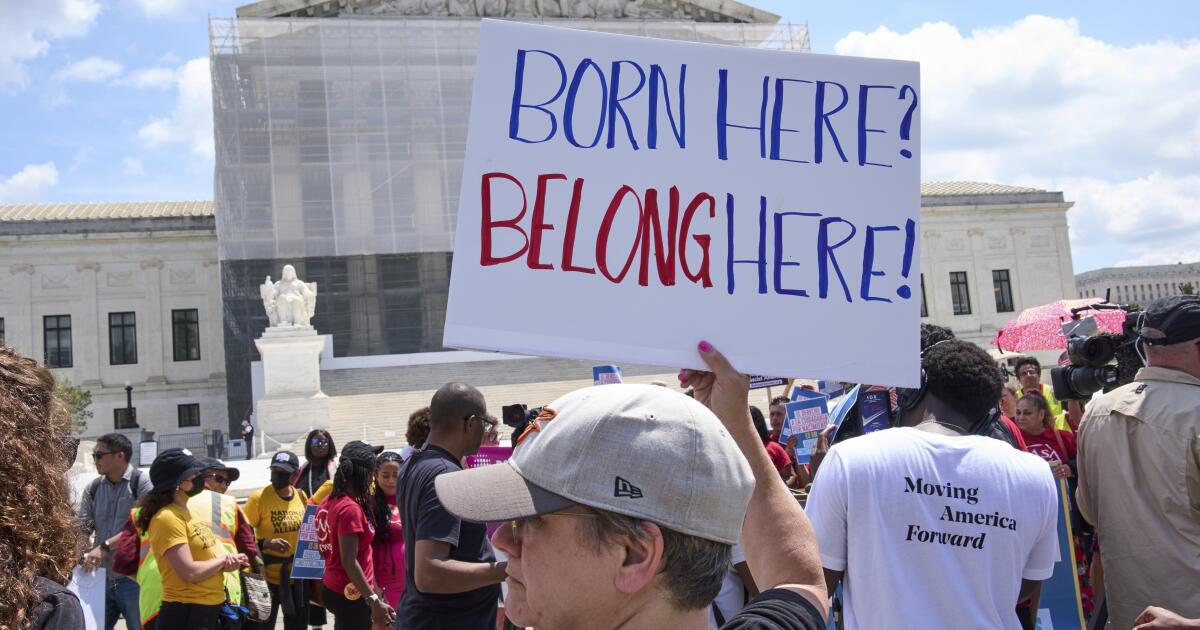
This week’s narrow Supreme Court decision protecting birthright citizenship is rightly being hailed as a triumph for the American experiment.
By some, anyway.
Check out MAGA world and you’ll quickly find Trump surrogates and even elected leaders spouting a kind of extremist anti-immigrant sentiment that once, not so long ago, was considered intolerable in the public sphere.
This has included suggestions that go as far as banning pregnant women from traveling to the United States for fear they might give birth here, and — no joke — one notable commentator writing that demanding female immigrants be sterilized might be a solution.
Trump’s Homeland Security advisor Stephen Miller said after the ruling that children of immigrants might not be “qualified to carry on or capable of executing the inheritance of this country.”
“We have people from all over the world, from Third World nations, nations that on their own would have never invented the wheel, let alone modern technology, let alone medicine, let alone air travel, and they can just come into the country, have a baby at a hospital, paid for it by you and me, and then that baby is automatically a citizen,” Miller said.
Before you tell me that the Supreme Court has spoken and this is a done deal, no matter if there’s more gross Miller mush, let me tell you about Supreme Court Justice Ketanji Brown Jackson’s written opinion and why it matters. It is, if read in the right light, a warning for what comes next — a fight to rewrite history to serve political aims.
“The odds were long and the stakes were high,” Jackson wrote about the creation of the 14th Amendment in 1866, which has long been understood as granting citizenship to any child born on U.S. soil and which was the focus of this case.
Still, she wrote, despite the unlikeliness of post-Civil War America rising to the challenge of inclusiveness, the amendment was always meant to do just that — because free Black people, recently emancipated but denied citizenship, “fought for the shared humanity of all people.”
An alternative interpretation by MAGA world of this amendment and this history was the center of this case.
To greatly simplify, the 14th Amendment was originally a response to a Supreme Court decision, the Dred Scott case, that said freed Black slaves could not be U.S. citizens. MAGA world was arguing that the authors of the 14th Amendment never intended much more than that — citizenship for ex-slaves and their descendants.
While concurring with the majority of the court, Jackson also wrote her own summary that makes a vital point: Without history that includes the Black experience — as most of the arguments in this case did — we are left bereft of the suffering that has shaped our values and which gives us the empathy required to be a pluralistic society.
Black history — any non-white history, really — is the history of resistance and the road map to recovery from this dark era of hate.
It’s hard to call someone your fellow citizen if you take away their humanity — which is exactly what this case was attempting to do by splitting into factions those who would fight for equality and rewriting history with only the voices that match the current administration’s goals.
It was disappointing that the court, whose individual justices bounced around arguments from a myriad of sources outside of their erstwhile adherence to the ideas of originalism, did not call out that erasure more forcefully, and that it was left to Jackson to do so.
Jackson took that narrow idea that Black people — and the white legislators sympathetic to their cause — had only themselves in mind when crafting the 14th Amendment and attacked it head-on, arguing that if we just look at what Black people were saying at the time, the larger intent of the amendment becomes clear.
“This alternative account pitches Black Americans against immigrants when the advocates who promoted the Fourteenth Amendment did no such thing,” Jackson pointed out of the MAGA version of events. “Freed Blacks fought for the shared humanity of all people.”
That “universalist vision of belonging and citizenship,” she wrote, “eventually won the day.”
The 14th Amendment was largely written by Sen. Lyman Trumbull of Illinois, who took much of the basis of it from the legal arguments of Black intellectuals, including Frederick Douglass, the most influential Black statesman of the era.
Trumbull then argued in Congress that the amendment was meant to be inclusive — even of so-called “gypsies” and Chinese immigrants, who faced extreme racism, especially in California.
One congressman opposed to the measure warned that if it passed, Chinese immigrants would “overrun” California and “will double or treble the population.” At the same time, the Romani would likely continue to “wander in gangs” and “have no homes, pretend to own no land, live nowhere, settle as trespassers where ever they go, and whose sole merit is a universal swindle,” he warned.
Asked if the amendment would grant citizenship to those two controversial groups of immigrants, Jackson points out that Trumbull gave an unapologetic “undoubtedly,” again drawing on the universalist ideas of Douglass and others.
The “child of an Asiatic is just as much a citizen as the child of a European,” Trumbull said (and Jackson quoted, drawing from an amicus brief by Evan Bernick of Northern Illinois University and Jed Sugerman of Boston University).
“There is a serious breakdown in on the court that reflects the breakdown and echo chambers in America,” Sugerman, the professor, told me Wednesday. “When it comes to history and originalism, you have to read more broadly than just the founding fathers that you liked.”
So the history of the 14th Amendment is right there — equality not just for Black Americans but for immigrant Americans — but it required Jackson to write her own opinion to put it on the court record.
Legal scholars aligned with Trump did Olympic-level gymnastics in this case to parse what the authors of the 14th Amendment meant with the phrase “subject to the jurisdiction” — words that MAGA claimed were meant to secretly exclude undocumented immigrants.
Brown instead reminded us that outside of those white-only discussions when the amendment was written, it was the activism of Black people — their demand for colorblind equality — that actually shaped the final words that granted citizenship to all babies born within our borders.
Solidarity — the unbreakable strength of American democracy.
After the ruling, Trump wrote on social media that Congress could write legislation undoing birthright citizenship. Some pundits say that wouldn’t work, but I’m here to say Trump has managed a bunch of stuff that the pundits said wouldn’t work.
But “because of President Trump’s courage and leadership, we are now on the precipice. Yes, we were dealt a setback, but because of his courage alone, we’re on the precipice as a nation of being in a position to end this travesty once and for all, and that’s what we have to fight for.”
Miller and his ilk are seeking to rewrite history to justify their vision of the future of America.
Jackson alone in the court offered us both a warning and a path — a reminder that our history holds indisputable facts despite politics, and we erase them at our own peril.
In 1913, Antonino Alati left southern Italy to find a better life in a land where many people regarded him as little better than scum.
He joined millions of his fellow countrymen in the United States, where the press vilified Italians as poor, dirty, violent Catholics who had too many babies, refused to assimilate and could never possibly be considered “white.”
Politicians were already working to shut the door on them. A congressional report released two years before Alati’s arrival cited southern Italians as evidence that “the new immigration as a class is far less intelligent than the old.” They came to the U.S., the report asserted, “with the intention of profiting, in a pecuniary way, by the superior advantages of the new world and then returning to the old country.”
Alati wouldn’t let bigotry win. He soon sent for his wife and children, including his infant son Salvatore. Alati turned to Alito, Salvatore became Samuel. A generation later, the family had a Supreme Court justice in Samuel A. Alito Jr. — the second Italian American, after Antonin Scalia, to sit on the highest court in the land.
During his 2005 confirmation hearings, Alito praised his father as an “extraordinary man who came to the United States as a young child and overcame many difficulties” to ensure a better life for him and his sister. By then, Italian Americans were established as an essential part of this country’s fabric, from music to politics to food.
If there’s one constant in this country besides death and taxes, it’s how quickly descendants of immigrants, and sometimes immigrants themselves, forget how loathed their ethnic group was and how they proved the haters wrong. Too many become uncharitable to the policies that helped them and the immigrants who followed.
But Alito’s stance against birthright citizenship goes beyond just forgetting his roots. His 39-page opinion describes the supposed impact of undocumented migrants on the U.S., using words — “overran,” “soared,” “exploded,” “massive,” “a stream,” “huge” — that read like the same invective used against Italians in his grandfather and father’s time.
The justice channels anti-Italian conspiracies of the past by casting doubt on the national allegiances of the U.S.-born children of Mexican, Guatemalan and Salvadoran immigrants — the same patriotism test that Italian Americans faced generations ago when xenophobes questioned their Catholicism. Alito claims without evidence that millions of agricultural workers were able to apply for American citizenship after President Reagan’s 1986 amnesty “at least in part because of fraud” — a charge also leveled against Italians who sought to naturalize back in the day.
And so it goes, each passage a jumbled argument dressed up in judicial interpretations largely rejected by his fellow Catholic Supreme Court justices John Roberts, Amy Coney Barrett and Brett Kavanaugh. Coney Barrett signed on to the majority opinion that Roberts wrote, and Kavanaugh concurred.
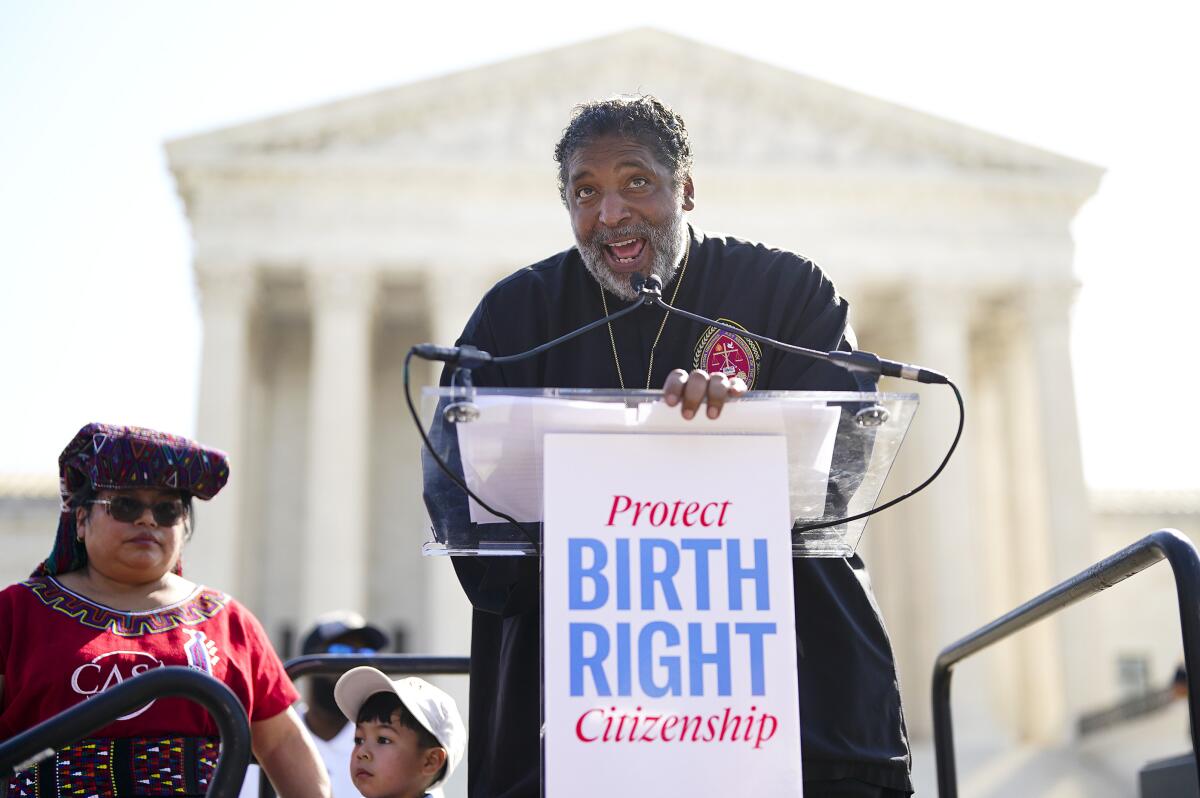
Rev. William Barber II speaks during a rally outside the U.S. Supreme Court on April 1 while justices heard oral arguments on birthright citizenship.
(Al Drago / Getty Images)
I know how quickly families forget their own immigrant histories. Yet I look at people like Alito and wonder how they ended up thinking the way they do, because I could never imagine doing the same.
Like Alito’s paisanes, my Mexican family was also demonized for supposedly being insufficiently American and posing a threat to national unity. They also sacrificed their own dreams so their children and grandchildren could achieve theirs.
And just like Alito, some members of my family have forgotten our history and support Trump or favor some of his immigration policies, dismissing new arrivals as criminals or lazy. That’s why I will always side with undocumented people and welcome anyone who gives birth in this country with the hope that their newborn finds a better life.
It seems from his dissent that Alito somewhat agrees with me. He posits that millions of Americans who were born in this country to parents without papers “have a strong moral claim to be able to remain in the land where they grew up.” Congress “can and should address their situation,” he writes.
The justice blasts birth tourism, where women from China and other countries travel to the U.S. to have a baby, then return home, benefiting from our generosity and offering nothing in return.
I agree that’s a mockery of what being an American should be and ruins it for people who want to contribute to building a better nation. But Alito throws out the baby with the bathwater by failing to recognize that Trump’s attempt to erase birthright citizenship via executive order is presidential overreach based on bigotry, not rule of law. He’d rather cut up the Constitution to spite something he doesn’t like. Thank God his side lost, yet it’s sad that Trump’s pathetic attempt to define who can be an American went as far as it did.
Alito concludes by stating that the court’s decision to uphold the 14th Amendment is “a mistake that will seriously affect the country’s future.”
What new immigrants might inflict on this country is the perpetual worry of immigration restrictionists — and yet history keeps proving them wrong. Alito’s family did; so did mine. Only in these United States can the progeny of people once portrayed as parasites and invaders side with those making the same argument about the latest batch of newcomers.
History will see Alito’s vote for what it is: a forsaking of the promise his family once fulfilled, to support the people who never wanted them here in the first place.
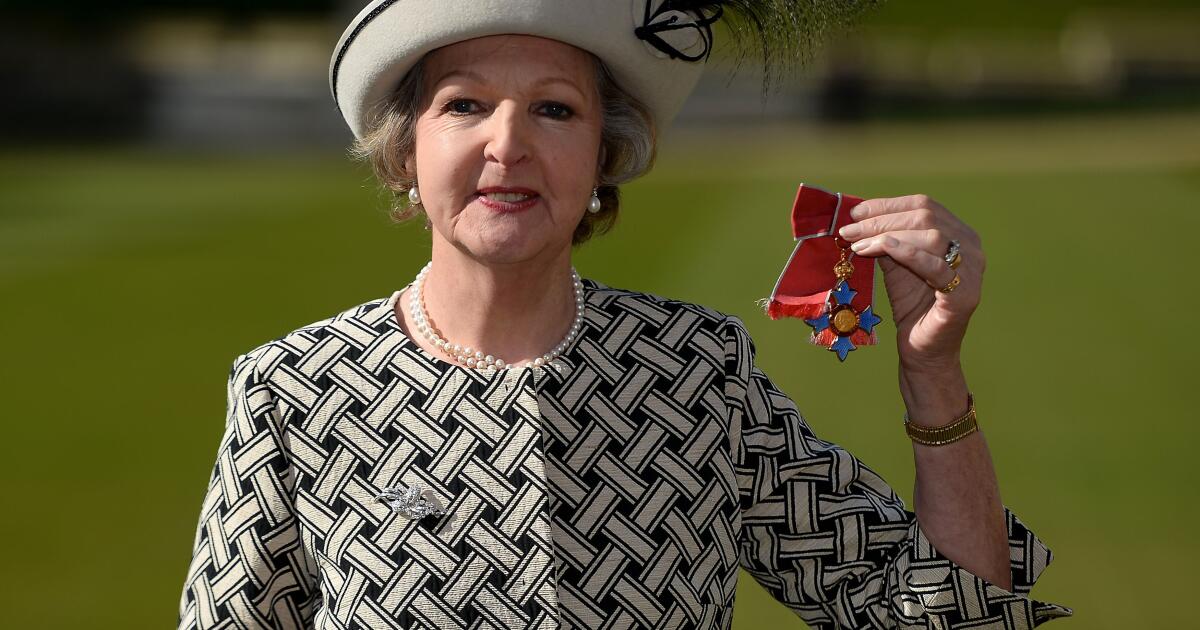
LONDON — Penelope Keith, a comic performer who shone as flinty but lovable upper-crust characters in British sitcoms “The Good Life,” which aired on PBS in the U.S. as “Good Neighbors,” and “To the Manor Born,” has died aged 86.
Keith’s family said Monday that she had been diagnosed with cancer and died at her home in Surrey, near London.
Keith began her acting career onstage and joined the Royal Shakespeare Company in 1963. But she found her greatest fame on television.
She won a BAFTA Award in 1977 for “The Good Life,” playing Margo Leadbetter, a snobbish suburbanite appalled by her back-to-the-land neighbors Tom and Barbara Good, played by Richard Briers and Felicity Kendal.
Kendal called Keith a “comic genius.”
“She was a joy to know and work with, and she will be much missed,” Kendal said.
Keith displayed a similar mix of imperiousness and deadpan wit in “To the Manor Born,” broadcast between 1979 and 1981 and brought back for a 2007 Christmas special. Keith played cash-strapped aristocratic widow Audrey fforbes-Hamilton, forced to sell her country estate to a nouveau millionaire, played by Peter Bowles, with whom she has a love-hate relationship.
Keith’s velvet tones featured on children’s show “Teletubbies” as the voice of the Bear With Brown Fuzzy Hair and in ads for everything from Pimm’s to Parker Pens. She also presented cozy documentary TV series, including “Penelope Keith’s Hidden Villages.”
Keith continued to perform in stage roles into her 80s. Theaters in London’s West End will dim their lights Wednesday evening in tribute to her.
In 2014 she was made a dame, the female equivalent of a knight, for services to the arts and to charity.
She is survived by her husband, Rodney Timson, and their two sons.
WASHINGTON — The Supreme Court on Tuesday upheld the Constitution’s promise that all those born here are citizens of the United States, regardless of the status of their parents.
In a 6-3 decision, the justices rejected President Trump’s plan to revise the Constitution by executive order and to end citizenship at birth for newborns whose parents were here illegally or temporarily.
Chief Justice John G. Roberts spoke for the court to reject Trump’s proposed limits on birthright citizenship.
“Citizenship, then and now, was the right to have rights — to freely participate in our political community,” he said. “The Framers of the 14th Amendment extended that promise to ‘every free-born person in this land.’ We keep that promise today.”
Justices Sonia Sotomayor, Elena Kagan, Amy Coney Barrett and Ketanji Brown Jackson joined in full. Justice Brett M. Kavanaugh concurred in the outcome based on the federal law that incorporates birthright citizenship.
But the outcome was closer than most had predicted.
Justices Clarence Thomas, Samuel A. Alito and Neil M. Gorsuch dissented in agreement with Trump.
The decision is the second major defeat for Trump from a conservative court that usually supports broad presidential power.
In February, the court struck down Trump’s sweeping worldwide tariffs, his signature economic policy. Roberts said Congress, not the president, has the power to raise revenue and impose taxes, including duties on imports.
In April, Trump came to the court to hear the arguments over birthright citizenship. He sat in the gallery while the justices posed steadily skeptical questions to his solicitor general.
He left after an hour having heard enough to know he was likely to lose.
It was the rare Supreme Court case which was decided based simply on the words of the Constitution.
The justices, both conservative and liberal, say they look to what the Constitution says and how its words were originally understood.
The 14th Amendment adopted in 1868 says: “All persons born or naturalized in the United States and subject to the jurisdiction thereof are citizens of the United States and of the State where they reside.”
In its place, the Reconstruction Congress adopted the broad view of citizenship based on the place of birth, not parentage, that had been part of English law for centuries.
In the 19th Century, it was understood that the only exceptions to this rule of birthright citizenship were for the children of foreign diplomats, foreign troops on American soil or, for a time, Native Americans who lived on tribal reservations.
In 1924, Congress extended full citizenship to all Native Americans who were born in this country.
The Supreme Court had also confirmed the broad understanding of birthright citizenship in 1898. The justices upheld the U.S. citizenship of Wong Kim Ark who born in San Francisco to Chinese parents who later returned to China.
“The 14th Amendment affirms the ancient and fundamental rule of citizenship by birth within the territory,” the court said then. “In clear words and in manifest intent, [it] includes the children born, within the territory of the United States, of all other persons, of whatever race or color.”
Congress added birthright citizenship to the immigration laws in 1952.
“The privilege of United States citizenship is a priceless and profound gift,” he wrote, and in the future, it will not extend to newborns whose parents are in this country unlawfully or temporarily, such as on tourist, student or work visa, he said.
His proposal was quickly blocked by judges as unconstitutional, and it never went into effect.
In his appeal, Trump’s attorney argued that judges have been “misreading” the phrase “subject to the jurisdiction.” He said this refers to “political allegiance.”
By that standard, the children of temporary visitors and unlawful immigrants are not citizens because they and their parents “not completely subject to the United States’ political jurisdiction,” according to the administration.
Trump could have proposed legislation on tariffs and birthright citizenship and urged the Republican-led Congress to adopt new laws. Instead, he chose to try to change the law and revise the Constitution by executive order.
Before the Supreme Court, Trump’s attorney pointed to the surge of illegal immigration in recent decades.
“We’re in a new world now,” he said, one that calls for new restrictions on citizenship.
“It’s a new world. It’s the same Constitution,” responded Roberts.
June 29 (UPI) — The Archdiocese of San Francisco has reached a $395 million settlement with hundreds of survivors of childhood sexual abuse allegedly committed by members of the clergy, lawyers for the victims and the archbishop announced Monday.
The agreement in principle, which follows three years of bankruptcy proceedings and extensive negotiations between the archdiocese and lawyers representing the victims, affects some 530 survivors, according to lawyer Jeff Anderson, who is among the claimants’ litigation team.
During a press conference streamed live online Monday afternoon, Anderson described the agreement as “a real settlement that provides for a significant measure of accountability, required transparency and an authentic reckoning by those that allowed these indelible horrors to be inflicted upon so many for so long.”
The archdiocese filed for Chapter 11 bankruptcy in August 2023, after hundreds of clergy sexual abuse civil cases were filed against it, which put a stop to all litigation and forced the survivors to reorganize into a committee that was represented by nine claimants.
Those nine claimants then negotiated the settlement on behalf of all of the survivors, according to Anderson, who said the agreement reached also includes a 14-point plan to protect future children from similar abuses and empower survivors.
“This is unprecedented, and this gives me hope and it is the courage of these survivors that has caused it to happen,” he said.
In a letter addressed to members of the Archdiocese of San Francisco, Archbishop Salvatore Cordileone said that they believe “this proposal offers a path toward fair compensation for survivors who have carried the burden of this abuse for a lifetime.”
“We accept the responsibility for the failures that allowed this harm to occur,” he said.
“I sincerely apologize to all those who have suffered because of those failures.”
The lawsuits that prompted the archdiocese to file for bankruptcy were filed after California enacted legislation that opened a three-year window from Jan. 1, 2020, to Dec. 31, 2022, lifting the statute of limitations on allegations of childhood sexual assault so victims of crimes even decades old could seek a civil, monetary resolution from their perpetrators.
Margie O’Driscoll, a survivor of clergy sexual assault and one of the nine committee members, said during the press conference that she was abused as a teenager by a priest at Marin Catholic High School nearly five decades ago.
She spoke directly to those who were similarly abused.
“I, like every survivor, have carried this pain and shame along like a ball and chain for a very, very long time — I see you and I know what you carry,” she said.
“So, while I want to say that today is a significant victory for everyone in the case … it’s really come at a significant cost to the 500 people sexually abused by priests and religious leaders.”
O’Driscoll said some of the victims had been abused more than 70 years ago, during which they carried the shame associated with the crime, while being scorned by the archdiocese and sometimes their accusations not believed by family and friends.
“And I think, today, shame is going to change sides,” she said.
Hundreds, if not thousands, of claims were filed after the passage of Assembly Bill 218, resulting in billions of dollars in settlements for survivors of childhood sexual abuse.
In October 2024, the Archdiocese of Los Angeles reached an $880 million settlement with 1,353 survivors. In April 2025, Los Angeles County reached a $4 billion settlement resolving more than 6,800 claims of sexual abuse allegedly committed at probation department facilities and MacLaren Children’s Center.
Trejo has played for several first and second division soccer clubs in the South American country since 2023 and signed on with the northern Venezuela-based Club Sport Marítimo de La Guaira earlier this year.
On Sunday, Trejo’s club announced the deaths of his family in an Instagram post.
“Club Sport Marítimo de La Guaira profoundly laments the irreparable loss of the wife and sons of our player Lucas Trejo,” the team wrote. “[The deaths] occurred on June 24th during the earthquake that shook the entire country.”
When the earthquakes struck, Trejo was at a training session in the capital city of Caracas while his wife Yanina and children— Aarón and Ainhoa— were at the family home in the severely affected beachfront city of La Guaira.
Trejo’s brother-in-law Ricardo Ardiles told CNN Español that the Club Sport Marítimo de La Guaira defender rushed home after the temblors and was “emotionally overwhelmed” as he dug through rubble for days in search of his family.
“What he found was a horrific scene,” Ardiles said last week. “He found absolutely nothing of what the building itself had been.”
Trejo was far from the only athlete gravely affected by the seismic activity in Venezuela.
Former Club Sport Marítimo de La Guaira player Héctor Bello also lost his wife Andrea during the earthquakes. She died while protecting their infant daughter, who was later found alive by rescue teams.
“I’m going to make sure our baby remembers how wonderful you were, how much you loved her,” Bello wrote in an Instagram post honoring his wife. “I’ll tell her the story of how you saved her, how you gave your own life for our daughter, how you were a brave woman who, even with your last breaths, never abandoned her.”
“Venezuelan football bids a heart-wrenching farewell to a young man who represented our country’s colors with pride, commitment and love,” a social media statement from the federation read. “His passing has plunged the entire Vinotinto family into mourning and leaves an indelible mark on all those who shared moments with him both on and off the pitch.”
Eighteen-year-old Razan Sijaa, who played for Caracas Fútbol Club, 14-year-old Víctor Palacios of Club Sport San Augustín’s academy and 17-year-old prospect Ricardo Veloz were also killed by the quakes.
Locally, the family of Dodgers shortstop Miguel Rojas narrowly escaped tragedy and were doing OK after the earthquakes.
“Literally two blocks away from where my family was, two buildings collapsed — the whole building,” Rojas told reporters last week. “I’m lucky, to be honest with you guys. I’m really lucky to have my family still alive and with me. I’m not taking this for granted.”
According to Rojas, his wife and kids were in Caracas, which is approximately six miles south of where the quakes struck. His wife was there to renew her passport, and the kids were going to try to get Venezuelan citizenship. He added that his sister was in Los Teques, Rojas’ hometown about 17 miles south of the coastal destruction.
“It’s really tough to see teammates of mine and players that I played with at some point in my career lose family members, to lose kids,” said Rojas, who spent years playing baseball in La Guaira. “It’s really devastating. It’s been really hard for me to go to sleep at night.”
TIJUANA, Mexico — Vivianne Petit Frere’s brightly painted Haitian restaurant sits blocks from the towering U.S. border wall in Tijuana.
Called Lakou Lakay, the name in Haitian creole means “home,” and it reflects her family’s deepening roots in their adopted homeland where her granddaughter was born two years ago, automatically making her a Mexican citizen.
Like the United States, Mexico extends citizenship to children born within its borders.
President Trump insists the U.S. is the only nation to do so as he seeks to deny birthright citizenship for children whose parents are living in the country illegally or have temporary legal status.
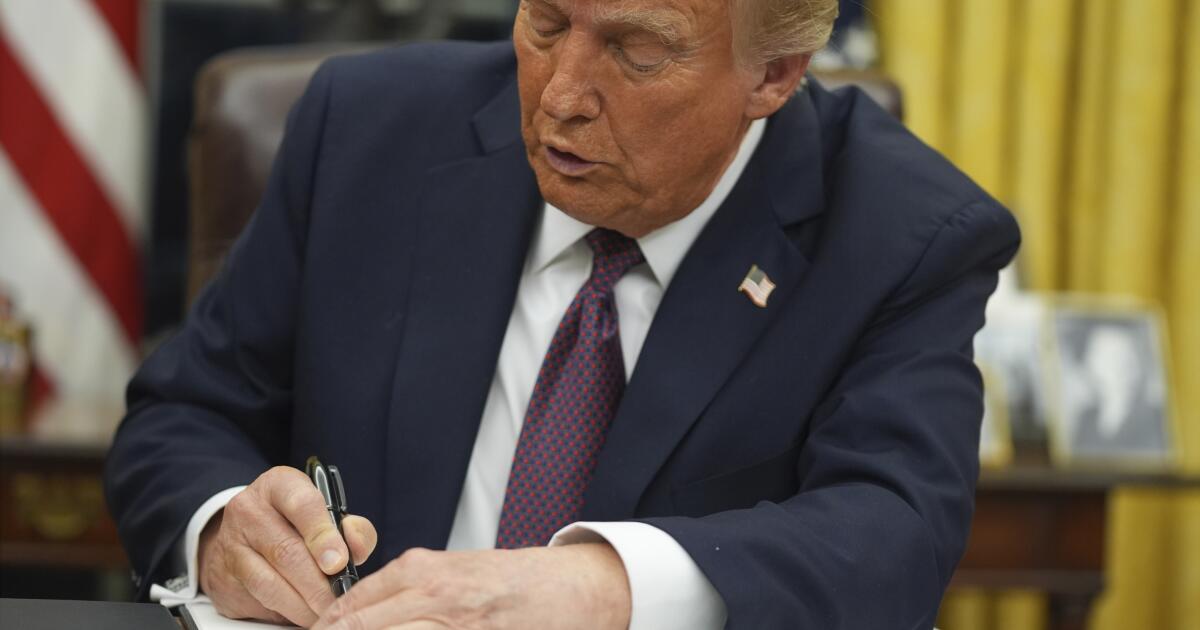
The U.S. Supreme Court is expected to weigh in soon on the constitutionality of his birthright citizenship order. Trump signed it on Jan. 20, 2025, the first day of his second term, amid his Republican administration’s broad immigration crackdown. The idea has faced skepticism from conservative and liberal justices alike.
In April, Trump posted on Truth Social: “We are the only Country in the World STUPID enough to allow ‘Birthright’ Citizenship!”
In fact, about three dozen countries, mostly in the Americas, guarantee automatic citizenship to children born on their territory — among them, Canada, Honduras, Brazil, Argentina, Venezuela and of course, Mexico.
Petit Frere fled Haiti in 2019. She traveled from Brazil and walked through the Panamanian jungle to Mexico chasing the so-called American Dream with the intention of crossing the border and settling with relatives in Florida. But she soon learned that was an illusion, while Mexico opened its doors.
Her restaurant’s name symbolizes in her Haitian culture a shared space affording a sense of belonging. On the walls she has framed signs in Spanish, English and Creole that make clear it is more than an eatery offering tasty traditional Haitian dishes, such as fish with plantains, and rice and beans.
“Every dish tells a story, every detail connects cultures,” one sign says. “We aim to promote an authentic cultural exchange between two peoples with similar historical roots yet where Haitian identity proudly blossoms on Mexican soil.”
In just over five years in Tijuana, Petit Frere has established a thriving business, become fluent in Spanish and is getting a degree in social work.
And she welcomed the first generation Mexican in her family, her granddaughter, Alexca.
There are no figures on how many children born to noncitizens have received Mexican birthright citizenship. Tens of thousands of Haitians are living in Mexico. In 2021, when Mexico saw a significant increase in Haitian migration, at least 10 percent of arriving Haitian women were pregnant, according to the United Nations’ International Organization for Migration.
Citizenship and birth
In the U.S., birthright citizenship was enshrined after the Civil War through the 14th Amendment to the Constitution, in part to ensure former slaves would be citizens.
The right was expanded to immigrants’ children in the late 1800s when the Supreme Court ruled nearly anyone born in the U.S. — no matter their parents’ legal status — has citizenship.
The practice, many legal historians believe, dates to the 1600s and 1700s, with European rulers encouraging migration to the expanding American colonies. Those colonists, though, wanted any of their children born overseas to retain European citizenship.
So even as the colonial boundaries shifted “you’re a citizen as long as you’re born within the domain of the king, of the monarch,” said César Cuauhtémoc García Hernández, a law professor at Ohio State University. “But the legal tie between the home country in Europe and the settlers remained strong through the promise of birthright citizenship.”
Dominican Republic removed birthright citizenship
In 2007, the Dominican Electoral Council officially ordered the denial of citizenship to all children born to parents without legal status.
Six years later, a Dominican court applied it retroactively to 1929.
Over a decade later, as many as 130,000 people remained stateless despite passage of a law in 2014 to correct the court decision after it drew strong international condemnation, according to the Center for Migration Studies of New York. The law now impacts the next generation, which remains vulnerable to deportation.
Her growing Mexican family
Petit Frere was born in French Saint Martin, a Caribbean island that does not offer automatic birthright citizenship. She and her mom, who is Haitian, were deported to Haiti when she was 6.
Petit Frere left Haiti seeking a better life. She was dismayed to discover when her teenage daughter left Haiti to be reunited with her in Tijuana three years later, she was nearly five months pregnant. She had been a teen mother herself and had hoped for a different path for her daughter.
But Alexca, a bubbly toddler who giggles and runs about, has conquered her grandmother’s heart. Petit Frere said she’s grateful her granddaughter was born in Mexico rather than Haiti, where surging gang violence has left more than 1 in 10 homeless.
A Mexican passport will make travel easier, she said. Few nations allow Haitian passport holders to visit visa-free.
“As a Mexican citizen, she will have more opportunities,” Petit Frere said.
That’s also true for her three nieces who were born in Brazil and were made automatic citizens there, she said.
Petit Frere said she and her daughter had permanent residency in Mexico before her granddaughter was born. But other parents in Tijuana’s Haitian community did not. Mexico allows the parents of children with birthright citizenship to become permanent residents.
“There are a lot of children in Tijuana who are 6, 7, 8 years old now who are Mexican and their parents who are Haitian did not have legal status but now have become permanent residents because their children were born here,” she said.
Petit Frere started paperwork for Mexican citizenship, which would make it easier to expand her business.
Petit Frere also is a community organizer with the Haitian Bridge Alliance, advocating for the Haitian migrant community. She said she hopes to pursue another degree in international migration, possibly through a U.S. university.
“The children of immigrants are proving to be the most outstanding in the world,” she said. Efforts to limit birthright citizenship “could just be out of jealousy,” she said.
Watson writes for the Associated Press. AP writer Tim Sullivan in Minneapolis contributed to this report.
The strike in Deir el-Balah is the latest Israeli attack amid ongoing ‘ceasefire’ violations.
Published On 29 Jun 202629 Jun 2026
At least three people have been killed in an Israeli air strike in Deir el-Balah in central Gaza, health authorities say.
An eight-year-old and two men were killed in Monday’s attack, and several people were wounded, Al-Aqsa Martyrs Hospital said.
Recommended Stories
list of 3 itemsend of list
The strike occurred near Wadi Salqa Bridge on al-Baraka Street. The Palestinian news agency Wafa named those killed as Ali Fayez Isbaitan, Hassan Salman al-Hanajra and eight-year-old Malik Wael Abu Shaweesh.
Israeli military vehicles also advanced on Salah al-Din Street in the Nuseirat refugee camp, also in the central Gaza Strip, amid gunfire and shelling, Turkiye’s Anadolu news agency reported. Two people were reported injured by shelling in Beit Lahiya in northern Gaza.
Despite the “ceasefire” that came into effect in October, Israeli forces continue to carry out strikes on the enclave.
Israeli attacks killed at least four Palestinians in Gaza on Sunday, including a 13-year-old girl, and wounded several.
Ongoing violations
Gaza’s Government Media Office reported that 1,045 Palestinians have been killed since the “ceasefire” took effect and 3,380 have been injured. It has documented 3,465 Israeli violations of the agreement.
“We strongly condemn the occupation’s systematic policies of targeting and destroying the Palestinian people,” it said.
It called on the mediators and parties sponsoring the “ceasefire” to compel Israel to implement all of its terms and “immediately cease its ongoing violations”.
The Palestinian Ministry of Health said on Sunday that a total of 73,054 Palestinians have been confirmed killed and 173,480 injured since Israel launched its genocidal war against Palestinians in Gaza in October 2023.
Also during the “ceasefire”, the Israeli military is continuing to expand the area it is occupying inside the Strip and to issue forced displacement orders. It says Palestinians are not allowed to approach the Israeli-occupied area beyond the “Yellow Line”, which encompassed 53 percent of Gaza’s territory at the start of the ceasefire and had increased to 64 percent by March.
Anadolu reported that Israeli military vehicles have moved the “Yellow Line” markers about 150 metres (165 yards) to the west in central Gaza.
Israeli Prime Minister Benjamin Netanyahu has called for Israeli forces to occupy 70 percent of the Strip.
Appearing as the amoral daughter of Joan Crawford at only age 17, Blyth’s short film career saw her work with many top stars of Hollywood’s classic era.
At only 24, Samuel Kim Arredondo, better known as Samuel, has lived through nearly every iteration possible in a K-pop idol’s career.
As a child growing up in L.A.’s Koreatown, he attended Wilshire Park Elementary School — but by the fifth grade he had moved to South Korea with his mother, Kyung-ju, with dreams of K-pop stardom. There, he became a trainee under Pledis Entertainment.
Now a subsidiary label of Hybe — parent company of K-pop superstars BTS — Pledis was forming what became one of the most successful “third generation” K-pop groups of all time: Seventeen. Samuel, who was in the running to debut with the group, is even captured in early footage from their “Seventeen TV” variety show.
Though he didn’t make the cut, he remained close with the members and helped write lyrics for their 10-year anniversary album. Just last week, he filmed a dance challenge with singer-MC Mingyu for the reggaeton-infused pop number “Zigi Zigi Zigi” — the lead single off of his new EP, “Samuelito,” which dropped June 8.
After leaving Pledis, Samuel — who is fluent in both English and Korean — signed to a new agency, Brave Entertainment, then formed one half of a short-lived hip-hop duo, 1Punch. (He was Punch, the other kid was One.)
In 2017 he competed on the second season of Produce 101, a globally popular Korean competition franchise, where he made it to the penultimate episode before the debut of the group Wanna One. That same year, he released his first solo album, “Sixteen,” fully showcasing his outstanding dance ability, youthful swagger and velvety tenor.
Yet before he could finally make headway, he suffered a devastating loss.
Samuel’s father, José Arredondo, who came to the U.S. from Michoacán as a child, died tragically in a 2019 case that made national and local headlines. After having spent years apart from his father while living in Korea, Samuel spent quality time with him shortly before his death.
José was a pillar of his community; he rose from washing cars to owning his own car dealership, alongside other businesses in Bakersfield. A precocious young Samuel can still be found showing off his dance and Spanish skills in an old commercial for the dealership. (“Volkswagen me hace bailar,” he says before busting a move.)
The loss of his father was made more harrowing when the news went public, Samuel recalls over a Zoom interview from Seoul, where he is promoting his new album.
“The articles went out first,” he explains. “It was everywhere before I even wanted to talk about it, so I had no choice to keep it private … of course it’s definitely hard for me.”
In the aftermath, Samuel went under the radar — but after a year or two, he started to pave a way forward. After getting out of the contract with his former label, and with the support of his mother, he launched his own company, Samuel Music Group.
“If I kept on staying in the past, I think no one would like it — even my dad wouldn’t like it,” he says. “I learned a lot through that emotion as well. Always be grateful, always be thankful every time, and try to say ‘thank you’ always, especially to parents.”
Composed of three songs and one interlude, “Samuelito” takes its name from the childhood moniker some know him by today. As the follow-up to his 2024 EP, “Now,” it is his second record release since he became independent. It’s also his first record sung predominantly in Spanish — along with the occasional sprinkle of English and Korean. (Take the onomatopoeic “Ddook Ddak,” which is Korean slang for “just like that.”)
Singing in Spanish for the first time, he tells me, to music he created himself, made his “heart race.”
“Samuelito” is not so much an exploration of Mexican musical traditions, but of Latin-influenced rhythms and sounds filtered through his uniquely multicultural lens. In the future, he dreams of working with genre-spanning Latino pop artists who crossed over culturally, like Selena Gomez, Camila Cabello and Rauw Alejandro.
In an Instagram reel from earlier this year he described his efforts as “K-tone” — a Latin and reggaeton fusion, powered by K-pop discipline. The comments below were peppered with encouraging responses from fans in multiple languages.
Wrote Liz Zeledon, from Oceanside: “As a Korean-Nicaraguan who grew up with exposure to both cultures, I love hearing Latin influences in K-pop… Korean Latines are so underrepresented in the Korean music industry.”
Reached by phone, Zeledon is a K-pop fan who has kept tabs on Samuel since his Seventeen trainee days; she is also a child of immigrant parents.”Representation is so important, because existence and visibility are not the same thing,” she says.
In the lead-up to the album’s release, Samuel posted photos and videos of himself as a young child. In one, his dad holds him up as a baby, dressed in all-white with a tam hat. Though Samuel says the EP is not an on-the-nose tribute to the elder Arredondo, his spirit resonates through the lyrics of the poignant downtempo track, “Never Say Goodbye.”
“Gritos que yo sé/Que llegan hasta El Cielo/Gotitas en el suelo/Y se me cae el mundo entero,” he sings. (“Cries that I know/Reach all the way to Heaven/Little drops on the ground/And my whole world comes crashing down.”)
“I used to listen to a lot of Spanish music while I was growing up … I used to eat a lot of Mexican food too,” he says. “While I was in the studio last year, I had [this] big vision: [‘What if] I bring back my roots and just be the true me and call this album “Samuelito?”’ It just felt fresh.”
Samuel started songwriting and producing for himself in the making of “Now.” On his new album, only three writers are credited, including himself — which is somewhat of a rarity these days in K-pop. One of them is Canadian Mexican singer-songwriter Andrea Rocha.
From her new home in L.A., Rocha said the main goal was to seamlessly blend two distinct musical cultures. Although Samuel came to the studio with the structure for his songs already in place, they worked on melodies and writing in Spanish together, since this was his first time penning lyrics in the language.
Rocha says she was taken aback by Samuel’s professionalism. “I’d be like, ‘Oh, what about this melody?’ And then he would sing it perfectly,” she says. “I did ask him about his K-pop training, because it sounds really intense. I think it shows how hard he’s worked in those years because he’s got all the star qualities. Compared to a lot of newer artists that I work with, I’m like, ‘Ooh, they’ve [done] a lot of work to get to that level.’”
These days, Samuel splits his time between Seoul and Los Angeles — once again calling Koreatown his permanent home. He also continues to spend time with his dad’s side of the family in Bakersfield.
“I think the biggest thing that I am happy about is getting back to my roots, where I started,” says Samuel.
WASHINGTON — A Democratic U.S. senator warns the Trump administration is getting ready to round up 500 immigrant children in a hasty effort to remove them from the country, bypassing legal protections. It would be their second attempt after a federal court intervened last year in an overnight plan to fly out hundreds of children on Labor Day weekend.
Sen. Ron Wyden of Oregon wrote in a letter Wednesday to U.S. Health Secretary Robert F. Kennedy Jr., which oversees the Office of Refugee Resettlement caring for unaccompanied migrant children, that he had “credible information” that the Trump administration had a list of more than 500 migrant children it was targeting for a fast-track removal process and that the department was racing to act in days. He warned that the administration was abdicating “core humanitarian and child welfare mandates” and demanded an immediate halt to any plans to remove the children.
Wyden, who is the ranking member and senior Democrat of the Senate Finance Committee, which has jurisdiction over ORR, did not detail how he came by his information. His office declined to provide further details. ORR falls under the Department of Health and Human Services.
An HHS spokesperson denied any such plans.
“The new information I obtained leads me to believe that the Department is laying the groundwork for another lawless deportation effort, this time on a greater scale, across more countries of origin,” Wyden wrote.
“You have been entrusted with the care and safety of the children placed within the ORR network. Proceeding with this plan knowingly endangers their lives and violates your duty to these vulnerable children.”
Wyden also issued an early warning last August ahead of what eventually became a chaotic weekend of efforts by the Trump administration to remove Guatemalan children in its care and send them home.
HHS spokesperson Emily Hilliard said in “there are no plans to target these children,” calling Wyden’s claims ”irresponsible fearmongering.”
“The Trump Administration is working to identify the parents or legal guardians of unaccompanied alien children in our care because ensuring every child is placed with a properly vetted sponsor is our top priority,” she said.
Over the Labor Day weekend, dozens of migrant children either staying in government-supervised shelters or with foster families were taken from their homes and bused to airfields in Texas bound for Guatemala. A federal judge woken up in the middle of the night eventually stopped the planes. Lawyers for the children — many who had fled violence at home to come to the U.S. — later described how traumatic the middle-of-the-night removal effort was for them.
The administration insisted it was reuniting the Guatemalan children — at the Central American nation’s request — with parents or guardians who sought their return. Lawyers for at least some of the children said that wasn’t true and argued that in any event, authorities still would have to follow a legal process that they did not.
Migrant children traveling alone are usually entrusted to U.S. government care, and there are various legal protections designed to protect them once they’re in the U.S. and navigating the immigration system.
The Trafficking Victims Protection Reauthorization Act of 2008 is one of the key pieces of legislation designed to protect them. With some limited exceptions, it requires that children be placed in the “least restrictive setting possible,” which generally means that they can be released to a sponsor such as a relative in the U.S. while their immigration proceedings play out.
The children can apply for a specially protected status if they can’t return to their home country because of abuse or neglect and they can also apply for asylum.
The Trump administration has made it increasingly difficult for those children to be released to sponsors though. The administration says that they are doing due diligence to make sure that sponsors are thoroughly vetted and that in the past, children were released into dangerous situations.
But advocates say that the result has been children lingering for months in government shelters.
This time, Wyden said the children at risk of being removed come from various countries, potentially including Guatemala, Honduras, El Salvador, and Afghanistan, and have been in U.S. custody — mainly in foster care — for at least 180 days. He said they were described as not having any “viable sponsor” who could come forward and take care of them in the U.S.
Not having an identified sponsor could mean the child’s parents are in their home countries, are deceased or are too afraid to claim their children after ICE started arresting some parents who are not in the country legally during their reunification efforts.
Gonzalez and Santana write for the Associated Press.
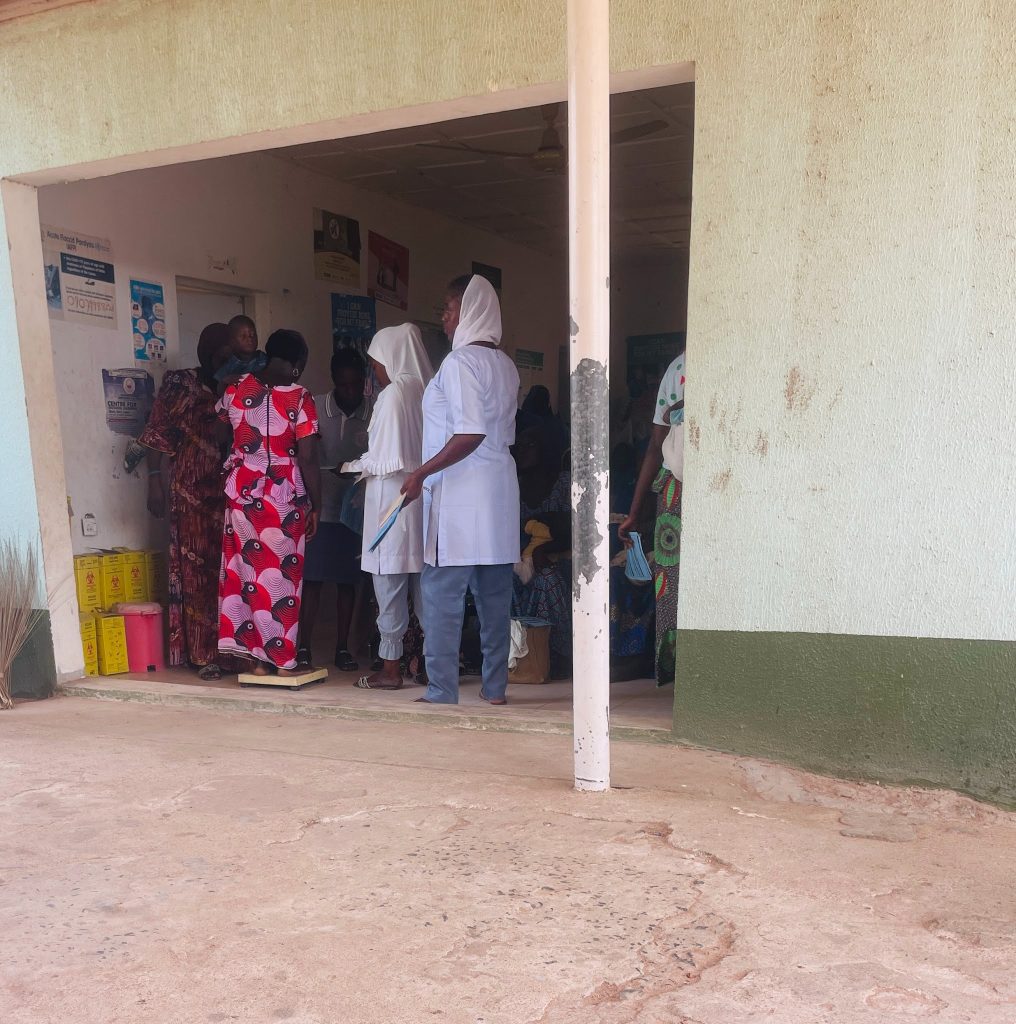
Every Thursday, 35-year-old Fatima Sani joins hundreds of other women from neighbouring communities across Demsa, a local government area in Adamawa State, northeastern Nigeria, to obtain Ready-to-Use Therapeutic Food (RUTF) for her one-year-old malnourished daughter at the Demsa Primary Healthcare Centre. The mother of nine has made several trips to the centre to ensure her daughter recovers from malnutrition. Her treatment includes RUTF, a paste made from powdered milk, peanuts, butter, vegetable oil, sugar, and a mix of vitamins and minerals. A sachet contains 500 calories and essential micronutrients.
“My youngest children are twins, and both of them were diagnosed with malnutrition,” Fatima told HumAngle. “One of them has been declared healthy and discharged by the centre, so I no longer bring him here, but I come to obtain RUTF for his twin, and hopefully, she recovers and gets discharged too.”
She noted that the twins were the only children in her household ever to be diagnosed with malnutrition in her household. When asked what the cause might be, Fatima replied: “Hunger.”
She sells fresh vegetables at the local market in Demsa, and her husband, whom she referred to as Sani, is a rice farmer. She explained that most of his harvest is kept for household consumption, while the rest is sold to meet other needs. Then, a disaster repeatedly washed away his produce.
“For three years in a row now, floods have been destroying my husband’s farm,” she said, adding that the destruction in 2025 left him devastated. “The rice had reached maturity, but on the expected day of harvest, the flood came and washed everything away.”
‘Food is scarce’
UNICEF, in its 2025 report, highlighted that flooding is worsening the nutrition crisis in Adamawa, as the destruction of farmlands, disruption of livelihoods, displacement of households, and damage to health and nutrition facilities have all contributed to reduced access to food and essential nutrition services in the state. This has led to a surge in malnutrition levels, doubling the previous year’s estimates and placing children, pregnant women, and lactating women at increased risk.
After the flood ravaged her husband’s farm, Fatima said, feeding her family became extremely difficult. “We now eat once or twice a day. Some days, there is nothing at all,” she said. She added that her husband, Sani, left Demsa about two months ago in search of greener pastures due to feeding difficulties in their household.
Helen Daniel, another woman who collects RUTF for her malnourished granddaughter at the healthcare centre in Demsa, told HumAngle that the 20-month-old child was almost dying when she first saw her. “I had gone to the village to check on my daughter when I noticed that my granddaughter’s ribs were visible. At close to two years, she could barely stand, and she was struggling to keep her head firm,” Helen said.
Her daughter and son-in-law are full-time farmers in Wuro-Laka, a nearby village in Demsa, so when floods ravaged rural communities around their area, including their farmland, they lost their only means of livelihood.
“Food is scarce, and they only eat what they can get,” Helen said.
Since she had seen women trooping into the Demsa Primary Healthcare Centre with their children who exhibited the same symptoms as her granddaughter, Helen returned to Demsa town with the child after her visit and headed there too. There, the child was diagnosed with malnutrition in March.
“This is my sixth trip to the centre, and I can boldly say there has been a significant improvement in my granddaughter’s health since I started feeding her the RUTF. She has gained weight, and I can’t wait for her to start walking,” Helen said.
Dr Innocent Agaba, Senior Registrar at the Department of Paediatrics, Modibbo Adama University Teaching Hospital, Yola, explained that malnourished children who are left untreated do not attain their full intellectual potential and may eventually die. “They will be duller than their peers, and they are literally going to be shorter and smaller than their peers,” he said.
His observation is consistent with global research. Studies by the World Food Programme, World Health Organisation, and UNICEF have found that childhood malnutrition and stunting are linked to poorer cognitive development, reduced educational outcomes and delayed physical growth, with long-term consequences that can persist into adulthood.
The paediatrician also noted that malnourished children are prone to health complications and organ failures.
At the primary healthcare centre in Demsa, a group of healthcare staff are attending to mothers of malnourished children. Photo: Saduwo Banyawa/HumAngle
Across flood-prone areas
According to the Integrated Food Security Phase Classification, armed conflict, inflation, and extreme weather are the main drivers of acute malnutrition in Northern Nigeria, which is affecting about 6.4 million children aged 0 to 59 months, as well as 786,000 pregnant and breastfeeding women.
The 2025 analysis shows that, of the 21 local governments analysed in Adamawa State, the malnutrition rate was reported to be in the Alert Phase (Phase 2), indicating a deteriorating nutrition situation requiring close monitoring and targeted interventions. Meanwhile, some LGAs in Borno were in the Critical Phase (Phase 4), meaning malnutrition levels had reached an emergency threshold, with a high risk of illness and death among affected children and urgent action was needed to prevent further deterioration.
Members of the International Rescue Committee distributing RUTF supplements to malnourished children at the Imburu primary healthcare centre. Photo: Saduwo Banyawa/HumAngle
The effects of repeated flooding on child nutrition are not limited to Demsa. Across Adamawa State, other flood-prone communities are facing similar challenges. In Imburu, a community in Numan Local Government Area of Adamawa State, families are also grappling with rising cases of malnutrition linked to the loss of farmland and livelihoods.
Twenty-one-year-old Shaawalatu Yakubu is one of the RUTF recipients at the primary healthcare facility in Imburu. She told HumAngle that her family is yet to recover from the devastating impact of last year’s flooding. The family relied on produce from their maize farm. Before the damage, she explained, her family’s needs were fully met, and her daughter was on a different meal plan that included soya beans and custard pap with milk, but now, the child is fed whatever is available.
“The flood washed away our maize farmland that reached maturity, including other farmlands and households in the area,” she said.
Get our in-depth, creative coverage of conflict and development delivered to you every weekend.
Subscribe now to our newsletter!
Shaawalatu, who resides in Ngbalang, a neighbouring community around Imburu, receives RUTF for her malnourished daughter every Wednesday. “The RUTF is free, and I have seen changes in my daughter since I started feeding her with the supplement,” she said.
Aisha Musa, whose son is being treated at Imburu Primary Healthcare Centre, said that the prices of foodstuffs in the area had gone up because most farmers are trying to make up for losses incurred in the previous flood. “One mudu of maize was ₦550 Naira, but now, it’s ₦750,” she said. To help her son tackle the crisis, she feeds him soya beans and guinea corn pap alongside the RUTF supplement.
An assessment conducted by the National Emergency Management Agency (NEMA) and the Adamawa State Emergency Management Agency (ADSEMA) in June 2025 found that over 9,000 hectares of farmland were destroyed by floods across Adamawa State, while over 23,000 people were displaced. Communities in Numan, including Imburu, Ngbalang, Lure, and Zangun, were severely flooded. Farmlands were submerged, and residents were forced to seek shelter in makeshift homes.
A cross-section of makeshift homes erected on the street of Imburu by residents in 2025. Photo: Saduwo Banyawa/HumAngle.
Still, there’s a challenge
Every registered woman receives 14 packs of RUTF per child each week across the state’s nutrition centres. Two sachets are to be administered daily. However, there are times when supply is inconsistent, and the children don’t meet the feeding standard.
Norah Noel, a healthcare provider at a nutrition centre in Fufore, another flood-prone local government area in Adamawa, said that RUTF shortages affect recovery rates among malnourished children in the region and that, despite assistance from the Adamawa State government and humanitarian agencies, these shortages persist.
“Since last October, we haven’t had RUTF on the ground. The rate of malnutrition is increasing because we have plenty of cases that are coming,” she told HumAngle.
Norah stressed that children aged six to 10 months are among the most affected in the region, adding that more cases are recorded during the rainy season because repeated flooding in the area causes food scarcity.
The healthcare provider also explained that the Fufore facility, located in the town centre, is always overwhelmed with cases from neighbouring villages. Since there is a shortage of RUTF, Norah stated that the centre is seeking alternative measures to provide care for those affected, while critical cases are referred to larger healthcare facilities.
She explained that some people spend an average of ₦6,000 to ₦10,000 on transport to reach the centre, only to be disappointed by RUTF shortages.
“What we do is show them how to make Tom Brown,” Norah said. Tom Brown is a locally produced flour mixed with grains to prevent relapse in malnourished children.
While the healthcare centre carries out outreach in some of the rural communities in order to reach the malnourished children, Norah believes some children might never make it to the facility, especially those in inaccessible areas.
In June 2025, UNICEF revealed that over 400,000 children in Nigeria’s northeastern and northwestern regions would be at risk of imminent nutrition stockouts. This means a shortage of RUTF and Supplementary Food, with data indicating a reduction in overall partner and financial volume.
According to the paediatrician, it is important for malnourished children to complete their full course of RUTF, which can last several weeks or even months. Recovery is considered complete only when a child reaches the recommended weight-for-height Z-score or when their Mid-Upper Arm Circumference (MUAC) returns to a normal range.
Stopping treatment too early can undo any progress that has been made. “If a person begins to enjoy some benefits from some recovery and then stops, he just reverses back to his initial stage and returns to a pre-morbid state,” he said.
Yet for many families in rural Adamawa, completing treatment is often easier said than done. During the rainy season, flooding frequently cuts off access to healthcare facilities, making it difficult for caregivers to obtain RUTF or attend follow-up appointments.
Smith Jocthan, the Facility Manager at Demsa Primary Healthcare Centre, told HumAngle that residents from communities like Kodomun, who rely on the facility for RUTF, do not usually show up during the rainy season. Other residents in Fufore raised a similar concern.
“Their culverts have a problem. When it is flooding season, it’s not easy for them to come to the facility,” he said.
For health workers on the frontlines, these access challenges underscore a broader problem. Both Jocthan and Norah identified flooding as a major driver of the malnutrition crisis in Adamawa. In Demsa, Jocthan said, repeated flooding is affecting children’s well-being.
Jocthan Smith, sitting in his office at the Primary healthcare facility in Demsa. Photo: Saduwo Banyawa/HumAngle.
Beyond the physical barriers created by flooding, health workers say social and cultural factors also hinder efforts to tackle malnutrition. Jocthan noted that certain misconceptions also contribute to the slow recovery rate in the region, which leads to low rates of discharge among the malnourished children in Demsa. “One such tradition among some people is that a child under five years should not eat eggs. Because if they do, they will become thieves. We know eggs are a source of protein, but most children are denied the opportunity of getting that protein,” he said.
Despite the setbacks, he said the facility is making progress. “This is because many are educated on how to prepare local foods. Before, there was no knowledge of that,” Jocthan said.
In May, Médecins Sans Frontières (MSF), an international humanitarian organisation, warned that malnutrition is no longer a seasonal emergency but a permanent feature of Nigeria’s humanitarian landscape, especially in the northern region, where cases are extremely critical.
Dr Agaba stated that RUTF supplementation alone is far from enough. “One of the biggest challenges to dealing with malnourished children, especially in impoverished settings, is that people assume RUTF is enough,” he said. The paediatrician stressed the importance of other aspects, such as a healthy, well-fed mother, understanding of a balanced diet, and exclusive breastfeeding.
What to do with the floods?
A study on the causes and effects of floods in Adamawa State has identified the opening of dams, excessive rainfall, rising water levels, and poor drainage as major factors.
When floods pushed families out of their homes in the Benue River Valley in 2025, Agoso Bamaiyi, an environmental scientist, noted that the overflowing of the Benue River through its tributary, the Gongola, is the main driver of flooding in the region. Even though the expert acknowledged climate change and global warming as contributing factors to the rising frequency and intensity of floods, he argues that the Benue’s overflooding remains the central cause in Adamawa. He says dredging the Benue River and constructing a reservoir dam will address the flooding situation.
In May, the National Emergency Management Agency (NEMA) met with the Adamawa State Governor, Ahmadu Fintiri, as part of its response to rising climate-related threats. Zubaida Umar, NEMA’s Director-General, disclosed that no fewer than 33 states are at risk of flooding this year, with Adamawa listed among the most vulnerable according to projections.
Governor Fintiri has said that his administration is preparing ahead of the disaster. While measures such as monthly sanitation and drainage clearing are already in place, he emphasised the need for continuous sensitisation of residents in high-risk areas and revealed the government’s plan to establish temporary shelters to accommodate displaced persons in the event of flooding.
Fintiri also advocated for stronger federal support so as to ease the impact of the flood on affected communities.
HumAngle reached out to the National Emergency Management Agency (NEMA) and the Adamawa State Management Agency (ADSEMA) for comments on their efforts to address the root causes of the flooding, but has not yet received a response.
With little clarity on what is being done to prevent future flooding, families continue to grapple with its consequences on their own. Helen is determined to nurse her granddaughter to full health. “I will make sure she eats well and is taken care of, and once she recovers, I won’t send her back to the village but will live with her instead. I’m not sure she can survive another cycle of hunger,” she said. Fatima shares a similar hope for her child. She wants her daughter to fully recover and eventually get cleared of malnutrition, just like her twin brother.
Paul Avery, a journeyman actor best known for his role on “All My Children,” and his wife, Sheila, have died following a house fire. He was 81 and she was 77.
The couple’s death was confirmed by their daughters Parker Sanchez and Kyle Avery, who said the fire broke out in their home in Blairstown, N.J., early last Tuesday morning. While firefighters were able to reach Paul and Sheila inside the Mohican Road home, the couple succumbed to smoke inhalation.
The cause of the fire is under investigation.
Paul had a recurring role playing Hughie the bartender at Foxy’s on the ABC daytime soap “All My Children” for 12 years. He also acted in the 1978 film “Superman,” “Three’s Company,” “Soap,” and appeared in more than 300 commercials. He also acted in theater productions and produced plays in both New York and Los Angeles.
According to his daughters, the actor joked that his “elastic face” landed him multiple national commercials that ran concurrently. Casting directors looking for a “Paul Avery type” would turn the actor away because he was in too many commercials.
“He had a teeny tiny part — one line in Superman — but boy did he make a meal out of that,” Sanchez joked.
Kyle Avery added that at the Oscars, they played a clip from “Superman” that featured Paul reciting his line.
“His good friend ran into the kitchen and made him an Oscar out of tinfoil and handed it to him,” she said. “But I think the thing that he was proudest of was that he could make a living as an actor.”
Paul Avery was born Oct. 8, 1941; and Sheila Avery was born May 22, 1949. Paul was raised in Indianapolis, served in the Vietnam War in his 20s and moved to Los Angeles and then New York by his late 20s to try to make it as an actor. Sheila was raised in Kansas City, Mo., and moved to New York where she worked as a registered nurse but also had a background in theater.
She studied the craft in college, performed on a USO tour in Vietnam and worked as a costume mistress.
According to the couple’s daughters, the two brought their Midwest charm and sensibilities to the East Coast.
The couple met while living in an apartment building filled with other journeymen actors in the late 1970s.
“They were all part of this theater community, people who would go from regional theater to regional theater with the season,” Kyle Avery said. “They were a whole troupe of people who’d be in New York for part of the year, but then they’d go and be in Lakewood, Ohio, or Kansas City or Chicago, just following the theater.”
Sheila was previously married to John Quincy Bruce Jr., also an actor in the New York theater community and the father of Sanchez. Sheila and Paul got together in 1982 and married in 1984. They celebrated their 42nd wedding anniversary in April.
Paul was a jack-of-all-trades and master of many. He was a small plane pilot who often flew into a tiny airport in Blairstown, N.J., which is how the couple discovered the town they’d call home. There, they opened a bookstore, Cabbages and Kings. Paul also launched a magazine: the Warren County Companion. According to the couple’s daughters, Paul was the first internet service provider in town. He also penned film reviews for the New Jersey Herald and some for the New York Times as well.
Sheila found what her daughters called the “perfect job,” which brought together her work as a registered nurse and background in theater: speaking in schools about domestic violence and sexual assault. She also became a counselor who worked with survivors, and a trainer who worked with volunteers, teaching them how to interact with victims.
“People who took her training 20 years ago have been contacting us and saying, ‘Your mother changed the way I thought about the world, she is the basis for my feminism,’” Sanchez said. “It’s been so fascinating to hear the ripple effects of young women who took that training from her, and who are now middle-aged women who are still thinking about her.”
The daughters said that their parents were community icons who were dedicated to service. “They had a sense of duty to the people around them,” Kyle Avery said.
“They loved to throw parties,” Sanchez said. “They hosted an annual event called Faux Giving and they would have these insane traditions, like we would have a head-measuring contest and measure the circumference of people’s heads, and then a winner gets to eat their pie first, and a badge.
“Whoever had the smallest head, everyone there would shout, ‘Pin head! Pin head!’ at this person, and it was the silliest thing in the world, but everyone who attended that event, even if they came one time, would talk about it forever.”
Kyle Avery added, “They were incredibly memorable.”
“They were community builders, they were people who wanted to nourish you in every way, and they were so good at it.”
They are survived by their children: Kyle Avery; Parker Sanchez and her husband, Pablo; Paul Avery’s son from a previous relationship, Stuart Sutherland; and their grandchildren, Avery, Duncan and Liana.
HARRISBURG, Pa. — Six months after President Trump warned states not to regulate artificial intelligence, they are increasingly doing just that.
Congress has stalled on producing federal regulations of artificial intelligence as states forge ahead and scrutinize how chatbots interact with children, how AI systems are used by employers and what developers must do to try to prevent an AI-caused catastrophe.
State lawmakers have stepped back from earlier, wider-ranging attempts to regulate AI that were vetoed or otherwise derailed by governors who viewed the measures as too onerous toward the industry’s development, including efforts to hold developers accountable for bias in AI systems.
But they are returning with legislation that is more targeted and, often, probes the corners of life where Americans interact with AI but may not know it.
Presidential power versus state power
Trump’s move to restrain states’ actions on AI drew criticism from members of both political parties and civil liberties and consumer rights groups who worried that banning state regulation would amount to a gift to AI giants, who enjoy little to no oversight.
Trump has made AI a top national and economic security priority, and he said that letting states clutter the regulatory playing field for an industry that’s spending trillions of dollars and driving the economy is too risky in the race with China for AI superiority.
Trump issued an executive order that directed the attorney general to create a task force to challenge state laws that are more than “minimally burdensome,” and directed the Commerce Department to draw up a list of problematic regulations. It also threatened to restrict funding from a broadband deployment program and other grant programs to states with AI laws.
The White House said it wouldn’t target state laws that seek to prevent fraud and protect consumers and children.
In the meantime, the Trump administration released a “national policy framework” in which it urged Congress to preempt state AI laws that are out of step with its regulatory worldview and to pass legislation to protect children, intellectual property rights and free speech. A recent bipartisan draft proposal in the House was met with withering criticism from key Democrats and Republicans.
The White House has given no indication that it has made good on its threat to enforce the president’s executive order by going to court against a state’s AI law or withholding money. In a statement, it said the Trump administration is “eager to work with partners” to enact its policy framework.
States seem largely unrestrained by Trump
Trump’s executive order didn’t seem to discourage states from trying to regulate how AI is used. More bills have been introduced this year than last, including by Republicans, said Justine Gluck, policy director of the Future of Privacy Forum, a nonprofit that advocates for data privacy in technology and whose members are from industry, academia and civic groups.
In Illinois, legislation on the desk of Democratic Gov. JB Pritzker piggybacked on elements of laws passed last year in California and New York that require developers of large advanced AI models to create protocols to prevent their systems from causing catastrophes such as a biological weapons attack, power outage or large-scale hack.
Illinois added a requirement that AI developers must get an independent auditor to review whether they are complying with their own policies. Analysts see it as a step toward requiring AI developers to take greater accountability for their products.
The bill’s sponsor, Democratic state Sen. Mary Edly-Allen, brushed aside Trump’s threat.
“I don’t know if you’ve met Illinois, but we’re pretty independent,” Edly-Allen told the Associated Press.
The bill drew nearly unanimous support, signaling a willingness by members of Trump’s party to cooperate with Democrats in filling the AI regulatory vacuum left by the federal government.
This kind of legislation is expected to expand to other states.
Regulating chatbots, especially for children
A growing number of states are imposing restrictions on how AI chatbots can interact with people, especially children. A mix of Republican- and Democratic-led states have passed such laws this year, including Colorado, Connecticut, Idaho, Iowa, Nebraska and Oregon.
In many cases, states want companies to tell people when they are interacting with AI instead of a human. Many want chatbots to be restricted in how they interact with minors, parents to have control over their child’s access, and data given to chatbots to be kept private.
In recent weeks, Connecticut enacted provisions for companion chatbots that sustain an ongoing relationship with a human. Under them, a chatbot must not be able to interact with someone under 18 unless it is programmed against encouraging self-destructive behavior and provides parents with tools to manage the child’s use.
Transparency in AI and decision-making
In California, lawmakers are advancing the “No Robo Bosses Act of 2026” to prohibit employers from relying solely on AI to fire or discipline workers, and an expansion of how the state regulates AI chatbots, including banning chatbot outputs to children from being used for advertising.
Colorado in May required companies that deploy AI systems in important areas such as employment, education, housing or banking to tell people when AI is being used to influence a decision made about them.
It was a stab at regulating what researchers say is the bias inherent in AI systems that sort through a consumer’s data and render consequential decisions — including who gets hired, a home loan or medical care. But it watered down a 2024 law aimed at preventing AI’s penchant to discriminate, amid pressure from Democratic Gov. Jared Polis.
In Connecticut, lawmakers required employers who are using employment-related AI systems to tell employees or job applicants that they are interacting with AI.
Meanwhile, Connecticut, Washington and Utah required AI developers to embed data into digital content that will allow users to determine whether the content — such as photos or video — has been created or altered by AI.
More laws are possible this year.
Some Republican-led states hold back
In Florida, the state House refused to advance what Republican Gov. Ron DeSantis called his AI “Bill of Rights” legislation. It included provisions to give parents control over their children’s access to companion chatbots and to require companies that use chatbots to tell consumers when they are interacting with AI instead of a human.
Florida House Speaker Daniel Perez, a Republican, said Trump had made it clear that the federal government should be in charge of AI regulation. DeSantis panned that idea, noting that the federal government isn’t acting.
In Utah, progress stalled on legislation modeled on laws in New York and California after the White House sent a one-sentence memo to lawmakers there to warn that it was “categorically opposed” to the bill.
Dodgers superstar Shohei Ohtani was away from the team Friday for the birth of his second child.
He was out of the lineup for the series opener against the Orioles, but the Dodgers did not opt to put him on the paternity list, temporarily playing down a player instead. The team said it expects Ohtani back at some point this weekend.
Ohtani pitched Wednesday, so he should be back with the team well before his next turn in the rotation.
With Ohtani out, rookie Ryan Ward served as the designated hitter Friday, batting seventh. And right fielder Kyle Tucker moved up to the leadoff spot that Ohtani usually occupies.
Entering Friday, Ohtani owned the second-highest OPS (.962) in the National League, among qualified hitters. And his 1.47 ERA ranked No. 2 among pitchers who have thrown at least 50 innings, despite giving up seven combined earned runs in his past two starts.
Ohtani has been pitching through a blister on the middle finger of his right hand. And last week he missed a game to address a bout of inflammation in his left knee, which he thinks may have stemmed from mechanical problems in his pitching delivery.
Will Smith to get injection for neck
Catcher Will Smith (stiff neck) will get an injection to address his neck injury, manager Dave Roberts said. Recent imaging came back “fine,” Roberts said, and didn’t reveal anything “really bad.”
Smith said last week, before undergoing imaging, that he was diagnosed with an “inflamed disk.”
Smith — remaining on the injured list past the minimum stint, despite the Dodgers’ initial optimism — will be sidelined through the weekend, and he may not make the trip to Minnesota on Monday, which kicks off a three-city trip.
Edwin Díaz throwing off mound
Dodgers closer Edwin Díaz pitches against the Washington Nationals in April.
(Nick Wass / Associated Press)
Closer Edwin Díaz (elbow surgery) has progressed to throwing off the mound. He threw a 15-pitch bullpen on Friday, all fastballs, at 91-93 mph, Roberts said.
“Really positive day for Edwin,” Roberts said.
When Díaz underwent the procedure to remove loose bodies from his elbow in late April, the Dodgers eyed a post-All-Star break return. And they won’t push for an aggressive build-up, with the long-term in mind.
Short hops
Left fielder Teoscar Hernández (strained left hamstring) is on track to begin a minor-league rehab assignment early next week, Roberts said. … Left-hander Blake Snell (elbow surgery) is progressing in his throwing program after undergoing a NanoNeedle scope procedure to remove loose bodies from his elbow in mid-May. He is close to throwing off a mound, Roberts said.
It’s Friday afternoon in North Hollywood and Ziggy Marley is perched on a stool inside his newly built Rebel Lion Studio, tucked in one of the neighborhood’s creative enclaves.
The nine-time Grammy winner is surrounded by a collection of lion figurines, guitars, traditional hand drums and a piano. Along the walls hang two replicas of backdrops his legendary father, Bob Marley, used on tour in the 1970s. The murals, depicting Rastafari icons and Haile Selassie I and Marcus Garvey, were featured in the 2024 biopic “Bob Marley: One Love.”
“These are what we used as the backdrop for the concert scenes. Them spiritual to me,” Marley says in patois as the smell of palo santo dances around the rehearsal space.
Music has been both an inheritance and lifelong pursuit for Marley. From sitting in studio sessions with his father as a child to building a five-decade career of his own, he has remained a curious student of the craft, one willing to challenge convention in search of a deeper meaning. That spirit is evident on “Brightside,” his ninth solo album, which was released on vinyl on April 18 (Record Store Day) and May 1 on streaming.
Rather than recording the eight-track project in 440 Hz, the standard tuning frequency for most modern music, he opted for 432 Hz, a tuning some musicians and theorists believe creates a warmer, more meditative listening experience. He also slowed down his songwriting process, giving each lyric room to carry its message of hope through turbulent times. The album, which may be his most personal yet, also features “Many Mourn for Bob,” the first song he has written directly about his late father.
“I think it shows the next stage that I probably am in,” says Marley, adding that he felt connected to his father on a spiritual level. “We took another step in the relationship, to another place that it’s never been before.”
Ziggy Marley is bringing his “Brightside” tour to the Hollywood Bowl on June 21 alongside reggae star Burning Spear.
(Dania Maxwell / For The Times)
He adds, “When I was doing the song, it kind of came to me like this song could’ve been my father’s song. It could’ve been a song that he wrote.”
The reflective nature of “Brightside” arrives at another pivotal time in Marley’s career. This year marks the 20th anniversary of “Love Is My Religion,” the Grammy-winning album that launched his solo career and crystallized a personal philosophy he still carries today. He is also set to release his sixth children’s book, “True to Myself,” in September.
As we wrap up our conversation, Marley has only a few minutes before Rebel Lion Studio shifts back into work mode. Within minutes, bandmates, background singers and production crew members begin funneling into the space, hauling in stacks of equipment as promotion and preparations continue the “Brightside” tour, which stops at the Hollywood Bowl on June 21.
This interview has been lightly edited for length and clarity.
You recorded your latest album, “Brightside,” here at Rebel Lion Studio, which you designed and built from the ground up. Can you take me back to the beginning of that process and why you wanted to do it?
I grew up around my father and my mother as growing musicians trying to succeed and there was one thing I kept hearing over and over throughout my life: independence. Their whole mission was to be independent. I saw them work and I saw my father build a studio. I saw him have a space where he can do more music and control his own time. That was a dream of mine for a long time, ever since I started doing music because usually we use other people’s studios. I couldn’t have this in my house. It’s too much. It’s a dream come true.
We’re surrounded by two beautiful murals. Is there a particular item that is personal to you?
The murals are replicas of my father’s backdrops that they used. The original artwork is by Neville Garrick, but he helped us re-create them for the Bob Marley movie. These are the murals we used as the backdrop for the concert scenes. They are spiritual to me cause that’s Haile Selassie and Marcus Garvey, two very important beings for us. Inspirational.
On “Brightside,” Ziggy Marley dedicated a song to his father, Bob Marley, for the first time in his career.
(Dania Maxwell / For The Times)
“Brightside” is your ninth solo album. What mindset were you in emotionally and spiritually when you started working on it?
I never thought about making an album, I was just writing songs. You just tap into things in your subconscious that are waiting to become music, I feel like. Then when the time comes for writing songs, the time comes. It’s like a season. Like you have blueberry or orange season. So there’s a season for me when I write songs. Then you say, “All right, let’s make an album then.” But you don’t think about an album before. It’s just an expression or a feeling just to make music, not for any reason but to make it. It happened over a period of years. Ideas and experiences that eventually come out. But closer to the time I [made] the album, I remember writing some of the later songs like “Why Let the World.” It was a song that I wrote because I was feeling down and everything that was happening in the world and the country. Just so much negativity and I just felt like I needed to take a break from it. To recharge yourself. We cannot fight every day. We need to take a break and then get back to it. I needed to teach myself to take some time. It was more of a mental thing than an emotional thing. Stuff I deal with my father, personal life and stuff with my spirituality and my faith. So there’s a lot of me in this record.
“Many Mourn for Bob” is the first song you’ve explicitly written about your father. Your brother, Stephen, is also on the vocals. What surprised you emotionally once that song was finished?
I’m not sure I thought about it like that. The experience of expressing that emotion, it’s a spiritual experience. I think it shows the next stage that I probably am in and even my relationship with my father on that spiritual level. It’s a different place. We took another step in the relationship, to another place that it’s never been before. When I was doing the song, it kind of came to me like this song could’ve been my father’s song. It could’ve been a song that he wrote. That’s how I felt about it. This is partly his song. It’s me and him making this song. This song is his song too.
How has your relationship with grief changed over the years?
It’s more of a comrade, understanding, empathy and having the maturity and the experience to understand what he went through as a man, as a human being. I think that’s what it is, really. A better understanding of what he went through, not the glory. The pain, the mental and emotional state. You’re more than just an idol. You’re more than just a legend. You’re more than just a father. To go deeper than that, so that’s the next level.
Yeah, the skit you used of him saying “I’m just a man from the ghetto” on the song really summarizes that.
That’s the real him. That’s him right there. Even in the tone of his voice, you can hear the real Robert coming out.
Another standout song from the album is “Racism Is a Killa.” One thing that you do well is having a heavy topic, but finding a way to still make it feel hopeful and joyful. Why was it important for you to approach the track this way rather than from a place of anger, heaviness or sounding preachy?
I think it started out preachy and angry, but over time, it kind of evolved and I kind of evolved too ‘cause my own evolution is represented in the music. And you know something, doing that song helped me evolve because I had to think about it differently without the anger. The song made me do that. Like how else can I approach this? It’s inspiration that causes these things. It’s not an intellectual thing. I didn’t do that intellectually. Like over time, something just started coming out of me. I never really thought about it before, but I can see it now.
In the video, which features your daughter, Zuri, you referred to the condition as “Racismosis” in the video and sang about how it can be cured.
It’s kind of like a sickness, a disease. It’s a virus. We can minimize the virus and stop the disease. It’s true. Racism is a killa. This virus can kill ya. Literally kill ya. Spirtually kill ya. Emotionally kill ya. Mentally kill ya. It kill ya in different ways. It kills the victim and it kills the person perpetrating it. It’s killing everyone, but we can cure it though. It starts with the children. I have a friend of mine who said, “Yo, my little son loves this song. He doesn’t want to stop. He says ‘Put on “Racism is a Killa.”’ So that’s where the antidote is starting. The minds of the children. The music with a conscious message gives them the right consciousness that they grow up with. That is how we take our time and lower the spread of the virus.
You recently released an alternate version for “Racism Is a Killa” with Big Boi. How did that collaboration come together and what excited you about working with him?
I’ve loved Big Boi and Outkast from a long time ago. He’s a legend and a strong voice. There’s different layers to it and I feel like Big Boi took it to that other layer. So yeah, we just love Big Boi and I’m going to jump on something he does. [Laughs]
I’d be remiss if I didn’t ask your approach for your album and how you swapped the typical 440 Hz for 432 Hz. Do you remember the first time you heard the music played back that way?
It’s a long journey because for most of my life in music, I’ve tried to be a student. I’ve tried to keep an open mind and learn more and more. With this album, there’s an inspirational side of music and that’s where I lean into most of the time, but as I grew up, I started to understand there’s also a science too. It’s also mathematics. The universe, it’s all mathematics and science, and I shouldn’t shun the science of music just because I think the inspiration is all it should be. I think a part of that was learning that for myself and opening up and saying, “Yo, let me put some science into this.” Frequency. What does frequency do to people? Frequency affects people. Frequency is a weapon. It’s a tool. I’m sure the army has some kind of frequency thing. So frequency is powerful. I wanted to try something different anyway. I want to be different. I want my frequency to be different from the majority of frequencies that’s being played out there, because it’s fun for me to be different.
When I was working on the demos, I was like “Let me try this 432 Hz thing” and I like how it feels for me personally, how I sing on the frequencies. It resonates differently and makes me feel different. We did it and it felt good, and we did it live, and from my point of view, I felt a different energy with the audience too. So all of those experiments led me to the final conclusion to say, “Yeah, let me do the record in 432.” It’s really nice vibes, which the world needs a different frequency. We can use it.
This year marks the 20th anniversary of “Love Is My Religion,” your first solo Grammy-winning album. When you think back to that era of your life, who was Ziggy back then?
A lot was changing because I moved to L.A. during that time.
You got married around that time too, right?
Yeah. I don’t really fight change. I just try to navigate them and figure them out cause sometimes change is hard. There was a lot of change living here, moving around, trying to find a place, music, but then it’s like we are continuously updating ourselves. I’m continually updating. You know how you update your OS. I’m updating my OS. My operating system is being updated throughout my experience in life. There’s always something else out there for me to evolve to. So during that period of my life, “Love Is My Religion” came to me when someone asked me, “What religion are you?” And I just said “Love is my religion.” I never thought about it before, never contemplated it, never even thought of those words together before in my life, and they just came out to me that day. So the album represents a time in my life when I realized there’s a spiritual awakening that I had. “Love Is My Religion” is a spiritual awakening. That’s my thing. That’s who I am. That’s why it’s a milestone.
“If you think you’re going to change this world with music and you’re trying to send a message out there, you have to speak to children,” Ziggy Marley says.
(Dania Maxwell / For The Times)
You’re kicking off the “Brightside” tour this month, which includes a stop at the Hollywood Bowl. What are you most excited about when it comes to bringing this album to people for the first time live?
I’m excited about playing the music. I think it’s about the music. These new songs, they vibrate very highly for me and I’m excited about experiencing and expressing that. And also kind of not doing it for the audience. I don’t want to do it for the audience. I want the audience to experience what I’m experiencing, what I’m expressing. I want them to feel me. I don’t want them to be like “Hey look at me.” [Laughs] There’s still connectivity going on, but I want them to feel the songs the real way. That’s what I’m excited about for people to feel it the way that I feel it.
You even posted the lyrics and told fans to get to practicing, so they can really understand the message.
Yeah. Just reading them for me, I really like the writing I did on this. I also took some time with this too. I was saying to someone that I developed a deeper relationship with the lyrics and the words than I did before. My relationship with the words here are very mature. I feel good about it. That’s why I want people to know the words because words are very important. Words are very important. If you know the words you get a deeper understanding of what I’m talking about and what I’m feeling.
After nearly 50 years of making music, Ziggy Marley built his own studio in North Hollywood called Rebel Lion Studio. He plans to turn it into a multipurpose creative space.
(Dania Maxwell / For The Times)
Look on the bright side is a phrase that people say often, but what do those words mean to you right now?
Sometimes we can get in a place [where] we can’t see the other side of things because we’re so caught up in that one place. Like the cliché, there’s two sides to a story, ya know? The universe is always yin and yang, but there’s always another side of things. But I feel like the way we are being programmed in a way through media and everything, it’s like there’s only one side. Everything is like this, there’s nothing else going on over there that we need to see, we only need to see this. This is all that’s going on in the world. There’s nothing good, there’s nothing nice, there’s no good people, there’s no love. So it’s a realization too. A realization that there’s the other side. Never get to that place where we think it’s just that side alone because we get so much of it. It’s a reminder, I think, for us like “Come on guys.” The thing about it too, sometimes you can feel like — even for me — some people say, “Hey look on the bright side,” some people find that like “Why are you happy? Why you so chirpy?” [Laughs]
That’s true.
I’m proud that I’m on the bright side. I’m living on the bright side, I don’t care. You don’t like me because I’m living on the bright side? You want me to be like you, you want me just live on the dark side with you, right? So it’s like a proudness of being positive and having that outlook in life, and not feeling like you have to [fall to] peer pressure. More positivity in life, not just the negativity. I’m confident in that too. So it’s kind of like that too, you know, like being proud, lifting up that side of me. Yeah, I’m happy to be living on the bright side.




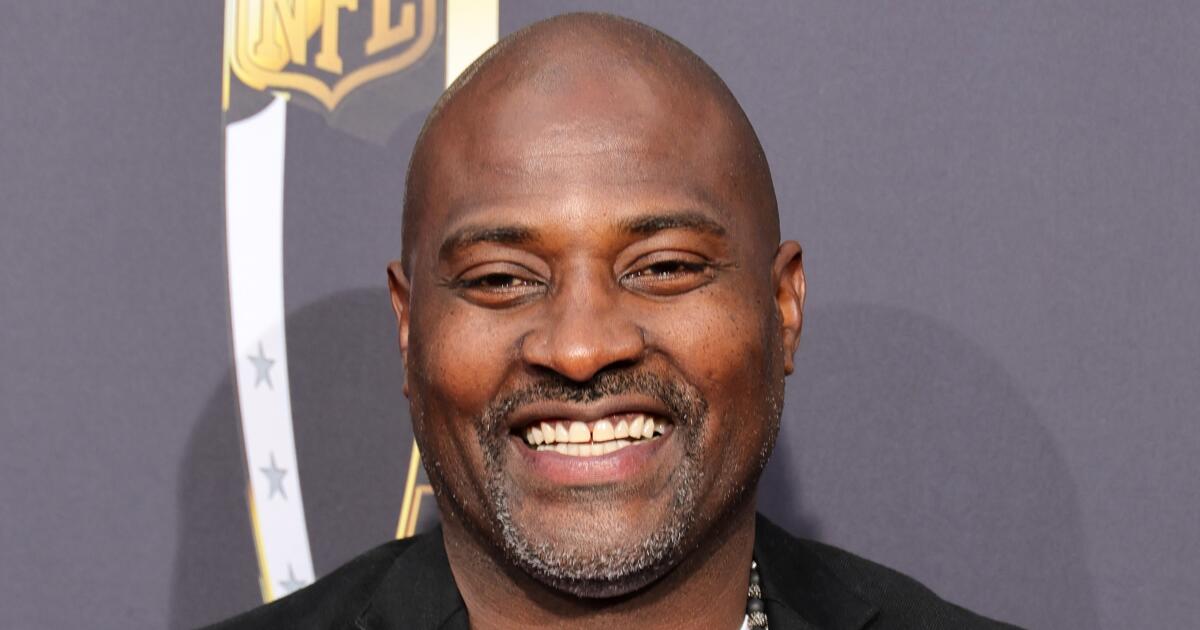
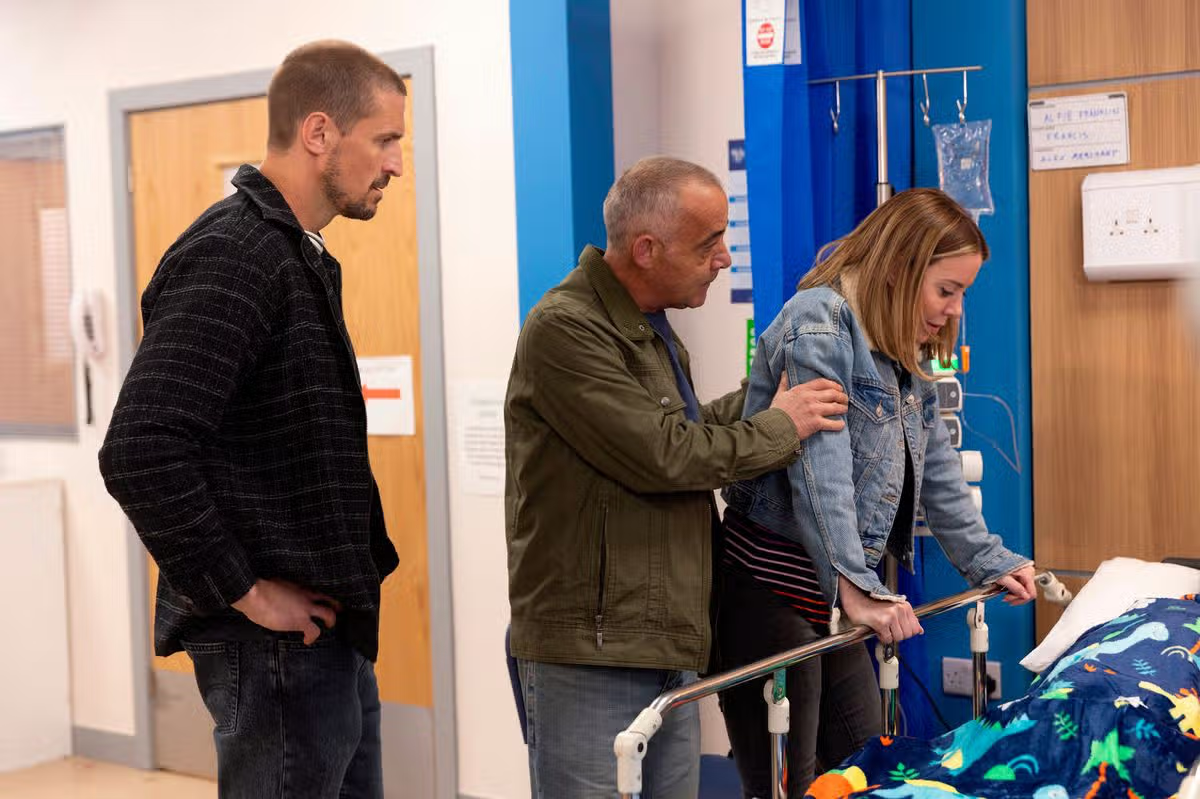

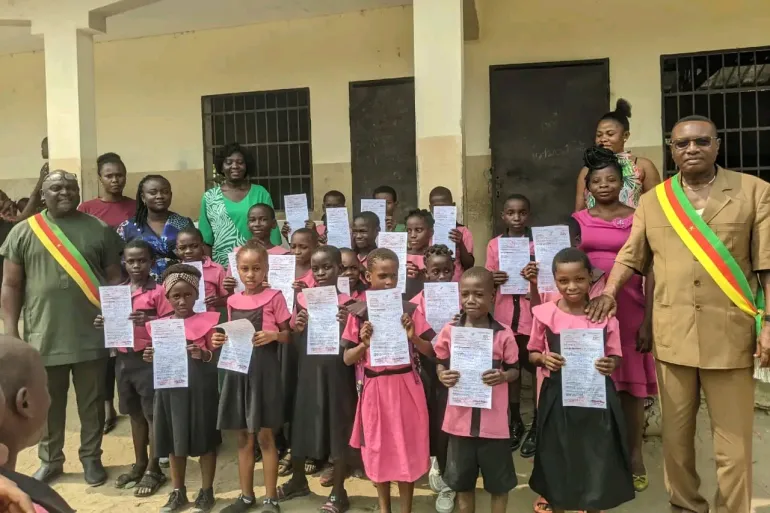

![Members of the Tiko Council team conduct a community sensitization session for pregnant women at a local health center to highlight the importance of early birth registration [Lucrece Armande _ Social Voices]](https://i0.wp.com/www.aljazeera.com/wp-content/uploads/2026/06/Members-of-the-Tiko-Council-team-conduct-a-community-sensitization-session-for-pregnant-women-at-a-local-health-center-to-highlight-the-importance-of-early-birth-registration-Lucrece-Armande-_-Social-Voices-1782791789.jpg?w=640&ssl=1)
![Mayors from Cameroon's top-performing municipalities, including Mayor Oumarou Sanda of Garoua 2 (center), are awarded for their exceptional efforts in deriving grassroots civil registration [Salomon Beguel _ UNICEF]](https://i0.wp.com/www.aljazeera.com/wp-content/uploads/2026/06/Mayors-from-Cameroons-top-performing-municipalities-including-Mayor-Oumarou-Sanda-of-Garoua-2-center-are-awarded-for-their-exceptional-efforts-in-deriving-grassroots-civil-registration-Salomon-Beguel-_-UNICEF-1782791781.jpg?w=640&ssl=1)