chief

‘Doesn’t seem qualified’: Who is Bill Pulte, acting US intelligence chief? | Donald Trump News

United States President Donald Trump has appointed businessman and federal housing regulator Bill Pulte as acting director of national intelligence (DNI).

Trump made Tuesday’s surprise announcement on social media that Pulte would replace Tulsi Gabbard, the former Hawaii congresswoman who has served as the director of national intelligence until recently.

Trump said Pulte will keep his other positions in addition to taking over from Gabbard, who resigned last month after revealing her husband’s cancer diagnosis.

Who is Bill Pulte?

Pulte, 38, a graduate of Northwestern University, has been director of the Federal Housing Finance Agency (FHFA) since March 2025.

He is heir to his family’s residential development firm – one of the US’s largest homebuilders, PulteGroup, which was founded by his grandfather in the 1950s. He previously founded a private equity firm, Pulte Capital, and is involved in large-scale philanthropic activity.

Pulte is seen as a loyal Trump supporter and has encouraged prosecutions of the president’s perceived political enemies, accusing New York Attorney General Letitia James and California’s US Senator Adam Schiff, both Democrats, and Federal Reserve Governor Lisa Cook, an appointee of Democratic former President Joe Biden, of mortgage fraud.

A federal grand jury refused to indict James in a Justice Department prosecution in December 2025 after Pulte wrote a criminal referral to the Justice Department, accusing her of listing a home she owned in Virginia as her primary residence to secure more favourable loan terms. Officials have also not brought charges against Schiff, who denies the allegations against him.

Trump attempted to fire Cook – an unprecedented move by a president against a US central bank official – over Pulte’s unsubstantiated accusations, but courts allowed her to remain in the role. She, too, denied the allegations. The Supreme Court is expected to rule in the coming weeks in her case.

In response to Pulte’s actions, Senate Democratic Leader Charles Schumer called the newly appointed director of national intelligence a “partisan thug” on Tuesday.

“A guy who can file such baseless, political and outrageous charges against political office holders he doesn’t like can’t be entrusted to protect our national security,” Schumer said.

Pulte’s views on whether the 2020 election was rigged against Trump – a claim many of his appointees have backed despite a lack of any evidence – are not immediately clear. He is understood to have deleted 25,000 social media posts before Trump nominated him to serve as FHFA head in January 2025, Senator Elizabeth Warren, a Democrat, said during his vetting process for the position.

Trump said Pulte will continue as FHFA director and chair of federally supported mortgage banks Fannie Mae and Freddie Mac.

“William has deep experience managing the most sensitive matters in America, the safety and soundness of the Markets, and over 10 Trillion Dollars at Fannie Mae/Freddie Mac, a substantial increase from where it was just 12 months ago,” Trump wrote on his Truth Social platform.

Pulte, who has no experience in intelligence operations, will oversee 18 intelligence departments including the Central Intelligence Agency (CIA) and the National Security Agency (NSA), which monitors foreign communications and helps defend the US against cyberattacks.

Could Pulte become the permanent intelligence chief?

Pulte can serve in the job for up to 210 days without being confirmed by the Senate. That timeframe would allow him to stay in the post through the November midterm elections, in which Trump’s fellow Republicans are seeking to retain control of Congress.

This is significant, as Republican Senator John Thune said Pulte might have trouble winning confirmation in the narrowly divided chamber if Trump decides to nominate him to the post beyond the current temporary appointment.

“If he’s somebody we want in that position permanently, he’s got a lengthy road ahead of him,” Thune was quoted by news agency Semafor as saying.

What have the reactions to Pulte’s appointment been?

Pulte’s appointment has drawn scepticism from lawmakers and intelligence officials.

“We don’t need a weaponised DNI. We need professionals there,” Senate Majority Leader Thune told reporters on Tuesday. “I’m trying to get more information about the current state of their thinking about that position. And, again, if he’s somebody they want in that position permanently, he’s got, as you all know, a lengthy road ahead of him.”

“I don’t see any evidence of qualifications for that job,” Republican Senator John Cornyn told reporters. Cornyn, a member of the Senate Intelligence Committee, lost a primary election last week to a Trump-backed challenger.

Arkansas Senator Tom Cotton, who chairs the Senate Intelligence Committee, said in response to questions about Pulte’s national security credentials: “I have no observations on the matter.”

Republican Senators Thom Tillis of North Carolina, Bill Cassidy of Louisiana and Cornyn of Texas, all of whom are leaving the chamber after this year’s elections, joined the chorus against Pulte.

“Doesn’t seem qualified,” Cassidy said.

“When we looked at his background for the current confirmation, I thought most of his experience was in the building industry,” Tillis said. “I didn’t know he had any national security experience.”

Senator Mark Warner, a Democrat from Virginia and the vice chair of the Senate Intelligence Committee, said in a statement on Tuesday: “The concern is not only that Mr Pulte lacks the ‘extensive national security experience’ required by statute for the job, which was created after intelligence failures led to the deaths of thousands of Americans on 9/11. It is that he appears to have been selected precisely because the White House believes he will provide the narrative it wants, not the intelligence we need.”

Senator Warren, a Democrat from Massachusetts, said in a written statement on Tuesday that Trump is now “rewarding his lackey – who has no national security experience – with a perch atop our nation’s intelligence community. What could go wrong?”

Source link

Ex-Scottish National Party chief pleads guilty to embezzling funds | Politics News

Murrell admitted the offences at the High Court in Edinburgh after an investigation into the party’s finances.

The former chief executive of the ruling Scottish National Party (SNP), and ex-husband of former First Minister Nicola Sturgeon, has pleaded guilty to embezzling more than 400,000 British pounds ($540,000) from the party’s funds.

Sixty-one-year-old Peter Murrell admitted the offences at the High Court in Edinburgh on Monday, following a years-long investigation into the SNP’s finances and the alleged diversion of donations intended to support the Scottish independence campaign.

Recommended Stories

list of 4 itemsend of list

Murrell, who was the SNP’s chief executive from 2001 to 2023, was remanded in custody by the judge before a sentencing hearing scheduled for June 23.

Judge James Young said Murrell was responsible for a “gross breach of trust” for embezzling offences between August 2010 and October 2022.

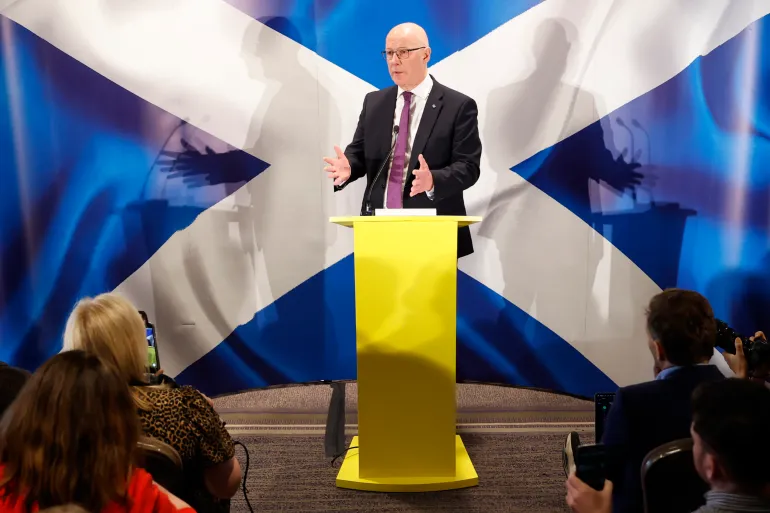
EDINBURGH, SCOTLAND - MAY 25: First Minister John Swinney speaks during a press conference following Peter Murrell's embezzlement hearing at the Edinburgh Marriott Hotel Holyrood on May 25, 2026 in Edinburgh, Scotland. First Minister and SNP Leader John Swinney is speaking to the press after Peter Murrell, the estranged husband of former first minister Nicola Sturgeon, admitted embezzling more than £400,000 the Scottish National Party (SNP) between August 2010 and January 2023, during part of his 22-year tenure as chief executive of the party. (Photo by Jeff J Mitchell/Getty Images)
Scotland’s First Minister John Swinney addresses a press conference after Peter Murrell’s embezzlement hearing at the Edinburgh Marriott Hotel Holyrood on May 25, 2026, in Edinburgh, Scotland [Jeff J Mitchell/Getty]

Murrell’s arrest came after a lengthy investigation into the diversion of 600,000 British pounds ($810,400) in SNP donations intended to support the party’s campaign for Scottish independence.

Although part of the United Kingdom, Scotland has a devolved government with powers over areas such as health and education. But the country has so far rejected calls for full independence.

Sturgeon, the former head of Scotland’s administration, quit as SNP leader and first minister in February 2023.

Murrell was arrested in April that year after officers searched the home he shared with Sturgeon near Glasgow, as part of an investigation into the SNP’s finances.

Sturgeon was herself arrested in June 2023 and questioned for seven hours before being released without charge.

Current First Minister John Swinney, who was re-elected to his post following the SNP’s victory in local elections in May, said he felt “betrayed” by Murrell’s actions.

“By embezzling from the SNP, Peter Murrell was stealing the hopes, the dreams and the aspirations of thousands of people all over Scotland,” said Swinney.

Rugby Union - Six Nations Championship - Scotland v England - Murrayfield Stadium, Edinburgh, Scotland, Britain - February 8, 2020 Scotland's First Minister Nicola Sturgeon and Peter Murrell in the stands REUTERS/Russell Cheyne
Nicola Sturgeon and Peter Murrell attend a rugby game in Edinburgh, Scotland [File: Russell Cheyne/Reuters]

‘I am betrayed’

Sturgeon, who was cleared in the probe last year, announced in January 2025 that she and Murrell had separated.

In an Instagram post, she said she was “utterly appalled” by her former partner’s admission and that she had “no knowledge or suspicion whatsoever”.

“To be deceived and let down by a husband I loved and trusted has caused me acute pain,” she added.

Sturgeon stepped down as a lawmaker earlier this year, ending a nearly 30-year career as one of the independence movement’s main figureheads.

Source link

Tulsi Gabbard resigns as intelligence chief after husband’s cancer diagnosis

May 22 (UPI) — Tulsi Gabbard resigned as director of national intelligence Friday to support her husband, who has been diagnosed with a rare form of bone cancer.

Gabbard said in a resignation letter, which she posted on X, that after her husband Abraham Williams’ recent diagnosis she will “step away from public service to be by his side and fully support him through this battle.”

The principal deputy director of national intelligence, Aaron Lukas, will take over as acting DNI after Gabbard departs June 30, President Donald Trump said in a post on Truth Social.

“I am deeply grateful for the trust you placed in me and for the opportunity to lead the Office of the Director of National Intelligence for the last year and a half,” Gabbard said in her letter.

Gabbard, who told Trump that she is resigning during a meeting in the Oval Office on Friday, was a controversial nominee for the position.

Nearly all Republicans voted to confirm her on a party-line vote, but former Senate Republican leader Sen. Mitch McConnell voted against her because she had “failed to demonstrate” that she was ready for the position.

Before she was named DNI, Gabbard served in the U.S. House of Representatives and the Hawaii House of Representatives dating to 2002.

The decision to resign, Gabbard said, is the balance of her husband’s dedication to her career, dating to her time in the military, and that she “cannot in good conscience ask him to face this fight alone while I continue in this demanding and time-consuming position.”

In his post, Trump said that Gabbard “has done an incredible job, and we will miss her.”

“She, rightfully, wants to be with [Abraham], bringing him back to good health as they currently fight a tough battle together,” Trump said. “I have no doubt he will soon be better than ever.”

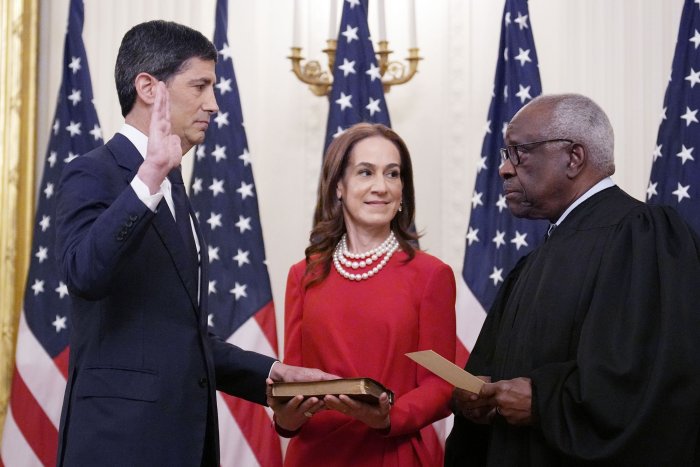
Kevin Warsh takes the oath of office as he is sworn-in as the new chairman of the Federal Reserve by Supreme Court Associate Justice Clarence Thomas in the East Room of the White House on Friday. Photo by Yuri Gripas/UPI | License Photo

Source link

Do not get 100% of your supply from one country, EU industry chief says

Published on

EU Industry Commissioner Stéphane Séjourné called for EU businesses to diversify their suppliers on Friday as trade tensions with China ramp up.


ADVERTISEMENT


ADVERTISEMENT

The comments come as Beijing has made repeated threats towards the EU in recent weeks, while Brussels seeks to strengthen its legislation against its Asian rival.

Last year, China restricted exports of rare earths and chips, strategic for the EU’s green technologies, defence and automotive industries.

“Do not make 100% of your supplies in one country,” Séjourné told EU businesses after a meeting with the EU’s 27 trade ministers in Brussels. He added: “The global geopolitical situation shows that your ability to provide yourself abroad must also depend on other types of countries and also on European production.”

The European Commission has so far issued guidance to EU companies and Séjourné signalled that if they did not move, the EU executive would “perhaps have to move to the next step.”

Measures force car producers to diversify

Internally, the Commission is already working on a proposal to force car producers to source chips from multiple suppliers, Euronews has revealed.

Last year, a spat between the Dutch government and the Chinese chip company Nexperia, based in the Netherlands, caused shortages of chips for EU industries after Beijing blocked exports in retaliation.

EU Trade Chief Maroš Šefčovič told Euronews at the time that China was “weaponising” critical supplies for EU industry.

Brussels and Beijing have been at loggerheads since the EU presented several proposals restricting China’s access to the EU single market.

The so-called “Industrial Accelerator Act” aims to favour EU companies in public procurement and impose strict conditions on Chinese investments in the bloc. Meanwhile, a Cybersecurity Act could exclude Chinese telecoms companies from the EU market.

Beijing has directly threatened the EU with retaliation if it moves forward with those proposals. China repeated the threats after media reports about potential EU measures against cheap Chinese imports flooding the EU market.

An orientation debate is set to take place in Brussels between EU commissioners on 29 May to decide on the EU’s strategy as its trade deficit with China becomes more critical month after month.

Source link

Guess Who’s Coming to Dinner?–the President : Restaurants: Chief executives usually give up dining out, but not this one. George Bush is known for roaring out of the Oval Office and into his favorite eatery.

Read his lips: Sichuan Beef Proper, baked stuffed lobster, whiskey steak, chicken fajitas. There’s nothing like a good meal to chase those S&L; blues away.

George Bush, who never met a menu he didn’t like, eats out in restaurants about once a month–more than any President in recent history. Whenever he finds himself with a free evening and a craving for Chinese food, he slips out of the White House and into a corner table for a little Yan Chow fried rice. Just like your average all-American guy.

Well, not exactly. Where the President is concerned, there’s no such thing as a casual dinner on the town.

Your average guy doesn’t have someone who brings special bottled water for him to drink. Or salt, pepper and sugar for his table. Or an entourage of White House staff, Secret Service and reporters in tow.

Not to mention the food taster.

Yes, Virginia, the President does have a food taster. And no, the White House will not comment on food tasters–or anything else, for that matter–when it comes to protecting the Presidential palate.

But whenever the chief executive goes out to eat, there’s a man in the kitchen standing over the food. Sometimes he just watches; sometimes he digs right in.

The night the First Couple went to I Ricchi, an Italian restaurant in downtown Washington, the food taster washed their plates, glasses and utensils before the meal and kept them in sight at all times; tasted every dish to be served to the President; watched as the food was put on the plates and served; and uncorked and tasted the bottle of wine reserved exclusively for the President and Mrs. Bush.

In April, right after traces of benzene were found in Perrier water, Bush joked with an audience in Indianapolis: “I’m sorry I couldn’t get over here to have lunch with you today; I wasn’t allowed to. On the way over I was notified that the Secret Service had found my food taster face down in the salad. Somebody had washed my lettuce with Perrier.”

Traditionally, Presidents give up public dining when they move into 1600 Pennsylvania Ave.

Nixon occasionally strolled across Lafayette Square, Secret Service alongside, for dinner at Trader Vic’s at the Capital Hilton. Ford and Carter rarely dined out. The Reagans, especially after the assassination attempt in 1981, kept close to the White House for meals. When Nancy Reagan did venture out, she favored the cloistered atmosphere of the Jockey Club.

But George Bush, determined to maintain as normal a lifestyle as possible, roars out of the Oval Office and into one of his favorite restaurants at the drop of a Daily Special.

The restaurants love it, of course. It inevitably boosts business. And it’s a big thrill for other customers.

But any spontaneous jaunt is a complicated logistical maneuver for the Secret Service. His security staff gets nervous when the President goes out in public and even more nervous when he does it unexpectedly. But these excursions are safer than his announced appearances in two respects: There’s the element of surprise–what the public doesn’t know can’t hurt him. And he goes out to restaurants so often, they’ve got the drill down pat.

When George and Robert Tsui get a call from the Secret Service reserving Table N-17, they know exactly what to expect.

By now, the two brothers who run the Peking Gourmet Inn in Falls Church are old hands at handling the hullabaloo that accompanies a visit from the First Customer–it’s the President’s favorite spot for a family dinner. Bush has been a VIP customer of the restaurant for the past five years and still stops by every couple of months: He came right before his inauguration, on the eve of the trips to Poland and Colombia, and to celebrate his son Marvin’s birthday, to name a few occasions.

“They treat this, just like any other American family, as their little favorite Chinese restaurant,” says Robert Tsui. “We try to be as low-key as we can.”

Low-key, all things considered. The President is brought in one of the restaurant’s seven doors; it varies each time and is always a last-minute decision by the security detail. There are Secret Service agents and police both inside and surrounding the restaurant. Customers are waved with a portable metal detector when they arrive for dinner. And then there’s the taster . . . er, make that “nutrition expert.”

“When President Bush was vice president, he didn’t have a nutrition expert in the kitchen,” says George Tsui. “After he became President, the nutrition expert stays in the kitchen to understand what he’s eating.”

The President sits at a big round table in a partitioned area that has a bulletproof window installed by the Tsuis. The Secret Service waits right on the other side of the partition, and only the Tsuis and waiter Tak Chung Pang–all wearing official pins–are allowed past. Bush reportedly wields a mean chopstick and is partial to the Sichuan Beef Proper, a spicy shredded-beef dish with roasted sesame seeds; Peking duck; and the giant spring onions the Tsuis grow on their Virginia farm.

After dinner the President comes into the dining room to greet customers. “There’s no better attraction than the No. 1 man–wherever you go,” says Robert Tsui. “Whether they are Democrat or Republican, whether they politically agree with the man or not, they always love the fact that they’re dining with him.”

An “above average” tipper (20%), Bush pays most of the time by check, which the Tsuis cash. “The thing is, it would be abusing the privilege not to cash the check, because the check may be more valuable uncashed,” Robert explained. “We cash them out of respect to the President.”

But elsewhere in the country, there’s at least one Bush check on display: “George Bush, Business Account, The White House”–now hanging on the wall of Patsy Clark’s restaurant in Spokane, Wash.

House Speaker Tom Foley invited Bush, who was visiting Washington state for its centennial celebration, to join him, his wife, Heather, and Environmental Protection Agency Director Bill Reilly for dinner there last fall. Foley had intended to pick up the tab, but the President pulled rank and paid the $121 bill with a check for $140.

The next morning, a newspaper article said owner Tony Anderson planned to keep and frame the check as a souvenir. “About 2 p.m. that day, a Secret Service guy showed up at the restaurant with an envelope,” says Anderson. “It was a thank-you note from Bush with $140 in cash enclosed. He wanted to pay for dinner. He was insistent on it.”

Anderson only had 20 minutes’ notice of the Presidential supper, which had been reserved under the name of an assistant to the President. There were Secret Service agents “everywhere–35 or 40 guys” including, says Anderson, the one who brought salt, pepper, sugar and bottled water for the table in a shopping bag. The food taster watched, but did not sample, the President’s medium-rare Jack Daniel’s whiskey steak. Anderson found out later that the Secret Service had been visiting his restaurant for two weeks, posing as regular customers, and had the place thoroughly staked out.

“He was a wonderful person to have as a customer,” says Anderson. But having both Bush and Foley under his roof was nonetheless nerve-racking. “I was thinking, ‘These guys are two of the most powerful people in the world. What if something happens?’ I was actually sort of relieved when they left.”

Until it happens, no restaurant can imagine what goes into a visit from the President.

The operative word is secret .

Palm owner Wally Ganzi, who is also a personal friend of the President, knew several weeks in advance that the Bushes would join him and his wife, Reva, along with actress Cheryl Ladd and her husband, Brian Russell, for sirloin steak, onion rings and cheesecake last November. But his staff was told only the day before, when the Secret Service arrived to inspect the premises.

“Someone should pay the Secret Service a compliment,” says Ganzi. “They really try their best in every possible way. They’re not rude, very courteous. They really try not to disturb your business. They don’t strong-arm you.” The one thing they really concentrate on is egress–the quickest way to get the President out if there’s a problem.

Christianne and Francesco Ricchi, on the other hand, got the shock of their lives when I Ricchi’s owners found out they’d be cooking for a very VIP guest–only one month after the restaurant opened last year.

“My husband approached me and said, ‘You will never guess who’s coming to dinner,’ ” says Christianne Ricchi. “The Secret Service flashed their badges and says, ‘Are you the owner?’ He thought it was immigration.”

The couple only had two hours’ notice to prepare for the presidential appearance at the dinner, hosted by former Bush speech writer Vic Gold. “Our concern was making sure that everything was absolutely perfect,” says Christianne Ricchi.

Meanwhile, the Secret Service searched the restaurant, brought in bomb-sniffing dogs, stationed men outside all the entrances and on the roof across the street, and brought in the food taster, who played an unusually active role–sampling all the food and wine.

Time and security were equally tight in May when the Bushes joined former Republican National Committee chairman Dean Burch and his wife, Pat, for dinner at La Chaumiere in Georgetown. Antoine de Ponfilly, who served the Presidential party, found out at 5 p.m. that “someone important” was coming that night, but the Secret Service would not say who it was.

The Secret Service chose the private room upstairs for the President and then positioned two men on the roof, two in the back, three on the stairs and “a lot” in front of the tiny French restaurant, de Ponfilly says.

When the Bushes went up to eat, customers were inspected with portable metal detectors but didn’t find out who was in the restaurant until Bush came downstairs after dinner.

It was more down-home last July at Rio Grande Cafe, the Tex-Mex restaurant in Bethesda, when Bush and fellow Texan Robert Mosbacher, the secretary of commerce, came in for quesadillas, cheese enchiladas, beef and chicken fajitas and the specialty of the house: mesquite-broiled quail.

Manager Jerry Green noticed two police cars in front of the restaurant when he arrived at 3 p.m. Three hours later, the Secret Service toured the restaurant and picked a table for Bush in a back corner.

The food taster asked Green to point out what food would be served to the Presidential party. Green pointed to the 40 pounds of beef already cooking on the grill.

“He got the same old stuff that everybody gets here,” says Green. “Honestly, I’m not going to change my food just for the President. But I did give him an extra quail. I figured I could do that much for him.”

The party lasted two hours and everyone else in the restaurant lingered to watch Bush tackle his fajitas; since he sat facing the front, the customers could get a good look.

“Nobody would leave,” says Green. “The Secret Service finally closed the door when we were filled to capacity with a two-hour wait.”

After Mosbacher paid the bill with his American Express card, Green grabbed the chair Bush had been sitting in “right after he finished with it.” Within two days it was back on the floor–painted red, white and blue.

When Mabel Hanson of Mabel’s Lobster Claw Restaurant in Kennebunkport, Me., curls her hair, you know something’s up.

“The President said, ‘Hiya, Mabel. How are you? What are you all dressed up for?’ ” says Hanson, who just happened to be spiffed up when Bush dropped by last year. “I cried when he came–just a few sniffles. I can’t help it. It’s the President coming through your door.”

Mabel’s has been a Bush family favorite for almost 20 years. There’s a whole wall devoted to the Bushes: lots of pictures of George and Barbara, a few of George and Mabel, a portrait of the President with “He’s Our George” above it and a banner from the President’s inauguration–Mabel’s first trip ever to Washington.

You can usually pick out the Secret Service: They’re the only guys in Kennebunkport wearing suits.

Bush sits at his favorite corner table, where he usually has lobster stuffed with sea scallops. He’s “not too much for desserts” but occasionally treats himself to butter-crunch ice cream or Mabel’s famous peanut butter ice cream pie.

“These people couldn’t change if they tried,” she says. “They’re as natural as grass growing.”

Earlier this month, the Bushes and daughter Dorothy Bush LeBlond went to the Breakwater Inn in Kennebunkport with Bush golfing buddy Spike Heminway, his wife, Betsy, and daughter Alex. Unlike most dinner visits, owner Carolyn Lambert got advance word when Heminway made the reservation the night before and said the Bushes would be joining them.

“It was very important to me that this didn’t get out of hand,” Lambert says. “I told my employees when they came in the next night, ‘If you told any of your friends to come down here and hang around, call them back and tell them not to come.’ ”

In the morning, the Secret Service and a White House staffer showed up and told Lambert, “There need to be people in the dining room. If Mr. Bush felt you were going to lose business because of him, he would be unhappy.”

The restaurant, not surprisingly, was full of the inn’s regular customers and a few enterprising reporters who had wheedled reservations that afternoon for the remaining tables. Except for the food taster in the kitchen, it was a typical Sunday-night dinner in Maine. The President had the pan-fried chicken breast special and mud pie.

When Bush goes to his other hometown, he usually makes a beeline for Otto’s Barbecue in Houston, where he chows down on pork ribs or link sausage with beans.

On his first visit there as President, the Secret Service checked out the bathrooms and sneaked Bush through the back door into the back dining room. “But the customers knew something was up,” says manager June Sofka. “Then the President came in the main dining room and shook hands with everybody. It was just exhilarating.”

“I was busy running around so I didn’t get my picture taken with the President. But I picked up his plate and the silverware and took it home. I still have it.”
Source link

US pausing $14bn arms sale to Taiwan due to Iran war, navy chief says | US-Israel war on Iran News

Acting Navy Secretary Hung Cao’s remarks come as US President Donald Trump gives mixed signals on the sale.

A top United States military official has said Washington is pausing a $14bn arms sale to Taiwan to conserve munitions for its war on Iran.

Acting Navy Secretary Hung Cao provided the update to lawmakers during a Senate hearing on Thursday, a week after the weapons sale took centre stage in talks between US President Donald Trump and Chinese leader Xi Jinping in Beijing.

Recommended Stories

list of 4 itemsend of list

“Right now, we’re doing a pause in order to make sure we have the munitions we need for Epic Fury – which we have plenty,” Cao told the Senate Appropriations Subcommittee on Defense.

“But we’re just making sure we have everything, but then the foreign military sales will continue when the administration deems necessary.”

Cao said any decision to move forward with the sale – which would be the largest ever weapons transfer to Taiwan – would be made by Secretary of Defense Pete Hegseth and Secretary of State Marco Rubio.

The war has been paused since the US and Iran agreed to a ceasefire on April 8, but the sides have yet to reach a permanent peace deal.

The US Congress approved the weapons package for Taiwan in January, but the sale requires Trump’s sign-off to move forward.

If approved, the sale would surpass a record-breaking $11bn arms package for Taiwan approved by Trump in December.

Taiwanese Premier Cho Jung-tai told reporters on Friday that Taiwan would continue to pursue arms purchases, according to Taiwanese news outlet FTV News.

William Yang, senior analyst for northeast Asia at the Crisis Group, said in a social media post that the pause will “exacerbate anxiety and scepticism about US support in Taiwan and make it difficult for the Taiwanese government to request additional defence budget for the foreseeable future”.

Trump, who has confirmed that he discussed the arms sale with Xi, said last week in an interview with Fox News that he “may” or “may not” approve the package.

Trump has also suggested that the package could be used as a “negotiating chip” – despite a decades-old precedent against consulting with Beijing on arms sales.

China claims self-governing Taiwan as part of its territory, and objects to Washington’s ongoing but unofficial support for Taipei.

The US government does not officially recognise Taiwan but is committed to helping the island to defend itself under the 1979 Taiwan Relations Act, enacted shortly after Washington severed diplomatic ties with Taipei.

Trump has continued to test the status quo on Taiwan in other ways, saying earlier this week that he would consider speaking to Taiwanese President William Lai Ching-te about the arms deal.

Such a move would break with four decades of diplomatic protocol against direct talks with the Taiwanese leader and almost certainly provoke an angry response from Beijing.

Trump held a phone call with former Taiwanese President Tsai Ing-wen after his 2016 election win, but their talks took place before he was sworn in as president.

Source link