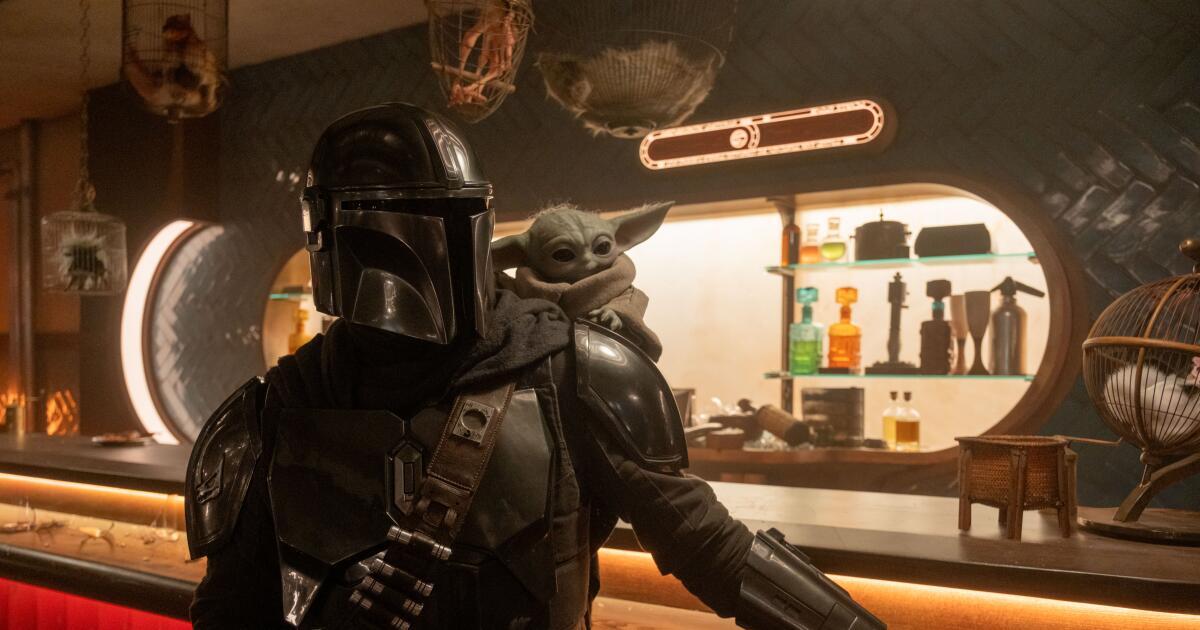
So asked a Times colleague on our morning editorial call earlier this week, sharing her impression that the Oscars — which were handed out March 15 — just concluded. And though it may feel like Hollywood was awarding gold statuettes just yesterday, the Emmys wait for no man, least of all this one.
I’m Matt Brennan, editor in chief of the Envelope and I’ll be back in your inboxes for the next three weeks to share highlights from our four pre-nominations issues, starting with the June 4 edition. Whether you’re a voter prioritizing what to catch up with or an observer trying to get a handle on what’s in this year’s race, read on.
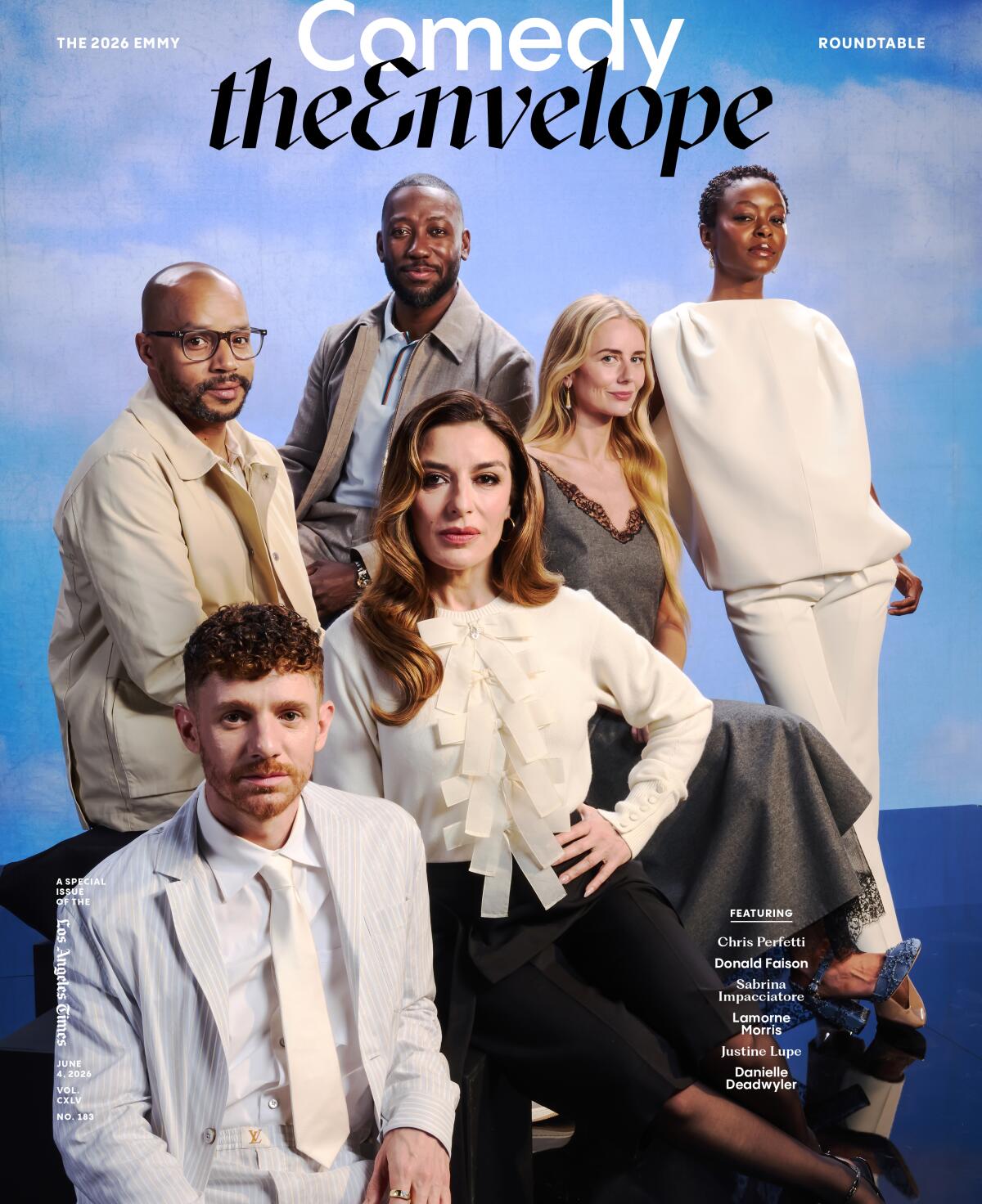
The Emmy Comedy Roundtable
(Christina House / Los Angeles Times)
Leave it to comedy legend Steve Carell to deliver a sage piece of advice on The Envelope’s 2026 Emmy Comedy Roundtable — without even participating in the conversation.
“Steve says this beautiful thing that characters don’t know whether they’re in a comedy or a drama,” Carell’s “Rooster” co-star Danielle Deadwyler relayed to nods of agreement and appreciation from the panel. “And that’s about as true as it gets. You bring full rigor and development and discipline to the making of a role, regardless of what genre.”
Of course, with Deadwyler, Donald Faison (“Scrubs”), Sabrina Impacciatore (“The Paper”), Justine Lupe (“Nobody Wants This”), Lamorne Morris (“Spider-Noir”) and Chris Perfetti (“Abbott Elementary”) around the table, the conversation, moderated by The Times’ Lorraine Ali, came with plenty of laughs too — about surviving bad reviews, being mistaken for other performers, breaking one’s castmates and much more. You can also watch it on YouTube here.
Meet ‘SNL’s’ resident ‘quiet little freak’
(Sela Shiloni / For The Times)
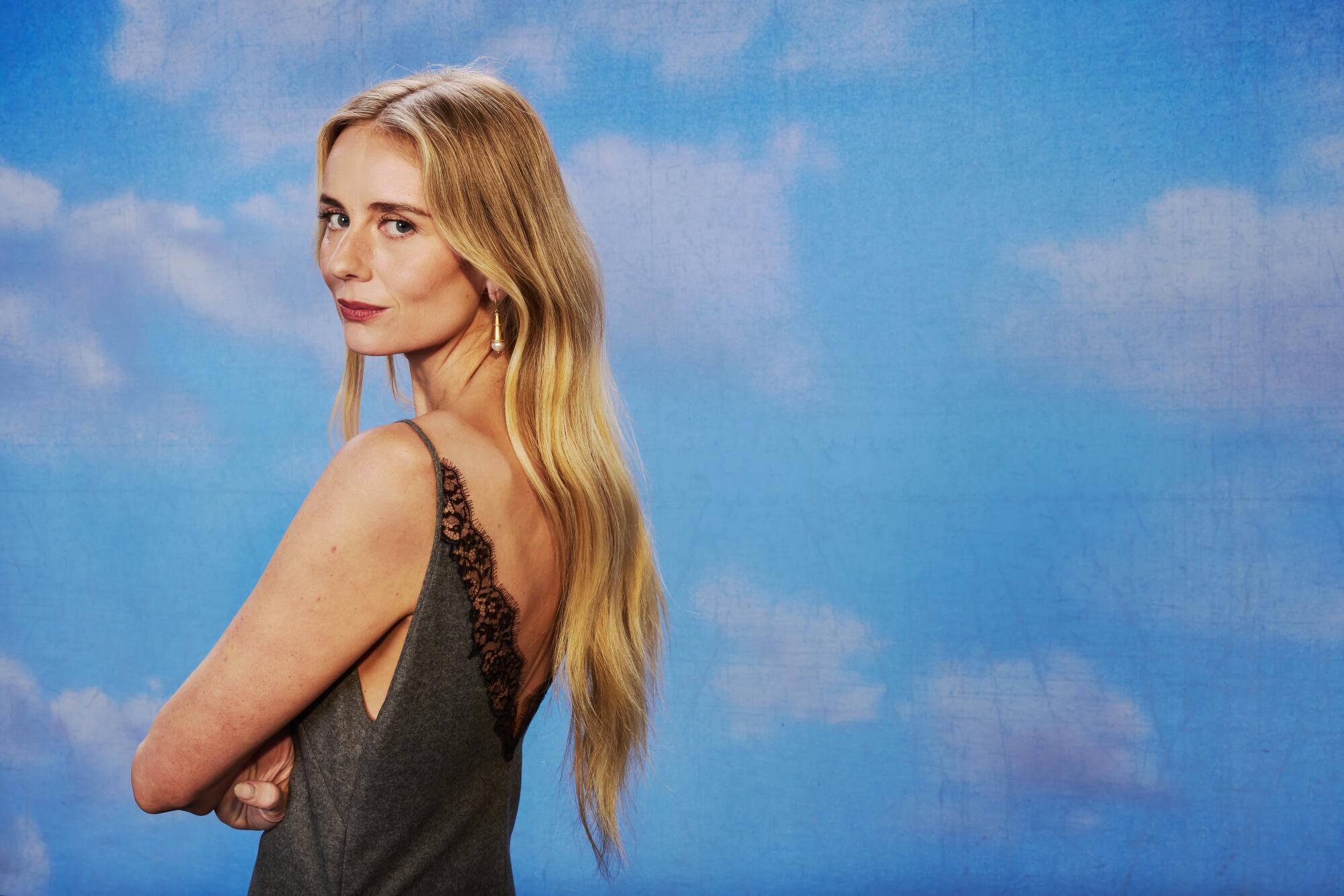
As someone who counts ex-Trump voters among my own family, “Saturday Night Live” cast member Ashley Padilla’s character in “Mom Confession” — about a stubborn MAGA parent who finally admits to her kids that she may have been wrong about the president — struck a chord with me when it aired in January. So I was delighted to see contributor Tim Grierson’s profile of the actor (and former Diane Keaton assistant) dig into what makes the sketch, like so much of her work on NBC’s variety series, tick.
“Padilla, who sports an ebullient manner and warm smile, has become a fan favorite by exploring how much humor (and tension) you can derive from stillness,” he writes. “Her best sketches … sparkle because of how expertly she builds suspense regarding where the setup is going.”
‘Margo’s Got Money Troubles’
Sex work is work. And in the right hands, it’s highly creative work. Case in point: HungryGhost, the alien alter ego Margot Millet (Elle Fanning) assumes when she launches an OnlyFans to make ends meet in “Margo’s Got Money Troubles.”
As contributor Tomris Laffly reports, the DIY artistry that brings HungryGhost to life in “Margo” reflects the layers of craftsmanship required to bring her to the screen, from hand-bedazzled cowboy boots to bulk-bought containers of turquoise eye shadow. “She’s a director,” executive producer and director Dearbhla Walsh says of Margo, an aspiring writer. “You could always see the creation [process], how Margo brought theater into her OnlyFans.”
Mindy Kaling was in her early 30s when the first TV series she created, “The Mindy Project,” made its debut and set in motion her attempt at forging an identity as a prolific multi-hyphenate after “The Office,” where she was a writer and cast member for eight seasons. But if you ask her to reflect on that time of her life, she says, it’s a bit of a blur.
As she explained recently, “I remember it, but not all that distinctly. It was such a grind — waking up at 6 a.m. to be on camera, wrapping late. And I did that for 117 episodes.”
But ask her about her 20s, when she was living in New York City and trying to figure out how she could break into the industry as a comedy writer? “I remember incredibly vividly,” she says. “I’m like, did I feel things more intensely back then? I’m not sure. But that period of time … there was just so many highs and lows. And it felt cinematic to me.”
So she made a TV show about it.
Premiering Tuesday with three episodes, “Not Suitable for Work” follows five ambitious 20-somethings living in Manhattan who are navigating the early stages of their careers while trying to have a semblance of a life and the heightened emotions they experience during this period. Kaling calls it the third chapter in her semi-autobiographical TV trilogy, which includes “Never Have I Ever,” about a first-generation Indian American teenager coping with her father’s death while trying to be popular (or at least not super uncool), and “The Sex Lives of College Girls,” about four young women who dorm together and boldly maneuver their new, uninhibited lives on campus.
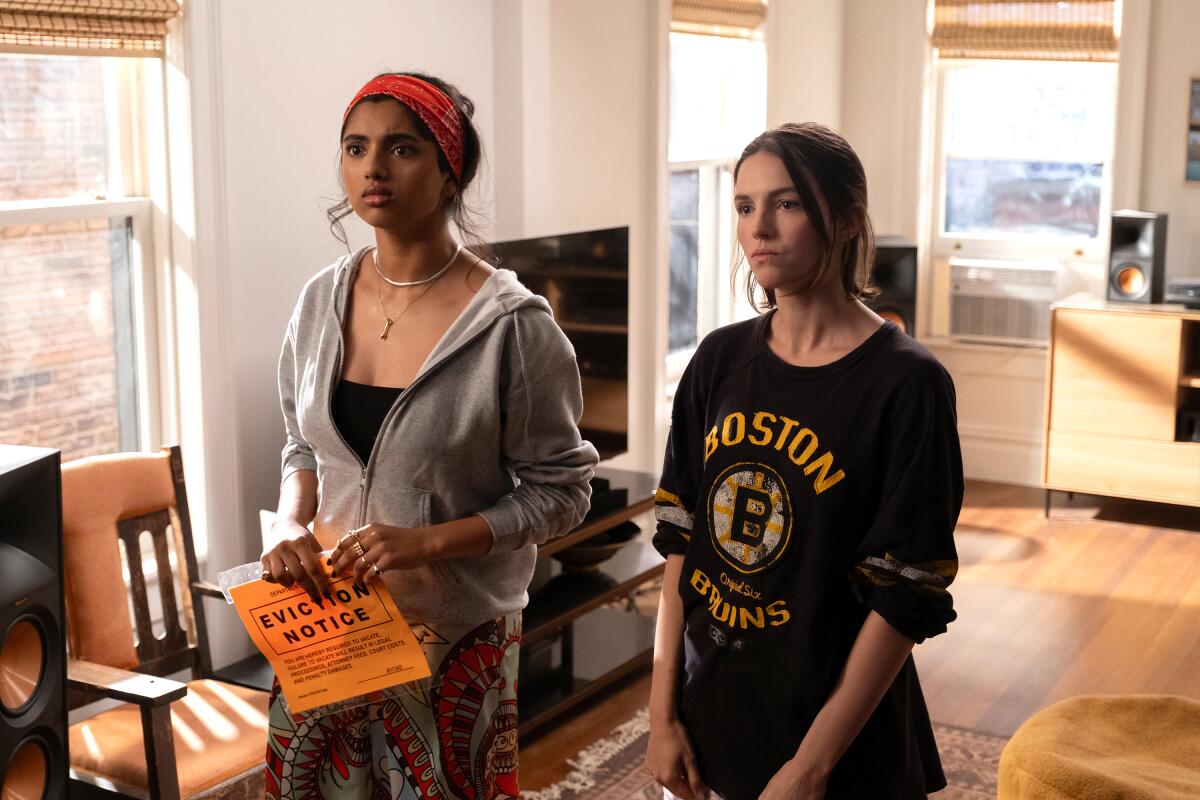
In the new Hulu series, viewers are introduced to AJ Pascarelli (Ella Hunt), a hard-working and disciplined young woman who moves to town to start a high-pressure finance job, and her roommate Abhinaya “Abby” Chilukuri (Avantika), a savvy and fashion-obsessed assistant to a celebrity stylist. They live across the hall from Josh Teitelbaum (Jack Martin), an idealistic nepo baby of a media titan — he’ll lean into his privilege when it suits him while also trying to distance himself from it — with ambitions of making it in journalism. His two roommates are Kel Washington (Nicholas Duvernay), an insecure but earnest med student who would rather be acting, and Davis Beau Bradley Barrett III (Will Angus), a high-energy, bumbling financial analyst who works at the same corporate firm as AJ and is an undercover hopeless romantic. As one might expect, there are some messy entanglements within and outside the group.
1
2
1.Abby (Avantika), left, and AJ (Ella Hunt) move in together.2.Across the hall live Davis (Will Angus), left, Josh (Jack Martin) and Kel (Nicholas Duvernay).(Gwen Capistran / Disney)
“I hope that young people will respond to the show, “ Kaling says. “We did so much research in it because at a certain point it is funny — I’m in my 40s, and I am often like, ‘I wonder if young people are suspicious about why I’m so obsessed with writing shows about young people.’”
So, why is she?
“Because I find it almost impossible to reflect on the current time I’m in,” she says. “It would be too painful to be too introspective about the time that I’m in. I need a real sense of distance to look back on it, especially since having kids. Once you have kids, it triggers these memories of your own childhood.”
Over video call from New York City, Kaling reflected on the series and her early years of trying to make it. These are edited excerpts from the conversation.
How did you land on the professions that your characters would be pursuing and what did you want to say about ambition at this stage of life?
I love people who have big wants, and sometimes the audience is like, “Maybe you want the wrong thing” and they [the characters] don’t quite know that yet. I love writing about the underdog. And with their particular professions, they’re all things that I had some interest in researching. I’ve always been fascinated by investment bankers. I went to Dartmouth, so I have a lot of friends who went into that, and I swear I’ve had my friends explain their job so many times to me, and I still didn’t totally understand it. We were lucky; a very famous investment bank very generously offered to let me come for a day and meet with young bankers. I also … write about the children of immigrants. I’m very, very interested in that story, and so we got to research what it’s like being the child of Nigerian immigrants. But every single character has a journey, or there’s an aspect of them that I feel like I really relate to, and that is in almost all my shows.
What was it like observing young people in the investment banking world?
They were wary — because they’re smart — of someone from Hollywood coming in to document what they were doing and asking questions. It helped that a lot of the guys liked “The Office” and a lot of the women liked “The Mindy Project” and “Sex Lives of College Girls” because they’re all kind of young. I think that made them trust me a little bit more. For the AJ and Davis characters, so much of what I researched when I was there fed into their plot line … almost all the characters have a boss they fear and idolize, and the way that first-year bankers feel about their managing directors is not dissimilar to the way I felt about Greg Daniels when I started at “The Office.” And the hours are actually not dissimilar.
There’s a moment early on where Jay Ellis’ character, Bill, who is a managing director at this fictional investment banking firm, is asked about work-life balance. I’m curious how you thought about that at the start of your career versus now.
I didn’t care at all about anything except my job for 16 years. It was my entire personality and purpose. When I was in my 20s, the only thing that mattered was being a good comedy writer and succeeding, and one day maybe being able to create my own shows. There was no balance. I didn’t want balance. I wanted to live and breathe comedy writing for my entire life. I hated the weekends, actually. And who wouldn’t? I was a friendless transplant in Los Angeles and I just wanted to get back to working at “The Office.” Every year I was there, I got more ambitious and I wanted to go off and create my own show and have a bigger part as an actor and everything.
It wasn’t until after I did that on “The Mindy Project” … that I just felt like, “OK, I get this. I want to now try being a mom.” Once I had my daughter, Katherine [at 37], it wasn’t that the balance changed, it was my first real, legitimate interest outside of work — that I cared about more than work.
“When I was in my 20s, the only thing that mattered was being a good comedy writer and succeeding, and one day maybe being able to create my own shows,” Kaling says. “There was no balance. I didn’t want balance.”
(Ebru Yildiz / For The Times)
After college, you moved to Brooklyn with two Dartmouth friends to pursue a career in comedy. You eventually got a full-time job as a production assistant on “Crossing Over with John Edward,” a program where people would receive psychic readings. Tell me about that time in your life.
I remember feeling like I had no access and that I didn’t have any place to put my ambition. It was so far away from anything I wanted to do — scripted comedy and reality television could not be further apart. It was a fascinating time because there were such highs and lows. There was the excitement of new crushes and having fun in a new city with two friends, but there was also the crushing disappointment of feeling like I was never gonna make it. I didn’t even have a path forward to making it, but I was lucky, because I lived with my two best friends. We would go to open mic nights, and we would go to restaurant week and see how the rich people in Manhattan were living. We would take the subway uptown to Central Park and walk along Fifth Avenue and like look at these amazing homes and just dream what it was like to be like a wealthy New Yorker who could buy everything that they read about on DailyCandy — now I’m really dating myself here, back when DailyCandy was a thing. But that’s what it was like, I just I felt a lot of extreme emotions.
How did you approach that job?
My boss was a producer and would approach the families and get their information, and then we would have to do research on them, but it was mostly because they would do a little clip package on the different families. I had to get them to sign releases to be on the show and get photographs of their deceased [loved ones] and them. I actually thought it was pretty interesting work. It just had nothing to do with comedy writing, and that job was not clearly going to lead anywhere toward comedy writing, and I came to New York because of “Saturday Night Live.” When I was working there is when my friend Brenda [Withers] … and I started writing this play “Matt & Ben” [a satirical play that imagines the story of Matt Damon and Ben Affleck before “Good Will Hunting” made them famous] in the time we had off. We started writing it, then I got that job as a PA, then the show went up at the Fringe Festival, and then it was going to go off off Broadway, and when it went off-off-Broadway, and I had a steady income, that’s when I quit my job there. I was only at “Crossing Over” for three or so months.
Greg Daniels attended a performance of “Matt & Ben” and it’s what led to you getting on “The Office” at 24.What was that first meeting like?
Back then, because the internet was so different, when I looked up Greg, besides his credits, you couldn’t find a lot of biographical information about him, or even a photo. I don’t think I even knew what he looked like. When I met him, I don’t think I had seen the British “Office” yet; I wasn’t cool. At that time, I had put so much pressure on this job. I only had two interviews — it was this and there was a show that ended up getting canceled while I was waiting to meet the showrunner. It was a pilot called “Nevermind Nirvana,” about an Indian man who married a white woman, and Ajay Sahgal was the writer. I was like, “Oh my God, if anyone is going to get hired to work on the show, it has to be me.” I was pretty excited about that meeting, but when I was sitting in the waiting room at the production offices to meet with Ajay, they told them they weren’t going to pick up the pilot, so I never even got to meet him, and they just told me I could leave.
I’d only had that interview, and then I met with Greg. This is my memory: it was a high-rise building in Century City, in the offices of “King of the Hill,” so there was a lot of like “King of the Hill” cutouts and stuff there. And he’s just a very thoughtful, quiet guy who doesn’t push conversation … I’m someone who’s pathologically chatty, and so talking to Greg, who is completely fine with there being pauses in conversation, and is just a confident grown-up, it was incredibly intimidating. I was very stressed out in our meeting, but I also was blown away by him.
That first season, you were also the only female writer on staff and the youngest —
B.J.[Novak] is a month younger than me. I want to correct that because he’ll read this and go, “Hey … !”
How did that play into how you felt in the room?
I haven’t really ever had imposter syndrome. And this is my probably my personality defect — I felt that even if I hadn’t seen anyone like me in these roles, that I was just going to be the first one, and I was going to work really hard and prove it to them. The staff was super competitive, but they were smart feminist guys. It was hierarchical and stressful, but it was not because of my fellow writers, except that I wanted to impress them. I felt nervous because I wanted to be contributing, but I don’t know why — I just loved the pilot so much that Greg had made, and I loved these characters, and this world — I was like, I can’t possibly lose my job, I love it too much. Which is probably really stupid, I didn’t ever think there’s a possibility that I could get fired here.
Phyllis (Phyllis Smith), Kelly (Mindy Kaling), Dwight (Rainn Wilson) and Michael (Steve Carell) in a scene from Season 2 of “The Office.”
(Paul Drinkwater / NBCUniversal via Getty Images)
We see how AJ wants to impress the boss and takes on more than she can chew and screws up some data before a big presentation. What was that first big mistake or misstep that you made in those early years that you still think about?
I remember Season 2 — because I just wanted to prove to Greg and to the cast and to the director, the cinematographer, and everyone that I was super invested — we were shooting “The Dundies” [episode]. I was an actor on the show as well, but I wasn’t acting in this scene, but it was my episode [that I wrote], and in between takes, John [Krasinski, who played Jim Halpert] and Jenna [Fischer, who played Pam Beesly] were just on set, and I remember going up to them and being like, “Guys, that take was so great!” And I walked away. Greg came up to me and was like, “You know, we really should let just the director talk to the cast between takes.” Greg, he’s my mentor, but he definitely, over the course of the eight years I lived there, had corrected me many times, as he should have, but that was one of the first times. I remember I was so embarrassed, but I didn’t understand it’s not the role of a story editor to be giving feedback to the cast between takes on a show.
The bosses on the show all have different styles and expectations that may seem demanding or annoying on the surface. How do they reflect where you’re at now?
No one trains you on how to be a good boss. And bad bosses are so prevalent. The entire premise of “The Office” hinges on this funny concept that terrible bosses exist. It wasn’t until I was on “The Mindy Project” that I was the employer for the first time. Every single year of that show, it was a battle getting a new season. One of the challenges of being a good boss is being able to put aside those personal, professional battles you’re fighting … but then also realizing that you’re a mentor to other people, and you have to start thinking about things that you never thought you needed to — overtime, maternity leave, respect in the workplace, the things that make the workplace enjoyable for everyone else who’s there working for you. And it’s not like that comes naturally.
The double blessing of having a good boss, which I did in Greg Daniels and Howard Klein [an executive producer on “The Office”], is that they modeled that for me. Even though I could not be more different than Greg. Even to this day, I’m realizing I have all the unique challenges of being a single mom, being the creator of these shows with crews and casts, but then also being able to be empathetic for all the people that work for me and making sure I make time to listen to them when they want to talk to me about an issue that they’re having; it’s a continual challenge that I’m hoping I’m getting better and better at [managing].
When Bill is asked about work-life balance, he’s also asked if he has inspirational words to impart. It’s very much about overworking and being productive. How do you tackle the question today?
I used to say “you have to write your own part.” And everyone would get annoyed because they’re like, “I’m not a writer.” I’ve had to really think about the question so I could be helpful. We all want a linear path to success. And if my career has taught me anything, it’s that the linear path just was not how I got my job. You know when you go on Google Maps and it shows you all the different paths — the fastest, one path with the toll road and one path that’s going to take seven minutes longer. I’ve only ever taken the one that’s seven minutes longer, or the toll; it’s never been the easy way. The sooner I got used to that, the better.
Before I let you go, in the show, one of the celebrity clients Abby is dealing with is Austin Blanchett, Cate Blanchett’s fictional nephew. Was it always going to be Cate? What other celebs were in the running?
It was Cate Blanchett’s nephew before we had Harry Richardson. When I worked on “Ocean’s Eight,” one of the biggest surprises on it was that Cate Blanchett was incredibly funny and did not take herself seriously at all. I suspect if anyone was going to think it was funny that in this fictional world of the show she had this useless nepo nephew that she had to help get jobs, it would be Cate. I hope she doesn’t sue me. I think she would think it was funny.
Sit at a table with a bunch of actors and it inevitably becomes an impromptu acting class, one in which even theMichelle Pfeiffer is leaning over to observe. At least that’s what happened on a recent afternoon when The Envelope gathered six actors from some of this season’s most talked about television series for its 2026 Emmy Drama Roundtable.
It all began when Pfeiffer (“The Madison”) shared that, while studying acting, she couldn’t grasp the technique created by Sanford Meisner, which trains actors to stop overthinking and encourages them to listen and respond actively to their scene partners. The revelation immediately activated Katherine LaNasa (“The Pitt”), who beckoned Tom Pelphrey (“Task”) to join her in a spontaneous application. (Both had studied the method.)
“I like your jacket,” LaNasa said, locking eyes with Pelphrey.
“You like my jacket?” he replied playfully.
“I do like your jacket … You’re smiling at me.”
The exchange, which had a flirtatious energy, continued for a minute, before Pelphrey and LaNasa emphasized that it’s essentially looking at and listening to what the other person is doing.
“Somehow I was doing it wrong and I didn’t understand why I was doing it wrong,” Pfeiffer said.
This openness and encouragement carried the entire conversation, which brought together Pfeiffer, who plays Stacy Clyburn, a wealthy New York City matriarch whose life is upended by the tragic death of her husband, which compels her to move to Montana; LaNasa, who brings depth to the burnout plaguing steadfast, straight-talking charge nurse Dana Evans; Pelphrey, in his turn as Robbie Prendergast, a sanitation worker who robs drug houses at night to provide for his family; Zahn McClarnon, who stars as Det. Joe Leaphorn, a stoic man battling his past and the loss of his son in “Dark Winds”; Billy Magnussen, who portrays Duncan Park, the eccentric and profit-hungry CEO of a tech company in “The Audacity”; and Karolina Wydra, who plays Zosia, the eternally cheerful liaison to a utopian, hive-minded collective in “Pluribus.” Read on for excerpts from our discussion.
I know all your characters are going through some personal things, but if you were to transform into them for 24 hours, what would you do with that day?
Magnussen: I live with Duncan daily because I think your job as an actor is to check the morality of the character you’re playing. And at the same time, you have to question your own morality, see where you stand, to then deal with that character. Duncan’s a really messed-up guy, and doing it for five months … I was on set 16 hours a day every day. I was with him nonstop. And his temperament and pace was just out of this world. It’s exhausting. So what would I do? I would try to go to a spa, personally, because it’s exhausting.
Wydra: Do you find that it gets blurry after a little while?
Magnussen: I still know who Billy is.
McClarnon: But there’s times where you can’t see that line between [fiction and] reality, just moments. I’ve found myself in those moments where I know the difference, obviously, but I’m so emotionally attached to Deanna Allison, who plays my wife on the show, where I can’t separate them anymore. It’s not like 24 hours, but just moments where I’m like, “Wait a second, where am I? Am I in the show? Is this Joe Leaphorn or is this Zahn?” Usually in the middle of the season, it starts to get a little blurry for me.
Magnussen: Do you think it’s the job, though, to keep it separated? Or do you guys believe in Method acting?
Wydra: Rhea Seehorn, who is on “Pluribus,” who’s incredible, who’s my partner in crime, she gave me a book about Method [acting] — the Method and what really Method was. And it’s not what we think it is. We all do Method acting, but it’s not staying in the character and living in the character forever. … And that’s what people think Method is, is that you never break the character, you take the character home, but it’s not. It’s building a world. Building it, personalizing it.
Pfeiffer: Isn’t that what we all do? Some actors will go live on the ranch. They won’t take a bath for six months. They really take it to another level, which I’m not willing to do … From the minute I commit to something, it’s right there [in my head], I’m thinking about it. It can be a year away, and it’s right here torturing me, which is I think why I’m a bit of a commitment-phobe. My agents always call me “Dr. No” because I know no matter what, even if I’m not consciously aware of it, it’s there just badgering me.
LaNasa: I have found that people want Dana, want my character, in real life. And it’s cool because she’s very comforting to people. But I had an experience recently in New York where this table of girls, they were having some party, and someone said, “Oh, you mean a lot to us.” And I said, “Oh, are they nurses?” Well, some of them are. And then they asked at the end of their dinner would I take a picture. And then one girl told the other people to leave and then she told me her illness journey. And I had breast cancer. She was going through breast cancer. And it was really interesting. And it was the most meaningful that I’d ever felt about taking a character home where it’s like … I think I spoke about my wellness journey because I was playing the role. It ended up coming up through the press. … And for some reason, because I was Dana in someone’s mind, it meant something. And I thought, “Well, this was actually useful. This breaking of that wall between character and person was actually useful.”
Tom, you get the call that you’re cast as Robbie in “Task.” What’s the first thing you do to figure him out?
Pelphrey: When I read the first two episodes, I felt like I understood Robbie’s soul perfectly, but I knew that I would have to break my ass to get that accent right. So that was where I focused most of my conscious energy and discipline and time, was just [on the] technical, just on the accent. The fun part was, because he would be my age, thinking about growing up in Philly at that time and who his heroes would be, having ideas for tattoos, stuff like that. We had more time than you get sometimes before we had to start filming because we knew and then the writers’ strike happened. I had a lot of months to sit with him and emotionally and spiritually. And I’d just become a father. Obviously [with] Robbie, everything he does is for his kids.
Pfeiffer: It changes everything. It opens your heart.
Pelphrey: I was a new person. And I understood him in that regard perfectly and I couldn’t have before. I could have imagined it and now I knew for sure.
For “The Audacity,” Billy, you spoke with some tech folks. What did you come to understand about what they’re after as innovators versus what you’re after as a creative?
Magnussen: Listen, no one’s a villain in their own story. I believe that from Day 1, these people probably came to the Valley with genuine ideas. The genesis of their idea was to connect and really bring something powerful and important to society and people. And, “Oh wait, we’re making a lot of f— money.” And through that lens, you start being blinded by this humanity that’s around you or caring for people around you rather than a bottom line. When you’re in an incestuous pool or in a small bubble, culture is created. And like Facebook, their slogan was “Move fast and break things.” Being a bull in a china shop is not a good idea anywhere, but for some reason that was the culture. People just started doing that more and more and breaking things and breaking things and breaking things. I don’t think they started off that way, but the culture just bred them to become this way. I personally relate that to, I don’t want to say Hollywood or the entertainment world, but we’ve seen the toxicity. And we’ve been slowly trying to filter that out, I think, of Hollywood. But when you have a microclimate kind of culture feeding in toxic behavior and rewarding toxic behavior over and over again, it breeds it. So you start to have to scrape away that cancer. But again, the genesis of all these ideas were pure. We were 6 years old just dreaming to be something or being like, “I could do this.”
Pfeiffer: Pretending to be something else, other than what we were.
Magnussen: I empathize with that. I don’t think people are bad. I just think they’re lost sometimes.
Karolina, your character in “Pluribus,” Zosia, is carrying the weight of almost every person in the world. What do you remember about those discussions with [creator] Vince Gilligan and how he helped you unpack this character and the relationship with Carol, Rhea [Seehorn]’s character?
Wydra: I took a break for five years from acting before Zosia came into my life. I walked away at 39 to have kids and my agent and my manager dropped me and it was really terrifying to also be a woman and turning 40, to have children at that time. When Lou [her second son] was maybe a year-and-a-half [old], I got the itch of like, “God, I miss acting so much. How am I ever going to come back? How am I going to get an opportunity?” And I was 43 at the time and out of nowhere I got an email being like, “Hey, there’s this thing …” from a commercial agent that I was on their roster, but I did not work with them. And they said, “There’s this audition.” And I go, “OK.” I read it and I said, “Who wrote it?” And she said, “Vince Gilligan for Apple TV.” I went, “What? OK.” And I didn’t know anything about the project and it was always my dream to work with Vince from when I saw “Breaking Bad.”
Long story short, I’m here and the whole journey has been so wild, so insane. When I first would talk to him about Zosia, I was like, “God, how am I going to tackle the world and someone that has the highest emotional intelligence, someone that does all these different things? And how do you see the Others? How do you want them to move about the world and the complexities of who they are?” Vince is such a beautiful human being. He’s like, “They’re just happy and content.” You go, “OK, yeah, but … what else?” For me, Zosia is extremely spiritual. Meditation was my key, my go-to to get into that zone of connection to humanity, not in the physical but very spiritual way where, [if] you meditate enough, the ego gets lifted and you truly feel connected, and you feel one with everyone. And the wild thing, I think the greatest gift, was becoming a mother; I understood what it means, unconditional love. Because my heart lives outside my body all the time. And so becoming a mother was a gift to play Zosia, because I unconditionally love Carol. And now, no matter what she throws at me, I just love her, and take care of her, and I want to nurture her.
Michelle, you get the call from Taylor Sheridan, who also created “Landman” and “Yellowstone.” He says he wants to meet with you and he wants to do it on his turf in Texas, not yours. There’s no script. What does someone like Taylor Sheridan say to someone like Michelle Pfeiffer that will get her to agree to the show?
Pfeiffer: Well, he gave me a lot of tequila.
LaNasa: Writing this down: Tequila, check.
Pfeiffer: I got a call that he wanted to meet with me, that he had an idea for something, “But you have to come to Texas.” And I said, “Is there anything? Is there an outline? Is there a paragraph?” “No, no. He wants to explain it to you in person.” I had to stay the night in Fort Worth and then met with him and he gave me tequila, and then after a while I had to stop drinking. He gave me a very rough outline of the show, of the character … She’s been with the love of her life for 50 years. It’s the marriage that we all dream of having. And he dies suddenly, tragically, and … all of a sudden the rug is really just emotionally and psychologically pulled out from underneath them. And it’s how do you rebuild a life and it’s the study of grief. He said that I had committed that night, which I did not. I’d had a few cocktails. We went back and forth a little bit about [the fact] that I really would like to read something. And he said, “Well, I would really like to cast this before I write anything.” Then I realized I wasn’t going to win this battle and I reached out to Helen Mirren [who starred in Sheridan’s “1923”], who I don’t know, but I figured she doesn’t suffer fools and she would give me the truth about what it’s like to do this. She couldn’t have spoken [more] highly of everything. She said the scripts are wonderful. The production is wonderful. And loves Montana. And so I took a leap of faith. I never do that.
What stands out to you about his process versus then working with your husband, David E. Kelley, also a prolific writer, who adapted “Margo’s Got Money Troubles”?
Pfeiffer: I couldn’t be luckier working for two of the most talented and prolific writers in the history of television. [They’re] not that much different. I purposefully didn’t want to bug David because it’s not like we had any hard-and-fast rules about not working together, but we weren’t really actively seeking it out because that can get a little dicey, just looking at it from afar. I really cherish my marriage, and our family, and I just didn’t want to mess it up. I really mostly went to the director and every now and then I might throw a little something his way. And [with] Taylor … I would go through Christina [Alexandra Voros], our director, because he’s just not honestly that accessible because he’s got a bit going on. I personally don’t like to spend my time trying to rewrite things. It’s more interesting to me to try to make something work and then I end up finding something I never would’ve decided. It just takes you to a new place and it’s so much more interesting than anything I would have conjured up.
Zahn, you’re not only the lead in “Dark Winds,” but also an executive producer and directing episodes. I know there was a moment where your character was supposed to shoot someone in the face early on. And you felt strongly, “My character’s not someone that would do this.” Talk to me about leaning into speaking your mind.
McClarnon: There’s not a lot of Native characters on television. The foundation of that character obviously comes from Tony Hillerman’s books. So the foundation was set for that character. And when I got to a point in the season where I’m supposed to kill a man, shoot him in the head in the middle of the desert — first off, I didn’t see that in the books. And I know it’s television and we want drama and all that stuff, but also, to be honest with you, I want Native kids — see, I’m going to cry now — to have something to look up to. We grew up with these stereotypes and we grew up with these tropes of Native Americans. The only one I can really remember that I really looked up to was Will Sampson in “One Flew Over the Cuckoo’s Nest” because he was playing a trope, but he becomes the hero at the end of the story. It’s one of my favorite films. So when it came to that point where the writer said, “He’s going to kill this rich white man in the desert and shoot him in the head,” morally, I think Joe Leaphorn is more than that.
And it was simple. I sat down with the showrunner [John Wirth] and we talked about it, and we went back and forth for about a week. And I’m so glad that I have access to somebody like that. I have access where they’re not telling me, “No, this is the way it’s written. This is what you’re going to do.” So yeah, we decided not to shoot the guy in the head, where I’d just leave him out in the desert to fend for himself.
Katherine, you’ve talked to nurses and medical professionals in the making of “The Pitt,” but you were also a patient during your breast cancer journey, interacting with them a lot from the other side. What is something that they’ve told you or even something you observed in that time that really spoke to you about what they’re going through on the day to day in these jobs?
LaNasa: It’s funny, I’d always wanted to work with John Wells. I go through this period of all this unemployment, and then I get this job for John Wells. I had had cancer a year before and then had complications up to like six months before. It wasn’t until I got to the emergency room set that I was like, “Oh, this whole period … ” — the spirituality of that. I really believe that we need to be grateful for our life while we’re living it, no matter what’s going on. Because I still have my children, and I have nature, and I have my husband, and cooking, and my dog, and so many wonderful things. And I was really trying to hold onto that. It’s always this idea that maybe something is for a reason or whatever — now I’m going to cry. The fact that that was so purposeful, that I understood so deeply what it was to be a patient, what it was to be terrified going into the emergency department. I also understood how much it mattered when a nurse took a little extra time and was a little bit kind.
Pfeiffer: You’re going to make me cry.
LaNasa: And there was one particular nurse — I had my cancer, went through my radiation and then [went] back and forth, back and forth [to the ER]. And there was a week, the second trip to the ER [they thought I might have multiple sclerosis]. “Now do I have MS on top of having had cancer?” And I had a breakdown in the ER. And she’s like, “Listen, first six months after cancer are really bumpy, and it’s not going to stay like this. Do you need an Ativan?”
Magnussen: Did not see that turn.
LaNasa: It was that human touch. Or when they would come and give you a warm blanket or something. There’s a nurse, Kathy Garvin at County, who told me she wouldn’t do the job that she does being the [emergency department] charge nurse if it wasn’t in a county hospital. She wants to do that hard work for people that really need her. For the most underprivileged, for the unhoused. And I try to honor that in the story and to just bring that to life — their generosity and their humility.
The Envelope’s 2026 Emmy Drama Roundtable: From left, Zahn McClarnon, Michelle Pfeiffer, Tom Pelphrey, Katherine LaNasa, Billy Magnussen and Karolina Wydra.
There’s a lot of discussion in the industry right now about runaway production and can L.A. rebuild and what’s lost. I’m curious how you feel about this topic.
Magnussen: I live in Georgia and … one of our biggest exports as Americans is our culture. And if we just keep it isolated to Hollywood, I think we lose out at expressing everything we are as Americans.
McClarnon: We shoot on the Tesuque Pueblo. There’s 19 pueblos in New Mexico. We have taken over their old casino and we’ve converted it into a soundstage. We use their back lot. We obviously help out the tribe with renting the place out. And so I like shooting in New Mexico and supporting the local community, especially local Natives.
Pfeiffer: I think there’s room for all of it. We shot [a movie] in London that took place in Los Angeles. And it’s ridiculous that our entire industry has left. Los Angeles is really hurting. And a lot of people are hurting. All those jobs, all of those restaurants where people used to eat, people used to shop. And I think to not give the same sort of tax incentives that other states are doing — look, if it takes place in Georgia, you should go to Georgia. But I think Los Angeles was really built on the movie [industry].
LaNasa: I have a 34-year-old and a 12-year-old. I remember with my 34-year-old, even just being a young, starting-out mother, I would be like, “Well, I’m not going out of town. I have a child.” I would never go do a TV show out of town. I had a kid and the kid was in school and I needed to provide consistency for that child. And then with my second one, that was impossible. We would just not have been able to work. But it’s really hard on families. We are actors and we’ve come here to pursue the industry. We’ve moved here and we’ve risked something … L.A., for all of its problems, is a city of dreamers. It’s a city of people that came to pursue their art. And I am one of those people. And so in a way, I wasn’t really a citizen like the other citizens of Atlanta. I was outside. I didn’t have my community.
Magnussen: I know, but that’s the thing I have an issue with is this idea that, “It’s only there.”
Pelphrey: I’ll say this. Love that we get to film all over our beautiful country. Would love to keep the jobs in this country. That would be the nice part. Because when everybody’s like, “Oh great, we can go to Belarus or London.” Guess what? All of us get to go. Our crew doesn’t get to go — the people that we know that we need, that we work with, that we make these things with. We get to go wherever the f— we want, actors, directors, but the crew doesn’t.
If you buy books linked on our site, The Times may earn a commission from Bookshop.org, whose fees support independent bookstores.
Twenty pages into “There’s Only One Sin in Hollywood” by bestselling Pasadena author Rasheed Newson, I had to stop reading. Not because the story and characters were anything less than gripping —I was utterly transfixed. Not because I was unmoved by the setting, the 1950s version of the iconic landmarks where today’s Angelenos, myself included, work, play, eat and drink: Griffith Park, the L.A. Central Library, the Paramount Pictures lot, the Roosevelt Hotel, the Tam O’Shanter in Atwater Village and the Black Cat in Silver Lake, site of America’s first queer riot, also depicted in the book.
No, it was writerly admiration — OK, envy — that stopped me. As I turned the pages, I kept scribbling the same question in the margins. “How did Newson do this?”
How did Newson, author of the 2022 bestseller “My Government Means to Kill Me” and a producer/writer on such popular TV series as “The Chi” and “Bel-Air,” craft a novel populated with a seamless mix of real and invented characters, each with their own true or fictional backstory, personality, career vicissitudes, sartorial style and sexual proclivities, adhering simultaneously to both his novelistic timeline and historically accurate events?
How did Newson seat his fictional protagonist — Aaron Touissant, a Black, closeted gay Hollywood “fixer” employed by Skyline Studios to keep queer actors’ secrets secret — at the same Beverly Hilton ballroom table with Sidney Poitier, Diahann Carroll, Harry Belafonte, Sammy Davis Jr., Lena Horne, Ruby Dee, Ossie Davis, James Edwards, Eartha Kitt and Xavier Barlow, Newson’s invented Black gay movie star who is Skyline’s greatest hope and Touissant’s principal client?
I couldn’t read another page without knowing, and those unread pages were calling to me. So I called Rasheed Newson, whom I’d seen around the L.A. lit scene but had never met, and asked how he’d made the magic of his novel happen.
“I wanted to do a deep dive into Black queer history during the Golden Age of cinema,” Newson said. “The first thing that came to me was Xavier’s character. I decided to make him the 10-years-younger, queer rival of Sidney Poitier, to highlight the acceptable versus unacceptable — meaning, straight versus gay — 1950s Black movie star.
“I read a lot of books on Hollywood’s golden era,” Newson said. “But I was trying to get closer to what people were thinking at the moment, rather than what they reflected back on later. Only newspapers give you that. So I spent hours and hours in the downtown L.A. public library, poring over microfiche, reading the newspapers of the time.”
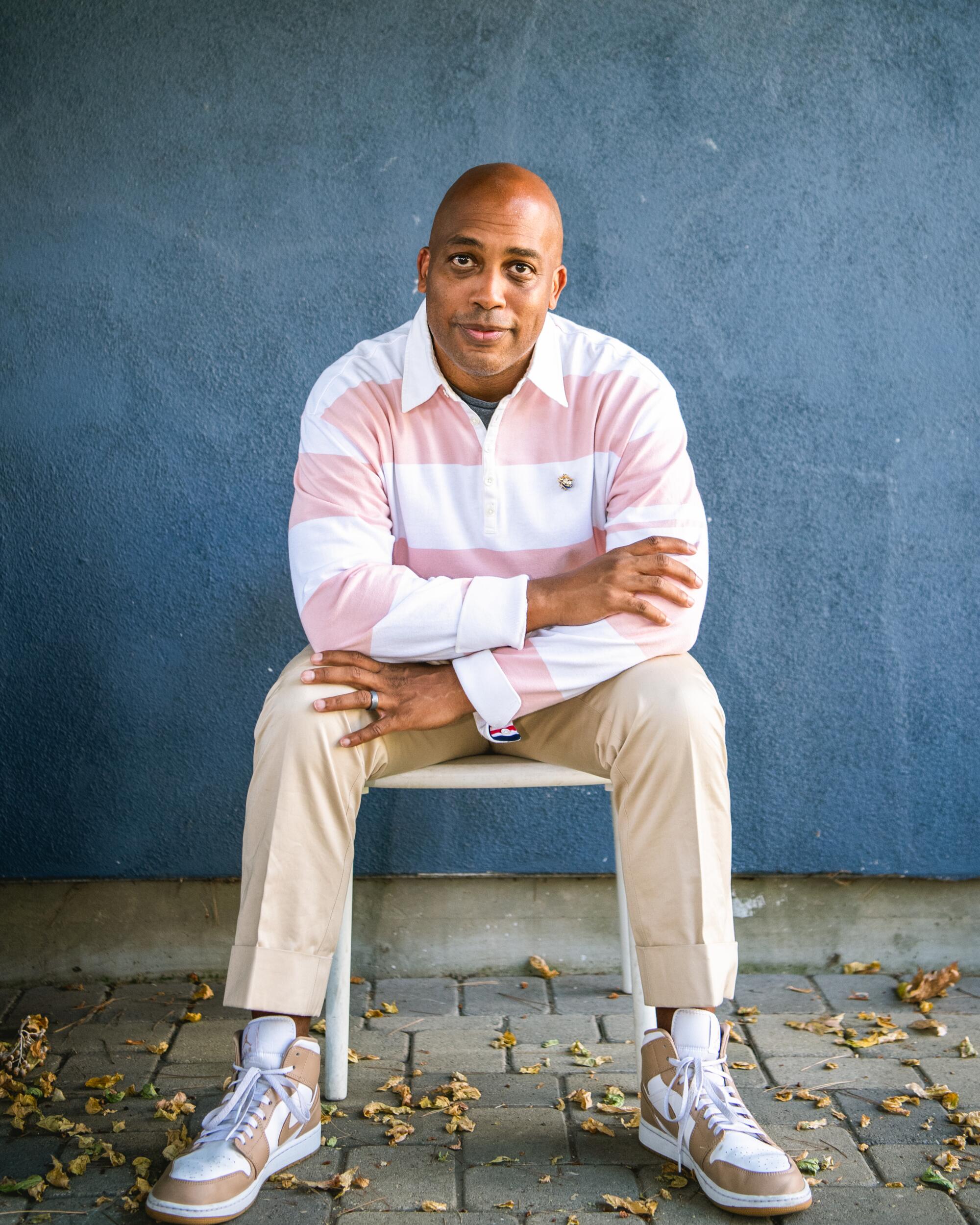
Author Rasheed Newsom.
(Mariah Tauger / Los Angeles Times)
I asked Newson about the titular “one sin in Hollywood.”
“That sin is disobedience,” he said. “Particularly when your disobedience threatens to upend how the business makes money. In Hollywood you can be an addict, be a philanderer, be outspoken. But don’t disrupt the cash flow.”
Newson’s plot and characters serve the novel’s thesis well. We meet Aaron Touissaint as a brutally bullied “sissy” in a small, small-minded Ohio town. Aaron escapes his torturers, first by rooting himself in the town’s only movie theater open to Black people, and then by lying about his age and enlisting in the Navy at 16. On the Korean battle front, Aaron becomes the aide and the lover of superstar fighter pilot and “model Negro” Horace Dixon. When the war ends and Skyline Studios buys the screen rights to Horace’s life story, Aaron follows Horace to Hollywood.
The movie is canceled. Horace leaves Hollywood and a heartbroken but determined Aaron behind. Hired as a Skyline security guard, Aaron is promoted to fixer, keeping himself and Skyline’s A-listers closeted by any means necessary. To that end, Aaron marries Kimberly, who becomes his poised, self-contained “beard.”
At the top of Aaron’s client roster is Xavier Barlow, Skyline’s new, hot rising star and Aaron’s new, hot crush. “The bond between us was never conventional,” narrator Aaron tells us. “Off and on for nearly a decade, it was my duty to keep [Xavier’s] nose clean. … He challenged me to admit who and what I am. And I fell in love with him.”
As secret same-sex love stories all too often do, Aaron’s love for Xavier, and Xavier’s one-man campaign to mitigate Hollywood’s homophobia, come to a tragic and suspicious end. Soon after Xavier publicly protests the studio’s homophobic rewrite of a movie script he intended to serve as his coming-out announcement, a truck crashes into his car on Wilshire.
“This was no accident,” Aaron realizes. “Xavier was hunted down.” With his best friend, Diahann Carroll, and a sizable contribution from Sidney Poitier, Aaron organizes the funeral, attempting to redeem the reputation he was hired to protect. “The news reports following Xavier’s death impeached his character,” Aaron says. “The implication was that gay men naturally had messy lives and untimely deaths. … Confidential magazine went as far as to print that “the driver of the truck [that killed Xavier] could well have been one of Xavier’s spurned male lovers.”
“Furious at the coverage,” Aaron narrates the story, “Diahann asked me, ‘Why don’t they print the lovely things I have to say about Xavier?’ ”
“I said, “They never will. Xavier fought the studio, and everything you’re reading is part of his punishment.”
The erasure of gay Black Hollywood is really the point of this imaginatively crafted, stunningly tense, historically significant sophomore novel. Newson’s impressive gifts for story, for writing the erotic and the noir, and for rooting himself in his adopted city are on magnificent display here. By smoothly merging the true and the invented stories and characters of 1950s Hollywood, Newson alerts us to the increase in racism and homophobia evident in the entertainment business, and in the U.S., today.
Kelvin Washington: Welcome back to The Envelope. I’m Kelvin Washington, alongside the usual suspects, Yvonne Villarreal, also Mark Olsen. It’s good to have you all here. Everybody doing well?
Mark Olsen: Yeah, I’m doing great.
Yvonne Villarreal: Good to see you.
Washington: Well, first of all, I didn’t get the green [wardrobe] memo. It’s OK. Leave me out.
Villarreal: I’m trying to blend in with the chair.
Olsen: That’s why you pop
Villarreal: You do pop.
Washington: Well, you took what I was going to say. You don’t blend in. You always stand out.
Villarreal: Thank you.
Washington: That’s true. All right, so we’re kicking off Emmy season in here. And there’s obviously a million different things to have seen. We’ll start it off with Yvonne — I’ll go to you. What have you seen? Give me a couple of things that stand out to you that you’re enjoying.
Villarreal: Look, I’m always gonna mention “The Pitt.” Season 2 really captivated me. Also, there’s “Pluribus.” Can never go wrong with Rhea Seehorn. Also, one that — surprisingly for me, just given the subject matter — I really enjoyed this season, is “The Testaments.” And I think it’s because of, you know, the young cast and feeling that sense of hope that these young teenage girls are gonna get us out of this. Those are my picks so far.
Washington: Did you say that we need that?
Villarreal: We do need that.
Washington: OK, I just wanted to make sure.
Villarreal: I won’t mention reality TV, because I know it makes Mark a little…
Washington: Let’s make him a little squirmy.
Olsen: Maybe one of these days, I’ll try!
Villarreal: “One of these days”?
Washington: Twenty-five years into it.
Villarreal: “Real Housewives of Rhode Island” is all I’m going to say. I’ll just leave it there.
Olsen: Rhode Island?
Villarreal: Rhode Island.
Washington: Mark, I’ll go to you next, but just to your point there, Yvonne, I haven’t seen much of it, but I did have some guests at the morning show that I anchor from “Love on the Spectrum.”
Villarreal: Oh yeah.
Washington: Folks love that show. I mean, when I tell you that we had a couple of the guests come in and they’re walking around, people were screaming, “Can I get their picture?” So you’re talking about reality TV, just that, that’s a big one there.
Villarreal: They’re stars. And hearing who’s broken up already. I won’t spoil it, because you should watch that one.
Olsen: Wait a minute, how do people on your morning show rate “The Morning Show”?
Washington: Oh, that’s a good question. Some of the [story] lines or the feel hits a little too real, too close to home at times, that’s for sure. But I think it’s run its course a little bit as far as the watercooler [chatter] around the job a little. You know, it’s had some seasons here. But there are some things that, you know, some us look at each other like, “Clearly someone in the business is on there writing that show because that was too close to home.”
Villarreal: Lots of conniving.
Washington: But that’s all sensationalized. We’re just an ordinary morning show. None of that going on.
Villarreal: There’s no Billy Crudups out there.
Washington: Watch how I turn over here to Mark and we switch subjects. What about you, Mark? What are you watching? What do you enjoy?
Olsen: You know, it’s funny, I find as we’re in sort of like post-peak TV, I definitely find that I’m liking my TV to just feel like TV. And so I definitely like the Bill Lawrence universe, [that] kind of comfort watch — the new show “Rooster” with Steve Carell and Danielle Deadwyler, who’s just like so charming, so good on that show. I have really grown to like that show. I really enjoy the week-to-week. Even as I’ve maybe fallen off with some of his other shows, it’s funny how he’s always giving you a new show, like, “Oh I like this one!” And again [with] the week-to-week, “Oh it’s my day to watch ‘Your Friends and Neighbors’! Let me see what my good friends Jon Hamm and Olivia Munn are all up to.”
Washington: Are your neighbors like that?
Olsen: I have not had any disputes over dogs with my neighbors, no.
Washington: By the way, have you been, you mentioned Steve Carell, like he’s in his ‘zaddy’ era. It’s amazing what a beard does for a lot of people. No one ever necessarily thought of him as a heartthrob and all of a sudden I’ve heard, I’ve seen some things on Threads or whatnot, and they’re like, “Oh girl, I didn’t know Steve Carell…”
Villarreal: Some of us have known all along, OK?
Washington: I digress.
You guys mentioned a couple for me. “The Pitt” is unexpected — I was going to say every episode, really every 10 minutes. So that’s always a wild ride. And in “Paradise,” the shift from the previous season for me, because, you know, it’s not that I’m spoiling it, but just the shift into the outside and prior to, that dynamic to me was interesting. Almost like two different shows between Season 1 and Season 2. That for me is interesting to see how folks do and Sterling K. Brown, where’s he in all of this? So those are the ones that I’m looking at there.
I swing to you, [Yvonne]. You had a chance to speak with Carrie Preston, of course, in “Elsbeth.” Kind of a “Columbo”-style of a show, if you will. Tell us a little bit more about that.
Villarreal: This is the thing. We should never discount what’s happening on broadcast TV.
Washington: Good point.
Villarreal: “Elsbeth” is one of those shows that is so compelling. It really expanded, Robert and Michelle King’s “Good Wife” universe. They’ve had the spin-off, “The Good Fight,” and “Elsbeth” is in that universe, but it feels totally different. It’s this comedy procedural that follows Elsbeth, who we were introduced to as this eccentric lawyer, and in “Elsbeth” she’s moved from Chicago to New York as this NYPD consultant and de facto detective. And she has these really unconventional, unorthodox, eccentric methods to solving cases. And it’s really fun to watch and it was really fun to have this conversation with her.
Washington: All right, well, let’s get into it. Here’s Yvonne and Carrie now.
Carrie Preston, star of CBS’ “Columbo”-esque hit “Elsbeth.”
(Christina House / Los Angeles Times)
Yvonne Villarreal: I’m always very eager to talk about this character that I’ve spent 15 years tracking. You made your debut as Elsbeth Tascioni in “The Good Wife,” and she leaves a memorable impression early on, with just three minutes [of screen time]. I did time it. What do you remember about the call about this character and what [creators Robert and Michelle King] told you about who she was?
Carrie Preston: They had offered me the role, and I was working on some other things and I had just dyed my hair red, but they didn’t know this yet. And so they all knew me as a blond and I thought, “Oh my gosh, I hope they’re going to be OK with this character being a redhead because in their minds I’m not that.”
But [Robert] called and he said, “We’re thinking about this character like a female Columbo.” I didn’t really watch a lot of “Columbo,” but I understood what he meant, which was, this is a person who is going to be coming at things in an unexpected and unorthodox way and people are going to underestimate her. I took that to heart. But nonetheless, I was going in as a guest. As a guest, you’re going into somebody else’s house, you wanna follow their rules, you don’t wanna jump in their pool and start swimming around without asking permission. So I was a little tentative with it, but I took myself to the set before we started shooting just to show them, “This is what I look like now, are we still good? Because I can’t change the hair right now ’cause I’m doing this other thing.” Luckily, they were like, “Oh I think that actually works really well for the character.” And little did I know, I was gonna then be the redheaded actor for a good 16 years now, or whatever it is. I look back at that time, I was just finding my way with this character and figuring out, “How can I make her something different but not too different that I don’t fit in with the world of the show and the landscape of that universe?” And so looking back, you can see how I was tiptoeing around and it took a little moment before they really let me just let what my instincts were telling me to do, fly.
Villarreal: Because you knew she would be coming back in some capacity.
Preston: I didn’t know. I did two episodes at the end of their first season. Did not get a call at all in Season 2. And I thought, “OK, well, I guess I was a little too weird or I wasn’t really what they were thinking.” You kind of start talking to yourself and then you go, “I can’t read their minds. I’m just gonna keep doing what I’m doing.” And that was a really fun time. Then they called in Season 3 and that was when they said, “OK, we’re gonna do a little arc; we want this to flesh this character out.”
Villarreal: She went on to appear in many episodes of “The Good Wife” and also [its spin-off] “The Good Fight.” Then they have the idea during the pandemic of, “We want to do a show centered around Elsbeth.” And I imagine that’s a thrilling call to get, just like that first call that you received. As an actor in this sort of fickle industry, where you’ve put in the time, when you get a call like that from these prolific TV producers that are really respected, and they say, “We see you as being able to lead a network series.” How do you wrap your brain around that?
Preston: It was kind of a slow buildup to that because even when I was doing “The Good Wife, “ at the end of that series they were talking about, “How can we spin off the show?” And some people like yourself and people who are in the industry, fans, et cetera, were saying, “Why don’t you spin it off with Elsbeth Tascioni?” And Robert King reached out and said, “Would you be interested in this?” And so I said, “Of course, I would do anything to be be doing that.” Then I heard they’re doing this spin-off and it’s starring Christine Baranski and Rose Leslie and Cush Jumbo — pretty much everybody but me. And I was like, “OK, well, I guess that’s what they’re gonna do.” But I did reach out again and said, “I’d love to be a part of this.” And they said, “Yes, we’re definitely gonna bring you on and have you continue as a guest.” I went and did other things. I did “Claws.” I had already been working on “True Blood.” So I was doing all these other shows and thinking, “OK, I guess this is their spin-off. I’ll just be a guest again, and that’ll be that.”
And again, people would keep calling and saying, “Hey, what if you did a spin-off of the spin-off?” And still I dared not dream. It really wasn’t until 2020 that it felt like it was more plausible, possible. They were coming to the end of “The Good Fight.” They had this idea. And it seemed like a good one, and it seemed like a good business model, frankly, to have Elsbeth Tascioni, maybe one or two other series regulars, and then bring in all these amazing guests. It still took another three years before we actually did a pilot that, then, got picked up. So it was just these many, many steps before we actually got to this. So each time, I tried not to hold on to that dream too much, but at the same time, treasure every moment, even treasuring just the thought that they pitched me as the center of a show to a network that hired them to write a script. Even that, I was like, “Wow, this is incredible.” When we finished the pilot, I looked at the crew and I said, “We need to really honor this moment because this might be it. This might be the last time [I’m] ever playing this character. And we came together, and we made something really special. Whether or not it’s going to go to series, we all know we did something really wonderful.” And I burst into tears. I was so grateful for that opportunity. So every moment is a moment of gratitude and humility, to be honest.
Villarreal: Was there any part of you that thought, “I don’t know if I can do this”? Or because you were reaching for it for that length of time, when it finally happened, you’re like, “I can do this.”
Preston: There is this sense of wanting to make sure that I am doing everything I can to make this situation collaborative, to lead in a way that is not overbearing, to be a part of an ensemble, not just with the cast but with the crew. All of these things that I’ve been meditating on for decades. And I direct as well, so I know what it’s like to lead, and I’ve learned from watching really great leads, and not-so-great ones that get caught up in certain things, that rob them of an opportunity of creating something in a collective way. So I was excited to take all of these things that I’ve learned along the way and funnel them and channel them into this opportunity. Every day is a blessing, every day is challenge, and every day I feel like I do something that I know I can do better the next day. I try to meditate on that, because I want this opportunity that I’m having to be as special for the 300 people that are around me who are doing this with me. That’s really my goal.
Villarreal: In the series, obviously, we’ve come to know Elsbeth as this Chicago lawyer; here she’s a New York City police consultant. I really want to know what Elsbeth would be like in Los Angeles. What do you think that looks like?
Preston: Elsbeth finds beauty wherever she goes. I think it would be tough for her because she so likes to be right in the middle of all of humanity and [in] L.A., you’re isolated a lot in your cars — having to kind of keep yourself sequestered from other people just because that’s how people get around. I bet she’d be on the subway, she’d be on transit, she’d be on buses, she‘d be out in the malls, she would be out on the beaches, meeting people, talking to people, learning about Venice Beach as compared to Sherman Oaks. She would be all about finding all the different vibes and how she fits in.
Villarreal: You’re known for being a scene-stealer supporting player. This role in particular sort of encapsulates that. Is playing a lead rather than a supporting player a particular kind of challenge? Do you have to learn how to have your character take up space differently?
Preston: I approach it the same way that I approach anything I do as a co-star, a supporting actor, a guest star, whatever. I’m there to serve the script and to work with the people who are around me to elevate a scene and make it work. And to make the the job of everyone around me easy. I really feel like when you come at it with that collaborative spirit, you don’t think about, “Oh, I’m the lead.” You don’t think about where you fall into that hierarchy. You’re just there to make the scene work. And I like that. Because then I don’t feel pressure to be something more than what that is. You’re building a house every day, and you’ve got to start with foundation and then move all the way up. You can’t just come in and the house is already built. That takes more than one person. And I like that, and I feel like Elsbeth is like that too. She’s very much about the other person. For me, if you’re ever stuck in an acting scene and you don’t know what you’re doing, you need to just focus on the other person, and then all of that other stuff starts taking care of itself. What does this person need? What am I giving this person? What am trying to get from this person? Just all the like the basic building blocks of acting and then you can get out of your own head and let the choices happen.
Villarreal: Something that’s so striking about the character is her physicality. She sort of darts into frame, or she’s crouching, even the movement of her hands as she’s reenacting what might have happened. What was that like, finding the movement of Elsbeth?
Preston: It started from the beginning. The scripts, at the beginning, would write in these pauses. They would just say “pause” in the middle of a sentence. And I was like, “Huh, what is that?” That became the most fascinating thing to me. “What’s happening there? What’s happening with this woman when she’s not speaking?” And, so, that’s where the physical stuff started coming. And in “The Good Wife” and “The Good Fight,” there was a little bit of an evolution of that. The tote bags were brought in very early on by Brooke Kennedy, who was the producing director and one of the main directors on “The Good Wife.” She said, “I want her to always have something going on.” And I was like, “Great, I love that.” That’s a gift for an actor. I’m someone who, if you give me a prop, I’m gonna do something with it. I just like that. It’s fun. I’ve trained for the theater. So I love that idea. There’s a term that sometimes we use — I don’t know if it’s OK to say it — but sometimes we call each other “props-titutes.” If you get a prop, you can’t help it; you’re gonna have to do a thing with a thing. And so the bags and all that stuff — I started thinking, “Oh, I guess [with] this woman, her mouth is saying one thing, her mind is thinking another and her body’s doing a third thing.” As soon as I came up with that little weird math equation, things started locking into place.
Robert King directed the pilot. He created the show with Michelle King. Robert loves any kind of physical comedy. Marx Brothers, Three Stooges, Lucille Ball, all of that stuff. He just loves it. He worships that stuff. We were doing a scene and he said, “I don’t want you to just walk up. Let’s have you like lean in like Charlie Chaplin or something.” And I was like, “Great!” So he had me lean into frame and wouldn’t you know, that just became then the signature thing for this new iteration of this character. And it became kind of a metaphor for the whole show. This woman is not ever gonna approach things straight. She’s always gonna approach things at an angle. That’s another fun, creative thing that you can run with. Then the writers and the directors and the other actors, we all just started playing with that. And I have to do these scenes where I sum up the entire crime. Sometimes it’s like a five-page monologue. Well, you don’t have that much time to memorize that stuff because you get the script and I’m learning 50 pages of dialogue every eight or 10 days. So the physicality helps me remember it. And I imagine it helps Elsbeth piece it together.
Villarreal: Are you like at home just [mimics exaggerated movements]?
Preston: Yes, I’m coming up with things.
Villarreal: Is Michael [Emerson, the actor], your husband, like, “What’s going on here?”
Preston: He lets me do my thing. What I’ll say to him is, “I’m gonna go close the door and talk to myself for a while.” And he’ll go, “OK.” I learn my lines by myself. I record my own cue lines. It all has to happen alone. Because I know I have to go back over and over and over again. And when somebody is running lines with me, I’m very concerned about how bored they must be. So I just have to do all that on my own. The funny thing is I learn my lines a lot when I’m on the train. I go back and forth between New York City and the Hudson Valley a lot. It’s like an hour and 20 minutes. So the people on those trains are seeing this crazy lady, because I’ve got my ear things in and I’m looking at my [script].
Villarreal: Do you have your own bags?
Preston: I’ve go my own bags, and I am sure if they don’t recognize me as Elsbeth, they just think I’m another insane person who lives in New York City and no one cares. The kooky redheaded lady on the train.
Villarreal: Let’s talk about that other element that’s so crucial to Elsbeth, which is the hair and the wardrobe. You talked earlier about how you dyed your hair for another role, and you didn’t know you’d be locked in for this long with it, but it’s such a feature of her. Obviously we’ve seen her wear wigs in the show.
Preston: Which was fun, to go back to my original blond look.
Villarreal: And you mentioned Lucy earlier, Elsbeth in the tutu this season was so, so good —
Preston: One of the best compliments that Jon Tolins, our showrunner, ever gave me was when he saw the dailies from that day of the tutu and dancing with the little 6-year-olds. Oh, my God, I was in heaven. He just wrote, “Lucy level.” And I was like [playfully belts a note], “This is a dream.” Because I decided this woman would really want to be trying to do her absolute best. She would really be wanting to try to dance the best way that she knew how, but her body doesn’t know how to do that. But her mind wants to. Plus, I like to entertain the crew. They often don’t laugh because the crew has seen everything and they’ve seen me do a million things. But if I can get them to laugh, that’s a win.
Villarreal: Her style is so intriguing — sometimes I’m like, this is what “And Just Like That” should have had, some of these wardrobe pieces.
Preston: Well, that’s Dan Lawson, our costume designer.
Villarreal: What does that do for you? And please tell me there is a bag closet. I’m obsessed with the bags.
Preston: Oh yes. If you were to walk into the costume shop and see my section, it’s like a circus had a party under a rainbow. There’s four or five racks of clothes, and they go on what seems like a mile. And then there’s [a] whole wall of the totes. And Dan finds special totes that he’ll shop for, but then he also has some of the totes made because he wants them — we decided early on it would be totes, of course, but like after the opera episode, she would then have an opera tote. We had to make very specific totes that would do callbacks to previous cases and things like that. Dan thinks about everything.
Villarreal: Do they put things in the totes?
Preston: They do, but early on there were a lot of things in the totes, and I was starting to have to go to physical therapy because people don’t understand when you’re working on a scene, it takes six hours to shoot a scene, and if I’m coming running in with totes on my shoulders a hundred times it’s gonna take a toll on my body.
Villarreal: But you also need things in them so they don’t fall down easily.
Preston: Carol [McLennan], who’s my on-set costumer, she’s constantly putting top sticks so that they’ll stay. She’s finding creative ways to safety-pin them on. The continuity of the bags, you have to make sure that they’re exactly the way they were for every take. It’s like I have a child — three children, my totes.
Villarreal: Such a feature of the show is obviously the sort of revolving door of guest stars. This season you’ve had Stephen Colbert, Griffin Dunne, Beanie Feldstein and Patti LuPone, who was in the finale. Are you ever just lost in the fact that you’re acting opposite these people? Is there a moment that stands out from that?
Preston: Dianne Wiest. I’m a huge, lifelong fan of Dianne Wiest, like top five. And when I found out she was gonna be in the episode where she plays a nun, a murderous nun, I just thought, “I’m not gonna be able to contain myself.” I usually reach out to everybody before to send them an email or a text or something and just tell them how thrilled I am that they’ve said yes. So I wrote her a thank-you for saying yes/stalker-level fan email. And she wrote back. And she’s like, “Oh, Carrie, I’m so happy to hear that.” It was just like, “Oh, my God, I could just hear her voice.” When she showed up — I mean, she’s Dianne Wiest. And she is wearing a nun’s habit, and I couldn’t stop staring at her face. She would catch me staring at her and then she would just smile, with that sweet gorgeous face of hers and I would say, “I’m sorry, I’m sorry. I know that it’s probably making you uncomfortable. I just am absolutely honored. I do not even understand how I got to be so lucky to have someone like you doing this.” And you could say that for every single person on the show. I fangirl on them in the way that the character fangirls on Diane Lockhart. You know what I mean? The same little spirit lives inside me that is Elsbeth. I have wonder and appreciation. And it’s become more infectious. She has become more infectious the more I play her.
Villarreal: There was the moment where, in the Griffin Dunne episode, where he’s threatening towards her. I’m trying to remember if there’s been a moment like that where I felt threatened for your character. What was that like filming with him?
Preston: It was wonderful. Robin Givens, who was our director, [and] who, as we know, is an actor as well, she was really directing us to reach a pretty scary place. I like it when our show gets scary like that because we have to remember that she’s hanging out one-on-one with murderers. She’s going into their space. And as unthreatening as she is, that in and of itself is threatening. And we need to remind the audience of that from time to time. She pushes buttons because she’s trying to get them to admit something, or she’s pinning the fly to the bulletin board and watching it squirm. And this one, I realized as I was playing it, I was like, “I’ve got to play up the flirtatious side because that’s what he gets really guarded about, the fact that he’s a womanizer. So if I play that up, it’s gonna infuriate him.” And so he backs me up, and then we realize there’s no way out. It’s great, but it’s scary. But she knows that he’s not gonna do anything to her because he still thinks he’s gonna get away with murder. But we added this one [look], and I wanted to make sure [it was kept]. I said, “Please, Robin, please don’t let them cut this.” I look back at him at the very end going, “Gotcha. I got you just where I wanted you. You fell into my trap.” And they kept that in the cut. I was very happy about that because we build these things together, and sometimes they just have to cut them for time. But they didn’t.
Villarreal: Because you’re also thinking with your director’s hat. And I know it must be hard to even think about whether you can direct an episode of “Elsbeth.” But is that something on your bucket list? Or would it just be too difficult to manage?
Preston: I love this job so much. This is the dream job, and I want to make sure that I am doing everything I can to do that in the best way that I can, every day. And I do feel like having directed myself before in the past, in things where I was just a part of the ensemble, the way I choose to direct, I found that I was shortchanging the acting a little bit. I don’t want to do that on this show. I do think it would cost the crew to have me do both things, and I care about them so much. I don’t have to prove that I can do both. The one thing I could do is direct the first episode of the season because I would be able to prep. Otherwise I wouldn’t be able to prepare. I feel like I trust our directors. I love our writers. I love our crew and I love how things are going.
Villarreal: We know Elsbeth as this person with a keen ability to read people, who can sniff out liars, murderers. What was so interesting this season was to see her vulnerable side in her personal life. And see that she has her blind spots too. Were you excited when you saw that they were going to explore this side of her? And what was that like to play?
Preston: I think it’s always a good thing to deepen the character as you go along because, you know, we’re a police procedural; we have to figure out how to put a crime each episode, just structurally. But we want texture to the character, and having that vulnerable side really gave us that. As an actor, if you can find the drama in the comedy, it makes the comedy stronger, and vice versa. It was a wonderful way to stretch myself as an actor. It’s important to always show the heart of a character that you’re playing. The more specific you are, the more universal it is. And I think people can relate to her in that way. Everybody has felt heartbreak or confusion or duped or confused or distrustful of their own intuition and all of that stuff. And so the complexity of that was, of course, great to play.
Villarreal: Are you, Carrie, as perceptive as Elsbeth?
Preston: I do have a little bit of an empath in me. I do feel like I can read a room really quickly and I can kind of tell what people are thinking or what people are feeling. A vibe. I don’t know what it is, but it’s an empathic kind of nature. I have way more boundaries than I think Elsbeth does, but I’m not nearly as brilliant as that woman. I don’t know how many people in the world are. That’s what makes her so special. But I key into that side of her and I can relate to it.
Villarreal: Final question for you. The show will return for a fourth season. What do you want to see from Elsbeth? Who’s your dream guest star? It must shift because you guys are getting everybody.
Preston: We’re getting wonderful people who are interested in the show and I’m so proud of that and I know Jon is too. Jon Tolins is our showrunner. We’ve really, both of us, made it our personal missions to create an environment — and he creates scripts — that people want to come and participate in, and a welcoming place where somebody gets to play a delicious character for eight or nine days and then go on with their busy careers. I never would have dreamed that, for example, Steve Buscemi would have wanted to be on a show like “Elsbeth,” but he did and he asked to be on it. That blew our minds and it still is blowing our minds. So I could not even dream of most of the people that have come on. That said, you know, I’ve said this before, I’m a huge Meryl Streep fan. I would love for her to come on. We think often about, maybe we should see a parent of Elsbeth, a mother maybe. So we play around with different ideas for that, and that would be nice to see because we’ve seen Elsbeth as a mother, but we haven’t seen her as a daughter. We’ve seen her as a friend but we haven’t seen deep into her her origin story. So I think that could be a fun thing to tap in Season 4. But I trust Jon and the writers.
Villarreal: I want Diane Lockhart to stop by.
Preston: I know, wouldn’t that be great? Or Alicia. But I don’t know. We got Sarah Steele who played Marissa [in “The Good Wife” and “The Good Fight.”] That was amazing. But like Michelle King was saying in an interview [for an L.A. Times’ Screen Gab event] yesterday, this show has kind of found its own place separate from that universe. It’s nice if we have people from that universe pop in, but it’s not required. And a lot of our fans never even watched those shows. So that speaks to what Jon and the writers are doing and what we’re, as a collective, bringing to the audience.
Villarreal: Thank you so much for being here. I, for one, can’t wait to see what the bag selection is like in Season 4.
When actors from TV’s top comedy series recently gathered for The Envelope’s Emmy Comedy Roundtable, any lessons they’d learned over the years about how not to break quickly went out the window — this year’s guests made each other laugh early and often.
Contributing to the hilarity were Danielle Deadwyler, whose English professor in HBO’s “Rooster” has her life disrupted by a bestselling writer; Donald Faison, who reprises the role of Christopher Turk, now chief of surgery, in the revival of ABC’s medical sitcom “Scrubs”; Sabrina Impacciatore, who embodies the vain managing editor of a failing regional newspaper on Peacock’s “The Paper”; Justine Lupe, who plays Morgan, a flighty but loyal sister and podcast co-host in Netflix’s rom-com “Nobody Wants This”; Lamorne Morris, who portrays New York City journalist Robbie Robertson in Prime Video’s Depression-set “Spider-Noir”; and Chris Perfetti, who features on “Abbott Elementary” as awkward but well-intentioned social studies teacher Jacob Hill.
In the course of our conversation, participants discussed surviving bad reviews, what fans misunderstand about comedy and, yes, how they keep a straight face during funny scenes (if not on The Envelope roundtable). Read excerpts from the conversation below.
What is the last thing that made you laugh out loud, whether it was meant to be funny or not?
Lupe: I have a one-and-a-half year-old. She’s just starting to talk. She doesn’t really say a lot of words at once, but she started doing this thing where, when she’s going poop, she just goes, “Oh, wow. Oh, wow.” And every time it’s just so cute.
Perfetti: I also do that when I poop, so please tell her it’s normal… I don’t know, guys. It’s scary times. I don’t find myself laughing out loud very much anymore. I guess to that end, I watch Jimmy Kimmel’s monologue every night and I think that it’s pretty drop-dead gorgeous. It’s so funny, and he’s using that platform in such a gorgeous way.
Faison: My daughter was playing a volleyball game against a very formidable opponent. I’m just going to put it out there: LeBron James’ daughter. She was serving and pushed everybody back with her serve. Boom! Everybody backs up. Now she’s got everybody out of bounds, then she taps it real soft and it falls in front of them. I laughed out loud. I was just so impressed, and my daughter looked at me like, “You mother—. Don’t you enjoy that!”
Impacciatore: A couple of days ago I was fighting with my boyfriend and it was a very bad fight and I really wanted him to understand my reasons. I was trying to put on my trousers and unfortunately I put two legs in one [side]. He started to laugh so loud and I was so upset. And then I started to laugh loud too. But it’s horrible when it happens, because I’m a very serious person when I fight.
Donald, the last season of “Scrubs” concluded in 2010. Now Dr. Turk is back working at the hospital with his buddy J.D. (Zach Braff) and a lot of the original cast. What was it like stepping back into that world?
Faison: When the pandemic happened, Zach and I did a rewatch podcast of “Scrubs,” and that’s where all of this started to formulate again. In doing the rewatch podcast, we researched what the fans liked, what we liked, and what we thought was funny. And we were very honest about it. If it sucked, we said it sucked. Then the T-Mobile [ad campaign with Faison and Braff] happened. So for the past five or six years, I’ve been playing Turk to Zach Braff’s J.D. When the revival came around, it was easy to slip back in because we had been doing this banter for so long. The only thing that’s different is that he’s older, but maturity has not set in with him yet. He’s a 50-year-old kid who’s really good at cutting people open and training younger people, but for the most part, he’s still silly.
Chris, “Abbott Elementary,” which follows several teachers at an underfunded public school in Philly, is heading into its sixth season. That means you’ve been playing Jacob for quite some time. Do you ever find the line between your personalities blurring?
Perfetti: The line between Chris and Jacob is definitely blurring. When we first started, I was shocked that [creator] Quinta [Brunson] saw me as this person. We weren’t alike at all, but I trusted that she saw something [in me] she wanted to exploit. Now, I would be so lucky to steal some of what he’s got going on. He’s unbelievably loyal and ambitious and really comfortable in his own skin. He leads from that place. And I need to shut the hell up and stop telling the writers things about my own life because now they’re showing up in the show. So truly the line between Chris and Jacob is getting weirder.
Danielle, “Rooster” takes place at a fictitious college. You actually have several degrees, including multiple master’s. Did you draw on your own experience in academia for “Rooster”?
Deadwyler: I was a student, and that’s a very different dynamic than being an administrator or a professor. But I dig education. I dig the intention of the environment, the debate, the ongoing pushing of the self and weaving that into your personal life. It’s all super connected. So I just brought that to the show.
You’re renowned for your work in intense films like “Till” and “The Piano Lesson.” Do you use a different muscle for comedy?
Deadwyler: I was always saying to the [“Rooster”] team, ‘Hey, guys, I feel good. I can breathe. I have energy to do things. Is that normal for people?’ So yes, it’s a completely different muscle. But [co-star] Steve [Carell] says this beautiful thing that characters don’t know whether they’re in a comedy or a drama. And that’s about as true as it gets. You bring full rigor and development and discipline to the making of a role, regardless of what genre.
Justine, how much do you relate to your character Morgan in the interfaith romantic comedy “Nobody Wants This”? Or is it more like you want to fix her?
Lupe: I don’t know if I want to fix her because that’s what’s compelling about her. I have so much fun playing the mess of Morgan. I relate to her. I started off where she was kind of a semiautobiographical story of [show creator] Erin Foster’s relationship with her sister, Sara. Then immediately the ship left the dock when I took the character. Justine has now taken over this idea of who this person is, and it’s a lot more sloppy and unbridled. The mess of her is actually me, because I’m a little bit sloppy as a person.
The show really captures the relationship between siblings, and sisters in particular.
Lupe: I identify with the idea of being someone who’s evolved past their original home life, and then going back into circumstances with your family, and regressing immediately. I wanted to play with that dynamic. Morgan might think that she’s evolved past certain things and then the minute she’s codependent with her sister, they devolve back into the bratty kid-like versions of themselves that are like picking on each other. I know the feeling, when you go back home and you’re like, “Wow, have I grown up at all?”
Lamorne, “Spider-Noir” is based on a Marvel comic and is set in an exaggerated version of 1930s New York. Audiences have the choice to watch the series in black and white or in color. How does the tone change between the two styles?
Morris: I watched both and they both have their own unique qualities. I would say the way folks should watch it is the way we traditionally watched TV as a people. You start in black-and-white and then when color was introduced, you would go back and watch those same films when they added color to it. While we’re filming it, [I was thinking] “How are they gonna make this visual effect look cool in black-and-white?” And then you watch it in black-and-white and you go, “What the f—?!” And I go back and watch it in color and go, “Holy — it looks great in color, too.” Everything down to the wardrobe [and] the set design, you watch it in black-and-white and it looks bold and as vivid as if it were in color. But then when you watch it in color and you go, “Holy crap, that house is blue, that suit is orange.” So just go watch it in both versions.
Sabrina, your character in “The Paper” wants to be the managing editor of the Toledo Truth Teller, but she’s really all about the clickbait. How much did you know about that conflict in modern journalism?
Impacciatore: I made sure not to know anything about it because Esmeralda doesn’t have a clue. Esmeralda is not a real journalist. Esmeralda is there for some mysterious reasons that I’m trying to figure out. She’s the queen of bull—, so I made sure not to know anything about journalists. And because I had played Valentina in “White Lotus,” I wanted to make sure that this character is going to be completely different from her. She must be out loud, she must be big. So I made some choices about her, for example, the nails. I still have these nails because I’m still shooting, but usually I don’t have long nails. But these nails started to make me think in a different way, to move my hands in a different way. Like these are guns, weapons to manipulate people. [Touches Morris with her nails.]
Morris: Consider myself manipulated.
Impacciatore: I’m the opposite. I have no filters in life. I am my own worst enemy. I’m too transparent. I don’t know how to hide feelings. So I thought, “What does she do?” Because it’s a documentary, she thinks one day she will be a star. So I have her have hair like Rita Hayworth the first day I arrived on set. They were looking at me like, “What is she doing?” They didn’t get it, so I had to explain that she wants to be a star. Once you start to play a manipulative person, you see manipulation everywhere. It’s like now I’m losing a bit of innocence, because I don’t trust anybody anymore. Now randomly I say, “Are you trying to manipulate me?”
“The Paper” and “Abbott Elementary” are mockumentaries. Does it make a difference in how you’re performing when it’s shot in that style?
Perfetti: On our best day, we’re trying to dupe people into believing that it’s real life. But similarly, I think Jacob thinks that he will be the star of this documentary whenever it comes out. He’ll be an executive producer on it. So there’s very much an element of having one foot in the audience’s experience. His outrage is heightened because he knows it’s being captured on film. I grew up doing plays and so it’s an easy dynamic to borrow from. When you’re on stage, even on your best days, you always have even a pinkie in the audience’s experience. You have to be able to be in conversation with them. The mockumentary format really allows for that and I think it informs the show in a really beautiful way.
Impacciatore: The first time that I watched “The Office,” I thought, “This project is incredible, but the light is so horrible. I will look so ugly.” I was trying not to be chosen for this project because I was so scared to be so ugly. So when I arrived on set as the character, I brought my own ring light and I said, “Guys, Esmeralda, because she knows she’s in a documentary, she needs her own lighting.” I got away with it. To me, comedy is a very serious thing.
What do audiences underestimate or misunderstand about what it takes to make a comedy?
Deadwyler: The assumption is that you’re being funny, and it’s not that at all. When you [Chris] just talked about doing plays, I was thinking theater is the thing that enabled me to really lean into the joy and transition into working on “Rooster.” There’s a rhythm and a quality of engagement that I learned completely in the theater world that applied to the gelling and the cohesion of “Rooster” in all of the scenes. So leaning into drama enables you to lean into the hilarity or the quirkiness or awkwardness of humor.
Morris: If the script is funny, it’s going to be funny if you’re an actor playing it real. And obviously you have throughout history those characters who know how to add to that, who can ham it up in such a way. Chris Farley and those guys. The Belushis, the Will Ferrells. They can take something really funny and just say, “I’m gonna add my stamp to it so when you see this type of humor, you know it was from me.” Then you have your Judd Apatows of this world who can create a funny environment and all the actors are basically playing it real and playing it straight.
Faison: People think you’re actually that funny or you’re that quick and you can come up with those jokes that fast. But really you’re saying somebody else’s words and you’re being somebody else. Somehow I got labeled as a stand-up comic. I’ve never done stand-up in my life, but I’ve been in so many comedies that people think, “He must be funny in real life.” I imagine Jack Black must hate going outside because everybody’s, “Do that skandosh, sliggidy, diggity thing that you do!”
Deadwyler: They want you to do that you do for drama, too.
Morris: “Make me cry”?
Deadwyler: They want you to give them the feeling that they know you for, because that’s all they’ve witnessed of you. They want me to ride a horse. They want me to cry. And it’s like, “I’m just trying to get these chicken wings and go home.”
And trying to break out of that, whatever that is, and move on to the next thing that you want to do.
Faison: For a long time it was very difficult as an actor to do anything else other than comedy, because you could get typecast. That’s something that happens right away. You could be the best friend for the rest of your life if you’re not careful.
Morris: I came up in traditional comedy. Second City, Chicago. When I was a kid, I didn’t care about anything else other than like making people laugh. So in plays and things, I was always cast as the comic relief, back in my ham-it-up days. Up until the beginning of my TV career with “New Girl.” I didn’t know who I wanted to be on that show. I didn’t know who I was and I’m thankful to the staff for just allowing me to grow into that character. But what I grew into was a f— clown. I just was like, “Oh man, I get to do this for seven years.” I loved every minute of it.
When you get recognized out in public or somebody knows they know you from something, who have you been misidentified as? Or do they simply call you by your character’s name?
Faison: I was at sushi once and it was actually another famous person that came up to me, I’m not gonna say their name. And he looks at me and goes, “Alfonso?” I said, “Nope.” And he hightailed it out so quick. I was like, “I gotta call Alfonso Ribeiro and tell him that somebody thought that I was him at a restaurant.” I’m glad to be recognized, but I am not Alfonso Ribeiro.
Morris: People think I’m everybody, but there’s one guy I get. Malcolm Barrett. This has been going on for 15 years. A good friend from theater school, we did every play together, he called me when I moved to L.A. and was like, “Dude, congratulations on your AT&T commercial!” I was like, “What AT&T commercial?” And he’s like, “The one where you’re playing Pop-a-Shot basketball.” And I’m like, “That’s not me.” Years later, everyone, people would come up to Malcolm all the time and say, “Congrats on ‘New Girl.’”
Perfetti: I cannot go to Philadelphia because I suddenly now have 5 million new family members. I don’t get mistaken for an actual person, but I do love the moment where you pass them on the sidewalk or on the subway and you see the wheels churning in their mind.
Lupe: I have a yoga teacher that still calls me Willa [her character from “Succession”]. I’ve been going to her for like a year and she’ll be like, “And Willa, you want to move into down dog.”
Justine, you’ve been referred to as a scene-stealer more than once for your work in “Succession” and “Nobody Wants This.” What do you make of that?
Lupe: That was the thing about “Succession.” I started when I was 26 and I felt like I got to be a fly on the wall in so many incredible scenes with all-star actors. To even be even seen among that kind of company, it makes me so happy. I feel the same way about “Nobody Wants This.” I look around and I’m like, “Wow, these are just incredible people that I’m working with.” So it’s nice to know that people are even registering my existence.
Perfetti: Willa is responsible for what I think may be one of the funniest TV moments ever. I can’t remember which season where you read your reviews and throw the iPad overboard, but it lives in my mind rent-free. The sound you make, the way that you just kind of stare off into the distance afterward, it’s one of the greatest things I’ve ever seen.
Do you read reviews of your work?
Morris: I did a movie called “Sandy Wexler” with Adam Sandler and he said to me, “Hey buddy, when a film comes out, don’t read the reviews.” He’s like, “Who cares? We got our own thing going.” … It allowed him to stay true to who he is for his fan base, which is larger than life. If you start caring so much about what people think about your art, it’s going to change what got you there in the first place. That’s what Jamie Foxx talked about after winning an award, you don’t want to switch it up all of a sudden because everybody looks at you like you’re this great actor, you won this thing, and you start doing things differently.
Impacciatore: On set, if someone gives me a feedback about something that he liked, I don’t want to hear that because it feels like a trap. And I don’t want to know what worked and what didn’t work because I want to be free. I want to explore things. Reading a review … it’s something rational that is describing something irrational. Like to me, acting is an irrational act. It’s wild when it happens. It’s going somewhere else and not even knowing what you did.
Faison: I tend to not look at reviews. This was the first time ever in my life … when “Scrubs” came out this time around. It’s because we made it for the fans. It was strictly for the fans. So when we put it out and the critics were very nice this time around, that was cool. And then you get to Reddit and Instagram and you’re waiting for them to be like, “You guys suck!” “How dare you?!” And that didn’t show up. It was like, well, I’m gonna read the reviews then.
Lupe: I once had a critic call me a “bargain-basement Gwyneth Paltrow.”
Morris: You’re like, “Gwyneth Paltrow, you say?”
Lupe: As long as the word Gwyneth is in there, I’m OK.
Morris: If someone calls me “a bootleg Eddie Murphy,” I’m retiring.
Faison: “He kind of reminds me of a poor man’s Richard Pryor.” Why, thank you.
Lupe: There was like a part of me where I was like, “Well, if I can make it through that, then whatever. Who cares? It’s just fun to hear people’s perceptions of what you’re putting out there. How people interpret it. Because sometimes you can’t see the forest through the trees. If you have enough perspective, it’s interesting to hear the dialogue about the things that you’re working on.
Deadwyler: If it’s productive, I find that critical analysis is useful. But if it’s critical stabbing, that’s useless to me.
Faison: I have a question for all of you guys. When it comes to acting on set, do you prefer to see what you just did or do you prefer to trust what the director says? When it comes to comedy, I wanna see what the f— we are doing just to make sure we’re in the rhythm.
Lupe: I don’t watch it in the moment. I’ve gotten easier on myself watching things after they’re released. When I first watched my work, I just wanted to like, in all honesty, tear my face off. It was really a tough experience.
Morris: If I trust the director, I never look at the monitor. No knock on, like first-time directors, because I work with a lot of first-time directors that I trust, but there are some from time to time that just go, “It’s great,” every take. And so sometimes I have to go, “Just give me a second, let me see.” … A couple of times [they’d tell me], “Everything you did was brilliant.” And I know for a fact it wasn’t. So now I don’t trust s— you say.
The Envelope’s 2026 Emmy Comedy Roundtable: Lamorne Morris, from left, Justine Lupe, Chris Perfetti, Danielle Deadwyler, Donald Faison and Sabrina Impacciatore.
Chris, the cast on “Abbott” are so good at bouncing lines off one another. How are you not breaking all the time, or are you?
Perfetti: It’s certainly gotten harder as we’ve gotten closer. We’re all trying to make each other break now. But we’re pretty good. The show is sort of made on the fly and we’re constantly throwing jokes away or trying to see how far we can push something. I think a lot of what we find funny on “Abbott” is people trying to avoid pain. Even when it’s ridiculous, it doesn’t feel too hard to keep our feet on the ground. We’re also so blessed with the mockumentary [format]. The story is very much told by the camera. So I’m always on, and something that comes up in that take might make it into the final cut because there’s three cameras going at all times. But Quinta probably breaks the most because … she genuinely forgets about some of the jokes that she writes. And so when she hears it again, it takes her by surprise.
Lupe: There is something to that energy of people enjoying being in that kind of space with each other, like on the verge of laughing. Riding the line of being just about to break, it’s so much fun. The chemistry between them is so palpable. When you see a break like that, you’re like, “Wow, they’re really enjoying each other.”
Morris: [It’s hard when] I’m literally loopy, it’s late and I know this actor I’m working with is a f— killer. I start laughing before we roll, and I’m like, “This is gonna be so difficult.”
Lupe: And then it’s like that thing when you’re like a little kid, where someone’s like, “Stop laughing” and it makes it worse because you are trying so hard not to laugh.
Impacciatore: If there is that moment where we can break, there is a real abandonment and there is a real freedom … It’s the most beautiful feeling about being an actor. It’s about feeling less lonely.
Faison: Danielle, you’re working with Steve. First of all, he’s gonna break everybody. I’m pretty clear that everybody on set’s gonna laugh because he’s just got that. But has anybody made him break yet? And who is that person? I know if I made Steve Carell break in the middle of a scene, I’m dancing for a while. I’m gonna be calling my mom like, “Yo, he f— laughed at my joke!”
Deadwyler: I know that they wilded out the day the bed broke [during a fight scene with co-star Phil Dunster]. But I have not seen him break in that way. He is so rigorous. He’s about building the character, building a dynamic, trying to tell a full story.
Lupe: He also must have so much practice from “The Office.”
Deadwyler: He’s strong.
Faison: I laugh harder at “Saturday Night Live” when they break than when they keep it together.
The endlessly exploitable Spider-Man is back in “Spider-Noir,” a retro tale set in a recognizable New York in an inconsistent 1933 (to judge by a preponderance of cultural referents). There is a comic-book precedent for this version of the character, called simply the Spider, though research tells me that, costume and superpowers aside, he is different in nearly every respect. I don’t suppose that will be an issue for most of you.
Shot in “authentic” black and white, the eight-episode series, which premieres Monday on MGM+ channel and streams Wednesday on Prime Video, is something of a stunt, but one that offers a reasonable, (imperfectly) period-appropriate approach to the material. (Stylistically, it belongs to a later decade.) An available colorized version, which seems primarily a sop to younger viewers who refuse to watch anything in black and white, works less well, flattening and softening the image, making the special effects look less special, the expressionist photography less expressive and ordinary scenes more artificial. You can probably tell which I’d choose, but you do you.
Nicolas Cage, in his first live-action television role, plays Ben Reilly, a down-at-the-heels private eye, spiking his morning coffee with whiskey helpfully provided by his knowing secretary, Janet (Karen Rodriguez), and barely scraping by on the occasional divorce case. Five years earlier, as the Spider, he was a super-powered guardian of the people; but he gave it up after the love of his life was murdered on the Spider’s account. In this variation, she’s the one who told him that with great power comes great responsibility, that well-worn Marvel homily, quoted in this world as if it were the work of Abraham Lincoln and not Stan Lee. But Reilly, who calls himself a coward and claims to be no hero, regards his mutant abilities as “a part of me I wish never existed. With no power, there’s no responsibility.”
Naturally, in the Spider’s absence, things have gone to pot in Gotham. “The city’s a mess,” says Reilly’s best and only friend, unemployed reporter Joe “Robbie” Robertson (national treasure Lamorne Morris, keeping it real, relatively speaking). “The people could use a hero.”
“Well, I hope they find someone,” says Ben.
Robbie Robertson (Lamorne Morris) is a journalist and Ben Reilly’s best friend.
(Aaron Epstein/Prime)
Nevertheless, you will not be surprised that, much against his will, Reilly will fall into a web, tee-hee, of intrigue; involving the city’s bootlegging crime boss, Silvermane (Brendan Gleeson, serving a full Irish breakfast), whose superpower is that he has very nice hair; Silvermane’s sort-of mistress, femme fatale nightclub singer Cat Hardy (Li Jun Li), a bird in a gilded cage; and Cat’s bodyguard, Flint (Jack Huston), who has gone missing. Nor will it shock you to learn that other super-powered entities will turn up, to give our hero — who soon enough will be swinging through town, somehow never losing the fedora perched atop his masked head — someone his own size to pick on him.
To coin a phrase, some are born super-powered, some become super-powered and some have superpowers thrust upon them, and in every case this comes with a serving of tragedy and trauma, for heroes and villains alike. If there’s a theme to “Spider-Noir,” beyond “make another Spider-Man show,” it’s this, and there’s a spine of sadness that runs through the series, its best and most depressing feature (and, taking “noir” at is word, fitting to the genre).
The photography and production design, achieved through whatever combination of backlot shoots, dressed locations, digital environments and black magic, work better and worse (though never bad) from shot to shot, but Alfred Hitchcock used background projections and model trains, and it’s nice to see Manhattan before those pencil-thin supertowers began polluting the skyline. (It’s the city as King Kong first knew it.)
The pacing can drag at times. The music goes everywhere but the represented period and characters quote lines from movies yet to be released. The writing and the acting boldly flirt with cliche and caricature, which, as the show is about 100% pastiche, drawn from films more than three-quarters of a century old, could scarcely be avoided and isn’t really a problem. (In a way, it’s the point.) You may spot a scene pinched from Orson Welles’ “The Lady From Shanghai,” narrative echoes of “Casablanca,” a line playing off James Cagney’s final words in “White Heat,” just off the top of my head.) But the overall what and why of the story is clever and the conclusion satisfying.
Cage, who voiced a different version of the “Spider-Noir” character in the animated “Spider-Man: Into the Spider-Verse,” is a good choice for the weary gumshoe. (The series is about 75% detective story, 25% superhero) Metafictionally, he’ll bust out an Edward G. Robinson imitation, mouth Cagney dialogue sitting alone at the movies. But the main model is Humphrey Bogart, whose looks Cage’s recall more than a little; Bogart played Sam Spade and Philip Marlowe in the films most associated with those characters, whose mordant humor creator-writer Oren Uziel seeks to replicate here, with fair success. One can forget that Cage, who finds a middle way between doing a bit and playing a person, is a good comic actor, and not merely a weirdo.
Eight years after going off the air, “Sofia the First” is getting another opportunity to find out what being royal is all about.
Disney’s first preschool princess returns for a new set of adventures in “Sofia the First: Royal Magic” premiering Monday on Disney Jr. The following day, eight episodes will stream on Disney+.
The sequel series finds Sofia — once again voiced by Ariel Winter — leaving home to attend the Charmswell School for Royal Magic. Rapunzel makes a guest appearance in the premiere episode and Moana, Jasmine, Cinderella, Aurora and Elena of Avalor will all stop by over the course of the first season.
According to Disney, “Sofia the First” still holds the record for the top three cable TV telecasts for girls ages 2 to 5 with more than 3 billion hours watched since the series premiered. The trailer for “Sofia the First: Royal Magic” was viewed 7.54 million times on social media in the first 24 hours after it was released. The show’s theme song, which has been updated for the new series, remains popular on TikTok among teens who first watched the show as preschoolers.
Series creator and executive producer Craig Gerber says the show’s tone is one of the reasons for its enduring popularity. “The charm, the humor and the storytelling was simple enough for [children] to understand, but sophisticated enough to stick with them as they were growing out of the key demographic,” he says. “They remember [the show] very fondly and it becomes a source of comfort for them.”
Rapunzel makes an appearance in the premiere episode of “Sofia the First: Royal Magic.”
(Disney)
Originally there were discussions to have a spin-off series with a whole new set of characters going to Royal Prep, the school Sofia graduated from in the first series. But soon Gerber realized that a sequel series was the way to go because of the love for the character. “It became clear that the real exciting part of coming back to this world would be to follow the further adventures of Sofia and bring her to a new audience,” he says.
Sending Sofia to a new school was the obvious choice. “We thought it would be very exciting and fresh for her to go to a school where she could focus on learning magic and mastering the powers inside her,” Gerber says. “In the first series, she learned what being royal is all about. In this series, she’s going to learn what being the most magical princess is all about.”
Winter was 12 years old when she auditioned for the role 15 years ago. At the time, she said Sofia’s voice was close to her own — what she thought she would sound like if she were a princess. But even all these years later, it was easy for her to find the voice again because she never really stopped doing it.
“If people told me that they had a child who loved Sofia, I would be like, ‘Oh, do you want me to make a voice recording for them?’ I’d make at least one of these a week, maybe more,” she says. “The show meant so much to me and I know it meant so much to so many people. To know that I am going to get to help influence another generation of kids in a positive way is just so exciting.”
In addition to Winter, all of the original cast is returning, including Sara Ramirez as Sofia’s mother Queen Miranda, Darcy Rose Byrnes as Sofia’s stepsister Amber, Wayne Brady as her beloved rabbit Clover, Eric Stonestreet as her flying horse Minimus and Tim Gunn as the castle steward Baileywick.
But a whole new series and location also means new characters. Here’s a look at three of the new characters who will be entering Sofia’s world.
Eden Espinosa as Zandrya
Eden Espinosa voices Zandrya, the new villain in “Royal Magic.”
(Disney)
Broadway star Eden Espinosa, perhaps best known for playing Elphaba in “Wicked,” will be voicing the new villain Zandrya. “She is loud, bratty, confident and powerful,” Espinosa says.
“We wanted Zandrya to have that entitled air,” Gerber says. “As if all of the magic should just be given to her and she shouldn’t even really have to work for it. She is a sorceress that is after magical items to give her more power. And because Sofia is becoming more and more confident in her magical abilities, Zandrya has a hard time getting what she wants.”
As master of disguise, Zandrya takes a different form each time she appears in an episode — the better to fool Sofia and get her hands on the magic amulet. That means Espinosa, who also voiced the Queen of Hearts in Disney’s “Alice in Wonderland Bakery” and Cassandra on “Tangled,” gets to take on a new voice with each new episode.
“She’s the most fun character to play,” she says. “Voiceover has always been a dream of mine ever since I saw ‘Little Mermaid’ when I was I think 10.”
Espinosa says Zandrya is “the most fun character to play.” The actor has to take on a new voice whenever her villain takes on a different form.
(Disney)
As in the original series, music will play a big part in “Sofia the First: Royal Magic.” In fact, there will be twice as many songs, with each 11-minute episode getting its own number. “What I love about the songs I’ve gotten the privilege to sing is that they feel current,” Espinosa says. “They feel like it’s on the pulse of what’s happening now. They are bops. The challenge is I have to sing the songs in the voice that I’m in for that episode.”
“We’re very lucky to work with folks like Eden, who can take any personality, any voice and still manage to hit all the notes and convey the acting and and really give a fun, rollicking performance,” Gerber says.
And, like Elphaba, Zandrya might be a little misunderstood. “I think as humans we have all sorts of things going on underneath the surface,” Espinosa says. “While she has a very clear mission and intention, I do know that she has moments in interacting with Sofia that she has reflections that make her think.”
Yvette Nicole Brown as Lady Saddlespur
Yvette Nicole Brown voices Lady Saddlespur, Sofia’s new teacher.
(Disney)
Yvette Nicole Brown is one of Gerber’s go-to performers. She’s been the voice of Chief Faye Fireson on “Firebuds” and Luna on “Elena of Avalor.” So it was an easy yes for Brown when Gerber asked her to be the voice of Sofia’s new magical creature teacher and flying derby coach Lady Saddlespur.
“If I’m doing a show, I’m gonna find room for her,” Gerber says of Brown. “Lady Saddlespur is a fun foil for the kids as she pushes them to be better students.”
“She is a Southern belle,” Brown says of her onscreen alter-ego.“She’s very proper. She believes that everything at Charmswell should be done just so.”
Brown says her favorite part of animation is that it encourages her to tap into her child-like side. “When we were kids, we lived in this place of wonder,” she says. “I remember the first shows I watched. I remember ‘Captain Kangaroo,’ ‘Mr. Rogers’ Neighborhood’ and ‘Sesame Street.’ Those performers have stayed with me my entire life. The honor of getting to be one of the first voices that these babies hear is everything.”
Brown is also delighted by the life lessons the show imparts. “Lessons about accountability, sharing, kindness, regulating your emotions and following directions. The importance of school and learning and being careful and gentle with animals and other people and their feelings. I think it’s a great stepping stone for the babies to learn how to be productive, caring members of society, which is what we’re all supposed to be trying to be.”
Pepper is Sofia’s pet puppy-unicorn. Nate Torrence, who is also the voice of Clawhauser in the “Zootopia” movies, says nothing sounds more adorable than “the collab of a puppy and unicorn.”
Gerber has wanted to create such a character since the original series. “He’s there for comic relief to a large degree,” Gerber says. “And also to give us that little bit of daily magic because Sofia can talk to animals.”
“He’s a pretty lovable guy,” Torrence says. “Even though he plays a little air-headed, he actually is really witty. It’s that old-school Abbott and Costello kind of timing or Charlie Chaplin because there’s so much physical comedy going on with Pepper.”
Because he’s getting to voice a character for so many episodes, Torrence says he’s felt more growth with Pepper than many of the other characters he’s played. “I do think they’ve allowed my voice to be a new kind of voice in the world,” he says. “I get to have a bit more attitude and sass. To be a part of a franchise like this is a nice little dream come true for me.”
Few would contend that Lerner and Loewe’s “Brigadoon” and Rodgers and Hammerstein’s “Flower Drum Song” represent the best work of these legendary duos.
Unlike Lerner and Loewe’s eternally popular “My Fair Lady,” “Brigadoon” hasn’t had a Broadway revival since 1980. “Flower Drum Song,” relegated to the shadows of Rodgers and Hammerstein’s “Oklahoma!” and “South Pacific,” didn’t last long when it received its first and only Broadway revival in 2002.
I assumed nostalgia was fueling the desire to give these Golden Age musicals a makeover. But when I sat in the audience for these shows and fell immediately under the spell of their scores, I had a different answer.
The music makes a case for why “Brigadoon,” now in a soaring revival at Pasadena Playhouse, and “Flower Drum Song,” making a less assured reemergence at the Aratani Theatre in Little Tokyo, should live again. I was particularly skeptical of “Brigadoon,” with its airy-fairy book and heavy dose of romantic hokum, but the Broadway-level production at Pasadena Playhouse may be the best local staging of a musical I’ve seen in my 20 years covering the scene for The Times.
Kylie Victoria Edwards and Daniel Yearwood in “Brigadoon” at Pasadena Playhouse.
(Jeff Lorch)
I knew both musicals principally from their film adaptations. I missed David Henry Hwang‘s original rewrite of “Flower Drum Song,” which was a storied success at the Mark Taper Forum in 2001 but fared less favorably when it moved to New York the following year. I suppose I first saw “Brigadoon” as a kid at my grandmother’s house, amused at the way she goofily sang along. When I recently watched both movies again, it was like falling into a musical comedy time warp.
The enduring love for these Broadway shows isn’t just about the standards they have bequeathed to the American songbook. It’s also about the yearning for a more optimistic era of musical storytelling, when goodness could be counted on to prevail and a happy ending might be delayed but only rarely denied.
“Brigadoon,” a romantic fantasy about two Americans who stumble upon a mystical Scottish village that magically comes to life for a single day once every 100 years, might seem to be irredeemably old-fashioned. The show, which premiered on Broadway in 1947, was Lerner and Loewe’s first hit after a string of flops and fizzles. Without the success of “Brigadoon,” “My Fair Lady,” “Camelot” and the movie musical “Gigi” might never have happened.
Betsy Morgan and Max von Essen in “Brigadoon” at Pasadena Playhouse.
(Jeff Lorch)
But how do you solve a problem like Alan Jay Lerner’s book, written for a sensibility markedly more wholesome than our own? Enter playwright Alexandra Silber, whose fresh adaptation works for the most part remarkably well. There are a few lumpy patches, moments when the revision over-explains itself or belabors a point. But the way Tommy Albright (Max Von Essen) and Jeff Douglas (Happy Anderson), the accidental American intruders, have been modernized is a fizzy delight.
Imagine if Vincente Minnelli’s screen version of “Brigadoon,” starring Gene Kelly and Van Johnson, was remade with Paul Rudd and John Goodman, and you’ll have some idea of the comic chemistry here. But I should preface this thought exercise by first extolling the musical theater prowess of Von Essen, who received a Tony nomination for his work in “An American in Paris” and has a voice that could make the angels swoon. Less is required of Anderson’s jaded, booze-sodden Jeff, but this smart-alecky sidekick is re-imagined with crackling comic vitality.
The production, directed and choreographed by Katie Spelman, saves its most assertive interventions for its female characters. Fiona MacLaren (Betsy Morgan), the unmarried heroine who catches Tommy’s amorous eye, still falls heedlessly in love but not before correcting some of her American suitor’s chauvinistic assumptions. Morgan might overdo Fiona’s fiery streak when she sings “Waitin’ For My Dearie,” but the driving impulse is to bring the musical’s out-of-time female characters into the 21st century.
“Brigadoon” ensemble at Pasadena Playhouse.
(Jeff Lorch)
Meg Brockie (Donna Vivino), no longer the town floozie single-mindedly out to bed Jeff, is now the proprietor of Brockie’s Pub and the keeper of Brigadoon’s traditional language and culture. She’s still a sensual wrecking ball, but she’s too formidable to be treated as comic relief.
Silber has transformed Mr. Lundie, Brigadoon’s schoolmaster and moral guide, into Widow Lundie. The casting of the great Tyne Daly in the role is reason enough to make the gender switch, but it’s all part of a recalibration of the values of this theatrical world.
The dynamism of the singing and dancing smooths out some of the adaptation’s rough edges. Spelman puts her own stamp on Agnes DeMille’s original choreography, which was as integral to the storytelling as the book, lyrics and music.
When Charlie (a phenomenal Daniel Yearwood), a genial groom readying himself for the big wedding day, performs with his buddies “I’ll Go Home With Bonnie Jean,” Pasadena Playhouse erupts in a stomping frenzy of Celtic ecstasy. And Yearwood’s gorgeous rendition of “Come to Me, Bend to Me” is so seductive, it’s no wonder that Jean (Kylie Victoria Edwards), Fiona’s sister, has chosen to marry him.
“Brigadoon” ensemble at Pasadena Playhouse.
(Jeff Lorch)
All, however, is not idyllic in time-forgotten Brigadoon. Casting a pall over the nuptials, Harry Beaton (Spencer Davis Milford), hopelessly in love with Jean, threatens to destroy Brigadoon’s miracle by leaving the town for good.
Silber deepens Harry’s character and gives his story more emotional weight. (Milford manages to be both convincingly menacing and pitiably heartbroken.) The movie tweaked Harry’s fatal ending, but the adaptation does something even more striking with his desperation. The change is absorbed naturally by the musical, even if the funeral dance that Maggie (Jessica Lee Keller) elaborately performs might be more moving on a reduced scale.
The adaptation doesn’t always get the dramatic proportions right. When Jeff bares his soul to Tommy after the two are back on barstools in New York, the revelation that he is a heartsick widower complicates our understanding of a character originally conceived as a cynical bachelor. But Silber tries to extract too much sympathy from the exchange and stops the action when it should be moving rapidly toward its big finish.
Marc Oka, foreground, and Esther Lee, from left, Gemma Pedersen, Ai Toyoshima, Sally Hong, Hillary Tang and Emma Park in Rodgers and Hammerstein’s “Flower Drum Song,” produced by East West Players and the Japanese American Cultural and Community Center.
(Mike Palma)
But nothing can derail the success of this extraordinary production, the high watermark so far of Pasadena Playhouse producing artistic director Danny Feldman’s ongoing reexamination of the American musical canon. Jason Sherwood’s ravishing scenic design, full of eye-catching texture and lush density, makes it impossible not to dream along with the characters. Even the stage curtain, graced with Brigadoon’s floral insignia, is a work of art.
A 22-piece orchestra, under the music supervision of Darryl Archibald, draws out the all the sublime color of Frederick Loewe’s music. Most spectacularly, the blend of Von Essen’s lyric baritone and Morgan’s assertive soprano gives eternal life to Tommy and Fiona’s numbers. Hearing “The Heather on the Hill,” “Almost Like Being in Love” and “From This Day On” in the majestic intimacy of Pasadena Playhouse is a memory that will last at least a lifetime.
It’s a bit harder to judge this update of “Flower Drum Song,” which is Hwang’s second crack at revising the book, originally written by Oscar Hammerstein II and Joseph Fields. A co-production between East West Players and the Japanese American Cultural and Community Center, the revival doesn’t have the resources of Pasadena Playhouse’s “Brigadoon” and likely doesn’t have the same goals.
Ai Toyoshima, from left, Brian Shimasaki Liebson, Grace Yoo and Scott Keiji Takeda in Rodgers and Hammerstein’s “Flower Drum Song,” produced by East West Players and the Japanese American Cultural and Community Center.
(Mike Palma)
The musical, which premiered on Broadway in 1958, was groundbreaking for the way it provided a showcase for Asian American performers. Henry Koster’s 1961 studio film adaptation followed suit with an even greater reach. The intention was to create musical theater entertainment built around generational conflict — a longstanding device of romantic comedy. But here the clash involves immigrants in San Francisco trying to reconcile traditional Chinese culture and modern American life.
Stereotypes, however, prevailed, leaving a community at once grateful for representation and uncomfortable with the reinforcement of old tropes. Hwang (author of the Tony Award-winning “M. Butterfly”) set out to re-imagine the characters from the perspective of a contemporary Asian American dramatist nearly 25 years ago. But times continue to change along with cultural sensitivities, and he wanted to revisit his work for East West Players’ 60th anniversary season.
Directed by EWP artistic director Lily Tung Crystal, who is of Chinese heritage, the production is on a quest for a deeper authenticity. This mission is to provide a more genuine reflection of Asian American experience — community members speaking directly to fellow community members.
Grace Yoo, left, and Scott Keiji Takeda in Rodgers and Hammerstein’s “Flower Drum Song,” produced by East West Players and the Japanese American Cultural and Community Center.
(Mike Palma)
The production is most effective when the actors are singing, especially Grace Yoo, who plays Mei-Li and had me entranced the moment she started singing “A Hundred Million Miracles.” Don’t let the traditional flower drum she totes around fool you. She’s no longer the quietly obedient daughter of authority. Having fled communism, she has arrived in the U.S. without papers and (unlike the original) her father, and isn’t too keen on anyone dictating to her what she can and cannot do.
Scott Keiji Takeda, who plays Ta, Mei-Li’s reluctant inamorato, has a sumptuous voice that captures the hues of Richard Rodgers’ music. But unfortunately his wooden characterization raises questions about what exactly Mei-Li sees in him.
There’s a tension between the update’s good intentions and the tendency of musical comedy to traffic in amusing caricatures. (Exaggeration and simplification are par for the course.) In trying to root out offensive Asian American stereotypes, Hwang imports swishing stereotypes for laughs in his creation of a new character, Harvard (Kenton Chen), who works at the theater owned by Ta’s father and seems a throwback to the campy, wisecracking gay characters that were a staple of 1980s big-budget movie comedies. Harvard may get a more empowering storyline than his florist-hairdresser-retail-clerk predecessors, but the humor is redolent of the same punishing cliches.
Krista Marie Yu in Rodgers and Hammerstein’s “Flower Drum Song,” produced by East West Players and the Japanese American Cultural and Community Center.
(Mike Palma)
Emily Kuroda as take-charge producer Madame Liang and Marc Oka as Wang, Ta’s old-school father, throw themselves into the revival with full farcical force. Crystal’s fluid staging, full of agile and vibrant design choices, smoothly maneuvers the action. But earnestness is the enemy of hilarity. Hwang can be very witty, but how can the production let itself go when it’s so often being called upon to make an important point?
Linda Low (Krista Marie Yu), no longer Mei-Li’s rival for Ta’s hand in marriage, is now her ally. When she sings a middling version of “I Enjoy Being a Girl,” the joke isn’t on her but a society that leaves women so few options. The problem is that for Hwang to rebuild Mei-Li and Linda into characters of credible modern-day complexity, he would have to start from scratch, not just retooling the book but commissioning a new score to flesh out his more complicated vision. In other words, leaving Rodgers and Hammerstein’s musical behind.
“Brigadoon” manages to transcend time, but this take on “Flower Drum Song” falters between eras.
‘Brigadoon’
Where: Pasadena Playhouse, 39 S. El Molino Ave.
When: 8 p.m. Tuesdays (5/26), Wednesdays and Fridays; 7 p.m. Thursdays; 2 and 8 p.m. Saturdays; 2 p.m. Sundays and 7:30 p.m. June 14 (closing night).
Tom Kane, a prolific voice actor whose signature roles included Master Yoda in a number of animated “Star Wars” shows as well as Professor Utonium on “The Powerpuff Girls,” has died. He was 64.
Kane died Monday from complications of a stroke he suffered in 2020, his representative Zachery McGinnis confirmed to The Times. The voice actor’s death was announced on social media by his talent agency, Galactic Productions.
“From his unforgettable performances in Star Wars to countless animated series, documentaries, and games, Tom brought wisdom, strength, humor, and heart to every role he touched,” reads a statement posted Monday on Galactic Productions’ Facebook page. “His voice became part of our lives, our memories, and the stories we carry with us. … Though his voice may now be silent, the characters, stories, and love he gave to the world will live on forever.”
Kane first joined the “Star Wars” franchise through video games in the 1990s, voicing droids, Imperial officers and rebel pilots in installments such as “Star Wars: Shadows of the Empire” and “Star Wars: X-Wing vs. TIE Fighter.” He would go on to voice other characters, including the iconic protocol droid C-3PO, Jedi Master Yoda and the bounty hunter Boba Fett, in various games over the years.
He continued to voice Yoda in animated “Star Wars” shows, first in “Star Wars: Clone Wars,” Genndy Tartakovsky’s series set after the events of the 2002 film “Episode II — Attack of the Clones,” in which Kane also voiced C-3PO.
But Kane’s most notable “Star Wars” role was as the narrator of the 2008 film “Star Wars: The Clone Wars” and the subsequent series of the same name, where he kicked off each adventure as the spoken version of the classic “Star Wars” opening crawl to set the stage for the story that followed.
“Tom loved ‘Star Wars,’” Dave Filoni, Lucasfilm’s president and chief creative officer, said in the studio’s tribute to Kane. “Fans may best remember him as the voice of the animated Yoda, but truly his voice was the spirit of the Clone Wars. His opening narration introduced an entire generation to the ‘Star Wars’ galaxy getting viewers ready for another adventure far, far, away.”
“When I was first starting out as a director I was fortunate to have someone as legendary as Tom there to help me learn and guide me towards what the actors needed. Very Yoda like indeed,” Filoni added.
Besides his “Star Wars” roles, Kane’s credits also include the devoted valet Woodhouse in “Archer,” the mutant Magneto in Marvel video games, the prim and proper head of house Mr. Herriman in “Foster’s Home for Imaginary Friends” and the flamboyant villain Him in “The Powerpuff Girls.”
Kane said in a 2014 Reddit AMA that “The Powerpuff Girls’” Professor Utonium, who combined sugar, spice and everything nice — along with chemical X — to create the super-powered kindergartners, was the character he most identified with.
“He’s a dorky dad who loves his kids,” Kane wrote in a comment. “That’s pretty much me.”
Tara Strong, who voiced Powerpuff Girl Blossom, described Kane as “Brilliant. Giving. Funny. Supportive. [And] Kind.” in her tribute.
“They say there’s no such thing as a perfect man… those people never met [Tom Kane]. I’ve never in my life met a sweeter soul or a better human being,” Strong wrote in a Monday post on X. “I’m beyond grateful for all the hours we spent together in the booth, and so grateful we got to see him again recently… hug him tight and tell him how much we love and miss him.”
“I love you, Professor. You were the best dad, the best human, and I feel so honored to have known you and called you my friend,” she added.
Born April 15, 1962, in Overland Park, Kan., Kane began his voice acting career at age 15 doing commercials in his hometown of Kansas City, according to IMDb. In addition to his work in games, film and television, Kane has lent his voice to announce awards shows, including the 78th, 80th, 83rd, 84th and 90th Academy Awards broadcasts, as well as on attractions at Disney Theme parks.
“I’m also glad that his characters and voice will live on in many ways,” Filoni said in his tribute. “Wherever you go there’s always a chance that Tom is the voice you hear guiding you through Disneyland or a galaxy far, far away.”
Kane is survived by his wife, Cindy, and their nine children, six of whom joined the family through adoption and fostering.
Nearly 50 years on from “Star Wars” and the launch of a media empire (large or small “e”? You decide), the fandom has become its own galaxy of warring planets. But based on the success of the streaming series “The Mandalorian,” set around the title bounty hunter, we can all agree that his charge Grogu — green, wrinkled, big-eyed Baby You-Know-Who — is still adorable. Of the many “Star Wars” offshoots, this seems to be the sturdiest.
The brand is back together for “The Mandalorian and Grogu,” which is a movie, a hoped-for franchise revival, a fourth season of sorts and an affable throwback. But it’s never quite riveting enough as canon or fodder to supplant anyone’s memories of [insert favorite “Star Wars” film here].
The expectations game was never going to help series creator Jon Favreau’s big-screen version, written with Dave Filoni and Noah Kloor. Granted, this upscaled, agreeably rangy treatment of an adventure storyline that wouldn’t have been out of place on the show could have attempted more. Especially when it puts sci-fi icon Sigourney Weaver in an X-wing pilot uniform as a veteran of the Rebellion, but barely gives her anything to do besides secure Mando a job and keep tabs on his progress. (Gang, try harder. It’s Sigourney Weaver.)
Aimed squarely at kids of all sizes, “Star Wars” has become a glorified tour of a billionaire’s expanding playworld and “The Mandalorian and Grogu” wants the track well-oiled, not bumpy. The simple pleasures here of good vs evil, IMAX hugeness and composer Ludwig Göransson’s space-opera-hits-the-club score, go down easy enough to not be aggravating. It’s a lot.
But it’s not this reviewer’s position to tell you what “a lot” is — loose lips spoil scripts. When the moment comes at an appropriately dangerous time for our heroes, we sense the kind of thing that only movies can do well when they’re myths writ large: slow things down, shift momentum away from the tyranny of exposition and let emotion, humor, wonder and character co-exist. “The Mandalorian and Grogu” takes the series’ thematic underpinnings — what parenting looks like between a masked human loner and an otherworldly toddler — and deepens them.
The movie takes place in wonderfully detailed environments that evoke the earlier, beloved films. You’re not being pandered to, however; the payoff is a lovely echo. Elsewhere, the action set pieces are serviceably handled by Favreau. (One of them plays like, of all things, an homage to “The French Connection.”)
Otherwise, this is another hunt-and-retrieve narrative for the bounty hunter voiced by Pedro Pascal, physically embodied in armor by Brendan Wayne and, in combat, by fight choreographer Lateef Crowder. Still independent but New Republic-curious, Mando is tasked by Weaver’s Col. Ward to find a wayward scion of the slimy gangster Hutt clan, Rotta (voiced by Jeremy Allen White), whose return will unlock some important information. Of course, things don’t go as planned, which for a while is interesting — are the Hutts like the Corleones, perhaps? — until it’s not, because then the dialogue would need to rise above the level of a middle-school play.
That being said, one of the movie’s strong points, absent its story deficiencies, is that, across its many wordless scenes, it’s at heart a solidly rousing, delightfully icky creature feature, in the vein of a supercharged Ray Harryhausen-meets-Guillermo del Toro joint. “It’s a hard world for little things,” Lillian Gish famously says in “The Night of the Hunter,” a movie nobody will ever confuse with “The Mandalorian and Grogu.” But we all know summer fare like this is only ever as enjoyable as the monsters conjured up for conquering.
CANNES, France — Cannes is technically half over and the hunt for a masterpiece continues. Critics on the Croisette are starting to resemble that classic comic-strip panel in which an explorer crawls desperately across the sand toward an oasis that’s only a mirage.
This far into an underwhelming festival, good films have a way of looking like great ones, such as James Gray’s “Paper Tiger,” a grimy thriller with Adam Driver and Miles Teller playing brothers in 1980s New York who get mired in a scheme to sanitize the Gowanus Canal. Driver’s ex-cop knows the codes of cutting deals with the Russian mob; Teller’s engineer is the square who can’t grasp how doing things the right way just makes the situation worse. As the normies, Teller and his naive wife, portrayed by Scarlett Johansson, feel like kids playing dress-up. (Johansson’s perm is a bit much.) Still, the script is tense and tight — and at this point, I’m happy to see anything with a plot.
Rodrigo Sorogoyen’s “The Beloved” has two of them: It’s a film within a film about a famous director (Javier Bardem) who casts his estranged actor daughter (Victoria Luengo) in his latest project. The fictional movie he’s making looks stiff, a period epic about Spain’s colonialist withdrawal from the Sahara in the 1930s, which doubles as a metaphor for the father’s destructive absence from his now-adult child’s life. A boozer, she’s not stable enough to stand up to the scrutiny of his sudden attention. Luengo herself holds the camera splendidly even in her character’s weaker moments, turning her charisma off whenever her father needs her to turn it on.
Consider it a shot and chaser to “Garance,” which stars a vibrantly sloppy Adèle Exarchopoulos as another alcoholic actress. Sharp, smartly paced and entertaining, it’s fantastic until the last stretch, which peters out and then abruptly stops.
One of the festival’s big themes seems to be connection: that we’re all stuck on this rock together and, ultimately, the difference between human and android, man and woman, is moot. At least three movies have someone saying, “That’s life,” with a shrug. The films themselves, however, are lifeless. Worse, they’re long. I can roll with movies that are mostly vibes, but only to a limit — say, 85 minutes.
Sophie Thatcher in the movie “Her Private Hell.”
(Neon)
Nicolas Winding Refn’s “Her Private Hell” is longer than that and the inertia is excruciating. The Danish director of “Drive” hasn’t made a feature film since “Neon Demon” premiered at Cannes in 2016 and this grim fairy tale feels more like a feint than a comeback. A sulky daughter (Sophie Thatcher) skulks around a misty skyscraper with her hot young stepmother (Havana Rose Liu) idly fretting about a murderer named the Leather Man. Down below, an Army private (Charles Melton) hunts the killer. Little happens other than chain-smoking, costume changes and interminable shots of color-shifting strobe lighting splaying across the cast’s cheekbones. Thankfully, Kristine Froseth adds pep as a bimbo who hasn’t yet learned how to talk as leadenly as everyone else.
Too much of the program is made up of tedious movies by beloved Cannes veterans — essentially affirmative action for auteurs. Eight years ago, Hirokazu Kore-eda won the Palme d’Or for “Shoplifters,” a chaotically enchanting portrait of a family of fraudsters. Now, he’s returned with “Sheep in the Box,” a slick and dull story about two grieving parents who adopt a clone of their dead son. “Sheep” aspires for Spielbergian catharsis — one scene seems to consider itself an art-house take on “A.I. Artificial Intelligence” — but the human characters come off as mechanical as the little robot boy. Between the musty setup and saccharine score, it’s the film equivalent of a bowl of stale candies.
Arthur Harari, who co-wrote 2023’s Palme- and Oscar-winning “Anatomy of a Fall,” is here as the director of “The Unknown,” a stilted drama about a sulky male photographer who wakes up in the body of Léa Seydoux after a nameless, wordless one-night stand. You can imagine Brian De Palma running with the sex-contagion idea (or “It Follows” director David Robert Mitchell grumbling that he deserved an inspired-by writing credit). But “The Unknown’s” shape-shifting intrigue stalls out once you realize that none of the characters have a personality to begin with. Who cares what soul is inside each shell if they’re all monotonously slack-faced? “Face/Off” it isn’t.
Léa Seydoux in the movie “The Unknown.”
(Festival de Cannes)
On that note, one emotional highlight to date was the presentation of an unannounced honorary Palme to John Travolta. (Yes, his face-swapping 1997 thriller with Nicolas Cage was in the celebratory montage.) Already bursting with passion to be world-premiering his directorial debut, “Propeller One-Way Night Coach,” Travolta was moved to tears. “Surprise complète!” Travolta gasped, kissing his trophy and blurting, “I was just happy to be here.” Indeed he was, as evident by the jaunty white beret he’d worn for the occasion, which quickly went viral on social media.
Travolta’s infectious enthusiasm carried over into the movie itself, a semi-autobiographical trifle about his childhood love of air travel. Set in 1962, a boy roughly Travolta’s age voyages from New York to Los Angeles on a series of hopping flights with his mother, who is hoping to land a rich husband or a good Hollywood role in that order. The kid’s joy is as stratospheric as the plane; he adores everything but the airline’s chicken cordon bleu. As a nostalgia piece, it’s “A Christmas Story” with a third of the jokes, none of the cynicism and not quite the length to justify itself as a movie. At barely an hour, it skedaddles in time to leave you with a sheepish smile.
Given the choice, I’d prefer to see a truly terrible movie over one that’s merely bland and mediocre. With that context, I’ve been literally raving over “Butterfly Jam,” a film so fundamentally misguided it could almost be the cineaste version of “The Room.”
Set in New Jersey, “Butterfly Jam” is a tale of toxic masculinity among braggadocious Circassian immigrants played by Barry Keoghan, Harry Melling and Riley Keough — actors who, despite their talent and effort here, are too notoriously Irish, English and Graceland-ian to be convincingly a part of a subculture this specific. It’s filmmaker Kantemir Balagov’s fault more than theirs. Despite supposedly arriving to the States as teenagers, the cast don’t even have accents, just dyed jet-black hair. While adamantly miserabilist, it does have a plot or at least one shocking plot point that’s so ghastly it made me giddy. A few scenes later, a pelican switches on a cotton candy machine with its bill, sending hot sugar whirring through the air — seriously — and I nearly applauded in delight.
Woody Harrelson and Kristen Stewart in the movie “Full Phil.”
(Festival de Cannes)
Likewise, a friend warned me against staying up through 2 a.m. for the premiere of Quentin Dupieux’s “Full Phil,” cautioning that it was the worst film they’d ever seen at Cannes in over a decade. But there was no way I’d miss watching Woody Harrelson and Kristen Stewart play a miserable father and daughter on a Parisian vacation, directed by a French oddball who rarely fails to entertain — although this time, he comes close.
The story is simple: The dad flusters, fidgets and whines; the girl gobbles room service as though aspiring to become human foie gras. “Full Phil” took about an hour to reveal its point — that parenthood makes you a glutton for punishment — and the jokes are more gestures at where a joke should be. Still, I support Harrelson and Stewart signing on to a project this cuckoo. Better still, it boasted something in short supply: a satisfying ending. Here’s hoping the festival itself ends stronger too.