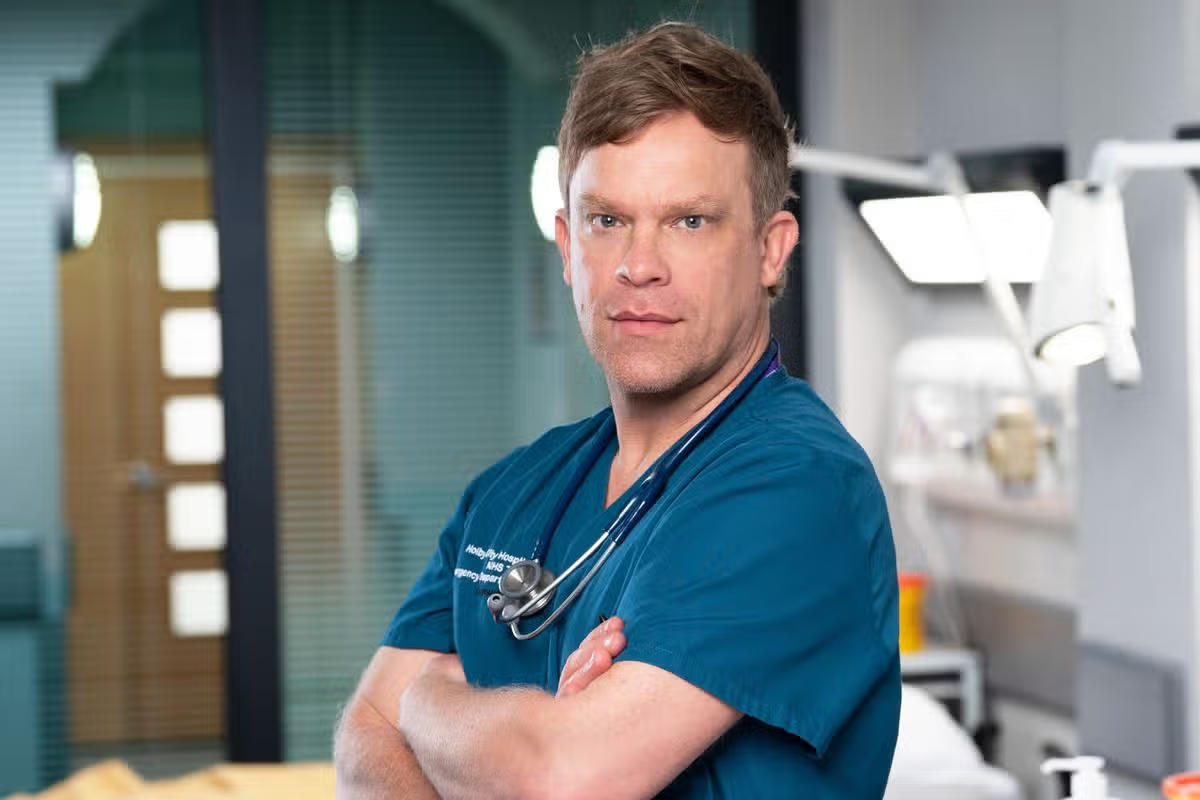
Casualty aired explosive scenes involving Dylan Keogh on Saturday night.
Viewers will recall that only recently, recovering alcoholic Dylan, played by William Beck, relapsed after struggling with the news that his colleague, Stevie Nash, had been having an affair with his son Dr Matty Linlaker.
Since relapsing, Dylan has pushed his loved ones away, including son Matty, and he has caused concern in recent scenes after he was seen driving erratically with a bottle by his side.
At the start of Saturday’s episode, Dylan headed to a care home to visit his father, Brian Carroll. However, alcoholic Brian didn’t recognise his son due to his years of drinking and things soon got unpleasant when Brian said some horrible things about his son, claiming he never loved Dylan.
Taking to Twitter, now X, viewers were quick to do a double take over Brian as they quickly spotted that he had been recast with a different actor. Brian made his first debut in 2015 and he was last seen on the BBC medical series in 2018.
In the earlier episodes, Brian was played by actor Matthew Marsh but on Saturday’s episode, the character of Brian was being played by actor David Beames.
Viewers were quick to share their reaction to Brian’s return after eight years, especially as it was a new actor playing the character. One person said: “Woah that is a different Brian? What happened to Dylan’s little sister with Hazel? #Casualty”
Another person wrote: “Dylan’s father is back?! #Casualty”, a different viewer put: “they’ve recast dylan’s dad! oh! #casualty” while another fan added: “Hang on… That’s not Matthew Marsh… Dylan has a new dad? #Casualty.”
Later in the episode, upset by his father’s cruel words, Dylan rushed out of the care home and started drinking from the clear bottle as he drove off, leaving his son Matty a voicemail saying: “Things are going to change”, adding that he’s not like his own father and that he cares about Matty.
Upon listening to the message, Matty and Stevie were concerned to hear a crash at the end, where it looked as though Dylan had been involved in a serious car crash.
However, thankfully, Matty discovered his dad uninjured and upon confronting his father for drink driving, Dylan insisted he hadn’t drunk since his initial relapse. A breathalyser later confirmed that he was telling the truth.
The emotional episode ended with Dylan vowing to make things right again and start AA meetings, as well as therapy to tackle his addiction.
This article contains many spoilers for “Heartstopper Forever.”
In the early minutes of “Heartstopper Forever” — the feature film finale of Netflix’s hit teen romantic dramedy series — Charlie Spring (Joe Locke) notices a crooked photo strip on his boyfriend Nick Nelson’s (Kit Connor) bedroom wall. Gently pulling down the pictures, taken on the beach day they made their relationship official, Charlie smiles wistfully at their younger selves: “We look like babies.”
It’s a line that applies to the characters as much as it does to Locke and Connor. Four years after being catapulted into global stardom, the pair are bidding a bittersweet farewell to the roles that have defined their own coming of age.
“Season 1 does feel like an immensely long time ago that I do look back and think, ‘Yeah, we do look like babies,’” Connor says, with Locke nodding in agreement next to him on a recent video call from London. “‘Heartstopper’ itself was this tiny little show that was clearly something quite special to us, but we didn’t really think or know anyone was going to watch. And, suddenly, it became this thing that was immensely important to a lot of people.”
Adapted by Alice Oseman from her own bestselling graphic novels, which originated as a webcomic in 2016, “Heartstopper” chronicles the endearing love story between high-strung, gay overthinker Charlie and kind-hearted, bisexual rugby player Nick at an all-boys’ school in England.
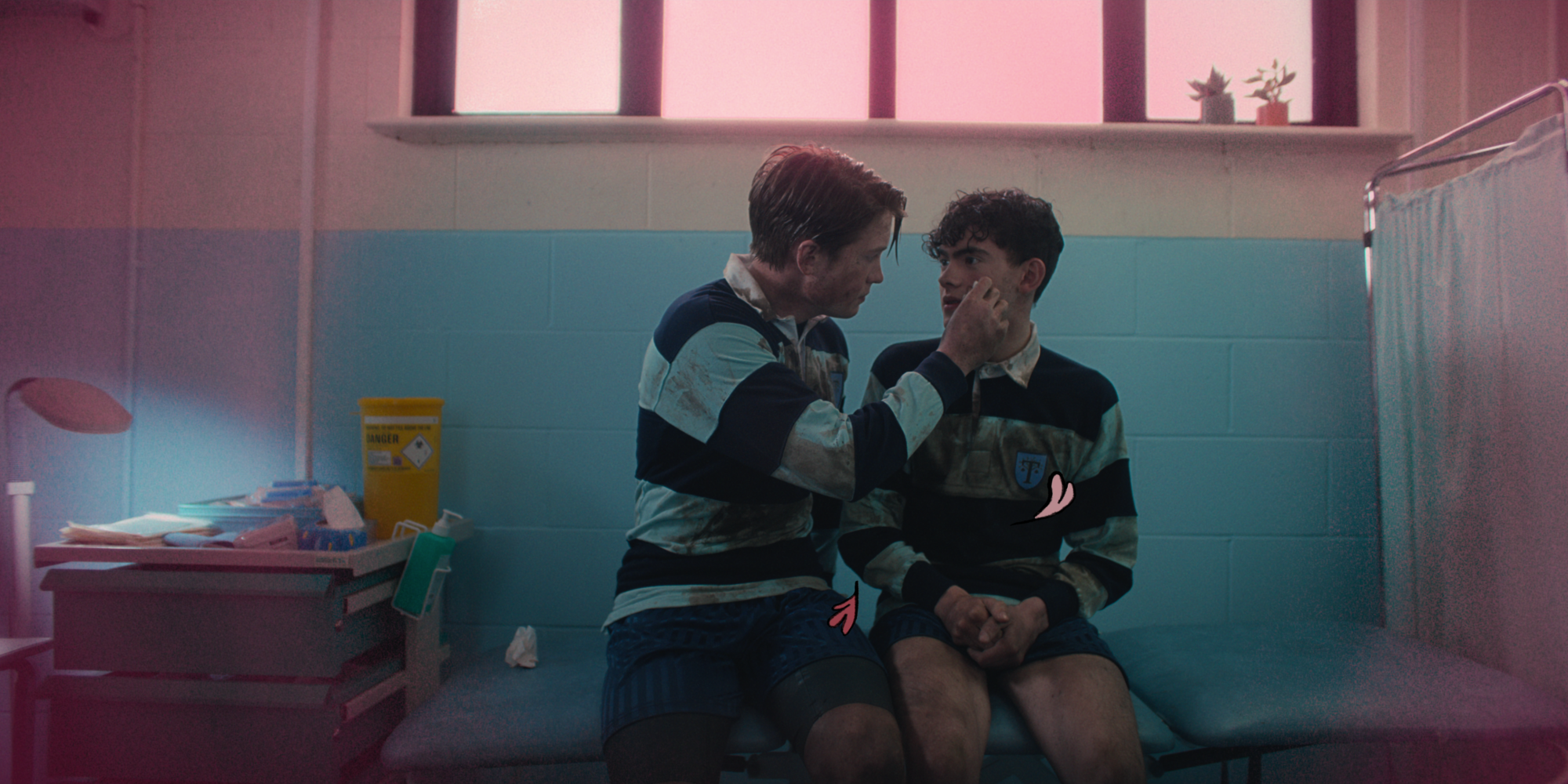
Nick (Kit Connor) and Charlie (Joe Locke) in a scene from Season 1 of “Heartstopper.”
(Netflix)
Upon its debut in 2022, the show was lauded for its unabashedly joyful, tender portrayal of queer youth — a refreshing departure from the trauma-heavy narratives that dominate other teen dramas. Even as “Heartstopper” ventured into darker thematic territory, such as Charlie’s history of eating disorders and struggles with self-harm, Oseman’s writing never lost its deft, light touch.
From the outset, Oseman knew she wanted to end “Heartstopper” with Nick going off to university in Leeds and Charlie, who is a year younger, finding independence as head boy at school. But with her cast growing increasingly more in demand every year, the author-turned-screenwriter says it would have been logistically difficult to make a fourth and final season.
After Netflix greenlit a two-hour finale instead, Oseman elected to zero in on her protagonists — not unlike her comics — rather than give each character their own, heavily condensed arc. “I think that was definitely the right decision, because we really get to spend a lot of time with Nick and Charlie and not feel like we’re missing anything,” she says.
Directed by Wash Westmoreland (“Colette,” “Still Alice”), “Forever” finds the first loves grappling with the reality of an impending long-distance relationship, leading to a rash breakup and, ultimately, an emotional reconciliation. In a surprising role reversal, as Charlie confidently steps into a leadership role as an advocate for other LGBTQ+ students, Nick is left to discover his own identity and self-worth outside of being the protective, supportive boyfriend.
On the set of “Heartstopper Forever” as Connor and Locke film a scene from the movie.
(Samuel Dore / Netflix)
Connor, who also executive produced the film with Locke, felt Charlie and Nick’s romance would be better wrapped up in a feature-length format. “There were a few very important and crucial, but short and intense [plot points] — the breakup and the time apart, and the eventual makeup and the two of them discovering who they are without one another,” he explains. “Doing it in a shorter period, I thought, would make those things hit that much harder and feel that much more visceral.”
Unlike previous seasons in which she could rely on her existing comics as storyboards for the show, Oseman was working simultaneously last year on the sixth and final volume of the “Heartstopper” comics, released earlier this month, and the “Forever” screenplay.
Juggling the same story in two different formats turned out to benefit each end product. “When I finished writing the first draft of the script, it actually made me do a really big rewrite of the comic, because it helped me see which moments were really important and which moments didn’t need to be there,” she says. (One of the pivotal scenes was the Pride parade, filmed on the last morning of production.)
As first-time producers, Locke and Connor also provided script notes that directly influenced the story. For instance, “there was no scene between Charlie and Mr. Ajayi in the original script,” says Locke, referring to the gay art teacher, played by Fisayo Akinade, whose classroom became Charlie’s safe haven from bullying before he befriended Nick. “I was like, ‘That scene in Season 1 with them is so pivotal to the story. It would be really lovely to have just a little moment for them in the film that circles on that chapter of their relationship.’ And straight away, Alice was like, ‘Yeah, great idea. Let’s do this.’”
For his part, Connor always feared that the show’s “rose-tinted” approach, though part of the story’s appeal, “would not be nuanced enough to talk about the complexities of being human and being young.”
Locke says he proposed a scene with Fisayo Akinade, who plays art teacher Mr. Ajayi, as a way to circle back on their relationship.
(Netflix)
“There was one moment where I was like, ‘Oh God, I hope these young people watching “Heartstopper” don’t suddenly forget that these kids are human, and that these kids can make mistakes and still be lovely, delightful and good people,’” Connor says. With Oseman and Locke, Connor was adamant about “finding the place [where] these characters were being treated in a way that we all felt good about.”
According to Oseman, Locke and Connor were also heavily involved in selecting a new intimacy coordinator, Robbie Taylor Hunt. Over the years, the amount of sex — or lack thereof — in “Heartstopper” has been the subject of much discourse. “It always annoyed me slightly that people were like, ‘Oh, this is so unrealistic. They’re not having sex.’ They were underage. What do you want us to do?” Locke says with a wry laugh.
Oseman has learned to tune out that online chatter, accepting that she cannot please everyone — let alone represent the entire spectrum of the young queer experience. With each season and now this film, her creative team chose to age up the story slightly. After Charlie and Nick lost their virginity to each other at the end of Season 3, the film uses physical intimacy to reveal more about their maturing relationship.
Locke says those scenes were necessary to the plot. “The pier sex scene is this carnal lust between these two people who need to get it out. The sex scene in the pillow fort is a moment of connection for them,” he says. “And the big sex scene at the end of the film is the reconciliation of their relationship.”
In the end, Nick and Charlie decide to give their relationship another shot, confident that their love can defy the conventional wisdom that teen romances rarely last. But what they learn during their split is “that you can’t put all of your hopes and dreams, your mental health and your ability to survive into one person, because it’s not fair on yourself and on that other person,” Connor says.
Over the years, the amount of sex, or lack of it, in “Heartstopper” has been the subject of online discourse. The film shows more physical intimacy.
(Netflix)
The film’s epilogue, like in the comics, offers a brief glimpse of Charlie visiting Nick for a weekend in Leeds, ending with the two of them looking through the pages of a scrapbook that still has room for new photos. While Oseman has her own vision of Nick and Charlie’s future in 10 years — they’d be newly married with a dog, she believes — the actors who play them aren’t so sure.
“I feel like the beauty of ‘Heartstopper’ is that we get to see a chapter of these two young men’s lives, and it ends in a way that doesn’t promise anything,” Connor says. “Even if they were to not end up together eventually, it wouldn’t make the experience that they shared together any less special or pivotal to who they are as people. I think that’s kind of beautiful.”
Locke is reluctant to divulge his own interpretation of the characters’ future, preferring instead to let viewers make sense of the hopeful ending. “I hope they’re happy,” he says simply. (But for the record, the actors both believe that Charlie and Nick will stay together. “Of course, we all hope so,” Connor clarifies.)
Although she is ready to tell new stories, Oseman believes that she will be revisiting Nick and Charlie, who first appeared in her 2014 debut novel “Solitaire,” “in small ways for the rest of my life.”
“I think there definitely won’t be another 10-year-long webcomic — probably not — but I love thinking about what Nick and Charlie might be up to when they’re 40 or 60,” Oseman says. However, she adds, “I think the main story of ‘Heartstopper’ has concluded, and I do feel good about that.”
Like their high school characters, Locke and Connor are ready to graduate from the “Heartstopper” universe. Wary of being typecast, they have established themselves as versatile stage actors, making their Broadway debuts in “Sweeney Todd” and “Romeo + Juliet,” respectively. Onscreen, Locke joined the Marvel universe in “Agatha All Along,” while Connor has explored vastly different cinematic genres — his next major project, the film adaptation of the dark fantasy video game “Elden Ring,” will reunite him with “Warfare” director Alex Garland.
Even on the day of our interview, Connor and Locke looked a world away from Nick and Charlie. Locke wore an all-black designer outfit, while Connor — dressed in a light blue striped button-down over a white tank and khakis — had traded Nick’s signature floppy hair for designer stubble. Yet both actors have made peace with the reality that they will forever be linked to each other and their roles. “That’s part and parcel of the job,” Connor says.
Fittingly, the last scene Connor and Locke filmed as Nick and Charlie was the anniversary scene in the park where there is a fallen tree with the letters “N+C” carved into the trunk. “It was lovely because it was back to how a lot of the ‘Heartstopper’ experience has been, which is just me and Joe,” Connor says.
“I love thinking about what Nick and Charlie might be up to when they’re 40 or 60,” says creator Alice Oseman. However, she adds, “I think the main story of ‘Heartstopper’ has concluded, and I do feel good about that.”
(Netflix)
Would they be open to revisiting Charlie and Nick’s love story as older adults? “In 10, 15, 20 years, who knows? Maybe,” Connor says. “Even if Alice were to decide that they wanted to make a TV show about another character in the universe of ‘Heartstopper’ and they wanted us to cameo or something, then, hey, maybe.”
While the “Heartstopper” team expected the series to resonate with younger audiences, they have been particularly moved by the reactions of older queer viewers, who have marveled at the strides in LGBTQ+ representation onscreen. Coming from the world of young-adult fiction — where she notes stories of queer joy are abundant — Oseman recalls being surprised that “Heartstopper” was treated as an anomaly in mainstream media. Still, she is proud to have helped move the needle on LGBTQ+ representation, particularly when such characters remain underrepresented.
“My hope is that people will be able to look back … and say, ‘Hey, “Heartstopper” did really well. Let’s make another queer show that’s got the [same] ‘queer joy’ vibes,’” Oseman says. “I hope it’s been able to give that encouragement to the people in power to let there be more stories out there because we just need more, different kinds of queer stories.”
Connor believes that anyone can enjoy the show because “Heartstopper” simply captures the universality of “human beings being happy and being in love.”
“Obviously, the [queer] representation is incredibly important. I think that the very existence of the show and the comfort and safety that it can bring people is one of the things that makes it so special,” Connor says. And the demand for such stories “isn’t going to change,” he adds. “Queer people are always going to exist.”
EXCLUSIVE: Hollyoaks newcomer Charlotte Riley, who replaced original Leah Barnes actress Ela-May Demircan, has revealed the pressure of taking on the role amid backlash
07:04, 17 Jul 2026Updated 07:04, 17 Jul 2026
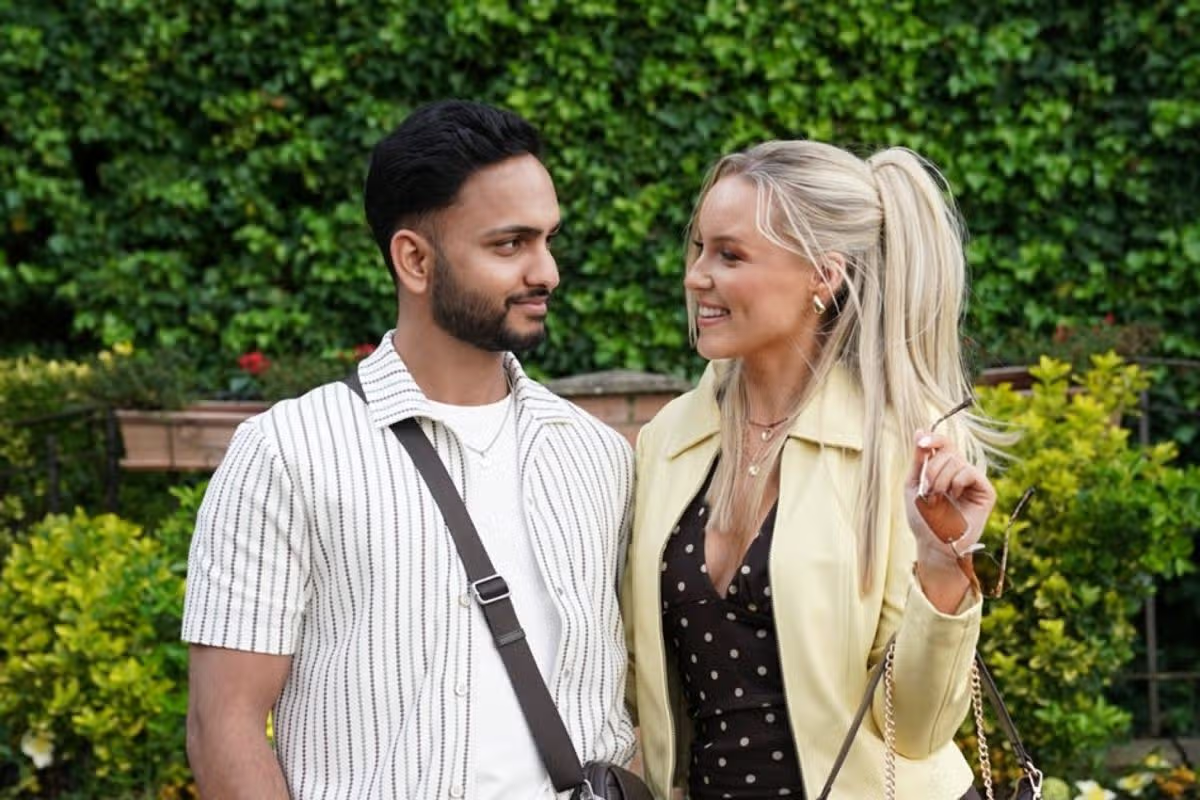
Hollyoaks’ new Leah Barnes actress Charlotte Riley has shared her reaction to backlash from viewers(Image: Lime Pictures)
Hollyoaks‘ new Leah Barnes actress Charlotte Riley has shared her reaction to backlash from viewers aimed at bosses.
After the role was recast and original actress Ela-May Demircan was replaced, newcomer Charlotte confessed there was “pressure” with taking on the role. Hearing out why fans weren’t impressed about the changes to the character, Charlotte explained why the role was recast.
She also, in an exclusive chat with the Mirror, defended the changes to Leah as fans called out the character’s “personality transplant”. Hollyoaks bosses planned the change in order to take the character of Leah down a different route.
As for the changes to Leah as a person, it’s very much to do with her time in LA. Charlotte hopes the show will explore some of Leah’s past, while she added that we will see another side to Leah very soon.
On the backlash, Charlotte sympathised: “There is definitely pressure. I obviously understand it because when you watch your favourite show, and they recast someone, you’re like, it’s not her!
“I would be the exact same honestly. People don’t like change, myself included, but I think that’s why people need to get comfortable with change in that life changes people.
“People grow and that’s what they wanted to do with Leah, take her down a different route. She’s been in LA, she’s been studying, and she’s changed as a person.
“She’s had these American influences, and her style’s changed.” Charlotte also explained that a lot of the confidence and chaos we are seeing with Leah is a front she’s putting on.
She told us: “There’s a lot that’s gone on and you never lose your inner self. She has past trauma like with the loss of her mum, she’s not completely changed. But she’s got these great cover-ups, she puts on a front for everyone.
“In the summer we will see it deteriorate a bit. She’s not always perfect and she wants to put on a front. Finding this new aspiration of being an influencer, it’s given her confidence to change as a person.”
Charlotte is loving her time on the soap though, and she talked about reuniting with her Coronation Street co-stars Lewis Walton and Brook Debio, who both recently joined the Channel 4 soap too. She said: “Brook found out way before anything, then Lewis and then it just happened, it was me!
“I love it, it still doesn’t feel real and I don’t think it ever will. When you’re constantly doing auditions and it’s rejection therapy, when you do get the job it’s like imposter syndrome.
“But I have found my feet a bit, and I’m settled in now. I love it. I’m constantly living in that dream and doing what I have wanted to do since I was little.”
Hollyoaks is available to stream on Channel 4’s streaming service now, while it also airs Mondays to Wednesdays on E4 at 7PM.* Follow Mirror Celebs and TV onTikTok,Snapchat,Instagram,Twitter,Facebook,YouTubeandThreads.
London — It’s a scorching day and the city feels blanketed by the heat. Even the unusually strong air conditioning in a suite at the Raffles hotel is no match for the temperature. Octavia Spencer immediately peels off her jacket after entering the room and realizing there are no cameras present for our interview. Hannah Waddingham, her co-star in “Ride or Die,” kicks off her heels as they settle onto a plush sofa.
“You’ve seen that we look nice,” Spencer says. “So now we can do this.”
There’s a relaxed, familiar vibe between the actors. They didn’t know each other prior to filming the series, now streaming on Prime Video, but they did develop a real-life friendship during production in Prague last year. It was perhaps inevitable considering that “Ride or Die,” created by Tessa Coates, is about two best friends whose relationship is upended when one of them is revealed to be a professional assassin.
Spencer, 56, plays Debbie Claybourne, a lawyer whose career has been put on hold due to her British husband David’s political aspirations. The actor was approached by Skydance, now part of Paramount, as part of a development deal with the studio. She said yes almost immediately, and by happenstance both she and the producers imagined Waddingham, 51, in the role of Judith Burton, a skilled assassin who works for a shady organization run by the Director (Bill Nighy).
“It was always just the two of us for these roles,” says Spencer, who won an Oscar in 2012 for “The Help.” “We did a Zoom and I was sitting there thinking, ‘I hope she says yes.’”
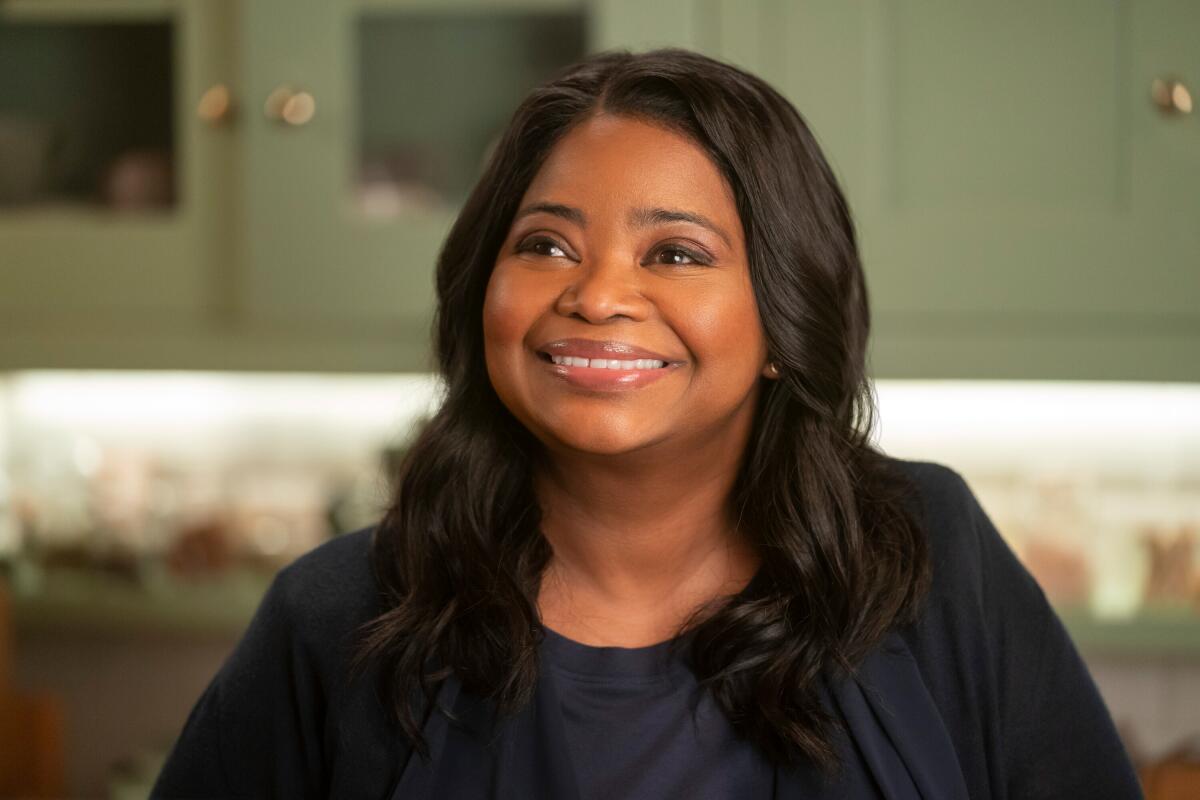
In “Ride or Die,” Spencer plays Debbie, a lawyer and wife of a British politician, who is best friends with secret assassin Judith, played by Waddingham.(Dusan Martincek / Prime)
“It’s Octavia Spencer and I’m thinking, ‘Be cool, be cool,’” Waddingham chimes in. “Octavia and Tessa start telling me the plot and at the end I said, ‘Who the hell are you going to get to play Judith?’ Octavia’s face filled the whole screen and she said, ‘We want to make you Judith, dummy.’”
Each professes to be a fan of the other, but Spencer is particularly effusive. She admits to initially having to remind herself that Waddingham is, in fact, an actual person and not Rebecca Welton, her character on “Ted Lasso.” She turns to her co-star. “We know you’re a brilliant comedian, but you also showed us in ‘Game of Thrones’ this depth,” Spencer tells Waddingham, adding, “With her beauty and that statuesque presence she has, this role was literally written with a woman of her caliber in mind.”
Waddingham turns red. “I’m not good when she does this,” she admits.
“Well, it’s very true,” Spencer responds. “I think it was kismet. I knew it was meant to be when we were at the upfronts for Amazon and we were in the wings with Will Ferrell and Reese Witherspoon, just chatting it up. I’ve always had severe stage fright. They walked out and I got really quiet, centered myself, and then I felt these arms around me. She wrapped me up from behind, and it was like, ‘OK, I’m good.’ That’s what it has felt like this entire process.”
Waddingham’s memory of that day, her second time meeting Spencer after their first call, is slightly different. “Octavia is so established in Hollywood,” she says. “I’m still a newcomer in this town. So I was having the worst impostor syndrome that day. I was thinking, ‘I look like a competition winner.’”
Nerves settled by the time the production started in January 2025. Before joining forces in Prague, Waddingham flew to Ischgl, an Austrian ski town known for its party vibe, to shoot the show’s opening sequence. The James Bond-style scene introduces Judith as talented, serious and a bit of a loner. That perception is quickly upended when the character arrives at Debbie’s home in London for their book club meeting and the duo begin singing along to Salt-N-Pepa’s “Shoop.”
“Octavia is so established in Hollywood,” Waddingham says of meeting her co-star. “I’m still a newcomer in this town.”
(Bexx Francois / For The Times)
“That was our first scene together and we didn’t plan anything or talk about it,” Waddingham says. “But we had an unspoken, organic process.”
“We had a lot of trust,” Spencer adds. “I knew she was going to come in with 1000% and that I was going to too. Some of those things you figure out when you’re on the set and some of those things just happen in the moment.”
Showrunner Matt Miller points to the scene as evidence of the actors’ “instant chemistry.”
“It really feels like this is a friendship that has endured 25 years from the moment they get on screen,” Miller says, speaking with Coates over video call later. “From the second you see them dancing around, you’re like, ‘Oh yeah, these two are best friends.’”
Coates and Miller wanted to ensure that the characters’ history was baked into the scripts. They’ve been friends for decades, so there had to be a shorthand between them that was immediately apparent and they had to be on equal footing. The duo are forced on the run across Europe, dogged by their past, and successfully get themselves out of danger.
“These characters came from a great desire to see women like this on screen,” Coates says. “So many stories suggest aging is the worst thing that could possibly happen to you. But what if getting older seemed really cool and you got wiser and better at your job and gave less of a s— about things?”
Coates adds they wanted both characters to be competent and clever women who happen to be thrown into difficult circumstances.
“Women in their 50s are just as capable, just as beautiful, just as sexy,” Spencer says. “We’re just aging.”
Spencer and Waddingham, both executive producers on the series, never sought top billing over the other. Although the show is ostensibly an action comedy, they wanted to ground it in real emotions. Everything is tethered to this friendship.
“Women in their 50s are just as capable, just as beautiful, just as sexy,” Octavia Spencer says. “We’re just aging.”
(Bexx Francois / For The Times)
“There couldn’t be one more important than the other,” Waddingham says. “The thing they say about relationships is that when one is at 90 and the other is at 10, or one is at 80 and the other is at 20. That’s what this had to be straight away. If you have that pendulum back and forth, you can create magic.”
Although both characters find small romances throughout the story, men are sidelined for the far more important relationship: their own. And it’s not always an easy partnership between them.
“There is a love story at the center of this,” Spencer says. “It’s not a romantic love story, but it is a familial relationship. It’s contentious, and the relationship is fractious at points.”
Waddingham adds, “You have to be able to call each other out, and then get through that storm and let the water settle.”
Still, there is a lot of action in “Ride or Die.” Judith frequently kicks ass, often taking on groups of imposing men. It’s deeply satisfying to watch Waddingham, who did most of her own stunt work, take these men down.
“In theater, I never had an alternate,” she explains. “I’m not usually Method, but with this I thought my exhaustion from fighting and the stunt training would lend itself to Judith’s exhaustion and her frailty. It wasn’t particularly healthy, if I’m honest, but that fractured tiredness really helped play the role.”
She adds, “It’s a real art form. The first stunt work I did was on ‘The Fall Guy’ and learning to stop before you punch someone in the face is hard.”
“That’s why I was terrified for you,” Spencer interjects. “Because I did punch somebody in the face. The only other time that I actually had to do stunts was on ‘Snowpiercer.’ It was so exciting watching you, but then I was like, ‘Somebody could hit her for real.’”
Waddingham felt added pressure knowing Judith’s background. “She’s not just an assassin, she’s a notorious assassin of 30 years,” she says. “If you see her punching someone, like when we’re running out of the gala, that punch can’t be some girly thing. You have to believe she can do it perfectly and effortlessly.”
Waddingham did much of her own stunt work in “Ride or Die.” “It’s a real art form. The first stunt work I did was on ‘The Fall Guy’ and learning to stop before you punch someone in the face is hard.”
(Bexx Francois / For The Times)
Both actors approached the show with complete dedication. Waddingham and Spencer appear in almost every scene, which vacillate between action, comedy and drama. Debbie, named after Coates’ mother, feels betrayed by Judith and her husband, who is involved in shady dealings with an Albanian gang. “There were the rigors of it physically, but there was also the emotional rigor of it,” Waddingham says.
“It might have been the most challenging job that I’ve ever done,” Spencer agrees. “The most challenging, but also the most gratifying. I knew I would not be called upon to do any stunt sequences, but I did have physical stuff I needed to do. And then dealing with the emotional weight of Debbie discovering that two very important relationships are not at all what she thought they were was a lot.”
She pauses. “But you know what, why not?” she continues. “We don’t want to be in a comfortable place all the time. You want to know you completed something that was very difficult to do. I feel very proud now, looking back.”
“We couldn’t have left our hearts and our bodies and our brains on it any more than we did,” Waddingham agrees. “It is splattered with us. I’ve been very privileged to go from ‘Ted Lasso’ to this, because ‘Ted’ is a very hard act to follow in terms of that constant and emotional push and pull. This has that as well.”
While filming “Ride or Die,” Waddingham found out Apple TV had greenlit a fourth season of “Ted Lasso,” which premieres Aug. 5. She wasn’t expecting to be pulled back to her Emmy-winning role of Rebecca after the series ostensibly concluded in 2023. “I didn’t know anything about it,” she says. “No clue.”
“We found that out together,” Spencer says.
Waddingham had only two weeks off after wrapping “Ride or Die” before flying to Kansas to film the first episode of Season 4, which sees Rebecca attempting to lure Jason Sudeikis’ Ted back to London to coach Richmond’s women’s soccer team. The rest of the series then shot in England. The new episodes keep Rebecca as one of the emotional cores of the show.
“I haven’t really stopped since then,” Waddingham says. “When I’m older, I’m going to have a little sleep. But this is what you wait for in your life.”
For Spencer, “Ride or Die” has raised the bar on what type of project she wants to do as a producer and as an actor.
“It is hard to get things made,” Spencer says. “I don’t have time to do things just for a paycheck. It has to resonate with me because your time and health are your most valuable commodities, and time is something that you have no control over. As an artist, I want to be fulfilled and when you get a project like this now everything has to compare. I’ve learned to be very discerning.”
She gestures to Waddingham. “Don’t you want to be excited about things?” she asks.
“Yes,” Waddingham agrees. “And it just doesn’t happen very often. But this was remarkable from the beginning. To be able to spend a couple of days together right now and regroup, it’s almost like a therapy session. We’ve had distance to reflect on all the good and all the exhausting, and on what we have created together. I know that neither of us will ever forget this.”
Spencer nods. “It is a dream. I feel very fortunate that we get to look for projects like this for ourselves and have an active voice in procuring those things for ourselves and for other people. But you dream it, and then you get something like this, and it surpasses everything you ever thought you could want.”
In the latest episode of “The De Los Podcast,” actor and comedian Fabrizio Guido spoke with hosts Fidel Martinez and Suzy Exposito about his role in the Netflix series “Running Point” — as well as being a part of a new wave of young Latino Hollywood stars and how he got his start in the stand-up comedy world.
Having grown up in L.A. himself, Guido talked about owning the persona of “Running Point” character Jackie Moreno: a concession-worker-turned-executive-assistant from Boyle Heights.
“I just felt I had all the tools necessary to bring this character to life,” Guido said. “It was a really important opportunity for people to see this side of L.A. … to get to know that kid that you see on the street or at the mall [and say] ‘Oh, that guy reminds me of Jackie.’”
Part of the appeal of the character was the chance to “showcase how much heart L.A. has.”
“It can be isolating if you’re the only Latino on a set,” Guido shared. “So to have peers that share a similar upbringing as you — you walk away with a friendship most of the time because you have stuff in common.”
He also mentioned that the bump in Latino talent has led to diversity in roles within the community.
“For the longest time, it could’ve been stereotypical — the only things Latino could play,” Guido said. “For the first time we’re starting to see this emergence of what it means for each one of us to be Latino. I’m bringing my experience to the table, Keyla is bringing her experience to the table, Xolito is bringing his. We’re not going by what the industry thinks Latino is, we’re bringing what we think Latino is.”
But beyond the acting world, Guido has also tackled the stand-up comedy scene in recent years.
He shared that he got his first gig thanks to comedian Gabriel Iglesias, who he worked with on the Netflix sitcom “Mr. Iglesias.” The arena comic convinced Guido to do a five-minute set — which Guido worked on for two weeks — at the Brea Improv.
“I got on stage, did my first joke and was super nervous,” he said. “Second joke did really well and it afforded me enough time to get present and then I ran through my five minutes, got off stage a different person. I knew I was in love. I felt like something in my life had shifted in that moment and I’ve been in love with stand-up ever since.”
While the likes of Don Gilet, Shantol Jackson and shaquille Ali-Yebuah are reprising their roles, viewers are keen to see some other familiar faces on the programme have more of a staple role.
On a Reddit thread, one person asked: “Apart from Selwyn and Catherine, have there been any other recurring characters in DiP? As in, are there Saint Marie residents who have been brought back in subsequent seasons?
“I’m not really referring to characters who are brought in for multiple episodes to fulfil a storyline (such as Sophie for Neville, or Mervin’s brother, for instance).
People were quick to share their thoughts on the matter, highlighting that the taxi driver is a frequent character alongside the ambulance staff that appear in certain episodes, reports the Express.
One fan replied: “See, that makes me wonder why they haven’t made him sort of a character instead of just an extra. He could add some local flavour to the show. Give us a better sense of island life, if you know what I mean.”
Another chimed in: “I was thinking of him too (the taxi man), but he feels more like a background extra than a proper “character” most of the time tbh. Still wild how a tiny island somehow has infinite one-episode guest stars but almost no regulars.”With someone else adding: “YES. This is what I mean. Why are there barely any locals? It would give the series some depth and breadth.”
Over the years, Death in Paradise devotees have watched a steady stream of familiar faces arrive and depart on the fictional Caribbean island of Sainte Marie.
A host of detectives have led the show, including DI Richard Poole (Ben Miller), DI Humphrey Goodman (Kris Marshall), DI Jack Mooney (Ardal O’Hanlon), DI Neville Parker (Ralf Little) and most recently DI Mervin Wilson (Don Gilet).
Yet it is only Commissioner Selwyn Patterson (played by Don Warrington) and Catherine Bordey (played by Élizabeth Bourgine) who have featured in the BBC series since its very first series back in 2011.
Sadly, fans may have to exercise some patience before finding out whether their wishes are granted, as the current series remains in production, with the cast currently out in the Caribbean shooting season 16.
Earlier this year, it was announced that the show had been recommissioned for a further two series and two Christmas specials.
Death in Paradise is available to watch on BBC iPlayer
If you buy books linked on our site, The Times may earn a commission from Bookshop.org, whose fees support independent bookstores.
“Writers are always selling somebody out,” Joan Didion once wrote. She was talking about journalists, but it can be just as true of novelists. Whether the genre is romantasy or autofiction, making up stories often demands making up stories about real people — exploiting them — to serve a narrative purpose.
Cali Adeline’s debut novel, “People Watching in the Desert,” gives this thorny ethical business an impressively complex treatment for a book that comes on like a beach read. Sonny, its hero, has checked into Sanctuary, a spendy Phoenix-area resort, for an extended stay. She’s 25 and unemployed, and it’s unclear at first how she acquired the funds to splurge on an on-site cottage with a pool, 90-minute massages, and various forced-fun adventures. It’s also unclear why she chose a five-star resort for the splurging, given her discomfort with everything from the menu on down. Sitting down for dinner alone, she “discreetly googled some of the words on her phone under the table: cotija, calabacitas, tabbouleh, bisque.”
Adeline lays out a breadcrumb trail that eventually reveals that Sonny has lugged some especially heavy personal baggage to Sanctuary. Her neglectful, addict mom died when she was a child, only to be replaced with a repressive, overprotective grandmother who stomped on her every ambition. Early adulthood has been defined by failed relationships and uninspiring work. People are to be feared: She’d sooner indulge in croquettes at the resort’s cocktail party than make small talk with other vacationers, and when she braves the world outside her cottage it’s usually with a notebook in her hand.
The early pages of “People Watching” weave Sonny’s perspective with brief sketches of her fellow resort-goers, which usually open with godlike authority: “Allana was ten feet tall and beautiful.” “Chloe and Mark had been married for seven blissful years.” “Dale was invisible. He had that way about him.” The odd bluntness of these statements, combined with their touches of surreality (“ten feet tall”?), makes clear that these mini-bios are scribblings from Sonny’s notebook. Terrified of the world, but determined to better understand what she’s been excluded from for so long, she’s determined to imagine her way into reality.
Sonny’s Walter Mitty-like imaginings do some valuable double duty in the novel. For one thing, they offer some necessary conflict in a setting that’s all about relieving tension. Resorts are, almost by definition, boring, but as Sonny hangs out poolside or does yoga or endures a singing bowl, her mind (and the novel) is reeling with imagined infidelities, deaths, gambling debts and other domestic dramas. Second, her sketches serve as character-defining examples of projection on Sonny’s part, as her observations of others reveal her own concerns about love, sex, money and rejection.
And, of course, she’s deflecting, too — better to make up drama about others than confront her own. The memories Sonny eventually surfaces are more potent than anything she makes up. But they’re also crueler, and you can understand why she’ll think and write about anything but. She recalls a time as a child when she was neglected for days on end and braved a trip to a neighbor for help. “The woman asked Sonny when the last time she took a bath or changed her clothes was and Sonny didn’t know the answer. Her only response was, ‘I’m four,’ as she proudly held up five fingers,” Adeline writes. “She was three.”
Remember the words “beach read” up there? It’s not difficult to predict how Sonny’s arc will curve: It’s a Walter Mitty story, but also an Ugly Duckling story. That notebook full of mini-dramas becomes a source of drama in itself. Say, that bartender is pretty cute, isn’t he? And Sonny eventually integrates with a few of her fellow resort-goers, and learns there’s more to them in reality than her imaginings. As one character gently chastises her, “People can surprise you, Sonny, but you have to let them.”
The pat-ness of Sonny’s Sanctuary journey makes her yet another entry in an evolving genre you might call “Is This Character Concussed?” In these novels, the main character has been so absurdly addled by a (late-revealed) trauma that everyday human interactions are wildly aglow with (at first) terror or (later) manic-pixie wonder. Prime examples include Gail Honeyman’s “Eleanor Oliphant Is Completely Fine,” Sayaka Murata’s “Convenience Store Woman,” and multiple characters in the oeuvre of Sally Rooney and Ottessa Moshfegh. (Women are the most common character in these books, but guys can play too: See Fredrik Backman’s “A Man Called Ove.”) Socially awkward characters offer an opportunity for dry humor and deadpan prose. Because these stories have to dramatize a search for normalcy, its leads tend to be awkward in ways that strain credulity.
But you don’t have to wholly buy into the idea of a character like Sonny to find something intriguing about what Adeline is saying about storytelling throughout “People Watching.” In Sonny’s notebook, every observation is a moral choice, a mini-essay about what proper conduct is, what failure is, how you might get past it, and what our responsibilities to others might be. A notebook is a place of wish fulfilment, and a place for vengeance. Sonny explains at one point that she only started to get free of her grandmother’s clutches once she was capable of imagining her violently erased:
“I wrote a story. About her. And how one day while I was at work the house caught fire. Which wasn’t that far-fetched because the whole place really was a fire hazard. And … and … well, she was asleep inside the house, in the story, and didn’t make it out. I didn’t mean it. I was angry. And it was a story.”
Adeline stresses the word “story” three times in one brief passage. Sonny wants to reassure everybody that she was just making it up. But no writer is, not entirely.
SACHA Baron Cohen has brought back the iconic Ali G character at Wimbledon ahead of a new film.
Sacha, 54, first played faux-streetwise poseur from Staines in 1998 on The 11 O’Clock Show before landing his own series, Da Ali G Show.
Sacha Baron Cohen has returned as Ali G with an appearance at WimbledonCredit: InstagramHe wore a Wimbledon-coloured tracksuit as he took his seat in Centre CourtCredit: Twitter
Sacha last played Ali G in 2014 but at the men’s singles final at Wimbledon on Sunday, the star resurrected the character.
Sitting in Centre Court, Ali wore a Wimbledon-coloured tracksuit with the motif ‘Official Ganja Dealer’ on the back, hat, heavy gold chain and glasses, Sacha sported his alter ego‘s facial hair, and attitude.
Sign up for the Showbiz newsletter
Thank you!
Ali also joined Instagram to share videos from the tournament and said: “I iz BACK!
“And if u iz at dis borin wimbledore final lookin 2 get grand slammed, I iz here wif de hookup. dm me, especially if u iz fit.”
Ali also shared posts from Wimbledon on his new Instagram pageCredit: InstagramSacha is preparing a new film as his comic creationCredit: GettyAli G first appeared in 1998 on The Eleven O’Clock ShowCredit: AF archiveThere was also an Ali G movie in 2002Credit: Alamy
He also shared a shot of a DVD of his TV series and wrote: “dm me if u want to buy one of these DVD box sets.
“Me iz got like 10,000 of dem. Dey iz very rare. Free pickup in the northwest surrey area.”
Sacha’s appearance at Wimbledon as Ali G comes as he prepares a new film for his comic creation.
When the cast members and creators of the 1990s “X-Men: The Animated Series” reunited at the 2019 Hill Country Comicon in New Braunfels, Texas, they went out for dinner and collectively yearned to one day work together again.
“We said, ‘Let’s put it to the universe: Universe, why don’t you manifest that somebody buys the rights to the show and decides to reboot it and bring us all back.’ We toasted the universe and here we are,” recalls Canadian actor Lenore Zann, the voice of the irresistibly tough Rogue, during a recent video call while visiting Los Angeles.
The result of that metaphysical request is Marvel’s “X-Men ’97,” which debuted in 2024 on Disney+, not as a reboot but as a continuation of the original 1992 classic animated show.
The first season of this new era for the X-Men received an Emmy nomination for animated program. Now, the long-awaited second season has arrived, with the fourth episode streaming this week. Even after the controversial firing of showrunner Beau DeMayo, “X-Men ’97” has already been renewed through Season 4 and the voice cast has started recording their lines for Season 3, Zann says.
The show’s success with both fans and critics is in large part due to its commitment to honor the original ‘90s show, about a group of mutants fighting for themselves and for humanity, not only by preserving its hand-drawn animation style and mature themes but also the voices and personalities of the characters.
“When I pitched the show to Kevin [Feige], he got it immediately and his first question was, ‘Are you going to get the original cast back?’ And I was like, ‘Yes, we are,’” says Brad Winderbaum, head of Marvel Television, Animation, Comics and Franchise at Marvel Studios.
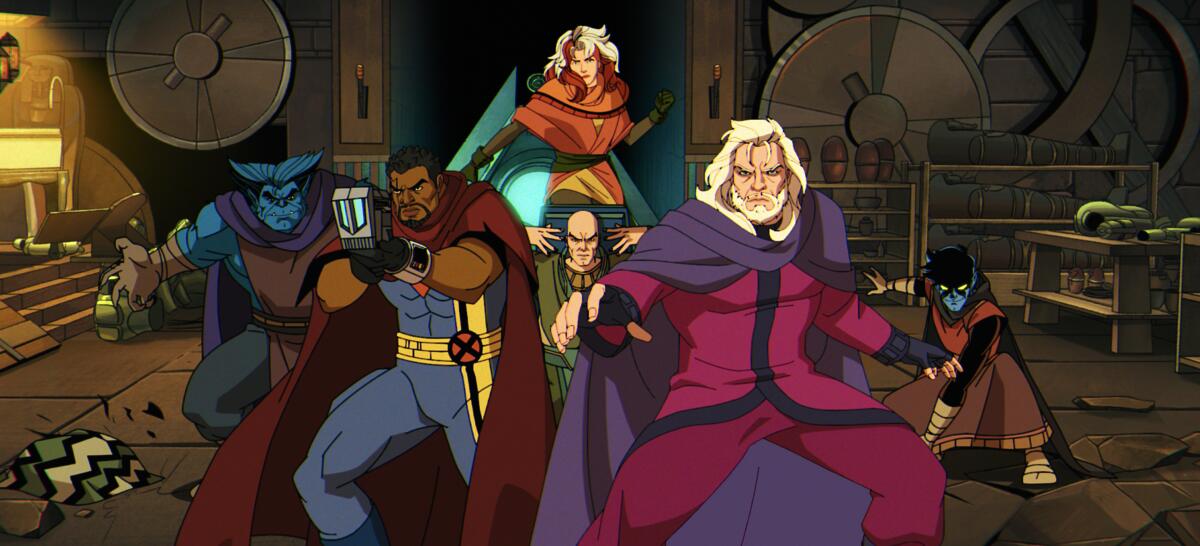
Several voice actors from the original “X-Men” animated series returned for “X-Men ‘97,” which has returned for Season 2. From left, Beast (George Buza), Bishop (Isaac Robinson-Smith), Rogue (Lenore Zann), Professor X (Ross Marquand), Magneto (Matthew Waterson) and Nightcrawler (Adrian Hough).
(Marvel)
Not everyone was still around to return — Norm Spencer, voice of Cyclops, died in 2020 — but in addition to Zann, actors George Buza (Beast), Alison Sealy-Smith (Storm), and Cal Dodd, the voice of the lovable clawed grouch Wolverine, have reprised their roles in “X-Men ’97.” Their emblematic voice performances, Winderbaum says, are baked into his psyche.
“Any time Lenore says the word ‘sugah,’ it just makes me melt into a puddle on the floor,” Winderbaum says, laughing. “She is Rogue and, when she turns it on, she becomes an icon.”
Busy with her political career as part of Canada’s parliament, Zann stepped away from the entertainment business for over a decade. Zann was back home in Truro, Nova Scotia, figuring out her next chapter when she received an email from a friend who said producers at Disney were looking to have her audition for a show. She was skeptical.
Zann eventually got a call from casting director Meredith Layne and a screenplay with lines that were instantly familiar from her time voicing Rogue, the spunky heroine whose touch can be deadly, in the ‘90s.
”I thought, ‘I guess they’re looking for Rogue, so I’ll just give them Rogue,’” she recalls, laughing. “And I did my Rogue voice, which is basically just my own, but with a bit of a Southern accent thrown on,” she adds with a slight twang.
The producers then asked her if she would reprise her superhero for a new generation of kids.
Doing her Rogue voice, Zann recalls: “I said, ‘You had me at hello, sugah.’”
She revels in the similarities between her and Rogue. “We’re both social justice warriors. We really fight for people to be accepted as who they are.”
In 2024, Zann published “A Rogue’s Tale: A Memoir,” a tome recounting her storied life, titled after a memorable episode in the ‘90s series that revealed her beloved mutant’s backstory.
Wolverine in a scene from Season 2 of “X-Men ’97.”
(Marvel)
For Dodd, leaving behind Wolverine after five seasons of the original show felt like losing a part of himself. “X-Men ’97” offered him a chance to feel complete once again.
“I was so happy because when I first created the voice of Wolverine in ‘92, he became very quickly like my brother or my right arm,” Dodd says during a recent video call. “I got my arm back, and my brother.”
After all these years, Dodd was also pleased to see how the most important character of his career looked in the new series. “Out walks Wolverine and I just went, ‘Holy crap, you look great, bub,’” he recalls, laughing about his first time recording lines for “X-Men ‘97.”
When he first auditioned for the role in the ‘90s, Dodd had no idea who Wolverine or the X-Men were. At the time, he was making a living as a singer for commercials and jingles in Toronto.
Dodd remembers the lines he was asked to deliver were directed at the villainous mutant Sabretooth. He had never seen an image of Wolverine or any of the characters. “At one point, I said to them, ‘Is this an animal cartoon?’ They just thought I was a complete imbecile,” he recalls with a chuckle.
In that initial scene, where Sabretooth attacked Jubilee, a member of the X-Men who Wolverine sees as a daughter, his line was: “All right, you egg-sucking piece of gutter trash. You always like pushing around people shorter than you. Well, I’m shorter. Try pushing me.” Dodd recites it from memory in Wolverine’s voice with a growl.
“The lines I was reading, I’d heard them before in the small town that I grew up in Canada; it’s a fisherman’s town, a tough little town,” says Dodd about his reference for Wolverine’s voice. “I knew guys that were exactly like him, and I knew the way they sounded.”
Even without any notion of the X-Men, he nailed it.
“The next morning, they called me and said, ‘We would love to have you as our Wolverine for the very first X-Men animated series,’” Dodd recalls. “And I said, ‘I would love to be your Wolverine, whoever, and whatever he is.’”
1
2
1.Cal Dodd, voice actor for Wolverine in “X-Men ’97.”2.Lenore Zann, who voices Rogue.(Pauline Aguirre)
When Rogue came into Zann’s life, she already had a notable career as a screen and stage actor. Zann had starred as Marilyn Monroe in a rock opera about the actor’s life, for which she received much praise. “My agent called me and she said, ‘Lenore, they’re doing this animated series, and they’re looking for “a woman with a deep husky, sexy voice who can do a Southern accent,”’” Zann recalls, laughing. “And she said, ‘That’s you!’”
Back then, Zann wasn’t interested in doing voice work, so she missed the first auditions. But about a month later, she says, her agent called again. They still hadn’t found the right voice, so she pushed Zann to audition. She walked in and looked at a drawing of Rogue that Larry Houston, the storyboard artist and director of the show, had drawn.
“She had a very sassy attitude, and she had her hand on her hip and her head back with the hair flowing. I was like, ‘Yeah, I can do that.’ And then I went into the studio, put the headphones on, and opened up my mouth, did the first line: ‘I remember I had a boyfriend, when I kissed him, poor boy went into a coma for three days,’” she says in Rogue’s voice. That was enough for her to land the life-changing part.
At the end of the first season of “X-Men ’97,” both Rogue and Wolverine find themselves in difficult times. Wolverine’s clash with Magneto, the perennial antihero, left him severely injured, physically and mentally.
“He’s as tough as nails and he is more pissed off than anything that he was the only one that stood up to Magneto. He’s disappointed,” says Dodd. “And it’s a struggle for him in Season 2 for a lot of it. And then you see what happens. He’s in a funky place, but he’ll handle it.”
Part of that healing process will involve leaning into the humor tat Dodd imbues in his delivery. “What I think is surprising when you go back and watch that original animated series is how funny Cal is,” says Winderbaum. “Wolverine has amazing one-liners throughout that original series.”
As for Rogue, she is grieving the loss of Gambit, a.k.a. Remy LeBeau, who died in the first season. To voice Rogue’s sorrow, Zann leaned into her own grief over the passing of her 17-year-old niece from cancer. In Season 2, Rogue is trying to move forward.
“She’s still basically on a hero’s journey wanting to get justice for what happened to Remy and for the genocide that she witnessed and that she is a survivor of,” Zann says. “She still got survivor’s guilt, and she’s still trying to find her place within the X-Men now that the one that she loves is gone.”
At comic conventions, Zann and Dodd often meet fans of the original show, who are now adults, and their children, who have also come to love the characters. The emotions that people share with them are at times overwhelming.
“Many times, they tell us that this show saved their lives. They were either LGBTQ+ or they were bullied, or they just felt othered,” Zann explains. “A lot of folks who are Latino tell me that when they were little kids, their parents were agricultural workers, and they learned how to speak English from watching our show. We made them feel it’s OK to be different.”
“I see grown men in tears. They’re in their 40s and they’re crying,” Dodd says about meeting lifelong fans. “I can tell you that Wolverine can cry as well.”
Zann believes the X-Men are like modern-day mythological heroes. Through their fantastical ordeals, the X-Men illustrate qualities that inspire viewers, young and old.
“They are a group of misfits who band together to learn how to control the things that make them different and learn to accept and love themselves,” she says. “It’s an honor to be part of this incredible group of people and these characters that can really touch lives and help change them for the better.”
For its upcoming Los Angeles venue, experiential art firm Meow Wolf will focus on the art of storytelling, with a specific eye toward spoofing our city’s moviemaking magic. To help bring that vision to life, Meow Wolf has entered into a creative partnership with Titmouse, one of L.A.’s most renowned independent animation houses.
The Hollywood-based studio behind popular series such as “Big Mouth” and “Star Trek: Lower Decks” will create animation that will be shown throughout the West L.A. venue, which is on target for a late 2026 opening at the Howard Hughes entertainment complex.
It’s a move that represents a shift for Santa Fe, N.M.-based Meow Wolf. Over the last decade-plus, the art collective has grown beyond its anything-goes, punk-meets-psychedelic roots into an organization with full-scale, maximalist installations in its hometown, Denver, Las Vegas, Houston and the Dallas suburbs. In the past, Meow Wolf kept most of its media in-house.
As part of its larger-than-life participatory art installations, Meow Wolf L.A. will feature a mix of live action and animation, the former filmed by Meow Wolf in its Santa Fe studio. Meow Wolf’s James Stephenson, a senior VP with the company and its creative director of emerging media, said the degree to which the L.A. exhibition will lean into various animation styles necessitated an outside partner. Titmouse’s work, in development by a number of directors with contrasting tones, will be shown on a variety of formats, ranging from cinema screens to full-room projections.
“I really believe in animation as an art form, and I know the Titmouse folks do too,” Stephenson says. “Animation is made by artists. It’s made by artists with their own hands. It’s something that is still very rooted in craft.”
Meow Wolf’s L.A. space is set in a former cinema complex, and will champion its location, taking guests on a journey through a converted movie house and beyond, into a sci-fi-inspired fantasyland with sentient spaceships and a 30-foot-tall mushroom tower. Meow Wolf creatives have spoken of the fantastical movie theater as one that will feature animated, self-aware candy before attendees enter the main exhibition space, making Titmouse’s work some of the first art guests will encounter. Titmouse co-founder Chris Prynoski has said the studio has lined up at least six directors for the exhibit.
An in-progress art installation destined for Meow Wolf L.A. at the art collective’s Santa Fe, N.M., headquarters. The L.A. exhibition will feature animation from Titmouse.
(Gabriela Campos / For The Times)
Titmouse, says Stephenson, is the right partner because “they’re known less for a house style, and more for a house vibe.” Over the years, Titmouse has been behind such diverse shows as “Scavengers Reign,” owning a Jean Giraud influence rooted in French and Spanish surrealism, the lively “Jentry Chau vs. the Underworld,” with an unique color palette that took inspiration from anime and Chinese mythology, the exaggerated comic book feel of Adult Swim’s “Metalocalypse,” and the approachable yet expressive tone of “Star Trek: Lower Decks.”
“Meow Wolf’s vibe is similar to Titmouse’s vibe,” Stephenson says. “It’s artist-first, artist-driven, independent and kinda edgy. They are always trying to find the edge of what’s possible. They try to see how far they can go, and it’s done for fun and in the spirit of taking risks.”
Prynoski says working with Meow Wolf will give Titmouse a sense of artistic freedom it doesn’t always have when delivering content for more traditional Hollywood partners. He says the multi-director approach is a callback to the early days of Warner Bros. Animation, when individual creators put their own stamp on Looney Tunes material.
“I use Bugs Bunny as an example,” Prynoski says. “You’ve got a Friz Freleng Bugs Bunny short. You’ve got a Chuck Jones Bugs Bunny short. You’ve got a Tex Avery Bugs Bunny short. They’re all different versions of Bugs Bunny, and people who are really paying attention can tell which director directed each one. Even though to the layman, these are all Bugs Bunny, but if you lined them up, they are drawing in different styles, sensibilities and techniques.”
Prynoski says that was a centerpiece of his pitch to Meow Wolf, noting that characters will reappear in multiple installations, each handled by a different artist. Meow Wolf L.A., in fact, will be the firm’s most character-driven exhibition, as guests will follow the storylines of three main protagonists throughout the space.
In announcing the partnership, Meow Wolf and Titmouse released an image from an animated work directed by Luca Vitale. It features a key character having a moment with a hummingbird and it’s done in an elegant, slightly anime-influenced style. It’s an image full of movement, reflecting a character in transition with inviting pastels and bold dashes.
“I like that image because I think it captures some of the sense of wonder that we want people to feel,” Stephenson says. “The character is having an encounter with the elusive nature of creativity and reality in a way that makes them have a different perspective of what’s possible.”
Other contributing animation directors to Meow Wolf L.A. include Space Dawg, Felix Colgrave, Alexander Vanderplank and Philémon Martin, and Jun Ioneda.
Titmouse’s partnership with Meow Wolf will extend beyond the L.A. exhibition. The two will be working on the development of Meow Wolf New York, which is slated to open some time after Los Angeles, and are collaborating on a planned animated series, which Prynoski is spearheading.
Meow Wolf exhibits are the result of sometimes hundreds of disparate artists coming together in a shared space. Distilling that into a signature, singular style for a series could be a challenge. Stephenson pinpoints some guiding principles.
“You really need to feel the hand of the artist,” he says. “You need to feel a DIY aesthetic. You need to feel the materiality. Those are very specific to what we are.”
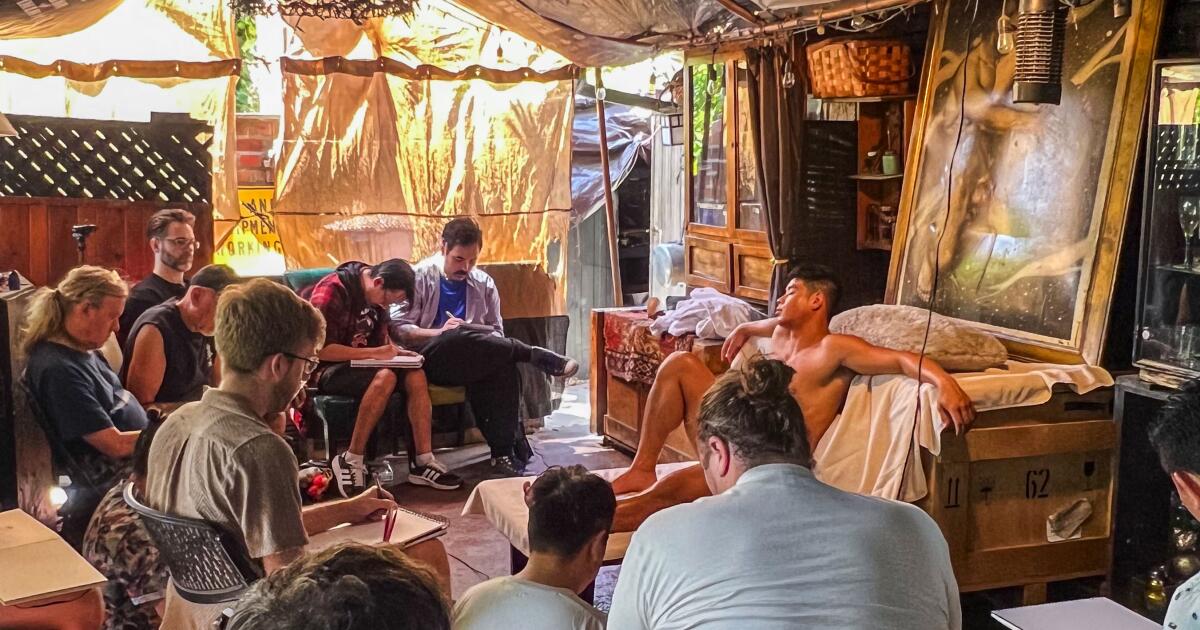
“We’re putting on social, immersive figure drawing events for neurodivergent, queer nerds,” says Jennifer Martina, the producer at Nest of Friends, the nonprofit production company that stages biweekly figure drawing at Geeky Teas & Games in Burbank.
Martina and artist Sketkh Williams, Sketch by Sketkh’s host, provide a welcoming atmosphere across identities, skill levels and nerdy interests, while also playing to their own backgrounds in theater. The sessions feature dramatic lighting, staging and soundtracks, and use professional cosplayers as models. Embodying characters from “Star Wars,” video games, anime and other IP, these pros don’t just dress the part, they take pains to hit their characters’ canonical stances for attendees to capture.
For Martina and Williams, the events are an alternative to nude or more traditional figure drawing sessions. “That just doesn’t interest us,” says Martina. “We’re both theatrical people, so for us part of putting on a show is seeing characters, some cool costume design and a theme.”
• American playwrights, recognizing that identity is more complicated and slippery than ideology, have been shedding fresh light on what it means to be an American. • Writers such as Young Jean Lee, Tarell Alvin McCraney, Quiara Alegría Hudes, Branden Jacobs-Jenkins, Jeremy O. Harris, Ayad Akhtar, and Bess Wohl have been creating drama from the multidimensional, intersectional realities of characters whose backgrounds refuse to be compartmentalized into a single category.
The American democratic experiment stands on shaky ground. Not since the Civil War have these proverbially United States been so disunited. As the nation throws itself a grand old 250th birthday bash in Washington, the mood in much of the country is more funereal than festive.
All-out partisan warfare has sown chaos. Republican legislators, taking their lead from a president who sees half the nation as his personal enemy, have put their own party’s interests over the republic’s. Staying in office has become the only thing that matters. The values imparted to me throughout my public school education — equal opportunity, impartial justice, respect for expertise, basic honesty — have been abandoned by a new breed of politician that has turned governance itself into a blood sport.
Where can one turn for reassurance that America’s best years are still ahead? Would you believe me if I said the theater? I’m not toeing the line for my field. I’m merely calling attention to a development that’s been gaining strength since I first reported on it in 2015. A cohort of playwrights, breathtakingly diverse demographically as well as aesthetically, has been rejuvenating American theater.
These writers aren’t on a sociological mission. They’re not trafficking in grievance or appealing to a particular political base. They let their plays do the talking. And they’ve been trying to have a conversation that isn’t hijacked by the most doctrinaire voices in the room.
From an institutional perspective, the American theater is in bad shape. The triple whammy of the COVID-19 closures, inflation and technological disruption has left everyone hurting. The Mark Taper Forum had to suspend programming for more than a year, smaller companies still in operation are producing fewer shows, and producers everywhere are gravitating toward the bankably familiar.
But despite this difficult terrain, it has been a boom time for American playwriting. For more than a decade, I’ve been teaching a course at the California Institute of the Arts called American Drama Now, and each year the selection of plays has become harder to whittle down. I designed the seminar partly around theater offerings in Los Angeles to connect students to recent developments in the field and to consolidate awareness that something special is happening in the American theater.
The current generation of playwrights has revealed itself to be remarkably resilient and independent. It has had no other choice. By the time many of these rising talents were accruing debt in graduate writing programs, the dream of a sustainable career in the nonprofit theater had already gasped its last breath.
When Wendy Wasserstein, Tony Kushner,Craig Lucas and Jon Robin Baitz emerged in the late 1970s and ’80s, it was still imaginable that a chosen few playwrights could make a living via the regional theater circuit, that constellation of companies founded as an alternative to the Broadway model.
That prospect was growing dimmer a few years later when playwrights such as Suzan-Lori Parks and Lynn Nottage came into prominence. But hope was still alive in the late 1990s and early 2000s. Regional theaters such as Seattle Rep, the Guthrie, the Goodman and Baltimore Center Stage remained committed to their missions while New York nonprofit companies continued to hold the line off-Broadway.
When did the picture change? In 2009, “Outrageous Fortune: The Life and Times of the New American Play” was published by the Theatre Development Fund, and one of the key findings in this study written by Todd London with Ben Pesner and Zannie Giraud Voss is that “there is no way to view playwriting as anything but a profession without an economic base.” A chasm had opened between the network of increasingly corporate-minded nonprofit theaters and the artists this system was built to serve.
The situation has grown bleaker in the last decade and a half as commercial pressures have ramped up and media consolidation and digital shortsightedness have obliterated arts coverage. Yet there’s been an unexpected upside. Theater artists who have come of age in this period have been released from the burden of having to conform to notions of regional theater respectability.
Instead of worrying about the timid taste of subscription audiences, these dramatists have been writing for themselves and their communities, dreaming up plays that don’t have to fit into institutional slots or stay within the staid bounds of traditional proscenium house decorum. The irony is that in not trying to pass muster with more conservative theatergoers (and their fastidious institutional guardians), playwrights have been winning over not just critics but also formerly squeamish artistic directors and perennially nervous Broadway producers.
The politics of identity for them is a lived experience. And as dramatists, they’re uniquely positioned to appreciate the conflicted loyalties and communal tensions of American life in dramatic rather than dogmatic terms. Whatever agendas they may personally espouse, these writers are too alert to the messiness of history and human nature to be rigidly ideological in their work.
The ongoing war between woke and anti-woke factions is a fatuous melodrama best left to the satirists. The goal of playwrights grappling seriously with what it means to be an American today isn’t to score social media points but to shed light on the fractured reality of our collective experience.
Characters in plays by Young Jean Lee, such as “Straight White Men,” are often “trying on masks to see what might prove effective in a given situation.”
(Lawrence K. Ho / Los Angeles Times)
Identity is not a fixed fact but a raucous collision of parts. No single category can contain the Whitmanesque multitudes jockeying for position inside us. Race, religion, ethnicity, gender, age, sexuality, class, disability and geography don’t line up in perfect political harmony, and each social marker tells only a fraction of the whole story. (Money, the great unequalizer, may be the most taboo subject of all.) “We are not only but also,” the sociologist and cultural historian Todd Gitlin wrote in his 1995 book “The Twilight of Common Dreams: Why America Is Wracked by Culture Wars.” We also overlap and often even clash with ourselves.
Discussion around identity can be dangerous. How can anyone be expected to navigate the minefield? Tribalists and traditionalists have controlled the terms of the battle, one by simplifying, the other by denying, the way privilege has shaped our compound selves.
Playwrights know better. They understand the way oppression, which falls disproportionately on the marginalized, has warped all of us. History, whether acknowledged or not, is etched in our souls.
It is a long-held tenet of the theater that the most interesting characters, like the most interesting people, are defined by their schisms and paradoxes. (How else could Hamlet have maintained his centuries-long hold?) Dramatists are more cognizant than ever of the sociopolitical import of these contradictions and they’ve been chronicling the way this historically freighted baggage emerges in the drama of everyday life.
All the world is indeed a stage and all its inhabitants merely stock players, as Jaques lays out in “As You Like It.” Hegel described Shakespeare’s characters as “free artists of their own selves.” The truth where we and our contemporary stage surrogates are concerned is somewhat more constrained. Culture and representation largely determine the range of our performance possibilities.
Plays such as Branden Jacobs-Jenkins’ “Appropriate” reexamine “the canon of great American family dramas … to uncover the stories that have been suppressed.”
(Craig Schwartz)
Jacobs-Jenkins has recognized perhaps more acutely than any of his peers the way dramatic forms have locked us into set scripts about our lives. He tackles genres — adapting a Dion Boucicault melodrama in “An Octoroon,” reexamining the canon of great American family dramas in “Appropriate” — to uncover the stories that have been suppressed in the dominant white middle-class narratives that would prefer not to think of themselves as political.
Lee’s standout identity plays — “Straight White Men,” “The Shipment” and “Songs of the Dragons Flying to Heaven” — reject the illusion of stable, coherent characters propagated by psychological realism. The figures in her uncategorizable works are in experimental flux, trying on masks to see what might prove effective in a given situation. Even “Straight White Men,” which uses the old home-for-the-holidays genre as a springboard, can’t help spinning away from the drama’s droll hyper-naturalism toward something resembling performance art. (Not even straight, white men want to be confined to a box, even a relatively plush one.)
“Fairview,” by Jackie Sibblies Drury, “theatricalizes the experience of the white gaze.”
(Jeff Lorch)
In “Fairview,” Jackie Sibblies Drury theatricalizes the experience of the white gaze, ultimately reversing the comfortable position white theater audiences have traditionally held. Bess Wohl’s “Liberation,” this year’s most decorated play, reanimates the history of the 1970s feminist movement by questioning what it could be leaving out of the picture. “The Balusters,” by David Lindsay-Abaire, brings the current culture wars to the stage with unique sensitivity through the squabbles of a neighborhood association torn between protecting its town’s heritage status and coming to terms with the more pluralistic demands of the 21st century.
“Fairview,” “Liberation,” and “The Balusters” are extremely funny plays that also happen to be deadly serious. If philosophy begins in wonder, trenchant social drama seems to start in laughter.
What do theatergoers want? They don’t just want to look; they also want to be seen. Isn’t that what any of us wants when gazing into the mirror held up to nature, as Hamlet describes the theater? To be granted a more expansive view of ourselves and others?
E pluribus unum, the motto of the United States, is so fundamental that it’s printed on our currency. There’s perhaps no place where the truth of this phrase — out of many, one — is more regularly realized than at the theater, where strangers transform over the course of a show into that mysterious organism we call an audience.
Gitlin ends “The Twilight of Common Dreams” with a plea: “For too long, Americans have busied themselves digging trenches to fortify their cultural borders, lining their trenches with insulation. Enough bunkers! Enough of the perfection of differences! We ought to be building bridges.”
A coalition mindset doesn’t mean denying history or pretending that America has been a level playing field. It’s been anything but in this “melting pot where nothing melted,” to quote the rabbi whose eulogy sets Kushner’s “Angels in America” in motion. But history happens to all of us, not just a select few. And to be an American is to be embroiled in the great democratic experiment that has been defined by division from the beginning. Empathy, the nuclear fusion of playwriting, is expanded when we’re allowed to take in more of our patchwork selves. Today’s dramatists have been extending a generous invitation to their compatriots: We’ll show you our complexity, if you’ll show us yours.
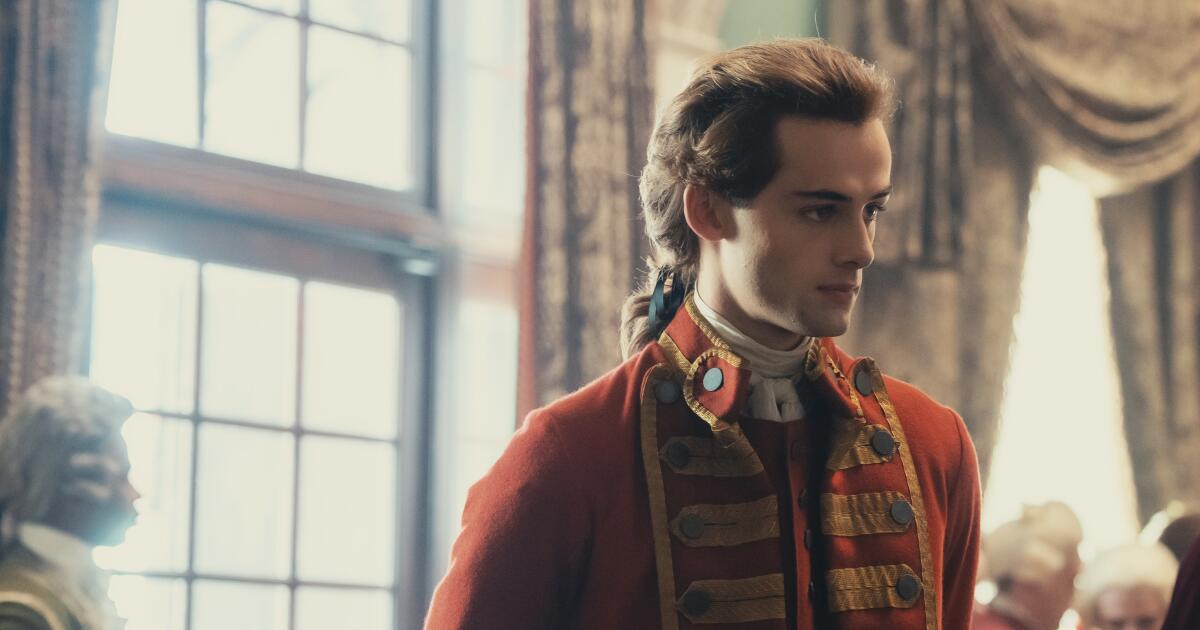
It’s the 250th birthday of the United States of America and how better to celebrate than with a big-screen hagiography of America’s first president, George Washington? “Young Washington” arrives in theaters just in time for the Fourth of July with a chiseled, hot young actor in the lead role and the sheen of a prestige HBO drama, though the result isn’t really big-screen spectacle or appointment television. It feels more like something to be watched on the AV rig in a middle school social studies class. At least there won’t be a quiz at the end.
But there could be, because the plot of “Young Washington” plays out with all the thrill of a textbook chapter. It takes place mostly around 1753-55, at the advent of the French and Indian War. We open in medias res when the 23-year-old Col. Washington (William Franklyn-Miller) lurches from a dysentery-riddled nap directly into battle in the Pennsylvania woods, his battalion on the back foot, surrounded by gore and gunpowder. Another officer describes how dire the situation is while George ponders saving his men and asks, “What could be worth the risk?” Washington steels his gaze and we cut to black. You can almost hear the eagles scream, guitars riff and engines rev.
“Young Washington” is produced and distributed by Angel Studios, the faith-based movie studio that churns out films based on true stories that either feature freak accidents, strange illnesses or, more recently, unique stories from the past in which faith in God is a factor. Apparently, our nation’s founding also falls under this umbrella.
The film is directed by Jon Erwin, one of the in-house Angel Studios mainstays, who also helmed “Jesus Revolution,”“I Still Believe” and “I Can Only Imagine.” Erwin gives the whole project a kind of gritty, visceral approach — very “Game of Thrones” in red coats. It’s violent, muddy, the contrast is high and too many drone shots soar over the forest treetops.
Though it opens with a bang, this 1755 battle framing device gives way to the George origin story, starting with his father’s death 12 years earlier, when the 11-year-old George is bereft that he’ll have to sacrifice his education in order to become a tenant farmer and provide for his family including his mother, Mary (Mary-Louise Parker, doing a bizarre accent).
His older half-brother Lawrence (John Foss) takes him under his wing and teaches him, and the young George grows into a smart, bright, ambitious young man, whose dreams of becoming a British officer are dashed because he doesn’t have formal education, a fortuitous marriage or his own land. But he’s bootstrapped himself into intelligence and with savvy networking and know-how, he becomes indispensable to the British, volunteering as a major to survey land and negotiate treaties with the Native tribes and French army. It’s all a bunch of politicking and petty disputes until it escalates into all-out war thanks to an ill-advised ambush.
Sir Ben Kingsley, Kelsey Grammar (who starred in “Jesus Revolution”) and Andy Serkis play the British officers who begrudgingly, at times, believe in George and his capabilities, though a lot of the film is about a young man getting rebuffed by snobbish British officers.
He’s the kind of character who always makes the noble choice, does and says what’s right, and sees everyone as equals (including enslaved African men and Native American allies). He inspires his brother and others that the world can change and takes inspiration from his mother, who encourages him to continue his path and do it as God’s servant.
Unfortunately, this doesn’t make for a character that’s in any way complex or interesting at all. Franklyn-Miller is certainly pretty, serving as a fine face for this story, but the screenplay (by Erwin, Diederik Hoogstraten and Tom Provost) flattens his character into a basic cookie-cutter hero. Audiences, including the middle school social studies students, deserve better and more nuanced stories about this country and the values it was built upon.
“Young Washington” is propaganda in the form of a history lesson wrapped in a summer blockbuster. If only it were even slightly entertaining — maybe they’ll tackle that in the inevitable sequel.
‘Young Washington’
Rated: PG-13, for sequences of strong war violence and some bloody images
We made it. With just days left in Phase I voting, this week marks the last issue of The Envelope, and the last edition of this letter from the editor, until we return with a crop of newly minted Emmy nominees in August.
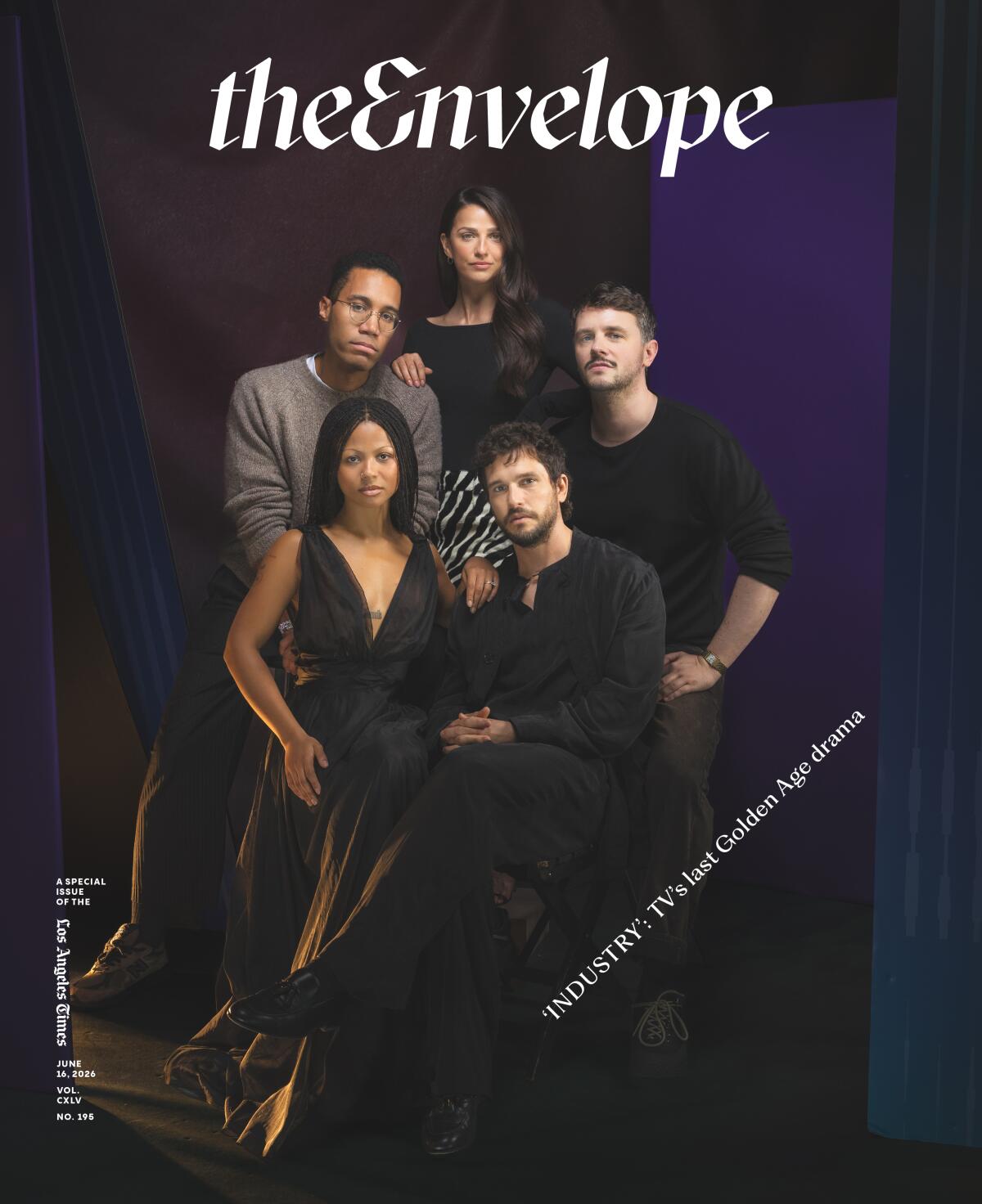
How do “Industry” stars Myha’la and Marisa Abela want the series to end? Let’s just say they are as unsentimental about their characters as series creators Mickey Down and Konrad Kay.
“I want there to be a huge statue of Harper Stern in front of J.P. Morgan,” Myha’la says of her hard-charging trader. “And a bird s— on her arm.”
“In her mouth,” interjects Abela, who plays Harper’s No. 1 frenemy Yasmin Kara-Hanani.
After the laughter ringing through the room subsides, though, Abela does allow for a moment of reverence — for the HBO drama if not for the disreputable people who populate it. “I don’t know if I need Yasmin to be happy at the end of it,” the actor says, reflecting on her character’s emergence as a Ghislaine Maxwell type in the Season 4 finale. “I know I want it to feel worthy of everything that has come before… What I love about the show is that [the writers] don’t often backtrack. You commit to something and then you have to live with the f— fallout. Which is savage.”
Though he joined The Envelope’s 2026 Emmy Writers Roundtable to discuss the return of another beloved comedy, “The Comeback,” we couldn’t resist asking Michael Patrick King about the intense fan reactions to his “Sex and the City” revival “And Just Like That…”
“What happened was, it was really well made, but it wasn’t their Carrie,” he said. “Even though you stand behind it, you go, ‘Wow, that’s a surprise. I thought that they would be interested in 57-year-old women who still hadn’t figured everything out. And instead they wanted them to be 35 and still allowed to be lost.’”
For more juicy tidbits from the minds of of TV’s top writers, be sure to check out the full conversation, which also included Megan Gallagher (“All Her Fault”), Jonathan Glatzer (“The Audacity”), Andrew Guest (“Wonder Man”), Bruce Miller (“The Testaments”) and Sonja Warfield (“The Gilded Age”).
How Connor Hines won over Ryan Murphy
Writer Connor Hines, who translated the real-life relationship between JFK Jr. and Carolyn Bessette into FX’s major hit “Love Story.”
(Evan Mulling / For The Times)
While our On Writing series of screenwriter essays are always revealing — about the inspiration behind a series, the process of adaptation or the making of a major plot turn, to name just a few — I don’t remember one as candid about the art of the pitch as Connor Hines’. In this week’s issue, the writer behind “Love Story: John F. Kennedy Jr. and Carolyn Bessette” explains how he prepared to present his vision for the new anthology’s first season to one of TV’s most powerful producers, Ryan Murphy. As it turns out, landing the meeting is not the (only) hard part.
“I spent roughly three months in the trenches with [producers] Brad [Simpson] and Nina [Jacobson], deepening and refining my presentation [to Murphy] — one that I’d recite in the shower, on runs, at Trader Joe’s, while I drove,” Hines writes. “It was a crash course in storytelling, producing, and understanding the alchemy that propelled so many of Ryan’s shows into the zeitgeist.”
It’s at once a practical and existential question that plagues the two lead chefs in FX’s “The Bear.” He was the emotionally tortured and volatile chef who left behind a rising career in Michelin-starred restaurants to return to Chicago, his hometown, to run his recently deceased brother’s floundering sandwich joint. She was a Culinary Institute of America-trained chef with potential and a steady demeanor seeking mentorship and an opportunity to work with a prodigy. Together, Carmen “Carmy” Berzatto and Sydney “Syd” Adamu — played by Jeremy Allen White and Ayo Edebiri, respectively — transformed the Original Beef of Chicagoland from a hole-in-the-wall into the titular fine-dining establishment.
But now their partnership in the kitchen has come to an end.
Created by Christopher Storer, “The Bear’s” fifth and final season picks up the morning after Syd, Richie (Ebon Moss-Bachrach) and Nat (Abby Elliott) learn Carmy is quitting the food industry and leaving the restaurant in their hands at a make-or-break moment. And the pressure mounts for Syd to decide if she’ll jump ship to pursue another opportunity. The eight-episode season, now streaming in full on Hulu, largely stretches across one day as the restaurant’s debts accumulate, suppliers cut them off and an unrelenting storm floods the kitchen and threatens to upend a night of service the chefs desperately need to have one last shot at survival and one last performance as a team to deliver an improbable turnaround.
In some ways, it’s a journey that mirrors the actors’ own trajectories. Before “The Bear” became a runaway hit, White was best known for his role on Showtime’s long-running dark comedy “Shameless,” while Edebiri primarily worked as a stand-up comedian and writer. Just as their characters have evolved and gained electric momentum in their careers, so have the actors. Both garnered Emmy Awards for their performances on “The Bear,” and they have added a multitude of film and TV credits to their résumés since. Edebiri is currently starring opposite Don Cheadle in the revival of “Proof,” her Broadway debut, while White will be starring this fall as an investigative reporter in Aaron Sorkin’s “The Social Reckoning,” a companion piece to “The Social Network” that chronicles Facebook’s whistleblower scandal.
Over separate video calls from New York, Edebiri and White reflected on “The Bear’s” conclusion and what it means to leave the characters that supercharged their careers behind. Here are edited excerpts from the conversations.
Ayo Edebiri as Sydney Adamu and Jeremy Allen White as Carmen “Carmy” Berzatto in a scene from Season 5 of “The Bear.”
(FX)
After living inside these characters’ skins for so many years, what’s it like to be done playing them?
Edebiri: They keep saying that we’re done, so I guess that really is the thing of it. Obviously I know that it’s over, but even when we were finishing our first seasons, it didn’t matter how much critical acclaim we got because we’re on a show that’s a part of a network that has a deal with the streaming service — there’s all these things that are continually in flux or that you know that you have no control over. As an actor, you’re used to this state of limbo or not totally knowing or being prepared for an ending, so I think I’m not overwhelmed by it, if that makes sense.
White: I don’t know yet. We were very lucky to understand for a long time when the show was going to end and, to a degree, how the show was going to end. It was difficult to see the direction it went — I have strong feelings about Carmy and where he ends up and how his story might continue on. So much of this season, for Carmy, is about a surrender or acceptance of his place in the world and his place in the kitchen, and it’s the first time he’s really been able to get very honest with himself since we’ve met him. And, in doing so, he chooses to leave, and that was hard for me, for Jeremy. Maybe there’s a world in which he tries this and he comes back. I think I had a different understanding for a while of Carmy’s future. I want him to be happy and healed, but it felt like … I don’t know — imagining him outside of a kitchen was hard for me.
I want to unpack that a little bit more. He wants to be happy. But it was interesting to see him wrestle with how his work hinders that — is it the crutch or the salvation? Did you find yourself having an existential moment as Jeremy taking in what Carmy was wrestling with, or have you reckoned with it before?
White: He threw himself into this work, into this world, pretty young in life. And he was really good at it. But a big part of him burying himself has so much to do with his brother, with his family. I was finishing something too. And, yes, of course, I was thinking of goodbyes, and I was thinking of moving on, and new pursuits and all of these things. I was checking in with myself and what it might feel like to just make such a hard turn in life. I thought a lot about what you get back from your work, but I think ultimately, what Carmy and I don’t share is he was causing so much chaos in his work life; it wasn’t just himself that he was punishing at times. It came down to this surrender to an easier way, a softer way, which was to turn it over to Syd, to turn it over to Richie, to turn it over to Tina in the kitchen — that part, I had an easier time understanding.
“The most beautiful thing about their relationship is their true unconditional belief in one another,” says Allen about Sydney and Carmy in “The Bear.”
(David Urbanke / For The Times)
Syd was facing a crossroads: a shiny new job that could take her to the next level or sticking with this seemingly sinking ship that has taken her to the next level, but where she’s felt unappreciated or stifled at times. Ayo, what did you think of the choice she made?
Edebiri: We’re really fortunate to have such amazing writers who thought about her and her journey. [There’s] an awareness of Sydney’s womanhood and Blackness and youth, but I think [they treated] her with the full dignity of just being a human being and getting able to be a complex character in this show and giving her the dignity of being just as flawed as the other characters. [The choice she made] just made sense to me. It made sense in the architecture of the show. It was gratifying to get to build to that with everybody.
The bulk of this final season has the team dealing with this massive storm that’s created a slew of setbacks at a make–or–break moment for the restaurant. It leads to one final symphony in the kitchen together.
White: Those days were beautiful. So much of our show is shot so quickly, but then we really get to slow down with these choreographed pieces of kitchen ballet, and that’s also when we feel really strong as a group of performers, where we’re incredibly reliant on one another, not just for the emotional beats of a scene, but in this very technical aspect as well. I remember going back to Season 1 and filming Episode 7, “The Review,” which was the single-take episode, and just how much camaraderie came from that, and how much respect came from that for everyone — that feeling of real success that we could do this. It’s a really nice thing that happens sometimes on sets, where there is such a nice mirror of what’s going on with the characters and what’s going on with the cast. In this last push, and this team effort, we want these things as the characters, and we want these things as the cast. We want these people to have what they want, what they deserve, so it was really exciting shooting that last episode or two where all those things are coming into place.
Edebiri: That’s Chris’ thing — it’s like a classical piece of music or something; there’s different movements. His own challenge that he puts on himself, and that, in turn, puts on us, is that we’re still in the same piece of music, but everything just has a different feeling. He’d been talking about it since, low-key, Season 3, but definitely started talking about it a little bit more concertedly when we were filming [Season] 4. It was really starting to take shape in his brain. This challenge of having it be in this one day, and how each episode can feel different, was really exciting to him, so in turn, it became exciting to us.
Were you hoping for more runway to chart what the characters were facing?
Edebiri: No, I think it was cool. I was just like, “Yeah, let’s see what it is.” That’s kind of what everything has been with this show. Part of her emotional journey for the last season, what was on a slower track, in a way, there was something also really fun in having the pressure cooker of one day, and everything getting to ramp up and be quite immediate, which I think has been reminiscent of Seasons 1 and 2 in a fun way.
Tina (Liza Colón-Zayas), left, Sydney (Ayo Edebiri), Richie (Ebon Moss-Bachrach) and Carmy (Jeremy Allen White) in “The Bear.” The restaurant faces multiple setbacks, including a storm that causes damage and dwindling supplies.
(FX)
Carmy and Sydney’s dynamic has been so fundamental to the series. These are two people who see something in each other that the other doesn’t. What do you admire about their relationship as friends and as co–workers?
White: The most beautiful thing about their relationship is their true unconditional belief in one another. They see the beautiful things in one another that the other one is not able to witness in themselves. Even though trust has been tested and trust has been broken at times, there is such a loyalty to the best in themselves. They know that they can rely on one another. In a lot of ways, they saved each other. That piece in the opening episode of Season 3, where Carmy gets the call about Mikey and serves the scallop to Syd without ever having met her — there is this invisible tether that was not witnessed by either of them, but it inspired Syd, and whether Carmy knew it or not, this thing was loved and enjoyed by someone that was birthed from this very traumatic moment. There’s just this beautiful, invisible tether that has always existed and will always exist between the two of them.
Edebiri: What I admire about it is the fact that they are able to bring out — through a lot of miscommunication and hard work, but ultimately, I think, with good intentions — the best in each other. They want to see each other be the best versions of themselves.
How is that reflected in your dynamic? Jeremy, who is Ayo as a scene partner and what has she brought out in you as a performer, and vice versa?
White: I was really so lucky to kind of witness Ayo in real time — everybody else had to wait some months to see her on the show. I remember genuinely being struck by her presence, her groundedness. It felt like, if this makes sense, wrong because she was doing it so well. She’s incredibly smart, she’s a wonderful writer, and she’s very skilled improvisationally, and so, in acting with her, there’s something that always makes you feel very in the moment. You can never like relax, in the best way. It’s like you always have to surrender yourself to each moment.
Edebiri: When we first started, I was coming from the comedy world, and he was coming from a much more dramatic world. Our approaches were so different. He has such amazing presence of being and a quiet focus and has such care for the work. He’s a really great leader. There are ideas in society of men in power, and what power held by men has to look like and feel like, and he’s very gentle — especially in the show, which can live so much in the space of chaos and anxiety, having a gentle spirit really helps with filming. He’s so good at making that very clear and helping teach me that as well … I’ve definitely learned from him, without realizing it, ways to protect yourself and protect your peace, and protect also the peace of your co-workers — you get the work done, you be serious about it, but it doesn’t have to be torture.
Edebiri on working with White: “When we first started, I was coming from the comedy world, and he was coming from a much more dramatic world. Our approaches were so different. He has such amazing presence of being and a quiet focus and has such care for the work.”(David Urbanke / For The Times)
What was it like to see them get this thing they’ve been after — not one, but two Michelin stars?
White: Reading that moment —there’s been so much pain and heartache … for years and years and years, and I was just so relieved to see this joyous moment on the page. It felt so, so close to the surface of me already. And we — Jeremy and Ayo — have shared so many insane, joyous moments in our lives since the show. So it felt familiar in the best way. I’m so glad for that moment for both of them — for Carmy and Syd.
Edebiri: We’re shooting it so fast. You always wish you just had more time, and that was one of the last scenes — I think it was the last thing that he and I shot. There’s obviously a bit of a preciousness and emotionality that you’re feeling in that moment, while also tapping into what’s happening to the characters. It’s this thing that, in the brain of myself, we’ve been building to this over five seasons. There’s obviously a somewhat meta reflection of what we’ve gone through — this is just such a crazy journey. But I think at the end of it, especially because of what we know is going to change in their relationship, that in their working proximity, that they are not going to be close, but they know that they were able to do this thing and build this thing together, I think [is] what felt very special, and felt very cool. I hope it’s something that people who have loved the show also feel.
Fans have intense feelings about their relationship, as I’m sure you know. Has it surprised you how strongly people feel about their dynamic?
White: I know that exists. I don’t have too much knowledge on how that all works. It’s funny, I’m very aware of it now because it’s become part of a conversation around the show, but it was nonexistent in our approach to the work. It wasn’t even a thought for either of us. It didn’t occur to us. But I understand it. There is an intimacy, of course, with these two characters. And there is this trust. They lean on each other and they admire each other so much. I’m not like — nobody’s crazy to feel that. There is love there, it’s just not a romantic partnership.
Edebiri: It surprised me the first two [seasons] because I don’t think that that’s what we were doing. Anytime that you say otherwise, I’ve learned [not to]. It’s been hard when doing press, it feels like we get asked specific questions to try to give a specific answer, but the point of art is we make it and we give it. If people are having a response, that’s great, and if I don’t agree with you, I don’t think I’m shutting it down or anything. We made something, then you’re picking something up — that’s the exchange.
White says he knows fans have intense feelings about the relationship between Carmy and Syd. “It’s funny, I’m very aware of it now because it’s become part of a conversation around the show, but it was nonexistent in our approach to the work. It wasn’t even a thought for either of us.”(David Urbanke / For The Times)
Carmy has a few heartfelt conversations this season, but one that really stands out is the one with his mom, played by Jamie Lee Curtis, while revisiting the family home he’s stayed away from for years. He cooks for her. She’s remorseful. Jeremy, what did you think of that moment for Carmy?
White: There’s resistance in it. People like Carmy, you can give them the answer, you can give them the sorry, you can give them the opportunity, and a lot of the times they don’t know what to do with it, or they push it away, or they push it down. What that scene was about, for Carm, was becoming available to even listen. That was the conflict of the scene and the moment. But he was able to eventually get to that acceptance to release some of the resentment, to release some of the anger. Then he is able to show up for her, which was what has been absent. He was able to take it and give her something. It’s been years, if ever, that he’s really been able to do that, to get out of his own way, and be of service in that way to his mother.
Ayo, it was really touching to see Syd naming Tina her chef de cuisine. How did you feel about what that sets up for where Syd and the Bear might be headed with these women as partners in the kitchen?
Edebiri: I loved it. I love getting to work with Liza [Colón-Zayas]. I’ve been so privileged to also be able to direct her — she’s just phenomenal. I think about these two characters, where they started Day 1; Tina was pretending not even to speak English just to stay away from the girl. It was rough from the get-go, but I think both for Liza and I, as two women of color as well, we felt so invested in their relationship and the community they built with each other. There’s something very moving about that to me. Part of the thing for Sydney, she doesn’t know — I think Carmy can see it — that one of her strengths is that they’re different types of leaders. Part of what I think makes Sydney a great leader is that she’s able to delegate and actually remove herself when she knows that she might not be the best in a situation, it might be somebody else.
I haven’t actually seen it. I can’t watch the episodes, but I know when we were filming it, it was both very sweet and very funny. I don’t know if they kept any of the improv from Liza.
You can’t watch because you’re emotional about it or because you just don’t have access?
Edebiri: No, I don’t want to. We were doing all this press and everybody was, “You were so emotional; you wanted to cry, right?” And I’m like, “No, I just don’t want to watch.” I’ll watch it later. The only season that I watched before [it aired], frankly, was 3 and 4 because I had episodes that I made in it. I love the show and I know the show is good. I don’t enjoy watching myself.
I do love that Syd’s ethos in the kitchen is borrowed from “Ratatouille.”
Edebiri: Yes, f—ing rat. It tracks for Sydney.
“I love getting to work with Liza [Colón-Zayas],” says Edebiri about her co-star, whose character is named chef de cuisine. “I’ve been so privileged to also be able to direct her — she’s just phenomenal.”
(FX)
Jeremy, what was your reaction when you read Carmy is in a suit interviewing for an internship at an architectural firm? And what he expresses there?
White: I understand and I’m proud of the courage that it takes [to do a life pivot], but also I tried to play that scene in a way where I didn’t want it to be entirely clear [what happens next]. I wanted the question to be like, “Is this guy still so f— up in the head that he’s trapped regardless of his place in this world, or place of work? Is it a romance that he’s saying goodbye to? Is it a love that he still has, and he’s not quite over yet?” Then I was like, “Do we snap out of that scene and we’re back on the clock?” What is this? I think the goal of the scene is it shouldn’t be all too clear and wrapped up.
What do you think?
White: I could see there’s obviously so much love. There’s love for the people he works with, and there’s love for the paces he’s gone through, but I didn’t know. … I didn’t know if it was a goodbye or an admittance. I think I was trying to find something between him coming clean and being like, you know what, I don’t belong anywhere else or I’m so in love with this thing, but it’s not good for me, and I think it exists somewhere in between that.
Ayo, what was your reaction to Carmy interviewing at the firm?
Edebiri: I was like, “Yeah, that makes sense. This boy’s a noodle.” He’s a fool, he’s ridiculous. It makes sense.
Where do you think he goes from here? Have you thought about it? Do you think he will ever find his way back to the kitchen?
White: I haven’t thought about it too much. I do think there’s something really honest about that direction that Carmy was moving into, but I would hope there’ll always be room for him somewhere in a kitchen.
Edebiri: Syd is like, “You can’t do anything else, brother. Like, what’s the plan?” I don’t know if he takes a break, if he comes back to help her, if he does his own thing.
What do you think happens to the Bear?
Edebiri: I think they do well. It’s not just her; it’s her and Sugar and Richie and Marcus and Tina. She got in it for Carmy, but I think she ended up finding her own voice. I think they keep going, at least for a few more years. I really do.
White: I have to believe that all the pain and suffering and trauma — not only that Carmy has gone through, but that everybody has gone through — is for some greater good. That there is a payoff. My hope is that it would be successful. They’ll have the endurance and the motivation to make it.
For a long time, the lifestyles and foibles of the modest bourgeoisie were a mainstay of art-house cinema, with urbane, upscale audiences happy to turn out to see versions of their own lives depicted on the screen. But more recently, as ideas about what middle age looks like have shifted, along with the changing demographics of viewers, these films have largely disappeared. Which is what makes the seriocomic “The Invite” feel both fresh and something of a throwback — a movie for those who worry about losing their edge.
Directed by Olivia Wilde, “The Invite” was a clear standout when it premiered at the Sundance Film Festival in January and now arrives in theaters as one of the best dramas of the year so far. It feels daring for how it wants to actually examine the emotional costs of contemporary grown-up life, bringing wincing laughs of recognition.
The film begins with married couple Angela and Joe, played by Wilde and Seth Rogen, checking back in at their home in San Francisco at the end of the day. He has been at the teaching job he resents and she has been frantically preparing for the dinner party she may not have told him about. Their daughter is away at a sleepover for the evening and it seems they no longer fully know how to relate to each other. As they bicker and jab, their quiet dissatisfaction with their lives stops being so quiet.
Angela has invited over their neighbors from the apartment upstairs, who they do not know well and who often have loud sex. That couple, Piña and Hawk, played by Penélope Cruz and Edward Norton, seems more assured, self-possessed and adventurous, the kind of people you can absent-mindedly invent stories about, assuming their lives are much cooler than your own.
Things go in ways both expected and unexpected, the two couples warily feeling each other out as they wait to spring their own private agendas. Over the course of the evening, things will be alternately tense, flirty, vulnerable and revelatory as surprisingly little food is eaten. (Other substances get ingested instead.)
An adaptation of Cesc Gay’s 2020 Spanish film “Sentimental,” the screenplay is credited to Rashida Jones and Will McCormack. In an unusual step, the script was further workshopped and developed with the cast during rehearsals. Rogen came up with some of the biggest laugh lines and Norton wrote the deeply earnest monologue he delivers late in the film. (The popular Belgian psychotherapist Esther Perel is also credited as a consultant.)
This American version expands upon the characters more than Gay’s original film while consistently returning to the disappointment of Angela and Joe’s lives in terms both big and small. Neither of them are the people they once thought they might become. Whether two people who are each unhappy can make it as a couple becomes the overriding theme of the film.
This is Wilde’s third movie as a director and it is, by far, her most cohesive and accomplished, both contained and expansive. Her debut, 2019’s charming end-of-high-school tale “Booksmart,” had a throw-everything-at-the-wall quality, as if she wanted to get out every idea and try every trick in case she never got another chance to direct. Wilde’s follow-up, the 2022 psychodrama “Don’t Worry Darling,” became mired in behind-the-scenes gossip and tabloid speculation that overshadowed what was intended as a stylized portrait of female rage and discontent.
Her latest fulfills and exceeds the promise of those earlier movies. Shot on 35mm film by cinematographer Adam Newport-Berra, the action of “The Invite” is almost entirely confined to Angela and Joe’s apartment, which thanks to a recent renovation has plenty of rooms to explore. All four players are exceptional in their roles, playing smartly off their screen personas while exploring the nuances of the characters and their intersecting dynamics.
Wilde’s Angela is expressive and antic; Rogen’s Joe is sullen and snarky. Cruz is alluring and watchful, while Norton turns out to be the film’s secret weapon. He has a low-key comic energy and helps guide the story through a few of its trickier emotional turns. At one point he simply rises from behind a couch and it plays like a punchline.
Skip the next two paragraphs if you want to hold onto the film’s purest pleasures. Those noises from upstairs have been Piña and Hawk hosting group sex parties and they are now cruising Angela and Joe for some extramarital couples’ fun. Here, the movie pivots from passive-aggressive party conversation into farce, as Angela and Joe try to process the idea anyone else might find them desirable, as they have long since given up on seeing themselves in that way.
Wilde in particular lights up during this section, Angela’s mind racing at possibilities she never considered for herself while fumbling over the practicalities of protocols and just how this would work. Before pushing the film into its final forlorn section, the excitement that something sexy might happen charges the actors. It is very likely that streams of Sade’s seductive “By Your Side” will skyrocket.
But the focus stays very much on the struggles of married life. One of the biggest strengths of “The Invite” is the way it keeps evolving as the night progresses so it never feels claustrophobic or repetitive. There is a sense of visual invention and imagination to the film that continues all the way through, such as a moment when Wilde crouches down to check on a doomed soufflé in the oven and addresses the camera directly, looking up as if talking to Rogen. The viewer is frequently placed in an adjacent POV to the different characters, as if you are there in the room too.
The film has a propulsive rhythm to it, a relentlessness, even as Wilde and editors Yorgos Mavropsaridis and Anthony Boys know when to ease off the throttle and take it easy for a bit. The film breathes in a dynamic way, the last few beats taking a startling turn toward a somber wistfulness. The ending is just enigmatic enough to have audiences talking it through as they make their way out of the theater.
The end credits include a handwritten dedication, “For Diane,” a nod to Diane Keaton. The live-wire wit and idiosyncratic verve that she embodied in “Reds” and “Something’s Gotta Give” are very much on display here. Early in the story, Norton dryly notes, “We love a contentious environment.” Thanks to Wilde’s confident direction and the ensemble’s unpredictable performances, audiences will too.
‘The Invite’
Rated: R, for sexual material, language throughout, and drug use
Kara Zor-El (Milly Alcock) can swill an entire sorority’s supply of booze. As a Kryptonian, her hangovers are instantly cured by a yellow sun. And so director Craig Gillespie’s “Supergirl” follows a trail of empty beer bottles to find Superman’s lonely younger cousin marking her birthday on a solo interstellar bender, pounding shots alongside her dog, Krypto.
Unlike sweet-natured Kal-El (David Corenswet), a.k.a. Clark Kent, who escaped Krypton as a baby, this traumatized 20-something bore witness to their home planet’s long and painful extinction. Playing grief like the sandblasted absence of emotion, Alcock’s Supergirl isn’t in the mood for Metropolis do-gooding. She prefers slumming it at extraterrestrial honky-tonks with suitors who look like armadillo-plated slugs. She’s most visibly depressed when she tries to convince herself she’s having fun.
Who doesn’t want to go on a “Star Wars” cantina crawl? The opening stretch of “Supergirl” is great — Alcock even passes out on a toilet with aplomb. Briefly we hope that Gillespie and screenwriter Ana Nogueira are shaking up the superhero format like a bottle of gas-station champagne. I’d love to see Alcock’s heroine in a grotty, silly “Animal House”-style comedy, out-drinking a galaxy of alien squids. But the limits of Hollywood’s imagination squeeze Supergirl to stop partying and start doing some regular old rescuing. Sigh. Someone’s gotta save franchise movies from themselves.
As usual, there’s a tyke in trouble: 13-year-old Ruthye (Eve Ridley), a fellow orphan with a ramrod disposition and a tidy brunet braid that gives away that her character is modeled on Hailee Steinfeld’s vengeful teenager in “True Grit.” Ruthye wants to hunt and kill the creep who murdered her family. Unlike Supergirl, the child thinks it’s healthier to exorcise — not imbibe — one’s heartache. The duo visit an Epstein-island-like planet of kidnapped breeding women where, in one of the script’s subtler sick horrors, the locals imply that pubescent Ruthye is more valuable than aged 23-year-old Supergirl. (Although some of the caged extras appear to be as ancient as 30.) It’s yet another swiped idea, this one from “Mad Max: Fury Road,” for a minor story beat that’s unnecessary. Still, Alcock reacts with exactly the right note of disdain: “Cool,” she croaks. ‘Nuff said.
They’ve come to this cesspool to find the villainous Krem, an unrecognizably vile Matthias Schoenaerts with a mug that’s been pierced all over like he face-planted into a pile of thumbtacks. His biker-scumbag-times-infinity prosthetic design is fantastic, but what makes it genius is that the makeup team allowed a couple of metal studs to fall off Krem’s forehead before his first close-up. You know, for that lived-in barbarian sex trafficker look.
As Ruthye, Ridley’s crisp British elocution is the cleanest thing in the movie, which is shot by Rob Hardy in shades of mustard smog and latrine brown. Neither Supergirl as a babysitter nor Gillespie as a storyteller let the kid carry her share of the action, but I suspect Ridley has the talent for it. She seizes her small opportunities to impress in the film’s second half. Spitting on a baddie, her righteous loogie stings like a moral disinfectant.
Meanwhile, Jason Momoa swaggers into the fray from the cover of an ’80s hard-rock album with Kiss’ makeup, Manowar’s muscles and Meatloaf’s motorcycle. His character, a blue-skinned bounty hunter, only tangentially slots into the plot. Really, Momoa’s massive presence is here to prove that James Gunn was serious when he announced he was hard-resetting DC Comics’ film canon up to 2023’s “Aquaman and the Lost Kingdom.” Momoa as Aquaman is dead. Long live Momoa as Whoever This Guy Is.
Gillespie likes to champion difficult women, from Tonya Harding in “I, Tonya” to the Dalmatian-skinning Disney villain of “Cruella.” Yet as his budgets have mounted, so has the pressure to make his problematic ladies popular with a mass audience. “Supergirl” feels anxious to entertain. The jokes all have the same sense of snarky humor, no matter what species is cracking them. One scene even has a comic slow clap that, in my theater, didn’t get a reaction. The camera and cutting pace refuse to relax. Major set-piece action shots are impossible to follow. You can’t squint past the distracting lens flares.
Alcock’s wildling Supergirl is the one reason to see the film. As in her too-brief role on the “Game of Thrones” prequel “House of the Dragon” and her rollicking cameo at the end of 2025’s “Superman,” the Australian actor is a striking combination of grounded conviction and otherworldly essence, the ideal one-two for a character who plays anti-gravity fetch with her dog. Floating weightless in the stars, her hair unbrushed and bathrobe-like jacket shrugged on, she makes the impossible look casual. (Supergirl’s iconic red-and-blue minidress is so not her style.)
Alas, Krypto the pup is sidelined early on with a whimper, both from him and us. Maybe he’ll get more screen time when the digital animators figure out how to make him look more realistic. (Between the mutt’s anime eyes and that gawky-phony deer in “Disclosure Day,” are CGI creatures getting worse?)
Grief tethers Supergirl to Ruthye, even though they disagree on how to handle it, and it also seems to repel her from Corenswet’s dopey, innocent Clark Kent. There’s rich irony in the personality contrast between the cousins. Her Kryptonian parents raised her to help humanity; his parents intended their son to rule it. But due to twists of fate, she’s the miserable, maladjusted one. The movie has no time to mine the psychology underneath their clash, let alone summon a sniffle for the other pitiful characters who die during this escapade. Perhaps it’s holding that tension back for a sequel, but I’d rather invest in the characters now.
A flashback to Supergirl’s first touchdown on Earth has the awkwardness of a study-abroad student realizing she doesn’t like her host country at all. Despite our planet seeming to have enforced its monoculture on outer space — an extraterrestrial dive bar band even does “The Girl From Ipanema” — Supergirl appreciates little of it besides some product-placement dog treats and, in a forced touch, the pop music on her headphones as well as crammed into the soundtrack next to Claudia Sarne’s gravelly score. I’ll accept this degenerate Supergirl sporting a retro Blondie shirt, but not her willingly choosing to listen to mopey contemporary Earth jams like Rilo Kiley and a twee cover of Jimmy Eat World over, say, Kryptonian death metal.
Still, the production design has imaginatively askew takes on the mundane: gridded jail cells, plodding space buses, clumsy oxygen suits that shimmy on with a satisfying squeak. When Supergirl makes a pit stop at a celestial convenience store, she samples a snack that I’m forced to call poop-corn. If “Supergirl” sells enough of it, hopefully Alcock can rampage again in a more confident sequel that truly cuts loose.
‘Supergirl’
Rated: PG-13, for sequences of strong violence, action, language, and smoking
There’s something delightful about plays about grand divas in crisis.
The prima donna in extremis in Pearl Cleage’s “Angry, Raucous, and Shamelessly Gorgeous,” which is having its Los Angeles premiere at the Geffen Playhouse, has an air of Bette Davis extravagance to her. When Anna Campbell (Charlayne Woodard) struts around her elegant hotel suite in Atlanta, she can’t resist delivering one of Davis’ signature lines: “What a dump!”
She’s not at all dissatisfied with the accommodations. She’s just frustrated that the weather isn’t cooperating with her upcoming outdoor performance and agitated that this might be a bad omen for her big American comeback.
More than 30 years ago, Anna and her manager and trusted companion, Betsy Samson (a formidable Denise Burse), fled to Europe on the heels of a highbrow scandal. Anna made waves when she performed “Naked Wilson,” a protest piece that had her delivering male monologues from August Wilson’s plays while standing stark naked before a divided audience.
The idea was to call attention to the way women have been de-centered in the male canon, but some felt it was sacrilege to subject Wilson’s work to a feminist stunt. Acting opportunities dried up, and Anna high-tailed it to Amsterdam, where her histrionic grandeur was put to good use in European classics.
Charlayne Woodard in “Angry, Raucous, and Shamelessly Gorgeous” at Geffen Playhouse.
(Jeff Lorch)
Woodard brings Anna to life with a smokey voice, a statuesque presence and an arch demeanor. When her arms are in flamboyant motion, she leaves the impression of a seductive windmill that might slice you to bits if you come too close.
The sumptuous production, directed by LaTanya Richardson Jackson with solidarity for Cleage’s characters, provides a marvelous showcase for Woodward to slink around on Beowulf Boritt’s glamorous five-star set in costume designer Emilio Sosa’s inspired Pucci-esque outfits. Her Anna doesn’t do much but give attitude. Ah, but what delicious attitude she gives!
Cleage’s play, it must be said, is hamstrung with exposition. More time is devoted to setting up the dramatic situation than to activating it. Author of “Blues for an Alabama Sky,” a 1995 abortion drama still ahead of its time, Cleage is telling a backstage story that’s clearly close to home. She’s also spinning an intergenerational tale of Black women groping past their initial distrust to a deeper understanding of what they have in common.
The intentions are noble and the themes are handled with admirable complexity, but the writing is sluggish. The plot is like an old car whose engine just refuses to start on a cold winter morning.
Anna has returned to Atlanta to headline a festival that is rebooting her “Naked Wilson” piece. She’s worried about disrobing at her age, but it turns out that she’s only being honored for her work. A much younger and far less experienced performer has been cast in the part that made her a cause célèbre.
Denise Burse, from left, Deborah Joy Winans, Charlayne Woodard and Olivia Washington in “Angry, Raucous, and Shamelessly Gorgeous” at Geffen Playhouse.
(Jeff Lorch)
Precious Watson (Olivia Washington), who goes by Pete, has not only never performed in a Wilson play but she’s never even seen one on stage. She’s a stripper whose only real dramatic experience has come from the adult entertainment industry. (Don’t call her a porn star, not because she’s ashamed of the films she made but because she’s too modest about her screen credits.)
Anna, her hauteur hardening like a protective shell, is aghast. She’s also fearful about her future. She’s run out of money, and this festival was to have launched her return to the U.S.
Betty, whose fate is tied to Anna’s, has been dangling the prospect of a national tour. But when Kate Hughes (an appealingly grounded Deborah Joy Winans), the producer of the festival, hears of this idea, she thinks it’s completely unrealistic.
“I love Anna,” she tells Betty. “ I’m honoring Anna, but there just isn’t an audience for the kind of presentation you’re talking about.”
Time marches on, and one era’s sensational renegade becomes a footnote in the next. But Anna can’t believe that all she holds sacred — study, discipline, seriousness, commitment — is of little value in the social media world.
Deborah Joy Winans, left, and Denise Burse in “Angry, Raucous, and Shamelessly Gorgeous” at Geffen Playhouse.
(Jeff Lorch)
Pete (whom Washington plays with impressive self-possession) doesn’t seem at all bothered about what she doesn’t know. Anna keeps prefacing her remarks with the words “no offense,” but Pete can’t help being offended by her pointed disdain. Their standoff energizes the play, but this jolt of momentum comes a little too late.
“Angry, Raucous, and Shamelessly Gorgeous” is not just the title. It’s also a plot summary. The gorgeous part is the richness of Cleage’s characters, radiantly realized by all four actors under Jackson’s warm direction.
Cleage gives the women plenty of substance, though her novelistic mode — more telling than showing — deprives her drama of style. The elegant staging tries to compensate, but the performers have to rely a little too heavily on their own charms to make up the difference in a play that swerves unexpectedly at the end into a cutesy fairy tale.
‘Angry, Raucous, and Shamelessly Gorgeous’
Where: Gil Cates Theater at Geffen Playhouse, 10886 Le Conte Ave., L.A.
When: 7:30 p.m. Wednesdays-Thursdays, 8 p.m. Fridays, 3 and 8 p.m. Saturdays, 2 and 7 p.m. Sundays. (Check for exceptions.) Ends July 12
Woody, Buzz Lightyear and Jessie will be back at the box office this weekend, delivering what could be the biggest film debut of the year.
Analysts expect the fifth installment of Disney/Pixar’s “Toy Story” franchise will pull in at least $150 million in the U.S. and Canada, with some predicting as much as $175 million — either of which would set a franchise record, topping the nearly $121-million opening of 2019’s “Toy Story 4.”
A strong showing for “Toy Story 5” will further fuel a recovery of the box office this year from the post-pandemic doldrums.
Domestic ticket sales are up over last year, and Roth Capital Partners forecasts the second quarter will climb 6.5% to $2.8 billion — a post-pandemic high.
“Toy Story 5” is the first of several family tentpoles this summer, ahead of Universal and Illumination’s “Minions & Monsters” and Disney’s live-action “Moana.”
“Right now we’re on pace for the best opening of the year,” said Daniel Loria, editorial director at Box Office Co. “This is a performer.”
The timing also is fortuitous for Walt Disney Co. at a moment when its other once-reliable franchises such as “Star Wars” and Marvel have faltered. The recent “Star Wars: The Mandalorian and Grogu” dropped sharply at the domestic box office after its late-May opening, bested by low-budget horror films “Backrooms” and “Obsession.”
“People love these characters from ‘Toy Story,’ ” said Paul Dergarabedian, head of marketplace trends at Comscore. “It’s just as appealing as ever.”
Indeed, across four films and 30 years, “Toy Story” has grossed more than $3 billion worldwide. It is the most-watched franchise on Disney+, with more than 2 billion hours streamed. Woody, Buzz Lightyear and Jessie have spawned 19 theme park rides, four themed lands, two hotels and roughly $1 billion a year in global retail sales.
The production budget for “Toy Story 5” is about $150 million to $200 million. A crew of about 300 people worked on the film at Pixar’s Emeryville, Calif., headquarters.
For Pixar, the reliance on “Toy Story” reflects a shift away from originals that used to be its lifeblood.
February’s “Hoppers” managed a respectable $372 million worldwide, but the surer money now comes from sequels.
“Inside Out 2” grossed nearly $1.7 billion in 2024, and both “Toy Story 4” and “Toy Story 3” crossed $1 billion globally.
Still, the franchise label is no guarantee: The 2022 spin-off “Lightyear” stalled at $226 million worldwide after straying from the formula, recasting Buzz as an actual sci-fi hero — voiced by Chris Evans rather than Tim Allen — and sidelining Woody and the rest of the gang.
“Toy Story 5” stays closer to home but wades into new territory: the explosion of tech in everyday life. The toys must contend with Lilypad, a tablet that captures the attention of their owner, Bonnie — a premise that grew out of a tech-toy character originally written for “Toy Story 4” and scrapped for time. Disney is betting the underlying tension is universal.
“What parent hasn’t had anxiety over tech versus toys with their kids?” said Andrew Cripps, head of theatrical distribution for Walt Disney Studios.
Disney is betting that this universal concern will drive audiences to the film.
The fifth installment also arrives with an unusually high-wattage assist: Taylor Swift wrote and performed an original song, “I Knew It, I Knew You,” and made a surprise appearance at last week’s premiere, performing it after the credits before joining longtime franchise composer Randy Newman for “You’ve Got a Friend in Me.”
“It means the world to me to be a small part of the universe of these films,” Swift told the crowd.
The expected blockbuster opening for “Toy Story 5” would be a full-circle moment for the long-standing franchise; Pixar animators in 1995 hadn’t even considered the possibility of a sequel while working on the first “Toy Story.”
“There was so much learned on that first film, specifically our iterative process,” Pixar Chief Creative Officer Pete Docter said in a phone call last week from Madrid, shortly before the film’s Spain premiere. “A lot of things that we discovered having worked on that film have just continued to inform every movie that we make.”
“Toy Story” revolutionized the movie business as the first computer-animated feature film. But its enduring appeal was in the bonds between the characters, Docter said.
Docter, who supervised animators and helped with character design and writing on the original “Toy Story,” added: “It certainly had some new technology, but it was really up to the story and characters to carry the audience.”
The franchise’s longevity is also due to its ability to capture generations of fans.
“Having parents now that say, ‘I grew up with “Toy Story,” and now I’m showing my kids,’ has been really gratifying,” Docter said.
A VHS tape of 1993’s “The Nightmare Before Christmas” introduced brothers Roy and Arturo Ambriz to the tactile whimsy of stop-motion, an animation technique where physical objects are manipulated and photographed frame by frame to achieve the illusion of life.
Realizing that the characters on screen were figures in real sets shocked the Mexican filmmakers’ young minds and set them on an arduous path to craft their own worlds.
“If there’s something we’ve loved our whole lives it’s toys: collecting them, modifying them, playing with them, creating dioramas for them,” said Roy, 36, from under his dark shades during a recent interview at Netflix Animation Studios in Burbank.
“And for us, the most sublime moments in life are when we’re doing something artistic, whether that’s painting, drawing or sculpting. And stop-motion animation combines all of that.”
The culmination of years of tireless work and financial stress for the Ambriz siblings is the breathtaking period fantasy “I Am Frankelda,” Mexico’s first-ever stop-motion feature, which is now streaming on Netflix.
“Thankfully, no one put it into our heads that it was impossible to do this,” said Arturo, 38. “That’s why we don’t like going around saying that this is extremely difficult, because maybe if young people hear that, they might not want to do stop-motion. Don’t tell them!”
A lavish musical, “I Am Frankelda” follows Francisca Imelda (voiced by Mireya Mendoza), a young aspiring writer living in 19th century Mexico and struggling to publish her stories. Meanwhile, in the Realm of Spooks, an alternative reality that’s home to all of the fictional characters Francisca has written, Herneval (Juan Pablo Monterrubio), a winged prince, must save his parents and his kingdom. The creatures in this world live off of human fear, so they create our nightmares.
Herneval crosses into the human world to bring Francisca with him to the Realm of Spooks, so that she can write new nightmares that actually scare people. Humans have become difficult to terrify. By this point, a frustrated Francisca has decided to change her name to Frankelda (a reference to “Frankenstein” author Mary Shelley, who inspired the character). Frankelda and Herneval sing of the relationship between fiction and reality. One can’t exist without the other.
Frankelda was first introduced as part of the 2021 series “Frankelda’s Book of Spooks,” which HBO Max commissioned. In the show, the heroine shares nightmarish tales alongside Herneval, who appears not as a prince but a sentient book. The film “I Am Frankelda” is a prequel that explains the relationship between these characters.
Last month, “I Am Frankelda” screened at the Los Angeles Latino International Film Festival, where Guillermo del Toro moderated the post-screening Q&A. A longtime mentor of the Ambriz brothers, Del Toro first supported them by donating to a Kickstarter campaign to finance their ambitious 2016 short film inspired by cubist art, “Revoltoso,” about a one-eyed boar living during the Mexican Revolution.
“In that moment, it was incredibly validating to realize that if Guillermo liked what we were doing, then it made sense to keep on doing it,” Roy said.
Two years apart in age, Roy and Arturo both studied filmmaking at the Centro, a university in Mexico City. Yet directing together wasn’t always the plan.
“I said, ‘We have to co-direct,’ because the situation naturally lent itself for me, being the older one, to take on the role of director while Roy would serve as production designer. But at a certain point, I realized that the hierarchy was wrong, and that if we wanted something sustainable for the rest of our lives, it had to be a 50/50 split between us. And I mean, 50/50, Roy!” said Arturo, playfully chastising his younger brother.
“It’s more like 60/40, with me having 60% of the power,” Roy added laughing.
In 2011, not long after graduating, Arturo found himself ridden with anxiety. Over the course of his education, he’d focused on artistic excellence but hadn’t much thought about how to actually make a living out of his and his brother’s shared passion. That’s when he decided they should create their own studio, Cinema Fantasma, so as to have control of the projects they took on. Their productions for hire include the Adult Swim show “Women Wearing Shoulder Pads,” which was produced entirely at their company in Mexico City.
“It’s been very difficult because we are filmmakers by vocation, but we are businesspeople by necessity,” said Arturo. “Developing that side of things has been the hardest part, but both are indispensable.”
To wrap up the “Frankelda” series, HBO Max requested a 30-minute special. Instead of accepting that offer, Roy suggested they use the proposed budget allocated to partially fund a full-length feature film. HBO Max agreed with the caveat that the brothers would have to come up with the rest of the money needed on their own.
To finance “I Am Frankelda,” Roy and Arturo mortgaged two homes. They are losing one of them to pay off their debts, so it helps that their dream of animation is a family affair. Their parents are executive producers on “Frankelda”; Roy’s wife, Ana Coronilla, worked as production designer; and Arturo’s spouse, Irene Melis, as a director of photography.
That “I Am Frankelda” is a musical is due in great part to Roy’s love of musical theater.
“At first, Arturo wasn’t sure, but using my 60% share of the power, I convinced him that it should be a musical,” Roy said. Yet it’s Arturo who wrote the lyrics to musical numbers. Each track starts as a poem that composer Kevin Smithers transformed into songs.
A fantastical stop-motion musical period piece, “I Am Frankelda” is far from an easy sell, and that’s what makes its existence all the more astonishing. The Ambriz brothers’ creative pursuit of the unpopular and the unfeasible has bonded them with Del Toro.
Mexican filmmaker Guillermo del Toro, pictured, interviewed “I Am Frankelda” directors Roy and Arturo Ambriz on May 30 during the film’s screening at the TCL Chinese Theatre as part of the Los Angeles Latino International Film Festival.
(Jill Connelly / For De Los)
“He is our most important mentor and the person we admire most in the world, and we also share many of the same interests,” Arturo explained. “That’s why when we saw ‘Pan’s Labyrinth,’ it was like when the glass slipper fits Cinderella. It was exactly what we loved: monsters, war, the cruelty of the human spirit, fairies and period settings.”
“Did you just call yourself Cinderella?” Roy interjected with the mischievous smirk typical of a younger brother trying to ruffle some feathers.
“Yes!” Arturo said quietly but without hesitation.
Every time they hear Del Toro speak about his interests, the Ambriz brothers discover a new well of references and “cultural protein,” from authors to painters.
“Guillermo is someone who actively champions the work of others, which I believe is the right way for an artist to be,” Arturo said.
When they finished “I Am Frankelda,” the brothers sent it to Del Toro, eager to hear his thoughts. As soon as he watched it, Del Toro called them.
“We spoke with him for hours, and he told us everything he saw, obviously with great tact, sharing both the good and the not-so-good,” Roy recalled. “But most importantly, he kept telling us that we had created something unprecedented. He insisted that we would pull through, even though we had ended up with a lot of debt.”
The version of “I Am Frankelda” that premiered at film festivals in 2025 is not the same one that will be available on Netflix. Based on Del Toro’s thorough feedback, the filmmakers recut the film and even animated new scenes. They playfully refer to this new cut that audiences will see globally as “The Grandfather Cut,” to honor Del Toro’s influence.
That “I Am Frankelda” was picked for distribution by Netflix is also Del Toro’s doing, the brothers said. It was the veteran director who suggested the film to the streaming company.
“I Am Frankelda” debuted in Mexico last October to an incredible reception, in part thanks to the fandom the characters had amassed via the episodic series.
“We receive fan art and fan fiction every day. People send us photos cosplaying the characters or of their ‘Frankelda’-themed quinceañeras. We’ve even bought bootleg merch at Mexican markets and on Temu or AliExpress too,” Roy said.
“We’ve bought ‘Frankelda’ socks from there that are of terrible quality, but all the more beautiful because of their bad quality,” he added.
“Of course, there are haters, too, but a large segment of the audience really identified with Frankelda as someone who perseveres, as someone who refuses to let her detractors hold her back. It’s been really beautiful watching that fandom grow,” Arturo said.
Another conviction where they align with Del Toro is their disinterest in engaging with artificial intelligence.
“AI is the antithesis of stop-motion. We’re not even remotely interested in it, because we do stop-motion to enjoy the artistic processes,” Roy said. “We created the studio for painting, drawing, sculpting and writing. Whatever happens with AI doesn’t really matter to us.”
Their second feature, “The Ballad of the Phoenix,” a medieval fantasy, is already in the works.
Few people do simmering panic as nimbly as Sarah Goldberg.
In her role as Dr. JoAnne Felder, a performance psychologist tending to the mercurial psyches of the billionaire man-children of Silicon Valley on the new AMC satire “The Audacity,” Goldberg careens from serene to slapstick as she tries to keep a lid on her increasingly unruly life.
It is the latest in a string of enviably layered characters for the Vancouver native, including her Emmy-nominated breakout turn as aspiring actor Sally Reed on the HBO contract killer dramedy “Barry” and the coolly calculating portfolio manager Petra Koenig on the network’s drama “Industry.”
“I’m definitely learning some large tech and finance words that I didn’t know,” she says with a laugh about her recent wealth-adjacent roles on a Zoom from London, where she makes her home. “I’m not sure if I’ll retain them.”
Given the accolades, it seems likely Goldberg only needs to memorize her lines and the rest will follow.
While she has given a distinctive performance in each of her roles, one of several threads tying the characters together is a moment when fear, rage, excitement, ambition or all of the above collide but must be contained. While that discipline sometimes devolves into delicious displays of apoplexy — witness Goldberg’s incredible, expletive-littered elevator meltdown in “Barry” — the 40-year-old actor is more often the face of diplomacy while telegraphing cortisol levels in the red beneath her placid exterior.
“As a blond Canadian, I really ran the risk of being the girl next door,” she says of her attempt to dodge typecasting onscreen after cutting her teeth onstage in London and New York in the mid-2010s. “I didn’t want to be the girl next door … maybe the girl next door with bodies in the basement.”
While the only bodies to be found in JoAnne’s basement on “The Audacity” are her eavesdropping son and his friends, the London Academy of Music & Dramatic Art (LAMDA) graduate has accomplished the mission of subverting what might have been a perky ingenue image with the role. (One she will continue, since the series has already gotten a Season 2 order.)
When the ethically challenged therapist starts dabbling in insider trading thanks to info gleaned from her patients — including bold tech names Duncan Park (Billy Magnussen) and Carl Bardolph (Zach Galifianakis) — the slippery slope awaits.
Goldberg with “The Audacity” co-star Billy Magnussen.
(Ed Araquel / AMC)
“I think that she started her career with a desire to help people and somewhere along the line she’s become incredibly jaded and she’s exhausted by being the most intelligent person in the room and yet having no material wealth to show for it,” says Goldberg of her character, whose struggles extend to motherhood of son Orson (Everett Blunck) and marriage to child psychologist Gary (Paul Adelstein).
It does not help that JoAnne is surrounded by people who have no trouble sliding headfirst down the slope as if it were an Aspen trail.
“She’s working with people who have so many houses that if one burns down, it doesn’t matter, and yet she’s struggling to keep the roof over her own head. So somewhere along the line she starts making these little contracts with herself thinking, ‘In this sea of moral bankruptcy, is my tiny little transgression really so bad? Or is it even justified?’ But these little small pacts start to snowball. You can see somebody torn between their better judgment, their core instinct, their humanity, and someone who is so frustrated that they’re stepping toward a kind of nihilism.”
That sense of inner conflict appeals to Goldberg, who says she knew instantly that she had to play JoAnne when she read the script by showrunner Jonathan Glatzer. “It’s rare for me to go out and be like, ‘I have to play this role!’” she says, adding with a laugh, “I can be quite passive. I can be quite Canadian in the American market. I felt like he’d found this incredible line of satire with pathos, which is my favorite kind of style.
“I’m always interested in playing characters on the precipice of losing their moral compass and which way they decide to go,” she continues. “And if JoAnne has anything in common with Sally from ‘Barry,’ because they’re such different characters, it’s that. … I love that Jonathan’s given JoAnne very mundane relatable problems in a world where the scale is so off and there’s a lot that the average person can’t relate to in that bubble.”
Goldberg has also been busy creating her own bubble, writing, producing and starring in the Canadian-Irish series “Sisters” — which just concluded its second season on AMC — with Irish actor Susan Stanley, her best friend since their LAMDA days. The odd couple sibling comedy finds Goldberg playing Sare, a buttoned-down Canadian who goes to Ireland to find her long-lost biological father (Donal Logue) and discovers shambolic half-sister Suze (Stanley).
“I was pretty shocked at how hard it is to get something made,” she says of the series’ six-year journey to screen. “And then to be in a leadership position where you’re inviting everyone to dinner and you’ve got to make sure there are three courses and being responsible for everybody’s well-being — it was wildly challenging, but absolutely thrilling.”
While she prepares to return to JoAnne’s world in Palo Alto — her hometown of Vancouver serving as a double — Goldberg feels very fortunate about where she’s landed.
“I’ve been so lucky at this stage in my career to work on scripts that I feel are really saying something and characters that I feel are morally complex and also to be in the business at a time where female characters are more complicated.”
David Baerwald holds up his most precious possession so that it’s visible on our video conference: a very old violin in a very old, battered case.
Baerwald, an award-winning musician, film composer and songwriter who called Los Angeles home for nearly four decades, doesn’t play the violin. During his years with the Tuesday Music Club (immortalized in the Sheryl Crow album “Tuesday Night Music Club”), he played guitar. But the violin belonged to his grandfather Ernst Baerwald — and it plays an important role in his recently published debut novel, “The Fire Agent.”
Not every successful artist turns to a new medium at age 65 or moves to the opposite coast (Baerwald now lives in Kingston, N.Y.). Then again, not every artist has a family history quite like Baerwald’s, one that includes Germany and Japan, two world wars, a 1920s throuple and Beethoven’s Ninth.
On the Shelf
The Fire Agent
By David Baerwald Spiegel & Grau: 624 pages, $32
If you buy books linked on our site, The Times may earn a commission from Bookshop.org, whose fees support independent bookstores.
The violin in Baerwald’s hands was the one his German-Jewish grandfather played as a Japanese prisoner of war in the Bandō camp at Tokushima during World War I. “It’s a very serviceable violin,” Baerwald notes. “A friend of mine played it for some years in the Long Beach Symphony. When my grandfather was older and wealthy, he bought a better violin, which was lost in a fire. But this is the one that matters.”
It matters because Ernst Baerwald was a founding member of a German POW orchestra that chose Beethoven’s great symphony as their premiere work — a performance so moving that it began a Japanese tradition marking the December holidays that persist to this day. Baerwald’s grandfather not only kept his violin throughout the war in which he fought; when he defected from the Third Reich in 1941, he placed it in an oiled bag and brought it with him via an oceanic escape.
Ernst Baerwald’s odyssey from a cushy childhood in Frankfurt to his final days in a beautiful Berkeley mansion, with a long sojourn in Tokyo along the way, reads like, well, a novel. Sent to an elite boys’ prep school in Germany, then on to a seriously disciplined Milanese dojo where he was trained by a Japanese sensei, Ernst was a prisoner in Japan for four years during World War I.
Those details might have been easy to find, but it wasn’t until David Baerwald went to clear out his parents’ house in Brentwood that he discovered papers showing that his grandfather had not only been the head of the Tokyo office of I.G. Farben, but that he had given a major speech to the nascent Office of Strategic Services (precursor to the Central Intelligence Agency) in 1943 that laid out the plan for the firebombing of Japan.
For the record:
10:56 a.m. June 8, 2026An earlier version of this story said Ernst Baerwald’s 1943 speech to the OSS urged use of the atomic bomb on Japan. It laid out the plan for the firebombing of Japan. It also said Kurt Baerwald joined the CIA. He joined the U.S. Army.
He also urged them not to allow partnerships between large corporations and the military, the way the German scientific community and government did with I.G. Farben and Krupp Armaments and Steel. “Any business that makes peace with Fascism will become Fascist,” he said. “And once Fascism captures economic control, then a Fascist coup will inevitably follow to seize political power. Germany, Italy, Rumania, Japan, Spain the story is the same. We cannot allow it to become the story of America.”
When Baerwald read that, “I was really alarmed, in the moment,” he says, realizing how closely tied his grandfather had been to the bombs dropped on Hiroshima and Nagasaki. “But it gave me a plan.” He wanted to show how deeply his grandfather had become integrated into Japanese culture.
“One of my characters tells Ernst that he has ‘yuyo,’ which might best be described as grace,” says Baerwald. “Its Japanese meaning is closer to the state of a river rock that has been washed over and tumbled thousands of times, so that it’s both distinct, and a meaningful part of its environment.” To some extent, the author understands “yuyo” personally, having lived in Japan and been educated at its International School until age 12, when his family moved back to California, “although I wouldn’t claim it for myself,” he says.
That move, in the early 1970s, may have led to his career in music. “When we got back to the States, I was extremely troubled. Call me a fish out of water, I guess. I went through a period of voluntary mutism — I think they call it selective communication. I didn’t talk to anyone, especially not to my family. My hearing would sort of come and go at will, too.” His mother understood he seemed to like his sister’s acoustic guitar, so she suggested he take some lessons. “At the time, it wasn’t at all a career path, it was a way of reassembling my brain so that I could cope with the reality I was experiencing, finding a way to communicate again.”
Part of what he was experiencing, which he knows a great deal more about now, was feeling “the secrets that were the engine propelling my family.” After Ernst’s long career of service and deception, David Baerwald’s father, Kurt, entered the U.S. Army during WWII and later became a professor of Japanese studies at both in Japan and at UCLA. The effects on their family of five still reverberate. Baerwald’s mother eventually became a clinical psychologist who specializes in trauma. “I had to separate myself completely from my family in order to survive,” he says.
However, what stalled the writing of this first novel were the two decades he initially left out, which included Ernst, Lina and their lover Chizuko being a ménage à trois in a 1923 Tokyo dealing with the aftermath of an earthquake and wildfires.
Although “The Fire Agent” is based on Ernst’s history, not all of the facts are congruent. The wrestling coach at the American school in Tokyo, Ernst’s glamorous courtesan Chizuko, and many of the characters are composites. Speaking of that courtesan, Baerwald says it’s true that his grandfather and grandmother cohabited with a Japanese woman for many years, even after Lina and Ernst had a child together. “I found so many letters between my grandfather and my grandmother and I think they truly loved each other, and I think they truly loved that woman, too.”
That didn’t make it easy for Baerwald to write about that love. “My German grandmother, on whom Lina is partly based, was terrifying,” he says. “It was easier to write about her sex life with my grandfather and their Japanese lover by creating composite characters.”
He didn’t want to leave out their sex life, though, or that of others.
“Every generation of young people thinks they invented sex, right? But nothing is new — and it never gets old. Here’s an example. One of my godfathers, Sam Jameson, was the L.A. Times bureau chief in Tokyo for decades. He was also the doyenne, if you will, of the cross-dressing community in that city. It was this rich world he was a part of that nobody knew anything about. I based the character I call Bünheimer on him.”
Some of the worlds Baerwald has uncovered through his family’s papers are rich and sensual; others, like the POW camp where Ernst was held and the speech he gave to the OSS analysts at the Presidio in the 1940s, are stark and terrible. While he renders all appropriately, he’s aware that his perspective remains that of a white Western man. How did he gain the courage to write about people of other races, cultures and genders? He says it comes from something he did when he was on a swim team in high school. “The psychological trick I would play on myself at each meet was to imagine the water I’d dive into was freezing cold,” he says. “And of course it wasn’t. Which was such a relief and kept me going.”
Like his grandfather’s beloved violin, Baerwald has taken a deep dive into previously unknown waters — and survived. As he works on his second novel, he’s better prepared for airing family secrets and the publishing world. Ever the musician, he likens his first round with it to a Shepard tone, the auditory illusion that can make listeners feel like two notes one octave apart are constantly ascending or descending in pitch (Baerwald has worked with famed composer Hans Zimmer, who used the tone in, for example, “The Dark Knight”).
“A Shepard tone can make you feel like you’re flying. Or sinking,” he says. “At this point in my life and art, I prefer to have my feet firmly on the ground.”