Weekly insights and analysis on the latest developments in military technology, strategy, and foreign policy.
Here’s TWZ’s weekly carrier tracker monitoring America’s flattop fleet, including deployed Carrier Strike Groups (CSG) and Amphibious Ready Groups (ARG), using publicly available open-source information. Check out last week’s report here.
USS George Washington dropped anchor off the coast of Da Nang, Vietnam, on July 30, beginning a five-day port call. The carrier entered the South China Sea the prior week and conducted operations southwest of Luzon, Philippines, from July 24 to 28. This marks the fourth time a U.S. aircraft carrier has visited the country since normalizing relations in 1995 and the first time since 2023. The crew aboard GeorgeWashington welcomed the local community, hosting public tours and participating in local events. Guided-missile cruiser USS Robert Smalls and destroyer USS Shoup also arrived alongside the flattop.
“While our ship represents the high-end capabilities of the U.S. Navy, our visit here to Vietnam supports a U.S.-Vietnam relationship that continues to grow stronger across an increasingly broad range of subjects, reflecting our shared interest in a free and open Indo-Pacific,” the commanding officer of George Washington, Capt. Nicholas DeLeo, said. “Our Sailors are excited to step ashore, learn about Vietnam’s rich culture, and work side-by-side with the community here in Da Nang. It is through these personal connections that we build the trust necessary for a peaceful and prosperous region.”
USS George Washington (CVN 73) pulls into Da Nang, Vietnam, for a scheduled port visit, July 30, 2026. U.S. Navy photo by Mass Communication Specialist 3rd Class Juan Cordova. Seaman Juan Cordova
The Theodore Roosevelt CSG returned to Pearl Harbor, Hawaii, on July 28, after completing the at-sea phase of exercise Rim of the Pacific (RIMPAC) 2026. The large-scale exercise, which successfully concluded on July 31, brought 30 nations, 30,000 personnel, 30 surface ships, five submarines, and nearly 200 aircraft together to execute 2,400 sorties and respond to 5,000 scenario-based operational problem sets.
“No single nation can ensure security in the Pacific alone,” the commander of the RIMPAC Combined Task Force, Vice Adm. Jeff Jablon, said. “The network of allies and partners in the region is an asymmetric advantage. The work participating nations do at RIMPAC builds the combined and joint ability to deter conflict and supports all nations in exercising their sovereign rights and freedoms in the maritime domain.”
USS TheodoreRoosevelt departed Pearl Harbor over the weekend and will head back to San Diego before deploying, likely to replace the Abraham Lincoln CSG in the Middle East, depending on how negotiations with Iran play out in the near term. Less than two weeks remain on the 60-day timetable initially agreed upon in the Memorandum of Understanding signed by both countries on June 17.
USS Theodore Roosevelt (CVN 71) passes the USS Arizona Memorial while departing Joint Base Pearl Harbor-Hickam, Aug. 1, 2026. U.S. Navy photo by Mass Communication Specialist 3rd Class Alexia Mezick. Seaman Alexia Mezick
In the Middle East, U.S. forces, led by USS Abraham Lincoln and USS George H.W. Bush, “continue to strictly enforce the U.S. blockade against Iran,” U.S. Central Command (CENTCOM) posted on X this morning. To date, CENTCOM has redirected 44 commercial vessels, disabled two by force, and boarded another two to ensure compliance. The pace of redirections is ramping up, with more vessels turned around in the past week (27) than in the first two combined (17). In audio released with the update, dock landing ship USS Comstock, part of the three-ship Boxer ARG – the only amphibious group in the region – issued a simple warning: “If you do not comply, we will compel compliance with force.”
Sailors conduct flight operations aboard USS George H.W. Bush (CVN 77), July 29, 2026. U.S. Navy photo. Seaman Apprentice Lucas Krug
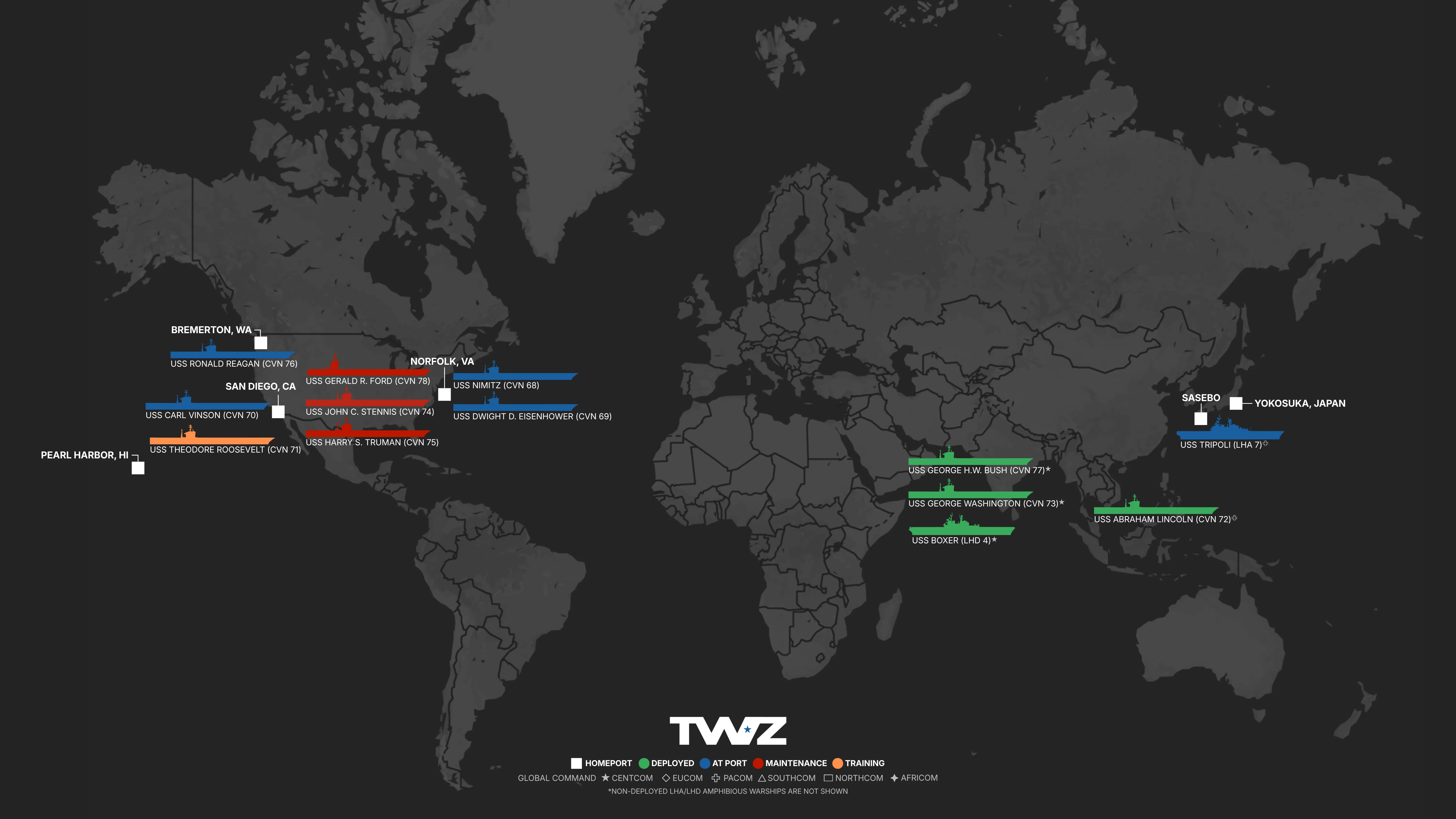
Overall, three U.S. carriers are deployed, three are working up or at homeport in various states of readiness, four are in maintenance, and one is being used for training. One amphibious ready group is deployed, five are training or in port, and three are in maintenance availabilities.
Note: Positions are general approximations. Non-deployed LHA/LHD amphibious warships are not shown.
Contact the author: ian.ellis-jones@teamrecurrent.io
Weekly insights and analysis on the latest developments in military technology, strategy, and foreign policy.
Here’s TWZ’s weekly carrier tracker monitoring America’s flattop fleet, including deployed Carrier Strike Groups (CSG) and Amphibious Ready Groups (ARG), using publicly available open-source information. Check out last week’s report here.
While the American airstrike campaign may be on pause, the rebooted naval blockade remains in full effect, as the second week comes to a close. In an update posted Monday morning, U.S. Central Command (CENTCOM) announced that it has redirected 17 commercial vessels, disabled two kinetically, and boarded another two “to ensure compliance” since reinstating the blockade on July 14. Both carriers deployed to the CENTCOM area of responsibility (AOR), USS Abraham Lincoln and USS George H.W. Bush, remain on station “to support maritime security and stability in the Middle East.”
An EA-18G Growler on the flight deck of USS George H.W. Bush (CVN 77). U.S. Navy photo NAVCENT Public Affairs
In the U.S. Pacific Command (PACOM) AOR, USS George Washingtontransited the Luzon Strait westbound and entered the South China Sea on July 22, escorted by guided-missile cruiser USS Robert Smalls and destroyers USS Benfold and USS Shoup. Washington’s repositioning comes on the heels of a serious incident last week between the Philippine Navy and China Coast Guard at Second Thomas Shoal, resulting in the medical evacuation of a Filipino Navy SEAL. “The melee marked the most severe incident between Beijing and Manila to date. It was the first time the two forces directly engaged each other beyond rammings, water cannon blasts and other coercive activities,” USNI Newsreported. A U.S. Coast Guard cutter was also on scene to provide support.
The U.S. Ambassador to the Philippines, Lee Lipton, acknowledged the arrival over the weekend, writing on X, “The USS George Washington Carrier Strike Group’s advanced capabilities, including the F-35, are upholding FREEDOM of Navigation and Overflight in the South China Sea. We challenge excessive maritime claims around the world.”
USS George Washington (CVN 73) transits the Luzon Strait, July 22, 2026. U.S. Navy photo by Seaman Apprentice Anthony Vilardi
USS Theodore Roosevelt, also underway in the Pacific, led a massive group sail as part of the final stages of exercise Rim of the Pacific (RIMPAC) 2026. The ongoing RIMPAC 2026, which we have covered in previousreports, is set to wrap up at the end of the month. The group sail and photo exercise (PHOTOEX) took place on July 22 approximately 100 nautical miles northeast of Kauai, Hawaii, according to public AIS data, with more than 20 American and allied warships participating in the show of force.
USS Theodore Roosevelt (CVN 71) leads a group sail in the Pacific Ocean off the coast of Hawaii during Exercise Rim of the Pacific 2026. Commander, U.S. 3rd Fleet
Back stateside, USS Dwight D. Eisenhower departed Naval Station Norfolk on July 22 to conduct an ammunition onload with USNS Medgar Evers. MH-60S Seahawks, attached to the “Dragonslayers” of Helicopter Sea Combat Squadron (HSC) 11, were spotted transporting ammunition while operating in the Atlantic Ocean. The flattop returned to homeport yesterday.
An MH-60S Seahawk transports ammunition aboard USS Dwight D. Eisenhower (CVN 69). U.S. Navy photo by Petty Officer 2nd Class Miguel Santiago
Amphibious assault ship USS Tripolireturned to Sasebo, Japan, over the weekend, completing a more than six-month deployment to the CENTCOM and PACOM AORs. Tripolistopped at White Beach Naval Facility in Okinawa last week to disembark elements of the 31st Marine Expeditionary Unit (MEU) before heading back to Sasebo. USS Boxer, flagship of the sole ARG now deployed in the Middle East (and around the globe), conducted a vertical replenishment with USNS Carl Brashear on July 20.
USS Tripoli (LHA 7) arrives at White Beach Naval Facility, Okinawa, after concluding a six-month deployment. U.S. Marine Corps photo by Lance Cpl. Eadan Avramidis
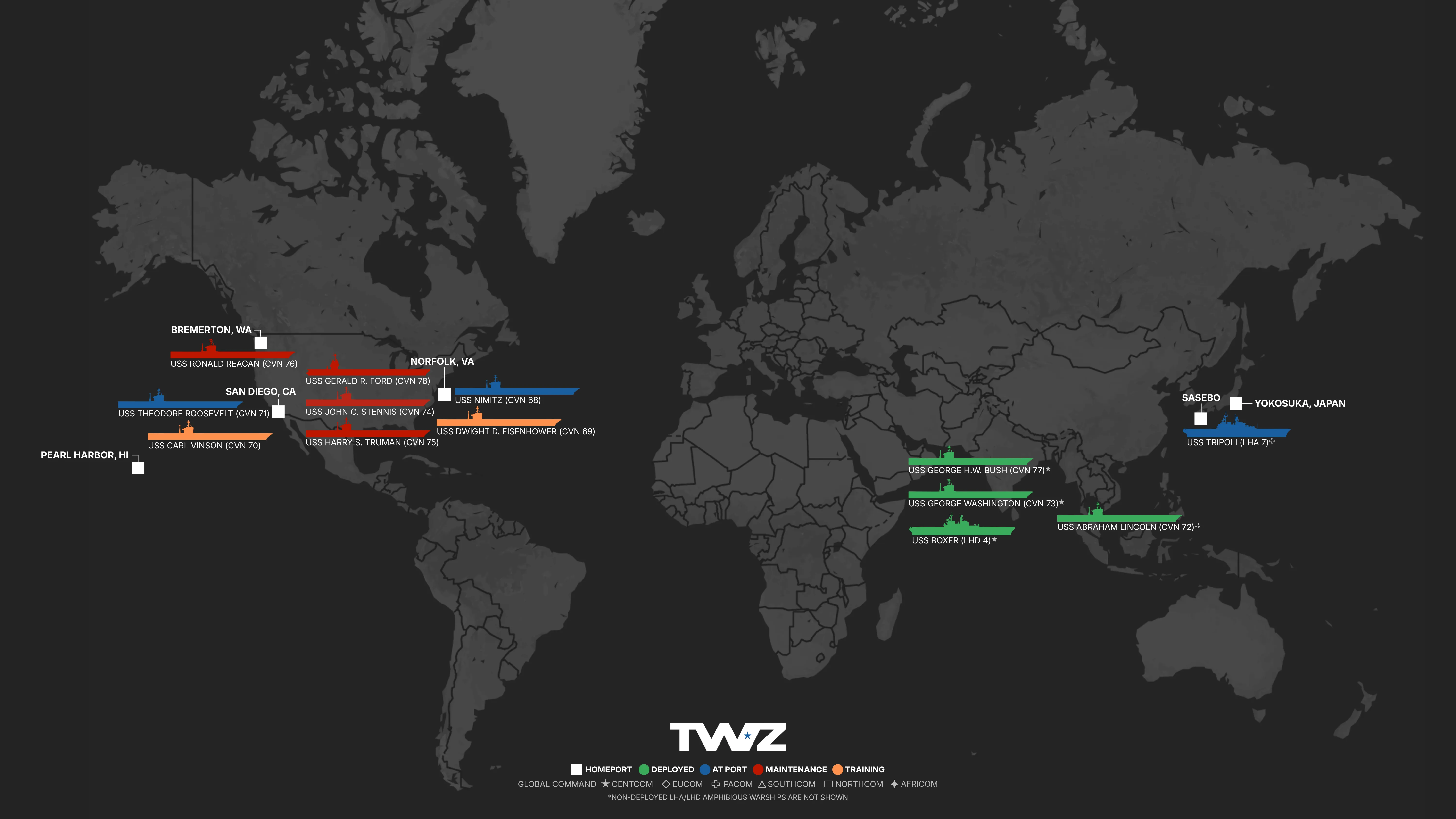
Overall, three U.S. carriers are deployed, three are training or in port in various states of readiness, four are in maintenance, and one is being used primarily for training. One amphibious ready group is deployed, five are training or in port, and three are in maintenance.
Note: Positions are general approximations. Non-deployed LHA/LHD amphibious warships are not shown.
Contact the author: ian.ellis-jones@teamrecurrent.io
Weekly insights and analysis on the latest developments in military technology, strategy, and foreign policy.
Here’s TWZ’s weekly carrier tracker monitoring America’s flattop fleet, including deployed Carrier Strike Groups (CSG) and Amphibious Ready Groups (ARG), using publicly available open-source information. Check out last week’s report here.
U.S. Central Command (CENTCOM) announced the end of a weekend wave of air strikes yesterday, the ninth consecutive night of precision strikes “further degrading Iranian military capabilities,” and the beginning of a new, tenth round today. As the blockade approaches the one-week mark, CENTCOM forces have redirected seven commercial vessels and disabled one kinetically, firing AGM-114 Hellfire missiles into the smokestack of an unladen oil tanker heading toward Kharg Island, since reinstating the blockade on July 14.
U.S. forces enforce naval blockade measures against Iran, July 15, by disabling an unladen oil tanker attempting to sail toward an Iranian port. U.S. Central Command
Over 20 U.S. Navy warships are operating in the Arabian Sea and broader Indian Ocean, which we covered extensively last week, and naval force posture has not changed since. Two CSGs, led by USS Abraham Lincoln and USS George H.W. Bush, plus an ARG, centered on USS Boxer, are the primary naval assets supporting Blockade 2.0 and the renewed strike campaign, alongside some 14 guided-missile destroyers and a mix of other surface ships. The video below released by CENTCOM shows F/A-18 Super Hornets armed with AIM-9X, GBU-31, and GBU-54 launching during the campaign.
U.S. forces launching aircraft and precision munitions against Iranian military targets. U.S. Central Command
Moving east, USS George Washington is operating in the Western Pacific. The flattop was spotted conducting a fueling-at-sea with USNS Earl Warren and a replenishment-at-sea with USNS Charles Drewlast week in the Philippine Sea. 1st Lt. Arren Halfacre, serving aboard Washington, said the complex operation with Warren, which involved three fuel lines simultaneously, was a “rarely done evolution” that included roughly 150 Sailors and Merchant Mariners.
USS George Washington (CVN 73) during a fueling-at-sea evolution in the Philippine Sea. U.S. Navy photo by Mass Communication Specialist 2nd Class Tyler Crowley Petty Officer 2nd Class Tyler Crowley
Also in the Pacific, USS Theodore Roosevelt is well into the sea phase of exercise Rim of the Pacific (RIMPAC) 2026 and underway in the Hawaiian Islands Operating Area. RIMPAC 2026 is the world’s largest international maritime exercise and the 30th iteration in a series that started in the early 1970s. Participating units have been operating over the past week south of Oahu, to the west of the Big Island, with AIS transponders broadcasting publicly. Roosevelt welcomed the acting Secretary of the Navy, Hung Cao, who observed flight operations, met with senior brass, and took photos with the crew on July 18.
USS Theodore Roosevelt (CVN 71) during Exercise Rim of the Pacific (RIMPAC). U.S. Navy photo by Seaman Apprentice Tyler Harstad
Back in the continental United States, USS Nimitz is at Naval Station Norfolk, her final homeport before a deactivation that was delayed until next year, moored at Pier 14N. A couple of piers down, USS Dwight D. Eisenhower is berthed at Pier 11S. And, further south along the Elizabeth River, USS Gerald R. Ford moved to Pier 5N at Norfolk Naval Shipyard in advance of her first Planned Incremental Availability. On the west coast, USS Carl Vinson, the only carrier currently in San Diego, moored at Kilo Pier on July 17 after a weeklong underway completing flight deck certifications and carrier qualifications with Carrier Air Wing (CVW) 2.
Nimitz-class aircraft carrier USS Nimitz (CVN 68) arrives to Naval Station Norfolk, July 9, 2026. U.S. Navy photo by Mass Communication Specialist 2nd Class Oscar Pichardo
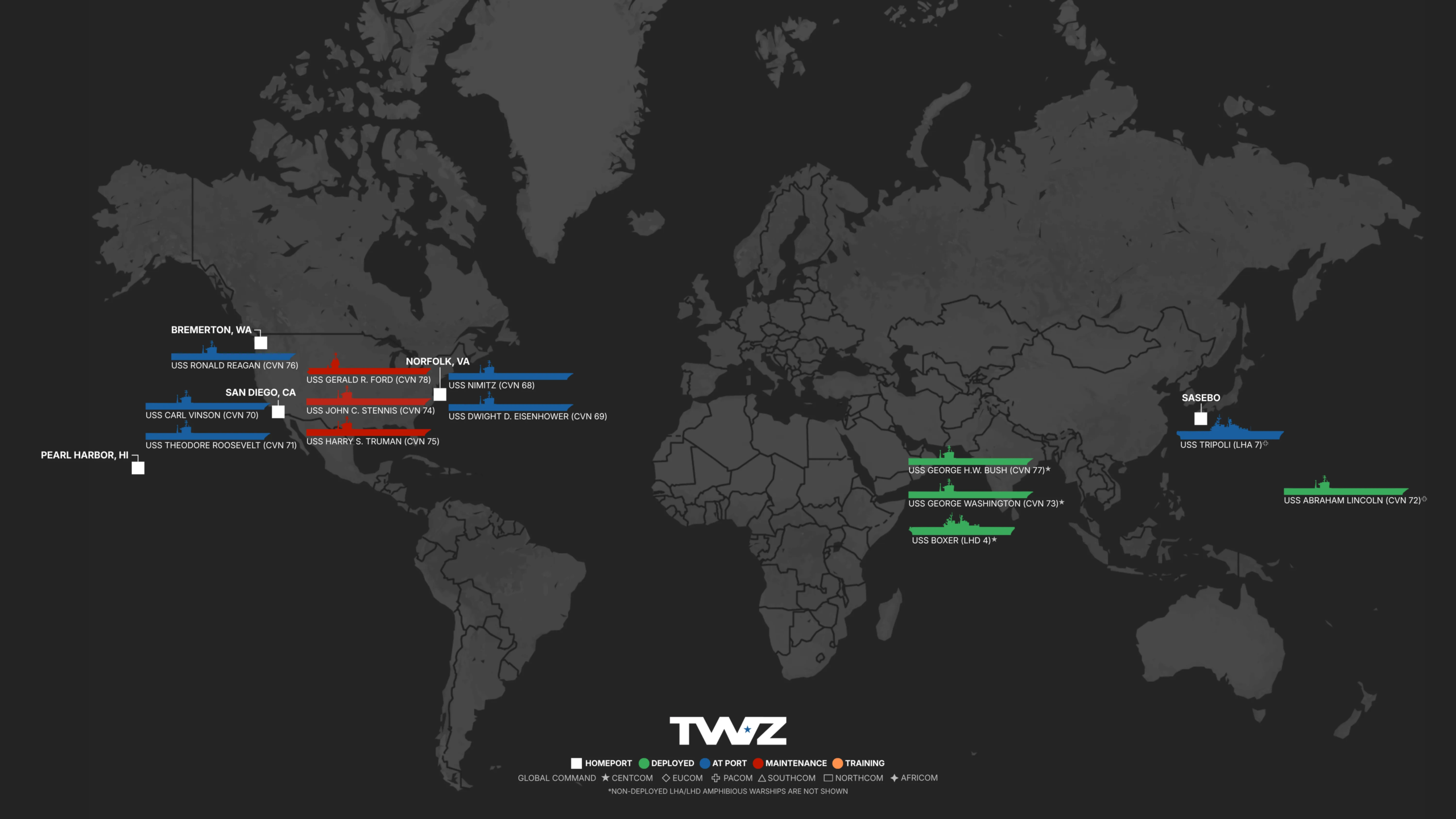
Overall, three U.S. carriers are deployed, three are training or in port in various states of readiness, four are in maintenance, and one is being used primarily for training. Two amphibious ready groups are deployed, four are training or in port, and three are in maintenance.
Note: Positions are general approximations. Non-deployed LHA/LHD amphibious warships are not shown.
Contact the author: ian.ellis-jones@teamrecurrent.io
Weekly insights and analysis on the latest developments in military technology, strategy, and foreign policy.
Here’s TWZ’s weekly carrier tracker monitoring America’s flattop fleet, including deployed Carrier Strike Groups (CSG) and Amphibious Ready Groups (ARG), using publicly available open-source information. Check out last week’s report here.
The U.S. blockade is back on beginning tomorrow. “We are reinstating the Iranian blockade,” President Donald Trump wrote on Truth Social today after days of escalatory tit-for-tat exchanges between the U.S. and Iran while negotiations falter. Following the President’s announcement, U.S. Central Command (CENTCOM) released a statement with additional information, stating the blockade would begin on July 14 at 4:00pm eastern time. “CENTCOM forces will enforce the blockade against vessels transiting to or from Iranian ports and coastal areas. The U.S. military continues to support traffic flow through regional waters for all vessels not violating the blockade.” During the first blockade from April 13 to June 18, the Navy redirected more than 140 compliant commercial vessels and kinetically disabled nine that were non-compliant.
CENTCOM recently confirmed that more than 20 U.S. Navy ships are operating in the Middle East. On June 30, the majority of that force, including USS Abraham Lincoln, USS George H.W. Bush, and USS Tripoli, were pictured together in a photo exercise (PHOTOEX) and massive show of force with 16 other ships in the northern Arabian Sea. Two flights of 14 aircraft each from Carrier Air Wings (CVW) 7 and 9 conducted a flyover. Abraham Lincoln passed the 200 consecutive days at sea mark on the same day.
U.S. Navy warships transit the Arabian Sea in close formation as CENTCOM forces continue to promote regional security and stability, June 30, 2026. U.S. Navy photo U.S. Central Command Public Affa
Thousands of miles away, the sea phase of the biennial exercise Rim of the Pacific (RIMPAC) 2026 is underway. USS Theodore Roosevelt, amphibious assault ship USS Essex, and the other U.S. and international ships participating, steamed one by one out of Pearl Harbor last week. “The world’s largest international maritime exercise, RIMPAC provides a unique training opportunity while fostering and sustaining cooperative relationships among participants critical to ensuring the safety of sea lanes and security on the world’s oceans.” In the opening days, Roosevelt conducted flight operations with embarked Super Hornets and Hawkeyes, carried out general quarters drills, small boat operations, a refueling-at-sea evolution with USNS Guadalupe south of Oahu, and embarked partner navies including Philippines, South Korea, New Zealand, Poland, Germany, and more. During the large-scale exercise, which runs through the end of the month, the decommissioned Ticonderoga class cruiser ex-USS Mobile Bay and amphibious warship ex-USS Peleliuwill be sunk by U.S. and partner forces.
USS Theodore Roosevelt (CVN 71) leaves Pearl Harbor, Hawaii, ahead of the sea phase of Exercise Rim of the Pacific 2026, July 7, 2026. Royal Air Force Photo by Cpl. Tomas Barnard OR-4 Tomas Barnard
Notably, medium displacement unmanned surface vehicle (MDUSV) Sea Hunter was spotted leaving Pearl Harbor on July 7 (albeit with a manned crew). Sea Hunter, made by Leidos, is the sister ship of Seahawk, which worked up with the Roosevelt CSG during COMPTUEX training in April. Both are actively training and it’s possible one could deploy with the CSG, which would mark the first hybrid manned-unmanned CSG, but these are older test assets that were not initially built for long deployments. Roosevelt sits at the leading edge of the Navy’s “tailored force pairing” concept, which could include integrating naval drones into CSG operations, but the MDUSV selected to deploy with the group has not been announced.
U.S. Navy medium displacement unmanned surface vessel Sea Hunter departs Joint Base Pearl Harbor-Hickam, Hawaii, to begin the sea phase of Exercise Rim of the Pacific 2026, July 7, 2026. U.S. Navy photo by Mass Communication Specialist 1st Class Kyle Carlstrom
The nearly 3,000 Sailors aboard USS Nimitzarrived at Naval Station Norfolk on July 9, marking the completion of a four-month transit and homeport shift. Nimitz left Naval Base Kitsap-Bremerton, Washington, in March and circumnavigated South America, participated in Southern Seas and embarked officials from multiple countries, sailed in Fleet Exercise (FLEETEX) 250, and pulled into New York Harbor for the International Naval Review 250 and July 4 celebrations. “Nimitz will be permanently homeported in Naval Station Norfolk, training Naval Aviation’s next generation of warfighters, while standing ready to answer the Nation’s call as it has for the past 51 years.” Nimitz, back in Norfolk for the first time in nearly 40 years, was slated to be taken offline this year but her service life was extended before expected decommissioning in 2027.
USS Nimitz (CVN 68) departs New York Harbor following participation in the International Naval Review 250. U.S. Navy photo by Mass Communication Specialist Seaman Alyssa Boling Seaman Apprentice Alyssa Boling
USS Gerald R. Ford, which returned home in May following a historic 11-month deployment, entered Norfolk Naval Shipyard (NNSY) in advance of her Planned Incremental Availability (PIA). This is Ford’s first scheduled availability at a public shipyard and comes after a twice-extended combat deployment. “A PIA is a scheduled period for an aircraft carrier to undergo extensive maintenance, repairs and modernization to meet future operational demands, spanning a wide array of overhauls and inspections. Additionally, a concurrent availability will be conducted to restore spaces damaged during a fire aboard the then-deployed carrier in March 2026.” Ford’s arrival at NNSY follows the early PIA completions for Nimitz-class aircraft carriers USS Dwight D. Eisenhower in April 2026, and USS George H.W. Bush in November 2024, according to a statement by U.S. 2nd Fleet.
Norfolk Naval Shipyard (NNSY) in Portsmouth, Virginia welcomed USS Gerald R. Ford (CVN 78) on July 7 in advance of its Planned Incremental Availability (PIA). U.S. Navy photo Shelby West
USS George Washington, America’s only forward-deployed aircraft carrier, is conducting flight operations in the Philippine Sea. Washington carried out a replenishment-at-sea (RAS) evolution with USNS Earl Warren while underway in the Western Pacific on July 9, and recently participated in exercise Valiant Shield, teaming up with Japan, New Zealand, and Australia to sink a decommissioned amphibious warship. The ex-USS Juneauabsorbed several hits from Washington’s air wing, including F-35Cs and F/A-18s, as well as long-range anti-ship missiles (LRASM) fired by U.S. Air Force B-2 bombers, and air and sea-launched effects shot by allied forces. “George Washington is the U.S. Navy’s premier forward-deployed aircraft carrier, a long-standing symbol of the United States’ commitment to maintaining a free and open Indo-Pacific, while operating alongside allies and partners across the U.S. Navy’s largest numbered fleet.”
An F/A-18 Super Hornet takes off from the flight deck of USS George Washington (CVN 73) while underway in the Philippine Sea, July 11, 2026. U.S. Navy photo by Mass Communication Specialist 2nd Class Ana Souza Young Petty Officer 2nd Class Ana Souza Young
On the amphibious front, the Boxer ARG arrived in the U.S. Central Command area of responsibility (AOR) in early July. “Boxer is deployed to the U.S. 5th Fleet area of operations to support maritime security and stability in the Middle East,” according to U.S. 5th Fleet. USS Tripoli, which has been the sole ARG in CENTCOM since March, participated in the PHOTOEX with the two carriers and has since moved farther east in the Indian Ocean, crossing into the U.S. Pacific Command (PACOM) AOR. Boxer may have relieved Tripoli, which has been there for more than four months, or Tripoli could be heading for a port call, emergent repairs, or, potentially, back home. Tripoli’s latest position via AIS and satellite imagery is unknown. Three additional amphibious assault ships have been operating and training around the United States: USS Kearsarge, USS Makin Island, and USS Essex. Two-thirds of the Iwo Jima ARG (less the flagship USS Iwo Jima), amphibious transport dock ships USS Fort Lauderdale and USS San Antonio, are back in the Caribbean and were recently docked pierside in La Guaira, Venezuela, to support the earthquake relief mission.
San Antonio-class amphibious transport docks USS San Antonio (LPD 17), left, and USS Fort Lauderdale (LPD 28), right, both ported during a cross-decking movement in La Guaira, Venezuela, July 9-10, 2026. U.S. Marine Corps photo Cpl. Daniel Garcia
Overall, three U.S. carriers are deployed, three are training or in port in various states of readiness, four are in maintenance, and one is being used primarily for training. Two amphibious ready groups are deployed, four are working up or in port, and three are getting wrenched on.
Note: Positions are general approximations.Non-deployed LHA/LHD amphibious warships are not shown.
Contact the author: ian.ellis-jones@teamrecurrent.io
Weekly insights and analysis on the latest developments in military technology, strategy, and foreign policy.
Here’s TWZ’s weekly carrier tracker monitoring America’s flattop fleet, including deployed Carrier Strike Groups (CSG) and Amphibious Ready Groups (ARG), using publicly available open-source information. Check out last week’s report here.
Amphibious assault ship USS Boxer finally arrived in the U.S. Central Command (CENTCOM) area of responsibility (AOR), months after reports of a surge deployment in March to reinforce troops in the Middle East during the war against Iran. Boxer deployed on March 18 and transited the Pacific westbound before entering the Indian Ocean in early May, but never crossed into the CENTCOM AOR. Rather than continue to the Middle East, the ARG disaggregated: Boxerdoubled back to Singapore and the South China Sea, where Portland was still operating, while Comstock moved on to CENTCOM. Boxer and Portland transited the Malacca Strait northbound in late June and have re-aggregated with Comstock in the AOR.
USS Boxer (LHD 4) and USS Portland (LPD 27) sail in formation while transiting the Indian Ocean. U.S. Central Command photo
The U.S. now has four big-deck warships on station in the Middle East – two aircraft carriers, USS Abraham Lincoln and USS George H.W. Bush, and two amphibious assault ships, USS Tripoli and USS Boxer – representing a step up in naval force posture while negotiations with Iran develop. In contrast, the U.S. appears to be drawing down its forward-deployed strategic bomber forces, with the last B-52 Stratofortress bombers departing RAF Fairford last week, according to plane spotters.
USS Abraham Lincoln (CVN 72) underway in the Middle East. U.S. Navy photo
USS Nimitz, on her final transit, arrived in New York City on July 3 and anchored off the coast of Stapleton, Staten Island, ahead of the International Naval Review (INR) 250 on July 4. Nimitzsat at anchor in New York Harbor during INR 250, the pinnacle event of the Navy’s celebration of America’s 250th birthday and the largest international maritime event in U.S. history, which featured over 70 U.S. and allied naval vessels and tall ships. Before pulling into New York, Nimitz departed Mayport, Florida, last week and steamed up the east coast while conducting ordnance offload. The Boeing MQ-25 Stingray demonstrator drone, also known as the T-1, was on full display once again.
USS Nimitz (CVN 68) transits the Hudson River. U.S. Marine Corps photo by Cpl. Xavier Alicea
USS Dwight D. Eisenhower moored in Norfolk on July 2 after a two-week work-up supporting Carrier Qualifications (CQ) and East Coast Fleet Replacement Squadrons (FRS). Student naval aviators were aboard and successfully completed CQ from June 27-30, according to a release on DVIDS. “The multi-day training evolution focused on developing the next generation of fleet aviators, specifically highlighting pilots navigating the E-2 Hawkeye pipeline.” Eisenhower is preparing to deploy in early 2027, TWZpreviously reported.
T-45C Goshawk jet trainer aircraft launches off of the flight deck of USS Dwight D. Eisenhower (CVN 69). U.S. Navy photo by Miguel Santiago Petty Officer 2nd Class Miguel Santiago
USS Carl Vinson returned to San Diego after completing flight deck certifications and CQ with Carrier Air Wing (CVW) 2 from June 25 to July 1. The Navy formally announced the completion of her nine-month Planned Incremental Availability (PIA), which TWZ reported last month. “Our Sailors’ efforts were vital in preparing Carl Vinson to return to sea,” Cmdr. Paul Novess, Carl Vinson’s maintenance officer, said. “It was my honor to bring Sailors from all rates into our 13 production teams to safely execute more than 359,000 man hours of maintenance.”
USS Theodore Roosevelt and amphibious assault ship USS Essex just wrapped up the in-port phase of RIMPAC 2026 at Joint Base Pearl Harbor-Hickam, Hawaii. Both ships, along with several other participating units, have been hosting public events and open tours for the local community and visiting service members. The sea phase of the exercise is set to begin this week. Roosevelt was leaving Pearl Harbor, according to public AIS data, at the time of publication.
USS Theodore Roosevelt (CVN 71) docked at Joint Base Pearl Harbor-Hickam, Hawaii. U.S. Navy Photo by Mass Communication Specialist First Class Ryan A. LeCompte
After participating in the live-fire SINKEX of USS Juneau last week, USS George Washington has continued operations in the Western Pacific. The flattop and embarked CVW-5 were recently spotted in the Philippine Sea conducting flight operations, live-fire shooting drills, nighttime fast rope exercises, small boat evolutions, and physical training on the flight deck. Washington is operating alongside guided-missile cruiser USS Robert Smalls, guided-missile destroyers USS Shoup and USS Benfold, and fast-attack submarine USS Minnesota.
A fast-rope exercise on the flight deck of USS George Washington (CVN 73) while underway in the Philippine Sea. U.S. Navy photo by Mass Communication Specialist 3rd Class Nicolas Quezada
Note: Positions are general approximations.Non-deployed LHA/LHD amphibious warships are not shown.
Contact the author: ian.ellis-jones@teamrecurrent.io
Weekly insights and analysis on the latest developments in military technology, strategy, and foreign policy.
Here’s TWZ’s weekly carrier tracker monitoring America’s flattop fleet, including deployed Carrier Strike Groups (CSG) and Amphibious Ready Groups (ARG), using publicly available open-source information. Check out last week’s report here.
Aircraft from Carrier Air Wing (CVW) 5 embarked on USS George Washington, including F/A-18 Super Hornets, F-35C Lightning IIs, and an E-2D Hawkeye, participated in a live-fire sinking exercise (SINKEX) during exercise Valiant Shield in the Western Pacific over the weekend. The ex-USS Juneau, a decommissioned Austin-class amphibious transport dock ship that was involved in both the Vietnam War and Operation Desert Storm, was sent to the bottom by U.S. and partner forces approximately 40 nautical miles northeast of Guam.
George Washington conducts sinking exercise during Valiant Shield 2026. U.S. Navy photo by Petty Officer 3rd Class Nicolas Quezada
“The evolution brought together air, surface, and subsurface assets in coordinated strikes, allowing crews to sharpen critical skills in weapons employment and target engagement under realistic conditions that no simulator can fully replicate,” according to a press release from Task Force 70 Public Affairs. A torpedo fired by a Japanese Maritime Self-Defense Force diesel-electric submarine, JS Jingei, delivered the final blow.
Multilateral, Joint Forces execute sinking exercise during Valiant Shield 2026. U.S. Navy photo by Seaman Apprentice Anthony Vilardi
A few thousand miles to the east, USS Theodore Roosevelt, with a packed flight deck, arrived at Joint Base Pearl Harbor-Hickam, Hawaii, on June 23 ahead of the biennial exercise Rim of the Pacific (RIMPAC) 2026. The 30th iteration of RIMPAC is the largest ever and will feature 30 partner nations, 31 surface ships, five submarines, 15 national land forces, more than 200 aircraft, and 30,000 personnel in and around the Hawaiian Islands. Roosevelthosted service members from partner nations and the local community during an open ship tour event over the weekend.
USS Theodore Roosevelt (CVN 71) arrives at Pearl Harbor. U.S. Navy photo by Petty Officer 1st Class Erik Melgar
Back in the continental United States, USS Nimitz joined 25 other ships for a fleet formation photo exercise (PHOTOEX) in the Atlantic Ocean on June 25 as part of the inaugural Fleet Exercise (FLEETEX) 250. FLEETEX, a large-scale multinational maritime exercise, includes a series of “structured multilateral training events at-sea, aimed at building cohesiveness, validating tactical procedures, and strengthening the interoperability of participating units.” Warships, aircraft, and personnel from the U.S. and 13 allied countries were involved in the two-week exercise that wrapped up today.
USS Nimitz participates in FLEETEX 250. U.S. Navy photo by Seaman Johnathan McCune
Nimitz pulled into Mayport, Florida, the following day to disembark family and friends who were aboard for a Tiger Cruise. Nimitz and several other participating ships will sail to New York City this week to take part in the seventh International Naval Review 250 from July 3-8.
Notably, Boeing’s MQ-25A Stingray demonstrator drone was spotted on Nimitz’s flight deck, which you can read about in detail here, and the C-2A Greyhound made its last trap aboard the flattop, marking the end of an era in naval aviation as the CMV-22B Osprey takes the reins for the “no fail” carrier onboard delivery mission.
MQ-25 Stingray demonstrator drone, also known as T-1, spotted embarked on the USS Nimitz. U.S. Navy photo by Petty Officer 3rd Class Gina Gallia
USS Dwight D. Eisenhower continues working up off the east coast and was most recently underway in the Jacksonville Operating Area with her AIS transponder turned on. Eisenhower is conducting carrier qualifications and supporting East Coast Fleet Replacement Squadrons, according to DVIDS. On the west coast, USS Carl Vinson got underway for training on June 25.
IKE conducts carrier qualifications in the Atlantic Ocean. U.S. Navy photo by Petty Officer 2nd Class Miguel Santiago
Two aircraft carriers remain on station in the Middle East: USS Abraham Lincoln and USS George H.W. Bush. Both carriers were spotted conducting flight operations over the past week in the U.S. Central Command-5th Fleet area of responsibility (AOR). With the blockade lifted while negotiations are ongoing – and both sides still exchanging weekend tit-for-tat blows – neither appears to be leaving the AOR, for now.
Abraham Lincoln conducts flight deck operations. U.S. Central Command Public Affa
Note: Positions are general approximations.Non-deployed LHA/LHD amphibious warships are not shown.
Contact the author: ian.ellis-jones@teamrecurrent.io
Weekly insights and analysis on the latest developments in military technology, strategy, and foreign policy.
Here’s TWZ’s weekly carrier tracker monitoring America’s flattop fleet, including deployed Carrier Strike Groups (CSG) and Amphibious Ready Groups (ARG), using publicly available open-source information. Check out last week’s report here.
The United States lifted its naval blockade of Iranian ports, U.S. Central Command (CENTCOM) announced on Friday, following the execution of the Islamabad Memorandum of Understanding in Versailles. While the blockade is over, the fate of the blockade forces – and future U.S. force posture in the region – remains unclear. The “plan is to keep the current force posture” during negotiations, a U.S. official said on background, but “the agreement contemplates the reduction in military forces in the region upon the agreement of a final deal.”
Major U.S. naval assets, including two aircraft carriers, continue operating “in the general area to support freedom of navigation,” according to a press release from CENTCOM. “U.S. forces remain present and vigilant to ensure all aspects of the agreement with Iran are adhered to, obeyed, and in full force and effect.” USS Abraham Lincoln, now deployed for more than seven months, was conducting flight ops in the CENTCOM area of responsibility (AOR) as of June 21, and USS George H.W. Bush was last spotted on June 20.
A U.S. Sailor oversees flight operations from the tower aboard USS Abraham Lincoln (CVN 72) as the aircraft carrier continues to operate in the Arabian Sea. pic.twitter.com/upff7YF7Hh
USS Nimitz arrived at Naval Station Mayport in Florida on June 16, marking the completion of her participation in Southern Seas 2026. “This year’s deployment marked the 11th iteration of the Southern Seas exercise since 2007, demonstrating the United States’ enduring commitment to the Western Hemisphere. Southern Seas 2026 highlighted unprecedented diplomatic and military integration, recording the highest number of Latin American leadership visits in the exercise’s history, with approximately 339 distinguished visitors embarking and 3,100 guests hosted during port visits.” Nimitz is on the final leg of a homeport shift to Naval Station Norfolk after the Navy announced a service life extension into 2027.
USS Nimitz (CVN 68) Nimitz-class aircraft carrier coming into Mayport, Florida – June 16, 2026 SRC: FB- Naval Station Mayport pic.twitter.com/DgPsu6R1lG
USS Dwight D. Eisenhower departed Norfolk on June 17 for Fleet Replacement Squadron Carrier Qualifications (FRS-CQ) and is underway in the Virginia Capes Operating Area, according to publicly available AIS data. Eisenhower is not scheduled to deploy this year, and is preparing for a deployment in early 2027, TWZ has learned.
USS Dwight D. Eisenhower (CVN 69) Nimitz-class aircraft carrier leaving Norfolk, Virginia – June 17, 2026 SRC: FB- Sean Tuttle pic.twitter.com/1lYOX670Ot
USS Theodore Roosevelt got underway on June 15 and is conducting exercises off the west coast in the U.S. 3rd Fleet AOR. The drills are meant to “bolster strike group readiness and capability” and the crew was spotted participating in firefighting drills, barricade drills, and crash and salvage training on the flight deck. While the upcoming deployment date is unknown, Roosevelt is the next carrier slated to deploy.
Power for Peace 🔱
USS Theodore Roosevelt (CVN 71) sails through the Pacific Ocean while conducting exercises to enhance strike group capability.
Our visible demonstration of warfighting readiness through operational competence is the high standard we hold ourselves to. pic.twitter.com/B88XO04n1R
— U.S. Pacific Fleet (@USPacificFleet) June 22, 2026
USS Carl Vinson is moored at Berth Lima at Naval Air Station North Island in San Diego. Over the weekend, Vinson was the centerpiece of NASCAR’s “Race the Base” event at Naval Base Coronado. “The event marked a historic collaboration between the U.S. Navy and NASCAR while celebrating the service’s enduring connection to the American people. It provided attendees opportunities to engage directly with Sailors, explore Navy capabilities, and learn about the Navy’s role in defending the nation around the globe.”
USS George Washington moored in Apra Harbor, Guam, from June 16-20, and then participated in a PHOTOEX to kick off exercise Valiant Shield 2026. Washington was pictured alongside cruiser USS Robert Smalls, destroyers USS Shoup and USS Benfold, fast-attack submarine USS Minnesota, and the Japan Maritime Self-Defense Force, including JS Kaga, JS Fuyuzuki, and JS Jingei. “Valiant Shield is a biennial, multilateral field training exercise conducted by the U.S. Armed Forces and partner nations in the Western Pacific focusing on joint, cross-combatant integration operating seamlessly across sea, air, land, and cyberspace.”
Lethal Joint Force. US Navy aircraft with CVW-5 & @USAF F-35As fly over the USS George Washington (CVN 73) Carrier Strike Group and @JMSDF_PAO units during Valiant Shield 2026 in the Philippine Sea, demonstrating multi-domain Combat Readiness. (1/2) pic.twitter.com/wzT5KHWx71
— U.S. Pacific Fleet (@USPacificFleet) June 22, 2026
Note: Positions are general approximations.Non-deployed LHA/LHD amphibious warships are not shown.
Contact the author: ian.ellis-jones@teamrecurrent.io
Weekly insights and analysis on the latest developments in military technology, strategy, and foreign policy.
Here’s TWZ’s weekly carrier tracker monitoring America’s flattop fleet, including deployed Carrier Strike Groups (CSG) and Amphibious Ready Groups (ARG), using publicly available open-source information. Check out last week’s map here.
The U.S. blockade of Iranian ports remains in full effect and, despite the shaky ceasefire amid ongoing, but uncertain, negotiations, the Navy’s force posture remains unchanged. Enforced by two CSGs and one ARG, U.S. Central Command (CENTCOM) forces have redirected over 100 commercial vessels, disabled four using force, and allowed more than 25 carrying humanitarian aid to pass through.
The Boxer ARG, still operating under U.S. Indo-Pacific Command (INDOPACOM), doubled back from the Indian Ocean to the Malacca Strait and pulled into Singapore on May 19. The purpose of the port call is unknown, but, as of publication, Planet satellite imagery reviewed by TWZ shows Boxer moored at Sembawang Terminal for the past week. Previous reports indicated the ARG was headed to CENTCOM; however, the group does not appear to be in a hurry.
USS Boxer (LHD 4) Wasp-class amphibious assault ship coming into Singapore – May 19, 2026 SRC: FB- Military Aviation Photography Singapore pic.twitter.com/lzK3NfY9CB
Also operating in INDOPACOM, forward-deployed USS George Washington departed Yokosuka, Japan, on May 23. While the composition of the CSG is unconfirmed, destroyer USS Shoup and cruiser USS Robert Smalls also got underway, according to public AIS data, and will likely escort the carrier during her upcoming Western Pacific patrol. A George Washington spokesperson recently told us the CSG was “underway conducting routine operations to sharpen our Sailors’ warfighting edge.” The underway coincides with a recent surge of Chinese naval activity in the region.
USS George Washington Conducts Flight Operations Petty Officer 2nd Class Lillian OlenSuper Hornet attached to Strike Fighter Squadron (VAQ) 141 lands on CVN-73 Seaman Apprentice Kiah Nesbitt
USS Nimitz arrived in the Caribbean Sea as a flurry of USAF surveillance flights around Cuba has driven speculation about potential future military operations. Officially, Nimitz is participating in exercise Southern Seas and “scheduled to conduct passing exercises and operations at sea with partner nation maritime forces as the ships circumnavigate the continent of South America.” The CSG did not embark a full nine squadron carrier air wing and, with only one destroyer escort, the ODIN-equipped USS Gridley, is not the combat-capable force we’d expect if major combat ops were imminent.
Welcome to the Caribbean, Nimitz Carrier Strike Group!
The aircraft carrier USS Nimitz (CVN 68), the embarked Carrier Air Wing 17 (CVW-17), USS Gridley (DDG 101) and USNS Patuxent (T-AO 201) are the epitome of readiness and presence, unmatched reach and lethality, and strategic… pic.twitter.com/83mfzSIKzd
The Iwo Jima ARG is also on station in the Caribbean and facilitated the transport of U.S. Southern Command (SOUTHCOM) Commander Gen. Francis L. Donovan to Caracas, Venezuela, via MV-22B Ospreys over the weekend. During his second official visit to the country following Operation Absolute Resolve, the Gen. “took part in bilateral discussions with senior interim government leaders, met with U.S. Embassy leadership and staff, and observed the joint force conduct a military response exercise.”
📍Venezuelan Coast (🇻🇪)
Additionally, the @Southcom (🇺🇸) Commander Gen. Francis L. Donovan, as predicted, arrived in Caracas via MV-22B Osprey from on board the USS Iwo Jima (LHD-7) under escort from the cruiser USS Lake Erie (CG-70).
Weekly insights and analysis on the latest developments in military technology, strategy, and foreign policy.
Here’s TWZ’s weekly carrier tracker monitoring America’s flattop fleet, including deployed Carrier Strike Groups (CSG) and Amphibious Ready Groups (ARG), using publicly available open-source information. Check out last week’s map here.
The Ford is finally home. The supercarrier, with nearly 4,500 Sailors aboard, pulled into Naval Station Norfolk on Saturday, greeted by hundreds of families and friends after completing a grueling 326-day combat deployment. The well-deserved homecoming capped the longest deployment in more than five decades, which was extended multiple times to support operations across two continents and combatant commands.
Ford, the world’s largest and most advanced aircraft carrier, departed Virginia almost a year ago for, what was at the time, a routine deployment to Europe. The deployment turned out to be anything but when Ford was redirected to the Caribbean in November ahead of Operation Absolute Resolve. Following the successful extraction of President Nicolas Maduro out of Venezuela, and despite pushback from top Navy brass to come home, the CSG crossed the Atlantic again to project power and pressure from the eastern Mediterranean and northern Red Sea during Operation Epic Fury against Iran. Overall, Ford sailed over 57,000 nautical miles, logged more than 5,700 flight hours, and conducted 12,000+ aircraft launches. Upon arrival in Norfolk, Carrier Strike Group 12 was presented with the Presidential Unit Citation, the highest honor a military unit can receive.
Meanwhile, three other carriers conducting routine operations and work-ups returned to their respective homeports with much less fanfare. USS George Washington, USS Dwight D. Eisenhower, and USS Theodore Roosevelt, each at various stages of training prior to future deployments, pulled into Yokosuka, Norfolk, and San Diego, respectively, over the past week.
The Navy’s only forward-deployed carrier, USS George Washington, completed a weeklong shakedown cruise after a brief pierside availability. In response to unconfirmed reports the flattop was in maintenance, a George Washington spokesperson told TWZ the “U.S. Navy’s forward-deployed aircraft carrier conducts short maintenance availabilities between patrols to service critical systems and conduct repairs” and was recently “underway conducting routine operations to sharpen our Sailors’ warfighting edge.” Regardless of her past status, Washington is operational today and preparing for an upcoming WESTPAC patrol.
The U.S. maintains a considerable naval fleet in the Middle East enforcing the ongoing blockade of Iran. Two CSGs and one ARG – more than 20 warships in total – continue operations in the U.S. Central Command (CENTCOM) area of responsibility (AOR). Another ARG, led by USS Boxer, is nearby in the Indian Ocean operating under U.S. Indo-Pacific Command (INDOPACOM) as of May 16, but, as we have noted previously, the group could enter CENTCOM at any time. U.S. forces have redirected 81 commercial vessels and disabled four attempting to run the blockade to date, according to the latest press release from CENTCOM.
U.S. Sailors support flight operations aboard aircraft carrier USS Abraham Lincoln (CVN 72) sailing in the Arabian Sea. Every operational success across CENTCOM begins and ends with America’s men and women in uniform. pic.twitter.com/PjmByqI4jC
Weekly insights and analysis on the latest developments in military technology, strategy, and foreign policy.
Here’s TWZ’s weekly carrier tracker monitoring America’s flattop fleet, including deployed Carrier Strike Groups (CSGs) and Amphibious Ready Groups (ARGs), using publicly available open-source information. Check out last week’s map here.
More than 20 U.S. Navy warships, two carrier strike groups among them, are enforcing the blockade of Iran in the U.S. Central Command (CENTCOM) area of responsibility (AOR). To date, CENTCOM has redirected 61 commercial vessels linked to Iran and disabled at least four attempting to run the blockade.
USS John Finn (DDG 113) sails behind USS Milius (DDG 69), USNS Carl Brashear (T-AKE-7), and USS George H.W. Bush (CVN 77) in the Arabian Sea.
Over 20 U.S. warships are enforcing the blockade against Iran. CENTCOM forces have redirected 61 commercial vessels and disabled 4 to… pic.twitter.com/gG9B2K5c9p
The Navy released new images last week of both CSGs supporting the blockade. The USS George H.W. Bush was conducting flight operations in the Arabian Sea on May 6, and recently spotted with 25 F/A-18E/F Super Hornets, two E-2D Hawkeyes, and three MH-60 Seahawks of Carrier Air Wing 7 visible on the flight deck. Unlike the Abraham Lincoln CSG, also operating in the AOR, George H.W. Bush is not equipped with 5th-generation carrier-based F-35Cs.
Nimitz-class aircraft carrier USS George H.W. Bush (CVN 77) sails in the Arabian Sea, May 3, 2026. George H.W. Bush is deployed to the U.S. 5th Fleet area of operations to support maritime security and stability in the Middle East. (U.S. Navy photo) U.S. Central Command Public Affa
The Gerald R. Ford CSG transited the Strait of Gibraltar westbound and is steaming toward Norfolk. The strike group has been deployed for 322 days, as of May 11, and is expected to return home in the coming weeks. The CSG departed Norfolk in June 2025 and was initially supposed to return in January, but its deployment was extended twice to support combat operations in the Caribbean and the Middle East.
PACIFIC OCEAN (May 4, 2026) –The Nimitz-class aircraft carrier USS Theodore Roosevelt (CVN 71) conducts flight operations, May 4, 2026. Theodore Roosevelt, flagship of Carrier Strike Group (CSG) 9, is underway in the U.S. 3rd Fleet area of operation conducting advanced training to bolster strike group readiness and capability. An integral part of U.S. Pacific Fleet, U.S. 3rd Fleet operates naval forces in the Indo-Pacific and provides the realistic, relevant training necessary to execute the U.S. Navy’s role across the full spectrum of military operations. (U.S. Navy photo by Mass Communication Specialist 3rd Class Aaron Haro Gonzalez) Seaman Aaron Haro Gonzalez
USS Nimitz is anchored off Rio de Janeiro, Brazil, for a five-day liberty port call. Nimitz is circumnavigating South America en route to her new homeport in Norfolk. Originally slated to be decommissioned this year, her service life was recently extended into 2027.
USS Nimitz (CVN 68) Nimitz-class aircraft carrier and USNS Patuxent (T-AO-201) Henry J. Kaiser-class replenishment oiler along with a Brazilian attack submarine in Rio de Janeiro, Brazil – May 7, 2026 SRC: X-@dmdst12pic.twitter.com/Qch7agZEDJ
Another Marine Air-Ground Task Force is set to arrive in CENTCOM in the near-term. While the Boxer ARG has not been confirmed in CENTCOM as of publication, an arrival announcement could come as soon as next week. The 11th Marine Expeditionary Unit (MEU) is comprised of a command element, a Ground Combat Element, Battalion Landing Team 3/5, an Aviation Combat Element with two squadrons, Marine Medium Tiltrotor Squadron (VMM) 163 (Reinforced) and Marine Fighter Attack Squadron (VMFA) 122, and a logistics combat element. The approximately 5,000 Marines and Sailors aboard Boxer ARG will join the Tripoli ARG, already on station in the Middle East, and significantly enhance the United States’ expeditionary capabilities in the region.
U.S. Marine Corps F-35B Lightning II assigned to Marine Fighter Attack Squadron (VMFA) 122, 11th Marine Expeditionary Unit, land during flight operations aboard Wasp-class amphibious assault ship USS Boxer (LHD 4) in the Pacific Ocean, May 2, 2026. The 11th MEU, embarked aboard the Boxer Amphibious Ready Group, is a persistent, combat credible force contributing to deterrence and crisis response in the U.S. 7th Fleet area of operations. U.S. 7th Fleet, the U.S. Navy’s largest forward-deployed numbered fleet, routinely interacts and operates with allies and partners to preserve a free and open Indo-Pacific. (U.S. Marine Corps photo by Sgt. Trent A. Henry) Sgt. Trent A. Henry
Note: Positions are general approximations.Non-deployed LHA/LHD amphibious warships are not shown.
Contact the author: ian.ellis-jones@teamrecurrent.io