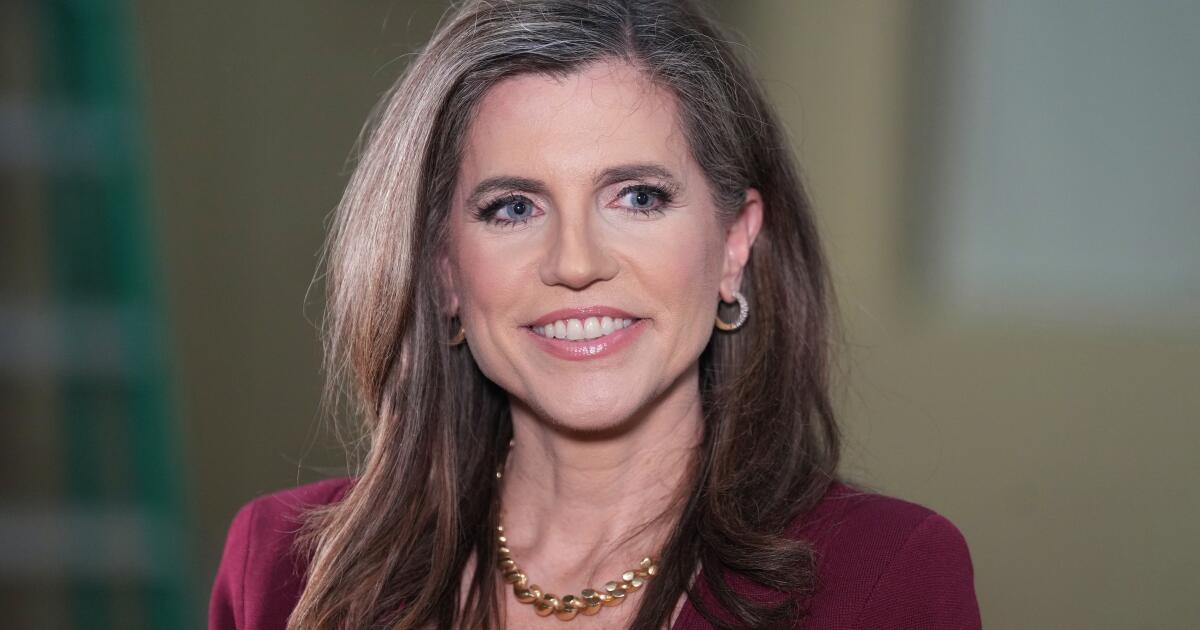
COLUMBIA, S.C. — After a decade of roiling South Carolina and national politics, Rep. Nancy Mace finished a distant fifth in her state’s Republican primary for governor, leaving an uncertain future for one of the nation’s unabashed politicians.
Her campaign mirrored her whipsaw career. Mace courted the support of President Trump after harshly criticizing him over the Jan. 6, 2021, attack on the U.S. Capitol. She emphasized her fights with other Republicans to release files from the Jeffrey Epstein investigation.
In the final days before Tuesday’s primary, she called for a law to prevent anyone not born in the U.S. from holding political office or serving as a judge. She suggested that Rom Reddy, another candidate for governor, wasn’t qualified because he was a naturalized citizen whose mother was from India and father from Italy.
“I didn’t come out of a slum in India,” Mace said during an appearance in Greenville County this month. “I am born and made here in America.”
By the end of her campaign she was only making sporadic public appearances. She struggled to raise money and had no presence on television. Mace mostly communicated through social media — a place she has used to her advantage since first being elected to the South Carolina House in 2017.
In a lengthy statement posted after her loss, Mace recounted her achievements in the U.S. House, saying she had “taken on the rich and powerful in both parties” and “voted to release the Epstein files and lost some support for that.”
Four congressional Republicans were part of the initial group pushing for a discharge petition forcing the files’ release. Mace and Rep. Thomas Massie lost their races, and Rep. Marjorie Taylor Greene resigned in January.
Mace didn’t give an indication of her next plans in her concession speech Tuesday night. She is backing Alan Wilson in the runoff for governor, even though just last year she accused Wilson of protecting child sex abuse defendants.
“When children needed him to act, Wilson looked the other way,” she said.
Wilson will face Lt. Gov. Pamela Evette in the runoff on June 23. Evette received Trump’s endorsement, spurring Mace to lash out on social media.
“Pamela Evette is NOT ENDORSED by DONALD TRUMP,” Mace wrote, incorrectly. “Do not believe her LIES.” Mace posted an AI-generated image of posing with Trump herself.
Mace dropped out of high school and worked as a server at the Waffle House before getting her diploma. She later attended The Citadel and became the first woman to graduate from the state’s military academy. And in recent years, she talked about the importance of defending victims of sexual assault and shared stories of being raped as a teen.
After her political career began in the South Carolina House, Mace got wide praise from Republicans in 2020 for winning back a U.S. House seat around Charleston that had flipped to Democrats for one term.
“For those folks that are out there today that maybe weren’t with us yesterday, I’m asking for a chance — a chance to prove to you that I will be a compassionate leader, a good listener, an independent thinker,” Mace said then.
Collins and Kinnard write for the Associated Press. Kinnard reported from Washington. AP writer Bill Barrow contributed from Atlanta.
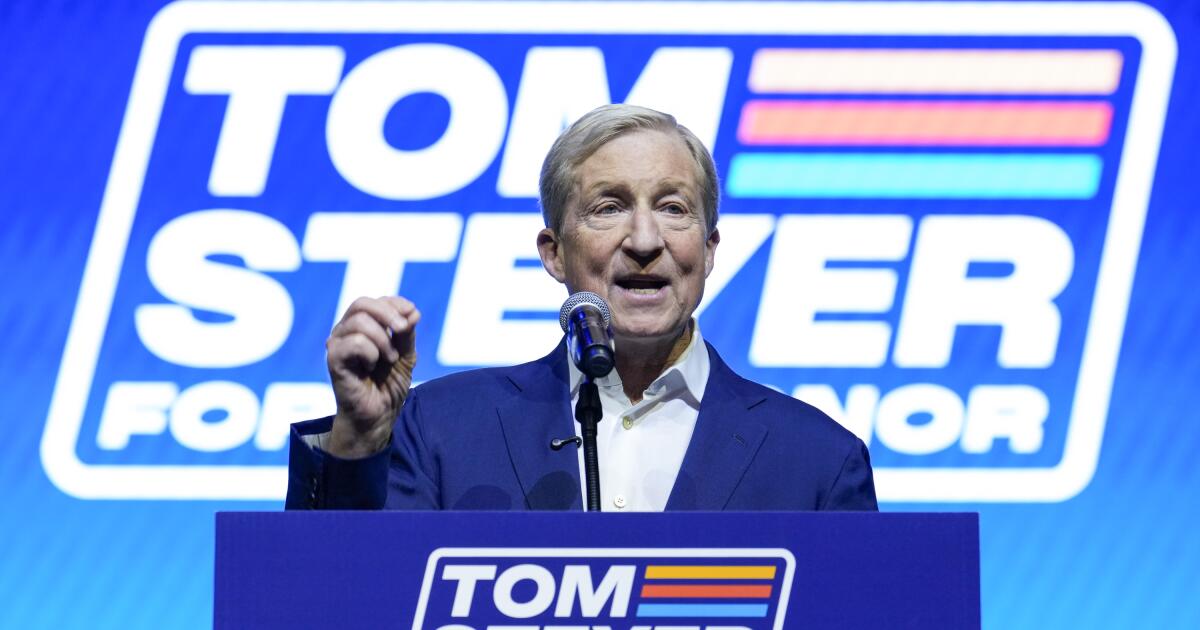
Californians couldn’t escape billionaire Tom Steyer’s political ads — during newscasts, sitcoms, or sporting events; on streaming services, YouTube, influencers’ social media feeds, or their mailboxes. Even the Puppy Bowl.
Yet despite spending a record-shattering $216 million of his wealth on his run for governor, the Democrat failed to win enough votes in last week’s primary to advance to the November general election to replace termed-out Gov. Gavin Newsom.
“Money isn’t everything, even though it obviously helps,” said Andrea Godfrey Flynn, a marketing professor at the University of San Diego. “It boosted Steyer way up. … But there are so many other factors at play that it may not have been enough.”
Steyer, a hedge fund co-founder turned environmental warrior, polled at 1% shortly before he entered the governor’s race in November, according to a survey by UC Berkeley’s Institute of Governmental Studies that was co-sponsored by the Los Angeles Times.
He climbed in subsequent polls, hitting 19% in the same poll shortly before the June 2 primary, putting Steyer in contention for winning one of the top two spots in the contest that would allow him to advance to the November election. But then he hit a ceiling, and on Tuesday, it became official that he failed to advance.
Steyer emailed supporters Tuesday expressing gratitude for their efforts backing his campaign, endorsements and votes.
“Together, we fought for a California that belongs to the people who keep it running every day, and we insisted that they do not have to settle for a system that protects corporate profits at the expense of working people,” he wrote. “I’m proud of how we never compromised our values or lowered our sights for what California can and should be.”
He pointed with pride at major corporations such as Chevron and Meta spending heavily to oppose his bid, and said their tens of millions of dollars spent attacking him shows the flaws in the electoral system. And he acknowledged that may be part of the reason some voters were skeptical of voting for a billionaire.
“I’m proud of the enemies we made,” Steyer said. “This campaign proved that business-as-usual depends on politics-as-usual, and there is no going back. We must continue to fight for a system where democracy serves Californians, not corporations — and where you do not have to be a billionaire to run on single-payer, or on breaking up monopolies, or on calling out a corrupt system when you see it. Because people are fed up with a system rigged to benefit billionaires and leave them behind.”
As of Tuesday evening, Steyer had received more than 1.9 million votes of the more than 9 million cast, lagging behind the two candidates who will appear on the November ballot: Republican Steve Hilton, a former Fox News commentator, and Democrat Xavier Becerra, a longtime elected official who most recently served in President Biden’s cabinet. Steyer was trailing Hilton, the second-place finisher, by just over 200,000 votes.
Steyer immediately endorsed Becerra, whom he had relentlessly attacked in the closing weeks of the campaign as beholden to corporations with business in front of the governor.
California has a history of unsuccessful self-funders. Former Northwest Airlines co-chairman Al Checchi spent more than $40 million of his money on an unsuccessful gubernatorial primary campaign in 1998, which broke records at the time.
More than a decade later, former EBay chief Meg Whitman spent $144 million of her wealth on her bid to become California’s governor, setting a new national record for spending on a state election. She won the GOP nomination but lost in the general election.
Sheri Sadler, a veteran Los Angeles-based Democratic media buyer, said Steyer’s 2026 gubernatorial deluge was notable.
“I literally saw his spots ad nauseam,” she said. “They left almost no stone unturned.”
Sadler worked for Steyer in the final weeks of his presidential bid and scheduled $50 million of billionaire Rick Caruso’s money on ads during his unsuccessful 2022 Los Angeles mayoral campaign.
She believes that Steyer hit a ceiling because voters who are bombarded by ads eventually feel that the candidate is trying to purchase their affection.
“It’s one thing to give me a message I can resonate with. If they’re just trying to buy my vote, that feels different to me,” she said, adding that Steyer’s wealth undermined his platform, which included support for raising taxes on billionaires. “That’s my gut. And I feel like that’s what happened to us on Caruso and possibly why he didn’t run” for governor this year.
Steyer, 68, made his fortune founding a hedge fund that included investments in fossil fuels, private prisons and other businesses that are controversial among Democrats. He told voters that he walked away from the firm 14 years ago, leaving an enormous amount of money on the table, because it did not align with his morals. Steyer adds that he and his wife have pledged to give away most of their wealth before they die.
And unlike many wealthy self-funders, Steyer did not leap into a campaign as a political neophyte who assumed their business skills would translate into being an effective elected official.
Steyer and his wife, Kat Taylor, are longtime donors to Democratic candidates, but for well over a decade, they have spent hundreds of millions of dollars on liberal causes such as fighting climate change, mobilizing young voters, urging the impeachment of President Trump, opposing an effort by oil companies to suspend California environmental standards, increasing the state cigarette tax and supporting last year’s redrawing of the state’s congressional districts to counter Trump.
Darry Sragow, a veteran Democratic strategist who advised Checchi, said that Steyer’s focus on such causes had the potential to be meaningful to voters who are often skeptical about the sincerity and motives of rich candidates.
“Tom Steyer has done a good job in that respect, because if you’re going to overcome that skepticism, it’s very helpful for the candidate to show that he or she has actually been involved in the world of public policy and politics for an extended period,” and Steyer has, Sragow said.
Assemblyman Isaac G. Bryan (D-Los Angeles), who endorsed Steyer, argued that he promoted proposals that were against his personal interests, such as the proposed billionaire’s tax that is expected to appear on the November ballot.
“Interestingly enough, Tom Steyer is also the only candidate who’s talked about campaign finance reform and wanting to get money out of politics, including his money, to return power to the people and have publicly financed elections,” Bryan said after a Steyer rally near downtown L.A. on May 31.
Former Orange County Rep. Katie Porter and state Supt. of Public Instruction Tony Thurmond also campaigned on limiting the influence of corporate PAC money in elections, or implementing publicly financed elections in California. Porter often criticized Steyer for running as a “change agent” while spending millions he earned from investments in oil and gas.
“You paid the lowest tax rate on this stage and yet you made the billions that you’re using to fund your campaign off fossil fuels,” she said to Steyer during an April 28 debate in Claremont.
Political experts argue that messages that seem contradictory to a candidate’s background, as well as drowning voters with incessant ads, can be jarring and off-putting to the electorate.
“It can be an overload to voters where they hit that tipping point where they’re no longer interested,” Flynn said.
Despite Steyer’s foundational argument that his wealth meant he was not beholden to anyone, she said voters may be unable to reconcile a billionaire’s ability to understand or empathize about an average Californian’s needs.
“The messaging still is a giant factor,” Flynn said. “I’m curious [about] how believable it came across to voters — can you trust a billionaire to really care about affordability, someone who made money working with business or in business not to care about special interests?”
While Steyer campaigned as a hard-left liberal, he failed to be the top pick for progressives. Steyer had the support of 35% of likely voters who identified as strongly liberal while Becerra was backed by 37%, according to Berkeley’s May poll.
After talking to college Democrats at UCLA on the eve of the primary, Steyer said regardless of what happens in the primary, he will remain politically involved, though he would not run for president in 2028.
“I’m going to keep working on these issues, because I’ve been working full-time on these issues for 14 years,” Steyer said. “There’s no question what I’m going to do. How I do it is a little bit up in the air.”
Times staff writer Dakota Smith contributed to this report.
To learn more about this campaign, we reached out to one of the soldiers leading this effort from the unit that created it. In an exclusive interview, an Unmanned Systems Department Officer for the First Corps Azov of the National Guard of Ukraine offered us unique insights into how the program began, how it’s going, where it is headed and how AI is helping to identify and hit targets deep behind the lines. It’s a capability we described in great detail — about how it was rapidly gestating and would arrive on the battlefield around now. The officer spoke on condition of anonymity to discuss operational details.
Some of the questions and answers have been edited for clarity.
Azov patrols the border areas around Mariupol.
Ukrainian territory must be free of Russian forces. The surest path to achieving this is pushing the “sanitization zone” for enemy logistics closer to Russia itself and occupied Crimea.
— First Corps Azov of the National Guard of Ukraine (@azov_media) May 25, 2026
Q: Walk me through the genesis of the mid-range strike campaign.
A: I will first of all start with answering the question of why. So the reason why we are currently conducting this campaign is to hunt enemy logistics capabilities, and currently we have a lot of quite cheap assets that can strike enemy targets at quite a deep range. So the overall meaning, the overall sense of this campaign is to strike enemy concentrations of cargo in the places where this concentration is the highest and the protection of those enemy logistical assets is at the lowest level.
So, if we’re talking about enemy logistics very close to the front line, to the line of contact, we are mostly talking about a person with a backpack. Then, if we are moving deeper into the enemy controlled area, further from the front line, then we’re talking about cars. Then even deeper we’re talking about trucks. Even deeper we’re talking about long haulers with trailers, so a higher concentration of cargo. Even deeper into the enemy controlled area, we’re talking about the railroads, the trains that are carrying supplies. So the deeper we go from the line of contact, the higher is the concentration of enemy cargo.
Russian rail logistics are now also the target of Midstrike drones, with lines to Crimea being particularly affected. pic.twitter.com/K1BFd0QVov
The other part of answering this question is basically about how the enemy protects their logistical assets. So the deeper we go from the line of contact, not only is the distance larger, but also the areas that the enemy needs to protect. So just simple mathematical calculations show us that the distance of 50 kilometers deep from the line of contact is usually the most concentrated area the enemy has to defend against our strike assets. But if we go to the depths of 300 kilometers, then the areas that the enemy should protect are much larger, and it’s basically impossible to saturate that area with all the necessary protection assets that the enemy needs to strike down our drones.
The point I would like to make is that we conduct those strike operations at deeper ranges with basically the same assets that we use for the tactical depths, for example, at the depths of 50 kilometers. That means we do not increase the cost of our assets. We just introduced some technical modifications, and we can use the same assets to strike in the deep area.
How Ukraine Uses the US-made Hornet AI Strike Drone To Disrupt And Cut Russian Logistics Lines
Q: What drones are you using to carry out these attacks and how are you increasing the ranges?
A: Basically, we’re using fixed-wing kamikaze drones with some modifications in terms of communication systems. We’ve installed Starlink systems on those drones, and we have also introduced a number of modifications in terms of the engine of the drones – in terms of the overall propelling unit. And this allowed us to increase the range of the assets that we used previously for the range up to 50 kilometers, with some modifications for longer distances.
Q: What kinds of drones are you using?
A: Just the simple fixed-wing chemical drones, such as Hornet systems, such as the Darts systems, and also some other assets that, for now, we prefer not to mention.
Darts
Q: Can you provide additional details about the modifications you have made to these drones and what is their maximum range?
A: Well, I would say that these are quite technical things, and I wouldn’t want to disclose those, because I would want to avoid the situation where the enemy is going to do the same modifications.
Q: Are you reaching as far as 100 kilometers?
A: From what we can say now, we can cover distances of up to 250 kilometers, but as you might understand, with time we will cover longer and longer distances.
Q: Can you describe how these attacks work? Do you operate these as first-person view drones through a video feed? Do they have a terminal seeker?
A: The process is really simple. So, for example, we select a section of the road, or the road as a whole and we distribute that road or the sections among our units. And I would like to mention that this is an all Ukrainian operation. It’s not a task for just one single unit, and basically each unit has its own area of responsibility and its own section of the road.
And then we just send drones there in hunting mode, and I cannot disclose how this works from the standpoint of intelligence, but the overall principle is that the intelligence just gives us the priorities for the targets. For example, they say that you need to target this type of vehicle with these types of cargo.
And in terms of the targeting, I remember that you were also asking the question about how the targets are selected. For this we use both the AI tools and also the operator himself, so we’re using both methods for that.
Q: I want to get back to AI in a bit, but what area of operations do you cover?
A: Our area of interest and area of responsibility is related to all the roads that the enemy is using to bring in supplies to the area of operations of our corps, which is roughly in the area of the town of Dobropillia in eastern Ukraine, and for example, this may be the route from Rostov that goes to Mariupol and then goes to Donetsk, and this could be any other route that the enemy might use to bring military cargo to the area of operations of our corps.
First Corps Azov works in and around the area of Dobropillia in the Donetsk region of Eastern Ukraine. (Google Earth)
Q: What were some of the more successful mid-range drone strike missions you carried out?
A: That’s basically an easy principle. When I said that we are hunting the enemy’s logistics, I mean that this is a daily process. This is a continuous process, and this is not about one standalone mission, when we fly somewhere, when we hit a target and the mission is over.
Last night, Ukraine expanded its mid-range strike campaign to the Sea of Azov, hitting at least 5 vessels carrying Russian cargo.
At least two of the cargo vessels were hit at the occupied ports of Berdyansk and Mariupol, as Ukrainian forces seek to cut off Russian logistics. pic.twitter.com/NoXeAO7Ca6
Q: How are these mid-range strikes on Russian logistics affecting their ability to fight?
A: This is causing shortages of fuel for the enemy. This was already commented on by our media, and also the media resources of the enemy, and now we understand that this is true, not only for Crimea, where there is a severe shortage of fuel now, but also this is true about the other Russian-controlled territories. And basically, when we are striking enemy logistical supplies of fuel, this affects the overall situation, because what is fuel? Fuel is basically the blood of war, which is necessary to fuel the generators that the enemy is using for the FPV operations. The fuel is used for the vehicles that basically bring in those FPVs to the combat zone.
I’d like to add an additional explanation of how this works. If we destroy a car that brings fuel to the line of contact, then we’re talking about destroying like two canisters, so that’s approximately 40 liters of fuel. But if we strike a fuel tank and a tank vehicle, which is bringing fuel to the overall area, so then we can talk about several tons of materials.
Gas stations across Russian-occupied Crimea are facing worsening fuel shortages, with long queues, rationing, and voucher-based distribution reported by residents. Some locals say fuel has become so scarce that it is treated as a luxury, while Moscow insists there is no cause for… pic.twitter.com/0LSYWEqiDH
— Radio Free Europe/Radio Liberty (@RFERL) June 5, 2026
Q: Is this setting the stage for a Ukrainian advance in the east or Zaporizhia?
A: I would say that blocking the logistical supplies to the Zaporizhia Oblast and also to Crimea is a byproduct of our attacks aimed at cutting enemy logistics to our area of operations. Because we’re targeting the roads that go through Mariupol, also to Crimea, to supply the Zaporizhia region, and as well our area of operations. But as for the most strategic aspect of this question of whether this might influence some counter-offensive capabilities of the Ukrainian Defense Forces, I think that is not the question within my scope of responsibility, because I’m an officer responsible for the UAS component of the corps, and I think that this is more of a question that should be directed to the general staff of the Armed Forces of Ukraine.
Ukraine 🇺🇦 continues to launch an important number of mid-range strike, targeting Russian 🇷🇺 logistics in occupied territories
Since early may, more than 270 trucks have been hit, together with multiple fuel depots and trains.
Q: Tell me how you came to use the U.S.-made Hornet drones.
A: I would say that this is also a question that should be directed at one level up from my level. We get those drones, we deploy those drones, but the questions of how we get them and what are the specifics of their supply, this is not a question that I can answer.
A U.S.-made Hornet drone. (U.S. Army photo by Spc. Thomas Dixon) Spc. Thomas Dixon
Q: When did you start getting them?
A: We have been receiving these drones for almost a year.
Q: When you got the Hornet drones, were you given any instructions on what missions to accomplish with them or what targets to pursue?
A: I think that the principle thing to explain here is that the Hornet drone is a tactical level UAV system. It can be used at the maximum range of 50 kilometers – the maximum range of the basic configuration of this drone. The drones we are currently using are the modification of the Hornet drone, but the basic configuration of this drone is only a tactical-level UAV. This is why our mid-strike operations, which have started only recently, are using modified drones.
I think that it is important to add that these modifications are conducted by the units themselves.
The First Corps Azov of the National Guard of Ukraine maintains control over enemy logistics near Donetsk.
Strike UAV pilots are targeting Russian logistics deep in the operational rear. Drone units maintain constant surveillance and fire control over all supply routes around… pic.twitter.com/i4TYOWJBg4
— First Corps Azov of the National Guard of Ukraine (@azov_media) April 16, 2026
Q: When did you begin to make the modifications and was the mid-range strike concept something that Azov developed?
A: Yeah, I would say that basically that was Azov development. So the first tests of these new modifications started in early winter. After approximately a month of testing, we started combat deployment of those drones approximately in January or February of this year. And we use those new modifications to ensure our middle strike operations. In terms of the tactics, I would also like to say that Azov developed new tactics of the deployment of middle strike drones, because the previous tactics they were mostly concentrated on the use of very expensive assets, which are available in limited numbers, so the targeting cycle was different, which is why we needed to develop new tactics and change this targeting cycle.
Q: What systems were you using before that were so expensive?
A: Well I’m not really talking about some specific assets here. I’m mostly talking about the overall tactics and the targeting cycle. So, the tactics of middle strikes were developed for expensive assets that the Corps didn’t have at the moment. So, this is basically why we started developing our own assets that could ensure that we have those middle strike capabilities, and we can also engage targets at the operational level.
Magyar claims a reduction from 3,800 cargo journeys to 1,100 cargo journey (71.05%) along the E-58 Mariupol -Berdiansk – Melitopol – Simferopol highway in the past two weeks
— Ukraine Control Map (@UAControlMap) June 9, 2026
Q: When you added Starlink, did you have to seek permission from SpaceX to use their system for these weapons?
A: The first thing that I would like to say is that we do not use only Starlink. It is just one of the possible communication systems and communication solutions that we’re using. And the second thing that I would like to add is that all the international issues, international cooperation questions, are the issues that should be dealt with at the level of our ministries and at the level of our central government, so once again, this is not a question that I can answer.
Una parte vital de la efectividad de los drones Hornet con los que Ucrania está atacando las rutas logísticas rusas entre 80 y 120km del frente es la recopilacion de datos para que el algoritmo aprenda. Por eso algunos modelos llevan grandes terminales Starlink. https://t.co/yGePjoPo2Kpic.twitter.com/iWu2bLrwq5
Q: Can you tell me what other communications systems you use?
A: No, this information is still secret, because none of those assets have been taken by the enemy, so the enemy doesn’t know yet that we’re using those. But I think that in some time we will be able to go public with those assets and tell more about what we use, apart from Starlink.
Q: Are you using Starlink and the other systems on the Darts drones as well, or just Hornet?
A: Yes, we are using Darts for those middle strike attacks. So, basically, the overall tactics of those mid-strike attacks with small UAV systems, it can use any fixed wing kamikaze drones with modifications which is why we are using Hornets, we are using Darts and also the other types of drones.
While the Ukrainian “Hornet” strike UAV is receiving a lot of attention recently, the “Darts” UAV remains a workhorse for mid-range strike. It, too, has AI terminal targeting and control capabilities to defeat Russian jamming. https://t.co/cNcQytap1Dpic.twitter.com/C8nYJ20Uer
A: Unfortunately, no. The enemy has not yet got hold of those assets, and if one of them will be shot down, or if one of them will be captured by the enemy, then I think that we will be able to go public with those assets.
Q: Can you talk more about how you are using AI for the Hornets and Darts?
A: The AI is used for the so-called last-mile system. I’m talking about the terminal guidance here, and also the AI can also be used to identify the targets, especially when the drone is flying in the autonomous mode. It can recognize the type of the target and it can automatically engage the target. So all of these processes can happen without the involvement of the operator. This allows us to launch several drones at the same time, and this also allows us to ensure a higher level of coordination for those attacks.
I think that one of the examples of these attacks was captured by one of our videos that you might have seen when one fixed-wing drone is observing the target and the other drone is actually hitting it.
1-й корпус НГУ «Азов» контролює ворожу логістику під Донецьком. Знищення російської техніки
Q: Is there a man in the loop or a man on the loop during the terminal phase of the attack or is it fully autonomous?
A: Since we are trying to control the whole process, usually it is the person who takes the final decision and actually makes this decision to strike the target, because we do not want to over rely on the artificial intelligence. If necessary, this whole process can also happen without human involvement, but as I have already mentioned, our policy is that the decision should be made exclusively by the operator.
Q: So this is man in the loop?
A: Yes, so technically men can be out of this loop, but in our case we involve humans in this system, so that’s man in the loop.
Visual look of Hornet UI. Not much new, can mark soldiers individually. Seems aiming is done by either by lock a target (red) or manually aiming by continusly clicking (green) https://t.co/d2LGtV2aON
Q: Have the Russians developed countermeasures for this effort?
A: Since the overall intent was to go to the massive deployment of those drones against the enemy logistics at once, as for now, the enemy has not yet had enough time to adapt to these tactics of ours. And now they’re desperately trying to find some countermeasures to find some ways to react to this.
Images showing unusually painted Russian trucks have appeared on social media channels in recent days with a paint scheme designed to throw off Ukraine’s AI-assisted mid-range strike drones. (Via X) via X
They are putting on anti-drone nets deep into their controlled territory. They are placing people armed with shotguns every 50 meters of their critical roads, but basically, as for now, there is no Russian tactic that would be effective in protecting their logistics. I do not say that they will not come up with this tactic in a month or so, but as for now, they do not have an effective countermeasure for that.
The only thing that I would like to add is that we approximately know the direction in which the enemy is moving to ensure counter measures to this tactic of ours, and we already have countermeasures for their countermeasures.
The current Ukrainian superiority in mid-range drone warfare is a brilliant advantage that comes with an expiration date.
Failing to prepare for the day Russia matches this capability guarantees a catastrophic collapse of front line logistics for Ukraine.
Q: Is the AI enhancement helping to mitigate Russian jamming and electronic warfare measures?
A: Well, I would like to say that EW is not the only way to counter UAVs. So, in addition to EW assets, there are other counter drone methods. Nets can be used. Air observation posts can be used. The drones can be shot down with enemy interceptor drones, and also there are hundreds and hundreds of people armed with shotguns who can also try to shoot the drones down. So the EW systems are just a small part of this overall system of drone countermeasures, and it is a general misconception that all anti-drone efforts are from the EW system. I would say that EW accounts for approximately 10% of overall counter drone efforts.
The main idea of the use of the AI systems is not only to help operators to counter enemy drone countermeasures, but the AI also helps the operator with navigation, with orientation, with the identification of the targets. So this is a complex system that helps the operator with many tasks.
Here: strike by the Ukrainian-American “Hornet” drone on occupier positions. Two Russians confirmed as “gruz 200” (KIA). Interestingly, the Russians call this drone “Martian-2” because its capabilities seem “out of this world” to them.
Q: What are the lessons that the U.S. can learn from your mid-range drone strike campaign, given the importance of logistics everywhere.
A: Well, I would say that the main lesson that the U.S. can learn from our experience is that drones in their basic configuration, right out of the box, is not something that can work, and this is not something that can bring you the best results at once. This is why every unit should have their own drone laboratory that can reconfigure those drones and modify them, and I’m not only talking about reconfiguring tactical level drones to turn them into middle strike capacities. I’m talking about all warfare in general.
U.S. soldier Sgt. Kevin Tran, assigned to 173rd Airborne Brigade, sets up a one-way attack Hornet drone during a demonstration in the 7th Army Training Command’s Grafenwoehr Training Area, Germany, March 25, 2026. The demonstration provided leaders with insight into how AI-enabled one-way attack systems operate alongside Army fires formations. (U.S. Army photo by Spc. Thomas Dixon) Spc. Thomas Dixon
Assets become obsolete very quickly and in three months everything can change, starting from the navigation systems and ending with the control systems. For example, today the GPS signal works, in a month it doesn’t work anymore. Today we use this set of frequency ranges, and in a month all those frequency ranges are jammed by the enemy. So I’m saying this for you to understand that for example, if the U.S. government purchases Hornet drones for their units, then the units are going to have good tactical level drones. But if you want to squeeze all of the possible benefits from those drones, then you will need to modify the structure of your units and include the departments, include the sections that will deal with the modification and reconfiguration of those drones to ensure the most efficient results that can be achieved.
From what I see now, the U.S. is mostly just giving the unit some assets, but they are not thinking about re-configuring or repurposing those drones.
Q: Is there anything I haven’t asked you that you would like to address?
A: I think that we have covered all the topics. The only thing that I would like to add is that I would like your audience to see that Ukraine introduces new innovations that can basically change the battlefield, and this is why trying to forecast the outcome of the war based on the number of tanks or aircraft or bombs that would be incorrect, so the victory will belong to the side capable of adapting faster and not to the side that has more resources.
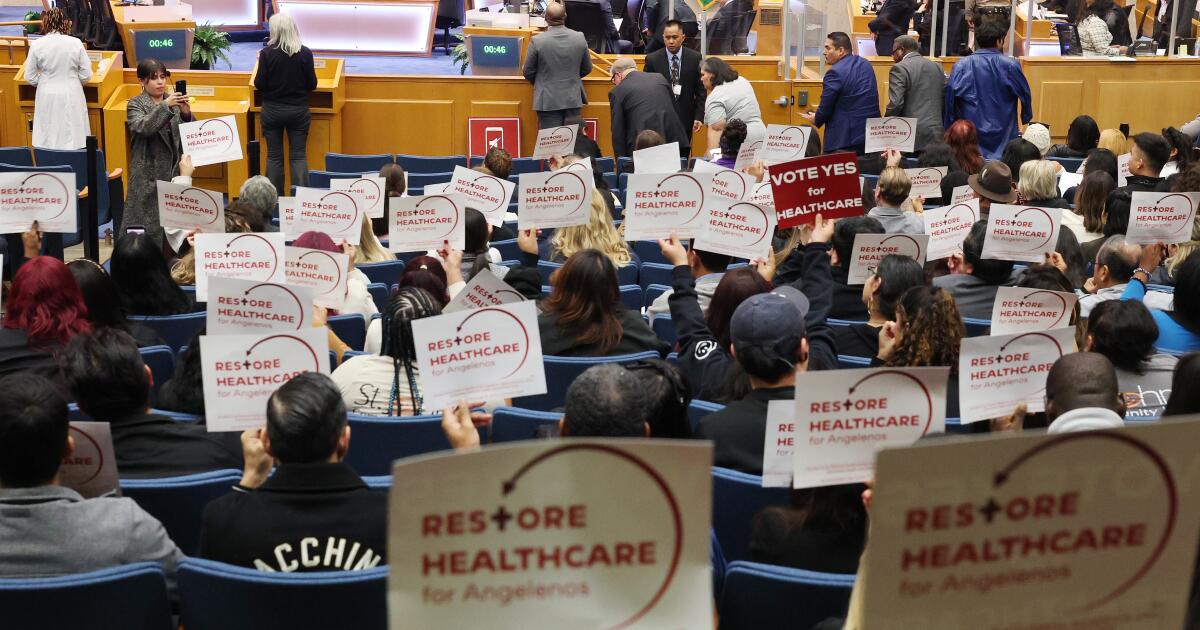
Supporters of a half-cent sales tax proposed to help fund health services in Los Angeles County declared victory Tuesday after days of steadily gaining ground as more ballots were counted.
The latest results show the “yes” camp ahead by a slim margin, with just more than 50% of the vote. The measure needs a simple majority to win.
“Today, Angelenos sent a clear message: we take care of each other,” said Jim Mangia, chief executive of St. John’s Community Health and a spokesperson for the campaign, in a statement. “For months, we watched Washington make decisions that stripped healthcare away from hundreds of thousands of our neighbors — and today, Los Angeles County answered.”
The campaign said it would be organizing a news conference Wednesday to celebrate the “historic win.”
The proposal, on the ballot as Measure ER, had gained traction since election night, when results showed the tax had failed to gain a majority of support among early voters. Voters have not rejected a sales tax hike in L.A. County since 2012, when a transportation measure fell just short of a needed two-thirds majority with 66.1% support.
Approval of Measure ER would impose a new sales tax of half a penny of every dollar spent in the county, with the proceeds going to local hospitals and clinics that say they’re bleeding funding after federal cuts. Officials anticipate it will bring in $1 billion annually to patch the holes in the health services network.
The tax, which was championed by a coalition of healthcare advocates, takes effect Oct. 1 and will last for five years.
WARNER, N.H. — For Rahm Emanuel, the road to the White House runs through the uphill climbs of rural New Hampshire.
The onetime Democratic congressman, White House chief of staff, Chicago mayor and U.S. ambassador to Japan hasn’t formally announced his ambition to return to power in Washington. But his weekend trip through the state that typically holds the first presidential primary was hardly subtle.
There were the union hall visits and intimate house parties, staples of New Hampshire political rituals. At one event in the backyard of a handsome home in Concord, Emanuel greeted voters and practiced a stump speech that highlighted strains on the middle class and the excesses of the tax system.
And then there was the bike tour.
Over the course of three days, Emanuel pedaled more than 117 miles across New Hampshire from Portsmouth on the coast to Hanover on the Vermont border in what he dubbed the “Spin-Free Tour,” a nod to his blunt demeanor that he sees as an asset for a Democratic Party trying to move beyond its devastating losses in 2024.
“Tough times require a tough leader,” Emanuel told the Associated Press during a break at a coffee shop in Warner. “I don’t think this is just about learning the words to ‘Kumbaya.’”
For someone who has spent the better part of three decades in the highest orbits of political power, the 66-year-old Emanuel is in the unusual position of lacking a natural platform. His likely rivals in a Democratic presidential contest are mostly younger and, as governors, senators or a recently departed vice president, can more easily attract attention.
And despite his thick resume, Emanuel isn’t especially well known outside political circles, as demonstrated by a woman who asked who he was after he left the coffee shop. When informed that it was Emanuel and that he was considering a campaign, she responded, “A campaign for what?”
How Emanuel taps into tenacity to overcome hurdles
Emanuel is tapping into his hard-wired tenacity in hopes of overcoming such challenges.
As many prominent Democrats focus on castigating President Trump, Emanuel has released a flurry of policy proposals addressing everything from social media bans for children to prediction markets and a mandatory retirement age of 75 for those in public office. That would prevent him from seeking a second term if he were elected.
Emanuel is often on the road, talking education in Mississippi and Michigan. He’ll travel to Israel next month to address the U.S.-Israeli relationship as the war in Gaza has spurred new divisions in both political parties, especially among younger voters.
He is a regular guest on podcasts ranging from those hosted by Katie Couric and Kara Swisher to shows focused on fly fishing. He often uses the appearances to knock his own party for overreaching in cultural debates, particularly those involving the rights of transgender people. It’s a message of centrism that has echoes of that of the first president he served, Bill Clinton.
“We did things that were really ridiculous,” he said of Democrats on an episode of Couric’s podcast that posted last week. “Rather than worry about classroom excellence, we were worried about bathroom and locker room access.”
And he hops on the bike.
The tour gives him a chance to both demonstrate his physical fitness at a time of heightened awareness of the nation’s aging political leaders and to introduce himself to the state’s notoriously picky voters before the rest of the field swoops in after the November midterms.
“It is early,” said Rep. Maggie Goodlander, D-N.H., who appeared alongside Emanuel at the Concord house party. “But what I’d say is the people in New Hampshire know how to vet candidates and they’re the most engaged electorate in the country.”
Martha Kruse, a 76-year-old retired special education teacher from Laconia, New Hampshire, is just that type of voter. Active in her local Democratic Party, she traveled to the Concord event to see Emanuel after hearing him in interviews.
“I’m going away really enthused about him,” she said, adding that he was “right on” to prepare a campaign so early.
Riding through the hills of rural New Hampshire
The future of the presidency seemed a world away during a hilly 20-mile stretch of the ride on Saturday, which included an elevation gain of more than 1,300 feet. Along with a cadre of friends and aides, Emanuel cycled past homes where residents were tending to their yards or celebrating a recent graduation on their front patio. He was chatty at times as he rode with the pack and cycled alone at other points, showing little strain in navigating the steep hills.
With summer finally creeping into New England, the humidity was high and the rain was occasionally intense. The group stopped for water and snacks every 10 to 15 miles, huddling under a barn during one rainy stretch. A small group of local activists met up with Emanuel at the coffee shop in Warner, where he held court from a rocking chair.
But the realities of modern politics occasionally asserted themselves. The group cycled past signs praising Trump and denigrating his predecessor, Joe Biden. As the miles dragged on, a chase vehicle crept by periodically with cameras poking out the window to capture scenes that could later be shared on social media, where Emanuel now has an almost daily presence.
And the whir of the midterms wasn’t far away. In neighboring Maine, Graham Platner was contending with a drumbeat of reports about his history with women that has left some Democrats worried that the party’s path to a Senate majority is suddenly imperiled. Emanuel, who helped power Democrats to their sweeping 2006 victories in the U.S. House, said the “jury is still out” on whether Platner can win the Senate race.
“Everybody is holding their breath whether this is the start of something or the end of something,” he said.
Emanuel hopes voices of moderation are prevailing
But as the broader debate over the Democratic Party’s ideological future unfolds, Emanuel said he thought voices of moderation were prevailing. He noted recent wins by Rebecca Bennett, who emerged from a crowded Democratic primary in New Jersey with the nomination for a competitive House seat, along with Josh Turek, the new Democratic Senate nominee in Iowa.
“There’s a bigger character piece to this than ideological,” Emanuel said. “There’s radical moderates and their profile and character speak to kind of fighting a system, which is what’s needed right now.”
The bike tour was certainly not John McCain’s “Straight Talk Express,” the 2000 campaign bus from which the Arizona Republican senator opined on any question that came his way to seize attention and mount a surprise New Hampshire win over front-runner George W. Bush. But some voters said they were open to Emanuel.
Don Daley, a 60-year-old state employee from Concord, watched Emanuel talk from a bench in the backyard of the house party. He said that Emanuel probably “steps on a few toes.”
“But I think that’s what we need right now,” he said. “Some of our Democratic leaders haven’t been strong enough.”
WASHINGTON — Democrats’ path to winning control of the Senate probably runs through Maine — where voters were set to head to the polls Tuesday after several days of growing party anxiety about Graham Platner, who has faced a string of controversies as the likely Democratic candidate.
Democrats not just in Maine but around the country — including in Texas, Iowa and other red states where the party’s mission to flip Senate seats would become more urgent if its prospects in Maine faltered — were closely watching Platner’s performance in Tuesday’s primary.
“They’ve probably become if not less optimistic, at least more nervous over the last 10 days or so,” said Mark Brewer, a political science professor at the University of Maine.
Democrats face a challenging map as they seek to regain control of both chambers of Congress and claw back power in Washington. Unseating Sen. Susan Collins, the veteran Maine Republican, has been viewed as one of the party’s best chances, Brewer said.
Platner’s primary opponent, Maine Gov. Janet Mills, suspended her campaign in late April, clearing his path. He is generally expected to prevail as the Democratic nominee, but what percentage of his party’s vote he captures could help indicate how strong his candidacy will be in the general election, said John Cluverius, director of survey research for the Center for Public Opinion at UMass Lowell, which has conducted polling on the race.
“It’s critical [for Democrats], because without Maine, to win back the Senate you would need to win in states that Donald Trump won overwhelmingly,” Cluverius said.
Platner, an oyster farmer and Marine Corps veteran, emerged as a political outsider and quickly gained popularity.
But apparent scandals followed him. The latest came Thursday, when the New York Times reported that three ex-girlfriends of Platner’s had described his behavior as volatile and, by one account, physically rough. Platner, who denied the latter allegation, had previously addressed controversies related to his texting of women outside his marriage, a Nazi-style tattoo and old Reddit posts.
Over the weekend, Platner projected confidence. He took questions from audience members at a Sunday town hall, and on Friday, the campaign saw its best fundraising day since Mills suspended her bid opposing Platner for the nomination, bringing in $200,000 in 24 hours, a campaign official said.
“Since the beginning, Maine, you had my back,” Platner told supporters at a Friday rally. He drew a standing ovation when he continued: “Now, as every single piece of that past and journey gets dug up, litigated and weaponized, you have my back.”
Platner described the allegations against him as “politically motivated” and false.
The controversies surrounding him could help Collins, who has a track record as a political survivor, Brewer said. In 2020, the last time Collins was reelected, polls predicted she would lose to her Democratic opponent, but she secured reelection, even as the state went for Democrat Joe Biden in the presidential race.
“Her position has probably improved over the last few weeks,” Brewer said. “She has mostly stayed out of the way on this and let the negative stories pile up.
Last week, Democratic leaders largely stood by Platner, as Senate Minority Leader Chuck Schumer indicated the party would continue to back him. Rep. Ro Khanna (D-Fremont) campaigned with him at the Friday rally. Sen. Elizabeth Warren (D-Mass.) recorded a call to prospective voters on his behalf, and Sen. Brian Schatz (D-Hawaii) appeared at a virtual fundraiser, according to a source familiar with the plans.
The political calculus comes down to whether “they would rather have a Senate majority with Graham Platner in it than a Senate minority without Graham Platner in it,” Culverius said.
Democrats must flip at least four Republican seats to take control of the Senate, a difficult task. The Maine seat is the only possible Democratic flip in a state that went for Democratic presidential nominee Kamala Harris in 2024 rather than for President Trump.
Democrats are also looking for victory in Texas, Iowa, Ohio, North Carolina or Alaska, all states that went for Trump in 2024. The party must additionally retain their seats in competitive races in Michigan, New Hampshire and Georgia.
How Platner affects his party’s chances of taking Senate control depends on what happens next, Brewer said.
“What else are we going to see? And I don’t know that anybody knows that at this point,” Brewer said. “I think that’s really what Democrats have to worry about the most. Is this as bad as it gets, or is there other stuff?”
Voters are willing to overlook scandal more readily than in the past, said Brandon Rottinghaus, a political scientist at the University of Houston. And in these midterm elections, Democratic voters view the stakes as “extremely high.”
“Most voters are looking at the prospect of winning and losing,” he said. “Parties are worried about getting the win.”
AUSTIN, Texas — A lawyer who represented Texas Atty. Gen. Ken Paxton for nearly a decade over accusations of corruption and securities fraud is supporting Democrat James Talarico — and not his former client — in one of the biggest U.S. Senate races.
Talarico on Monday drew attention to his campaign winning the endorsement of Houston attorney Dan Cogdell, who was part of Paxton’s defense team during the Republican’s historic impeachment trial in 2023 that ended in acquittal.
The legal troubles that shadowed Paxton in public office in Texas are a central attack line of Talarico’s campaign, though in his endorsement, Cogdell didn’t cite concerns about his client’s past.
Cogdell said he didn’t dislike Paxton as a person and felt that Texas lawmakers were right to eventually acquit the attorney general. But as a politician, Cogdell said, Paxton is too focused on appeasing President Trump.
“I worked my ass off for the man for nine years,” Cogdell said in an interview with the Associated Press. “But that’s a different inquiry, my obligation to Ken ended at the courthouse steps and my obligation as a citizen is to do what I think is the right thing.”
Cogdell said Texas needs a lot of work, pointing to education and health care, “and to simply bootlick or rubber stamp Trump, that’s not what we need in D.C. right now.” He also recently spoke to Talarico at length on Cogdell’s podcast.ty.
Asked for comment, an aide to Paxton’s campaign said Cogdell is a Democrat and called the endorsement unsurprising.
The lead defense attorney in Paxton’s impeachment trial, Tony Buzbee, reiterated that on X. Buzbee added that he was supporting Paxton in the race.
Cogdell described himself as a registered Democrat, although voters in Texas do not register by political party. He added, however, that he considers himself a moderate who has given more campaign contributions over the years to Republican candidates than Democrats.
Talarico has given Democrats hope of flipping the statewide seat in Texas blue as the party scrambles to retake control of the U.S. Senate in November.
Paxton’s insurgent campaign beat Sen. John Cornyn in the Republican Senate primary runoff last month, helped by a Trump endorsement in the final days of the race.
Veteran Democratic politician Xavier Becerra won one of the top two spots in California’s primary election for governor, according to the Associated Press, a finish that puts him in a prime position to win in November and make history as California’s first elected Latino governor.
“The people of the great state of California, in the greatest nation on earth, have spoken — loudly and proudly,” Xavier Becerra said in a statement Friday. “We will not be bought. We will not be bullied. And we are never backing down. November, here we come.”
Former Fox News host Steve Hilton, a Republican, remains in a close second and appears on the cusp of securing the right to face off with Becerra in the November general election.
Tom Steyer, a hedge fund manager turned climate change activist, may be destined to finish in third place — which would be a disappointing end to a campaign that saturated California’s television screens, social media scrolls and mailboxes thanks to the progressive Democrat spending $216 million of his own wealth.
Becerra’s victory was declared by the Associated Press on Friday evening, three days after the June 2 election — an indication of the competitive race to replace termed-out Gov. Gavin Newsom and California’s lengthy process of counting ballots. Still, Becerra and Hilton were within a percentage point of each other, though that could change as the vote tally continues. While his fate is not sealed, Steyer faces long odds to finish in the top two.
Under California’s primary system, only the two candidates who receive the most votes in the primary advance to the November general election, regardless of their party affiliation.
Becerra would enter the general election campaign with a significant edge over Hilton since Democratic voters in California outnumber Republicans by almost a 2-to-1 margin, a telltale reason why no GOP candidate has won a statewide race since 2006.
President Trump’s endorsement of Hilton helped consolidate support from Republican voters, which was pivotal to his success in the primary, but would likely hurt him in a face-off against Becerra. Nearly two-thirds of voters in the state want a governor who will fight Trump’s policies, according to the survey by UC Berkeley’s Institute of Governmental Studies that was co-sponsored by the Los Angeles Times.
Becerra could make history by becoming the first Latino to be elected governor — and the first to lead the state in more than 150 years. The last time a Latino held the office was in 1875, when then-Lt. Gov. Romualdo Pacheco was elevated to fill a vacancy and served for 10 months.
“California has made history. Xavier Becerra’s advancement to the general election is a defining moment both for the state, and for the millions of Latino families who have been instrumental in shaping the state’s future. … As home to the nation’s largest Latino population, California will once again demonstrate the decisive power of Latino voters,” said Voto Latino Executive Director Beatriz Lopez.
Though Latinos make up about 40% of the state’s population and are California’s largest ethnic group, they historically have lower turnout in elections and are underrepresented in government. Though Becerra often cites his upbringing as a child of working-class Mexican immigrants, he will still need to demonstrate he can deliver for those communities, said Christian Arana, vice president of civic power and policy at the California-based Latino Community Foundation.
“There’s a lot of excitement about the representation side,” Arana said. “You can have Latino representation, but whether or not that will actually lead to tangible outcomes for Latino communities, that’s what people want to know.”
Once stuck in the single-digits in public opinion polls with a handful of other Democratic candidates, Becerra rose quickly and unexpectedly following the political demise of former Rep. Eric Swalwell.
Becerra’s rise began days after Swalwell dropped out in April following allegations of sexual assault and misconduct, which he denies. Becerra quickly consolidated support from elected officials including Assembly Speaker Robert Rivas and influential groups like Planned Parenthood Affiliates of California and the California Medical Assn.
But both supporters and critics of Becerra struggle to explain exactly how or why he became the main beneficiary of Swalwell’s downfall.
Becerra’s campaign credits the timing of a major television and digital advertising push. The political ads began running just before the allegations against Swalwell came out and depicted Becerra as a calm, experienced leader with a record pushing back against Trump and support from Young Democrat groups.
Steyer’s campaign hired an intelligence firm to look into the online surge favoring Becerra and found thousands of bot accounts had amplified Becerra on various social media platforms. Becerra’s campaign denied any involvement and dismissed the influence of the fake accounts.
Political experts describe it as the stars aligning for the longtime Democratic politician. In the aftermath of the scandal, voters were apparently drawn to Becerra’s long resume and calm, thoughtful demeanor.
“He just never overreacted. Even when attacked [during debates], he was calm,” said Fernando Guerra, professor of Chicano Studies at Loyola Marymount University. That “gave the sense of being a moderate, while he’s really a liberal, so he was able to appeal not only to Latinos, but to liberals and to moderates.”
After Swalwell’s campaign crumbled, members of the political brain trust — many with ties to Newsom — that had been advising the former congressman began working for Becerra, including digital strategist Alf LaMont and veteran consultants Courtni Pugh and Lindsey Cobia.
“There was nothing going for him for a long, long time,” said Jason McDaniel, associate professor of political science at San Francisco State University. “I do think it was just people looking for someone who had a lot of experience who could win.”
Becerra’s first election victory was to the state Assembly in 1990. He served one term before successfully running for a Los Angeles congressional seat, which he held for 24 years.
Then-Gov. Jerry Brown appointed Becerra as state attorney general in 2017, a post he used to challenge Trump administration policies in the courts more than a 100 times — with great success. Becerra helped craft the Affordable Care Act in Congress and defended it as attorney general, and Joe Biden nominated him to serve as Health and Human Services secretary.
The 68-year-old veteran elected official has faced criticism on the campaign trail for his record leading the massive federal agency, particularly over a New York Times investigation that found thousands of unaccompanied migrant children ended up working in dangerous jobs after they were released to sponsors.
Some former Biden administration officials, many of them anonymous, have also criticized Becerra’s leadership of the agency.
Still, Becerra’s supporters said the candidate’s experience, particularly when it comes to fighting the Trump administration, qualifies him for California’s top job.
“He’s had some very important positions in government,” labor leader Dolores Huerta said at Becerra’s election night party in downtown Los Angeles. “He is qualified. He doesn’t have to go into a learning mode.”
“He’s a legal scholar,” said David Dixon, a political science professor at Cal State Dominguez Hills and brother to a longtime Becerra aide. “When our Constitution is threatened, we need people like him to be in positions of power to reclaim things we are losing now.”
Times staff writers Seema Mehta, Dakota Smith and Andrew Khouri contributed to this report.
WASHINGTON — The last time Washington, D.C., residents chose a new delegate to Congress and a new mayor in the same election, gas was $1.33 a gallon and George H.W. Bush was president.
This fall they will do it again — under starkly different circumstances.
As the city heads toward pivotal primaries this month to pick candidates for those roles, President Trump’s influence on the nation’s capital is shaping up as a major campaign issue. The fresh slate of candidates is weighing how best to approach Trump’s Republican administration and congressional control over the heavily Democratic city’s affairs.
“It’s going to be a big sea change in city politics, no matter how the elections shake out,” said Amanda Huron, a professor at the University of the District of Columbia who teaches courses on D.C. history and politics. But Washington’s lack of full autonomy brings “all sorts of peculiarities around the city’s governance.”
Since Trump returned to office last year, the National Guard is on an open-ended deployment as part of what he calls a crime-fighting mission. He is putting his personal imprint on the city’s storied landmarks. And major cuts to the federal workforce have compounded economic pressures on the capital, which has one of the country’s highest unemployment rates.
The city has long had a unique, if fraught, relationship with the federal government: While residents can vote for their local leaders, they are limited by Washington’s status as a federal district in how much influence they can actually have on the city’s affairs. That limited autonomy has been further squeezed under Trump and his federal law enforcement takeover, launched last year.
This fall, current council members Janeese Lewis George and Kenyan McDuffie are the frontrunners vying to replace Mayor Muriel Bowser, elected in 2014. The leading candidates in the race to succeed long-serving congressional Del. Eleanor Holmes Norton are Robert White Jr. and Brooke Pinto, also D.C. council members.
On June 16, primaries will be held for those roles, which in an overwhelmingly Democratic city usually dictate who will take the top spot come November.
Washington, and its elected officials, have limited autonomy
Washington, unlike other cities, does not control its fate.
What choices voters have is through a limited home rule agreement passed by Congress in 1973 that allowed residents to elect their local government leaders.
But Congress retains control over local affairs, including the approval of the budget and laws passed by the city council. Congressional members elected by voters from thousands of miles away routinely introduce measures to impact city affairs.
That has meant local leaders must balance pressures from their constituents with the demands of Congress and the administration — an act Bowser was forced to perform repeatedly.
During Trump’s first term, she ordered the painting and naming of Black Lives Matter Plaza, just north of the White House, in 2020. Just months after Trump’s inauguration to his second term, she agreed to remove it in response to pressure from congressional Republicans.
That act, the decimation of the federal workforce by the Department of Government Efficiency and the surge by federal law enforcement and the National Guard into the city have emerged as central themes in the election season. Right now, about 3,500 troops are in the city — a number authorities say will climb to 5,000 as the country’s 250th anniversary celebrations approach.
Trump has routinely said his intervention has made Washington “one of the safest” and most beautiful cities in the country, enjoying a historic drop in crime.
Candidates campaign on promise of resistance to Trump
George told The Associated Press that her top priority is addressing “the affordability crisis here in D.C., which the Trump administration has only made worse by unjustly firing federal employees en masse and militarizing our streets.”
McDuffie said his top priority is public safety as crime continues to be an issue. He has said he would add 1,000 police officers over four years, fully staff the 911 call center after years of chronic staffing shortages and take a public health approach to violence reduction.
“We cannot have an affordable city,” he said, “without public safety as its foundation.”
Both said they would bolster the city’s legal defenses against federal overreach and said Bowser should have been less cooperative with federal authorities as they targeted members of the city’s immigrant communities.
Alex Dodd, co-founder of Free DC, an activist group supporting city independence, said the organization endorsed George because of her willingness to be more aggressive in opposing Trump and congressional Republicans.
“When our leaders comply with this administration before being forced, they are giving this regime an enormous advantage,” he said.
Pat Wheeler, a native Washingtonian and communications consultant who served as a department head at Morgan State University, applauded Bowser for cooperating with the Trump administration on some aspects. She noted failure to do so could have sparked retribution and a loss of what little control city officials have.
“Trump can snap his finger and the whole Republican Congress will say, ‘Let’s put a federal control board over the mayor,’” she said.
Affordability and social issues also concerns
The D.C. delegate position is a nonvoting one, but it grants the nearly 700,000 people of the district, who have no other representation in Congress, a voice through speechmaking on the House floor and bill introduction.
But critics said the 88-year-old Norton was diminished during the second Trump administration and not visible enough in the fight against administration and congressional overreach on the city’s autonomy. She filed paperwork to end her campaign for reelection in January.
Norton, who has served 18 terms, has had a storied career. She and her predecessor, Walter Fauntroy Jr., both had national standing coming out of the civil rights era.
“Eleanor Holmes Norton is maybe one of the last major political figures who comes out of the civil rights movement,” said Matt Dallek, a political historian at The George Washington University. “It’s a real passing of the torch.”
The campaigns of candidates running to replace her have centered on local control, Trump and affordability. Frontrunners and council members Pinto and White have also engaged in personal skirmishes questioning the origins of campaign contributions and connections to Republicans.
Pinto told the AP her top priority for the city is self-governance, something that has “never been a true reality for the people of D.C.”
She said affordability for the middle-class and working families is another concern.
White’s campaign has said he’s “not willing to continue to see our tax dollars used to allow DC police to cooperate and conspire with federal agents to trample our constitutional rights and to terrorize our communities.”
Brenda Manley, a longtime resident of Ward 7, an area with a storied Black history across the Anacostia River, said the city was well managed despite the tensions with Trump. But she said she hoped all the candidates would spend more time on the campaign focusing on programs that are beneficial to all residents, like a tuition grant program championed by Norton or major strides made in education during Bowser’s tenure.
PORTLAND, Maine — Graham Platner, the insurgent Democratic candidate for U.S. Senate in Maine, will hold his first major campaign rally Friday night as reports continue emerging about his history with women.
Last weekend, his campaign wrestled with stories about sexually explicit messages that Platner sent to several women while he was married. Then on Thursday, The New York Times reported about his relationships with previous girlfriends. Some viewed him positively but others described him as volatile and insulting.
One woman said Platner twisted her arm during an argument and locked her in a room. Platner called that allegation untrue.
But with Maine’s primary around the corner Tuesday and Democrats desperate to rally behind a candidate who can defeat Republican Sen. Susan Collins in November, there’s been little sign of voters or political allies backing away from Platner, who has pitched himself as an imperfect person who has redeemed himself.
Some dismissed news of the text messages as a private matter, one that should be addressed solely by the married couple. Others argue that the need for Democrats to take back control of the U.S. Senate from Republicans is too important to cast aside imperfect candidates.
Yet they’re also wrestling with the question of whether more controversial information surrounding Platner could come out ahead of the November election.
“I think a lot of people are afraid,” said Deb Dagnan, chair of Maine’s Piscataquis County Democrats. “They’re waiting for the other shoe to drop after he gets the nomination. Then what do we do?”
Key to the Senate
Platner is key to Democrats hopes’ to take back the U.S. Senate this year. Yet he’s been bedeviled by near-constant controversies involving his disclosure of a since-covered tattoo of a Nazi symbol, his history of inflammatory online comments and the texting revelations.
Nevertheless, Platner’s most prominent supporters have continued to back the candidate, including Sens. Bernie Sanders, Elizabeth Warren and Ruben Gallego. Platner is scheduled to appear in Bar Harbor Friday evening with progressive Rep. Ro Khanna of California, as well as Democratic candidates for U.S. House and governor, as a part of a “get out the vote” rally in the coastal resort town.
The event is taking place just days ahead of the state’s June 9 primary election, where Platner is expected to secure the Democratic nomination. His top opponent, Gov. Janet Mills, suspended her campaign in late April.
He’ll do so under reignited scrutiny amid reports that he and his wife, Amy Gertner, have had marital difficulties and sought counseling after he allegedly sent sexually explicit text messages to other women.
According to The Wall Street Journal, Gertner had told the campaign in August about the messages, which she had discovered on his phone last year, to make sure they weren’t a liability to the campaign. Platner’s campaign team reportedly decided that the texts were private and being handled by the couple, who were married in 2023.
Genevieve McDonald, a former campaign staffer for Platner, told The Associated Press that the candidate was “sexting multiple women while married” and that “the campaign tried to assess that as an election vulnerability.”
Shortly after the news came out, Platner posted a five-minute video taken by Gertner, who avoided speaking directly about her husband’s reported texts but dubbed the broader coverage as “gossip” and said “being married is hard.”
Voters worry that more scandals lurk
Gertner’s emotional comments about working on her marriage have resonated with some women, who say they are shocked that a former campaign aide would betray someone’s trust and the issue should remain between the couple.
“It’s none of my business as far as I’m concerned,” said Joanne Mason, a local Democratic leader from south-central Maine. “And I would hope that people wouldn’t judge any one person on their own private marriage.”
Valerie Tate, a Democrat from Belfast, described Gertner’s honesty about trying to work on their mental health and marriage as admirable.
“That is not a scandal,” Tate wrote in an email. “That is integrity. Personal growth is not a disqualification from public life. For many of us, it is precisely what made us worthy of it.”
However, Tate conceded that her mind wasn’t fully at ease. With the public still learning about Platner’s past, there is a chance something could emerge as a dealbreaker for voters.
“Of course, there is that concern as there would be in any race with somebody we don’t know all the dramas and the journeys they’ve been on,” she wrote. “Something could come out that would be disqualifying.”
Past controversies simmer
This isn’t the first time Platner has faced questions about his past. He had a tattoo recognized as a Nazi symbol, which he had covered up after starting his campaign.
Platner has said he didn’t realize the meaning of the tattoo. However, a former girlfriend told the Times he joked about it being a Nazi symbol and called it “my Totenkopf.”
There’s also been much attention on Platner’s former Reddit posts, which were dismissive of military sexual assaults and used homophobic slurs, for which he has apologized.
Platner has never held elected office and has fashioned a straight-talking, progressive, populist-style campaign focusing on issues such as income inequality, lack of health care accessibility and the rising cost of housing. In return, he’s attracted thousands at his rallies and campaign events and collected millions in campaign funds to further boost his messaging.
“People want somebody new,” said Paige Zeigler, a former Maine Democratic lawmaker and head of the Waldo County Democrats, on why Platner’s staying power has remained strong. “They want somebody that they feel that they can embrace. And Platner is riding that wave.”
Whittle and Kruesi write for the Associated Press. Kruesi reported from Providence, R.I.
A huge, waning moon glimmered over Los Angeles on election night, a metaphor for a trend that emerged in early returns.
The city’s political establishment seemed to be on the retreat in favor of populist insurgents from both the left and the right.
Mayor Karen Bass held a cushy lead in her bid for a second term, and the Associated Press declared that she had made it into the November runoff election. But the underwhelming amount of support she got thus far showed that many voters in a super-blue city didn’t have enough confidence in a Democratic stalwart to return her to office. Instead, many chose self-proclaimed upstarts from opposite ends of the political spectrum: Republican reality TV star Spencer Pratt and democratic socialist City Councilmember Nithya Raman.
Raman launched her campaign at the last moment, just weeks after endorsing her longtime ally Bass, figuring that enough Angelenos were tired of the incumbent and would join her message of change from inside City Hall.
Raman’s instincts were half right. Voters did want change. But they didn’t view her as a challenge to the status quo — to many, she is the status quo.
The mayoral hopeful didn’t articulate a platform that radically departed from Bass’, and voter antipathy to her muddled messaging showed: she ended the night in third place. If the current results hold, Bass would face Pratt in the runoff.
At Raman’s election-night party at Boomtown Brewery on the outskirts of Little Tokyo, I saw why her chances of becoming L.A.’s next mayor were slim from the start. The gathering felt like happy hour at a Silver Lake bar: far whiter than the city overall, with few Latinos. Her address to a packed house was a grab bag of platitudes mixed with a broadside against MAGA, which is a political nothing in L.A. politics. It was an uninspiring cri de coeur and reflective of a campaign that wasn’t apocalyptic enough for those, such as Pratt’s people, who want radical change, while offering nothing new for Bass supporters.
Yet Raman still insisted she had unlocked something transformative.
“Together, we built something extraordinary,” she said to cheers. “And it gives me so much inspiration to be a part of it, a movement powered not by cynicism or political insiders, but by ordinary people who still believe Los Angeles is worth fighting for.”
Raman then went on the dance floor to greet well-wishers, pumping her fist while a DJ blasted Daft Punk’s “Lose Yourself to Dance.”
A billboard for L.A. mayoral candidate Spencer Pratt near MacArthur Park on June 2, 2026.
(Ronaldo Bolanos / Los Angeles Times)
Across town in West Los Angeles, Pratt reveled in his second-place position, enjoying a Mexican dinner with friends and family. It was a peaceful conclusion to a spring of fulminations against Bass (“Karen Basura”), nonprofits, homeless people (“zombies”) and anything that reeked of Democratic pieties, even as the Republican swore he was campaigning for all ideologies in a nonpartisan race.
Long dismissed as a has-been joke, Pratt correctly judged that Angelenos are angry and don’t want to be polite about it anymore. He and his supporters will take his unlikely rise as a mandate to double down against liberal L.A.
But if Pratt, who lost his house in the Palisades fire, does move on to the general election and is serious about winning, he needs to learn from the political revolution successfully pursued by his polar opposites, the local chapter of the Democratic Socialists of America.
Six years ago this spring, L.A.’s political establishment wrote off DSA-LA as wokoso upstarts in their long-shot quest to get a political novice named Nithya Raman elected to the city council. Even as Raman and three other DSA members joined the council, skeptics dismissed them and their progressive policies as anomalies that didn’t reflect how Angelenos actually wanted the city to work.
Tuesday night, four of the six DSA-endorsed candidates in L.A. city elections were in first place by large margins and another was comfortably in second, reflecting DSA’s multicultural, citywide reach. In a telling sign of its newfound king-making status, the local chapter declined to endorse Raman or any other mayoral candidate. Without that powerful backing, their trailblazer, along with DSA member Rae Huang, withered on their L.A. revolutionary vine.
Councilmember Hugo Soto-Martínez and L.A. Unified school board member Rocío Rivas looked to be coasting to outright victories. Marissa Roy was on her way to a runoff that would exclude the incumbent city attorney, Hydee Feldstein Soto, who was a distant third in the early returns. In District 9, where Curren Price is terming out, Estuardo Mazariegos stood comfortably in second place and looked to headed to a runoff against a fellow Latino candidate in a race that will see South Los Angeles elect its first non-Black council member in 63 years.
The most surprising outcome involved Councilmember Eunisses Hernandez, who became a punching bag, along with Bass, for people who thought L.A. had transformed into a hellhole. So-called dark money groups, which don’t have to reveal where their funding comes from, poured hundreds of thousands of dollars into negative mailers. Opponents vying for her seat cast federal raids against drug dealers and gangs in the MacArthur Park area as an indictment of her leadership, berating her during debates and on social media.
Even Hernandez’s supporters were fretting about what might happen on election night. But by the time I arrived at her raucous soirée in Highland Park, early returns showed her way ahead of the field and perhaps avoiding a runoff.
“It’s reassuring to see [DSA’s success],” she said as jubilant supporters lined up beside her to get tattoos — real ink, not temporary — of hummingbirds, her campaign’s logo. “That means people see us. That means people want more.”
Hernandez pointed to her fellow DSA member, New York City Mayor Zohran Mamdani.
“What happened with DSA over there didn’t happen overnight,” she said. “In L.A., we’re getting there.”
A table filled with campaign buttons for Council Memer Hugo Soto-Martinez, who ran for reelection this year and is expected to win outright.
But anyone who wants to win in Los Angeles needs to realize that antiestablishment sentiment is in the air.
At the same time, I would remind the victorious populists to look up in the sky and remember their Shakespeare.
“O, swear not by the moon, th’ inconstant moon / That monthly changes in her circle orb / Lest that thy love prove likewise variable,” Juliet warned Romeo.
Politics, like la luna, waxes and wanes whether we like it or not, and anyone who bets on a permanent transformation at City Hall will probably lose.
Angelenos have declared that they want dramatic change. But how will they feel in November?
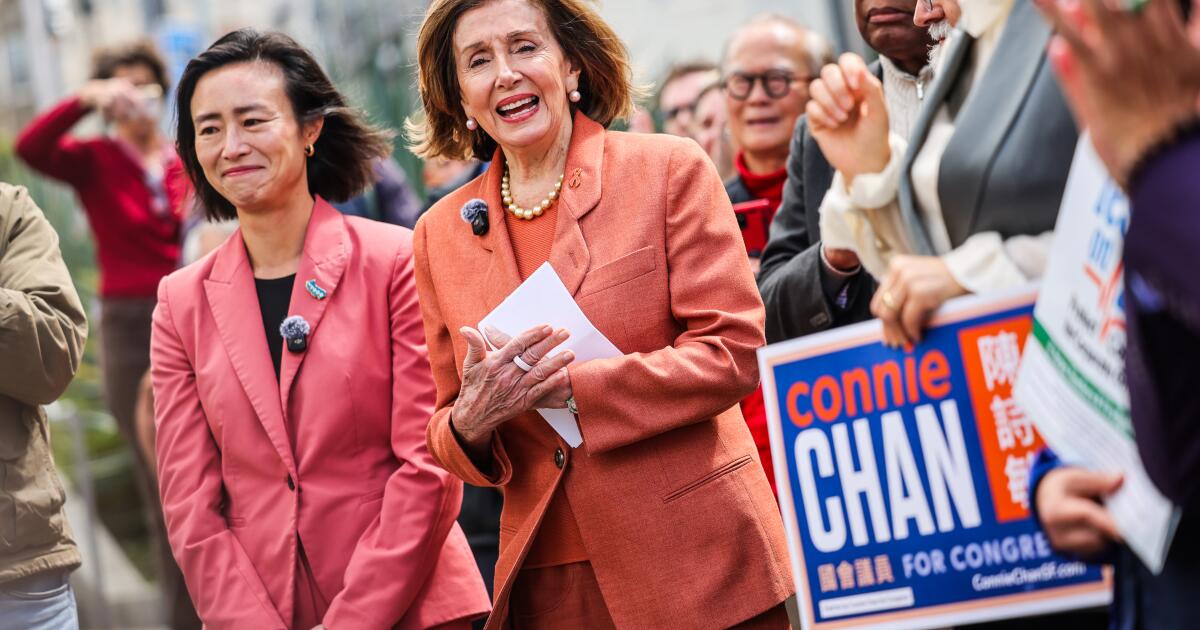
Even on her way out, Rep. Nancy Pelosi (D-San Francisco) — 86 and retiring — held sway.
Last month, in the final stretch of the race to replace her, Pelosi endorsed Connie Chan, a member of the San Francisco board of supervisors and a candidate who had until then struggled to gain traction. The move clearly had an effect, with Chan advancing out of Tuesday’s primary to the general election in November, according to the Associated Press.
Political observers were quick to note that Pelosi’s famed political influence was alive and well, as made clear as of Wednesday morning by Chan’s bounding past the third-place finisher, tech millionaire and Democratic political operative Saikat Chakrabarti, who self-funded his campaign to the tune of nearly $10 million.
But cast another way, the race’s early results also showed the limits of Pelosi’s influence — in the form of state Sen. Scott Wiener, who as of Wednesday morning was clearly the race’s front-runner, holding a double-digit lead over both Chan and Chakrabarti.
Wiener — an ambitious and prolific state lawmaker with a strong base in San Francisco, particularly in the liberal bastion’s LGBTQ+ community — has long eyed the seat but held off from running for years in deference to Pelosi, a trailblazing politician and one of the most powerful of her generation. She was the first woman ever elected House Speaker in 2007 and oversaw both of President Trump’s first-term impeachments.
However, that changed in late October, when Wiener, 56, announced he couldn’t wait any longer and would be running this year. His announcement came before Pelosi had announced her own plans, amid broader party backlash against gerontocracy and elderly incumbents holding on within the aging Democratic establishment, and it appeared to irk her.
In early November, shortly after California voters passed Proposition 50 to allow Democrats to redraw the state’s congressional districts to better favor Democrats — an initiative she helped spearhead — the still influential Pelosi announced she would retire.
In that announcement, Pelosi thanked San Francisco voters for giving her wide latitude to be a fearless voice in Washington. She hadn’t faced a serious election challenge since the Reagan administration. In her last race, in 2024, she won reelection with 81% of the vote.
Pelosi then waited until last month to endorse Chan as her chosen successor.
Chan, 47, who was born in Hong Kong and immigrated to San Francisco with her family at age 13, was first elected to the board of supervisors in 2020, and has been chair of its budget committee since February 2023. Before winning office, she was a Chinese interpreter and then an aide for nearly 15 years to several different Democratic politicians from the Bay Area, including then-San Francisco Dist. Atty. Kamala Harris.
Other establishment figures, such as Sen. Adam Schiff (D-Calif.) and former San Francisco Mayor Willie Brown, endorsed Chan as well.
Last week, Pelosi said she’d decided to weigh in and back Chan in part because, after spending years boosting women into positions of power, she’d realized there weren’t enough around anymore.
“It’s not about women being better than men; it’s that we have to have women at the table,” she told NBC News.
At her election night party, Chan told the SF Standard that Pelosi’s endorsement “absolutely changed the tide” in the race, delivering a “fatal punch” on behalf of her campaign.
But that punch, if devastating to Chakrabarti’s campaign, had clearly not knocked out Wiener — who was ready Tuesday night with a few punches of his own in a speech to his supporters.
“Tonight, San Franciscans sent a very clear message,” he said, according to shared remarks. “San Franciscans are ready for bold leadership, real results, and a new generation of leaders that isn’t afraid to take on the toughest fights facing our country.”
Wiener, who served in the San Francisco board of supervisors himself before winning election to the state Senate in 2016, said in this political moment, “we can’t afford politics that simply preserve the status quo.”
He said, “I’m not going to Washington to sit quietly, protect the status quo, or wait my turn.”
“I’m going to fight relentlessly for Medicare for all, to build millions of homes, to make public transit more expansive and reliable, for affordable clean energy, for working families, for civil rights, and for democracy itself,” he said. “I’m going to fight to protect our immigrant neighbors, LGBTQ people, reproductive freedom, and the rule of law — and to protect them from Donald Trump and MAGA extremism.”
Others, including many in the LGBTQ+ community, also cheered the strong showing from Wiener, who is gay and has long championed LGBTQ+ rights. Kelley Robinson, president of the LGBTQ+ rights organization Human Rights Campaign, said her organization was “thrilled.”
“We need more voices like Wiener in Washington. Not only would he expand the number of openly LGBTQ+ members of Congress, he has a record of impact and delivering for his constituents,” Robinson said. “We are excited to support him on to victory in November.”
With Tuesday’s primary settled, a new head-to-head race for Pelosi’s seat begins — one that, given her endorsement of Chan and Wiener’s intentional focus on pulling San Francisco in a new direction, will be an even clearer referendum on her influence.
Los Angeles’ music industry, in recent years, has generally supported progressive causes. But as the primaries for the city’s mayoral race and California‘s governorship wrapped up Tuesday, some music executives and performers have supported and donated large amounts to Spencer Pratt, the right-leaning activist and reality TV star running for mayor.
According to data from the Los Angeles City Ethics Commission, Pratt’s supporters include two members of the record industry’s most powerful family who donated the maximum amount allowed by law.
Pratt is a registered Republican whose heated rhetoric about homeless “zombies” and AI-created advertisements have rankled progressives and delighted conservatives. He has received support from President Trump, who told reporters that “I’d like to see him do well. He’s a character. I don’t know him, I assume he probably supports me… I heard he’s a big MAGA person.”
In response, Pratt told TMZ that “Everybody wants me to succeed because L.A. is the most important city in the country. The only support I need is from moms that wanna feel safe in Los Angeles. I’m laser-focused on that.”
Universal Music Group is home to some of music’s most outspoken progressives, including Olivia Rodrigo and Billie Eilish, whose brother and collaborator Finneas O’Connell donated $250 to the progressive mayoral candidate Nithya Raman on May 6.
Earlier this year, UMG’s chairman and chief executive Lucian Grainge presented Rodrigo with the company’s Universal Music Group x REVERB Amplifier Award, which advocates for “social and environmental nonprofit campaigns through the cultural power of music,” according to a release.
On May 9, Grainge (listed as a resident of Pacific Palisades, where Pratt lost his home in the 2025 fires) maxed out with an $1,800 donation to Pratt’s campaign, as previously reported in The Times. A representative for UMG did not immediately return a request for comment on Grainge’s donation.
He’s not the only Pratt donor in the family.
Grainge’s son Elliot ascended through the record industry with his 10k Projects label, and now heads UMG’s competitor Atlantic Records. Vocal progressives like Cardi B, the Marías and Charli XCX are some of the label’s most high-profile acts.
On May 8, Elliot Grainge also gave $1,800 to Pratt‘s campaign. A representative for Atlantic did not immediately return a request for comment.
Last month, the record producer and composing titan David Foster and his wife, singer Katharine McPhee, performed at a fundraiser for Pratt where they crooned a version of Tina Turner’s hit “The Best” to the mayoral hopeful. “Spencer, you’re simply the best. Better than all the rest. Better than Karen Bass and Nithya Raman,” McPhee sang.
At Warner Music, Gabz Landman, the senior vice president for A&R at Warner Chappell, its powerful music publishing wing, who has worked with Dua Lipa, Laufey and Amy Allen, gave $105.24 to Pratt on Feb. 4. Through a Warner Music representative, Landman said the donation was for merchandise given to a friend, and was not intended as support for Pratt’s campaign.
The superstar EDM producer and DJ Kaskade has left supportive messages on Pratt’s social media, commenting on one of the candidate’s posts that “At this point, who is buying in to Bass’s fairytale narrative?! I am still shocked she hasn’t resigned!” The DJ and producer Diplo also left a supportive comment — a prayer-hands emoji and “please” — on one of Pratt’s social media posts. Records do not show any personal donations to Pratt’s campaign from either artist.
Public records do not show any donations to Pratt’s campaign from live-industry executives atop firms like Live Nation, AEG or Goldenvoice.
WASHINGTON — Democratic Rep. Jimmy Gomez of Los Angeles is reportedly under investigation by the House Ethics Committee over sexual misconduct allegations.
The investigation came after the New York Post reported in April that the 51-year-old, five-term congressman had been spotted kissing a much younger congressional staffer from a different office in 2023.
According to CNN, which on Tuesday first reported news of the investigation, the congressional committee learned of other allegations of sexual misconduct as it investigated the report of Gomez’s 2023 conduct with the staffer.
The 2023 incident with Gomez and a younger staffer reportedly occurred at a party hosted by Swalwell, according to the New York Post. Gomez’s office denied the report at the time.
Another lawmaker, Texas Republican Rep. Tony Gonzales, also resigned from Congress in April in the wake of allegations of sexual misconduct with a former staffer who later committed suicide.
Both Swalwell and Gonzales were under investigation by the ethics committee before they resigned, but those investigations ended when they left office as the committee only has jurisdiction to investigate sitting members.
Gomez’s office didn’t respond to multiple requests for comment, but, in a statement to CNN, Gomez said he would cooperate with the ethics investigation. While he acknowledged making “personal mistakes” outside his marriage and apologized to his family, he said his actions didn’t violate House ethics rules.
“Years ago, I made personal mistakes outside my marriage that have caused real pain to my wife and family. Although my actions were consensual in nature and haven’t violated the law or House ethics rules, that doesn’t diminish the impact that these mistakes have made on those I care about the most,” Gomez said.
The House Ethics Committee declined to comment on the reported investigation.
Gomez is married to Mary Hodge, a past top aide to former Los Angeles Mayor Eric Garcetti. The couple have a son whom Gomez wore in a baby carrier during the lengthy House speaker election in 2023. That same year, Gomez founded the Congressional Dads Caucus, which has advocated for expanded child tax credits and other parent-friendly legislation.
The disclosure of the congressional investigation comes as Gomez faces a campaign challenge from Angela Gonzales-Torres, a Pasadena City College counselor with the backing of the progressive Justice Democrats.
Gonzales-Torres has criticized Gomez for receiving the backing of the American Israel Public Affairs Committee, or AIPAC, though Gomez has at times taken political stances at odds with the group.
After news of the ethics investigation broke, Gonzales-Torres wrote on the social media platform X, “I take political corruption seriously … I also take very seriously what appears to be a culture in Congress in which men abuse women.
“If @RepJimmyGomez has nothing to hide, he should have no concern. But if there was any criminal behavior that he witnessed, participated in, or helped conceal, we will find out and we will help ensure accountability and justice.”
Gomez was first elected to Congress in a 2017 special election to succeed Xavier Becerra, who is now running for governor and has seen the biggest boost in support following Swalwell’s departure from the race in April.
Gomez previously served in the state assembly from 2012 to 2017 and was political director for the United Nurses Assn. of California before that.
Xavier Becerra’s campaign for California governor appeared doomed just two months ago. Every major opinion poll showed the longtime Democratic politician mired near the bottom of the pack, overshadowed by his flashier or wealthier rivals.
Now Becerra tops them all, according to the most recent opinion polls, emerging as a surprise front-runner in a race that has confounded voters and political experts alike.
Both his loyal supporters and well-financed critics have a hard time explaining Becerra’s rapid ascent, with theories ranging from outright luck to a nefarious social media push. Others credit Becerra’s mild temperament, describing him as a steady figure — the Goldilocks candidate in a field of competitors who weren’t just right.
Becerra, when assessing his sudden rise, believes voters wanted experience, not “glitz and sizzle.”
“Folks put their faith in someone who’s done that kind of work and achieved results, someone who’s taken on real crises and been able to pull us out of them,” Becerra said in an interview Friday after a union rally in the Inland Empire. “Now it’s time to get things done. I think they’re looking for someone who could actually do that.”
Becerra’s team also points to the fortuitous timing of their seven-figure political ad campaign that launched shortly before explosive allegations of sexual assault and misconduct against the then-leading Democrat in the race, former Rep. Eric Swalwell. After Swalwell suspended his campaign on April 12, Becerra’s ascent began.
Becerra is backed by 25% of likely California voters, followed by Republican Steve Hilton at 21% and environmental activist Tom Steyer, a fellow Democrat, at 19%, according to a new UC Berkeley Institute for Governmental Studies poll co-sponsored by the Los Angeles Times. Two months ago, before Swalwell dropped out of the race, support for Becerra registered at just 5%.
“It’s almost too good to be true,” said Carrie Webster, a Becerra supporter and Long Beach hairdresser who interviews political candidates on social media using the name “Crowd Source Carrie.”
“He shot through the roof, but it feels like it’s all organic,” said Webster, 49, who said she isn’t paid for her political work.
A Sacramento resident, Becerra, 68, served one term in the state Legislature, more than two decades as a Los Angeles congressman and then as California attorney general, and most recently worked as the secretary of Health and Human Services in the Biden administration.
His only previous statewide race was his 2018 bid for attorney general. In that contest, which he won handily, he had the major advantage of incumbency after being appointed by Gov. Jerry Brown to fill the vacancy caused by then-Atty. Gen. Kamala Harris’ election to the U.S. Senate.
Running for governor has proved to be much more daunting. His top Democratic challengers not only include Steyer, a free-spending billionaire, but also former Los Angeles Mayor Antonio Villaraigosa, current San José Mayor Matt Mahan, former Orange County congresswoman Katie Porter and state Supt. of Public Instruction Tony Thurmond.
In early March, the chair of the California Democratic Party, Rusty Hicks, urged stuggling candidates to drop out of the race. He feared the crowded field of candidates would splinter the party’s voters and lead to a Republican being elected as the next governor of California.
Under the state’s top-two primary system, only the first- and second-place finishers in the primary advance to the November election, regardless of party. While Hicks did not mention Becerra by name, he was certainly among the struggling candidates at the time.
Until now, Becerra’s splashiest moment was in late March, when he launched a public pressure campaign to boycott a gubernatorial debate hosted by USC after he and other candidates of color were excluded from lineup. University officials based the invites on opinion polls and a controversial campaign fundraising formula. The debate was canceled less than 24 hours before it was scheduled to take place.
Then came the allegations against Swalwell, which prompted nationwide interest in the otherwise sleepy California governor’s race. Political data strategist Paul Mitchell compared the moment to a dramatic scene midway into a “Real Housewives” season.
“Finally, somebody flipped a table, threw wine on somebody else, and all the voters started paying attention,” he said.
Alf LaMont worked for Swalwell’s team as a digital communications expert until his firm quit on April 10 following news reports about the allegations against the East Bay Democratic congressman.
LaMont said he was “doomscrolling” that same night when he saw an “organic, random” push for Becerra on Threads and other social media sites. LaMont said he immediately called Becerra’s campaign team and signed up to work for him.
Webster, the Long Beach content creator, also noticed the online buzz about Becerra.
“People were saying, ‘Let’s print out yard signs, T-shirts,’” Webster said. “Or someone would say, ‘I’m going to start Gen X for Becerra,’ or ‘I’m going to start Millennials for Becerra.’”
The push was so noticeable that Steyer’s campaign hired an intelligence agency with ties to a major Israeli firm to study the trend.
The agency’s report found about 3,000 fake accounts that amplified Becerra across social media platforms X, Facebook and Instagram while also criticizing Steyer, according to Steyer’s team. In all, the fake accounts generated 1.3 million views and 42,000 engagements, the report stated.
Steyer spokesperson Kevin Liao alleged a coordinated network from Becerra’s team or his supporters. Becerra’s campaign denied any role and dismissed the influence of the fake accounts.
Earlier opinion polls also offer a possible explanation for Becerra’s rise.
Even as he remained stuck behind other candidates in support among voters, Becerra’s favorability ratings versus his unfavorability ratings were better than rivals, including Porter and Villaraigosa.
Swalwell also had high favorability ratings, and when he dropped out, Becerra was “seen as the least objectionable of the candidates that were remaining,” Mitchell said.
The UC Berkeley Institute poll released Thursday shows more likely voters viewed Becerra favorably (44%) than unfavorably (38%). By contrast, 39% of voters viewed Steyer favorably and 43% unfavorably.
Becerra’s campaign credits part of his April surge to good fortune. His team unleashed a large advertising buy — a major chunk of his remaining campaign funds — placing spots on cable TV and online beginning in late March.
The timing was opportune given the chaos caused by Swalwell.
Becerra’s ads depicted him as calm and experienced. One showed him speaking to a diverse group of young people about his record of challenging President Trump, suing his administration more than 100 times when he served as attorney general, and his plan to bring down the cost of living for “the next generation.”
At the same time, LaMont’s team — which also is behind Gov. Gavin Newsom’s political communications — created a more “earthy” and “grassroots” look to Becerra’s campaign ads and messaging. Words like “Tio” and “carne asada” emphasized the candidate’s Latino heritage.
Polls done in the wake of Swalwell’s exit showed Becerra gaining ground.
Special interest groups, including California Medical Assn., which had supported Swalwell, switched to Becerra. A well-financed, independent political committee campaigning against Steyer — an effort intended to benefit Swalwell — also moved over to Becerra. Major corporations, including Chevron, Meta and McDonald’s, lined up next.
Becerra appeared unprepared for the speed at which voters and others gravitated toward him. He stammered through hastily filmed videos asking for small-dollar donations as his campaign sought to convert the new interest around him into donors.
He appeared stiff during his first post-Swalwell debate appearance; he mistakenly referred to Trump’s “war in Iraq” instead of Iran during his first answer and fended off the first of many attacks to come during an April 22 debate. During a sit-down interview with a KTLA-TV reporter in Los Angeles in early May, Becerra went immediately on the defensive — questioning whether it was a “gotcha piece.”
Still, people flocked to town halls, including one in Oxnard in May, where he leaned into his “bad dad joke” persona. He greeted the large crowd with his corny, familiar line, “Did you think you were coming to a Bad Bunny concert?”
Oxnard audience member Rose Castren, 68, told The Times she liked Becerra’s “calm and reassuring” style. The retired nurse watched the CNN debate in early May, where the candidates piled on Becerra to try to undercut his momentum.
“The other candidates seemed to be coming unglued,” she said. “And he didn’t.”
Times staff writer Seema Mehta contributed to this report.
With former Biden Cabinet secretary Xavier Becerra surging in recent polls, the two candidates battling to win the second spot in this week’s primary and advance to the November election highlighted the strategic reasons why they believe voters ought to support them.
Republican Steve Hilton — a former conservative commentator who rocketed past his main GOP rival, Riverside County Sheriff Chad Bianco, after President Trump endorsed him in April — urged voters to back him to avoid the possibility of two Democrats facing off in November.
“I want us to fight like we are third. We aren’t going to let this slip away,” Hilton told a few hundred people at the Santa Monica Hilton Hotel & Suites on Sunday morning.
Steve Hilton surged ahead of his GOP rival, Riverside County Sheriff Chad Bianco, after receiving an endorsement from the president.
(Kayla Bartkowski/Los Angeles Times)
The former British political strategist once led the polls, but has slipped slightly behind Becerra. Not too far behind Hilton is billionaire hedge fund founder turned climate change activist Tom Steyer, a Democrat.
During his hour and a half appearance, Hilton veered between his oft-repeated criticisms about 16 years of Democrat-led rule in California to jabs at the top Democrats in the race.
Steyer’s nonstop advertising blitz is “one reason alone to defeat him,” while Becerra is the “living embodiment of more of the same.”
“Our secret weapon? The Democrat candidates,” Hilton said to chuckles.
Asked why voters shouldn’t back Bianco, Hilton said it was simple math. Only the first- and second-place finishers in the June 2 primary will advance to the general election, regardless of party affiliation.
“Every vote for Chad Bianco is a vote for two Democrats in the top two,” he said.
If a GOP gubernatorial candidate fails to make the November ballot, it would depress the Republican vote, harming the party’s down-ballot candidates, as well as handicap a Republican-led ballot initiative that would require voters to show government-issued ID to cast ballots.
California gubernatorial candidate Tom Steyer takes a picture with a volunteer during a Get Out the Vote rally at Los Angeles Trade Technical College on Sunday.
(Eric Thayer/Los Angeles Times)
Steyer, who has spent a record-breaking $216 million of his wealth on his gubernatorial bid, argued that he is the only candidate in the race who is not beholden to special interests. He hammered Becerra for the support he has received from corporations including Meta, Airbnb, Uber and Chevron. Steyer argued that Becerra, if elected governor, would be more responsive to special interests than financially strapped Californians.
“We’ve seen it in this race. Chevron cuts you a check and you look the other way when they hike prices at the pump. Meta gives you money and your AI plan starts sounding like ChatGPT,” Steyer, sporting a ball cap labeling himself a “class traitor,” told more than 500 supporters at a community college near downtown Los Angeles on Sunday afternoon. “That’s the story of Xavier Becerra.”
Corporations, along with labor unions and interest groups including the California Assn. of Realtors, have spent more than $18.7 million to boost Becerra as of Sunday, according to the election spending tracker California Target Book.
“These companies may be selfish, but they’re not stupid. They don’t give hundreds of thousands of dollars to get someone elected unless they know he’s going to be on their side,” Steyer said.
Though Steyer earned his fortune in part through past investments in private prisons, fossil fuels and private equity, his supporters described him as a reformed billionaire who stepped away from those industries more than a decade ago.
Francesca Fiorentini, a comedian and podcaster, compared Steyer to Charles Dickens’ fictional miser Ebenezer Scrooge.
“At the end of ‘A Christmas Carol,’ nobody turns to Ebenezer and is like, ‘No, I’m not gonna accept your gifts.’ No, they welcome him. They might clown him a little bit, but we need to welcome someone like Tom Steyer,” Fiorentini said. “Tom Steyer is actually listening, he actually cares, he’s actually changing his belief system and he’s acting accordingly.”
Though he mainly went after Becerra, Steyer also made sure to criticize Hilton.
“You are not voting for who’s on the ballot, you’re voting for the California that comes after,” Steyer said. “The California that Steve Hilton is running on sounds exactly like what Trump wants: higher prices, lower wages, and less freedom.”
His campaign underscored his attacks against Becerra by having a handful of supporters dressed as zombies speak outside of Becerra’s Sunday evening rally in Long Beach. Waving signs naming businesses that have supported Becerra, they wore lanyards describing “Big Oil,” “Big Tech” and other corporate sectors as Becerra’s “bestie.”
At a raucous rally, elected officials, labor leaders and reproductive rights advocates were among the speakers who introduced Becerra, who attacked Steyer and Hilton, though not by name.
“We are not going to let a billionaire or Trump’s handpicked candidate take over this state,” he told more than 1,000 people at the city’s convention center. “We are not going to let them gut Medicaid while Californians work hard to build a future. We are not going to let them buy an election…. Not here, not in this state, not on our watch.”
Becerra seemed in awe as he stood in front of the packed room.
“Look around this room. One of our opponents has a billion dollars in a checkbook,” he said. “We have something better… We don’t have the money, but we have the movement. We don’t have the money, but we’ve got the momentum. And in this state, if you’ve got the momentum, you run across the finish line, and you win, baby, you win.”
Becerra also released a new video that ostensibly attacks Hilton as “Trump’s favorite” — a thinly veiled effort to prop up Hilton among Republicans to ensure he finished ahead of Steyer in the primary. Given that Democratic voters outnumber Republicans by almost 2 to 1, Becerra would much rather face Hilton than Steyer in the general election.
Newsom’s campaign employed this strategy to boost GOP businessman John Cox in the 2018 gubernatorial election, as did then-Rep. Adam Schiff against Republican Steve Garvey in Schiff’s successful 2024 U.S. Senate race.
Billionaire Tom Steyer has argued that he is the only candidate not beholden to special interests.
(Eric Thayer/Los Angeles Times)
Steyer launched an ad this weekend titled “Risky” that implies Becerra could face criminal charges related to the acts of two former advisors who have plead guilty to federal charges related to stealing campaign funds from a dormant Becerra campaign account.
Becerra’s campaign called the ad defamatory in a cease and desist letter sent to the Steyer campaign on Saturday.
Becerra, Hilton and Steyer, the front-runners in the race, barnstormed the state in the final days before the June 2 primary. They devoted much of their attention to voters in Southern California, which is home to many of the state’s 23.2 million registered voters. Lower-polling candidates also stumped in the Southland — San José Mayor Matt Mahan greeted diners at Grand Central Market in downtown Los Angeles, and former Orange County Rep. Katie Porter kicked off a union canvassing event in Orange on Saturday.
Unlike recent contests to lead the nation’s most populous state, this year’s gubernatorial contest failed to energize the electorate. Despite a crowded field of candidates with notable resumes, as well as record-breaking spending by Steyer and independent-expenditure committees. Californians only recently tuned in.
Political experts of both parties believe voters malaise was due to fatigue about the nation’s political polarization, as well as Trump administration policies such as federal tariffs that drove up prices everywhere and some that disproportionately affected California, such as immigration raids. Southern Californians were also reeling from the devastating wildfires in the Pacific Palisades and Altadena and last year’s special election to redraw the state’s congressional boundaries.
Earlier this year, Democratic leaders worried that their voters would splinter among their candidates, creating a scenario where two Republicans advanced to the general election. They controversially urged their party’s candidates to assess their viability, effectively urging several low-polling candidates to drop out of the race.
Democratic turnout also prompted concerns. As of May 22, mail ballots returned by Democrats were 9.2% lower compared with the 2022 gubernatorial primary, while ballots returned by Republicans were 11.6% higher, according to Political Data Intelligence. But the return rates are shifting — as of Friday, Democrats were 7% behind their 2022 return rate, while Republicans were 6.8% higher.
The most recent polls suggest that the prospect of two Republicans advancing to the general election is nonexistent, and there is now a slim chance that two Democrats win the top two spots in the June 2 primary.
The leading candidates for mayor fanned out across Los Angeles this weekend to make their final cases to voters ahead of Tuesday’s hotly contested primary election.
An energized Mayor Karen Bass galvanized crowds of labor union workers sporting union merch Saturday. “Four more years!” crowds chanted as a slew of local and state Democratic heavyweights joined the incumbent.
City Councilmember Nithya Raman spent the day dashing between local restaurants and bars in an old-school yellow Scout convertible to meet with business owners and her supporters.
Meanwhile, former reality TV personality Spencer Pratt hosted a block party in Baldwin Village with barbecue food, free merch and American-flag lawn chairs — although he spent much of the event off to the side, listening to the concerns of Black residents.
Recent polls have placed Pratt and Raman within striking distance of Bass, who had enjoyed a comfortable lead for much of the campaign. A recent survey, co-sponsored by The Times, had Bass at 26%, Raman at 25% and Pratt at 22% — with a roughly 3% margin of error in either direction and 10% of voters undecided.
The top two candidates in Tuesday’s jungle primary will advance to a November runoff, unless one candidate manages to garner over 50% of the vote.
Mayoral candidate Spencer Pratt speaks with Diane Waterhouse, a caregiver and Westchester native, about homelessness and drug addiction at a campaign event Saturday in Baldwin Village. “We just talk about it like, ‘oh it’s Skid Row, that’s just where the drug addicts are.’ No, there’s communities, there’s kids, there’s people that work there, businesses,” Pratt said.
(Noah Haggerty / Los Angeles Times)
“I believe God moves mountains; I believe that you can get that 51% on that Tuesday,” Diane Waterhouse, a 60-year-old caregiver, told Pratt at his Baldwin Village event.
On the lawn of Jim Gilliam Park on Saturday, supporters from across the city chanted Pratt’s name, took selfies in front of black campaign vans with his hummingbird logo and ate cookies decorated with his face as kids raced around on scooters and played with the handful of dogs attending.
But Pratt — who had spent the morning at the West Los Angeles Animal Shelter speaking with animal welfare advocates — headed toward the nearby recreation center to talk with residents away from the cameras.
“Most people that come here and want our vote — we give y’all our vote; we’re still living like this. Nothing changes,” Erica Helon, a 40-year-old bus driver, told Pratt in one of the most tense moments of the event.
Pratt, wearing a beige suit and a hat with his name stylized like the L.A. Lakers logo, emphasized he was in South Los Angeles to listen and wasn’t even asking residents for their votes. He pulled Helon aside and gave her his personal phone number so they could talk more.
“I’m here because I want to be a voice for the community,” he said at one point. “I’m here because I don’t know what I don’t know.”
Helon, who is still undecided, left the event open-minded on Pratt.
“I would love to see what he’s going to do for this city,” she said.
Los Angeles mayoral candidate Nithya Raman joins a group photograph during a campaign stop Sunday with SevaSphere volunteers after preparing meals for people experiencing homelessness at Oaks Kitchens.
(Kayla Bartkowski / Los Angeles Times)
Raman, who has made publishing detailed policy plans a staple of her campaign, spent Saturday meeting with local restaurant owners after recently dropping a policy plan for small businesses.
Around sunset, the yellow convertible pulled up to Lowboy Bar, an Echo Park staple. Raman, sporting a Japanese Dodgers hat and a rainbow City Council fanny pack, joined campaign staff for drinks at tables covered in “Nithya Raman for Mayor” pins.
A few young Angelenos, starting out their nights in trendy getups, recognized Raman and stopped by to chat and take pictures.
“I’ve lived in L.A. for 12 years. It’s a very, very important city to me,” said Ryan Bergeron, a 35-year-old who works in marketing and does art on the side.
Bergeron, who is on the Echo Park neighborhood council, hopes Los Angeles can serve as a “beacon in an otherwise scary time in the country” as it tackles affordability, the housing crisis and sustainability issues.
As for Raman, “I’ve seen her as a councilmember and been really proud of that,” Bergeron said. When she announced her candidacy for mayor, “It felt like everything really clicked.”
Mayor Karen Bass and Councilmember Monica Rodriguez attend the Los Angeles Democratic Party and Avance Democratic Club Carne Asada Tour, a community event held Saturday at the Yosemite Recreation Center. Avanceis one of the country’s largest Latino Democratic clubs.
(Karla Gachet / For The Times)
Bass, conversely, wound down after a day of union rallies by eating tacos at the Yosemite Recreation Center’s picnic tables in Eagle Rock with several local politicians, including Councilmember Monica Rodriguez and county Democratic Party Chair Mark Ramos.
California Atty. Gen. Rob Bonta and L.A. County Sheriff Robert Luna had joined Bass earlier in the day. Although Luna missed out on the picnic, he still enjoyed several tacos in his car.
Come Sunday, Raman, wearing jeans and a chartreuse cardigan, was greeting bike riders at a Sawtelle coffee shop and speaking to a phone bank group at UCLA.
“It is absolutely essential to making sure that our little campaign, without all the political machine behind us, without MAGA millions behind us, that our vision of Los Angeles still manages to get out to the people, and your work today is an essential part of that,” Raman told a group of United Auto Workers-represented graduate students from multiple nearby universities.
She had several other appearances scheduled for the rest of the day, including lunch with a group of Korean American Democrats in Koreatown, Encinofest, a block party in Silver Lake and a visit to Boyle Heights.
“There seems to be increasing awareness about the race and excitement about the issues,” Raman told The Times. “It’s been really exciting to see people engaging and feeling positive about the city’s future.”
About two dozen students spoke to potential voters associated with UAW and urged them to mark Raman’s name on their ballots by Tuesday.
Stephanie Wert, a 30-year-old psychology graduate student at UCLA and head steward for UAW, said the phone bank could determine whether Raman’s campaign would survive the week.
“This vote is going to be decided on the margins, and so I think we could really make the difference that pushes her to the runoff,” Wert said.
Bass peeked around the back doors of a supporter’s Venice home Sunday afternoon to cheers from several dozen supporters at an intimate event. Speaking over small snack plates and beverages, many said they saw real improvements in the homeless populations around their neighborhood during Bass’ tenure as mayor.
Tatiana Barhar, a Venice resident for over 30 years, said she saw in real-time an “extreme” homelessness problem get better during Bass’ term, thanks to her Inside Safe program. “I want to support her,” she said. “I think there’s a lot more she can do.”
Bass spoke of 1960s-level crime rates, thousands of unhoused people pulled off the street into housing and efforts to build up Hollywood during her time as mayor. “We got a lot to do,” Bass said. “We have such a bright future in the nation’s second-largest city, and I hope that you will continue to be there with me as we win.”
Pratt’s moves on Sunday remained more elusive. His campaign emphasized he was hoping to have intimate moments with L.A. communities, instead of a media and influencer frenzy like some of his previous, more widely publicized events.
One of those more intimate moments was a community event in a Latino neighborhood near downtown L.A. on Sunday morning. Pratt had spent Thursday in New York for some national media interviews to “get the message to as many people as possible.”