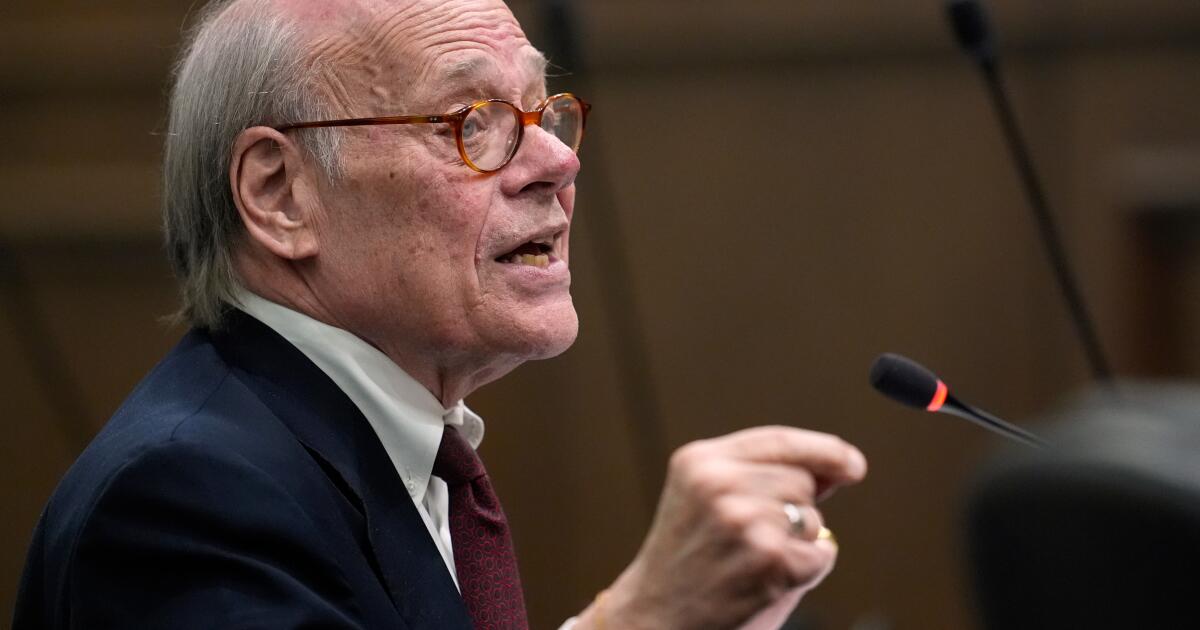
WASHINGTON — Democratic Rep. Steve Cohen of Tennessee on Friday announced that he is ending his bid for reelection, his career upended by the redistricting battles that are sweeping the country after last month’s Supreme Court decision.
Republicans in Tennessee this month enacted a new U.S. House map that carves up Cohen’s majority-Black district, reshaping it to the GOP’s advantage as part of President Trump’s strategy to hold on to a slim majority in the November midterm elections.
“I don’t want to quit. I’m not a quitter. But these districts were drawn to beat me,” Cohen told reporters in his Washington, D.C., office.
Cohen is challenging the state’s redistricting effort in court and said that he would reenter the race if that lawsuit succeeded in restoring his old congressional district.
He lamented that Tennessee would likely shift to an entirely Republican congressional delegation after the next election, warning that it could also leave the state out of the loop once Democrats are able to regain the White House.
Redistricting targeted Cohen’s district
Tennessee was the first state to pass new congressional districts after a U.S. Supreme Court ruling that significantly weakened federal Voting Rights Act protections for minorities. But more Southern states could follow. Republicans in Louisiana, Alabama and South Carolina also have taken steps toward redistricting.
Cohen has represented his Memphis-based district for about two decades, among the last of the white Democrats representing the South. He has been a longtime member of the House Judiciary Committee and has focused on strengthening voting access and civil rights.
“It’s unique in America that an African American majority district has elected a white guy, and that we’ve got a great relationship, great amount of support,” said Cohen, who is also the first Jewish person to represent Tennessee in Congress.
He was facing a primary challenge from state lawmaker Justin Pearson, a Black Democrat who represents Memphis in the state’s General Assembly. Pearson has said he will continue his campaign in the state’s newly redrawn 9th Congressional District.
But Cohen predicted that it would be nearly impossible for Tennessee Democrats to win a seat in Congress with the new districts. He added there was a chance the redistricting effort could “backfire on the Republicans” but that would require an “unbelievable registration effort among Democrats” and a massive vote turnout effort.
Cohen vows to oppose Trump
Sitting in his congressional office with staff looking on, Cohen pointed to photos of Memphis and local projects that he had championed during his career and expressed worry that Memphis voters would no longer have a voice in Washington. He also recounted how he had worked with the state’s Republican leaders to win funding during the Biden administration for a larger bridge to cross the Mississippi River into Memphis.
House Democratic leader Hakeem Jeffries said in a statement that Cohen was “a powerful champion for civil rights” and that “the City of Memphis, the Congress and the nation are better because of Steve’s commitment to making a difference.”
Cohen said that the Republican’s redistricting effort was being done “for Donald Trump to get one more vote, he thinks, to stop them from being impeached.”
Still, he vowed to use his remaining time in Congress to try to mount opposition to Trump, calling the president “the greatest threat to democracy and to decorum and grace that we’ve ever seen.”
Like many lawmakers, Cohen has often attracted attention with colorful outbursts during congressional debates and hearings. During Trump’s first term, in 2019, Cohen brought a bucket of fried chicken to a House Judiciary Committee hearing at which then-Atty. Gen. William P. Barr was a no-show.
“The message is Attorney General Bill Barr is not brave enough to answer questions from a staff attorney and members of the Judiciary Committee,” he said in a statement at the time.
WASHINGTON — In recent weeks, several social media influencers have popped up in online feeds touting the California gubernatorial campaign of billionaire Democrat Tom Steyer.
Some complain about the price of gasoline. Others mention environmental concerns. One cites her newfound sobriety as evidence that people can change — a nod to Steyer’s self-proclaimed metamorphosis from hedge fund titan to scourge of big corporations.
“I did not expect the most progressive governor candidate to be a billionaire, but look at the policies you guys,” said one content creator on TikTok with the user name Jaz R. “Hear me out. I know Tom Steyer is a billionaire, but he also is for the people.”
The posts include direct-to-the-camera appeals, with personal details interwoven into messages of support for Steyer. An influencer goes for a stroll as onscreen text touts Steyer’s policies. Some seek to convey authenticity, if occasionally ham-fistedly; one influencer mispronounces Steyer’s last name.
What they do not include is a disclosure that their creators were paid by the Steyer campaign to produce the videos, according to a complaint filed this week with California’s Fair Political Practices Commission and a Times review of the posts.
The complaint alleges that the Steyer campaign failed to notify the influencers it hired of their obligation to inform their audience when their posts have been sponsored by the campaign.
California passed a law in 2023 requiring that influencers disclose if they have been paid to create promotional content for or against a candidate or ballot measure, one of the few jurisdictions in the country with such a requirement. There is no such requirement at the federal level.
“Every time there’s a new technology, you have to create legislation that requires them to disclose,” said state Sen. Tom Umberg (D-Orange), who sponsored the bill.
Violating the law doesn’t carry criminal, civil or administrative penalties, but the FPPC can take influencers who break the law to court and ask a judge to force them to comply.
The complaint was filed by two California women — political influencers themselves — who said they noticed a number of new accounts that suddenly started posting similar-sounding videos promoting Steyer earlier this month.
“They had the exact same language, they had the same talking points,” said Beatrice Gomberg, who worked with Kaitlyn Hennessy in their digital sleuthing efforts.
The FPPC did not comment on the complaint.
Steyer’s campaign appears to have relied on paid influencers more than any candidate for governor, according to the most recent campaign finance filings.
That spending represents only a small fraction of the massive campaign war chest Steyer has seeded with nearly $180 million of his own money. But the complaint highlights the growing degree to which political candidates have come to seek out the authenticity that social media influencers seem to offer.
Steyer campaign spokesperson Kevin Liao said the campaign had properly followed the rules in hiring influencers and that the campaign is “confident” that Gomberg and Hennessy’s complaint is “baseless.”
“Creators make their living generating content. The campaign believes in compensating people for their time and work product and has paid creators to generate content,” Liao said in a statement. “Payments for creator content are disclosed in campaign finance reports, and we notify creators we directly work with of their disclosure requirements.”
While many of the new Steyer influencers have few followers, Steyer’s campaign disclosed in its most recent campaign finance report that it had paid thousands of dollars to numerous social media influencers with massive audiences, the Sacramento Bee reported.
Several of the videos produced by these popular social media personalities also failed to disclose that they had been paid by the campaign, according to the complaint and The Times’ review of the content.
But even accounts with few followers can still have a big impact if they are producing a steady stream of content supporting Steyer, said veteran California political strategist Mike Madrid.
“What they’re trying to do is trip the algorithm,” he said. “It looks like it has a bigger audience than it really does. It’s taking the concept of astroturfing into the digital age.”
Gomberg and Hennessy said they became friends after meeting at an April campaign event for Xavier Becerra, Steyer’s chief Democratic rival in the race, who holds a narrow advantage over Steyer in several recent political polls.
The pair have been prolific social media supporters of Becerra’s campaign ever since, though they insist they are not being paid for their efforts.
They said they discovered that many of the new pro-Steyer accounts seemed to be run by influencers — mostly women — who had previously created different social media accounts to hawk other products.
One of the pro-Steyer influencers had an online portfolio listing numerous clients, including the Steyer campaign and a gummy designed to boost arousal, according to the complaint and the Times review of the publicly accessible website.
The pair said they stumbled on an advertisement placed by a vendor for the campaign on a platform used by creators to find work. The advertisement indicated that creators would be paid $10 for each post, with bonuses for posts that amassed large viewership.
The vendor who posted the ad did not respond to a request for comment.
The advertisement has since been updated to say that it pays $1,000 per month and that creators will have to disclose that it is paid content.
As Gomberg and Hennessy dug deeper, they determined that some of the influencers promoting a candidate for governor weren’t even based in California.
A TikTok account using the handle jess.votes, for example, appears to be connected to a woman registered to vote in Florida. Other accounts were connected to women who indicated elsewhere that they were based in Pennsylvania, Missouri and Michigan.
Several influencers who created seemingly paid content promoting Steyer did not respond to multiple requests for comment from The Times.
The brouhaha over paid social media content is just the latest instance of the growing political impact of online creators.
Eric Swalwell’s campaign for governor — and congressional career — came to an end after multiple women accused him of sexual assault. A pair of influencers had publicly raised concerns about Swalwell’s behavior and helped connect victims with journalists who produced highly detailed reports of the allegations.
The California law requires influencers to disclose in a political post’s audio or text that it was sponsored and who paid for it.
The onus is on the creators to make the disclosure, but campaigns are required to tell them that they must do so. Despite passage of the law, the issue has so far remained largely under the radar.
“I have dozens of candidates and campaigns and I have not heard this issue come up one time,” said a campaign finance lawyer who requested anonymity because they represent numerous candidates with active campaigns.
Gomberg and Hennessy said that they were driven to call attention to potential violations of the disclosure requirements because of their concern about the corrosive influence such paid content could have if left unchecked.
“You have people who have trust in these creators,” Hennessy said. “You have a responsibility to your audience.”
COVINGTON, Ky. — Rep. Thomas Massie was stuck in Washington for a vote on Capitol Hill, so one of his supporters made the pitch for his campaign in a banquet hall packed with Republicans in northern Kentucky.
The audience had just heard Ed Gallrein, who was drafted by President Trump to run against Massie in next Tuesday’s primary, describe the congressman as suffering from “a severe case of Trump derangement syndrome.”
Then Gex Williams, a state senator backing Massie, told the audience at the Lincoln Day Dinner not to worry about all that.
“If you are thinking that you can’t be for President Trump and for Thomas Massie, you certainly can be,” Williams said.
Whether voters agree will determine whether Massie’s political career survives Trump’s most aggressive attempt to purge the Republican Party of dissenters. The president already succeeded last week in dislodging several Indiana state senators who opposed his redistricting plan, and he’s supporting a primary challenge against U.S. Sen. Bill Cassidy in Louisiana on Saturday.
But nothing compares to the vitriol against Massie, whom Trump has called a “moron” and a “nut job” who “will go down as the WORST Republican Congressman.” Trump made an unusual trip to Kentucky to campaign against Massie, and some of the president’s top advisors are working to help Gallrein, a former Navy SEAL.
Massie angered Trump by voting against his signature tax legislation over concerns of adding to the national debt, pushing for the release of the Jeffrey Epstein files and opposing his decision to go to war with Iran. His positions, Massie insists, reflect the America First promises Trump initially made on the campaign trail.
In a Kentucky district where the president won by 35 points two years ago, Massie told the Associated Press that the upcoming primary is “by far the most challenging reelection I’ve ever faced.”
Party loyalty or ideological purity?
The race is playing out across Kentucky’s 4th Congressional District, which sweeps northeast from the outskirts of Louisville along the Ohio River, through the suburbs south of Cincinnati and over to the lush foothills and old coal towns of Appalachia.
Voters here have sent Massie back to Congress ever since his first election in 2012, embracing his stalwart independence and jaunty personality. Back in 2020, they brushed off Trump’s social media demand to “throw Massie out of Republican Party” because he was a “third rate Grandstander.”
Now, Republican voters are debating whether they will do the same thing again.
“If all we’re doing is pulling in yes men, then how do you grow from that? How do you have the best end product if everyone just says, ‘Oh yeah, that’s a great idea,’” said Tonya Young, an attendee of the Lincoln Day Dinner who is leaning toward Massie but still undecided.
“However, I do feel like it’s important to stay loyal. That’s where, I’m like, I’m a hot mess,” said the 57-year-old special education teacher. “Sometimes you have to just bite the bullet and compromise on things.”
Young said she will plumb through the Republican-backed bills that Massie voted against before she makes up her mind. What isn’t a major part of her calculation is Trump’s endorsement of Gallrein or his epithets against Massie.
Young still supports Trump, rating his second term at a “B to a C+” relative to his campaign promises. During Trump’s first term, Young said, she’d “probably put more stock in” his endorsement.
‘I’m going to vote for Massie even though he makes me mad’
At the Lincoln Day Dinner in Covington, well-dressed Republicans sat at circular tables, ate dinner and listened attentively as candidates gave speeches.
Steve Jarvis, a 77-year-old retired law enforcement officer, who stood near the late night coffee station, has decided to vote against Massie for the very first time.
“Made me sad, truly it does,” said Jarvis, wearing a bespoke American flag bow tie made of feathers, “I like Massie.”
When Massie first ran for Congress, Jarvis bought a Massie campaign sign, sized for a freeway overpass, and planted it outside his home, a few doors down from which lived Massie’s opponent.
But some of Massie’s departures from the party, he said, “made me nuts. I can’t do it anymore.”
One was Trump’s flagship Big Beautiful Bill, which Massie voted against citing the consequent budget deficit and increased inflation.
“I understand voting your principle once or twice,” said Jarvis, “but at some point in time when it becomes crucial, I think they have to get in line.”
Gallrein, he said, would get in line.
Jana Kathman came to a different conclusion.
“I’m going to vote for Massie even though he makes me mad,” she said while shopping for bagels at a local farmers market outside Covington.
The 56-year-old registered nurse said, “I just like him as a person, I like how he lives his life, and I know he stands very strong with his convictions.”
Though she still likes Trump, his endorsement and attacks don’t impress her.
“I don’t like when Trump plays the little games as soon as someone opposes him, but we know that’s how Trump lashes out,” Kathman said.
‘Antibodies’ to Trump’s electoral broadside
Gallrein mounted the stage at the Lincoln Day Dinner with a prepared speech. He grew up on a family farm, was inspired by President Reagan to join the Navy SEALs and was recently asked by Trump to serve his country again in Congress.
He hyped up Trump — “Do you know he doesn’t take a salary?” — and launched into a list of Trump-backed policies Massie had voted against, lumping him in with the “radical Democrats.”
Gallrein declined an interview request, and he’s declined to attend candidate forums and debates with Massie.
Several voters said they were grateful for Gallrein’s service, but still don’t have a grasp of his platform, aside from his fidelity to Trump.
Massie argues that’s why Kentucky should stick with him, using what has become a go-to refrain.
“Politicians promise during the campaign, and then they go to D.C. to go along to get along,” he said. “My opponent is promising to go along to get along.”
Massie is hopeful that Trump’s anger will blow over once he wins the primary.
“Once this race is over, I don’t think there’s any benefit to him attacking me, I’ll have the antibodies from a natural infection,” Massie said chuckling.
After years of being considered a conservative gadfly in Congress, he said, maybe he has some of those antibodies already.
NEW YORK — A federal immigration court in Lower Manhattan has come to represent the Trump administration’s deportation campaign in New York City, with agents carrying out chaotic and sometimes violent arrests in the hallway as migrants leave hearings.
Now the court is serving as a front in a different kind of battle: one of the city’s most closely watched congressional races.
In the Democratic primary between incumbent U.S. Rep. Dan Goldman and former city Comptroller Brad Lander — for a district so solidly blue that the June primary is considered its deciding election — both candidates have made the Trump administration’s treatment of migrants at 26 Federal Plaza a feature of their campaigns, but with decidedly different approaches.
Goldman — an heir to the Levi Strauss denim fortune and former prosecutor who was lead counsel for President Trump’s first impeachment — has approached the topic with a lawyerly bent that leverages the power of his office.
He sued the administration to open immigration detention centers to members of Congress, conducts oversight visits and turned his office across the street into what he’s called a triage center that connects immigrants with advocacy groups and legal services that has, his campaign said, helped more than 30 people get released from federal custody.
After a recent visit, Goldman credited his oversight work as a reason conditions at a holding facility inside the building have improved.
“What you see from our multipronged approach is the way that I push back, which is not performative, but it is substantive,” he told the Associated Press outside 26 Federal Plaza after he toured the detention center that is closed to the public.
Meanwhile, Lander — a progressive city government stalwart who is running with the support of Mayor Zohran Mamdani — has acted as protester and court observer, watching hearings and attempting to accompany immigrants out of the building past masked federal agents.
His efforts have gotten him arrested twice, with the most recent case headed to a trial scheduled to take place just before the primary.
“I would characterize his oversight function as strongly worded letters,” Lander told AP when asked about Goldman’s approach. “And my oversight function is: Show up with hundreds of your neighbors and bear witness and accompany people and demand access and stay until they give it to you or they arrest you.”
Lander’s first arrest happened last year when he linked arms with a person authorities were attempting to detain in the hallway outside the court. Lander was running for mayor at the time, and the arrest gave his campaign a jolt of excitement at a time when Mamdani and former Gov. Andrew Cuomo were considered the front-runners in the race.
A few months later, after losing the mayoral primary but not long before launching his congressional campaign, Lander was arrested again during a large protest at the building and hit with a misdemeanor obstruction charge.
But instead of accepting a deal that would have made the case go away in six months, Lander instead opted to go to trial. He said the case would extract information about the federal government’s immigration enforcement efforts at the building during a tense period that predates Goldman’s oversight visits.
Goldman dismissed Lander’s efforts as performative.
“I don’t understand why someone would reject a dismissal of a case so that he can have a public trial, ostensibly to ask for information that I could provide him whenever he wanted because I have the answers from doing my oversight,” he said.
This week, Lander returned to 26 Federal Plaza to sit in on hearings. But just before entering the building, his team got word that federal agents were lingering outside an immigration hearing at a different federal courtroom in a building across the street. He raced over and eventually found the agents, who were wearing masks and milling around in the court’s waiting room.
“The challenge is trying to figure out who they’re going to arrest,” Lander said, popping out of the hearing, where he sat in a back row and took notes. After a while, the agents walked away from the hearing room, down a hallway and exited the floor. It was not clear why they left.
“Maybe we have different styles,” Lander said of his opponent after the agents departed. He later went back across the street and filmed a campaign video in front of 26 Federal Plaza.
A briefing memo obtained by The Times appears to support former Rep. Katie Porter’s accusation that a Tom Steyer staffer leaked a video of her yelling at an employee, an outburst that tainted her gubernatorial prospects when the video became public.
The video, which was obtained in October by Politico, showed Porter erupting at a staff member who appeared in the background of a prerecorded Zoom call between the former congresswoman and then-Energy Secretary Jennifer Granholm.
During a nationally televised interview on CNN by Dana Bash on Monday, Porter accused the Steyer campaign of leaking the damaging video.
“I am confident that is the case,” Porter said after Bash asked how she knew Steyer was the source. “I’ve been told by many people it’s a Department of Energy video, it was only held by the Department of Energy, and people can follow the trail to who his campaign staffers are and understand what happened there.”
Following the CNN interview, Steyer’s campaign denied that the candidate was involved with the leak.
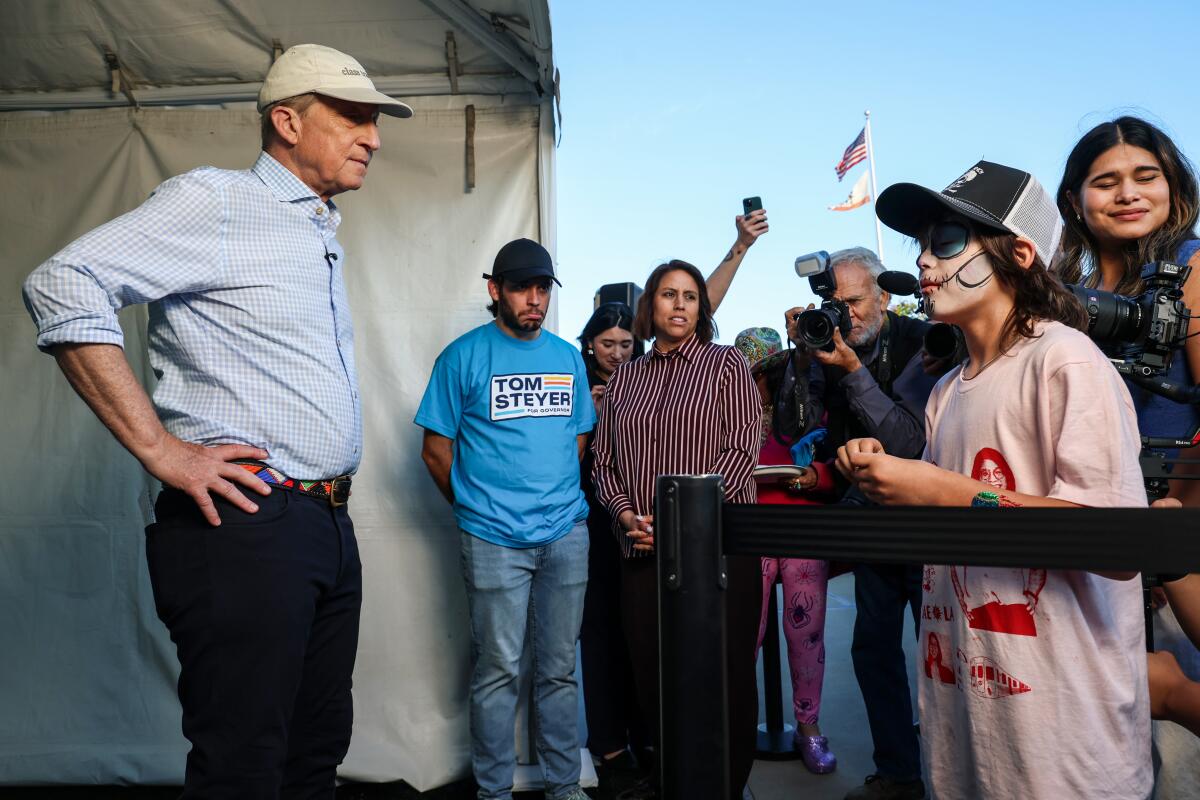
Gubernatorial candidate Tom Steyer hosts an “LA Block Party” campaign event Wednesday at East Los Angeles College in Monterey Park. Rocky Mosse, 9, waits his turn for a photo with Steyer.
(Robert Gauthier/Los Angeles Times)
“Tom has nothing to do with that video,” Steyer campaign spokesperson Sepi Esfahlani said after Porter levied the accusation on Monday. “This is an attempt from Katie Porter to deflect from her past mistakes. Katie Porter only has one person to blame for her standing in the race, and it’s herself.”
According to a briefing memo from the meeting obtained by The Times, Steyer spokesman Kevin Liao was listed as an “expected participant” on the video call between Granholm and Porter, which took place on June 21, 2021, and was filmed to promote electric vehicles by the Biden administration. Granholm and Liao were the only participants listed from the Energy Department, according to the document obtained by The Times.
“This is a 20 minute recorded Zoom with Energy Secretary Jennifer Granholm to discuss the importance of investing in electric vehicles,” the document apparently prepared for Porter and her staff states. “Kevin Liao, Granholm’s press secretary, reached out to set this up. His team will edit this video down into a 2-3 minute clip for social media. Secretary Granholm will have a whiteboard, as noted in the script.”
The edited video conversation was posted on the U.S. Department of Energy’s Facebook page in early July 2021. Politico reported that the Porter staff member snapped at by the congresswoman was not the source of the video provided to the news outlet.
The clip from the Porter-Granholm call was the second unflattering video of the candidate to surface last fall. Days earlier, another clip began to circulate, showing Porter threatening to end an interview with CBS California reporter Julie Watts after becoming frustrated by Watts’ questioning.
U.S. Secretary of Energy Jennifer Granholm speaks during the UNFCCC COP29 Climate Conference in Baku, Azerbaijan, in 2024.
Before the videos became public, Porter had a narrow edge in the race, according to a poll by UC Berkeley’s Institute of Governmental Studies, though many voters at the time remained undecided. Though Porter has continued to hover in the upper tier of gubernatorial hopefuls, she currently trails behind two Democrats — Steyer and former Biden cabinet member Xavier Becerra — and one Republican, former Fox News host Steve Hilton.
The UC Irvine law professor has repeatedly said she apologized to the employee, who spent four more years working in Porter’s congressional office. Dozens of former staffers also came to her defense in an open letter last month.
Liao declined to comment when reached Wednesday evening. He is a primary spokesman for Steyer’s campaign and sent the press release announcing the San Francisco billionaire’s campaign for governor in November. Granholm, when reached via text message, denied leaking the video and said she did not know who did.
According to his LinkedIn profile, Liao, a Los Angeles-based political consultant, worked as Granholm’s press secretary from January through October 2021, during the time the Porter video was recorded. In 2024, he founded Frontrunner Strategies, a consulting firm which has been paid more than $45,000 by Steyer’s campaign, according to campaign finance records.
Porter’s campaign declined to comment on the document.
Voting is underway in the primary election to replace Gov. Gavin Newsom, who is term-limited and exploring a 2028 presidential bid.
A Wednesday Emerson College poll showed Democratic former U.S. Health and Human Services Secretary Xavier Becerra leading with 19%, followed by both Republican former Fox News host Steve Hilton and Steyer at 17%. Riverside County Sheriff Chad Bianco, a Republican, had support from 11% of likely voters and Porter had 10%. San José Mayor Matt Mahan, former Los Angeles Mayor Antonio Villaraigosa and state Supt. of Public Instruction Tony Thurmond were in single digits. Twelve percent of voters were undecided, according to the poll.
Top candidates, with the exception of Thurmond, are slated to appear in a Thursday night debate hosted by CBS California and the San Francisco Examiner.
Published reports say Sen. Flavio Bolsonaro negotiated a multimillion-dollar sponsorship deal to finance a film about his father, former President Jair Bolsonaro, with a banker now jailed on suspicion of leading a criminal organization involved in financial fraud. Photo by Andre Borges/EPA
May 14 (UPI) — Just five months before Brazil’s October elections, the presidential campaign of right-wing Sen. Flávio Bolsonaro has become entangled in what authorities describe as the country’s largest recent banking fraud case.
According to reports published by Intercept Brasil, Bolsonaro negotiated a multimillion-dollar sponsorship deal to finance a film about his father, former President Jair Bolsonaro, with a banker now jailed on suspicion of leading a criminal organization involved in financial fraud.
The Brazilian news outlet released audio recordings and messages allegedly tied to negotiations between the senator and Daniel Vorcaro, owner of the collapsed Banco Master. Vorcaro is being held in pretrial detention as part of a financial and political scandal that has expanded to include Brazilian politicians and judges.
The scandal erupted after Brazil’s Federal Police intercepted Vorcaro’s phone messages, which reportedly reveal a close relationship between the two men — with Flávio Bolsonaro referring to the banker as “brother.”
In the conversations, Bolsonaro allegedly pressured Vorcaro to release payment for a sponsorship worth 134 million reais, or about $26 million, according to Brazilian outlet G1 Globo. The funds were intended for the Hollywood production of The Dark Horse, a biographical film aimed at improving Jair Bolsonaro’s public image.
In one audio recording, Flávio Bolsonaro discussed the urgency of the payments and the importance of the film project, according to Agência Brasil.
“Even though you gave us the freedom to hold you accountable, I feel uncomfortable having to ask,” the senator said in the recording. “We are at a crucial point in the movie’s production, and because many payments are still pending, everyone is tense, and I worry this could have the opposite effect from what we expected for the film.”
Authorities say the controversy extends beyond the size of the sponsorship and centers on the source of the money. Brazil’s Central Bank liquidated Banco Master after discovering an accounting shortfall estimated at between $7.6 billion and $10 billion.
Investigators allege the bank operated a scheme involving fraudulent securities sales and the theft of pension savings belonging to public-sector workers. Brazilian media reported that while retirees lost savings, members of the banker’s family purchased luxury homes in Miami and private aircraft.
Hours before the audio recordings became public, Flávio Bolsonaro denied having a business relationship with Vorcaro and dismissed the allegations as false during television interviews.
After the recordings surfaced and his voice allegedly could be heard in the conversations, the senator acknowledged contact with the banker, but argued the deal involved legitimate private sponsorship.
Bolsonaro later wrote on X that he was the victim of political persecution and said the leaked chats only showed a lawful business negotiation.
“It was a son seeking private sponsorship for a private film about his father. Zero public money,” the senator wrote, insisting he did not know the banker’s funds allegedly originated from purported fraud.
The market reaction was immediate. After publication of the recordings, the São Paulo stock exchange fell nearly 2% and the Brazilian real weakened against the U.S. dollar, reflecting investor concerns over political instability.
Recent polls show Flávio Bolsonaro statistically tied with President Luiz Inácio Lula da Silva in a potential runoff election.
Government allies have launched an offensive to capitalize on the scandal, demanding Bolsonaro’s removal from office through ethics proceedings in the Senate. According to Gazeta do Povo, lawmakers are seeking to suspend his political rights for eight years.
Those aligned with Lula also are pushing to create a congressional investigative committee into Banco Master. The proposed inquiry would seek access to Bolsonaro’s banking and tax records to trace the millions of reais allegedly negotiated in the sponsorship deal.
Left-wing parties argue the movie financing arrangement served as a front for money laundering and illicit enrichment, linking the failed bank’s expansion to political protection networks allegedly built during Jair Bolsonaro’s administration.
Sacramento — A veteran California political consultant has agreed to plead guilty in a scheme to steal campaign funds from Xavier Becerra, now a leading candidate for governor, when he served in the Biden administration, according to filings in her criminal case on Thursday.
Dana Williamson will plead guilty to three counts, including bank fraud and lying to authorities. In exchange, the federal government will dismiss 20 other counts against her related to her tax filings and a federal COVID-era loan she received.
A court hearing is scheduled Thursday morning.
Williamson, a former chief of staff to Gov. Gavin Newsom, was arrested in November and pleaded not guilty. The government secured guilty pleas in December from two advisors who worked with alongside her to skim money from Becerra.
Prosecutors say that Williamson, Becerra’s then-chief of staff Sean McCluskie and lobbyist Greg Campbell took part in a scheme to siphon money from Becerra’s dormant campaign account and funnel it to McCluskie.
McCluskie needed the money, according to prosecutors, so he could afford to fly home frequently to see his family in California while working for Becerra, who was Biden’s health secretary, in Washington, D.C.
As part of the scheme, Williamson and another consultant charged Becerra’s account up to $10,000 a month to manage one of his dormant state campaign accounts.
Becerra approved the payments, even though he had never paid such a high amount for a similar job. He told The Times that McCluskie told him to pay the fees.
Becerra’s rivals in the governor’s race are hammering him over his decision, arguing he should have known something wasn’t right. Becerra has said that he didn’t know about the criminal behavior and has called the charges a “gut punch.”
Known as an hard-nosed and aggressive operator, Williamson’s career in politics also included working for former governors Jerry Brown and Gray Davis and mentoring other women.
McGregor Scott, Williamson’s attorney, told reporters last year that federal authorities initially approached Williamson about helping them with a probe into Newsom. She refused, he said, and was subsequently charged.
Details contained in the indictment and other public records suggest that federal authorities were looking into the state’s handling of alleged sexual harassment at Activision Blizzard Inc., a video game company.
Out in the high desert city of Barstow stand three Del Tacos that bill themselves as better than their corporate cousins.
They’re the last ones owned and operated by Ed Hackbarth, the founder of the Mexican fast food chain. Two of them feature the word “Original” under their marquees, even though that’s historically inaccurate — Hackbarth opened the first Del Taco in the nearby town of Yermo in 1964.
That hasn’t stopped thousands of devotees — myself included — from trekking to these Cal-Mex shrines to buy memorabilia, gawk at historical photos and gorge on hard shell tacos, burritos and bun tacos that they insist are tastier than the ones at regular Del Tacos.
Among those visitors was Republican gubernatorial candidate Steve Hilton.
He stopped by the Original Del Taco off 1st Avenue on Saturday after a town hall with lieutenant governor candidate and Barstow native Gloria Romero. His campaign posted a short video on social media of him standing outside the spot — the oldest operating Del Taco — while holding something that looked like a melted Frisbee.
It was what the place calls a Barstow Taco: ground beef, a few strips of lettuce, a blizzard of bright yellow cheese and a thick red tomato slice on top, all inside a hard taco shell.
Hilton gleefully wielded the crunchy mass with one hand as he pointed to the Original Del Taco sign with the other.
“My Barstow street taco, I’m going to enjoy,” he concluded in an accent from his native England, while giving a thumbs-up. “See you soon.”
He didn’t take a bite.
The social media blowback exploded like a digital Montezuma’s revenge. Haters ridiculed Hilton for visiting a Mexican restaurant in what seemed like an attempt to attract Latino voters — if he was going to do that, why on Earth pick a multimillion-dollar empire founded by a gringo? Others noted that “street tacos” are made with corn tortillas and bought from a food truck or street stall. As the author of a book about the history of Mexican food in the United States, I pointed out that this Del Taco isn’t actually the original, despite what the marquee says.
A humble man would have immediately owned up to his mistakes. Hilton is not a humble man.
To someone who pointed out that “Barstow street taco” is a misnomer, Hilton shot back, “It’s what they call it!” To someone who accused him of supporting bland corporations instead of mom-and-pop shops, Hilton responded that he went there because Romero once worked there.
“Not everything in life has to be turned into a political argument!!” he whined.
Hilton and his followers are treating Del Taco-gate as much ado about nada — and yet it tells voters everything they need to know about the man.
Three hard shell beef tacos from Mitla Cafe, the San Bernardino restaurant that indirectly served as the inspiration for Taco Bell and Del Taco.
(Jenn Harris / Los Angeles Times)
Endorsed by President Trump, he has consistently topped the polls this year, mainly because the many Democratic candidates have split the vote. Hilton has outperformed his main Republican rival, Riverside County Sheriff Chad Bianco, by promoting a message of positivity with weak-salsa slogans like “Make California Golden Again” and “Califordable.”
During debates, the former Fox News host has relied on his dry wit and posh tone to make his answers sound stronger than they are. He has especially focused on selling himself to Latinos. Months before announcing his run, we sat down at my wife’s restaurant in Santa Ana as he tried to pick my brain about this crucial swing vote, asking questions I kept telling him I had already answered in my columna.
Hilton is no pendejo. But I have to wonder about his judgment after that Del Taco video.
I have no problem with Hilton campaigning at a Mexican restaurant — it’s a political trope practiced by candidates of all persuasions. It’s unfair to expect a British immigrant who’s been in California only since 2012 to be fully versed in taco culture, as essential to the state as it is. And people shouldn’t bash him for highlighting a California culinary institution that’s one of the better legacy fast food chains out there, even though the Barstow Taco is, well, whatever. (Del Taco’s half-pound bean and cheese burrito, on the other hand, is as silky as a Luther Vandross slow jam.)
A proper hard shell taco is a beautiful thing. Just head out to San Bernardino’s Mitla Cafe, where Hackbarth’s former boss, Glen Bell, learned to make the tacos that turned the two of them into millionaires. But bragging about enjoying a hard shell taco nowadays is like showing up to a street takeover in a horse buggy.
As relevant to modern-day California as tamale pie, hard shell tacos are a reflection of Hilton’s pitch to voters: Instead of offering a bold vision for the future, he offers a return to a past that will never happen again and that wasn’t as great as people make it out to be.
I’ve tried to be as open as possible to Hilton’s campaign. California could benefit from a governor who didn’t emerge from the Sacramento swamp. It might even benefit from a Republican, as in the 2000s when Arnold Schwarzenegger forced Democrats to fight instead of fester.
But Hilton disappoints again and again. He launched his campaign in Huntington Beach, enamored of politicians there who seek to silo their city from the rest of California and humiliate liberals at every opportunity. His embrace of Trump‘s endorsement and refusal to admit that Joe Biden legitimately won the 2020 presidential election expose him as a toady. Hilton’s ongoing boast that he is the candidate for legal immigrants disqualifies my father, who originally came to this country without papers yet has contributed more to the California experiment (and is now a U.S. citizen) than Hilton ever has.
I’ll even be gracious and excuse Hilton for wrongly calling the Del Taco he visited the original one — the background is admittedly confusing. But his Barstow street taco flub is a stand-in for his campaign, which will flop come November if he doesn’t get his Mexican meals straight.
Hilton told me over the phone that it was his first time eating at a Del Taco (he enjoyed the Barstow Taco off-camera but felt their fish taco was better). He didn’t stop by “for the food, frankly,” but rather for its meaning to Romero and to California entrepreneurship.
“The idea of going to the first location of a business that ends up going big is actually pretty cool,” the former restaurateur said, noting that he had shot a video at the San Bernardino location of the first McDonald’s, which is now a museum.
He didn’t get defensive when I told him the Del Taco wasn’t the first one and that what he ordered wasn’t actually a street taco — “I would say I’m learning, and I love learning and I love food, and exploring places and community through food, and I really would love to learn more, for sure.”
Hilton said he does enjoy “real” tacos but couldn’t name any places he favored. He asked for recommendations. I suggested we go get some tacos with my dad, and he immediately agreed.
“So you can explain to him how you’re the candidate of legal immigrants,” I added. “My dad came to this country in the trunk of a Chevy.”
Hilton stayed silent for a second. “OK, let’s have that conversation,” he said.
When a friend asked if Tom Steyer could stop by my wife Delilah’s downtown Santa Ana restaurant, I had to explain to her who he was.
It’s not political apathy in my honey’s case. She’s just exhausted from running her small business, Alta Baja Market, in these inflationary times. She’s one of the 16% of undecided voters in a recent California Democratic Party poll — a group that may determine which two candidates for governor face each other in the general election.
Delilah agreed that Steyer could visit on Saturday after I told her that many of our friends support the billionaire’s progressive platform.
“Politics is your job, not mine,” she joked as we drove to Alta Baja and I named the other major candidates. The only ones she had heard of were Antonio Villaraigosa (“I liked him as mayor, but he needed to keep his pants on,” referring to his extramarital affairs) and Katie Porter (“Some of my workers like her, but I don’t know what she’s done”). She might be the last person left in the Golden State who hasn’t seen any of Steyer’s television and YouTube ads.
So a visit to Santa Ana, the heart of Latino Orange County, was a good move. At Alta Baja, he could talk to my Mexican American wife and other blue-collar Latinos.
When rival Xavier Becerra came to O.C. a few weeks ago, on the other hand, he appeared at a private fundraiser attended mostly by professional Latinos.
“I just want someone who tells us where our taxes are going and treats this country like a business, and we’re not wasting money,” Delilah said. She’s a socially liberal and fiscally conservative Democrat who has been especially angered by President Trump’s deportation deluge, which left the streets of downtown Santa Ana empty for months last summer. “Because right now, our government is a hot-ass mess.”
I asked what questions she had for Steyer.
“So insurance had to cover all the disasters that happened with the fires,” Delilah replied. “So why is everybody else having to pay for it? And what are you really gonna do to help the state?”
She paused. “Tom is a Democrat, right?”
Delilah prepared for Steyer’s noontime stop as if it were any other day. She has fed the likes of U.S. Sen. Alex Padilla, Orange County Dist. Atty. Todd Spitzer and former Speaker of the Assembly Anthony Rendon. Republican gubernatorial candidate Steve Hilton is a fan of Alta Baja’s blue cornbread; Oakland Mayor Barbara Lee held a meet-and-greet there when she ran for president two years ago.
“You know who should ask questions?” Delilah said after she set the till for the day. “Angela.”
That would be 19-year-old Alta Baja employee Angela Nino, who will be voting in her first election.
“She’ll always be telling me, ‘Did you see the debate? Did you see the debate?’ And I always say, ‘No, I’m too tired to watch.’”
Nino soon clocked in.
“Guess who’s coming, Angela?” Delilah said before looking at me. “Is his name Tim or Tom?”
“It’s like I agree with some of his things, but he’s a billionaire,” said the Orange Coast College student and Santa Ana resident when I asked about Steyer. “His answers at debates have been pretty broad so far.”
Delilah smiled.
“You’re the future, girl, so ask him anything.”
Almost everyone who came in as we waited for Steyer was a campaign worker or volunteer. Former state Controller Betty Yee, who ended her campaign for governor last month and endorsed Steyer, sat at a table with her husband. Orange County Supervisor Vicente Sarmiento, who initiated Steyer’s Santa Ana visit, thanked Delilah for the opportunity. He has known her since the start of his political career on the Santa Ana City Council nearly 20 years ago,
“This is a city where our residents were criminalized because of ICE, our downtown suffered because of construction, and all this on the heels of a pandemic,” he told me. “These are the folks Tom needs to listen to.”
Sarmiento’s staffer got his attention. Steyer was here.
The candidate strolled in with a videographer and photographer. He wore his usual casual billionaire outfit — white-and-cardinal Nikes, jeans, checkered shirt with rolled-up sleeves and a colorful Southwestern-style fabric belt.
Steyer went straight to the counter.
“Are you running for governor?” he cracked while shaking Delilah’s hand.
“I don’t want to,” she replied.
“I knew you were a smart woman!”
He listened with wide eyes and a stern face as Delilah complained about a years-long light-rail project in front of Alta Baja “that has been worse for businesses here than COVID.” Insurance rates have gone up 30% in the last year alone, she said.
“Well, look, that’s my whole thing,” Steyer responded in his low, gravelly voice. “I’m willing to take on the big corporations who are ripping off California. And they’re all spending a lot of money against me.”
It was the Steyer I’ve heard on too many commercials: pugnacious, compassionate but spouting a whole bunch of boilerplate. Delilah smiled weakly.
“I appreciate that,” she said. “And we need more of that.”
Then she waved Nino over. Usually shy, the architecture major now channeled her inner Lesley Stahl.
“Why do you have to be governor in order to do something while you have billions of dollars?” she said.
“So I’ve been able to do something, but what I see in California — and what Delilah and I were just talking about — is big corporations actually run the state,” he said.
“That’s true,” Nino conceded.
“You have to take on the big corporations that are screwing everybody. And you can really only do that as governor,” Steyer continued.
“You want to tax the billionaires, is that correct?” Nino asked next, as Steyer nodded. “How come on some [campaign disclosure] forms, it shows that your billions are in different [countries] besides in the U.S.?”
The candidate vigorously shook his head.
“I might have investments outside the United States, but there’s nothing I’m doing to not pay — I pay full California and American taxes on everything, promise. There’s a lot of ways I could avoid taxes, but I don’t. And so, anything that I’m doing overseas is not to avoid taxes. … I give you my word.”
One more from Nino!
“And how can the people trust billionaires when currently they have been very disappointing towards us?”
“I understand why people are skeptical,” Steyer replied. “They couldn’t be more skeptical than I am.”
He argued that other moguls “are supporting every other candidate. Those people hate me — like, they think I stand for something really bad, which is making them pay their fair share,” referring to a proposed November ballot initiative that would impose a one-time 5% tax on billionaires like Steyer (he supports the measure).
“And they’re right,” Steyer concluded. “And so it’s like, they hate me, and that’s fine.”
Nino stayed silent. Delilah thanked Steyer, who was off to visit other local businesses owned by friends of ours. He bought a bottle of rosé, posed for photos with Delilah and Sarmiento and went off — but not before a staffer adjusted the back of his collar.
Delilah and Nino went back to prepping lunch orders. What did they think about Steyer?
“To be honest, I’m so skeptical,” Nino said. “I don’t think he has enough experience as some of the other candidates, and I feel like he could have been more into detail about his policies.”
What about you, honey?
“Gracious, very kind and not pompous, which is what I would expect from most politicians,” Delilah said. “I like that he heard out Angela — that’s important [that] politicians listen to the next generation, and I think everybody should be doing that. But I wasn’t satisfied with my insurance question.”
“And we don’t know if this is a performance,” Nino added, drawing a playful gasp from Delilah. “We’ve seen, like, throughout the years, many political people go into, like, regular [businesses] to seem like, ‘Oh, we’re relatable to the people. We know your struggles.’”
“Do they really?” Delilah interjected.
Nino frowned.
They could just be putting on a show for the cameras, she said.
Eileen Wang, an Arcadia city leader facing charges of acting as an illegal foreign agent of China, resigned Monday after reaching an agreement to resolve the federal case.
Wang, who served as mayor of the San Gabriel Valley suburb, entered into a plea agreement with prosecutors over charges that she acted under the control of the People’s Republic of China to promote propaganda in the U.S. between 2020 and 2022, according to court filings.
Wang, who was previously elected to the City Council in November 2022, stepped down as mayor on Monday hours after the plea agreement was unsealed. Arcadia officials and Wang’s attorneys said the conduct described by federal authorities occurred before Wang was elected.
Wang appeared in federal court in downtown Los Angeles during a brief hearing Monday, where a judge instructed her lawyers to set a date when she would formally enter a guilty plea.
The maximum sentence for the charge is 10 years in prison.
Dressed in a blue suit jacket and skirt and accompanied by four lawyers, Wang listened to the proceeding through a Mandarin interpreter. She sniffled throughout the hearing, wiping at her eyes and her nose with her hand and a tissue.
The magistrate judge ordered a $25,000 bond and for her to surrender all of her passports and travel documents. Assistant U.S. Attorney Amanda B. Elbogen asked that the judge order Wang to refrain from any communication with the Chinese government, including consular officials in the U.S.
“Individuals in our country who covertly do the bidding of foreign governments undermine our democracy,” said First Assistant U.S. Attorney Bill Essayli in a statement Monday. “This plea agreement is the latest success in our determination to defend the homeland against China’s efforts to corrupt our institutions.”
In a statement, Wang’s attorneys, Brian A. Sun and Jason Liang, said “she apologizes and is sorry for the mistakes she has made in her personal life.”
“Her love and devotion for the Arcadia community have not changed and did not waver. She asks for the community’s understanding and continued support,” her attorneys said.
The city of Arcadia’s website said Wang was “vacating her position” and the process of selecting someone to step in as mayor would begin at the next City Council meeting.
“We understand this news raises serious concerns, and we want to be direct with our community about what we know and where we stand,” City Manager Dominic Lazzaretto said in a statement. “The allegations at the center of this case, that a foreign government sought to exert influence over a local elected official, are deeply troubling. We take them seriously.”
From late 2020 through at least 2022, Wang worked with Yaoning “Mike” Sun, her former fiance, to run a website called U.S. News Center that branded itself as a news source for Chinese Americans, according to the plea agreement unsealed Monday. Both Wang and Sun “executed directives” from Chinese government officials, posting requested articles and reporting back with screenshots showing how many people viewed the stories, the agreement says.
“There is no genocide in Xinjiang; there is no such thing as ‘forced labor’ in any production activity, including cotton production. Spreading such rumor is to defame China, destroy Xinjiang’s safety and stability,” read the message from the Chinese government official, according to the plea agreement.
Minutes after receiving the link, Wang posted the article on her website and responded to the Chinese government official with a link to the article on her website, according to the court filing.
“So fast, thank you everyone,” the government official responded, the court records show.
Prosecutors also say Wang edited articles at the request of officials and shared information showing the reach of the posts.
“Thank you leader,” she wrote on Aug. 20, 2021, after being complimented for a post that was viewed more than 15,000 times, according to the plea agreement.
Wang never disclosed that the Chinese government had directed her to post the content, according to court documents.
Wang’s attorneys stressed in their statement “that the conduct underlying the information and the agreement with the government relates solely to Ms. Wang’s personal life — i.e., a media platform that she once operated with someone whom she believed to be her fiancé — and not to her conduct as an elected public official.”
Prosecutors charged Sun, a resident of Chino Hills, in December 2024 with conspiracy and acting as an illegal agent of a foreign government. Wang said her relationship with Sun ended in the spring of 2024.
Sun had also served as campaign manager for her City Council campaign to lead Arcadia, a landing spot for many Chinese and Taiwanese immigrants. Prosecutors accused Sun and his Chinese government contacts of cultivating Wang in hopes that she would rise in politics and help them strengthen China’s influence in California.
“We broke up the fiance relationship,” Wang told the City Council after he was charged. “We keep the friendship.”
Sun was sentenced in February to four years in federal prison after pleading guilty in October 2025 to one count of acting as an illegal agent of a foreign government.
Sun worked as an illegal agent for the People’s Republic of China, submitting reports to high-level government officials about work he was doing on the government’s behalf, according to a federal sentencing memorandum. This activity included combating Falun Gong, a spiritual practice banned in China, and supporters of Taiwanese independence. Sun also was accused of monitoring the then-president of Taiwan during her April 2023 trip to the U.S.
Wang said in a 2024 interview that she moved to Southern California from China 30 years ago. Her mother was a Chinese medicine and acupuncture doctor and her father was a physician in Sichuan province before working at USC, she said.
Wang appeared as usual at last week’s city council meeting, shepherding along discussions on street paving, the upcoming budget and a potential e-bike ordinance. Lazzaretto, the city manager, said in his statement that the city has conducted an internal review related to the charges and found no wrongdoing.
“We can confirm that no City finances, staff, or decision-making processes were involved,” Lazzaretto said in a statement. “We have found no actions that require reconsideration or that are invalidated as a result of these developments.”
In Congress, Katie Porter’s blunt, combative style helped rocket her to progressive stardom. It has also become her biggest vulnerability as she campaigns to be California’s next governor.
Her brusque approach, prosecutorial instincts and suburban mom appeal fueled Porter’s rise during her three terms in the U.S. House of Representatives, where she rattled CEOs and Trump administration leaders and batted away GOP challengers in a competitive Orange County district.
Her tack, however, made her a polarizing force within her own party, where fidelity remains an essential currency of success and power. In Congress, Porter clashed with then-House Speaker Nancy Pelosi and L.A.’s Rep. Maxine Waters.
The same rough edges that endeared Porter to many voters have also alienated some Democratic insiders and interest groups whose support could prove critical in the race to replace outgoing Gov. Gavin Newsom.
Then-Rep. Katie Porter meets with parents, doctors and diabetic patients in her Irvine office in 2019.
(Mark Boster / For The Times)
“She came in [to the governor’s race] as an outsider, as a mom, as a fighter. She wasn’t pulled into the establishment,” said Lorena Gonzalez, president of the California Federation of Labor Unions. “I think that’s why she’s popular with voters, because they want somebody who’s going to fight, and sometimes that ruffles feathers.”
In the campaign for governor, Porter, a single mother of three, has struggled to convert grassroots popularity into broader institutional support. Even after former Rep. Eric Swalwell dropped out of the race amid allegations of sexual assault, she has yet to see a major surge in support or endorsements from Democratic power brokers.
A pair of embarrassing videos continue to hang over her campaign. The videos, which surfaced in October, showed Porter yelling at a staff member and threatening to walk out of a television reporter’s interview.
As former U.S. Health and Human Services Secretary Xavier Becerra has ascended and she remained stagnant in polls following Swalwell’s exit, Porter has increasingly sought to redeem her image. She poked fun at the incident with her staffer in an ad, smilingly asking a group of whiteboard-wielding supporters behind her to “please get out of my shot.”
In recent debates, Porter has sought to play up the qualities that made her a standout among resistance-era progressives, needling former hedge fund executive Tom Steyer over his past investments in private prisons and the pressing Becerra for a “yes” or “no” on statewide single-payer healthcare. Porter emphasizes her support for single-payer healthcare, providing free child care and college tuition and making wealthy corporations pay their “fair share” in taxes.
Porter said she wants to increase taxes on the state’s wealthiest residents but doesn’t support the proposed billionaire’s tax ballot measure because it is a “one-time tax” that won’t solve the state’s underlying budget issues.
“I can’t believe, with [the] interrupting and name-calling and shouting and disrespect for everyone up here who’s stepping into public service that anyone wants to talk about my temperament,” she said during the May 5 debate on CNN.
Though she acknowledged she mishandled both caught-on-tape situations and said she apologized to the staffer, the videos hindered her early momentum and have undercut her efforts to make inroads with potential allies in the race.
Porter speaks at a gubernatorial candidates forum on Sept. 28, 2025, in Los Angeles.
(Carlin Stiehl / Los Angeles Times)
Influential lawmakers, labor groups and party insiders have coalesced behind Becerra and Steyer, her top Democratic rivals.
Porter has scored some key endorsements. She is one of three candidates backed by the California Federation of Labor Unions, along with Steyer and former Los Angeles Mayor Antonio Villaraigosa. She also has support from Teamsters California, the National Union of Healthcare Workers and progressive groups such as Emilys List and California Environmental Voters, which dual-endorsed her and Steyer.
Union support is pivotal for Democratic candidates in California, sending a clear signal that they support the priorities of working-class voters. For Porter, who has proudly refused to accept corporate donations throughout her political career, the labor endorsements also help her attract the small-dollar donations that are essential to her campaign.
While in Congress, Porter proved to be a prodigious fundraiser. In her last reelection campaign for the House of Representatives in 2022, she raised more than $25.6 million in contributions — the second-most in Congress, behind only Bakersfield’s Rep. Kevin McCarthy, who was then the House Republican leader.
Still, her backing from elected Democrats remains comparatively thin. Along with her mentor, Sen. Elizabeth Warren (D-Mass.), just three members of Congress have endorsed her gubernatorial bid: Reps. Robert Garcia of Long Beach, Dave Min of Irvine and Derek Tran of Huntington Beach. She also picked up an endorsement from Assemblywoman Cottie Petrie-Norris (D-Irvine) after Swalwell dropped out.
Though none would speak publicly, multiple sources who work in and around the state Capitol expressed concerns about Porter’s temperament and her willingness to work collaboratively with people she disagrees with.
“Katie Porter hurt herself big time because she needs anger management and she doesn’t have the temperament” to be governor, Democratic former Sen. Barbara Boxer said during a recent interview with NewsNation’s Leland Vittert.
Through her campaign spokesperson, Porter’s declined to be interviewed for for this story.
Porter questions Tim Sloan, president and chief executive officer of Wells Fargo, during a House Financial Services Committee hearing in Washington in 2019.
(Andrew Harrer / Bloomberg)
Defenders argue the backlash reflects a double standard for women in politics — a salient point in a state that, despite its liberal reputation, has never elected a woman as governor.
“Sacramento sizes up every gubernatorial candidate the same way: Can they win, and is this someone I actually want to work with?” said Elizabeth Ashford, a Democratic consultant who is not working with any of the candidates running for governor. “The videos showed an angry woman, and for a lot of people that translated to ‘I don’t want her as my boss.’
“It’s a double standard that dogs women in politics. Jerry Brown was famous for his loud, unfiltered outbursts and nobody questioned whether he was up to the job,” said Ashford, who served as the former governor’s deputy press secretary.
Gonzalez agreed, arguing that women who stand up for themselves “are often labeled as ‘difficult.’ Probably a lot of people think I’m difficult,” the labor leader added with a laugh.
Born in Iowa, Porter often connects her politics to her family’s financial struggles after losing their farm during the 1980s farm crisis. She earned degrees from Yale and Harvard, where she studied bankruptcy law under Warren. In 2012, while working as a law professor at UC Irvine, Porter was appointed by then-Atty. Gen. Kamala Harris to oversee California’s $18-billion mortgage settlement.
After defeating Republican incumbent Rep. Mimi Walters in 2018, Porter quickly emerged as one of the Democratic Party’s most recognizable progressives. Armed with a whiteboard and other visual aids in congressional hearings, she confronted banking and pharmaceutical executives over drug prices, consumer debt and corporate profits.
The props, theatrical at times, seemed to aggravate Waters, then the Democratic chairwoman of the Financial Services Committee. On several occasions, Waters sided with Republicans who challenged Porter’s use of visual and audio aids during hearings.
“Please do not raise your board. We’ve talked about this before,” the chairwoman scolded when Porter tried to hold up a “Financial Services Bingo” card during a 2019 hearing on debt collection. (She later got to show the board on “Late Night with Seth Meyers.”)
Eager to force change they campaigned on, Porter and other freshmen, including members of “The Squad,” at times clashed with Pelosi and other Democratic leaders.
Porter speaks to volunteers while campaigning in Mission Viejo in 2018.
(Victoria Kim / Los Angeles Times )
Porter has slammed lawmakers, including Democrats, for stock trading and funneling earmark funding to their home districts, arguing that such practices breed corruption and mistrust in Congress. The critiques irked Pelosi, a powerful force in California politics.
In her second term, the Orange County Democrat lost her coveted spot on the Financial Services Committee after she listed it as her third choice and requested a waiver to stay on it. Typically, members prioritize such high-profile committees and request waivers to serve on lesser ones in addition. The move was seen as a risk, the result a check on Porter’s ambition.
“So many of us, regardless of ideology, run on ‘shaking up Washington.’ But then when you actually come here, there’s a lot of consequences for doing that,” Rep. Alexandria Ocasio-Cortez (D-N.Y.) told The Times after Porter lost the committee position.
Porter’s willingness to buck party norms also raised eyebrows during her Senate campaign, when she entered the race for Sen. Dianne Feinstein’s seat before Feinstein had announced retirement plans in early 2023. Although then-Rep. Adam Schiff also launched an early campaign, he did so only after privately seeking Feinstein’s blessing. She ultimately finished third in the primary.
Her decision to run for Senate did not ingratiate her with Washington’s Democratic leadership. The party was forced to spend millions to ensure another Democrat was elected to her contested Orange County congressional seat, and Schiff, her top rival in the race, was a close ally of Pelosi — who endorsed him — and helped lead the first impeachment effort against President Trump.
Controversy surrounding Porter’s personal relationships have also surfaced during previous campaigns. In 2024, she obtained a five-year restraining order against a former boyfriend who she said bombarded her and her children with threatening messages.
When a whisper campaign about the end of her marriage threatened her first House run, Porter shared details of her 2013 divorce with the Huffington Post, including that her ex-husband, Matthew Hoffman, physically intimidated and verbally abused her. Hoffman also claimed to be the victim of abuse, including an incident in which Porter allegedly threw hot mashed potatoes at him. Both filed for restraining orders and sought anger management during the divorce.
Former employees have also rallied to her defense. In an open letter last month, 30 former staffers described Porter as a “workhorse” who “asked of us what she expected of herself.”
“She demanded a lot, but she also fought for us, mentored us, and stood by us when life got hard,” the former aides wrote. “We believe the public should understand the full person we know, not a caricature built from a few clips on a bad day.”
Porter has argued that voters are looking for someone willing to challenge powerful interests rather than accommodate them.
Katie Porter is interviewed after the California Gubernatorial debate at Skirball Cultural Center on Wednesday.
(Jason Armond/Los Angeles Times)
“It’s on me to keep campaigning and keep demonstrating that,” she told reporters after a recent gubernatorial debate in San Francisco. “It’s also not lost on me that the last time the Democratic Party had a woman nominee for governor was 1994, when I was in college.”
The affordability crisis is at the forefront of the race to replace term-limited Newsom. As a single parent, Porter argues she is acutely aware of gas and grocery prices — as well as higher-stakes consequences.
She described feeling shocked when, during a recent conversation with her 17-year-old son, he asked if she would visit him if he moved to another state.
“I said, ‘Paul, you love California, why would you leave California?’ And he said, ‘Well, I’m thinking I might want to have a family and I might want to have a house, and I know that means I’ll have to leave California,’” Porter recounted at a March forum hosted by the California Assn. of Realtors. “We need to be a state that doesn’t just retain people like my son … but welcomes new families.”
The centerpiece of her proposed “affordability solutions” are free child care, free tuition at UC and CSU schools for students who complete two years of community college, and ending income taxes for those who earn less than $100,000 — an idea she acknowledges she “stole” from Republican candidate Steve Hilton. “I will take a good idea anywhere I can get it,” she said at a recent forum.
To pay for it, Porter would impose a progressive corporate tax, meaning more profitable businesses and corporations would pay a higher rate. A less than 1% tax hike on businesses that earn hundreds of millions in profit would bring in around $8 billion, according to her website.
“I think she deeply and personally understands the everyday struggles that so many Californians are grappling with right now,” said Petrie-Norris, who last month became the first state legislator to endorse Porter.
While Petrie-Norris describes herself as more politically moderate than Porter, the Irvine assemblywoman praised her as a “pragmatic problem-solver” and “proven fighter” who has taken on corporate interests and the Trump administration.
For a while, Porter was one of four women among the major candidates running for governor. One by one they have dropped out of the race, citing difficulties raising money and support.
After sharing the debate stage with five men recently, Porter was asked whether California is ready for a female governor.