Business

Supreme Court rules for Chevron in Louisiana wetlands damage case

April 17 (UPI) — The Supreme Court ruled unanimously in favor of Chevron in a case related to damage to wetlands in Louisiana that dates to World War II.

The case was brought more than a decade ago and relates to damage allegedly done when Chevron’s corporate predecessors were refining aviation gas on behalf of the federal government during the war, Scotusblog and The Washington Post reported.

The 8-0 ruling sent the federal lawsuit back to a lower court in a move that could jeopardize a $745 million ruling against the company to restore the wetlands, as well as other similar cases with fossil fuel companies before courts in the United States.

Parishes in Louisiana filed the case with the help of state officials against oil and gas companies refining crude oil along the coast during the war, claiming that proper permits were never obtained for their work and that they had not followed “prudent industry practices.”

The previous decision on the $745 million ruling was made by a state court, which Chevron contended does not have the jurisdiction to rule because it was working under the auspices of the federal government.

After the state court judgement was handed down, the company’s lawyers asked the U.S. Supreme Court to move the case to a federal court, where it may be able to have the ruling thrown out.

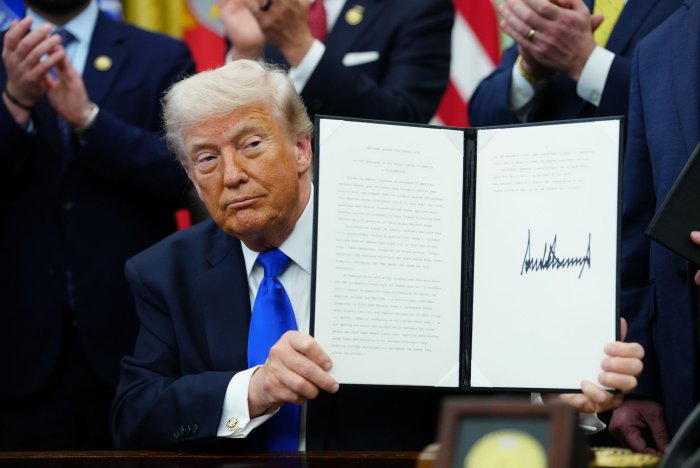
U.S. President Donald Trump departs the White House en route to Davos, Switzerland on Wednesday. Photo by Olivier Douliery/UPI | License Photo

Source link

Is this the weirdest business class seat ever? New designs with wraparound TVs that look more like a private cinema

FORGET battling for the armrest or squinting your eyes at the tiny screen – the future of flying has been revealed.

We all love to try and make a flight as comfortable as possible, whether that be upgrading to premium economy or taking a cosy jumper onboard, but a new business class plane seat has been revealed and it is more like a private cinema.

A new plane suite has been revealed and it looks like a cinema Credit: Safran
The Origin plane suite features a wraparound screen that can be used for in-flight entertainment Credit: Safran

In a collaboration between plane seating provider Safran and in-flight entertainment system provider RAVE Aerospace, a new plane suite with U-shaped TV screen and seat headrest speakers has been revealed.

Known as Origin, the suite’s will bring greater comfort to passengers with a giant screen that travels across the front and sides of the pod, essentially looking like a wraparound cinema screen.

The screen can be used for in-flight entertainment such as films, but can also be used as a wallpaper.

As such, the screen can show all sorts from the inside of a cafe to a cosy library, reports Flight Global.

Read more on travel inspo

HOL YES

I’m a travel editor & mum-of-3… my favourite family holidays from just £3pp a night


SUN SWAP

I’ve visited Florida 50 times… my holiday costs less than a European all-inclusive

In addition to the screen, Origin has a number of other cool technologies.

For example, the suite has a temperature management system which allows passengers to create their own microclimate.

The seat also has Euphony, which is Safran’s headset-free audio system, meaning that there are speakers built in the headrest so passengers don’t have to plug in headphones.

The entire suite also has lighting that changes to match the screen’s visuals.

And the seat has cushions that have been made to improve comfort on long-haul flights.

The new concept was revealed at the annual Aircraft Interiors Expo in Hamburg and while the concept isn’t in any planes yet, the show often allows airlines to essentially ‘shop’ for future features of their service offering.

Ben Asmar, Vice President, Products and Strategy at RAVE Aerospace said: “Future display technologies are about more than just consuming content.

“They enable curated experiences, whether that’s deep immersion or the ability to escape into environments beyond the physical.”

Asmar added that the suite could be the future of premium travel and that it could be flying within the next five to 10 years.

The seating also boasts comfortable cushioning and speakers in the headrest Credit: Safran

Our favourite Caribbean holidays

If you click on a link in this box, we will earn affiliate revenue.

Hotel Capriccio Mare, Dominican Republic

Facing the calm, crystal waters of the Caribbean Sea, Hotel Capriccio Mare looks like a bright white island villa. The hotel’s position on Bavaro’s coastline is perfect for exploring the popular resort town of Punta Cana. Whether it’s strolling the sands to grab a fresh coconut with a straw, or venturing out on a catamaran trip to Saona Island, this dreamy Caribbean resort is not one to miss.

BOOK HERE

Coconut Court Beach Hotel, Barbados

This friendly, family-run hotel is a slice of Caribbean paradise. This hotel sits smak-bang on a sugar-white beach with warm turquoise waters. Enjoy both the beaches of Barbados and its plethora of rum bars – there are about 1,500 of them on the island.

BOOK HERE

Sugar Bay Club, St Kitts

Set on the quiet side of St Kitts’ Frigate Bay, the boutique Sugar Bay Club offers superb value and wonderful views of the Atlantic Ocean. Staff are on hand to assist with island tours, from catamaran cruises to scenic railway excursions.

BOOK HERE

Antigua Yacht Club Marina Resort, Antigua

Amazing Antigua has 365 beaches – one for every day of the year – as well as a fascinating history. This resort in Falmouth Harbour is perfect for exploring the beautiful local area, including Pigeon Point, Nelson’s Dockyard and English Harbour.

BOOK HERE

Jean-Christophe Gaudeau, VP Marketing at Safran Seats said: “Our ambition is to redefine the future of premium travel.

“With Origin, we bring together seating innovation and future display technologies to create an immersive, adaptive environment that puts comfort, well‑being and passenger control at the forefront.”

Safran already has other seat designs on a number of airlines including Emirates, Japan Airlines, Air France, United Airlines and Air New Zealand.

Its designs usually include privacy doors, wireless charging and premium comfort.

In other flight news, there’s a new unusual double decker plane seat that could make economy travel much better.

Plus, a budget airline has axed all London flights to long-haul holiday destination despite only launching three years ago.

While the suite is not currently on any plane, it could be within the next five to 10 years Credit: Safran

Source link

Iran war’s big winners: Wall Street, weapons firms, AI and green energy | Business and Economy News

The International Monetary Fund has downgraded its global growth forecast for 2026 from 3.3 to 3.1 percent, citing the impact of the United States-Israeli war on Iran and the shutdown of the Strait of Hormuz on the world economy.

The war has damaged energy infrastructure across the Gulf, while critical exports like oil, gas, chemicals and fertiliser remain largely stranded by Iran’s shutdown of the strait and the subsequent US naval blockade of Iranian ports.

Recommended Stories

list of 4 itemsend of list

In the worst-case scenario of a prolonged war, the IMF said global growth could fall to 2.5 percent in 2026, with low-income and developing economies hit the hardest by soaring commodity and energy prices. The global shipping and logistics industry is facing a separate crisis.

But every economic crisis also has beneficiaries: despite the dire macroeconomic outlook, some corners of the global economy are thriving on the uncertainty.

Here’s a look at five industries that are doing well either despite – or because of – the darkening economic outlook.

Wall Street investment banks

Global investors have been on a rollercoaster since the start of US President Donald Trump’s second term last year. The president’s erratic decision-making, where he often issues an ultimatum one day and then changes it the next, has led traders to coin the term “TACO trade”, where TACO stands for “Trump Always Chickens Out”.

The recent volatility has made some investors anxious, but it’s been a boon to investment banks, which make millions in commissions and revenue from the surging volume of trade, according to Sean Dunlap, a director of equity research at Morningstar Research Services.

“Clients want to reposition, so they trade frequently,” he told Al Jazeera. “Spreads tend to increase, which increases the profitability for trade intermediaries like banks.”

First-quarter results for 2026 – released this week – showed that Morgan Stanley reported a profit of $5.57bn, up 29 percent year on year, while Goldman Sachs reported a profit of $5.63bn, up 19 percent year on year.

JP Morgan Chase also reported major gains, with first-quarter earnings of $16.49bn, up 13 percent year on year. The banks all cited high levels of trading, deal-making, and “robust client engagement” as the reasons behind surging profits.

The boomtime for banks could reverse course, however, if volatility persists for too long, Dunlap warned, because investors may become increasingly cautious and less willing to borrow money to make trades.

Prediction markets

As mainstream Wall Street banks reap profits, the crypto-based prediction platform Polymarket has been earning upwards of $1m a day since the start of the month by letting users make peer-to-peer bets on everything from sports tournaments to elections.

Polymarket has been doing well since the start of the war, but it revised its fee structure on March 30 to cash in even more on its popularity.

Rival platforms like Kalshi, Novig and Robinhood also follow the same business model, but Polymarket has been the standout winner of 2026 because it controversially allows users to bet on the outcome of conflicts like the Iran war.

Polymarket revised its fee structure on March 30 to cash in on its popularity. The change has already netted the platform more than $21m in fees since April 1, up from $11.6m for all of March and $6.23m for all of February, according to DefiLlama, a website that provides data analysis for decentralised finance platforms.

If the current trend continues, Polymarket could make $342m in fees this year alone, according to DefiLlama’s analysis.

Anonymous users have also made millions correctly predicting the dates of major events like the US-Iran ceasefire, but the outcomes for rank-and-file users are typically less impressive.

Researchers found that the top 1 percent of Polymarket users captured 84 percent of all trading gains, according to a new report released this month analysing 70 million trades from 2022 to 2025. The returns are so high that US federal regulators have pledged to crack down on insider trading in prediction markets following suspiciously well-timed bets on Iran war outcomes.

Aerospace and defence

Unsurprisingly, the aerospace and defence industries are booming this year due to major conflicts in Ukraine, Iran, Sudan, Gaza and Lebanon and a surge in global defence spending.

About half of the world’s countries have increased their military budgets over the past five years, according to an April report from the IMF, which means they are also buying everything from drones to missiles — more than ever before. Demand is growing particularly fast in Europe, where NATO countries have committed to raising defence spending to 5 percent of gross domestic product (GDP) by 2035.

The defence industry has, in turn, seen major gains on the stock market. The MSCI World Aerospace and Defence Index – which tracks aerospace and defence stocks across 23 global markets – reported net returns of 32 percent year on year at the end of March.

The defence index outpaced the MSCI World Index, which tracks 1,300 large and mid-cap companies across the same 23 markets. The index, which gives a broader overview of global stock markets, reported net returns of 18.9 percent over the same period.

Artificial intelligence

Last year, the United Nations Trade and Development (UNCTAD) office predicted that the AI industry would grow from $189bn in 2023 to $4.8 trillion by 2033, and the Iran war does not seem to have dented the outlook.

“Despite the shocks from the Iran war, we’re still seeing resilience in a lot of sectors like artificial intelligence and renewable energy,” said Nick Marro, lead analyst for global trade at the Economist Intelligence Unit.

One metric for the AI boom has been the high volume of semiconductor chips still being exported out of East Asia, he said. At the top of the chart is chipmaking powerhouse Taiwan, which reported record-breaking merchandise exports of $80.2bn in March, up 61.8 percent year on year, according to EIU analysis.

The surge was led by exports to the US, which grew by 124 percent year on year, the EIU said.

Taiwan Semiconductor Manufacturing Company, the world’s top chipmaker better known by its acronym “TSMC,” on Thursday posted a net income of 572.8 billion New Taiwan Dollars (NTD) ($18.1bn) for the first three months of 2026 – up 58 percent year on year in NTD.

Another metric, initial public offerings or “IPOs,” also shows that the industry is confident for the moment, with industry leaders Anthropic and OpenAI both planning to go public this year.

Renewable energy

The Iran war has highlighted the need to transition from fossil fuels not only for environmental reasons, but also for reasons of energy security. The war marks the third major energy shock this decade, following the COVID-19 pandemic and the 2022 Russian invasion of Ukraine.

The Iran war has “boosted” renewable energy “given the urgency to switch away from fossil fuels and diversify towards renewable sources,” Marro of the EIU said.

Even before the Iran war began, the International Energy Agency reported that global governments were already taking active measures to invest in renewable energy for geopolitical reasons.

According to an IEA report released this month, “150 countries have active policies to advance renewable and nuclear deployment, 130 have energy efficiency and electrification policies, and 32 have policies to incentivise supply chain resilience and diversification across critical minerals and clean energy technologies.”

The Iran war has triggered another flurry of policymaking in Asia, which typically buys 80 to 90 percent of the oil and gas that transits through the Strait of Hormuz. Since the shutdown, the region has been struggling to find alternative sources of energy, forcing governments to deploy emergency measures like fuel rationing and price caps.

South Korea, Thailand, India, Cambodia, Indonesia, Vietnam and the Philippines have all announced a variety of measures from tax breaks for at-home solar panels to commissioning new renewable energy projects – and even restarting nuclear reactors.

The surge in policymaking has been good for the renewable industry. The S&P Global Clean Energy Transition Index, which tracks 100 companies that produce solar, wind, hydro, biomass and other renewable energy across emerging and developed markets, is up 70.92 percent year on year.

Source link

Penetrium Bioscience unveils new approach to cancer treatment

Penetrium Bioscience CEO Cho Won-dong speaks during a press conference in Seoul on Thursday. Photo by Penetrium Bioscience

SEOUL, April 16 (UPI) — South Korea’s Penetrium Bioscience unveiled a novel approach to cancer treatment that targets the environments surrounding tumors. That announcement came during a press conference in Seoul on Thursday.

The company said that its drug candidate, Penetrium, developed by its major shareholder CNPharm, is designed to overcome a key problem of traditional cancer treatments — drug resistance caused by “sublethal” dosing.

Thus far, such resistance has been attributed to genetic mutations within cancer cells. However, Penetrium Bioscience shifted its focus to the tumor microenvironment, which it identified as a critical factor behind inadequate dosing.

Its rationale is that cancer cells can undergo adaptive changes, which reinforce the physical and metabolic barriers of the tumor microenvironment, enabling them to withstand further treatment.

Based on this concept, the company said that it has targeted the “soil,” which means the environment surrounding cancerous cells, rather than the “seed,” or the tumors themselves.

Penetrium aims to disrupt this process, and the company noted that its mechanism has been checked by three independent institutes, including Seoul National University Hospital and KAIST, one of Korea’s leading science and engineering universities.

“Penetrium is the ideal strategic partner capable of restoring drug efficacy by overcoming the sub-lethal dose limitations faced by targeted anticancer therapies from global big pharmaceutical firms,” Penetrium Bioscience CEO Cho Won-dong told the press meeting.

“This research will usher in a new era for targeted cancer treatments,” he added.

Penetrium Bioscience plans to present its research findings at the upcoming AACR Annual Meeting 2026, one of the world’s most prominent scientific conferences on cancer research.

Hosted by the American Association for Cancer Research, the yearly event is scheduled to begin Friday and run through Wednesday in San Diego.

The share price of Penetrium Bioscience dipped 9.55% on the Seoul bourse on Thursday.

Source link

Turkiye’s Roketsan eyes top 10 exporter rank amid Middle East conflict | Business and Economy News

Modern warfare has dramatically changed as we have seen from the Russia-Ukraine war, conflicts involving Gaza, India and Pakistan, and the recent US-Israeli strikes on Iran. At the centre of this shift is a surging global reliance on drone and missile technology as well as advanced air defence systems.

Turkiye, one of the largest military powers in the Middle East, is increasingly positioning itself as a major supplier in the global defence sector. Central to this effort is Roketsan, a company founded in 1988 to supply the Turkish Armed Forces, which has since evolved into the country’s primary manufacturer of missile and rocket systems.

Recommended Stories

list of 3 itemsend of list

Currently exporting to approximately 50 countries, the firm is one of the fastest-growing defence companies globally.

So how did Roketsan secure a large share of the global arms trade?

Bypassing Western embargoes

Turkiye’s defence expansion was largely accelerated by restrictions placed upon it. Western embargoes aimed at halting its military advancement meant Ankara could not acquire the necessary technical systems or components.

In 2020, the United States imposed Countering America’s Adversaries Through Sanctions Act (CAATSA) restrictions on Turkiye – a key member of the transatlantic military alliance NATO. These sanctions targeted Turkiye’s military procurement agency, its chief Ismail Demir, and three other senior officials. Washington also ejected Ankara from the F-35 stealth jet programme in July 2019.

The measures came after Ankara purchased Russia’s S-400 missile defence system, which was seen as a potential threat to NATO security. The European Union also prepared limited sanctions and discussed restricting arms exports following energy exploration disputes in the Eastern Mediterranean.

To circumvent this, the country built an integrated, domestic defence ecosystem. Today, Turkiye relies on a vast supply chain of nearly 4,000 small and medium-sized enterprises (SMEs) scattered across the country. As a result, the Turkish defence industry now operates with a local production rate exceeding 90 percent.

Türkiye's defense industry now operates with a local production rate exceeding 90 percent, bypassing long-standing Western embargoes. [Al Jazeera]
Türkiye’s defence industry now operates with a local production rate exceeding 90 percent, bypassing long-standing Western embargoes [Al Jazeera]

This shift has yielded significant financial returns for Ankara. In 2025, Turkiye’s defence industry reported $10bn in exports. Roketsan’s General Manager Murat Ikinci told Al Jazeera that the company currently ranks 71st among global defence firms, with ambitions to break into the top 50, then the top 20, and ultimately the top 10.

To support this expansion, Turkish President Recep Tayyip Erdogan inaugurated several large-scale facilities last week, including:

  • Europe’s largest warhead facility.
  • new research and development (R&D) centre housing 1,000 engineers.
  • the “Kirikkale” facility dedicated to rocket fuel technology.
  • new infrastructure for the mass production of ballistic and cruise missiles.

These projects represent a $1bn investment, with the company planning to inject an additional $2bn to expand mass production capabilities.

The ‘Tayfun’ and modern warfare

Roketsan’s R&D strategy – which employs 3,200 engineers and makes the company the third-largest R&D institution in Turkiye – is heavily influenced by data gathered from ongoing global conflicts.

According to Ikinci, the war in Ukraine highlighted the impact of cheap, first-person view (FPV) and kamikaze drones supported by artificial intelligence. In response, Roketsan developed air defence systems like “ALKA” and “BURC,” alongside the “CIRIT” laser-guided missile.

The regional landscape was further complicated during the US-Israel war on Iran, as cheap Iranian-designed Shahed drones – recently upgraded by Russia with “Kometa-B” anti-jamming modules – overwhelmed defences and even struck a British base in Cyprus in March 2026. During the same month, NATO air defences were forced to intercept three Iranian ballistic missiles that entered Turkish airspace.

Meanwhile, the recent conflict between Israel and Iran showcased the use of complex attacks combining ballistic missiles with “swarms” of kamikaze drones designed to overwhelm air defences. This environment makes hypersonic technology a critical asset.

This brings the Tayfun (Typhoon) project into focus. Tayfun is a developing family of long-range ballistic missiles. Its most advanced iteration, the Tayfun Block 4, is a hypersonic missile engineered to penetrate advanced air defence systems by travelling at extreme speeds.

When Al Jazeera asked for specific details regarding the Tayfun’s exact operational range, Ikinci was elusive. “We avoid mentioning its range; we just say its range is sufficient,” he noted.

Similarly, historical Western sanctions have pushed Turkiye to form new cooperation initiatives, effectively accelerating an “Eastern shift” away from Western defence dependence. Turkish drones are now being used by a growing number of countries, including by Pakistan during its war against India last May.

Based on these threat assessments, Roketsan has prioritised five key areas of production:

  1. long-range ballistic and cruise missiles.
  2. air defence systems, including the “Steel Dome”, Hisar-A, Hisar-O, and Siper.
  3. submarine-launched cruise missiles, utilising the AKYA system to leverage Turkiye’s large submarine fleet.
  4. smart micro-munitions designed specifically for armed drones.
  5. long-range air-to-air missiles, a need highlighted by the brief India-Pakistan skirmish.

A strategic export model

Unlike traditional arms procurement, Turkiye is marketing its defence industry to international buyers as a strategic partnership.

“Our offer to our partners… is as follows: Let’s produce together, let’s develop technology together,” Ikinci stated.

İkinci emphasizes that Roketsan's international strategy is based on "partnership models" rather than simple sales. [Al Jazeera]
Rokestan’s General Manager Murat İkinci, right, emphasises that Roketsan’s international strategy is based on ‘partnership models’ rather than simple sales [Al Jazeera]


By establishing joint facilities and R&D centres in allied nations across the Middle East, the Far East, and Europe, Turkiye is attempting to secure long-term geopolitical alliances rather than purely transactional sales. Ikinci highlighted Qatar as a prime example of this model, describing it as a benchmark for technological, military, and security cooperation in the region.

Filling the global stockpile gap

This rapid expansion comes at a critical time for the global arms trade. Ongoing wars have severely depleted the stockpiles of advanced weapon systems worldwide.

During the recent US-Israel war on Iran, Washington relied heavily on multimillion-dollar Patriot and Terminal High Altitude Area Defense (THAAD) systems to intercept cheap Iranian drones targeting US assets across Qatar, Kuwait, Bahrain, Saudi Arabia, and the United Arab Emirates. With growing concerns that US interceptor supplies could run low, Gulf states – which have collectively detected over 1,000 drones in their airspace – are actively seeking alternative defence technologies, creating a highly lucrative opening for Turkiye’s missile industry.

Defence analyses indicate that even military superpowers like the US will require significant time to replenish their current air defence inventories due to the complexity and massive infrastructure required to build them.

Turkish defence officials view this shortage as a strategic opening. Having localised its supply chain, Turkiye claims it can manufacture and export these highly sought-after complex systems independently.

As global demand for air defence and ballistic technologies rises, Roketsan is aggressively reinvesting its revenues into production infrastructure to expand its footprint in the international arms market.

Source link

Roblox, Nevada settle over child-safety standards

Sophia D’Eramo plays on the online game platform Roblox in 2020 in Franklin, Mass. The state of Nevada and Roblox reached a settlement to better protect young gamers, the Nevada attorney general said Wednesday. File Photo by Emily Flynn/EPA

April 15 (UPI) — Nevada and the online gaming platform Roblox have reached a unique settlement that will help protect young online gamers and pour money into the state’s youth programs, the state’s attorney general said Wednesday.

“This settlement will create a safer environment for our children online,” Attorney General Aaron Ford told reporters during a press conference. “I hope that it will serve as a bellwether for how online interactive platforms allow our state’s youth to use the products.”

Nevada opened an investigation into children’s safety on the popular online game creation platform in 2024. There have been lawsuits in that state and others alleging that Roblox has failed to protect young gamers from online predators and other issues.

As part of the settlement, Roblox will spend about $10 million on non-digital youth programs in the state, plus contribute toward an online safety awareness program.

In addition, the company will start using stricter age-verification measures, which will restrict what children under certain ages can see and with whom they can communicate. These measures will include facial age-estimation technology, robust parental controls, expanded parental oversight and dedicated law enforcement support.

Roblox has also committed to using government-issued ID for age assurance as well as behavioral monitoring to identify users who may have been assigned the wrong age, Ford said during the press conference.

Roblox will also include tighter controls for parents and a ban on encrypted messaging involving minors. If a parent account isn’t linked to a child account, the latter will be limited to a restricted child mode. Adults must have a “trusted friend” label, which requires parental consent, before they can chat with those under the age of 13. The changes will also include limits on notifications during nighttime hours.

Roblox told UPI in a statement that while it disputes the claims in the complaint it is “pleased” to have reached a settlement with Ford, stating it reflects the company’s “continued commitment to fostering online health and safety for kids.”

“Roblox is proud to have worked alongside Attorney General Ford to reach this landmark agreement, which builds on our work to establish a new standard for digital safety,” Roblox Chief Safety Officer Matt Kaufman said.

“This resolution creates a blueprint for how industry and regulators can work together to protect the next generation of digital citizens.”

Roblox told UPI that the agreement helped shape several safety measures, including two new age-based accounts announced Monday: Roblox Kids for users between the ages of 5 and 8 and Roblox Select for users ages 9 to 15.

Beginning in June, the accounts will “more closely align content access, communication settings and parental controls with a user’s age,” Roblox said Monday in a statement.

Source link

Trump again threatens to fire Powell if he doesn’t step down

April 15 (UPI) — President Donald Trump again threatened to fire Federal Reserve Chair Jerome Powell if he doesn’t step down from his position in May.

“Then I’ll have to fire him,” the president said on Fox Business. “If he’s not leaving on time — I’ve held back firing him. I’ve wanted to fire him, but I hate to be controversial. I want to be uncontroversial.”

Powell’s term as chair ends on May 15 and Trump does not have the authority to fire him without cause. But his nominated replacement, Kevin Warsh, hasn’t been confirmed by the Senate. If he doesn’t get confirmed, Powell could stay on as chair pro tempore.

“That’s what the law calls for. That’s what we’ve done on several occasions,” Powell said.

He said he plans to stay on the board.

“I have no intention of leaving the board until the investigation is well and truly over with transparency and finality,” Powell said.

The Senate Banking Committee is scheduled to have hearings on Warsh’s nomination on April 21.

Powell’s term as a Fed governor goes until 2028, but he said he hasn’t decided if he’ll serve out that term.

Complicating matters, the Trump administration has been trying to prosecute Powell for his role in the $2.5 billion renovation of the Fed headquarters. The building went far over budget, and Trump has implied that something illegal is happening.

U.S. attorney for the District of Columbia Jeanine Pirro tried to subpoena Powell over the renovation, but a judge denied it. Pirro admitted she had no evidence.

Sen. Thom Tillis, R-S.C., who is on the Senate Banking Committee, said he will continue to block Warsh’s confirmation until the investigation into Powell ends.

But Trump said he isn’t worried about Tillis.

Tillis “is an American; he knows what to do,” he said.

Trump said the investigation must happen.

“What they’ve done to that, so it is probably corrupt, but what it really is is incompetent, and we have to show the incompetence of that,” he said.

Trump has wanted Powell out of the Fed since he was elected to office for the second term. He has said he wants interest rates dropped, but Powell has taken a more conservative approach. Powell has lowered the rates, but not fast enough for the president.

“Does that mean we stop a probe of a building that I would have done for $25 million that’s going to cost maybe $4 billion? Don’t you think we have to find out what happened there?” Trump said in the interview at the White House. “I have to find out.”

He called Powell “a disaster.”

“Here’s a man who took this little, tiny building and a couple of other little, tiny complex, and he’s spending more than $3 billion. I want to know who the contractor is, because that contractor is making billions of dollars, perhaps.”

The Fed said the building’s cost overruns are due to “unforeseen conditions” requiring more spending, including “more asbestos than anticipated, toxic contamination in soil, and a higher-than-expected water table.”

Trump has also tried to oust Fed governor Lisa Cook on the allegation that she committed mortgage fraud.

Speaker of the House Mike Johnson, R-La., presents the family of Benjamin Ferencz with his Congressional Gold Medal during the Holocaust Memorial Museum’s Days of Remembrance ceremony at the U.S. Capitol on Tuesday. The gold medal was presented posthumously to Ferencz, who served in the Army during World War II and prosecuted Nazi war criminals during the Nuremberg Trials. Photo by Bonnie Cash/UPI | License Photo

Source link