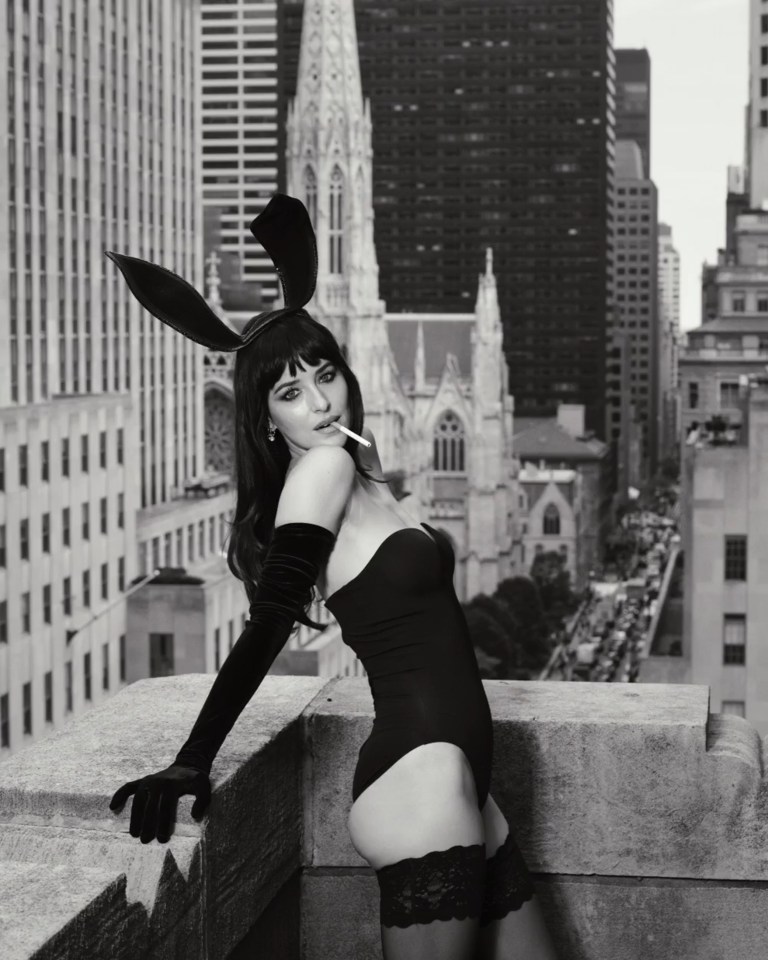
Bunny

Mona Awad’s ‘Bunny’ spawned a creepy-cute aesthetic universe and film adaptation

Among novelist Mona Awad’s prized possessions is a handmade rabbit brooch with delicate hanging daggers. It’s a gift from a reader. The present was inspired by Awad’s goth-tinged comic novel “Bunny,” which has garnered a cult following on social platforms like BookTok over the last several years with readers who call themselves “bunnies.” Driven largely by these devoted fans, the book’s sequel “We Love You, Bunny” hits shelves this month in paperback, while Awad hops across the U.S. on her latest book tour.

The bunnies are so enamored with Awad’s horror-adjacent satires centered on academia and female friendships (and often compared to “Heathers” and “Mean Girls”), they have created their own online — and offline — aesthetic universe.

Their videos and artwork, spanning Pinterest, YouTube, Instagram and TikTok, bring the novels’ surreal, “creepy-cute” aesthetic to life. The fan art features moody Ivy League backdrops with bunny ears, heavy tomes, blood-red candles and saccharine doll-like fashion. It’s a style ripped straight from the book’s antagonists — one of whom wears a pink dress patterned with beheaded girls. Some bunnies cosplay lace-adorned, ax-wielding characters and post the images on social media, or illustrate them.

Sara Ah Sing, a 30-year-old multidisciplinary artist in San Diego who considers herself a bunny, is one such illustrator. She discovered Awad’s fiction when she went down a BookTube dark academia genre-themed rabbit hole. “I was taken aback by how intense and vivid the descriptions were, and not only detailed, but very viscerally described … Mona Awad is not a generic prose writer,” Ah Sing says.

Author Mona Awad writes and dreams up her fiction in La Jolla, where she has a second home.

Author Mona Awad writes and dreams up her fiction in La Jolla, where she has a second home.

(Ariana Drehsler / For The Times)

She recalls a protagonist called Cupcake. “She’s described as a person who looks like a cupcake … something like ‘The Children of the Corn’ going to prom. And, it’s like, OK, what does that mean? For an artist it begs for interpretation — and I just have to illustrate it.”

Her imagination has been reignited with the sequel, “We Love You, Bunny.” Ah Sing illustrated its tortured central character, Aerius, as a muscled romance book cover star — with a twist. “Instantly when we meet him in the new book, he’s described with all these delicious descriptions. He’s got all these very specific tattoos that are in very specific places on his body,” Ah Sing says. “He’s wearing pearls and has auburn hair that covers one eye — it’s like a playground for your brain reading that kind of stuff.”

Awad’s vivid descriptions have led to all kinds of fan-led creations. Los Angeles-area Bookstagrammer Michelle Grondine, 40, is inked with five “Bunny”-inspired tattoos. “I have one on my inner ankle, one on my forearm, one on my collarbone, one on my lower back of a cat reading ‘Bunny’ and one on my thigh,” Grondine says. Each of the tattoos varies in style, not unlike the distinct personalities in the book’s fictional MFA cohort.

Grondine plans to attend Awad’s upcoming event at Skylight Books in Los Angeles on Sept. 21 with her best friend, Valentina Feldstedt, who lives in Northridge. The two met online after Grondine spotted Feldstedt’s “Bunny” social posts, and they quickly bonded over their shared obsession. They have collected various editions of the series (including the Barnes & Noble-released “We Love You, Bunny,” which features a bonus chapter), gone to see Awad live several times and crafted Taylor Swift Eras tour-style friendship bracelets for fellow fans and Awad (whom they call “our alpha bunny.”)

"Bunny" author Mona Awad's spread of her fan art and gifts in her home in La Jolla.
"Bunny" author Mona Awad's spread of her fan art and gifts in her apartment in La Jolla.

“Bunny” author Mona Awad’s spread of her fan art and gifts in her home in La Jolla. (Ariana Drehsler / For The Times)

Feldstedt, 30, has her own “Bunny” tattoo, which she says doubles as an excuse to pitch the novel to strangers. “It’s weird, but if you get it, you get it,” Feldstedt says. “And if you don’t, you’re not a bunny — and that’s fine.”

Awad says her sequel, in part, owes to bunnies like Ah Sing, Grondine and Feldstedt. “When readers started finding it online and creating and expanding the universe of it, it gave me permission to go back to it,” Awad reflects.

She walks around her Boston home and plucks up a fan-made crocheted rabbit toting an ax. Another fan, a nail artist, crafted spooky bespoke black and purple press-ons decorated with intricate white hares. Awad says there’s a song written about the book by an indie band from western Massachusetts called the Greys, and you can buy fan-crafted “Bunny” merch on Etsy.

A poster signed by fans at Mona Awad's book signing for "We Love You, Bunny" at the Center for Yoga in Los Angeles.

A poster signed by fans at Mona Awad’s book signing for “We Love You, Bunny” at the Center for Yoga in Los Angeles.

(Ariana Drehsler / For The Times)

But “Bunny” didn’t always have such a rabid fan group. In fact, when the first book was published in 2019, it received critical acclaim, but Awad was disappointed it wasn’t selling as well as her previous novel, “13 Ways of Looking at a Fat Girl.”

“I was like, well, maybe it’s just a weird book,” she recalls on a Zoom call in her literature-lined home. A few years later, during the height of the COVID-19 pandemic, Awad got a call from her publisher. The book was selling, and they couldn’t figure out why. “It was beginning to sell more than 1,000 copies a week, which is crazy two years after publication,” she says. Around that time, BookTok and BookTube had discovered her novel. Next came the bunny ears.

“More and more readers were tagging me on Instagram, and they were dressed in bunny ears, or they had a bunny tattoo, or they were sharing visual art that they had made, envisioning the characters — paintings, ink drawings, cartoons, comics, so many different iterations of this — and then all of these reels and collages that were just so incredible to see,” she says, pausing to emphasize her amazement. “I was really startled by it. It just kind of came in this wave, and then it just grew from there.”

Jane Friedman, a books industry veteran who tracks publishing news, trends and the intersection with technology in her newsletter “The Bottom Line,” says that intense literary fandoms aren’t entirely new. “Apart from BookTok, there have always been these really obsessive fan communities,” Friedman says. “The internet and social media just made it easier for them to come together, making them far more powerful.”

Friedman emphasizes that some critics are concerned that a so-called BookTok phenomenon pushes literature toward consumerism and waters down literary quality. “You can sometimes see authors chasing a trend rather than writing what they would ordinarily write, hoping their book will go viral,” Friedman says. “But I don’t think that’s the case here. It’s probably a mix of timing, serendipity, literary quality and, you know, the stars aligning.”

Awad was born in Montreal to a French Canadian mother and an Egyptian father. She grew up in a French-speaking family, and when her mother enrolled her in an English-speaking school, she recalls feeling like a complete outsider. It was an experience that would happen again and again — like later when her family moved to a Toronto suburb (where, of course, she had a few goth years), and again in her 30s during grad school when she earned her MFA at Brown University.

1

Superfan Valentina Bunny lives in Northridge.

2

Madelyn Bunny hails from Kentucky.

3

L.A.'s Michelle Bunny has five rabbit tattoos with plans for more.

4

Valentina Bunny, left, and Michelle Bunny with author Mona Awad.

5

Chloe Bunny lives in Australia.

1. Superfan Valentina Bunny lives in Northridge. (Valentina Feldstedt) 2. Madelyn Bunny hails from Kentucky. (Madelyn Chimento) 3. L.A.’s Michelle Bunny has five rabbit tattoos with plans for more. (Michelle Grondine) 4. Valentina Bunny, left, and Michelle Bunny with author Mona Awad. (Michelle Grondine) 5. Chloe Bunny lives in Australia. (Chloe Bunnie)

“It was kind of my first taste of New England, which was very, very mythical to anybody who doesn’t come from there … It was disorienting in ways that I suppose were productive in retrospect, but it was hard. It was my first taste of being critiqued. It was my first experience of sharing work with others and having them talk about it with me, and it wasn’t easy,” she says. “I mean, the whole world of the MFA felt like fodder for horror.”

Being an outsider looking in remains a central theme across her novels, including her other critically acclaimed works, and it resonates deeply with readers. The wildly imaginative “Bunny,” often described on TikTok as a “fever dream,” has been translated into 17 different languages. Awad notes that she has an especially huge readership in war-plagued Ukraine, where the book is a breakout bestseller. “It’s so moving to me,” she says. “What they say is that it’s a very anti-fascist book, and it’s a very anti-establishment kind of book. It is about resisting the pull of the clique, finding your own ground, standing on your own ground, and being authentically yourself and embracing that.”

It’s a theme she will continue in the third Bunny book. “The minute I turned in ‘We Love You, Bunny,’ I missed the characters and the world,” Awad reflects. She knew there would be another one. Although Awad has deep roots on the East Coast where she’s taught university-level creative writing courses — her students perhaps not so unlike some of the MFA characters in her “Bunny”-verse — nearly all of her books were written in Southern California, where she has a second home and plans to write her next novel. She notes that a short story she wrote in 2025 for the New Yorker was set in the San Diego area, as was her novel “Rogue.” “It’s been such a generative place for me,” she says. “I’ve become sort of superstitious about it.”

Her next book is taking shape as she works and dreams near the ocean. Meanwhile, her existing work is set to make waves in Hollywood. “Bunny” is slated to be adapted into a film by J.J. Abrams’ production company, Bad Robot, and was recently acquired by a major streaming service — although Awad can’t disclose which one yet. She says she’s been deeply involved. “I feel like my vision of the book is being honored, which is really meaningful. Part of the reason that’s so important to me is because I want to honor my readers’ connection to it.”

That deep bond is something Awad witnesses firsthand nearly every night on the road, where her digital fandom materializes into physical rooms filled with devoted readers (often donning rabbit ears). “The thing that moved me the most about going on tour for the hardback — and it’s happening as I’m on tour for the paperback too — is seeing just how many people bond over the book,” Awad reflects. “Not only the art that has been generated by ‘Bunny,’ but so much community and friendship has been formed. You see this kindred spirit through reading, and it’s the most beautiful thing.”

Mona Awad presents “We Love You, Bunny” at Skylight Books on Sept. 21. 1818 N. Vermont Ave., L.A.

Source link

Gloria Steinem, the Playboy Mansion and the power of women’s stories

It was 1963 and up-and-coming freelance journalist Gloria Steinem had been a working writer in New York City for roughly three years when Show magazine sent her on an undercover assignment that she was uniquely qualified for: to infiltrate Manhattan’s “greatest new showbiz gimmick,” the Playboy Club. She already had the beauty and brains, all she’d need was an alias, a leotard and a notebook. The assignment would change the course of her career, but not in the way that she’d hoped.

“GIRLS:

Do Playboy Club Bunnies Really

Have Glamorous Jobs,

Meet Celebrities, And

Make Top Money?

Yes, it’s true! Attractive young girls can now earn $200-$300 a week at the fabulous New York Playboy Club, enjoy the glamorous and exciting aura of show business, and have the opportunity to travel to other Playboy Clubs throughout the world.”

Armed with the above ad and welcomed by a grinning private guard calling, “Here bunny, bunny, bunny!” Steinem set out to expose the working conditions and interior lives of the bunnies slinging booze to the playboys who patronized the club. She subjected herself to the wardrobe fittings, which included getting her bunny suit stuffed to boost her breast size; she was poked and prodded during an invasive physical exam; she strutted through the club near-naked with sore feet and a suit so tight, she had to wrap gauze around her midsection where her skin had been rubbed raw; and various other indignities she underwent for the sake of journalism.

Documenting a lunch shift at the club, Steinem wrote, “Somehow, the usual tail pullings and propositions and pinching and ogling seemed all the more depressing when, outside this windowless room of perpetual night, the sun was shining.”

Steinem’s article accomplished what it set out to do, and not only were the working conditions at the club exposed, but some were subsequently improved because of her work. In her essay collection “Outrageous Acts and Everyday Rebellions,” Steinem wrote that in response to the story, Hugh Hefner wrote her a letter saying that her “beef about the physical given [to] the girls before they start work at the club prompted my eliminating it.”

Also as a result of her piece, she was slapped with a $1-million libel suit, subpoenaed as a witness in a liquor laws case against the Playboy Club, and received “obscene and threatening” calls.

Most notable, of the short-term results of the story, was the immediate impact it had on her career. Sure, in a lot of ways it had put her on the map, but she struggled to land serious journalistic assignments because, as she put it, “I had now become a Bunny — and it didn’t matter why.”

Steinem, a feminist icon and one of the most widely recognized leaders of the second-wave women’s movement, died on Wednesday at 92. Since she shed the bunny suit after her 11-day stint on the job at the Playboy Club, she went on to cofound New York Magazine and Ms. Magazine, which changed the course of the abortion rights movement with its “We Have Had Abortions” petition in which high-profile women admitted to having illegal abortions, Steinem among them. She played a pivotal role in spearheading some of the most influential and successful women’s rights efforts. And in 2013, she was awarded the Presidential Medal of Freedom for her lifetime of work as a journalist and activist.

Still, with all the aforementioned accomplishments, and decades later, Steinem said that her naysayers used her bunny work in an attempt to discredit her. For decades she considered the story a “professional error of gigantic proportions.” But later, she changed her tune.

“I’m not sorry I did it,” she told Ronan Farrow in 2020, when she was 86 years old. “But it is true that as old as I am, when anybody wants to put me down, they say, ‘Well, she was once a bunny.’ ”

In Steinem’s “Famous Last Words” interview, released on Netflix following her death, she closed the segment by addressing the audience. “Please tell your own story,” she said. “This is the most important thing we can do for each other: is to know each other through stories.”

I was hesitant to tell this story, and stewed over the potential risks I would be taking by telling it, but then I thought of the risk Steinem took. She dealt with fallout and she grappled with the ways the article may have hurt her career more than helped. But of the ample wisdom she imparted, its the power of women’s stories to shift culture, change policy and empower other women that feels most resonant.

I didn’t discover Steinem’s “I Was a Playboy Bunny” exposé until I was in college. I was in my late twenties at the time because I’d taken a few detours after I left high school, most of them dead ends.

One such detour led me through the massive hedge-lined gates of the Playboy Mansion. I was 18, and the E! reality series “The Girls Next Door” sparked renewed interest in Playboy bunnies. I wish I could say that I’d arrived at the mansion on an undercover magazine assignment, but the reality was different. I’d been watching a rerun of the E! show from a bedbug-ridden townhome in downtown Los Angeles, and earlier that day I grappled with whether I should pay my parking debt or buy a burrito.

I watched as the girls bounced around the mansion, appearing carefree, bedbug-free and parking ticket-free. Their lives, produced and edited as they were, appeared to be stable and glamorous, and I thought, “Hmm, maybe I should do that.” If Hefner was good at anything, it was creating a facade.

Like Steinem found, applying to be a Playboy bunny was surprisingly simple. I emailed a photo of myself in a swimsuit and shortly afterward, an invitation to a casting call at the mansion arrived.

At the casting call, I was handed a satin robe and pointed toward a small tent where I could change and a large tent with the photo crew inside. Steinem had likened wearing the bunny suit to feeling like meat on a hook. I, too, couldn’t shake the thought of a meat factory and almost instantly, realized I wanted off the conveyor belt.

My trip to the mansion and endeavor to become a bunny was short-lived. I’d driven there feeling like a femme fatale, and left feeling naive and out of my depth. Worse, it was just another humiliating misadventure that I’d carry around for years with shame.

That is until I came across her story in her essay collection “Outrageous Acts and Everyday Rebellions.”

Steinem said that she was pigeonholed because of the story. She struggled afterward to be taken seriously and that may be true, but I’d argue an opposite point. Because Steinem was ultimately held in such high regard as a journalist and activist, and because she was an undercover bunny along the way, she helped the bunnies of the world to take themselves a little more seriously, to see that beyond the bunny suit, there is a world of possibilities waiting for them.

In the collection, originally published in 1983 and reprinted several times, Steinem wrote that after a town-hall meeting in New Bedford, Mass., a little girl of 6 or 7 gave her a crayon drawing of her in the bunny costume copied from a photo that had circulated online. “ ‘Even if a girl looks silly,’ she said, ‘boys should know that’s she’s smart.’ ”

“This story may outlast me,” she wrote. “but it’s not going to outlast or outsmart that little girl.”

In the book, Steinem wrote that one longer-term result of the article was “realizing that all women are Bunnies. After feminism arrived in my life, I stopped regretting that I had written the article.”

The line “All women are Bunnies” stands out. But what I imagine she meant is, bunnies are just women.

Source link

Bad Bunny wins first Emmy for Super Bowl halftime show

It’s been a remarkable year for Bad Bunny, one of pop music’s biggest stars. After winning multiple trophies earlier this year at the Grammys, including album of the year for “Débi Tirar Más Fotos,” he can add another accolade: Emmy winner.

The Puerto Rican rapper and singer, also known as Benito Antonio Martínez Ocasio, won his first Emmy for variety special (live) on Saturday for his historic Super Bowl halftime show. It was the first Spanish-language halftime show, a 13-minute spectacle that transformed a football field into a variety of scenes including a sugar cane field, bodega, wedding party and casita, like the one in his 2025 San Juan residency. It also featured performances by Lady Gaga and Ricky Martin. Mikael Wood, The Times’ pop music critic, called it “a busy and colorful performance that drew lines between the traditional folk forms of his native island and the throbbing reggaeton beats that have made him an icon to young people around the globe.”

Bad Bunny served as a producer on the show. It won seven Emmys overall, including for directing for a variety special and music direction.

Also honored at Saturday’s ceremony was Mariska Hargitay for her documentary “My Mom Jayne,” about her mother Jayne Mansfield, a Hollywood actor who died in a car accident when Hargitay was 3 years old. Hargitay also received an Emmy for directing the film and Tony Hardmon won for cinematography. The movie, which premiered at the Cannes Film Festival last year, had a limited theatrical run before being released on HBO in June 2025. Hargitay won an Emmy in 2006 for lead actress in a drama for playing Det. Olivia Benson in “Law & Order: Special Victims Unit.”

In an interview with The Times last year, Hargitay said, “Making this film has been so extraordinary to me and totally reframed the narrative for me,” about Mansfield and the struggles she encountered over her brief but celebrated career. The film also revealed that Hargitay’s biological father was Nelson Sardelli, a former entertainer, and not Mickey Hargitay, the man who raised her and Mansfield’s second husband.

Mariska Hargitay will host the Primetime Emmy Awards on Sept. 14 in Los Angeles.

The first pair of Emmy ceremonies, formerly called the Creative Arts Emmys, are held over two nights, two weekends before the Primetime Emmy Awards, and honor many of the behind-the-scenes workers and craftspeople in television. An abridged version of the ceremonies will be broadcast Sept. 12 on FXX and stream on Hulu the following day.

Here is a list of winners from Saturday’s ceremony:

Variety special (live)
“The Apple Music Super Bowl LX Halftime Show Starring Bad Bunny”

Variety special (pre-recorded)
“The Muppet Show”

Documentary or nonfiction series
“Mr. Scorsese”

Documentary or nonfiction special
“My Mom Jayne: A Film by Mariska Hargitay”

Unstructured reality program
“Love on the Spectrum”

Structured reality program
“Antiques Roadshow”

Host for a reality of reality competition program
Alan Cumming, “The Traitors”

Game show
“Jeopardy!”

Game show host
Jimmy Kimmel, “Who Wants to be a Millionaire?”

The complete list of winners for Saturday’s ceremony can be found at televisionacademy.com.

Source link