If you buy books linked on our site, The Times may earn a commission from Bookshop.org, whose fees support independent bookstores.
What does it mean to lack ambition in a country that worships wealth? It means you are a capitalist wallflower, a laggard with a serious character flaw. No field of endeavor is immune from this attitude, the art world least of all. But artists with a desire for riches and fame must not declare their intentions so brazenly. At a time when the plastic arts are about as marginalized as they ever have been, and media buzz is generated by dead painters whose works sell for enormous sums at auction, creation in and of itself has little value unless it is lashed to something marketable.
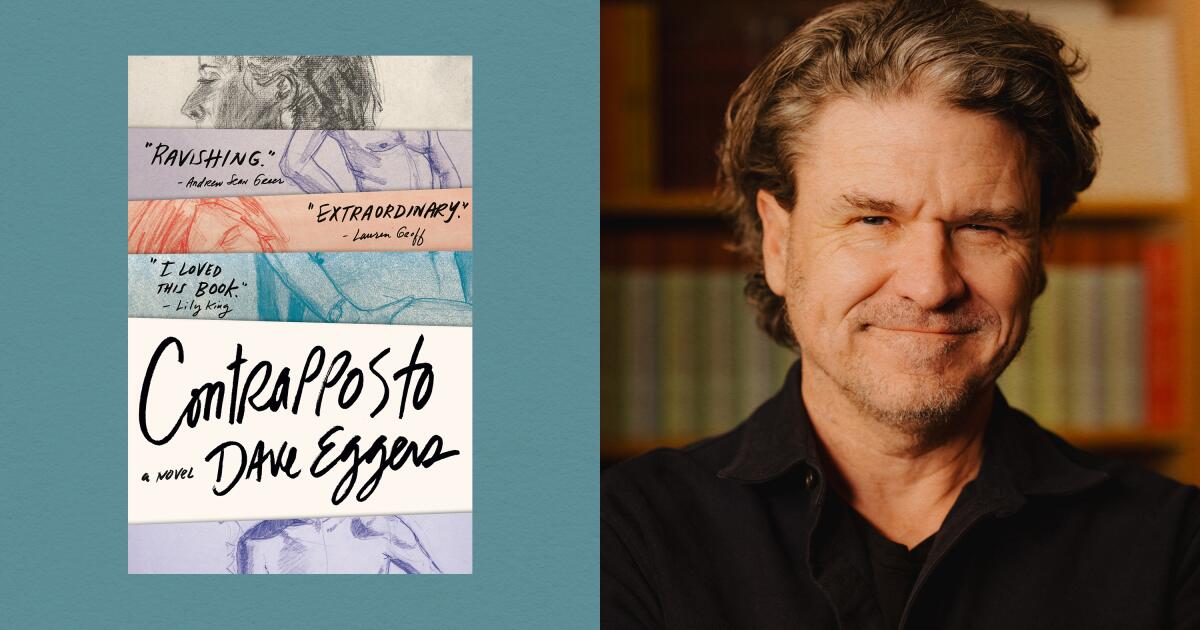
With his new novel “Contrapposto,” Dave Eggers has written a big-hearted, deeply moving story about the choices artists make, or don’t make, to square up their own notions of success and happiness. The book is dual bildungsroman, following two friends across the long span of their lives from adolescence to their 70s, as they fall in and out of each other’s lives, make their way in the world, and fumble around for meaning and purpose in their art.
The protagonist in “Contrapposto” is Rob “Cricket” Dibb, an underclass Midwestern kid, raised by a single mother in a North Indiana suburb that’s about as nowheresville as it gets for budding artists with dreams of glory. Cricket doesn’t dream big. He’s just trying to endure without bodily harm, seeking refuge from his mother’s abusive boyfriend in the basement with his grandfather Silas, who teaches him about jazz and the beauty of a glorious sunset. He draws so he doesn’t have to think. Immersion in art is his escape hatch from the dreariness of his pinched world: “The drawing meant nothing, would never mean anything to anyone, but it was true to how he saw it. His hand had recorded what he saw and felt about this thing. He was an ugly, common creature who could occasionally freeze time. That was enough.”
Cricket’s apprenticeship is decidedly informal. No full scholarship rides to Bard or Pratt for him; instead he saves up to enroll himself in a life drawing class in Chicago, where he discovers the beauty of applying rigor and rules to his work, how to break down pictures into the geometry of circles and squares, planes and angles. “He measured proportions and improved,” writes Eggers. “He grew more confident with each pass on his drawing, and realized … that much of the rightness of the drawing, of any drawing, came through time and diligence and discernment.”
He meets his slightly older schoolmate Olympia, one of Eggers’ most beguiling creations, when she implores him to scrawl scatological bathroom graffiti on a playground structure in Old-English typography. Unlike Cricket, Olympia is earnest and sincere about her art in the way that only a young person untainted by cynicism can be. She claims to inhabit the soul of Albert Camus, and flings around aphorisms about art that fly over Cricket’s head. She is an aesthete, someone who likes to go to the race track just to revel in the colors on display there. She wants to create an art scene in their little world. “You know all the great art movements have friends at their core, right?,” she tells Cricket. “A lot of time they’re jammed together by some critics and the artists reject the name and the association. But think about Patti Smith and Sam Shepard. Did you know they dated for a while?”
Cricket is beguiled by her, and Olympia in turn is taken in by Cricket’s talent. When the local library pulls a few of Cricket’s semi-nude life drawing portraits down for fear of offending their patrons, Olympia becomes his advocate and champion. In contrast to Cricket, who skates along with no end plan, Olympia is a committed careerist, an artist who insists on a captive audience to justify her work. She wants to earn money as an artist; Cricket just wants to be left alone. This push and pull between the two frame Eggers’ novel across the six decades of his narrative.
One of many joys of “Contrapposto” is observing Cricket’s artistic awakening via the mentors who guide him into his artistic consciousness. Marcus Carpenter, a wizened sage in battered work boots (one imagines him as the art world analogue to the late novelist Jim Harrison), is the moral conscience of the novel, fighting the good fight for personal expression and railing against the “new, paradoxical tyranny wherein those without technical skill terrorize those who possess it.” Carpenter plucks Cricket from arts college and its meaningless pontificating to his “atelier in the corn,” a ramshackle Victorian where Cricket learns how to transmute what he sees with color and light. “The talented have talent,” Carpenter tells Cricket during one of his endearing rants. “The untalented have theories.”
From there, Cicket’s life is a crooked line. He doesn’t abandon art, but he can’t summon the urge to sell himself or his work, to graft his joy in making things onto the caprices of the marketplace. As Eggers jumps through time, we find Cricket working as an intern in an art gallery, an arid, lifeless space where nothing inspiring can possibly exist. As a young man he works as a ship-breaker in Turkey; in middle-age, we find him in a coastal town in Cambodia, making replicas of great paintings for tourists. Olympia, his elusive love and sporadic muse, flits in and out of his life as she works her way up the tiers of the art world’s ziggurat. She gently berates him for his timidity: “This is how artists have power. We sell work. You’re implying there’s nobility in powerlessness. That’s been an idiotic trope for too long — that participating in the business side of it taints you. Do you know how dumb that is? That artists have to be these fragile little wood nymphs that are too precious to touch the money?”
As “Contrapposto” arrives at its beautiful, life-affirming conclusion, we are left pondering the significance of artistic endeavor in a world that commodifies everything, including our bodies and brains. At a time when even the greatest achievements are debased in a culture that gives equal weight to meretricious novelty, is it even worth the trouble? Eggers’ brilliant novel has the answer: Follow your bliss. In the final analysis, it is all that matters.
Summer, and all the vacation days and potential travel that implies, is upon us. And whether flying internationally or taking time off at home, you can’t beat a good British crime drama as the ultimate self-soother (especially in summer when the U.K.’s inevitable drizzly city streets and windswept moors can provide at least visual relief from the heat). The genre is varied, the casts inevitably fine and justice almost always prevails. So here are 15 shows, new and old, to watch. (And if that’s not enough, you can find 15 more here.)
‘Young Sherlock’ (Prime Video)
Will we ever tire of reimagining Sherlock Holmes? Not anytime soon, apparently. Created by Matthew Parkhill and developed by Guy Ritchie (who directed two episodes), this version gives us a college-aged Sherlock (Hero Fiennes Tiffin) banished to the role of Oxford University porter by his fed-up older brother, Mycroft (Max Irons), who hopes to put the arrogant young rip on a steadier path. Alas, before you can say “Sir Bucephalus Hodge” (the Oxford bigwig played by Colin Firth), young Sherlock is up to his flat cap in murder and mystery, which he is determined to solve with the aid of his new best bud — wait for it — James Moriarty (Dónal Finn). An over-the-top romp that proves, if nothing else, the near-miraculous elasticity of Arthur Conan Doyle’s iconic creation.
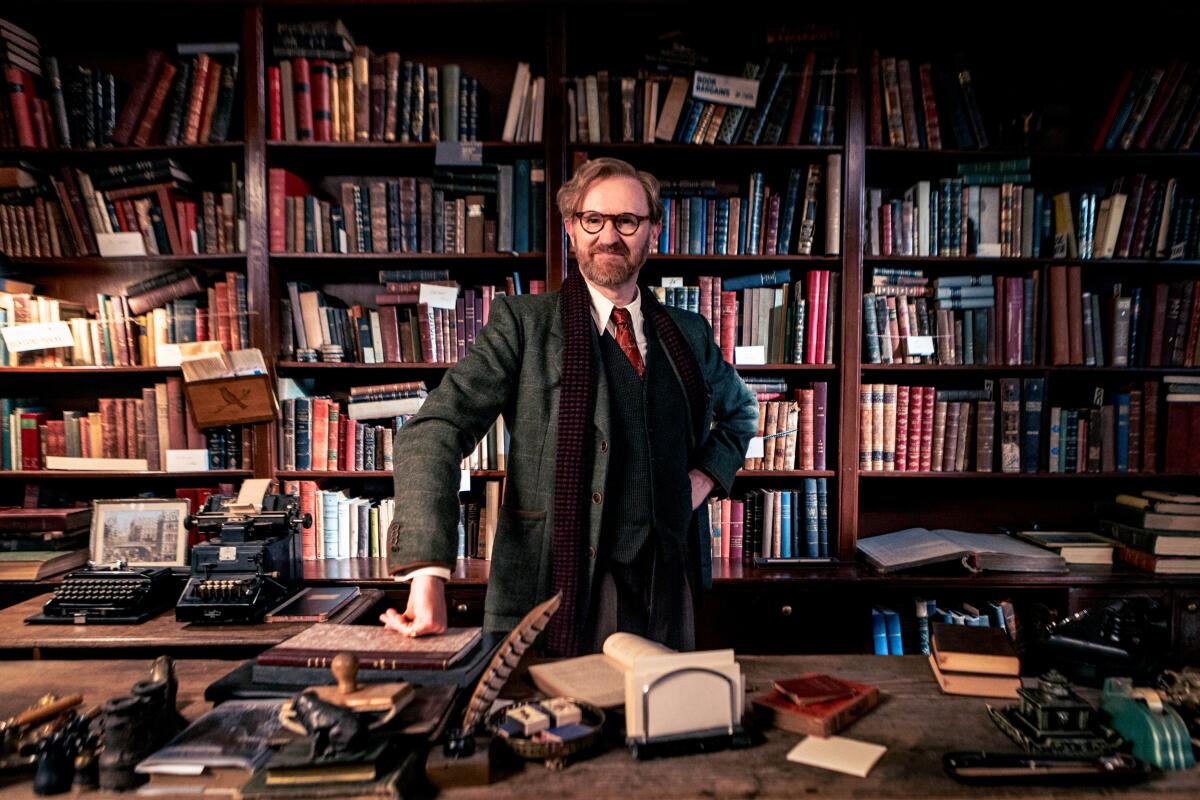
Mark Gatiss stars as Gabriel Book in “Bookish.”
(PBS)
‘Bookish’ (PBS)
Speaking of Holmes, “Sherlock” co-creator and co-star Mark Gatiss is up to it again, this time in the leading role. In post-World War II London, Gabriel Book (Gatiss) runs a secondhand bookshop, above which he and his beloved wife, Trottie (Polly Walker), live. But all is not what it seems, as Jack (Connor Finch), the young orphan ex-con they take under their wing, soon discovers. Gabriel apparently did something so important during the war that he is now the neighborhood’s go-to crime solver (with a letter from Winston Churchill to ensure VIP access). He also has a personal stake in Jack’s reclamation, which gives the series a fascinating and pathos-filled LGBTQ-history subtext.
Rishi Nair as Alphy Kottaram, left, and Robson Green as Geordie Keating in the 11th and final season of “Grantchester.”
(PBS)
‘Grantchester’ (PBS)
The sacred meets the secular in this long-running pairing of a young vicar with a worldly police detective in the titular idyllic Cambridgeshire village during the 1950s and ‘60s. In Seasons 1-4, that vicar is Sidney Chambers (James Norton), a jazz enthusiast plagued by memories of WWII who offers unsolicited insights to gruff and initially ungrateful Det. Inspector Geordie Keating (Robson Green). Friendship inevitably blooms, and when Sidney leaves the scene (and Norton the series) at the end of Season 4, many hearts (including Geordie’s) are broken. But subsequent replacement vicars — Will Davenport (Tom Brittney) in Seasons 5-9 and Alphy Kotteram (Rishi Nair) in Seasons 9-11 — each find their way to Geordie’s side, bringing their own charms, detectival insights and personal woes. The final season premieres June 14.
‘Touching Evil’ (BritBox)
DI Dave Creegan (a young Robson Green) is brought in to help DI Susan Taylor (an even younger Nicola Walker) of the Organized and Serial Crime Unit solve a series of abductions that Creegan comes to believe have been committed by a serial killer. The relationship sticks and the pair goes on to track down all manner of nasty killers with a combination of unconventional techniques and good police work. Green’s Creegan gets top billing, and a deeply resonant personal story, but seeing Walker (who would go on to star in so many fine series, including the terrific crime dramas “River” and “Unforgotten”) play a finely tuned second fiddle is great fun too.
‘Karen Pirie’ (BritBox)
For fans of Scottish crime drama (see also “Case Histories,” “Shetland” and “Dept. Q”), Det. Inspector Karen Pirie (“Outlander’s” Lauren Lyle) is a refreshing historic cases hero. Smart, ambitious and dogged, she is not burdened by a dark past or traumatic pain or the generally dour outlook that plague so many of her peers. Based on the books of Val McDermid, the series is set on the Scottish peninsula of Fife (the first season involves the picturesque town of St. Andrews) and all the gloriously broody scenery that implies. Murder mystery plus vicarious international mini-break.
‘Sister Boniface Mysteries’ (BritBox)
This cheeky spinoff of the iconic “Father Brown” puts a sweet-faced Catholic nun (Lorna Watson) at the center of all manner of murder in the fictional 1960s Cotswolds town of Great Slaughter. Sister Boniface is, of course, not just any nun. Having served as a codebreaker at Bletchley Park during WWII before entering the convent, she holds a PhD in chemistry, which makes her the perfect, if most unlikely, forensic specialist. (She also rides a red Vespa and serves as the convent’s vintner.) Unflappably brilliant and sincere in her vocation, she proves that faith in action can be both serious and great fun to watch.
‘The Bletchley Circle’ (BritBox)
Like Sister Boniface, Susan Grey (Anna Maxwell Martin) served her country as a codebreaker, but she is finding post-WWII life a bit more, well, boring. Forced back into the traditional roles of wife and mother, Susan tries to make do until a series of murders suggests to her a pattern unnoticed by the police. Gathering her former and still formidable colleagues who are also languishing in a sexist world, she creates, for two marvelous seasons, her own private crime unit. (See also, the one-season spinoff, “The Bletchley Circle: San Francisco.”)
‘Sherwood’ (BritBox)
When truculent Gary Jackson (Alun Armstrong) is murdered by an arrow outside his home in Nottinghamshire, near Sherwood Forest, Det. Chief Supt. Ian St. Clair (David Morrissey) is quick to put down any Robin Hood references and look instead at the town’s 30-year-old but still roiling divisions over the U.K.’s 1984-85 miners’ strike. Based on real events, “Sherwood” is both a murder mystery and a contemplation of the damage done by class-based strife and longheld grudges, often based on misinformation. With an incredible cast, including Lesley Manville, Kevin Doyle and Lorraine Ashbourne, it is deeply moving drama that illuminates the personal price of social divisions. Season 3 premieres this year.
Lesley Manville as Susan Ryeland and Timothy McMullan as Atticus Pund in “Magpie Murders.”
(Nick Wall / Eleventh Hour Films / PBS)
‘Magpie Murders’ (PBS)
Season 3 of “Magpie Murders” — titled ”Marble Hall Murders” — is also set to bow this year, so now is a good time to catch up on the previous adaptations of Anthony Horowitz’s Susan Ryeland novels, which both satirize and honor the murder-mystery genre. Ryeland (Lesley Manville) is a book editor whose most famous — and tiresome — author, Alan Conway (Conleth Hill), has just turned in his final murder mystery called “Magpie Murders.” Only the last chapter is missing and Conway has just been found dead at his country home. So it’s up to Ryeland, working with Conway’s literary detective Atticus Pünd (Tim McMullan), to figure out what happened, both in real life and in the book. This mystery-within-a-mystery launches two vivid characters, Ryeland and Pünd, working separately and together to solve crimes, sometimes in two different timelines.
Bill Nighy as headmaster Alan Lockwood, from left, Sharon Small as Det.Sgt. Barbara Havers and Nathaniel Parker as Det. Inspector Thomas Lynley in “The Inspector Lynley Mysteries.”
(Alex Bailey / BBC)
‘The Inspector Lynley Mysteries’ (BritBox)
The many, and voluminous, novels of Elizabeth George are being adapted in “Lynley,” a new series that has its charms. Still, I’m sticking with the older version, which ran from 2001 to 2008. Over six seasons, the unlikely partnership of Det. Inspector Thomas Lynley, eighth earl of Asherton and generally natty guy played by Nathaniel Parker, and his distinctly working-class and perpetually disheveled sergeant, Barbara Havers (Sharon Small), creates a classic odd-couple mix that allows some actual insight into issues of class and gender. But mostly, they make a great detective team, often using their differences to their advantage. The mysteries range far and wide over the U.K., from gritty streets to posh country homes, and 24 90-minute episodes are enough to keep you going all summer long.
Derek Jacobi in the title role of “Cadfael” in 1995.
(ITV)
‘Cadfael’ (BritBox)
Though the oldest series on this list (1994-1998), “Cadfael,” based on the books of Ellis Peters, remains a classic and constant recommendation. The great Derek Jacobi plays the titular 12th century monk who was once a soldier of the Crusades. Now a botanist and apothecary, Cadfael aids the local sheriff in solving all manner of crimes committed in and near Shrewsbury Abbey during England’s 15-year civil war known now as the Anarchy. Though the series does not delve as deeply into the politics of the time as the novels do, it creates an uncertain world in which violence runs rampant. Mercifully, there is a monk who knows his stuff, and if Jacobi isn’t enough reason to watch, the costumes and landscape are pretty great too.
‘No Offence’ (BritBox)
Joanna Scanlan was punk rock long before her turn in “Riot Women,” especially as the wildly frank, slightly raunchy, take-no-prisoners DI Viv Deering in this blackly funny depiction of the wayward Friday Street division of the Manchester Police. They are not misfits exactly — Deering knows what she’s doing as does her team, including the ambitious Det. Constable Dinah Kowalski (Elaine Cassidy), the self-doubting Det. Sgt. Joy Freers (Alexandra Roach) and Paul Ritter’s wise-cracking Randolph Miller (OK, maybe he is a misfit) — but they are much more recognizably human than most TV coppers. We know they’ll get their man, but it will take some time, and more than a few hilarious and heartbreaking misfires.
‘Inspector George Gently’ (Acorn TV)
After the murder of his wife, Inspector George Gently (Martin Shaw) leaves London’s Metropolitan police force in search of a more peaceful life in 1960s Northumberland. But as anyone who has seen “Vera” could tell him, Newcastle Upon Tyne is far from peaceful. Still brokenhearted, Gently finds himself solving crimes, and trying to teach his sergeant John Bacchus (Lee Ingleby) to be an honorable man in a time of shifting social mores and political upset.
‘Whitechapel’ (Hulu)
Come for the Jack the Ripper overtones, stay for the always great character actor Phil Davis (“Trying,” “Vera Drake”). He plays old-school Det. Sgt. Ray Miles, a member of an East End squad that is less than thrilled by their new guy, opposite the smooth and ambitious Det. Inspector Joseph Chandler (Rupert Penry-Jones), who shows up to his first crime scene in a tux and doesn’t appear to understand that this is the East End. But with what seems like a Ripper copycat on the loose, everyone needs to put aside their preconceived notions and figure out what’s going on. The series is wildly atmospheric with plenty of gallows humor and more than a few truly loopy plotlines, but great fun with Davis managing, as ever, to sell even the most preposterous scene.
James Norton as Henry Alveston, from left, Matthew Rhys as Darcy and Matthew Goode as Wickham in “Death Comes to Pemberley.”
(Robert Viglasky / PBS)
Death Comes to Pemberley (PBS)
This adaptation of P.D. James’ sequel to “Pride and Prejudice” is a miniseries, and just three episodes long, so this might be a bit of a cheat. But if you haven’t seen it, you should. Elizabeth Darcy (nee Bennet) (Anna Maxwell Martin) and Fitzwilliam Darcy (Matthew Rhys) are happily married and planning a ball. Sure, a couple of servants see a ghost in the woods (where Elizabeth encounters a suspicious woman), and Col. Fitzwilliam (Tom Ward) clearly wants to marry Georgiana (Eleanor Tomlinson), who doesn’t seem too keen, but what of it? Then Elizabeth’s sister Lydia (Jenna Coleman) shows up uninvited and hysterical; her still-caddish husband, George Wickham (Matthew Goode), had an argument with his friend Capt. Denny (Tom Canton), and the two vanished into the woods where shots were subsequently heard. Once again, Mr. Darcy must do what he can to protect the dreaded Wickham, and in doing so all manner of secrets are revealed. Jane Austen meets Agatha Christie with a cast either writer would kill for.
There’s a good reason why David Sedaris is the most beloved humorist in America. He has an unerring ability to tap into the absurdity and petty annoyances of American culture more cogently than any other writer of his generation. He is also funny as hell.
Sedaris’ latest collection, “The Land and Its People,” finds the author grappling with the seductions and consolations of technology, creeping mortality, unwanted sexual advances and feral dogs, for starters. I recently chatted with Sedaris about books, nannies and iPhones.
My fiction is always way, way over the top. I can’t write any story where people are reasonable.
— David Sedaris
You’re reading Book Club
An exclusive look at what we’re reading, book club events and our latest author interviews.
By continuing, you agree to our Terms of Service, which include arbitration and a class action waiver. You agree that we and our third-party vendors may collect and use your information, including through cookies, pixels and similar technologies, for the purposes set forth in our Privacy Policy such as personalizing your experience and ads.
✍️ Author Chat
Your first book was a collection of short stories. Was it always the intent to move into writing essays, or did you have designs on being a novelist?
It never occurred to me that I would write essays about my life. I started off writing fiction, and then I started doing these readings in Chicago. Then I was to read at this variety show at this place called Park West. I was limited to about five minutes, and so I just plucked something from my diary. And it worked. I would walk onstage wearing a tie with a stack of diaries in my hand. Then I started doing these radio shows, and I thought I could read my fiction, but it had to be nonfiction. So a lot of the earliest pieces that I ever read were just things plucked from my diary.
What actually happened was that after this piece I wrote called “The Santaland Diaries” had been on the radio, I had this other book that I had already written, and I was just kind of waiting for someone to call and ask if they could publish it. But it couldn’t be published unless “Santaland” was included.
That book was “Barrel Fever” in 1994 which was a big hit. Now you were that rare creature: a bestselling essayist.
With essays, there’s a kind of shorthand to it. If you’re writing fiction, you have to world-build with every story, whereas with an essay I can just get up on stage and say “my sister and I went shipping” and people know who my sister is, and I can just get right into it. My fiction is always way, way over the top. I can’t write any story where people are reasonable.
What makes you unique is that you are onstage in front of an audience more often than 99% of authors. You can workshop material to see if it lands, much like a comic.
Yes, and I don’t ever want to waste an opportunity to do that. The frustrating thing about being on a book tour is that I can no longer make any changes to the book. So I’ve been bringing out some little, short things I’ve been working on to get it on its feet.
Much of your writing is observational. Do you find, given your public profile, that it becomes harder to do that?
It depends on where I am. If I’m hanging out in places where people don’t read, or in another country, then it doesn’t make any difference. The bigger problem is that when you’re spying on the world now, the world is just looking at their phones.
“The Land and Its People” is the new collection of essays by David Sedaris.
(Little, Brown and Company)
I know you aren’t big on the phone, or at least taking pictures with your phone. In one of your essays in the new book, you are on a Kenyan safari with your partner Hugh and you adamantly refuse to snap a single photo.
If you’re at a book signing, you meet someone and then stand up and someone takes a picture with their phone. I’d rather talk to that person, you know? The picture thing, it just doesn’t make any sense to me. It doesn’t mean anything. I was invited to the Academy Awards because I wrote something about a movie, which was crazy. But it never for one moment occurred to me to go up to anybody to take a selfie. All that means is that I bothered this person. By the way, I have never once asked Hugh to send me his safari pictures.
What books make you laugh out loud?
I’m always happy to find a funny book, but they are hard to find. Did you read “Rejection” by Tony Tulathimutte?
It’s on my nightstand.
Oh my God, I laughed out loud so many times at that book. And he’s not a humorist. I’m not even sure if he thinks the book is funny. There’s a short story in there, about a guy who’s just a complete a— and his girlfriend moves in with him and he makes her put all of her stuff in the oven.
I like things that are funny that aren’t supposed to be funny. Somebody said to me a few weeks ago, “How can we laugh with the world in such terrible shape?” I said, it’s easy. Just get rid of any sense of empathy or compassion! If you’re writing satire, you have to go big. You can’t tone it down. Then it’s not satire anymore, it’s just cereal milk.
You do write in the new book about this kind of language policing that is prevalent now.
I hate it. I mean, the New Yorker is pretty good to me. I can’t complain. But I turned something in to them, and they told me I couldn’t use the word “nanny” in the piece. I mean, a nanny is a real profession, like a pharmacist. I told them I wouldn’t cut it. It just makes me think about young people who are starting out, who can’t say no because they need the money.
(This Q&A was edited for length and clarity.)
📰 The Week(s) in Books
(Illustration by Jim Cooke / Los Angeles Times; Photo via Getty Images)
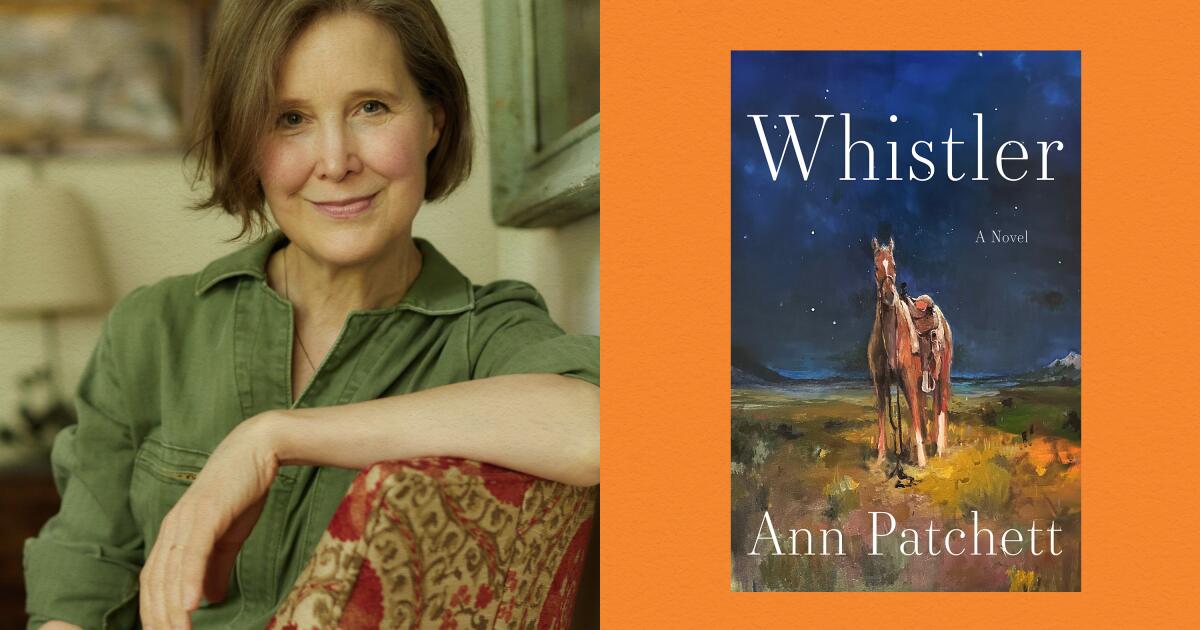
Leigh Haber is blown away by Anne Patchett’s 10th novel, “Whistler.” “This exquisite writer has once again delivered an incandescent work of fiction — sweet, but never sentimental, infinitely wise and suffused with love,” Haber writes.
Songwriter and Sheryl Crow collaborator David Baerwald has written a novel called “The Fire Agent,” about his grandfather Ernest, a musician and a prisoner of war in a Japanese internment camp during World War I. “One of my characters tells Ernst that he has ‘yuyo,’ which might best be described as grace,” Baerwald tells Bethanne Patrick. “Its Japanese meaning is closer to the state of a river rock that has been washed over and tumbled thousands of times, so that it’s both distinct, and a meaningful part of its environment.”
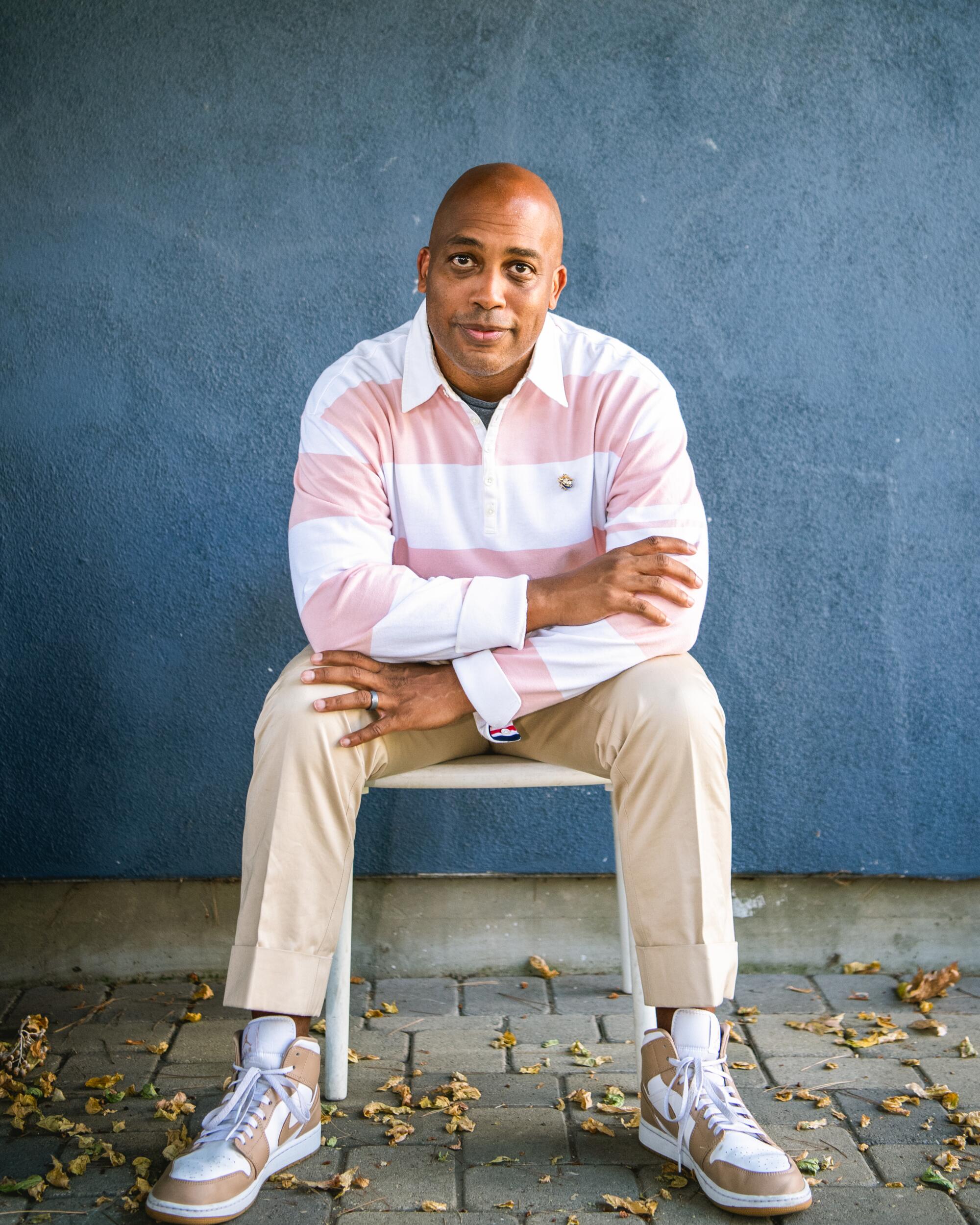
Rasheed Newson, a showrunner for “The Chi” and “Bel-Air,” has written “There’s Only One Sin in Hollywood,” a novel about an often-neglected chapter of Hollywood’s Golden Age. “I wanted to do a deep dive into Black queer history during the Golden Age of cinema,” Newson tells Meredith Maran. “The first thing that came to me was Xavier’s character. I decided to make him the 10-years-younger, queer rival of Sidney Poitier, to highlight the acceptable versus unacceptable — meaning, straight versus gay — 1950s Black movie star.”
Finally, Adam Messinger, a staffer at West Hollywood’s Book Soup, attempts to answer the question: Why are books shrinking? One possible culprit may be social media. “Holding the book up to take a photo of it is easier,” writer and social media influencer Caroline Mason tells Messinger. “Although I do sometimes still drop it.”
📖 Bookstore Faves
Lost Books in Montrose looks and feels unlike any other bookstore in L.A. — a verdant terrarium filled with new and used books and vinyl. Created by Last Bookstore co-owners Jenna and Josh Spencer, Lost Books also sells plants. Moss has colonized the ceiling, and tall trees keep sentry over the store’s diverse and eclectic inventory. I asked Josh Spencer about how Lost came about.
What was the thinking behind opening Lost?
It was spontaneous. My wife and I were eating dinner in the very charming neighborhood of Montrose, and saw a very cool vacant storefront. It also happened to be on Honolulu Avenue, and with both of us being from Hawaii, we took it as a sign. We did not want to franchise the Last Bookstore at the time, and wanted the new store to have its own name and unique vibe.
You also sell plants. Where did that idea come from?
My wife grew up in a rain forest on Maui. She loves plants, and we thought that a pairing of nature with literature was exciting and not done before.
Who are your customers?
Mostly locals in Montrose, La Cañada, La Crescenta, Glendale. But we get a fair number of tourists and also people from other parts of L.A. People who love beauty, nature and books. And vinyl!
Are you seeing that big vinyl resurgence we’ve been hearing about?
Absolutely! Our vinyl does very well for us.
What genres or types of books do well for you there?
Classics, kids books, mysteries, graphic novels, art, self-help, memoirs, cookbooks and gardening of course!
Lost Books is located at 2233 Honolulu Ave., Montrose.
(Please note: The Times may earn a commission through links to Bookshop.org, whose fees support independent bookstores.)
If you buy books linked on our site, The Times may earn a commission from Bookshop.org, whose fees support independent bookstores.
At the recent glitzy PEN America Literary Gala at the Natural History Museum in New York City the evening’s MC, B.J. Novak, declared that the crowd was there to celebrate more than just freedom of speech — they were there for “literary glamour.”
“Writing is glamorous,” he declared. “Reading is glamorous.”
For Novak, bestselling novelist Ann Patchett — who has also worked tirelessly on behalf of independent booksellers and in support of her fellow writers, and was one of the event’s honored guests — epitomizes that allure. “I think it’s great that Ann Patchett is a smoke show. She doesn’t have to be,” he quipped. “It’s just cool that she is.”
With “Whistler,” Patchett’s 10th novel, she definitively proves that the “smoke show” moniker, if at all relevant, is icing on the cake. This exquisite writer has once again delivered an incandescent work of fiction — sweet, but never sentimental, infinitely wise and suffused with love. It’s also an ode to New York City itself.
“Whistler” is narrated by protagonist Daphne Fuller, a 54-year-old English teacher married to Jonathan, a restlessly retired doctor and hospital administrator who dotes on his wife and whom he regards as “extraordinary.” When we first encounter the couple, they’re roaming the Metropolitan Museum of Art — which, one gets the sense, they know by heart. As Daphne ponders the sculpture “Two Horses,” by Charles Ray, Jonathan spots an elderly stranger eyeing his wife, casting glances in her direction. The stranger follows them from room to room fixated on Daphne. Jonathan’s curiosity is piqued, and he slips away from his wife’s side to get to the bottom of why they’re being followed — which is revealed to be the novel’s inciting incident.
Turns out that stranger is no stranger at all. He is Eddie Triplett, a long-lost stepfather whose divorce from Daphne’s mother, Abigail, remains an unhealed wound. Running into Eddie now for the first time in more than four decades, Daphne is startled by the rush of emotion she feels: “I hadn’t known there was something in me to break,” she reflects, “but there it was and break it did. I stepped into an open crack in time and fell backwards.”
Eddie, as it happens, is but one of Daphne and her sister, Leda’s, three dads. By the time Abigail marries her third husband, mild-mannered Lucas, and the couple go on to have three sons, Daphne has grown a protective shell. These facts are narrated with detachment by the protagonist herself. As she and Eddie gently unspool their memories and together fill in the blanks, their bond deepens. The “falling backwards” Daphne experiences in Eddie’s company — traversing time — soothes, softens and delights her.
As the novel unfolds, what becomes ever clearer is that Daphne and her author are undeniably similar, though Patchett has observed: “I am normally careful to make sure there is a big wall between my life and my fiction.” In “Whistler,” she throws that caution to the wind. Easter eggs are scattered throughout. Like Daphne, Patchett is married to an older man — also a doctor — whom she adores. She too had three dads, as she chronicled in a 2020 New Yorker piece aptly titled “My Three Fathers.” Patchett and her heroine also appear to share this enviable trait: They navigate life with grace, generosity and utter competence. IRL, Patchett returns emails on the day she receives them, is an outspoken advocate for free expression, is generally renowned for her good deeds. She’s also widely known for her many devoted friendships, though she doesn’t suffer fools. You’d want to be her ride or die. As you would … Daphne’s.
In an interview 10 years ago, Patchett observed that it wasn’t until she read a piece by Jonathan Franzen, “in which he insisted that the novelist had to do what scares him most, and for him, that had been writing about his family,” that she considered following that path in her fiction. “I thought ‘oh nothing would scare me more. I would happily ride down the Amazon in a canoe and deal with snakes’ ” (as she did for “State of Wonder”) “ ‘than face my family.’ ” In 2016 she wrote “Commonwealth,” which drew on her personal experience of divorce and dysfunction, themes she revisits in “Whistler.” But in “Whistler,” it’s as if Patchett herself is in the reader’s ear. (And, by the way, should you pick up the audio version of the book, she narrates and is literally in your ear.)
Patchett has said she had an ulterior motive for writing “Whistler.” She’d been in the midst of writing a different book, a novel about a Wyoming rancher and her horse, Whistler, but it wasn’t clicking. As she pressed on over the better part of a year, a second idea came to her “like a fever dream.” She immediately filed away the messy work-in-progress and began writing a fictional ode to a cherished friend, former publishing executive Jim Fox, to whom “Whistler” is dedicated. Fox had died two years before, on his 85th birthday, and Patchett was still grieving. Her aim, with “Whistler,” she has said, is to put down on paper how much they loved each other. Fox is reborn as Eddie Triplett in the book, a charming and erudite book editor who radiates joie de vivre and is among the loves of his stepdaughter Daphne’s life.
Patchett’s literary style isn’t of the show-offy variety packed with dazzling sentences and edge-of-your-seat cliffhangers. The drama is quiet. Her words accrue and gain power through their spareness and clarity, and a level of character development that forges an easy intimacy with the reader. There’s also a sly wit and sagacity that have become Patchett signatures, honed to perfection in “Whistler,” whether wrestling with the legacy of family trauma, or the human struggle to accept the transitory nature of it all. Or, as Patchett’s mother once admonished after the failure of her daughter’s first marriage: “Stop trying to make everything permanent. It doesn’t work.”
While Patchett has clearly drawn on actual events and individuals to produce this luminous work, she exhibits the expert novelist’s knack for following a plot where the imagination takes it. I don’t recommend consuming “Whistler” in one enormous gulp. I dipped in and out, savoring scenes, reflecting on them, occasionally shedding a tear. In other words, I didn’t want it to end.
Haber is a writer, editor and publishing strategist and co-founder of the Ink Book Club on Substack. She was director of Oprah’s Book Club and books editor for O, the Oprah Magazine.
According to Abs Mechial, there is a specific minute every day in which holidays can be booked for cheaper on average – but you may need to set your alarm to take advantage of it
A financial adviser has revealed the best time to book your 2026 holiday (stock)(Image: Ralf Hahn via Getty Images)
If you are yet to book a getaway this year and are wondering when the ideal moment might be to do so, a financial expert has identified precisely when you should – and shouldn’t – make your move. Abs Mechial turned to TikTok to reveal that not only are certain days preferable for booking, but specific times of day matter too.
“When is the worst time to book a holiday and when is it actually cheapest? he asked his followers in a video. Surprisingly, according to research, Abs claimed there is a one-hour window in each day when holidays can cost you significantly more money to book.” he asked his followers.
Content cannot be displayed without consent
“According to the data, the most expensive time to book is between 9am and 10am,” he explained. “Bookings in that window came in around 30 per cent more than the cheapest time of the day – so no more booking holidays as soon as you log in for the day.”
As for the most economical time of day, Abs warned that you might need to set your alarm. “Early… and I mean really early,” he said. “Between 4am and 5am – and the logic does make sense.”
Abs highlighted that overnight, demand “drops off” and consequently prices “reset” to their baseline.
He elaborated: “Then as the day goes on, the more searches and more clicks result in prices starting to creep back up again.”
For those reluctant to wake up before sunrise, however, Abs provided guidance for anyone wanting to book during “more realistic hours”.
“Late evening, around 8pm to 10pm tends to be noticeably cheaper than the morning rush,” he enthused. “But if you want to go even further and want the exact moment – not just the hour, but the minute – according to the data, the single cheapest minute to book a holiday is 2:48am.”
Surprisingly, bookings made at that precise time worked out up to 60 per cent cheaper on average, according to Abs.
He concluded with a word of caution, however: “Now, definitely take that with a pinch of salt – booking at 2:48am isn’t going to make every holiday 60 per cent cheaper, but the pattern is clear – if you want to save money, avoid peak booking hours because timing, just like everything else with money, makes a massive difference.”
Responding in the comments, one TikTok user offered their own unverified tip: “Best to search in private browser so prices do not increase if you are searching for same destinations. Prices increase with demand so private searching will prevent this.”
A second person added: “I usually book mine within 72 hours of departure… like 50% cheaper! I find the hotels I want and then I wait for them to deal them off.”
A third exclaimed: “Wow that’s crazy how the time of day can cost you!”
While a fourth TikTok user pointed out: “Doesn’t change if you want a certain resort at a certain time of year.”
PRICES are plunging for summer holiday breaks – and families can take advantage right now.
The conflict in the Middle East and the continuing cost-of-living crisis has seen many people adopt a “wait and see” approach.
Sign up for the Travel newsletter
Thank you!
Prices are plunging for summer holiday breaks – and families can take advantage right nowCredit: GettyYou’ll enjoy stunning sea views at this hotel, perched right on the shore in Callao SalvajeCredit: Getty
But travel firms are now offering even more incentives to get us booking, from free child places to extra discounts.
We’ve researched some of the cheapest deals we can find for a family of two adults and two children in July and August including hold luggage for all and transfers.
And if you’re prepared to go for a self-catering option and a smaller hotel with less fancy facilities, there’s great value to be had.
We’ve even found some all-inclusive options for those who don’t want to worry about budgeting on their break.
WITH a splash pool, splash games area and mini club full of activities, this resort has plenty to keep the family occupied, as well as a free shuttle bus to the beach and town centre.
This deal is all-inclusive, too — with unlimited ice lollies for the kids as well as alcoholic drinks from 10am to 11pm.
Seven nights’ all-inclusive at the 3* Santa Susanna Resort Affiliated by Fergus is from £2,133 for a family of four, including Ryanair flights from East Midlands on July 31, 20kg hold bags and coach transfers.
THIS low-rise, white-washed hotel in Costa Teguise has two freshwater pools and a large sun terrace.
Well-equipped apartments come with balconies and kitchenettes but there’s also a pool bar where you can order freshly made pizzas, burgers and kebabs.
Seven nights’ self-catering at the 3* Paradise Hotel is from £1,509 for a family of four. Includes flights from East Midlands on July 30, 20kg hold bags and coach transfer.
If you buy books linked on our site, The Times may earn a commission from Bookshop.org, whose fees support independent bookstores.
Twenty pages into “There’s Only One Sin in Hollywood” by bestselling Pasadena author Rasheed Newson, I had to stop reading. Not because the story and characters were anything less than gripping —I was utterly transfixed. Not because I was unmoved by the setting, the 1950s version of the iconic landmarks where today’s Angelenos, myself included, work, play, eat and drink: Griffith Park, the L.A. Central Library, the Paramount Pictures lot, the Roosevelt Hotel, the Tam O’Shanter in Atwater Village and the Black Cat in Silver Lake, site of America’s first queer riot, also depicted in the book.
No, it was writerly admiration — OK, envy — that stopped me. As I turned the pages, I kept scribbling the same question in the margins. “How did Newson do this?”
How did Newson, author of the 2022 bestseller “My Government Means to Kill Me” and a producer/writer on such popular TV series as “The Chi” and “Bel-Air,” craft a novel populated with a seamless mix of real and invented characters, each with their own true or fictional backstory, personality, career vicissitudes, sartorial style and sexual proclivities, adhering simultaneously to both his novelistic timeline and historically accurate events?
How did Newson seat his fictional protagonist — Aaron Touissant, a Black, closeted gay Hollywood “fixer” employed by Skyline Studios to keep queer actors’ secrets secret — at the same Beverly Hilton ballroom table with Sidney Poitier, Diahann Carroll, Harry Belafonte, Sammy Davis Jr., Lena Horne, Ruby Dee, Ossie Davis, James Edwards, Eartha Kitt and Xavier Barlow, Newson’s invented Black gay movie star who is Skyline’s greatest hope and Touissant’s principal client?
I couldn’t read another page without knowing, and those unread pages were calling to me. So I called Rasheed Newson, whom I’d seen around the L.A. lit scene but had never met, and asked how he’d made the magic of his novel happen.
“I wanted to do a deep dive into Black queer history during the Golden Age of cinema,” Newson said. “The first thing that came to me was Xavier’s character. I decided to make him the 10-years-younger, queer rival of Sidney Poitier, to highlight the acceptable versus unacceptable — meaning, straight versus gay — 1950s Black movie star.
“I read a lot of books on Hollywood’s golden era,” Newson said. “But I was trying to get closer to what people were thinking at the moment, rather than what they reflected back on later. Only newspapers give you that. So I spent hours and hours in the downtown L.A. public library, poring over microfiche, reading the newspapers of the time.”
Author Rasheed Newsom.
(Mariah Tauger / Los Angeles Times)
I asked Newson about the titular “one sin in Hollywood.”
“That sin is disobedience,” he said. “Particularly when your disobedience threatens to upend how the business makes money. In Hollywood you can be an addict, be a philanderer, be outspoken. But don’t disrupt the cash flow.”
Newson’s plot and characters serve the novel’s thesis well. We meet Aaron Touissaint as a brutally bullied “sissy” in a small, small-minded Ohio town. Aaron escapes his torturers, first by rooting himself in the town’s only movie theater open to Black people, and then by lying about his age and enlisting in the Navy at 16. On the Korean battle front, Aaron becomes the aide and the lover of superstar fighter pilot and “model Negro” Horace Dixon. When the war ends and Skyline Studios buys the screen rights to Horace’s life story, Aaron follows Horace to Hollywood.
The movie is canceled. Horace leaves Hollywood and a heartbroken but determined Aaron behind. Hired as a Skyline security guard, Aaron is promoted to fixer, keeping himself and Skyline’s A-listers closeted by any means necessary. To that end, Aaron marries Kimberly, who becomes his poised, self-contained “beard.”
At the top of Aaron’s client roster is Xavier Barlow, Skyline’s new, hot rising star and Aaron’s new, hot crush. “The bond between us was never conventional,” narrator Aaron tells us. “Off and on for nearly a decade, it was my duty to keep [Xavier’s] nose clean. … He challenged me to admit who and what I am. And I fell in love with him.”
As secret same-sex love stories all too often do, Aaron’s love for Xavier, and Xavier’s one-man campaign to mitigate Hollywood’s homophobia, come to a tragic and suspicious end. Soon after Xavier publicly protests the studio’s homophobic rewrite of a movie script he intended to serve as his coming-out announcement, a truck crashes into his car on Wilshire.
“This was no accident,” Aaron realizes. “Xavier was hunted down.” With his best friend, Diahann Carroll, and a sizable contribution from Sidney Poitier, Aaron organizes the funeral, attempting to redeem the reputation he was hired to protect. “The news reports following Xavier’s death impeached his character,” Aaron says. “The implication was that gay men naturally had messy lives and untimely deaths. … Confidential magazine went as far as to print that “the driver of the truck [that killed Xavier] could well have been one of Xavier’s spurned male lovers.”
“Furious at the coverage,” Aaron narrates the story, “Diahann asked me, ‘Why don’t they print the lovely things I have to say about Xavier?’ ”
“I said, “They never will. Xavier fought the studio, and everything you’re reading is part of his punishment.”
The erasure of gay Black Hollywood is really the point of this imaginatively crafted, stunningly tense, historically significant sophomore novel. Newson’s impressive gifts for story, for writing the erotic and the noir, and for rooting himself in his adopted city are on magnificent display here. By smoothly merging the true and the invented stories and characters of 1950s Hollywood, Newson alerts us to the increase in racism and homophobia evident in the entertainment business, and in the U.S., today.
In Deborah Levy’s new novel “My Year in Paris With Gertrude Stein,” the celebrated British author turns her keen observational and critical eye toward Stein, a writer that Levy feels has been criminally redacted from the canon of modernist masters that emerged at the turn of the 20th century. “My Year in Paris With Gertrude Stein,” however, is anything but a dry-as-dust revisionist treatise.
Levy couches her thoughts on Stein’s life and work within the story of three women in contemporary Paris, including Levy’s fictive avatar as the narrator, grappling with her own notions of identity as she writes about Stein and her partner Alice B. Toklas. I spoke with Levy about Stein, Toklas and Picasso.
You’re reading Book Club
An exclusive look at what we’re reading, book club events and our latest author interviews.
By continuing, you agree to our Terms of Service, which include arbitration and a class action waiver. You agree that we and our third-party vendors may collect and use your information, including through cookies, pixels and similar technologies, for the purposes set forth in our Privacy Policy such as personalizing your experience and ads.
✍️ Author Chat
Have you always had an abiding interest in Gertrude Stein?
She has always been lurking there for a number of reasons. When I was studying modernist literature, I was pointed to all the usual suspects — T.S. Eliot, Ezra Pound, Beckett, Joyce. But no one ever pointed to Gertrude Stein. She was absent in Britain, anyway. I’m not sure it’s the same in America.
I feel like in America she certainly is not frequently cited among that pantheon of modernist writers that you just mentioned.
I thought her most commercial work, “The Autobiography of Alice B. Toklas,” was quite enchanting. But when you start to dig into her other writing, you find this mixture of very obtuse, very violent work, and some brilliant work.
You write in the book that you sometimes don’t understand Stein, but this doesn’t diminish your enjoyment of her work.
The thing about avant-garde writers is that they either crash or they triumph. For readers, it’s either someone popping a vein at the new and strange, or someone over-praising the work. And I thought, well I’m allowed to have mixed emotions about Stein’s writing. Sometimes she is totally brilliant, and sometimes less so.
Author Deborah Levy
(Sheila Burnett)
You also celebrate Stein and Toklas’ fierce individuality, which runs counter to the usual narratives about female authors during this time.
Well, female writers are supposed to suffer or commit suicide. And the glorious thing about Stein and Alice is that the art of living was very important to them. Travel, conversation, or driving around. This really appeals to me. You know, Stein would have a roast chicken leg in one hand and one hand on the steering wheel, with the dogs in the back.
I feel like Stein’s legacy as a writer has been occluded by her renown as a collector of the greatest modern art of the century, most notably Picasso before he became Picasso. She is remembered more for collecting others’ art than for her own art.
If you’re going to collect this bold, daring art of your own time, and you’re buying it cheap, because it’s being mocked, you have to know how to defend it. Stein wasn’t an art historian. She studied psychology with William James and then studied medicine at Johns Hopkins. Through her conversations with Picasso and others, she really began to acquire the apparatus to defend the work, and that fascinated me.
You write that Stein wanted to kill the 19th century with her work by dismantling and then reassembling language.
She was going to write through continuous present tense. She got rid of commas so she could hurtle through time and make her thoughts move forward. No question marks, because it was self-evident to her when someone was asking a question in her writing. She really was a pioneer.
Her prose reads like Beckett’s, decades before his novels were published.
The critic Roland Barthes wrote that all writing has some kind of behavior. A lot of avant-garde writing behaves like Stein, but she wasn’t imitating any other thing. She made something new for her century.
(This Q&A was edited for length and clarity.)
📰 The Week(s) in Books
Book jacket for “Marilyn and Her Books: The Literary Life of Marilyn Monroe” by Gail Crowther
(Los Angeles Times illustration; book jacket from Galley Books)
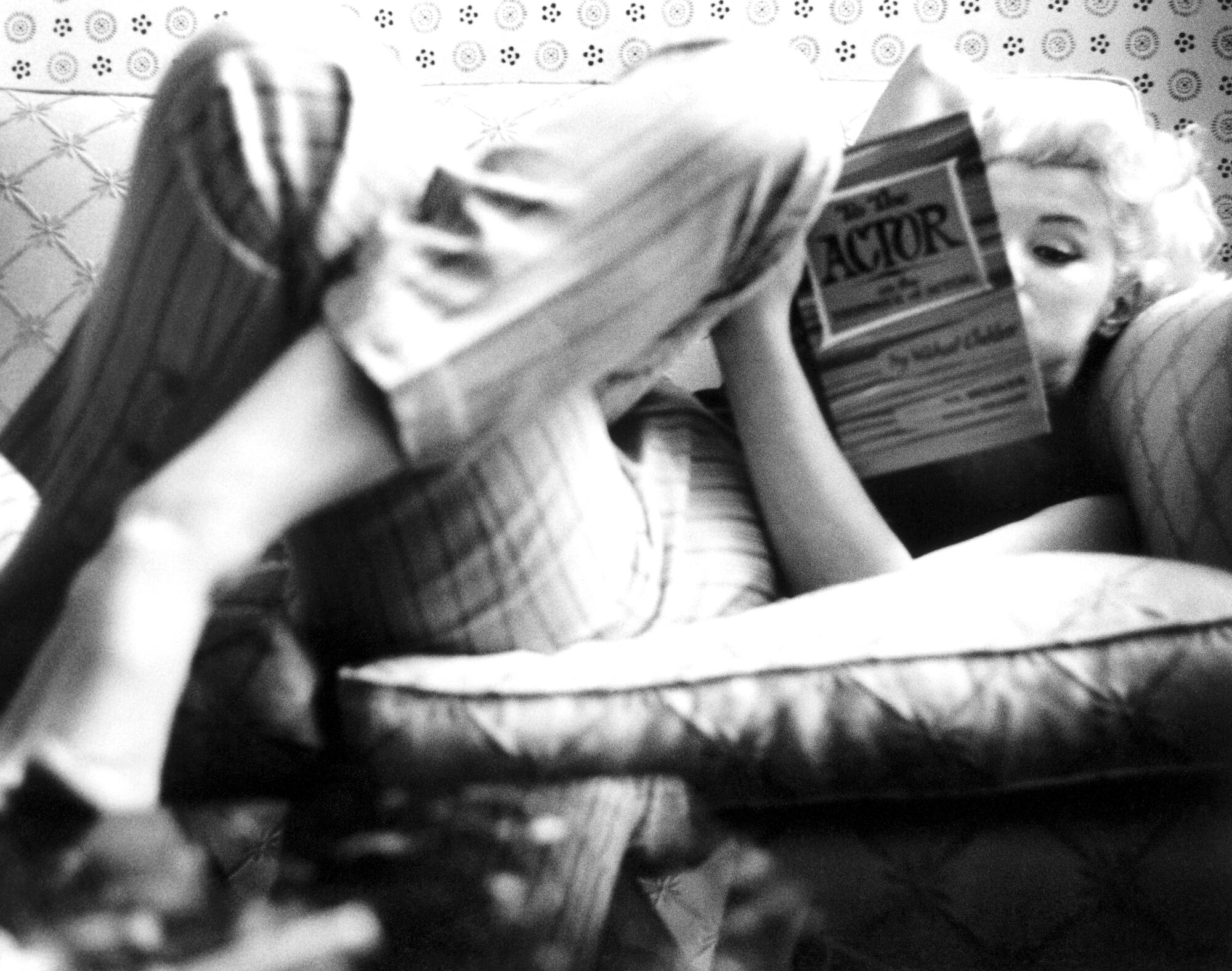
Marilyn Monroe was an avid reader who traveled with her treasured library of books wherever she lived. Yet, the stubborn image of Monroe as a literary dilettante remains. Now Gail Crowther has written “Marilyn and Her Books” which sets out to debunk that misconception of the screen legend. Crowther’s sharp account is both the story of Monroe’s library and “what we’ve projected upon Monroe when we’re asked to consider that she had one,” writes Mark Athitakis.
As Cuba struggles with a faltering economy and President Trump’s saber-rattling overtures, Ada Ferrer’s timely new memoir “Keeper of My Kin” “argues that the grand narratives of exile and revolution are, at their core, made up of private reckonings with irretrievable consequences,” writes Mariella Rudi.
When Eagle Rock’s Read Books was threatened with a massive rent hike from its landlord, co-owners Jeremy and Debbie Kaplan rallied the community around the fight for tenant’s rights and started an activist organization called Save North East Los Angeles Shops. “Commercial landlords [have] unbelievably unrealistic expectations of rent, and a small business can only sell a T-shirt or a hamburger or a service for what the market will bear,” neighborhood preservationist Aaron Peskin told Emily St. Martin.
Finally, Swan Huntley found a novel way to put off writing her next book: She hiked to every Erewhon store in Los Angeles.
📖 Bookstore Faves
A Good Used Book’s beautiful interior
(A Good Used Book)
Jenny Yang and Chris Capizzi started A Good Used Book in 2017 by selling secondhand titles at local flea markets and the Grand Central Market downtown. Seven years later, after a brief COVID blowback, the pair opened their own storefront in Historic Filipinotown. Now, A Good Used Book has blossomed into a vital community space featuring a vast selection of previously loved books across all genres. The store also hosts pop-up markets on the weekends, with more events scheduled in the coming year. I spoke with Capizzi about his store.
Who are your customers?
Our customer base is pretty broad. We’re selective about the books we carry, but we want anyone to be able to find themselves somewhere in the shop, whether you’re just getting back into reading or you’re the kind of person who already has strong opinions about translations. And we try not to take ourselves too seriously, so even though we may have critical theory, we also have “Choose Your Own Adventure.”
How do you pick inventory? Is there any emphasis on any particular genres that might be popular?
We definitely do the work to find books, but honestly a lot of the time the books seem to find us. In terms of what we carry, we focus mostly on classic, modern and contemporary fiction, but we love genre fiction too, like sci-fi, crime and horror. And a big part of what makes the store feel like us are our nonfiction and culture sections — humanities, sciences, film, music, fashion and design. Anything for that curious person who just wants to go a little deeper.
I know the store is about much more than books. Can you tell me about some of the other community events you guys organize?
During the week we’re all about the books. Every Sunday we host the Every Sunday Funday Market that features two food pop-ups out front, one savory and one sweet, and four or five local vendors and artists inside. We rotate vendors selling and making ceramics, jewelry, Japanese retro radios, soaps and candles, zines and prints, and even Persian perfumes. And we always have drinks going out of our vintage Coleman cooler, too. It’s a lot of things happening at once, but it adds up to a pretty easy, fun Sunday afternoon.
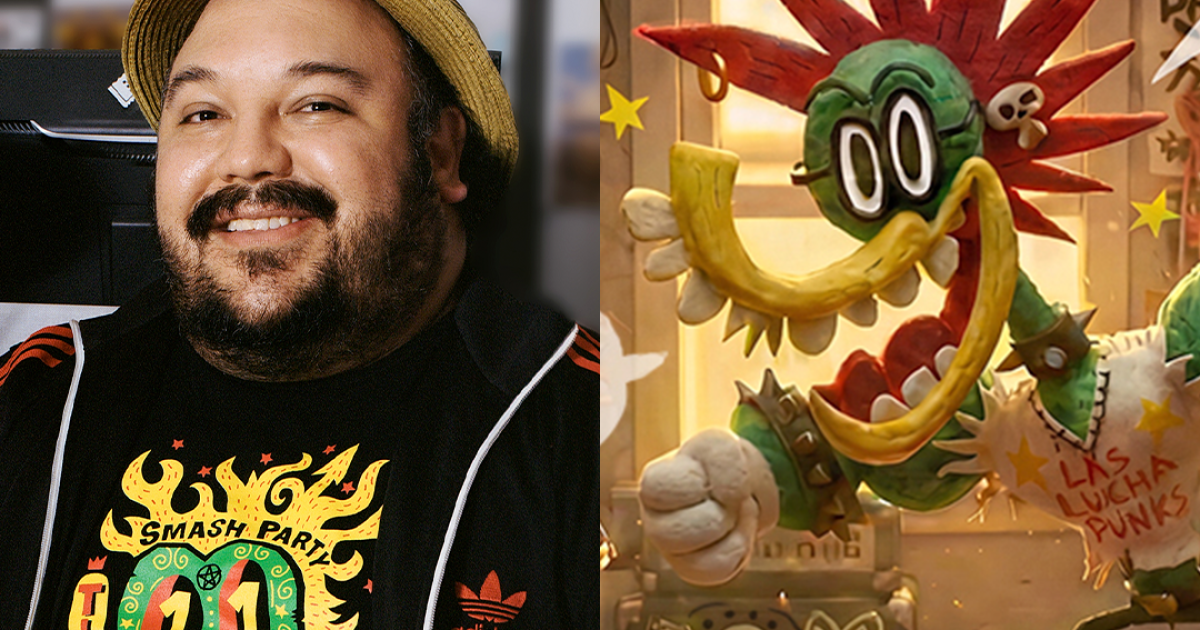
Animator Jorge R. Gutierrez is facing online backlash following news that his latest series, “Punky Duck,” will use artificial intelligence for its production.
Amazon MGM Studios and Amazon Web Services announced on Wednesday the launch of the GenAI Creators’ Fund, a joint initiative that gives creators access to professional-grade AI tools and funding to produce cinematic entertainment.
Three animation projects have already been greenlighted, including Gutierrez’s “Punky Duck,” which follows a punk duck and his best friend, Smiley Cat, through a wildly exaggerated Los Angeles filled with alien invasions, giant monsters, robot criminal conspiracies, telenovela-style family drama and supernatural mayhem.
BuzzFeed Studios’ “Cupcake & Friends” and Albie Hecht’s “Love, Diana Music Hunters” are also part of the initiative.
Fans took to social media to critique the “Book of Life” creator, sharing their disappointment. Many pointed out how the tool is actively reshaping traditional Hollywood jobs, from storyboarding to production design, raising concerns over creative control.
As a response to the backlash, Gutierrez uploaded a screenshot to Instagram that same day featuring news articles by Variety and the Hollywood Reporter with a caption addressing the collaboration: “I understand a lot of you are happy for me and a lot of you are really angry at me for experimenting with AI at Amazon. I’m going to leave the comments open so you can get it all out and hopefully feel better.”
Gutierrez also warned that any death threats will be reported, as well as threats to his family. The post has since been deleted.
In a subsequent Instagram post, he shared a screenshot of a post on X, which showed edits to Gutierrez’s Wikipedia page, where he is described as a “sellout.” Gutierrez captioned his Instagram: “Whoever did this I thought it was really funny!”
The Mexican creator is behind Nickelodeon’s “El Tigre: The Adventures of Manny Rivera” and Netflix’s “Maya and the Three.” He is also currently developing the long-awaited Speedy Gonzales film with Warner Bros. Pictures Animation.
It took over a decade for Gutierrez to get approval for his 2014 film “The Book of Life,” a beloved storybook animation about the Day of the Dead. After multiple rejections from top animation studios, it was eventually produced by Mexican director Guillermo del Toro — a staunch critic of AI, who described its use as “sharting” at a party to The Times late last year.
By comparison, “Punky Duck,” was greenlighted in two months, according to Cartoon Brew.
In a statement to The Times, Gutierrez said he is “cautiously optimistic” about his collaboration with Amazon MGM Studios: “Artists driving tech, and not the other way around, is my goal.”
“It’s a big experiment for me, and like all experiments it might not work, and I will be as cautious and ethical as possible with AI,” he said.
Gutierrez has been critical of AI in the past, expressing distaste for the tool through a series of cheeky memes shared in 2023, 2024 and 2025. Last year, he referred to the nascent technology as a “mutant AI cockroach.”
In the age of Ozempic, the buzziest hardcovers are getting smaller — and slip right into your Baggu. At Book Soup in West Hollywood, the bestselling hardcover fiction display is marked with laminated cards that denote the book’s place in the top 10, with each one cut snugly into the popular hardcover frame of 6-by-9 inches. But lately, more of the books rising to the top wear the placard noticeably looser.
I should know, I work at Book Soup so I spend a lot of time staring at this display and can tell you, the answer to this problem is definitely to print out smaller cards cut to the little sister “trim size” of 5-by-8 inches — or 5½-by-8¼ to be specific.
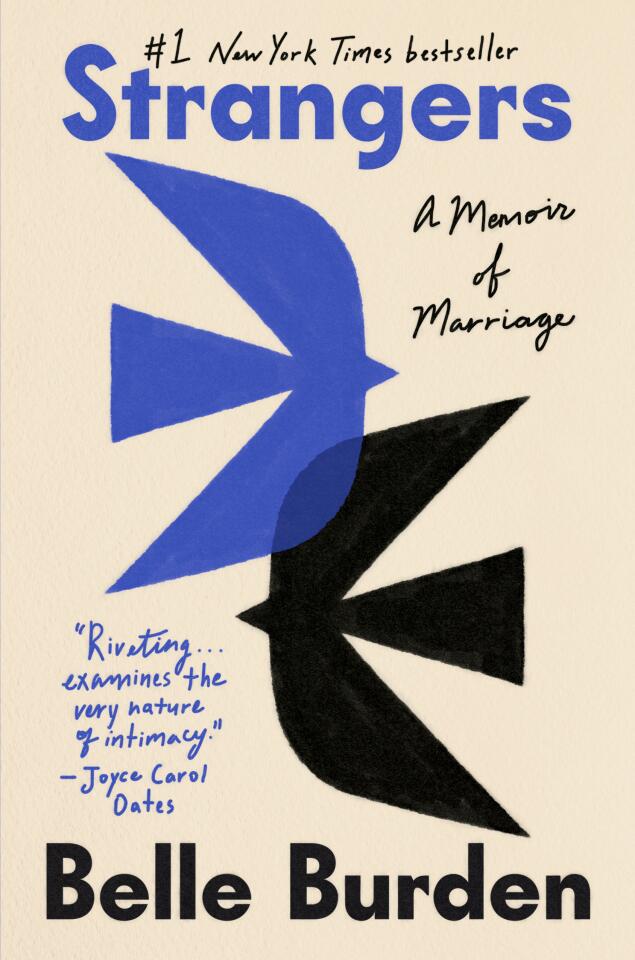
While the New York Times bestsellers from 2025 skew in favor of the 6-by-9 trim, the popularity of 5-by-8 books appears to be on the rise. Current utilizers of the smaller cut include the buzzy Vanderbilt heir Belle Burden’s “Strangers,” George Saunders’ darkly humorous “Vigil” Lena Dunham’s millennial-tinged tell-all “Famesick” and the infamously tablet-sized “Transcription” from Ben Lerner.
1/5
“Strangers: A Memoir of Marriage” by Belle Burden (The Dial Press)
2/5
“Famesick: A Memoir” by Lena Dunham (Random House)
3/5
“Vigil: A Novel” by George Saunders (Random House)
4/5
“Transcription: A Novel” by Ben Lerner (Farrar, Straus and Giroux)
5/5
“Lost Lambs” by author Madeline Cash (Farrar, Straus and Giroux)
Gretchen Achilles is the director of interior design at Farrar, Straus and Giroux. Achilles recently implemented the 5-by-8 cut for one of this year’s breakout hits, “Lost Lambs” by Madeline Cash. “It’s a tone,” she says. “Smaller trim sizes have an intimacy. … You want to echo what’s going on in the text as an experience for the reader.”
According to Achilles, FSG frequently implements the 5-by-8 trim size. She said that length is the No. 1 factor when deciding to employ it, followed by genre. She listed literary fiction, memoir, biography, and essay collections as the defining genres of the smaller size books.
Caroline Mason is a writer in New York whose debut novel “An Endless Cycle of Evenings” from Hyperion Avenue is slated for 2027; she runs the Instagram account @literarycrushes. Mason described a 5-by-8 hardcover as shorthand for a specific book she seeks out when she is in a bookstore because it often signals a character-driven novel. “It’s my favorite kind of book,” Mason says. She adds that it’s also Instagram-friendly.
“Holding the book up to take a photo of it is easier,” she says with a laugh. “Although I do sometimes still drop it.”
Dahlia de la Vega is an L.A.-based Bookstagrammer who runs the page @ofpagesandprint. According to De la Vega, she finds the shrunken books more approachable. “When I sit down to read a small hardcover, it almost feels like I’m reading a journal,” she says. “Whereas when I read a large hardcover, it almost feels like I need a journal to jot down notes about what’s happening.”
Ethan Mann, my colleague and a supervisor at Book Soup, told me he remembers the place he was both mentally and physically when he purchased a 5-by-8 hardcover copy of “The Parade” by Dave Eggers. (Right before the pandemic struck at CSUN campus store at Cal-State Northridge). “It’s easier to attach relevance to the specific feel of [the book] because it seems one of a kind,” he says.
Mann adds that hardcovers are sometimes a tough sell on the floor. They are often derided for their cost, and customers declare they will wait till the paperback comes out. But the smaller hardcover has the benefit of fitting into nearly any bag.
Esther Margolis is a publishing veteran and the founder of Newmarket Press. She says that the 5-by-8 hardcover is nothing new. According to Margolis, the smaller trim size was previously the industry standard for U.S.-based publishing houses, and any fluctuation is due to the evolution of printing technology.
“Unlike for mass-market paperbacks, hardcover books were shelved, so it didn’t matter that the books were different sizes,” Margolis says. “They didn’t have to fit into a pocket.”
The popularity of the 5-by-8 hardcover is, at the very least, indicative of a shift in what I witness consumers at Book Soup seeking out. With social media making it easier than ever to connect over the act of reading, or looking like you are reading, cover design and presentation — and how it cuts through the noise of the attention economy— is perhaps a factor too.
“A small hardback is like a Labubu,” my co-worker Mann says. “ The feeling in your hands isn’t just about books — it’s about all cute things. … We like small things we can control.”
The success of the publishing industry could never rest on the tiny shoulders of the small hardcover. It may not even represent any changes in production. But on the bestsellers display at your favorite local indie, it represents the small pleasure of palming a near-pocket-size book in your hands.
And, yes, maybe Instagrammability too.
Messinger is a writer in L.A. who runs the Substackadumbmessinger.
POP star Mollie King has admitted that the birth of her daughter Annabella was a bittersweet moment for her family.
She and cricket star Stuart Broad welcomed Annabella, now three, in November 2022 – at a time Mollie’s father Stephen was dying from a brain tumour.
Sign up for the Showbiz newsletter
Thank you!
Mollie King has admitted that the birth of her daughter Annabella was a bittersweet moment for her family (pictured in 2023)Credit: PAMollie welcomed Annabella, now three, at a time her father Stephen was dying from a brain tumourCredit: Instagram
The Saturdays singer-turned-Radio 1 host has revealed that the sad circumstances gave her the incentive to book a C-section for the birth – to make sure Stephen would be able to meet his granddaughter before he passed.
Stephen died 10 days later, but got to meet Annabella thanks to Mollie’s decision.
Chatting to Giovanna Fletcher on the Happy Mum podcast this week, Mollie, 38, revealed that she learnt of her father’s illness when she was six months pregnant.
“It happened in August. And I had seen my dad that morning. We had gone out for a walk with my dog and with Stuart as well. And everything seemed pretty fine, pretty normal,” she recalled.
Mollie shares two children with cricket star Stuart BroadCredit: InstagramThe Saturdays singer-turned-Radio 1 host has revealed that the sad circumstances gave her the incentive to book a C-section for the birthCredit: GettyMollie and Annabella after the radio star competed in a 500km cycle across England to raise money for Red Nose Day 2024Mollie was one fifth of The Saturdays – they released four studio albums and 18 singles between 2008 and 2014 before going on hiatusCredit: Getty
“And then that evening, I had a call from my sister to say Dad’s not been very well at all – he’s gone into hospital.
“I was like, Oh my gosh. Basically, over the next few days, we got the news that he had a brain tumour, which is obviously shocking because there was nothing – there were no signs.
“And you just don’t know how to process it.”
Mollie went on: “I think that I was trying to really get my head around it and come to terms with it. But also, I’m in this stage of like – I’m pregnant, this is meant to be such a magical happy time.
“I was really worried that he wasn’t going to meet Annabella. I was like, I can’t have him not meet my kids.”
Mollie – who has since welcomed a second daughter – reflected on how her father had been a very “present granddad” for her nephews, and couldn’t picture her own child never knowing him.
“I was like, I just can’t have him not meet my little girl. It can’t be like that,” she continued. “And so… because of that… I’d booked in to have a C-section.
“I was like, I just need to know that she is going to come out at a safe time, but I need her to meet dad.”
Mollie admotted that, after she made the decision, she felt self-conscious telling the hospital staff of her reasons; but that they were happy to accommodate the C-section, booking her in for it right away.
“I remember them saying to me at the hospital, they were like, you know, why are you choosing to do this? And I found it really hard to talk about at the time,” the All Fired Up songstress went on.
“I didn’t want to talk about it. I was like, oh, you know, just, I think it would be nice to know when she’s coming and all of this.
“And then eventually I said, look, my dad is dying and we’ve only got a few weeks. I just need her out now. And they’re like, totally get it. Completely understand – let’s book you in for this date. And it was amazing.”
Mollie admitted that it was “really difficult” to then lose her father 10 days later, and says she has put off getting married to Stuart because she can’t imagine the day without her father there.
“Elements like walking down the aisle without him I still struggle with. There needs to be a gap so I can process it all,” she previously told The Times.
Mollie was one fifth of The Saturdays – they released four studio albums and 18 singles between 2008 and 2014 before going on hiatus. Mollie then turned to radio presenting.
She welcomed her second daughter, Liliana, with Stuart in January 2025.
The idea grew as organically as the purple cauliflower at Erewhon. One day, I walked from my place in Los Feliz to the beach. I stopped at two Erewhon locations on the way to refuel. I made a reel about my journey and posted it to Instagram. My friend Fish saw it and said, “You should walk to all the Erewhons.”
I thought: I don’t have time to do that. I’m a very serious person who needs to write her novel.
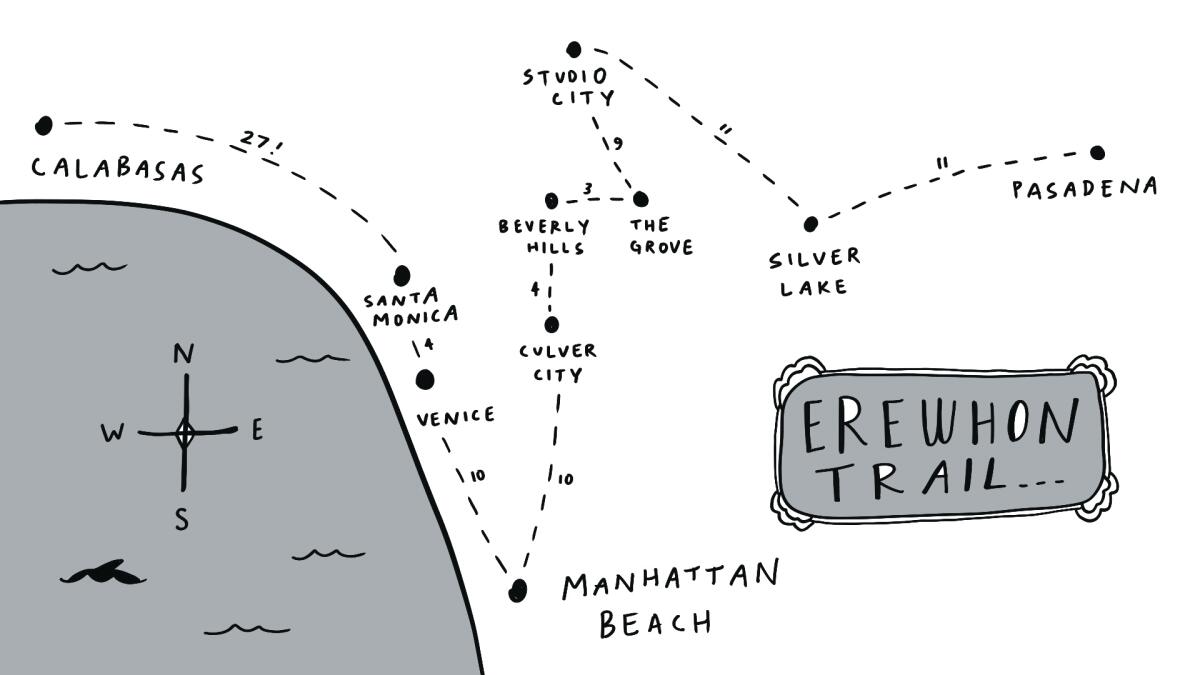
But later I found myself mapping out an 89-mile hike in my Notes App, starting in Pasadena and ending in Calabasas, stopping at all 10 Erewhon locations on the way. (My route did not include the Palisades, which is closed because of the fires; nor did it include LACMA or the new Glendale locale.)
“I need to write my novel” is a thought I have a lot. I usually heed this thought and sit at the desk like a soldier, imagining the wonderful day when I’ll sell said novel — for an amount that would probably be comparable to a fraction of an Erewhon employee’s yearly salary.
Erewhon Trail map illustration by Swan Huntley.
(Erewhon Trail map illustration by Swan Huntley. )
I really wasn’t in the mood to write the novel, though. When I imagined myself pecking away at the keyboard, I felt bad. When I imagined myself walking around L.A. in my Home Depot gardening hat, I felt good. So, I put on my hat, got into an Uber headed for Pasadena, and texted my sister, “Carpe diem, bitch.” Or at least that was my intention. What I actually sent was, “Carpet diem hitch.”
Over the summer, I hiked a little bit of the Pacific Crest Trail. A few years ago, I biked the Camino in Spain. I’ve walked from Los Feliz to the beach a handful of times. I’ve traversed the length of Manhattan thrice. Before that, when I was a teenager, I used to trek from La Jolla to Del Mar while drinking beer (I carried a cooler; yes, I’m sober now) and listening to Sarah McLachlan on my Discman. I’ve always been drawn to activities that many people find tedious. Like walking forever. Or writing a novel.
Starting in the fourth century, pilgrimages were served up by the church as a way for Christians to pay penance for their sins. They were hard and dangerous and a lot of people died. Fast-forward to now: Such treks have taken on an “Eat, Pray, Love” aura. Or a “Wild “ aura. They live in the realm of self-help and of sport. They’re a way to create friction in an increasingly frictionless world. By walking from Mexico to Canada, or from Erewhon to Erewhon, I wonder whether we’re trying to get back to the part of ourselves that wants to try harder.
Or we just want to become more valuable dinner party guests.
What do you do?
I do really long walks.
I ordered a Goddess Smoothie in Pasadena, and then I repeated this tradition at every store thereafter. The smoothie costs $19, tastes like heaven, and it’s green, which my brain reads as “good for me.”
It took me a little over three hours to walk 11 miles to Silver Lake. I got a Vegan Avocado Sandwich for lunch, took an Uber home and posted a reel on Instagram about my first day on the trail. A lot of people liked it. Some of them called me a genius.
In the last 10 years, I’ve published four novels and two illustrated books for adults. I was naïve and just totally blindly happy about the publishing process in the beginning. People wanted to buy my work? Other people wanted to read it? Cool.
The first book, “We Could Be Beautiful,” did well because the publisher put real money into the marketing of it. Then that stopped happening. At a certain point, I realized that expecting too much was unwise. It was up to me to market my books myself. Which meant: social media.
They say you have to see a book cover six times before you buy the book — or consider buying it. There are a lot of book covers on Instagram. Actually, there’s a lot of everything on Instagram, and out of all the everything, is a book cover that exciting?
No.
My second reel, which depicted my journey from Silver Lake to Studio City, went a little bit viral. To date, almost 10,000 people have shared it with their friends. Why? I think the answer has something to do with a desire for levity.
If the atmosphere of the world could be depicted by an Erewhon beverage, it wouldn’t be a vibrant, cheerful one, like the bright magenta Pitaya Smoothie. It would be the dark and brooding Germ Warfare Shot. I find it perplexing that people talk about the apocalypse as if it’s happening later. It’s happening now. If we were really thinking about how climate change is affecting us, we’d be out in the streets screaming. All the time. But we’re not doing that. We’re carrying on with our usual lives. Apparently, for me, that includes walking to Erewhons.
Any long-distance trek is as much an internal journey as it is external. As I continued the trail, I started to think that maybe my endeavor was a reaction to my feeling of total powerlessness. I can’t save the polar bears. I can’t force the president to go to therapy. But I can add some levity to the brooding atmosphere.
Recently, someone commented on one of the reels, “Transplants make LA locals look bad.” This person, and many others, hear the name Erewhon and assume I’m poking fun at it. Erewhon has become a joke about L.A. — a joke that was amplified after Hailey Bieber invented her smoothie in 2022 that Erewhon dubs the “Strawberry Glaze Skin Smoothie.” I’ve never had it, but I can tell you that it looks like a sky full of strawberry clouds. According to an Erewhon employee I spoke to, this smoothie was a turning point. It aligned the brand with wealth and power. Now, Erewhon evokes the image of smooth-skinned, health-conscious Angelenos with money to burn.
The Erewhon Trail, then, inevitably becomes a conversation about privilege, my own included. Instagram hid my two favorite comments, because it was worried they’d be too rude to show, but I think they’re the funniest ones.
This is what white people do on Prozac.
This is what happens when a liberal arts teacher gets fired.
To both of these comments, I say: Yes.
I’m not on Prozac yet, but maybe after I get fired, I will be.
In order to get fired, though, I’d have to get an actual job, which might never happen.
The most intense leg of the trail was from Santa Monica to Calabasas. My friend Fish joined me. Google said it would take 27 miles. After marching through the mountains, I decided to use my own intelligence to make the route shorter. This cut out four miles, bringing the total to 23. For long stretches, Fish and I walked in the bike lane, or in the bramble by the side of the road. That’s the penalty for straying from Google. Your sidewalks disappear and your chances of getting hit by a car go way up.
My legs were noodles by the time we got to Calabasas. I crawled across the parking lot to show my viewers how weak they’d become. The employee at the door smiled at me and handed me a basket, and I thought about the pain of my legs, which no one could see, and about all the secret battles people are fighting all the time, and I wished that we cared about each other as much as Erewhon cares about us. Multiple employees were perfecting the already-perfect plateaus of bell peppers and apples in the produce section. Their thoughtfulness was the opposite of the vibe I encounter in most public restrooms, which is that the strangers who were there before me didn’t have many thoughts about my experience. As lame as the fact that an Erewhon smoothie costs $19 is that so many of us need to be paid to be nice to each other.
When I tell people about my love for Erewhon, they either say, “Duh, I know,” or something along the lines of, “That place is ridiculous, right?” This is almost always followed by the mention of a food item and some amount of money. Like, “Doesn’t a carrot cost $12,000?”
Actually, I tell them, no. Although sometimes, yes. There is a Japanese strawberry that’s famously expensive ($20), but that’s avoidable. I then explain that contrary to popular thought, there is a way to shop at Erewhon on a budget. A jar of soup, for example, costs $15.50. If you return the bottle, you get $3 back. In my opinion, the soup can be two meals, so that’s $6.25 per meal. A lot of the produce is either the same price or only a little bit more expensive than at other health food stores, and it’s in consistently better shape. The most important piece of making Erewhon more affordable, though, is becoming a member. You get 10% off, a free drink of the month and discounts on a bunch of items.
You might be wondering: How many Erewhon memberships has she personally sold?
She’s lost count.
The other reason to go to Erewhon is the environment. It’s visually appealing and the employee-to-customer ratio is notable, and the result is that you feel like you’re at a resort. And frankly, these simple things — a nice environment, high quality food — should be available to everyone.
Back to the question of whether or not Erewhon is ridiculous — yes, of course it is. If you sit at any of the locations and listen to the conversations around you, you’ll probably feel like you’re an extra in a satirical movie. At Studio City, I overheard two moms in white pants and cashmere sweaters talking about how, based on their Instagram recon, they figured out that so-and-so was sitting next to so-and-so at a benefit dinner. Another snippet I overheard in Studio City: “You gotta make music from the heart, man, and the label will feel it.”
It didn’t occur to me to ask for free merch until after I’d finished the trail. Armando at the Santa Monica location was the lucky recipient of my request. I explained my uniquely heroic feat to him, and then wondered aloud if perhaps I could get a sweatshirt, or at least a hat.
Sadly, Armando was unauthorized to give me merch, but he did offer me a gift card in a tiny envelope. I was very grateful. I assumed the card was worth $50 at least.
After we parted ways, I opened the envelope.
Ten dollars.
Enough to put a down payment on a smoothie.
My dreams now are so different from when I was younger. Back in grad school, I imagined that maybe I’d write a bestselling novel, and maybe it would be adapted for the screen, and maybe my tombstone would read: She contributed very serious literature to civilization.
What I never accounted for was, of course, the unknown. Maybe one day, over a decade after school ended, I’d get a lot of attention for making performance art about walking to grocery stores.
Huntley’s novels include “I Want You More,” “Getting Clean With Stevie Green,” “The Goddesses” and “We Could Be Beautiful.” She’s also the writer/illustrator of the darkly humorous “The Bad Mood Book” and “You’re Grounded: An Anti-Self-Help Book to Calm You the F— Down.” She lives in Los Angeles.
Marilyn and Her Books: The Literary Life of Marilyn Monroe
By Gail Crowther Gallery Books: 304 pages, $30
If you buy books linked on our site, The Times may earn a commission from Bookshop.org, whose fees support independent bookstores.
In 1951, not long after her breakthrough appearances in “All About Eve” and “The Asphalt Jungle,” Marilyn Monroe went to college: She enrolled in a pair of 10-week classes at UCLA’s adult-extension program, both covering literature. Looky-loos peeked through the windows. Some likely assumed a publicity stunt. But Monroe’s passion for books was sincere. An orphan who bounced around upward of a dozen foster homes and orphanages regretted that she’d never graduated high school, she moved often in her life but always made sure her books came wherever she went.
Gail Crowther’s “Marilyn and Her Books” is the story of that library, though more precisely it’s about what we’ve projected upon Monroe when we’re asked to consider that she had one. Our prevailing cultural reflex, then and now, is skepticism larded with misogyny. A famous 1955 photo of her sitting in a Long Island playground reading James Joyce’s “Ulysses” — one of 50 known photos of her reading — is routinely scoffed at whenever it’s posted online. (Crowther gathers up a sampling of misogynistic comments.)
But Crowther’s sleuthing determines that Joyce’s novel was a regular companion of hers, and she was particularly enchanted with Molly Bloom’s closing soliloquy. As an actor who had to be exceedingly smart to play dumb blondes, she used the shoot to make “a profound statement about her social positioning.”
Marilyn Monroe reads the book “To the Actor: On the Technique of Acting” by Michael Chekhov in a quiet moment at the Ambassador Hotel in New York.
(Ed Feingersh / Michael Ochs Archives / Getty Images)
Writing about Monroe’s reading habits demands a lot of speculation on the part of Crowther, who’s written engaging books on Dorothy Parker, Sylvia Plath and Anne Sexton. We know a lot about the star’s library — when she died in 1962, she owned more than 400 books, diligently cataloged and auctioned in 1999. There’s documented marginalia and scribblings that suggest a serious reader, and anecdotes about her reciting poems at parties, reading Proust on set, and expounding on Whitman, Dostoevsky and Tolstoy. She had strong opinions about Hemingway: “Those big tough guys are so sick, they aren’t even all that tough. … They always want to kill something to prove themselves.”
And Crowther literally has the receipts from Los Angeles and Beverly Hills stores like the Pickwick Book Shop, Martindale’s Book Store and Hunter’s Books, where she purchased titles that were practical (“How to Live With a Cat”), relatable (“Sister Carrie”) and weighty (a three-volume life of Sigmund Freud).
Her third husband, playwright Arthur Miller, suggests the purchases were largely a pose: In his memoir, he wrote that aside from some short stories and Colette’s “Cheri” she likely never read anything start to finish. It would be nice to know more, but as Crowther pointedly observes multiple times, journalists never thought to ask her about her reading. When the subject of literature came up, Monroe seemed compelled to play to ditzy expectations. After telling interviewers she wanted to play Grushenka in an adaptation of “The Brothers Karamazov,” they asked her if she could spell the character’s name. She demurred.
A clearer historical record might have blunted the sexist comments that have stalked her, and given Crowther an opportunity to do less guesswork. “Marilyn and Her Books” is scaffolded with 15 chapters, each dedicated to a question that usually can’t be answered in full: “Did Marilyn read all her books?” (probably not, who does?), “Did Marilyn suffer from imposter syndrome?” (probably, who doesn’t?). Some questions feel like attempts to pad the pages (“Are there any surprising omissions from Marilyn’s personal library?” “How did Marilyn’s reading compare to that of her contemporaries?”). The elegiac opening and closing chapters, in which Crowther imagines visiting Monroe’s home and scanning her shelves, also add to the feeling that too much is being extrapolated out of not enough information.
Curiously, the book also dwells little on Monroe’s own literary ambitions. Crowther shares a few scraps of despairing, Plathian verse, but almost entirely neglects her unfinished posthumous memoir, published in 1974 as “My Story.” Its relative shapelessness, along with its use of a ghostwriter, doesn’t bolster her literary credentials, but its existence points to Monroe’s ambition to have them.
And there’s plenty to say about the literary work that Monroe herself has inspired, including Joyce Carol Oates’ 2000 masterpiece, “Blonde,” or Sharon Olds’ poem “The Death of Marilyn Monroe,” in which a man who carted away her body is shocked into the reality of “a woman breathing, just an ordinary woman breathing.” Writers have afforded Monroe the grace and status in death that she was rarely afforded in life.
But the core question that drives the book, the subject of a central chapter, is valuable: “Why is Marilyn Monroe’s reading ability doubted?” Among other things, Crowther argues, Monroe suffered from a “poisonous cocktail of patriarchy, industry decisions, cultural stereotypes, social expectations, Marilyn’s unwitting complicity,” and more. Crowther keeps her focus narrowly on Monroe, but it doesn’t require a substantial mental leap to see how Monroe is just one example of a cover-model-worthy woman artist being told she’s a try-hard for demonstrating intelligence. (To pick just one example, the pop star Dua Lipa’s book club has a demonstrated high-literary bent, selecting Tommy Orange, Olga Tokarczuk and Percival Everett, which got her mocked as “an alien spaceship touching down in a medieval peasant village.”)
“Marilyn’s reading formed a concerted effort to overcome any inadequacies she perceived in herself,” Crowther writes. That, too, made her a lot like anybody who goes to books to satisfy gaps in our knowledge. We can do that in private, to avoid embarrassment. For Monroe, though, the effort was always public and always suspect — the culture was attuned to see any book in her hand as a prop. For most people, reading is an escape route. For Monroe it only led to one more cul-de-sac.