NEW YORK — They started their pro careers in Spain and now two Real Madrid prospects are taking on L.A. Baba Miller doesn’t have to look far for inspiration with Luka Doncic playing in the same city.
After admiring Doncic’s path from Real Madrid to the top of the NBA, Miller hopes to carve his own path in L.A. after the Clippers drafted the late-blooming Spanish forward 36th overall in the NBA draft on Wednesday.
The versatile big man was just 6 feet 2 when he was 14. Now standing 6-11 as a mature 22-year-old, Miller called that kid “chubby.” But once he started growing rapidly, Miller slimmed down. When he struggled to hold up against more physical players, his youth coach started playing him at the wing. The position change, along with his developing body, set the stage for his creative style of play.
As a senior at Cincinnati, Miller averaged 13 points, 10.3 rebounds, 3.7 assists and 1.2 blocks per game. He was just one of three players nationally to average at least 13 points, 10 rebounds and three assists last season. He was the first Bearcat to lead the team in points, rebounds and assists since Oscar Robertson in 1959-60.
Miller has not yet developed his three-point shooting, averaging just 29% during his college career, which began with two seasons at Florida State. His career-best for three-point shooting was 34.2% (39 for 114) during one season at Florida Atlantic.
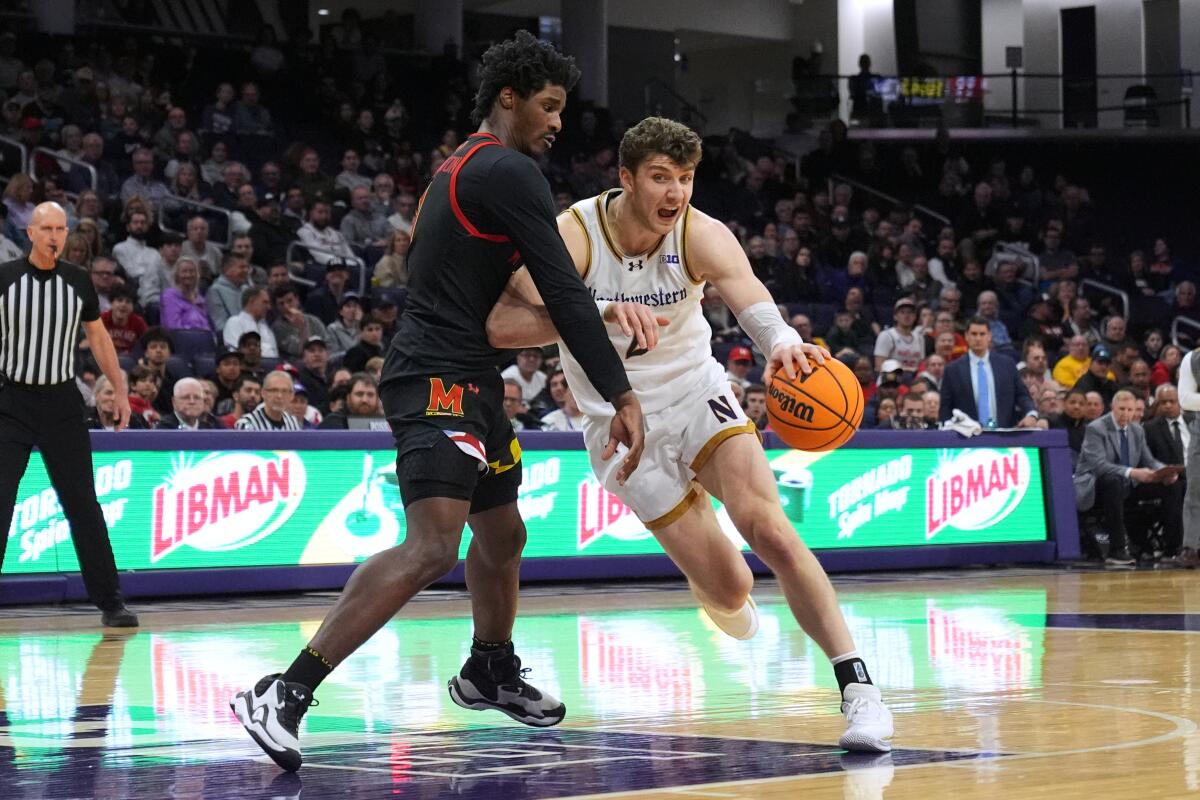
The Clippers waited until late in the second round to get their knockdown shooter and used a trade to get the rights to Northwestern forward Nick Martinelli with the 55th pick. The Clippers got the pick from the Houston Rockets in exchange for cash, according to ESPN reports, and added the two-time Big Ten scoring champion. Averaging 23 points, 6.2 rebounds and two assists last season, Martinelli shot 51% from the field and 41.7% on threes.
The Clippers traded their 52nd pick to Atlanta for the Hawks’ No. 57 pick and cash, according to reports. After sending the rights to North Carolina’s Henri Veesaar to Atlanta, the Clippers will get French prospect Narcisse Ngoy, a 7-foot, 235-pound center who played for a second-tier team in France and figures to be a long-term project.
Nearly half of Wednesday’s second-round picks changed hands on draft day. Some, like the 56th pick that went from Chicago to the Lakers to the Dallas Mavericks, bounced around multiple times.
Nick Martinelli drives against Maryland forward Solomon Washington during a game last season.
(Nam Y. Huh / Associated Press)
Ohio State guard Bruce Thornton, one of 10 prospects who attended the second round, walked across a stage lit up in New York Knicks blue and orange and put on a Knicks cap as the 31st pick, but was told shortly before the photo opportunity with NBA deputy commissioner Mark Tatum that he would be traded. By the time he spoke with reporters at a news conference, he was wearing a bedazzled Rockets hat.
“No state tax,” Thornton said with a wide smile, “so even better.”
The Clippers already bolstered their backcourt during the draft by taking Illinois guard Keaton Wagler fifth in the first round Tuesday. Wagler is expected to pair with former All-Star guard Darius Garland, with the Clippers trying to win their first playoff series since 2021.
The Clippers added frontcourt depth during last year’s draft with Yanic Konan Niederhauser, but the 6-11 center suffered a Lisfranc injury in March and missed the end of the season. After trading starter Ivica Zubac to the Indiana Pacers midseason, helping the Clippers secure the draft pick that turned into this year’s top-five selection, the team had only 38-year-old Brook Lopez at center. The Clippers have a team option on Lopez’s $9.2-million contract.
In his meetings with the Clippers, Miller could sense that the organization was hoping to add impact role players to help take the franchise that has had 15 consecutive winning seasons over the hump to postseason glory.
“They got guys like Darius and Kawhi [Leonard] that are already established stars in the league,” Miller said. “So I feel like just coming in and trying to help the team be better is the main goal. Every team’s goal is trying to win a championship eventually, so just trying to stay the course on that and be part of that.”
Attorneys general in seventeen states are suing California over its landmark single-use plastic law, which went into effect on June 1.
The lawsuit comes after a coalition of environmental groups sued the state over the same law this month, arguing the new final regulations create loopholes so large they gut the law.
The states are led by Nebraska Atty. Gen. Mike Hilgers, and the plaintiffs include the National Assn. of Wholesaler-Distributors. The coalition is asking the court to block enforcement of the law immediately.
“Once again, California is trying to enact a policy that negatively impacts the rest of the country,” said Hilgers in a news release. “If California goes unchecked, consumers will be forced to pay more for basic necessities.”
The other states in the coalition are Alabama, Florida, Georgia, Idaho, Indiana, Iowa, Louisiana, Missouri, Montana, North Dakota, Oklahoma, South Carolina, South Dakota, Texas, Utah and West Virginia. The lawsuit was filed in the U.S. District Court of Eastern California in Sacramento on Monday.
State Senate Bill 54, the Plastic Pollution Prevention and Packaging Producer Responsibility Act, was signed by Gov. Gavin Newsom in 2022. It was considered landmark legislation because it requires plastic and packaging companies to use less single-use plastic and ensure by 2032 that all food packaging is either recyclable or compostable.
The intent was not only to reduce single=use plastic, but also to put the onus and cost of dealing with it on packaging producers and manufacturers, not consumers and local governments. It was supposed to incentivize companies to consider the fate of their products and spur innovation in material redesign.
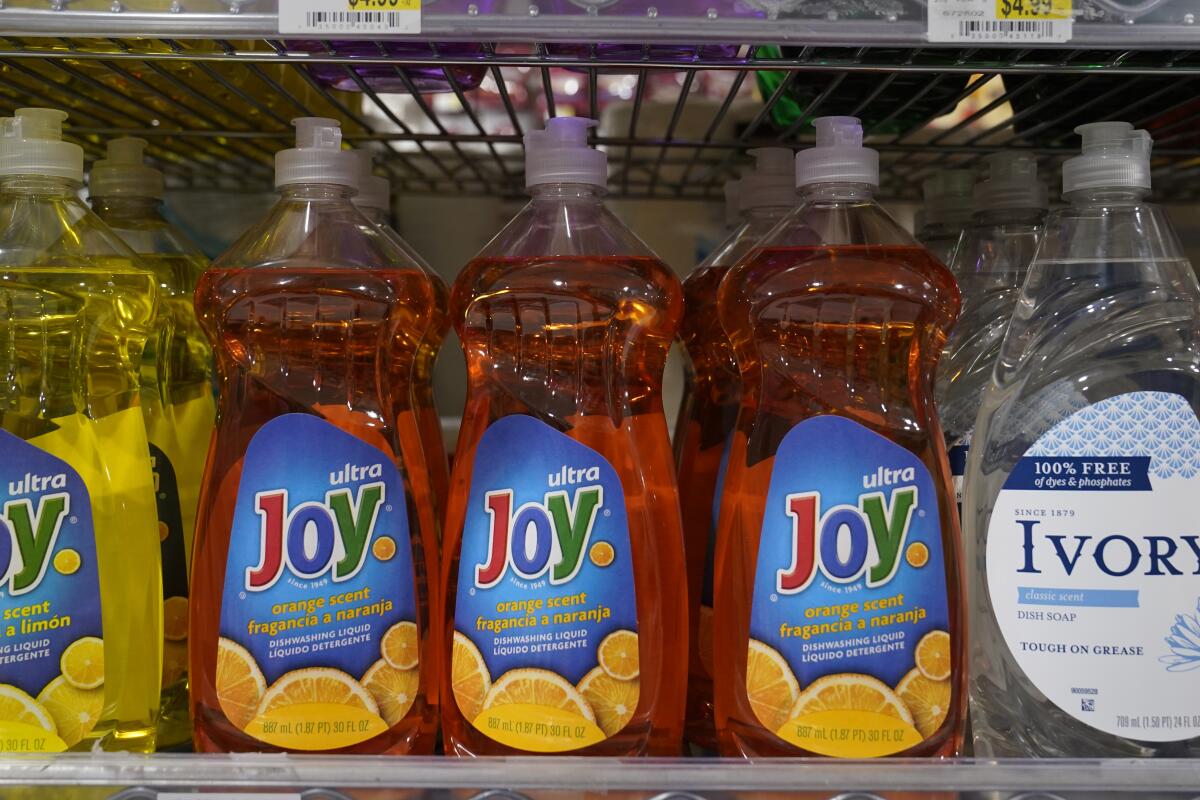
Plastic bottles of dishwashing liquid at Compton’s Market in Sacramento on June 17, 2022.
(Rich Pedroncelli/AP)
According to one state analysis, 2.9 million tons of single-use plastic and 171.4 billion single-use plastic components were sold, offered for sale or distributed during 2023 in California.
The single-use plastic law is what is known as a producer responsibility law. It emphasizes the idea of a “circular economy” in which the producer of a material must consider its fate — making sure it can be reused or recycled, or at least reduced.
In California, all producers of single-use packaging and plastic foodware (plates, knives, spoons, etc.) join a private entity known as a producer responsibility organization. Only one such organization has been approved in California: the Circular Action Alliance.
The states and the National Assn. of Wholesaler-Distributors say the plastic law discriminates against businesses selling into the state in two ways: by making them change or alter their plastic packaging and by conferring government authority upon the alliance, enabling a private entity to regulate and impose taxes and fees on businesses selling into California.
“California is not entitled to pronounce nationwide policies,” Eric Hoplin, president and chief executive of the wholesalers group, said in a statement. “Because the Act extends California’s regulatory reach far beyond its borders and brings within its sweep conduct wholly unconnected to California, the Act violates principles of federalism, the horizontal separation of powers, and due process.”
In addition, the attorneys general say the law suppresses their free speech by compelling companies to join and fund the speech of an organization with which they may disagree.
Hoplin and his organization filed a similar suit in Oregon in February. Oregon has a comparable single-use plastic law. A federal judge blocked enforcement of that law. A trial begins on July 13.
Heidi Sanborn, executive director and CEO of the National Stewardship Action Council, which advocates for the producer responsibility laws and a more circular economy, said in May that both SB 54 and the Oregon law are public policies that were “passed by legislatures and implemented with government oversight.”
She said the laws create clear and consistent rules so all producers contribute fairly to the cost of recycling and waste management.
Meanwhile, environmental groups are also unhappy.
On June 2, Oceana, the Natural Resources Defense Council and Californians Against Waste Foundation filed a lawsuit in San Francisco Superior Court.
They allege that the final regulations for the law, drafted and approved by the state’s waste agency, include exclusions for large categories of plastic packaging that companies could use indefinitely. In addition, they say, the regulations also allow for recycling technologies that pollute, such as chemical recycling, which the law as originally drafted forbids.
“While SB 54 remains a monumental achievement as the nation’s strongest single-use plastic reduction law, some of the final regulations implementing the statute undermine the law’s ambitions,” Christy Leavitt, Oceana’s senior campaign director, said in a statement.
HARRISBURG, Pa. — Six months after President Trump warned states not to regulate artificial intelligence, they are increasingly doing just that.
Congress has stalled on producing federal regulations of artificial intelligence as states forge ahead and scrutinize how chatbots interact with children, how AI systems are used by employers and what developers must do to try to prevent an AI-caused catastrophe.
State lawmakers have stepped back from earlier, wider-ranging attempts to regulate AI that were vetoed or otherwise derailed by governors who viewed the measures as too onerous toward the industry’s development, including efforts to hold developers accountable for bias in AI systems.
But they are returning with legislation that is more targeted and, often, probes the corners of life where Americans interact with AI but may not know it.
Presidential power versus state power
Trump’s move to restrain states’ actions on AI drew criticism from members of both political parties and civil liberties and consumer rights groups who worried that banning state regulation would amount to a gift to AI giants, who enjoy little to no oversight.
Trump has made AI a top national and economic security priority, and he said that letting states clutter the regulatory playing field for an industry that’s spending trillions of dollars and driving the economy is too risky in the race with China for AI superiority.
Trump issued an executive order that directed the attorney general to create a task force to challenge state laws that are more than “minimally burdensome,” and directed the Commerce Department to draw up a list of problematic regulations. It also threatened to restrict funding from a broadband deployment program and other grant programs to states with AI laws.
The White House said it wouldn’t target state laws that seek to prevent fraud and protect consumers and children.
In the meantime, the Trump administration released a “national policy framework” in which it urged Congress to preempt state AI laws that are out of step with its regulatory worldview and to pass legislation to protect children, intellectual property rights and free speech. A recent bipartisan draft proposal in the House was met with withering criticism from key Democrats and Republicans.
The White House has given no indication that it has made good on its threat to enforce the president’s executive order by going to court against a state’s AI law or withholding money. In a statement, it said the Trump administration is “eager to work with partners” to enact its policy framework.
States seem largely unrestrained by Trump
Trump’s executive order didn’t seem to discourage states from trying to regulate how AI is used. More bills have been introduced this year than last, including by Republicans, said Justine Gluck, policy director of the Future of Privacy Forum, a nonprofit that advocates for data privacy in technology and whose members are from industry, academia and civic groups.
In Illinois, legislation on the desk of Democratic Gov. JB Pritzker piggybacked on elements of laws passed last year in California and New York that require developers of large advanced AI models to create protocols to prevent their systems from causing catastrophes such as a biological weapons attack, power outage or large-scale hack.
Illinois added a requirement that AI developers must get an independent auditor to review whether they are complying with their own policies. Analysts see it as a step toward requiring AI developers to take greater accountability for their products.
The bill’s sponsor, Democratic state Sen. Mary Edly-Allen, brushed aside Trump’s threat.
“I don’t know if you’ve met Illinois, but we’re pretty independent,” Edly-Allen told the Associated Press.
The bill drew nearly unanimous support, signaling a willingness by members of Trump’s party to cooperate with Democrats in filling the AI regulatory vacuum left by the federal government.
This kind of legislation is expected to expand to other states.
Regulating chatbots, especially for children
A growing number of states are imposing restrictions on how AI chatbots can interact with people, especially children. A mix of Republican- and Democratic-led states have passed such laws this year, including Colorado, Connecticut, Idaho, Iowa, Nebraska and Oregon.
In many cases, states want companies to tell people when they are interacting with AI instead of a human. Many want chatbots to be restricted in how they interact with minors, parents to have control over their child’s access, and data given to chatbots to be kept private.
In recent weeks, Connecticut enacted provisions for companion chatbots that sustain an ongoing relationship with a human. Under them, a chatbot must not be able to interact with someone under 18 unless it is programmed against encouraging self-destructive behavior and provides parents with tools to manage the child’s use.
Transparency in AI and decision-making
In California, lawmakers are advancing the “No Robo Bosses Act of 2026” to prohibit employers from relying solely on AI to fire or discipline workers, and an expansion of how the state regulates AI chatbots, including banning chatbot outputs to children from being used for advertising.
Colorado in May required companies that deploy AI systems in important areas such as employment, education, housing or banking to tell people when AI is being used to influence a decision made about them.
It was a stab at regulating what researchers say is the bias inherent in AI systems that sort through a consumer’s data and render consequential decisions — including who gets hired, a home loan or medical care. But it watered down a 2024 law aimed at preventing AI’s penchant to discriminate, amid pressure from Democratic Gov. Jared Polis.
In Connecticut, lawmakers required employers who are using employment-related AI systems to tell employees or job applicants that they are interacting with AI.
Meanwhile, Connecticut, Washington and Utah required AI developers to embed data into digital content that will allow users to determine whether the content — such as photos or video — has been created or altered by AI.
More laws are possible this year.
Some Republican-led states hold back
In Florida, the state House refused to advance what Republican Gov. Ron DeSantis called his AI “Bill of Rights” legislation. It included provisions to give parents control over their children’s access to companion chatbots and to require companies that use chatbots to tell consumers when they are interacting with AI instead of a human.
Florida House Speaker Daniel Perez, a Republican, said Trump had made it clear that the federal government should be in charge of AI regulation. DeSantis panned that idea, noting that the federal government isn’t acting.
In Utah, progress stalled on legislation modeled on laws in New York and California after the White House sent a one-sentence memo to lawmakers there to warn that it was “categorically opposed” to the bill.
A federal judge on Friday rejected former President Biden’s attempt to block the Trump administration from releasing to a conservative group the recordings that Biden made with a ghostwriter.
U.S. District Judge Dabney Friedrich found that the public interest in the material outweighed whatever privacy rights Biden had.
The recordings were obtained by special counsel Robert Hur in the course of his investigation into whether Biden improperly retained classified documents while a senator and vice president. Republicans in Congress demanded them after Hur declined to file charges against the then-president.
Biden’s Democratic administration refused to turn over the 2017 recordings and transcripts, leading congressional Republicans to hold his attorney general, Merrick Garland, in contempt.
President Trump’s Department of Justice authorized the release of the materials. That led Biden last month to sue to seek to block the release to a staffer at the conservative Heritage Foundation who had formally requested the records.
Biden objected to the release as an invasion of privacy, saying the recordings included him discussing sensitive personal matters such as the death of his older son, Beau Biden. But Friedrich found that the administration redacted that material.
The judge wrote that the materials “contain no mention of highly sensitive topics like illness or death, nor do they mention any non-public persons, including members of Biden’s family.”
Representatives for Biden did not immediately comment but asked Friedrich to bar release of the material while they appeal her decision. The Justice Department did not immediately respond to a request for comment.
Friedrich was nominated by Trump, a Republican, in 2017.
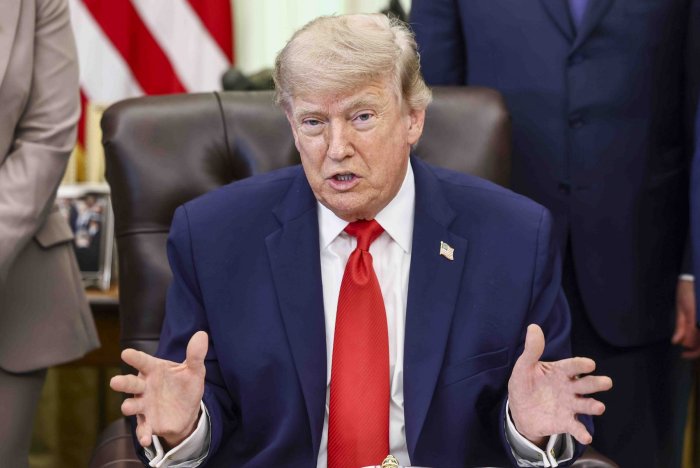
A judge on Friday permanently blocked President Donald Trump’s “anti-weaponization” fund because, despite administration officials’ statements that the fund will not be enacted, she does not believe them. Photo by Samuel Corum/UPI | License Photo
June 12 (UPI) — A federal judge on Friday extended an order to indefinitely block President Donald Trump‘s $1.776 billion “anti-weaponization” fund because she does not trust the administration’s word that it will not attempt to enact it.
The fund was announced last month and meant to compensate people the Trump administration alleged were targeted by the Biden administration, including people who were convicted for their actions during the Jan. 6, 2021, riots at the Capitol Building in Washington, D.C.
Judge Leonie Brinkema of the Eastern District of Virginia in her ruling blocked Acting Attorney General Todd Blanche, Associate Attorney General Stanley Woodward, Jr., and Treasury Secretary Scott Bessent from taking “any action to create or operate” the fund and that they not proceed with the concept “in any manner, or under any name.”
Brinkema’s ruling builds atop one from Washington, D.C., Judge Richard Leon that they do not believe the administration will not attempt to distribute money in the scheme.
Both judges indicated that they do not believe that the Department of Justice will back off from the plan because no officials from the agency have said they would do so while sworn in and under penalty of perjury.
“When the President of the United States says” that he wants something, referring to Trump, Brinkema said “that’s a pretty good indicator there will be an incentive and motive to make it happen,” CNN reported.
Even with the fund having been on hold for the last week, at least one person already has attempted to file a claim, to which the federal court responded that it is “not accepting applications”
President Donald Trump speaks to reporters about restoring commercial fishing access to areas of the Pacific during a signing ceremony in the Oval Office of the White House on Thursday. Photo by Jim Lo Scalzo/UPI | License Photo
Cameron Brink said she’d appreciate some grace. She really would.
Sparks fans should give her some, because where else is she going to get it?
Certainly not from WNBA refs. Not from opponents with more to play for than ever. Certainly not from the game itself; basketball moves fast, and a bummer can become a bust in a blink.
But Brink, 24, is not on the brink of bust territory, no. Block that thought. Technically, it’s Year 3, but after a torn ACL derailed her as a rookie two summers ago, it’s practically like Year 2 for the former Stanford star. And by design, the WNBA is testing her confidence, her decision-making and her patience as she tries to reestablish herself as one of the WNBA’s best young players.
So, grace.
The recognizable 6-foot-4 forward — she’s the long-blond-haired hooper in the New Balance ads — was the No. 2 overall pick in 2024.
Now she’s her team’s No. 3 option in the post. She’s coming off the bench behind Nneka Ogwumike and Dearica Hamby for the Sparks, who are a modest 6-6 after wins this week over the expansion Portland Fire and the struggling Seattle Storm.
Against the Fire, Brink scored two points and picked up four fouls in nine minutes. Then she went to Seattle and had 15 points in 18 minutes but was pulled with more than five minutes left in the fourth quarter after getting her third, fourth and fifth fouls in 86 seconds. (WNBA players get six fouls before being disqualified.)
For the season, Brink has been called for 49 fouls in 208 minutes. A foul about every four minutes!
They’re silly fouls and they’re phantom calls. Egregious and ticky-tack. Costly and common. A real fouled-up buffet. She sets screens that get scrutinized as if by the most vigilant TSA agent. And sometimes, yes, she’s doing the accidental tripping. Other times, the officials are.
Her reputation precedes her, so everyone gets a superstar’s whistle when being defended by Brink. Opponents bake it into their game plans.
That can’t continue.
All that fouling is hindering Brink’s development because it’s robbing her of important in-game reps — which she needs, foremost, to figure out how to stop fouling.
Sparks forward Cameron Brink, left, blocks the shot of the Tempo’s Laura Juskaite during a game last month.
(Jeff Lewis / Associated Press)
“At the pro level,” said Tara VanDerveer, Brink’s coach at Stanford, “every young player always has a lot of work to do. And I saw her make a three. I see her block shots. She rebounds, she can handle the ball, she’s unselfish, she’s a terrific talent. But there’s always things players need to work on.”
We know what Brink’s thing is.
“She has to be disciplined,” VanDerveer said. “And if you want something so badly, if you want to be an All-Star someday or make the Olympic team, you’ve got to be dependable … and I think anyone can change, if it’s behavior they recognize is not in their best interests or not in their team’s best interests. It’s hard, but it’s something I think people can do.
“That’s what Cam is working on.”
And, VanDerveer added, “I’m really so excited that Nneka is there, because she will give her such great guidance and mentorship.”
And grace. Brink is getting that from Ogwumike — also a former Stanford star, the Sparks legend returned to L.A. this season after two seasons in Seattle — and her other teammates.
“I just do my best to lead by example,” Ogwumike, 35, said. “But then also let [Brink] know that she’s very capable, that she’s more than capable, which is exactly why she’s here with us and it’s exactly why we need her on this team.”
Sparks forward Cameron Brink, wearing a facemask, controls the ball while defended by Sun forward Raegan Beers.
(Joe Buglewicz / Getty Images)
But how long will Brink get grace from the Sparks in the what-have-you-done-for-me-lately business of basketball?
The foul trouble tells us why a win-now team wouldn’t trust her, why the Sparks would give meaningful minutes to two veteran post players ahead of her. Why they wouldn’t prioritize Brink’s development alongside winning as they strive to snap a previously unthinkable five-year playoff drought.
And what about fans? How patient will you all be with a player who was drafted immediately after Caitlin Clark and five spots in front of Angel Reese?
These days, that might depend on what the parlay calls for.
Or, preferably, whether you remember Brink’s first 15 WNBA games. All starts, all signs pointing to stardom. She showed up in 2024 throwing lavish block parties. Her 2.3 blocks per game were message-sending spikes, like what Lisa Leslie used to enthrall Sparks crowds with.
From the jump, she had guys coming to games at Crypto.com Arena wearing her No. 22 jersey and little girls arriving in groups with No. 22 painted on their cheeks and “I love Cam Brink” signs in hand.
And then the torn ACL cost her 25 games of her rookie season and another 25 last season, plus her spot on the United States’ Olympic 3×3 women’s basketball team in Paris in 2024.
She had to start over. Lost a lot of ground. But you see that masked woman stuck on the Sparks’ bench for all but 17 minutes per game?
You can’t miss her. She’s looking uncomfortable in protective facial gear that either hinders her breathing or her peripheral vision, her only options to protect the torn septum she suffered in a victory over the Las Vegas Aces last month.
She’s the one with the 6-8 wingspan who’s averaging 9.2 points, 4.3 rebounds and 1.5 blocks while shooting 52.1% from the field in her limited minutes.
She’s still Cameron Brink. Between fouls, she’s fluid and fast and covers more of the court than almost anyone in the WNBA, able to leap from defending guards to centers in a single bound.
“It’s just looking at every day as a new opportunity to learn and grow and not getting too bogged down when things don’t go exactly as you planned,” Brink told me. “Because more times than not, things are not going to go how you want them to. And that’s life. So I just want to be able to put my best effort out there every single night.
She knows what the Sparks need from her: “To perform, just come on the floor and compete.”
Justice Department had walked back controversial plan after meeting backlash from lawmakers and lawsuits.
Published On 12 Jun 202612 Jun 2026
A federal judge in the United States has indefinitely blocked the Trump administration from moving forward with plans for a $1.8bn “anti-weaponisation” fund, meant to offer payments to those who experienced alleged “lawfare” and “weaponisation” of the government.
The ruling on Friday represents another setback for the scheme, which has faced heavy resistance from lawmakers and has been walked back by the Department of Justice previously.
Recommended Stories
list of 3 itemsend of list
Judge Leonie Brinkema of the US District Court for the Eastern District of Virginia had issued a temporary halt to the fund last week and issued a preliminary injunction as it was set to expire on Friday.
The fund was the product of a settlement between Trump and the Justice Department of a $10bn lawsuit the president had brought against the Internal Revenue Service (IRS).
The Justice Department set up a $1.776bn fund that would have been helmed by a five-member commission to distribute funds to those they deemed victims of “weaponisation”, a term that Trump has used to describe investigations and criminal cases into himself and his allies.
Attorney General Todd Blanche walked back the plans earlier this month amid growing criticism, and government attorneys have argued that lawsuits challenging the scheme are now irrelevant.
Even before the administration announced it was dropping the fund, the Justice Department did not form the five-member commission to decide on payout criteria, so no money was paid out or claims accepted.
Many of the Republican president’s allies are opposed to compensating rioters who stormed the US Capitol on January 6, 2021. In May, however, Blanche would not rule out the possibility that Capitol rioters who engaged in violence could be eligible to apply for payments from the fund.
Trump issued mass pardons to Capitol rioters on his first day back in the White House last year. More than 1,500 people were charged in the January 6 attack before Trump erased every case with his sweeping act of clemency.
Plaintiffs who sued to block the plan argued that the scheme diverted taxpayer funds into what was essentially a slush fund and have expressed doubt about Blanche’s assurances that the fund will not move forward.
While the administration has moved away from the scheme, Trump himself has not endorsed its cancellation and has continued to discuss it positively in comments to the press.
ALEXANDRIA, Va. — A federal judge agreed on Friday to extend a court-ordered block on the Trump administration’s creation and operation of a $1.8 billion settlement fund for compensating people who claim to be victims of a weaponized government.
Earlier this month, acting Atty. Gen. Todd Blanche told Congress that the government is scrapping its plans for the fund in the face of a fierce bipartisan backlash. Government attorneys have argued that lawsuits challenging the fund are now moot, but plaintiffs’ attorneys aren’t satisfied by Blanche’s assurances that the fund won’t move forward.
Neither was U.S. District Judge Leonie Brinkema, who ruled that the “Anti-Weaponization Fund” will remain blocked until further notice from the court.
“The (government’s) mootness argument, in my view, doesn’t go anywhere,” the judge said.
President Trump, meanwhile, has not publicly and unequivocally endorsed its cancellation. He has continued to express support for the fund in remarks to reporters.
Brinkema gave the parties a week to negotiate an agreement for Blanche to submit a sworn declaration that the administration won’t revive the fund.
Brinkema previously agreed to temporarily block the administration from proceeding with the fund for at least two weeks. Her May 29 order was due to expire on Friday.
Trump’s Republican administration created the fund to resolve his lawsuit against the Internal Revenue Service over the leak of his tax returns.
Plaintiffs who sued to block fund payouts argue that the government can’t legally divert taxpayer money into what they argue is a slush fund for compensating Trump’s allies.
In a separate case on Wednesday, a different judge in Washington, D.C., rejected a government watchdog’s parallel request for a court order temporarily blocking the Trump administration from forging ahead with the fund. U.S. District Judge Richard Leon said he accepts Blanche’s representation that the fund is now moot.
Leon had asked Justice Department attorney Andrew Block why Blanche doesn’t formally rescind his May 18 order establishing the fund. Block said he didn’t know. He still didn’t have an answer to that question when Brinkema posed it two days later.
“It’s a huge gap in the record that we don’t have an answer to that question,” the judge said.
In the Virginia case, attorneys from the legal advocacy group Democracy Forward asked for an order to temporarily suspend the fund’s implementation and stop the Trump administration from disbursing any payouts from it.
The plaintiffs include a fired prosecutor and a college professor acquitted of assaulting federal agents at a protest.
Even before the administration said it was dropping the fund, the Justice Department did not form the five-member commission that would decide on payout criteria, so no money was paid out nor claims accepted.
Many of the Republican president’s allies are opposed to compensating rioters who stormed the U.S. Capitol on Jan. 6, 2021. In May, however, Blanche wouldn’t rule out the possibility that Capitol rioters who engaged could be eligible to apply for payments from the fund.
Trump issued mass pardons to Capitol rioters on his first day back in the White House last year. More than 1,500 people were charged in the Jan. 6 attack before Trump erased every case with his sweeping act of clemency.
Brinkema was nominated to the bench by President Clinton, a Democrat.
The 52 clubs involved have outlined in the letter an agenda they hope to discuss at the meeting with the FA.
Among the issues they raise are:
Whether the process adopted by the board “complies” with the constitutional rights of the member clubs
The use of “anonymous” surveys instead of a formal voting procedure
The “incentive of financial distributions” to press for an agreement
“Concerns” regarding the independence of decision-making on the board
A need for “transparency and accountability”
The letter asks that the FA is bound by a notice period to agree the meeting and confirm an agenda, which is believed to be between seven and 14 working days.
Anthony Shaw, operations manager at Hashtag United FC, pulled the 52 clubs together and signed the letter on their behalf.
All clubs were listed. Among them were Middlesbrough, Derby County, Halifax, Doncaster Belles and Hull City.
Former Women’s National League chair Carol West has strongly opposed the proposals, writing on social media: “The damage being done here should not be underestimated. I can’t quite believe it’s being allowed to happen.
“The overriding issue with all of this is that the vast majority of clubs do not want PGA (Professional Game Academy) teams in their league but have repeatedly been denied their democratic right to vote to formalise this once and for all.
“Instead, they’ve been told it’s happening regardless which isn’t right.”
The Angels flipped the script on the Dodgers, preventing a Freeway Series season sweep with a 13-5 win Sunday afternoon at Dodger Stadium.
Emmet Sheehan’s start only lasted 1 ⅓ innings, as he struggled to keep his pitch count low. He threw 35 of his 49 pitches in the second inning alone. Many of those went to Nick Madrigal, who battled Sheehan in a 14-pitch at-bat in which Madrigal won two ABS challenges.
“I thought the stuff was good coming in,” said manager Dave Roberts about Sheehan. “After the first inning, I just didn’t feel comfortable getting him past the 40-pitch mark in one inning. I’m not going to put this guy in harm’s way.”
The Angels third baseman drew a walk, marking the beginning of the end for Sheehan, who already allowed a single. The 26-year-old pitcher loaded the bases with another walk. Angels catcher Sebastián Rivero drove in two runs with a center-field single.
“Frustrating,” Sheehan called his outing. “Couldn’t put guys away, not efficient.”
The game shifted into an unexpected bullpen game, and the Dodgers shuffled through seven pitchers. Edgardo Henriquez retired five consecutive batters. But the Dodgers’ spiral continued. Jo Adell reached first after a ball deflected off the glove of Miguel Rojas. Adell then moved to second on a passed ball by catcher Dalton Rushing. Reliever Blake Treinen then gave up a walk and before Rivero hit another two-run single.
Madrigal beat the Dodgers (42-24) in another double-digit pitch plate appearance in the fifth. Home plate umpire Dan Iassogna called a third strike, but Madrigal argued with the umpire, emphatically slapping his head. After an ABS review, the pitch was determined to be a ball. Rushing, seemingly not pleased with a borderline check-swing call, argued with Iassogna. In the end, a 12-pitch at-bat resulted in another walk.
Coupled with a missed call for a walk on a foul-tip earlier in the game, the check-swing call added to a frustrating afternoon for the Dodgers.
“It should be reviewable,” Roberts said of the foul tip. “That changed the game, and obviously the Madrigal check-swing. I felt that he went. That did impact the game.”
Dodgers manager Dave Roberts walks on the field during the seventh inning Sunday against the Angels.
(Eric Thayer / Los Angeles Times)
Roberts replaced Alex Vesia with Jonathan Hernández, who gave up a two-run single to Jose Siri. Miguel Rojas threw out Madrigal at home on the hit to limit the damage.
In the third inning, Kyle Tucker drove in a run on a groundout that landed a foot away from home plate, but it gave Shohei Ohtani just enough time to sprint home after Rivero threw to first.
Still, the Dodgers, who had outscored the Angels 41-5 in games this season before Sunday, struggled. Twice, Rushing hit singles. Twice, Ryan Ward, the next batter, grounded into a double play, dashing any momentum. Rushing and Ward hit back-to-back home runs to right field in the sixth, but the Dodgers couldn’t capitalize on the momentum.
Rushing received more playing time than predicted this series, but he said he embraced the opportunity. He matched his career-high with four hits on Sunday. His home run was his first since April 20.
“This year, my whole goal was make sure if there’s an opportunity that I can pick a day that Will [Smith] needs rest, make sure that I can provide just as much as he does with the bat as well as behind the plate,” Rushing said Saturday. “He knows I’ll catch every game if he can’t go back there.”
Catcher Will Smith did not play Sunday because of neck stiffness, despite Roberts predicting the catcher would return for the series finale. Imaging on Smith’s neck came back negative, though it’s unclear if he’ll play Tuesday against Pittsburgh.
“It’s not anything serious, but it’s something that is preventing him from playing,” Roberts said. “It’s kind of a day-to-day thing.”
Rushing’s and Ward’s home runs were quickly negated when Adell hit a two-run homer to left-center field. Zach Neto also hammered a seventh-inning, three-run home run. By the time the game concluded, the bottom of the Angels lineup batted 13 for 15, walking four times. The Angels (25-41) could’ve scored more if not for Neto and Mike Trout, who hit a combined one for 12.
“The bottom half of the order, they were fouling off a lot of balls, we couldn’t put those guys out,” Roberts said. “But, yeah, the Madrigal at-bat really was a difference today.”
Glasnow talks about his injury
Dodgers starting pitcher Tyler Glasnow (back spasms), who was put on the 60-day injured list Saturday, attributed his slow recovery to trying to come back too soon. He plans to rest a few days before building back up.
“It’s uncomfortable,” Glasnow said. “When I get into my load, something feels weird. The more I go, the more it starts to aggravate it. Generally, before I start to throw, as long as it’s completely gone, it gets over the hump, it’s gone, and then I can get back to full speed. I just feel like I haven’t gotten there yet.”
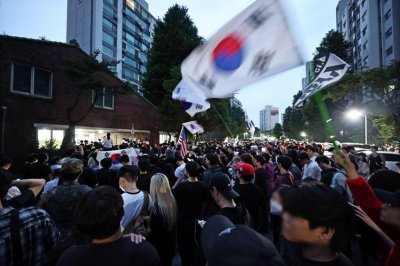
Protesters demonstrate in front of a polling station in Songpa District, Seoul, South Korea, 04 June 2026, to call for the suspension of ballot counting. A shortage of ballot papers forced an extension of voting at several polling stations in the area during the local elections held the previous day. Photo by YONHAP / EPA
June 5 (Asia Today) — Protesters who had blocked a polling station in Seoul’s Songpa district for two nights and three days moved Friday to a vote-counting center, demanding a new election after ballot shortages disrupted voting in the June 3 local elections.
The ballot boxes from the No. 2 polling station in Jamsil 7-dong were transferred and counted after about 1,000 police officers were deployed. But protesters said they could not accept the result and effectively occupied the entrance area of the counting center, calling for a revote.
About 300 people, including citizens and conservative YouTubers, gathered near the entrance of the Olympic Park handball arena, according to an unofficial police estimate.
Even after the counting was completed, protesters chanted slogans including “revote” and “invalidate the vote.” Some protesters have alleged election fraud, but election authorities have attributed the disruption to a shortage of ballot papers during voting.
The atmosphere grew tense as access for election workers and arena employees was effectively blocked. Some arena employees who tried to leave were reportedly stopped by protesters and remained inside.
Police continued to guard the area around the arena after the vote count ended. Officials at the scene were considering sending election commission workers home first and removing vote-counting materials separately.
The protest followed a broader ballot shortage controversy in South Korea’s local elections. The National Election Commission said ballot shortages occurred at 50 polling stations nationwide and temporarily halted voting at 22 sites. The disruption drew public criticism and led the commission’s chairman, Roh Tae-ak, to announce his resignation Friday.
Earlier, protesters blocked the removal of ballot boxes from Jamsil 7-dong’s No. 2 polling station after a ballot shortage left voters waiting for hours. Police later escorted officials to retrieve the remaining ballot boxes, and the final count ended Friday afternoon.
The state of California is leading an effort to prepare a possible lawsuit that could thwart Paramount Skydance Corp.’s planned acquisition of Warner Bros. Discovery, a potential obstacle for the $111 billion deal.
The lawsuit, which could be filed as early as this month, would likely involve multiple states, according to a source familiar with the deliberations who was not authorized to comment publicly.
The litigation would seek to challenge the proposed merger on antitrust grounds, arguing it would thwart competition, lower wages and lead to widespread job losses.
“The Paramount acquisition of Warner Brothers remains an active investigation, and we do not have any updates to share at this time,” said California Atty. General Rob Bonta’s office in a statement.
In a statement, Paramount said it “will continue to fight against any attempt to derail a deal that plainly benefits consumers, creators and the industry as whole.”
“Opposing this deal means opposing expanded consumer choice, new opportunities for creators and workers, and greater competition throughout the creative ecosystem — the opposite of what antitrust law is meant to achieve,” the company added.
Under Paramount Chairman David Ellison’s proposal, Warner investors would receive $31 a share, nearly four times the price of the company’s stock in April 2025. He also said he will keep both studios’ release schedules of 15 movies a year for a total of 30 films a year.
Nonetheless, Ellison and his team have vowed to make $6 billion in cuts following the merger, which requires regulatory approval. The combined company would have to contend with $79 billion in deal debt.
The prospect of substantial job cuts during a period of downsizing in Hollywood has ignited widespread opposition to the sale.
Thousands of people who work in the TV and film industry, including actor Joaquin Phoenix and director-writer-producer JJ Abrams signed an open letter opposing Paramount’s planned acquisition of WBD, saying it would lead to fewer production jobs and fewer choices for consumers. Others have also raised concerns about the impact it could have on content.
“The consequences would be felt nationwide, from destroying CNN the way that Ellisons have devastated CBS to entertainment industry job losses and consumers losing access to independent voices and a competitive market,” said Norm Eisen, executive chair of Democracy Defenders Fund, one of the groups that organized the open letter. “State attorneys general have both the authority and the responsibility to act when a transaction of this scale directly threatens the public’s interest, and I hope states across the country will join any effort to challenge this deal,” Eisen said in a statement.
The potential lawsuit, first reported by Bloomberg and Reuters, is being considered by other states, including New York and Colorado.
“Paramount and Warner Bros. haven’t cleared regulatory scrutiny,” Bonta told The Times in March. “My office has an open investigation into [the deal] and we intend to be vigorous in our review.”
Despite the potential obstacle, Raymond James equity analysts said in a note on Thursday that they “still believe the deal is likely to close.”
Last month, Paramount hired antitrust attorney Jeffrey Kessler to defend its planned acquisition of Warner Bros. Discovery. Kessler recently led a case for state attorney generals against concert promoter and ticketing firm Live Nation, resulting in a win for states, including California.
“We also think there are win/win solutions to be had particularly in California given exodus of production from CA in recent years and efforts to bring production back to Hollywood,” the analyst said in their note.
A congressional panel in the United States has rejected an effort to revoke a provision from the defence budget that would further integrate the US and Israeli militaries.
An amendment to sink the pro-Israel measure, introduced by Democratic Congressman Ro Khanna, failed in a voice call on Thursday in the House Armed Services Committee.
Recommended Stories
list of 3 itemsend of list
That defeat paves the way for the proposal to advance to the floor of the House of Representatives.
Khanna had argued that the provision in the National Defense Authorization Act (NDAA), formally called Section 224, rewards Benjamin Netanyahu at a time when the Israeli prime minister is trying to dictate US policy in the Middle East.
The progressive Democrat cited recent reports that President Donald Trump is angry at Netanyahu over Israel’s escalation in Lebanon.
“Everyone in America — whether you’re a Republican, an independent or a Democrat — says that we need to tell Netanyahu that America calls the shots, not the prime minister of any other country,” Khanna said.
“They want less cooperation and blank checks to Israel, not more. Only the United States Congress would dream up at this moment, ‘Let’s actually do more for Israel.’”
The vote on the amendment was taken by calling on committee members to say aloud either “yes” and “no”, and the “nays” clearly were more numerous. It was not recorded as a roll-call vote, which would require each member’s preference to be logged.
Section 224 would require the Pentagon chief “to designate an executive agent responsible for synchronising cooperative efforts between the United States and Israel”.
That official would be in charge of overseeing several joint initiatives, “including bilateral defence technology research, development, testing, evaluation, integration, and industrial cooperation”, the NDAA reads.
Netanyahu’s endorsement
Critics have raised concern that Section 224 may make US military aid to Israel more opaque, concealing the assistance as cooperation rather than a separate expense.
The measure also risks tethering the US military to its Israeli counterpart technologically at a time when the American public is rapidly turning against Israel, according to recent public opinion polls.
“As political pressure builds to reduce US military assistance to Israel, Section 224 provides the framework for continuing — and expanding — US-Israel military ties by entrenching Israeli technology within the US defense supply chain in a way that would shield it from the annual appropriations process,” the nonprofit lobbying group A New Policy said in a brief last week.
“The use of must-pass legislation as the NDAA as a mechanism of integration speaks to the plummeting popularity of continuing unconditional support to Israel.”
The measure comes as Netanyahu pushes to transform US aid to Israel from direct assistance to military “cooperation”.
The Israeli prime minister wrote a letter to Republican Congressman Marlin Stutzman endorsing a bill facilitating that transition.
In the letter, Netanyahu said, “The time has now arrived for us to move from aid recipient to partner.”
He added he supported Stutzman’s plan for a “new framework of joint defense cooperation, codevelopment, coproduction and mutual investment in areas including advanced missile defense, artificial intelligence … and next generation military platforms”.
Referencing the letter on Thursday, Khanna argued that Section 224 “directly” follows Netanyahu’s language.
“I am for Team America. I am for the interests of this country, and I believe that when Donald Trump ran, he ran ‘America First’,” the Democrat said.
“That includes American interests against any foreign country. We should have American sovereignty and make it clear that we strike 224. If we want to give aid to Israel, if we want to sell them weapons, that should be a vote for the entire Congress.”
But both Democrats and Republicans pushed back against his argument, saying that the provision aims to streamline existing cooperative programmes that benefit the US.
Key Democrat backs Section 224
Congressman Adam Smith, the top Democrat on the panel, said he was “very sympathetic” to Khanna’s frustration with Netanyahu.
“Mr Netanyahu insisted on this war with Iran that has strengthened Iran and weakened our position. I do not like his leadership of Israel or where he is going,” Smith said.
But he added that it is in the US’s interests to have deep military ties with Israel, a country accused by leading rights groups and United Nations investigators of committing genocide in Gaza.
“The reason that we have these partnerships with Israel, where we may not have as many developed partnerships with other NATO countries, is because Israel has actually been having to fight,” Smith said.
“They have faced drone attacks and missile attacks. They have had to develop new technologies, technologies that we’ve benefitted from.”
Rights advocates often decry the promotion of Israel’s weapons as “battle-tested” — because they have been tested on the Palestinian and Lebanese communities that they devastated, killing tens of thousands of people along the way.
Earlier on Thursday, Palestinian rights advocates warned against approving Section 224 during a news conference on Capitol Hill.
“It is unfathomable that this is the American response to a country that has, over the past two and a half years, carried out a genocide against Palestinians and started wars in both Iran and Lebanon,” said Margaret DeReus, the executive director at the Institute for Middle East Understanding (IMEU).
Republican Congressman Thomas Massie has promised to introduce an amendment to revoke Section 224 when the NDAA goes to a full House vote.
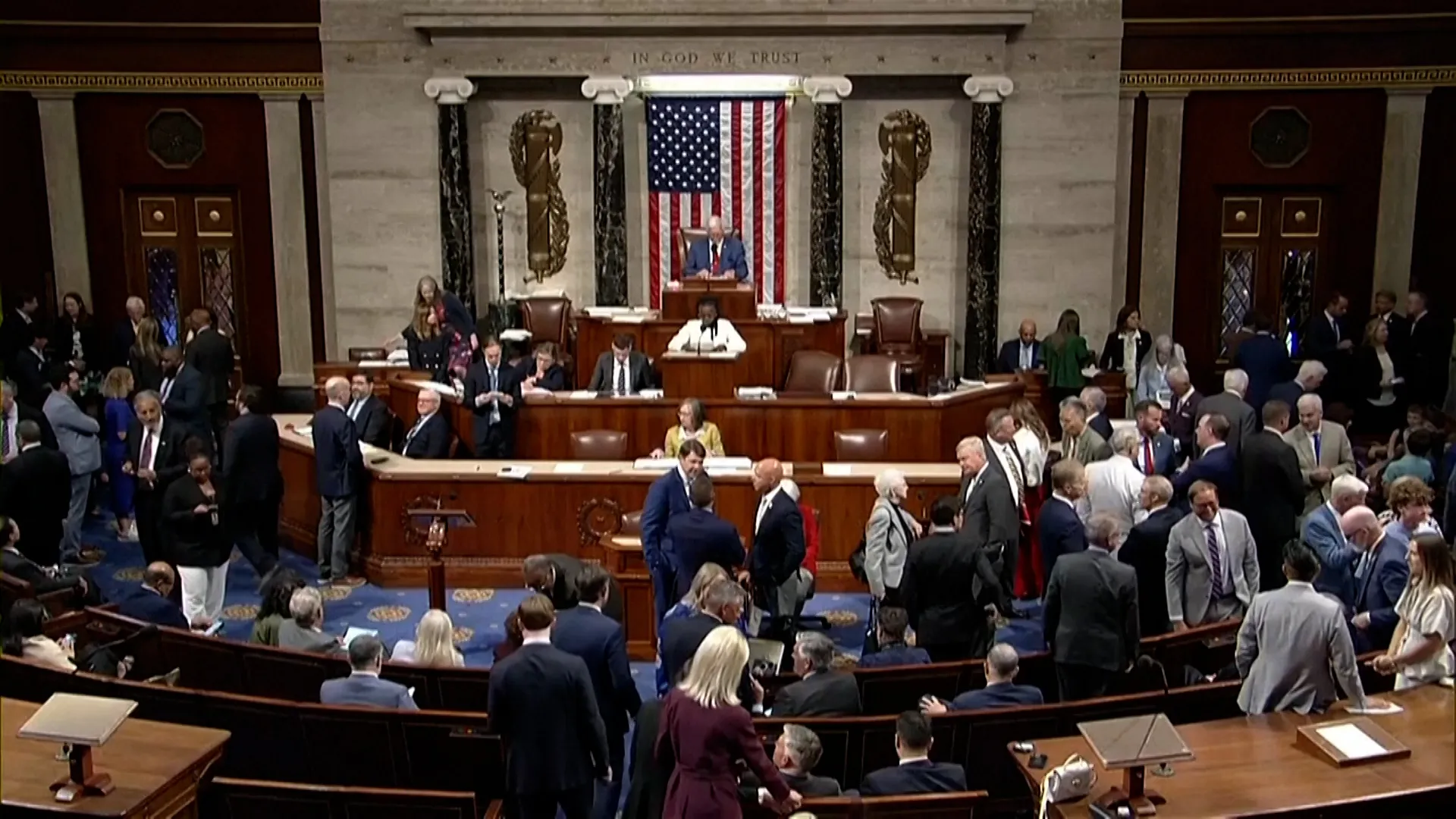
This is the moment the Republican-led US House of Representatives passed a resolution to reign in President Donald Trump’s ability to keep attacking Iran, unless Congress declares war or approves the use of military force. But it’s unlikely to become law as Trump can veto it even if it passes the Senate.
The battleship and frigate provisions are included in an early draft of the annual defense policy bill, or National Defense Authorization Act (NDAA), for the 2027 Fiscal Year, which the House Armed Services Committee released late yesterday. The Trump class battleship and FF(X) are set to be some of the Navy’s top shipbuilding priorities in the coming years.
A model of the Trump class design on display at the Surface Navy Association’s (SNA) annual symposium in January 2026. A model of the FF(X) frigate is also seen in part at the left. Eric Tegler
Tying the battleship construction timeline to weapon system progress
The section in the proposed legislation regarding the Trump class battleship is brief, reading as follows:
“The Secretary of the Navy may not enter into a contract or other agreement that includes a scope of work for the construction of the lead ship of the Battleship program until the date on which the Secretary certifies to the congressional defense committees that the weapon systems planned for inclusion in such lead ship are at a sufficiently mature technology readiness level.”
The provision does not name any particular weapon systems or define what level of “technology readiness” would be accepted as “sufficiently mature.”
A rendering of a Trump class battleship firing various weapons. USN
In terms of technological maturity, the railgun presents particular questions. Between 2005 and 2021, the Navy had an active railgun program. Despite promising developments, plans for an at-sea test were repeatedly pushed back before the entire effort was shelved. Major technical hurdles were cited as a key factor in that decision. The railgun itself was effectively placed in storage at White Sands Missile Range (WSMR) in New Mexico.
However, it emerged earlier this year that the Navy had conducted a new round of testing of the railgun at WSMR in February 2025. Whether the Navy has any plans to pick up where it left off with this prototype design, which was developed by BAE Systems, or pursue a new one remains unclear. General Atomics, which previously supported U.S. Army railgun efforts, has publicly expressed interest in being involved in arming the Trump class.
A picture showing the Navy’s prototype railgun being fired at WSMR. USN
While the Navy has been very active in developing and fielding laser directed energy weapons, this is another area where the service has faced continued challenges in expanding their operational use. The plans for the Trump class specifically call for a 300-kilowatt-class laser, which is far more powerful than any of the designs the Navy has integrated on its warships to date. The service currently has eight Arleigh Burke class destroyers with the Optical Dazzling Interdictor, Navy (ODIN), as well as another one of those warships with the High Energy Laser with Integrated Optical-dazzler and Surveillance (HELIOS). HELIOS is a 60-kilowatt-class design, though there has been talk about scaling up its power rating to 150 kilowatts. ODIN’s power rating does not appear to be officially confirmed, but it is understood to be significantly lower than that of HELIOS. You can read more about all of this here.
The Arleigh Burke class destroyer USS Preble fires its HELIOS laser directed energy weapon during a test. US Military
The Intermediate Range Conventional Prompt Strike (IRCPS) hypersonic missile, another key component of the future Trump class arsenal, is also still in development. The first test launch from a warship, the stealth destroyer USS Zumwalt, is expected to come next year. IRCPS is the Navy half of a joint program with the U.S. Army, which is working to field a land-based version of the same missile. The Army refers to its complete weapon system as the Dark Eagle. The Army had suffered significant setbacks in the past with the Dark Eagle, but the service had blamed those issues on the launcher rather than the missile.
The hypersonic missile common to the Navy’s IRCPS and Army’s Dark Eagle systems seen being test fired from a launch pad on land. US MilitaryA briefing slide showing the integration of launch tubes for IRCPS missiles on the USS Zumwalt. The Trump class battleship design is set to include a similar launch tube array for these missiles. USN
More context about what planned weapons systems for the Trump class may have prompted the House Armed Services Committee to include this section in the draft NDAA are likely to emerge as the proposed bill is refined. Nuclear propulsion and other planned aspects of the ship could present their own challenges during development and production. The U.S. Navy has not procured a nuclear-powered surface combatant of any kind since the Cold War.
“We intend to, with all we can do, use pull-through technologies, [including] things from that we’ve worked on with DDG(X),” Chief of Naval Operations Adm. Daryl Caudle said at a hearing earlier this month. “It will have the SPY-6 radar. It will have the Baseline 10 Aegis combat system. It will pull through, of course, the A1B Ford class reactor plant and all the design that goes with that. The only thing inherently new to it will be the actual hull itself, and so most of the fixtures in it. And I would say the directed energy [weapons] and up gunning, that will also be new.”
One of the “mistakes that we’ve done before, quite frankly,” is “we’ve started to build before the design is mature enough,” the CNO also said at a roundtable on the sidelines of the Navy League’s Sea Air Space 2026 in April. “And we want to make sure that we’re at [sic] least a very, very high level – I won’t try to give a percentage, but you can think like 80% or more design – before the first weld is done.”
The Navy is understood to still be in the very early phases of laying out the Trump class design.
Another rendering of a future Trump class battleship. White House/USN
The provision in the draft NDAA could easily delay the start of work on the first of these battleships, which could set back the entire schedule for the program. As it stands now, the Navy is looking to order the lead ship, set to be named the USS Defiant, in Fiscal Year 2028. With an estimated price tag of $17 billion, this ship would cost more than each of the next three Ford class aircraft carriers, and is not expected to enter service in 2036. The Navy also currently plans to buy 14 more battleships between Fiscal Years 2029 and 2055. As TWZ has previously explored in detail, many significant questions remain about the future of the Trump class, including whether the program will ultimately come to fruition at all.
Plans for future FF(X) frigate subvariants
In its current form, the draft NDAA would also require the Secretary of the Navy to “submit to the congressional defense committees a strategy for the iterative development of the FF(X) class frigate” within 180 days of the bill becoming law. The Secretary would also be compelled to provide a briefing to update legislators on their progress in devising this strategy within 90 days.
The strategy would have to include the following:
“Information on the estimated timeline for each planned variant (commonly known as a ‘‘Flight’’) of the FF(X) class frigate”
“Details on the integration of additional capabilities for future Flights of the frigate, such as vertical launch systems or improved sensors, and implications for the space, weight, power, and cost of the hull form.”
Any additional mission sets or combat functions that may be added to the concept of operation for FF(X) class frigates.”
The Navy has already confirmed that the FF(X) design will based on that of the Legend class cutter currently in service with the U.S. Coast Guard. As mentioned, the fact that the first of these frigates, at least, will lack a VLS array has raised significant questions about this program.
A rendering of the FF(X) frigate. USNThe US Coast Guard’s Legend class cutter USCGC Hamilton. USCG
The Constellation class would have featured a 32-cell Mk 41 VLS array. There had already been a debate about whether this was sufficient VLS capacity to meet operational requirements, something TWZ previously explored in detail.
A rendering of a Constellation class frigate. USN
The Navy’s current stated vision for the Flight I FF(X) configuration is to utilize containerized weapons and other systems to make up for gaps in integrated capabilities. The frigates are also expected to act as motherships for future fleets of uncrewed surface vessels, which could provide additional distributed weapons and sensor capabilities and capacity.
A briefing slide with details about the FF(X) design, including its armament package, shown at the Surface Navy Association’s (SNA) 2026 annual symposium. Eric Tegler
“While Flight I of the FF(X) Class (currently planned as at least the first 2 ships) does not incorporate a traditional fixed VLS battery, it retains the capability to deploy VLS-equivalent payloads through modular, mission-tailored configurations,” according to the Navy’s 2027 Fiscal Year budget request. “This approach provides an inherent growth path for VLS and other capabilities through containerized solutions in early flights, reinforcing the platform’s adaptability while mitigating cost, schedule, and integration risks associated with fixed VLS installation.”
A containerized VLS, in particular, would be far more limited in capacity than a traditional built-in Mk 41 and Mk 57 array.
At the same time, the Navy’s budget documents make clear that there are already plans for “studies for future flights [that] will consider expanded capabilities including Vertical Launch Systems, and Anti-Submarine Warfare systems.”
Huntington Ingalls Industries (HII), the shipbuilder behind the Legend class design on which the FF(X) will be based, has shown multiple concepts for derivatives with integrated VLS arrays and other additional capabilities in the past, as seen in the video below.
Patrol Frigate Variants – Information Video
When it comes to the battleship and FF(X) provisions in the draft NDAA, it is also important to remember that this legislation is not yet finalized and could easily change in the weeks and months ahead. The House’s version of the bill will also need to be reconciled with what the Senate puts forward, a process often marked by lengthy negotiations. The House and Senate will both need to pass the finalized version, and then the President has to sign it into law.
As the name makes clear, the battleship program is of particular significance to President Donald Trump, which will be an important factor in these processes. Even before his first term, Trump had expressed interest in returning battleships to the Navy’s combat fleets, but there had been no indications of any formal moves to pursue this ship before last year. With the schedule the Navy has laid out now, major decisions about how to proceed in the production of these ships, if at all, will fall to the next administration. There are already massive competing priorities, and some members of Congress have already questioned whether the battleship effort is the best use of available resources.
The House Armed Services Committee has at least taken steps now toward putting a hold on production of the first Trump class battleship until it is confident that key weapon systems are mature, as well as pushing the Navy to lay a formal plan for future versions of the FF(X) frigate.