bill

Treasury Secretary Bessent confirms steps for a Donald Trump $250 bill

Treasury Secretary Scott Bessent said Thursday that his department has prepared the design for a $250 bill featuring President Trump, anticipating the passage of stalled legislation in Congress to put the president on a new denomination of legal tender.

Bessent said at the White House that authorizing the currency will be up to lawmakers on Capitol Hill, but that “we’ve created the bill” because “we have to be prepared.”

The secretary downplayed the idea that the administration is pushing the matter, despite Trump’s penchant for infusing his name and likeness across the nation’s capital and into the observances of the 250th anniversary of the Declaration of Independence. Bessent also insisted there is nothing inappropriate about Trump’s visage being part of the seminal national celebration.

“The president doesn’t do it; the House and the Senate have to do it,” Bessent said at the White House, referring to legislation, introduced by Rep. Joe Wilson (R-S.C.), that would direct the Treasury Department’s Bureau of Engraving and Printing to put Trump’s face on the new bill to mark the 250th anniversary of the nation’s founding.

A Treasury Department spokeswoman said the agency carried out “appropriate planning and due diligence” to implement a potential congressional mandate “to produce a $250 commemorative note which will appropriately recognize the 250th Anniversary of our great nation.” The spokeswoman did not mention Trump.

If passed and signed into law by Trump, Wilson’s bill would mark an extraordinary recognition for a sitting U.S. leader and comes as Trump has sought to place himself at the center of Independence Day commemorations. The Department’s preparation for the languishing legislation suggests some enthusiasm for the idea on the part of the Trump administration.

Report: Trump ally has pushed to expedite new currency

The agency’s explanation follows a Washington Post report stating that U.S. Treasurer Brandon Beach, a Trump appointee, has been pushing the Bureau of Engraving and Printing to expedite the process for a new currency note. The paper also reported that the former BEP chief, Patricia Solimene, was reassigned after pushing back.

The Treasury spokesperson declined to comment on Solimene’s status but confirmed that Michael Brown, a top Beach aide, became acting director of engraving and printing May 18.

Beach did not respond to an Associated Press request for comment.

Wilson’s legislation, which so far has languished in Congress, is intended to create an exception to existing law that bars any living person from appearing on U.S. currency; the bill would allow current and former presidents to be featured.

Bessent confirmed the measure is designed for one person.

“Donald J. Trump,” he said emphatically, repeating the full name that the president himself often uses in the third person.

According to the Post report, Beach last fall provided the Bureau of Engraving and Printing with the design for the new bill. It featured Trump’s portrait — the same one that adorns banners hanging on some federal buildings in Washington — and a 250th anniversary logo. Trump’s signature also was included, a design element that would differ from other paper money.

British artist Iain Alexander told the Post he designed the bill and said he’d discussed it with the president. Alexander did not respond to an AP request for comment.

The newspaper also reported that Solimene resisted pressure from Beach and Brown and stressed to them the lengthy legal and procedural process required to issue new currency. Solimene was reassigned against her will, the Post reported, paving the way for Brown to oversee the bureau.

Trump has aggressively spread his name and likeness

A new currency note would be the latest example of Trump expanding his personal brand in his official capacity since returning to the White House last year.

Beach and Bessent already streamlined approval of a commemorative 250th anniversary coin featuring Trump. The Treasury Department has asserted that those special coins fall outside the prohibition on living presidents appearing on money. In 1926, the nation’s 150th anniversary, then-President Calvin Coolidge appeared on a commemorative half-dollar coin that was official legal tender.

The Trump administration has had banners featuring his portrait hung on the Department of Justice and other federal buildings. And his slate of appointees to the Kennedy Center governing board added his name to the national performing arts facility that Congress originally designated as a memorial to assassinated President John F. Kennedy. That renaming is being challenged in court because of the federal law establishing the center as the official memorial to the 35th president.

Bessent noted that unless Wilson’s exception passes, current law sets just two conditions for him to consider on currency: that “In God We Trust” is printed somewhere on it, and that only deceased individuals be depicted, with their names described below their portraits.

“It’s all up to Capitol Hill,” Bessent said. “We will stick to the law.”

Barrow writes for the Associated Press.

Source link

Newsom vows to levy 100% tax on California recipients of Trump’s $1.8-billion ‘slush fund’

Gov. Gavin Newsom has threatened to tax 100% of the money Californians receive from President Trump’s “anti-weaponization” fund for his political allies.

Trump’s Justice Department had announced last week that it would establish a $1.776-billion fund to compensate allies of the president who claim they have “suffered weaponization and lawfare” under the Biden administration’s Justice Department.

“Anyone from California that receives any of those funds, we want to tax 100% of those proceeds,” the governor told reporters Thursday.

“That’s an action the state of California can take …[and] it’s an action we look forward to taking.”

Just how Newsom would do so remains unclear. He indicated that he would need action from the Democratic-led California Legislature to impose the new tax. If adopted, the measure would likely face legal challenge.

The fund has prompted outrage from Democrats and some Republicans — including Sen. Mitch McConnell (R-Ky.), who said in a statement that the “slush fund,” which would “pay people who assault cops,” was “utterly stupid.”

Newsom’s remarks about Trump’s settlement fund came on Thursday as he signed a bill designed to prevent election interference ahead of Tuesday’s primary.

The bill, Senate Bill 73, restricts law enforcement agencies and officers — including those from federal agencies — from interfering with state and local election officials, such as confiscating ballots, voter rolls or voting machines without a warrant.

The governor said the bill is meant to address “legitimate anxiety” over threats to election integrity after Riverside County Sheriff Chad Bianco’s decision to seize ballots from the county’s voter registrar as part of a fraud probe. Bianco, a long-time Trump supporter, is one of the top Republicans running to succeed Newsom after the end of his second and final term as governor.

Newsom also pointed to ICE and Border Patrol’s decision last November to stage an event near Dodger Stadium, calling it a “show of force designed to intimidate free expression and free speech.”

“That’s why we have to step up and we have to draw the line,” Newsom said. “We have to clarify the rules of engagement… there are fines associated with this, criminal fines and jail time of three years, so that’s a warning [to] the folks out there that think they can do the bidding of the Trump administration.”

Newsom said he expects Trump to interfere with the upcoming election — noting that the president has falsely claimed that he “won” California in the last election.

“Every single thing that Donald Trump is saying only suggests that he will do more, not less, to intimidate and to impact the outcome of this election,” Newsom said. “I absolutely expect the worst again, because we’ve been on the receiving end of it.”

Source link

After a Minnesota church protest, states are toughening penalties for disrupting services

At least four states have adopted laws this year making it a crime to disrupt worship services, a reaction to a high-profile protest inside a Minnesota church that prompted outrage from faith leaders.

The Republican lawmakers sponsoring most of the legislation say those gathering at sacred sanctuaries deserve protection beyond what existing trespassing laws provide. They also say these new laws will prevent escalating clashes between congregants and protestors as many churches, mosques and synagogues remain on edge over recent mass shootings and acts of violence targeting religious groups.

“People should go to church to be able to sit in peace, worship as they please, without having to worry about people coming in and harassing them,” said Idaho Sen. Mark Harris, a Republican who co-sponsored legislation criminalizing protests inside places of worship. “I think the thing that happened in Minnesota was kind of a shock to some of us, that churches would be used as a place to berate people.”

Critics in both parties have warned that the laws infringe on free speech rights.

Here’s a look at the situation.

The laws make it a crime to interfere with worship

Bills have been signed into law in Republican-dominated Idaho, Louisiana and Oklahoma. In Kansas, a bill is becoming law without the signature of Democratic Gov. Laura Kelly.

Similar bills have been introduced for this year’s legislative sessions in at least seven other states and in Congress. Nassau County, New York, passed a similar measure this year. In 1994, President Bill Clinton signed a law making it a federal crime to intentionally injure or interfere with or intimidate someone entering a place of worship or a reproductive health facility.

The details in the bills differ, but they all make it a crime to interfere with religious assemblies.

Laws against trespassing already apply to disruptions on the grounds of churches or other private property. But legislators say the new laws would boost penalties and bar other protest activity like holding signs near places of worship.

The penalties could be harsher than for trespassing. In some states, people could face up to a year in prison and fines as high as $10,000 for first offenses. The laws also give the states a way to prosecute cases if local authorities decline to do so.

A protest in Minnesota touched off the call for action

Thirty-nine people, including two journalists, were charged in February for roles in a protest during a St. Paul, Minnesota, church service. The protesters had learned that one of the church pastors was also an official at U.S. Immigration and Customs Enforcement who had been overseeing an intensive Minnesota operation.

The U.S. Department of Justice charged the protesters with conspiracy against religious freedom and interfering with the right of religious freedom. The protesters and journalists have pleaded not guilty and the cases are pending in federal court.

Louisiana Rep. Gabe Firment, a Republican, said he was inspired to introduce legislation that allows protestors to be forcibly removed from churches and other places of worship after seeing videos showing the fearful expressions of children at the Minnesota church.

“The first thought that came to my mind was those poor kids,” Firment said. “You certainly have a right to protest, but just like you don’t have the right to come into someone’s home and act like that, you don’t have the right to come into private church property to do that.”

Oklahoma Sen. Todd Gollihare, a Republican, wrote his bill after anti-abortion protestors disrupted his church service last year. His law bars blocking highways within one mile of a service or approaching someone to hand them a flyer within 100 feet of a place of worship.

His Republican colleague, Sen. Kendal Sacchieri, described the law as extreme and said she was afraid of the precedent it would set.

Court challenges could await the laws

The Nassau County ordinance is already facing a court challenge from the New York Civil Liberties Union, which says there’s no history of residents facing intimidation, harassment or violence outside places of worship — and that the statute denies people their constitutionally protected rights of expression in public places.

Kevin Goldberg, vice president at Freedom Forum, which advocates for First Amendment rights, said that if the laws are challenged in courts, governments would have to show there’s a need for them. “You can’t be guessing, you can’t be speculating,” he said. “There has to be some evidence that there’s an actual threat going on — that there’s been a problem there, that you can reasonably forecast there will be a problem.”
In Louisiana, Democrats raised concerns about mandatory jail time for disrupting services and warned that the laws were too arbitrary, suggesting that they could be applied against a congregant for singing out of turn as a pastor delivers a homily.

“If the spirit just hits me and I start singing during the middle of his homily, and it disrupts his homily in a way where he’s got to say ‘Hey, take a seat’, I mean that would materially disrupt his service and now I’m going to jail for 30 days,” Rep. Edmond Jordan said during a March hearing in the Louisiana Legislature.

The law’s proponents said police officers and judges would have discretion about how to apply the law.

Brook and Mulvihill write for the Associated Press. Mulvihill reported from Haddonfield, N.J.

Source link

Republican progress on immigration bill stalls out over Trump’s ballroom, DOJ settlement

Senate Republicans appeared increasingly unlikely to meet their self-imposed deadline for passing a roughly $70-billion immigration enforcement bill this week as disputes over security funding for the White House and the Trump administration’s $1.8-trillion settlement fund effectively derailed progress.

Republicans were already expected to abandon $1 billion in security money for the White House complex and President Trump’s ballroom amid backlash from members of their own party. But then questions about the settlement fund added to some of the senator’s concerns. They are questioning who would get the money.

Republican senators met with acting Atty. Gen. Todd Blanche on Thursday as they worked to finalize the bill’s text and whether to put parameters on the settlement, which was designed to compensate Trump’s allies who believe they have been politically persecuted. Sen. John Thune (R-S.D.) told reporters that senators had questions and wanted to know “how we might make sure that it’s fenced in appropriately.”

But senators who emerged from the meeting were tight-lipped and indicated that lawmakers would not hold a vote on the package before leaving Washington for a Memorial Day break, risking failure to meet Trump’s June 1 deadline.

Asked about a vote this week, Sen. Susan Collins (R-Maine) responded, “I don’t even know.” Sen. John Kennedy (R-La.) was more blunt: “We’re going home,” he said.

The last-minute scramble comes as Democrats have criticized Republicans for trying to fund Trump’s ballroom when voters are concerned about basic affordability issues — and as some GOP lawmakers have grown increasingly frustrated with Trump. Several GOP senators have spoken out against the settlement, which was announced this week, and many were upset by the president’s endorsement Tuesday of Texas Atty. Gen. Ken Paxton in the party primary runoff next week against Sen. John Cornyn.

Asked Thursday at the White House if he was losing control of the Senate, Trump replied: “I don’t know, I really don’t know. I can tell you — I only do what’s right.”

Possible parameters on Trump’s settlement fund

The “anti-weaponization” fund, part of a settlement that resolves Trump’s lawsuit against the IRS over the leak of his tax returns, unexpectedly became one of the main complications in the bill. Democrats said they would force votes to block it or place restrictions on it.

Democrats have an opening because Republicans are trying to pass the immigration enforcement bill through a complicated budget process that requires a long series of amendment votes. Democrats are considering multiple amendments, potentially to block that new fund outright or to ban any payments to Trump supporters who harmed law enforcement officers in the Jan. 6, 2021, attack on the Capitol.

Presenting a united front, Democrats from both the House and Senate rallied on the Capitol steps Thursday to show their opposition. Senate Democratic leader Chuck Schumer of New York said the amendment process “will give Republicans countless chances to do the right thing.”

He added that if they declined to make changes, it would show voters that “Ballroom Republicans are not working for you, they are busy fighting for Trump.”

Those amendments, along with others, could pass as a growing number of Republicans have voiced reservations about the fund. So Republicans are now discussing their own last-minute additions to head that off, potentially placing some parameters on the settlement and who could receive compensation, according to two people with knowledge of the private discussions who requested anonymity to discuss them.

It was unclear how any Senate changes would be received in the House. House Speaker Mike Johnson (R-La.) said Wednesday that the House will pass the bill “whatever form it takes.”

Tensions rise between Senate and White House

As Republicans challenged the settlement and parts of his agenda, Trump unloaded on the Senate in a social media post on Wednesday.

He urged Republicans to fire the Senate parliamentarian, Elizabeth MacDonough, who said over the weekend that parts of the $1-billion security proposal cannot remain in the ICE and Border Patrol bill. Trump also renewed his long-standing calls for the Senate to pass the SAVE Act, a Republican bill that would require all voters to prove U.S. citizenship, and to end the Senate filibuster.

Republicans need to “get smart and tough,” Trump said, or “you’ll all be looking for a job much sooner than you thought possible!”

While they have been loyal to Trump on most issues, Senate Republicans have resisted his repeated calls — even in his first term — to kill the filibuster, which triggers a 60-vote threshold in the Senate.

Hanging over the growing GOP rift is Trump’s surprise endorsement of Paxton. That intervention has Republican senators privately fuming that it could cost them their majority in November as they view the incumbent, Cornyn, as the better candidate in the November general election.

Secret Service request falters

Under the Secret Service’s request, about $220 million would fund security improvements related to the ballroom. The rest would go for a new screening center for visitors, training and other security measures.

Sen. Thom Tillis (R-N.C.) said the effort to add the security package to the bill was a “bad idea.” The bill should not have included the other security improvements, he said, “because it’s just giving everybody the ‘billion-dollar ballroom.’”

Several other Republicans in the House and Senate have questioned the request, and senators left a briefing with the director of the Secret Service last week saying they needed a lot more information.

People “can’t afford groceries and gasoline and healthcare, and we’re going to do a billion dollars for a ballroom?” asked Louisiana Sen. Bill Cassidy, who lost reelection in his GOP primary on Saturday after Trump endorsed one of his opponents.

Left in the bill is the money for ICE and Border Patrol, which Democrats have blocked for months in protest of the administration’s immigration enforcement crackdown.

Democrats demanded changes for the agencies, but negotiations with the White House yielded little progress. So Republicans are using the complicated budget maneuver called reconciliation — the same process that allowed them to pass Trump’s tax and spending cuts bill last year — to fund the agencies through the end of Trump’s term with a simple majority and no Democratic votes.

Still, passage requires sign-off from the parliamentarian and unity from Republicans.

Jalonick, Freking and Groves write for the Associated Press. AP writers Collin Binkley, Lisa Mascaro and Joey Cappelletti contributed to this report.

Source link

Republicans mull dropping $1-billion security money request for the White House and Trump’s ballroom

Republican senators are considering dropping a proposal for $1 billion in security money for the White House complex and President Trump’s ballroom after it has failed to win enough party support on Capitol Hill.

Pressured by the White House, Republicans have tried to add the money to a roughly $70-billion bill to restore funding to U.S. Immigration and Customs Enforcement and the Border Patrol. But the security proposal has met with backlash from some GOP lawmakers who are questioning the cost and the lack of detail from the White House and U.S. Secret Service about how the taxpayer dollars would be used.

Sen. John Kennedy (R-La.) said Wednesday that the bill was “back to square one” without the security money because “the votes are not there.”

Sen. Thom Tillis (R-N.C.) said the effort to add the security package to the bill was a “bad idea” and he does not think there is enough backing to pass it, even if it were reduced.

The text of the bill has not yet been released. But Senate Majority Leader John Thune (R-S.D.) acknowledged “ongoing vote issues” as leaders try to measure Republican support, as well as “ongoing parliamentarian issues” as they try to figure out what will be allowed in the bill under the chamber’s rules.

The wrangling comes as Democrats have criticized Republicans for trying to fund Trump’s ballroom when voters are concerned about basic affordability issues — and as some GOP lawmakers have grown increasingly frustrated with Trump. Several have spoken out against the administration’s $1.8-billion settlement fund designed to compensate Trump’s allies, and many were upset by the president’s endorsement Tuesday of Texas Atty. Gen. Ken Paxton in the party primary runoff next week against Sen. John Cornyn.

“There’s always a consequence with taking on United States senators,” Thune said. Trump “obviously has his favorites and people he wants to endorse and that’s his prerogative. But what we have to deal with up here is moving the agenda, and obviously that can become slightly more complicated.”

Republican opposition blocks Secret Service request

Under the Secret Service request, about $220 million would pay for security improvements related to the ballroom. The rest would go for a new screening center for visitors, training and other security measures.

Tillis said the bill should not have included the other security improvements “because it’s just giving everybody the ‘billion-dollar ballroom.’”

“They need to explain to me why we need this,” Tillis said, noting that Trump had originally said private money would cover the project.

Several other Republicans in the House and Senate have questioned the request, and senators left a briefing with the director of the Secret Service last week saying they needed a lot more information.

People “can’t afford groceries and gasoline and healthcare, and we’re going to do a billion dollars for a ballroom?” asked Louisiana Sen. Bill Cassidy (R-La.), who lost reelection in the GOP primary on Saturday after Trump endorsed one of his opponents.

Sen. Jim Justice (R-W.Va.) said he is supportive of the security money and thinks it is necessary to protect the president. But he acknowledged that the optics are not very good for Republicans, and that they have not communicated about it well.

“We’ve got people out there who are worried about how in the world they’re going to have enough gas to get home,” Justice said.

Tensions rise between Senate and White House

As Republicans challenged parts of his agenda, Trump unloaded on the Senate in a social media post.

He urged Republicans to fire the Senate parliamentarian, Elizabeth MacDonough, who said over the weekend that parts of the $1-billion security proposal cannot remain in the ICE and Border Patrol bill. Trump renewed his long-standing calls for the Senate to pass the SAVE Act, a Republican bill that would require all voters to prove U.S. citizenship, and to end the Senate filibuster.

“Republicans play a very soft game compared to the Dumocrats,” he wrote. “It is their single biggest disadvantage in politics.”

Trump said Democrats would eliminate the filibuster “on the First Day” if they ever get full power in Washington again and that Republicans need to “get smart and tough” or “you’ll all be looking for a job much sooner than you thought possible!”

Republicans have been loyal to Trump on most issues, but they have resisted his repeated calls — even in his first term — to kill the filibuster, which triggers a 60-vote threshold in the Senate.

Hanging over the growing GOP rift is Trump’s surprise endorsement of Paxton. That intervention has Republican senators privately fuming that it could cost them their majority in November as they view the incumbent, Cornyn, as the better candidate in the November general election.

Democrats test Republicans on settlement fund

As Republicans move forward on the immigration enforcement legislation, Senate Democratic leader Chuck Schumer of New York said Democrats plan to force a vote on Trump’s proposed settlement fund.

Democrats have an opening because Republicans are trying to pass the immigration enforcement bill through a complicated budget process that requires a long series of amendment votes. Democrats are considering multiple amendments potentially to block that new fund outright or to ban any payments to Trump supporters who harmed law enforcement officers in the Jan. 6, 2021, attack on the Capitol.

Those amendments, along with others, could pass as a growing number of Republicans speak out against the fund and other parts of Trump’s agenda.

Thune said he was “not a big fan” of the new fund, which the administration announced as a part of a settlement that resolves the president’s lawsuit against the IRS over the leak of his tax returns. Cassidy called it a “slush fund” and said “you can’t just make up things.”

Tillis said he thinks it is a “real risk” that some of the rioters charged — and later pardoned by Trump — in the Jan. 6 attack could get compensation through the fund. He said that would be “absurd.”

On Wednesday, two police officers who helped defend the Capitol in the 2021 assault sued to block the payouts. Acting Atty. Gen. Todd Blanche, a personal attorney for Trump before joining the Department of Justice in Trump’s second term, would not rule out the possibility that rioters who assaulted police on Jan. 6 would be eligible for compensation when he testified in a Senate hearing this week.

Jalonick, Freking and Cappelletti write for the Associated Press.

Source link

Senate advances bill aimed at ending Iran war as Cassidy, after primary loss, flips to support it

The Senate advanced legislation Tuesday that seeks to force President Donald Trump to withdraw from the Iran war, as a growing number of Republicans defied the president’s wishes.

Since Trump ordered the attack on Iran at the end of February, Democrats have forced repeated votes on war powers resolutions that would require him to either gain congressional approval for the war or withdraw troops. Republicans had been able to muster the votes to reject those proposals, but Louisiana Sen. Bill Cassidy — fresh off a primary election loss in which Trump endorsed his opponent — switched sides to deliver a crucial vote to pass the legislation.

The 50-47 vote tally demonstrated the small but crucial number of Republicans voting to halt the war with Iran. The legislation will get a vote on final passage, but the timing was not immediately clear.

Republican Sens. Rand Paul of Kentucky, Susan Collins of Maine and Lisa Murkowski of Alaska had all previously voted for similar war powers resolutions and did so again Tuesday. Cassidy voted for the legislation for the first time.

After his primary election loss last week, Cassidy returned to Washington saying that he was proud of his work to uphold the Constitution and would carefully consider how he would vote on several priorities of the Trump administration.

Groves writes for the Associated Press.

Source link

Bipartisan bill proposes $130 fee for electric vehicles

May 19 (UPI) — A bipartisan bill in the U.S. House is proposing a new $130 fee for registering an electric vehicle to help pay for transportation infrastructure.

The Five-Year Surface Transportation Reauthorization bill was introduced on Sunday by Reps. Sam Graves, R-Mo., and Rick Larsen, D-Wash. As proposed, it would require an annual $130 registration fee for electric vehicles and $35 for plug-in hybrids.

Graves said in a statement that the bill “ensures that electric vehicle owners begin paying their fair share for the use of our roads.”

Currently, the Highway Trust Fund is used to pay for county roads, bridges, railways and other infrastructure projects. The fund is filled by taxes on gasoline.

“The ‘user pays’ principle has been fundamental to how we fund our nation’s surface transportation system for as long as I’ve been in Congress,” Larsen said in a statement. “I support that principle and worked to make sure that this new fee on EVs is fair and not punitive.”

Albert Gore III, executive director of the Zero Emission Transportation Association, said the fees would penalize electric vehicle owners. The organization estimates that the fee is higher than what is collected on the gas tax on a per-consumer basis.

The federal gasoline tax is about $0.18 per gallon. It has not changed since 1993.

“I don’t argue that the number should be zero, but the number should be fair,” Gore said.

Congress eliminated electric vehicle subsidies last year, totaling about $7,500 per vehicle, as part of an effort to peel back sustainability and environmental efforts enacted under the Biden administration.

Fees on electric vehicle owners are in place in at least 41 states,

Vice President JD Vance speaks during a news conference on anti-fraud initiatives in the Indian Treaty Room of the Eisenhower Executive Office Building at the White House on Wednesday. Photo by Daniel Heuer/UPI | License Photo

including Colorado and New Jersey, ranging from $50 to $260.

Source link

Senate parliamentarian deals blow to $1-billion security proposal for White House

A proposal to fund $1 billion in security additions for the White House campus and President Trump’s new ballroom fails to meet procedural rules, according to the Senate parliamentarian, dealing a blow to Republican plans to include it as part of a bill to fund immigration enforcement agencies for the next three years.

The parliamentarian’s ruling, described late Saturday by Senate Democrats, said that funding for a project as large and complex as Trump’s massive East Wing renovation is too broad to be included in the narrow GOP budget bill, which cannot be filibustered and needs only a simple majority to pass.

It’s unclear whether Republicans will be able to immediately salvage any part of the billion-dollar Secret Service proposal, which would fund security for Trump’s ballroom along with other parts of the White House, including a new visitor screening center, additional training for agents and extra reinforcements for large events. Republicans said Saturday night that they are revising the legislation based on the parliamentarian’s advice.

Ryan Wrasse, a spokesman for Senate Majority Leader John Thune (R-S.D.), wrote in a post on X that “none of this is abnormal” during the complicated budget process that Republicans are using to try to pass the immigration enforcement and White House security money on a partisan basis.

“Redraft. Refine. Resubmit,” Wrasse said in the post.

Democrats say they’re ‘ready to stop them again’

Democrats have seized on the security request, accusing Republicans of dedicating federal resources to the ballroom project instead of focusing on helping Americans with rising costs. Republicans have insisted that private donations will be used to build the ballroom and that the federal dollars are focused just on much-needed security enhancements.

Senate Minority Leader Chuck Schumer (D-N.Y.) took credit for the ruling after Democrats argued to the parliamentarian that the security money doesn’t belong in the bill.

“Republicans tried to make taxpayers foot the bill for Trump’s billion-dollar ballroom,” Schumer said Saturday evening. “Senate Democrats fought back — and blew up their first attempt.”

Schumer added that Democrats “will be ready to stop them again” as Republicans say they will revise the bill.

The ruling from the Senate parliamentarian is advisory, but such rulings are rarely if ever ignored when lawmakers put together legislation that can pass with a simple majority. Most bills are subject to a filibuster and thus need 60 votes for passage — meaning Republicans must find some Democratic support in the 53-47 Senate.

Part of immigration bill

Republicans are looking to approve a roughly $72-billion package to fund Immigration and Customs Enforcement and Customs and Border Protection until the end of Trump’s term after Democrats have blocked the money for months.

As part of that package, Republicans included $1 billion for White House security enhancements, part of it connected to Trump’s ballroom. The Secret Service had requested the money after a man was charged with trying to assassinate Trump at the White House Correspondents’ Assn. dinner last month.

The overall budget package is providing another boost of funding for Trump’s immigration and deportation agenda, fueling operations through September 2029. It comes on top of Immigration and Customs Enforcement and Border Patrol funds Congress provided last year in the One Big Beautiful Bill Act that Trump signed into law.

The parliamentarian kept most of the immigration portion of the legislation intact, though some minor provisions were blocked, including Customs and Border Patrol funds to hire, train and pay Border Patrol agents. Republicans said those were only technical fixes.

Oregon Sen. Jeff Merkley, the top Democrat on the Senate Budget Committee, said Saturday evening that “Democrats are prepared to challenge any change to this bill.”

Americans shouldn’t spend “a single dime” on Trump’s “Louis XIV-style ballroom and throw tens of billions more at two lawless agencies,” Merkley said.

Jalonick and Freking write for the Associated Press. AP writer Lisa Mascaro contributed to this report.

Source link

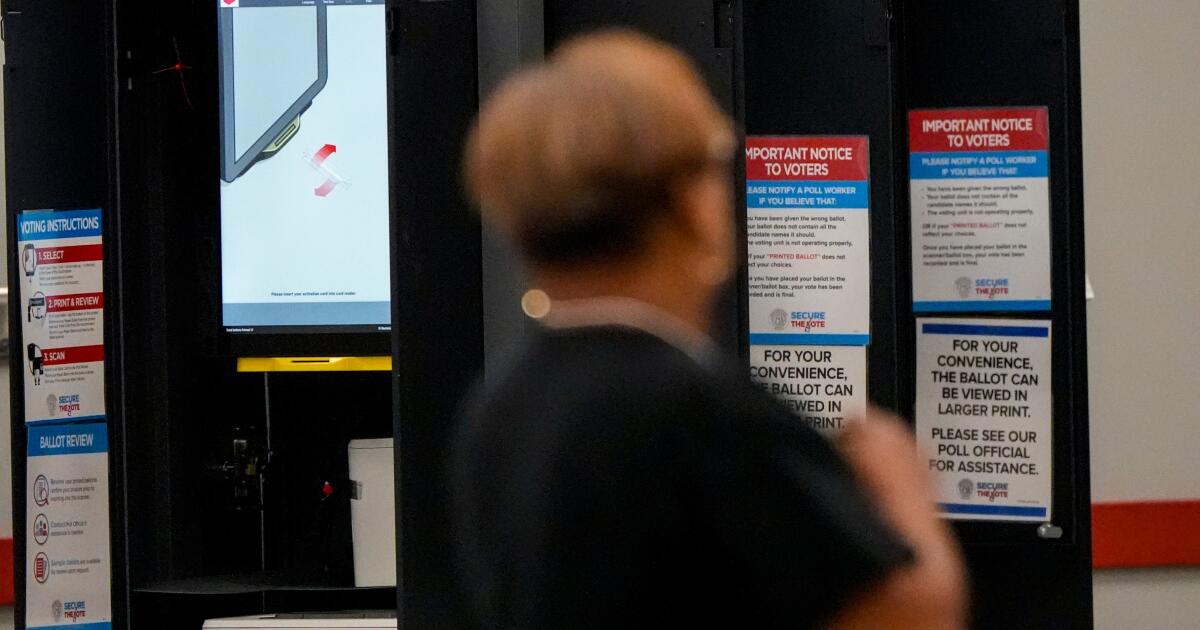
Some in GOP want ballots to be counted by hand, not machines

A growing effort to raise suspicion about the security of voting systems has kindled a back-to-the-future moment among conservatives in some parts of the U.S.

Republican lawmakers in at least six states have introduced legislation that would require all election ballots to be counted by hand instead of electronic tabulators. Similar proposals have been floated within some local governments, including about a dozen New Hampshire towns and Washoe County in the presidential battleground state of Nevada.

The push for hand-counting ballots comes amid mistrust of elections stoked by many Republicans who advance the false narrative that widespread fraud cost former President Trump reelection in the 2020 contest.

Despite no evidence of widespread fraud or major irregularities, conspiracy theories have proliferated among his allies that voting systems were somehow manipulated to favor Democrat Joe Biden. That has prompted calls to ban electronic tabulators used to scan ballots, record votes and compile race tallies.

“It’s our responsibility, and it should be our desire, to count every vote and to imbue confidence in our citizenry that our elections are fair and free, and that their vote is being counted,” said New Hampshire state Rep. Mark Alliegro, sponsor of a hand-counting bill that is similar to ones proposed in Arizona, Colorado, Missouri, Washington and West Virginia.

Alliegro said he was motivated by his analysis of recounts in nearly 50 New Hampshire state legislative races, not by the 2020 presidential election.

But some of the bill’s supporters reference the 2020 election to explain why they argue his hand-count legislation is needed. They cite a belief — despite evidence disproving it — that Trump actually won a landslide victory and that cheating is the only way to explain how New Hampshire voters elected a Republican governor and GOP majorities in the Legislature, but then backed Democrats for federal office.

Critics of the proposals to ditch electronic ballot tabulators and return to hand-counting are blunt about what they see as the motivation.

“It’s coming from conspiracy theories and lies,” said Sylvia Albert, director of voting and elections for Common Cause, a nonpartisan group that advocates for expanded voter access. “It’s attempting to lower people’s confidence in elections.”

Albert and others said it’s unrealistic to think election officials can count millions of ballots by hand and report results quickly, given that ballots often include dozens of races. The partisan review last summer of the 2 million ballots cast in Maricopa County, Ariz., which included a hand count, took several months and hundreds of people to complete.

“If you have a jurisdiction with 500 voters, you might be OK. But if you have a jurisdiction with thousands of voters, tens of thousands of voters, hundreds of thousands of voters, it’s just not going to work,” said Jennifer Morrell, a former elections clerk in Colorado and Utah who now advises state and local election officials.

Even in New Hampshire’s small towns, hand-counting is a complicated, lengthy process when a typical ballot might include 50 questions, said Milford Town Clerk Joan Dargie, who spoke against the proposed legislation on behalf of the New Hampshire City and Town Clerks Assn. She estimates her town would have to boost election workers from 200 to 350, and said many of her fellow clerks have said they will quit if they have to tabulate every ballot by hand. “People who are asking to get rid of machines obviously haven’t worked in an election,” she said.

As one example, Cobb County, Ga., performed a hand tally ordered by the state after the 2020 election. It took hundreds of people five days to count just the votes for president on roughly 397,000 ballots, said Janine Eveler, elections director for the county in metro Atlanta. She estimates it would have taken 100 days to count every race on each ballot using the same procedures.

Counting by machine isn’t just faster. Multiple studies have shown it’s also more accurate, said Charles Stewart, professor of political science at the Massachusetts Institute of Technology.

The first research on the topic was done almost two decades ago, comparing recounts of New Hampshire races that were originally tabulated by hand with those tabulated by machines. In that study and subsequent research, the machines won, he said.

“Counting votes is very tedious. Human beings are bad doing tedious things, and computers are very good at doing tedious things,” Stewart said.

Most states also conduct postelection audits that are designed to identify any irregularities with ballot scanning and counting. But with many Republicans believing Biden was not legitimately elected, election machines have become a popular target.

In Nevada, a Republican county commissioner is pushing a proposal that would require hand-counting of all ballots, along with a return to primarily in-person voting and beefing up uniformed security at polling places.

“I’m 82 years old, and I’ve been through a lot of elections,” said Washoe County Commissioner Jeanne Herman. “I know that something is not right.”

The proposal has drawn opposition from other commissioners, the biggest labor union in the state and a rare front-page editorial in the largest newspaper in northern Nevada, which said the measure could cost taxpayers “millions of dollars to chase down Facebook rumors of illusory election fraud.”

In West Virginia, a bill to repeal the state law governing tabulation machines died in committee earlier this month. In Missouri, lawmakers have not yet acted on a proposal that would ban electronic voting machines and tabulation equipment and require hand-counting to be livestreamed and recorded.

The bill’s sponsor, Republican state Rep. Mitch Boggs Jr., said he has no proof elections have been manipulated but is responding to constituent concerns.

“You file what the constituents are asking for,” Boggs said. “But at the end of the day, what they’re really wanting is just the transparency. They want to know that our elections are secure.”

Republican state Rep. Petty McGaugh said the legislation would delay election results and likely undermine their accuracy. When she became clerk of rural Carroll County in 1995, election staff were still hand-counting ballots by marking tallies in blocks of five on paper. She noticed multiple errors and eventually switched the county to an electronic tabulation system.

“I don’t really think that in this day and age we need to go back to hand-counting where it’s so susceptible to human error,” she said. “We’ve got to start trusting electronics and computers.”

In New Hampshire, that message seems to have gotten through. Last week, a state House committee unanimously recommended killing the hand-counting legislation and voters in nine towns where the question was on the ballot in local elections rejected it.

Source link

House passes bill to discourage release without bail before trial

The House Rules Committee debates the Cashless Bail Reporting Act on Tuesday in Washington before advancing it to the full House, which passed it Thursday. Photo by Olivia Ardito/Medill News Service

WASHINGTON, May 14 (UPI) The House on Thursday passed the Cashless Bail Reporting Act, which is intended to deter states and communities from releasing people charged with crimes before trial without paying bail. Ninety-six Democrats joined most Republicans to approve the measure, 308 to 116.

If the Senate were to write a companion bill and pass it, the act could have significant repercussions for the Black, Latino and low-income communities, according to researchers and activists. Advocacy groups also had raised concerns that the bill would lessen states’ rights.

“We have seen state and local governments making reforms to their bail systems in response to the growing body of research which has highlighted the inequities in bail systems, which disproportionately burden racial minorities, women and overwhelmingly the poor,” Rep. Mary Gay Scanlon, D-Pa., said in an earlier hearing on the bill

The bill expanded on a 2025 executive order from President Donald Trump, “Taking Steps to End Cashless Bail to Protect Americans,” which required the U.S. Attorney General to send a list of states and local jurisdictions that have eliminated cash bail for some crimes that “pose a clear threat to public safety and order.”

These crimes include violent, sexual and indecent acts, and burglary, looting and vandalism. To encourage elimination of cashless bail, the executive order also directed agencies to identify funding to these communities that could be “suspended or terminated.”

The bill would require annual lists of states and communities that allow cashless bail.

“It would be creating a bit of a hit list for different policymakers to attack and to try to pressure those states, counties, localities to change their policies and practices, to avoid … a lot of public safety funding that they get every year from the federal government getting completely gutted,” Nicole Zayas Manzano, deputy director of policy for the Bail Project, a non-profit group that advocates for bail reform and provides bail assistance, said about the lists.

In a Rules Committee meeting on Tuesday, Republicans said the act would lower crime rates.

“We know violent criminals released on cashless or artificially low bail have reoffended,” said Rep. Andy Biggs, R-Ariz.

Rep. Jamie Raskin, D-Md. voted for the bill, but said it would do little more than track bail practices in states and localities.

“It’s hard to see how issuing a report advances community safety or justice, given the strangely hostile rhetoric we are hearing from our colleagues about cashless bail,” Raskin said in the debate before the vote.

In a 2024 study, the Brennan Center for Justice found that there was “no statistically significant relationship” between cashless bail policies and increases in violent crime.

In the Rules Committee meeting, Rep. Michelle Fischbach, R-Minn., referenced the Bail Project, a non-profit organization that pays bail for low-income people who cannot afford it. She claimed that the group put violent offenders back on the street.

“In Indiana, from 2019 to 2021, 24% of the roughly 1,000 defendants cut loose by the Bail Project … had been charged with a crime of violence, so we’re putting violent offenders back on the road. And 35% were facing felony charges and had a previous charge of at least one crime of violence,” Fischbach said.

The group rejected the congresswoman’s description.

“The cutting loose reference mischaracterizes our work. We only step in after a judge has deemed somebody eligible for release, and it is only the affordability of cash bail that is preventing them from getting out, which is also unconstitutional,” Zayas Manzano said. “Then we really connect them with social services in their own communities.”

Moreover, studies found that cash bail disproportionately harms minorities, notably those in Black, Latino and low-income communities. In 2024, the Criminology & Public Policy Journal reported that Black defendants were 34% more likely to be recommended to be held behind bars until their cases were resolved when compared to white defendants.

Zayas Mazano said people jailed before trial were more likely to pre-emptively plead guilty, receive harsher punishments and end up with worse criminal records.

“Your life also just falls apart once you’re trapped inside, right? You could lose your housing if you can’t go and pay rent. You can lose your job if you’re not able to show up after a certain number of days. You could lose custody of your children. I mean, all kinds of things can really happen, but then just really snowball onto communities of color, in particular, and low-income people in general,” she said.

According to the Prison Policy Initiative, 69% of pretrial detainees were people of color, with Black (43%) and Hispanic (19.6%) defendants especially overrepresented compared to their share of the total U.S. population.

“Study after study shows that judges tend to assign people of color higher cash bail amounts and that they are less likely to be able to afford those cash bail amounts. And so they are very often forced into whether or not they must stay behind bars, which we certainly see huge racial disparities in jail, pretrial, and otherwise,” Zayas Manzano said.
During the Rules Committee meeting, Democrats mirrored concerns about the bill passing. Notably, Raskin discussed how the federal court system has functioned on a cashless bail system for about 60 years, instead of making bail decisions based on the danger of flight or violence to others.

“In America, whether you’re a president or a pope or a pauper, you’re innocent until proven guilty beyond a reasonable doubt as to every element of the charged offense,” Raskin said. “And no one should be detained pretrial simply because they don’t have the financial resources to post bail.”

Source link

L.A. Times wins prestigious APSE triple crown, Bill Plaschke honored

The Times earned prestigious Associated Press Sports Editors triple crown honors for a sixth consecutive year, claimed first place in two individual categories and finished in the top 10 in eight categories.

The staff submitted work published in 2025 and competed against the largest print and digital sports publications in the country.

Bill Plaschke took top honors in the columnist category for a portfolio that included commentary about using boxing to aid his fight with Parkinson’s disease, the affect of nearly losing his Altadena home in the Eaton Fire, the Dodgers’ 18-inning win during the World Series and UCLA’s fight for the right to break its Rose Bowl lease.

It was Plaschke’s 10th first-place columnist finish of his career. He previously won the APSE’s Red Smith Award, the highest honor in American sports journalism.

The Times also earned first place in event coverage for the staff’s work chronicling the Dodgers World Series Game 7 win, tying with the Dallas Morning News for top honors.

Eric Sondheimer, who is poised to begin his 50th year covering high school sports in Southern California, placed second in short feature for his coverage of the chilling affect immigration raids had on Los Angeles high school football players.

Kevin Baxter placed ninth in national beat writing for his coverage of preparation for the 2026 World Cup, including a look at why FIFA president Gianni Infantino has worked to court President Trump.

The Times’ eight top-10 finishes included the categories print portfolio, digital, event coverage, special sections, investigative, national beat writing, columns and short feature. The staff also earned an excellence in video award.

Source link

Justin Bieber plays an A-list Montecito party with defense execs

Just weeks after Justin Bieber’s well-received Coachella headline gig, the singer played a small private event for tech, entertainment and defense industry moguls. Executives at controversial firms, such as surveillance tech giant Palantir, were also on the bill.

Bieber was a headliner at WNDR, entertainment executive Jeffrey Katzenberg’s invitation-only confab at the Rosewood Miramar in Montecito last week. The programming for the event was first reported by Puck.

The ultra A-list talks and guests included director James Cameron and former Disney CEO Bob Iger, YouTube CEO Neal Mohan, FIFA President Gianni Infantino, Oprah Winfrey and Julia Roberts, comedians Chris Rock and Trevor Noah and artist Jeff Koons on a panel discussion with LACMA chief Michael Govan.

Bieber, meanwhile, performed a Wednesday poolside set for attendees at the Rosewood. The “Swag” singer reportedly became the highest-paid headliner in Coachella history last month, and its most lucrative merch seller.

Representatives for Bieber did not immediately respond to a request for comment.

While there was lighter programming (like a karaoke party with pop producers StarGate and a talk about snacks with chef Nancy Silverton), the bill included talks and cameos from major weapons and surveillance technology firms noted for their support for — or deep engagement with — the Trump administration.

One panel featured Anduril Industries’ Palmer Luckey, who recently welcomed Defense Secretary Pete Hegseth to its Southern California headquarters. “We are rebuilding the Arsenal of Freedom,” Hegseth said after the Anduril visit.

Palantir Chief Executive Alex Karp led another talk. Palantir’s AI-driven defense and surveillance software has faced scrutiny around how tech like its Maven Smart System may have been used to target civilians in the Iran war.

Karp also published a recent book, “The Technological Republic,” where he wrote that “We must resist the shallow temptation of a vacant and hollow pluralism. We, in America and more broadly the West, have for the past half century resisted defining national cultures in the name of inclusivity. But inclusion into what?”

Katzenberg’s WNDR conference is one of several recent multi-discipline, ultra-elite gatherings hosted by CEOs, including Jeff Bezos and Eric Schmidt. Katzenberg founded his investment firm WndrCo in 2017.

Source link

British Airways warns ticket prices will SOAR to cover £1.7billion fuel bill

British Airways aircraft at Gatwick Airport.
epa11846878 British Airways aircraft at Gatwick Airport in London, Britain, 23 January 2025. The British government is considering airport expansions in London. Plans for a third runway at Heathrow and a second runway at Gatwick are under review by the Treasury in an effort to boost growth. Transport Secretary Heidi Alexander has a deadline of 27 February to decide whether to permit Gatwick to bring its existing emergency northern runway into routine use. EPA/ANDY RAIN Credit: EPA

BRITISH Airways passengers face higher fares after its parent company warned rising oil prices will add about £1.72billion to its fuel bill this year.

International Airlines Group (IAG), which also owns Iberia and Aer Lingus, said it expects to pass on part of the extra cost through ticket prices, with business class and other premium long-haul passengers among those most likely to be affected.

British Airway Planes Ahead Of International Consolidated Airlines Group SA Results
IAG warned the crisis could deepen if the strait remains blocked, with global jet fuel supplies potentially restricted Credit: Getty

Chief executive Luis Gallego said airlines need to increase fares to help offset fuel costs, which make up about a quarter of their spending.

The rise follows disruption linked to the Middle East conflict and the closure of the Strait of Hormuz, which normally carries about a fifth of the world’s oil and gas shipments.

IAG warned the crisis could deepen if the strait remains blocked, with global jet fuel supplies potentially restricted.

However, the group said it does not expect any disruption to summer fuel supplies.

MAKING WAVES

Famous seaside town once dubbed ‘Britain’s Magaluf’ is getting £50m rail link


RIDE ON

Popular UK seaside pier opens famous Paris-like attraction this summer

Mr Gallego said there is less jet fuel coming from the Middle East, but there are “other places with record supply” such as the US.

He said IAG has been “planning for situations like this for many years”, and has invested in its own jet fuel supply at its “main hubs”.

The company recorded a pre-tax profit of £365million during the three months to the end of March.

That was a 76.6% increase from £207million a year earlier.

The group now expects its annual fuel bill to reach £7.78billion.

Mr Gallego attributed the firm’s “strong first quarter” to “continued strong demand for our networks and airline brands”.

He added: “IAG is uniquely positioned to navigate the current headwinds created by the Middle East conflict thanks to our leading positions across diverse markets, strong brands, structurally high margins and strong balance sheet, as well as a strong track record of execution.”

IAG said about 3% of its capacity was “exposed to the Gulf region” at the start of the war on February 28, mostly with British Airways flights.

A large part of this has been redeployed, including boosting capacity at destinations where there are now fewer flights by Middle East carriers such as Bangkok, Singapore and the Maldives.

British Airways has also announced additional flights this summer on routes with higher demand for direct flights, such as India and Nairobi.

Source link

Ruling party fails to push through constitutional amendment bill amid opposition boycott

National Assembly Speaker Woo Won-shik announces his decision not to put a constitutional amendment bill to a vote during a plenary session in Seoul on Friday. Photo by Yonhap

The ruling Democratic Party’s (DP) push to put a constitutional change to a national vote in the upcoming local elections fell through Friday as the main opposition People Power Party (PPP) continued to boycott a parliamentary vote on the proposal.

Shortly after Friday’s plenary session opened, National Assembly Speaker Woo Won-shik announced that he will not put the amendment bill to a vote as the PPP warned it would launch a filibuster to block the proposal.

“I convened the plenary session again today in an effort to prevent the first constitutional amendment vote in 39 years from falling through,” Woo said. “But I believe further proceedings would be meaningless, seeing the (PPP) responding with a filibuster.”

The PPP boycotted a vote on the bill Thursday, leaving the unicameral parliament short of a quorum.

Cheong Wa Dae expressed regret over the National Assembly’s failure to pass the bill due to opposition from PPP lawmakers.

“The public will find it difficult to understand why they opposed even minimal constitutional changes aimed at safeguarding national security and democracy,” presidential spokesperson Kang Yu-jung said in a written briefing, noting that there had been broad public consensus on the need to “reflect the lessons” of former President Yoon Suk Yeol’s Dec. 3, 2024, martial law attempt in the Constitution.

“We urge the National Assembly to continue the discussions on the constitutional amendment with a greater sense of responsibility during the second half and to keep the promise it made to the people,” she added.

President Lee Jae Myung earlier highlighted the need to amend the constitution in “phases” if necessary, saying the Constitution, which has remained unchanged for nearly 40 years since 1987, may now be outdated.

The proposed bill aimed to tighten the rules for declaring martial law, requiring the president to obtain parliamentary approval without delay and stipulating that if the National Assembly rejects the declaration or fails to approve it within 48 hours, the martial law will be immediately nullified.

It also sought to include the 1980 pro-democracy uprising in Gwangju and the 1979 Busan-Masan pro-democracy protests in the preamble. It currently states that the country inherits the spirit of the April 19 revolution in 1960, which overthrew South Korea’s first president, Rhee Syng-man, over election fraud.

The bill was jointly proposed by 187 lawmakers from the DP and five minor parties.

A constitutional amendment requires two thirds of votes from sitting lawmakers to be put to a national referendum for final approval by a majority of ballots cast.

South Korea is set to hold its quadrennial local elections on June 3.

Copyright (c) Yonhap News Agency prohibits its content from being redistributed or reprinted without consent, and forbids the content from being learned and used by artificial intelligence systems.

Source link

GOP bill would fund $1 billion in White House security upgrades for Trump’s ballroom

Senate Republicans have added $1 billion in White House security upgrades to legislation that would fund immigration enforcement agencies, a proposed boost for President Trump’s ballroom project after a man was charged with trying to assassinate him at the White House Correspondents’ Assn. dinner last week.

The GOP bill released late Monday would designate the money for the U.S. Secret Service for “security adjustments and upgrades” related to the ballroom project, which Trump and Republicans have been pushing since Cole Tomas Allen allegedly stormed the April 25 media dinner at the Washington Hilton with guns and knives. The legislation says the money would support enhancements to the ballroom project, “including above-ground and below-ground security features,” but also specifies that the money may not be used for non-security elements.

White House spokesperson Davis Ingle praised Republicans for including the money for the “long overdue” project, saying it would “provide the United States Secret Service with the resources they need to fully and completely harden the White House complex, in addition to the many other critical missions for the USSS.”

The money is part of a larger bill to pay for Immigration and Customs Enforcement and Border Patrol, as Democrats have been blocking funds for both agencies since mid-February. Congress passed bipartisan legislation to fund the rest of the Homeland Security Department on April 30 after a record-long shutdown, but Republicans are using a partisan budget maneuver to push through the ICE and Border Patrol dollars on their own. The House has not released its bill yet, but the Senate is expected to start voting on its version of the legislation next week.

It is unclear exactly how the $1 billion would be used, and the amount far exceeds the proposed $400 million for construction of the ballroom. The White House has said in court documents that the East Wing project would be “heavily fortified,” including bomb shelters, military installations and a medical facility underneath the ballroom. Trump has said it should include bulletproof glass and be able to repel drone attacks.

The National Trust for Historic Preservation has sued to block construction of the project, but a federal appeals court said last month that it can continue in the meantime.

The White House has said that private money would pay for the construction but public money would be used for security measures. Some Republicans have suggested that public money pay for all of it, arguing the security breach at the dinner shows the president needs a secure place to host events.

“It would be insane” to hold the dinner at a hotel again, said Republican Sen. Lindsey Graham of South Carolina, who introduced a bill to pay for the ballroom’s construction with Sen. Katie Britt, R-Ala.

Democrats have said they will oppose any efforts to pay for the ballroom.

“While Americans are struggling to make ends meet as a result of President Trump’s failed policies, Republicans are focused on providing tens of billions of dollars for the President’s vanity ballroom project and cruel mass deportation campaign,” said Illinois Sen. Dick Durbin, the top Democrat on the Senate Judiciary Committee, which oversees the U.S. Secret Service.

Jalonick writes for the Associated Press. AP writer Darlene Superville contributed to this report.

Source link

Louisiana Republicans eliminate Democrat’s elected position

Louisiana Republicans eliminated an elected position days before an exonerated man who overwhelmingly won the New Orleans-based clerk seat was set to take office.

Republican Gov. Jeff Landry on Thursday quietly signed into law legislation abolishing the long-standing Orleans Parish clerk of criminal court position, according to Louisiana Secretary of State spokesperson Trey Williams.

Republicans say wiping away the office is a consolidation effort meant to make the local judicial system more efficient and cut costs. But Democrats condemn the change as government overreach, arguing that it infringes on a predominantly Black parish’s decision at the polls.

Calvin Duncan, who spent nearly 30 years behind bars for a crime he did not commit, easily won election to the criminal court clerk position in November, beating the incumbent and earning more than two-thirds of the vote. He had been set to take office Monday and has asked a federal judge to allow him to take office as scheduled.

“It’s a sad thing to see the state government repeating what happened to Black public officials during Reconstruction,” Duncan said. “They will do what they do, and I will do whatever I have to do to vindicate the voters of New Orleans and make sure that what happened to me never happens to anybody else.”

Landry did not immediately respond to requests for comment.

Duncan, a Democrat whose murder conviction was vacated in 2021 after evidence emerged that police officers lied in court, has vowed to help fix the system that once failed him.

Duncan, 63, and his supporters say he is being targeted by the most powerful Republicans in the state, including those who have denied his innocence, even though Duncan’s name is listed on the National Registry of Exonerations.

“We’re doing something because powerful people don’t like him,” Rep. Mandie Landry, a New Orleans Democrat, told lawmakers during a legislative committee hearing in April. Landry, who is not related to the governor, described the Republican efforts as “atrocious” and worries what they could mean for other elected positions in the state.

Law consolidates two court clerk positions

Republicans say the legislation consolidates the civil and criminal court clerks’ offices in Orleans Parish, putting it in line with all other parishes in the state, which have a single clerk’s office. The civil clerk position would remain and absorb the criminal clerk’s role.

Eliminating the clerk position saves the state about $27,000 and the city $233,000, according to the office of the legislative auditor, which added that the long-term costs of consolidation are “unknown.” The legislation also shifts about $1.17 million in state expenditures to the parish. The civil and criminal court clerks have separate physical offices and different case management systems.

The governor told the Associated Press that eliminating Duncan’s elected office was about improving government efficiency and “cleaning up a system in Orleans Parish that has been plagued by dysfunction and corruption for years.”

The consolidation is part of a broader GOP effort during the ongoing legislative session to overhaul the judiciary in New Orleans — including bills that propose abolishing several other elected judicial positions in the parish. However, those jobs would be eliminated further down the line, allowing officials to serve out their terms.

The bill’s Republican author, Sen. Jay Morris, who represents a district several hours from New Orleans, said the goal was to implement the clerk consolidation before Duncan takes office, preventing him from starting a four-year term. Morris acknowledged that he expects lawsuits to be filed because of this law but believes the change to be constitutional.

“It’s unfortunate for Mr. Duncan, I concede that,” Morris told lawmakers in April. “He seems very nice, but we don’t make policy around here for just one person.”

Concerns of disenfranchisement

Although conversations have revolved around Duncan, many also raise concerns about how the change potentially could disenfranchise voters — a heightened worry in a deeply red state that has been central to efforts to weaken the Voting Rights Act, including the case at issue in a landmark Supreme Court ruling last week. Orleans Parish is a Democratic hub with a predominantly Black electorate.

“Mr. Duncan was elected by 68% of the vote in a city that’s majority African American. This is the will of the people, and what your bill attempts to do is usurp the will of the people,” Rep. Edmond Jordan, a Democrat, told Morris.

Well before the legislation reached the governor’s desk, Duncan said he could see the writing on the wall. Ahead of the outcome, Duncan’s advocates held a ceremonial swearing-in for him. Hundreds of people gathered on the steps of the Orleans Parish criminal courthouse to support him.

Duncan told lawmakers that along the campaign trail last year, he spoke with many people who told him they typically abstain from voting in elections. “Now, this bill tells people exactly what they had believed — that their vote doesn’t count,” he said.

Cline and Brook write for the Associated Press and reported from Baton Rouge, La., and New Orleans, respectively.

Source link

Speaker Mike Johnson once longed for a ‘normal Congress,’ but that seems long gone in the House

House Speaker Mike Johnson has lamented he would like to preside over a “normal Congress,” but the chamber the Republican is leading is anything but.

All-night sessions. Hours of dead zones with no action on the floor. Legislation being written on the fly, behind closed doors. Sudden votes scheduled. Spectacular failures. And, as happened this week, stunning turnarounds in which the House actually passes bills.

“Sometimes it’s an ugly process, sometimes it’s a long process,” Johnson said after House passage of a bipartisan bill to fund much of the Department of Homeland Security, ending the longest agency shutdown in history. “But we got it done.”

Republicans, who face an uphill climb this election year to keep hold of their paper-thin House majority, appear at times as if they are still learning on the job, years after having returned to power in 2022, while they are also about to ask voters in November to rehire them for another term.

This week’s starts and stops — for example, five hours of delay as Johnson huddled behind closed doors to salvage his agenda, then a sudden vote tally near 11 p.m. — would typically have been the kind of situation that shocked the political and procedural senses. Now, it’s just another Wednesday.

Or two weeks ago, when a routine House Rules Committee hearing ended up becoming a midnight forum to debut a just-produced 14-page bill to revise a surveillance bill, known as the Foreign Intelligence Surveillance Act, or FISA, before it was rushed to the floor for a 2 a.m. vote. It failed.

“House Republicans have shown again that they can’t govern,” said Rep. Ted Lieu of California, part of Democratic leadership.

“They routinely pass bills to the Senate that are way too extreme, then it ends up that we have all these floor session days where we’re just doing nothing,” he said.

House GOP’s slim majority makes leader’s job challenging

Johnson, who took over for the ousted Kevin McCarthy more than two years ago, is presiding over one of the slimmest House majorities in modern times, leaving him no room to spare if he’s trying to pass legislation on party-line votes, without Democrats.

The speaker is juggling not only President Trump’s priorities but also those of the various factions that make up his majority, from the conservative House Freedom Caucus to what remains of the GOP’s more pragmatic conservatives.

And Johnson’s own future is always in question, after Republicans chased other speakers, including McCarthy, John Boehner and Newt Gingrich, to early exits.

Last year Johnson, of Louisiana, led passage of the party’s signature achievement, a big bill of tax breaks and safety net cuts, which Trump signed into law. At the time, he quipped about the difficulty of getting it over the finish line.

“I do so deeply desire to have just a normal Congress,” the speaker said in July.

“But it doesn’t happen anymore,” he said. “Our way is to plow through and get it done.”

What’s ahead as House GOP tries to stay in power

Ahead of the fall elections, Johnson and other Republican lawmakers have discussed an agenda that includes the promise of another GOP-only budget package like the tax cuts bill that they could push through the House and the Senate, without Democratic votes.

Budget Chairman Jodey Arrington (R-Texas) said Thursday that he expects “the centerpiece” of that package “will be supporting our troops” with more than $100 billion in funding for the war against Iran as well as money to replenish defense munitions and other Pentagon-related needs.

Despite the turbulent week in the House, Arrington said what they’re calling “Budget reconciliation 3.0” should be the “next order of business.”

Yet GOP lawmakers may decide it’s better to skip the hard work of legislating, and the dramatic upheavals that tend to come with it, and hit the campaign trail to win over voters instead.

Rep. Richard Hudson (R-N.C.), the chairman of the House GOP’s campaign arm, the National Republican Congressional Committee, acknowledged that trying to pass legislation with such a tight majority “can be rough. It’s ugly.”

“I’d be fine with letting us go home and campaign,” Hudson said. “But we’ve got a lot of important work still to do.”

Some of Johnson’s most ardent sparring partners, those most conservative Republican lawmakers, turned their blame for the messy process not on Johnson’s leadership but on their own GOP allies across the Capitol in the Senate, who often dismiss the House’s work.

“Yeah, sometimes, it gets a little tense,” said Republican Rep. Chip Roy of Texas. “But we’re still getting stuff done. We’re sending it over to the Senate. So we look forward to them doing their job.”

Mascaro writes for the Associated Press.

Source link

House approves bill to fund the Department of Homeland Security and end the record shutdown

After weeks of delay, the House voted Thursday to fund much of the Department of Homeland Security, but not its immigration enforcement operations, and send the bipartisan package to President Trump to sign, ending the longest agency shutdown in history.

The White House had warned that temporary funding Trump had tapped to pay Transportation Security Administration and other agency personnel would “soon run out,” and that sparked new threats of airport disruptions.

DHS has been without routine funds since Feb. 14, causing hardship for workers, though much of Trump’s immigration agenda that is central to the dispute is being funded separately.

“It is about damn time,” said Rep. Rosa DeLauro of Connecticut, the top Democrat on the House Appropriations Committee, who proposed the bill more than 70 days ago.

The House swiftly voted by voice, without a formal roll call, to pass the measure.

The House’s narrow Republican majority has repeatedly stalled out under House Speaker Mike Johnson, with his own party tangled in internal disputes on a range of pending issues, including the homeland security funding. While the Senate unanimously approved the bipartisan package a month ago, the bill languished in the House.

Democrats refused to fund U.S. Immigration and Customs Enforcement and the Border Patrol without changes to those operations after the fatal shootings of two U.S. citizens by federal agents during protests against an immigration crackdown in Minneapolis. Republicans would no go along with a plan pushed by Democrats to fund TSA and the other parts of DHS without the money for ICE and Border Patrol.

To break the impasse, Republicans in both the House and Senate decided to tackle the immigration enforcement funding on their own through what is called budget reconciliation, a cumbersome weekslong process ahead.

By beginning that budget process Johnson, R-La., was able to unlock a broader bipartisan bill for TSA agents and the rest of DHS. House Republicans late Wednesday adopted budget resolution on a largely party-line vote, 215-211, that is focused on eventually providing $70 billion for immigration enforcement and deportations for the remainder of Trump’s time in office and ensure Democrats can no longer block funding. Trump’s term ends in January 2029.

One key Republican, Rep. Chip Roy of Texas, said isolating the immigration-related money on a separate track is “offensive to the men and women who serve in ICE and Border Patrol, and are serving this country every single day.”

Mascaro writes for the Associated Press.

Source link

Maine Gov. Janet Mills vetoes bill pausing AI data center development

Maine Gov. Janet Mills on Friday vetoed a bill that would have paused construction of artificial intelligence data centers in the state because lawmakers in the Maine legislature refused a carve-out to the pause for an already in progress project there. File Photo CJ Gunther/EPA

April 24 (UPI) — Maine Gov. Janet Mills on Friday vetoed a bill that would have paused artificial intelligence data center construction in the state for 18 months.

Mills said she decided to veto it because it would have potentially harmed a permitted and in progress data center expected to create hundreds of jobs, both for construction and once the center opens.

The project, a $550 million data center in Jay, Maine, is a multi-year effort to redevelop the former Androscoggin Mill, which was damaged in a 2020 boiler explosion and then closed in 2023, took with it hundreds of jobs and 22% of the town’s tax revenue.

The bill would have been the first in the country restricting or slowing the spread of large-scale data centers required for power-hungry AI systems, which have driven up the cost of both electricity and water for residents living near them, NBC News and Politico reported.

“A moratorium is appropriate given the impacts of massive data centers in other states on the environment and electricity rates,” Mills said in a press release.

“But the final version of this bill fails to allow for a specific project in the Town of Jay that enjoys strong local support from its host community and region,” she said.

There are more than 5,000 data centers in the United States — more than any country in the world — and that number has grown significantly in the last four years as artificial intelligence has become a focus the tech industry.

While many state and local leaders have started to respond to concerns among residents about the huge amounts of electricity needed to power AI data centers and the huge amounts of water needed to keep them cool, as have some members of Congress.

As states have contemplated increased regulation and scrutiny from tech and AI companies, President Donald Trump at the same time has worked to keep the cuffs of tech companies because they “must be free to innovate without cumbersome regulation,” he said in December.

“Excessive state regulation thwarts this imperative,” Trump said in an executive order meant to prevent states from creating new regulations.

Mills said she worked with Maine’s legislature to carve out an exemption for the data center in Jay but was unsuccessful, so she vetoed the law.

The development in Jay, she said, is under contract and permitted, and is expected to create 800 construction jobs, more than 100 high-paying permanent jobs and “substantial tax revenue” for the Town of Jay.

In a letter informing the legislature that she planned to veto the bill, Mills said she plans to issue an executive order to establish a council to study the impacts — real and potential — of data centers in Maine.

“I believe it necessary and important to examine and plan for the potential impacts of large-scale data centers in Maine, as the use of artificial intelligence becomes more widespread,” Mills said.

“Given the serious conversations about data centers here and around the country, I believe this work should commence without delay,” she told legislators.

President Donald Trump speaks during a Health Care Affordability event in the Oval Office at the White House on Thursday. Trump announced announced a new drug price deal with Regeneron. Photo by Will Oliver/UPI | License Photo

Source link

British assisted-dying bill falls after runing out the clock

Members of the non-profit Dignity in Dying campaign group protest outside Parliament in London on Friday where the House the Lords was holding its final debate on an assisted-dying bill before it runs out the clock in the legislative timetable of the current session of parliament, which is due to end next week. Photo by Andy Rain/EPA

April 24 (UPI) — A bill to legalize assisted-dying in England and Wales was Friday set to run out of time to complete all the necessary stages for it to become law in the current session of parliament, 10 months after MPs passed the legislation.

The Terminally Ill Adults (End of Life) Bill has been stalled in its committee stage in the House of Lords since June but with Friday set to be the final debate in the upper chamber before the 2024-2026 session ends in early May, it has run out of road.

“Detailed line-by-line scrutiny of the Terminally Ill Adults (End of Life) Bill continues,” The Lords said Friday in its order of business for the day.

Members have used up all 14 committee-stage days allotted for the bill as they attempted to grapple with more than 1,000 amendments covering everything from blocking overseas patients from accessing the treatment and the inclusion of people injured serving in the military or in industrial accidents to making patients aware of non-lethal treatment options.

Only around halfway through the stages required before it can receive “Royal Assent” from King Charles and finally become law, the bill can no longer proceed and cannot be carried over to the 2026-2027 session.

Supporters vowed not to give up on the bill, which would give terminally ill adults with less than six months to live the legal right to end their lives with the help of medical professionals, saying they would try to reintroduce it when the new parliament convenes on May 13.

The bill’s sponsor, Labour MP Kim Leadbeater, said she had a group of backers who had agreed to try to bring back the bill immediately following the state opening of parliament.

To do so, they need to prevail in a ballot in which MPs compete for 25 slots to introduce legislation they have authored to the House of Commons, so-called private members’ bills.

The next private members’ bill ballot is scheduled for May 21.

Leadbeater said she was disappointed, upset and angry at the outcome.

She said that terminally ill patients and their families she had been speaking with felt “a real sense of feeling let down by our democratic system.”

“This is not over. The issue is not going to go away just because of an undemocratic filibuster in the Lords. We will keep pushing for a safer, more compassionate law until parliament reaches a final decision.”

Opponents were concerned over the watering down of key safeguards in the original bill introduced in the House of Commons in November 2024, including dropping the requirement for a High Court judge to review every case.

“If we’re going to do this, we have to have safeguards and I really don’t think there are anywhere near enough safeguards in it,” said Baroness Grey-Thompson, adding that it was the job of peers to go through every line in legislation.

She told the BBC that when bills failed it because it was usually because they were poorly drafted, rather than because of the number of amendments tabled.

“It was written in haste and there are so many gaps in it that a number of peers are really uncomfortable with this particular bill, even though they may be in favor of the principle,” she said.

Leadbeater said she hoped the Commons would pass the bill again and an accommodation could be agreed with members of the upper house over amendments.

She did not rule out invoking a very rarely used procedural maneuver, a theoretical nuclear option that dates back more than a century in which the Lords is rendered powerless to stop a bill that the House of Commons has passed more than once from becoming law — but said she hoped that would not be necessary.

Children race to push colored eggs across the grass during the annual Easter Egg Roll event on the South Lawn of the White House in Washington on April 21, 2025. Easter this year takes place on April 5. Photo by Samuel Corum/UPI | License Photo

Source link

Brown vetoes pot shop bill

Reporting from Sacramento — Gov. Jerry Brown on Wednesday vetoed a bill that would have barred medical marijuana dispensaries within 600 feet of homes, saying it stepped on the powers of cities and counties that already have authority to regulate pot shops.

The governor also signed 28 measures into law, making it easier for California firms to sell wine over the Internet and allowing bars to infuse alcohol with fruits and vegetables for use in cocktails.

Brown has until Oct. 9 to act on nearly 600 bills sent to him by the Legislature this year and has already wielded his veto pen several times, complaining about the state imposing too many standards on communities and families.

On the medical marijuana issue, the governor noted that he had previously signed a measure giving cities and counties clearer authority to regulate the location and operation of dispensaries.

“Decisions of this kind are best made in cities and counties, not the State Capitol,” Brown wrote in his veto message.

The bill was SB 847, by state Sen. Lou Correa (D-Santa Ana), who said he wanted to allow cities to chose their own regulations and to protect children living near such facilities from second-hand smoke.

The governor signed a bill Wednesday allowing wine merchants without stores to obtain a special state license to sell to customers over the Internet or by telephone or direct mail. Assemblyman Das Williams (D-Santa Barbara) introduced AB 623 because current law provides for an alcohol wholesaler’s license but requires holders to periodically sell to other retailers, even if they only want to sell directly to customers on the Internet.

The governor also signed a measure eliminating a state prohibition against bars and restaurants providing infused alcoholic beverages, with fruits, vegetables, herbs and spices added to spirits for flavor.

Sen. Mark Leno (D-San Francisco), author of SB 32, said the restrictions were decades old and were intended to address health concerns about the infusion process. Modern methods make the practice safe, he said.

On another measure, Brown exercised his veto pen and took a swipe at its author in the process.

With budget cuts forcing many state parks to close or reduce operations, Sen. Tom Harman (R-Huntington Beach) proposed that the state post details of potential park closures on a website and respond to any efforts from the private sector to help keep them open.

Brown said the idea in Harman’s bill, SB 386, was good but didn’t require a state law.

“What parks do need is sufficient funding to stay open — something I feel compelled to note the author and his colleagues refused to let the people vote on,” Brown wrote in his veto message, referring to Republican opposition to putting tax extensions on the ballot.

patrick.mcgreevy@latimes.com

Source link