bill

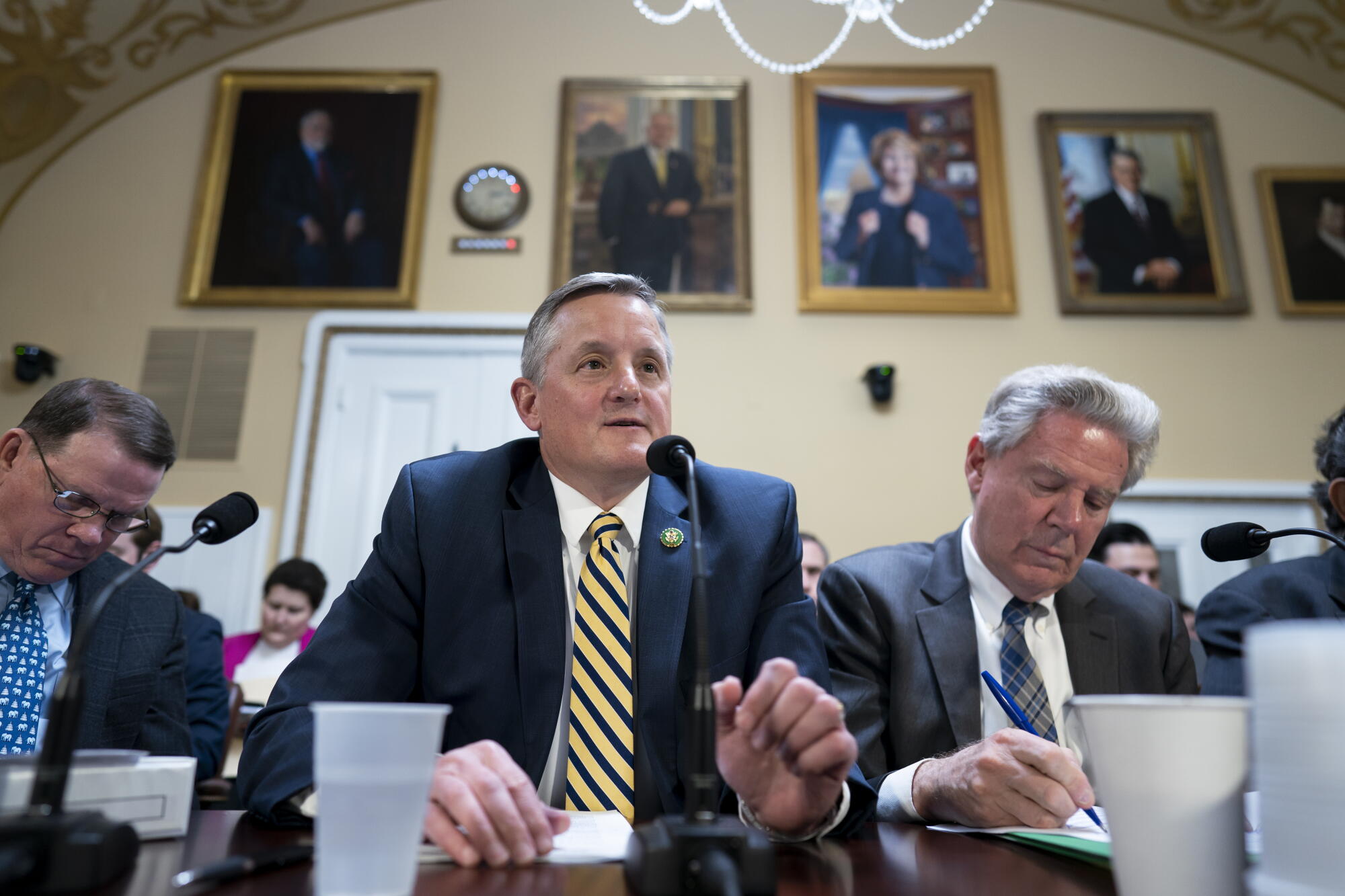
Speaker Mike Johnson once longed for a ‘normal Congress,’ but that seems long gone in the House

House Speaker Mike Johnson has lamented he would like to preside over a “normal Congress,” but the chamber the Republican is leading is anything but.

All-night sessions. Hours of dead zones with no action on the floor. Legislation being written on the fly, behind closed doors. Sudden votes scheduled. Spectacular failures. And, as happened this week, stunning turnarounds in which the House actually passes bills.

“Sometimes it’s an ugly process, sometimes it’s a long process,” Johnson said after House passage of a bipartisan bill to fund much of the Department of Homeland Security, ending the longest agency shutdown in history. “But we got it done.”

Republicans, who face an uphill climb this election year to keep hold of their paper-thin House majority, appear at times as if they are still learning on the job, years after having returned to power in 2022, while they are also about to ask voters in November to rehire them for another term.

This week’s starts and stops — for example, five hours of delay as Johnson huddled behind closed doors to salvage his agenda, then a sudden vote tally near 11 p.m. — would typically have been the kind of situation that shocked the political and procedural senses. Now, it’s just another Wednesday.

Or two weeks ago, when a routine House Rules Committee hearing ended up becoming a midnight forum to debut a just-produced 14-page bill to revise a surveillance bill, known as the Foreign Intelligence Surveillance Act, or FISA, before it was rushed to the floor for a 2 a.m. vote. It failed.

“House Republicans have shown again that they can’t govern,” said Rep. Ted Lieu of California, part of Democratic leadership.

“They routinely pass bills to the Senate that are way too extreme, then it ends up that we have all these floor session days where we’re just doing nothing,” he said.

House GOP’s slim majority makes leader’s job challenging

Johnson, who took over for the ousted Kevin McCarthy more than two years ago, is presiding over one of the slimmest House majorities in modern times, leaving him no room to spare if he’s trying to pass legislation on party-line votes, without Democrats.

The speaker is juggling not only President Trump’s priorities but also those of the various factions that make up his majority, from the conservative House Freedom Caucus to what remains of the GOP’s more pragmatic conservatives.

And Johnson’s own future is always in question, after Republicans chased other speakers, including McCarthy, John Boehner and Newt Gingrich, to early exits.

Last year Johnson, of Louisiana, led passage of the party’s signature achievement, a big bill of tax breaks and safety net cuts, which Trump signed into law. At the time, he quipped about the difficulty of getting it over the finish line.

“I do so deeply desire to have just a normal Congress,” the speaker said in July.

“But it doesn’t happen anymore,” he said. “Our way is to plow through and get it done.”

What’s ahead as House GOP tries to stay in power

Ahead of the fall elections, Johnson and other Republican lawmakers have discussed an agenda that includes the promise of another GOP-only budget package like the tax cuts bill that they could push through the House and the Senate, without Democratic votes.

Budget Chairman Jodey Arrington (R-Texas) said Thursday that he expects “the centerpiece” of that package “will be supporting our troops” with more than $100 billion in funding for the war against Iran as well as money to replenish defense munitions and other Pentagon-related needs.

Despite the turbulent week in the House, Arrington said what they’re calling “Budget reconciliation 3.0” should be the “next order of business.”

Yet GOP lawmakers may decide it’s better to skip the hard work of legislating, and the dramatic upheavals that tend to come with it, and hit the campaign trail to win over voters instead.

Rep. Richard Hudson (R-N.C.), the chairman of the House GOP’s campaign arm, the National Republican Congressional Committee, acknowledged that trying to pass legislation with such a tight majority “can be rough. It’s ugly.”

“I’d be fine with letting us go home and campaign,” Hudson said. “But we’ve got a lot of important work still to do.”

Some of Johnson’s most ardent sparring partners, those most conservative Republican lawmakers, turned their blame for the messy process not on Johnson’s leadership but on their own GOP allies across the Capitol in the Senate, who often dismiss the House’s work.

“Yeah, sometimes, it gets a little tense,” said Republican Rep. Chip Roy of Texas. “But we’re still getting stuff done. We’re sending it over to the Senate. So we look forward to them doing their job.”

Mascaro writes for the Associated Press.

Source link

House approves bill to fund the Department of Homeland Security and end the record shutdown

After weeks of delay, the House voted Thursday to fund much of the Department of Homeland Security, but not its immigration enforcement operations, and send the bipartisan package to President Trump to sign, ending the longest agency shutdown in history.

The White House had warned that temporary funding Trump had tapped to pay Transportation Security Administration and other agency personnel would “soon run out,” and that sparked new threats of airport disruptions.

DHS has been without routine funds since Feb. 14, causing hardship for workers, though much of Trump’s immigration agenda that is central to the dispute is being funded separately.

“It is about damn time,” said Rep. Rosa DeLauro of Connecticut, the top Democrat on the House Appropriations Committee, who proposed the bill more than 70 days ago.

The House swiftly voted by voice, without a formal roll call, to pass the measure.

The House’s narrow Republican majority has repeatedly stalled out under House Speaker Mike Johnson, with his own party tangled in internal disputes on a range of pending issues, including the homeland security funding. While the Senate unanimously approved the bipartisan package a month ago, the bill languished in the House.

Democrats refused to fund U.S. Immigration and Customs Enforcement and the Border Patrol without changes to those operations after the fatal shootings of two U.S. citizens by federal agents during protests against an immigration crackdown in Minneapolis. Republicans would no go along with a plan pushed by Democrats to fund TSA and the other parts of DHS without the money for ICE and Border Patrol.

To break the impasse, Republicans in both the House and Senate decided to tackle the immigration enforcement funding on their own through what is called budget reconciliation, a cumbersome weekslong process ahead.

By beginning that budget process Johnson, R-La., was able to unlock a broader bipartisan bill for TSA agents and the rest of DHS. House Republicans late Wednesday adopted budget resolution on a largely party-line vote, 215-211, that is focused on eventually providing $70 billion for immigration enforcement and deportations for the remainder of Trump’s time in office and ensure Democrats can no longer block funding. Trump’s term ends in January 2029.

One key Republican, Rep. Chip Roy of Texas, said isolating the immigration-related money on a separate track is “offensive to the men and women who serve in ICE and Border Patrol, and are serving this country every single day.”

Mascaro writes for the Associated Press.

Source link

Maine Gov. Janet Mills vetoes bill pausing AI data center development

Maine Gov. Janet Mills on Friday vetoed a bill that would have paused construction of artificial intelligence data centers in the state because lawmakers in the Maine legislature refused a carve-out to the pause for an already in progress project there. File Photo CJ Gunther/EPA

April 24 (UPI) — Maine Gov. Janet Mills on Friday vetoed a bill that would have paused artificial intelligence data center construction in the state for 18 months.

Mills said she decided to veto it because it would have potentially harmed a permitted and in progress data center expected to create hundreds of jobs, both for construction and once the center opens.

The project, a $550 million data center in Jay, Maine, is a multi-year effort to redevelop the former Androscoggin Mill, which was damaged in a 2020 boiler explosion and then closed in 2023, took with it hundreds of jobs and 22% of the town’s tax revenue.

The bill would have been the first in the country restricting or slowing the spread of large-scale data centers required for power-hungry AI systems, which have driven up the cost of both electricity and water for residents living near them, NBC News and Politico reported.

“A moratorium is appropriate given the impacts of massive data centers in other states on the environment and electricity rates,” Mills said in a press release.

“But the final version of this bill fails to allow for a specific project in the Town of Jay that enjoys strong local support from its host community and region,” she said.

There are more than 5,000 data centers in the United States — more than any country in the world — and that number has grown significantly in the last four years as artificial intelligence has become a focus the tech industry.

While many state and local leaders have started to respond to concerns among residents about the huge amounts of electricity needed to power AI data centers and the huge amounts of water needed to keep them cool, as have some members of Congress.

As states have contemplated increased regulation and scrutiny from tech and AI companies, President Donald Trump at the same time has worked to keep the cuffs of tech companies because they “must be free to innovate without cumbersome regulation,” he said in December.

“Excessive state regulation thwarts this imperative,” Trump said in an executive order meant to prevent states from creating new regulations.

Mills said she worked with Maine’s legislature to carve out an exemption for the data center in Jay but was unsuccessful, so she vetoed the law.

The development in Jay, she said, is under contract and permitted, and is expected to create 800 construction jobs, more than 100 high-paying permanent jobs and “substantial tax revenue” for the Town of Jay.

In a letter informing the legislature that she planned to veto the bill, Mills said she plans to issue an executive order to establish a council to study the impacts — real and potential — of data centers in Maine.

“I believe it necessary and important to examine and plan for the potential impacts of large-scale data centers in Maine, as the use of artificial intelligence becomes more widespread,” Mills said.

“Given the serious conversations about data centers here and around the country, I believe this work should commence without delay,” she told legislators.

President Donald Trump speaks during a Health Care Affordability event in the Oval Office at the White House on Thursday. Trump announced announced a new drug price deal with Regeneron. Photo by Will Oliver/UPI | License Photo

Source link

British assisted-dying bill falls after runing out the clock

Members of the non-profit Dignity in Dying campaign group protest outside Parliament in London on Friday where the House the Lords was holding its final debate on an assisted-dying bill before it runs out the clock in the legislative timetable of the current session of parliament, which is due to end next week. Photo by Andy Rain/EPA

April 24 (UPI) — A bill to legalize assisted-dying in England and Wales was Friday set to run out of time to complete all the necessary stages for it to become law in the current session of parliament, 10 months after MPs passed the legislation.

The Terminally Ill Adults (End of Life) Bill has been stalled in its committee stage in the House of Lords since June but with Friday set to be the final debate in the upper chamber before the 2024-2026 session ends in early May, it has run out of road.

“Detailed line-by-line scrutiny of the Terminally Ill Adults (End of Life) Bill continues,” The Lords said Friday in its order of business for the day.

Members have used up all 14 committee-stage days allotted for the bill as they attempted to grapple with more than 1,000 amendments covering everything from blocking overseas patients from accessing the treatment and the inclusion of people injured serving in the military or in industrial accidents to making patients aware of non-lethal treatment options.

Only around halfway through the stages required before it can receive “Royal Assent” from King Charles and finally become law, the bill can no longer proceed and cannot be carried over to the 2026-2027 session.

Supporters vowed not to give up on the bill, which would give terminally ill adults with less than six months to live the legal right to end their lives with the help of medical professionals, saying they would try to reintroduce it when the new parliament convenes on May 13.

The bill’s sponsor, Labour MP Kim Leadbeater, said she had a group of backers who had agreed to try to bring back the bill immediately following the state opening of parliament.

To do so, they need to prevail in a ballot in which MPs compete for 25 slots to introduce legislation they have authored to the House of Commons, so-called private members’ bills.

The next private members’ bill ballot is scheduled for May 21.

Leadbeater said she was disappointed, upset and angry at the outcome.

She said that terminally ill patients and their families she had been speaking with felt “a real sense of feeling let down by our democratic system.”

“This is not over. The issue is not going to go away just because of an undemocratic filibuster in the Lords. We will keep pushing for a safer, more compassionate law until parliament reaches a final decision.”

Opponents were concerned over the watering down of key safeguards in the original bill introduced in the House of Commons in November 2024, including dropping the requirement for a High Court judge to review every case.

“If we’re going to do this, we have to have safeguards and I really don’t think there are anywhere near enough safeguards in it,” said Baroness Grey-Thompson, adding that it was the job of peers to go through every line in legislation.

She told the BBC that when bills failed it because it was usually because they were poorly drafted, rather than because of the number of amendments tabled.

“It was written in haste and there are so many gaps in it that a number of peers are really uncomfortable with this particular bill, even though they may be in favor of the principle,” she said.

Leadbeater said she hoped the Commons would pass the bill again and an accommodation could be agreed with members of the upper house over amendments.

She did not rule out invoking a very rarely used procedural maneuver, a theoretical nuclear option that dates back more than a century in which the Lords is rendered powerless to stop a bill that the House of Commons has passed more than once from becoming law — but said she hoped that would not be necessary.

Children race to push colored eggs across the grass during the annual Easter Egg Roll event on the South Lawn of the White House in Washington on April 21, 2025. Easter this year takes place on April 5. Photo by Samuel Corum/UPI | License Photo

Source link

Brown vetoes pot shop bill

Reporting from Sacramento — Gov. Jerry Brown on Wednesday vetoed a bill that would have barred medical marijuana dispensaries within 600 feet of homes, saying it stepped on the powers of cities and counties that already have authority to regulate pot shops.

The governor also signed 28 measures into law, making it easier for California firms to sell wine over the Internet and allowing bars to infuse alcohol with fruits and vegetables for use in cocktails.

Brown has until Oct. 9 to act on nearly 600 bills sent to him by the Legislature this year and has already wielded his veto pen several times, complaining about the state imposing too many standards on communities and families.

On the medical marijuana issue, the governor noted that he had previously signed a measure giving cities and counties clearer authority to regulate the location and operation of dispensaries.

“Decisions of this kind are best made in cities and counties, not the State Capitol,” Brown wrote in his veto message.

The bill was SB 847, by state Sen. Lou Correa (D-Santa Ana), who said he wanted to allow cities to chose their own regulations and to protect children living near such facilities from second-hand smoke.

The governor signed a bill Wednesday allowing wine merchants without stores to obtain a special state license to sell to customers over the Internet or by telephone or direct mail. Assemblyman Das Williams (D-Santa Barbara) introduced AB 623 because current law provides for an alcohol wholesaler’s license but requires holders to periodically sell to other retailers, even if they only want to sell directly to customers on the Internet.

The governor also signed a measure eliminating a state prohibition against bars and restaurants providing infused alcoholic beverages, with fruits, vegetables, herbs and spices added to spirits for flavor.

Sen. Mark Leno (D-San Francisco), author of SB 32, said the restrictions were decades old and were intended to address health concerns about the infusion process. Modern methods make the practice safe, he said.

On another measure, Brown exercised his veto pen and took a swipe at its author in the process.

With budget cuts forcing many state parks to close or reduce operations, Sen. Tom Harman (R-Huntington Beach) proposed that the state post details of potential park closures on a website and respond to any efforts from the private sector to help keep them open.

Brown said the idea in Harman’s bill, SB 386, was good but didn’t require a state law.

“What parks do need is sufficient funding to stay open — something I feel compelled to note the author and his colleagues refused to let the people vote on,” Brown wrote in his veto message, referring to Republican opposition to putting tax extensions on the ballot.

patrick.mcgreevy@latimes.com

Source link

Live Nation is supporting two California bills to lower prices. Can fans trust it?

Bruno Mars tickets running for $2,000 and ones for SZA costing $600 caught California lawmakers’ attention. They’re advancing two bills targeting the resale market.

Earlier this year, tickets to see SZA perform at the Crypto Arena in Los Angeles were selling for $600 the day before they officially went on sale at $35 a piece.

In San Francisco, tickets to see Sam Smith at the newly renovated Castro Theater went on sale for $120, only to be quickly snatched up by scalpers and resold for upwards of $600.

Those are some of the stories that California lawmakers are citing as they advance two plans to change the ticketing landscape. One caps the extent to which resellers can mark up the original ticket price while the other prohibits resellers from selling tickets they don’t yet own.

Democratic Assemblymembers Issac Bryan of Culver City and Matt Haney of San Francisco are each carrying bills that they say would protect consumers from fraudulent and deceptive ticket sales.

Both measures are backed by the ticket market’s dominant seller, Beverly Hills-based Live Nation, which owns Ticketmaster. Its support has some worried that the bills will help the company crush its competitors and jack up prices.

A federal jury in New York this week found that the company illegally acted as a monopoly in a victory for, among others, California Attorney General Rob Bonta, who with colleagues in other states sued the company two years ago and kept going after federal prosecutors settled. Live Nation is now awaiting penalties.

Despite these headwinds, the ticket bills are sailing through the Legislature.

Supporters say the legislation has nothing to do with the antitrust case against Live Nation and helps consumers. Opponents disagree.

“The state Legislature should really be standing up for consumers instead of advancing bills that are there to help a monopoly that has been caught on record calling its fans stupid and has bragged about robbing them blind,” said Jose Barrera, national vice president for the far west region at the League of United Latin American Citizens, a civil rights advocacy group.

Ticketmaster’s competitors in the online resale market are lobbying against the measures, a sign that they view the proposals as a threat to their business.

Jack Sterne, StubHub’s head of policy communications, wrote to CalMatters, stating, “Passing laws that hand the Ticketmaster monopoly more power and don’t actually make tickets more affordable is the last thing California’s leaders should do.”

But Stephen Parker, executive director of the National Independent Venue Association, which is co-sponsoring the bills, argues that they will regulate the marketplace to better protect fans by limiting price gouging and encouraging the face value — or below face value — exchange of tickets.

“Ultimately, that is what these bills will do, in addition to making sure that the tickets are actually real,” he said. “That is a good thing for California consumers. It’s a good thing for artists and it’s a good thing for these small businesses and nonprofits that make up the independent stages across the state.”

A Live Nation spokesperson said in a statement to CalMatters, “The resale lobby constantly tries to change the subject by pointing fingers at Ticketmaster, even though it has less than 25% of the resale market. This has nothing to do with anyone’s monopoly, but rather is about protecting fans from scalpers and the resale sites that cater to them.”

The company has spent roughly $165,000 on lobbying efforts this legislative session, including to support Bryan’s bill.

‘Unlikely allies’

Bryan’s Assembly Bill 1349 would ban the sale of speculative tickets — or tickets that are not in the possession or ownership of the people who list them online. In an April hearing, Bryan said the bill protects consumers from predatory mark ups.

“This bill is so important that, after our introduction, it brought unlikely allies together,” Bryan said, according to the CalMatters Digital Democracy database. “In fact, this bill brought the Giants and the Dodgers together, brought the National Independent Venue Association and Live Nation together. It brought Kendrick Lamar and Kid Rock together. It brought Isaac Bryan and Donald Trump together.”

Several secondary ticket sellers are fighting the measure, including StubHub, SeatGeek and Vivid Seats. The three companies have spent roughly $1.1 million dollars on lobbying efforts this legislative session, which included opposition to Bryan’s bill.

People watch fireworks during Bad Bunny’s halftime show from a parking garage outside Super Bowl LX at Levi’s Stadium in Santa Clara on Feb. 8, 2026. Photo by Jungho Kim for CalMatters

People watch fireworks during Bad Bunny’s halftime show from a parking garage outside Super Bowl LX at Levi’s Stadium in Santa Clara on Feb. 8, 2026. Photo by Jungho Kim for CalMatters

Opponents including Robert Herrell, executive director for the Consumer Federation of California, argue that the bill strengthens Live Nation Ticketmaster’s grip on the ticketing and live entertainment industry. According to them, the measure would give Live Nation complete control over the ticket even after it has been purchased — meaning, for example, that consumers could lose the ability to sell it or give it away.

“There’s no consumer choice in the matter,” said Herrell. “They can keep people out of shows if they want to. There have been situations where, if you bought a ticket on the secondary market, you’ve been denied entry into a show.”
Proponents say Herrell and other opponents are mistaken. They say they are not trying to prevent transferability but rather, they want to protect fans from speculative costs.

“We want those rooms full,” said Ron Gubitz, executive director of Music Artists Coalition, which is co-sponsoring both bills. “So you have to be able to transfer a ticket. We just want it to be in a way that’s safe, trustworthy and not creating this run on the market that exists now.”

Gubitz pointed to a recent Bruno Mars concert, where tickets were on StubHub for $400 to $2,000 before they were on sale through Ticketmaster.

“That’s crazy,” he said. “That’s a speculative ticket that Bryan’s bill is trying to stop. That shouldn’t happen. It’s not fair to anybody, except for the secondary (market). It seems great for them.”

Price caps in a free market

Haney’s Assembly Bill 1720, also known as the California Fans First Act, would put a 10% cap on resale event ticket markups, inclusive of the ticket fees. In other words, a reseller could not charge more than 10% higher than the original ticket price.

In an interview with CalMatters, Haney said artists, independent venues and downtowns are currently being “screwed over and exploited” by scalpers and brokers.

“We can’t allow the status quo to continue if we want to ensure Californians have access to affordable tickets to see their favorite artists or if we want independent venues or the broader landscape of musicians and artists to thrive in our state,” he said.

Haney rejected the idea that his bill would strengthen the Live Nation Ticketmaster monopoly, saying that the company is one of the biggest operators and profiteers of the secondary ticket market and would therefore be subject to the same restrictions as any other platform or broker.

“I don’t think it’s a free market to allow folks to come in and buy up all these tickets and then create scarcity and then you’re now required to buy your ticket at a much higher price from someone who had nothing to do with the event,” he said. “This is not something we would ever allow for airplane tickets or even dinner reservations.”

The bill has been criticized by opponents like Diana Moss, vice president and director of competition policy at Progressive Policy Institute, who said price caps notoriously distort the market, describing them as “anti-consumer, anti-competitive and anti-artist.”

“If you shut down the resale market with price caps then guess what? Ticket buyers have no place to go but right back to Ticketmaster,” said Moss. “If (Live Nation) succeed(s) in decimating the resale market, then they steer millions and millions of fans back to their own ticketing platform where they charge monopoly ticket fees and where fans are hostage to their glitchy online platform and all of their data, privacy and security concerns that we always hear about in the news.”

Those concerns didn’t stop the bill from passing out of the Assembly Committee on Arts, Entertainment, Sports and Tourism last week with a 6-1 vote. The bill also passed out of the Assembly Committee on Privacy & Consumer Protection on Thursday with a 9-4 vote.

Mihalovich is a California Local News fellow for CalMatters.

Source link

Lawmakers Override Veto of Stem Cell Bill

The Legislature voted in Boston to overturn Gov. Mitt Romney’s veto and approved a bill designed to propel the state to the forefront of embryonic stem cell research.

The bill immediately became law over Romney’s objections, after both chambers exceeded the two-thirds vote needed to override a veto. The vote was 112-42 in the House and 35-2 in the Senate.

The Republican governor vetoed the bill last week because it allowed the cloning of human embryos for use in stem cell experiments — a practice Romney said amounted to creating life in order to destroy it.

Source link

House passes a bill to protect Haitian immigrants, in slap back to the Trump administration

In a rare bipartisan moment, the House passed legislation Thursday that would extend temporary protections for Haitian immigrants, a long-shot effort fighting back against President Trump’s attempts to end the program.

The bill, pushed forward by House Democrats with a group of Republicans over the objections of the GOP leadership, would require a three-year extension of temporary protected status for Haitians by the Trump administration. That would allow hundreds of thousands of qualifying immigrants to remain in the United States without fear of deportation.

The vote was 224-204, drawing applause in the chamber. But it faces uncertainty in the Senate, and the Republican president would almost certainly seek to veto it.

“I know firsthand how important our Haitian neighbors are to our communities, to our civic life, to our culture, to our workforce, to our economy,” said Democratic Rep. Ayanna Pressley of Massachusetts, who is co-chair of the House Haiti Caucus and represents one of the largest Haitian communities in the country.

During the debate, she recounted the number of Haitian immigrants working in healthcare, housing construction and other industries. Haitians with temporary legal status “are not the problem, quite the contrary, they are part of the solution,” she said.

Pressley has said deporting Haitians back to the troubled Caribbean country would be a “death sentence,” given the effects of natural disasters and gang violence. “Congress can do the right thing,” she said.

Ten Republicans, many from districts with large numbers of Haitian residents, joined all Democrats and one independent in voting for passage.

Congress tries to act before the Supreme Court does

The effort to help 350,000 Haitians living lawfully in the United States comes as the administration is working to end the temporary legal status for several groups, exposing them to deportation.

In less than two weeks, the Supreme Court is prepared to consider a fast-track case that would end the protected status for Haitian and Syrian immigrants in a challenge widely seen as threatening the broader program. The administration filed emergency appeals after lower courts stopped the immediate end of the program.

It is part of the administration’s efforts to strip certain immigrant groups of legal status as the White House works to fulfill Trump’s campaign promise of conducting the largest mass deportation operation in history. Some 1.3 million people fleeing countries around the world have been granted temporary protected status in the U.S.

The protections for Haiti, first approved after a devastating 2010 earthquake, have been extended multiple times. The State Department warns Americans not to travel to Haiti “due to kidnapping, crime, terrorist activity, civil unrest.”

Guerline Jozef, executive director of the Haitian Bridge Alliance, an advocacy organization, fought back tears as she described the fear of deportations coursing through the community.

“We are asking, where will you be? On the right side of history?” she said at a news conference outside the Capitol. “Or continuing to cause trauma to people who are asking for nothing other than safety and protection?”

Trump has described migrants from poorer countries in vulgar terms, and he has falsely accused Haitian migrants in Ohio of eating their neighbors’ cats and dogs.

The conservative majority court has allowed the end of temporary legal status for a total of 600,000 people from Venezuela while lawsuits play out, leaving them to face potential deportation.

Lawmakers debate whether to help Haitians or stick with Trump

Rep. Laura Gillen (D-N.Y.) whose district includes Long Island’s Haitian community, said she promised constituents she would work to protect their status. She introduced the legislation with Republican Rep. Mike Lawler of New York as soon as she took office last year.

“It’s cruel to expect Haitians to be forced to return to these deadly, dangerous conditions,” she said at a news conference. “Human lives are at risk.”

Lawler said there are differences of opinion on immigration policy, but that Haitian immigrants have become vital to his community and forcing them out would be unjust and unwise.

“They are small business owners, they are nurses, they are caregivers, they participate in our economy and take care of American citizens,” he said. “Congress has a responsibility to act.”

But Rep. Jim Jordan (R-Ohio) decried the number of immigrants, including Haitians, who have entered the U.S., and cited Democratic efforts to halt funding for enforcement and deportation efforts.

“Make temporary permanent,” he said, “that’s their plan.”

Rep. Brandon Gill (R-Texas) said the program was “backdoor amnesty” for foreigners.

To Rep. Tom McClintock (R-Calif.), the temporary status first granted under the Obama administration has become “an open-ended invitation” for immigrants to enter the country, including some illegally, and remain.

“The Trump administration has heeded the cries of the American people,” he said.

Using a discharge petition to force votes

The vote was the latest effort by House Democrats to maneuver past the Republican majority using a discharge petition — once a rare tool, but now used increasingly to form bipartisan coalitions.

The discharge petition process forces the bill to the House floor for consideration, powering past House Speaker Mike Johnson (R-La.) and GOP leaders. It was used to help pass legislation that required the Justice Department to release the files of the sex trafficking investigation of Jeffrey Epstein.

Republicans hold a slim majority in the House and are typically able to swat back such efforts from Democrats. But Democrats and Republicans have formed bipartisan alliances to reach the majority needed on the discharge petitions.

Pressley’s effort to discharge the bill won support from four Republicans on the initial petition, and several more once it came to the floor vote.

Mascaro writes for the Associated Press.

Source link