bill

Bipartisan bill proposes $130 fee for electric vehicles

May 19 (UPI) — A bipartisan bill in the U.S. House is proposing a new $130 fee for registering an electric vehicle to help pay for transportation infrastructure.

The Five-Year Surface Transportation Reauthorization bill was introduced on Sunday by Reps. Sam Graves, R-Mo., and Rick Larsen, D-Wash. As proposed, it would require an annual $130 registration fee for electric vehicles and $35 for plug-in hybrids.

Graves said in a statement that the bill “ensures that electric vehicle owners begin paying their fair share for the use of our roads.”

Currently, the Highway Trust Fund is used to pay for county roads, bridges, railways and other infrastructure projects. The fund is filled by taxes on gasoline.

“The ‘user pays’ principle has been fundamental to how we fund our nation’s surface transportation system for as long as I’ve been in Congress,” Larsen said in a statement. “I support that principle and worked to make sure that this new fee on EVs is fair and not punitive.”

Albert Gore III, executive director of the Zero Emission Transportation Association, said the fees would penalize electric vehicle owners. The organization estimates that the fee is higher than what is collected on the gas tax on a per-consumer basis.

The federal gasoline tax is about $0.18 per gallon. It has not changed since 1993.

“I don’t argue that the number should be zero, but the number should be fair,” Gore said.

Congress eliminated electric vehicle subsidies last year, totaling about $7,500 per vehicle, as part of an effort to peel back sustainability and environmental efforts enacted under the Biden administration.

Fees on electric vehicle owners are in place in at least 41 states,

Vice President JD Vance speaks during a news conference on anti-fraud initiatives in the Indian Treaty Room of the Eisenhower Executive Office Building at the White House on Wednesday. Photo by Daniel Heuer/UPI | License Photo

including Colorado and New Jersey, ranging from $50 to $260.

Source link

Senate parliamentarian deals blow to $1-billion security proposal for White House

A proposal to fund $1 billion in security additions for the White House campus and President Trump’s new ballroom fails to meet procedural rules, according to the Senate parliamentarian, dealing a blow to Republican plans to include it as part of a bill to fund immigration enforcement agencies for the next three years.

The parliamentarian’s ruling, described late Saturday by Senate Democrats, said that funding for a project as large and complex as Trump’s massive East Wing renovation is too broad to be included in the narrow GOP budget bill, which cannot be filibustered and needs only a simple majority to pass.

It’s unclear whether Republicans will be able to immediately salvage any part of the billion-dollar Secret Service proposal, which would fund security for Trump’s ballroom along with other parts of the White House, including a new visitor screening center, additional training for agents and extra reinforcements for large events. Republicans said Saturday night that they are revising the legislation based on the parliamentarian’s advice.

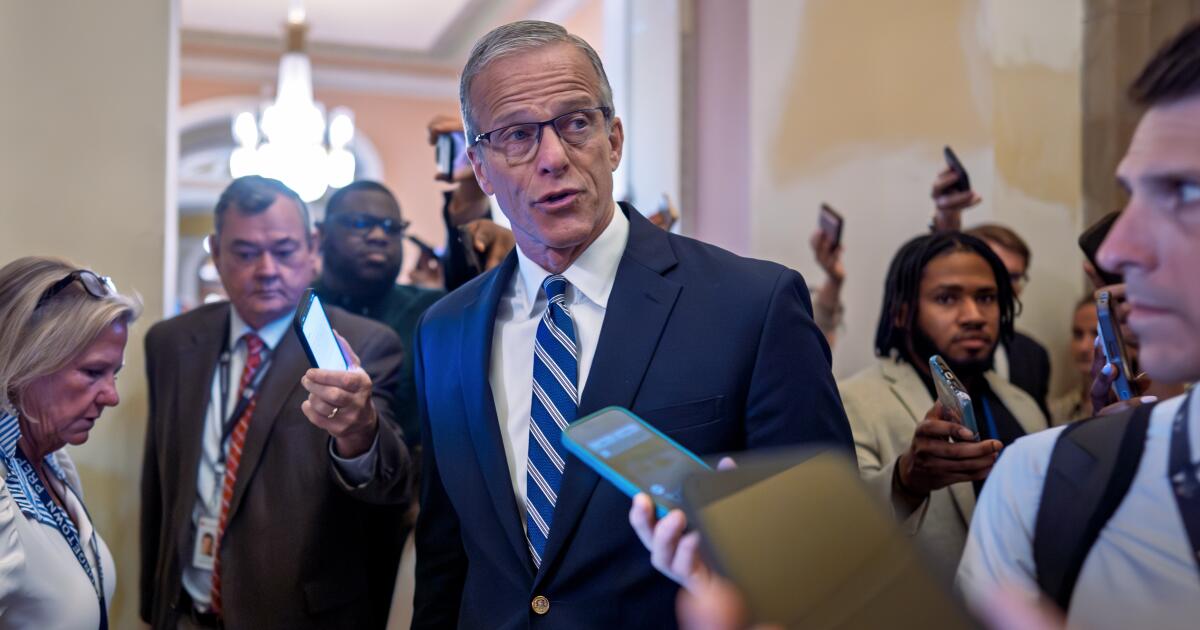
Ryan Wrasse, a spokesman for Senate Majority Leader John Thune (R-S.D.), wrote in a post on X that “none of this is abnormal” during the complicated budget process that Republicans are using to try to pass the immigration enforcement and White House security money on a partisan basis.

“Redraft. Refine. Resubmit,” Wrasse said in the post.

Democrats say they’re ‘ready to stop them again’

Democrats have seized on the security request, accusing Republicans of dedicating federal resources to the ballroom project instead of focusing on helping Americans with rising costs. Republicans have insisted that private donations will be used to build the ballroom and that the federal dollars are focused just on much-needed security enhancements.

Senate Minority Leader Chuck Schumer (D-N.Y.) took credit for the ruling after Democrats argued to the parliamentarian that the security money doesn’t belong in the bill.

“Republicans tried to make taxpayers foot the bill for Trump’s billion-dollar ballroom,” Schumer said Saturday evening. “Senate Democrats fought back — and blew up their first attempt.”

Schumer added that Democrats “will be ready to stop them again” as Republicans say they will revise the bill.

The ruling from the Senate parliamentarian is advisory, but such rulings are rarely if ever ignored when lawmakers put together legislation that can pass with a simple majority. Most bills are subject to a filibuster and thus need 60 votes for passage — meaning Republicans must find some Democratic support in the 53-47 Senate.

Part of immigration bill

Republicans are looking to approve a roughly $72-billion package to fund Immigration and Customs Enforcement and Customs and Border Protection until the end of Trump’s term after Democrats have blocked the money for months.

As part of that package, Republicans included $1 billion for White House security enhancements, part of it connected to Trump’s ballroom. The Secret Service had requested the money after a man was charged with trying to assassinate Trump at the White House Correspondents’ Assn. dinner last month.

The overall budget package is providing another boost of funding for Trump’s immigration and deportation agenda, fueling operations through September 2029. It comes on top of Immigration and Customs Enforcement and Border Patrol funds Congress provided last year in the One Big Beautiful Bill Act that Trump signed into law.

The parliamentarian kept most of the immigration portion of the legislation intact, though some minor provisions were blocked, including Customs and Border Patrol funds to hire, train and pay Border Patrol agents. Republicans said those were only technical fixes.

Oregon Sen. Jeff Merkley, the top Democrat on the Senate Budget Committee, said Saturday evening that “Democrats are prepared to challenge any change to this bill.”

Americans shouldn’t spend “a single dime” on Trump’s “Louis XIV-style ballroom and throw tens of billions more at two lawless agencies,” Merkley said.

Jalonick and Freking write for the Associated Press. AP writer Lisa Mascaro contributed to this report.

Source link

Some in GOP want ballots to be counted by hand, not machines

A growing effort to raise suspicion about the security of voting systems has kindled a back-to-the-future moment among conservatives in some parts of the U.S.

Republican lawmakers in at least six states have introduced legislation that would require all election ballots to be counted by hand instead of electronic tabulators. Similar proposals have been floated within some local governments, including about a dozen New Hampshire towns and Washoe County in the presidential battleground state of Nevada.

The push for hand-counting ballots comes amid mistrust of elections stoked by many Republicans who advance the false narrative that widespread fraud cost former President Trump reelection in the 2020 contest.

Despite no evidence of widespread fraud or major irregularities, conspiracy theories have proliferated among his allies that voting systems were somehow manipulated to favor Democrat Joe Biden. That has prompted calls to ban electronic tabulators used to scan ballots, record votes and compile race tallies.

“It’s our responsibility, and it should be our desire, to count every vote and to imbue confidence in our citizenry that our elections are fair and free, and that their vote is being counted,” said New Hampshire state Rep. Mark Alliegro, sponsor of a hand-counting bill that is similar to ones proposed in Arizona, Colorado, Missouri, Washington and West Virginia.

Alliegro said he was motivated by his analysis of recounts in nearly 50 New Hampshire state legislative races, not by the 2020 presidential election.

But some of the bill’s supporters reference the 2020 election to explain why they argue his hand-count legislation is needed. They cite a belief — despite evidence disproving it — that Trump actually won a landslide victory and that cheating is the only way to explain how New Hampshire voters elected a Republican governor and GOP majorities in the Legislature, but then backed Democrats for federal office.

Critics of the proposals to ditch electronic ballot tabulators and return to hand-counting are blunt about what they see as the motivation.

“It’s coming from conspiracy theories and lies,” said Sylvia Albert, director of voting and elections for Common Cause, a nonpartisan group that advocates for expanded voter access. “It’s attempting to lower people’s confidence in elections.”

Albert and others said it’s unrealistic to think election officials can count millions of ballots by hand and report results quickly, given that ballots often include dozens of races. The partisan review last summer of the 2 million ballots cast in Maricopa County, Ariz., which included a hand count, took several months and hundreds of people to complete.

“If you have a jurisdiction with 500 voters, you might be OK. But if you have a jurisdiction with thousands of voters, tens of thousands of voters, hundreds of thousands of voters, it’s just not going to work,” said Jennifer Morrell, a former elections clerk in Colorado and Utah who now advises state and local election officials.

Even in New Hampshire’s small towns, hand-counting is a complicated, lengthy process when a typical ballot might include 50 questions, said Milford Town Clerk Joan Dargie, who spoke against the proposed legislation on behalf of the New Hampshire City and Town Clerks Assn. She estimates her town would have to boost election workers from 200 to 350, and said many of her fellow clerks have said they will quit if they have to tabulate every ballot by hand. “People who are asking to get rid of machines obviously haven’t worked in an election,” she said.

As one example, Cobb County, Ga., performed a hand tally ordered by the state after the 2020 election. It took hundreds of people five days to count just the votes for president on roughly 397,000 ballots, said Janine Eveler, elections director for the county in metro Atlanta. She estimates it would have taken 100 days to count every race on each ballot using the same procedures.

Counting by machine isn’t just faster. Multiple studies have shown it’s also more accurate, said Charles Stewart, professor of political science at the Massachusetts Institute of Technology.

The first research on the topic was done almost two decades ago, comparing recounts of New Hampshire races that were originally tabulated by hand with those tabulated by machines. In that study and subsequent research, the machines won, he said.

“Counting votes is very tedious. Human beings are bad doing tedious things, and computers are very good at doing tedious things,” Stewart said.

Most states also conduct postelection audits that are designed to identify any irregularities with ballot scanning and counting. But with many Republicans believing Biden was not legitimately elected, election machines have become a popular target.

In Nevada, a Republican county commissioner is pushing a proposal that would require hand-counting of all ballots, along with a return to primarily in-person voting and beefing up uniformed security at polling places.

“I’m 82 years old, and I’ve been through a lot of elections,” said Washoe County Commissioner Jeanne Herman. “I know that something is not right.”

The proposal has drawn opposition from other commissioners, the biggest labor union in the state and a rare front-page editorial in the largest newspaper in northern Nevada, which said the measure could cost taxpayers “millions of dollars to chase down Facebook rumors of illusory election fraud.”

In West Virginia, a bill to repeal the state law governing tabulation machines died in committee earlier this month. In Missouri, lawmakers have not yet acted on a proposal that would ban electronic voting machines and tabulation equipment and require hand-counting to be livestreamed and recorded.

The bill’s sponsor, Republican state Rep. Mitch Boggs Jr., said he has no proof elections have been manipulated but is responding to constituent concerns.

“You file what the constituents are asking for,” Boggs said. “But at the end of the day, what they’re really wanting is just the transparency. They want to know that our elections are secure.”

Republican state Rep. Petty McGaugh said the legislation would delay election results and likely undermine their accuracy. When she became clerk of rural Carroll County in 1995, election staff were still hand-counting ballots by marking tallies in blocks of five on paper. She noticed multiple errors and eventually switched the county to an electronic tabulation system.

“I don’t really think that in this day and age we need to go back to hand-counting where it’s so susceptible to human error,” she said. “We’ve got to start trusting electronics and computers.”

In New Hampshire, that message seems to have gotten through. Last week, a state House committee unanimously recommended killing the hand-counting legislation and voters in nine towns where the question was on the ballot in local elections rejected it.

Source link

House passes bill to discourage release without bail before trial

The House Rules Committee debates the Cashless Bail Reporting Act on Tuesday in Washington before advancing it to the full House, which passed it Thursday. Photo by Olivia Ardito/Medill News Service

WASHINGTON, May 14 (UPI) The House on Thursday passed the Cashless Bail Reporting Act, which is intended to deter states and communities from releasing people charged with crimes before trial without paying bail. Ninety-six Democrats joined most Republicans to approve the measure, 308 to 116.

If the Senate were to write a companion bill and pass it, the act could have significant repercussions for the Black, Latino and low-income communities, according to researchers and activists. Advocacy groups also had raised concerns that the bill would lessen states’ rights.

“We have seen state and local governments making reforms to their bail systems in response to the growing body of research which has highlighted the inequities in bail systems, which disproportionately burden racial minorities, women and overwhelmingly the poor,” Rep. Mary Gay Scanlon, D-Pa., said in an earlier hearing on the bill

The bill expanded on a 2025 executive order from President Donald Trump, “Taking Steps to End Cashless Bail to Protect Americans,” which required the U.S. Attorney General to send a list of states and local jurisdictions that have eliminated cash bail for some crimes that “pose a clear threat to public safety and order.”

These crimes include violent, sexual and indecent acts, and burglary, looting and vandalism. To encourage elimination of cashless bail, the executive order also directed agencies to identify funding to these communities that could be “suspended or terminated.”

The bill would require annual lists of states and communities that allow cashless bail.

“It would be creating a bit of a hit list for different policymakers to attack and to try to pressure those states, counties, localities to change their policies and practices, to avoid … a lot of public safety funding that they get every year from the federal government getting completely gutted,” Nicole Zayas Manzano, deputy director of policy for the Bail Project, a non-profit group that advocates for bail reform and provides bail assistance, said about the lists.

In a Rules Committee meeting on Tuesday, Republicans said the act would lower crime rates.

“We know violent criminals released on cashless or artificially low bail have reoffended,” said Rep. Andy Biggs, R-Ariz.

Rep. Jamie Raskin, D-Md. voted for the bill, but said it would do little more than track bail practices in states and localities.

“It’s hard to see how issuing a report advances community safety or justice, given the strangely hostile rhetoric we are hearing from our colleagues about cashless bail,” Raskin said in the debate before the vote.

In a 2024 study, the Brennan Center for Justice found that there was “no statistically significant relationship” between cashless bail policies and increases in violent crime.

In the Rules Committee meeting, Rep. Michelle Fischbach, R-Minn., referenced the Bail Project, a non-profit organization that pays bail for low-income people who cannot afford it. She claimed that the group put violent offenders back on the street.

“In Indiana, from 2019 to 2021, 24% of the roughly 1,000 defendants cut loose by the Bail Project … had been charged with a crime of violence, so we’re putting violent offenders back on the road. And 35% were facing felony charges and had a previous charge of at least one crime of violence,” Fischbach said.

The group rejected the congresswoman’s description.

“The cutting loose reference mischaracterizes our work. We only step in after a judge has deemed somebody eligible for release, and it is only the affordability of cash bail that is preventing them from getting out, which is also unconstitutional,” Zayas Manzano said. “Then we really connect them with social services in their own communities.”

Moreover, studies found that cash bail disproportionately harms minorities, notably those in Black, Latino and low-income communities. In 2024, the Criminology & Public Policy Journal reported that Black defendants were 34% more likely to be recommended to be held behind bars until their cases were resolved when compared to white defendants.

Zayas Mazano said people jailed before trial were more likely to pre-emptively plead guilty, receive harsher punishments and end up with worse criminal records.

“Your life also just falls apart once you’re trapped inside, right? You could lose your housing if you can’t go and pay rent. You can lose your job if you’re not able to show up after a certain number of days. You could lose custody of your children. I mean, all kinds of things can really happen, but then just really snowball onto communities of color, in particular, and low-income people in general,” she said.

According to the Prison Policy Initiative, 69% of pretrial detainees were people of color, with Black (43%) and Hispanic (19.6%) defendants especially overrepresented compared to their share of the total U.S. population.

“Study after study shows that judges tend to assign people of color higher cash bail amounts and that they are less likely to be able to afford those cash bail amounts. And so they are very often forced into whether or not they must stay behind bars, which we certainly see huge racial disparities in jail, pretrial, and otherwise,” Zayas Manzano said.

During the Rules Committee meeting, Democrats mirrored concerns about the bill passing. Notably, Raskin discussed how the federal court system has functioned on a cashless bail system for about 60 years, instead of making bail decisions based on the danger of flight or violence to others.

“In America, whether you’re a president or a pope or a pauper, you’re innocent until proven guilty beyond a reasonable doubt as to every element of the charged offense,” Raskin said. “And no one should be detained pretrial simply because they don’t have the financial resources to post bail.”

Source link

L.A. Times wins prestigious APSE triple crown, Bill Plaschke honored

The Times earned prestigious Associated Press Sports Editors triple crown honors for a sixth consecutive year, claimed first place in two individual categories and finished in the top 10 in eight categories.

The staff submitted work published in 2025 and competed against the largest print and digital sports publications in the country.

Bill Plaschke took top honors in the columnist category for a portfolio that included commentary about using boxing to aid his fight with Parkinson’s disease, the affect of nearly losing his Altadena home in the Eaton Fire, the Dodgers’ 18-inning win during the World Series and UCLA’s fight for the right to break its Rose Bowl lease.

It was Plaschke’s 10th first-place columnist finish of his career. He previously won the APSE’s Red Smith Award, the highest honor in American sports journalism.

The Times also earned first place in event coverage for the staff’s work chronicling the Dodgers World Series Game 7 win, tying with the Dallas Morning News for top honors.

Eric Sondheimer, who is poised to begin his 50th year covering high school sports in Southern California, placed second in short feature for his coverage of the chilling affect immigration raids had on Los Angeles high school football players.

Kevin Baxter placed ninth in national beat writing for his coverage of preparation for the 2026 World Cup, including a look at why FIFA president Gianni Infantino has worked to court President Trump.

The Times’ eight top-10 finishes included the categories print portfolio, digital, event coverage, special sections, investigative, national beat writing, columns and short feature. The staff also earned an excellence in video award.

Source link

Justin Bieber plays an A-list Montecito party with defense execs

Just weeks after Justin Bieber’s well-received Coachella headline gig, the singer played a small private event for tech, entertainment and defense industry moguls. Executives at controversial firms, such as surveillance tech giant Palantir, were also on the bill.

Bieber was a headliner at WNDR, entertainment executive Jeffrey Katzenberg’s invitation-only confab at the Rosewood Miramar in Montecito last week. The programming for the event was first reported by Puck.

The ultra A-list talks and guests included director James Cameron and former Disney CEO Bob Iger, YouTube CEO Neal Mohan, FIFA President Gianni Infantino, Oprah Winfrey and Julia Roberts, comedians Chris Rock and Trevor Noah and artist Jeff Koons on a panel discussion with LACMA chief Michael Govan.

Bieber, meanwhile, performed a Wednesday poolside set for attendees at the Rosewood. The “Swag” singer reportedly became the highest-paid headliner in Coachella history last month, and its most lucrative merch seller.

Representatives for Bieber did not immediately respond to a request for comment.

While there was lighter programming (like a karaoke party with pop producers StarGate and a talk about snacks with chef Nancy Silverton), the bill included talks and cameos from major weapons and surveillance technology firms noted for their support for — or deep engagement with — the Trump administration.

One panel featured Anduril Industries’ Palmer Luckey, who recently welcomed Defense Secretary Pete Hegseth to its Southern California headquarters. “We are rebuilding the Arsenal of Freedom,” Hegseth said after the Anduril visit.

Palantir Chief Executive Alex Karp led another talk. Palantir’s AI-driven defense and surveillance software has faced scrutiny around how tech like its Maven Smart System may have been used to target civilians in the Iran war.

Karp also published a recent book, “The Technological Republic,” where he wrote that “We must resist the shallow temptation of a vacant and hollow pluralism. We, in America and more broadly the West, have for the past half century resisted defining national cultures in the name of inclusivity. But inclusion into what?”

Katzenberg’s WNDR conference is one of several recent multi-discipline, ultra-elite gatherings hosted by CEOs, including Jeff Bezos and Eric Schmidt. Katzenberg founded his investment firm WndrCo in 2017.

Source link