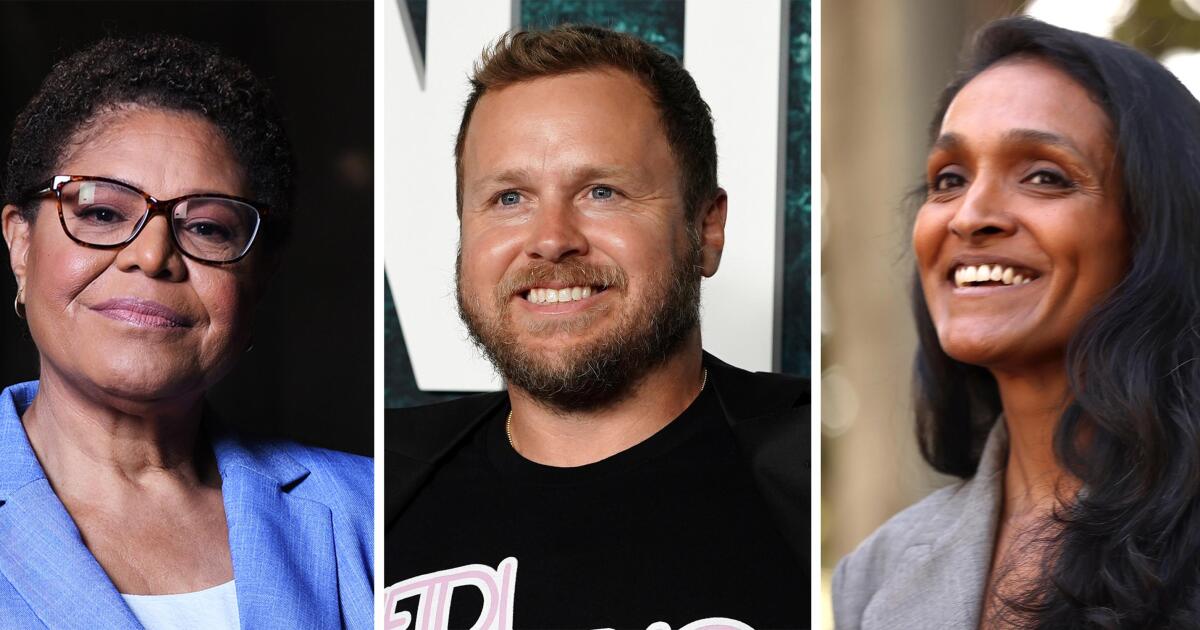
Since election night in California, a single theory of election fraud has taken root like no other — not just among online conspiracy theorists or bot accounts, but among major conservative influencers and people close to President Trump.
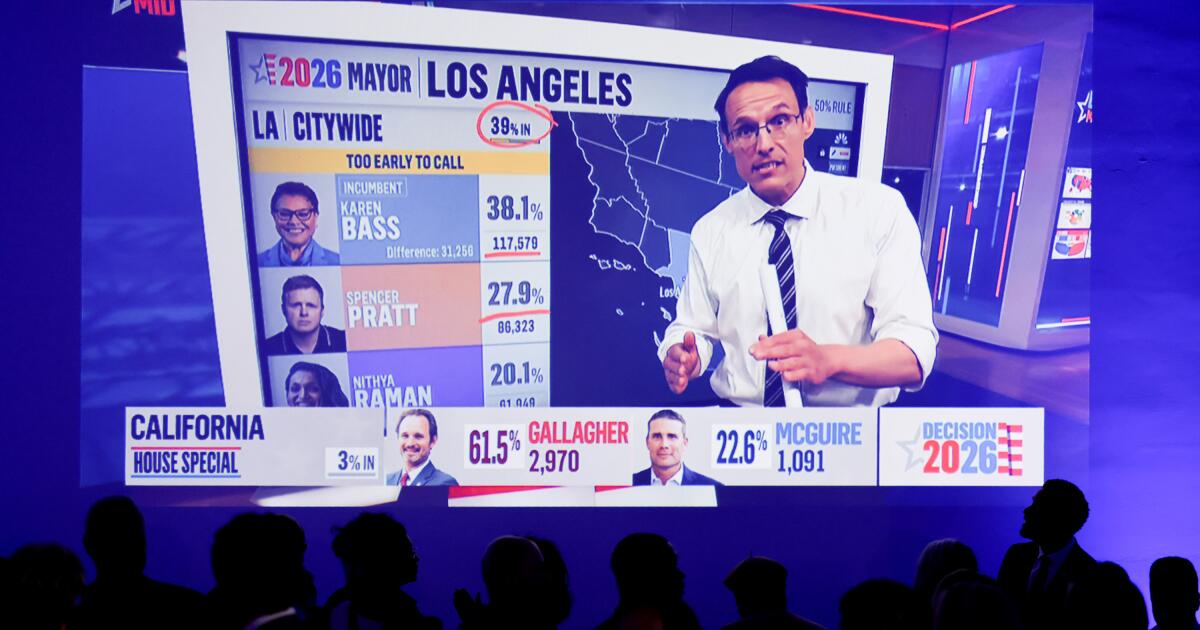
Late on election night, an update of vote counts in the Los Angeles mayor’s race appeared on election results pages of various media outlets including the Los Angeles Times.
It showed leading Democrats Mayor Karen Bass and Councilmember Nithya Raman receiving tens of thousands of new votes, and leading Republican former reality TV star Spencer Pratt receiving no new votes.
Close observers of the vote tally immediately took screenshots, with some shouting fraud. Others ran statistical analyses that showed it would be impossible for a candidate such as Pratt — running second in the race — to receive zero votes in such a large batch of ballots.
Share via
“They’re not even trying to hide the fraud anymore,” wrote Elon Musk, the world’s richest man and one-time member of Trump’s inner circle.
The claim fit into the broader narrative being pushed relentlessly by Trump and other Republicans in recent days, that California Democrats were cheating.
But the discrepancy in the Tuesday vote count in the mayor’s race was not fraud.
What attracted far less attention than the update with zero Pratt votes was another update one minute later that showed tens of thousands of votes for Pratt, and none for Bass or Raman.
There was no batch of votes that included zero votes for any candidate, as Los Angeles County’s own data show plainly.
But voting data pushed out by the Associated Press came as two separate updates one minute apart, with Bass’ and Raman’s votes in the first and Pratt’s in the second.
“The AP vote count receives updates as provided by election officials and adds them to our vote count. What happened in this case is that there was a lag in an automated update such that some candidates’ votes were added in one update and the other candidates followed about a minute later,” the Associated Press said in a statement to The Times.
“Specifically, an electronic update from the Los Angeles County website pulled in votes for only one group of candidates, including Karen Bass and Nithya Raman. Exactly one minute later, the electronic update picked up the votes for another group of candidates including Spencer Pratt. Taken together, the updates included 21,870 votes for Pratt, 12,850 votes for Bass and 9,521 votes for Raman, along with votes for other candidates.”
The Times’ election results page relies on the AP’s data feed, and checks for updates once a minute.
According to a Times review of election night results data, The Times pulled data from the AP’s feed at approximately 8:35 p.m. that included 0 new votes for Pratt and eight other candidates. When The Times’ system next checked for new numbers a minute later, there was an update with votes for Pratt but no new votes for Raman, Bass and others.
Michael Sanchez, a spokesperson for Dean Logan, head of the L.A. County registrar-recorder/county clerk’s office, said he could not speak for how news outlets report county data, but that he could confirm there were no batches of votes that included zero votes for Pratt.
“It is false,” he said of that narrative. “In every single result update that we released on election night and since election night, he has received votes,” Sanchez said.
Justin Grimmer, a political science professor at Stanford University and senior fellow at the Hoover Institution who researches and evaluates claims of election fraud, conducted his own data analysis of the vote updates, and came to the same conclusion.
He said there was an initial update with no Pratt votes, but a second one 41 seconds later with no votes for Bass or Raman — leading him to believe the single batch of ballots was just reported in two back-to-back updates rather than one.
“Because they came so close together, it looks like it was just a sequence of updates,” he said.
Grimmer said news outlets are “thinking about speed” and the best way to get people the most accurate information as quickly as possible, but “haven’t quite adjusted to being in this world where there’s this group of people who monitor these data feeds as if they are official government reports.”
“It leads to these horrible tweets about there being evidence of fraud,” he said.
Grimmer said he operates under the “mantra” that such fraud claims can’t be dismissed “by mere assertion” that the fraud didn’t happen, but must be looked into — which is why he dived into the data in the first place. This claim, he said, was similar to claims about odd-seeming vote tallies that were made during and after the 2020 election of Joe Biden over Trump, so he was familiar with how to look into the data.
“You can just go to the source code for the page, and then you can find where the sort of feed is, and that’s all I did — just found the feed, downloaded it, and then just saw what the updates were,” he said.
Grimmer said it was not surprising to him that people were watching the data feeds come in closely enough to notice an apparent discrepancy in the data that lasted less than a minute.
“There is a group of individuals who are convinced that there’s lots of fraud going on in U.S. elections, and for whatever reason, this group is convinced that they’re gonna uncover this by careful monitoring of these data feeds and the data that is being reported,” he said.
Grimmer said he would not presume to tell news outlets how to do their job of delivering election results quickly in the future, but does hope they balance the need to move quickly with “this reality that their feeds are now being monitored by individuals who think that they’re able to discover instances of fraud from what’s happening in the feeds.”
Sanchez reiterated that the county’s own official results of votes have been accurate — saying that “at no point” did the county office “report an official results update in which Pratt received zero votes.”
After the 2022 Los Angeles mayoral primary, developer Rick Caruso looked to have a surprising, and sizable, lead over then-U.S. Rep. Karen Bass.
The morning after the polls closed, Caruso was ahead by 5 percentage points — 42% to Bass’ 37% — and the former Republican called the early results “a victory story.”
But that lead did not last as the vote count continued. By the time all votes were tabulated two weeks after election day, Bass had come out on top, with 43% of the vote compared with Caruso’s 36%.
Welcome to the postelection vote-count slog in California, where tight races are often impossible to call even when the initial results seem clear-cut.
The California governor’s race still has not been called even though Republican Steve Hilton has been the top voter-getter and Democrat Xavier Becerra has been in second place since election night. The same is true in the battle over who will face Bass in the mayoral election: reality TV personality Spencer Pratt, who is now in second place, or L.A. City Councilmember Nithya Raman, who is in third place.
At this point in the vote tally, “everybody has an opinion and very few facts” about what the results will be, said Mike Murphy, a Republican strategist.
“Nobody in politics wants to be patient,” Murphy said, adding that California has “adopted a system that’s slow and deliberate.”
It’s not just the L.A. mayor’s race where mail-in ballots have swung election outcomes. Other contests, including those for highly competitive Orange County congressional districts and L.A. City Council seats, have come down to extremely narrow margins that have shifted long after election day.
On election night in November 2024, just over 1,000 votes separated Democrat Dave Min and Republican Scott Baugh in their bid for the 47th Congressional District, with Baugh enjoying a slight lead.
But, ultimately, as more ballots were counted, Min pulled ahead. He ended up winning by about 10,000 votes.
Similarly, in the race between Democrat Derek Tran and then-incumbent Michelle Steel to represent Congressional District 45, it took until Nov. 27 to determine that Tran had won the contest by just over 650 votes.
In 2022, the race between then-incumbent Gil Cedillo and community activist Eunisses Hernandez for L.A. City Council was similarly unsettled. On election day, Cedillo had a comfortable lead with 56% of the vote. But two weeks later, Hernandez ended up in the lead with 54% of the vote to Cedillo’s 46%.
Experts say confirming the final spot in the mayor’s race could still take several more days, depending on how close the contest becomes and how many ballots still need to be counted. Only an estimated 62% of ballots from the city of Los Angeles had been counted as of Thursday morning.
“Of the 40% remaining, or outstanding, there could still be a chance that there would be a significant return of more left-leaning votes, which would certainly benefit Raman,” said Pete Peterson, dean of the School of Public Policy at Pepperdine University.
Late results tend to favor Democrats — as seen in the 2022 Bass-Caruso contest — as Democrats tend to be more likely to vote by mail, a system that accepts ballots up to seven days after election day as long as they are postmarked by that Tuesday. And this year, Democratic voters held on to their ballots longer amid an unsettled governor’s race, which could further boost that phenomenon.
“The major difference between ’26 and ‘22, you had two candidates versus three,” Peterson said. “Mathematically, it’s a different situation.”
Three experts The Times interviewed said Raman still had a chance to pass Pratt, but it seemed more likely at this point that Pratt would survive and challenge Bass in November.
The remaining ballots to count, even if they are overwhelmingly left-leaning, will probably be split between Raman and Bass, which means Raman needs to outperform not just Pratt but Bass to make such a comeback possible, Peterson said.
He called her chances of ousting Pratt “dastardly remote … but it’s not impossible.”
In L.A. County, the registrar of voters reported late Wednesday that officials estimate they still have about 713,000 ballots to process and count, which primarily includes vote-by-mail ballots postmarked by election day but not yet received, as well as ballots returned to drop boxes and vote centers on election day. The registrar only made countywide estimations, which includes a much larger pool than L.A. city voters who will decide the mayor’s race.
Kamy Akhavan, the managing director at the USC Dornsife Center for the Political Future, said there’s a theory circulating among pundits that ballots submitted later are going to break more progressive, meaning they’ll be more friendly to Raman.
“Whether there is enough of them to tilt the outcome in favor of Raman taking a second place position, right now, it seems unlikely,” he said.
Pratt is pulling from the same electorate in Los Angeles that voted for President Trump and could snag a few more voters who are angry about the state of the city. But his lead very well could shrink a bit as more Democrats’ ballots are counted, Murphy said.
“Nithya, she’ll probably go up because there’s going to be a fair amount of Democratic votes and she’ll get her chunk, but will she catch Pratt? You can extrapolate it either way,” Murphy said.
A similar left-leaning shift also occurred as more ballots were counted in November 2022 when Bass and Caruso faced off in the general election. Results on election night wavered between the two candidates, but by the following morning Caruso had a thin lead with 51.25% of the counted votes. Bass sat at 48.75%.
Caruso remained in the lead — though it continued to shrink — as the week dragged on, but by Saturday, Bass had pulled ahead with 50.78% of the counted vote. Caruso had fallen to 49.22%.
Her momentum continued to grow as more ballots were processed. Eight days after polls closed the following week, the Associated Press called the race for Bass. At that point, she led Caruso by six points with 53% of the vote.
The final tally would have her winning almost 55% of the vote.
California officials have worked to dispel rumors and falsehoods about slow election results — explaining that it’s part of the process to accurately count and confirm ballots, especially those mailed in — though there has been a growing push to expedite results to build voter trust.
The process has been particularly slow in L.A. County, though experts say that is mostly a result of the county’s massive voter base. Mail-in ballots are also heavily scrutinized with workers verifying signatures and giving voters a chance to remedy the situation if their signature doesn’t match, a process that takes time.
“They’re using that level of care because they’re supposed to — that’s their protocol — and also because it could make a big difference,” Akhavan said. “We’ve seen some elections in Southern California decided by single digits. And that just means this is going to take time. That can be very frustrating, even annoying, to Angelenos.”
A huge, waning moon glimmered over Los Angeles on election night, a metaphor for a trend that emerged in early returns.
The city’s political establishment seemed to be on the retreat in favor of populist insurgents from both the left and the right.
Mayor Karen Bass held a cushy lead in her bid for a second term, and the Associated Press declared that she had made it into the November runoff election. But the underwhelming amount of support she got thus far showed that many voters in a super-blue city didn’t have enough confidence in a Democratic stalwart to return her to office. Instead, many chose self-proclaimed upstarts from opposite ends of the political spectrum: Republican reality TV star Spencer Pratt and democratic socialist City Councilmember Nithya Raman.
Raman launched her campaign at the last moment, just weeks after endorsing her longtime ally Bass, figuring that enough Angelenos were tired of the incumbent and would join her message of change from inside City Hall.
Raman’s instincts were half right. Voters did want change. But they didn’t view her as a challenge to the status quo — to many, she is the status quo.
The mayoral hopeful didn’t articulate a platform that radically departed from Bass’, and voter antipathy to her muddled messaging showed: she ended the night in third place. If the current results hold, Bass would face Pratt in the runoff.
At Raman’s election-night party at Boomtown Brewery on the outskirts of Little Tokyo, I saw why her chances of becoming L.A.’s next mayor were slim from the start. The gathering felt like happy hour at a Silver Lake bar: far whiter than the city overall, with few Latinos. Her address to a packed house was a grab bag of platitudes mixed with a broadside against MAGA, which is a political nothing in L.A. politics. It was an uninspiring cri de coeur and reflective of a campaign that wasn’t apocalyptic enough for those, such as Pratt’s people, who want radical change, while offering nothing new for Bass supporters.
Yet Raman still insisted she had unlocked something transformative.
“Together, we built something extraordinary,” she said to cheers. “And it gives me so much inspiration to be a part of it, a movement powered not by cynicism or political insiders, but by ordinary people who still believe Los Angeles is worth fighting for.”
Raman then went on the dance floor to greet well-wishers, pumping her fist while a DJ blasted Daft Punk’s “Lose Yourself to Dance.”
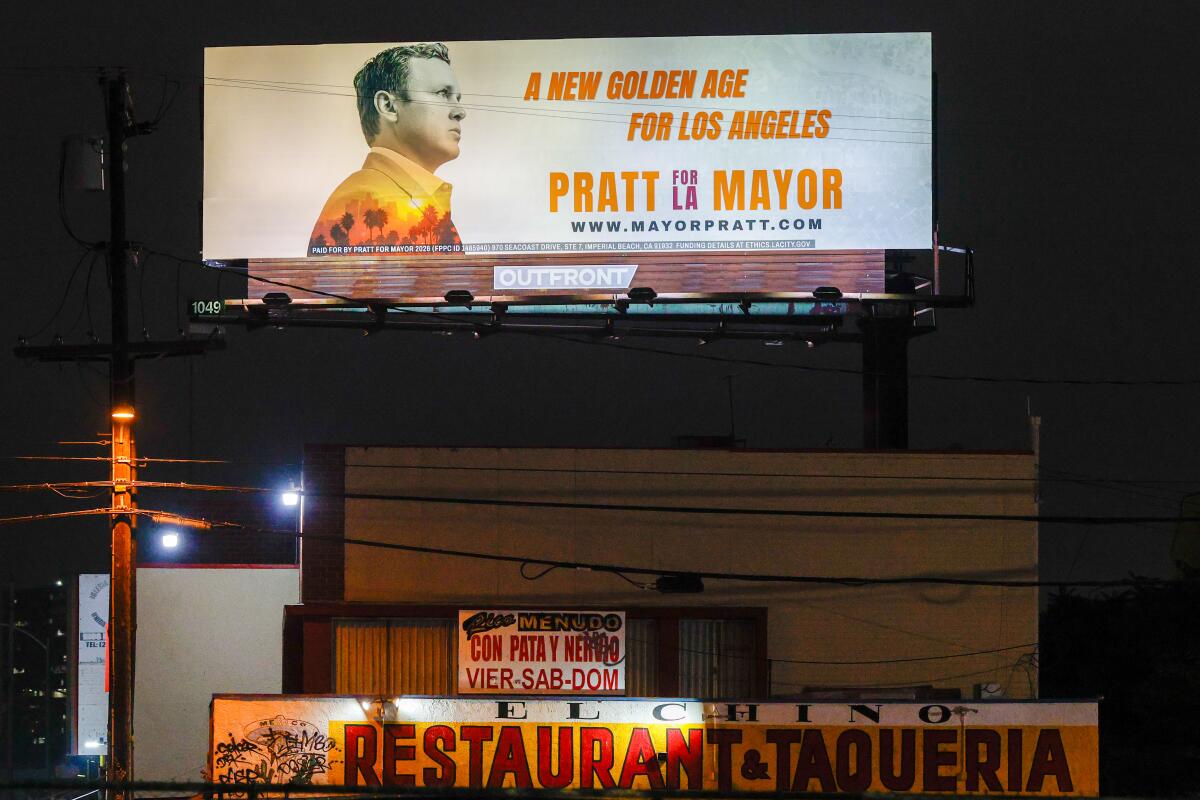
A billboard for L.A. mayoral candidate Spencer Pratt near MacArthur Park on June 2, 2026.
(Ronaldo Bolanos / Los Angeles Times)
Across town in West Los Angeles, Pratt reveled in his second-place position, enjoying a Mexican dinner with friends and family. It was a peaceful conclusion to a spring of fulminations against Bass (“Karen Basura”), nonprofits, homeless people (“zombies”) and anything that reeked of Democratic pieties, even as the Republican swore he was campaigning for all ideologies in a nonpartisan race.
Long dismissed as a has-been joke, Pratt correctly judged that Angelenos are angry and don’t want to be polite about it anymore. He and his supporters will take his unlikely rise as a mandate to double down against liberal L.A.
But if Pratt, who lost his house in the Palisades fire, does move on to the general election and is serious about winning, he needs to learn from the political revolution successfully pursued by his polar opposites, the local chapter of the Democratic Socialists of America.
Six years ago this spring, L.A.’s political establishment wrote off DSA-LA as wokoso upstarts in their long-shot quest to get a political novice named Nithya Raman elected to the city council. Even as Raman and three other DSA members joined the council, skeptics dismissed them and their progressive policies as anomalies that didn’t reflect how Angelenos actually wanted the city to work.
Tuesday night, four of the six DSA-endorsed candidates in L.A. city elections were in first place by large margins and another was comfortably in second, reflecting DSA’s multicultural, citywide reach. In a telling sign of its newfound king-making status, the local chapter declined to endorse Raman or any other mayoral candidate. Without that powerful backing, their trailblazer, along with DSA member Rae Huang, withered on their L.A. revolutionary vine.
Councilmember Hugo Soto-Martínez and L.A. Unified school board member Rocío Rivas looked to be coasting to outright victories. Marissa Roy was on her way to a runoff that would exclude the incumbent city attorney, Hydee Feldstein Soto, who was a distant third in the early returns. In District 9, where Curren Price is terming out, Estuardo Mazariegos stood comfortably in second place and looked to headed to a runoff against a fellow Latino candidate in a race that will see South Los Angeles elect its first non-Black council member in 63 years.
The most surprising outcome involved Councilmember Eunisses Hernandez, who became a punching bag, along with Bass, for people who thought L.A. had transformed into a hellhole. So-called dark money groups, which don’t have to reveal where their funding comes from, poured hundreds of thousands of dollars into negative mailers. Opponents vying for her seat cast federal raids against drug dealers and gangs in the MacArthur Park area as an indictment of her leadership, berating her during debates and on social media.
Even Hernandez’s supporters were fretting about what might happen on election night. But by the time I arrived at her raucous soirée in Highland Park, early returns showed her way ahead of the field and perhaps avoiding a runoff.
“It’s reassuring to see [DSA’s success],” she said as jubilant supporters lined up beside her to get tattoos — real ink, not temporary — of hummingbirds, her campaign’s logo. “That means people see us. That means people want more.”
Hernandez pointed to her fellow DSA member, New York City Mayor Zohran Mamdani.
“What happened with DSA over there didn’t happen overnight,” she said. “In L.A., we’re getting there.”
A table filled with campaign buttons for Council Memer Hugo Soto-Martinez, who ran for reelection this year and is expected to win outright.
But anyone who wants to win in Los Angeles needs to realize that antiestablishment sentiment is in the air.
At the same time, I would remind the victorious populists to look up in the sky and remember their Shakespeare.
“O, swear not by the moon, th’ inconstant moon / That monthly changes in her circle orb / Lest that thy love prove likewise variable,” Juliet warned Romeo.
Politics, like la luna, waxes and wanes whether we like it or not, and anyone who bets on a permanent transformation at City Hall will probably lose.
Angelenos have declared that they want dramatic change. But how will they feel in November?
L.A. Mayor Karen Bass made what sounded like a victory speech Tuesday night.
Councilmember Nithya Raman made what sounded almost like a concession speech.
And former reality TV star Spencer Pratt relayed a message from the heavens.
“Well, obviously God wanted five more months of me exposing all the failures of our mayor, so it’s gonna be a fun ride,” Pratt said. “I hope she’s ready.”
Assuming Pratt holds on to one of the two spots in the Nov. 3 general election as the final votes are tallied in the next few days, the smart money will be on Bass, for reasons I’ll get into in a moment.
But the supreme being and patron of all pontiffs has to be considered a wild card. This is the first time, to my knowledge, that an incumbent mayor in the City of Angels would be running against a challenger whose campaign manager is God Almighty.
So here we go. We could be in for one of the more remarkable electoral adventures in city history, with a complete novice and MAGA conservative going up against a liberal career politician in a deep-blue city and state full of people who are tired of hearing excuses from Democrats. (If Raman ends up ousting Pratt, my apologies for jumping to conclusions. But it’s not my fault. The devil made me do it.)
If you intend to follow closely, as of course you should, maybe you can help me count the number of times Pratt plays the faith card. I went to St. Peter Martyr School and attended the church by the same name, and I don’t recall ever hearing a nun or a priest drop God’s name as often as Pratt does.
In fact, I just watched a clip of Pratt talking to Fox News TV host and Donald Trump disciple Kayleigh McEnany, and over the course of 1 minute and 52 seconds, he mentioned God or Jesus 10 times.
“Thankfully, I married an angel who was very connected with Jesus and has brought me to the light,” Pratt said of his wife and former reality TV co-star Heidi Montag. “It’s been very empowering to just pray and just be on his path and just say, ‘God, if you want me to save these animals, save these humans and protect my city, just keep putting me in the place where I can do that.’”
Is he running for mayor or cardinal?
Look, I totally respect your average true believer. But I’m not entirely comfortable with a mayor who might be sitting around City Hall waiting for signs and smoke signals rather than knowing what to do on his own.
God has a lot on his plate. He might be busy multiplying fishes and loaves so people don’t go hungry thanks to the president’s tariffs and warmongering. Is he going to rush to answer a prayer for guidance about underfunded parks or broken sidewalks in Los Angeles?
How did we get here, you ask?
Well, Pratt is an AI creation, in a way. A composite of sorts. You combine the forces of social media, political rebellion, second-rate celebrity obsession and the Peter Principle, and here’s a little Trump puppet walking around L.A. like he’s the chosen one.
Add to that the very real essence of his appeal to some voters:
Los Angeles has problems. Big problems that don’t get fixed quickly enough or at all, and Pratt represents the angry voter who wants to know why City Hall can’t do better and where all the money went. He’s absolutely right when he says we shouldn’t have people living on the streets, using drugs on the streets and dying on the streets.
But if Pratt is in the general election rather than Raman, we’re in for a national media circus rather than a summit on solutions. Raman is well-versed on matters of relevance and could have pushed back against Bass in substantive, detailed ways. On the other hand, as Pratt has fairly argued, Raman headed City Council’s homelessness committee, so isn’t she partly to blame for the failures she tried to pin on Bass?
As for Pratt’s policy chops, he has not responded to my offers of a get-together. Absent that, and given his careful avoidance of local reporters who know their stuff, I read his platform on his campaign website and I can tell you that while he touches on many of the right issues — public safety, fiscal integrity, homelessness — attention to detail and depth of knowledge are not God-given strengths.
Maybe Pratt can actually deliver on his promise of a “treatment-led recovery model that addresses mental illness and addiction as the primary drivers of chronic homelessness.” But that would require an act of God (which I suppose is possible given their relationship), because those matters are primarily under the direction of the county, not the city.
This is the main problem here. Bass was beatable, and could have been pushed by a serious challenger to do better.
In the last election, Rick Caruso gave her a scare. That was partly because he had some depth on the issues, he was a successful businessman and philanthropist, he had served on the police commission and the water and power board, he had built relationships across the city and, along with his family, he had poured time and millions of dollars into underserved communities.
In this election, it looks as though Bass could get lucky and face off against a guy who lost his house in the Palisades fire, saw a few homeless encampments through his car window, and decided he wanted to be mayor. Some might have questioned his hubris, but only before learning that he was on a mission from God.
If you’re keeping count, that’s nine mentions of God so far in this column.
One more for the tie, with an eye toward five more months of campaign fodder.
The most important thing political junkies might need this week is patience.
With so many key races expected to be tight, officials are warning it could takes days — perhaps even more than a week — to know the outcome of Tuesday’s primary election.
Here are some important things to watch as the results roll in:
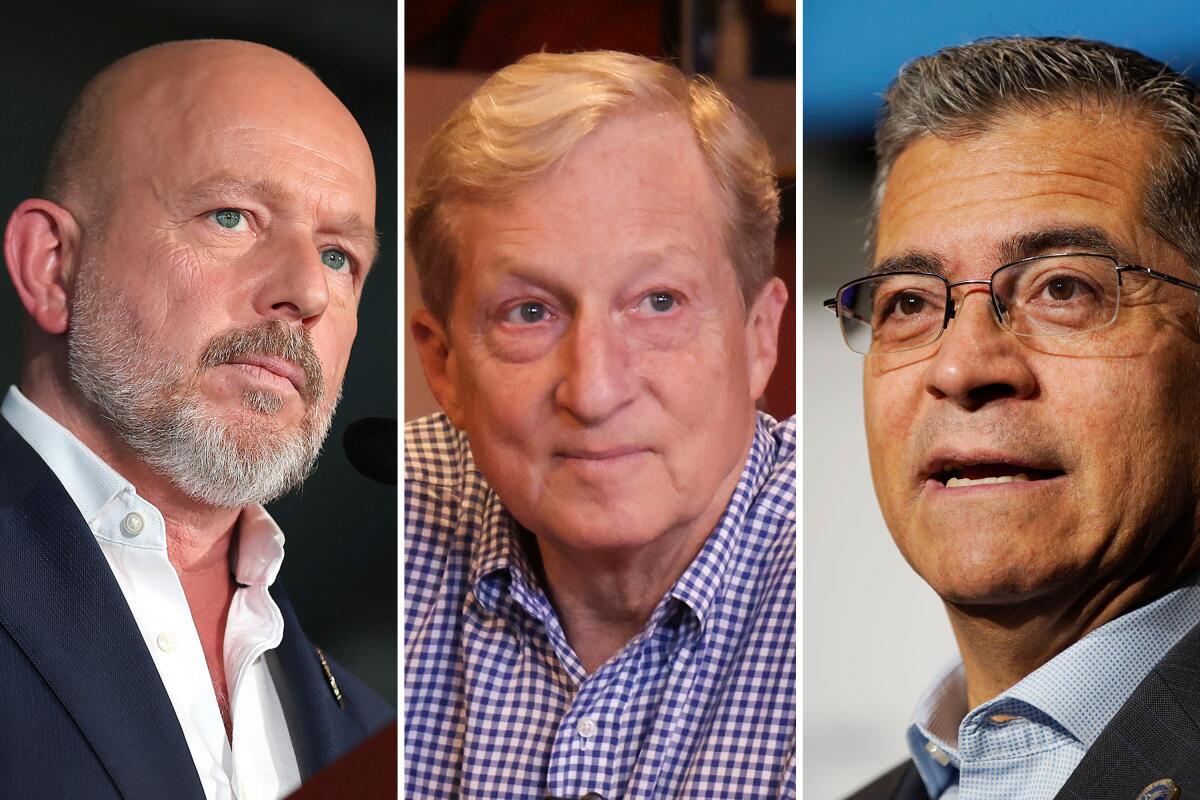
From left; Steve Hilton at the California Republican Convention in San Diego; Tom Steyer campaigning in downtown Santa Ana; and Xavier Becerra in San Diego.
(Los Angeles Times)
1. The fight for the second top spot
Most polls and pundits say Democrat Xavier Becerra is likely to be the top voter-getter in the primary to replace Gavin Newsom as California governor.
Until recently, it was assumed that Republican Fox News host Steve Hilton would also advance, especially after he was endorsed by President Trump.
But a new poll suggested Hilton was in a tight race for second place with Democratic billionaire Tom Steyer, who is spending heavily from his own fortune. If he is successful, California could see a competitive Democrat-versus-Democrat general election come November.
Under California’s election rules, the top two vote-getters move on to the general election regardless of party preference.
Hilton is urging Republicans to unite around him to avoid being shut out. His main GOP opponent is Riverside County Sheriff Chad Bianco.
A few months ago, Hilton and Bianco led some polls amid a crowded Democratic field, prompting fears that Democrats might be locked out of November’s general election. But those concerns have subsided somewhat with Becerra’s rise in the polls.
More to read:
Left to right: Karen Bass on Friday, April 8, 2022; Spencer Pratt on April 16, 2025; Nithya Raman on March 3, 2026.
(Christina House / Los Angeles Times; Jordan Strauss / Invision/AP; Genaro Molina / Los Angeles Times)
2. Is the mayor’s race really a tossup?
It’s rare for the Los Angeles mayor’s race to become a national story. But that has happened this year thanks to a showdown few would have predicted.
Former reality TV star Spencer Pratt is a big reason for all the attention, running from the right in a very liberal city. Embattled Mayor Karen Bass is the incumbent, with City Councilwoman Nithya Raman running from the left.
Pratt had overshadowed his opponents when it came to social media (and old media) attention. But is that enough to get him into the runoff? Bass has big labor on her side, and we’ll see whether that helps her get out the vote. But Bass is also unpopular, according to polls. Does that give Raman an opening among Democrats who are looking for an alternative?
More to read:
Dan Egelhoff plays with his dog at a “Barbecue, Beer and Ballots” event at Rep. Ken Calvert’s office.
(Christina House / Los Angeles Times)
3. The fallout from California redistricting
When it comes to congressional elections, this should be a good night for Democrats, by design. That’s because California voters last year approved Proposition 50, which redrew congressional districts to favor Democrats.
It was part of a national battle by both red and blue states designed to help their respective parties secure control of Congress. The new California maps give Democrats an advantage in some areas, but it’s still unclear how sweeping the victories will be. There are some notable intra-party battles in “safe” districts as well.
Rep. Ken Calvert (R-Corona) lost his seat in redistricting and is now challenging incumbent Young Kim (R-Anaheim Hills) in the 40th District.
In San Francisco, several factions of the Democratic Party are vying to replace former House Speaker Nancy Pelosi in the 11th District.
California’s 48th Congressional District in San Diego and Riverside counties has traditionally been red. But the sudden retirement of longtime Republican incumbent Darrell Issa and redistricting puts it in play.
Veteran Rep. Brad Sherman is facing a strong challenge from fellow Democrat Jake Levine in the 32nd District.
More reading:
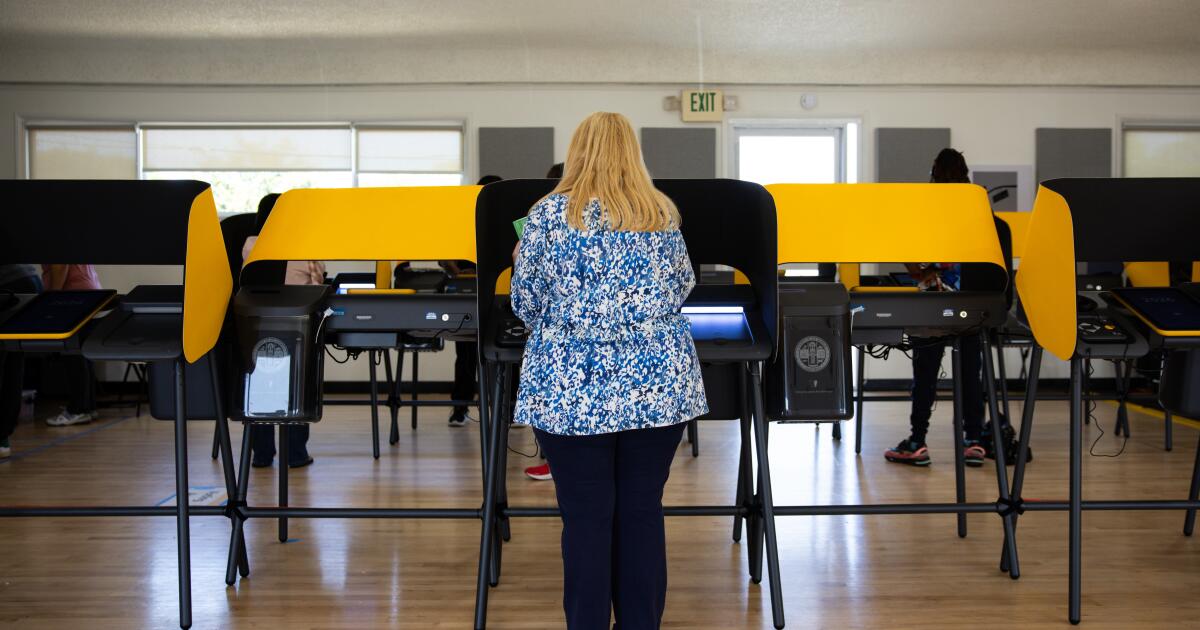
Want more information about the ballot-counting process? Times reporter Grace Toohey breaks it down, including how to track your mail-in ballot, how races get called and why it takes so long.
As primary voters head to the polls Tuesday to determine which candidates will face off in November to become California’s governor and Los Angeles’ mayor, both races are wide open, with a new crop of candidates challenging the Democratic status quo.
For Democrats, little clear consensus has emerged so far on who should lead the city and state into the future.
In California’s crowded gubernatorial race, Democrats have struggled in recent months to settle on a candidate to succeed term-limited Gov. Gavin Newsom.
In L.A., experience seems to be as much a liability as an advantage.
Mayor Karen Bass finds herself in the extraordinary position, as an incumbent, of fighting to make the runoff as she is assailed from the left and the right. The latestUC Berkeley-L.A. Times poll shows Bass leading with just 26% of the vote, one point ahead of City Councilmember Nithya Raman, a wonkish Democratic socialist, and four points ahead of Republican Spencer Pratt, a former reality TV star.
“There’s a clear sense of frustration with the Democratic Party,” said Sara Sadhwani, a professor of politics at Pomona College. The reason a wave of conservative outsiders like Pratt and Hilton are doing so well in such a solidly liberal city and state, Sadhwani said, is that they’re more willing to spell out the challenges that L.A. and California face.
“Democrats tend to be very concerned about not upsetting one coalition or another, so it’s politics as usual with many of the Democratic candidates,” Sadhwani said. “Spencer Pratt has blown a hole in that by just naming the problems that everyday residents and voters are seeing and feeling on the ground.”
On homelessness, many Angelenos are frustrated Bass hasn’t significantly moved the needle.
“We can point to facts and figures that might suggest that things have changed,” Sadhwani said. “But when you walk down the streets of Los Angeles, it doesn’t feel like it, so she hasn’t passed the field test. That’s the problem.”
A growing segment of Angelenos also chafe at the city’s high cost of living. And many are angry about the Bass administration’s lack of preparation and response to the 2025 Palisades fire.
“The Democrats have to account for those challenges,” Sadhwani said. “They have been in power for all of this time.”
California, of course, remains a Democratic stronghold, and polls show state voters are overwhelmingly opposed to President Trump. His second-term agenda — including a sweeping immigration crackdown, tariffs and the war in Iran — only seems to have cemented California’s status as a resistance state.
But after so many years of Democratic dominance, in Sacramento and at Los Angeles City Hall, leaders have to answer for voter frustrations.
The top two vote-getters in California’s nonpartisan primaries will advance to theNovember runoff, unless one candidate manages to pick up more than 50% of the vote.
Republicans have turned out at higher rates than Democrats in early voting. Paul Mitchell, vice president of the Sacramento-based bipartisan firm Political Data Inc., said that older Democrats who reliably turn in their ballots were slower to vote this year, likely because two Republicans were on the gubernatorial ballot and the Democratic field was fractured.
“That has caused them to dive into a lot more strategic voting,” Mitchell said, noting many seemed to be waiting to cast their ballots for the Democrat who looks to have the best chance of moving on to November.
For the GOP, getting a candidate on the November ballot for governor means more than just demonstrating Republicans are players in California. A GOP candidate would bring out more Republicans to vote in the general election, raising the party’s prospects of winning down-ballot races and passing a GOP-led ballot initiative on voter ID.
For Democrats, the midterm races offer the party its first major chance to chart a new path for the future.
As polls show Trump cratering in popularity, Democrats in California and beyond are struggling a year and a half after Kamala Harris’ bruising 2024 defeat to agree on what went wrong.
The Democratic National Committee’s long-awaited autopsy of that election — which said Harris “wrote off rural America,” wrongly assumed identity politics would win over voters of color and failed to develop “defined or consistent” strategy against Trump — has only generated more hand-wringing.
“There is not a clear vision, there is not a clear policy agenda, and the Donald Trump presidency upended the policy world as we knew it,” Sadhwani said. “It’s unclear how any Democrat, including any of the individuals in these two races, is going to navigate the waters into the future. One thing is for certain: We aren’t going back. So, which of these candidates is going to lead us into an uncertain future?”
Referendum on Bass
In L.A., the election is a referendum on Bass, who pledged in 2022 to solve homelessness, cut crime and make the city more affordable.
“How has L.A. changed in four years?” said Christian Grose, a professor of political science and public policy at USC. “The Bass campaign is saying it has changed for the better and she still needs more time. All the other candidates, from very different perspectives, are saying that it’s much worse than it was four years ago, and it’s time for new leadership.”
Bass told The Times she plans to win in November by demonstrating her administration’s progress in clearing homeless encampments and accelerating the building of affordable housing. She has also noted that data shows homicides in the city are at their lowest since 1966.
Challenging Bass from the left is Raman, who was elected in 2020 as the first DSA-backed L.A. City Council member. Pitching herself as the viable progressive in the race, Raman has accused Bass of not doing enough to make the city affordable and critiqued Bass’ spending on Inside Safe, her program to move unhoused people into stable housing. Although Raman presents herself as an outsider, she is a former Bass ally who has chaired the council’s Housing and Homelessness Committee for more than three years.
“She’s absolutely a part of the establishment,” Sadhwani said. “She’s been in City Hall longer than Karen Bass.”
Pratt is challenging Bass and the entire Democratic status quo.
A former star of “The Hills” who lost his home in the Palisades fire, he has surprised many political observers with his success assailing the city’s handling of the 2025 firestorms. He has called unhoused people drug-addled “zombies” and argued that L.A.’s housing crisis requires heavy-handed policing.
Still, most political experts agree that Bass has the most viable path to victory, starting with a solid base of Black voters and a large share of Latino voters, plus support from powerful unions.
“Under normal circumstances, or at least under historic circumstances, that would be plenty to get her over the finish line,“ said Jim Newton, executive director of UCLA Blueprint magazine and a former political journalist for The Times. “What’s problematic for her is that there are people who are angry with her.”
A reset in California
Newsom has emerged in recent years as the national face of Democratic resistance to Trump, bolstering California’s status through a barrage of lawsuits and all-caps trolling against Trump.
Whatever candidate replaces Newsom, things are going to be different.
The emerging front-runner, Becerra, is a safe-bet career politician who has served as California attorney general and U.S. secretary of Health and Human Services. Asked recently why he had climbed in the polls, Bercerra said he thought voters wanted experience, not “glitz and sizzle.”
He has pledged to issue executive orders declaring California’s housing shortage a state of emergency and directing state agencies to maintain coverage for every Californian affected by federal or Medi-Cal cuts. He also touts his record, as the state’s attorney general, of suing Trump 122 times.
Steyer, a hedge-fund billionaire, calls himself “the most progressive candidate on the ballot.” He has pledged to build one million affordable homes, make the wealthy pay more taxes, and defend the environment — stances that are certain to unsettle Sacramento lobbyists and test the limits of California’s progressivism. But his past investments in coal plants and ICE prisons raise questions for some voters.
“His wealth is in one way his Achilles heel in the election,” Grose said. “Voters think of him as a billionaire more than progressive.”
Hilton has pledged to cut government spending, make housing more affordable and bring gas prices down. But to achieve some of his goals he would scale back public services and environmental regulations and ramp up domestic production of oil and natural gas — strategies that many Californians might hesitate to get behind.
“Clearly, the party itself has lost its way in California,” Sadhwani said. “I would not be surprised if the California Democratic Party looks for new leadership after this election.”
If Republicans make it to the runoff, they face steep odds of being elected in November in a state where Democratic registered voters outnumber Republicans bymore than 20 percentage points.
Rob Stutzman, a GOP strategist, said neither Hilton nor Pratt was likely to win. But if they made the runoff they could have a huge impact on the political environment by advancing “grievance issues that really put up a spotlight on what I call the blue state incompetence.”
Of all the candidates, Mitchell said, Pratt as an outsider adept at Instagram and TikTok has the greatest opportunity to create a new surge electorate. But he’s also going after the hardest voters to get to turn out: disaffected voters who are upset at the system.
Pratt had more retweets and viral videos than any other candidate, Mitchell said. “But that doesn’t buy him the vote of the disaffected DoorDash driver who believes that the system is broken, and who hasn’t voted in the last five elections.”
If Republicans don’t make it past the primary, Mitchell said, Democrats would likely hit the reset button.
“Pratt running has kind of obfuscated the differences between Raman and Bass,” Mitchell said. “It’s like a WWE match versus a chess match. I think Raman versus Bass would be more of a strategic and nuanced election than Spencer Pratt trying to hit Karen Bass over the head with a chair.”
As the voters deliver their ballots to neighborhood drop-off sites and others wait to vote in person Tuesday, Times reporters fanned out across the city to ask residents whom they planned to support for mayor.
Here is a sample of what voters said about their preferred candidate.
‘The other choices were not worth my vote’
Steven Travers 57 Glassell Park Self-employed
Voter Steven Travers told The Times that he didn’t feel like there were many options for him in the mayoral election this year, except for the incumbent Karen Bass.
Shopping at Vons in Echo Park, Travers said, “Just what I’ve seen of her, and you know, the way she speaks, she seems to be OK.”
“I guess she’s done an OK job since she’s been the mayor,” Travers said. “The people she’s running against, I mean, there’s really nobody else that I think I would want to be in that position.”
This decision to vote for Bass, despite the wide field of options, came down to how she had handled homelessness in the city and Travers’ neighborhood of Glassell Park, where there had been homelessness issues “for a period of time.”
The issue, Travers said, has been lessened and “certain areas things are getting a little bit cleaned up. And I’m assuming that she’s, you know, part of that whole thing.”
Travers also said that “anybody involved in politics in Los Angeles” seems to always talk about homelessness “more than anything else” and that Bass “seems to be trying to maybe do something about it.”
Simply put, “The other choices were not worth my vote,” Travers said.
Looking for a more humane L.A.
Zorah Archie-Winston 22 View Park Recent USC graduate
Zorah Archie-Winston said that she’s probably voting for Nithya Raman for mayor.
“If I had to choose, like, right now, I think I’m leaning more towards Raman,” Archie-Winston said.
One of the main reasons for that, she said, is Raman’s personality and the humanity she brings to the table.
The 22-year-old View Park resident said that the unhoused population is something she feels very passionately about, and she believes Raman shares that.
“We could have, like, a lot more of a compassionate view on the unhoused population and those adjacent,” Archie-Winston said.
She said she’s been following along with Raman’s journey on the L.A. City Council and looks forward to seeing what the candidate could do as mayor, especially for tenancy rights.
“I think there are a lot of resources and things that are really inaccessible to those who are struggling to live in L.A. for one reason or another, and I think that’s something Raman will be able to help with,” Archie-Winston said.
‘He might be our only saving grace’
Ann Raljevich 66 Westchester Medical biller
Ann Raljevich, a 66-year-old medical biller, says Spencer Pratt could be the city’s hero in the mayoral race.
“I think he might be our only saving grace,” said Raljevich, of Westchester.
Under the city’s current leadership, Raljevich tells The Times, she said she hasn’t seen change in the city. She said she still sees the same unkempt streets, drug addicts around town and high sales taxes.
“Being in the medical field — the drugs bring on the schizophrenia and bring on all the other things, and I mean, I see it when I drive in and out of town,” Raljevich said. “I see it everywhere.”
Raljevich said she also admired that Pratt was from Southern California and graduated from USC.
She said the fact that he hasn’t directly declared a political party affiliation shows that he doesn’t care what people think and is just here to do the job.
“He never really came out to say whether he’s a Republican or a Democrat,” Raljevich said. “He’s just for the people.”
The leading candidates for mayor fanned out across Los Angeles this weekend to make their final cases to voters ahead of Tuesday’s hotly contested primary election.
An energized Mayor Karen Bass galvanized crowds of labor union workers sporting union merch Saturday. “Four more years!” crowds chanted as a slew of local and state Democratic heavyweights joined the incumbent.
City Councilmember Nithya Raman spent the day dashing between local restaurants and bars in an old-school yellow Scout convertible to meet with business owners and her supporters.
Meanwhile, former reality TV personality Spencer Pratt hosted a block party in Baldwin Village with barbecue food, free merch and American-flag lawn chairs — although he spent much of the event off to the side, listening to the concerns of Black residents.
Recent polls have placed Pratt and Raman within striking distance of Bass, who had enjoyed a comfortable lead for much of the campaign. A recent survey, co-sponsored by The Times, had Bass at 26%, Raman at 25% and Pratt at 22% — with a roughly 3% margin of error in either direction and 10% of voters undecided.
The top two candidates in Tuesday’s jungle primary will advance to a November runoff, unless one candidate manages to garner over 50% of the vote.
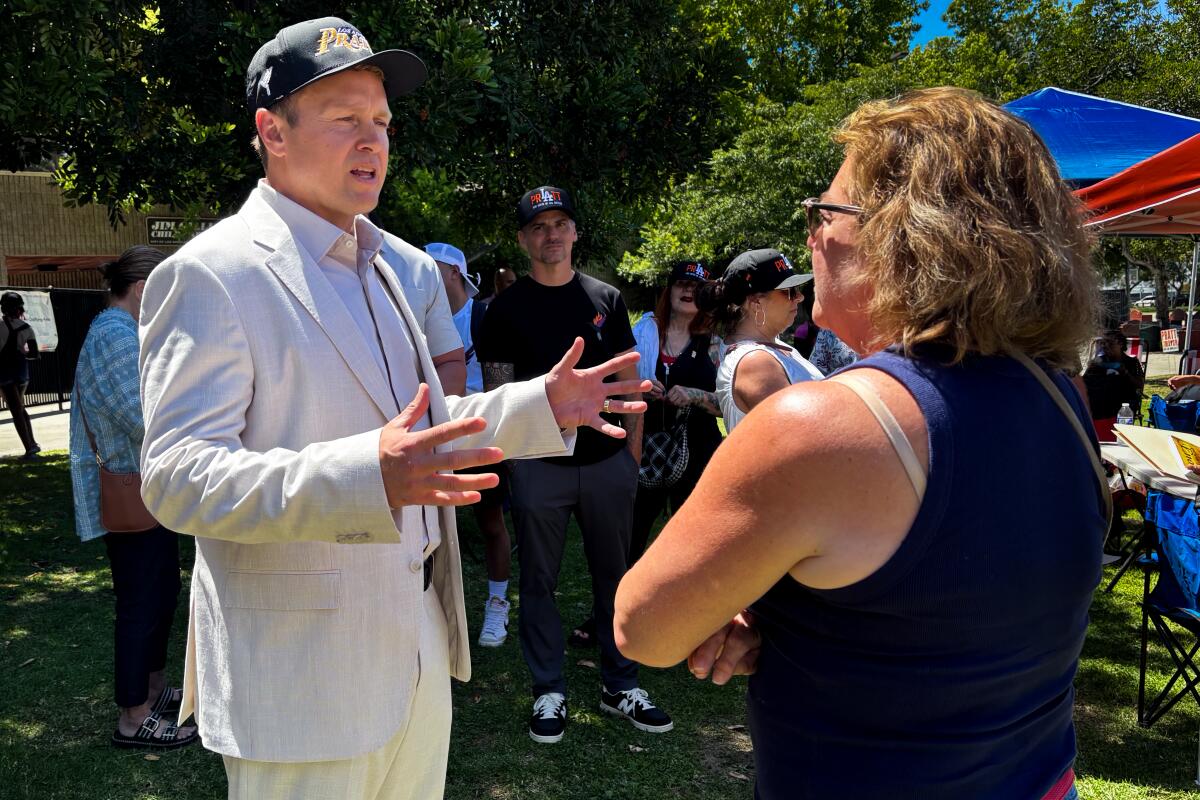
Mayoral candidate Spencer Pratt speaks with Diane Waterhouse, a caregiver and Westchester native, about homelessness and drug addiction at a campaign event Saturday in Baldwin Village. “We just talk about it like, ‘oh it’s Skid Row, that’s just where the drug addicts are.’ No, there’s communities, there’s kids, there’s people that work there, businesses,” Pratt said.
(Noah Haggerty / Los Angeles Times)
“I believe God moves mountains; I believe that you can get that 51% on that Tuesday,” Diane Waterhouse, a 60-year-old caregiver, told Pratt at his Baldwin Village event.
On the lawn of Jim Gilliam Park on Saturday, supporters from across the city chanted Pratt’s name, took selfies in front of black campaign vans with his hummingbird logo and ate cookies decorated with his face as kids raced around on scooters and played with the handful of dogs attending.
But Pratt — who had spent the morning at the West Los Angeles Animal Shelter speaking with animal welfare advocates — headed toward the nearby recreation center to talk with residents away from the cameras.
“Most people that come here and want our vote — we give y’all our vote; we’re still living like this. Nothing changes,” Erica Helon, a 40-year-old bus driver, told Pratt in one of the most tense moments of the event.
Pratt, wearing a beige suit and a hat with his name stylized like the L.A. Lakers logo, emphasized he was in South Los Angeles to listen and wasn’t even asking residents for their votes. He pulled Helon aside and gave her his personal phone number so they could talk more.
“I’m here because I want to be a voice for the community,” he said at one point. “I’m here because I don’t know what I don’t know.”
Helon, who is still undecided, left the event open-minded on Pratt.
“I would love to see what he’s going to do for this city,” she said.
Los Angeles mayoral candidate Nithya Raman joins a group photograph during a campaign stop Sunday with SevaSphere volunteers after preparing meals for people experiencing homelessness at Oaks Kitchens.
(Kayla Bartkowski / Los Angeles Times)
Raman, who has made publishing detailed policy plans a staple of her campaign, spent Saturday meeting with local restaurant owners after recently dropping a policy plan for small businesses.
Around sunset, the yellow convertible pulled up to Lowboy Bar, an Echo Park staple. Raman, sporting a Japanese Dodgers hat and a rainbow City Council fanny pack, joined campaign staff for drinks at tables covered in “Nithya Raman for Mayor” pins.
A few young Angelenos, starting out their nights in trendy getups, recognized Raman and stopped by to chat and take pictures.
“I’ve lived in L.A. for 12 years. It’s a very, very important city to me,” said Ryan Bergeron, a 35-year-old who works in marketing and does art on the side.
Bergeron, who is on the Echo Park neighborhood council, hopes Los Angeles can serve as a “beacon in an otherwise scary time in the country” as it tackles affordability, the housing crisis and sustainability issues.
As for Raman, “I’ve seen her as a councilmember and been really proud of that,” Bergeron said. When she announced her candidacy for mayor, “It felt like everything really clicked.”
Mayor Karen Bass and Councilmember Monica Rodriguez attend the Los Angeles Democratic Party and Avance Democratic Club Carne Asada Tour, a community event held Saturday at the Yosemite Recreation Center. Avanceis one of the country’s largest Latino Democratic clubs.
(Karla Gachet / For The Times)
Bass, conversely, wound down after a day of union rallies by eating tacos at the Yosemite Recreation Center’s picnic tables in Eagle Rock with several local politicians, including Councilmember Monica Rodriguez and county Democratic Party Chair Mark Ramos.
California Atty. Gen. Rob Bonta and L.A. County Sheriff Robert Luna had joined Bass earlier in the day. Although Luna missed out on the picnic, he still enjoyed several tacos in his car.
Come Sunday, Raman, wearing jeans and a chartreuse cardigan, was greeting bike riders at a Sawtelle coffee shop and speaking to a phone bank group at UCLA.
“It is absolutely essential to making sure that our little campaign, without all the political machine behind us, without MAGA millions behind us, that our vision of Los Angeles still manages to get out to the people, and your work today is an essential part of that,” Raman told a group of United Auto Workers-represented graduate students from multiple nearby universities.
She had several other appearances scheduled for the rest of the day, including lunch with a group of Korean American Democrats in Koreatown, Encinofest, a block party in Silver Lake and a visit to Boyle Heights.
“There seems to be increasing awareness about the race and excitement about the issues,” Raman told The Times. “It’s been really exciting to see people engaging and feeling positive about the city’s future.”
About two dozen students spoke to potential voters associated with UAW and urged them to mark Raman’s name on their ballots by Tuesday.
Stephanie Wert, a 30-year-old psychology graduate student at UCLA and head steward for UAW, said the phone bank could determine whether Raman’s campaign would survive the week.
“This vote is going to be decided on the margins, and so I think we could really make the difference that pushes her to the runoff,” Wert said.
Bass peeked around the back doors of a supporter’s Venice home Sunday afternoon to cheers from several dozen supporters at an intimate event. Speaking over small snack plates and beverages, many said they saw real improvements in the homeless populations around their neighborhood during Bass’ tenure as mayor.
Tatiana Barhar, a Venice resident for over 30 years, said she saw in real-time an “extreme” homelessness problem get better during Bass’ term, thanks to her Inside Safe program. “I want to support her,” she said. “I think there’s a lot more she can do.”
Bass spoke of 1960s-level crime rates, thousands of unhoused people pulled off the street into housing and efforts to build up Hollywood during her time as mayor. “We got a lot to do,” Bass said. “We have such a bright future in the nation’s second-largest city, and I hope that you will continue to be there with me as we win.”
Pratt’s moves on Sunday remained more elusive. His campaign emphasized he was hoping to have intimate moments with L.A. communities, instead of a media and influencer frenzy like some of his previous, more widely publicized events.
One of those more intimate moments was a community event in a Latino neighborhood near downtown L.A. on Sunday morning. Pratt had spent Thursday in New York for some national media interviews to “get the message to as many people as possible.”
In 1973, Tom Bradley became L.A.’s. first Black mayor by assembling Black, Jewish, white and Latino liberals into a coalition that ended decades of conservative white rule at City Hall.
Bradley’s election transformed Los Angeles politics and began what has been, for the most part, a 50-year reign of moderate Democrats. Year after year, the election map has changed, but liberal centrists have usually remained on top.
But as Mayor Karen Bass seeks reelection, she is struggling to unite her traditional base as she faces attacks from Democratic Socialists of America Councilwoman Nithya Raman on the left and Republican reality TV star Spencer Pratt on the right.
Some political experts in L.A. say mainstream Democrats are floundering as they try to patch together their coalitions in an era when poll after poll shows the city’s residents frustrated with the status quo.
“Overwhelmingly, Angelenos feel Los Angeles doesn’t work,” said Fernando Guerra, founding director of the Center for the Study of Los Angeles at Loyola Marymount University. “You have this liberal regime that has dominated from ‘73 to ‘26 and it’s stagnant.”
Traditional voting patterns, political experts agree, are unraveling as L.A.’s mounting housing costs create new political fault lines in this city of 3.9 million. The devastating 2025 wildfires, along with enduring problems of homelessness, declining city infrastructure and traffic, have exacerbated discontent.
It’s still possible Bass can pull off reelection in the nonpartisan mayoral race and some coalition of centrist Democrats can survive. But the fact that she is unlikely to avoid a runoff when U.S. incumbents typically win at a 90% rate, Guerra said, shows that L.A.’s mainstream Democratic institutions are hollowing out.
“The problem is not Bass,” Guerra said, adding: “Any regime that lasts for that long begins to fall upon itself. … It stagnates and stops being innovative, and just becomes protective of the ingrained interests that have nurtured that coalition.”
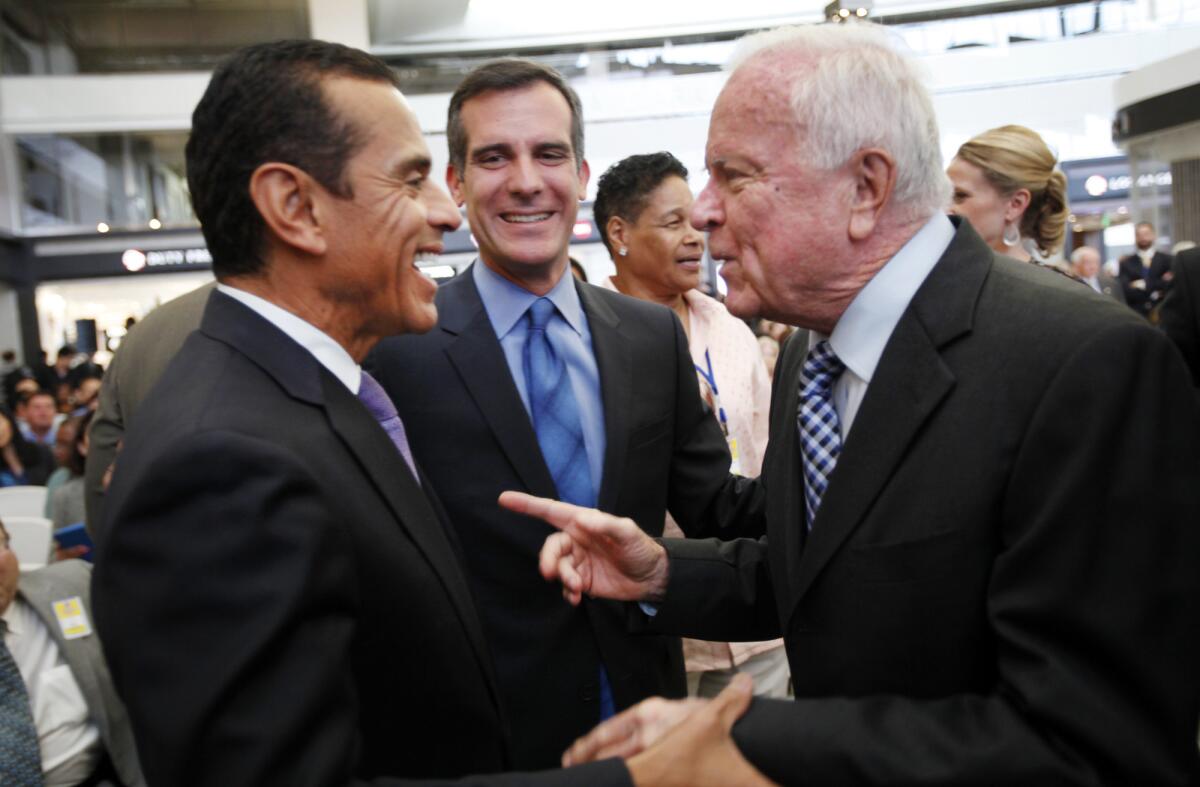
Former L.A. Mayors Antonio Villaraigosa, Eric Garcetti and Richard Riordan.
Most political observers in L.A., however, are confident that the city’s future is not conservative.
The DSA, a decentralized anti-capitalist group, has made inroads in L.A. as it advocates for rental protections, defunding the police and a Green New Deal. Over the last six years, Angelenos have elected four DSA-backed City Council members and a DSA-recommended city controller.
“L.A. is clearly a city that is steadily moving to the left,” said Jim Newton, executive director of UCLA Blueprint magazine and a veteran political journalist who worked for the L.A. Times for 25 years.
“People are unhappy, but they’re not unhappy enough to vote for a Republican,” Guerra agreed. “They have been looking at the other alternatives: the Democratic Socialist party that is the challenge to the establishment.”
Some caution, however, that it is too early to map out Los Angeles’ political future.
“I think everything is up for grabs,” Sonenshein said, noting that he expected more competition for Latino and Asian voters, young voters and even older Democrats. “Certainly, younger voters are completely up for grabs. It’s just hard to know where they’re going to end up. … Small shifts in the primary can make a very big difference.”
L.A. rose as the Republican stronghold of California.
As a massive influx of white Midwesterners descended on L.A. after the 1885 opening of the Santa Fe railroad, conservative white civic leaders — including the owners of the L.A. Times — touted the city as the GOP counterpart to progressive, union-friendly San Francisco. Liberal Black and white Angelenos were shut out of citywide power.
The purpose of the Bradley coalition, Sonenshein said, was to “break open the stranglehold of a city establishment that was … unresponsive to the diversity of the community.”
Bradley, an even-keeled attorney and former police officer, was well positioned to bridge L.A.’s racial divides. As a police community relations officer, he had cultivated relationships with Jewish business owners. He was an early supporter of L.A.’s first Latino City Council member, Edward Roybal, and had already united Black and Jewish Angelenos in the 10th District as the city’s first Black City Council member.
L.A. City Councilman Tom Bradley and Mayor Sam Yorty in a TV studio just before the start of a debate during their 1973 campaign for mayor.
(Los Angeles Times)
After his 1973 win, as waves of new immigrants moved to L.A., Bradley brought more Latinos and Asian Americans into the fold. A conscious alliance of minority communities reelected Bradley, helping him become the longest-serving mayor in L.A. history.
But by the 1990s, frustration had swelled over L.A.’s crime, pollution and poverty. Bradley’s popularity plummeted after Black motorist Rodney King was brutally beaten by LAPD officers in 1991 and riots erupted across the city the next year when a largely white jury acquitted the officers. More than 60 people were killed.
As Bradley prepared to step down, Democrats struggled to find a successor who could unite liberal Black, white, Latino and Asian Angelenos.
Still, some were skeptical that Richard Riordan, a Republican venture capitalist, would win. Riordan was a moderate, easygoing philanthropist, Newton said, and Republicans at the time made up 30% of L.A.’s registered voters, double their number now. Even so, he noted, “there were people who thought this is just not what this city is, the city doesn’t need a multimillionaire white guy Republican.”
Voters thought differently. After securing the support of San Fernando Valley Republicans and Democratic centrists and making small inroads among Latinos, Riordan became the first Republican L.A. mayor elected in 36 years.
The Bradley coalition was “a spent force,” Sonenshein said. “But new players were emerging in prominent roles, working to forge new types of alliances and, at times, temporary coalitions.”
When California voters in 1994 passed the anti-immigrant Proposition 187, which barred undocumented immigrants from receiving many public services, Latino participation in L.A. politics surged. Asian Americans also began to rise.
But after Bradley, there was no single Democratic coalition in the city.
When Antonio Villaraigosa challenged James Hahn in 2001 and 2005, Sonenshein said, Hahn drew support from the Black community and the Valley, Villaraigosa from Latinos and liberals. When Eric Garcetti defeated Wendy Greuel in 2013, Greuel had strong support in Black South L.A., but Garcetti managed to win with the white and Latino vote.
“People have to piece it together, because the Democrats have such a larger edge in L.A. than they did in Bradley’s age,” he said. “It’s almost a kind of entrepreneurial thing: You’ve got to go out and build a majority each time, and those alliances shift.”
There were still challenges from the right. But in 2022, when billionaire real estate developer Rick Caruso ran against Bass on a centrist law-and-order platform, he switched his party affiliation from Republican to Democratic. Some saw that as a recognition that a Republican could not win in L.A.
Like Bradley, Bass is a pragmatic politician with a long record of forging relationships behind the scenes.
In the 1990s, she founded the grassroots Community Coalition to combat the public health crises that plagued South L.A. amid the crack-cocaine epidemic.
But as Bass presides over a City Hall that is almost entirely dominated by Democrats, discontent is spreading. Polls show a substantial portion of the electorate views her unfavorably because of her handling of the Palisades fire.
Guerra said the lack of affordable housing had created a unique moment: Even after the King riots, the Northridge earthquake and the O.J. Simpson trial, he said, Angelenos were still invested in living in the city.
“You could still buy a home. You could still see yourself nurturing L.A., but also L.A. nurturing you,” Guerra said.
For Guerra, centrist Democrats have been so successful at inclusion they have struggled to identify priorities.
“There are too many members of the coalition and there are too many of the members who have veto power, which then leads to paralysis,” Guerra said. “The paralysis is what’s led to the lack of innovation, the failure to pursue policies that make sense for the greater good.”
The dysfunction, he said, is particularly clear on housing.
“Every NIMBY in every neighborhood, in every council district, is like, ‘We want housing, but not here,’” Guerra said. “That, replicated everywhere, leads to paralysis and no housing.”
It has also led to renters becoming a rising political constituency — a big shift from the Bradley era, when homeowners were the city’s dominant voters.
But that doesn’t mean working-class Angelenos have a bigger voice now in L.A. politics. Instead, the middle class is splintering along generational lines.
“Middle-class young folks graduating from college, who have extraordinary amounts of debt, cannot buy homes,” said Sara Sadhwani, a politics professor at Pomona College. “The city still has issues with food insecurity and low-wage worker protections, but those are not the issues dominating anymore.”
While L.A. Democrats have long focused on assembling coalitions of Black, Latino, Asian American and other minority activists, Sadhwani said, what was often not spoken about was the role of the city’s “nonprofit industrial complex.”
“Nonprofits have a huge role,” she said, noting that Bass came of that world. “Their politics are shifting.” Before 2020, she said, progressives focused on racial justice, immigration reform, and creating an economy that respects the work of immigrants; now, the focus is largely on homelessness and policing.
“What it means to be a progressive today,” Sadhwani said, “is actually quite different from what it was to be a progressive even just five years ago.”
Even as L.A. is clearly still a Democratic stronghold, Republicans say there are signs that some Angelenos are not in lockstep with liberal activists.
Donald Trump’s share of the vote in L.A. in the last three presidential elections, they note, climbed from 16% in 2016 to 21% in 2020 and 27% in 2024. And there is evidence that voters, at least at the county level, are questioning some criminal justice reforms.
Los Angeles Mayor Antonio Villaraigosa, pictured here on the cover of Newsweek, helped reshape the city’s Democratic coalition
(David McNew / Getty Images)
With Republicans making up about 15% of L.A.’s registered voters, Rob Stutzman, a GOP strategist, said Pratt might win enough independent voters and disaffected Democrats to make it past the primary. But he would then struggle to get more than 50% in the runoff.
“The math just isn’t there, but in addition to that it’s the stink of Trump,” Stutzman said. “The tribal politics of today make a Republican victory in L.A. very difficult.”
Raman stunned L.A.’s political establishment in 2020 when she was elected L.A.’s first DSA-backed City Council member.
As she runs for mayor, the Los Angeles chapter of the DSA hopes to expand its power as it endorses a new slate of 2026 candidates for City Council, city attorney and L.A. school board.
Richard Riordan, the last elected Republican mayor of Los Angeles.
(Los Angeles Times)
Raman is clearly betting that a big, viable part of the electorate is to Bass’ left, Newton said.
The DSA, Newton said, had done a good job in recent years of identifying renters’ interests and advancing them to usher in a “newer, younger, probably more progressive edge to the city’s politics.”
But so far, Raman, who has aligned herself with the DSA on issues such as renter protections but deviated on police spending, is struggling to unite the organization.
The Harvard and MIT graduate caught the DSA and her fellow City Council members off guard when she entered the mayoral race just before the filing deadline.
After building momentum, the DSA’s failure to rally around a 2026 mayoral candidate could hurt the movement for several election cycles, Guerra said.
“This dissension is setting them back,“ Guerra said. “They really do have an opportunity to elect a DSA mayor.”
Bass has seized on Raman’s lack of support in City Hall to critique her coalition-building skills.
“If you want to be the mayor and you can’t get along with people who are your colleagues on council,” Bass said recently, “I don’t know how you’re supposed to govern at all.”
In the end, the outcome of L.A.’s mayoral race may not depend so much on Bass’ ability to inspire her traditional Democratic coalition. The question is whether a new generation can find a way to represent a mass of Angelenos with bold new visions and coalitions of their own.
Good morning, and welcome to L.A. on the Record — our City Hall newsletter. It’s David Zahniser, with an assist from Noah Goldberg, Melissa Gomez and Sandra McDonald, giving you the latest on city and county government.
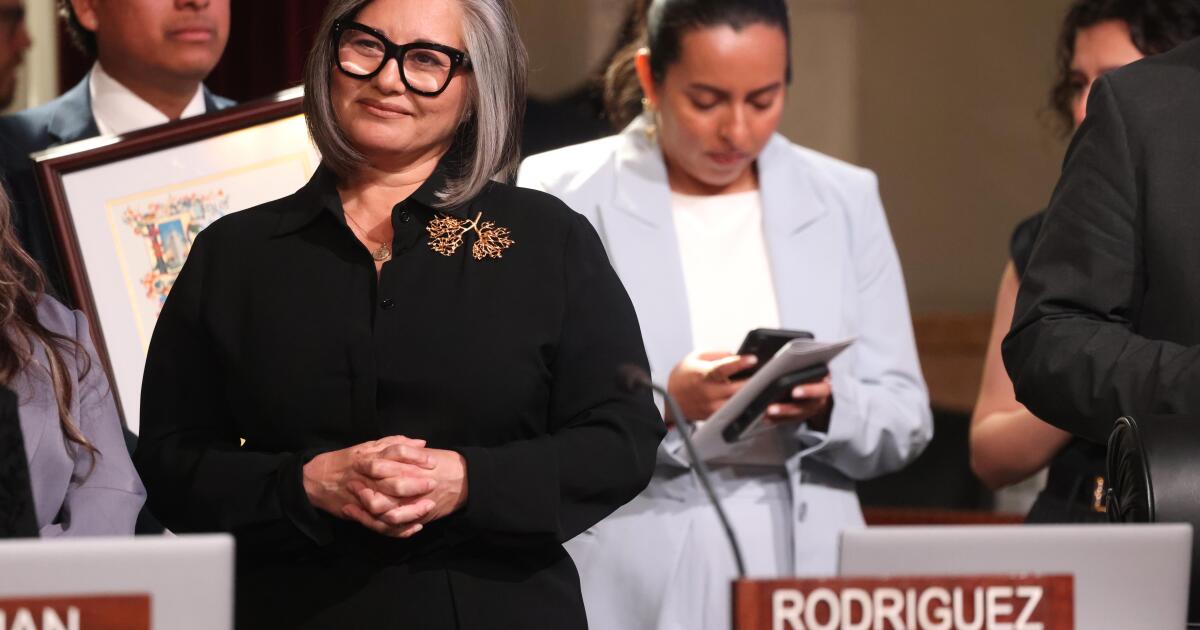
Los Angeles City Councilmember Monica Rodriguez has had some pretty tough words over the years for Mayor Karen Bass and her administration.
Rodriguez, who is running unopposed in Tuesday’s election, repeatedly criticized Bass’ Inside Safe program, which moves homeless people indoors, saying it lacked financial oversight. She voted against the mayor’s budget last year, saying too much was going to Inside Safe. She was especially harsh in the wake of the Palisades fire, saying that Bass’ team botched the first few months of the recovery.
That might make her an ideal person to endorse Councilmember Nithya Raman, who is running to unseat Bass in Tuesday’s primary and has leveled similar critiques. Instead, Rodriguez has emerged as an unexpected ally of the incumbent.
During the campaign, Rodriguez has appeared with Bass at events in Eagle Rock, Pacoima and even Sherman Oaks, located in Raman’s district. She popped up in a campaign flier from Latinos Por Karen Bass. And she’s been dinging Raman over everything from economic development to policies around outdoor barbecues.
Rodriguez explained her decision to support Bass in an interview, saying she views the incumbent as being far more willing to entertain opposing views than Raman — and understands that “not everyone thinks the same way.” Bass also is more consistent on the issues, Rodriguez said.
You’re reading the L.A. on the Record newsletter
Sign up to make sense of the often unexplained world of L.A. politics.
By continuing, you agree to our Terms of Service, which include arbitration and a class action waiver. You agree that we and our third-party vendors may collect and use your information, including through cookies, pixels and similar technologies, for the purposes set forth in our Privacy Policy such as personalizing your experience and ads.
Raman, by contrast, has shifted her positions on police spending, the tax hike known as Measure ULA and even who should be the next mayor, jumping into the race after she endorsed Bass, Rodriguez said.
“I don’t know what she stands for,” she said.
Raman’s campaign declined to comment on Rodriguez’s remarks. But former former Deputy Mayor Rick Cole, a Raman supporter, said he is surprised to see Rodriguez line up behind Bass, given how critical she has been over the years.
“Monica is a self-described maverick, so it’s ironic that she’s thrown in with the establishment on this. But sometimes personalities play a role,” he said.
Rodriguez had been talked up at one point as a possible opponent of Bass in this year’s election. If Bass wins a second and final term, the mayor’s race would be wide open in 2030.
Pratt accuses Bass of electioneering
It was a small yet upbeat event staged by Bass’ reelection campaign: The mayor, accompanied by supporters chanting “four more years,” walking up to an official drop box and putting in her ballot.
That miniature rally, staged last weekend near the city’s Memorial Branch Library, was captured on video and circulated by Bass’ campaign. But it has drawn a complaint from mayoral candidate Spencer Pratt, who accused the mayor of violating a state law prohibiting electioneering near a polling place or voter drop box.
In a complaint filed with the city clerk, Pratt attorney Peter McNulty said Bass and her supporters improperly solicited votes, waved campaigns signs and “engaged in blatant electioneering” near a voting location.
“Such clear violations of electioneering restrictions show a reckless disregard for the rule of law and an apparent belief that she need not comply with relevant restrictions that apply to all other candidates,” he wrote.
The Bass campaign pushed back on those allegations, saying the video features footage from two locations near the drop box. The portion that featured the Bass campaign signs was filmed 200 feet away — twice the distance required by law, said Alex Stack, a Bass spokesperson.
“Spencer is just mad that his supporters are AI cartoons and we have real Angelenos,” he said. “We follow the rules.”
Pratt’s lawyer said in his letter that he wants the city to investigate. He also filed a complaint with the state, citing the state election law that prohibits the dissemination of “visible or audible electioneering information” near a polling place or drop box.
Feldstein Soto flames Airbnb
City Atty. Hydee Feldstein Soto has been getting hit from both directions over the last few weeks.
On one side, a committee with at least $450,000 in funding from the Consumer Attorneys of California has been pumping out campaign ads promoting her opponent, Deputy Atty. Gen. Marissa Roy. On the other, a campaign committee heavily bankrolled by Airbnb is running ads for Deputy Dist. Atty. John McKinney, another opponent in the race.
Feldstein Soto has countered with a television ad that highlights her office’s lawsuit against Airbnb, which accuses the company of engaging in price gouging after the Palisades fire. Staring into the camera, Feldstein Soto said Airbnb and other special interests “are spending millions to try and get rid of me.”
“They think L.A. belongs to them,” she says. “I know it belongs to you.”
Feldstein Soto had raised about $860,000 for her campaign through May 16, compared with about $680,000 for Roy and about $122,000 for McKinney. But those fundraising efforts, which face strict limits under the city’s ethics laws, have been overshadowed by the unlimited spending from Airbnb and the others.
Justin Wesson, senior public policy manager for Airbnb in California, said in a statement that McKinney’s campaign platform is “focused on keeping Los Angeles communities safe and vibrant, including for Angelenos who share their home and their guests that contribute to the local economy.”
In recent weeks, Airbnb has been pushing the city’s elected officials to loosen L.A.’s home-sharing regulations, by allowing owners of second homes to lease their properties on short-term rental platforms.
Airbnb has put big money into other committees, including those that support Tim Gaspar, who is running to replace Councilmember Bob Blumenfield, and Jose Ugarte, who is running to replace Councilmember Curren Price.
Team Raman woos Huang, without success
We mentioned a few weeks back that Raman supporters have been noisily demanding that mayoral candidate Rae Huang drop out of the race, saying she was siphoning left-of-center votes away Raman. Turns out Raman’s campaign was trying to persuade her to pull the plug as well.
Raman campaign strategist Jeff Millman reached out to Huang advisor Bill Przylucki earlier this month about getting the community organizer to drop her mayoral bid, according to Huang spokesperson Emel Shaikh.
The overture from the Raman camp, first reported by LA Material, took place after the May 6 NBC LA debate but before a Fox debate planned for the next week, Shaikh said.
“She never really entertained the idea,” Shaikh said.
Raman, speaking with reporters on Friday, said she knew that people from both campaigns were conferring.
“I’m sure [Huang] was aware of it as well,” she said. “And I think we were really talking about how to achieve a bold, progressive vision for Los Angeles. Both of us got into this race because we felt a deep sense of dissatisfaction with the status quo.”
Millman, a veteran of L.A. politics, worked for former Mayor Eric Garcetti and was a spokesperson for Austin Beutner’s mayoral bid before his campaign ended in January. After Beutner dropped out, he moved to the Raman campaign. Przylucki is the former executive director of the progressive nonprofit Ground Game LA.
Supporters of Raman contend that Huang doesn’t have a path to victory — and could deprive Raman of a chance to compete in the Nov. 3 runoff. Asked whether she feels the same way, Raman said she is focused on getting her voters to the polls.
At this point, Raman is neck and neck with Bass and slightly ahead of Pratt, according to a poll from the UC Berkeley Institute of Governmental Studies, which was co-sponsored by The Times.
State of play
— A THREE-WAY RACE: Bass, Raman and Pratt are locked in a tight three-way contest, with the mayor holding a statistically insignificant lead in the run-up to Tuesday, the latest UC Berkeley-L.A. Times poll found. Bass had 26% support from likely voters, followed by Raman with 25% support and Pratt at 22%.
Bass, appearing at City Hall Thursday, said she’s not worried about failing to make the top two, telling an audience there are many polls that show different results. “I feel confident about Tuesday,” she said.
— AN EMBATTLED MAYOR: The Times took a look at Bass’ first term and the events that have put her political future in peril. Although some point to the city’s handling of the massively destructive Palisades fire, others say her troubles go much deeper.
— READING THE ROOM: While Bass has had difficulty managing the city, Raman faces a different issue: her struggle to forge working relationships with colleagues and allies. No one on the council, including those backed by the DSA, have endorsed her. Raman allies downplayed the issue, saying her strength is her independence.
— CUTTING CRIME: Even with L.A. experiencing fewer murders than at any point in 60 years, crime remains a potent issue in the mayor’s race. Pratt has been portraying the city as a lethal hellscape. Meanwhile, even some of Bass’ supporters have been shocked by how “aggressively pro-police she has been,” said former Councilmember Mike Bonin, who heads the Pat Brown Institute at Cal State, LA.
— DOWNTOWN IN THE DUMPS: Meanwhile, downtown business owners say they are struggling with crime, homelessness and aging infrastructure — all issues that have become central to the mayor’s race.
— LOVE, MOM: The mother of city controller candidate Zach Sokoloff has pumped at least $7.5 million into an independent expenditure campaign supporting him as he seeks to unseat City Controller Kenneth Mejia. The incumbent has accused the Sokoloff family of trying to buy the seat. Sheryl Sokoloff has declined to comment.
— SHERIFF SHOWDOWN: Los Angeles County Sheriff Robert Lunais in a rematch against former Sheriff Alex Villanueva, while also facing six other opponents. (Villanueva was unseated by Luna in 2022.) The top two vote getters will head to the Nov. 3 runoff.
— WAITING FOR THE WAGE: The council finalized its plan to delay a series of minimum wage hikes for hotel and airport workers this week, ensuring that the wage won’t reach $30 until January 2030 instead of July 2028.
— D&D AND DSA: Democratic Socialists of America, whose L.A. chapter is campaigning for five candidates in the city election, took in $30,000 at a Dungeons & Dragons-themed fundraiser. The candidates took part in the action, playing fantasy characters who still keep one foot in the political world.
— CALLING THE COPS: Looking to prevent copper wire theft, the Department of Water and Power is seeking to create its own police force.
— OUT OF THE FRYING PAN: The council on Wednesday confirmed Gabrielle Amster as the latest general manager for the animal services department, which oversees the city’s network of animal shelters. Amster had been serving as vice president of shelter engagement for DocuPet, a national pet registration business, according to her resume.
QUICK HITS
Where is Inside Safe? Bass’ signature initiative to tackle homelessness did not launch any new encampment operations this week.
On the docket next week: The election, obviously! If you haven’t cast a ballot by mail, make sure you show up at a voting center!
Stay in touch
That’s it for this week! Send your questions, comments and gossip to LAontheRecord@latimes.com. Did a friend forward you this email? Sign up here to get it in your inbox every Saturday morning.
I was willing to give the young novice a primer on what a mayor can and can’t do, and let him know City Hall is a reality show like no other he’s been on. But Spencer Pratt didn’t call me in response to my column last week.
I did, however, hear from a slew of his most ardent supporters.
Steven C. had this to say: “You’re a left-wing idiot, and … it’s time for you to retire. You’re a joke!!! You always have been!!! God bless Spencer Pratt and the 45th and 47th President of the United States Donald Trump!!!!!”
You may be onto something, Steven!!! I’ve been thinking about retiring!!!! But then a former reality TV star like Pratt comes along and tells Vanity Fair he had a chat with God, who told him He wants Pratt to be mayor of L.A!!!!! With people like this running for office, how can I retire?!!!!!
R.W. wrote to say: “You say Spencer has never done anything in his life…What credentials do you have? From what I’ve read about you, you are a lousy commie journalist who has never accomplished anything in your life!!”
Just recently, R.W., I replaced a broken toilet tank flush valve and I learned two Willie Nelson songs on the guitar. That’s not nothing.
Peter did not mince words: “Your piece on Pratt is a hit piece filled with bull— . You should go f— yourself before someone takes you out, which is the appropriate response to a s—bag like yourself. So please f— off and drop dead, which is exactly what you deserve.”
Peter, I did drop dead once. Cardiac arrest. While on the other side, I saw God, who told me to snap out of it because He was going to tell Spencer Pratt to run for mayor. Who knew God had a defibrillator?
All of these, by the way, were actual emails, and there were many more just like them. But it’s only fair to note that despite the fulminating knucklehead wing of Pratt’s posse, he’s tapped into a justifiable sense of frustration with City Hall, given homelessness, the Palisades inferno and budget issues that squeeze all manner of basic city services.
That’s why Mayor Karen Bass is paddling furiously, trying to keep her political career afloat. In the latest UC Berkeley-L.A. Times poll, Bass is at 26%, Nithya Raman at 25% and Pratt at 22%. That’s so tight, it appears that no one will get the 50% needed to win outright, and if we get a top-two runoff, it’s not clear who will go to the dance.
So as we close out the primary, with the election on Tuesday, five talking points come to mind.
Which candidate knows the city best?
Los Angeles has 114 distinct neighborhoods spread across 470 square miles (that’s 10 times the size of San Francisco), with an estimated 220 languages spoken. Diversity is a defining characteristic, and roughly half the population is Latino, which makes it a shame there’s no Latino candidate for mayor, especially given the raids and roundups by President Trump.
A mayor doesn’t have to speak six languages and know every corner of the city, but residents want to be seen and heard, and feel like they’re understood and represented.
Raman is well-versed on homelessness policy, and she’s spot-on about the need for greater urgency in problem-solving, but as my colleague Noah Goldberg reported, constituents in her district complain that they haven’t seen enough of her.
As I said, Pratt has wisely targeted municipal failure. But in the realm of outsider candidates with Republican credentials, Rick Caruso, who ran against Bass last time, was comfortable whether he was in the Valley, South L.A. or anywhere in between. And he easily connected with people. Would Pratt be a tourist in his own city?
By virtue of her job the last four years, Bass — who raised a blended Black and Latino family — knows the city best, although her unfavorability rating is a big problem.
What about the other candidates?
In the aforementioned poll, minister and housing activist Rae Huang had 9% and former educational technology businessman Adam Miller had 5%. Virtual unknowns, neither had a legit chance of winning, but they could be spoilers for one of the top three candidates.
If only I had a nickel for every time a reader suggested that.
By 101 measures, Los Angeles is one of the great cities of the world and California has built the world’s fourth-largest economy while leading on climate change, so apocalyptic diagnoses are a bit off the mark.
Also, local elections are nonpartisan. You don’t run for mayor as a D or an R.
And yet it’s true that Democrats and their policies and sensibilities rule the day, and they have a lot to answer for in Los Angeles and in California.
But would the same critics suggest that in conservative cities like Fresno and Bakersfield, which have their own homelessness and other problems, Republicans are to blame?
When it comes to housing, poverty, healthcare and streets occupied by people who are addicted or mentally ill, the failures go back decades, touch all levels of government, and cross party lines.
Have I given up on Los Angeles?
When I pointed out that Pratt seemed unaware of these complexities, and of the structural limits of mayoral power, readers suggested he was rising to the challenge while I was giving up on L.A.
Not at all. I care about L.A. enough to hold its leaders to a higher accountability, and to scrutinize posers and pretenders who think they can do a better job.
My advice for the next mayor.
Fix what’s broken, celebrate what works and take responsibility for what doesn’t.
Now let me try one more time:
Spencer, give me a call.
You can’t tell us you had a conversation with God about running for mayor and not share more details.
Did God scold you for referring to the mayor as Karen “Basura,” which means trash in Spanish?
Did He say we should pull out of the ‘28 Olympics, or have any advice on how to fill potholes and fix sidewalks?
If you’re having regular conversations about City Hall with the Father, the Son and the Holy Spirit, we’re dying to know: