autonomous

Autonomous Cessna Caravan Air Ambulance To Be Tested By U.S. Military

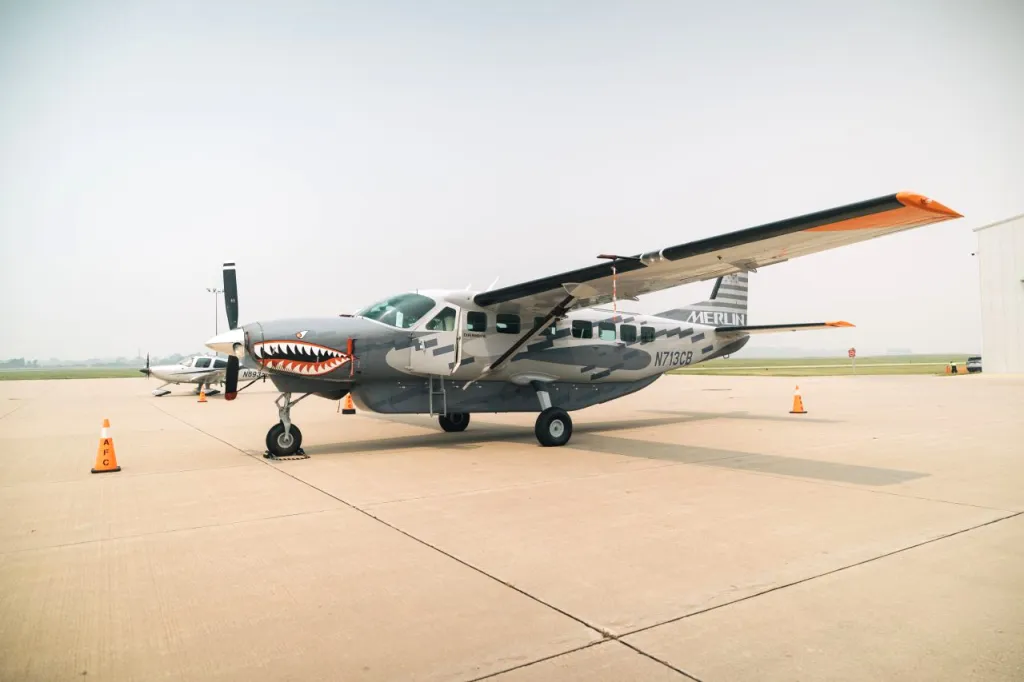
U.S. Africa Command (AFRICOM) is set to demonstrate a potential autonomous casualty evacuation (CASEVAC) capability in Morocco. The test will involve a Cessna Model 208B Grand Caravan with an artificial intelligence (AI) driven ‘copilot’ from Merlin Labs.

The ability to send out pilot-optional or even entirely uncrewed aircraft to rescue injured personnel could be extremely valuable for supporting U.S. operations in Africa. American forces on that continent are routinely deployed in remote areas where immediate access to medical care can be very limited. Autonomous CASEVAC capabilities could also be very relevant in other locales, like the Pacific, where future operations could be widely spread out across constellations of small islands.

Merlin Labs announced the planned capability demonstration today, which is being conducted under the initial phase of AFRICOM’s Autonomous Casualty Evacuation (CASEVAC) Industry Technology Challenge. The test is currently scheduled for some time in “early U.S. government fiscal year 2027.” That fiscal cycle began on October 1.

Merlin has already been using the Cessna Grand Caravan seen here for years now to support the development of autonomous capabilities. Merlin Labs

“The demonstration will encompass the full mission, from initial tasking and flight planning continuing through autonomous departure and enroute flight to an austere casualty collection site,” according to Merlin’s release. “Following simulated patient loading, the aircraft will conduct its return mission, autonomously completing the flight and landing back at the designated location.”

AFRICOM has awarded Merlin a very small $500,000 contract to support this demonstration. The company has already received millions of dollars in funding from the U.S. military for separate autonomy projects. This includes the development of autonomous capabilities for C-130-type aircraft for U.S. Special Operations Command (SOCOM) and similar efforts in support of the U.S. Air Force’s KC-135 tanker fleet. Just yesterday, Merlin announced a new deal with SOCOM, valued at $8.9 million, for continued C-130 autonomy work.

Merlin has said previously that its flagship autonomy package, called Merlin Pilot, has flown on at least four different types of aircraft already. Merlin Pilot is designed to be scalable in form and function, and can be configured to enable pilot-optional flight capability. The system can also increase safety margins during crewed flight operations by reducing task burdens (and resulting fatigue) for the humans onboard and helping alert them to potential technical faults.

Merlin Lands an Autonomous Cessna Caravan at Oshkosh AirVenture thumbnail

Merlin Lands an Autonomous Cessna Caravan at Oshkosh AirVenture

“Merlin’s demonstration [for AFRICOM] is planned to show how Merlin Pilot can bring onboard autonomy to aircraft supporting CASEVAC missions, managing flight planning, navigation, contingency response and mission completion without relying on a remote ground station or flight crew,” the release adds. “The system is designed to plan the optimal route from an operator’s tasking, replan dynamically around hazards, communicate with air traffic control using natural language processing, and continue safely along its authorized plan if a communications link is lost.”

The Grand Caravan’s “large cargo door and flat-floor cabin will allow ground level litter loading without rotor wash, winching or special equipment, and its cabin will be configured with an air ambulance medical module providing oxygen, power, and mounting for patient monitoring equipment,” the release also notes. “Merlin believes there is a clear follow-on path to operational scale using a [Beechcraft] King Air variant, which would provide twin-engine redundancy, greater payload capacity, and additional cabin space for multiple litter patients, medical equipment, and an in-flight attendant. The same architecture could also support autonomous logistics and personnel movement across dispersed operating locations.”

A stock image highlighting the Cessna Grand Caravan’s large cargo door. Cessna/Textron

As already mentioned, the use case for autonomous CASEVAC capabilities to support U.S. operations in Africa is clear-cut. The scale and scope of AFRICOM operations means that American forces are often dispersed in small groups at far-flung operating locations far from higher-level medical care. Options for getting individuals to a hospital, even after accidents in relatively low-risk areas, can be extremely limited. Medical professionals often talk about the so-called “golden hour,” which refers to the first 60 minutes after a serious injury occurs. The chances of saving that person’s life or otherwise preventing serious permanent damage are highest within that window.

“AFRICOM’s area of responsibility spans vast distances, and security threats can prevent access to nearby medical facilities, often forcing longer and more dangerous patient transport. In these conditions, transporting a wounded noncombatant or service member to medical care is both time-critical and logistically complex,” Merlin says in its release. “Conventional casualty evacuation relies on crewed aircraft, while remotely piloted systems require persistent command-and-control links that may be unavailable in austere or contested environments. The challenge set forth by AFRICOM seeks autonomous solutions that can accelerate access to a higher level of care while reducing the number of personnel exposed to risk.”

This was all rammed home in a very public fashion nearly a decade ago by the infamous ambush of American forces near Tongo Tongo in Niger, in which four U.S. Army soldiers died. The only immediate aerial CASEVAC support available in that instance was provided by contractors operating from the Nigerien capital Niamey more than 100 miles away.

A grainy screen capture from the U.S. military’s official video briefing on the Tongo Tongo ambush showing a contractor-operated Bell 214ST helicopter. US Military

Issues relating to ready access to higher-level medical care, as well as contested logistics chains, together with what is commonly referred to as the ‘‘tyranny of distance,’ are not limited to U.S. operations in Africa. Any high-end fight against China in the Pacific could easily see American forces spread across very broad areas, with established facilities of any kind being few and far between.

Furthermore, the U.S. Marine Corps and the U.S. Air Force, in particular, are envisioning future operations in that region being conducted in a highly distributed manner utilizing austere forward operating locations to create targeting complications for the enemy. The war with Iran has only underscored the kinds of threats and logistics challenges U.S. forces should expect to be faced with in an even larger-scale conflict in the Pacific.

With all this in mind, the U.S. Air Force has already been experimenting with Cessna Grand Caravans with semi-autonomous capabilities as a path to new distributed logistics capabilities, including in the Pacific.

demonstration of autonomous flight capabilities in AGILE FLAG 24-1 thumbnail

demonstration of autonomous flight capabilities in AGILE FLAG 24-1

As noted earlier on, Merlin, specifically, has been working for years now to demonstrate new degrees of autonomy in other existing U.S. aircraft. In September, Merlin and Textron (which owns the Cessna brand) also announced a new partnership to develop a cargo-carrying drone derived from the Cessna 408 SkyCourier.

Introducing SkyCourier UX thumbnail

Introducing SkyCourier UX

All that being said, the planned AFRICOM autonomous CASEVAC demonstration, and the paltry amount of funding put toward it, highlights how the U.S. military has been lagging behind in this arena.

China, especially, has been surging forward in the development of fully uncrewed logistics aircraft, which could be adapted for aeromedical and other missions in the future. Several Chinese cargo drone designs are flying now, including types that are significantly larger and more capable than a Cessna Grand Caravan. China’s People’s Liberation Army (PLA) would be faced with its own logistical and other challenges in any future conflict in the Pacific region.

China's New 7-Ton Cargo Drone Completes Maiden Flight thumbnail

China’s New 7-Ton Cargo Drone Completes Maiden Flight

China's unmanned transport aircraft completes maiden test flight thumbnail

China’s unmanned transport aircraft completes maiden test flight

In recent months, Ukraine has also demonstrated uncrewed CASEVAC capabilities in support of real combat operations using large multi-rotor drones. The U.S. military has explored broadly similar platforms in the past. However, these uncrewed aerial systems are designed for much more localized operations compared to what AFRICOM is now looking to demonstrate in Morocco.

МИ ЕВАКУЮВАЛИ ДВОХ ПОРАНЕНИХ ДРОНОМ STARGATE thumbnail

МИ ЕВАКУЮВАЛИ ДВОХ ПОРАНЕНИХ ДРОНОМ STARGATE

The outcome of the upcoming demonstration of the Merlin Pilot-equipped Cessna Caravan could help spur further interest within the U.S. military in new autonomous aerial CASEVAC and logistics platform. At the same time, it shows U.S. military efforts to pursue these capabilities remain limited despite the clear use cases already being made by America’s chief global competitor China.

Contact the author: joe@twz.com
Joseph is TWZ’s Deputy Editor, helping to oversee the site’s highly experienced and dedicated team, while also writing informative and impactful defense and national security content. He lives right in the thick of it in the Washington, D.C. area.


Source link

How The U.S. Army’s ‘Navy’ Aims To Go More Autonomous With Its Vessels In The Pacific

The U.S. Army wants to infuse new autonomous capabilities into its current and future fleets of amphibious landing ships and other watercraft. The service is also aiming to acquire up to 100 new purpose-built uncrewed surface vessels (USV). The maritime assets the service has now, often referred to as ‘the Army’s Navy,’ are obscure and generally underappreciated. However, the small force offers an important additional set of naval logistics capabilities, especially for any future fight in the Pacific, which could be further bolstered with optionally-crewed or entirely uncrewed platforms.

Army Maj. Gen. Frederick Crist, head of 8th Theater Sustainment Command (TSC), issued plans for future autonomous watercraft capabilities during a talk last week during a talk at the Association of the U.S. Army’s (AUSA) main annual symposium. 8th TSC, which has its main headquarters at Fort Shafter in Hawaii, is one of the top formations tasked with managing U.S. military logistics across the Pacific.

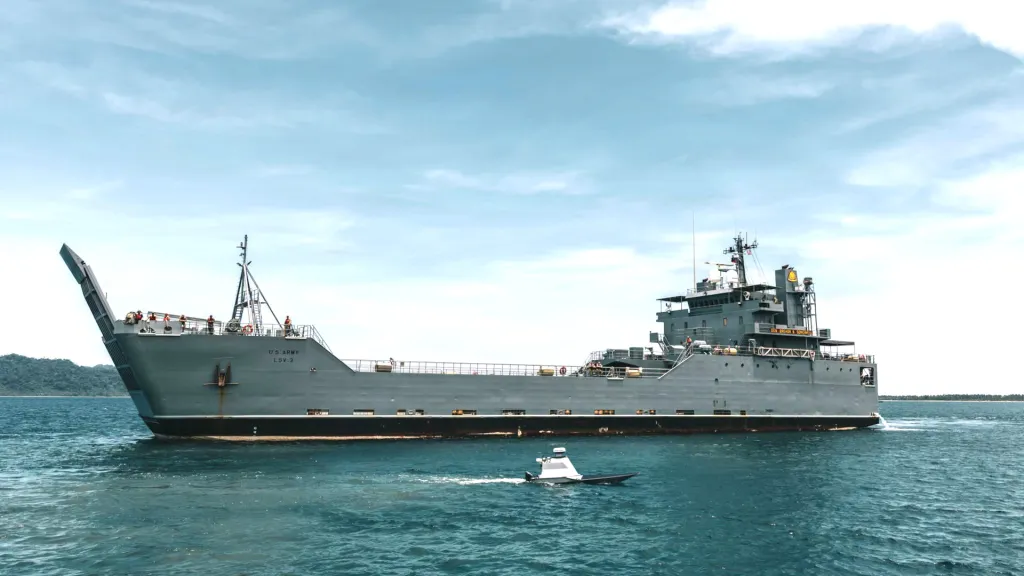
An uncrewed surface vessel (USV) passes by the US Army’s General Frank S. Besson class Logistics Support Vessel USAV General Brehon B. Somervell. US Army

“In order to be able to increase theater distribution, we have the two composite watercraft companies, at end state there, west of the IDL [International Date Line],” Crist explained, referring to the Army’s future planned maritime force posture in the Pacific. “We continue partnering with industry to be able to move into autonomous watercraft systems to be able to conduct other means of maritime distribution.”

To take a step back quickly, as part of its broader regional role, 8th TSC also has forward-deployed elements in Japan. This includes the 5th Transportation Company, which is currently organized as what the Army calls a composite watercraft company. As of 2024, the unit had a pair of General Frank S. Besson class Logistics Support Vessels (LSV), as well as 10 smaller Landing Craft Utility (LCU) type vessels and four small tugs, according to the Government Accountability Office (GAO).

The Army has eight LSVs, in total, and these are by far its largest and most capable ships. The two youngest LSVs, which were acquired in the mid-2000s, also form a distinct subclass, and their design is optimized for long-distance open-ocean operations, as you can read more about here. It’s not immediately clear which LSVs are currently assigned to the 5th Transportation Company. The unit is also set to receive new Maneuver Support Vessel (Light) landing craft.

Examples of the original LSV design, at left, and the open-ocean-optimized design, at right. An LCU-type landing craft is also seen at far right. US Army

Until very recently, the 10th Support Group (Regional), headquartered in Okinawa, was more directly responsible for overseeing forward-deployed Army logistics units in Japan. Earlier this month, the Army performed a so-called ‘reflagging’ of that formation, a largely administrative process that transformed it into the 45th Sustainment Brigade.

As part of the reflagging of the 10th Support Group into the 45th Sustainment Brigade, the Army has also been pushing ahead with plans for “the standup of a second composite watercraft company in Yokohama North Dock,” in the port city of the same name on the Japanese home island of Honshu, Maj. Gen. Crist explained last week. “That end state will have two composite water[craft] companies west of the IDL [International Date Line] under the command and control of the 45th Sustainment Brigade.”

A US Army LSV at the pier in Japan. US Army

When it comes to the watercraft assigned to these units, “we’re also moving into the autonomous lane,” Crist added. “Just in August, USARPAC [U.S. Army Pacific] had an opportunity to conduct an experiment by retrofitting an existing commercial vessel, the HOS Resolute [sic; HOS Resolution], with a kit to provide autonomous navigation.”

Maritime autonomy firm Sea Machines was able to integrate its SM300 software package on the HOS Resolution in just nine days for this demonstration. The ship is a 257-foot-long offshore support vessel more typically used to support oil and gas rigs. However, it features a stern ramp and four jack-up legs that also make it well suited to loading and unloading cargo at remote beaches.

A US Army truck drives off the HOS Resolution during the experimenting in August where the ship was fitted with the Sea Machines autonomy package. US Army

For years now, the U.S. Marine Corps has also been experimenting with the HOS Resolution and other similar ships more generally. That service has been using the vessels to help refine its new expeditionary and distributed concepts of operations, which are themselves heavily centered on future conflict scenarios in the Pacific. The Marines have brought those capabilities to Army demonstration exercises in the past, as well.

Another look at the HOS Resolution, in 2023, while operating under contract to the US Marine Corps. USMC

The Army sees the August experiment as a potential stepping stone to integrating increasing degrees into its existing watercraft fleets.

“You could increase the fleet of autonomous vessels by tapping into the existing manned fleet,” Maj. Gen. Crist said. “Put on retrofitting kits to be able to conduct navigation, and then eventually propulsion and engine room activities, and eventually get to a fully autonomous system.”

Even just adding in autonomous navigation capabilities could help reduce the workload for the human crews on Army vessels and provide added margins of safety. Blending autonomy with “propulsion and engine room activities” could improve reliability and reduce maintenance demands. Being able to operate those ships in a fully uncrewed mode, if desired, would open up additional operational possibilities, including just for repositioning ships across the broad expanses of the Pacific.

Army Maj. Gen. Frederick Crist, head of 8th Theater Sustainment Command (TSC), speaks at AUSA last week. US Army

Reduced manning requirements could be especially attractive for the Army’s ‘Navy,’ which is already a very small part of the service’s overall force structure. Last week, Maj. Gen. Crist also talked about further leveraging traditional crewed vessels owned and/or operated by contractors.

“It’s going to be a broad portfolio of systems of systems,” he said of the overall watercraft vision for the Pacific. “Army watercraft with Army Mariners will be, of course, one aspect of it. We also look for the opportunity to be able to leverage USTRANSCOM’s (U.S. Transportation Command) contracting capability to leverage operational support vessels that are commercially owned and commercially operated. We’re considering ways of being able to have commercial vessels that become manned by Army mariners.”

It is also interesting to note here how extremely similar this all sounds to the modifications the U.S. Navy made to the Spearhead class Expeditionary Fast Transport USNS Apalachicola ahead of its commissioning in 2023. However, despite tens of millions of dollars spent and successful demonstration of autonomous capabilities, the Navy curiously decided to put the Apalachicola into service without any plan to make use of these features operationally. There does not appear to have been any effort to integrate these capabilities more broadly within the Spearhead class since then, either.

The Spearhead class Expeditionary Fast Transport USNS Apalachicola. Austal USA USNS Apalachicola. Austal USA

Last year, the Navy struck the four oldest Spearhead class ships from its rolls entirely and has put several others on reduced operating status, ostensibly as a cost-saving measure. The service is still acquiring new Expeditionary Fast Transports, including members of the Expeditionary Medical Ship subclass that feature expanded medical facilities. The Spearhead class was born out of a program specifically to meet Army and Marine Corps requirements, and the ships are regularly used to support those services in the Pacific and elsewhere globally.

The Army also wants to expand its fleets of purpose-built uncrewed surface vessels (USV) for use in the Pacific, as well as elsewhere globally. Just earlier this year, Army Maj. Gen. Gavin Gardner, who preceded Maj. Gen. Crist as head of the 8th Theater Sustainment Command, said he wanted to rapidly acquire as many as 100 drone boats. His vision included larger USVs capable of carrying eight to 10 standardized shipping containers.

“I could see those operating in the U.S. PACOM area of responsibility,” Gardner told reporters at a roundtable in June, according to Military Times. “I think that gives you a ton of operations, inventory in motion, easy to respond. And then because they’re autonomous, and we can work with our partner nations forward, you have those berthed up everywhere from Korea to Japan, the Philippines, Australia, Singapore, Thailand, etc.”

“Clearly, [the autonomous vessels] would be forward in the theater, kind of moving supplies, because we have a constant demand for Army watercraft time now, to deliver equipment and supplies forward in the theater,” Gardner added at that time.

One of the inherent benefits of the Army watercraft fleets, and its LSVs in particular, is their ability to help alleviate the need for the U.S. Navy to meet more localized littoral logistics needs, if they are even available to help in the first place. Navy amphibious and military sealift ships would already be heavily strained by high demand during any major conflict in the Pacific or elsewhere globally. This could easily be further exacerbated by threats to those supply lines. All of this has already been underscored this year by pressure on maritime logistics chains in the context of the war with Iran. The Army’s ‘Navy’ also offers valuable additional capabilities and capacity in non-combat contingencies, such as responding to natural disasters.

Marine vehicles drive off an Army LCU landing craft during an exercise. USMC/Cpl. Ernesto Lagunes

More generally, the Army has been working to expand its use of smaller USVs, including speedboat-like designs, in various roles. The service has clearly been paying close attention to Ukraine’s very successful use of drone boats in one-way kamikaze attacks, as well as ones armed with guns and rockets and examples configured as launch platforms for surface-to-air missiles and weaponized uncrewed aerial systems (UAS).

The 7th Infantry Division, one of the Army’s main maneuver combat formations in the Pacific, just recently experimented with a Ukrainian-developed Magura-series USV during an exercise in Michigan. That particular USV was configured to launch a quadcopter-type drone. Another member of the Magura family was observed being used in a one-way-attack configuration by U.S. Army Green Berets from the 1st Special Forces Group during the annual Balikatan exercise in the Philippines earlier this year.

A Magura-series USV seen in use at the annual Balikatan exercise this year. US Army
Another Magura-series USV in use during Exercise Bayonet Quest 2026 in Michigan. US Army
The Magura USV launches a quadcopter-type drone during Exercise Bayonet Quest 2026. US Army

The Army has also been experimenting with American-designed USVs. The aforementioned recent exercise in Michigan also featured a Saronic Corsair, the same type of USV that the Navy used to rescue the crew of an Army AH-64 Apache attack helicopter that went down in the Gulf of Oman in June. Explosive-laden Corsairs were also used to carry out the first known U.S. kamikaze USV attack, which was launched against a coastal target in Iran in July.

A stock picture of a Saronic Corsair. Saronic

During another separate exercise in the Philippines this year, Salaknib 2026, Army forces used unarmed Rampage USVs from U.S. firm Havoc, as seen below. As part of that exercise, the USVs escorted a crewed General Frank S. Besson class LSV to its destination, heading out in front to help spot potential hazards.

US Army

“There’s all the work that the Department’s already doing with autonomy and autonomous systems that we look to take advantage of in the [Pacific] theater, as well,” Maj. Gen. Crist said at AUSA.

The Navy and the Marine Corps have both been working to grow their operational fleets of smaller USVs, as well as larger ones, in recent years. At the same time, the Navy has suffered years of setbacks and shakeups in its efforts to operationalize bigger and more capable designs. The service awarded contracts for a total of 30 new medium-sized USVs last month in its latest attempt to reverse that trend.

In September, Secretary Pete Hegseth also announced several new initiatives aimed at further expanding use of uncrewed platforms and advanced autonomous capabilities across the U.S. military and all domains. The Pentagon is presently laying the groundwork for the establishment of an all-new top-level Autonomous Warfare Command (AUTOWARCOM), which it hopes to see come to fruition next year.

What is clear now is that the Army’s vision for future watercraft operations, especially in the Pacific, is increasingly autonomous.

Contact the author: joe@twz.com

Joseph is TWZ’s Deputy Editor, helping to oversee the site’s highly experienced and dedicated team, while also writing informative and impactful defense and national security content. He lives right in the thick of it in the Washington, D.C. area.


Source link