CEO Saad al-Kaabi says QatarEnergy may have to declare force majeure on long-term contracts for up to five years.
Published On 19 Mar 202619 Mar 2026
Iranian attacks on Qatar have wiped out 17 percent of its liquefied natural gas (LNG) export capacity, causing an estimated $20bn in lost annual revenue and threatening supplies to Europe and Asia, QatarEnergy’s CEO says.
Saad al-Kaabi told the Reuters news agency on Thursday that two of Qatar’s 14 LNG trains, the equipment used to liquefy natural gas, and one of its two gas-to-liquids facilities were damaged in Iranian strikes this week.
Recommended Stories
list of 3 itemsend of list
The repairs will sideline 12.8 million tonnes of LNG production per year for three to five years, he said.
“I never in my wildest dreams would have thought that Qatar would be – Qatar and the region – in such an attack, especially from a brotherly Muslim country in the month of Ramadan, attacking us in this way,” al-Kaabi said in an interview.
His comments came hours after Iran on Wednesday launched a series of attacks on oil and gas facilities across the Gulf region after the Israeli military bombed its South Pars offshore gasfield.
Tehran has been firing missiles and drones across the Middle East in response to the United States-Israeli war on Iran, which began on February 28.
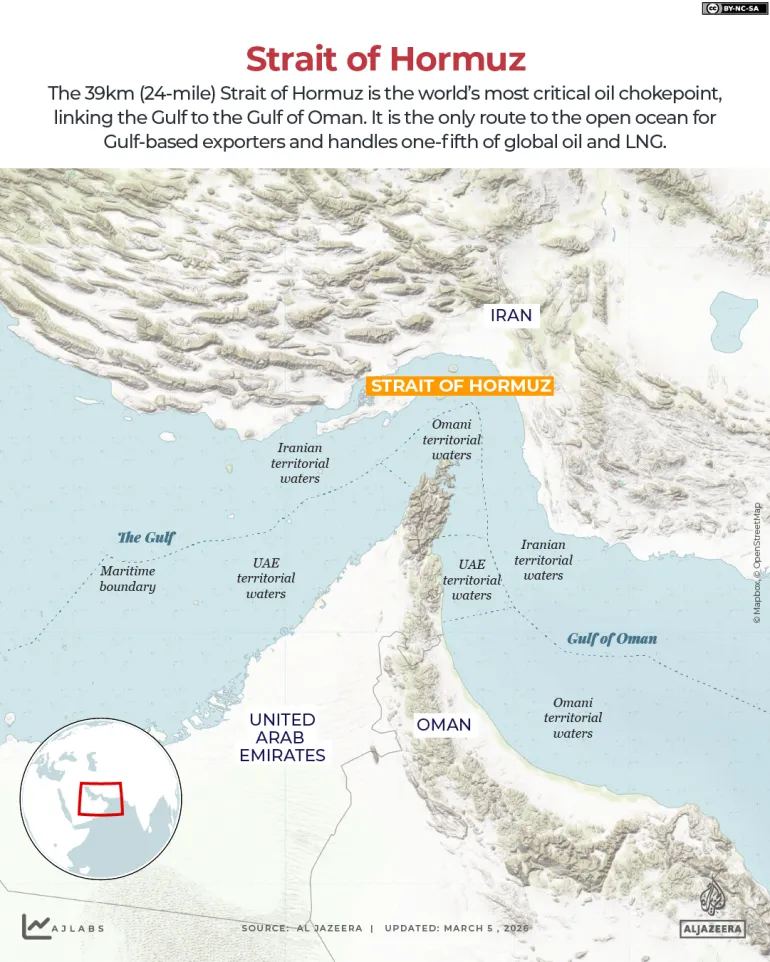
It also has essentially blocked the Strait of Hormuz, a critical Gulf waterway through which about one-fifth of the world’s oil and LNG supplies transit, fuelling soaring petrol prices and global concerns about rising inflation.
Iran’s attacks on energy infrastructure have heightened tensions with its Arab Gulf neighbours, who have condemned the strikes as a violation of international law.
Iranian Foreign Minister Abbas Araghchi said on Thursday that his country would show “ZERO restraint” if its infrastructure is struck again as the Israeli attack on the South Pars gasfield continued to spur condemnation.
“Our response to Israel’s attack on our infrastructure employed FRACTION of our power. The ONLY reason for restraint was respect for requested de-escalation,” Araghchi wrote on X.
“Any end to this war must address damage to our civilian sites.”
‘Stay away from oil and gas facilities’
During Thursday’s interview with Reuters, al-Kaabi said QatarEnergy may have to declare force majeure on long-term contracts for up to five years for LNG supplies bound for Italy, Belgium, South Korea and China due to the two damaged trains.
“I mean, these are long-term contracts that we have to declare force majeure. We already declared, but that was a shorter term. Now it’s whatever the period is,” he said.
QatarEnergy had declared force majeure on its entire output of LNG after earlier attacks on its Ras Laffan production hub, which came under fire again on Wednesday. “For production to restart, first we need hostilities to cease,” al-Kaabi said.
The damaged units cost about $26bn to build, al-Kaabi said. He also told Reuters that the scale of the damage from the attacks has set the region back 10 to 20 years.
“If Israel attacked Iran, it’s between Iran and Israel. It has nothing to do with us and the region,” he said.
“And so now, in addition to that, I’m saying that everybody in the world, whether it’s Israel, whether it’s the US, whether it’s any other country, everybody should stay away from oil and gas facilities.”
March 19 (UPI) — The FBI is investigating Joe Kent, who resigned this week as the counterterrorism director in protest over the war with Iran, over allegations that he leaked classified information, according to reports, while Trump administration officials attack his credibility.
Kent resigned Tuesday as director of the National Counterterrorism Center, a position to which the MAGA supporter and far-right conspiracy theorist with ties to White nationalist groups was nominated in early 2025 by President Donald Trump, stating that “Iran posed no imminent threat to our nation.”
“I cannot in good conscience support the ongoing war in Iran,” he said.
The FBI investigation into Kent predates his resignation, unidentified sources told Semafor, the first to report on the development. The New York Times, NewsNation and others have since corroborated that story.
Kent is the first senior Trump administration official to resign over the war that has divided Republicans and supporters of the president, who campaigned on ending conflicts while warning Americans that if the Democrats were to return to the White House, the United States would be lured into a war with Iran.
Little information about the allegations against Kent was known. The revelations of the investigation come as the White House was attempting to undermine and dismiss the man Trump had repeatedly called “a Great American Hero” for his service as a soldier, Green Beret and CIA officer.
In his resignation letter, Kent argued that Trump was pulled into the war by Israel, claiming the Middle Eastern country had deployed a disinformation campaign to convince Americans that Iran posed an imminent threat to the United States.
Trump told reporters on Tuesday that he thought of Kent as a “nice guy” who was “very weak on security.”
“I didn’t know him well, but I thought he seemed like a pretty nice guy. But when I read his statement I realized that it’s a good thing that he’s out because he said that Iran was not a threat. Iran was a threat.”
White House press secretary Karoline Leavitt refuted the allegation as “insulting and laughable.” Speaking to reporters Wednesday, she attempted to distance Trump from Kent, saying he has not been involved with the president’s intelligence briefings for several months and has not been seen at the White House “for quite some time.”
“The president feels it is deeply disappointing that after the president gave him an opportunity in this administration to serve the American people that he would resign with a letter filled with falsehoods — accusing the president of the United States of being controlled by a foreign country.”
The war began late last month after the United States and Israel attacked Iran. Secretary of State Marco Rubiohas said that the U.S. attack on Iran was preemptive. He said they knew Israel was going to attack Iran, which would result in Iran attacking U.S. bases and allies in the region.
The U.S. attack was intended to preempt an Iranian response, he said.
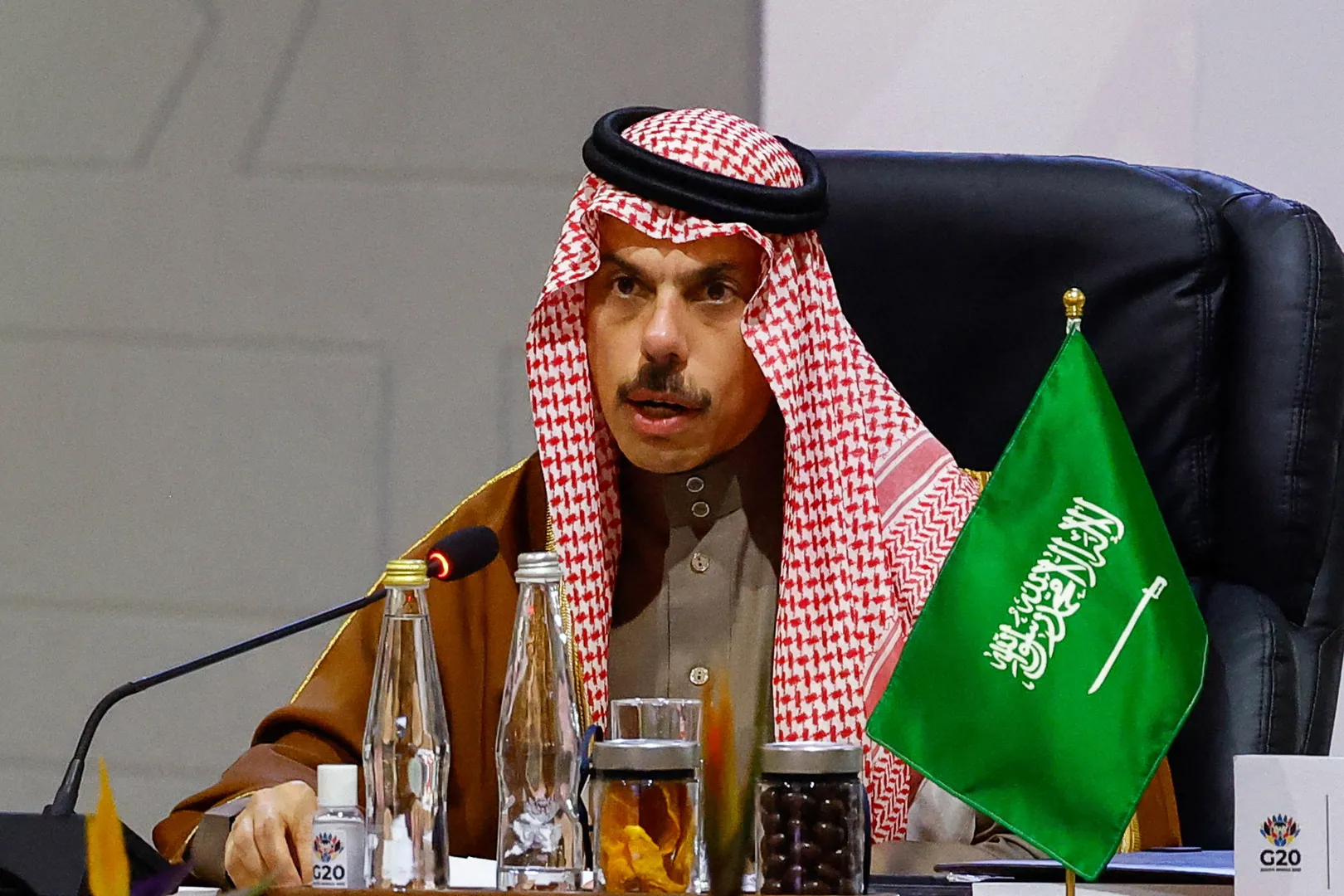
Saudi Arabia’s Foreign Minister warns Iran that regional neighbours have ‘significant’ capabilities with which to respond to Tehran’s aggression.
Saudi Arabia’s Foreign Minister Prince Faisal bin Farhan Al Saud has warned Iran that tolerance of its attacks on his country and those of neighbouring Gulf states is limited, calling on Tehran to immediately “recalculate” its strategy.
Warning that Saudi Arabia and other Gulf states have “very significant capacities and capabilities” that could be drawn on should they “choose to do so”, the foreign minister told a news conference early on Thursday that Iran had carefully planned its strategy for striking regional neighbours, despite denials from Tehran’s diplomats.
Recommended Stories
list of 4 itemsend of list
“The level of accuracy in some of this targeting – you can see it in our neighbours as well as the kingdom – indicates that this is something that was premeditated, preplanned, preorganised and well thought out,” Prince Faisal said.
“I’m not going to lay out what would and would not precipitate a defensive action by the Kingdom [of Saudi Arabia] because I think that is not a wise approach to signal to the Iranians,” the foreign minister continued.
“But I think it’s important for the Iranians to understand that the kingdom, but also its partners who have been attacked and beyond, have very significant capacities and capabilities that they could bring to bear should they choose to do so,” he said.
“The patience that is being exhibited is not unlimited. Do they [the Iranians] have a day, two, a week? I’m not going to telegraph that,” he added.
“I would hope they understand the message of the meeting today and recalculate quickly and stop attacking their neighbours. But I am doubtful they have that wisdom.”
Prince Faisal’s warning followed a meeting of foreign ministers from Arab and Islamic countries in the Saudi capital earlier in the day to discuss the expanding war in the region, which on Wednesday saw Iranian attacks on Gulf energy sites, including Qatar’s Ras Laffan gas facility, where significant damage was reported, and the United Arab Emirates’ Habshan gas facility.
Qatar’s Ministry of Foreign Affairs expressed its “strong condemnation and denunciation of the blatant Iranian attack targeting Ras Laffan Industrial City”, located 80km (50 miles) northeast of the Qatari capital Doha, which is the world’s largest liquefied natural gas (LNG) production facility, producing some 20 percent of the world’s LNG supply.
Iran’s Islamic Revolutionary Guard Corps (IRGC) had warned earlier that oil and gas facilities in Qatar, Saudi Arabia and the UAE would face retaliation for an Israeli strike on Iran’s South Pars gasfield.
Iranian state media reported that facilities linked to the country’s huge offshore South Pars field – located off the coast of southern Iran’s Bushehr province – had come under attack.
Saudi Arabia’s Ministry of Defence also said on Wednesday that its air defences had intercepted four Iranian ballistic missiles that targeted Riyadh and two launched towards the country’s eastern region.
Air defences in the UAE dealt with 13 ballistic missiles and 27 drones, according to the country’s Defence Ministry, while operations were suspended at the Habshan gas facility as authorities responded to incidents caused by fallen debris after the successful interception of a missile.
The Saudi foreign minister also told the news conference on Thursday that while the war will end one day, it will take much longer to restore relations with Iran as trust “has completely been shattered” due to Tehran’s tactics of targeting its neighbours.
“We know for a fact that Iran has been building this strategy over the last decade and beyond,” Prince Faisal said.
“This is not something that is a reaction to an evolving circumstance where Iran is improvising. This has been built into their war planning: targeting their neighbours and using that to try and put pressure on the international community,” he said.
“So when this war eventually ends, in order for there to be any rebuilding of trust, it will take a long time. And I have to tell you, if Iran doesn’t stop … immediately, I think there will be almost nothing that can re-establish that trust,” he added.
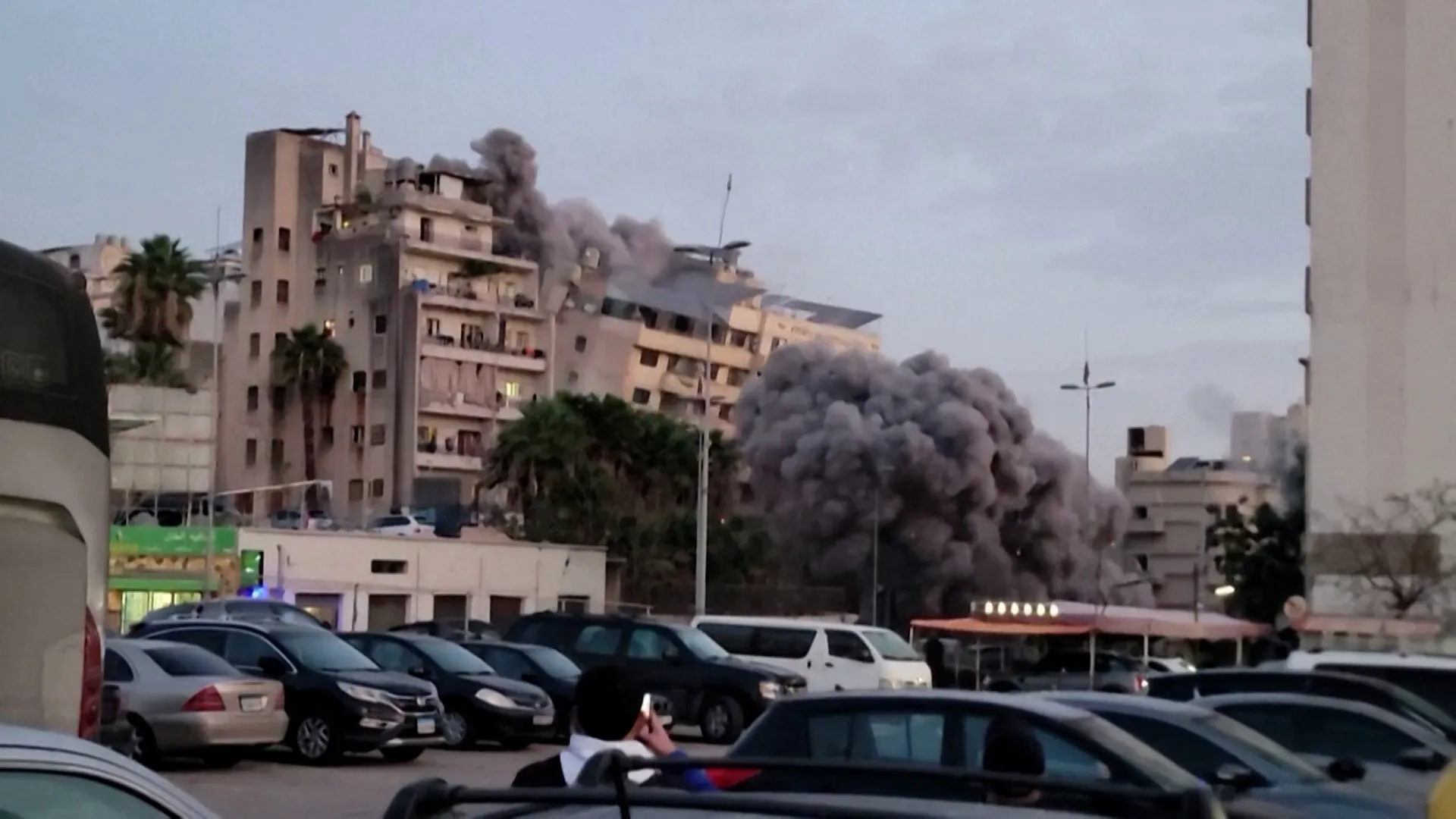
Several central neighbourhoods in Beirut have been attacked in a series of Israeli strikes. Al Jazeera’s Zeina Khodr has been at the scene of one attack that flattened a multi-storey residential building.
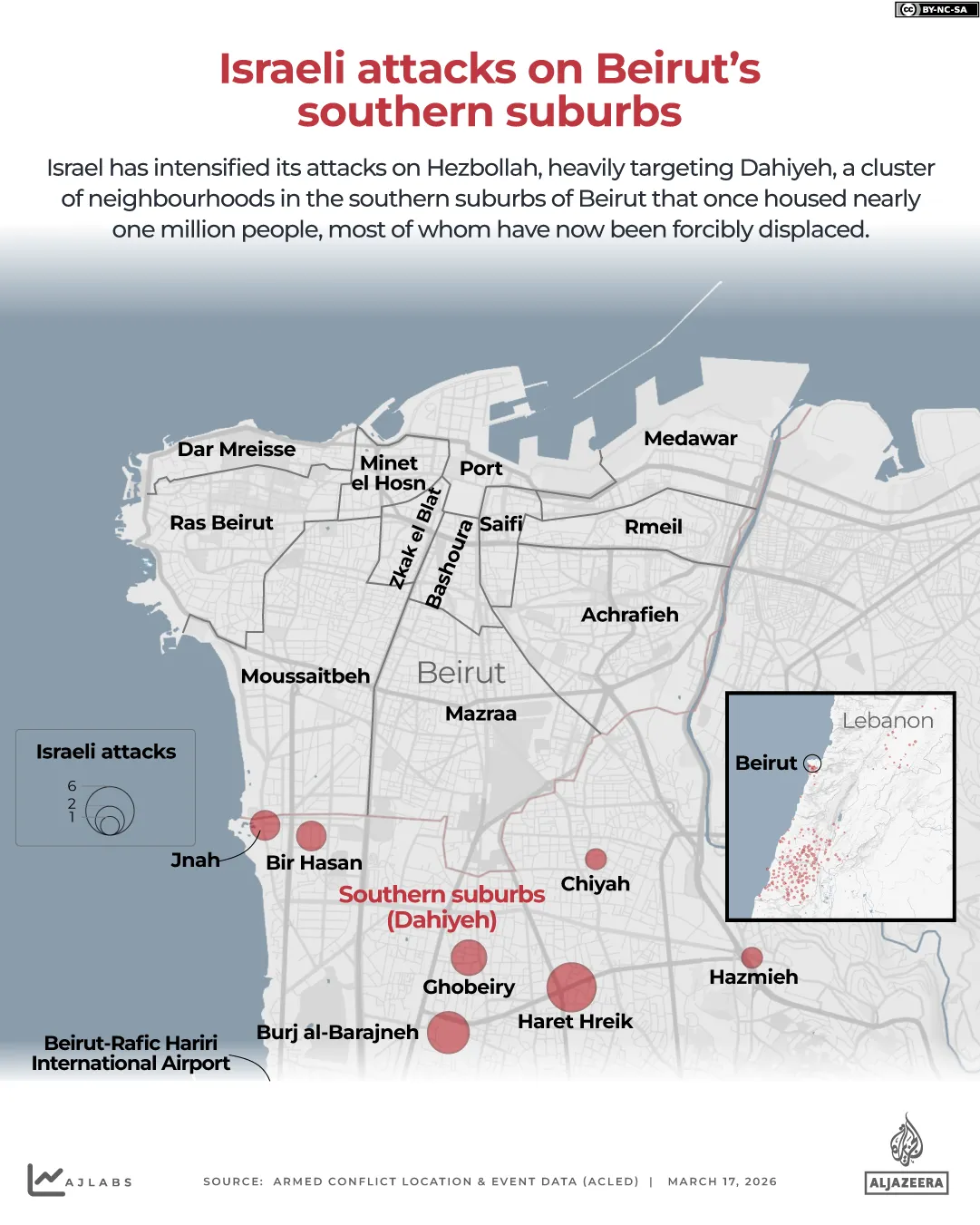
For years, Beirut’s southern suburb has been spoken about as though it were a world apart: A Hezbollah bastion, a target, a warning, or a battlefield. But in Arabic, the word “dahiyeh” simply means “the suburb”.
The word itself is ordinary. What makes it extraordinary in Lebanon is its history.
Recommended Stories
list of 4 itemsend of list
When the Lebanese speak of Dahiyeh, they do not mean any suburb of their capital city. They mean southern Beirut in particular – a dense belt of neighbourhoods that grew from villages, fields, informal housing and municipal edges into a major extension of the city.
Dahiyeh – in size nearly as big as municipal Beirut – has been shaped by migration and displacement in the past 50 years. While many moved there in search of work or housing, most of the others were pushed there by wars, political unrest, evictions and a general sense of being neglected by the Lebanese state.
The social geography of Lebanon, which gained independence from French colonisers in 1943, began to be transformed in 1948 when Israel’s establishment saw the expulsion of more than 700,000 Palestinians from their land in what is commonly referred to as the Nakba. After Israel’s further occupation of Palestinian lands in 1967 and the expulsion of Palestinian fighters from Jordan in 1970, southern Lebanon and parts of Beirut became increasingly bound up with the Palestinian national movement.
Beirut’s ‘belt of misery’
Dahiyeh’s growth, however, accelerated after 1975, when the Lebanese civil war broke out. People displaced from other parts of Beirut moved south. The subsequent Israeli attacks and invasions in 1978 and 1982 drove more people to the edge of the capital. In that sense, Dahiyeh was not just a destination for “migrants”. It was also a refuge for the uprooted, the poor, and those repeatedly forced to start over.
Studies by scholars such as Mona Harb, professor of urban studies and politics at the American University of Beirut (AUB), show how a common noun – Dahiyeh – gradually evolved into a distinct political space: A stigmatised periphery marked in the Lebanese imagination as Beirut’s “belt of misery” that hardened into a territory with its own social and political significance. Today, it is part of Greater Beirut, woven into the capital geographically, economically and socially, even if the country’s politics may have treated the area as an outlier.
Harb’s work explicitly frames the southern suburb as a politically produced urban territory rather than just a space outside Beirut. To understand how that happened, one has to begin with the making of modern Lebanon.
Under the French Mandate, and later through the political order consolidated at independence in 1943, power in Lebanon was distributed through a sectarian system that heavily favoured the established elites, especially the Maronite Christians, who dominated the presidency and other key positions. The system not only created inequality, but also formalised and reproduced it.
Rural Lebanon, especially the south and the Bekaa Valley, remained underdeveloped and politically neglected for decades. Among those most affected were Lebanon’s Shia community, who were disproportionately concentrated in the poorer agricultural regions and had less access to state investments, infrastructure and patronage than the more privileged urban and mountainous centres. Scholars say it was not simply a temporary developmental gap, but a long history of marginalisation that defined the country’s politics.
A man photographs the rubble of buildings destroyed by Israel in Dahiyeh [Hassan Ammar/AP]
Israeli attacks on Palestinian positions inside Lebanon repeatedly hit the surrounding Lebanese communities as well, mainly in the south. For the Shia in southern Lebanon, these attacks sharpened a bitter awareness: They were living on the front lines of a bitter regional conflict, while they were also being denied equal economic rights and meaningful political inclusion in Lebanon itself.
Out of that reality emerged a new form of Shia political mobilisation centred not only on identity, but also on deprivation, dignity and state neglect. That mobilisation found its earliest expression in Harakat al-Mahroumin, the Movement of the Deprived, founded by Imam Musa al-Sadr in the 1970s. Al-Sadr became a towering figure of modern Lebanese Shia politics because he gave social, religious and political forms to grievances building up for decades. That movement later grew an armed wing: Amal.
Al-Sadr’s mysterious disappearance during a 1978 trip to Libya remains unresolved and politically contested to this day. What is not contested is his historical importance. He helped turn the Shia of Lebanon from a neglected rural underclass into an organised political constituency demanding equal rights, representation, and a defining national presence.
The rise of Hezbollah
The 1982 Israeli invasion of Lebanon changed the Shia political landscape yet again. Israel’s siege of Beirut, the departure of Palestinian icon Yasser Arafat and his Palestine Liberation Organization forces, and Syria’s desire to dominate Lebanon all intensified divisions within Lebanese society.
Amal, which meanwhile had grown closer to Damascus to get weapons, money and political backing, remained a major force. But new Islamist movements emerged from within and around it, shaped by the Israeli occupation, disillusionment with older leaderships, and increasing support from Iran’s Islamic Revolutionary Guard Corps, especially in the Bekaa region.
Over time, these currents crystallised into Hezbollah. The split within the Shia movement was less theological and more about political strategy, defined by questions over aligning more closely with Syria, solidarity with the Palestinians, and general resistance against the Israeli occupation. Differences between Amal and Hezbollah over these questions turned violent in the 1980s, an intra-Shia fighting that Lebanese often recall as “a war among brothers”.
As Hezbollah grew stronger, Dahiyeh became much more than a residential belt. It turned into an urban heartland of a social and political force. Hezbollah built institutions there: Offices, schools, clinics, welfare networks and media infrastructure. Amal also had a presence, but the common shorthand that reduces Dahiyeh to a “Hezbollah stronghold” always conceals more than it reveals.
Today, Dahiyeh hosts a Shia majority, but also has a small minority of Palestinians and other Lebanese communities, including Christians. It bleeds physically into what is known as Greater Beirut, including its Christian and mixed areas. So when the suburb is bombed, it is not some isolated military island that is hit, but a deeply inhabited part of urban Beirut.
That is precisely why Dahiyeh is so central to the Israeli military’s thinking. During the 2006 war, large sections of the southern suburb, especially Haret Hreik, were devastated by Israel. The destruction became so emblematic that Israeli military strategists came up with what came to be known as the Dahiyeh Doctrine: Use of overwhelming force and large-scale destruction of areas associated with an armed group, with the aim of generating deterrence and putting pressure on residents supporting the group. Rights activists and legal scholars say the doctrine violates international humanitarian law, as civilian neighbourhoods and infrastructure do not become legitimate targets simply because an armed group is embedded among the population.
That Israeli pattern, however, has intensified since October 2023, when a genocidal war on Gaza and attacks on Lebanon began. Meanwhile, the killing of Hezbollah leader Hassan Nasrallah in an Israeli strike in late 2024 eroded Dahiyeh’s resistance. That erosion is more visible in the ongoing Israeli attacks on Beirut and southern Lebanon, where more than a million people have registered as displaced since March 2. The old formula – that Dahiyeh was the principal red line and that any strikes there could be deterred by Hezbollah’s threats of retaliatory strikes on several Israeli cities – no longer holds.
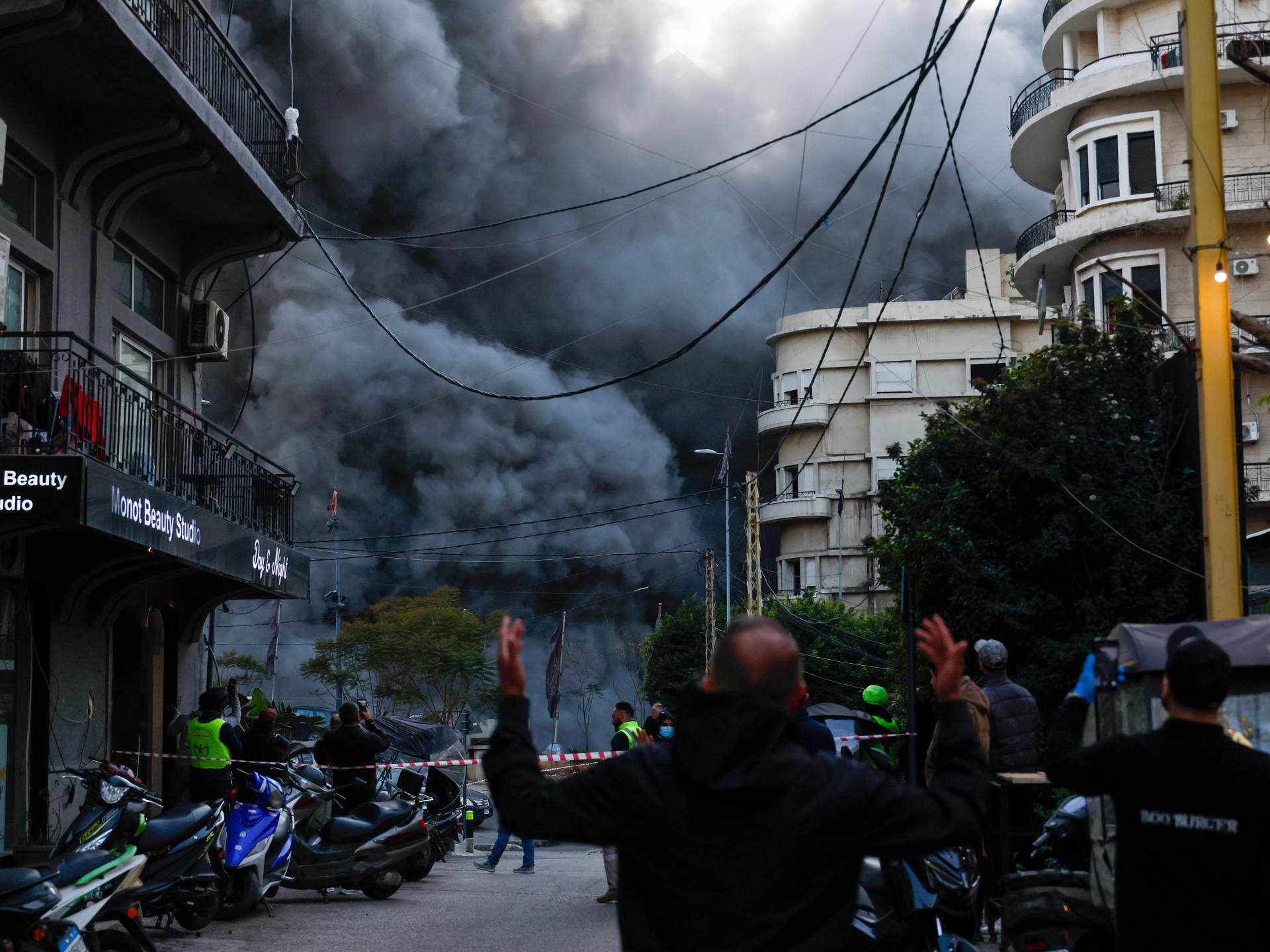
Once again, Dahiyeh has become a focal point of the war, with repeated bombardment sending plumes of smoke over a place that many outsiders still describe as a world apart, but which is in fact woven into Beirut’s daily life. Built over decades by the poor, the migrants and the repeatedly uprooted – and shaped by the politics of marginalisation against those whom al‑Sadr once named “the deprived” – Dahiyeh has long served as both a refuge and a front line. Today, it is again being made to carry the costs of a conflict larger than itself.
WASHINGTON — President Trump has once again mocked Gov. Gavin Newsom’s dyslexia as “disqualifying” for leadership, marking at least the fourth time in a week that the president has targeted the California Democrat for being open about his diagnosis.
In remarks Monday in the Oval Office, Trump said Newsom was “dumb” and should never be allowed to be president because he has “admitted that he has learning disabilities, dyslexia.”
“That’s how crazy it’s gotten with a low-IQ person,” Trump said. “Honestly, I’m all for people with learning disabilities but not for my president. … And I know it’s highly controversial to say such a horrible thing.”
But in the course of his needling, Trump mistakenly elevated his political rival to the rank of commander in chief — repeatedly referring to Newsom as “the president of the United States.” Newsom took the opportunity to turn the tables on the president.
“I, GAVIN C. NEWSOM, AM OFFICIALLY PRESIDENT OF THE UNITED STATES (THANK YOU DONALD!)” he wrote on X Monday.
The clash is the latest in a storied contest of chest-beating between Trump and Newsom, who have made sport of bad-mouthing one another across campaign rallies, interviews and social media.
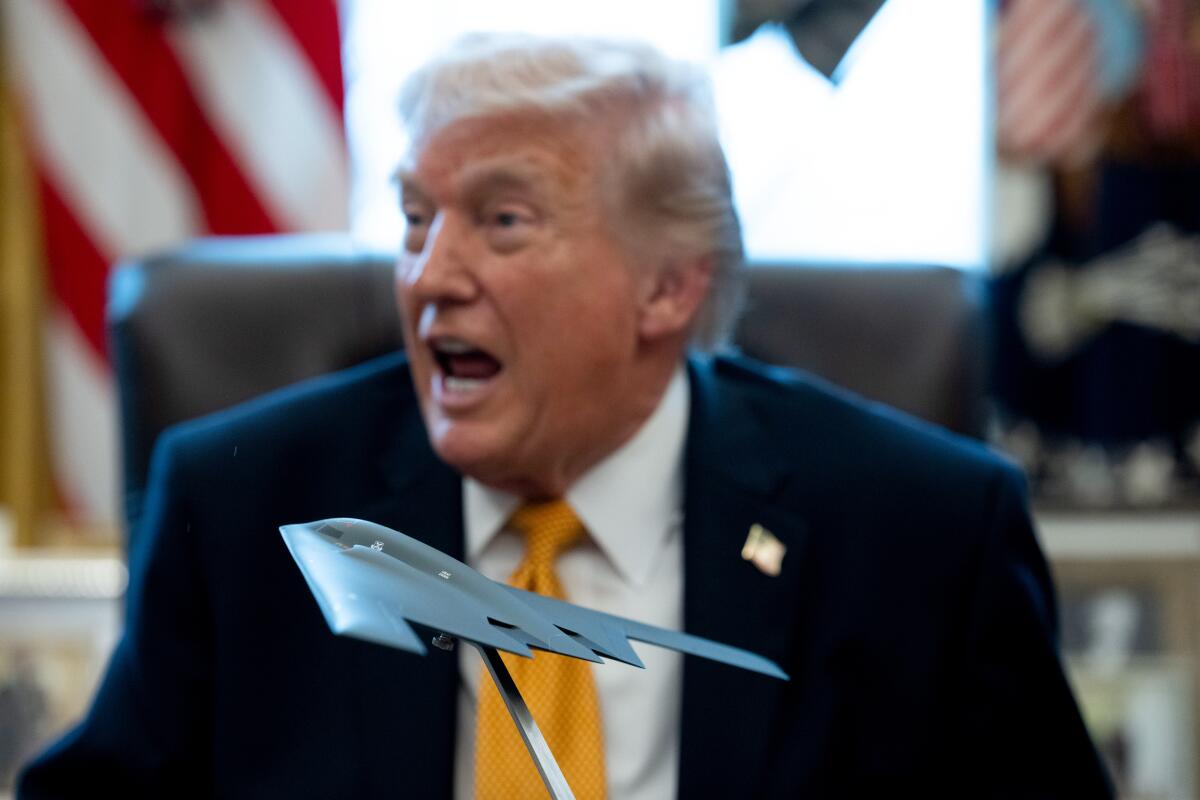
A model stealth bomber sits in front of President Trump during an executive order signing in the Oval Office Monday.
(Aaron Schwartz / Bloomberg via Getty Images)
The president has frequently cast Newsom as a symbol of the liberal governance he opposes, while the governor has leaned into the confrontations, often using them to elevate his national profile and position himself as a leading Democratic counterweight. His sparring with the president appears to be part of an aggressive strategy to amplify his own messaging as he weighs a potential run for president in 2028. This time, Newsom used the spotlight to support young people with dyslexia.
“To every kid with a learning disability: don’t let anyone — not even the President of the United States — bully you,” Newsom wrote on X. “Dyslexia isn’t a weakness. It’s your strength.”
The insults first materialized when a video went viral of Newsom speaking at a book tour appearance with Atlanta Mayor Andre Dickens during which he discussed his lifelong struggle with the learning disability. Since then, the president has repeatedly poked at the vulnerability.
Trump has brought up the governor’s dyslexia at least four times in the last week. He mentioned it at a political rally in Kentucky last week, where he equated dyslexia with a “mental lack of ability,” and again during a Fox News Radio interview on Friday, in which he reiterated that “presidents can’t have a learning disability.” In a post on Truth Social, Trump labeled Newsom’s admission a “politically suicidal act,” calling him “dumb” and “A Cognitive Mess!”
After the Kentucky rally, Newsom responded to Trump.
“I spoke about my dyslexia, I know that’s hard for a brain-dead moron who bombs children and protects pedophiles to understand,” he said.
Dyslexia affects as much as 20% of the population, according to the Yale Center for Dyslexia and Creativity. Despite affecting a such a wide portion of the population, the condition is widely misunderstood, according to dyslexia researcher Dr. Helen Taylor of the University of Cambridge.
“In some ways, Trump’s awful comments are just a cruder version of assumptions that already run through our culture,” she said. “If anything, [it’s] the opposite. There is evidence of an overrepresentation of people with dyslexia in business leadership roles.”
According to Taylor, there is a link between dyslexia and “enhanced abilities” in areas such as discovery, invention and creativity.
“The same cognitive trade-offs that can make routine tasks like reading more difficult support strengths in navigating complexity and guiding groups toward better future outcomes,” she said.
Newsom often describes his early experiences with dyslexia as a source of insecurity when he was growing up. In his memoir, the governor writes about his mother, Tessa Newsom, attempting to help him with homework. The lessons ended with him “running out of the room screaming that I didn’t know what was wrong with my brain.”
Back when Newsom was a boy in the 1970s, dyslexia was recognized but still not fully understood. He recalls a day when his mother grew so concerned that she took a deep breath and told him, “It’s OK to be average, Gavin.”
“I understood even back then that this, too, came from her deep reservoir of love for me,” Newsom writes in his book “Young Man in a Hurry.” “But I don’t recall crueler words ever said about me.”
The challenges from his learning disorder persist in his work at the state Capitol. Newsom finds reading off a teleprompter challenging. His aides describe days of painstaking preparation before major addresses to live audiences. Late edits to a speech, and the resulting changes to the words on the screen, threaten to throw off his delivery.
All memos in the governor’s office are written in 12 point Century Gothic font with specific spacing between lines, formatting that his aides say helps him with his disability.
The governor reads his daily briefings a few times in the morning, underlines sentences and writes down notes to retain the information on yellow cards he keeps in his suit pockets.
The ritual, he has said, helps him compensate for his dyslexia and feel confident communicating. But it also adds to the public perception of Newsom as a smooth-talking, and at times rehearsed, politician. His excessive preparation has become a trait he considers a “super power.”
His effort to thoroughly absorb reading material and desire to understand issues before he speaks about them means he’s often well-prepared. In his perception, the learning disorder has brought out his grit and resilience, and helped him hone other skills, such as quickly reading a crowd.
Without missing a beat, Newsom directed the journalist to the exact page in his 246-page budget that touched on the issue.
“While people with dyslexia are slow readers, they often, paradoxically, are very fast and creative thinkers with strong reasoning abilities,” according to the Yale Center for Dyslexia and Creativity.
The governor’s wife, Jennifer Siebel Newsom, discussed the president’s attacks Tuesday in a video on X in which she emphasized that “learning differences do not determine someone’s potential.” She listed a number of qualities she considered disqualifying for the presidency, including being a convicted felon, bankrupting businesses, having numerous associations with convicted sex offender Jeffrey Epstein, and sending “masked extremists to terrorize Black and brown communities and rip kids away from their families.”
“Everything that Donald Trump represents is frankly beyond disqualifying,” she said. “Day in and day out, Trump says things that make him unfit for office. He degrades our vulnerable communities, our institutions, even the Constitution itself.”
Two of the Newsoms’ four children have also been diagnosed with dyslexia.
Quinton reported from Washington, D.C., and Luna from Sacramento.
March 17 (UPI) — U.S. gasoline prices have surged by 27% and diesel by 34% since the start of U.S. attacks on Iran last month, fuel costs reported Tuesday indicate.
AAA reported that the national average cost for a gallon of gas in the United States was $3.79 Tuesday morning. Diesel was $5.044 per gallon, topping the $5 threshold for the first time in three years, CNBC reported.
A year ago, those prices were $3.078 and $3.592, respectively. A month ago, they were $2.917 and $3.651.
Fuel prices have been on the rise globally since the United States and Israel launched attacks on Iran on Feb. 28 amid negotiations over Iran’s nuclear program. The attacks, which killed Iran’s supreme leader, Ayatollah Ali Khamenei, prompted Tehran to effectively close down the Strait of Hormuz by banning ships linked to the United States or Israel. About 20% of the world’s oil runs through the waterway that separates Iran and Oman.
Brent Crude, the benchmark price for oil worldwide, rose about 2% to $102 a barrel Tuesday, The New York Times reported. The West Texas Intermediate, the U.S. benchmark, rose to $95 a barrel.
Diesel prices are particularly tied to the U.S. economy, which depends on it for the transportation of goods via trucks, trains and barges. Recent surges in prices could have a cascading effect.
Andy Lipow, president of Lipow Oil Associates, said Tuesday that trucking and rail companies have begun increasing their fuel surcharges in response to the fuel hikes.
“One should really be worried about higher diesel prices,” he said in a note published by CNBC.
President Donald Trump this week put pressure on other nations that rely on oil shipped through the Strait of Hormuz to join a coalition to police the transit route and reopen traffic.
Speaking aboard Air Force One on Sunday, Trump said the United States doesn’t need to be involved in reopening the Strait of Hormuz because little of its oil passes through the waterway. About 7% of the United States’ crude oil and condensate imports passed through the strait in the first half of last year, the U.S. Energy Information Administration said.
He said the United States was protecting it “almost like we do it for habit” and to help “some very good allies that we have in the Middle East.”
Patrick De Haan, head of petroleum analysis at GasBuddy, said Monday, “until we see a meaningful resumption of oil flows through the Strait of Hormuz, upward pressure on fuel prices is likely to persist.”
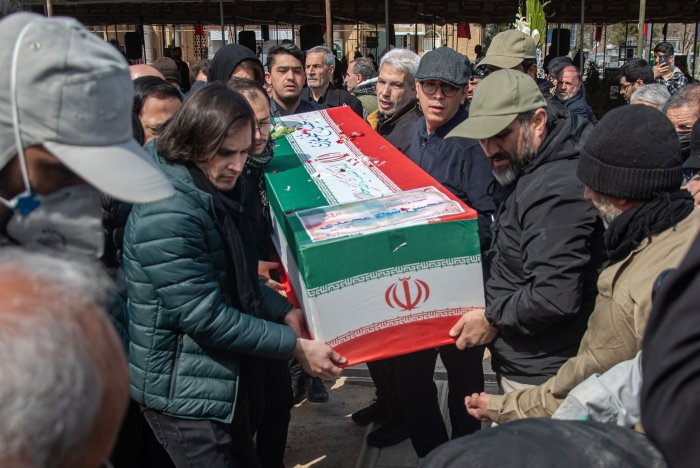
Iranians attend a funeral for a person killed in recent U.S.-Israel airstrikes at Behesht-e Zahra cemetery on the southern outskirts of Tehran in Iran on March 9, 2026. Photo by Hossein Esmaeili/UPI | License Photo
“If they rebuild and you return, we will kill you.”
That was the threat Abubakar Dalwa received before fleeing to Maiduguri, Borno State’s capital in northeastern Nigeria, on the night of March 8. Abubakar was sitting in the compound of his home in Dalwa, a recently resettled community in Konduga, a few kilometres from Maiduguri, with his children and wife. The children slept curled together on a plastic mat while his wife tended a pot over the fire. It was during Ramadan, the Islamic month of fasting, and she was preparing the meal they would eat before dawn.
Then the gunfire came in rapid succession around 10:20 p.m. The children woke up as Abubakar and his wife rushed them inside the room. Moments later, someone began knocking impatiently on the door.
“Open this door,” the person shouted. Abubakar’s wife clung tightly to him. He stepped outside and opened the door. About ten armed men stood in the darkness. Most wore military camouflage. Others were dressed in black uniforms. Belts of ammunition hung across their shoulders, some trailing toward the ground.
“They told me, ‘Get out and leave for Yerwa [Maiduguri],’” Abubakar recalled. The terrorists said they had come to burn the buildings. “They told me the buildings belonged to the government,” he added. “They said their fight was with the government, not us.”
Abubakar did not argue. By then, it was nearly midnight. He gathered his wife and children and fled into the darkness. “We left without taking anything,” he said.
Behind them, the town burned, and three people were killed: a man, a woman, and her baby. The man’s daughter survived but was shot in the leg. She was later taken to the Maimalari Cantonment Hospital in Maiduguri.
By 2 a.m., Abubakar and his family had reached the city. Soldiers received them at a military checkpoint. They were displaced again.
The assault on Dalwa was not an isolated raid. On the same night, another attack was unfolding hundreds of kilometres away in Kukawa. A member of the Civilian Joint Task Force (CJTF) stationed there said the terrorists attacked around midnight.
“They killed our men, including our Commanding Officer, carted away weapons and vehicles, burnt one building,” he said.
The seizure of weapons and vehicles during these attacks has become a recurring feature of recent raids across Borno, weakening security formations in rural areas and forcing some forces to consolidate around larger bases closer to Maiduguri.
How the attacks unfolded
In Dalwa, the attack lasted about an hour. A frontline member of the NFSS said the terrorists entered the town after overpowering the security units stationed there. “We knew they would overpower us from the first sounds of their gunfire,” he said.
Many of the terrorists carried heavy weapons, including PKT machine guns capable of sustaining rapid fire; others carried rocket-propelled grenades (RPGs).
The terrorists strategically positioned themselves in Dalwa. “They went from house to house,” the NFSS member said. “They ordered residents to leave the town.” Then they began setting buildings on fire.
Security officers attempted to resist the attack. They sought reinforcements from Maiduguri, but the vehicles sent to support them ran into buried landmines. Two soldiers were killed in the explosions. “And so we retreated,” the NFSS member said.
According to the volunteer security operative, the attackers approached Dalwa in coordinated groups. One group blocked the road leading to Damboa. Another positioned itself at the entrance of the town near a cemetery on the outskirts. A third group advanced directly into the town to engage the security forces.
“They came through the eastern side,” he said. “That used to be the original Dalwa before the first displacement.”
The security volunteers estimated the number of attackers to be between 80 and 100. Most of them arrived on foot, while others rode on motorcycles, they said.
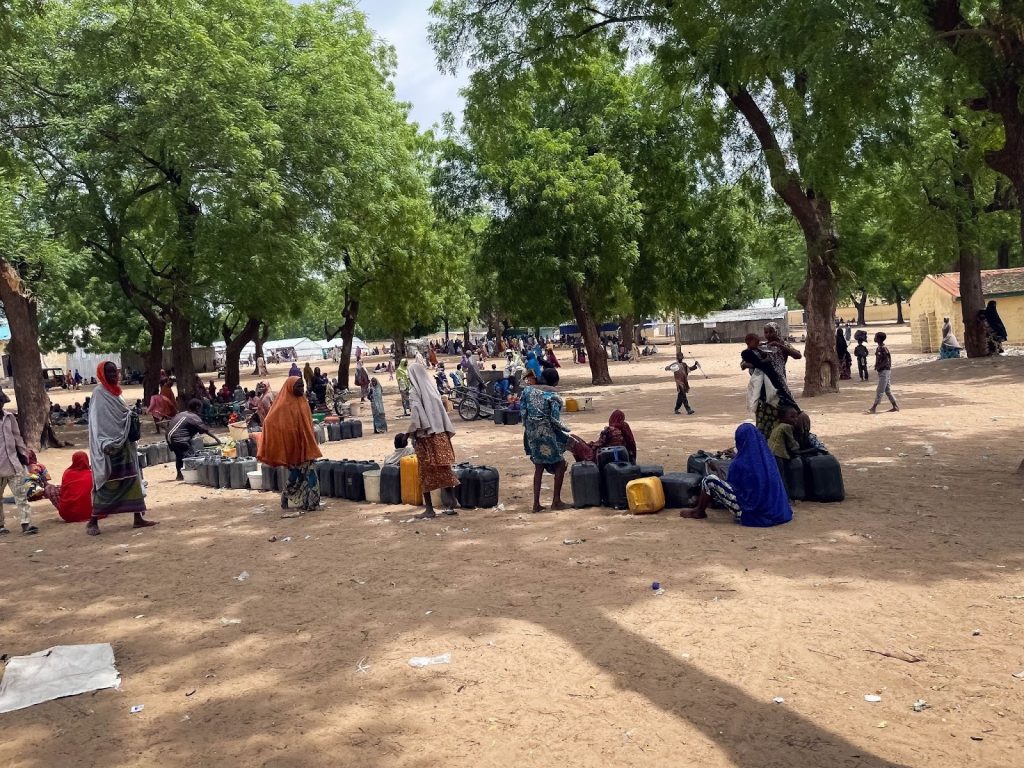
File: Young girls queued up, with their plastic containers at a water point in an Internally Displaced Persons camp in Borno. Photo: Hauwa Shaffii Nuhu/HumAngle.
During the March 8 attack, only about 20 soldiers were stationed in the town. Volunteer forces, including members of the NFSS, CJTF, and repentant terrorists known locally as “the hybrid”, numbered fewer than 100. Five days before the raid, surveillance drones had spotted terrorists gathering in nearby areas. “We anticipated the attack,” the NFSS member said.
But anticipation did not stop it. “The attacks keep increasing,” he added. “More than the previous year.”
Get our in-depth, creative coverage of conflict and development delivered to you every weekend.
Subscribe now to our newsletter!
In Kukawa, the insurgents used similar tactics. A CJTF member stationed there said the attackers arrived in three coordinated groups. One advanced toward the military base. Another waited on the outskirts of the town. A third group positioned itself along the road leading to Cross Kauwa to ambush reinforcements. He claimed that more than 200 fighters participated in the assault.
“They came mostly on foot,” he said. “They were all wearing military camouflage.”
The fighting lasted about three hours. After the terrorists withdrew, the commanding officer of the base, Umar Farouq, pursued them with a convoy, which was later ambushed, and most of his men were killed.
A pattern of attacks on rural security
The recent attacks on Dalwa and Kukawa are part of a broader pattern. Across Borno State, terrorists have increasingly targeted military bases, convoys, and resettled communities, often ambushing reinforcements and seizing weapons and vehicles during the attacks. Security volunteers say these raids are gradually weakening smaller rural security formations and concentrating forces around larger garrison towns closer to Maiduguri, leaving many outlying communities increasingly exposed.
The incidents suggest a deliberate campaign by terrorist groups, particularly the Islamic State West Africa Province (ISWAP). Their strategy appears to involve weakening security forces, isolating rural communities, and driving civilians out of resettled towns. These attacks are occurring against the backdrop of a significant government policy.
Over the past years, the Borno State government has implemented a resettlement programme to close camps for internally displaced persons and return families to their hometowns.
An illustration of armed terrorists in uniforms and a military vehicle. Illustration: Akila Jibrin/HumAngle.
The resettlement schemes started in 2020 when the state government began rebuilding homes, schools, clinics, and public facilities in previously abandoned communities as part of what was described as a transition toward a “post-conflict recovery phase”. Thousands of displaced residents have been moved out of camps in Maiduguri and returned either to their original communities or to nearby host settlements considered relatively secure.
But the recovery effort depends heavily on movement. Contractors, labourers, and materials must travel from Maiduguri into rural areas. That movement has increasingly become a point of vulnerability. Roads leading to resettled communities have suffered damage or been mined, isolating towns and delaying military reinforcements. When security forces attempt to respond, they often encounter roadside bombs or ambushes along the routes connecting rural communities to larger bases. Military installations themselves have also become targets. Such attacks on bases allow terrorists to seize weapons, vehicles, and ammunition that can be used in subsequent operations while weakening already thinly stretched security formations in rural areas.
On March 5, terrorists attacked a military base in Konduga, burning several buildings. A member of the Nigerian Forest Security Service (NFSS) told HumAngle that several soldiers were killed, and vehicles and weapons were stolen. Two days earlier, on March 3, the insurgents attacked Ngoshe, a town under the Gwoza Local Government Area (LGA) that had been resettled since 2020. The attackers first targeted a military base before spreading through the town and setting houses ablaze. Local sources and survivors said the attack lasted several hours and forced thousands to flee. Nigeria’s President, Bola Tinubu, condemned the attack on March 6, describing it as a “heartless assault on helpless citizens” and directing security agencies to rescue those abducted.
File: An image of a burnt residence in Ngoshe during the March 3 attack. Credit: Survivors of the incident.
Earlier attacks followed a similar pattern.
On Feb. 14, terrorists attacked a military base in Pulka, about ten kilometres from Ngoshe. On Feb. 5, another attack targeted a base in Auno along the Maiduguri-Damaturu road, according to a military source who asked not to be named. Several soldiers were killed, and vehicles were taken.
On Jan. 28, about 30 construction workers were killed in Sabon Gari in Damboa. The same day, terrorists attacked an army base in the town, killing nine soldiers and two members of the CJTF. A military base in Damasak was also overrun by terrorists, who killed seven soldiers, captured 13 others, including their commanding officer.
Earlier incidents also targeted reconstruction efforts and security infrastructure. On Dec. 25, 2025, a suicide bomber detonated at a mosque in the Gamboru Market area of Maiduguri. Five people were killed, and 35 others were injured. On Nov. 17 of the same year, workers fled after terrorists stormed a construction site in the Mayanti area of Bama. In the same town, terrorists attacked the Darajamal community in September last year, killing at least 63 people, including five soldiers, and burning about 24 houses.
On Nov. 20, the attackers invaded a CJTF base in Warabe, killing eight people and leaving three others missing. On Nov. 14, terrorists ambushed a military convoy along the Damboa-Biu road. Two soldiers and two CJTF members were killed. Brigadier General M. Uba, the Brigade Commander of the 25 Task Force Brigade, was abducted and later killed.
HumAngle has previously reported that terror groups have undergone several technological shifts that have expanded their attacks and operations, including the use of drones. Despite the violence, the resettlement programme continues. On Jan. 28, the Borno State government received about 300 Nigerian refugees from Cameroon and resettled them in Pulka. The government later received 680 more refugees on Feb. 8.
Why are the attacks happening?
Umara Ibrahim, a professor of International Relations and Strategic Studies at the University of Maiduguri, said the attacks may be aimed at constraining the government’s resettlement efforts.
“Because their movements are observed and monitored, and perhaps challenged, it is not in their interest for resettlement to proliferate,” he told HumAngle during a February interview.
The attacks also serve a logistical purpose.
“Some of their tactics include ambushing and carting away weapons and supplies from peripheral bases in unfortified areas,” the professor said. “It also includes attacks on bases, especially in places where backup might take time to arrive.”
As attacks on rural bases continue, residents and volunteer security operatives say the shrinking presence of security forces in some outlying communities is raising fears that large parts of rural Borno may again become vulnerable.
Many of these families, now fleeing towns like Dalwa, had already experienced displacement. Some years ago, insurgent violence forced them to abandon their homes and seek refuge in camps around Maiduguri. When the government announced resettlement plans, they returned. They rebuilt their lives slowly. Children went back to school. Farmers returned to their fields.
Now they are running again, and the promise of returning home is once again slipping out of reach.
No group has claimed responsibility for the attacks, which took place amid the escalating Israel-US war on Iran.
Published On 16 Mar 202616 Mar 2026
Share
A prominent hotel in central Baghdad’s heavily fortified Green Zone was struck by a drone, amid reports that Iraqi air defences intercepted an attack over the United States Embassy.
The strike on Monday evening hit the top floor of Al-Rasheed Hotel, causing damage but no casualties, according to two Iraqi security officials cited by The Associated Press (AP) news agency.
Recommended Stories
list of 3 itemsend of list
No group has claimed responsibility for the attack.
Security sources told the Reuters news agency that two Katyusha rockets had been intercepted that evening near the US Embassy in the Green Zone, which houses diplomatic missions as well as international institutions and government offices.
Earlier Monday, the Iran-backed Kataib Hezbollah announced that Abu Ali Al-Askari, a prominent security official with the paramilitary group, had been killed, without giving details on the circumstances.
Kataib Hezbollah is one of the largest groups in the Popular Mobilisation Forces (PMF) operating in Iran, which was founded in 2014 to stop lightning advances by ISIL (ISIS).
On the same day, AP reported that six PMF fighters were killed in a strike on a checkpoint in western Iraq’s Anbar province, and two others were killed in a separate strike on the headquarters of a PMF brigade in the same area.
Two Iraqi security officials told AP that the Majnoon oilfield in Iraq’s southern Basra province was targeted by two drones. No casualties were reported, and it was not immediately clear if there was damage to the facilities.
Iraq’s oil industry has been severely impacted by the US and Israel’s war on Iran and Iran’s closure of the Strait of Hormuz, a vital oil trading corridor.
Iraqi Minister of Oil Hayan Abdul-Ghani said in a video statement on Monday that a pipeline from the northern city of Kirkuk to Turkiye would be operational within a week, allowing the country to resume its oil exports, which have been interrupted by the ongoing war.
Also on Monday, air defences intercepted and shot down a drone near Erbil airport in the semi-autonomous Kurdish region of northern Iraq, according to security sources.
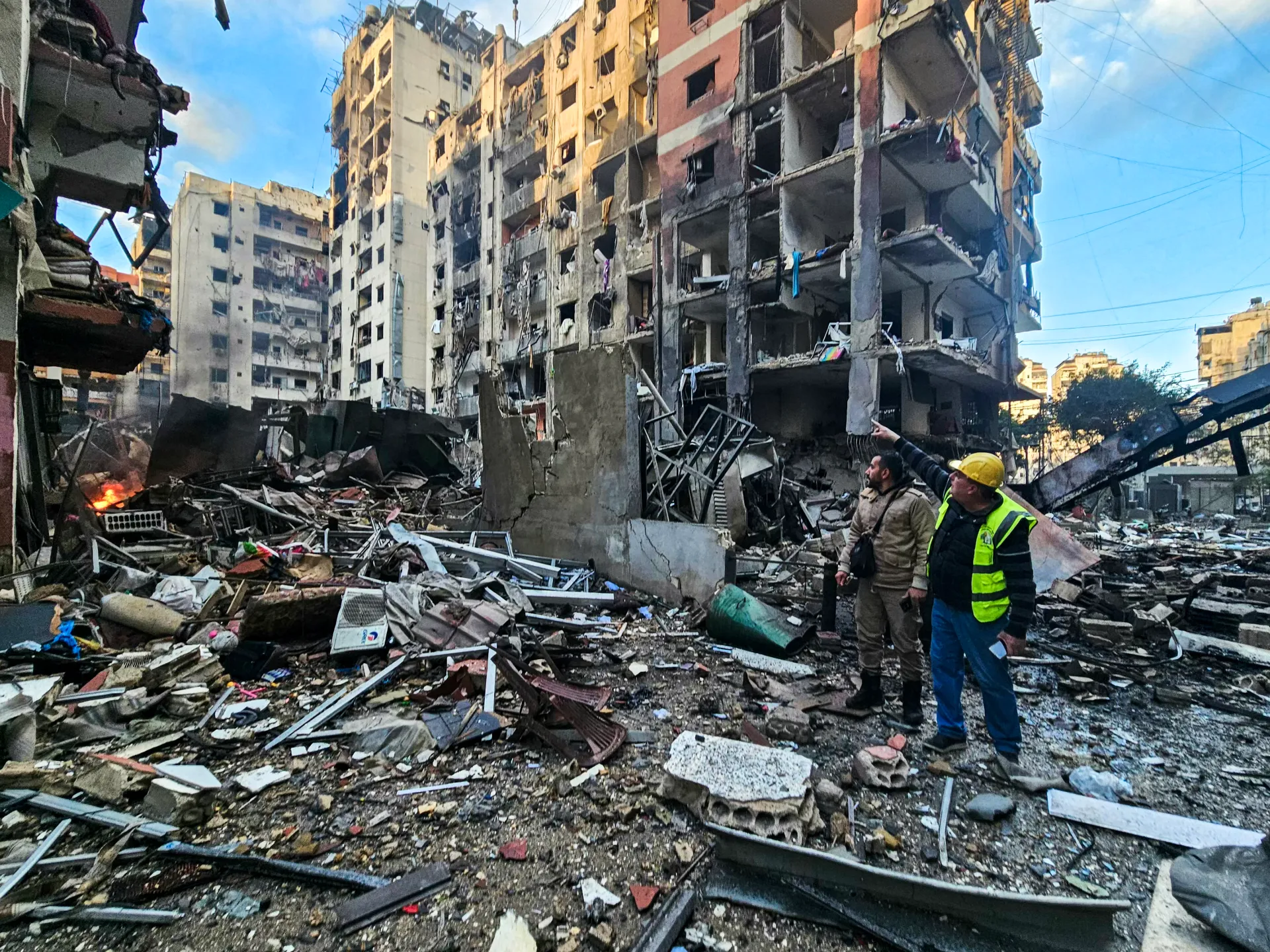
Neighbourhoods in Beirut’s southern suburbs have been left in ruins by Israeli bombing attacks. Israel says it is targeting Hezbollah infrastructure but hundreds of thousands of people have been forcibly displaced.
Alireza Enayati says relations with Saudi Arabia are ‘progressing naturally’ and he’s in direct contact with Saudi officials.
Published On 15 Mar 202615 Mar 2026
Share
Iran’s ambassador to Saudi Arabia denied Tehran is responsible for attacks on Saudi Arabia’s oil infrastructure, saying if it was behind the strikes, it would have announced it.
Alireza Enayati did not suggest who carried out the attacks, but added Iran is only attacking United States and Israeli military targets and interests during the ongoing war, Reuters news agency quoted him as saying on Sunday.
Recommended Stories
list of 4 itemsend of list
After the US and Israel launched attacks on Iran at the end of February, Tehran retaliated against US and Israeli military assets, including in Saudi Arabia, Qatar, Bahrain, Jordan, Iraq, and the United Arab Emirates (UAE).
Last week, the Ras Tanura oil refinery was forced to stop operations after debris from a drone caused a small fire. Attempted attacks were also reported on the Shaybah oilfield in the desert near the border with the UAE.
So far, Saudi Arabia’s Defence Ministry has not blamed anyone for the attacks.
Enayati said he’s in direct contact with Saudi officials, explaining that relations are “progressing naturally” in many areas.
Talks included Saudi Arabia’s publicly stated position that its land, sea, and air would not be used to target Iran. He didn’t elaborate.
Iran and Saudi Arabia re-established diplomatic relations in 2023, in a deal brokered by China, that saw the two sides, which backed rival groups across the region, agree on a new chapter in bilateral relations.
‘Reliance on external powers’
Enayati reiterated to the Gulf states that the war “has been imposed on us and the region” following coordinated US and Israeli attacks.
Asked about the attacks on Gulf nations, Enayati replied: “We are neighbours, and we cannot do without each other; we will need a serious review.”
“What the region has witnessed over the past five decades is the result of an exclusionary approach and an excessive reliance on external powers,” he said, calling for deeper ties between the Gulf Cooperation Council’s six members along with Iraq and Iran.
Iran’s Foreign Minister Abbas Araghchi also denied his country is targeting civilian or residential areas in the Middle East, and said Tehran is ready to form a committee with its neighbours to investigate the responsibility for such strikes.
So far, the UAE, which normalised relations with Israel in 2020, has faced the brunt of Iran’s attacks, with US bases and oil refineries heavily targeted.
While all countries targeted have strongly condemned Iran’s missile and drone strikes, regional sources say there remains growing frustration at the United States for dragging them into a war they did not sign up for but are now paying the heaviest price for, Reuters reported.
Enayati said to resolve the conflict, the US and Israel need to stop their attacks, and international security guarantees to prevent future “aggression” must be given.
Paul Musgrave, associate professor at Georgetown University in Qatar, said the administration of US President Donald Trump has lost much of its leverage in the region, and the US engaged in the wrong conflict at the wrong moment, without proper planning.
Iran’s strategy, meanwhile, now seems to be “not who has a bigger bomb or bigger munitions, but who has the highest threshold for pain”, Musgrave told Al Jazeera.
EU maintains pressure after slamming US for lifting sanctions on Russian oil exports as Middle East war bites.
The European Union has voted to renew sanctions against individuals and entities supporting Russia’s war on Ukraine, as Russian forces continued to target Ukrainian energy infrastructure, killing six people in the Zaporizhia and Kyiv regions.
The EU Council announced that the bloc’s 27 member states had agreed on Saturday to extend sanctions targeting some 2,600 individuals and entities with measures like travel restrictions and asset freezes until September 15, breaking an earlier deadlock caused by Hungary and Slovakia’s opposition to the move.
Recommended Stories
list of 3 itemsend of list
The extension of sanctions came one day after EU Council chief Antonio Costa slammed the United States for lifting sanctions on Russian oil exports, saying on X that weakening restrictions increased “Russian resources to wage the war of aggression against Ukraine”, with a knock-on impact on European security.
The measure was announced as Russia hammered Ukraine with missiles and drones on Saturday, killing five people and injuring 15 in the Kyiv region surrounding the capital, according to regional military administrator Mykola Kalashnyk.
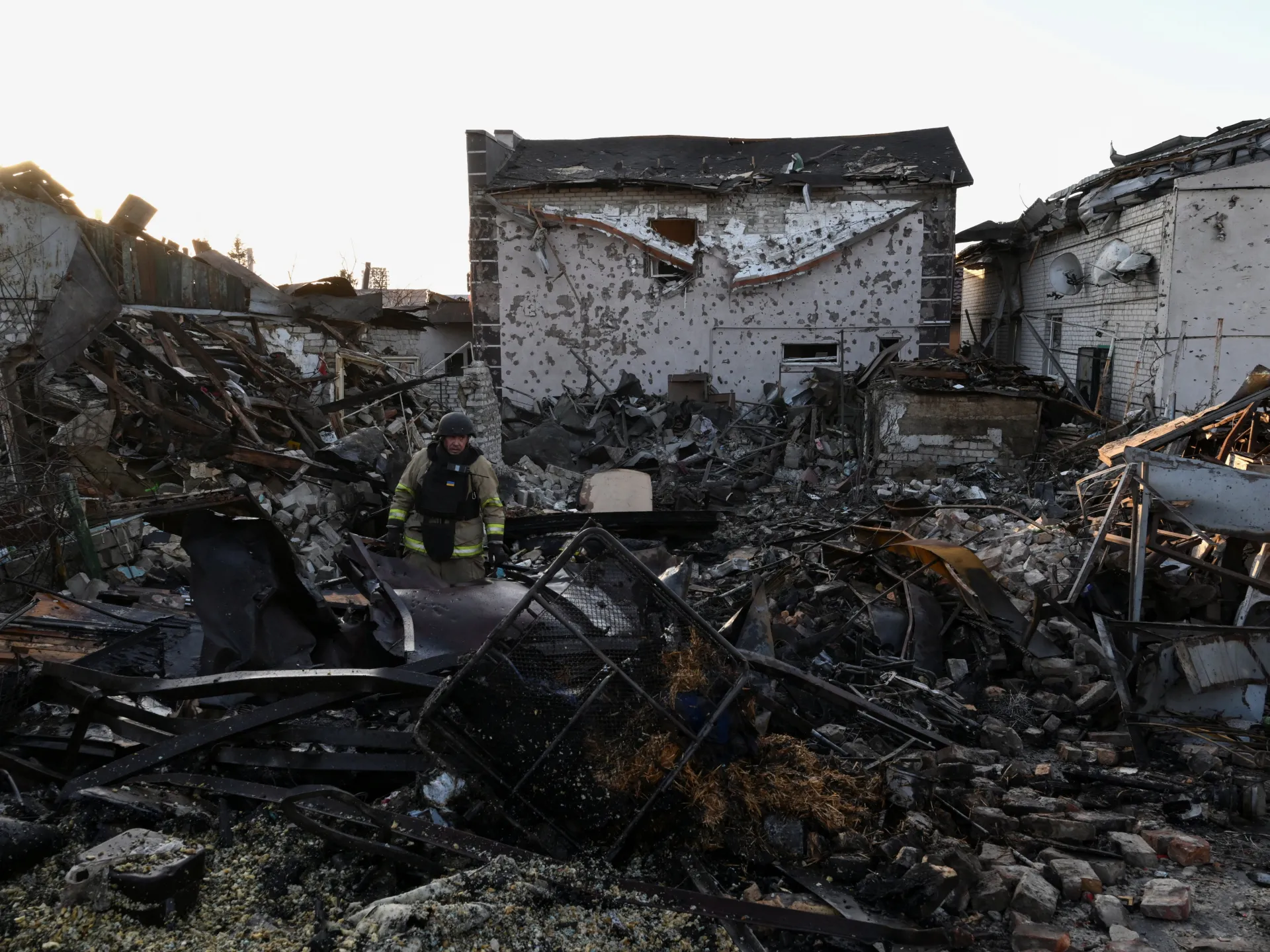
The city of Zaporizhzhia was also hit by Russian-guided bombs, killing one person and injuring three, said the governor of the southeastern region, Ivan Fedorov. Photos posted online showed parts of buildings reduced to rubble.
Ukraine’s President Volodymyr Zelenskyy said Russia’s main target was energy infrastructure outside the capital Kyiv, but that the Sumy, Kharkiv, Dnipro and Mykolaiv regions were also targeted in an attack that included about 430 drones and 68 missiles, most of which were downed by air defences.
Russia’s winter attacks on Ukraine have left swaths of major cities without power or heating, as Moscow’s troops continue their offensive amid demands Kyiv cede more territory in the east. Ukraine’s Energy Ministry said on Saturday that consumers in six regions were without electricity.
Ukraine’s forces have targeted Russian strategic infrastructure such as oil refineries, depots and terminals in long-range strikes. On Saturday, Ukraine’s military said that it had struck the Afipsky oil refinery and Port Kavkaz in Russia’s southern Krasnodar region.
Putin ‘exploiting’ Middle East distraction
Saturday’s fighting came as the Iran conflict has distracted international attention from a US-backed peace push in the four-year war, which Kyiv says Moscow has no interest in ending.
Belgium’s Prime Minister Bart De Wever called on Saturday for the EU to be mandated by its member states to negotiate with Russia as it became apparent amid spiking oil prices caused by the Iran war that the US was easing pressure on Russian President Vladimir Putin.
“Since we are not capable of threatening Putin by sending weapons to Ukraine, and we cannot choke him economically without the support of the United States, there is only one method left: making a deal,” he told the Belgian newspaper L’Echo.
EU chief diplomat Kaja Kallas has said in the past that the bloc must first reach an agreement on what is expected from Russia before directly approaching Putin, formulating its own “maximalist demands”.
However, the bloc’s inability to reach a common position was highlighted during the EU Council’s recent deliberations on extending sanctions.
Hungary and Slovakia, which have been sparring with Ukraine over blocked Russian oil flows through the Druzhba pipeline, had earlier opposed the extension of the restrictions, reportedly calling for some Russian oligarchs to be removed from the list of offenders.
Reacting earlier this week to soaring oil prices caused by the war in Iran, Hungarian Prime Minister Viktor Orban urged the EU to suspend sanctions on Russian energy.
Posting on X, Zelenskyy said, “Russia will try to exploit the war in the Middle East to cause even greater destruction here in Europe, in Ukraine.”
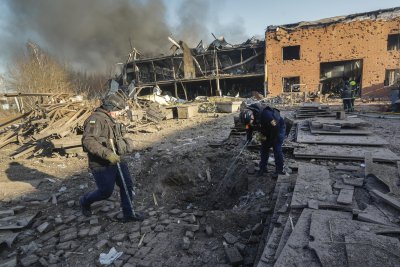
Ukrainian experts inspect a shell crater at the site of a Russian strike in Brovary near Kyiv, Ukraine, on Saturday amid the Russian invasion. Photo by Sergey Dolzhenko/EPA
March 14 (UPI) — Russian attacks on Kyiv overnight left at least four people dead and 15 injured, Ukrainian President Volodymyr Zelensky announced Saturday.
The missile and drone attacks hit four districts in the capital, bringing damage to schools, residential buildings and critical infrastructure, regional officials said, as reported by EuroNews. Zelensky said the attacks caused damage in Kyiv, Sumy, Kharkiv, Dnipro and Mykolaiv.
“The main target for the Russians was the energy infrastructure of the Kyiv region, but unfortunately, there were also direct hits on and damage to ordinary residential buildings, schools and civilian businesses,” Zelensky said in a post on X.
Zelensky said Russia used 430 drones and about 68 missiles to carry out the attacks, 58 of which were intercepted by Ukraine’s air defense system.
The president said the number of weapons used in the attack is a reminder to Ukraine’s partners that air defenses and missiles are a “daily necessity.”
“Every agreement on missile supplies cannot wait — everything must be implemented as quickly as possible,” Zelensky said. “Our agreements to increase the production of air defense missiles are a critical direction, and this direction requires one hundred percent attention.”
NBC News reported that Ukraine is waiting for the Trump administration to approve a major drone production deal.
He said Russia will attempt to take advantage of the new war in Iran and will benefit a surge in oil prices and from the United States easing sanctions on Russian oil to balance supply drops through the Hormuz Strait.
Russian officials said, meanwhile, that Ukrainian drones hit an oil refinery in the southern Krasnodar region.
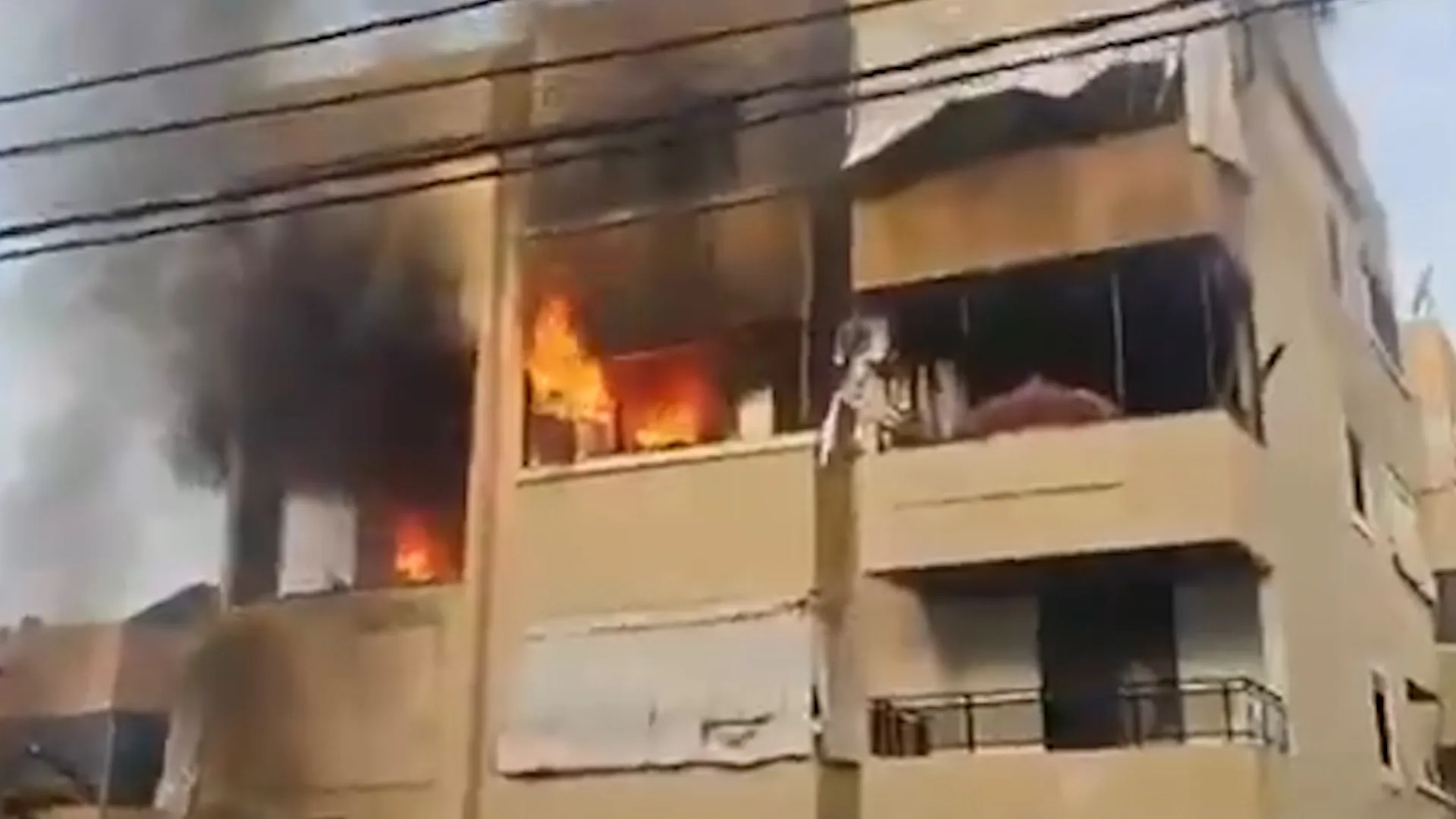
Video shows a large fire engulfing an apartment building in the Sidon area of southern Lebanon, following reports of an Israeli attack that killed four people.
United States President Donald Trump has said the country’s military bombed military installations on Iran’s Kharg island, warning the area’s critical oil facilities could be next if Iran continues to block the Strait of Hormuz.
Iran, in turn, threatened on Saturday to reduce US-linked oil facilities to “a pile of ashes” if oil structures on the island were attacked, as the US-Israel war on Iran, now in its punishing third week, spilled over into a global oil price crisis already in the making.
Recommended Stories
list of 3 itemsend of list
Kharg island is where more than 90 percent of Iran’s oil is exported. Crude oil prices have surged more than 40 percent since the war began.
Trump said on Friday that US forces had “totally obliterated” all military targets on Iran’s Kharg island oil export hub, describing it in a social media post as “one of the most powerful bombing raids in the History of the Middle East”. He provided no evidence of that.
The US president said he had chosen not to “wipe out” oil infrastructure on the Iranian island, for now.
“However, should Iran, or anyone else, do anything to interfere with the Free and Safe Passage of Ships through the Strait of Hormuz, I will immediately reconsider this decision,” he added.
Iran’s semi-official Fars news agency reported, quoting sources, that more than 15 explosions were heard on Kharg island during the US attacks.
The sources said the attacks targeted air defences, a naval base, and airport facilities, but caused no damage to oil infrastructure. Iran’s Fars news agency reported thick smoke was seen rising from the island.
Al Jazeera’s Mohamed Vall, reporting from Tehran, said Iran’s potential retaliatory attacks on Gulf oil facilities would be a “catastrophic scenario” for the region, and for the “entire industry of oil and gas”.
“The Iranians are keeping this, apparently, as a card to use,” he said. “They’ve been talking about restraint and the possibility of that restraint ending if the Iranian oil facilities are attacked, as the Americans are hinting and threatening.”
US ground operation in the works?
Meanwhile, 2,500 more Marines and an amphibious assault ship are being sent to the Middle East, a US official told the AP news agency.
Elements from the 31st Marine Expeditionary Unit and the amphibious assault ship USS Tripoli have been ordered to the region, according to the source, who spoke on condition of anonymity to discuss sensitive military plans.
(Al Jazeera)
Marine Expeditionary Units are able to conduct amphibious landings, but they also specialise in bolstering security at embassies, evacuating civilians, and providing disaster relief.
“What we’re to make of this is that the US is very slowly increasing its military posture in terms of prosecuting the war, and that it is not intending to wrap things up any time soon,” Al Jazeera’s Rosiland Jordan reported from Washington.
The deployment does not necessarily indicate that a ground operation is imminent or will take place.
Trump dismisses prospect of deal
Following the attack on Kharg island, Iran would be “wise to lay down their arms, and save what’s left of their country”, Trump wrote on his Truth Social platform.
“The Fake News Media hates to report how well the United States Military has done against Iran, which is totally defeated and wants a deal – but not a deal that I would accept!” he posted separately, providing no evidence Tehran was seeking any sort of deal.
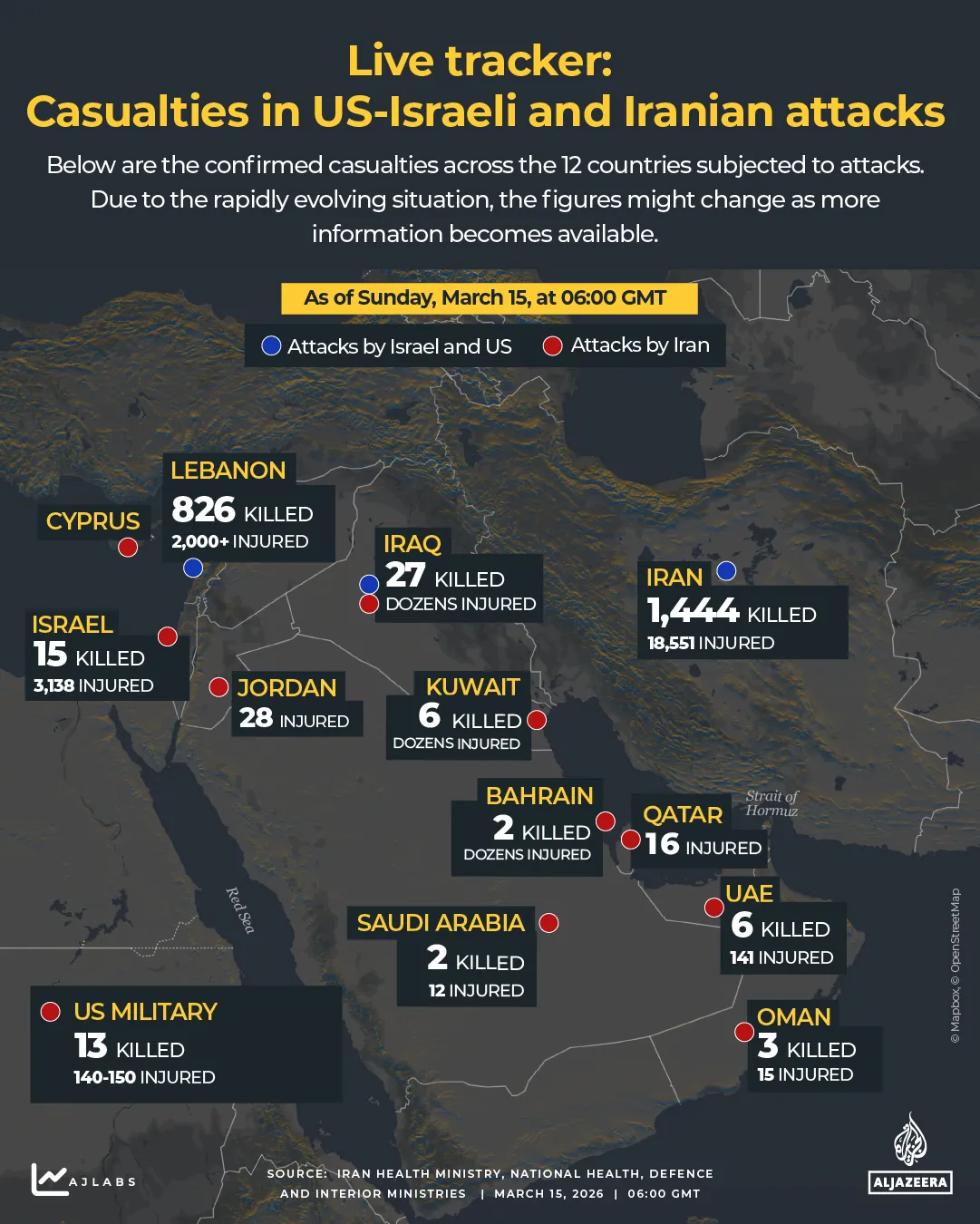
At least 1,444 people have been killed and 18,551 injured by US-Israeli attacks on Iran since February 28, Iran’s Ministry of Health says.
Al Jazeera’s Tohid Asadi, reporting from Tehran, said US-Israeli air attacks hit targets across the country, including in Tehran, Karaj, Isfahan and Tabriz. He said this was a sign that “we are not close to de-escalation.
“Iranian officials are talking about retaliatory strikes, with the Islamic Revolutionary Guard Corps talking about using what they call their most advanced weaponry, including Heidar missiles, to target Israeli territories and US bases in the region,” he said.
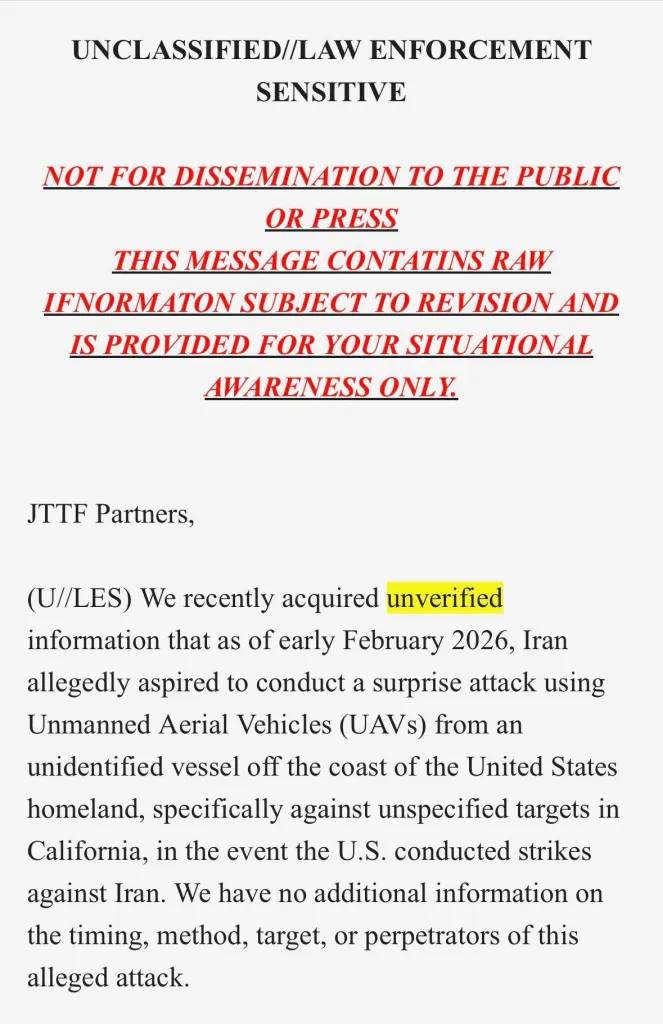
ABC Newsfirst reported on the alert on March 11. The FBI had sent out the notice to members of a Joint Terrorism Task Force last month, ahead of the current conflict in the Middle East. The United States and Israel began launching strikes on Iran on February 28.
The main body of the alert, which the FBI has now released, reads:
“We recently acquired unverified information that as of early February 2026, Iran allegedly aspired to conduct a surprise attack using Unmanned Aerial Vehicles (UAVs) from an unidentified vessel off the coast of the United States homeland, specifically against unspecified targets in California, in the event the U.S. conducted strikes against Iran. We have no additional information on the timing, method, target, or perpetrators of this alleged attack.”
FBI
The alert is marked as unclassified, but also as “law enforcement sensitive.” It declares up front that “NOT FOR DISSEMINATION TO THE PUBLIC OR PRESS” and that “THIS MESSAGE CONTATINS [sic] RAW INFORMATON [sic] SUBJECT TO REVISION AND IS PROVIDED FOR YOUR SITUATIONAL AWARENESS ONLY.”
Subsequent reporting from the Los Angeles Times, citing anonymous California law enforcement sources, said that the alert was based on intelligence the U.S. Coast Guard had received.
Additional context
Overall, much still remains unknown about the underlying intelligence behind the FBI’s drone attack alert. For unclear reasons, ABC‘s original report, which has since been updated, also did not note that the warning was the product of unverified intelligence or that it had been sent out as a precautionary measure.
For its part, the FBI had initially declined to comment in response to queries for more information from multiple outlets, including ABC and TWZ. We also reached out to U.S. Northern Command (NORTHCOM), the principal U.S. military command for defense of the homeland, which directed us to contact the FBI. We contacted the Department of Homeland Security (DHS) and the White House, as well.
“No such threat from Iran to our homeland exists, and it never did,” White House Press Secretary Karoline Leavitt wrote in a post on X on Wednesday, which also called for a full retraction of ABC‘s piece.
This post and story should be immediately retracted by ABC News for providing false information to intentionally alarm the American people.
They wrote this based on one email that was sent to local law enforcement in California about a single, unverified tip. The email even… https://t.co/jKey9ahsNk
“I am in constant coordination with security and intelligence officials, including at @Cal_OES [California Governor’s Office of Emergency Services], to monitor potential threats to California – including those tied to the conflict in the Middle East,” California Gov. Gavin Newsom wrote in his own post on X on March 11. “While we are not aware of any imminent threats at this time, we remain prepared for any emergency in our state.”
I am in constant coordination with security and intelligence officials, including at @Cal_OES, to monitor potential threats to California — including those tied to the conflict in the Middle East.
While we are not aware of any imminent threats at this time, we remain prepared…
“It’s all-around intelligence collecting, and it’s all about a posture of preparedness for the worst-case scenario,” Gov. Newsom said in response to ABC’s initial reporting, as well, according to TheSacramento Bee. “We have been gaming those out for some time as it relates to, again, what the FBI has been warning of. Again, it’s not a surprise, and it’s sort of a large part of the larger spectrum of considerations that we have as it relates to doing what we can to support our federal partners and local partners at the state level, in terms of what could happen next.”
“Law enforcement sources experienced in intelligence said such alerts are cautionary in nature,” the Los Angeles Times had also reported. “The source is experienced in counter-terrorism and said ‘that it’s not been deemed credible at this time.’ The sources stressed the warning was cautionary and there was no indication Iran was planning an attack or that it could successfully launch one.”
“This is not actionable,” a “California-based federal law enforcement official” separately told CBS News.
“All this means is we got this information and we want to get it out to law enforcement executives to make sure they’re up to speed on it,” a second law enforcement official from California also said, per that outlet. “There is absolutely nothing more to it.”
🚨Multiple US and state law enforcement and intel officials told @CBSNews there is no credible intelligence underpinning the bulletin distributed on the unverified possibility that Iran could retaliate for American attacks by launching drones at the West Coast. “This is not… https://t.co/gcdUBdgDX6
Generally speaking, there are long-standing concerns that Iran and/or other actors operating on its behalf could seek to launch asymmetric attacks on targets in the United States, as well as elsewhere outside of the Middle East, in retaliation for large-scale strikes. The risks of Iranians deciding to take such action have historically been seen as especially high in any scenario where they might be an existential threat to the regime in Tehran.
Earlier this week, ABC News also reported that U.S. federal authorities had issued another alert to law enforcement agencies after they “intercepted encrypted communications believed to have originated in Iran that may serve as ‘an operational trigger’ for ‘sleeper assets’ outside the country.”
“Although a large-scale physical attack is unlikely, Iran and its proxies probably pose a persistent threat of targeted attacks in the Homeland, and will almost certainly escalate retaliatory actions — or calls to action – if reports of the Ayatollah’s death are confirmed,” the DHS’s Office of Intelligence and Analysis also warned in a threat assessment published on February 28 also said, according to a story last week from Reuters.
On Wednesday, U.S. President Donald Trump had said “no, I’m not,” when asked about whether he was worried that Iran might attempt to attack targets in the United States in response to ongoing U.S.-Israeli operations, per Reuters.
Trump says he is not worried about Iran-backed attacks on US soil
“It’s being investigated, but you have a lot of things happening, and all we can do is take them as they come,” Trump also said later in the day.
“I have been,” the President added at the time when asked if he had been briefed about Iranian “sleeper cells” in the United States. “We know where most of them are. We’ve got our eye on all them, I think.”
Doocy: What have you heard about this bulletin about an Iran revenge plot in California — some kind of boat offshore launching drones?
DOOCY: If Iran tries to hit us back, have you been briefed about how many Iran sleeper cells there could be inside the US right now?
TRUMP: I have been, and a lot of people came in through Biden with his stupid open border. But we know where most of them are. pic.twitter.com/3mKVmq1uh9
Trump had previously downplayed concerns about attacks on the U.S. homeland in retaliation for the ongoing conflict against Iran in an interview with Time, which was published last week.
“I think they’re worried about that all the time. We think about it all the time. We plan for it,” he said. “But yeah, you know, we expect some things. Like I said, some people will die. When you go to war, some people will die.”
Long-range one-way attack drones with endurance measured in many hundreds of miles, if not more than a thousand miles, are increasingly a staple in military arsenals globally, and have also been proliferating to larger non-state actors.
This graphic from the Defense Intelligence Agency (DIA) showing the reach of certain kamikaze drones in the inventory of Iranian-backed Houthi militants in Yemen gives a good sense of the immense reach of this threat. DIA
A Shahed-136 kamikaze drone. Photo by Anonymous / Middle East Images / Middle East Images via AFP
In addition to being relatively low-cost, many of these kamikaze drones are very flexible in terms of where and how they can be launched. Iran and the U.S. military have notably demonstrated how Shahed-136-type and other kamikaze drone designs can be readily fired from ships, even smaller ones, and do not require significant deck space to be employed in this way. This also makes it easier to conceal the drones and their launchers before use. A warship with a purpose-built launch system is definitely not required. Even smaller commercial vessels could fire off multiple long-range one-way attack drones.
Iran Navy unveils its first drone division in the Indian Ocean
“Bravo Zulu. U.S. Navy forces in the Middle East are advancing warfighting capability in new ways, bringing more striking power from the sea and setting conditions for using innovation as a deterrent.” – Adm. Brad Cooper, CENTCOM Commander https://t.co/TgQ4WLbph3pic.twitter.com/WUiAVojTht
Once launched, the drones fly relatively low and slow, under the long-range radar horizon, creating complications for defenders. They are also relatively small and can be difficult to spot on radar, as well as by their infrared and acoustic signatures, making them even harder to spot and track. These complexities would be further amplified by a surprise attack launched from anywhere in the massive swaths of ocean ranging out many hundreds of miles from America’s shores.
Cruise missile threats to the homeland from rogue states and actors were a major factor in the U.S. Air Force deciding to install new active electronically-scanned array radars on F-15C Eagles primarily belonging to the Air National Guard. Up until recently, Guard F-15C units were tasked with guarding America’s ocean borders. Today, F-35As share that responsibility. Over a decade later, F-16 Viper fighters charged with the homeland defense mission also began getting AESAs, in part due to the need to better defend against drones and cruise missiles. The F-16 radar upgrade effort has since expanded to hundreds of other jets. This was also the key driver behind the abortive Joint Land Attack Cruise Missile Defense Elevated Netted Sensor System (JLENS) radar blimp program.
Now-retired US Air Force Lt. Gen. Michael Loh, then Director of the Air National Guard, listens to details about the new AN/APG-83 radar installed on the F-16 at a ceremony to mark the completion of upgrades to 72 Vipers in 2017. Northrop Grumman
So, yes, for many years the military has been very concerned with surprise standoff attacks coming from far off its shores from non-traditional platforms, enough for that threat to drive critical procurement initiatives. And all this was before the long-range one-way attack munition became a primary threat.
“Our potential adversaries have created significant capacity to reach us asymmetrically. Our forward layers, our allies, our partners, our forward combatant commands and geographic commands, have largely kept those threats away from the United States,” U.S. Air Force Col. Kristopher Struve, then Vice Director of Operations for the North American Aerospace Defense Command (NORAD), said during a virtual roundtable the Missile Defense Advocacy Association (MDAA) hosted back in 2021. “As we look into threats from cyber actors, space threats, as well as kinetic conventional cruise missiles, which have [seen] significant improvement on the part of China and Russia in recent years, those create avenues that can create havoc in the homeland while we are trying to project our power forward to potentially a regional conflict.”
Struve also said at that time that the U.S. homeland was “not a sanctuary any longer” and called for expanded defenses, including new surface-to-air missile batteries, to protect domestic critical infrastructure.
A Patriot PAC-3-series surface-to-air missile is seen being launched. US Military
TWZ has noted in the past that the line between traditional cruise missiles and long-range kamikaze drones, as well as decoys, is increasingly blurry. Long-range one-way attack drones are definitely more accessible, and often have greater reach, than most traditional cruise missiles.
“We’re behind. I’ll just be candid. I think we know we’re behind,” Lt. Gen. Charles Costanza, commander of the U.S. Army’s V Corps, said at a panel discussion at the Association of the U.S. Army’s (AUSA) main annual symposium last year. “We’ve been talking about counter-UAS [uncrewed aerial systems] and UAS capability for a better part of a decade, since, really, we watched the war in Armenia and Azerbaijan [in 2020] go on, and saw very much the beginning of the drone UAS capabilities.”
“We aren’t moving fast enough,” Costanza continued. “And it really took Russia’s invasion of Ukraine [in 2022], and the way they’re innovating, and Ukrainians are innovating, to realize, hey, we need to move fast.”
“Now, long-range one-way-attack drones, as well as increasingly capable cruise and ballistic missiles, continue to proliferate steadily, including to smaller nation-state armed forces and even non-state actors. An attack could even come from a small drone with a C4 charge launched from a fishing trawler 10 miles away from one of these critical radar installations. The threat of these kinds of near-field attacks has largely been overlooked for years, even as the low-end drone threat has exploded and ‘democratized’ precision-guided weaponry, as they did not fit the established aerial threat matrix and the countermeasures used to repel those threats.“
The potential for shorter-range drone attacks to come from vessels offshore, specifically, is also not simply an academic assessment of the available technology and its accessibility. U.S. authorities at least explored the possibility that a Hong Kong-flagged bulk carrier, the M/V Bass Strait, might have been tied to still mysterious drone swarms that harassed U.S. Navy ships off the coast of southern California back in 2019, which TWZ was first to report. Whether the Bass Strait or another nearby ship was the source of the harassment, or when it came from somewhere else, potentially further away, remains unknown, at least publicly.
A US Navy briefing slide discussing an interaction with the M/V Bass Strait on July 15, 2019. This says that at least at that time the bulk carrier was assessed to be “likely using UAVs to conduct surveillance on US Naval Forces while transiting to [a] scheduled port of call, [in] Long Beach, CA.” USN via FOIA
From what is known now, the FBI’s warning about a potential Iranian drone attack on California does not appear to have reflected an imminent cause for concern, and it remains unclear exactly what triggered it. Still, even if this specific threat has not turned out to be credible, the danger of such an attack is certainly well within the realm of possibility.
1 of 2 | A damaged building stands in the Dubai International Financial Center. The damage was caused by debris from the interception of an Iranian drone attack in Dubai, United Arab Emirates, Friday. Those in the UAE are being warned not to take photos or videos of damage or they could be charged under cybercrime laws. Photo by a stringer/EPA
March 13 (UPI) — Several people, including tourists and influencers, have been arrested in Dubai, United Arab Emirates, for possessing, sharing or commenting on digital content that shows attacks or damage from attacks by Iran in the country.
There have been 21 people arrested in the emirate, said advocacy organization Detained in Dubai.
“The charges sound extremely vague but serious on paper. In reality, the alleged conduct could be something as simple as sharing or commenting on a video that is already circulating online,” said Radha Stirling, CEO of Detained in Dubai and Due Process International.
“Under UAE cybercrime laws, the person who originally posts content can be charged, but so can anyone who reshapes, reposts or comments on it. One video can quickly lead to dozens of people facing criminal charges,” Stirling said.
Penalties can include up to two years in prison, fines ranging from about $5,500 to $55,000, and foreign nationals will face deportation.
“Foreigners need to understand that what may seem like normal social media behavior elsewhere can lead to arrest in the UAE,” Stirling said. “In some circumstances people can find themselves treated as national security suspects before the facts are even clarified.”
One 60-year-old British tourist has been charged under cybercrime laws for allegedly filming Iranian missiles over the city.
“We are in contact with the local authorities following the detention of a British man in the UAE,” the United Kingdom’s Foreign Office told CNN.
The UAE’s ambassador to the United Kingdom told British radio station LBC that the “United Arab Emirates is very safe.”
“The guidelines and regulations are there in the UAE to ensure people’s safety,” he said. He added that people filming could be hit by “falling debris.”
Stirling also said that Qatar has already charged more than 200 people under similar laws since the Iran war began.
The UAE defense ministry said on X Friday that 1,800 drones and missiles have been fired at the UAE since the war with Iran began.
Six people from the Emirates, Pakistan, Nepal and Bangladesh have been killed, and 141 people have suffered mild to moderate injuries.
Iranians attend a funeral for a person killed in recent U.S.-Israel airstrikes at Behesht-e Zahra cemetery on the southern outskirts of Tehran in Iran on March 9, 2026. Photo by Hossein Esmaeili/UPI | License Photo
Israel has killed almost 600 people in Lebanon and displaced more than 750,000 in less than two weeks. This is the opening act of Israel’s Gaza doctrine applied to a new front. The formula is consistent: Displace – either by ordering people to leave or by destroying their means of survival. Demolish civilian infrastructure to prevent return and expand territory through so-called “buffer zones”. Fragment any coherent governance by carving territory into disconnected enclaves where military action continues at a lower intensity.
I spent three years working in Palestine before being expelled by Israeli authorities. I watched this doctrine develop in real time. Now, from Beirut, I am witnessing its replication.
In the West Bank, Israel has spent decades fragmenting territory and denying Palestinians any contiguous geography. Water wells sealed with cement, homes demolished over impossible-to-obtain permits, herders pushed from their land by illegal settlement outposts. In Gaza, the same logic was applied with far greater speed and fury.
In October 2023, Israel announced that every Palestinian north of Wadi Gaza had to leave immediately. Days earlier, Israel’s defence minister had declared a complete siege: No electricity, no food, no water. By labelling an entire population as the enemy, Israel created a class of expendable people. The military released maps with Gaza divided into numbered blocks. When your number was called, you were forced to leave. Evacuation orders became the alibi for the crimes that followed. People were ordered into al-Mawasi, a stretch of coastline Israel designated a “safe zone”, a concentration area for hundreds of thousands living in tents, where air attacks continued. So-called evacuation zones were depopulated and destroyed.
Classic counterinsurgency logic would have entailed “clear, hold, and rebuild”. Israel’s approach was radically different: Destroy, displace, dismantle. The goal was not to pacify territory but to empty it. In both Gaza and southern Lebanon, Israel has treated civilian populations as indistinguishable from the resistance they support. Their displacement is the objective. The collapse of their political representation is a condition Israel seeks to make permanent. This is settler-colonial logic in contemporary military form.
The same playbook has now arrived in Lebanon, but with a revealing difference from previous Israeli operations here. In the first Lebanon war in the 1980s, Israel sought to install a sympathetic government. Gaza has shown that Israel has abandoned that aspiration. The goal is no longer to determine who governs a territory but to ensure that no coherent governance exists at all. Nor is Israel alone in this; the UAE’s approach in Yemen and the Horn of Africa – and its support to Israel in Gaza – reflects the same preference for isolated enclaves. What has emerged is a regional doctrine of fragmentation shared between aligned powers.
Israel has issued evacuation orders for the entirety of southern Lebanon and southern Beirut. The familiar map that appeared on my screen in Beirut last week had the same design and the same deadly ambiguity as the ones we dealt with in Gaza; announced evacuation zones failed to match those shown on the map. In Gaza, those who crossed the invisible lines were killed.
Hundreds of thousands of people are now on the move. Schools have become shelters, health workers have been killed, and people are sleeping on the seafront where just two nights ago a tent was bombed. Israel has threatened to attack Lebanese state infrastructure if the government fails to act against Hezbollah – extending its aims from displacement and infrastructure destruction towards the forced destabilisation of the state itself. The Lebanese government has responded by forbidding Hezbollah from firing. This is precisely the internal fracturing that Israel’s strategy appears designed to provoke.
But Lebanon is not Gaza. Hamas was fighting with an improvised arsenal inside a besieged strip of land, and this already proved challenging for Israeli forces. Hezbollah commands more sophisticated weaponry, hardened infrastructure, and decades of preparation for this kind of war. It has shown it can absorb heavy blows and strike back, surprising both Israel and outside observers with the depth of its capabilities. Israeli ground operations in southern Lebanon and the Bekaa have already met significant resistance. It is here that the doctrine may encounter its limits – not through diplomatic pressure, which has failed to materialise, but through asymmetric military reality. Iran has made Lebanon’s fate explicitly part of any ceasefire calculus, signalling a unification of fronts that Israel had thought were weakened.
A doctrine built on the assumption of impunity has encountered little resistance in the conference halls of a so-called rules-based order. The Gaza doctrine is the expanded version of what Israel previously called the “Dahiyeh doctrine” – the use of overwhelming force against civilian infrastructure – now weaponised towards a larger end: The permanent redrawing of the region’s geography, demography, and political order.
This doctrine has developed in a vacuum of accountability. The International Court of Justice has been ignored. The Security Council has been paralysed. Governments have continued trading with Israel as it steadily normalised the unacceptable. Daniel Reisner, who headed the international legal division of Israel’s military advocate general’s office, was candid in saying that “If you do something for long enough, the world will accept it […] International law progresses through violations.”
The United States is not a bystander to this failure; it is an active participant in deepening it. At the Munich Security Conference earlier this year, Secretary of State Marco Rubio framed the transatlantic alliance in ethnonationalist terms and cast colonialism as a Western achievement. At an event in Tel Aviv, US Ambassador Mike Huckabee expressed confidence that Washington would “neuter” both the ICC and the ICJ – the very institutions through which accountability might otherwise be pursued.
What is unfolding in Lebanon is the political continuation of an ongoing settler-colonial project. The evacuation orders are precursors to mass destruction, designed to prevent return and permanently alter the landscape. Stability in the Middle East demands more than ceasefire agreements that manage fragmented populations while permitting lower-grade warfare to continue. It requires unconditional enforcement of international law, full accountability for those prosecuting this doctrine, and the right of return and reconstruction – from Beit Hanoon to Beirut.
The views expressed in this article are the author’s own and do not necessarily reflect Al Jazeera’s editorial stance.
Heavy Israeli strikes have hit Tehran, Iran, as its allies launch attacks across Gulf states, and shipping through the Strait of Hormuz has been severely disrupted, sending global oil prices soaring.
Meanwhile, political pressure is mounting in Washington as the conflict spreads across the region.
Recommended Stories
list of 1 itemend of list
Here is what we know about what has been happening in the past 24 hours:
In Iran
Supreme leader speaks: Appointed last week following the assassination of his father, Iran’s new Supreme Leader Mojtaba Khamenei has issued his first statement, warning that attacks on Israel and US military assets and infrastructure in the Middle East will continue unless bases hosting US forces in the region are closed.
Heavy strikes on Tehran: The Israeli military has launched a new “extensive wave” of air attacks on Iran’s capital, Tehran, leaving the city covered in thick smoke on Friday morning.
Strait of Hormuz closure and surging oil prices: The Strait of Hormuz, which connects the Gulf to the Gulf of Oman, is closed, causing Brent crude oil prices to surge past $100 per barrel. The strait, which falls into the territorial waters of Iran and Oman, is the only waterway to the open sea available to oil and gas producers in the Gulf. Iran has stated that the strait is under Iranian control and US-and Israel-linked ships are banned. Other vessels must receive Iranian permission to pass.
Civilian casualties: Iran’s ambassador to the United Nations, Amir Saeid Iravani, said at least 1,348 civilians have been killed, with victims ranging in age from eight months to 88 years old.
A navy vessel is seen sailing in the Strait of Hormuz [Sahar Al Attar/AFP]
In Gulf countries
Regional retaliation and attacks: Iran has launched waves of drones and missiles towards Gulf countries that host US military assets and troops, and has targeted oil tankers and facilities.
Bahrain: The nation has reported intercepting 114 missiles and 190 drones since the war began on February 28.
Saudi Arabia: The country intercepted 10 drones over its eastern region and later destroyed an additional 28 drones that breached its airspace.
Attacks on the UAE: The country has strongly condemned Iranian strikes on the region, and said they have hit Dubai International Airport and some hotels.
Evacuations: Australia has ordered all “non-essential” officials to leave the United Arab Emirates and Israel, and urged its citizens to evacuate the Middle East while it is still safe to do so
Qatar’s response: Qatar’s airspace is officially closed, but Qatar Airways has scheduled more than 140 special flights to help repatriate stranded residents and citizens.
Qatar has strongly rejected Israeli media claims that it intentionally paused liquefied natural gas (LNG) production to manipulate US energy prices; officials clarified that the suspension was actually forced by an Iranian drone attack.
A view of the damaged part of the Dubai Creek Harbour tower after it was hit by an Iranian drone attack in Dubai, United Arab Emirates [EPA]
In the US
Trump claims war moving ‘rapidly’: US President Donald Trump told reporters the war against Iran was moving “very rapidly”.
“It’s doing very well, our military is unsurpassed,” he said at the White House, not directly responding to the latest comments from Iran’s new supreme leader.
Domestic opposition: More than 250 US organisations have signed a letter calling on Congress to halt funding for the war. They argue the $11.3bn spent in the first six days of the conflict is diverting crucial funds from urgent domestic needs, such as food benefits.
No ‘need’ for ground troops in Iran: US Senator Lindsey Graham has played down the possibility of US troops being deployed to Iran, but suggested the war could continue for some time. “I don’t see this conflict ending today,” the Republican senator told reporters in Washington, DC.
In Israel
New missile wave launched at Israel: The Israeli military said early on Friday that Iran had fired a new barrage of missiles towards Israel, and instructed people in affected areas to head to shelters.
Israel strikes Basij force: Israel’s military said it had struck checkpoints set up in Tehran by the Basij force of Iran’s Revolutionary Guards as part of efforts to undermine control by the authorities.
Regime change: Israeli Prime Minister Benjamin Netanyahu said Israel can create conditions for regime change, but it is up to Iran’s people to take to the streets. He also said Israel is aiming to stop Iran from moving nuclear and ballistic projects underground.
In Lebanon, Iraq
Downed US aircraft: A US KC-135 refuelling aircraft crashed in western Iraq. While the Islamic Resistance in Iraq claimed it shot the aircraft down using air defence systems, US Central Command (CENTCOM) stated the aircraft went down in “friendly airspace” and was not the result of hostile fire.
Iraqi port closures: Iraq has shut its port operations after an Indian crew member was killed during an attack on a US-owned oil tanker in Iraqi waters.
Six French soldiers hurt: A drone attack wounded six French soldiers in Erbil, in Iraq’s autonomous Kurdish region, President Emmanuel Macron said on Thursday.
Deadly attacks in southern Lebanon: Israeli bombardments continue on southern towns and villages. A strike on the village of Arki, near Sidon, killed nine people, including five children.
Mounting death toll and mass displacement: Lebanese officials have reported that at least 687 people have been killed in Israeli attacks on Lebanon since last Monday, including 98 children. The intense bombardments have displaced an estimated 700,000 to 750,000 people from their homes.
Women and children were among those killed in the attacks, according to the Taliban.
Published On 13 Mar 202613 Mar 2026
Share
Afghanistan’s Taliban government has accused Pakistan of targeting civilian homes in overnight air attacks in the capital Kabul and the southern province of Kandahar, as fighting between the two neighbours entered its third week, overshadowed by the United States-Israel war on Iran igniting the middle East.
Women and children were among those killed in the attacks, according to the Taliban.
Recommended Stories
list of 3 itemsend of list
Government spokesman Zabihullah Mujahid said on X Friday that Pakistan’s aircraft also struck fuel depots belonging to the private airline Kam Air near Kandahar airport.
There was no immediate comment from Pakistan’s military or government.
Calls for restraint from the international community have gone unheeded by both sides.
On Thursday, the Taliban government said four members of the same family, including two children, were killed by Pakistani artillery and mortar fire in eastern Afghanistan.
The deaths reported on Thursday brought the toll to seven people killed in Afghanistan since Tuesday in cross-border clashes, according to authorities in Kabul. That could rise with the latest attacks on Friday.
Fighting between the two countries intensified on February 26 when Afghanistan launched an offensive along their shared border in retaliation for earlier Pakistani air attacks on the Pakistan Taliban, just two days before the US and Israel attacked Iran, starting a sprawling regional war.
Pakistan maintains that it does not target civilians, and casualty claims from both sides are difficult to verify independently.
Islamabad accuses Kabul of harbouring fighters from the Pakistan Taliban, which has claimed responsibility for a series of deadly attacks inside Pakistan, and from the ISIS (ISIL) affiliate in Khorasan province. Afghan authorities deny the charge.
The United Nations mission in Afghanistan has said 56 civilians have been killed there, including 24 children, by Pakistani military operations from February 26 to March 5.
Pakistani officials have confirmed about 12 soldiers were killed and 27 wounded in the latest bout of fighting, while the Taliban claims to have killed more than 150.