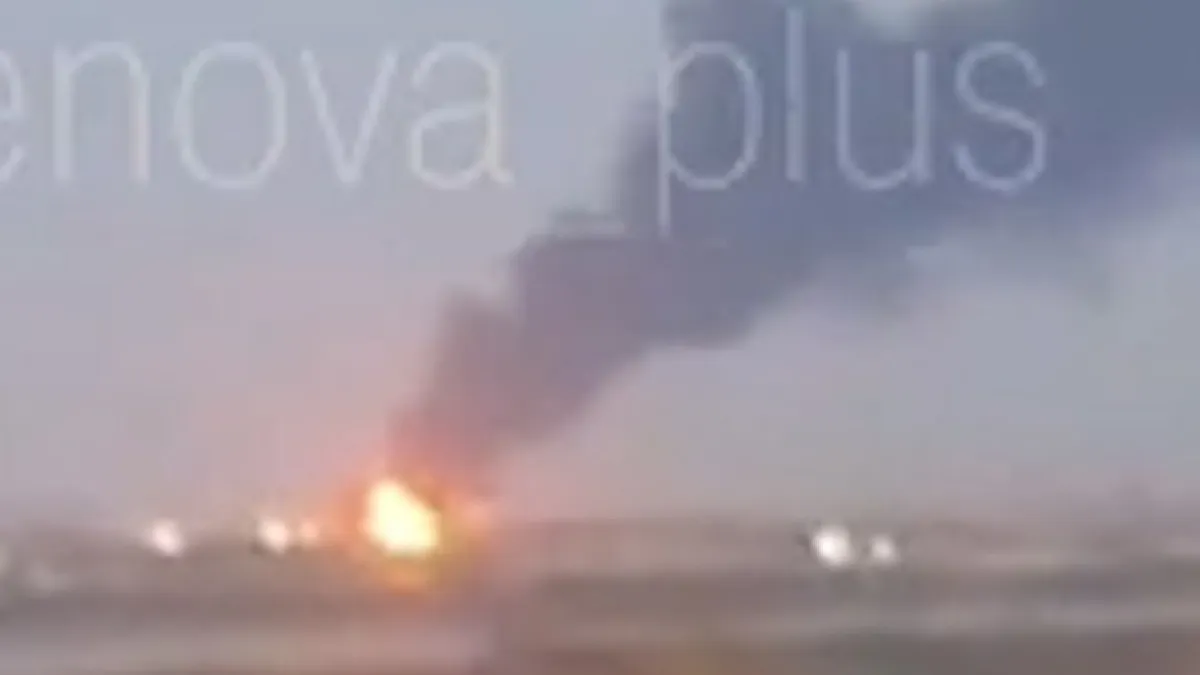
The United Nations Interim Force in Lebanon said there were no casualties after small arms fire targeted a border post.
Published On 7 Oct 20267 Oct 2026
The United Nations Interim Force in Lebanon (UNIFIL) says one of its posts on the Lebanon-Israel border was targeted by small arms fire, with no casualties reported.
The UN force said the incident occurred on Wednesday morning with several rounds of small arms fire targeting a UNIFIL position near Kfar Shouba along the UN-drawn border with Israel, known as the Blue Line.
Recommended Stories
list of 3 itemsend of list
“Such deliberate attacks gravely endanger the lives of peacekeepers,” UNIFIL said in a statement, adding that it was investigating the incident.
Under pressure from the United States and Israel, the UN Security Council decided earlier this year to set December 31 as the end of the mandate for the UN peacekeeping force in Lebanon.
UNIFIL was initially created to oversee the withdrawal of Israeli troops from southern Lebanon after Israel’s 1978 invasion, and its mandate has been renewed annually since then.
The mission was expanded after the 2006 war between Israel and Hezbollah. Proponents say it remains important to maintaining a demilitarised buffer between the two sides along the volatile Israeli and Lebanese border.
Israel has long accused UNIFIL of failing to prevent threats posed by Hezbollah and has increasingly pushed for the end of its mission since cross-border fighting escalated in the wake of the October 7, 2023, Hamas-led attacks on Israel and the start of Israel’s war on Gaza.
UNIFIL currently has 7,500 peacekeepers from around 50 countries operating in Southern Lebanon.
Last month, Lebanon’s Prime Minister Nawaf Salam pressed the UN on the need to “avert the vacuum” that would be caused by withdrawing the mission from the country’s south without a viable replacement.
Violence has decreased since a ceasefire following a June memorandum of understanding in the US-Iran war. Lebanon and Israel concluded a US-sponsored framework agreement later that month.
The Israel-Lebanon deal involves the disarmament of Hezbollah, a gradual withdrawal of Israeli forces from Lebanon’s south and the deployment of the Lebanese army to the region, starting in test areas known as “pilot zones”.
Israeli air strike kills Palestinian Civil Defence rescue volunteer as he was travelling to help wounded people near Kamal Adwan Hospital in Beit Lahiya, northern Gaza, a medical source says.
Published On 7 Oct 20267 Oct 2026
Israeli attacks have killed at least four Palestinians, including a rescue worker, and wounded several others across Gaza.
The Palestinian Civil Defence rescue volunteer was killed in an air strike as he was travelling to help wounded people near Kamal Adwan Hospital in Beit Lahiya, northern Gaza, a medical source said on Wednesday.
Recommended Stories
list of 3 itemsend of list
The Civil Defence identified the victim as Mohamed Tamous.
Meanwhile, an Israeli drone strike in the southern city of Khan Younis killed Hisham Ibrahim Abu Mustafa, 60, and injured several others, Nasser Hospital said.
The body of a 17-year-old Palestinian was also brought to Nasser Hospital after he was killed in an Israeli drone strike in the Qizan Abu Rashwan area south of Khan Younis, Turkiye’s state news agency Anadolu reported, citing a medical source.
A teenage boy died from wounds sustained last month when Israeli forces opened fire east of Khan Younis, Anadolu reported, citing a medical source.
Also on Wednesday, a girl was injured by Israeli gunfire directed at displaced Palestinians’ tents in the Al-Amal neighbourhood, Anadolu reported.
Additionally, in Khan Younis, the Israeli military carried out two demolitions in the northeastern and eastern parts of the city.
The military also carried out demolitions east of Gaza City’s Tuffah neighbourhood.
Israel has killed more than 74,245 Palestinians since it launched its genocidal war on Gaza in response to the Hamas-led October 7, 2023, attack on Israel.
UCLA running backs coach A.J. Steward preaches it and it is the mantra adopted by the Bruins’ prolific running backs.
UCLA’s three-headed backfield, composed of fifth-year players Wayne Knight and Anthony Woods and senior Jaivian Thomas, is hailed for its undeniable impact on the ground, ranking first nationally in rushing touchdowns, third in yards per carry and fifth in yards per game this season.
Steward, who works in tandem with offensive line coach and run game coordinator Chris Smith, said it’s what his tailbacks do without the ball and the group’s commitment to each other that separates the group from the rest of the pack.
UCLA running back Anthony Woods scores against Cal while receiver Mikey Matthews celebrates the touchdown on Sept. 5.
(Godofredo A. Vasquez/For The Times)
“The way we play without the ball in our hands is no different. It should be no different than what we do when we have the ball in our hands in terms of trying to make a play for our offense,” Steward said. “You cut the film on any of these guys, you’ll see they’re downfield making blocks. They’re there at the end of the play in case somebody puts the ball down [on] the ground and that’s because they hear it every day how you do anything’s how you do everything.”
Apart from the group’s buy-in to doing the little things, its commitment to unselfish football keeps one of the most dynamic running games in the country from fracturing.
All three of the Bruins starting running backs could have been the sole starter at another program, with Woods rushing for 1,131 yards and 16 scores at Idaho in 2023, Thomas running for 626 yards and seven touchdowns at California in 2024 and Knight earning AP All-America honors last season at James Madison for his record-breaking 2,039 all-purpose yards.
But, as Steward preaches, the star of the running unit is the running back unit. And that belief is shared by the players, keeping them tightly knit and unbothered by who gets the most touches or scores.
“It goes into their buy-in as a program, as a group, because you’re talking about three dynamic running backs that could have 40 carries, 50 carries, 30 carries, 20, whatever it is,” said offensive coordinator Dean Kennedy. “But the fact that they’re buying into each other, that you could see them on the sideline, genuinely caring about other people’s success, and when you have a group like that, it bleeds to the team.”
The ability to utilize three differently skilled but equally high-impact running backs has dramatically opened Kennedy’s playbook, allowing him to put the tailbacks out on the perimeter and act as receivers, creating headaches for opposing defenses.
But the real value comes in the dying embers of games, when everyone on both sides of the field is exhausted — except the UCLA running backs.
“The ability to when we’re in the fourth quarter, I’m looking at these three guys and none of them are banged up, none of them are gassed and we can just roll,” Steward said. “We have guys that have only played 15 snaps in a game, 20 snaps in a game, that we trust with the game on the line to be able to push the ball forward and get first downs in a four-minute situation. That’s a competitive advantage. That’s part of the method to the madness is to have guys really fresh by the time we get to the fourth quarter.”
The team-first mentality of the running back group stems from the emphasis Steward places on having authentic relationships with his players, a lesson he learned under coach Dave Bailiff, now the special assistant to the head coach at Texas State, when Steward was a graduate assistant at Rice.
After a fellow graduate assistant chewed out one of the scout team players, Bailiff brought all of the young coaches into his office and reprimanded them, highlighting that they should never say or do anything they wouldn’t do to their own son.
UCLA running back Jaivian Thomas weaves through the Purdue defense on Sept. 19 at the Rose Bowl.
(Ronaldo Bolanos/Los Angeles Times)
And Steward has carried that experience from more than a decade ago in Houston, inspiring how he leads his group in Westwood.
“I definitely see them as somebody’s sons. I struggled earlier in my career to be blunt in the moments that they needed me to be blunt, because I didn’t want to ruffle their feathers or strain our relationship momentarily,” Steward said. “But now, I’m addressing it with them because I don’t want them to get hurt from a place of love. It’s been good for them to see me with my family, so they see a lot of the consistency with how I raise my boys, with some of the lessons that I’m trying to teach them.”
That spirit allowed Steward to be one of two coaches — alongside nickels coach Gabe Lynn — to be retained after working for former coach DeShaun Foster.
Soon after he arrived, new UCLA head coach Bob Chesney asked Steward whether he wanted to remain in Westwood.
And the answer was easy.
“I told him how much I really believe in this place and how much I love the players that we have here. I knew it was only a matter of time before we could get this thing going in the direction that I’ve always envisioned it,” Steward said. “I’m blessed that he gave me an opportunity to stay, and we’re seeing the fruit of some of the work that was put in before they got here, but also the success that they brought and the culture they added.”
And Steward’s emphasis on cultivating a genuine connection to his players fit naturally with the culture Chesney vowed to instill in Westwood.
Steward’s three top running backs now praise the coach for who he is as a man and a leader.
“His faith and how he carries himself as a father and off-the-football-field stuff — I admire a lot of that,” Knight said. “He’s a very respectable man.”
On the field, Knight said Steward has made him become more of a pro, by harping on the little things and making sure that no one takes anything for granted. Thomas said Steward knew things about his game that Thomas did not know himself.
UCLA running back Wayne Knight smiles after scoring a touchdown against Purdue at the Rose Bowl on Sept. 19.
(Ronaldo Bolanos/Los Angeles Times)
Woods echoed his teammates’ message, adding that Steward has pushed the group to its limit and held them to the highest standard because he knows the players’ potential.
“If they believe the why behind the things that you do, it opens the door for them to trust your decision making sometimes when it doesn’t necessarily benefit them,” Steward said. “That’s really what’s unlocked our ability to see these guys get closer to their ceiling. Even when I’m giving them coaching points, they understand this comes from a place of love. Love is saying great job when it’s a great job, or telling you that’s not the standard when it’s not the standard.”
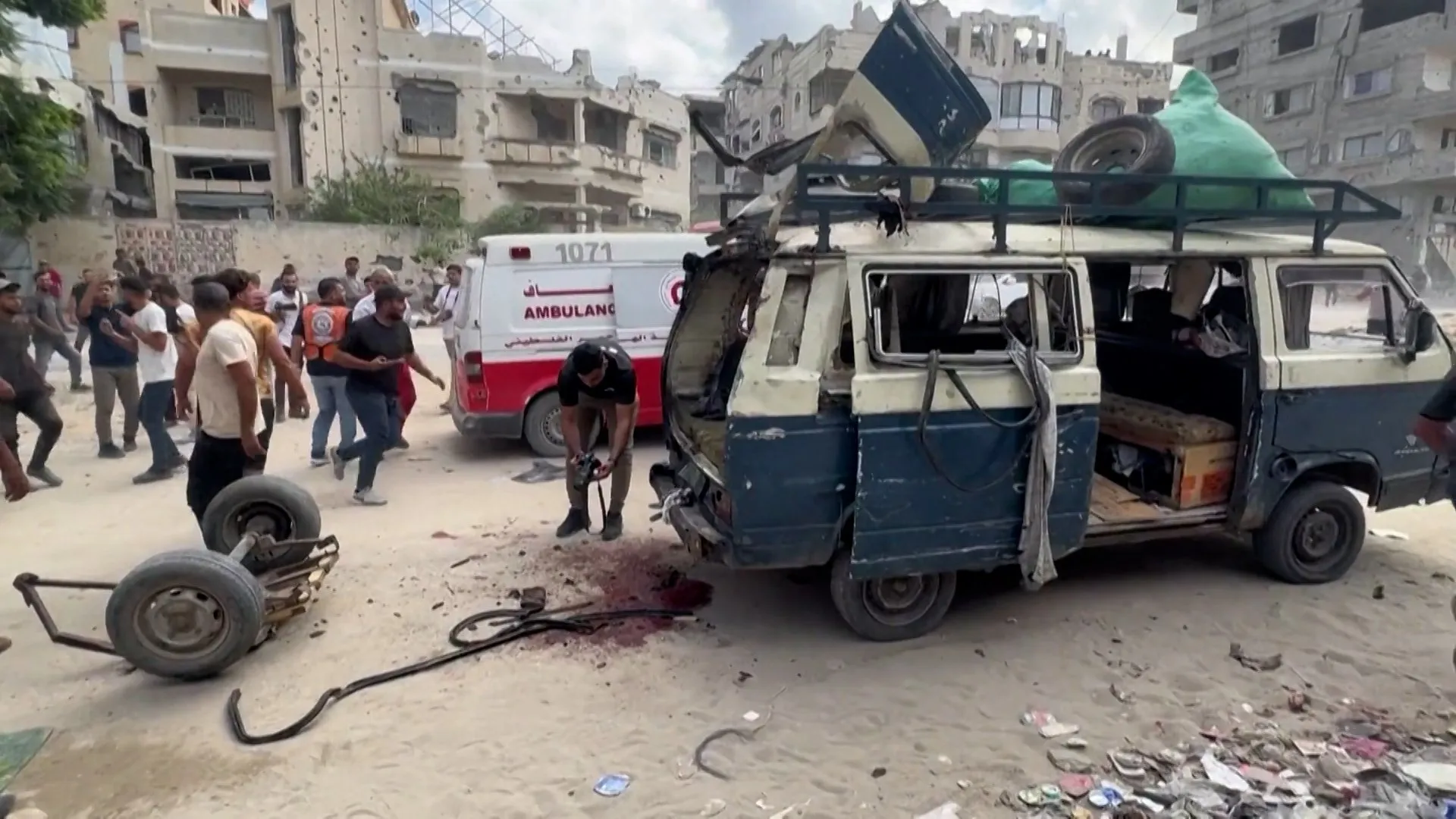
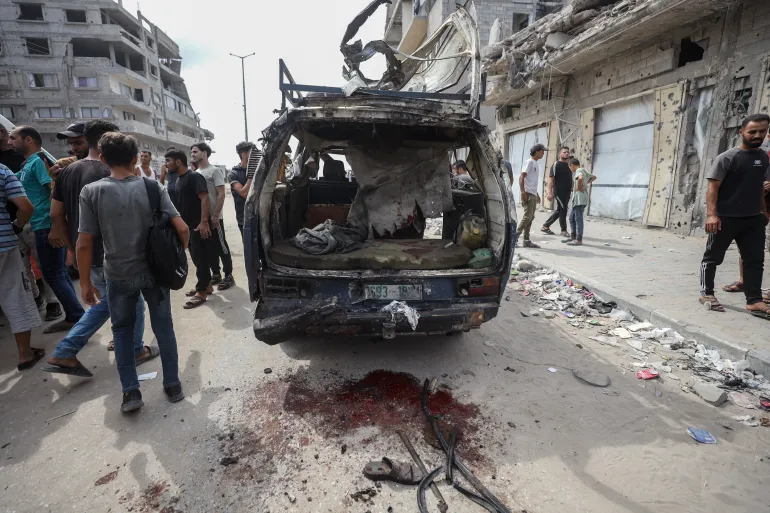
Israeli attacks on residential areas across Gaza killed at least eight civilians and wounded others on Wednesday. In Gaza City, an Israeli strike hit a minibus in the Tel al-Hawa area, killing six people and wounding 15 others, according to Palestinian medical officials.
At least six people killed in drone attack on passenger van and one person killed in strike on residential apartment.
At least seven Palestinians have been killed and more than 10 wounded in Israeli attacks on the Gaza Strip as Israel continues to violate a nearly year-old “ceasefire”.
Six of the victims were killed in an Israeli drone attack on a passenger van in Tal al-Hawa, in southwest Gaza City, on Wednesday, according to witnesses and medical sources.
Recommended Stories
list of 2 itemsend of list
The Palestine Red Crescent Society, a humanitarian group that runs ambulance and emergency services, said its crews took 13 wounded people to al-Quds Hospital.
Medical sources told Al Jazeera the injuries sustained by the victims of the attack are “critical”.
“Doctors say it’s difficult to save the lives of the wounded because the health system is decimated by years of Israeli attacks and the blockade,” said Al Jazeera’s Hind Khoudary, reporting from Gaza City. “The number of dead in the strike could rise in the coming hours.”
Earlier, the official Palestinian Wafa news agency reported that an Israeli attack on a residential apartment near al-Shifa Hospital in Gaza City killed at least one woman.
Elsewhere, four Palestinians, including two children, were wounded when an Israeli drone hit a shelter for displaced people in southern Gaza, according to local sources cited by Wafa.
Two other Palestinians were seriously wounded by Israeli forces southeast of Deir el-Balah in central Gaza, while Israeli tank fire was also reported in southern Khan Younis, in the southern part of the Strip.
The attacks came as the Ministry of Health in Gaza, which compiles casualty figures from hospitals across the territory, said in its latest daily update early on Wednesday that the bodies of at least nine people had arrived at hospitals during the last 24 hours.
While eight people were killed around the reporting period, one woman had died from earlier wounds, bringing the number of people killed since the start of the “ceasefire” between Israel and the Palestinian group Hamas in October last year to at least 1,431.
An Israeli strike targeted a vehicle in Tal al-Hawa, in southwest Gaza City [Khames Alrefi/Anadolu]
At least 5,026 have been wounded over the same period, including 31 in the past 24 hours, the ministry said.
“There is supposed to be a ceasefire in Gaza, but the Israeli army’s violence is endless. Every day, Palestinians are killed, injured, and the humanitarian situation is deteriorating,” said Khoudary, describing “terrifying” conditions for Gaza’s residents.
“Everyone inside the Strip is afraid to go to the supermarket, to take their children to school, and to live their everyday lives,” she added.
Overall, Israel’s genocidal war against Palestinians in Gaza has killed at least 74,032 people since October 2023, with another 175,142 wounded, according to health officials.
In August, an analysis by the United Nations Satellite Centre found that the number of destroyed structures across Gaza has increased by 9 percent since the “ceasefire” took effect.
Overall, about 82 percent of structures in Gaza, roughly 200,000 buildings, have been damaged, and about two-thirds of those have been destroyed since the start of the war, according to the UN.
White phosphorus can cause severe burns, ignite repeatedly and produce intense heat and toxic smoke. Here’s how Israel has used it in southern Lebanon, its impact on civilians and farmland, and why its use in populated areas is restricted under international law.
Al Jazeera’s Reem Takieddine explains.
Durban, South Africa – Bishop Raphael Bahebwa is in hiding, afraid he could be attacked for speaking out for the rights of foreigners in South Africa.
“I am in hiding now because they say they are going to kill me for speaking about the rights of foreigners,” he told Al Jazeera.
Bahebwa has lived in South Africa for 26 years, after arriving as a refugee from the Democratic Republic of the Congo (DRC).
In that time, he has watched antiforeigner sentiment flare repeatedly in the country he came to call home. But he says this year feels different.
A September 30 deadline declared by March and March, an anti-immigration movement that has led protests across South Africa this year, has renewed fears of violence among migrant communities.
The group has called for undocumented foreign nationals to leave South Africa and has warned of further demonstrations if its demands are not met.
For Bahebwa and other refugees in Durban, however, the distinction between documented and undocumented migrants offers little comfort. They say the hostility they experience on the streets rarely begins with a request to see their papers.
Fears of renewed violence
South Africa will hold local government elections on November 4, in a campaign in which migration has become an increasingly prominent political and social issue.
For months, Bahebwa was among hundreds of refugees and asylum seekers who slept on the pavement outside the Durban Refugee Reception Centre on Che Guevara Road.
Many were from the DRC and Burundi, with others from Uganda, Mozambique and Tanzania. They said they had fled their communities because they feared antiforeigner attacks.
They arrived outside the Department of Home Affairs (DHA) office seeking safety.
Instead, the pavement became their home.
For roughly four months, men, women and children slept outside, exposed to the elements and dependent on civil society organisations and volunteers for food and other necessities.
“It has been very tough,” Bahebwa said. “Never before have I experienced something like this.”
Some of the migrants told Al Jazeera that conditions became desperate. They described irregular access to food and medication and said one man who had tuberculosis died while living at the camp. Al Jazeera has not independently established the circumstances of his death.
The camp was also not far removed from the hostility its residents said they had fled.
On September 3, members of March and March confronted refugees and asylum seekers living outside the centre. Violence broke out, and police intervened. At least four people were reported injured.
At another protest days later, police officers stood between the two groups, forming a barrier as tensions rose.
March and March has described its mobilisation as a campaign against undocumented immigration, crime and deteriorating conditions in South African communities.
The group says the government’s response to immigration enforcement has been insufficient.
Its leaders have repeatedly rejected accusations that their campaign is xenophobic and insist their target is undocumented migration rather than foreign nationals generally.
Bahebwa said documented and undocumented migrants alike have been caught in the hostility.
Earlier this year, six refugees working in salons around Durban’s Warwick Street Market were beaten by men carrying sticks, according to public-interest news outlet GroundUp. Two were hospitalised.
Bahebwa said the migrants had also struggled to obtain help from the authorities after earlier attacks.
“Police said we can’t open cases because we are foreigners. We had nowhere to go,” he alleged. Police have not publicly responded to that specific allegation.
Nowhere obvious to return to
In mid-September, the government moved to clear the makeshift camp outside the refugee centre.
The refugees were given a choice: return to the communities they had fled or accept temporary accommodation at the Lindela facility in Gauteng, hundreds of kilometres from Durban. Lindela is a government-run immigration detention facility used to hold people facing deportation.
The choice divided them.
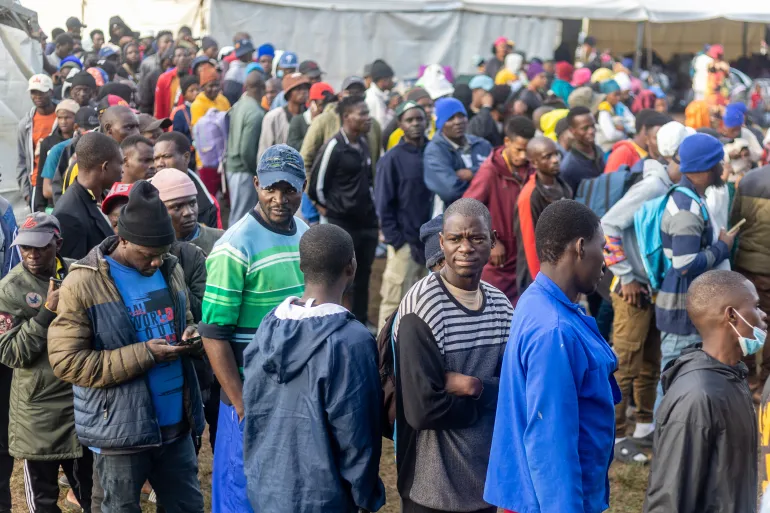
Malawi migrants to South Africa line up for supplies at an informal refugee camp in Sherwood, Durban, South Africa, after fleeing their homes amid fears of xenophobic attacks [File: EPA]
Some feared going to Lindela, a facility historically associated with immigration detention and repatriation. Others felt they could no longer endure life on the pavement.
On September 15, 274 people were transported by bus from Durban to Lindela. About 150 others chose to remain in Durban and began trying to find alternative accommodation.
For those who stayed behind, leaving the pavement did not resolve the problem that had brought them there in the first place.
Kafuti Muyumba, a small business owner from the DRC and a representative of the refugee community, said many were afraid to return to neighbourhoods where they had built businesses and lives.
People are afraid, he said. “Even the police allow March and March violence. They came with sticks and say we are attacking them,” Muyumba told Al Jazeera.
He said many refugees had lost their livelihoods during the months of upheaval and were now desperate to find accommodation.
“This is not the first time we are experiencing xenophobia,” he said. “In 2008 and then in 2015 we also experienced this.”
In 2008, xenophobic violence spread through townships and informal settlements, killing dozens and displacing thousands.
Further outbreaks of violence against foreign nationals followed in subsequent years.
For Muyumba, those memories make the rhetoric surrounding September 30 difficult to dismiss.
“We don’t trust the police. They are not being fair with us. Some of them are also saying we must go,” he said.
Police have said there are no plans to change their normal policing approach because of the September 30 deadline and that any protesters will be expected to remain within the law.
March and March said all it wants is for undocumented immigrants to leave the country and return home.
But Muyumba said returning to the DRC is not a viable alternative for many Congolese refugees.
“There is still war there,” he said.
A country tightening its borders
In response to ongoing protests, the South African government said it had intensified its immigration enforcement.
Between June 14 and August 20, authorities processed 86,596 foreign nationals for deportation and repatriation, according to the government’s Inter-Ministerial Committee on Migration.
Malawians made up the largest group, followed by Zimbabweans and Mozambicans.
Government data says 90 percent of those repatriated had entered South Africa illegally, while 95 percent were classified as having crossed the border outside official ports of entry.
The government says the operations form part of a broader effort to strengthen border management and enforce immigration law.
At the same time, officials have repeatedly warned private groups against taking immigration enforcement into their own hands.
March and March’s September 30 deadline has no legal authority. The government says common citizens cannot deport anyone from South Africa.
Protesters hold placards during an anti-immigration march in Durban, South Africa, calling for tighter border controls and the deportation of undocumented migrants [File: Thuli Dlamini/Reuters]
But deadlines do not need legal force to create fear, as was the case for an earlier deadline of June 30. For the refugees who spent months sleeping outside the DHA office in Durban, September 30 is another uncertainty layered on top of many others.
Some have been moved hundreds of kilometres away.
Others are trying to find new homes in the same communities they once fled. But among the migrants Al Jazeera spoke to, there is a shared anxiety that paperwork may offer limited protection when anger is directed first at being foreign.
Bahebwa has spent more than a quarter of a century in South Africa. For now, he says he is hiding and does not know what September 30 will bring.
“They are scapegoating us as foreigners,” he said. “It is not going to end on September 30. It has to do with the elections.”
Yemen’s government forces have conducted multiple air and ground operations in the southwestern governorate of Taiz in 24 hours as they intensify attacks against the Iran-backed Houthi group.
The government’s military media centre on Sunday claimed a number of operations against the rebels, including air strikes on Houthi positions in five locations across the governorate.
Recommended Stories
list of 4 itemsend of list
More than 146,000 people have been displaced since the fighting erupted in July after a period of relative calm since a United Nations-brokered ceasefire in 2022.
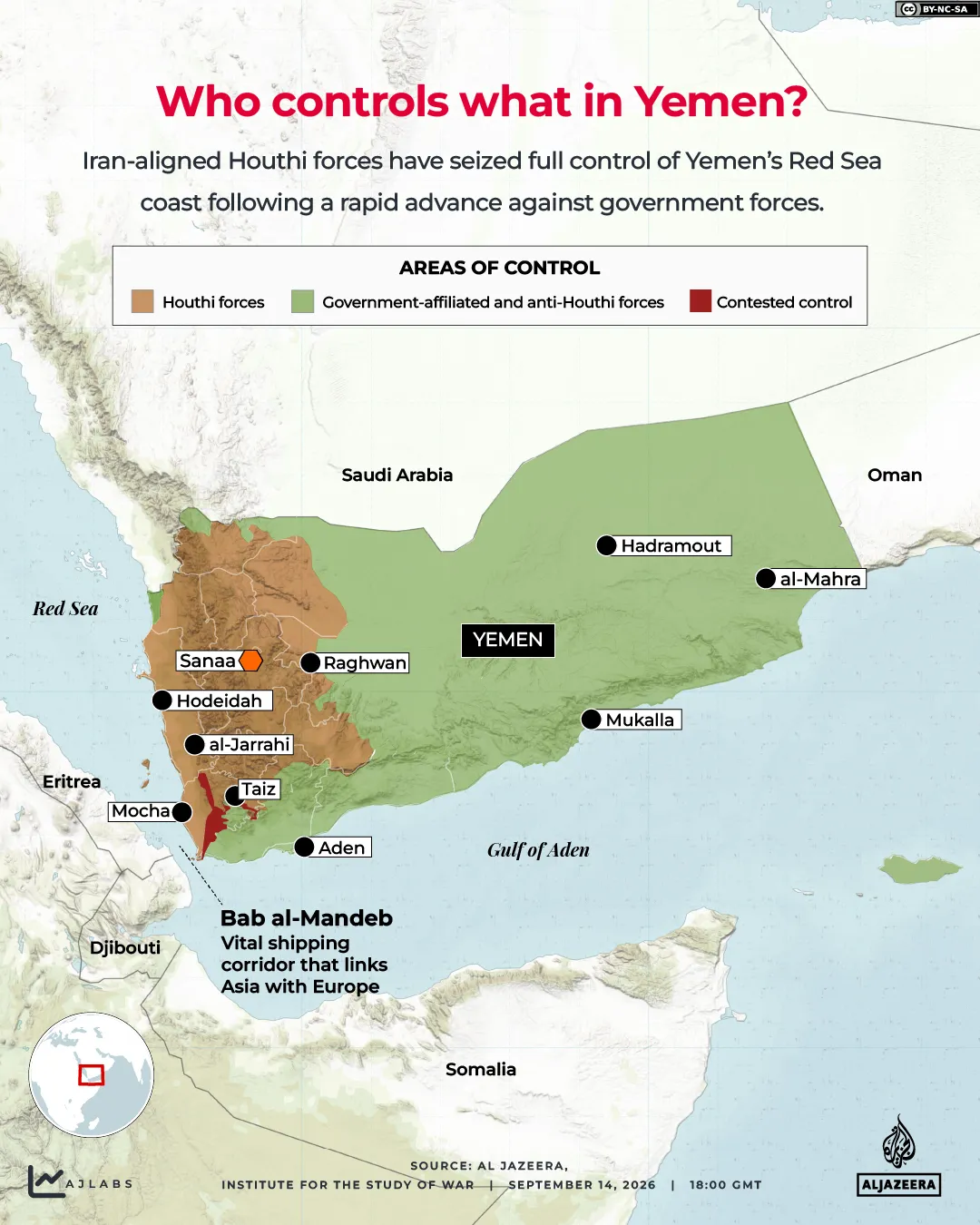
In recent weeks, the Houthis have made dramatic territorial gains against the government forces, seizing the strategic Red Sea coastal city of Mocha and expanding their control over the Bab al-Mandeb strait, a global maritime chokepoint connecting Europe to Asia.
Rashad al-Alimi, the head of the Presidential Leadership Council, has called on citizens to mobilise and join the fight against the Houthis as the government has stepped up its attacks against the Iran-backed group in an effort to stop their advance and regain lost territory.
Meanwhile, Saudi Arabia, which has faced Houthi attacks on its soil since fighting escalated further this month, has been turning to its allies, including Pakistan and Turkiye, for support.
Saudi Arabia backs Yemen’s internationally recognised government.
Here’s what we know about the latest fighting and the humanitarian conditions the impoverished country faces:
What to know about the latest fighting
According to the military media centre on Sunday, dozens of Houthi fighters, including field commanders, were killed or wounded in the previous 24 hours of fighting near Taiz’s capital, which is also named Taiz.
Government forces have carried out operations in several areas of the governorate, including the al-Waziiya district in the west, weapons sites and ammunition depots at Mafraq Mawiya and al-Dhukrah in the east, a Houthi gathering in the Hayfan district in the south and against military vehicles in the Gurab area in the northwest.
Government forces also thwarted infiltration attempts on the al-Ahtoub front and in Hadran as they carried out shelling of Houthi gatherings on the al-Kadha and al-Aqroud fronts, the media centre said.
It added that several Houthi military vehicles were damaged in the attacks.
Al Jazeera could not verify the battlefield claims.
“Government forces say they have made advances in the southern Taiz governorate, taking control of several areas and higher ground. Among them is Jabal Bazel, a mountaintop that places Houthi supply lines within target range,” Al Jazeera’s Maha Ali said on Saturday, reporting from Taiz.
“These developments point to significant and potentially decisive ground operations in recent hours.”
Ali said al-Alimi expressed confidence that government forces were capable of restoring control over the whole country. Houthis currently control vast swaths of northern and western Yemen while the government controls the south and east.
Since the current fighting erupted, the Houthis have accused the Saudis of carrying out attacks in Yemen and promised to prevent Saudi tankers from passing through Bab al-Mandeb, which Riyadh has been using as an alternative shipping route to the Strait of Hormuz. Tehran in effect has closed the Strait of Hormuz since the United States and Israel began a war on it in February. Before the conflict, a fifth of the world’s oil supplies had passed through that waterway.
Government forces, meanwhile, accused the Houthis of using Iranian air defence weapons and said they pose a danger to aircraft.
“These Houthi weapons pose a serious threat to international flight paths over the Red Sea and operate using a heat-tracking system,” Brigadier General Majed al-Nazili, the official spokesperson for the Yemeni government forces, said on social media.
“The weapons employed are capable of attacking military or civilian targets without the ability to distinguish between them, thereby endangering the safety of civil aviation and the lives of passengers.”
Early on Saturday, a Saudi-led coalition in Yemen said its air defence systems intercepted and destroyed two ballistic missiles and two drones launched by the Houthis towards Riyadh and Khamis Mushait in Saudi Arabia.
What has been the regional response to the conflict?
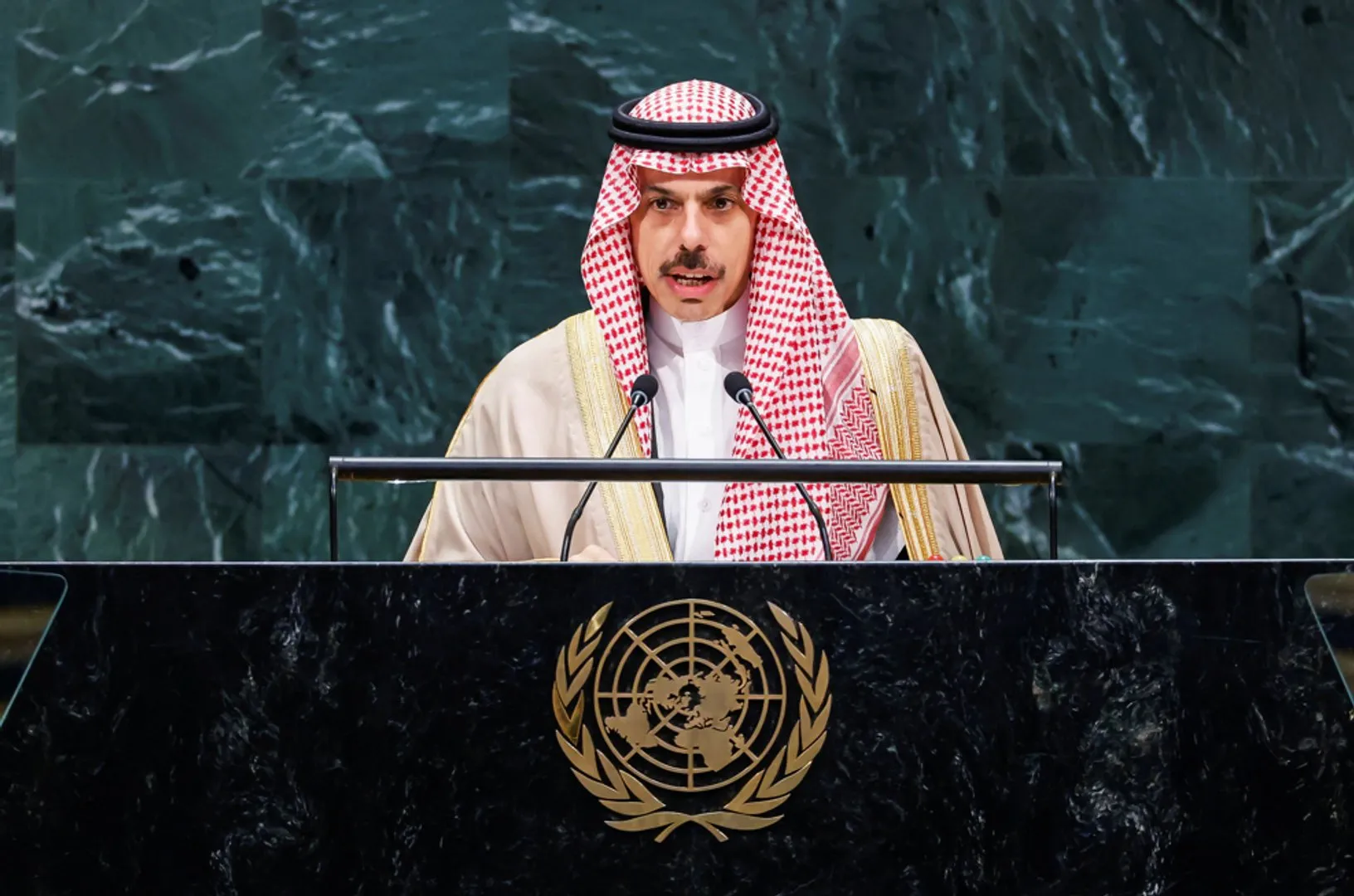
On Saturday, Saudi Foreign Minister Faisal bin Farhan Al Saud, addressed the UN General Assembly and called on the international community to condemn Houthi actions against the kingdom and in Yemen.
At the same forum, Yemeni Vice President Abdullah Abdulkader al-Alimi-Bawzer warned that the Houthis were using shipping security “as a tool for blackmail”.
“It is taking hostage the entire global economy,” he said.
The secretary-general of the Gulf Cooperation Council (GCC), Jassim Mohammed al-Budaiwi, on Saturday strongly condemned the recent Houthi attacks against Saudi Arabia.
“This dangerous escalation constitutes a flagrant violation of the Kingdom’s sovereignty and poses a direct threat to the security and safety of civilians and the stability of the region,” al-Budaiwi said in a statement.
Iran has denied it has any role in the Yemen conflict. Iranian President Masoud Pezeshkian told Al Jazeera that the actions of the Houthis were not connected to Iran and Tehran stands in solidarity with “everyone subjected to injustice”.
He urged the Houthis and Saudi Arabia to resolve their differences through dialogue, saying “a brother should not fight his brother,” and offered Iran’s help in ending the dispute. “We will not be warmongers,” he said.
On Friday, Iran delivered a ceasefire offer, which US President Donald Trump has rejected. It included Yemen and Lebanon. Tehran offered to open the Strait of Hormuz if the US fulfils its conditions, which include the lifting of Washington’s naval blockade on Iranian ports, a sanctions waiver and the release of Iran’s frozen assets.
(Al Jazeera)
Could Saudi allies join the conflict?
Saudi Arabia’s allies have rallied behind it amid intense fighting between the Yemeni government forces and Houthis.
Saudi Defence Minister Khalid bin Salman said on Saturday that there would be continued joint efforts with Pakistan to confront attacks against the kingdom in accordance with the Mecca Joint Defence Agreement signed last month.
He held talks with Pakistani Field Marshal Asim Munir on Thursday. A day earlier, the military chiefs of Saudi Arabia, Pakistan and Turkiye jointly reviewed threats facing Saudi Arabia at a meeting in the Saudi capital.
Multiple Saudi cities, including Riyadh, have been hit by drones and missiles attributed to the Houthis.
Meanwhile, France confirmed on Friday that it was sending troops to guard the major oil terminal at Yanbu, a Saudi port city on the Red Sea, but added that it was not joining the conflict. Yanbu has major oil storage and refining facilities and is connected by the East-West Pipeline, which can carry up to seven million barrels a day. The pipeline was damaged in a drone attack carried out from a group based in Iraq.
The US has so far not pledged military involvement, but the Saudi foreign minister said the kingdom was “continuing to work with our partners in the US”. On September 14, the commander of the US military’s Central Command, Brad Cooper, met the de facto Saudi ruler, Crown Prince Mohammed bin Salman, in Jeddah in the wake of the Houthis’ seizure of Mocha.
What’s the state of humanitarian conditions?
At least 146,000 people have been displaced in the Arab region’s most impoverished country over the past three weeks, most of whom were uprooted from or within Taiz governorate, according to Yemen’s UNICEF country representative, Akhil Iyer.
The number of casualties is still not confirmed as the rival sides have made conflicting claims. As per media reports, the death toll runs into the hundreds.
UNICEF has verified that at least 15 children have been killed and 14 injured in the conflict since early September while three have been reported missing.
According to the UN Office for the Coordination of Humanitarian Affairs, more than 22 million people in Yemen require humanitarian assistance and protection services; 18.3 million people face acute food insecurity; and more than 2.2 million children under five are acutely malnourished.
Saudi Arabia has used its address to the UN General Assembly to accuse Iran of flagrant attacks on civilian and economic targets across the region, while calling on the international community to condemn Houthi actions threatening Red Sea shipping.
Lebanese Prime Minister Nawaf Salam wants US-brokered ceasefire to be consolidated and for Israel to retreat.
Lebanese Prime Minister Nawaf Salam has called for an end to the Israeli occupation of southern Lebanon and the full enforcement of the ceasefire, as Israeli shelling and demolitions continue.
“We want the war to end and we want the ceasefire [with Israel] consolidated,” Salam said in a speech at the United Nations General Assembly in New York on Friday.
The prime minister demanded a complete withdrawal of Israeli forces from Lebanese territory up to its internationally recognised border and the release of all Lebanese detainees.
As delegates gathered to listen to Salam, on the ground in Lebanon, Israeli forces carried out a large explosion near Taybeh and Deir Siryan, while an Israeli air strike targeted a valley between Froun and Ghandourieh, triggering a large fire.
Al Jazeera’s Zeina Khodr, reporting from Froun, said the reality on the ground is that the conflict is far from over.
“From the ground here in Froun, we can still see Israeli warplanes and drones flying at low altitudes in the skies above and Israeli artillery shelling is still causing uncontrollable fires. Lebanese civil defence and firefighters are not being allowed by the Israelis to reach these areas and put out the flames,” she said.
“More than 60 towns in southern Lebanon are still occupied by the Israeli army, where the Israelis are carrying out a systematic campaign of demolitions,” Khodr added.
Israeli forces are “blowing up people’s homes, despite the framework agreement in which there is supposed to be a ceasefire that they have signed with the Lebanese government,” she said.
Israeli attacks in southern Lebanon have killed at least 4,386 people and wounded 12,407 others since March 2 , when the current Hezbollah-Israel war started. Since then, Israeli forces have occupied up to 600sq km of Lebanese territory up to the Litani River.
A US-brokered framework agreement between Lebanon and Israel in June provides for a gradual Israeli withdrawal from Lebanese territory and the deployment of the Lebanese army in areas vacated by Israeli forces.
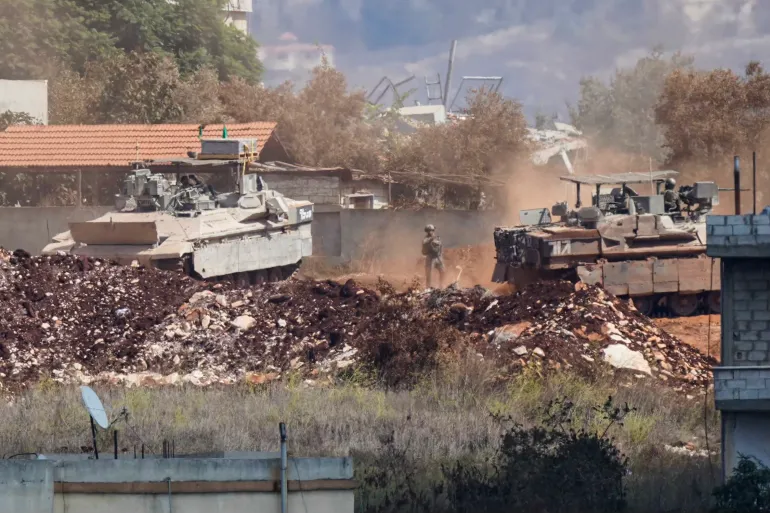
Israeli armoured vehicles in the southern Lebanese village of Zawtar al-Charkiyah on Thursday [Ammar Ammar/AFP]
Speaking at the UNGA, Salam said his government had entered into negotiations with Israel, mediated by the United States and President Donald Trump, “to end the war and restore Lebanon’s sovereignty”, adding that the success of any agreement is measured not by intentions but by fulfilment of commitments.
“What is required is to complete the translation of this agreement into practical steps within a clear timetable and with a verification mechanism that ensures the implementation of all its provisions,” he said.
He focused on state sovereignty, saying it “cannot be untouchable in one place and negotiable in another, nor can the rules of international law apply to some but not to others”.
Salam also pledged to oversee the disarmament of Hezbollah in exchange for Israel’s eventual full withdrawal, also saying “weapons must be exclusively in the hands of the state and that decisions on war and peace rest solely with its constitutional institutions”.
Stability in the Middle East can only come with respect for Palestinian rights, he said.
“There can be no lasting stability in Lebanon without lasting stability in our region, and there can be no stability in the region as long as this organisation [the UN] remains unable to enable the Palestinian people to exercise their inalienable right to self-determination, like all other peoples of the world,” Salam said. “No less and no more.”
France is sending its military to protect key Yanbu oil terminal; Pakistan and Turkiye to hold military talks with Riyadh.
By Al Jazeera Staff, AP, DPA and Reuters
Published On 25 Sep 202625 Sep 2026
Saudi Arabia’s allies are rallying to support the country as the Houthi rebels step up attacks.
France confirmed on Friday that it is sending troops to guard the major oil terminal at Yanbu. Meanwhile, Saudi officials are meeting with peers from Pakistan and Turkiye to discuss options under their mutual defence pact.
Recommended Stories
list of 4 itemsend of list
French President Emmanuel Macron told broadcasters TF1 and France 2 that Paris is to send “soldiers, radars, and defence systems” to the Red Sea port of Yanbu.
“Not to involve ourselves in any conflict, but to protect the site,” he said.
Yanbu hosts major oil storage and refining facilities and is connected by the East-West Pipeline, which can carry up to seven million barrels a day.
The Houthis, also known as Ansar Allah (supporters of God), have repeatedly fired missiles and drones into Saudi Arabia, disrupting oil flows from the world’s largest energy exporter.
On Thursday, the rebel group said it had struck the facilities of state oil firm Aramco in Yanbu, and a “sensitive target” in Riyadh. Saudi forces said they had intercepted six ballistic missiles. Authorities have not confirmed any damage.
The foreign ministers of Saudi Arabia, Pakistan and Turkiye met on Thursday to arrange an “urgent meeting” of their military chiefs of staff under the Mecca Joint Defence Agreement, which treats an attack on one member as an attack on all, the Saudi foreign ministry said in a statement.
They also condemned Houthi attacks that they claimed targeted Mecca and other civilian sites.
However, doubt persists over what action Turkiye and Pakistan might take under the pact, which is yet to be officially triggered. Both of the Saudi allies are heavily involved as mediators seeking to bring an end to the conflicts across the Middle East.
Saudi Arabia’s grand mufti called on soldiers to be ready to lay down their lives to fight the Houthis, according to the Saudi state news agency.
The Iran-aligned Houthis have been battling the Saudi-backed government of Yemen for more than a decade. That conflict has been rekindled amid Israel’s wars against the Iran-aligned Hamas group in Gaza and the Hezbollah group in Lebanon, and the United States war on Iran.
At the United Nations General Assembly in New York, Yemen’s Vice President Abdullah Abdulkader al-Alimi-Bawzer warned that the Houthis were using shipping security “as a tool for blackmail”.
“It is taking hostage the entire global economy,” he said.
The US has not renewed military involvement, but Saudi Foreign Minister Prince Faisal bin Farhan Al Saud said the kingdom was “continuing to work with our partners in the US”.
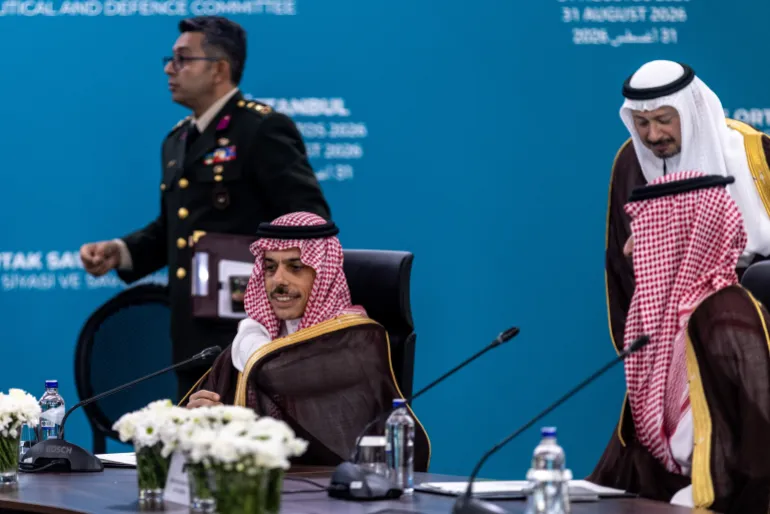
Saudi Foreign Minister Prince Faisal bin Farhan Al Saud in Istanbul, Turkiye [Burak Kara/Getty]
The Houthi targeting of Yanbu adds to the pressure on Saudi Arabia’s oil exports.
Earlier this month, the Houthis seized the Yemeni port of Mocha and several Red Sea islands, giving them significant control over the Bab al-Mandeb strait, which usually carries about 12 percent of global oil trade.
Strikes have also disrupted the operation of the East-West Pipeline linking Yanbu to export routes. Riyadh had been using it to export crude bypassing the Strait of Hormuz, which is restricted amid the Iran-US war.
However, the Houthis have now forced the Saudis to switch some exports back to Hormuz.
Brent crude rose more than 3 percent on Thursday, briefly topping $108 a barrel, before easing to $105.77 on Friday morning.
June Goh, a senior oil market analyst at Sparta Commodities in Singapore, said oil would likely stay above $100 a barrel as long as the war on Iran continued.
“With no clear resolution in sight, the gap in oil inventories globally is getting wider,” Goh told Al Jazeera.
Ukraine has targeted an industrial plant in Russia’s Perm region with a massive drone swarm. Russian authorities say they also repelled strikes headed towards Moscow.









![Protesters hold placards during an anti-immigration march in Durban, South Africa, calling for tighter border controls and the deportation of undocumented migrants [Thuli Dlamini/Reuters]](https://i0.wp.com/www.aljazeera.com/wp-content/uploads/2026/06/2025-11-07T155727Z_1005019881_RC2NRHA84QWK_RTRMADP_3_SAFRICA-PROTEST-1782784993.jpg?w=640&ssl=1)