TOP Gun: Maverick actor James Handy has been stabbed to death with his girlfriend’s son telling cops in a 911 call: “I just killed the man”.
The 81-year-old, who also starred in Logan and Jumanji, was found unconscious with multiple stab wounds to his chest on his front yard.
Sign up for the Showbiz newsletter
Thank you!
James Handy, pictured in TV series NYPD Blue, has been stabbed to deathCredit: GettySurveillance footage from outside the home caught an unknown man walking past around the time of the stabbingCredit: FOX 11
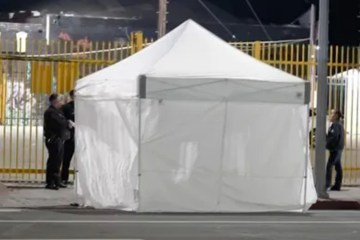
Authorities rushed to the scene in Tarzana, Los Angeles on Wednesday morning at around 9.30am after receiving a chilling 911 call.
Police revealed a voice at the end of the line said: “I am the son of man, I just killed the man of sin.”
Officials rushed to James’ home on Erwin Street and raced him to hospital where he was pronounced dead.
Some time later, 44-year-old Michael Gledhill – the son of James’ partner – waved down officers as they searched near the home.
James, pictured in TV show X files, was found with multiple stab wounds outside his homeCredit: Channel 4Police swarmed round James’ home early on Wednesday morning after receiving a chilling 911 callCredit: ABC7Police are continuing to investigate the deathCredit: ABC 7The actor (far left) also starred in Arachnophobia in 1990Credit: Alamy
Gledhill confessed to carrying out the fatal attack and said he was the one who phoned the police, according to the Los Angeles Police Department.
Gledhill was arrested for murder and taken to Van Nuys Jail with his bail set at $2,000,000.
The LAPD statement said: “Detectives believe this is an isolated incident and there appears to be no danger to the public at this time.”
A motive for the attack remains unclear.
Most read in Entertainment
James (far right) in NYPD BlueCredit: GettyJames (center) had a major role in 1986’s Popeye DoyleCredit: Alamy
Neighbors have claimed Gledhill and James were overheard arguing overnight.
The star’s talent agent, Pam Ellis-Evenas, paid tribute saying: “With great sadness I can confirm that the gentleman who was attacked and killed on Wednesday in Tarzana was the actor James Handy.”
James’ career spanned almost five decades with his most recent major role being in Tom Cruise’s Hollywood sequel Top Gun: Maverick in 2022.
He played the role of bartender Jimmy.
Another memorable role for James came in 2017 superhero flick Logan as he played the doctor who treated lead man Hugh Jackman.
James also starred in 1995 cult classic Jumanji alongside Robin Williams, Bonnie Hunt and Kirsten Dunst.
His career featured several TV credits such as the role of Arthur Devlin in eight episodes of Alias and recurring stints on Melrose Place and NYPD Blue.
In the race for Los Angeles mayor, incumbent Karen Bass secured a place on the November ballot. But who will challenge her is yet to be determined, as votes are still being tallied.
With 62% of the expected vote counted, reality television personality Spencer Pratt sits in second place and City Councilmember Nithya Raman trails in third. Although Pratt has declared victory, the Associated Press, which estimates the expected votes in, has not called the race.
This story is based on a snapshot of precinct-level results provided by the L.A. County registrar on Wednesday. The Times analyzed the 525,326 votes processed so far. This story will be updated when winners are finalized in early July by the secretary of state.
This map shows the margin and density of votes by precinct. Areas where a candidate leads by a wide margin, such as Brentwood for Pratt, appear darker on the map. More densely populated neighborhoods — such as Bass strongholds in Baldwin Hills and Hyde Park — appear in brighter colors. As of Wednesday, an estimated 710,000 ballots were yet to be counted, according to L.A. County officials.
More votes per square feet
More votes per square feet
More votes per square feet
The preliminary results show narrow margins among precincts on the Eastside, with some precincts showing an almost 30% split across the top 3 candidates.
Bass retained a strong lead in precincts across South L.A. compared with her 2022 race against Rick Caruso. Pratt has garnered heavy support from his neighbors in Pacific Palisades, as well as precincts in Bel-Air and Shadow Hills.
Raman, who represents Los Feliz, Hollywood Hills, Sherman Oaks and Encino on the city council, has so far underperformed in her home 4th District. She led in 12 of the 66 precincts, particularly in parts of Los Feliz. A few precincts in East Hollywood swung heavily for Pratt; but Bass led much of CD-4.
Karen Bass
Percentage of votes
Bass had strong support in South L.A.
Spencer Pratt
Pratt won half the vote in wealthy Pacific Palisades and Bel-Air precincts
Nithya Raman
Raman underperformed in much of her own council district
To win the race outright, Bass needs to secure at least 50% of the vote. She currently holds 35% of the vote and a five-point lead over Pratt. A Berkeley IGS poll released last week found that Bass and Raman would likely defeat Pratt by double digits in the event of a runoff.
Mail-in ballots with a June 2 postmark will be accepted by county election officials through Tuesday.
I was alone in the forest in my favorite place for the first time in years, so I did the only logical next right thing. I lay down.
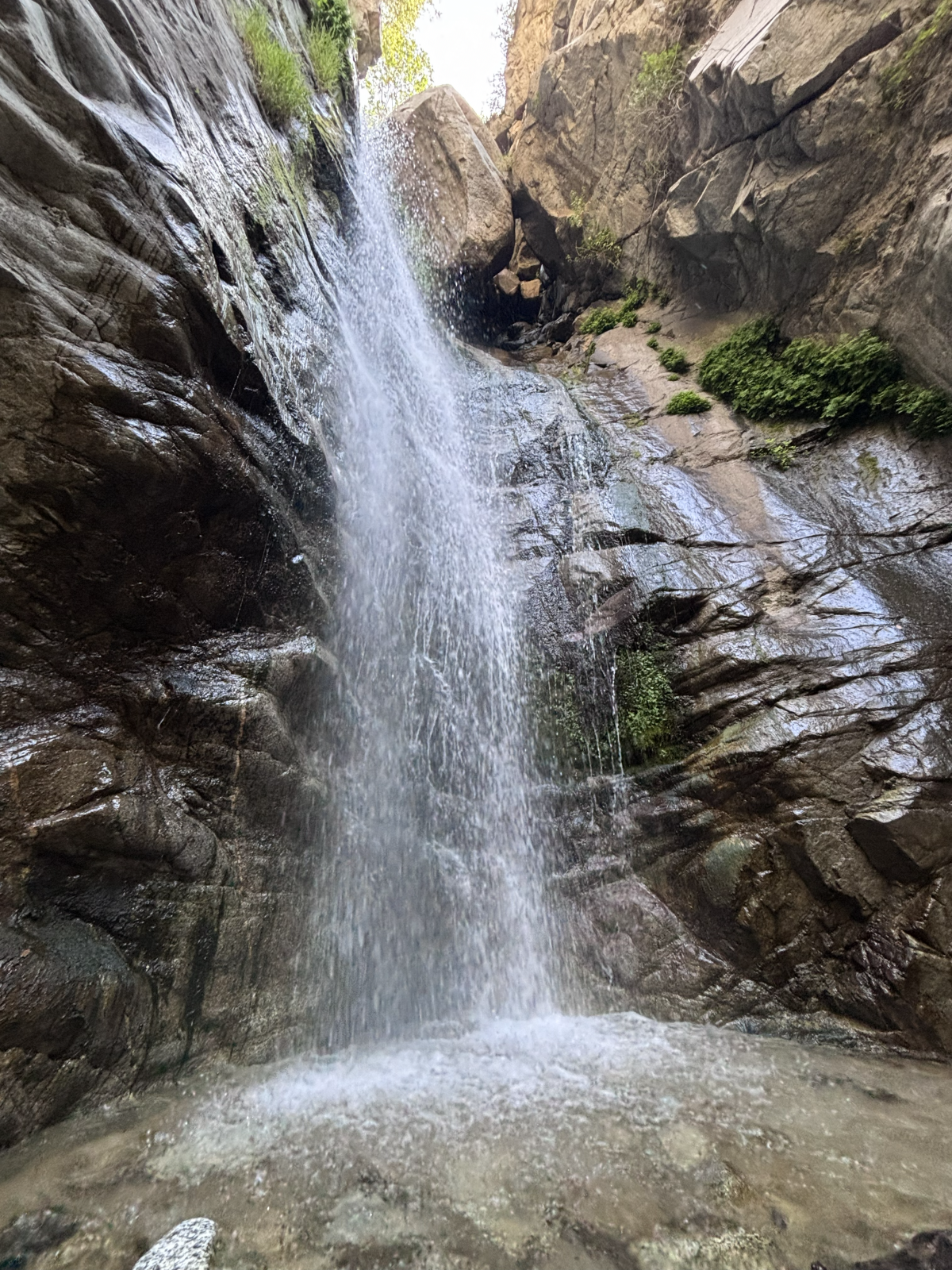
There I was, sprawled next to Millard Canyon Falls, listening as the water roaring down the cliff and cool air whooshed past my face. I gained a new perspective when I gazed at an upside-down waterfall. What’s the point of hiking if we don’t play around?
In today’s edition of The Wild, our weekly outdoors newsletter, I provide you with three great hikes where rivers and waterfalls are still flowing. It’s essential information as we head into summer and temperatures start to rise.
You are reading The Wild newsletter
Sign up to get expert tips on the best of Southern California’s beaches, trails, parks, deserts, forests and mountains in your inbox every Thursday
By continuing, you agree to our Terms of Service, which include arbitration and a class action waiver. You agree that we and our third-party vendors may collect and use your information, including through cookies, pixels and similar technologies, for the purposes set forth in our Privacy Policy such as personalizing your experience and ads.
If you were to force me to choose my favorite hike, I would stubbornly refuse to pick just one, but my list would include these three.
That’s why I really want to urge you, my dear Wild reader, to treat these places with the reverence they deserve. That includes:
Refreshing your memory on the seven “Leave No Trace” principles.
Packing a small trash bag in which you can store empty food wrappers, toilet paper and garbage you spot along the way.
Observing wildlife from a distance, including California newts, which you shouldn’t pick up because it’s rude and, more important, because they can secrete a neurotoxin through their skin that can be lethal to humans.
OK, let’s talk about where your next favorite hike will be!
Millard Canyon Falls in Angeles National Forest.
(Jaclyn Cosgrove / Los Angeles Times)
1. Millard Canyon Falls
Distance: 3.3 to 4.3 miles (see below) Elevation gained: About 900 to 1,100 feet Difficulty: Moderate Dogs allowed? Yes Accessible alternative: Paved segment of Gabrielino Trail from Windsor Boulevard
This 3.3- to 4.3-mile hike to Millard Canyon Falls will take you through lush hillsides and beneath the shade of coast live oaks and bigleaf maples as you walk alongside, and sometimes through, Millard Creek. Your journey ends at Millard Canyon Falls, a gorgeous 50(ish)-foot waterfall that gushes past massive boulders perched at the top of the cascade.
This hike is usually much shorter (about 1.5 miles), but a road closure in place since the Eaton fire lengthened it. I will explain more about the closure later. It is important to note, though, that Chaney Trail is the name of the roadway and an actual trail, both of which you’ll take on this hike.
To begin your hike, you can either parallel park nearNuccio’s Nurseries, taking care to obey all parking signage, or if those spots are all taken, park nearby and order a rideshare to drop you at the trailhead. I had cell reception with Verizon here, so it should be possible to order a ride back to your vehicle.
Millard Creek in Angeles National Forest.
(Jaclyn Cosgrove / Los Angeles Times)
From here, you have two options for reaching the Millard Canyon Falls trailhead.
1. Follow Chaney Trail road for about 1.66 miles to the Millard Canyon Falls trailhead. This route will be exposed, so you’ll need to start early if you choose this option.
2. Walk about half a third of a mile north from Nuccio’s, and then, near a bend in the road, you’ll take the Chaney Trail, a winding dirt path that I was delighted to find is in great shape. (Shout out to Restoration Legacy Crew, a volunteer trail maintenance group, for its amazing work in the Millard Canyon area!)
That trail is a bit overgrown in a few spots, so you’ll want to wear pants (or take the road). Additionally, make sure to lightly stomp before heading into overgrown areas, as this helps alert any snakes snoozing in the shade of your presence.
The view from the ground looking up at Millard Canyon Falls.
(Jaclyn Cosgrove / Los Angeles Times)
You’ll take Chaney Trail for about half a mile, pausing to catch your breath and take in the increasingly great views of the San Gabriel Valley. You will next cross over Mt. Lowe Motorway to take the Sunset Ridge Trail down. (See map for greater detail.)
You will boogie down a few switchbacks for 0.7 miles, enjoying shade provided by bay laurels and sumac trees, listening to the sweet songs of canyon wrens and spotted towhees. (That’s who was singing to me, anyway!)
You will reach the Millard Canyon campground, which is closed for overnight camping but does feature a few nice picnic tables shaded by massive coast live oaks. With the creek flowing nearby, I wouldn’t blame you if you stopped and had a little snack here.
Millard Campground in Angeles National Forest. It is closed because of damage from the Eaton fire.
(Jaclyn Cosgrove / Los Angeles Times)
That said, you have finally made it to the Millard Canyon Falls trailhead! Just northwest of the campground, you’ll find a little arrow pointing you northward onto the trail. From here, you will gain minimal elevation, and can actually just frolic. It is about half a mile to the waterfall.
As I mentioned, this trail is usually shorter and easier to access, as there’s a large parking lot near the trailhead and more parking along the roadway.
The roadway Chaney Trail was slated to reopen at the end of April. I frequently checked Los Angeles County Public Works’ road closure website, as I had planned to write about Millard Canyon once the road reopened. But when I checked the website, I saw that the reopening had been moved to the end of August. Huh?
I asked the public information officers at county Public Works about it and was told: “We are currently coordinating with our on-call emergency contractor to complete guardrail repairs on Chaney Trail, just north of the gate. Construction is anticipated to begin in July and be completed by the end of August, weather and field conditions permitting.”
Clockwise from top left: prickly phlox, golden yarrow, cliff aster and a type of larkspur. Center: A little bird on a dried out plant.
(Jaclyn Cosgrove / Los Angeles Times)
I passed a shiny new guardrail just north of the gate when I was hiking there earlier this week. I asked the agency whether there was some other guard rail missing. No, my friends. “The community raised concerns about the roadway narrowing included in this project, and we will be reconstructing the guardrail to address those concerns,” a spokesperson told me via email.
And now ends the saga of the Chaney Trail guardrail.
As for Millard Canyon, I will admit, it quite possibly is my favorite frontcountry natural areas. I was reminded of this fact when I visited this week. Although the road closure adds some steep mileage to reach the canyon, it’s worth it to me. I will be back. I hope to see you there!
The Fish Canyon Narrows near Castaic.
(Jaclyn Cosgrove / Los Angeles Times)
2. Fish Canyon to Fish Canyon Narrows
Distance: About 5.5 miles Elevation gained: About 400 feet Difficulty: Moderate Dogs allowed? Yes Accessible alternative:San Francisquito Creek Trail
To reach the Fish Canyon Narrows, you will take the Fish Canyon Trail (called Forest Route 6N32 or the Warm Springs Fish Canyon Truck Trail on some maps) on a 5.5(ish)-mile out-and-back journey. You will ascend into narrowing walls of sandstone, granite and conglomerate. A healthy stream flows throughout the canyon, giving you ample opportunity to cool off or have a picnic in a naturally occurring sound bath (which, when you’re lucky, will include a tree frog).
A quick note: This is the most rugged (read: least curated) of the three adventures mentioned in this list. There is no trail signage, and you’re in a less popular corner of Angeles National Forest. You might be entirely alone, especially if you hike this on a weekday. You should plan accordingly. Or skip it if I’ve already freaked you out. (I do this out of love!)
To begin, you’ll park on the road’s shoulder, and head east through a gate. Follow the roadway north and then south as it curves toward a dirt path. Follow the exposed dirt path northeast. You’ll trudge through multiple water crossings and be blessed with the occasional shade of sycamore trees.
The narrows are often cooler than the rest of the area. The first portion of this hike has little to no shade, so make sure to wear plenty of sun protection.
And if you leave the trail but aren’t ready to go home, head over to the swim beach at Castaic Lake. And if you’re not tired, there’s always the Cali Splash Park, a massive inflatable floating park. That’s a full day of adventure!
A hiker lies near the creek along the Icehouse Canyon Trail.
(Brian van der Brug / Los Angeles Times)
3. Icehouse Canyon Trail to Icehouse Saddle
Distance: Around 7 miles Elevation gained: 2,600 feet Difficulty: Challenging Dogs allowed? Yes Accessible alternative:West Fork National Scenic Bikeway
Icehouse Canyon Trail to Icehouse Saddle is a 7(ish)-mile trek that runs mostly parallel to the gorgeous and crystal clear Icehouse Creek, which often features several short waterfalls as the water rockets down the mountainside.
As they trek through the canyon shaded by bigleaf maple, California incense-cedar and bigcone Douglas-fir, hikers might spot wildflowers including orange-yellow western wallflowers, light purple Grinnell’s Beardtongue and red western columbine.
Icehouse Canyon is popular on weekends and is best visited on a weekday if you can swing it. You’ll need either a $5 Adventure Pass, an annual America the Beautiful pass or other federal public lands pass to park.
To begin your hike, you’ll park at or near the trailhead — in the parking lot if it’s your lucky day. Otherwise, you’ll park along the roadside, taking good care to read signage and not block anyone’s driveway. Once while walking to the trailhead, I was greeted by a local dog whose collar informed me that he was allowed to meander about and knew how to get back home. I love small mountain towns.
After you park — and remember to display your pass, as forest service workers do ticket vehicles without them — you’ll head east to the trailhead.
A visitor cools down in the creek at Icehouse Canyon.
(Jaclyn Cosgrove / Los Angeles Times)
Immediately upon entering the canyon, you’ll be greeted with stunning beauty. Try not to become too distracted by the pools of water surrounded by large boulders. (No one will know if you skip the hike and just take a dip.)
About a mile into your hike, you’ll come to a crossroad where the Chapman Trail and Icehouse Canyon Trail intersect. Continue east on the Icehouse Canyon Trail. A mile farther, you’ll start the switchback portion of the trail, where you’ll gain about 1,200 feet in 1.5 miles. It’s a beautiful suffer fest.
Icehouse Saddle will offer you incredible views of the San Gabriel Mountains and Mojave Desert. You’ll likely meet other hikers here who are planning to continue their journeys to one of several peaks reachable from the saddle, including to popular spots like Cucamonga and Ontario peaks.
Hikers meander past boulders and large pine trees.
(Brian van der Brug / Los Angeles Times)
It can be quite windy at Icehouse Saddle, so if you’re planning to have your lunch here (which I’ve done many times), consider packing a windbreaker.
The Times has been writing about hiking in Icehouse Canyon for more than 100 years, as city dwellers have long been drawn to its beauty. A July 1926 article about Icehouse Canyon started with a headline declaring, “Here’s a nice cool trip” in all caps.
“It is a trip which one will want to take more than once when its lure has gotten into the blood,” an unnamed Times journalist wrote.
May we all be so lucky to return again and again.
3 things to do
Docent Susan Hopkins leads a Pride Month hike during a previous year’s celebrations.
(L.A. County Department of Parks and Recreation)
1. Celebrate Pride across L.A. County The L.A. County Department of Parks and Recreation will host several events celebrating LGBTQ+ Pride throughout June. Almost 60 county parks are hosting events, including from 5 to 7 p.m. Thursday at Dalton Park in Azusa; from 5 to 7 p.m. Thursday at Dr. Richard H. Rioux Park in Stevenson Ranch; and from noon to 2 p.m. Saturday at Crescenta Valley Community Regional Park in La Crescenta. For a list of all events, visit parks.lacounty.gov.
2. Walk for peace in L.A. Los Angeles meditation nonprofit InsightLA will lead a free 12-mile Walk for Peace from 9 a.m. to 3 p.m. Saturday. The walk will start at Hollywood Forever Cemetery and end with community picnic at Tongva Park in Santa Monica. Register at insightla.org.
3. Repair trails in remote forest near L.A. The Lowelifes Respectable Citizens’ Club, a volunteer trail maintenance group, needs volunteers on Saturday and Sunday to help restore an overgrown segment of the Gabrielino Trail in Angeles National Forest. Volunteers will either ride gravel bikes down a 5.5-mile dirt road or hike in. Previous trail work experience not required. Register by emailing trailwork@lowelifesrcc.org.
The must-read
The aedes aegypti mosquito, called the “yellow fever mosquito,” is well-known for spreading nasty illnesses like its namesake and dengue fever.
(Sameer Neamah Mahdi / Associated Press)
Here’s a sentence I didn’t expect to write this year (or ever): Google would like to release up to 64 million sterilized male mosquitoes in California and Florida to help combat mosquito-borne illnesses such dengue, Zika, chikungunya and yellow fever. “Google says it can harness technology to optimize a concept that’s been around for decades, but hasn’t worked at a large enough scale with mosquitoes to rein in disease,” Times staff writer Lila Seidman reported. The project is called Debug —although Google could have gone with WiFly.
I’ll see myself out.
Happy adventuring,
P.S.
You’re sitting there thinking about your weekend, wondering, “Is there anywhere I could go dressed as a shark?” Why, yes, there is! The Cabrillo Marine Aquarium and Cosplay for Science will co-host the Science Entertainment Aquarium Convention from 9 a.m. to 4 p.m. Saturday at the aquarium (3720 Stephen M. White Drive in San Pedro). SeaCon 2026 will feature a beach cleanup, a fictional marine biology panel and a cosplay contest, along with much more. Learn more at the aquarium’s Instagram page. Have a jaw-some time!
For more insider tips on Southern California’s beaches, trails and parks, check out past editions of The Wild. And to view this newsletter in your browser, click here.
To apply the existing cannabis business tax to unlicensed cannabis businesses.
Los Angeles Measure TC
To apply the transient occupancy tax to online and other travel companies.
Los Angeles Measure TT
To increase the transient occupancy tax to fund general city services.
Bell Measure BB
To establish a sales tax to fund city services such as emergency services, prevent crime, maintain streets and after-school and anti-gang programs.
Bell Gardens Measure BG
To raise sales tax to fund city services such as police and emergency response, street repairs, park maintainence and youth and senior programs.
Beverly Hills City Treasurer
Beverly Hills City Council
Carson Measure FW
To allow the sale of “safe and sane” fireworks from up to 12 permitted temporary stands within the city around Fourth of July.
Commerce Measure PC
To enact a sales tax to fund police services, 911, youth and senior programs, library services, parks, streets and infrastructure.
Compton City Council, District 2
Compton City Council, District 3
Covina City Council, District 1
Covina City Council, District 3
Covina City Council, District 5
Covina Measure CC
To enact a sales tax to fund emergency services, clean up encampments, address homelessness, improve parks, repair streets and provide senior and youth programs.
Gardena Measure GG
To enact a sales tax to fund city services such as emergency response, hiring police officers, keeping parks clean, repairing streets and maintaining after-school and senior services.
Inglewood Measure I
To repeal the city’s ban on the public’s use of “safe and sane” fireworks, permit their sale under a regulated framework and establish rules and penalties for violations.
La Cañada Flintridge City Council
La Puente Measure LP
To raise the sales tax to fund public safety, street and sidewalk maintenance, park maintenance, youth and senior programs and other services.
Lakewood City Council, District 2
Lomita Measure LW
To enact a sales tax to fund services such as emergency response, property crime prevention, maintain parks, repair streets and sewers, maintain gang prevention efforts and address homelessness.
Long Beach City Council, District 1
Long Beach City Council, District 3
Long Beach City Council, District 5
Long Beach City Council, District 7
Long Beach City Council, District 9
Monterey Park Measure NDC
To prohibit data centers in the city.
Palos Verdes Estates Measure PF
To extend the parcel tax for 10 years to fund emergency services and prepare for wildfires.
Pasadena City Council, District 3
Pasadena City Council, District 5
Pasadena City Council, District 7
Pasadena Glen Community Services District Measure B
To enact an special parcel tax to maintain and improve roads and culverts within the district.
Pomona City Council, District 2
Pomona City Council, District 3
Pomona City Council, District 5
Pomona Measure Z
To restructure funding for the Pomona Children and Youth Fund using city sales tax rather than the general fund.
San Fernando City Council
San Marino Measure S
To enact a transaction and use tax to fund street and infrastructure repairs, improve public safety, provide youth and senior programs and library and parks maintenance.
Sierra Madre Measure GL
To increase the city’s spending limit to fund general governmental services for four years.
The Times’ results pages reveal how Californians voted for governor, U.S. House seats and in local city, school board and ballot measure races.
Every registered voter in the state receives a ballot by mail. Polls close at 8 p.m. on June 2, and mailed ballots need to be postmarked on or before that day. Winners may not be known on election night due to the high volume of mail-in ballots arriving after election day.
The vote counts on these pages update periodically as results are reported by the Associated Press and the L.A. County registrar. On election day, those results include in-person voting as well as any mail-in ballots already received. In the days and weeks following, votes will be reported approximately once a day, as they are processed by county registrars. Voters can track their own cast ballot here.
The Associated Press surveys the numbers posted by local election officials. The AP projects the winner for all statewide and federal races using vote returns and other data. A race may be called before all expected votes are in. Results can change as more ballots are counted.
These pages will update until the secretary of state certifies results on July 10.
Los Angeles City Atty. Hydee Feldstein Soto lagged behind her two well-funded challengers based on early returns Tuesday night. But her incumbent colleague, City Controller Kenneth Mejia, appeared to be faring better in his bid to stay in office, holding a double-digit lead over finance executive Zach Sokoloff.
Progressive Marissa Roy led the field vying to serve as Los Angeles’ top lawyer in the first batch of returns surfacing around 8:20 p.m.
L.A. County Deputy Dist. Atty. John McKinney sat in second, while Feldstein Soto was positioned third. The top two finishers will advance to November’s general election. It could be days before the outcome of the race is clear. Mail-in ballots with a Tuesday postmark will be accepted by county election officials for another week.
With only two candidates running, the controller’s race will be decided this month and will not go to a runoff in November.
The city attorney’s race transformed suddenly this spring after the Los Angeles Police Department’s largest union broke with Feldstein Soto and backed McKinney. Independent expenditure campaigns have thrown $3 million behind McKinney in recent weeks, with much of that money coming from a political action committee controlled by Airbnb.
Feldstein Soto sued the rental giant for violating price gouging laws in the wake of the Palisades fire last year and has openly questioned whether McKinney would shy from aggressive litigation against Airbnb if elected.
“Special interests have gotten really accustomed to special treatment at City Hall. They get special treatment all the time,” Feldstein Soto said in a recent interview, suggesting that both McKinney and Roy had been compromised by outside spending. Independent expenditure campaigns supporting Roy also received roughly $725,000.
McKinney told The Times that if elected, he would “absolutely” sue Airbnb if necessary.
A representative for Feldstein Soto’s campaign declined to comment on the early returns late Tuesday night.
The three leading candidates often sounded like they were campaigning for different jobs.
Roy said she would run the city attorney’s office as L.A.’s “largest public interest law firm,” focusing on tenants’ rights, wage theft and other issues affecting working-class Angelenos. A deputy attorney general in the California Department of Justice, she also vowed to sue the Trump administration, linking arms with the attorney general’s office and other city attorneys in aggressive litigation to curb what many Californians see as targeted abuses of power.
McKinney talked more like he was running for city prosecutor, leaning heavily on his experience winning high-profile felony trials in the downtown courthouse. He said he would improve the way the city attorney prosecutes gun crimes and animal abusers. Despite his lack of experience as a civil litigator, McKinney also said he could bring down the city’s litigation costs, which exploded under Feldstein Soto.
“While all votes have not yet been fully counted, we feel optimistic about qualifying for the General Election in November. People want political courage. They want leadership,” McKinney said in a statement Tuesday night. “What is already clear, is that this election has been shaped by the pressing and undeniable concerns of the people of Los Angeles.”
She said she improved public safety by repairing her office’s relationship with the LAPD and filed more misdemeanors than her predecessor. Although legal costs surged, Feldstein Soto said she did her best to mitigate damage on a number of difficult cases she inherited when taking office in 2022. The rise of so-called “nuclear verdicts” in civil claims reflects a nationwide trend rather than a fault of her leadership, she said.
Feldstein Soto was endorsed by Mayor Karen Bass and U.S. Sen. Adam Schiff (D-Calif.). Roy had the support of the L.A. County Democratic Party, the city chapter of the Democratic Socialists of America and U.S. Sen. Bernie Sanders (I-Vt.). In addition to the police union, McKinney was backed by his boss, L.A. County Dist. Atty. Nathan Hochman.
The city controller’s race, normally a fairly sleepy affair, has turned into the second-highest-spending race in the city.
Mejia, 35, known for his two corgis that he often features on billboards across Los Angeles, sought to retain his seat as the city’s accountant and auditor.
His only challenger was Sokoloff, a senior vice president for asset management at Hackman Capital Partners. Sokoloff, 37, alleged Mejia did not properly utilize the controller’s office to run audits on city departments and failed to keep up the auditing pace of his predecessor.
Sokoloff’s mother, Sheryl, has spent $7.5 million on independent expenditures in the race, mostly on attack ads and mailers against Mejia. Often, the ads point to allegations that Mejia in 2023 fostered a toxic workplace and made inappropriate sexual remarks to female subordinates.
A woman who identified herself as Sheryl Sokoloff hung up on a Times reporter last week when asked about the race expenditures.
Mejia said Sokoloff’s mother — married to Jonathan Sokoloff, managing partner of private equity firm Leonard Green & Partners — was trying to bankroll the seat for her son.
Mejia has long run on accountability and transparency for the city’s budget and made public-facing databases across dozens of topics on the controller’s website in his first term.
A licensed certified public accountant, Mejia is a member of the Green Party and does not accept endorsements from political parties or politicians. He was endorsed by the Los Angeles Daily News and multiple labor unions, including the United Teachers of Los Angeles and United Auto Workers.
Sokoloff, a Democrat, was endorsed by multiple former controllers, notable Democrats — including Schiff — and the L.A. County Democratic Party, along with other business advocacy groups.
Elections in the city of Los Angeles include mayor, City Council, three ballot measures and Los Angeles Unified School District board seats and, if you live in the city, you’ve maybe seen an ad about them.
The high-profile competition between incumbent Mayor Karen Bass, City Councilmember Nithya Raman and conservative reality star Spencer Pratt has been tumultuous. And that is to say nothing of Rae Huang, Adam Miller and the nine others contenders.
A candidate can win by getting a majority of the vote. If no one receives 50% + 1 vote, the top two advance to the November election.
twitter
facebook
envelope
angle-double-right
angle-down
angle-up
long-arrow-right
Jump to:
Mayor
The Associated Press, which surveys the numbers posted by local election officials and projects the winner using vote returns and other data, will call a winner (or a runoff) for L.A. mayor.