Members of the Republican Party have joined Democrats in questioning remarks made by United States President Donald Trump about the California cities of Los Angeles and San Diego.
Much of the backlash came on Tuesday, a day after Trump told a midterm rally in Nebraska that Americans should be willing to make sacrifices to gain victory in the US-Israeli war against Iran.
Recommended Stories
list of 3 itemsend of list
Those sacrifices, he implied, could include the destruction of American cities, in case of an Iranian attack.
“It’s a small price to pay for keeping the world safe, keeping our country safe,” Trump said, seemingly in reference to the knock-on effects of the war, including rising fuel and fertiliser prices.
“They can take out a city. Let them take out Los Angeles. Let them take out San Diego. This is a very small price to pay, and it’s going to be over with very soon.”
Trump has downplayed the impact of the war – now in its eighth month – despite polling that shows the conflict is widely unpopular in the US. He has also repeatedly promised the war would end soon, though no lasting ceasefire has been reached so far.
The fallout from his Nebraska remarks was swift. Gavin Newsom, an outspoken critic of Trump and the Democratic governor of California, said the president was “deranged”.
“This is not only madness. This is dangerous,” Newsom said in a video on the social media platform X, in which he called for Congress to rein in Trump’s behaviour.
Newsom, a possible contender in the 2028 presidential race, has clashed repeatedly with Trump.
Last year, the two faced off over Trump’s decision to deploy federal troops to California, as part of an effort to support a crackdown on undocumented immigration in the Los Angeles area.
In December, a federal judge ruled that the deployment had been illegal and ordered its end. Newsom, who opposed the deployment, cited that conflict in his remarks about Trump’s Nebraska rally.
“The president of the United States – the same one who sent in the National Guard into Los Angeles, sent 700 active duty Marines to the second largest city in the United States of America – just invited Iran to take out Los Angeles and San Diego,” Newsom said.
He added that Trump’s remarks should convince those who “didn’t think the November election mattered” to vote in the upcoming midterms.
Some from Trump’s own party have also expressed shock at his remarks.
Jim Desmond, a Republican running in a competitive race for the House of Representatives near San Diego, was among those who distanced themselves from Trump’s statement.
“I vehemently disagree with President Trump’s comments. America must stand up to Iran and defend our interests, but the first responsibility of our Commander in Chief is to protect the American people and our homeland,” Desmond wrote on X.
“No American city is expendable, and no American family should ever be treated as collateral damage.”
US Representative Kevin Kiley, an independent who caucuses with Republicans and is running for re-election in northern California, also called Trump’s comments “unhelpful”.
But the White House has dismissed criticism of the remarks, calling it part of a “media freakout” that “is not rooted in reality”.
“He was clearly stating U.S. cities would have been threatened if a nuclear Iran hadn’t been stopped,” White House Director of Communications Steven Cheung wrote on social media.
“America is safer because of the President. Iran has no nuclear, no navy, no air force, and no money.”
California has the largest population and economy of any state in the US. Because of its population, it also has the most seats in the House of Representatives, at 52.
All 435 seats in the House of Representatives are up for grabs in November’s midterms, along with a third of the Senate. Also on the ballot are key state and local races.
With Republicans’ control of Congress on the line, the results of the midterms are expected to weigh heavily on the final two years of Trump’s second term.
A pet project of architect Frank Gehry, a smaller concert hall to complement his legendary Walt Disney Concert Hall, is taking shape in downtown Los Angeles for an opening next September.
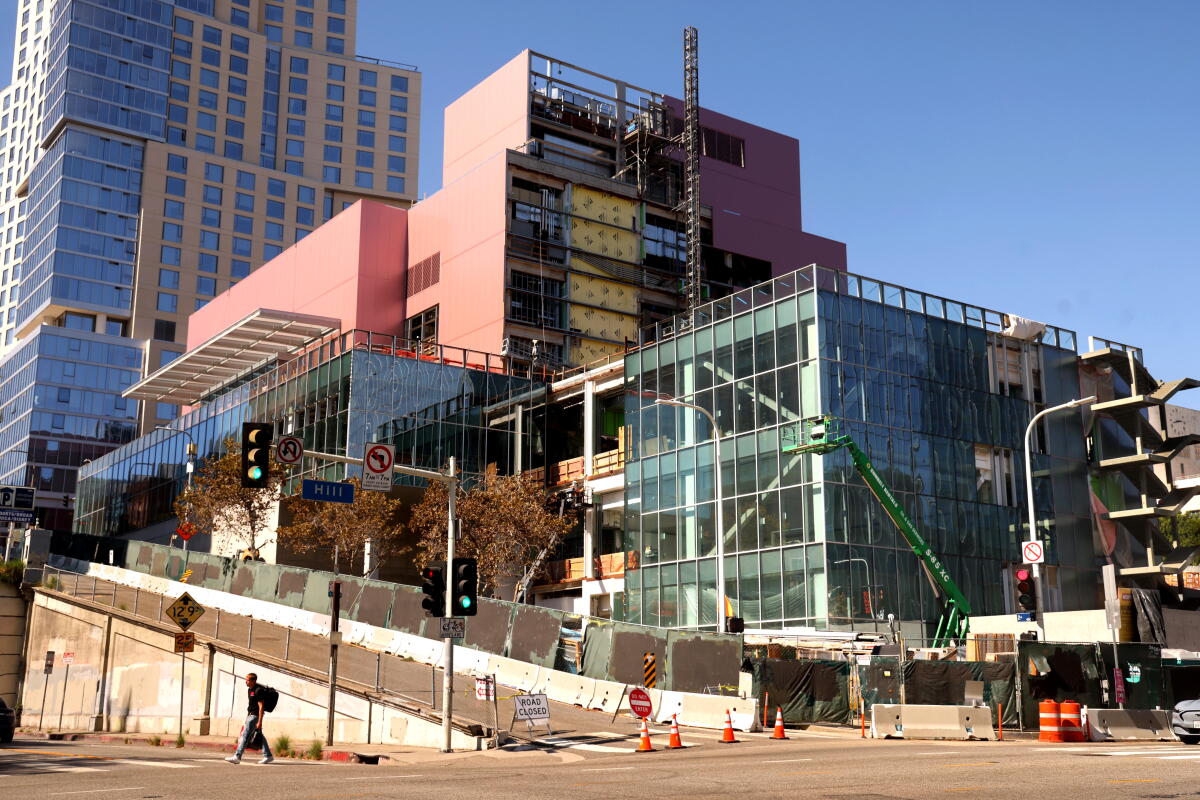
Elements Gehry devised to set it apart are already visible, as construction on the $337-million addition to the Colburn School of Performing Arts reveals details the architect conceived years ago.
The centerpiece of the expansion will be a 1,000-seat concert hall named for Pasadena philanthropists Terri and Jerry Kohl with an in-the-round design meant to create intimacy between the performers and the audience. The hall will include an orchestra pit and a stage similar in size to the one at Disney Hall so it can accommodate grand orchestra, opera and dance performances.
The Colburn Center, still under construction, in downtown Los Angeles last week.
(Genaro Molina / Los Angeles Times)
Gehry set out to create an immersive hall that would inspire artists and envelop the audience, said Meaghan Lloyd, his chief of staff and right-hand at his firm, Gehry Partners.
“Frank’s passion was bringing the audience closer to the performers and getting the relationship between the two just right, so that the audience can feel the performers, the performers can feel the audience reacting,” Lloyd said.
Kohl Hall will be part of the school where Colburn’s symphony orchestra, bands, youth string programs and children’s choirs will perform. It will also be available for rent for outside productions such as jazz and classical music concerts. It is expected to be in use more than 200 times a year.
Architect Frank Gehry with a model of his design for an addition for Colburn School.
(Christina House / Los Angeles Times)
The hall will open with a concert on Sept. 25, the Colburn School announced Tuesday. The weekend celebration will include inaugural performances at the Dance Center, a new dance instruction and performance venue being built as part of the 100,000-square-foot Gehry-designed addition.
The new Dance Center will double facilities for the school’s Trudl Zipper Dance Institute. The dance facilities will include a 100-seat theater for dance and four professional-size studios for dance instruction and rehearsal.
Beginning next year, the hall will be the home of the Los Angeles Chamber Orchestra, a group of professional musicians about half the size of the Los Angeles Philharmonic. LACO concerts will feature premieres of new fanfares by celebrated film composers, including a work by John Williams to be performed at LACO’s inaugural concert in the hall.
Meaghan Lloyd, chief of staff and partner at Gehry Partners, left, and Sel Kardan, president and chief executive of the Colburn School, look over construction of the Terri and Jerry Kohl Hall.
(Genaro Molina / Los Angeles Times)
Part of the hall’s commercial appeal is expected to be its size, in a sweet spot between the 2,265-seat Disney and the popular 415-seat Herbert Zipper Concert Hall already on the Colburn campus. The nearby Dorothy Chandler Pavilion seats about 3,200 guests. The Peacock Theater at L.A. Live seats 7,100.
Kohl Hall’s in-between size “is the missing piece of the venue puzzle” for Los Angeles, Colburn President Sel Kardan said.
A key feature already in place, hanging from the ceiling, is an array of steel clouds packed with concrete, designed to improve acoustics and evoke a sense of airiness. The clouds were made in the Netherlands by a firm with a history of building steel ship hulls that now specializes in building complex steel constructions like the clouds using digital data.
Visitors stand underneath concrete sound clouds designed to improve acoustics.
(Genaro Molina / Los Angeles Times)
The exterior metal cladding of the addition features a luminescent pink paint coating called Pink Kandi.
Japanese acoustical engineer Yasuhisa Toyota will serve as the hall’s acoustician, as he has for all of Gehry’s concert halls, beginning with Disney Hall.
The long-awaited Colburn School addition will be the third Gehry-designed building on Bunker Hill, which already has Disney Concert Hall and the Grand LA, a $1-billion apartment, hotel and retail complex he designed for New York mega-developer Related Cos.
The Colburn School dates to 1950 and moved to its current location downtown in 1998, where it has more than 2,000 students, most of whom range from middle school to college age.
Last year chef Debbie Lee debuted her long-awaited pocha in Highland Park: Yi Cha, one of L.A.’s best new bars, where Lee serves modern Korean bites that pair with artful cocktails and imported soju. Now she’s opened Mokja, a tandem cafe and market for Korean-leaning coffees, sandwiches, pastries and pantry goods. Enter Mokja through Yi Cha’s back alley and find sweet corn iced lattes, coffees topped with misugaru cold foam, and banana matcha lattes served alongside oxtail hand pies, Seoul-style breakfast plates, gochujang short rib onigiri, tomato-muchim pork belly BLTs, and a DIY ramyun station. In a hurry? Grab Lee’s premade bibimbap, mayak eggs, mandu, japchae and more from the refrigerators. If you’re shopping for your home, find coffee, mochi mixes, ice cream, hot sauce, black sesame spreads and other goods from local makers, plus imported Korean Oreos and chips, on the shelves around the cafe.
What is a sundae? Ice cream, of course, but what else? As the Food team compiled our favorite decked-out frozen desserts around the city, we couldn’t seem to reach a consensus.
It should have syrup or sauce, fruit and some sort of crunchy topping, I declared with unearned authority. Deputy Food editor Betty Hallock pointed out the iconic McDonald’s sundae with just vanilla soft serve and rich chocolate fudge. Another colleague mentioned layered parfaits while others hailed the banana split as a worthwhile variant that includes all the named elements.
We decided to take a broad definition to the dessert that was first created at a soda fountain in Two Rivers, Wis., in the late 19th century. (Hot fudge was invented in 1906 by L.A. candymaker Clarence Clifton Brown, whose son opened legendary ice cream parlor C.C. Brown’s in Hollywood.)
You can opt for classic or over-the-top versions at a carhop diner in Burbank or a Route 66 soda fountain, or build the sundae of your dreams at a French-Californian bistro or an open-air Italian restaurant with a roving gelato cart. There are plenty of creative takes that pull inspiration from many cuisines, like a Thai gelato maker in Torrance and an Ethiopian restaurant in Eagle Rock serving a brûléed banana split with Ethiopian coffee-infused chocolate sauce.
Here are 20 of our favorite sundaes and banana splits around Los Angeles. — Danielle Dorsey
May we assume that Rep. Bob Livingston was an adulterer two weeks ago? Did he think then that he was unfit to lead? His stepping down (Dec. 19) leads me to believe that a private adulterer suffers no loss of ability to lead; but that inability only comes with public knowledge of the “sin.”
I call this gratuitous grandstanding. I call this hypocrisy.
MARIAN L. GOLDBERG
Marina del Rey
*
First we hear that Rep. Henry Hyde admits to “youthful indiscretions” and now Livingston admits to previous affairs (Dec. 18). Our major newspapers tend to treat such matters rather gingerly and relegate them to one of the back pages. We continue to hear that our president’s crime was not about sex but lying under oath. But one cannot help wondering how these highly respected gents would have behaved at the time had they been subjected to the machinations of a Tripp-Starr duo.
WARREN PAINTER
Granada Hills
*
After reading about Livingston’s admission to having an affair and the House’s response of a standing ovation, I have finally figured out the real difference between Republicans and Democrats. Democrats view cheating on their spouses as unacceptable behavior and try to keep it secret. The Republicans view cheating on their spouses as acceptable as long as they admit they did it.
And these people have the nerve to talk to me about the president’s moral authority? Maybe we should throw out the entire legislature and start all over.
JIM PRIETTO
Laguna Niguel
*
Do the Republicans truly believe that their children will understand the difference between Clinton’s perjury and the lies of Hyde and Livingston?
JESSE ALBERT
Los Angeles
*
Any effort by the liberal media to compare Livingston’s admission of adulterous indiscretions with Bill Clinton’s sexual scandal is an effort to deceive the American people. You don’t have to be a rocket scientist to know they are not the same. Clinton lied under oath and tried to obstruct justice.
ART AMASAKI
Torrance
*
The cost to expose sexual misconduct by a major politician: federal government–$40 million; Larry Flynt–$1 million. The Republicans might say, “Chalk another one up for the private sector!”
DUAINE OSBORNE
La Mirada
*
It’s as ironic as it was inevitable that the furies unleashed by Kenneth Starr’s overzealous investigations would turn on the Republicans and begin to consume them.
JERRY BUCK
Sherman Oaks
*
During the Joseph McCarthy days the most frequent question asked by the Congress was, “Are you now or have you ever been a member of the Communist Party?” Today’s question asked by Congress can be characterized as, “Are you now or have you ever been guilty of infidelity?”
SAMUEL M. ROSEN
Newbury Park
*
Character does matter, especially if you happen to be a Democrat.
Alexandre Pantoja did not tap Joshua Van’s glove before the fight began. Nine months after an injury ended his reign as flyweight champion in just 26 seconds, the Brazilian returned to the Octagon to try to reclaim the belt that slipped away.
This time, no injury clouded the result. Pantoja came out determined to impose his style from the opening seconds, but Van found a way to keep him at a distance, counter with his boxing and survive the former champion’s take-down attempts.
After five rounds, the judges awarded the fight to the Van by unanimous decision, with scores of 49-46, 49-47 and 50-45.
Van retained the 125-pound title in the main event of UFC 331, held Saturday at Crypto.com Arena in front of a sold-out crowd of 19,357 fans. UFC CEO Dana White said the event generated $8.3 million in box office revenue, the highest in the arena’s history.
The result also vindicated Van’s claim to the championship.
In December 2025, Pantoja threw a high kick that Van caught. The Brazilian lost his balance and braced his left arm on the canvas to break his fall, but his elbow dislocated. The fight ended after 26 seconds and Van was awarded the belt.
Joshua Van punches Alexandre Pantoja during their UFC 331 flyweight championship bout at Crypto.com Arena on Saturday.
(Luke Hales / Getty Images)
Both fighters had much to gain during their return to the Octagon.
The animosity that had built up was evident from the start. As the fight began, Pantoja went straight for Van. The Brazilian scored an early takedown and sought to keep the champion on the mat, attempting to turn the fight into a grappling and ground-and-pound battle.
Van resisted and managed to get back to his feet. The lack of action during some early stretches prompted the first boos from the crowd.
But the pace changed.
Van began to find openings with his hands and Pantoja had to absorb strikes while continuing to seek takedowns. The champion also showed better defense against the Brazilian’s advances as the rounds progressed.
In the second round, the fight had to be briefly stopped after Pantoja claimed a headbutt. The strike was reviewed and determined to have been accidental, so the fight continued.
“I don’t even know why he was getting worked up. He came at me throwing punches, and I was just trying to counter, and he simply hit me in the head,” Van said. “I guess … I have a tougher head. So then he started complaining and all that. He was saying, ‘You headbutted me, you’re cheating.’ And I told him, ‘You hit me!’ So… um … that was it.”
Van began to take greater control of the fight during the second and third rounds. His boxing allowed him to keep Pantoja at a distance and respond when the Brazilian tried to close in to take him down. Pantoja kept pressing, but he could no longer control the fight on the ground for extended periods.
The fourth round allowed the former champion to regain some of the control he’d lost. Pantoja managed to take Van down to the canvas again and worked from the top for much of the round, showing that he could still trouble the champion when he managed to impose his style.
Van, however, ended the fight on a high note.
“I knew I hurt him — you know, I knew I hurt him,” Van said. “He’s a mental giant, you know. He just didn’t want to go down. He doesn’t want to show that he’s hurt, but I know deep down he was hurt. But like I said, man, that’s why I respect him so much.”
In the fifth round, the champion landed a powerful right-hand punch that knocked Pantoja down. The Brazilian managed to recover and continue until the end, but the blow ultimately tipped the fight in Van’s favor.
Alexandre Pantoja tries to pin Joshua Van on the ground during their UFC 331 flyweight championship bout at Crypto.com Arena on Saturday.
(Luke Hales / Getty Images)
Ahead of the bout, Van defended his title in May against Tatsuro Taira, winning by technical knockout in the fifth round. Pantoja, on the other hand, hadn’t competed since his elbow injury against Van.
“There’s nothing to prove, man,” Van said. “Like I said, I knew I was going to win the first fight, too. So it’s like: ‘OK, do you guys want to see me win again?’”
Before the fight, tensions between the two had escalated. Van had insisted that his first victory wasn’t solely due to Pantoja’s injury, while the Brazilian argued that the December result didn’t show who was truly the better fighter.
The answer, this time, came after 25 minutes.
Tsarukyan knocks out Ruffy
Arman Tsarukyan celebrates after earning a knockout win over Mauricio Ruffy during his UFC 331 lightweight bout at Crypto.com Arena on Saturday.
(Luke Hales / Getty Images)
The co-main event of the night also ended sooner than expected.
Arman Tsarukyan and Mauricio Ruffy arrived at Crypto.com Arena with a five-round bout scheduled and key positions in the lightweight division on the line. Ruffy accepted the fight with just four weeks of preparation after Charles Oliveira was pulled from the card.
Ruffy came out ready to trade blows and showed speed in the opening minutes. Tsarukyan, as he had done for much of his career, sought to use his wrestling skills to change the pace of the fight.
Tsarukyan managed to drive Ruffy against the cage and began landing elbows. At the 4:56 mark of the first round, Tsarukyan landed two elbows that knocked Ruffy out and forced the referee to stop the fight.
“I came to Los Angeles to enjoy the city,” Tsarukyan said. “But I also came to win. I owe those elbows to one of my coaches who taught me how to use them.”
UFC returns to Crypto.com Arena for the first time in eight years, and it does so with a card packed with big names and fighters looking to make the most of their opportunity to compete on the biggest stage in mixed martial arts.
Saturday’s main event will feature the flyweight title rematch between Joshua Van (17-2) and Alexandre Pantoja (30-6), a matchup that has been highly anticipated ever since their first bout ended prematurely. In December 2025, the two fighters faced off for the first time, but the bout ended after just 26 seconds when the Brazilian landed awkwardly after being sent to the canvas and suffered a serious arm injury, prompting the referee to stop the fight via technical knockout and crown Van the champion.
That victory made the Myanmar native a champion questioned by some, but Van legitimized his reign by prevailing in a grueling battle against Tatsuro Taira last May, stopping his challenger in the final round. For his part, Pantoja has not fought since that bout against Van, in which he suffered a dislocated arm.
In the co-main event, lightweight fighters Arman Tsarukyan (23-3) and Mauricio Ruffy (14-2) will face off in a bout that promises to define the division’s standings. Tsarukyan, from Georgia, has five straight wins, over Dan Hooker, Charles Oliveira, Beneil Dariush, Joaquim Silva, and Damir Ismagulov. Ruffy, from Brazil, has two consecutive victories in his most recent bouts, though he has won nine of his last 10 fights.
The card also features exciting preliminary bouts, including a matchup between Marlon Vera (23-12), who has been training in Southern California for years, and Canadian Charles Jourdain (18-1-1).
The main event at Crypto.com Arena starts at 6 p.m. PDT and will be broadcast on Paramount+. The preliminary bouts begin at 2:30 p.m. and will be broadcast on UFC Fight Pass and Paramount+.
The lineup includes a last-minute change. Brian Ortega was scheduled to fight on home turf, but due to an injury, his lightweight bout against Renato Moicano was removed from the card. As a result, Moicano will now face No. 11-ranked contender Tom Nolan in the main event of UFC Fight Night, which will take place on Oct. 31 at the Meta APEX in Las Vegas.
The last time UFC held an event at Crypto.com Arena was on Aug. 4, 2018, when T.J. Dillashaw defeated Cody Garbrandt by first-round knockout to win the bantamweight title at UFC 227.
Here is the full fight card:
Main card (Paramount +, 6 p.m.):
Joshua Van vs. Alexandre Pantoja, por el título de peso mosca
Arman Tsarukyan vs. Mauricio Ruffy
Patricio Pitbull vs. Dooho Choi
Alonzo Menifield vs. Iwo Baraniewski
Gable Steveson vs. Sean Sharaf
Preliminary Card (Paramount+ and UFC Fight Pass, 2:30 p.m.):
Alexandre Pantoja and Joshua Van hope their fight Saturday at Crypto.com Arena will last longer than 26 seconds.
It has been nine months since their first bout, which ended in less than a minute because of a Pantoja injury and made Van the UFC flyweight champion. Pantoja aims to reclaim the belt he lost at UFC 331, with the main event beginning at 6 p.m. and streaming on Paramount+.
Pantoja dislocated his elbow when he fell while trying to defend against one of Van’s moves on Dec. 6 at UFC 323 in Las Vegas. The fight ended immediately.
Van celebrated winning the 125-pound title, but both fighters walked away from that night feeling everyone deserved more than the premature result.
Alexandre Pantoja holds his arm after losing his flyweight title fight on Dec. 6 in Las Vegas.
(Ian Maule / Getty Images)
Pantoja, of Brazil, has not competed since that night. He has spent most of the past nine months recovering from the injury, while Van successfully defended his title once against Tatsuro Taira in May, winning by stoppage in the final round.
“It’s been [nine] long months,” Pantoja said. “I’ve been working hard. And at a certain point, I think that after two years as champion, five title fights — almost six title fights — at a certain point it’s good to take some time off, enjoy my family, enjoy myself. But at the same time, I’m really hungry to win again.”
Pantoja said he returned to the gym two days after that first fight. Although the injury kept him out of the octagon, he didn’t want to stay away from training for too long because he said that would have made it harder to get back to fighting at the championship level.
During his time out of the octagon, he observed how the division changed.
“I see a lot of good fights. We’re seeing the top 10 change almost completely,” Pantoja said Wednesday. “I see incredible fights in the flyweight division. And I think this Saturday, with my fight against Joshua Van in the main event here in Los Angeles, is very special.”
Van, meanwhile, enters the rematch coming off a five-round championship bout.
“I’ve been working on my ground game, and you’ll see it,” said Van, who holds dual American and Myanmar citizenship. “I tried it in the fight against Taira, but I didn’t quite pull it off. But this time, you’ll see a different level from Joshua Van.”
The champion’s confidence remains undiminished, as he sees the rematch as an opportunity to put any debate surrounding that first fight in 2025 to rest and prove his place in the division.
“When I beat him, I’ll be one of the greats in this division, and then the next challenger will come and try to take the belt from me,” Van said.
Pantoja said Van has changed since December, highlighting the fight against Taira and noting the champion has refined aspects of his fighting style.
Joshua Van celebrates after defeating Alexandre Pantoja in a flyweight title bout during UFC 323 on Dec. 6 in Las Vegas.
(Ian Maule / Getty Images)
“I think Van definitely evolved a lot after our fight,” Pantoja said. “He had the fight against Tatsuro Taira; I think he evolved and corrected some mistakes he made in that fight. So I think it’s going to be completely different.”
Pantoja doesn’t consider himself the same fighter who will face Van.
“The drive is always the same,” Pantoja said. “I’ve had the same drive since I was a kid — I’ve always wanted to fight the best fighters in the world. The drive is the same; it’s just that I think I’m much more mature now.”
Pantoja said Van is a top-tier fighter, but he believes the injury prevented both of them from showing everything they were capable of.
“He’s an incredible fighter,” said Pantoja, 36. “When you watch Joshua Van fight, his expression never changes — he always tries to stay in control. And that proves just how good you are.”
Although Pantoja officially lost that night, the injury changed the course of the fight before it could truly get underway.
“I injured my arm. I know that, as an athlete, I lost that fight, and now I have the opportunity to fight world champion Joshua Van — and that’s what I want. I want him at his best because I’m at my best too,” Pantoja said.
Tensions have escalated since their first encounter.
At a news conference in August in Los Angeles, the fighters got into an exchange that forced UFC president Dana White to intervene. Pantoja stood up from his seat after Van interrupted him, but the situation did not escalate into a physical confrontation.
“As far as I’m concerned, I’m his dad,” Van said. “He was being respectful before the fight, and I don’t know what he’s doing in interviews and stuff like that to make me look like the bad guy.”
Pantoja offered a different explanation.
“He does a very good job,” Pantoja said. “He needed a lesson. When I stood up, I tried to teach him a lesson. I’m from the ‘90s. Back then, if you didn’t respect your mother or father, you’d get a slap.”
Despite the disagreement, both have shown respect for their opponent’s skills. Van described Pantoja as a “very, very dangerous” fighter.
“He’s going to be motivated, he’s going to be hungrier, and I think this will be the best Pantoja we’ll see,” Van said. “So I’m very well prepared for this fight.”
Pantoja, for his part, knows he’s facing a champion who’s already had the chance to prove he can go the distance for five rounds. The Brazilian also viewed Van’s fight against Taira as a source of insight for his preparation.
“An incredible fight, very good,” Pantoja said of his 24-year-old opponent. “I think it’s a good fight for all the fans. It showed me something, but I know Joshua Van is very young and can fix a lot of things from that fight.”
For the Brazilian, the goal this weekend is clear.
“At the end of the day, what matters is the victory,” said Pantoja. “However it plays out — whether it’s by decision, split decision, KO or submission — I think the closer we get to the fight, the less those things matter. The closer we get to the fight, the championship doesn’t matter anymore, the money doesn’t matter — all that really matters is the win.”
Van doesn’t expect to let the fight go to the scorecards.
“I don’t think it’ll go five rounds; I’ll finish it within the first three rounds,” he said confidently. “It’ll be by knockout or submission, but I’m leaning more toward a knockout.”
If Pantoja regains the championship, he would become only the third flyweight champion in UFC history to reclaim the belt after losing it, joining Deiveson Figueiredo and Brandon Moreno.
For the Brazilian, returning to Los Angeles also holds personal significance. He recalled that it was the first city he visited when he arrived in the United States in 2014 and that, back then, he slept in a gym.
Now he’ll return as a title challenger in the main event of UFC 331.
“It’s so nice that people see where I started here and see how far I’ve come,” Pantoja recalled. “For me, the best part is being the same guy I was when I arrived here in 2014; I’m the same guy right now, and I’m very happy and proud of myself.”
Hikers trekking along trails around Los Angeles know that, by late summer, most creeks and rivers have dried up for the season.
However, recent rainfall across Southern California has replenished our waterways just enough to bring back a little of their spring and early summer glamour.
In this week’s edition of The Wild, our weekly outdoors newsletter, I will highlight three L.A. trails where you can still find water flowing, offering a cool relief in a year when L.A. residents are sick of humidity, heat and high electric bills.
You are reading The Wild newsletter
Sign up to get expert tips on the best of Southern California’s beaches, trails, parks, deserts, forests and mountains in your inbox every Thursday.
By continuing, you agree to our Terms of Service, which include arbitration and a class action waiver. You agree that we and our third-party vendors may collect and use your information, including through cookies, pixels and similar technologies, for the purposes set forth in our Privacy Policy such as personalizing your experience and ads.
Before heading out, here are a few things to remember:
Familiarize yourself with what poison oak looks like, as it will be prominent on all of these trails. Its leaves this time of year range from glossy green to red, orange and yellow.
Practice seven Leave No Trace principles, including never leaving anything behind such as toilet paper or orange peels.
Rocks and boulders in and along creeks will often be slippery from years of erosion. Take good care when climbing them or using them for leverage as you traverse an area.
Riparian habitats, like creeks flowing through canyons, are home to sensitive creatures including California newts, frogs and toads. Take good care to watch where you’re stepping, ensuring you aren’t crushing one of these little sweeties as you tromp along.
Now that we’ve all agreed to recreate responsibly, let’s talk about those hikes!
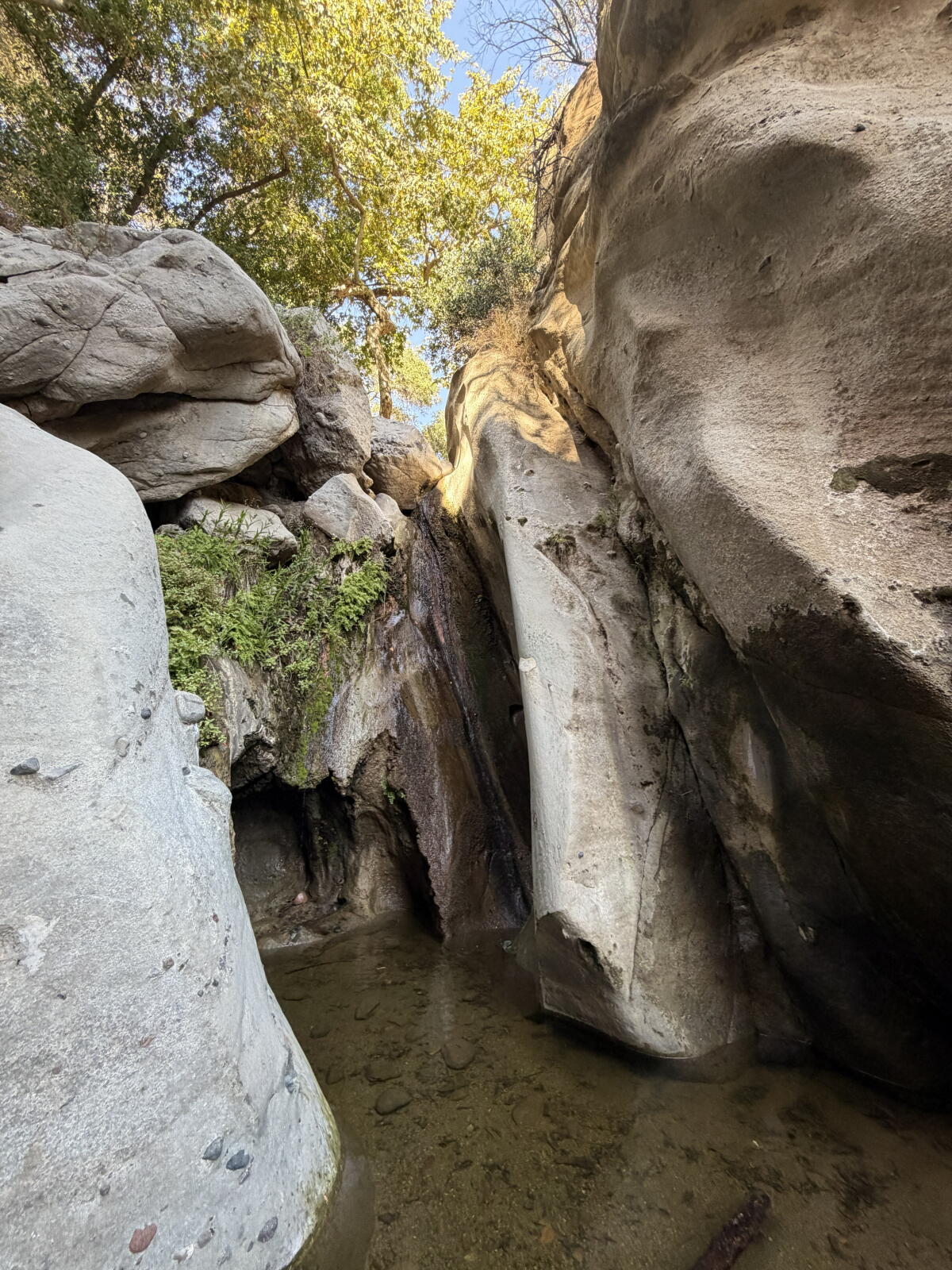
The Santa Ynez waterfall is an 18-foot cascade through a canyon carved by water for thousands of years.
(Jaclyn Cosgrove / Los Angeles Times)
1. Santa Ynez Waterfall Trail
Distance: 2.2 miles out and back Elevation gained: About 200 feet Difficulty: Easy in the beginning with technical aspects near the falls Dogs allowed: No Nearest to: Pacific Palisades Accessible alternative: Inspiration Loop Trail at Will Rogers State Historic Park
The Santa Ynez waterfall trail is a 2.2-mile journey along Santa Ynez Creek in Topanga State Park, shaded by large sycamores, oak trees and the canyon’s walls. You’ll notice a small cave-like structure in the canyon wall shortly upon starting the hike. Unfortunately, other visitors have carved into its sides. Don’t be one of them.
To begin your hike, you will park along Vereda de la Montura. Note that parking isn’t allowed daily between 8 p.m. and 6 a.m.
A small cave-like structure in Santa Ynez Canyon in Topanga State Park.
(Jaclyn Cosgrove / Los Angeles Times)
I thought I was in the wrong place when I first pulled up, given the trailhead sits in the middle of a neighborhood. I walked northwest along the street and found an open gate with stairs leading down. This is where you’ll start the trail.
I was immediately reminded of Sullivan Canyon (which is about 3 miles away, as the crow flies), as the two canyons feature rocky canyon walls and tall old trees. There are a few times when the trail splits off and returns to itself. Just over half a mile in, though, the trail splits in two, with Santa Ynez Canyon Trail to the west (or left) and the waterfall trail, which you will take to the north or northwest-ish.
A lush tree canopy provides shade in Santa Ynez Canyon as hikers head to the waterfall.
(Jaclyn Cosgrove / Los Angeles Times)
The first mile of this trail is primarily a nice stroll northward along a creek, the ground covered in green and brown leaves. However, just over a mile in, if you want to see the waterfall and small cave next to it, you will need to scramble up a large boulder and then rock hop through the creek. As of last week, there was a rope to aid hikers upward. (On my way down, I unintentionally slid quickly down the rock, feeling every peddle in the tuchus until I landed feet first in the creek — so take your time here.)
The waterfall isn’t roaring at the moment, but I found the trickling sound of water soothing. It’s also a geologically interesting area to look around, as the water has carved out the canyon walls into interesting shapes (and created a small cave near the waterfall).
The walls of Santa Ynez Canyon were carved by water, wind and time over centuries.
(Jaclyn Cosgrove / Los Angeles Times)
As I was heading back from the falls, I noticed several bees circling an area high in the canyon wall where it appeared they’d built a nest. Pack accordingly if you are allergic to bee stings.
Slow down and look up as you hike through Santa Ynez Canyon, taking the opportunity to observe rock formations, plants and reptiles.
(Jaclyn Cosgrove / Los Angeles Times)
I only saw three other people along the trail while there on a weekday. I was mostly alone, though, listening to the wrentits and spotted towhees as blue dragonflies darted to and fro.
Cold Creek in the Cold Creek Valley Preserve near Calabasas.
(Jaclyn Cosgrove / Los Angeles Times)
2. Cold Creek Trail
Distance: 2.2 miles out and back (with option to extend) Elevation gained: About 300 feet Difficulty: Easier end of moderate Dogs allowed: Yes Nearest to: South of Calabasas Accessible alternative: Nicholas Flat ADA Trail
The Cold Creek Valley Preserve, cared for by the TreePeople Land Trust, is a shady riparian habitat near Calabasas with a gently flowing creek that features multiple short cascades. The land was saved from development by several local residents and nonprofits, including Timothy B. Schmit, bass player for the Eagles.
The preserve features multiple public hiking routes, including the Cold Creek Trail.
“Located on an ancient trade route, the [I]ndigenous people of Southern California have used the area for hunting and settlement for generations, leaving a lasting influence visible on the land,” according to TreePeople. “The perennial Cold Creek is the keystone feature of the area, one of the cleanest free-flowing streams in the Santa Monica Mountains.”
The tree canopy along the Cold Creek Trail in the Cold Creek Valley Preserve provides a shady cool environment for hikers.
(Jaclyn Cosgrove / Los Angeles Times)
To begin your hike, you’ll park in a bumpy dirt lot just off Stunt Road. Be mindful as you near the trailhead, as there will likely be construction crew members in the area. They’re working to install rumble strips and other infrastructure to slow down drivers and hopefully improve traffic safety.
At the start of the trail, you’ll find a portable toilet near the gate. You’ll walk southeast for a short bit before rounding the curve of the trail. You’ll officially be transported into this sylvan sanctuary (although I could admittedly still hear the construction workers communicating on their walkie-talkies).
The trail mostly runs parallel to Cold Creek, which you will hear flowing and have the opportunity to sit near at multiple points along the route, including on a few wooden benches. The trail crosses the creek about four times, but it isn’t overly technical to maneuver.
The Cold Creek Valley Preserve is open from sunrise to sunset.
(Jaclyn Cosgrove / Los Angeles Times)
About half a mile in, the trail intersects with Lower Stunt High Trail. You can continue northwest along the creek. You will find another option, the Yucca Trail, just under a mile into your hike, a nice .68-mile loop through the preserve.
The park, open from sunrise to sunset, offers a sweet reprieve from the sun and is a great spot to take a deep breath and meditate in the woods.
The Gabrielino Trail is a multi-use trail frequented by hikers, bikers and horseback riders.
(Jaclyn Cosgrove / Los Angeles Times)
3. The Gabrielino National Recreation Trail (multiple segments)
Distance: 28.8 miles Elevation gained: About 6,000 feet Difficulty: Challenging when done in its entirety Dogs allowed: Yes Nearest to: Arcadia and Pasadena, depending on the trailhead Accessible alternative: Gabrielino Trail starting near North Windsor Avenue near Altadena
The Gabrielino National Recreation Trail is a 28.8-mile journey through the San Gabriel Mountains. Most thru-hikers start the trail at Chantry Flat and take the trail on a squiggly N-shaped journey all the way to its western trailhead near NASA’s Jet Propulsion Laboratory near Pasadena.
However, it isn’t necessary to take the entire Gabrielino Trail to enjoy its beauty. The trail has several entry points, offering short day trips, including the following, which run parallel to at least one local creek or river:
Regardless of where you go, I hope you enjoy our last weekend of summer. That’s right: Summer ends Tuesday! Hopefully that means it soon feels like autumn in L.A.
3 things to do
Volunteers walk down the beach at a Heal the Bay coastal cleanup event in 2024 with Water for L.A.
(Heal the Bay)
1. Clean up public lands around L.A. Heal the Bay will host L.A. County’s annual coastal cleanup day from 9 a.m. to noon Saturday in more than 60 sites. Participants should consider wearing closed-toe shoes and sun protection. Cleanup supplies will be available at sites but will run out at popular sites. Volunteers can pick a beach, river, park or trail near them by visiting support.healthebay.org.
2. Portray a bird of prey in San Dimas The San Dimas Canyon Nature Center will host a guided sketch experience from 6 to 7 p.m. Friday at 1628 Sycamore Canyon Road in San Dimas. Participants will learn how to draw a red-tailed hawk. Learn more at the center’s Instagram page.
3. Learn dangers from rangers in Newbury Park Hikers can bring their four-legged besties to Rancho Sierra Vista/Satwiwa from 9 a.m. to noon Saturday for a B.A.R.K. Rangers event where rangers will educate dog owners on how to safely and responsibly enjoy public lands. Rangers will also conduct a special swearing-in ceremony, complete with a Santa Monica Mountains National Recreation Area B.A.R.K. Ranger badge, for pups who complete certain challenges. Learn more at eventbrite.com.
The must-read
A juvenile great white shark in Hermosa Beach in April, seen via drone.
(CSULB Shark Lab)
Yes, El Niño morphed our city’s usually pleasant Mediterranean climate into the largest hot yoga class in L.A. But did you know it has also resulted in our ocean water being warm enough to attract animals not usually seen along our coastline? Those fishing off the Malibu Pier were surprised in mid-August by a hammerhead shark swimming nearby. A giant whale shark was recently documented by a fish spotter between Malibu and one of the Channel Islands, a species that prefers warmer waters (and is the largest known fish on the planet). And in line with our predicted “sharky summer,” a juvenile great white shark was spotted a bit close to a swimmer off the coast of Santa Barbara. The best news is: Nothing bad has happened to any humans or animals during these visits, underscoring how well we can co-exist with these beings, despite our fears of them.
Happy adventuring,
P.S.
More and more wildlife lovers are heading into public lands for “recreational herping,” the practice of looking for amphibians and reptiles. Conservation photographer Mario Ramos recently raised concerns via his Instagram page about how the increase is leading some folks to unintentionally harm the animals they seek to observe. “A harsh truth about field herping is that our interactions with wild herps are often stressful and potentially detrimental to the animals, no matter how you frame it,” Ramos wrote. Ramos then outlined how to ethically look for animals that slither and slide in the wild. Always respect the locals, folks!
For more insider tips on Southern California’s beaches, trails and parks, check out past editions of The Wild. And to view this newsletter in your browser, click here.
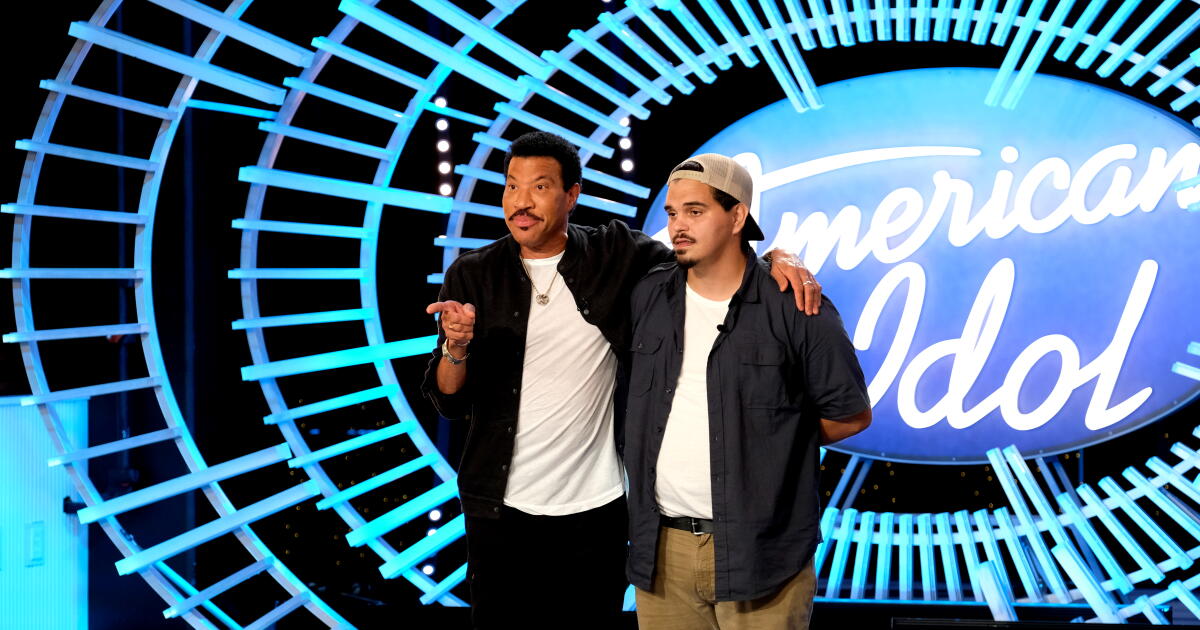
“American Idol” is packing up its stars after 25 years in Hollywood.
In the latest blow to Los Angeles film production, ABC’s long-running program will move its upcoming season to the Atlanta area, according to Fremantle, which produces the show with 19 Entertainment, owned by Sony Pictures Television.
Fremantle declined to comment further.
The move comes as Los Angeles’ production levels have tumbled, prompting concern from film workers, union leaders and elected officials who are scrambling to address the crisis. California, despite boosting its tax incentive program, has been struggling to compete against other states that offer more lucrative credits.
TV production activity in the L.A. region was down 27% in the second quarter compared with the same period a year ago, largely because of fewer reality TV shoots, according to the nonprofit FilmLA.
Earlier this year, another broadcast TV stalwart, Fox’s “The Masked Singer,” made plans to vacate its space on the Fox lot on West Pico Boulevard in Los Angeles and head to New Jersey, also in search of more lucrative tax credits. Another ABC hit, “Shark Tank,” also is relocating to Atlanta from its longtime home base on Sony’s Culver City lot.
“American Idol” has been a local economic engine since launching on Fox in 2002. For years, the show ranked as the No. 1 show on TV and employed hundreds of workers each season as aspiring singers hoped for their big break.
The most recent season originated from Red Studios in Hollywood.
Georgia offers generous tax incentives, including up to a 30% tax credit for reality television productions that spend at least $500,000 in the state. Unlike California, Georgia’s tax program allows compensation for actors and other so-called above-the-line workers to be included.
Like California, Georgia has been grappling with lower production levels. For more than a decade, its soundstages attracted colossal movie productions, but the region was dealt a blow when the Walt Disney Co. recently shifted production of its Marvel superhero films to facilities near London.
On Tuesday, a bipartisan coalition of lawmakers, the Motion Picture Assn., industry unions, Hollywood special ambassador Jon Voight and filmmaker Steven Paul made a pitch for a federal film and television tax credit to keep jobs in Hollywood and in the U.S. broadly.
Rep. Laura Friedman (D-Glendale) plans to introduce a bill into Congress as early as this month in collaboration with Rep. Brian Jack (R-Ga.), who represents a district southwest of Atlanta. The MPA released a study estimating a federal tax credit could add 143,000 film and TV jobs.
This year, in particular, has seen big swings as the California Film and TV Tax Credit Program expanded eligibility to include competition shows.
Large-scale competition shows are eligible under the state’s incentive program if they have a minimum budget of $1 million per episode. The credit, however, does not include traditional reality shows, game shows, talk shows or docu-follow television programs.
Changes in California’s formula resulted in a jump to 676 shoot days in the second quarter, compared with 463 shoot days during the first three months of the year. Nonetheless, this year’s April-June quarter still reflected an almost 40% decline when compared with the same time last year.
FilmLA said that over the last five years, reality productions have plummeted nearly 63%.
ABC in late July announced “American Idol” was returning, marking its 10th season on the Walt Disney Co. network. Producers are auditioning potential contestants this week during stops in Georgia, North Carolina and South Carolina.
ABC declined to comment on the move.
Ryan Seacrest has long hosted the show, which last season featured Lionel Richie, Luke Bryan and Carrie Underwood, a previous “American Idol” champion, as the celebrity judges.
Deadline first reported the planned move to Georgia.
Game shows are also leaving L.A.
A growing number of programs long based around Hollywood and New York have headed across the ocean to Ireland and Britain to take advantage of tax credits that bring down the cost of production as broadcast network executives contend with shrinking audiences and lower profit margins.
Fox currently has several prime-time game shows produced overseas, including “The Floor,” “Celebrity Name That Tune” and “Beat Shazam.
Staff writer Stephen Battaglio contributed to this report.
Paramount Skydance Chief Executive David Ellison faces a pivotal decision: Should he uproot his Hollywood studio — the birthplace of such film classics as “Sunset Boulevard,” “The Godfather” and “Beverly Hills Cop”?
Paramount floated shifting its home base to Tennessee or Texas in July, hoping to deter California Atty. Gen. Rob Bonta from waging a legal battle to block Paramount’s $111-billion acquisition of Warner Bros. Discovery.
Bonta rejected the tactic, calling it “blackmail.” His antitrust lawsuit, filed in collaboration with 11 other Democratic state attorneys general, has since stalled the largest Hollywood merger in decades and put Ellison in a jam.
The 43-year-old tech scion — a film aficionado who has spent two decades building his career in Hollywood — has told associates he doesn’t want to leave L.A. But he has signaled that he’s prepared to sell the historic studio lots and move Paramount’s and Warner Bros.’ operations from California if the merger isn’t finalized by next month, according to people familiar with the situation who were not authorized to comment.
“It would be devastating,” Assemblymember Rick Chavez Zbur, who represents a district that includes the Melrose Avenue movie lot and neighborhoods near Warner Bros. in Burbank, said of a Paramount move. “We need to do everything we can to protect these important jobs in California’s iconic industry.”
Paramount declined to comment.
Ellison is frustrated after securing approvals from more than 65 regulators worldwide for the mammoth merger that would bring HBO, CNN, CBS, Comedy Central, MTV and TBS under the same roof.
“California is the fourth-largest economy in the world and the best place to do business,” a spokesman from Bonta’s office said. “Strong antitrust enforcement is essential so everyone can benefit from a vibrant economy.”
A federal judge in Oakland temporarily blocked the deal, prompting Paramount to agree not to finalize the acquisition until after a trial or June 1, whichever comes first. Settlement talks collapsed in late August after Bonta accused Paramount of leaking and misrepresenting their discussions.
Paramount has plenty at stake. U.S. District Judge Araceli Martínez-Olguín set the trial for March, but the company urgently needs the valuable Warner assets to better compete against tech behemoths. And beginning Oct. 1, Paramount must increase its payout to Warner Bros. Discovery shareholders by $7 million a day, so-called ticking fees that will heap more debt onto the highly leveraged transaction.
Paramount asked the judge to require California and other plaintiff states, including Nevada, Oregon and New York, along with the Writers Guild of America (which also sued) to post a $1.88-billion bond that could compensate Paramount for ticking fee costs. A hearing is set for Sept. 24.
For weeks, Paramount’s most potent weapon has been its in-the-works plan to leave L.A.
Lobbying has been intense, prompting a parade of politicians led by Gov. Gavin Newsom, L.A. Mayor Karen Bass and gubernatorial nominee Xavier Becerra to urge the two sides to settle the lawsuit.
“It’s a game of chicken,” Kevin Klowden, an economist and managing director at the Melcene Advisory firm, said in an interview. “But I’m not dismissing the threat because it is very real.”
Relocating from Los Angeles would allow Ellison’s cash-hungry media company to qualify for lucrative tax incentives offered by another state. Ellison’s short list includes Tennessee, Texas and Georgia. But leaving its longtime home would be costly for Paramount too, given how much of the talent and deal-making remains concentrated around L.A.
Tennessee’s Department of Economic and Community Development declined to discuss its negotiations with Paramount, but in a statement a spokesperson said the state “remains committed to working with companies across a wide range of industries that are exploring opportunities to invest and grow in Tennessee.”
Early this month, a pro-merger group was set to hold a news conference outside Paramount, but it moved its gathering to a warehouse a few blocks away after anti-merger activists planned a counterprotest.
The pro-merger organization, Neighbors for Strong Communities, was incorporated in Washington, D.C., in June and has lobbed text messages to Californians urging them to press Bonta to drop the case.
Speakers were concerned with just one issue: What would happen should Paramount pull out?
“What are we going to do with all these people who have invested their lives and many generations into building something here?” asked Keyla Wood, who moved from Mexico to L.A. about a decade ago after getting her start in Spanish-language soap operas.
“It’s been one thing after the other: The pandemic, the strikes and then it was the fires,” said Wood, who has worked as a stand-in for Eva Longoria and Salma Hayek. “So many people never work again.”
David Ellison is deciding whether to leave Hollywood.
(Bloomberg via Getty Images)
L.A.’s very identity is at stake, added Daniela Kelly, an actor and dancer who arrived from Brazil two decades ago.
“Everyone in the world sees Los Angeles and Hollywood as the platform for their dreams,” Kelly said. “Imagine if a huge studio with 100 years of history here just leaves? What will we be?”
Businesses like Kelly’s small Kreashen Studios USA, which provides video and podcasting space in Marina del Rey, depends on the region’s entertainment economy.
“It’s difficult financially right now to keep open,” she said. “So I’m pro having Paramount stay because this is the center, the heart of Hollywood.”
But deal opponents and some experts say the merger would actually worsen L.A.’s already bleak production picture.
Paramount has promised to cut $6 billion in expenses — a figure that doesn’t factor in the cost of ticking fees, which would add $650 million each quarter to the $81 billion that Paramount had anticipated paying Warner shareholders.
“We’ve seen from previous mergers that jobs have been lost,” L.A. City Councilmember Adrin Nazarian said at a City Hall event recently.
“When you look at the economic impact, it’s pretty staggering,” Kelly LoBianco, the department director, said in a recent interview. “An estimated $4 billion in economic output lost, and another $550 million lost in tax revenue at the local, state and federal level.”
The merger also could erase $79 million in tax revenue to Los Angeles County even if Paramount stays in L.A., she said.
But state and county tax revenue would plummet further should Paramount dispatch hundreds of its workers to Tennessee or some other state, Klowden said.
“If Ellison moves all the management out and all of the productions out, you’re talking about potentially tens of thousands of jobs,” Klowden said. “That, bluntly, isn’t just devastating to L.A. That becomes devastating to everybody.”
A report commissioned by Paramount from Los Angeles Economic Development Corp. predicted even steeper losses of at least 28,000 jobs should the studio move its entire operation out of state, according to a draft report given to Politico.
Under a less dire scenario, Paramount could shift its corporate headquarters to another state to qualify for incentives but still maintain large staffs in the creative hubs of Los Angeles and New York, where the company has its legal headquarters.
When the Ellison family acquired Paramount from the Sumner Redstone family last year, Ellison shifted operations to L.A., where he and other key executives work on the Melrose Avenue lot.
The threat to pull up stakes has created a disconnect after Ellison has spent more than a year touting how his family’s growing collection of media properties would strengthen traditional Hollywood.
The relocation campaign echoes a tactic used by software giant Oracle Corp., co-founded by Ellison’s billionaire father, Larry Ellison. For three decades, Oracle thrived in Redwood City, Calif., but in 2020, the company moved its headquarters to Austin, Texas, joining other California tech firms leaving in protest of the state’s high taxes.
The elder Ellison announced in 2024 that Oracle would be moving again, this time to Nashville, although that relocation hasn’t been finalized.
Paramount would risk leaving behind a skilled talent pool filled with experienced production workers and entertainment executives, Klowden said.
Fleeing L.A. could prompt “a talent bleed-out,” Klowden said. “Creative types are like: ‘Would I feel comfortable moving there?’ And, ‘What if I move there and something goes wrong? There would be nowhere else for me to go.’”
He pointed to Nissan’s 2006 U.S. headquarters move to the Nashville area from Gardena in L.A.’s South Bay, which dramatically reset the automaker’s workforce as fewer than half of its Southern California employees made the trek to Tennessee.
On Friday, a magistrate judge told both sides to identify dates in late October to meet for court-ordered settlement talks.
Each has motivations to settle — including avoiding a years-long court fight. Bonta has said Paramount must be willing to part with assets to alleviate market concentration, which could lead to a sale of Warner’s New Line Cinema, which has rights to “The Lord of the Rings” and “The Conjuring” franchises, and potentially cable channels such as CNN, Food Network or Cartoon Network.
Paramount, as part of a settlement, could abandon plans to leave L.A.
“All of the parties need to understand what this [issue] means to workers and small businesses,” Zbur, the local Assembly member, said. “I’m hopeful for a settlement that assures that Paramount and Warner Bros. will maintain their operations and remain a significant economic and employment force in Los Angeles.”
Times staff writer Cerys Davies contributed to this report.
Major corporations and law firms recently packed one of downtown’s most exclusive restaurants, paying $3,000 a table to attend a charity fund-raiser. The dinner honoree was Fran Savitch, a top aide to Los Angeles Mayor Tom Bradley.
The impressive turnout was no surprise to those who know Savitch. “I’ve sat with Fran at a lot of the major dinners for the mayor,” said Christopher Stewart, executive director of the Central City Assn., a downtown business group. “And as many people who go over to greet the mayor, go over to Fran.”
A longtime Democratic Party activist who has worked for Bradley since 1973, she has been a major political contact for Bradley, both in Los Angeles and nationally. From throwing a reception in her Bunker Hill condo for West Virginia’s then-Democratic Gov. John D. (Jay) Rockefeller IV, now a U.S. senator, to co-hosting a reception for Joan Mondale last summer, Savitch often plays the political hostess for the mayor’s office.
Savitch also acts as a trouble-shooter for the mayor. She represented Bradley during crucial negotiating sessions with Oxford Properties to work out plans for the half-billion dollar Citicorp Plaza, now under construction downtown.
Her specialty is behind-the-scenes lobbying. That became blatantly evident three years ago when several council members and aides revealed that Savitch had lobbied them on behalf of the mayor to vote for a less strict version of rent control. (Bradley denied his aides did any such lobbying, but several council members and aides flatly contradicted him.)
Savitch also monitors several city departments for the mayor. She has been known to refer to them as “my” departments.
She offers her influential friends access to the mayor, and she offers the mayor access to their money.
“There are some terrific people I see socially who can make substantial contributions, and they, of course, expect access and I think they should have it,” Savitch said. “That’s part of what their money buys them, is at the very least to have their phone calls returned. You have to keep that in balance though, everyone has to have his phone calls returned. Maybe theirs get returned first. . . .”
One of those who knows what that kind of access can mean is William Norris, who belonged to the committee that supported Bradley’s first mayor’s race in 1969.
A former Police Commission president and now a U.S. appellate court judge, Norris had worked with Savitch on Democratic campaigns before he was a judge. So several years ago when his wife, an art consultant, suggested the city should have a museum of contemporary art, he called Savitch.
“I knew I had to have instant credibility,” Norris said. “I knew if I could sell it to Fran, it would ease the way with the mayor. She set up the original meeting with the mayor. . . . We couldn’t have pulled it off without her.”
Got the Wheels Turning
The meeting set up by Savitch got the wheels turning, and the $22-million Museum of Contemporary Art is due to open in 1986 as part of the $1.2-billion California Plaza.
Although grateful for the Bradley administration support for the museum, his judicial obligations prevent him from helping Bradley politically, Norris said. “They don’t have me, but they have my wife,” he added, chuckling. Merry Norris was one of many new city commissioners recommended by Savitch and appointed by Bradley last year.
Her appointment was part of a controversial move by Bradley to increase his influence by naming city commissioners more closely allied with his political views. The mayor asked all 175 commissioners to resign and ended up replacing about 70%.
Savitch, known as the key Bradley adviser on appointments, got much of the credit and much of the blame.
Howard Nishimura, a former Community Redevelopment Agency commissioner, was one of many appointees who complained that Savitch did not warn him that he and others were about to be fired. “She’s always happy to see you as long as she wants something,” he said. “But, I saw her the day before it (the commission shake-up) happened, and I wondered why she seemed to be avoiding me. Her eyes met mine, and she looked away. I was on the board six years and not one word from her!”
‘Committed to Women’
Barbara Schlei, a police commissioner who has been friends with Savitch for several years, credited Savitch for the increased percentage of women among the new appointees. “She uses her position to advance other women,” Schlei said. “Fran has always been deeply committed to women and their political activities.”
In public, Savitch is usually guarded and given to occasional self-deprecation, which she attributes to a lack of confidence at an early age.
“My father thought girls were a waste of time,” said Savitch, the older of two children. “Nothing I did was ever really good enough.”
Savitch’s only ambition as a girl was “what else, to get married and have children,” which she did. She has been married for 34 years to Superior Court Judge Leon Savitch, who is the uncle of the late newscaster Jessica Savitch. Savitch and her husband have two daughters, ages 32 and 26.
Father Was a Judge
Fran Savitch’s father was the late Superior Court Judge Alfred Gitelson, who made the landmark 1970 ruling that ordered desegregation of Los Angeles schools. Labeled the “busing judge,” he was voted out of office that same year.
Her own upper-middle-class West Los Angeles background was sheltered, she said. “Servants in the house were black, and that was the only association I ever had with members of the minority community.”
While living in Baldwin Hills during the early 1960s, she met Herschel Rosenthal, who is now a Democrat from Los Angeles in the state Senate. He introduced her to Bradley, who was retiring from the Los Angeles Police Department to go into law practice.
When Bradley decided to run for the City Council in 1963, she volunteered to work in his campaign. “Tom Bradley,” said Savitch, who almost always calls the mayor by his full name, “was someone that white people could support as well as black people, and that’s what it would take to get someone elected.” Savitch also worked for Yvonne Brathwaite Burke, a black attorney first elected to the Legislature and then Congress.
Savitch made one try for elected office, a 1975 City Council race she was expected to win but lost to Zev Yaroslavsky. She said she has no further aspirations to elected office. “I think Fran is doing extremely well,” Yaroslavsky said. “Perhaps even better than she had hoped to do as a councilwoman.”