Anaheim

Leo Carlsson, Anaheim Ducks aim to improve on breakout season

Joel Quenneville had one mission when he took over as coach of the Ducks last year: get them back to the playoffs.

He did much better than that. The Ducks scored a franchise-record 273 goals, spent much of the season atop the Pacific Division and knocked off the powerful Edmonton Oilers in the first round of the playoffs before falling to the Vegas Golden Knights, the eventual conference champions, in the second round.

All of which raises a question for Quenneville and the Ducks coming off a summer of upheaval and turnover: What can they do for an encore?

“Expectations are going to be higher across the board,” said Quenneville, whose team opens the season Friday in Las Vegas against the Golden Knights. “That’s healthy. But at the same time, it’s an everyday thing that that challenge is going to be out there.”

Before Quenneville arrived, the Ducks stumbled through a franchise-record seven straight losing seasons. Now many of the players in his locker room are thinking beyond just making the postseason.

“The culture change, we can really feel it,” goaltender Lukas Dostal said. “What we did last year, obviously we want to improve and move even further.

“You don’t play hockey to just think like ‘OK, we want to make the playoffs.’ You want to go as far as possible. So the sky’s the limit. I really trust this team.”

“At the end of the day, you want to win a Stanley Cup,” added new captain Mikael Granlund. “You have to have that one goal. We’re going to do everything we can to be better than last year.”

Many Ducks are certainly going to be better paid than last year. General manager Pat Verbeek had no choice but to overspend on center Leo Carlsson, signing him to a five-year, $90-million contract after the Flyers offered Carlsson the same deal. The 21-year-old, who had a career-high 29 goals and 38 assists last season, is the NHL’s highest-paid player this season.

Verbeek also re-signed restricted free agents Cutter Gauthier, (six years, $81 million) and Pavel Mintyukov (five years, $36 million) and gave center Tim Washe a $9-million contract extension. Gauthier led the team with 41 goals and 69 points last season.

“It’s a sign you’re doing something correctly,” Quenneville said of his players being rewarded. “But at the same time, I don’t think we change too much our demands. They know we work on a meritocracy and the better you do, the more you’re going to play.”

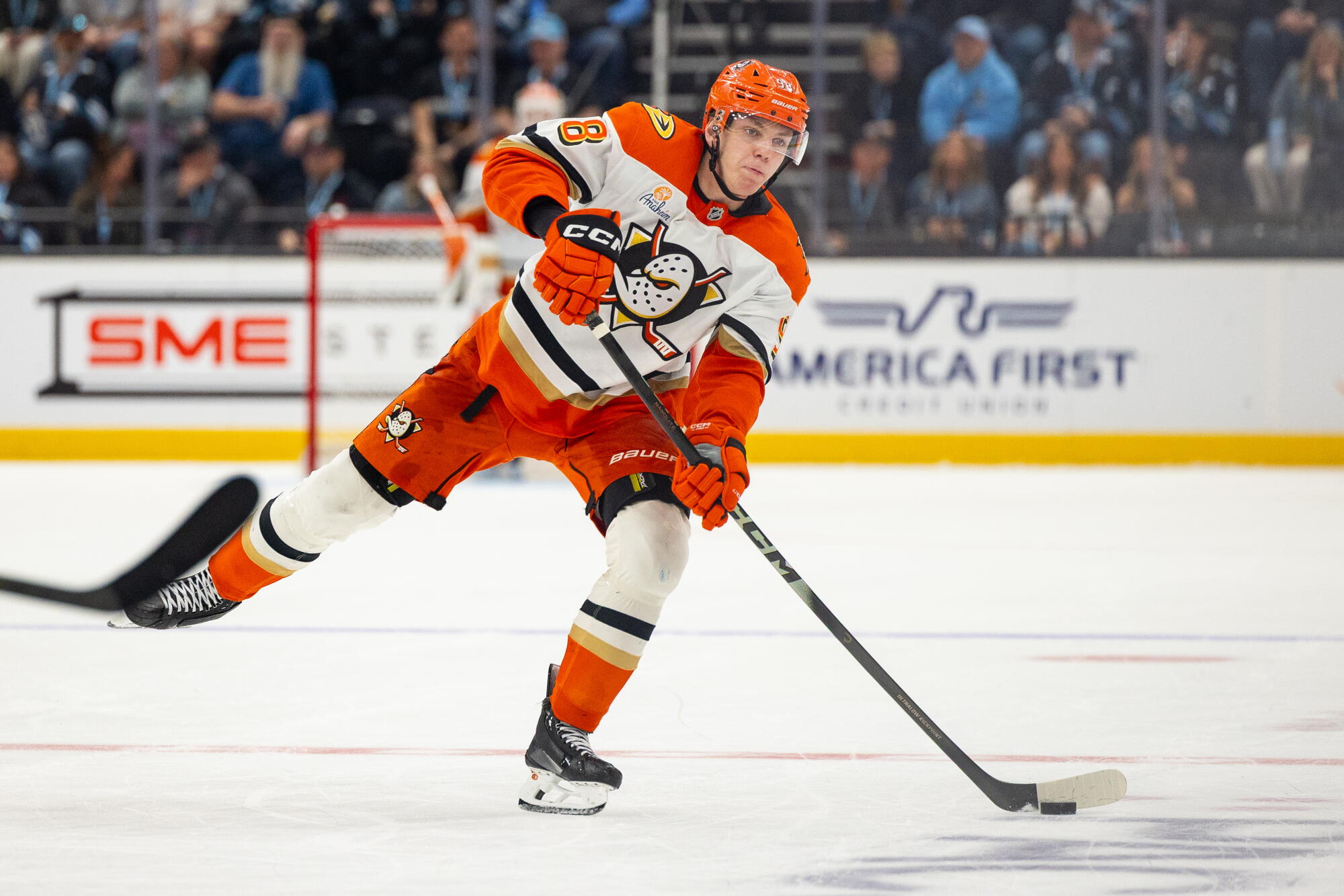
Ducks defenseman Pavel Mintyukov passes against the Utah Mammoth on March 20.

Ducks defenseman Pavel Mintyukov passes against the Utah Mammoth on March 20.

(Melissa Majchrzak / Associated Press)

All that spending left the team with nothing to offer veteran winger Chris Kreider, who was released this summer, joining an exodus that included key defensemen John Carlson, Radko Gudas, Olen Zellweger and Jacob Trouba.

The Ducks will also be without forward Troy Terry, who averaged 24 goals over the past five seasons, until well into the winter as he recovers from hip surgery.

As a result, the Ducks start with several new pieces up front and thin experience on the blue line, which isn’t a good look for a team that gave up 288 goals last season, fourth-most in the NHL.

Despite the additions of veterans A.J. Greer, a Stanley Cup winner in Florida who was acquired to add a physical presence in the attack, and Nick Jensen, 36, who was signed to stabilize the defense, the Ducks will once again have one of the youngest rosters in the NHL. But Quenneville has a history of turning young teams into champions. Nineteen years ago he took over a Chicago Blackhawks team that was the youngest in the league and led it to the conference final. A year later that team captured the Stanley Cup, the first of three Quenneville won in Chicago.

For the Ducks to match that, their summer additions will have to add up to more than the subtractions. And the investment Verbeek made in Carlsson, Gauthier and Mintyukov will have to pay off. What’s certain, however, is after last season’s breakthrough, the Ducks won’t be sneaking up on anyone.

“We made it a little harder for ourselves,” Washe said. “We’ve got a little target on our back.”

Source link

Arte Moreno finally sells Angels. Anaheim’s long nightmare is over.

Texts lit up my phone this morning from friends who had wasted most of their lives rooting for the Angels: Arte Moreno finally was selling the team.

“First order of business: it’s the Anacrime Angels,” Nelson Rodriguez cracked before sending a meme of Stringer Bell in “The Wire” wearing an old-school California Angels cap and saying, “I want you to put the word out there that we back up.”

“This news honestly made my year,” texted Anaheim City Councilmember Natalie Rubalcava, who graduated a year ahead of me from Anaheim High and whose daughter works at my wife’s restaurant. “Excited to leave the controversy and negativity behind and look forward to a new era of Anaheim baseball.”

“Shame this didn’t happen when [Shohei] Ohtani was an Angel,” the Mountain shared on a group text thread of childhood friends who call each other by long-standing nicknames — I’m the Consigliere.

“I get invited to the games but hell no,” replied the Butcher, who’s been a fan since the days of Hall of Famer Nolan Ryan in the 1970s.

“I’ll finally go back” to a game in person, my cousin Plas added. “A Trumper [Latino] what could’ve gone wrong …” he wrote, referencing Moreno, before asking if Kurt Suzuki was still manager because “that’s how little I’ve kept up with the team.”

Those are the texts I can print in a family newspaper.

Moreno is selling to Los Angeles Rams owner Stan Kroenke, whose company also owns perennial contenders in the NBA (Denver Nuggets), NHL (Colorado Avalanche) and England’s Premier League (Arsenal). Sources told my colleagues that the price was $4 billion, which would be a baseball record and speaks to the Halos’ untapped potential.

Major League Baseball still needs to approve the deal, but I guarantee that Commissioner Rob Manfred and the 29 other team owners are reacting with the silly swaying dance that Dodgers players do every time they get on base.

“The Moreno Family has been honored to steward the Angels for 23 years,” the soon-to-be-ex-Angels owner said in a statement.

You stewarded nada, Arte: You destroyed.

You started with so much hope and ended up with fans like my friends shooting venom at you like pissed-off cobras. There’s a reason why you’ll leave as one of the most loathed owners in baseball history. Your underperforming reign makes the McCourts of Dodgers infamy seem as amazing and beloved as the O’Malleys.

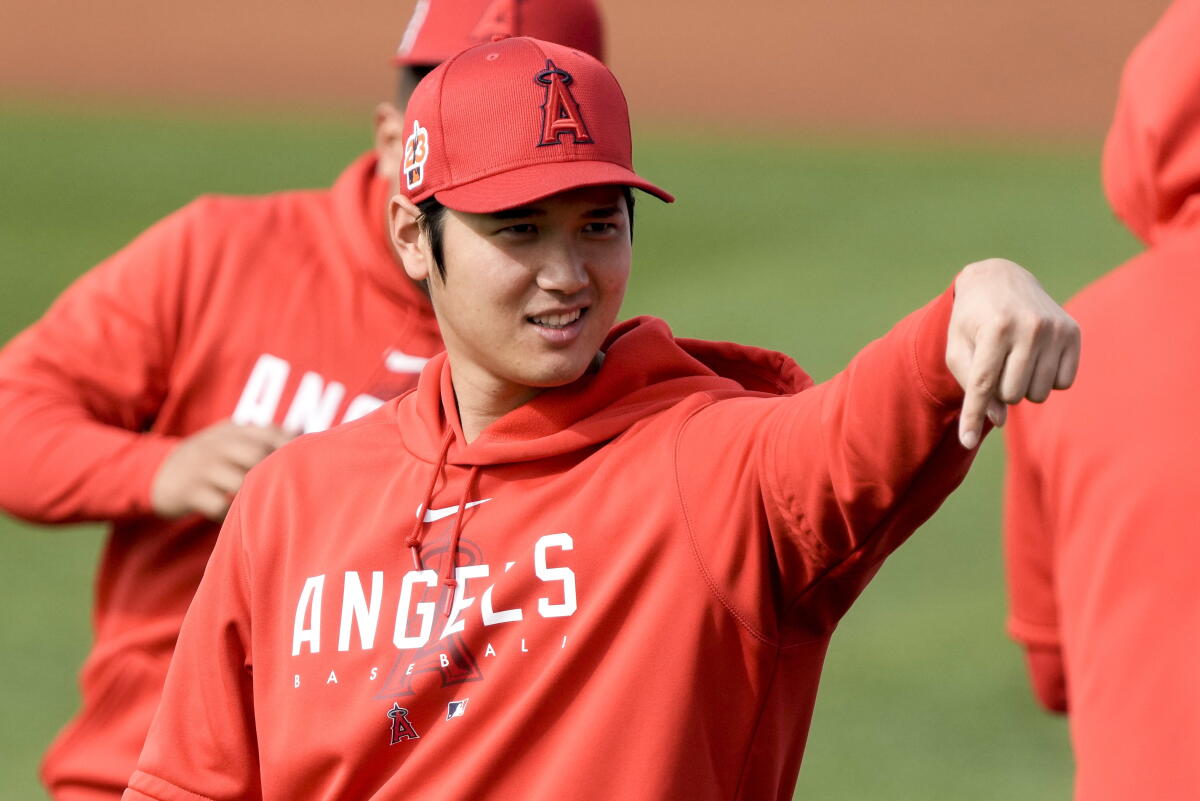
Los Angeles Angels' Shohei Ohtani gestures during a spring training baseball workout.

Not even Shohei Ohtani, at spring training when he played for the Angels in 2023, could change the team’s fortunes under Moreno.

(Morry Gash/Associated Press)

The Tucson native, who made his billions in the billboard industry, bought the Angels from Disney in 2003, the year after they won their sole World Series championship. At a festive press conference, Moreno handed a sombrero to then-skipper Mike Scioscia to wear, then announced that the first order of business was to cut beer prices.

The new owner quickly signed the best players in baseball — slugger Vladimir Guerrero and pitcher Bartolo Colón. Moreno walked Angel Stadium during games to ask fans what they wanted, what they needed, what they dreamed of. That first decade, he made the Angels what they never had been for a prolonged period: winners.

Fans packed the stands — more than 3 million each year from 2003 to 2019, the third-longest streak in baseball. Anaheimers donned Halos jerseys and hats like never before. More incredibly, Moreno was at the cusp of the impossible: convincing a generation of Latino baseball fans in Orange County to side with the Halos instead of the Dodgers.

But there were always signs that something was off.

Moreno renamed the team the Los Angeles Angels two years after he bought them, a ridiculous moniker that made them a national punchline. The renaming also cost Anaheim millions of dollars in legal fees after the city unsuccessfully sued to force Moreno to keep my hometown in the team’s name.

Moreno openly talked about moving the Angels to a city that would build him a new stadium. He also fell into the terrible habit of signing conservative-leaning, past-their-prime ballplayers like Josh Hamilton, Albert Pujols and Anthony Rendon to massive contracts that weighed down the team for years, like one of Angel Stadium’s legendary cinnamon rolls.

Die-hards like my pals trudged on, buoyed by generational talent Mike Trout and the occasional flash-in-the-pan prospect. But even they were turned off by the last three years.

Former Anaheim mayor Harry Sidhu pleaded guilty in 2023 to federal tax evasion charges stemming from accusations that he solicited an illegal $1-million campaign donation for an attempted sale of city-owned Angel Stadium to a Moreno-led company.

That same year, the Halos let Ohtani — who was on his way to a second most valuable player award and already had established himself as one of the most talented baseball players ever — walk away as a free agent while gaining nothing in return.

This season kicked off with Moreno telling the Orange County Register about a survey supposedly revealing that winning wasn’t “a top priority” for Angels fans. The Angels hadn’t made the playoffs in 11 years, hadn’t finished with a winning record since 2015, had landed in last place in their division for the last two years — and that’s what he offered as a speck of hope? No wonder the team is on pace to lose 100 games for the first time in franchise history. No wonder disgusted fans have protested both inside and outside Angel Stadium all summer.

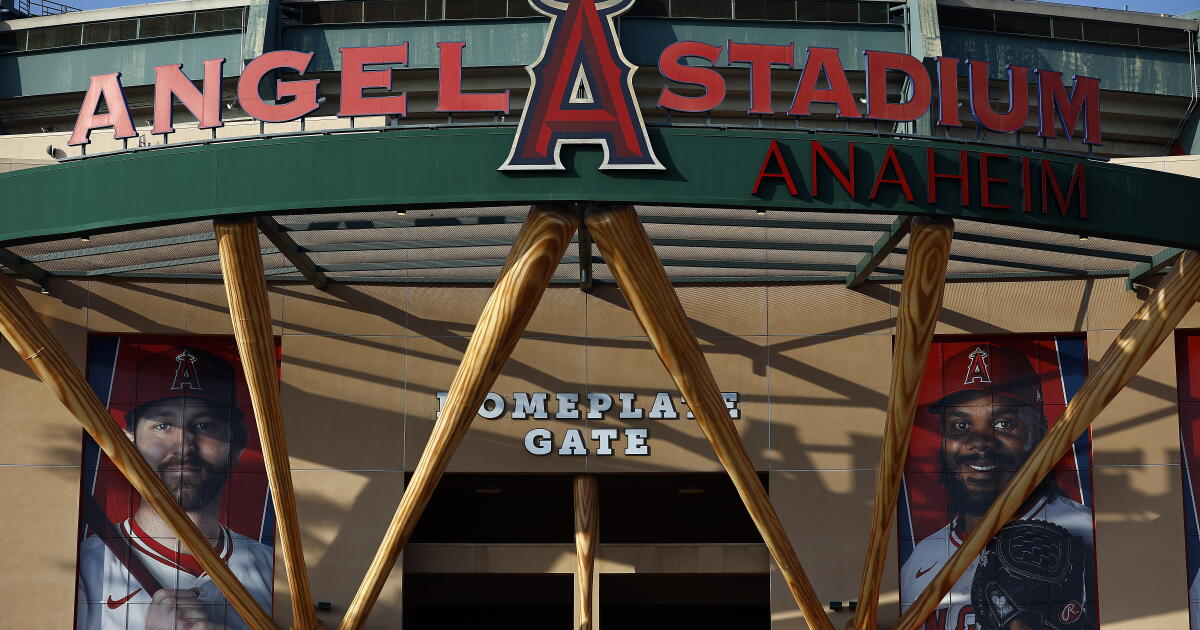
At the only game I went to this year — a sparsely attended afternoon snoozer against the Chicago White Sox — I found the stadium more beat-up than ever: peeling paint, beat-up seats, tinny PA system. For about $25 each, my friends and I bought tickets behind the first-base dugout that would have cost hundreds of dollars at Dodger Stadium.

Billboards along Southern California freeways have broadcast the Angels’ desperate attempts to draw in fans via pathetic promotions. Fireworks every Saturday. A bobblehead giveaway of light-hitting shortstop Zach Neto, who never has made an All-Star team. A “yard sale” that sounds like a giant casting off of crappy memorabilia a week away from the trash can.

Angels fans wave signs and urge owner Arte Moreno to sell the team during a protest on Saturday at Angel Stadium.

Angels fans wave signs and urge owner Arte Moreno to sell the team to an ownership group willing to invest more in winning during a pregame protest at Angel Stadium.

(Joaquin Ruiz / For The Times)

I never cared for the Angels, but I always wanted them to do well. Any success they achieved rubbed off on my hometown, as it did during that magical 2002 run.

I also wanted Moreno, the first Latino to own a major professional sports team, to succeed, so his fellow Trump supporters might know that our kind can excel at the highest echelons of American society, if only we get the chance.

But for the last few years, I cheered each time the Angels lost. I wanted them to tank, to forever seal Moreno’s legacy as a loser. To serve as a warning to all professional sports owners that they can abuse a host city and its fan base for only so long before people revolt by just not caring.

Good luck to Kroenke as he tries to resuscitate a franchise deader than a stump in the Petrified Forest.

Source link

Why the Angels will get a fresh start with Stan Kroenke, and much more

When the Angels won their lone World Series, this was the headline in the Los Angeles Times: “Fantasyland!”

Can we run that headline again?

For your new owner, Angels fans, you get a proven winner and real estate developer — more on that in a second — whose very name drips with baseball history.

You know him as Stan Kroenke, the owner of the Rams. His full name is Enos Stanley Kroenke, so named in honor of two St. Louis Cardinals Hall of Famers: Enos Slaughter and Stan Musial.

As he assembled his sports empire, baseball was the one sport that eluded him. He has the Rams, the Denver Nuggets, the Colorado Avalanche and Arsenal. He badly wanted the Dodgers, a runner-up in the bidding when Mark Walter bought them in 2012.

Now he is acquiring the Angels — at a $4-billion valuation, a record for a baseball team — and getting the closest thing to a blank slate that any owner can get without buying an expansion team.

The general manager? He’s an interim, and his contract expires this year.

The manager? His contract expires this year too.

The roster? The only players currently under contract for next year are outfielder Mike Trout — the Angels’ answer to Musial — and pitcher Yusei Kikuchi.

The stadium? The lease expires in six years.

The Angels’ playoff drought? The longest in the majors, going on 12 seasons. Go, Super Bowl champ, go!

For Kroenke, the first order of business might well be a comprehensive search for what would be the Angels’ answer to Les Snead and Sean McVay, the GM and head coach duo that led Kroenke’s Rams to a Super Bowl championship. The players might not be the next order of business. The deal is not expected to be approved until early 2027, according to a sale announcement, and who knows whether owners still will be locking out players by then?

But Kroenke appears to be the perfect guy to resolve the longest-running and most critical order of business in Anaheim: resolving the Angels’ future there.

For 60 years, the Angels have played in a stadium surrounded by 130 acres of parking lots. For 60 years, fans have driven into the parking lots, watched the game, and driven home. For 60 years, the city has lost untold millions in tax revenue by failing to build anything atop those parking lots.

Kroenke just does it. He is doing it around SoFi Stadium, which he built. He is doing it around the Rams’ training facility in Woodland Hills, which he built. He plans to do it around the sports arena he is building in San Diego.

Now Kroenke could lobby for a new ballpark in Inglewood, in place of the Forum, and call it synergy. James Butts, the mayor of Inglewood, has said he would frown upon a ballpark there.

But here’s betting Kroenke won’t ask. The sale announcement highlighted Kroenke’s “presence in one of the largest sports and entertainment markets in the United States” and said the purchase of the Angels “extends this footprint south into a market of more than three million residents with its own distinct civic identity, corporate base and tourism economy.”

Kroenke wants what all sports owners want these days: money coming out of a stadium site 365 days a year, not just on game days. That means shops, restaurants, homes, hotels, offices, parks, music venues, and food halls. And good luck to Kroenke or any other developer trying to find a vacant 130 acres in any urban area in Southern California, much less one adjacent to a train station and within three freeways.

This is already happening across the 57 Freeway from Angel Stadium, where Ducks owners Henry and Susan Samueli are putting up what they call the OC Vibe. Kroenke’s history indicates he would do something just as fun, and likely grander given that he’ll have more land, and suddenly Anaheim could be the coolest place to be in Orange County (*unless Olivia Rodrigo is putting on another Daisy Chain Fields festival in Irvine).

And, if Kroenke is willing to rename the team the Anaheim Angels, the city and its local assemblyman just pushed through a new law that could provide him with a significant financial incentive for development, which in turn could reduce his cost to build the new ballpark the Angels so desperately need.

The city owns the stadium and parking lots, so they were not part of the team sale. City officials have not met with Kroenke.

“Fans and residents welcome the start of a new chapter for baseball in Anaheim,” Mayor Ashleigh Aitken said. “I am encouraged by Stan Kroenke’s track record with the Rams and his commitment to investing in and uplifting neighborhoods.

“I look forward to working with the team’s incoming ownership to advance our city’s priorities around housing, open space and youth sports at the right time.”

For decades, Anaheim has loftily labeled the land around the neighborhood around the “Platinum Triangle.” Now the city might well have struck gold.

The local assemblyman that introduced that law, Avelino Valencia, could hardly have been any happier Tuesday.

“This is a big day for Anaheim,” Valencia texted me. “For 60 years, our community has filled Angel Stadium, raised a World Series banner as the Anaheim Angels, and shown up through every season.

“Few cities can offer a new owner a foundation like that. New ownership means new possibilities, and Anaheim is ready for them.

“I congratulate Stan Kroenke and Kroenke Sports and Entertainment on their agreement to purchase the Angels, and I welcome them home. Let’s build a partnership rooted in pride of place, a team that reflects the city it calls home, and the return of the Anaheim Angels.

“Anaheim is ready to work together, and Anaheim is ready to win.”

In a statement, Sen. Tom Umberg (D-Santa Ana) called it “a great day for Angels fans and Anaheim.”

As the stalemate between the city and Angels owner Arte Moreno grew more entrenched, the condition of Angel Stadium deteriorated. So did Moreno’s investment in the team.

Three years ago, the city commissioned an assessment of what it would take to keep Angel Stadium up and running for decades to come. We’re still waiting.

Those words, in a nutshell, exemplified the relationship between the team and the city in recent years. When the news broke Tuesday, a city official reached out to me to ask if it were true. And, after years of city officials sniping that the Angels had for a decade clipped the “of Anaheim” from their “Los Angeles Angels of Anaheim” name, the Angels emailed a statement confirming the sale with this headline: “Kroenke Sports & Entertainment to Acquire the Los Angeles Angels of Anaheim.”

After a season of “Sell The Team” chants, Moreno did. And, after Gov. Gavin Newsom signed Valencia’s bill into law last week, the title of the law actually sounded more appropriate Tuesday: “The Home Run for Anaheim Act.”

Source link