In its Annual Economic Report, published on Sunday, the Bank for International Settlements (BIS), known as the central bank for central banks, warned that the enormous spending on AI is accumulating financial vulnerabilities that could amplify any future shock and spread from markets into the wider economy.
ADVERTISEMENT
ADVERTISEMENT
Presenting the findings, BIS general manager Pablo Hernández de Cos said the message was one of “urgency”, with policymakers urged to act before any reversal makes the eventual adjustment more painful.
At the core of the warning is the scale of the spending, despite massive investment having supported global growth over the past year.
The five largest “hyperscalers”, the technology giants racing to build AI infrastructure, are on track to commit more than $1 trillion (€878bn) to AI-related investment across 2025 and 2026, a pace that is outstripping their earnings and free cash flow and pushing some to borrow heavily to keep up.
The BIS suggests this race is fuelled by a belief that only a handful of dominant players will ultimately prevail, encouraging firms to pour money into projects whose returns remain deeply uncertain.
Echoes of past manias
The report sets today’s AI boom against a long historical lineage, from the canal mania of the 1830s and Britain’s railway mania of the 1840s to the electrification of the 1920s and the dotcom bubble.
Each began with a genuine technological breakthrough that attracted more capital than commercial returns could justify, the BIS notes, with each episode ending “with an eventual reversal in investment, inducing economy-wide recessions”.
Compounding the danger are stretched share prices and opaque financing.
The BIS highlights the spread of “circular financing”, in which chipmakers and cloud giants take equity stakes in AI labs that then commit to buying their chips and computing power, effectively recycling money back to the original investors as revenue.
Much of the funding now flows through hedge funds and private credit vehicles that face lighter scrutiny than banks.
According to Zhang Tao, the BIS chief representative for Asia and the Pacific, that reliance on non-bank channels means an AI downturn could unwind into a sharper, faster crash than a traditional banking crisis.
The hidden costs of data centres
Beyond financial markets, critics argue the true cost of the AI build-out is being obscured in plain sight.
A central concern, examined by the Wall Street Journal, is how the technology giants account for their data centres.
By assuming the expensive equipment inside them will stay useful for longer, firms can spread its cost over more years, lowering the depreciation charged against profits in any given period and making earnings look healthier than the underlying cash burn implies.
However, the specialist chips at the heart of these facilities may become obsolete far faster than those extended schedules assume, leaving a gap between reported profits and economic reality, as well as a balance sheet more exposed than it appears should demand disappoint or a sizable need to replace hardware arise.
The physical scale is staggering.
Columbia University economist Stijn Van Nieuwerburgh estimates the build-out could cost in the region of $8 trillion (€7tn) over the next six years, financed in part through the kind of off-balance-sheet arrangements the BIS flagged.
The costs are also no longer confined to corporate accounts.
Some economists now warn of a so-called “third wave” of inflation, after the pandemic and tariffs, driven this time by the AI build-out. As chip manufacturers prioritise high-margin parts for AI servers, the resulting squeeze on memory and storage has rippled out to consumer electronics.
For example, Apple raised prices on its MacBooks, iPads and other devices last week, citing an “extraordinary surge in demand for memory and storage” and saying it had “never seen a component price increase this much, this quickly”.
The company’s shares fell around 6%, their worst day in over a year, as Microsoft, Nintendo and Sony have also made similar moves.
Beyond hidden costs and inflationary pressures, where the strain may spread furthest is raw power.
Goldman Sachs expects data centres to account for nearly half of the growth in US electricity demand by 2030, with consumer power prices forecast to rise around 6% a year through 2026 and 2027.
The BIS itself notes that the build-out’s hunger for electricity is already pressuring prices and input costs, with potential spillovers to inflation, though it stresses, as do many economists, that AI could yet prove disinflationary if its promised productivity gains eventually arrive.
Halfway through a turbulent year, a clear pattern has emerged across global markets: anything tied to the physical build-out of AI has soared, while several other assets that investors traditionally turn to in uncertain times have stumbled.
ADVERTISEMENT
ADVERTISEMENT
War in the Middle East, political upheaval and an oil-price spike formed the backdrop, yet stock markets in several regions still pushed to fresh record highs.
According to Dan Coatsworth, head of markets at AJ Bell, companies on the receiving end of the AI spending boom were the standout investments of the first half, while Bitcoin proved “a shocker” and gold lost its shine.
It is, Coatsworth noted, a remarkable run of events for only half a year’s worth of trading.
The most spectacular gains came from an unglamorous corner of the technology world: the firms that make memory chips.
As demand for AI computing collided with tight supply, prices surged and took shares with them. SanDisk led the US market with a gain of over 850% in six months, while Western Digital, Micron Technology and Seagate Technology all more than tripled in value, a pace of return that would ordinarily take many years to achieve.
The driver is the vast quantity of high-speed memory and storage needed to train and run AI systems as the largest technology companies race to expand their data centres.
Other US equities that soared on the back of the AI trade include Intel, Dell, Advanced Micro Devices (AMD) and Applied Materials, which all rose between 150% and 280% year to date.
The rush also lifted emerging markets, where Asian chipmakers such as TSMC and SK Hynix carry heavy weight, helping South Korea’s KOSPI double in value, Japan’s Nikkei 225 climb roughly 40% and the MSCI Emerging Markets index rise by around 27%.
In Europe, the FTSE 100 gained 7% in the first half of the year, France’s CAC 40 rose 5%, while Germany’s DAX gained 2%. Meanwhile, the MSCI India index fell 5% and Hong Kong’s Hang Seng lost 6%.
Notably, the memory rally has begun to unwind in recent days, with several of the same names caught in a sharp technology sell-off.
The fallen favourites, takeovers and the trades that cooled
The flipside was brutal for yesterday’s winners.
Previous AI darlings Meta and Microsoft were left behind, down 14% and 24% respectively on a total-return basis, as heavy AI spending turned the technology giants into more capital-hungry businesses and investors stopped paying a premium for them.
Microsoft now trades at its cheapest level in a decade, leaving both it and Meta valued more modestly than McDonald’s, an outcome few would have predicted at the height of the “Magnificent 7” craze.
Elsewhere, the assets many expected to lead disappointed.
Gold took investors on a volatile ride. After surging to a record high of $5,594.82 an ounce on 29 January, the precious metal lost around 28% from its peak despite the geopolitical turmoil that would normally send investors flocking to safe-haven assets. Instead, its appeal was undermined by higher bond yields and cash rates, which offer an income that a gold bar cannot.
Bitcoin fared worse still, falling 28% since the start of the year as enthusiasm for crypto drained away and money rotated towards technology shares instead.
In the UK, takeovers did much of the heavy lifting.
Six FTSE 100 companies, among them Glencore, Schroders and Segro, attracted bid interest in the first half, a sign that buyers still see value in British blue chips even after a three-year re-rating.
Housebuilders such as Persimmon struggled against a sluggish property market, while tech-adjacent names like Experian and RELX were swept up in fears about AI disruption.
One trade that conspicuously cooled was defence.
After a storming 2025, the likes of BAE Systems, Germany’s Rheinmetall and America’s Palantir all gave ground, as the good news on rising military budgets looked fully priced in and investors drifted elsewhere.
This article does not constitute financial advice. Always do your own research and invest according to your specific circumstances.
Micron, one of only a handful of companies able to make advanced memory chips at scale, said on Wednesday that revenue in the third quarter reached $41.4 billion (€36.5bn), more than four times the $9.3 billion (€8.2bn) it recorded in the same period last year.
ADVERTISEMENT
ADVERTISEMENT
The figure also comfortably beat the roughly $35.7 billion (€31.4bn) analysts had forecast, while profit climbed even more dramatically.
The Idaho-based group posted net income of $28.24 billion (€24.9bn), or $24.67 per share, against less than $2 billion (€1.7bn) a year ago. Adjusted earnings of $25.11 a share sailed past the $20.49 expected.
The market reaction to the impressive results was immediate.
Micron shares rose more than 15% in after-hours trading to around $1,213, leaving the company valued at roughly $1.16 trillion (€1tn).
The stock has now climbed about 700% over the past year, one of the most dramatic re-ratings of any large company through the AI boom, reflecting a fundamental shift in the economics of the AI build-out.
The vast data centres being constructed by hyperscalers such as Amazon, Microsoft, Google and Meta, which have collectively earmarked hundreds of billions of dollars in capital spending this year, depend on enormous quantities of high-bandwidth memory, a specialised chip that sits alongside the processors made by Nvidia and others.
Micron has said its entire 2026 output of these chips is already sold out under fixed-price contracts.
According to CEO Sanjay Mehrotra, the results reflect what he called the strategic value of memory in the AI era.
The company pointed to a series of multi-year customer agreements that it expects to make earnings more durable and predictable, a notable claim in an industry long defined by brutal boom-and-bust cycles.
Margins to rival the biggest names
What has startled analysts most is Micron’s profitability.
The company reported a gross margin of around 85% for the quarter, a level that now rivals or exceeds those of far larger technology names such as Nvidia and Meta, an extraordinary position for a memory maker historically squeezed by volatile chip prices.
The tightness of supply, with new factories not expected to add meaningful output until 2028, has handed producers exceptional pricing power.
Micron’s guidance was more striking still.
The company expects revenue of around $50 billion (€44bn) in the current quarter and adjusted earnings of roughly $31 a share, implying the boom is accelerating rather than fading. It is ramping up investment to match, lifting planned capital spending to about $27 billion (€23.7bn) this fiscal year and signalling a further jump in 2027, management told analysts during the earnings call.
The results offer reassurance to investors betting that AI infrastructure spending remains robust, with Micron’s order book serving as a real-time gauge of that demand.
The open question, as ever in the memory industry, is how long the upswing can last before supply catches up. Even the most bullish observers acknowledge that risk has not completely disappeared.
HARRISBURG, Pa. — Six months after President Trump warned states not to regulate artificial intelligence, they are increasingly doing just that.
Congress has stalled on producing federal regulations of artificial intelligence as states forge ahead and scrutinize how chatbots interact with children, how AI systems are used by employers and what developers must do to try to prevent an AI-caused catastrophe.
State lawmakers have stepped back from earlier, wider-ranging attempts to regulate AI that were vetoed or otherwise derailed by governors who viewed the measures as too onerous toward the industry’s development, including efforts to hold developers accountable for bias in AI systems.
But they are returning with legislation that is more targeted and, often, probes the corners of life where Americans interact with AI but may not know it.
Presidential power versus state power
Trump’s move to restrain states’ actions on AI drew criticism from members of both political parties and civil liberties and consumer rights groups who worried that banning state regulation would amount to a gift to AI giants, who enjoy little to no oversight.
Trump has made AI a top national and economic security priority, and he said that letting states clutter the regulatory playing field for an industry that’s spending trillions of dollars and driving the economy is too risky in the race with China for AI superiority.
Trump issued an executive order that directed the attorney general to create a task force to challenge state laws that are more than “minimally burdensome,” and directed the Commerce Department to draw up a list of problematic regulations. It also threatened to restrict funding from a broadband deployment program and other grant programs to states with AI laws.
The White House said it wouldn’t target state laws that seek to prevent fraud and protect consumers and children.
In the meantime, the Trump administration released a “national policy framework” in which it urged Congress to preempt state AI laws that are out of step with its regulatory worldview and to pass legislation to protect children, intellectual property rights and free speech. A recent bipartisan draft proposal in the House was met with withering criticism from key Democrats and Republicans.
The White House has given no indication that it has made good on its threat to enforce the president’s executive order by going to court against a state’s AI law or withholding money. In a statement, it said the Trump administration is “eager to work with partners” to enact its policy framework.
States seem largely unrestrained by Trump
Trump’s executive order didn’t seem to discourage states from trying to regulate how AI is used. More bills have been introduced this year than last, including by Republicans, said Justine Gluck, policy director of the Future of Privacy Forum, a nonprofit that advocates for data privacy in technology and whose members are from industry, academia and civic groups.
In Illinois, legislation on the desk of Democratic Gov. JB Pritzker piggybacked on elements of laws passed last year in California and New York that require developers of large advanced AI models to create protocols to prevent their systems from causing catastrophes such as a biological weapons attack, power outage or large-scale hack.
Illinois added a requirement that AI developers must get an independent auditor to review whether they are complying with their own policies. Analysts see it as a step toward requiring AI developers to take greater accountability for their products.
The bill’s sponsor, Democratic state Sen. Mary Edly-Allen, brushed aside Trump’s threat.
“I don’t know if you’ve met Illinois, but we’re pretty independent,” Edly-Allen told the Associated Press.
The bill drew nearly unanimous support, signaling a willingness by members of Trump’s party to cooperate with Democrats in filling the AI regulatory vacuum left by the federal government.
This kind of legislation is expected to expand to other states.
Regulating chatbots, especially for children
A growing number of states are imposing restrictions on how AI chatbots can interact with people, especially children. A mix of Republican- and Democratic-led states have passed such laws this year, including Colorado, Connecticut, Idaho, Iowa, Nebraska and Oregon.
In many cases, states want companies to tell people when they are interacting with AI instead of a human. Many want chatbots to be restricted in how they interact with minors, parents to have control over their child’s access, and data given to chatbots to be kept private.
In recent weeks, Connecticut enacted provisions for companion chatbots that sustain an ongoing relationship with a human. Under them, a chatbot must not be able to interact with someone under 18 unless it is programmed against encouraging self-destructive behavior and provides parents with tools to manage the child’s use.
Transparency in AI and decision-making
In California, lawmakers are advancing the “No Robo Bosses Act of 2026” to prohibit employers from relying solely on AI to fire or discipline workers, and an expansion of how the state regulates AI chatbots, including banning chatbot outputs to children from being used for advertising.
Colorado in May required companies that deploy AI systems in important areas such as employment, education, housing or banking to tell people when AI is being used to influence a decision made about them.
It was a stab at regulating what researchers say is the bias inherent in AI systems that sort through a consumer’s data and render consequential decisions — including who gets hired, a home loan or medical care. But it watered down a 2024 law aimed at preventing AI’s penchant to discriminate, amid pressure from Democratic Gov. Jared Polis.
In Connecticut, lawmakers required employers who are using employment-related AI systems to tell employees or job applicants that they are interacting with AI.
Meanwhile, Connecticut, Washington and Utah required AI developers to embed data into digital content that will allow users to determine whether the content — such as photos or video — has been created or altered by AI.
More laws are possible this year.
Some Republican-led states hold back
In Florida, the state House refused to advance what Republican Gov. Ron DeSantis called his AI “Bill of Rights” legislation. It included provisions to give parents control over their children’s access to companion chatbots and to require companies that use chatbots to tell consumers when they are interacting with AI instead of a human.
Florida House Speaker Daniel Perez, a Republican, said Trump had made it clear that the federal government should be in charge of AI regulation. DeSantis panned that idea, noting that the federal government isn’t acting.
In Utah, progress stalled on legislation modeled on laws in New York and California after the White House sent a one-sentence memo to lawmakers there to warn that it was “categorically opposed” to the bill.
WASHINGTON — In congressional races across the country, a new crop of super PACs is taking to the air with millions of dollars worth of advertisements to sway voters.
“President Trump said it best, ‘Celeste Maloy will never let you down,’” says one advertisement supporting the Utah Republican representative in her upcoming primary election.
“Standing up to big pharma, fighting for local jobs, Val Hoyle doesn’t back down,” says an ad backing the Oregon Democratic representative ahead of her primary victory last month.
The super PACs have nondescript names — such as Jobs and Democracy PAC and American Mission — and the text is so generic that it almost seems to have been created by artificial intelligence.
That isn’t so far off the mark. The AI industry has funded the ads.
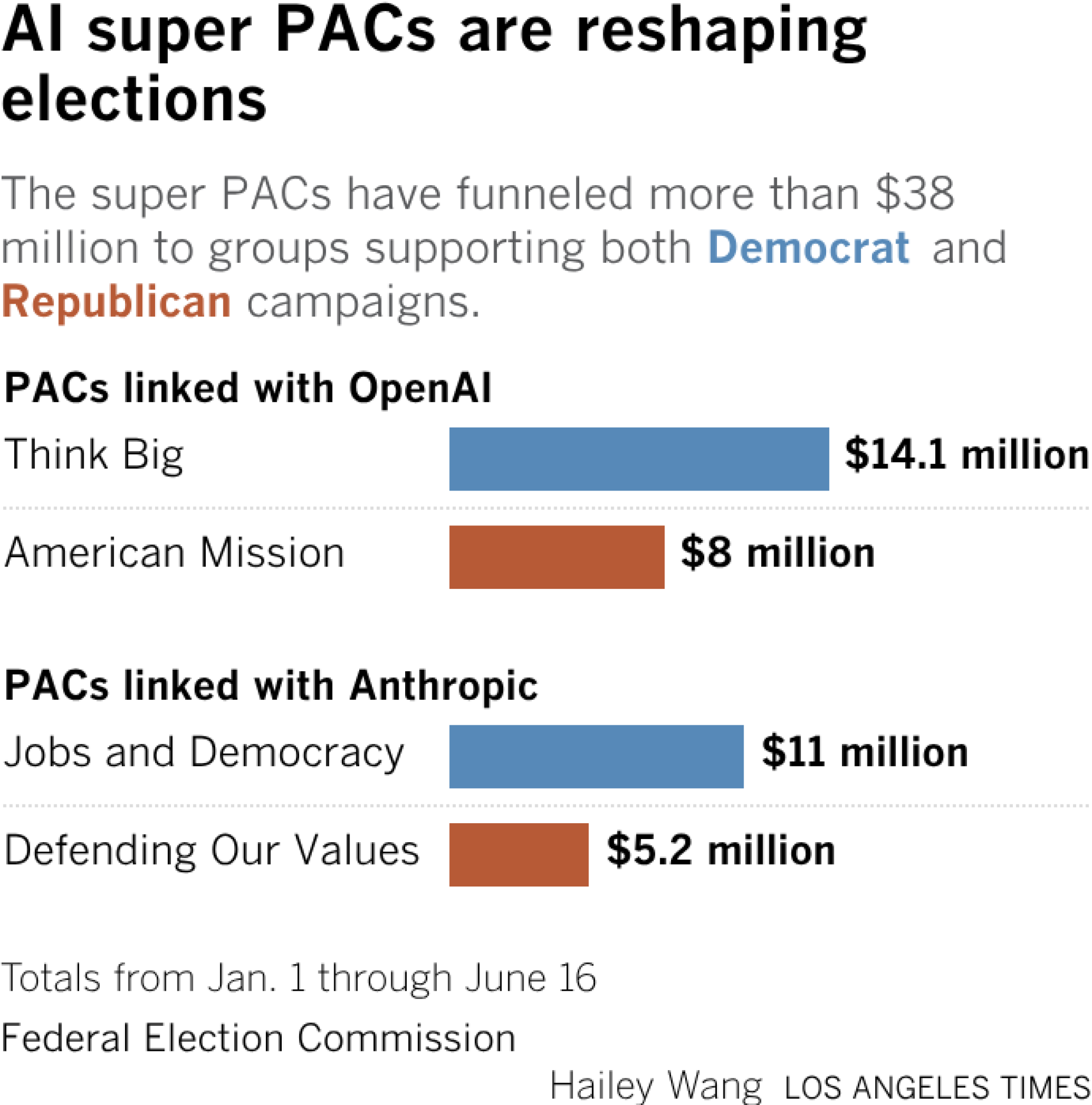
One network of super PACs is linked to Anthropic, maker of the popular AI tool Claude, and the other to Open AI, maker of ChatGPT.
They have been among the most prolific political spenders so far in the 2026 midterm elections, splashing out more than $37 million to date to influence races across the country and making the groups among the biggest outside spenders so far in congressional races. That number could grow exponentially as campaign season heats up closer to the November election — and as the Silicon Valley giants prepare initial pubic offerings that are poised to raise billions of dollars for the companies and their executives.
The AI political spending boom comes as emerging technology companies have become increasingly “comfortable with using their power to achieve a political goal,” said Adam Kovacevich, a former Google public policy executive and founder of Chamber of Progress, a technology trade group with a progressive orientation.
The leading AI companies have a history.
Anthropic was formed by former OpenAI employees who were concerned that the company was less focused on its original mission to safely harness the power of AI.
The companies are now the leading drivers of the burgeoning AI industry, and their competing views about how the technology should be regulated are playing out in a wide-ranging political ad spending war that has targeted congressional races in big cities and rural areas alike.
Anthropic calls for more stringent regulation and supports efforts by states such as New York and California that have passed more aggressive AI laws.
The groups spending in these races are super PACs, which are able to raise and spend unlimited amounts of money in federal races thanks to the 2010 Citizens United Supreme Court decision.
In some races, the AI-backed political groups have spent more than the candidates they are backing.
“There was no way as a grassroots person that I could compete with that kind of money,” said Al Olszewski, whose opponent in a Montana Republican congressional primary beat him by 30 points after getting a boost from $877,000 in ads from a super PAC backed by OpenAI’s co-founder. “I got crushed.”
The AI behemoths have emphasized that they are independent from the political groups.
One group counts $25 million in support from OpenAI co-founder Greg Brockman and his wife, Anna, alongside $100 million tied to one of Silicon Valley’s biggest venture capital firms, which holds a large stake in OpenAI. The global policy chief for OpenAI was reportedly involved in conceiving the group.
The other side has gotten $20 million from Anthropic and millions more from donors whose identities are not public.
This anonymous political cash is commonly known as dark money, and its prevalence is growing.
(Los Angeles Times photo illustration; source photos courtesy of the Tech Oversight Project)
“This has become very normalized now,” said Brendan Glavin, director of insights at OpenSecrets, which tracks campaign spending. “In 2024, we tracked over $1 billion in dark money.”
The political activity of these AI companies and executives reflects a dramatic shift from how emerging technology companies have historically engaged with politics.
Google, for example, didn’t hire its first in-house Washington lobbyist until after the company had gone public in 2005.
“I think that for a long time, the tech industry lobbying strategy was just ‘leave us alone,’” Kovacevich said.
He sees the spending by these AI-linked super PACs as following the recent playbook developed by the cryptocurrency industry, which has funded the only network of political groups that has spent more on congressional races this year than those linked to OpenAI.
“I think what the crypto industry realized was that there’s no substitute for building up political power,” Kovacevich said.
The political stakes for these technology companies are significant.
“AI policy is far from settled,” said Asad Ramzanali, the former deputy director for strategy in the White House Office of Science and Technology Policy during the Biden administration and the director of artificial intelligence and technology policy at the Vanderbilt Policy Accelerator.
Earlier this month, the Trump administration banned foreign nationals from using the most powerful AI model developed by Anthropic — and even banned the company’s own employees from it — which forced the company to restrict access for all users.
Manhattan matchup
The two super PAC networks have largely shied away from producing ads that mention AI and have mostly chosen to avoid competing against each other in the same races.
There’s one big exception.
In the marquee Manhattan Democratic congressional primary to replace retiring Rep. Jerry Nadler (D-N.Y.), each side has spent millions of dollars.
While the field includes Kennedy scion and social media star Jake Schlossberg and former Republican turned Trump critic George Conway, the target of all the AI-backed spending has been Alex Bores, a former Palantir data scientist who now serves in the New York state Assembly.
New York congressional candidate sponsored a state measure Bores requiring major AI companies to be transparent about their safety protocols and promptly report safety incidents.
(Yuki Iwamura / Associated Press)
That’s because Bores sponsored a state bill, known as the RAISE Act, that requires major AI companies to be transparent about their safety protocols and promptly report safety incidents. The bill was signed into law in December 2025.
The ads sponsored by the group tied to OpenAI, which has spent more than $7.5 million in the race, paint Bores as someone who can’t be trusted.
They cite his support from other tech billionaires, including former crypto mogul and convicted financial fraudster Sam Bankman-Fried, whose super PAC spent $100,000 to support Bores in 2022 when he first ran for New York Assembly.
“Is that really who should be shaping AI safety for our kids?” one ad asks.
An ad sponsored by the Anthropic-backed network, which has also spent more than $7.5 million supporting Bores, makes the case that the bill he sponsored is exactly why he should be elected.
“As a computer engineer, Alex Bores saw how dangerous unregulated AI could be and he wrote New York’s RAISE Act to put real safeguards on A.I. and hold big tech accountable,” the ad says.
The AI ad barrage in New York has even included what might be considered a kumbaya moment in the ad wars — another super PAC created to support Bores is most heavily backed by both an employee of Anthropic and an employee of OpenAI, who both focus on AI safety.
The group, Dream NYC, has spent more than $1.7 million supporting Bores.
Bores and fellow New York State Assemblymember Micah Lasher have been atop the most recent polls in the race ahead of the June 23 primary.
A general view of businesses in St. George, Utah, on Wednesday.
(Ian Maule / For The Times)
Rural Republicans
For voters in many parts of the country, the debate over AI policy has played out locally as a debate over the massive data centers required to power the technology.
In Utah, a proposed data center in Box Elder County, backed by “Shark Tank” television personality Kevin O’Leary, has generated controversy because of questions about its impact on resources in the drought-prone state and its environmental effect on the nearby Great Salt Lake.
In the state’s most competitive Republican congressional primary — the vast, newly drawn 3rd Congressional District — both candidates expressed concerns about how the project has been developed and called for greater transparency in this plan and for future data centers in the state.
Utah congressional candidates Phil Lyman and Celeste Maloy in a debate on June 1. A super PAC backed by Anthropic has spent more than $920,000 to support Maloy.
(Rick Egan / Pool / The Salt Lake Tribune Via Associated Press)
Despite their similar position on the project, a super PAC backed by Anthropic has spent more than $950,000 to support Maloy, who is running in the new district after the boundaries of her old district changed.
“It’s a lot of money to throw at a race,” said her opponent, Phil Lyman, a former conservative Republican state Representative who ran to the right of Utah Republican Gov. Spencer Cox in an unsuccessful primary challenge in 2024.
Lyman insists he is no AI skeptic.
“I’m not anti data centers, I’m pro-transparency,” he said. “I think the future is bright with AI.”
The group said it is backing Maloy because it sees her as “someone who’s worked the issue” of AI regulation and who “has demonstrated leadership” with Republicans in Congress.
Maloy’s campaign didn’t respond to request for comment.
Utah congressional candidate Phil Lyman speaks during a Cottage Meeting at the SunRiver Community Center Ballroom in St. George, Utah, on Wednesday.
(Ian Maule / For The Times)
But Lyman suspects the group’s support for Maloy ahead of their June 23 primary has more to do with old-fashioned politics than any emerging technology.
When Brian Grazer has an idea for a movie, he now starts with a chatbot. The co-founder of Imagine Entertainment — the company behind “A Beautiful Mind,” “Apollo 13” and “Liar Liar” — said he sits down with Anthropic’s AI assistant, Claude, to rough out a story before handing it to a writer.
“You can build the whole thing into an outline. You still need a screenwriter. I always believe you need a screenwriter,” Grazer said during a keynote at UCLA’s Entertainment Symposium on Thursday. What once could have taken up to a year, he said, now takes him about a week — but the human writer stays.
That balance — AI as an accelerant rather than a replacement — captures where much of Hollywood has landed in practice. Amazon MGM, Lionsgate, Netflix and Disney have all made major investments in the technology. The sharper question at the symposium, which drew many of the industry’s top lawyers and dealmakers to the Westwood campus, was not whether to use AI but how: who authorizes it, how far it goes and who gets paid.
For the companies building the tools, the answer increasingly comes from the client. Studios, production companies and distributors regularly approach Promise, a generative AI company, to bring AI into their productions, and each arrives with its own usage guidelines, said the company’s president, Jamie Byrne. Those rules govern which AI models Promise may use and what protections apply — effectively letting each client decide how heavily AI figures into the work.
“It comes down to a risk appetite,” Byrne said during a panel on AI. “We know that there’s talent that are staunchly against it. We know that there are many who are okay with it.”
He framed adoption as a competitive necessity: “Every time there’s a technology change, certain studios or production companies rise. Others fall, and it’s usually the ones that are not leaning into the new tool.”
Ron Howard, also of Imagine Entertainment, argued the limits will ultimately be set elsewhere — by viewers. “Sure, it’s about efficiencies and budgets, but more than anything, audiences are going to tell us where those restrictions are,” he said. He expects AI-generated content to settle into its own subgenre over time, with audiences signaling what they will accept.
The most contested ground is labor, where consent has become the dividing line. The emergence of synthetic performers such as Tilly Norwood has made AI a central issue in SAG-AFTRA’s contract. The union’s most recent agreement draws a clear line between authorized digital replicas, which use a performer’s likeness with their consent, and fully synthetic creations.
Talent agencies are organizing around the same principle. In recent years, Creative Artists Agency began digitally scanning clients into what it calls the CAA Vault, building a replica of a client’s image, likeness and voice while leaving the talent in complete control of how it is used.
That control is beginning to carry real value, said Tammy Brandt, CAA’s deputy general counsel, who said she is seeing more deals that involve digital likeness. Hollywood has been slow to work out how to monetize these replicas, she said, but once it does, audiences will start to encounter them more often.
“You have to lean into the technology and understand what it can do, and honestly, how you can make money, work with talent and with creative assets in a way that the user is interested in,” Brandt said. “There’s a little bit of trial and error as you go with that.”
CFOs lag on the AI curve, risking the growth and value creation they want, EY warns.
CFOs are sitting on a goldmine of tech potential—but most aren’t ready to dig in. That’s the major takeaway from a new Ernst & Young survey titled the DNA of the CFO.
Finance chiefs want to make investment decisions and create value. Yet, the majority of these bosses remain constrained by skills gaps, limited AI readiness and outdated measurement frameworks.
The London-based accounting firm sourced responses from more than 1,600 CFOs and senior finance leaders across 28 countries and 22 industries. The consensus shows a widening gap between CFO ambition and actually getting the job done.
“While CFO ambitions are clear, there’s quite a gap when it comes to execution,” Myles Corson, EY Global Strategy and Markets Leader for Financial Accounting Advisory Services, told Global Finance.
Consider the numbers: 60% of CFOs wish to lead on value creation, but only about a quarter currently guide value-creation discussions or make key investment decisions.
Another finding from the EY CFO survey reinforces that disconnect: Only 27% of respondents say their organizations view finance as a key partner in value creation.
“Organizations that treat finance as a key partner have a common trait: their finance functions demonstrate insight beyond the ‘comfort zone’ of financial performance,” Corson said. “They are also more actively involved in decisions—and it’s this that builds their reputation as valuable business partners.”
AI: What Must Change
A majority of respondents (68%) also say the definition of enterprise value needs to change. This reflects frustration with traditional metrics that fail to capture newer sources of growth. Nearly half (49%) say conventional measurement tools cannot adequately reflect value created by technology, data and long-term investments, while half (50%) cite difficulty in demonstrating upfront returns on investment.
The report also points to significant barriers in AI adoption across finance functions. Only 21% of CFOs say their organization’s AI readiness is “leading” or “advanced,” while fewer than 15% describe their teams as highly adaptable or confident using new technologies. Less than half of CFOs see strong AI potential in areas such as data analysis (49%), growth forecasting (45%), and dynamic pricing (41%).
However, confidence rises sharply among those further along the maturity curve: 71% of CFOs who describe their organizations as fully AI-ready say the technology can meaningfully support growth forecasting.
Finance teams continue to face structural hurdles in scaling AI, with 61% citing poor data quality, 51% struggling to articulate AI’s benefits clearly, and 50% reporting insufficient skills or capacity to use the technology fully.
Leadership Challenges
The survey also highlights talent pool challenges within finance organizations. About 38% of CFOs say they are evolving faster than their wider finance leadership teams, and 68% of CFOs say they require new leadership styles and skills to remain effective.
Just 12% of CFOs say their transformation outcomes exceeded expectations. Organizations with highly adaptable teams are three times more likely to achieve successful transformation outcomes, so leaders who foster a culture of adaptability and continuous learning are more likely to drive differentiated outcomes.
“For finance leaders, one of the key questions is: What is the right balance between specialist and generalist roles?” Corson said.
In the current high-tech environment of continuous change, generalists with broad experience are increasingly important.
“Finance leaders need to assess how to consistently develop broader skills, whether through rotations or other structured programs, including the opportunity to develop collaboration skills across functions,” Corson added. “Future finance leaders will need to be more than simply stronger technicians: they will need to demonstrate the skills of a complete enterprise leader—financial discipline, strategic thinking, technological fluency, and the ability to lead change.”
SpaceX is pushing deeper into AI with its largest acquisition yet, striking a $60 billion (€51.7bn) all-stock agreement to buy Anysphere, the developer of the AI coding assistant Cursor.
ADVERTISEMENT
ADVERTISEMENT
The purchase, announced on Tuesday, is intended to strengthen SpaceX’s position in the enterprise AI market, where rivals such as OpenAI and Anthropic have found early commercial traction.
Anysphere is a San Francisco startup that uses AI to automate large parts of software development, and its Cursor tool is widely used by programmers.
According to a regulatory filing, the two sides signed a merger agreement under which a SpaceX subsidiary, X67 Inc., will merge into Anysphere, leaving Cursor as a wholly owned subsidiary.
The merger is expected to close in the third quarter of this year, subject to regulatory approval.
The deal lands barely a week after Elon Musk’s company completed a blockbuster listing, and marks an aggressive move beyond rockets and satellites into enterprise AI software.
At the time of writing, SpaceX shares were trading a few cents below $200 in premarket trading, up more than 4% from Monday’s close and roughly 50% higher than its IPO price of $135.
Tuesday’s rally could see SpaceX overtake Amazon by market capitalisation if gains hold through the session.
The acquisition follows an option SpaceX secured in April, when it agreed to either acquire Cursor for $60 billion (€51.7bn) later in the year or pay $10 billion (€8.6bn) for a narrower partnership to provide compute.
Founded in 2022, Cursor has grown quickly, reporting roughly $2.6 billion (€2.2bn) in annualised business-to-business revenue, according to company data shared with Reuters this month.
The firm had previously raised more than $3 billion (€2.5bn) from backers including Nvidia and OpenAI.
SpaceX merged with Musk’s chatbot venture xAI in February, and this new deal could hand xAI a stronger position in AI-assisted coding, an area where it has trailed competitors, while giving Cursor access to far greater computing power.
Wall Street’s most famous market label may be outdated.
ADVERTISEMENT
ADVERTISEMENT
The ‘Magnificent 7’ or ‘Mag 7’ defined the first phase of the AI rally, as it included Nvidia, Apple, Microsoft, Alphabet, Amazon, Meta and Tesla, but a fresh grouping is now circulating among investors keen to capture its next leg.
In the wake of SpaceX’s blockbuster listing, analysts are looking to add Elon Musk’s company, as well as OpenAI and Anthropic, which are expected to IPO later this year, to a new market label.
Coined by the British financial firm Vanda Research, the ‘FAB 10’ stands for Frontier AI & Big Tech 10, and takes the original seven companies from ‘Mag 7’ together with the three new market darlings.
According to Vanda, last Friday’s SpaceX IPO offered the clearest signal yet that attention is widening beyond the ‘Magnificent 7’.
After Monday’s close above $192 per share, Elon Musk’s space and AI firm is now the sixth most valuable company in the world by market capitalisation.
What the new label captures
The term ‘Magnificent 7’ was coined in late 2023 by Michael Hartnett, who wanted a single term for the megacap stocks powering the market to records.
Their combined value now sits at roughly $22.6 trillion (€19.5tn), with Nvidia alone worth more than $5 trillion (€4.33tn) as the most valuable company in the world by market capitalisation.
The three newcomers represent a different flavour of the same AI boom.
SpaceX brings aerospace and satellite connectivity through its Starlink unit, while OpenAI and Anthropic are among the leading developers of frontier AI models.
According to Vanda, the ten companies collectively map the direction of the AI and technology sectors over the coming decade.
However, a wrinkle in the label is that two of the additions are not yet listed.
OpenAI and Anthropic remain private, though both have filed to approach public markets this year, potentially at valuations surpassing $1 trillion (€861bn) and making the ‘FAB 10’ as much a shorthand as a tradable basket.
The ‘FAB 10’ is also not the only contender.
Bank of America has floated an ‘AI Big 10’ that instead adds the chipmakers Broadcom, Advanced Micro Devices (AMD) and Micron, reflecting the semiconductor rally.
Others have suggested smaller clusters, such as the rival ‘MANGOS’ label, which has surfaced and includes Meta, Anthropic, Nvidia, Google (Alphabet), OpenAI and SpaceX.
Strategists caution that none of the names signals the demise of the ‘Magnificent 7’, which still accounts for roughly a third of the S&P 500 index. Investors are not abandoning the originals but simply broadening the definition of who leads the AI era.
As Vanda frames it, the next decade’s winners may simply need a bigger tent.
The world’s most valuable company, the chipmaker Nvidia, priced a $25 billion (€21.5bn) bond offering on Monday, marking its first issuance since 2021 and one of the largest by a technology company this year.
ADVERTISEMENT
ADVERTISEMENT
The deal was originally pencilled in at around $20 billion (€17.2bn) but was enlarged after demand ran more than three times the size of the bond, according to a person familiar with the matter cited by Bloomberg.
Investor appetite was the headline of the sale.
Orders reached as high as $85 billion (€73.2bn), allowing Nvidia to upsize the transaction and tighten its borrowing costs in the process.
The timing was also favourable.
The announcement of a US-Iran framework deal to end the conflict in the Middle East steadied credit markets, pushing investment-grade spreads to their narrowest levels since early February, before the Iran war began.
That backdrop helped Nvidia lock in relatively cheap long-term financing.
According to Bloomberg Intelligence analyst Robert Schiffman, inexpensive long-dated debt lowers Nvidia’s weighted average cost of capital and helps bankroll its AI investments without threatening its AA credit rating.
A company spokesperson stated that the proceeds would be used for general corporate purposes, including repaying and refinancing existing notes.
Nvidia last tapped the investment-grade market in June 2021, when it sold $5 billion (€4.3bn) of notes across four maturities, according to a regulatory filing.
The contrast in scale underscores how quickly its financing needs have grown alongside the data centre build-out and increased demand from hyperscalers.
A wider borrowing frenzy
Nvidia joins a queue of technology giants raising vast sums to fund AI infrastructure.
Meta and Oracle have each issued $25 billion (€21.5bn) in bonds this year, while Amazon completed a single $37 billion (€31.8bn) deal, the largest US investment-grade offering of this year before Nvidia’s issuance on Monday.
For Nvidia, the raise also keeps share dilution off the table, giving it greater flexibility as capital commitments mount. The firm has invested $5 billion (€4.3bn) in Intel, pledged up to $10 billion (€8.6bn) to Anthropic and contributed $30 billion (€25.8bn) to OpenAI’s latest funding round.
Nvidia shares closed up 3.5% at $212.45 after the deal, valuing the company at about $5.14 trillion (€4.42tn).
On the other hand, Alphabet, Google’s parent company, opted for equity instead, pricing an upsized $84.75 billion (€73bn) capital raise earlier this month, after originally seeking around $80 billion (€68.9bn), according to a company filing.
The transaction, which includes a $10 billion (€8.6bn) private placement from Berkshire Hathaway, ranks as the largest equity capital raise on record and is intended to fund the group’s AI compute expansion.
Management has guided 2026 capital expenditure to between $180 billion (€155.1bn) and $190 billion (€163.7bn).
However, the equity move came on top of an already heavy borrowing run. According to its own filing, Alphabet raised more than $85 billion (€73.2bn) of debt across six major currencies and markets in the first quarter of 2026, taking its total debt balance above $100 billion (€86.1bn).
That included a US dollar bond round early in the year, leaving Google relying on both debt and equity financing to bankroll its AI ambitions.
OpenAI is facing a fresh regulatory challenge after a group of state attorneys general demanded a wide range of documents about how ChatGPT protects the people who use it, a move that arrives at a delicate moment for the company as it lays the groundwork for a potential public listing.
ADVERTISEMENT
ADVERTISEMENT
The investigation, which arrived just days after OpenAI filed confidential paperwork for an IPO, threatens to complicate a listing that some analysts expect will value the ChatGPT maker at roughly $1 trillion (€861bn).
According to The Wall Street Journal, which first reported the matter, OpenAI received the subpoena on Friday from a group of states, with the inquiry led by New York’s attorney general.
Officials are requesting material covering the company’s advertising practices, how it keeps people using its service, its handling of consumer and health data, and its policies towards minors and older adults.
OpenAI said it would engage with the offices behind the request and stressed that protections are already built into its product.
A spokesperson stated that the company takes the concerns raised by the attorneys general “seriously” and works to bring the benefits of the technology to people responsibly. However, the firm has not confirmed which other US states are taking part.
Mounting legal pressure
The subpoena adds to a growing list of legal headaches.
Last Thursday, a Canadian woman sued OpenAI, blaming ChatGPT for her daughter’s suicide. Earlier in June, Florida Attorney General James Uthmeier filed suit against the company and CEO Sam Altman after two shootings in which the alleged attackers reportedly used the chatbot to plan their crimes.
OpenAI responded that its models repeatedly urged the individuals to seek help from mental health professionals and that it cooperated with the police in both cases.
These are not the first courtroom tests of the year for OpenAI.
In May, a federal jury in Oakland, California took less than two hours to reject Elon Musk’s lawsuit accusing Altman of abandoning the firm’s nonprofit roots, finding he had filed too late. Musk, who called the ruling a “calendar technicality”, said he would appeal.
The clampdown also extends across the industry.
European regulators have opened investigations into Musk’s rival chatbot Grok over antisemitic and sexualised content, including deepfake images.
Anthropic, also preparing an IPO, was told by the Trump administration to restrict two of its models abroad on national security grounds, illustrating how AI governance has become an increasingly fraught political battleground.
WASHINGTON — It was perhaps a surprising private overture from OpenAI Chief Executive Sam Altman to Sen. Bernie Sanders.
The meeting between the two had come just after the Vermont senator announced a plan for the public to take a 50% ownership stake in artificial intelligence companies such as OpenAI, using their stock to create a public wealth fund that would spread the fortune generated by AI behemoths.
Altman told Sanders that he, too, wants the public to have equity in AI companies. Though the CEO said he couldn’t support Sanders’ threshold of 50%, he nonetheless wanted to work with him to advocate for the general idea, according to people with knowledge of the conversation.
The nearly hourlong meeting in Sanders’ Senate office this week, held at Altman’s request, highlighted the inherent tension between AI powerhouses and policymakers as Americans are increasingly asked to accept the costs of the AI boom even as many remain unconvinced of its direct benefits. Yet it’s also creating odd political bedfellows fueled by populism as politicians from Sanders to President Trump embrace giving the public a stake in AI’s growth.
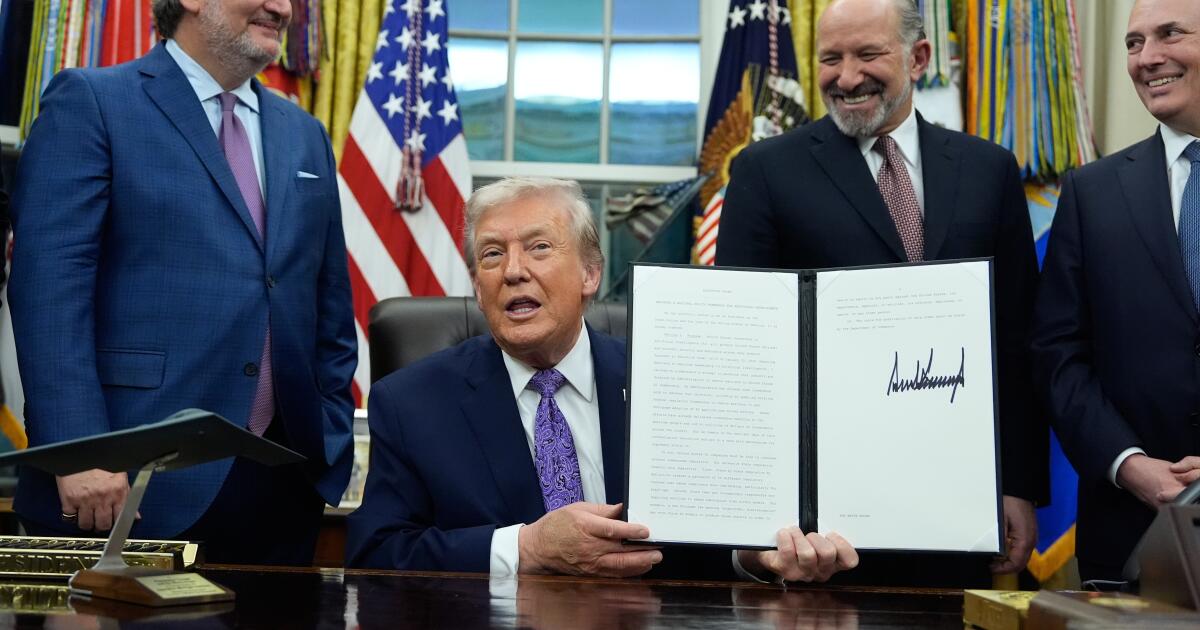
Speaking to reporters Friday on Air Force One, Trump described a potential partnership “where the American people can benefit from the success of AI” and said executives from leading AI companies will visit the White House, perhaps in the coming week, to discuss the idea.
“There’s something very interesting about it, where it almost becomes a partnership with the American public,” Trump said.
When reporters noted to the Republican president that Sanders, a democratic socialist and political independent, had proposed public ownership in AI companies, he pointed to similarities in their coalitions. The economic views of Trump voters and those who have supported Sanders for president, Trump said, “aren’t that far apart.”
Trump has embraced government investment in private companies in his second term, scrambling his party’s politics. His administration last year secured a 10% stake in the struggling Silicon Valley company Intel, and it considered a government takeover of Spirit Airlines earlier this year, although the airline couldn’t reach a deal and ultimately closed.
Public backlash
The positioning of leading figures such as Trump and Sanders comes as concerns about AI are emerging far beyond Washington.
In Michigan, Democrats recently clashed over Gov. Gretchen Whitmer’s appearance with Altman at the site of a major data center. Candidates such as New York Democratic House candidate Alex Bores have also made AI regulation a campaign issue by tapping into voters’ unease about the technology.
“This is a real change to society,” Altman told reporters this week. “I think it’s possible both that people can use AI a lot and like using it and also have anxiety about what it’s going to do for the future.”
Data center projects across the country have drawn opposition from residents concerned about electricity demand, water consumption and environmental impacts. Some states once eager to attract the facilities, including Ohio and Virginia, have moved to reconsider tax incentives.
“We need to pass legislation right now that says there’s not going to be any further data center development until they agree to pay for their own electricity, build their own grids and pay for their own water supply,” Sen. Josh Hawley of Missouri, a leading Republican skeptic of Big Tech, told the Associated Press.
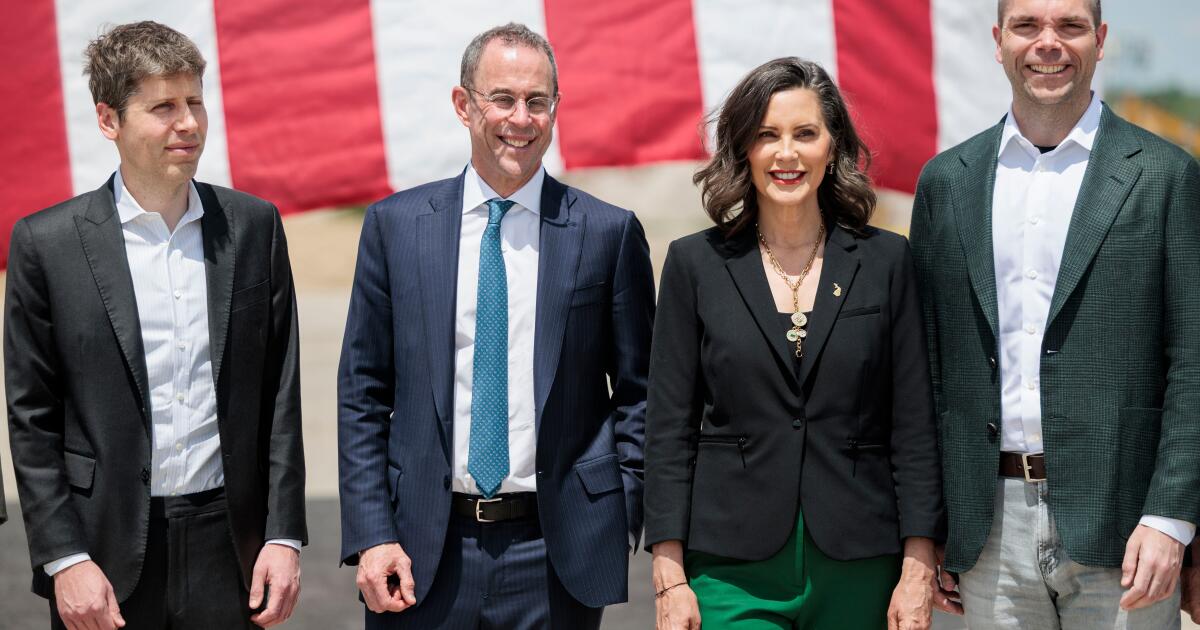
Before arriving in Washington, Altman stopped in Michigan on Monday to appear alongside Whitmer, a Democrat, at the site of a 1.65 million-square-foot data center project. Whitmer’s team said the project will create more than 2,500 union construction jobs.
But it also drew criticism from local activists and some fellow Democrats, including Rep. Rashida Tlaib of Michigan, who called the project “disgusting.” She said she was “so disappointed” in Whitmer.
“It’s a very controversial topic right now and it’s coming from the ground up,” Sen. Elissa Slotkin, another Michigan Democrat, said about the grassroots resistance. “People feel very strongly about it.”
Whitmer defended her appearance, telling reporters afterward that “one thing’s very clear: Everyone has a cellphone in our pocket.”
“We are all, more and more, consuming technology and data, and these data centers are going to get built. So, my thought is if we can hold them to a high standard and do it in Michigan, that’s the best way to do it,” she said.
The tensions extend beyond data centers. On college campuses, commencement speakers have been interrupted by boos when discussing artificial intelligence. About 70% of college students see AI as a threat to their job prospects, according to a 2025 poll by the Institute of Politics at the Harvard Kennedy School.
Altman acknowledged those concerns. He said that while “the impact on jobs has been less than many people in our field expected,” he understands “that college students have a lot of anxiety about the future.”
Washington seeks an AI bargain
The idea that AI’s expansion is inevitable is increasingly shared by leaders across the political spectrum, even as they disagree sharply about how to manage it.
That reality was at the center of Altman’s conversations in Washington. In addition to Sanders, Altman met with Trump administration officials such as Michael Kratsios, the White House’s chief science and technology advisor, and congressional leaders from both parties.
Sanders’ team emphasized that the two did not reach an agreement on the main points that the senator made to Altman, including the 50% figure to ensure that the public has decision-making power. The senator also expressed opposition to the growing spending on elections by the AI industry.
“Unfortunately, Sam Altman did not commit to any of those,” Sanders spokesperson Jeremy Slevin said.
Altman, emerging from the conversation, described it as “great,” though noting that the two “obviously don’t agree on everything.”
How AI should be governed
Congress this week released a bipartisan framework that would establish the first broad federal approach to AI regulation while temporarily preempting many state laws.
Anthropic, one of OpenAI’s top competitors, has proposed mechanisms for coordinating pauses on advanced AI development if systems become too powerful.
The Trump administration has also begun constructing its own oversight structure, signing an executive order to establish a process for reviewing national security risks posed by advanced AI systems before their public release.
Sanders said he found the administration’s move notable after years of warnings that regulation could slow American innovation.
“Even these guys are beginning to catch on that there are legitimate concerns that have to be dealt with,” Sanders said.
Cappelletti and Kim write for the Associated Press.
Oscar-winning director Martin Scorsese is joining the ranks of entertainment industry power players embracing generative AI.
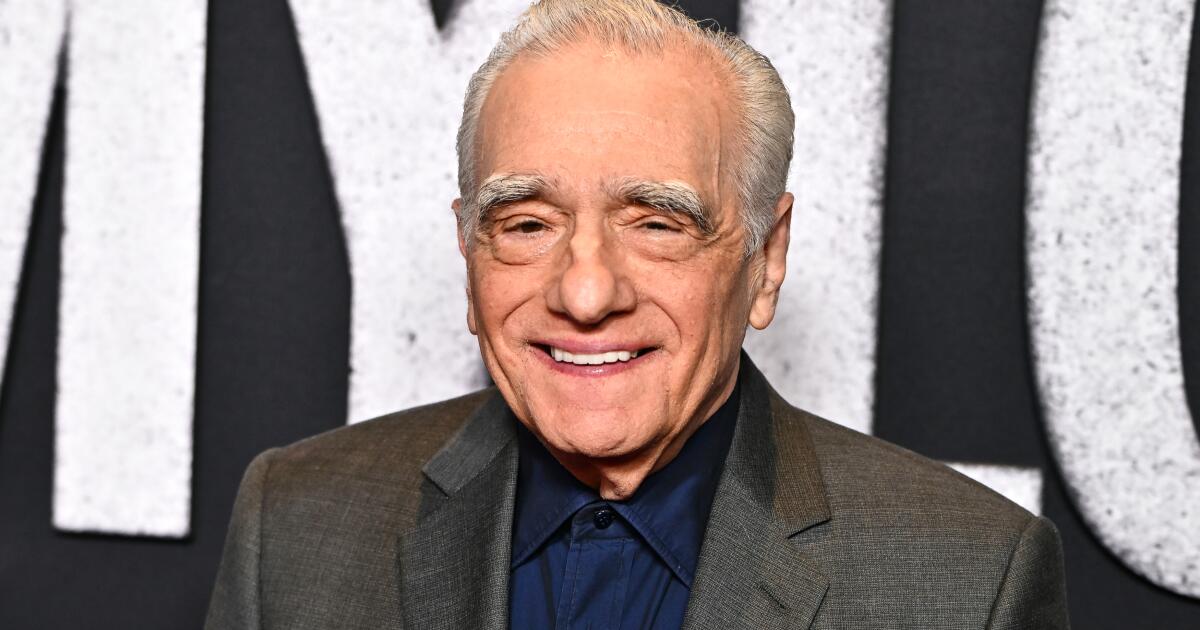
Black Forest Labs, the German AI startup behind the text-to-image model Flux, announced Tuesday that Scorsese is joining the company as an advisor.
The company unveiled the collaboration on its website with a video of the auteur using Flux to storyboard scenes, which involves mocking up shots before filming.
“This conveys a cinematic intelligence,” he said in the video, discussing the program’s uses with Black Forest Labs co-founder and Chief Executive Robin Rombach and Creative Artists Agency co-founder Michael Ovitz. According to the New York Times, Ovitz, an investor in Black Forest Labs, helped bring Scorsese aboard, along with Rick Yorn, Scorsese’s talent manager, whose investment firm BroadLight Capital is also an investor.
In a statement, Scorsese emphasized the potential for AI to transform the storyboarding process.
“For 70 years, I’ve been creating my own storyboards. There’s always been this problem of how do you communicate what you see in your head to your cast and crew. There are some things you have to see and feel,” he said. “I’m interested in the intersection of technology and storytelling, and seeing how that can push the bounds of creativity to create deeper and richer experiences for audiences.”
Traditionally, storyboarding is done by hand or digital illustration through a collaboration between directors and storyboard artists.
Scorsese’s public espousal of this technology marks the latest shift in attitude about AI from powerful Hollywood creatives. Since generative AI became widely accessible in 2022, Hollywood has struggled to navigate its power to rapidly upend industry norms.
Scorsese is not the first decorated filmmaker to embrace AI. James Cameron, the Oscar-winning “Avatar” director, is on the board of directors for Stability AI, where Rombach worked before launching Black Forest Labs. In his keynote address at the AI on the Lot conference last week, director and screenwriter Paul Schrader expressed a mixture of admiration and caution toward the technology.
“AI does not create — it combines,” Shrader said. “If AI wants an idea, it has to go to where that idea already exists. Of course, you can make the argument that that’s all artists do anyway, and to a degree that’s a valid argument. But you still have to come up with something.”
Not everybody is on board with generative AI’s potential transformations. Guillermo del Toro and Seth Rogen spoke out against the technology at Cannes last month, and below-the-line wokers, screenwriters and actors have continued to express apprehension and even horror at the prospect of being replaced by generative AI.
Scorsese’s entry into the AI field might especially shock fans given his traditionalist approach to filmmaking. In 2019, he famously criticized Marvel movies, calling them “theme parks” and “not cinema.”
“It isn’t the cinema of human beings trying to convey emotional, psychological experiences to another human being,” he said in a 2019 interview with Empire Magazine.
Even if his filmmaking centers humanity, Scorsese’s partnership with Black Forest Labs demonstrates his willingness to incorporate non-human assistance.
“Remember, cinema is a young medium, only around 125 years old, so we have to be open to how it can evolve,” he said in the statement on Black Forest Labs’ website.
As SpaceX and Anthropic eye public listings, index providers brace for major market dislocations.
When mega-cap companies go public, index providers and investors will see it as dropping battleships into the old fishing pond. The resulting waves are going to soak everyone.
Privately held artificial intelligence (AI) vendor Anthropic announced its filing of a draft registration statement with the U.S. Securities and Exchange Commission (SEC) for an initial public offering at a later date. According to the company’s website, Anthropic has not decided on the number of shares it will offer, nor at what price. The company recently closed a $65 billion fundraising round, valuing the company at $965 billion post-money.
The news comes as the SEC published SpaceX’s revised Form S-1 on the market regulator’s EDGAR database. The conspicuously absent OpenAI reportedly is filling out its underwriters bench for a possible September IPO. The AI company reached a post-money valuation of $852 billion, according to CNBC.
The Index Aspect
If index providers add these firms that would instantly become one of the 10-largest listed companies by market cap before their trading prices stabilize, it could cost them dearly due to resulting massive price dislocations.
“Leaving out a mega-cap company means the index is not doing its job,” James Angel, associate professor and faculty affiliate at Georgetown University’s Psaros Center for Financial Markets and Policy, tells Global Finance. “It thus makes sense to include a big IPO fairly quickly.”
“Big IPO” is not an understatement. Wall Street consensus expects SpaceX’s IPO to result in a market capitalization between $1.75 trillion and $2 trillion, would lower Meta’s and Tesla’s rankings in the10-largest Nasdaq-100 Index components by market capitalization while move Micron Technology out of the Top 10. If rumors of a SpaceX-Teslamerger prove true, only Nvidia, Alphabet, and Apple would have a larger market capitalization than the resulting $3.4 trillion behemoth.
The Fast Path
Nasdaq has already addressed the mega-cap issue by updating the methodology for inclusion in its Nasdaq-100 Index, which represents the 100 largest Nasdaq-listed non-financial companies, in May.
Among the major changes made by Nasdaq was introducing quarterly index reconstitutions in March, June, and September, in addition to its regular December reconstitution. Nasdaq has also incorporated a “Fast Entry” pathway for new listings that rank among the top 40 of the current Nasdaq-100 constituents by full market capitalization, based on both listed and unlisted shares.
“These companies are evaluated on their seventh trading day and, if eligible, added shortly thereafter, with all existing liquidity requirements still applying,” explained Emily Spurling, Global Head of Index at Nasdaq Global Indexes, in an interview posted on the Nasdaq website. “The quarterly rebalance handles the broader population of eligible companies; Fast Entry ensures the index can respond in a timely way when a company of significant scale enters the public market.”
SpaceX stock could see its highest price jump not on June 12, its reported IPO day, but on July 7, the earliest it could be added to the Nasdaq-100 Index, according to The Motley Fool’s Sean Williams.
“Taking into account the Juneteenth (June 19) and Independence Day (July 3) holidays for the stock market, the 15th trading day, including its IPO day, is July 6,” he wrote. “Index funds that attempt to mirror the market-cap-weighted Nasdaq-100 will be required to purchase a jaw-dropping number of shares after this 15-day period comes to a close. Mandatory purchases from exchange-traded funds and index funds are estimated at $22 billion to $27 billion.”
“Nasdaq made the biggest change in the Nasdaq-100 rules as an inducement to listing on Nasdaq,” says Angel. “The other index providers have no similar incentive to shorten the seasoning period. I get the impression they are just doing it to make their indices more reflective of what is going on in the market.”
The Not-So-Fast Path
Meanwhile, S&P Dow Jones Indices (S&P DJI) is mulling methodology changes to its S&P U.S. Indices and Dow Jones U.S. Total Stock Market Indices. The company is considering whether to implement a “narrowly defined rule exception for MegaCap companies and adjustment to the IPO seasoning period,” according to a prepared statement.
The index vendor defines mega-cap companies as those with a market capitalization equal to or greater than the 100th largest company in the S&P Total Market Index, which was approximately $150 billion at the start of June.
According to reports from Bloomberg News, the major consideration is whether to reduce the seasoning period for IPOs before they are eligible for inclusion in an index to six months from 12 months
The consultation period ended on May 28, and any changes that S&P DJI proposes to implement would take effect “prior to the market open on Monday, June 8, 2026, unless otherwise announced,” the statement continued.
The company declined to comment beyond its published statement.