agents

FBI agents fatally shoot alleged hostage-taker in California | Crime News

BREAKING,

The shooting ends a 12-hour standoff in the city of Bakersfield between suspect and law enforcement.

Agents with the Federal Bureau of Investigations (FBI) in the United States have fatally shot a man allegedly holding hostages inside of a building in California.

The shooting ended a 12-hour standoff at an office in Bakersfield that houses a bank branch and school district office.

In a statement, the Bakersfield police said the suspect was killed in “an officer-involved shooting involving Federal Bureau of Investigation personnel”.

It added that “all hostages were located unharmed and received medical evaluation and treatment at the scene”.

Police had originally been called following a bomb threat at the location. Police said the man barricaded himself inside with several people, two of whom were released Tuesday after negotiations with authorities.

Authorities established a wide perimeter around the building, evacuating the nearby City Hall and the police headquarters.

Bakersfield police sergeant Eric Celedon told reporters on Tuesday the department had “every single resource at our disposal out here to bring this to the safest resolution possible”.

Police on Wednesday said the investigation was ongoing and that “significant” law enforcement would remain in the area.

The identity of the suspect was not immediately released and a motive was unclear.

Source link

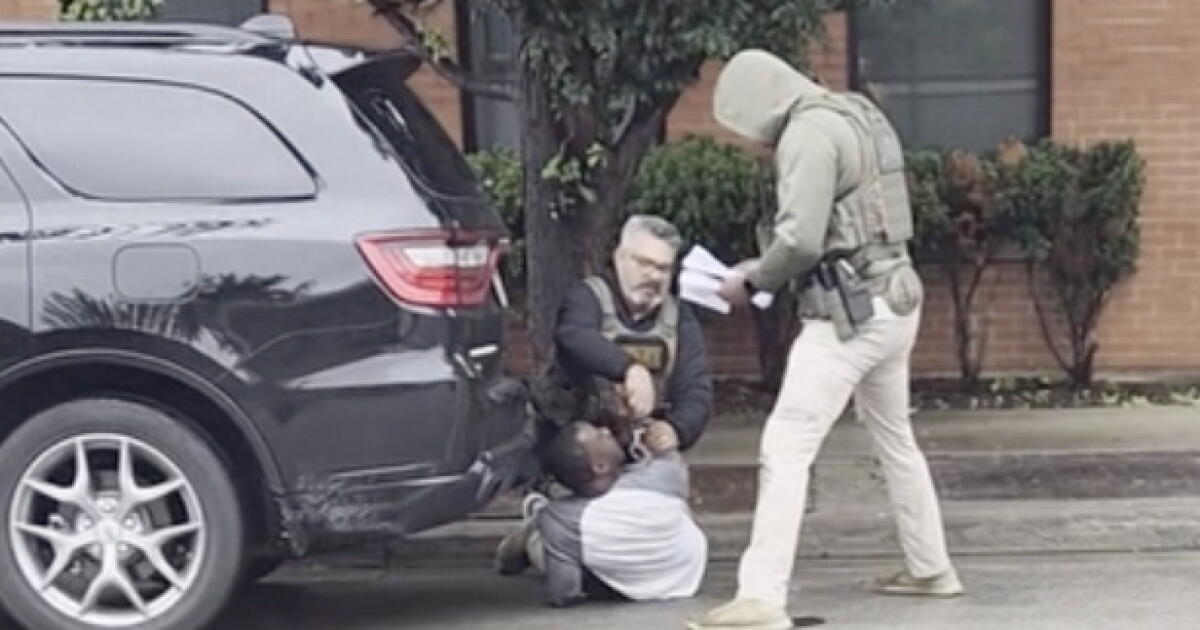
Trump’s DOJ sues 4 Democratic-run states over denying undercover license plates for federal agents

President Trump’s administration is suing four states over their refusal to issue undercover license plates to federal agents, the latest front in the wider struggle between the White House and Democratic-led states over the Republican president’s immigration crackdown.

The Department of Justice alleges in separate lawsuits announced Thursday that Maine, Massachusetts, Oregon, and Washington state are imposing unconstitutional restrictions that it says impede law enforcement and threaten agents’ safety.

“By denying undercover license plates to DHS components, including ICE, while issuing them to their own state agencies, these governors are pursuing discriminatory and obstructionist policies against federal law enforcement,” said acting Atty. Gen. Todd Blanche in a statement.

“These actions undermine federal immigration enforcement, allow dangerous criminals to escape justice, and terrorize American communities,” Blanche added.

The Justice Department filed the suits on Wednesday in U.S. district courts in the respective states. The four state governments are accused of trying “to obstruct the Federal Government’s immigration enforcement efforts, even though control over immigration and the nation’s borders is an exclusive federal power.”

Additionally, the Justice Department argues in the suits that the U.S. Constitution’s Supremacy Clause bars state governments from regulating federal law enforcement.

Maine Secretary of State Shenna Bellows, who oversees her state’s plate program and is also a Democratic candidate for governor, said she’s confident her decisions will hold up in court.

“What ICE did in Maine and continues to do was terrorize our friends and neighbors,” Bellows said in an interview Thursday. “There are no secret police in a democracy and we will always stand up for our Mainers safety and freedom.”

A spokesperson for Massachusetts Atty. Gen. Joy Campbell said the state’s lawyers are “reviewing the complaint and will defend the RMV policy to the greatest extent possible.”

Officials in Washington and Oregon did not respond to a request for comment on the federal action.

Feds say agents are endangered when easily identified

The administration asserts that federal agents “frequently investigate and apprehend violent criminals, including cartel members, gang members, sex offenders, human traffickers, and other violent offenders” and says making those authorities easily identifiable subjects them to increased harassment and potential physical harm.

The lawsuit comes after a back-and-forth between the DOJ and some state officials. The administration previously sent state officials letters demanding they justify their policies.

Maine Atty. Gen. Aaron Frey answered the Justice Department last week, defending his state’s policy and disputing the DOJ’s contention that it has hampered federal enforcement actions.

“Rather, the program reflects a legitimate and constitutional policy choice by the SOS not to allow its resources to be commandeered by the federal government for use in civil immigration enforcement activities that have, in Maine and elsewhere, resulted in multiple incidents of abusive and unconstitutional conduct by DHS officials,” Frey wrote.

Bellows, in her role as secretary of state, announced a pause on confidential license plates in January, after federal authorities ramped up their immigration enforcement activities in the state. Bellows said at the time that the state wanted to be “assured that Maine plates will not be used for lawless purposes.”

The federal suit against Maine argues that the state “has issued confidential license plates to law enforcement agencies for many years” and that “such plates are explicitly authorized under Maine law.” The state’s review this year, the suit argues, resulted in unlawful state regulation of the federal government by requiring federal applicants for state license plates to attest that federal vehicles that obtained confidential plates would not be used for civil immigration enforcement. The suit also states that Maine did not impose commensurate requirements on state or local agencies applying for the plates, making the program discriminatory against the federal government.

Bellows has previously defended her decision.

“When ICE asked for confidential license plates, I said no” because “covert civil immigration enforcement is not something Maine will facilitate,” she said last week.

Arguments are similar to debate over agents’ masks

The Trump administration’s arguments on the license plates are similar to its defense of federal agents wearing masks on their deployments to American cities. That became a flashpoint in an extended government shutdown over Department of Homeland Security funding, as Democrats on Capitol Hill demanded key changes to how Trump’s mass deportation plans were carried out after masked federal agents killed two U.S. citizen protesters in Minnesota.

The White House and DHS have maintained the agency’s mask policy, and the administration already has won a federal court order blocking a California law that barred law enforcement officials from covering their faces in the state.

Additionally, the administration has been at odds with so-called sanctuary cities where local law enforcement does not assist federal authorities with immigration enforcement. And Blanche has instructed the Justice Department’s Civil Division to identify all state and local laws, policies, and practices that could impede what the administration describes as “lawful federal operations.”

Barrow and Whittle write for the Associated Press. Barrow reported from Atlanta. Whittle reported from Scarborough, Maine.

Source link

Agents with search warrants keep focus on Minnesota in fraud inquiry

Federal agents executed multiple searches in Minnesota on Tuesday, seizing records and other evidence in an ongoing fraud investigation by the Trump administration of publicly funded social programs for children, authorities said.

Few details were released, though armed agents were seen at child-care centers in the Minneapolis area. KSTP-TV said one crew even had a battering ram.

Democratic Gov. Tim Walz, who has been on the defensive amid Trump administration claims that he hasn’t done enough to root out fraud, welcomed the raids. The state child welfare agency said it shared key information with law enforcement to “hold bad actors accountable.”

“We catch criminals when state and federal agencies share information. Joint investigations work, and securing justice depends on it,” Walz said.

The searches were being conducted at daycares, businesses and some residences, according to a person familiar with the matter who spoke to The Associated Press on the condition of anonymity because they were not authorized to publicly discuss the investigation.

Tensions between Minnesota officials and the federal government were high during an extraordinary immigration crackdown that led to the deaths of two people before Operation Metro Surge was eased in February.

Before that crackdown, the government had brought fraud charges against dozens of people, many of them Somali Americans, who were accused of fleecing a federal program that was meant to provide food to children. The investigation began during the Biden administration. More than 60 people have been convicted.

Various state and federal agencies, including the Department of Homeland Security, participated in searches Tuesday. Officers from Minnesota’s Bureau of Criminal Apprehension were removing boxes at some sites.

“The American people deserve to know how their taxpayer money was abused. … No stone will be left unturned,” DHS said.

Jason Steck, an attorney who represents childcare centers, said the names of targeted businesses that were shared with him show they’re operated by Somali immigrants. They were not his clients.

“A few childcare centers, a few autism centers, a few healthcare agencies of some type,” Steck said, adding that it appeared to be a “particular sweep for fraud.”

The executive director of Child Care Aware of Minnesota, a nonprofit that serves childhood educators, said the publicity will be unflattering.

“The majority are in business to do good business. You’re going to come across individuals who try to capitalize on systems that are broken and need to be fixed,” Candace Yates said.

Right-wing influencer Nick Shirley posted a video in December that caught the attention of the Trump administration. He alleged that members of Minnesota’s Somali community were running fake child care centers so they could collect federal subsidies, fueling suspicions on top of the food aid scandal. The claims were disproven by inspectors.

President Trump, meanwhile, has used dehumanizing rhetoric, calling Somali immigrants “garbage” and “low IQ.”

In February, Vice President JD Vance said the government would temporarily halt $243 million in Medicaid funding to Minnesota over fraud concerns. Minnesota sued in response, warning it may have to cut healthcare for low-income families, but a judge on April 6 declined to grant a restraining order.

Walz told Congress in March that he wanted to work with the federal government in fraud investigations, but that the immigration surge had made it more difficult.

“The people of Minnesota have been singled out and targeted for political retribution at an unparalleled scale,” he said at the time.

Vancleave and Richer write for the Associated Press. Durkin Richer contributed from Washington. AP reporters Steve Karnowski in Minneapolis and Corey Williams and Ed White in Detroit contributed to this story.

Source link

Mexico’s Sheinbaum demands answers over CIA agents in Chihuahua | Police

NewsFeed

Mexican President Claudia Sheinbaum said the federal government was not informed about the inclusion of CIA officers in an operation targeting a drug lab in the country’s north, adding that she is demanding answers from the US ambassador and state officials.

Source link

Volkswagen turns to AI agents for Chinese cars in race to close tech gap

Volkswagen Group announced plans to equip new cars for China with AI “agents” starting in the second half of this year. This strategy aims to help Volkswagen compete with fast-growing Chinese automakers in areas like electrification and digital features.

At an event in Beijing, the company revealed that its vehicles will utilize a China-specific electronic architecture to offer “onboard AI agents,” allowing for intuitive, human-like interaction while ensuring personal data protection. These AI agents can perform complex tasks, such as finding top-rated restaurants, making reservations, driving to the location, and organizing parking.

Volkswagen is shifting its image in China, aiming to be seen as a leader in electric and intelligent vehicles rather than just a traditional manufacturer. The company plans to introduce over 20 new electrified vehicles, totaling 50 new models by 2030, as part of its “largest ever electric mobility offensive. “

CEO Oliver Blume emphasized that their initiatives signal Volkswagen’s return to the market. The collaboration with Horizon Robotics aims to make this AI technology accessible across the mass market.

With information from Reuters

Source link

Kelsey Plum, Sparks leaders convinced free agents they can win now

The Sparks worked on building their 2026 roster long before the WNBA’s compressed free agency period tipped off.

Teams have had a little more than a week to prepare their training camp rosters between free agency, the league’s primary draft and an expansion draft. The Sparks have one of the more notable roster transformations in the league, adding Nneka Ogwumike, Erica Wheeler and Ariel Atkins.

On Sunday at the start of training camp in San Diego, Wheeler said Sparks returning guard Kelsey Plum sold her on the vision of the organization, and Ogwumike’s signing cemented it.

“KP played a big role in having me here,” she said, describing a lunch last season when Plum told Wheeler she wanted her to sign with the Sparks. “I think Nneka just was like the tip of the iceberg, like it was a no brainer. Once Nneka decides she wants to come here, because, as you know, president [of the WNBPA], life is always easier around her.

“We want to win the championship.”

Ogwumike’s return to Los Angeles was just one indicator that the Sparks are, as Wheeler put it, “going for gold.”

This year’s Sparks roster looks a lot more intentional than a couple of years ago. General manager Raegan Pebley said Atkins’ addition helps establish a deeper offense, while Rae Burrell playing at the three gives them more versatility.

There are still question marks. They don’t have a ton of ball-handling depth or much true-center play after Cameron Brink.

But Ogwumike has seen the changes internally and from afar, and she thinks the Sparks are ready to compete now.

“I didn’t actually want to leave, but I felt like I needed to, considering the growth that we wanted to see further in the organization, and I really wanted to come back,” she said. “… The timeline of a lot of things [in the offseason] accelerated, me narrowing down certain organizations, but L.A. was in the mix not because, not just because of the time that I’ve had here, but because of the amazing progress that I’ve seen in just the two years in my absence.”

Ogwumike said part of that was the investment in a practice facility, set to debut in 2027, and that the front office, led by Pebley, had a plan to build a winning team.

But the most important thing in bringing in the veteran trio was that the Sparks had a plan on the court, too.

“It’s really exciting when you can be in a place where everybody has the main thing being the main thing,” Atkins said. “And that’s not to say it wasn’t like that in the past, but it’s different when you have older players and vets around you that have done it before, because the way that they walk in, the way that they talk, there’s no uncertainty there, right? It’s like, this is how we need to get through, this is what we need to do, get it done so it really just be on us.”

Wheeler has only played in the WNBA postseason a handful of times between Indiana and Seattle and at 36 years old, she joined the Sparks led by coach Lynne Roberts with the intention of playing for a winner.

“I tell people all the time, I’m a businesswoman,” she said. “I have money. … So money don’t move me, [there] was a lot more money out there for me to go after. But I felt like Lynne is building a championship rock, and I want to be a part of that.”

Atkins was traded from Chicago for Rickea Jackson, a controversial move that shipped one of the best young players in the game away from the Sparks. On draft night, Pebley said the move helped them win games now and she reiterated that on Sunday.

“We were really aware of is that we were missing another counter punch with KP, she needed some support in terms of somebody that can take some pressure off of her, to have to score it, or to have to create for someone else to score it, that was a big reason of why Ariel, we feel, is a great fit,” she said. “And then Erica Wheeler is just a winner, and she’s going to bring some toughness and leadership there. So I think with those three at the one-two spot, we’re super excited about that.”

Atkins adds a defensive layer alongside Ogwumike for a team that was dead last in the WNBA in defensive points per game last season, and that’s one of those intentional, win-now kind of moves that has everyone in the organization excited.

The Sparks finished just two games out of a playoff spot last season. This year, expectations are far more than just finishing as a playoff team, and that messaging brought in one of the most cohesive rosters in the WNBA.

“I always say that the killer combination is investment and engagement, and so I’m seeing both at very high levels, and it permeates every aspect of the organization,” Ogwumike said. “Whether it’s basketball ops, front office, player experience, practice facility, it’s just something that I’ve always believed was our standard, and not only have we matched what our expectations were, but we’re now exceeding it in a timeline that I think is much faster than I ever expected.”

Source link