Scott Bryce, the actor best known for originating the role of Craig Montgomery on the soap opera “As the World Turns,” has died. He was 68.
Bryce died Sunday evening “surrounded by his loving wife Jodi Stevens-Bryce and loving son Jackson Bryce,” his agent Ken Melamed told The Times by email on Tuesday. “He was beloved by all!”
The actor revealed last year that he had been diagnosed with Stage 3 esophageal and stomach cancer in 2024.
“This evening my father lost his long-fought battle with cancer. What began as stage three esophageal cancer eventually spread and became brain tumors that took his life away from him,” Bryce’s son, Jackson, wrote in a tribute posted Sunday to Instagram. He said his father approached his treatments with “pride and courage, and an unshakable belief that somehow, everything would work out.”
“May his strength and relentless belief forever live within me,” he added. “He fought the hardest and most honorable fight I have ever witnessed.”
Born Jan. 6, 1958, in New York, Bryce followed in the footsteps of his actor parents. His father, Ed, portrayed Bill Bauer on the daytime drama “Guiding Light” for years, while his mother, Dorothy, was known for her role on the hospital soap “The Doctors.”
Bryce made his television debut as Craig Montgomery on CBS’ long-running soap “As the World Turns” in 1982. He received two Daytime Emmy nominations for his portrayal of the charming but ruthless businessman, whom he portrayed off and on from 1982 to 2008. The character was known for his ambition and mysterious business dealings but also had a reputation for being unlucky in love. One early romantic interest was Betsy Stewart, who was portrayed by Meg Ryan from 1982 to 1984.
Finn Carter, who played Montgomery’s wife, Sierra Esteban, on the show, shared a tribute to Bryce on Instagram Monday.
“My sadness knows no bounds. My gratitude for Scott knows even fewer,” Carter wrote. “Scott was the best husband a woman could ask for. As an actor he was fearless, kind, generous and forever looking for ways to grow. And what a sense of humor!”
Over the course of his decades-long career, Bryce appeared on shows such as “The Facts of Life,” “The Golden Girls,” “Murphy Brown,” “L.A. Law,” “The Good Fight,” “Law & Order” and “Law & Order: Special Victims Unit.”
He also portrayed Mike McQueen, the father of a cheerleader (Leslie Bibb) on the millennial teen drama “Popular.” McQueen marries the mother of his daughter’s high school rival (Carly Pope) in the series, which ended on a cliffhanger in 2001 after its cancellation.
“When asked what he wanted people to remember about him, he said, ‘I was a one-take actor. Two takes, max,’” Jackson Bryce wrote in his tribute. “In working with Dick Wolf on NBC, directors would schedule him at the end of the day because they knew it wouldn’t take long.”
In addition to his onscreen work, Scott Bryce was a theater actor as well as a director and a producer, with credits including the 2010 television movie “Frederick Douglass, From Slavery to Freedom” and the satirical web series “Steamboat.”
“My dad also made sure I knew his greatest accomplishment that came at 50 years old, becoming a Dad,” son Jackson said in his tribute. “He is a part of everything I’ve done and everything I will do.”
Josh Grisetti, the Broadway actor who charmed audiences with roles in “Something Rotten!” and TV’s “The Marvelous Mrs. Maisel,” has died, a family member confirmed to The Times on Monday. He was 44.
Grisetti died by suicide Friday, his “Something Rotten!” co-star Rob McClure first announced Sunday on Instagram, adding he is heartbroken and “not ready to even attempt to understand.” McClure also expressed his condolences to Grisetti’s wife and family. The Instagram post included photos of Grisetti and McClure over the years, including at Grisetti’s wedding. The actor married Mackenzie Perpich in 2020.
“Communities around the world will never be the same without him. We love you Josh,” McClure wrote in his caption. “Just a cataclysmic loss.”
On Broadway, Grisetti was best known for starring as Bottom brother Nigel alongside McClure’s Nick. The play follows the pair of brothers as they strive for success in the theatrical world amid William Shakespeare’s unstoppable rise. Grisetti portrayed Nigel Bottom from 2017 to 2018 for the show’s national tour. Grisetti also starred in musical comedies “It Shoulda Been You” and “Broadway Bound.” He appeared in award-winning off-Broadway productions including “Rent,” “Peter and the Starcatcher” and “Enter Laughing,” among others.
Grisetti’s regional credits also include “Spamalot” in Las Vegas, “How to Succeed in Business Without Really Trying” at the Reprise Theatre, “Beauty & the Beast” and “Peter Pan Goes Wrong” in La Mirada.
“Thank you, Josh, for sharing your beautiful energy and immense talent with us,” the La Mirada Theatre said on Instagram.
The actor, in what would be his final Instagram post, announced he departed a production of “Legally Blonde” at the Trentino Music Festival for “personal reasons” before the show’s opening.
The festival also mourned Grisetti in an Instagram post Monday: “Josh was a loving and caring person who was deeply dedicated to his friends, his students, and his colleagues. He was beloved by all who knew him, and he will be deeply missed by our students, faculty, and staff.”
Grisetti, born in December 1981 in Roanoke, Va., acted throughout childhood and performed in a variety of productions, including a kindergarten production of “Peter Rabbit” and high school productions of “Anything Goes” and “Flowers for Algernon.” He officially earned his Actors’ Equity card in 2004 for a production of “Where’s Charley?” at the Goodspeed Opera House, he told Playbill in 2009.
He also pursued a career in TV and film, most notably appearing in the Emmy-winning series “The Marvelous Mrs. Maisel.” He appeared as comedy writer Ralph Emerson in the series’ fifth season. He also had roles in shows “The Knights of Prosperity,” “Nurse Jackie” and “The Good Fight.”
He appeared in the film adaptation of Jhumpa Lahiri’s “The Namesake,” “The Immigrant,” “The Revolutionary Road” and “Men in Black 3,” among other movies, according to IMDb.
Grisetti, who also directed various musical productions, notably brought his talent and experience to Cal State Fullerton and Loyola Marymount University, teaching acting, musical theater and business. He also authored “God in My Head” in 2016, an “irreverent spiritual memoir” that details his accidental meeting with God through a “hallucinogenic journey.”
During his time on “Price of Broadway” in 2015, Grisetti reflected on luck and breaking into the industry. “Luck is required to kind of spark some things in this business a lot of the time, but then talent is what keeps you there,” he told Playbill.
“You start making your own luck, you start forging your own connections and making it happen.”
Sam Neill as Dr Alan Grant in Jurassic ParkCredit: AlamyThe screen icon also played Major Chester Campbell in Peaky BlindersCredit: Alamy
Sam Neill’s family confirmed the news in a statement: “It is with immense sadness that the whanau of Sam Neill share the news of his passing on Monday 13th July, in Sydney, Australia.
“Sam was surrounded by family and passed with the dignity that has characterised his whole life.
Sign up for the Showbiz newsletter
Thank you!
“The loss was sudden and unexpected but blessed by the fact that Sam remained cancer-free.
“They would like to express their deepest gratitude to the staff at St Vincent’s Private Hospital for their incredible care.
“More details will be shared later, but for now, on behalf of the family, we ask that you respect their privacy as they navigate this immeasurable loss.”
Australian Prime Minister Anthony Albanese paid tribute, writing on X: “Sam Neill starred in so many beloved Australian stories and he earned a special place in Australian hearts.
“Wry and dry, thoughtful and laconic, Sam fought illness with the same dignity, humour and conviction that gave strength to his every performance.
“He will be much mourned and long remembered. May he rest in peace.”
Fellow actor Richard E. Grant posted: “Knew @samneilltheprop for 3 decades and finally worked with him on PALM BEACH in 2018. An officer and a Gentleman in the truest sense.
“Guided and helped me through a very difficult time in my Life. Pictured beside producer @deb_bal & @ladyheathermitchell. Sail on, kind Sir.”
While Jurassic World: Dominion director Colin Trevorrow said Sam was “a friend and collaborator at a challenging time”.
He continued: “His strength gave us all strength. I’ll remember him for his tranquility, his love of wine, and for the calm assuredness he brought to his characters.”
Scottish actor Alan Cumming wrote: “Ahhh Sam, what a glorious beautiful man. You are missed. Sorry to the family for your immense loss.”
The Boys’ Karl Urban posted: “Heartfelt condolences to your whanau. Sam was truly brilliant. An inspiration for many who followed in his trailblazing footsteps.
“A beautiful man, A national treasure who gave so much to New Zealand and the to world. God speed Sam.”
At the time of writing, no cause of death has been given.
Who were Sam Neill’s parents?
Sam was born Nigel John Dermot Neill in Omagh, Northern Ireland, to English mother Priscilla Beatrice Ingham and New Zealand father Dermot Neill, an army officer.
The family emigrated to New Zealand when Sam was seven, settling in Dunedin, and he later went to boarding school in Christchurch.
He took the name Sam when he was a youngster because there were too many Nigels at school.
In his memoir Did I Ever Tell You This?, Sam wrote: “The one thing I resent about my parents, the only thing, is that they called me Nigel.
Sam pictured with his ex-wife Noriko Watanabe in 2006Credit: GettyHe also had a relationship with actress Lisa Harrow, whom he met on the set of 1981’s The Final Conflict – the pair later had a son togetherCredit: Alamy
“Changing my name to Sam at the age of 11 was probably the best decision I made in my life.”
He added: “I found I moved more easily in the world as a Sam. Nigel is an awkward fit in most circumstances. Imagine being a movie actor called Nigel Neill.”
His dad’s family had deep roots in the wine trade, having founded the Dunedin merchant firm Neill & Co generations earlier, which Sam later drew on when he established his own Central Otago winery, Two Paddocks, in the 90s.
Who was Sam Neill married to?
Sam had a long relationship with New Zealand actress Lisa Harrow, whom he met while filming 1981’s The Final Conflict. The pair had a son together, Tim, born in 1983.
Later on life, he went on to marry Japanese make-up artist Noriko Watanabe, whom he met on the set of the 1989 film Dead Calm.
The couple welcomed a daughter, Elena, in 1991, and Sam also adopted Noriko’s daughter from an earlier relationship, Maiko.
Sam and Watanabe separated in 2017.
Who are Sam Neill’s children?
Sam is survived by four children. Alongside Tim, Elena and Maiko, he also had a son named Andrew.
He was placed for adoption when Sam was in his early twenties and was reunited with his father in 1994.
Sam previously told The Times: “I’ve got a slightly unusual family – it’s more extended than most.
“My first son, Andrew, was given up for adoption when he was very small. I was quite small, too – in my early twenties.
“I didn’t see him for 25 years and then we went looking for each other.”
What movies did Sam Neill appear in?
Sam’s career spanned more than 50 years and around 150 screen credits. Among his biggest film roles were:
He also featured as Cardinal Thomas Wolsey in The Tudors, among many other roles.
Sam was awarded an OBE in 1991 for services to acting, and in 2022 accepted redesignation as a Knight Companion of the New Zealand Order of Merit (KNZM), the second-highest grade in the New Zealand royal honours system.
He previously turned down the KNZM when knighthoods were first restored to the New Zealand honours system in 2009.
The BBC has launched a new crime drama by the creator of Unforgotten starring John Simm alongside some other famous names
The first few minutes of I, Jack Wright took viewers by surprise(Image: BBC)
BBC viewers wasted no time sharing their reactions to the broadcaster’s latest crime drama.
Written by Chris Lang, the celebrated creator behind Unforgotten, Innocent, The Thief, His Wife and the Canoe, I, Jack Wright is a compelling whodunnit starring Nikki-Amuka Bird, John Simm, Daniel Rigby, Ruby Ashbourne-Serkis, Zoë Tapper, Percelle Ascott, Harry Lloyd and Liz Kingsman.
A synopsis reads: “I, Jack Wright, is a propulsive whodunnit with family secrets at its core. The apparent death by suicide of high-powered businessman Jack Wright (played by Trevor Eve) sends shockwaves through his family, leaving a mystery that pits greed, loyalty and suspicion against one another.
“As his many wives and children fight over the remains of his estate, a dogged police detective investigates – and uncovers the shocking truth about this well-heeled clan.”
Within minutes of the opening episode airing on BBC One on Sunday, July 12, viewers were sharing their thoughts on social media, reports Wales Online.
And it appears many were caught off guard when legendary actor Eve’s character met his demise almost immediately after the opening credits finished.
One viewer remarked: “Eddie Shoestring didn’t last long in this,” referencing Eve’s ’80s private detective TV drama Shoestring.
Another added: “Looked at the cast for #IJackWright and thought ooh, nice! Then one of my favourite actors character was dead in the first 5 minutes! Hopefully there’ll be some flashback scenes.”
Yet despite Jack Wright’s swift demise, audiences appeared to embrace the whodunit, with one viewer remarking: “It’s a bit like Cluedo.”
Another enthused: “ooh blimey! Binge time!”
The drama was filmed across London, particularly Holborn and Lincoln’s Inn Fields, Paris, and Hertfordshire. The Wright family’s main home, Marston House, was shot at the Mansion House North Mymms Park.
I, Jack Wright first debuted in April 2025 on UandAlibi before being acquired by the BBC. This means not only will the first series be repeated by the broadcaster, but they’ve also secured the second series, which is presently in production.
The inaugural series consists of six episodes altogether. The first episode premiered on BBC One on Sunday, 12 July, as part of a double bill.
Those who relished the opening two instalments won’t have long to wait, as episodes three and four will be shown on Monday, 13 July. Episodes five and six are scheduled to air on Sunday, 19 July.
Tomi Adeyemi, the author of the bestselling fantasy “Children of Blood and Bone,” isn’t planning to see the forthcoming film adaptation — even though she co-wrote it.
Over the weekend, the Nigerian American author posted a video on TikTok addressing fans who have been asking her the same question, “Why don’t you post about the adaptation of your first film adaptation anymore?”
“There is a reason I will not post anything about the adaptation of my work,” the author wrote in what appear to be screenshots of a group chat. “I have not seen the film, and I will not watch it.”
The adaptation of the first installment of Adeyemi’s “Legacy of Orïsha” fantasy trilogy is slated to hit theaters in January 2027. Gina Prince-Bythewood — who wrote and directed “Love & Basketball” and helmed “The Woman King” — is directing. The film stars Amandla Stenberg, Thuso Mbedu, Tosin Cole, Damson Idris, Cynthia Erivo, Lashana Lynch, Regina King, Idris Elba, Chiwetel Ejiofor and Viola Davis.
Alongside the screenshots of her comments in the group chat, she shared a February 2025 exchange with Stenberg that shows the author severing ties with the actor.
Adeyemi shared only her final message to Stenberg, which reads, “Do not ever use my name in an interview or video again. Do not text me. Do not call me.” That exchange is followed by a notification that she blocked Stenberg, who plays Princess Amari in the upcoming fantasy flick.
The message from Stenberg that preceded Adeyemi’s reply is not shown in full.
Stenberg, who played Rue in “Hunger Games,” Starr Carter in “The Hate U Give” and, recently, Verosha “Osha” Aniseya and Mae-ho “Mae” Aniseya in Disney’s “Star Wars” series “The Acolyte,” had been getting flack from readers of the series, who claimed colorism was an issue while casting the movie.
In February 2025, Stenberg posted a since-deleted nine-minute TikTok addressing the controversy and told followers that Adeyemi had given the actor her blessing when cast as the series’ princess.
“I am four months into training for ‘Children of Blood and Bone’ and I am getting my ass whooped,” Stenberg joked in the video, per BET.
“This year was mostly defined for me, honestly, by contending with what it felt like to receive racist death threats just for existing in the ‘Star Wars’ universe, and that was a really difficult thing for me to move through,” she continued. “But honestly, it feels so much more painful for me to feel like I’m at odds with my own community.”
Stenberg said that she considers her skin tone when navigating her career choices and would “never go after a role” she didn’t feel well suited for. “I know that colorism is an insidious system that relentlessly impacts every facet of entertainment.”
The actor continued that it was actually a meeting with the “Children of Blood and Bone” author that gave her the confidence to pursue the role.
“I had the opportunity to meet Tomi, the novelist, for the first time. … And she goes, ‘Amandla, I want you to know that when you were a little girl and you were cast as Rue in “The Hunger Games,” and people said that Rue’s death wouldn’t be as sad because you’re a Black girl — that inspired me to write this series so that Black girls like you and Black girls of all shades could have a story written about them,’” Stenberg said in the video. “We started crying, and I said to myself, ‘God wants me here.’”
Representatives for Stenberg, Adeyemi and Prince-Bythewood did not immediately respond to The Times’ request for comment.
A HUGE Hollywood actor was spotted by eagle-eyed fans amongst commuters at a busy London train station.
The A-lister and Oscar nominee, was snapped on the platform and getting off the tube – but would you have noticed him ?
Huge Hollywood actor stuns passengers as he’s spotted with commuters at London train stationCredit: TikTok/@y0unggabeThe A-lister and oscar nominee was snapped on the platform and getting off the tubeCredit: TikTok/@y0unggabe
Commuters at a train station in Hackney were left stunned this week, when they spied a famous film star among themselves.
The video uploaded onto TikTok showed none other than actor Stanley Tucci, 65, standing amongst the crowd.
Sign up for the Showbiz newsletter
Thank you!
As the onlooker zoomed into the star the camera quickly pans down before he notices.
The star is then snapped again as he’s shown making his way off the train and walking across the platform.
Stanley whilst attempting to be inconspicuous in a pair of black sunglasses is noticed by a few Londoners, who were left in shock.
The video was captioned: “(Started in Hackney, he got off in Canonbury) Saw a bald man and knew who it was straight away.”
Fans rushed to the comments, stunned to see such a famous actor at a station, one user said: “It’s always when I don’t take the train !”
“I beg ur finest pardonnnnnnn,” penned another.
A third added: “He lives in London. He’s everywhere.”
While his famous bald look might have blown his cover, it was him wearing a jacket in the brutal heatwave that had fans really talking.
Stanley whilst attempting to be inconspicuous in a pair of black sunglasses noticed by a few LondonersCredit: TikTok/@y0unggabeStanley Tucci is a well established American actor known for his versatility and acting rangeCredit: PA
Another commenter said: “Stanley is too hot for that blazer mate,” with a second adding:”It’s too hot for that jacket omg.”
Tucci is a well established American actor, director, producer and author known for his versatility and acting range.
Some of us are booked and busy six days a week traveling to the Mamanuca Islands of Fiji by way of the current season of “Love Island USA.” But sometimes an escape needs an escape. Peacock has a new beachy series that adapts Elin Hilderbrand’s bestselling 2023 novel, “The Five-Star Weekend.”
Now streaming, the series stars Jennifer Garner as Hollis, a lifestyle influencer grieving the death of her husband who decides to host a getaway to Nantucket with old and new friends — played by Regina Hall, Chloë Sevigny, D’Arcy Carden and Gemma Chan — to try to heal. It’s primarily a story of grief, resilience and female camaraderie. But there are glimmers of romance, too, courtesy of Hollis’ childhood boyfriend Jack, played by Timothy Olyphant. It reunites Olyphant and Garner two decades after they starred in the 2006 romantic comedy “Catch & Release.” And it’s not the only series that features Olyphant this month. He’ll also appear in Apple TV’s “Lucky,” which premieres Wednesday with two episodes, as a con artist father to the titular character (Anya Taylor-Joy). Olyphant stopped by Guest Spot to discuss both series.
You are reading Screen Gab newsletter
Sign up to get recommendations for the TV shows and streaming movies you can’t miss, plus exclusive interviews with the talent behind your favorite titles, in your inbox every Friday
By continuing, you agree to our Terms of Service, which include arbitration and a class action waiver. You agree that we and our third-party vendors may collect and use your information, including through cookies, pixels and similar technologies, for the purposes set forth in our Privacy Policy such as personalizing your experience and ads.
But this week didn’t just bring new summer launches. A look back at some of the standout series and performances from the recent season of television arrived Wednesday when 2026 Emmy nominations were announced. HBO Max’s “The Pitt” and “Hacks” led the pack — you can check out the full list of nominees here. But you may have more fun reading what our awards czar Glenn Whipp considered a snub or a surprise — come for his pitch-perfect Taylor Swift-Travis Kelce wedding comparison, stay for his astute observations. We also checked in with some of this year’s nominees: Rhea Seehorn (“Pluribus”), Sepideh Moafi (“The Pitt”) and Matthew Rhys (“Widow’s Bay”). (And, hey, if you’re a fan of “Widow’s Bay,” be sure to check out TV critic Robert Lloyd’s brilliant spotlight on K Callan, who has received well-earned praise for her turn as Ruth, the town’s forgetful secretary with a secret.)
Elsewhere in Screen Gab, our writers recommend two animated series that expand two beloved franchises. One focuses on the early days of your favorite “Adventure Time” duo, Finn the Human and Jake the Dog, the other revisits Marvel’s band of heroic mutants.
Meanwhile, I’ve been on my own nostalgia kick, revisiting episodes of “Tales From the Crypt” on Shudder. That decaying Crypt Keeper’s maniacal laugh, I fear, makes me feel like a kid again. Let’s see how long that lasts. See you next week!
— Yvonne Villarreal
Turn on
Recommendations from the film and TV experts at The Times
Finn and Jake in “Adventure Time: Side Quests.”
(Cartoon Network Studios)
“Adventure Time: Side Quests” (Disney+, Hulu)
We return to the Land of Ooo in the days when Finn the Human (now voiced by Sasha Knight, Jeremy Shada being almost 30) had not yet turned 13, and the order of the day was to go out and fight things. You’d think reviving a cartoon was easy — just draw the characters, make some similar voices — but we are talking about one of the greatest epics of this century, and I approached this revival with some trepidation. First, I looked to see whether longtime showrunner Adam Muto was still in charge, and he isn’t. But new captain Nate Cash is a veteran of the “Adventure Time” art department, wrote more than 40 episodes of “SpongeBob SquarePants” and was the supervising director on Patrick McHale’s great “Over the Garden Wall,” whose art director Nick Cross is the art director here. The new visual style, which dispenses with the usual outlines and detailing in favor of a sort of painterly Little Golden Book look, is jarring at first, but it grows on you — I mean, I’d buy an “Adventure Time” Little Golden Book — and keeps “Side Quests” from reading like a retread. The stories are good, the new monsters inventive. It’s got spunk. Most importantly, John DiMaggio is back as Jake the Dog, along with Tom Kenny as the Ice King, Olivia Olson as Marceline and Hynden Walch as Princess Bubblegum. Even series creator Pendleton Ward popped in to voice Lumpy Space Princess and write an episode — a seal of approval. — Robert Lloyd
A scene from Season 2 of Marvel’s “X-Men ’97.”
(Marvel)
“X-Men ‘97” (Disney+)
Regardless of whether you attribute it to “fatigue,” it’s no secret that comic book superhero stories have struggled to draw audiences to theaters these last few years. But some of the best offerings of the genre have been on TV. “X-Men ‘97” is a revival of one of my formative media experiences — “X-Men: The Animated Series.” Boasting some returning talent among the cast and creatives, “X-Men ‘97” continues the story of the iconic mutant team as they navigate being superheroes in a world that doesn’t always accept them for who they are. The first season leaned into some signature X-Men themes around tolerance, xenophobia and extremist violence while trying to thwart a superpowered genocidal human-android hybrid that wields an army of killer robots. The second season, which premiered earlier this month, picks up after the cliffhanger that saw members of the X-Men team scattered across time to cross paths with different versions of the powerful supervillain Apocalypse. Expect plenty of action, interpersonal tensions and philosophical dilemmas around destiny and morality. — Tracy Brown
Guest spot
A weekly chat with actors, writers, directors and more about what they’re working on — and what they’re watching
Timothy Olyphant in “Lucky.”
(Jessica Brooks / Apple TV)
Is it even July if Timothy Olyphant isn’t on your screen? Whether you prefer a breezy watch or a grifter thriller, the veteran actor has it covered. In Peacock’s “The Five-Star Weekend,” he plays the cool and charming high school sweetheart who softly orbits the show’s grief-stricken protagonist (Jennifer Garner) as she tries to heal from the death of her husband. The green flags are less obvious with his turn in Apple TV’s crime thriller “Lucky” as John Armstrong, an imprisoned father whose daughter (Anya Taylor-Joy) is on the run after the multimillion-dollar heist he got her caught up in collapses. It has the pair caught between a determined FBI agent (Aunjanue Ellis-Taylor) and the ruthless mob boss (Annette Bening).
And there’s more Olyphant in the pipeline. Production on Season 2 of FX’s “Alien: Earth” is underway. And later this year, he can be seen reprising his “Once Upon a Time in … Hollywood” character James Stacy — the true-life star of late-1960s western show “Lancer” — in David Fincher’s “The Adventures of Cliff Booth.” When does he sleep? When we caught him by phone in mid-June, he assured us he had just completed a lengthy nap. He discussed what it was like sharing screen time with Bening, reuniting with Garner and the small-time sports event that had his attention. — Y.V.
In “Lucky,” you’re playing a con artist who has brought his daughter into a criminal underworld. What did their father-daughter dynamic reveal to you?
There is something compelling about exploring a relationship in which a man has done a lot of damage to his kid without even seemingly knowing it. The idea of hurting your kids is like just the worst nightmare possible. The idea of doing it without even being aware of it makes it even worse. I knew [creator Jonathan] Tropper was behind it all, and he’s an extremely good writer, so I knew it was in good hands with exploring that material in a really elegant way.
You’re known for playing lawmen, but you have also played antagonists — both types of characters are often willing to cross lines or bend rules or sacrifice things to achieve what they see as the greater good. How do you think about those two types of figures?
I do find it compelling exploring the conflict between of feeling like you have to break rules in order to enforce rules and this idea of the original sin. Any interesting character has to be aware they’re capable of sin, except for maybe on “Law & Order,” but for the most part, life is complicated.
In the first two episodes of “Lucky,” your interactions are strictly with Anya and with Annette — both are dynamic performers at different stages in their careers. What stands out to you about sharing scenes with them?
Anya is really impressive because she has a composure and a strength to her that just seems beyond her years. I certainly didn’t have it when I was her age, and I just have a tremendous amount of respect for her and how she handled things on the other side of the camera,. And Annette is just a wonderfully unpredictable actor, take to take. You never see the same thing twice, and you never feel like you’re not playing in the right sandbox. It’s just a honor and a pleasure to work with her.
There’s a moment where Annette put her hand on your cheek — it terrified me.
Can I tell you? Only one take. And I’m smart enough to know, when that she did that, I thought to myself, “This is going to be on TV.”
Let’s also talk about “Five–Star Weekend.” Its focus is not necessarily on romance, but of friendship between women, but you do factor in as a flirtation of sorts for Jennifer Garner’s character. You’ve worked together before in 2006’s “Catch and Release.” How was it to reunite with her for this?
A pleasure. She’s a pro and gave just a wonderful performance in that show. It was easy-peasy working with her. I show up. They gave you a lot of cool things to say, and somebody hands you really cool wardrobe, the acting partner is really good, and so it makes the job pretty simple.
Timothy Olyphant as Jack and Jennifer Garner as Hollis in Peacock’s “The Five-Star Weekend.”
(Greg Gayne / Peacock)
You’re also reprising your “Once Upon a Time in … Hollywood” character James Stacy in David Fincher’s “The Adventures of Cliff Booth.” What’s it like being directed by him? How does he deliver a directing note?
That’s just that experience is really high up on the bucket list, and I just thank my lucky stars I had that opportunity. It was a very special experience.
He gives them [notes] out quite generously, is what he does. He gives you many and often, it’s really unlike anything I’ve experienced. I really enjoyed. It felt like a workout; it was this intense exploration of of the work. I hope I get another opportunity [to work with him]. I’d be thrilled.
You’re beginning production on Season 2 of “Alien: Earth.” What has it been like playing this android with bleached hair and eyebrows in this fictional world? The level of artistry of that set is quite something; I can’t imagine what it’s like being on that set.
It’s essentially child’s play, but sometimes it feels like you’re saying that with capital letters — this falls under that category. So many of the effects are practical, so many of the creatures are practical, so it’s a kick to be around that stuff. It’s a lot of oohing and aahing when you’re working with practical effects. And it’s about something. It’s got something to say. That’s pretty special when those two things come together.
Being on a set with those monsters that I watched as a kid, that I was thrilled watching those movies — to now wake up one day, and you’re part of that, you pinch yourself a little bit.
What can you tease about the new season?
It’s gonna get weird. There’s a lot going on on the surface and under the surface on this one.
Before I let you go, what show has your attention? I know you’ve been busy, so if you can’t tell me what you’ve watched recently, is there something you plan to watch on your long plane ride?
Does the World Cup count? I’ve got the World Cup fever. It’s just one of the greatest sporting events in the world.
Are you primarily rooting for us? Who are you going for?
What do you mean, am I rooting for us?
I mean, when we’re not playing, who are you rooting for?
I root for Brazil. My wife grew up in Brazil, so there’s a lot of Brazilian enthusiasm here in this house. I root too for our people to the north; I’m a fan of the Canadians. I just love that event. I love that it’s all these countries and everything evens out on that grass. It’s pretty great.
Luke Wilson has reportedly welcomed his first child with girlfriend Kendall Yates.
The new parents were spotted with their baby at a Tuesday press event for Wilson’s upcoming Netflix series, “The Hawk,” according to People and Page Six. The “Bottle Rocket” actor and his partner brought their newborn daughter in a carrier to the Newport Beach reception and introduced her to Wilson’s castmates and other attendees, per the outlets’ sources.
Representatives for Wilson did not immediately respond on Thursday to The Times’ request for comment.
Wilson, 54, and Yates, 24, have reportedly been linked since at least 2023. They have mostly kept their relationship away from the spotlight, but attended an afterparty for the Los Angeles premiere of Kevin Costner’s “Horizon: An American Saga — Chapter 1” together in 2024.
The “Idiocracy” actor has addressed his desire to have kids and his role as an uncle over the years. In a 2007 People interview, Wilson — then single — mentioned he “definitely want[ed] [kids] at some point.” In 2023, while promoting “Merry Little Batman,” Wilson spoke about being “a pretty good uncle” to brother Owen Wilson’s kids.
“They’re great little kids,” Wilson said of his nephews in an interview with Conan O’Brien in 2020. “The kind that make me want to have some kids of my own, which I should get on sooner rather than later.”
“I just don’t want to be one of those dads that has to pay somebody in the neighborhood to throw the football with his kid because I can’t,” he joked.
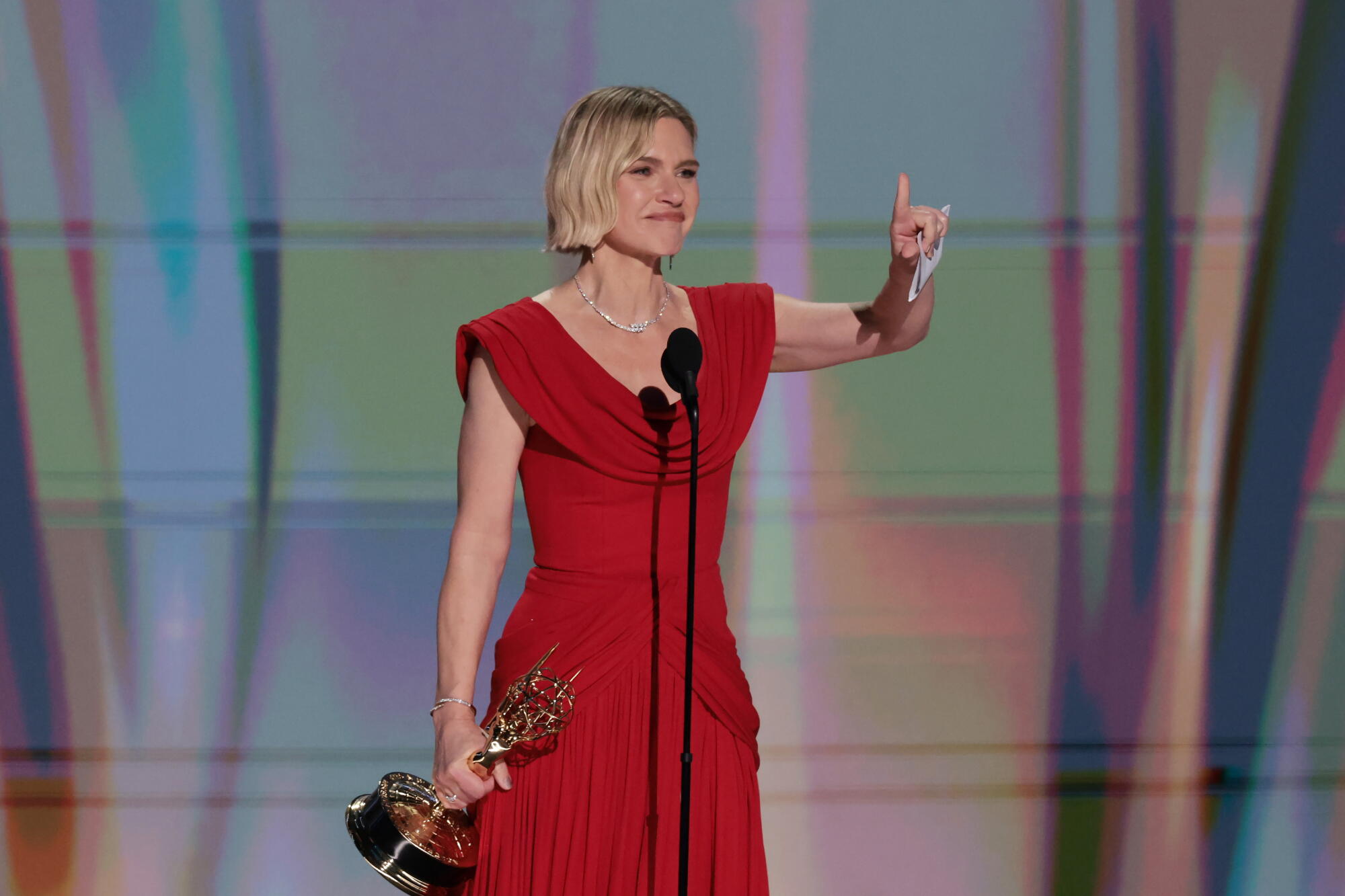
Rhea Seehorn was nervous about whether “Pluribus” would be recognized by Emmy voters Wednesday when nominations were announced. So she was jubilant when she and the surreal sci-series on Apple TV scored 18 nominations, the most for a first-year drama.
“I’m just so grateful,” the actor said in a phone interview. “People were like, ‘Why were you nervous?’ Honestly, you never actually know. I’m just so thrilled for the show, my co-stars, the production design, the editing, the writing, the music, the sound. I haven’t moved from my couch since they first announced everything because I’m still trying to call everybody on the show.”
Seehorn received a nomination for lead actress in a drama series for her portrayal of cynical Carol Sturka, a fantasy romance author who finds herself in a mystifying situation after a virus seems to have wiped out most of Earth’s population. The series was created by Vince Gilligan, who created the acclaimed series “Breaking Bad” and co-created its spinoff “Better Call Saul,” which also featured Seehorn.
The actor compared her experience of being nominated for “Pluribus” to “Better Call Saul,” which earned her two supporting actress nominations: “ ‘Better Call Saul’ was such a family that supported and cheered each other on, and I’m so grateful I have that environment again. People could not be happier for each other, and we get to celebrate the show together.”
She added, “The only part that feels different is that it’s my first nomination as a lead. It’s the process of Vince writing this for me and seeing the mountain which he wanted me to climb and going through that process. The whole thing has been its own journey, so ending up with awards and nominations, and being so well received by critics and fans is not lost on me.”
The series has been applauded for its mix of drama, comedy and strangeness in its portrait of a woman coming to terms to what seems like an impossible dilemma.
“I love the storytelling, how much Vince and I would drill down on making this as authentic as we could in terms of an everyman who has to deal with an insane situation,” Seehorn said. “Most of us are just not heroic or leaping off the couch to go save the world. And Carol is dealing with immense grief and confusion in an utter dystopian crisis. I love the humor and the drama that comes out of us being as realistic as we can with her amidst an unrealistic event.”
Fans of “Pluribus” have been relentlessly curious since the finale in December about when the second season will launch.
“I don’t know anything about that,” Seehorn said. “I don’t have to keep secrets because I’m not great at keeping them, and I know nothing. I don’t know what I’m doing with an atom bomb in the driveway. I can’t wait to find out. The writers want to have the same quality and reward the intelligence of the fans and never phone a single thing in. So their process is their process.”
Lasser was born in New York City on April 11, 1939, to parents Sol Jay Lasser, a tax specialist, and Paula Lasser, a designer. She attended Brandeis University, where she majored in political science and performed in musicals and cabaret. She dropped out her senior year to pursue acting.
“My career started almost too easy,” she told the Times in 1975. “In New York the first agent I met sent me on my first audition, and I was signed for a show-stopping part [a replacement for Barbra Streisand in ‘I Can Get It for You Wholesale’]. After that there was a flood of offers.”
She told the Times that she found it frightening to hit it big with such little training.
“I had to feel prepared,” she said. So, she studied under actor and acting teacher Sanford Meisner and worked hard.
“I feel so strongly that what is worth doing is worth doing the very best you can. But it’s so important to know what you want to do. How you can develop your potentials to the highest, live your life to the richest and fullest.”
Lasser joked in a 1976 article in the Times that her role as Mary Hartman might merit identification beyond being Woody Allen’s ex-wife. The two met in 1962 on a double date — with other people — but their chemistry was potent, and they began working together on various projects, including in her first project for television, “The Laughmakers,” an unaired pilot penned by Allen.
“When we met, I was seeing a friend of his. It was one of those things, well if you think you’re complicated, you should meet so-and-so. And it was Woody,” Lasser told the Toast in a 2013 interview. They “were meant to be in the same playpen,” she said. “Immediately we just connected. He was with somebody … oh, he was married, that’s right. … So, I met him, and it was so clear the whole night the four of us were there, and neither of us are talking to anyone else, do you know what I mean? … We really understood what the other was saying.”
The two were married from 1966 to 1970. Lasser acted in Allen’s “Take the Money and Run” (1969), “Bananas” (1971) and the 1972 film “Everything You Always Wanted to Know About Sex (But Were Afraid to Ask).”
Through the early ’70s, she appeared in various TV movies and television shows including “The Bob Newhart Show” and “The Mary Tyler Moore Show.” Somewhere along the way, the biggest producer in television caught wind of Lasser’s chops and wanted her for his pet project, a parody of sudsy daytime dramas called “Mary Hartman, Mary Hartman.”
During an interview featured in an oral history of American TV by the Television Academy Foundation, Lear said he’d brought the script for the series to a colleague, and they read it and said, “You can’t do this without Louise Lasser.”
“She came in my office, started to read the lines, and forget it,” Lear said. “There’s only one Louise Lasser.”
Lasser, put off by the soap opera nature of the show, turned down the role five times.
“I kept saying, no, it’s just not right,” she said during a 2000 reunion for the show. “I had no job, no money. … I just was that way, so after the fifth meeting, I said to my manager, ‘You mean he’s not going to call again?’
“Then my friend said, ‘You know, I think you really don’t want to say no.’ So I thought to myself my rationalization was, well, maybe it’d be really good for me to work for 52 weeks out of a year.”
Lasser starred as Hartman in 315 of the show’s 325 episodes over the course of an 18-month run.
We did it! America made it to 250 years of existence!
OK, not everyone may be feeling especially celebratory as we hit the semiquincentennial, as culture critic Mary McNamara wrote in her essay this week, but we can still find some solace in wanting to do better and be better. I’ve always believed the arts are a reflection of the heart and soul of a people. And in a country as multicultural and diverse as ours, that can look very many different ways. While it’s true that social media and the internet at large has siloed us, nothing stays the same and, like it or not, change and progress are very much at the root of America’s existence, as is acceptance of different ways of living. What makes this country great are those varied experiences and how art can be an entryway to them.
If that gives you enough inspiration, there are several Fourth of July events to watch over the weekend, including traditions like the “Macy’s 4th of July Fireworks Show,” now in its 50th edition, on NBC, Telemundo and Peacock, and Nathan’s Hot Dog Eating Contest on ESPN and ABC as part of their “Disney Celebrates America” programming. If you’re looking for something fresh, the America250 initiative will be streaming a ball drop from Times Square in New York beginning Friday night, which CNN is also covering via “Independence Eve Live With Anderson & Andy: Celebrating 250,” a New Year’s Eve-style production with Anderson Cooper and Andy Cohen. Similarly, PBS will be broadcasting “A Capitol Fourth: 250th Weekend Celebration” from the U.S. Capitol and from George Washington’s home in Mount Vernon. It will feature performances from the National Symphony Orchestra, Trace Adkins, Patti LaBelle, Kool & The Gang and more.
On Saturday, America250 will stream “America’s Block Party” from the L.A. Memorial Coliseum, which features performances by Chris Stapleton, the Smashing Pumpkins, Chaka Khan and Anthony Ramos. CBS will also air some of those acts on “The Great American Block Party 250,” along with performances from the Washington Monument in Washington, D.C., by the Zac Brown Band, Jon Batiste, Goo Goo Dolls and the War and Treaty (it will also stream on Paramount+).
You are reading Screen Gab newsletter
Sign up to get recommendations for the TV shows and streaming movies you can’t miss, plus exclusive interviews with the talent behind your favorite titles, in your inbox every Friday
By continuing, you agree to our Terms of Service, which include arbitration and a class action waiver. You agree that we and our third-party vendors may collect and use your information, including through cookies, pixels and similar technologies, for the purposes set forth in our Privacy Policy such as personalizing your experience and ads.
In keeping with this week’s theme, we’ve also rounded up several series and films that we recommend watching over the long holiday weekend that tell a story about America or Americans in all their glory — imperfect, diverse and unique. Now that’s something to celebrate. — Maira Garcia
Turn on
Recommendations from the film and TV experts at The Times
“The Americans” (Hulu)
Matthew Rhys as Philip and Keri Russell as Elizabeth in “The Americans.”
(FX )
This series may seem like an odd choice to recommend during the July 4 holiday, particularly when the main characters are driven by values that are pointedly un-American. The FX series, which concluded its six-season run in 2013, stars real-life couple Keri Russell and Matthew Rhys as Russian spies posing as a suburban couple living in Washington in 1981. Critics celebrated the drama as the couple took on their assignments to undermine the U.S. government while also concealing their true identities from their friendly neighbor — an FBI counterintelligence agent — and their two American-born children. Their journey is further complicated as they grow more attached to American lifestyles and values. Rhys, who is currently stirring up awards season buzz with his lead roles in Apple TV‘s “Widow’s Bay” and Netflix’s “The Beast in Me,” won an Emmy for lead actor in a drama during the show’s final season. Fans of “The Americans” are still shaken by the memory of the devastating series finale. — Greg Braxton
“Spirit of ’76” (VOD)
Jeff McDonald, left, David Cassidy and Steven McDonald in “The Spirit of ’76.”
(Philosophical Research Society)
In this energetic, colorful, low-budget 1990 ode to the bicentennial year, travelers from a colorless 2176 attempt to travel to 1776 to reclaim foundational knowledge lost when “the magnetic storm degaussed all recorded history.” They arrive instead on July 4, 1976, where a different sort of freedom holds sway — freedom to get down, freedom to boogie. It’s a friends-and-family affair, written and directed by Lucas Reiner, with appearances by his brother Rob and father Carl; a story co-authored by Roman Coppola; and costumes by his sister Sofia. David Cassidy and Olivia d‘Abo star as among the visitors from the future; Leif Garrett (like Cassidy, a 1970s TV and pop idol) is a disco-mad lothario. Also on board are Tommy Chong, Barbara Bain, Don Novello, Moon Zappa and performance artists the Kipper Kids as men in black. Julie Brown is a sex worker who has something to say about the Gulf of Tonkin Resolution that will sound distressingly timely. Brothers Jeff and Steve McDonald — from the band Redd Kross, and not playing brothers — are the bike-riding, long-haired, slang-slinging teens who join in to help the time travelers accomplish their mission. One word: tetrahydrozoline. — Robert Lloyd
“The Simpsons” (Disney+, Hulu)
“The Simpsons” has long been an American staple on television.
With more than 800 episodes across 37 seasons, “The Simpsons” is basically on track to reaching its own semiquincentennial milestone. Its relevance in today’s landscape may be debated, but the animated series has audaciously and consistently captured the American experience with its piercing satire about societal and cultural events and shifts, as well as its reflections on the frustrations and absurdities of daily life for a middle-class family living in a quintessential American suburb — an ideal that has long stood as a standard of success for generations of Americans and now feels like a fantasy for many who still strive for it. (Insert GIF of Homer disappearing into a shrub here.) It’s one of the most entertaining time capsules of a good chunk of America’s run so far. And hey, there are plenty of July 4 episodes to pre-game, pair with, or distract from your social obligations. — Yvonne Villarreal
“American Movie” (VOD)
Bill Borchardt, left, and Mark Borchardt in the documentary “American Movie.”
(Sony Pictures Classics)
One of the breakout documentaries of the ’90s, Chris Smith’s portrait of aspiring Wisconsin filmmaker Mark Borchardt suggests that if you want to understand America, you could do worse than spend some time in his company. Borchardt has no Hollywood connections, no money and seemingly no realistic path to finishing his low-budget horror movie “Coven” (which he stubbornly insists on pronouncing “COE-ven”). Working the graveyard shift at a cemetery and battling his own drinking, he somehow keeps persuading friends and relatives to help him inch the film toward completion. The movie is often hilarious but it never makes Borchardt the punchline, leaving open the question of whether he’s a genuine outsider artist or simply incapable of recognizing impossible odds. When he starts feeling sorry for himself, he has a way of snapping out of it: “No one has ever, ever paid admission to see an excuse.” As America marks its 250th birthday, with so many of the country’s problems seeming unsolvable, Borchardt reminds us that impossible sometimes just means unfinished. — Josh Rottenberg
“Reservation Dogs” (Hulu, Disney+)
Willie Jack (Paulina Alexis), Elora Danan Postoak (Devery Jacobs), Bear (D’Pharaoh Woon-A-Tai) and Cheese (Lane Factor) in “Reservation Dogs.”
(Shane Brown / FX)
This is perhaps too on the nose, but what is the story of America without Native Americans and Indigenous storytellers? Don’t worry, “Reservation Dogs” is not meant to be a history lesson. A coming-of-age dramedy, the series follows a group of teenagers living in a small town in the Muscogee Nation in rural Oklahoma. Culturally specific and infinitely relatable, the teens are grieving one of their own as they navigate familiar perils of adolescence: future aspirations (or lack thereof), relationships and rivalries, family and more as they grow into who they are meant to be. Created by Sterlin Harjo and Taika Waititi, the show was celebrated for its representational milestones both in front and behind the camera for the entirety of its three season run. But what keeps this show on my perpetual rewatch list is its humor, heart and endless humanity. And Cheese! — Tracy Brown
“Star Trek: Strange New Worlds” (Paramount+)
Una (Rebecca Romijn), Capt. Pike (Anson Mount) and Spock (Ethan Peck) in “Star Trek: Strange New Worlds.”
(Marni Grossman / Paramount+)
Despite being set on a starship traveling through the far reaches of space, “Star Trek” is a quintessentially American show that celebrates very American ideals and aspirations. The franchise depicts a future where good people want to do good, are endlessly curious, believe in justice and diplomacy and strive to maintain peace. They’re also willing to fight for what they believe in. “Strange New Worlds,” though created in our modern streaming times, captures a lot of the spirit and swagger of the original series — and not just because it features some characters that originated there. The show follows Capt. Christopher Pike (Anson Mount) and the crew of the U.S.S. Enterprise as they explore strange new worlds and boldly go where no one has gone before. Pike wields a kind of empathetic, nice dad next door charm and all the capabilities of a decorated starship officer, which makes him a perfect ambassador for his exploratory mission. He’d probably also make a good host of a big Fourth of July backyard bash. — T.B.
“Mo” (Netflix)
Mo Amer in Season 2 of his eponymous Netflix series.
(Eddy Chen / Netflix)
The immigrant experience has been portrayed in a number of films and series over the years — though I’d argue there still aren’t enough. This series created by and starring comedian Mo Amer captures not only the realities of navigating the American immigration system, with its draconian requirements and regulations, but also the experience of multicultural life in the melting pot that is Houston, Texas. Here, Amer plays a fictional version of himself, a Palestinian refugee who is trying to get legal status while encountering personal and professional roadblocks at every turn. It’s funny and melodramatic, occasionally veering into silliness, but it brilliantly highlights the very real struggle of finding your place in the world when you don’t know where you can call home or where you belong (the Spanish saying, ni de aqui, ni de alla, neither from here nor there, applies). And it’s one of the very few humanizing onscreen depictions of the Palestinian American experience. — Maira Garcia
“Pose” (Hulu) and “Fellow Travelers” (Paramount+)
Mj Rodriguez as Blanca and Billy Porter as Pray Tell in “Pose.” (FX)
Tim (Jonathan Bailey) and Hawk (Matt Bomer) in “Fellow Travelers.” (Ben Mark Holzberg / Showtime)
The struggle for gay rights has been a long chapter in American history and in the case of these two series, one depicts it through New York’s ballroom scene and the other through the halls of Washington. “Fellow Travelers,” created by Ron Nyswaner and based on Thomas Mallon’s novel of the same name, depicts the romance between Hawkins “Hawk” Fuller (Matt Bomer) and Timothy “Tim” Laughlin (Jonathan Bailey) beginning in the 1950s during the height of McCarthyism and the Lavender Scare and goes through the decades, culminating with the AIDS crisis of the ‘80s. If you want a good cry this weekend, start here. “Pose,” meanwhile, is at turns celebratory and heartbreaking as it depicts the experience of a group of Black and Latino members of the ball scene in the ‘80s and ‘90s. The series highlights the opulent costumes and performers in drag who would leave it all on the floor for a chance at glory among their peers, but also the interpersonal relationships and challenges faced by trans characters like Blanca (Mj Rodriguez, who scored an Emmy nomination for her performance in 2021), Elektra (Dominique Jackson) and Angel (Indya Moore), as well as gay characters like Pray Tell (the inimitable Billy Porter). Both shows are reminders that LGBTQ+ rights were hard won and that the struggle continues. — M.G.
The best weapon in the “Jackass’” arsenal isn’t the taser, the beehive or the booby-trapped latrine. It’s the explosion of relief when a prank ends, often in humiliation, always with hoots and claps. The first film, 2002’s “Jackass: The Movie” was slow to discover that carnage without camaraderie is painful; several injuries limped off-screen in horrified silence. Laughter heals, except for the brain hemorrhage that Johnny Knoxville suffered in 2022’s “Jackass Forever” when, dissatisfied by the clobbering he took from a bull, requested a second ramming that knocked him out cold.
Hence “Jackass: Best and Last,” the goon squad’s alleged final film, is underwhelmingly tame. Shot quickly by stalwart director Jeff Tremaine this spring, half of it is a clip reel of past hits, like the time fan favorite Steve-O slingshotted into the sky in a port-a-potty. The rest is scraps of hastily assembled chaos, the most elaborate of which is a puppet show in which veterans Ehren McGhehey, Dave England and Jason “Wee Man” Acuña dangle helplessly from strings, trying to recite cue cards while being pummeled by tropical fruit. “A pineapple!” Wee Man moans.
I’m no sadist. They’ve suffered plenty for our amusement. Still, it’s a shame that for the first time in two and a half decades of cringe comedy, the guffaws feel forced.
Acknowledging the Jackasses’ age, if not maturity, are a couple skits about prostate and rectal checkups. (The gnarliest involves clear pants, colonoscopy prep liquid and a game of Twister.) Modern technology enters the arena with a nimble-fingered robot. If the team had invested any actual energy into brainstorming this entry, they’d have played paintball with a sniper drone. At least for the sake of torch-passing, someone should have thought of something for the newish members introduced in “Jackass Forever” to do besides stand around and applaud.
These fresher faces — Jasper Dolphin, Rachel Wolfson, Zach Holmes — prove brave and resilient when allowed to participate. Only one of them, Sean “Poopies” McInerney, a surf bro so gullible that I’m not sure he’s capable of informed legal consent, fits into “Best and Last” like a well-worn punching bag. (When Poopies yelps that “my mind is getting to me” while wearing a shock collar around a sensitive area, people snort because, as sweet as he seems, the only thing rattling inside his cranium is a moth.) Early on, Poopies gets swollen lip injections that, someone claims, will last the whole movie. You expect his trophy wife pout to be a running sight gag. But his disfigurement never even gets another closeup.
“Jackass” started with a bang. In January of 1998, Knoxville, then a 26-year-old aspiring actor, strapped on a cheap bulletproof vest padded with a stack of “Hustler” magazines and fired a gun point-blank into his chest. His dumb derring-do went viral on VHS tapes, earning him an MTV show and five feature films. Watching that Rosetta Stone-cold stupid footage here, you’re struck not only by his audacity, but by the scene’s excruciating comic pacing. As there’s only one bullet in the pistol, empty chambers click multiple times before the bullet finally fires. Logically, you know Knoxville will live long enough for his hair to turn fright-wig white. Yet the lizard brain making you gawk is shrieking.
Do not attempt any of the stunts you’re about to see, the prefatory caution blares. Absolutely. The thing is, no one else could. “Best and Last’s” flashbacks are a walloping reminder that Knoxville is inimitable: a telegenic and extroverted entertainer with a charisma he wields like a skunk aims its stink. Upset him at your own risk. Like Buster Keaton before him, Knoxville has an uncanny awareness of how his death-defying escapades appear on camera. Even in that near-suicidal early segment, note how Knoxville stays on his feet, enduring agony with a magician’s “Ta-da!” He might have given himself a bruise the size of a baseball but he’s focused on the audience’s delight.
Over the years, the visuals dramatically improve, from snuff film aesthetics to confidently silly splendor. “Jackass Number Two,” released in 2006, expended major energy on a musical homage to Old Hollywood that nodded to Keaton and bathing beauty Esther Williams who, in MGM’s “Million Dollar Mermaid,” plunged 50 feet into a pool and broke her neck. By 2010’s “Jackass 3D,” which riffed on classic cartoons with Knoxville strapping himself onto an Acme-style red rocket, one could admit they went to see a Jackass movie for the cinematography with even more sincerity than if Knoxville claimed he bought “Hustler” for its life-saving properties.
The new movie doesn’t have any artistic ambition. The charitable excuse for its reliance on old material is that the gang wanted one more film that summed up their entire legacy — from the impact of seeing them age to the opportunity to include departed colleagues Ryan Dunn, who died in 2011, and Bam Margera, fired in 2020. The other explanation is it’s a cash grab made for pennies. Still, Steve-O strives for memorable moments, gathering the gang in a generic office building corridor to watch him take off his pants and pop out a ping-pong ball. There’s a lot of nudity but the setting feels half-assed.
“Best and Last’s” intro splat-tacular, typically a highlight of each film, hinges on the posse standing still on a moving floor. But the monochrome staging — white walls, white ground — looks almost like CGI, the antithesis of their appeal, and it takes us a minute to understand what’s actually going on. Worst, it lacks both suspense and surprise, that no-they-aren’t–oh-god-they-are drama that once elevated the franchise to the peak of pure cinema.
There is — and I mean this — existentialism in witnessing a person embrace shame and terror. Actors have won Oscars without achieving the transcendence of, say, misery glutton McGhehey in “Jackass Forever,” bound to a chair and coated in salmon and honey, realizing that his friends have released a bear into the room. Meryl Streep could never do that (and wouldn’t have to). McGhehey’s sole path to stardom is that he did.
Not everything in a “Jackass” movie needs to be that sublime. One of my few genuine howls in “Best and Last” came in a three-second rehash of someone stepping on a rake; another was the percussion Chris Pontius makes with his swinging nethers before attempting a naked Fosbury flop. There’s a great accidental gag in a cut bit from the original MTV pilot when a deputy pulls up to arrest Knoxville and forgets to put her car in park. Yet the snippet I keep thinking about is a throwaway beat in a new skit when McGhehey willingly gets into the wrong chair again and, once freed, attacks Knoxville who coolly knees him in the nuts. Everyone chuckles.
Once, in anthropology class, my professor lectured on an insular island tribe that cackled whenever someone got hurt. Schadenfreude was the community’s way to vent tension. I thought of that village throughout “Best and Last,” especially during Knoxville’s nonchalant disarmament of his pal. Team Jackass has stayed united even while at each other’s throats. In bad times, they’ve borne each other’s struggles with sobriety and mental health. In good, they’ve seen the inequality of success that’s left Knoxville in a better financial position to retire than the rest.
While “Best and Last” is a whiff, I can forgive this band of bozos’ urge to make it. No one seems happy to still be zapping themselves with electrodes. They just want to rally together for the final time to choke out one last laugh.
‘Jackass: Best and Last’
Rated: R, for extremely dangerous stunts and crude material throughout, graphic nudity, pervasive language and sexual material
How well do you remember your U.S. history class from high school or college? Did some of the key moments in America’s 250 years of existence involve Larry David playing a founding father? OK, maybe not, but it’s fun to imagine what that would be like. And that’s precisely what David and Jeff Schaffer have done with their new HBO series “Life, Larry and the Pursuit of Unhappiness.”
The series, premiering Friday, is a timely look at some of America’s big moments in history with a comedic twist that will remind viewers of “Curb Your Enthusiasm,” partly because it also features some cast members from the show. The series arrives on the cusp of the 250th anniversary of America’s founding, and offers an alternative history that’s still steeped in facts. Schaffer stopped by Guest Spot to talk about creating the series with David and what it was like to work with former President Obama.
Speaking of laughter, if you like yours with a whole lot of drama, FX dropped the final season of “The Bear” Thursday on Hulu. The series, which premiered in 2022 and made phrases like “cousin,” “yes, chef,” and “every second counts” memorable, ties up a lot of strings for its crew of chefs. Jeremy Allen White and Ayo Edebiri, the actors who were at the center of the show for five seasons, spoke to us about “The Bear” coming to a close, where their characters end up and what it feels like to leave them behind (be forewarned, the interview has lots of spoilers).
The finale feels like a fitting end to one of the best shows of the past decade (so far) — but we won’t say much more. Enjoy each episode like a multi-course meal at a fine-dining restaurant. You’ll want to savor each bite before it’s over.
You are reading Screen Gab newsletter
Sign up to get recommendations for the TV shows and streaming movies you can’t miss, plus exclusive interviews with the talent behind your favorite titles, in your inbox every Friday
By continuing, you agree to our Terms of Service, which include arbitration and a class action waiver. You agree that we and our third-party vendors may collect and use your information, including through cookies, pixels and similar technologies, for the purposes set forth in our Privacy Policy such as personalizing your experience and ads.
Also in this week’s Screen Gab, our writers recommend an animated series with monsters and mystery and a documentary about one of America’s greatest bands. I’ll get my flags, fireworks and BBQ supplies ready in the meantime. — Maira Garcia
Turn on
Recommendations from the film and TV experts at The Times
Bobby and Romy in Disney+’s “The Doomies.”
(Disney)
“The Doomies” (Disney+)
If you’re missing “Widow’s Bay,” and like cartoons, here’s another tale of monsters loose in a coastal tourist town, with the difference that the town, called “Ouimpre,” is decidedly on the Atlantic coast of northwest France. (It’s a Franglais pun.) There are half-timbered buildings; what used to be a Camembert factory after it was a beret factory; a cafe that serves crepes, not pancakes; and boulangeries, not bakeries. (It’s a French production; Disney encouraged animator Andrés Fernandez to go local.) As in “Stranger Things,” which no one may be missing by now, the protagonists are kids — Romy, who is excitable and impulsive, and Bobby, who is neither — abetted by a formidable female teenage demon slayer and a lighthouse keeper with occult knowledge. The series is energetic, funny and character-driven — even the monsters. The action is well-staged and intense, the color palette moody and evocative, and the design not at all reminiscent of a hundred other cartoons, which makes the show refreshing as well as fun. — Robert Lloyd
Earth, Wind & Fire in HBO’s “Earth, Wind & Fire (To Be Celestial vs. That’s The Weight Of The World)”
(Jeffrey Mayer / HBO)
“Earth, Wind & Fire (To Be Celestial vs. That’s the Weight of the World)” (HBO Max)
Even if you think you don’t know Earth, Wind & Fire, chances are they’ve soundtracked a wedding, bar mitzvah, awkward office party or some other memorable celebration in your life. Somewhere between “Shining Star,” “Let’s Groove” and “September,” the band mastered the art of coaxing three or four generations of a family onto the same dance floor. Questlove’s new documentary explores how that happened. If his recent Sly Stone film examined how genius can curdle into self-destruction, this one asks a different question: How did Earth, Wind & Fire founder Maurice White build something that lasted? Abandoned by his mother as a child, White set out to create not just a band but a family, assembling a sprawling ensemble around a musical and spiritual vision. Questlove is too thoughtful a filmmaker to sand down the rough edges. White emerges as both inspiring and flawed: a gifted bandleader, spiritual seeker and demanding perfectionist whose drive sometimes came at a personal cost. Drawing on interviews with everyone from former bandmates to Stevie Wonder, Lionel Richie and Barack and Michelle Obama, Questlove builds a portrait of White that never shies away from his contradictions. In the process, he shows how White’s fascination with spirituality, Egyptology and the cosmic unknown shaped both the band’s music and mythology. You may occasionally wish the film lingered longer on the performances themselves (for a reminder of what made Earth, Wind & Fire such a formidable live act, start with the 1975 concert album “Gratitude”). But by the end, you have a deeper appreciation for the band’s unlikely feat: turning something so eccentric into something so universal. — Josh Rottenberg
Guest spot
A weekly chat with actors, writers, directors and more about what they’re working on — and what they’re watching
Larry David in “Life, Larry and the Pursuit of Unhappiness.”
(John Johnson / HBO)
Is Larry David about to be the most entertaining (and crankiest) history teacher America has ever had?
To celebrate the arrival of the nation’s semiquincentennial, the comedian teamed up with Barack and Michelle Obama’s Higher Ground Productions to revisit the truth of our history with some comedic chaos. The result is “Life, Larry and the Pursuit of Unhappiness,” a seven-episode sketch comedy series from the mind of David and his longtime “Curb Your Enthusiasm” collaborator Jeff Schaffer that pairs reenactments of seminal milestones from America’s past with David’s misanthropic humor — or, as its creators dub it, “‘Curb’ in costume.” Subtitled “An Almost History of America,” it features a star-studded roster of actors dressing up in period clothes alongside David, including “Curb’s” Jeff Garlin, J.B. Smoove and Susie Essman, as well as Bill Hader, Kathryn Hahn, Jon Hamm and Jerry Seinfeld. The first episode premieres Friday at 9 p.m. ET/PT on HBO and will stream on HBO Max.
Over a video call, Schaffer discussed the show’s genesis, former President Obama’s improv skills and the British TV series that has him entertained. — Yvonne Villarreal
Tell me about getting into business with the Obamas. Their production company approached Larry. How did it evolve into this?
Larry and President Obama know each other a little bit. They really enjoy each other’s company, or at least Larry enjoys needling Obama, and Obama really enjoys needling Larry. The moment that we all met together to have our first meeting, the first thing Obama does — I’ve never met the president [prior]— he starts just ragging on Larry’s golf game, and how he wears so much sunscreen on the golf course. And Larry just goes to President Obama, “Oh, I’m sorry, my dad’s not from Kenya.” And that’s how it started. They have a great rapport and they wanted to do something special for the 250th [anniversary]. Larry says no to everything — his best friend can be having a premiere of a movie, and Larry will go, “Where is it in Hollywood?” But Larry’s not going, that’s too far. When this came around, Larry was like, “Huh, that’s actually pretty interesting.” He responded right away to the historical nature of it because, as he would say, he’s an American history buff.
The genesis for Larry and I is that we had done a tiny test run of this with that FTX ad for the Super Bowl a few years back. I don’t know, whatever happened to those people — I’m sure they’re fine — but he remembered how much fun he had being in costume. And honestly, I think he forgot how much he hated being in a wig. It’s like childbirth, enough time had passed.
Given the sort of tenor of the times, why does this type of comedic look at America’s history feel like the appropriate way to mark this anniversary?
It’s the 250th and I get that celebrating the country right now may feel like throwing a birthday party for your friend who’s in rehab — he’s all f— up — but we still love him, right? There’s a way to look at the country’s history, warts and all, the two steps forward and the one step back. And I think one of the best ways to do that is through comedy.
Going back to President Obama — what are the negotiations to get him to appear in it? Or was that on the table from the beginning?
Once I saw the two of them interact together, that became my primary mission. We’ll write the sketches, and we’ll do the documentary stuff, we’ll make it all historical and fun, whatever, but we have to get you two on screen together. It was also sort of the promise of the show, too. When I originally talked to Amy Gravitt at HBO about it, I remember I said, “What if I could give you a show that brought together two people half of America loves?”
What was it like directing them in a scene together? He gives the opening remarks at the start of the show.
He is a truly inspiring, amazing human being who also happens to have great comedic timing. He and Larry get into a groove immediately, which is very fun, and it was honestly one of the coolest things I’ve ever done in my life, directing them. The president said, “I guess I like being annoyed by Larry. Once we get together, I start sounding like him.” It’s like Larry’s this black hole of negativity that sucked Obama in for these brief periods of time; it was just fun.
Is he good at improv then on the spot like that?
Yes, he is. He’s got some really funny stuff in the sketch they’re in together that is all him — 100% the president.
Do you have a favorite moment from this first episode — it features the Declaration of Independence, segregation and Rosa Parks.
There’s different things in each of them. The thing that I’m most excited about is when you don’t know what the next one’s going to be, and then when the narration for the little documentary section starts, and it starts talking about Rosa Parks, I can just see [viewers] going, “Oh no …” That’s a great “Curb” feeling. It’s a comedy horror film — “Oh no, don’t do that, oh no.” Then you get sucked in.
We tried really hard to make sure that production-wise, there’s historical accuracy, so it really felt like you were in this moment. Then Larry gets dropped in, and all hell breaks loose. Same thing with World War I — I got to shoot a whole bunch of World War I fighting — and there’s Larry pretending to be dead. One of the things that attracted us to it in the very beginning was the idea of the juxtaposition between these big dramatic moments and then Larry. History is writ large, and Larry writes so small and that dynamic is fun for us.
One of the great things about a show like this — or what’s come before, like “Drunk History” — are the lessons that can be learned. Is there something you learned while filming this series or a takeaway you had in looking back at our history?
There are things I did not know. One of the things that was also enjoyable is being able to talk about modern things in a historical context, even with that phone. We don’t write dialog — we write some, but it’s basically like doing “Curb.” Larry knew that people were going to ask some questions about the phone, but I just was peppering these people with questions about all of the modern stuff, and just watching Larry get angrier and angrier at these people. At a certain point, the membrane of actor, of character to real human being was breached. He was so mad at them, but that’s what making the show is. Actually, at the end of the our shoot, President Obama said to me, “I see how it works. Larry makes the world uncomfortable, and you make sure the world makes Larry uncomfortable.” That’s literally how we make the show.
Would this format work for current historical events? How do you think, 250 years from now, a reboot of this show would tackle something like telling the story of the UFC fight on the White House lawn?
That’s the problem — we’ve entered an era of America parodying itself. It’s insane. One of my good friends, Dave Mandel, used to do a “Veep” and he’s like, “What do you do now?” I think what we tried to do, and you’ll see as you go further into episodes, we try to address a lot of things that are happening right now through a historical lens. So we might be back in colonial times, and we might be back in the ‘50s, but we’re actually talking about something that’s happening right now.
Before I let you go, what is the TV show or movie out right now that you’re telling everyone to watch?
I just started watching “Steve and Alice” [Hulu, Disney+]. It’s so well done; it’s so dark and funny and really engaging.
What’s the comfort show or movie you return to again and again?
I can pretty much put on any “Lord of the Rings” [HBO Max] movie anywhere and not be able to get my butt off the seat.
It’s at once a practical and existential question that plagues the two lead chefs in FX’s “The Bear.” He was the emotionally tortured and volatile chef who left behind a rising career in Michelin-starred restaurants to return to Chicago, his hometown, to run his recently deceased brother’s floundering sandwich joint. She was a Culinary Institute of America-trained chef with potential and a steady demeanor seeking mentorship and an opportunity to work with a prodigy. Together, Carmen “Carmy” Berzatto and Sydney “Syd” Adamu — played by Jeremy Allen White and Ayo Edebiri, respectively — transformed the Original Beef of Chicagoland from a hole-in-the-wall into the titular fine-dining establishment.
But now their partnership in the kitchen has come to an end.
Created by Christopher Storer, “The Bear’s” fifth and final season picks up the morning after Syd, Richie (Ebon Moss-Bachrach) and Nat (Abby Elliott) learn Carmy is quitting the food industry and leaving the restaurant in their hands at a make-or-break moment. And the pressure mounts for Syd to decide if she’ll jump ship to pursue another opportunity. The eight-episode season, now streaming in full on Hulu, largely stretches across one day as the restaurant’s debts accumulate, suppliers cut them off and an unrelenting storm floods the kitchen and threatens to upend a night of service the chefs desperately need to have one last shot at survival and one last performance as a team to deliver an improbable turnaround.
In some ways, it’s a journey that mirrors the actors’ own trajectories. Before “The Bear” became a runaway hit, White was best known for his role on Showtime’s long-running dark comedy “Shameless,” while Edebiri primarily worked as a stand-up comedian and writer. Just as their characters have evolved and gained electric momentum in their careers, so have the actors. Both garnered Emmy Awards for their performances on “The Bear,” and they have added a multitude of film and TV credits to their résumés since. Edebiri is currently starring opposite Don Cheadle in the revival of “Proof,” her Broadway debut, while White will be starring this fall as an investigative reporter in Aaron Sorkin’s “The Social Reckoning,” a companion piece to “The Social Network” that chronicles Facebook’s whistleblower scandal.
Over separate video calls from New York, Edebiri and White reflected on “The Bear’s” conclusion and what it means to leave the characters that supercharged their careers behind. Here are edited excerpts from the conversations.
Ayo Edebiri as Sydney Adamu and Jeremy Allen White as Carmen “Carmy” Berzatto in a scene from Season 5 of “The Bear.”
(FX)
After living inside these characters’ skins for so many years, what’s it like to be done playing them?
Edebiri: They keep saying that we’re done, so I guess that really is the thing of it. Obviously I know that it’s over, but even when we were finishing our first seasons, it didn’t matter how much critical acclaim we got because we’re on a show that’s a part of a network that has a deal with the streaming service — there’s all these things that are continually in flux or that you know that you have no control over. As an actor, you’re used to this state of limbo or not totally knowing or being prepared for an ending, so I think I’m not overwhelmed by it, if that makes sense.
White: I don’t know yet. We were very lucky to understand for a long time when the show was going to end and, to a degree, how the show was going to end. It was difficult to see the direction it went — I have strong feelings about Carmy and where he ends up and how his story might continue on. So much of this season, for Carmy, is about a surrender or acceptance of his place in the world and his place in the kitchen, and it’s the first time he’s really been able to get very honest with himself since we’ve met him. And, in doing so, he chooses to leave, and that was hard for me, for Jeremy. Maybe there’s a world in which he tries this and he comes back. I think I had a different understanding for a while of Carmy’s future. I want him to be happy and healed, but it felt like … I don’t know — imagining him outside of a kitchen was hard for me.
I want to unpack that a little bit more. He wants to be happy. But it was interesting to see him wrestle with how his work hinders that — is it the crutch or the salvation? Did you find yourself having an existential moment as Jeremy taking in what Carmy was wrestling with, or have you reckoned with it before?
White: He threw himself into this work, into this world, pretty young in life. And he was really good at it. But a big part of him burying himself has so much to do with his brother, with his family. I was finishing something too. And, yes, of course, I was thinking of goodbyes, and I was thinking of moving on, and new pursuits and all of these things. I was checking in with myself and what it might feel like to just make such a hard turn in life. I thought a lot about what you get back from your work, but I think ultimately, what Carmy and I don’t share is he was causing so much chaos in his work life; it wasn’t just himself that he was punishing at times. It came down to this surrender to an easier way, a softer way, which was to turn it over to Syd, to turn it over to Richie, to turn it over to Tina in the kitchen — that part, I had an easier time understanding.
“The most beautiful thing about their relationship is their true unconditional belief in one another,” says Allen about Sydney and Carmy in “The Bear.”
(David Urbanke / For The Times)
Syd was facing a crossroads: a shiny new job that could take her to the next level or sticking with this seemingly sinking ship that has taken her to the next level, but where she’s felt unappreciated or stifled at times. Ayo, what did you think of the choice she made?
Edebiri: We’re really fortunate to have such amazing writers who thought about her and her journey. [There’s] an awareness of Sydney’s womanhood and Blackness and youth, but I think [they treated] her with the full dignity of just being a human being and getting able to be a complex character in this show and giving her the dignity of being just as flawed as the other characters. [The choice she made] just made sense to me. It made sense in the architecture of the show. It was gratifying to get to build to that with everybody.
The bulk of this final season has the team dealing with this massive storm that’s created a slew of setbacks at a make–or–break moment for the restaurant. It leads to one final symphony in the kitchen together.
White: Those days were beautiful. So much of our show is shot so quickly, but then we really get to slow down with these choreographed pieces of kitchen ballet, and that’s also when we feel really strong as a group of performers, where we’re incredibly reliant on one another, not just for the emotional beats of a scene, but in this very technical aspect as well. I remember going back to Season 1 and filming Episode 7, “The Review,” which was the single-take episode, and just how much camaraderie came from that, and how much respect came from that for everyone — that feeling of real success that we could do this. It’s a really nice thing that happens sometimes on sets, where there is such a nice mirror of what’s going on with the characters and what’s going on with the cast. In this last push, and this team effort, we want these things as the characters, and we want these things as the cast. We want these people to have what they want, what they deserve, so it was really exciting shooting that last episode or two where all those things are coming into place.
Edebiri: That’s Chris’ thing — it’s like a classical piece of music or something; there’s different movements. His own challenge that he puts on himself, and that, in turn, puts on us, is that we’re still in the same piece of music, but everything just has a different feeling. He’d been talking about it since, low-key, Season 3, but definitely started talking about it a little bit more concertedly when we were filming [Season] 4. It was really starting to take shape in his brain. This challenge of having it be in this one day, and how each episode can feel different, was really exciting to him, so in turn, it became exciting to us.
Were you hoping for more runway to chart what the characters were facing?
Edebiri: No, I think it was cool. I was just like, “Yeah, let’s see what it is.” That’s kind of what everything has been with this show. Part of her emotional journey for the last season, what was on a slower track, in a way, there was something also really fun in having the pressure cooker of one day, and everything getting to ramp up and be quite immediate, which I think has been reminiscent of Seasons 1 and 2 in a fun way.
Tina (Liza Colón-Zayas), left, Sydney (Ayo Edebiri), Richie (Ebon Moss-Bachrach) and Carmy (Jeremy Allen White) in “The Bear.” The restaurant faces multiple setbacks, including a storm that causes damage and dwindling supplies.
(FX)
Carmy and Sydney’s dynamic has been so fundamental to the series. These are two people who see something in each other that the other doesn’t. What do you admire about their relationship as friends and as co–workers?
White: The most beautiful thing about their relationship is their true unconditional belief in one another. They see the beautiful things in one another that the other one is not able to witness in themselves. Even though trust has been tested and trust has been broken at times, there is such a loyalty to the best in themselves. They know that they can rely on one another. In a lot of ways, they saved each other. That piece in the opening episode of Season 3, where Carmy gets the call about Mikey and serves the scallop to Syd without ever having met her — there is this invisible tether that was not witnessed by either of them, but it inspired Syd, and whether Carmy knew it or not, this thing was loved and enjoyed by someone that was birthed from this very traumatic moment. There’s just this beautiful, invisible tether that has always existed and will always exist between the two of them.
Edebiri: What I admire about it is the fact that they are able to bring out — through a lot of miscommunication and hard work, but ultimately, I think, with good intentions — the best in each other. They want to see each other be the best versions of themselves.
How is that reflected in your dynamic? Jeremy, who is Ayo as a scene partner and what has she brought out in you as a performer, and vice versa?
White: I was really so lucky to kind of witness Ayo in real time — everybody else had to wait some months to see her on the show. I remember genuinely being struck by her presence, her groundedness. It felt like, if this makes sense, wrong because she was doing it so well. She’s incredibly smart, she’s a wonderful writer, and she’s very skilled improvisationally, and so, in acting with her, there’s something that always makes you feel very in the moment. You can never like relax, in the best way. It’s like you always have to surrender yourself to each moment.
Edebiri: When we first started, I was coming from the comedy world, and he was coming from a much more dramatic world. Our approaches were so different. He has such amazing presence of being and a quiet focus and has such care for the work. He’s a really great leader. There are ideas in society of men in power, and what power held by men has to look like and feel like, and he’s very gentle — especially in the show, which can live so much in the space of chaos and anxiety, having a gentle spirit really helps with filming. He’s so good at making that very clear and helping teach me that as well … I’ve definitely learned from him, without realizing it, ways to protect yourself and protect your peace, and protect also the peace of your co-workers — you get the work done, you be serious about it, but it doesn’t have to be torture.
Edebiri on working with White: “When we first started, I was coming from the comedy world, and he was coming from a much more dramatic world. Our approaches were so different. He has such amazing presence of being and a quiet focus and has such care for the work.”(David Urbanke / For The Times)
What was it like to see them get this thing they’ve been after — not one, but two Michelin stars?
White: Reading that moment —there’s been so much pain and heartache … for years and years and years, and I was just so relieved to see this joyous moment on the page. It felt so, so close to the surface of me already. And we — Jeremy and Ayo — have shared so many insane, joyous moments in our lives since the show. So it felt familiar in the best way. I’m so glad for that moment for both of them — for Carmy and Syd.
Edebiri: We’re shooting it so fast. You always wish you just had more time, and that was one of the last scenes — I think it was the last thing that he and I shot. There’s obviously a bit of a preciousness and emotionality that you’re feeling in that moment, while also tapping into what’s happening to the characters. It’s this thing that, in the brain of myself, we’ve been building to this over five seasons. There’s obviously a somewhat meta reflection of what we’ve gone through — this is just such a crazy journey. But I think at the end of it, especially because of what we know is going to change in their relationship, that in their working proximity, that they are not going to be close, but they know that they were able to do this thing and build this thing together, I think [is] what felt very special, and felt very cool. I hope it’s something that people who have loved the show also feel.
Fans have intense feelings about their relationship, as I’m sure you know. Has it surprised you how strongly people feel about their dynamic?
White: I know that exists. I don’t have too much knowledge on how that all works. It’s funny, I’m very aware of it now because it’s become part of a conversation around the show, but it was nonexistent in our approach to the work. It wasn’t even a thought for either of us. It didn’t occur to us. But I understand it. There is an intimacy, of course, with these two characters. And there is this trust. They lean on each other and they admire each other so much. I’m not like — nobody’s crazy to feel that. There is love there, it’s just not a romantic partnership.
Edebiri: It surprised me the first two [seasons] because I don’t think that that’s what we were doing. Anytime that you say otherwise, I’ve learned [not to]. It’s been hard when doing press, it feels like we get asked specific questions to try to give a specific answer, but the point of art is we make it and we give it. If people are having a response, that’s great, and if I don’t agree with you, I don’t think I’m shutting it down or anything. We made something, then you’re picking something up — that’s the exchange.
White says he knows fans have intense feelings about the relationship between Carmy and Syd. “It’s funny, I’m very aware of it now because it’s become part of a conversation around the show, but it was nonexistent in our approach to the work. It wasn’t even a thought for either of us.”(David Urbanke / For The Times)
Carmy has a few heartfelt conversations this season, but one that really stands out is the one with his mom, played by Jamie Lee Curtis, while revisiting the family home he’s stayed away from for years. He cooks for her. She’s remorseful. Jeremy, what did you think of that moment for Carmy?
White: There’s resistance in it. People like Carmy, you can give them the answer, you can give them the sorry, you can give them the opportunity, and a lot of the times they don’t know what to do with it, or they push it away, or they push it down. What that scene was about, for Carm, was becoming available to even listen. That was the conflict of the scene and the moment. But he was able to eventually get to that acceptance to release some of the resentment, to release some of the anger. Then he is able to show up for her, which was what has been absent. He was able to take it and give her something. It’s been years, if ever, that he’s really been able to do that, to get out of his own way, and be of service in that way to his mother.
Ayo, it was really touching to see Syd naming Tina her chef de cuisine. How did you feel about what that sets up for where Syd and the Bear might be headed with these women as partners in the kitchen?
Edebiri: I loved it. I love getting to work with Liza [Colón-Zayas]. I’ve been so privileged to also be able to direct her — she’s just phenomenal. I think about these two characters, where they started Day 1; Tina was pretending not even to speak English just to stay away from the girl. It was rough from the get-go, but I think both for Liza and I, as two women of color as well, we felt so invested in their relationship and the community they built with each other. There’s something very moving about that to me. Part of the thing for Sydney, she doesn’t know — I think Carmy can see it — that one of her strengths is that they’re different types of leaders. Part of what I think makes Sydney a great leader is that she’s able to delegate and actually remove herself when she knows that she might not be the best in a situation, it might be somebody else.
I haven’t actually seen it. I can’t watch the episodes, but I know when we were filming it, it was both very sweet and very funny. I don’t know if they kept any of the improv from Liza.
You can’t watch because you’re emotional about it or because you just don’t have access?
Edebiri: No, I don’t want to. We were doing all this press and everybody was, “You were so emotional; you wanted to cry, right?” And I’m like, “No, I just don’t want to watch.” I’ll watch it later. The only season that I watched before [it aired], frankly, was 3 and 4 because I had episodes that I made in it. I love the show and I know the show is good. I don’t enjoy watching myself.
I do love that Syd’s ethos in the kitchen is borrowed from “Ratatouille.”
Edebiri: Yes, f—ing rat. It tracks for Sydney.
“I love getting to work with Liza [Colón-Zayas],” says Edebiri about her co-star, whose character is named chef de cuisine. “I’ve been so privileged to also be able to direct her — she’s just phenomenal.”
(FX)
Jeremy, what was your reaction when you read Carmy is in a suit interviewing for an internship at an architectural firm? And what he expresses there?
White: I understand and I’m proud of the courage that it takes [to do a life pivot], but also I tried to play that scene in a way where I didn’t want it to be entirely clear [what happens next]. I wanted the question to be like, “Is this guy still so f— up in the head that he’s trapped regardless of his place in this world, or place of work? Is it a romance that he’s saying goodbye to? Is it a love that he still has, and he’s not quite over yet?” Then I was like, “Do we snap out of that scene and we’re back on the clock?” What is this? I think the goal of the scene is it shouldn’t be all too clear and wrapped up.
What do you think?
White: I could see there’s obviously so much love. There’s love for the people he works with, and there’s love for the paces he’s gone through, but I didn’t know. … I didn’t know if it was a goodbye or an admittance. I think I was trying to find something between him coming clean and being like, you know what, I don’t belong anywhere else or I’m so in love with this thing, but it’s not good for me, and I think it exists somewhere in between that.
Ayo, what was your reaction to Carmy interviewing at the firm?
Edebiri: I was like, “Yeah, that makes sense. This boy’s a noodle.” He’s a fool, he’s ridiculous. It makes sense.
Where do you think he goes from here? Have you thought about it? Do you think he will ever find his way back to the kitchen?
White: I haven’t thought about it too much. I do think there’s something really honest about that direction that Carmy was moving into, but I would hope there’ll always be room for him somewhere in a kitchen.
Edebiri: Syd is like, “You can’t do anything else, brother. Like, what’s the plan?” I don’t know if he takes a break, if he comes back to help her, if he does his own thing.
What do you think happens to the Bear?
Edebiri: I think they do well. It’s not just her; it’s her and Sugar and Richie and Marcus and Tina. She got in it for Carmy, but I think she ended up finding her own voice. I think they keep going, at least for a few more years. I really do.
White: I have to believe that all the pain and suffering and trauma — not only that Carmy has gone through, but that everybody has gone through — is for some greater good. That there is a payoff. My hope is that it would be successful. They’ll have the endurance and the motivation to make it.
Author Harlan Coben, known for gripping thrillers that place ordinary people in extraordinary circumstances, has provided enough source material for book-to-screen adaptations on Netflix that it merits its own landing page. The latest screen translation of his work begins with a parent’s worst nightmare.
“I Will Find You” follows an imprisoned father wrongfully convicted of brutally murdering his son. When he learns his child may still be alive, it sets off a harrowing, twist-filled search for the truth. User discretion is advised as to whether that makes it the perfect binge for the Father’s Day weekend. “I Will Find You” is also the first series in Coben’s partnership with the streamer to take place in the U.S. — other projects have been set in countries across Europe, including the U.K., France and Spain, in four different languages. Coben and showrunner Robert Hull stopped by Guest Spot to discuss the eight-episode series.
You are reading Screen Gab newsletter
Sign up to get recommendations for the TV shows and streaming movies you can’t miss, plus exclusive interviews with the talent behind your favorite titles, in your inbox every Friday
By continuing, you agree to our Terms of Service, which include arbitration and a class action waiver. You agree that we and our third-party vendors may collect and use your information, including through cookies, pixels and similar technologies, for the purposes set forth in our Privacy Policy such as personalizing your experience and ads.
Also in this week’s Screen Gab, our streaming recommendations include a series of brief historical videos that honor the 250th anniversary of the Declaration of Independence and a Netflix documentary that revisits Michael Jackson’s 2005 child molestation trial.
And if you’re a fan of “House of the Dragon,” which returns Sunday with its third season, check out coverage from Tracy Brown, our resident expert on all matters related to Targaryen family drama. She assembled a guide to refresh your memory on the events of the second season and spoke with Emma D’Arcy ahead of the new season.
Keep on reading (and watching). See you next week.
—Yvonne Villarreal
Turn on
Recommendations from the film and TV experts at The Times
In the spirit of the old CBS “Bicentennial Minutes” (the spirit of the old CBS for that matter) — which ran in commercial breaks from July 4, 1974, until Dec. 31, 1976, and featured celebrities telling a story from “200 years ago today” — historian and podcaster Heather Cox Richardson has mounted a series of similarly timed semiquincentennial videos, as “250 to 250.” Narrated by an array of scholars, politicians, activists, public servants and others, its overarching theme is that “the story of America has been one of the constant efforts of Americans — from all races, ethnicities, genders, and abilities — to make real the belief that we are all created equal and have a right to have a say in our democracy.” (It can’t be said too often.) Segments (there are 25 as of this writing) include the Constitutional Convention, the Triangle Shirtwaist Fire, the Erie Canal, the AIDS Memorial Quilt, Man o’ War, Eisenhower’s “D-day: In Case of Failure” statement, Rita Moreno, the Everglades, the Social Security Act, Fannie Lou Hamer, An Wang (the inventor of magnetic core memory), Thomas Paine’s “Common Sense” and L.A. Times reporter Rubén Salazar, killed by a sheriff’s rubber bullet during the 1970 National Chicano Moratorium March Against the Vietnam War. — Robert Lloyd
A still from “Michael Jackson: The Verdict” of Mark Geragos, who briefly served as the singer’s defense attorney.
(Netflix)
“Michael Jackson: The Verdict” (Netflix)
Moviegoers embraced “Michael,” propelling Antoine Fuqua’s film about the global superstar to become the highest-grossing music biography in movie history. But reviewers and others have continued to criticize the absence of references to the child molestation allegations that continually shadowed the singer. Netflix’s documentary “Michael Jackson: The Verdict,” however, brought it into focus. Directed by Nick Green, it chronicles the 2005 child molestation trial that threatened to derail Jackson’s career after a young boy accused him of abuse. The three-part series uses archival footage and new interviews with attorneys involved in the case, journalists, fans and members of Jackson’s inner circle to explore the trial, which sparked international attention, and its aftermath. Although the project is unlikely to affect Jackson’s popularity much, some of the revelations uncovered during the investigation are disturbing. — Greg Braxton
Guest spot
A weekly chat with actors, writers, directors and more about what they’re working on — and what they’re watching
Sam Worthington as David Burroughs, a wrongfully imprisoned father, in “I Will Find You.”
(Christos Kalohoridis/Netflix)
What would you do to save your child? “I Will Find You” follows David Burroughs (Sam Worthington), a father serving a life sentence for the gruesome killing his toddler son. But when his ex-sister-in-law Rachel Mills (Britt Lower), an out-of-work reporter, presents him with evidence that suggests his young son, Matthew, is still alive, it sets in motion a daring prison escape and a high-stakes rescue mission in search of the truth. And that’s just one of the parent-child dynamics that fuel the series to illustrate, as Coben told us, how most parents are “trying to do what we think is best for our child — and that could lead to greatness or it could lead to disaster.” Over a recent video call, Coben and showrunner Robert Hull discussed the chilling premise and the book moment that was most challenging to bring to screen. Beware of spoilers ahead. — Y.V.
Harlan, Netflix wanted to make this before you even finished the book. How did that shape or intensify your normal writing process? Is it hard to turn off the noise of the pressure that carries?
Coben: Actually, no. In terms of writing the novel, I’ve learned that the worst novels are the ones that you write thinking you’re going to make a great TV series or a movie. If you write a novel going, “Ooh, I can’t wait for it [to be adapted],” it’s going to stink — trust me. My caveat to that is, though, I don’t care about making changes. I don’t have fidelity to the novel. Once I knew it was going to be already a TV series, I made sure I cut off any thoughts of that, and just told Robby, “Your job is going to be to worry about how to adapt whatever I do.” The way it started was Robby and I had met, and we wanted to do something together at Netflix. We wanted to maybe do the first one that was going to be filmed [and take place in the U.S.], and weren’t sure which to do. I pitched the idea to Robby as I started writing the book, and Robby’s eyes lit up. We went to Netflix and [executives] were like which book is this? I’m “Well, it’s not a book yet; it’s a third of a book right now. I’ll finish it while Robby’s working on the pilot and the adaptation.
Robby, what pulled you into this story?
Hull: As a father myself, I would easily give my life to save my children. What would be terrifying is to not have that opportunity. And Harlan created this character [in that situation] — he says very early on in the book, “A father’s job is to protect my son, and I didn’t do that.” He’s [David] living in this spiritual prison, regardless. And in this day and age, to have someone come and say, “Hey, there might be a way for you to correct the past, to change the most horrible thing that’s ever happened to you” — I thought that was just an incredible way to start a story.
Britt Lower as Rachel Mills and Sam Worthington as David Burroughs in “I Will Find You.”
(Netflix)
Was there a moment from the book, or a twist, that was most challenging to bring to screen, or one that you were most excited about?
Hull: It’s actually the same moment: When Rachel comes [to the prison] and shows David the photograph very early on. That is a scene that has to establish who Rachel is, establish her back story, her pathos, her connection to David, introduce the mystery, David’s reaction to the mystery. There is so much going on. You have to check off in three pages and in the hands of possibly actors other than Sam and Britt, that could be a real train wreck of a scene. Sam’s reaction when he first sees that photo is just unmistakably incredible, and you don’t have to write it. He tells you in three or four seconds the last five years of what he’s been through, and the possibility that maybe things can be different just by staring at a photo, which is incredible.
Coben: That’s one of my favorite scenes too. Also the ending, making sure that landed and gave the emotional punch that I wanted and I felt when I was writing the book. I think we delivered it less-was-more there. It closes it and it leaves it, so you can interpret it your own way, and you can bring it. We were thinking, it’d be really interesting to ask people a year from now, “Where do you think those characters are?”
Let’s talk about that part of the ending — so spoiler warning starts here. The book goes more deeply into how Rachel and David’s relationship evolves into a romance by the end. The series is more vague — we see them hold hands. Robby, how did you want that moment to play?
Hull: If you want them to be together and you’re hoping they are, then I’ve done my job right. I actually don’t want to answer that question because the relationship is so complex and so dynamic. Early on, we didn’t want the traditional two-hander, where [it’s] “Oh, now they’re going to fall in love, now they’re going to come together.” No, Rachel’s her own character with her own story and pathos, and at the end, what they’ve been through together, if that moment is the promise of something more, great; if it’s the promise of “look what we’ve been through,” that’s OK too. That’s what I was going for, at least.
Do you think there’s more of David’s story to tell? Would you want a Season 2 to explore what happens next?
Coblen: I’m probably the only writer who will say this: No, not really. I don’t do Season 2’s unless I think they’ll be better than Season 1’s. Let me do new stories instead. This is a complete story to me. Now, if somebody says to me, “I’ve come up with an idea that might work, that could be as compelling as being [in prison] for five years for the murder of your child for the same character? I never say never. I’ve learned that in my career. But we’ll see. I don’t think so.
Robby’s like, “but I want a Season 2.”
Hull: The moment he said, “If you can come up with a story better than the one we told …,” I was like, “Oh, guess we’re not doing a Season 2.”
Before I let you go, what have you watched recently that you’re recommending to everyone?
Coben: “Your Friends & Neighbors” [Apple TV] by my pal Jonathan Tropper and my other pal Jon Hamm. I’m proud of the job they’ve done on that show and I’m happy for them.
Hull: “Run Away,” ’Safe,” “Fool Me Once.” [Each are a Coben adaptation for Netflix]. Those are the three I’m digging right now.
Unlike the movies, where directors get the glory, TV directors sit lower in the hierarchy, below creators, producers and actors. In most series, which might employ several over a season, they are interchangeable — which isn’t to say they aren’t valuable, transforming words on a page into a four-dimensional living thing. But a director hired to helm a pilot, as James Burrows, who died Friday at 85, was again and again — almost as a lucky charm — helps set the tone for the series. Jake Kasdan’s input was crucial to the feel (and philosophy) of “Freaks and Geeks,” as Hiro Murai’s was to “Atlanta” (and most recently “Widow’s Bay”). In some cases a director is a co-creator in all but title and union affiliation. A show might subsequently pass to later hands, but they’ll be honoring its established look and feel.
But Burrows was more than a little well known. If you sat through the opening credits of “Taxi,” whose pilot he directed along with 74 other episodes — and why wouldn’t you, with its pleasing Bob James theme and Checker Cab crossing the Queensboro Bridge — you would have seen his name for weeks on end. You might have noticed it on “Cheers,” which he co-created and for which he directed 236 episodes, or on “Will & Grace” (246 episodes), or “Frasier,” “The Big Bang Theory,” “3rd Rock From the Sun,” “Caroline in the City,” “Two and a Half Men,” “2 Broke Girls,”“The Neighborhood” or, just last year, “Mid-Century Modern” — all series whose pilots he directed. You might have caught it on episodes of “The Mary Tyler Moore Show,” “Phyllis,” “Rhoda” or “Laverne & Shirley,” until you began to think that maybe there was nobody else directing network multi-camera situation comedies, the most human of television formats and a specialty from which he rarely strayed.
And you might have seen him as himself this year in the third season of Lisa Kudrow’s “The Comeback,” as the man she enlists to save a television pilot from hacky AI jokes. “Surprising only comes from a group of writers huddled in a corner, beating themselves up to beat out a better joke,” he says.
“As director, I am there to help create the ensemble, to do everything I can to foster a community among the company, and to train a new set of actors to behave as a group and respect one another,” he wrote in his 2022 memoir, “Directed by James Burrows.” He famously took the cast of “Friends” to Las Vegas before the show premiered in order to foster bonds in a soon-to-be-impossible state of anonymity. “I guess I have a gift for creating families,” he told the New York Times in 2023.
But if “Friends” refers to the characters and the people who play them, it includes the audience too. Burrows’ talent was to midwife a real relationship between the viewer and the viewed, “You want to go where everybody knows your name,” runs the “Cheers” theme, and where you know everyone’s name. The families he excelled at creating were yours as well, and one watched knowing that these things happened in real time in real space, and that you could be in the room, if you made the effort. Tickets were available.
The son of Abe Burrows, who wrote or co-wrote the books for “Guys and Dolls,” “Can-Can” and “How to Succeed in Business Without Really Trying,” and co-created the radio comedy “Duffy’s Tavern” — set, like “Cheers,” in a bar, though the younger Burrows denied any influence — he’d been directing dinner theater when he had the idea to write to Mary Tyler Moore, whom he’d met on the set of a never-opened “Breakfast at Tiffany’s” musical. His stage experience (and his Yale School of Drama degree, presumably) proved eminently transferable to the proscenium reality of multi-camera situation comedy.
What Burrows shows share — the ones we remember, at least, out of many we don’t — is that they’re fundamentally joyful. They lack cynicism. They’re expressive of their times without being showily edgy. They walk a line between freshness and familiarity, which makes one want to return week after week. They may push an envelope — “Friends” was something new, after all — but subtly. We can assume, given his reputation and the fact that he could have retired on “Cheers” alone, that he liked what he did and did what he liked, and regard his choice of projects as a form of personal expression in itself, the basis of a body of work that has and will live on.
Did Ben Kingsley in “Gandhi” cross your mind? Probably not.
The 82-year-old Oscar winner thinks it should.
I’m Glenn Whipp, columnist for the Los Angeles Times and host of The Envelope newsletter. Don Logan or Mahatma Gandhi? The answer isn’t as plain as you might think.
Sign up for The Envelope
Get exclusive awards season news, in-depth interviews and columnist Glenn Whipp’s must-read analysis straight to your inbox.
By continuing, you agree to our Terms of Service, which include arbitration and a class action waiver. You agree that we and our third-party vendors may collect and use your information, including through cookies, pixels and similar technologies, for the purposes set forth in our Privacy Policy such as personalizing your experience and ads.
Not long ago, I spoke with Kingsley just before an Emmy FYC event for “Wonder Man,” the enjoyable new Marvel TV series that finds him revisiting Trevor Slattery, the washed-up, drug-addled actor he first played in 2013’s “Iron Man 3.”
“Wonder Man” follows struggling actor Simon Williams (Yahya Abdul-Mateen II), trying to land a big break in Hollywood while keeping his superpowers hidden. Trevor befriends Simon. Initially he has ulterior motives, but soon becomes Simon’s mentor, turning the series into a look at the indignities that actors face while pursuing their profession.
Taking notes while watching the show’s eight episodes, I wrote, “Ben Kingsley’s seething anger is everything.”
You may remember Kingsley’s bullying and badgering and swaggering menace playing the underworld sociopath in Jonathan Glazer’s 2000 crime-thriller “Sexy Beast,” still my favorite Kingsley performance, one that earned him a supporting actor Oscar nomination. (He lost to Jim Broadbent in “Iris.”)
Is that kind of boiling rage as fun to play as it is to watch?
“If the expression of rage or indignation is completely dramatically justified and that expression of indignation is of enormous benefit to the tribe, yes,” Kingsley answers.
(Larsen&Talbert / For The Times)
Kingsley says Itzhak Stern, Oskar Schindler’s loyal aide and factory manager in “Schindler’s List,” was, “bless him,” all about “contained rage.”
“And a colleague of mine who saw ‘Gandhi’ said, ‘That’s the angriest performance I’ve ever seen on screen,’” Kingsley continues. “That righteous indignation propelled him, and it can be expressed in many ways. Sometimes the safety valve is efficient enough to allow it to come through language and gesture, and sometimes the safety valve can’t hold it.
“That was Don Logan in ‘Sexy Beast.’ No safety valve.”
Let’s circle back to that thought of how rage can help the “tribe.” In “Wonder Man,” Trevor proclaims that “acting is not a job. It’s a calling, the single most consequential thing anyone could ever do with their life.”
“I would broaden the definition and refine it back to its origins,” Kingsley says when I ask if he shares Trevor’s view on acting. “There are images, thoughts and threads that I find nourishing and sustaining, and I treasure them. The tribal storyteller is a very consequential figure in the tribe, and if the mantle of the tribal storyteller falls upon that person’s shoulders, that is the single most consequential thing that person can do in their lives.”
“Trevor expresses it quite differently, and that’s fine,” Kingsley says. “That’s in the script. I honor the lines. But for me personally, as a rather convoluted answer, the tribal storyteller is the hand I hold and the baton I want passed on to me. Maybe it has. I hope I’m worthy, but it’s …” Kingsley widens his eyes and whispers, “Wow.”
“It is the single most consequential thing I can do with my life.”
Corey Feldman was rushed to an L.A. hospital after his plane arrived at Los Angeles International Airport on Monday.
The “Stand by Me” star, 54, started feeling unwell on his flight from Chicago to Los Angeles and was met by medical professionals at his gate. A doctor happened to be on board and checked on the former child star while in the air, but it was unclear what the issue was.
Doctors at a Los Angeles hospital were able to rule out gallstones, and on Tuesday, a representative for the “Goonies” star told The Times that they cracked the case, and Feldman is on the mend.
“Corey is doing much better and is now out of the hospital,” a rep for the actor and singer said. “They determined it was a really bad case of food poisoning (which no one ever wants to have on a plane!). Corey wants to thank everyone for all of the love and well wishes. He has definitely seen a lot of the messages and really appreciates everything.”
As for what soured Feldman’s stomach, his rep said, “Corey is vegetarian so I can definitely confirm it was not shrimp!”
Feldman was in Chicago to participate in a 40th anniversary celebration of the 1986 classic “Stand by Me,” one of the earlier films that put Feldman on the map as a young actor. He appeared at anniversary events alongside co-stars Jerry O’Connell and Wil Wheaton.
Feldman is dropping the single “What Am I Here 4” on Monday and is slated to perform two birthday shows, on July 25 at the Arrow Room in Rancho Cucamonga and on July 26 at the Garden Amp in Garden Grove.
“Nothing has changed since the last time I talked about all this,” Rogen said, “and I haven’t worked with him in a really long time and I have no plans to.”
The actors got their start in Hollywood on the cult classic TV show “Freaks and Geeks.” At the time, Rogen was 16 and Franco was 21. As they continued to make their way through the industry, they became known for a string of well-loved early-2000s and 2010s comedies including “This Is the End,” “The Disaster Artist” and “Pineapple Express.”
Franco’s illustrious movie career came to a halt when five women, including several of his acting students, accused him of sexual exploitation. Some of the allegations included removing protective plastic guards covering actresses’ vaginas during the filming of intimate scenes, and Franco getting angry when actresses didn’t want to go topless.
Two of the accusers filed a class action in 2019, claiming sex discrimination, sexual harassment, fraudulent business practices and intimidation. Franco settled the case in 2021 for $2.2 million.
Rogen and Franco’s friendship has been a point of contention for the actor, as Rogen continues to climb the ranks in Hollywood. Just last year, “The Studio,” a show that Rogen created, writes, stars in, directs and produces won 13 Emmys and is currently filming its second season.
Rogen previously said he regretted saying that he could work with Franco again after the allegations surfaced.
“What I can say is that I despise abuse and harassment and I would never cover or conceal the actions of someone doing it, or knowingly put someone in a situation where they were around someone like that,” Rogen said in 2021, in an interview with the U.K.’s Sunday Times. “I also look back to that interview in 2018 where I comment that I would keep working with James, and the truth is that I have not and I do not plan to right now.”
The actor is still hesitant to detail the nuances of his friendship with Franco. He told the New York Times that it’s “a very personal thing.”
“There’s the public-facing side of it, which I’ve spoken about, and I have the same stance publicly that I’ve had, and I think the proof is in the pudding — I have not worked with him in years,” Rogen said. “But the personal side of it is just so nuanced, and it involves people that I don’t know if I should be dragging into this.”
Some people are still processing “Euphoria’s” evolution away from its roots as a gritty drama that explored highly mature and dark teenage experiences to, in its final season, a fever dream-esque look at adulthood that played like a full-blown neo-noir crime thriller. But another show’s creative transformation has taken the stage now.
The third season of AMC’s adaptation of Anne Rice’s “Interview With the Vampire” brings a reset to the captivating world of bloodsuckers. While the first two seasons adapt the original 1976 novel, relying heavily on the recollection of Louis de Pointe du Lac (Jacob Anderson) as he recounts his centuries-long life and romance with Lestat de Lioncourt (Sam Reid) to a journalist, the new season shifts narrative focus and perspective over to Lestat, who transforms into a charismatic frontman of a glam-rock band to publicly set the record straight. As such, the series has been retitled “The Vampire Lestat,” which is the name of Rice’s second novel. For this week’s Guest Spot, I spoke with showrunner Rolin Jones about the show’s rebranding and Reid’s commitment to the musical challenge.
You are reading Screen Gab newsletter
Sign up to get recommendations for the TV shows and streaming movies you can’t miss, plus exclusive interviews with the talent behind your favorite titles, in your inbox every Friday
By continuing, you agree to our Terms of Service, which include arbitration and a class action waiver. You agree that we and our third-party vendors may collect and use your information, including through cookies, pixels and similar technologies, for the purposes set forth in our Privacy Policy such as personalizing your experience and ads.
Also in this week’s Screen Gab, TV critic Robert Lloyd steers us away from the usual streaming options to recommend a man’s video journal that documents his quest to travel the world by foot, while culture critic Mary McNamara suggests a new British comedy about codependent BFFs navigating the sort of tricky development that would end most friendships.
Speaking of endings to relationships, it was announced this week that “Doctor Who” showrunner Russell T Davies is exiting the series (again) seven months after Disney+ decided not to continue its partnership with the BBC to distribute the long-running sci-fi series. BBC also announced it will not air the show’s previously announced Christmas special this year. Lloyd, a longtime Whoverse follower, is a voice of calm through it all. He shares his thoughts on why the new questions swirling around the franchise don’t necessarily have to be cause for alarm — evolution is part of the show’s essence, he reminds us. Elsewhere in current events, if you’ve been curious (… sure, that’s the right word!) about the UFC Freedom 250 live event that will unfold in an oversize cage on the White House South Lawn in celebration of Trump’s 80th birthday and the country’s 250th anniversary — and will be streamed live on Paramount+ — check out our explainer about the controversy — and lawsuit — it has sparked.
Now if you’ll excuse me, I have another Matthew Rhys story to read so I can maintain my executive membership in the fan club. See you next week!
— Yvonne Villarreal
Turn on
Recommendations from the film and TV experts at The Times
In February 2023, Alexander Campbell, then 27, set out from Sydney to walk west around the world. Currently he is somewhere around Albania, having traversed, among other places, Bangladesh, Nepal, Pakistan, Kazakhstan, Turkey and Bulgaria. He’s been documenting his progress on camera all along the way, but it wasn’t until Day 938, in Georgia, that he began posting the longer, “uneventful” videos that make his channel such a singular, meditative, even hypnotic, form of vicarious travel. Walking alone to the sound of his own footsteps, through sun, rain, sleet, snow and dark of night, over mountains and deserts, through forests and fields, he becomes a character in a peripatetic, nearly one-man show. The occasionally encountered friendly local will warn him about wolves or bears or the hunters who might mistake him for one, though he meets more dogs than people. (He calls them all “Buddy,” warily.) Titles include “I Slept in a Barn Full of Stray Dogs,” “I Got Caught in a Snowstorm With Nowhere to Sleep” and “Something Was Out There in the Forest.”) — Robert Lloyd
Jemaine Clement, left, and Nicola Walker in “Alice and Steve.”
(Lara Cornell / Hulu)
“Alice and Steve” (Hulu, Disney+)
What would you do if your ex-turned-longtime bestie slept with your 26-year-old daughter? Well, Alice (“The Split’s” Nicola Walker) 100% loses her mind. Sure, during a drunken convo at a bar, she did tell Steve (“Flight of the Conchords’” Jemaine Clement) that he could have any woman he wanted, but she most certainly wasn’t talking about Izzy (Yali Topol Margalith). Having just returned home after breaking up with her boyfriend, Izzy decides that Steve, now bunking down on the sofa, is “strangely hot” enough for a little rebound sex and then a romantic relationship. And Steve, though initially regretful and more than a little shell-shocked, decides this is what he wants too. “I really like her,” he says by way of sheepish explanation. It leaves Alice no choice but to hilariously alternate between screaming and scheming as she tries to put a stop to the proceedings even at the expense of her marriage, her career, her friendship with Steve and her self-respect.
Clement’s sad-sack charm successfully boosts the leap of faith required to keep Steve from becoming an oblivious creep, but the show belongs to Walker. Her Alice becomes a blazing embodiment of the emotional maelstrom inside every woman who is expected to somehow put on a supportive, understanding face no matter how outrageous or impossible the situation. The laughs she elicits are exhalations of shock, recognition and relief. We can’t all ditch the high road for pure, luxurious fury, but it’s mighty fun to watch someone who does. — Mary McNamara
Guest spot
A weekly chat with actors, writers, directors and more about what they’re working on — and what they’re watching
Sam Reid as Lestat De Lioncourt in “The Vampire Lestat.”
(Sophie Giraud / AMC)
If you thought posting cryptic digs about an ex on your social media accounts as a way to cope with unresolved emotions was petty, this TV vampire may have you beat. The wild new, music-infused season of “The Vampire Lestat” (formerly “Interview With the Vampire”) revolves around Lestat de Lioncourt (Reid) on an elaborate mission to tell his side of the story after his ex-lover, Louis de Pointe du Lac (Anderson) published a scandalous memoir — with the help of journalist — that detailed their turbulent romance. In his bid to control the narrative, Lestat becomes an immortal glam rocker who launches a music tour and enlists the same journalist — newly turned into a vampire — to direct and film a music documentary about his life. The result is a flamboyant seven-episode season that blends rock-opera style performances (the season will feature 20 original songs) with personal reflections from its flashy frontman. As it enters its second week of release on AMC and AMC+, creator and showrunner Rolin Jones spoke over video call recently to discuss the show’s creative pivot and more. — Y.V.
To kick off the new season, there was an immersive premiere concert event at the historic Beacon Theatre in New York City earlier this month. Was that a surreal experience? Did you feel like a music manager?
I have a hard time talking about the work — the selling of the work, all that kind of stuff. I want to finish my edit, and then I want to like disappear at the Arctic. I knew we were doing this and I knew that there were like fans from all over the world flying in for it — some who didn’t have tickets. I knew there were people who had worked on the show from Seasons 1, 2, and 3 who got on a plane, asked for a ticket, and made a pilgrimage there. I was really moved by it. It was about as good as these things can ever be. It felt really beautiful. It felt like Vampire Church. It was pretty cool. And Sam — “surprising” is not the word because I’ve worked with him for a long time — was way better than he should have been. It’s incredible.
In this TV landscape, taking a show and giving it a new title as it enters its third season is a daring move. The series moves focus to the second book in Rice’s oeuvre. And while it continues the story of these characters, at the same time, it feels like a new show. What made you nervous about carrying out that kind of creative transformation? And what was thrilling about it?
We could start with a thrilling part because the idea to be able to go to the people who worked really hard and say, “Hey, let’s rebuild it” — that’s exciting. That part’s cool. The executing part about it is where the terror begins because most worthwhile art — you can call TV art — invariably has to have risk and danger involved in it, otherwise you’re probably performing a magic trick. No offense to magicians. But you want something that when you turn off the TV, you’re not immediately forgetting. The more risk you do, in terms of form, in terms of all that, you want to be able to feel like you can pull it off because, otherwise, they [the audience] have nothing to grasp onto. [And they say,] “You just destroyed this thing we love, how dare you!” But generally speaking, everybody — from the top of the network down to the actors who are doing it — was down for it. Mostly because, if you listen to our fandom, I think they demand it. They’re out there on a limb telling everybody “it’s the greatest TV show, and blah blah blah” and you have to deliver that for them so that they can continually confidently bombard all their friends and neighbors and say, “Watch the show.” There’s nobody who didn’t give everything [to this season]. It was a real collective leap together.
Sam undergoes quite the transformation to make this rock star vampire persona believable. What struck you about how he approached embodying Lestat this season?
I gained 20 pounds in Toronto, and that’s because I kept stuffing my face with bread, and about every three or four times I would have this big sloth of butter on bread, I’d go, “Poor Sam” because I know Sam had not touched a piece of bread. Let’s start there — 0% body fat, the dimensions on the waist. The level of dedication. He was living and breathing every second about the role and about the demands of it — sing songs, and not only sing songs, but go learn to be a musician, and go train with people who have been doing it their whole life so you can fake it. I feel very confident saying this: Anybody who watches this season and Sam’s performance will feel like, at the end, they saw one of the 10 greatest performances in the history of our medium. I think he absolutely disappeared. James Gandolfini did not sing songs, Swearengen [the “Deadwood” character played by Ian McShane] did not sing songs. Mr. White [the “Breaking Bad character played by Bryan Cranston] did not sing songs. I’ll put him [Sam] up against all of them. He’s incredible.
What if he wants to go off and be a rock star now?
He could do it.
Jacob Anderson as Louis De Pointe Du Lac in Season 3 of “The Vampire Lestat.”
(Sophie Giraud / AMC)
You have a rock band posing as vampires fronted by an actual vampire who is the focus of a documentary being directed by a vampire passing as a human. And for all this to work, the band has to be good. What was the challenge of making this fictional band’s stardom believable — the charisma, the presence on stage, the discography? It’s a tall order, in addition to making a compelling TV show.
Anytime you have seen these things, following a band, there’s so many ways it can fall flat. You can do three or four of the things you need to do, and if one of them falls apart, you’re still stuck there, going, “Eh.” We all, who are working on it, love music. We’ve all been in clubs. The first thing we did was remove the stardom for budget reasons, but also for singular storytelling — he decided to do rock ’n’ roll in the year 2025. Some basic building blocks, we need songs. So with [composer and songwriter] Daniel Hart, we bring him into the [writers’] room because it’s not only writing songs, but writing the context about when and where he’s [Reid] singing them. He has to be aware of what we’re doing in the room. We also have to be able to pivot when he has pure inspiration; he can come in with something we’ve never talked about, and go “Boom!” And it’s OK, now what do we do with this song? And quite often this year we restructured episodes because the song was beating our episode. [We had to] hire actors who can play or musicians that can act — and that’s not everybody, so that shrinks that down. Make sure when you’re in the club, or whether you’re singing the song in rehearsal, let us uglify it, embrace the mistake, make it a little dirty. We have a song this year that has some of the most beautiful orchestrations, but because of where it landed in the season and what it talked about, we ended up going with the most stripped down, bare version of it. Don’t worry, you’ll get to hear these beautiful orchestrations [at some point]. [It’s also thinking about] how do you carve out the time you need to shoot it and the playback elements of it, and what sacrifices you have to make on other set pieces that you would normally put in is a lot. But everything from the beginning was with one thing in mind: Do not suck. How can we suck less? Let’s not suck. And we just kept going over and over again with that.
At the end of the first episode we see Lestat reunited with his undead mom, Gabriella, who he has, I think it’s fair to say, an oddly intimate relationship with —
Multifaceted.
And obviously the Louis-Lestat romance is far from being over. What are you interested in exploring within those two dynamics, in particular, moving forward since they’re so central to Lestat?
It becomes immediately about him going, “Let me try to explain this … I might have just repelled 80% of you.” I’m really interested in the viewers who are really off-put by it. I want to see where they’re at by the end of Episode 7, if they trust us. And see what they’re feeling. I guess [some people feel], “Oh, you’re not allowed to do this in the TV world unless you got f— dragons and s—, but all the things that you would have thought [that the network might say], “Don’t do this,” we didn’t really have a lot of those obstacles. There was a lot of trust. The thing with the Lestat character is like it’s probably harder to cuddle up to him like you could Louis. Louis is a Faustian tale; here it’s like a Faustian tale but Elton John’s at the center of it. There’s a series of questions like “Why do you keep doing this to yourself? Why do you keep get trapped into these things?” It’s like going on odyssey, or as Jacob called it, an idiocy, with a character that is exotic and eccentric and contradictory. For us going forward, as we wrote it, every time we fell into the something that felt well-made or cool on a twist or turn level, we found we were very suspicious of it, and we were trying to make alien TV as best we could. So, what do I want? It’s less about exploring those two dynamics, although they’re richly part of this fabric. It was, how can you take them on a magic carpet ride, a very difficult one? The idea is to actually have, by the end, every single person recognize that part of themselves in him. And how can you normalize him over seven episodes? How can you deliver that to an audience?
I know you’ve been super–busy, but what’s the last thing you watched that you found yourself recommending to everyone or something that you were obsessed with right now?
A TV show I’m watching, one that I’m enjoying right now, is “Widow’s Bay” [Apple TV]— that has been very enjoyable. It’s so much fun.
Matthew Rhys’ facial expressions are so good.
Oh, he’s great, and that show just really knows what it is, and is joyfully silly, and has a great atmosphere. It’s one of the most beautifully shot things I’ve seen in a while. I’m not finished yet.
OK, before I let you go, I hope we get a concert out in L.A. at some point.
Wouldn’t that be nice? Where would you put it up? Echoplex?
Tomorrow marks the start of Emmy nominations voting, and we’re marking the occasion with with not one but two issues this week.which means twices as many series, and stories, to catch up with. So let’s get to it!
Cover stories
(Christina House / Los Angeles Times)
It’s rare for an awards roundtable to spark a real debate, but the thoughtful group of actors to appear on our 2026 Emmy Drama Roundtable — Katherine LaNasa (The Pitt”), Billy Magnussen (“The Audacity”), Zahn McClarnon (“Dark Winds”), Tom Pelphrey (“Task”), Michelle Pfeiffer (“The Madison”) and Karolina Wydra (“Pluribus”) — captured my attention with their layered conversation about runaway production.
Considering the economic boon Hollywood has brought to popular shooting locales like Atlanta and New Mexico, the dire consequences for the L.A. film industry and the increasing threat from production zones overseas, the group didn’t agree on one diagnosis, much less solution, to the problem. But in their conversation, these top names in the industry all showed deep concern about what such changes mean for showbiz’s shrinking middle class. “Our crew doesn’t get to go — the people that we know that we need, that we work with, that we make these things with,” as Pelphrey acknowledged. “We get to go wherever the f— we want, actors, directors, but the crew doesn’t.”
(Christina House / Los Angeles Times)
For the guests on our 2026 Emmy Limited Series/TV Movie Roundtable — which included Jamie Bell (“Half Man”), Linda Cardellini (“DTF St. Louis”), Camila Morrone (“Something Very Bad Is Going to Happen”), Michael Peña (“All Her Fault”), Andrew Rannells (“Miss You, Love You”) and Constance Zimmer (“Love Story”) — there’s no predicting which performances will resonate with viewers — or when.
The 2002 live-action adaptation of “Scooby-Doo,” in which Cardellini starred as Velma, has taken on cult status since its premiere, and enjoyed a revival of interest as a new Netflix version announced the cast. Rannells (“Girls”) and Zimmer (“Entourage”) have each seen their roles in epochal HBO comedies revisited by younger generations, who are often viewing the series through a very different lens. Peña, whose comedic flatulence on an “Eastbound & Down” blooper reel is now a viral meme, even wonders if he’ll be remembered for that over more serious fare like “Crash” and “World Trade Center.”
“Is that going to be your In Memoriam thing?” Rannells jokes.
At least Peña, laughing, takes it in stride: “Can you imagine?”
Digital cover: ‘The Boys’
(Bexx Francois / For The Times)
There’s plenty to chew on in contributor Max Gao’s digital cover story on Prime Video’s twisted superhero satire after the conclusion of five gloriously gory seasons, but my personal favorite feature may be the sidebar of memorable from key cast members. Chace Crawford’s on-set snacks of choice? Check. Jack Quaid’s surprising craftiness? Also check. Karen Fukuhara’s struggles with nausea? Ditto. If you are already missing “The Boys” and want to re-live it vicariously through some of its central figures, be sure to read the full piece, which already includes creator Eric Kripke and actors Laz Alonso and Erin Moriarty.
The mayor is in
(Ebru Yildiz/For The Times)
Speaking of double duty, Welsh actor Matthew Rhys showcases his range this season in two very different performances, last fall as a real estate scion suspected of killing his wife in Netflix’s “The Beast in Me” and right now as the put-upon mayor of a possibly cursed island town in Apple TV’s “Widow’s Bay.” One man is menacing, the other faintly absurd, but Rhys embraces the challenges of each role with aplomb — in particular, his physical comedy in the latter has gotten several big laughs out of me.
As contributor Emma Fraser reveals in her interview with Rhys, though, there is one stage direction capable of sending a chill up his spine: dance. “That still makes me shudder,” he says of a line-dancing scene in “The Americans” from 8 years ago. Let’s hope Widow’s Bay doesn’t have an underground swing dancing club.