Action

Oil hits 4-year high on Hormuz Strait, fresh U.S. military action fears

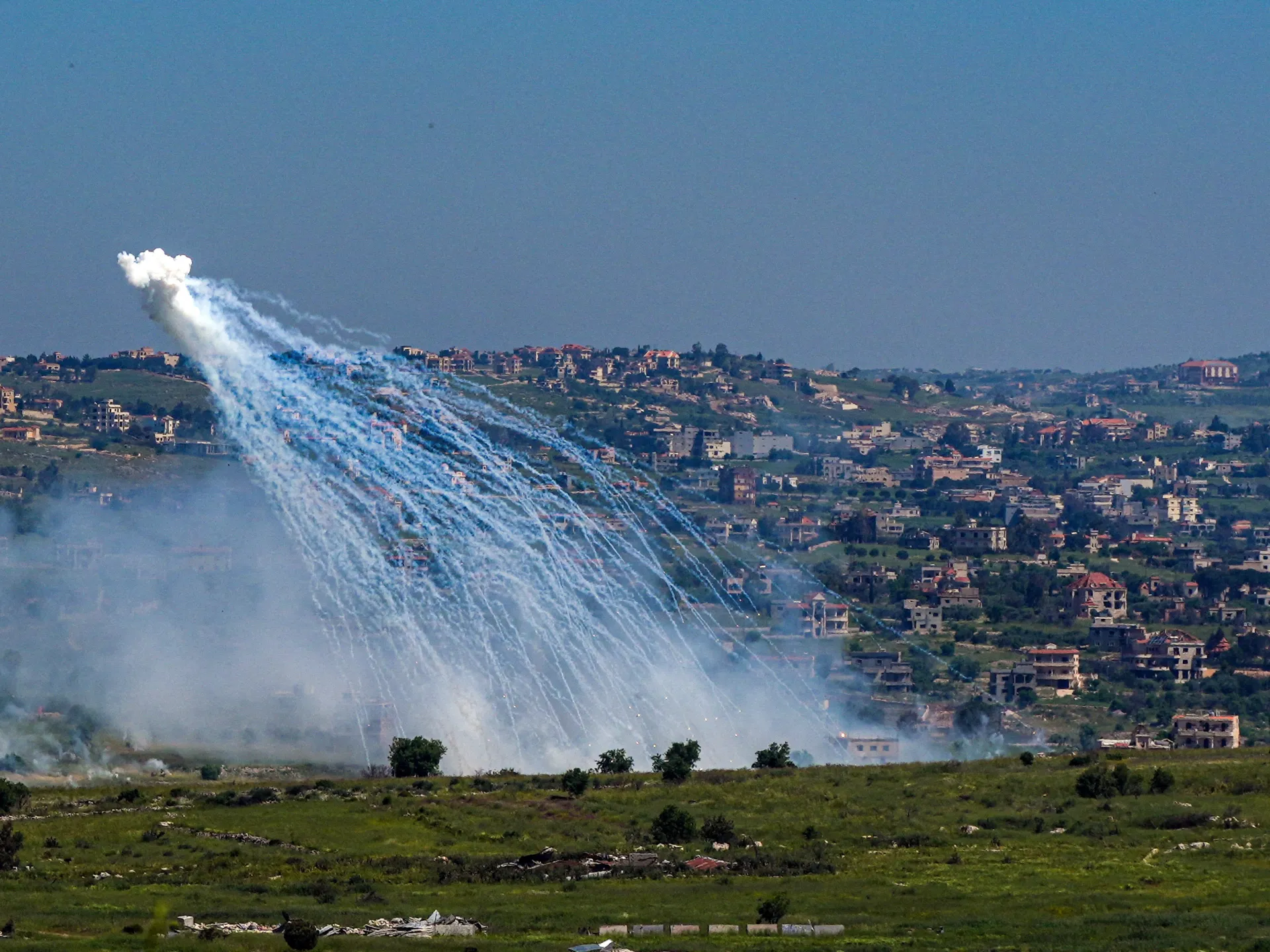
A gas station in Berlin, Germany, displays the latest per liter prices for petrol, diesel and LPG on Thursday after oil prices on global markets surged to their highest level since 2022. Photo by Filip Singer/EPA

April 30 (UPI) — Oil prices briefly topped $126 a barrel in Asian trade overnight as markets reacted to news the United States might resume its military offensive against Iran and fears the Hormuz Strait might remain closed for much longer than anticipated.

Brent crude, the global benchmark, surged to $126.31, its highest level since Russia invaded Ukraine in 2022, after a report that U.S. military commanders were pitching a campaign of “short and powerful” strikes to U.S. President Donald Trump, to force Iran back to the negotiating table.

The price retreated to around $120 by the time markets in Europe opened on Thursday and continued to fall through the morning. The Brent contract for June delivery was trading at $113.91 a barrel in mid-afternoon trade in London, while American crude for June delivery was changing hands at $104.82.

Oil prices have already elevated since the war began on Feb. 28 and began climbing further on Wednesday after Trump met with executives of U.S. oil companies the previous day about how to deal with supply disruption from the closure of the Strait of Hormuz by Iran, which has vowed it will continue until the United States’ blockade of its ports is lifted.

The group discussed “steps we could take to continue the current blockade for months if needed and minimize impact on American consumers,” a White House official said.

Around 25% of the world’s oil supply passes through the strait and the prospect of it remaining effectively closed for months has set alarm bells ringing in markets as traders’ faith in an early resolution fades and “the reality of the supply situation” sets in.

“The breakdown of talks between the U.S. and Iran, along with President Trump reportedly rejecting Iran’s proposal for a reopening of the Strait of Hormuz, has the market losing hope for any quick resumption in oil flows,” said William Patterson, ING’s Singapore-based head of commodities strategy.

Trump has said he believes the regime in Tehran will blink first, saying they were less afraid of the bombing than the blockade, with U.S. officials banking it will force Iran to shutter oil production because the oil has nowhere to go and the country lacks sufficient storage facilities.

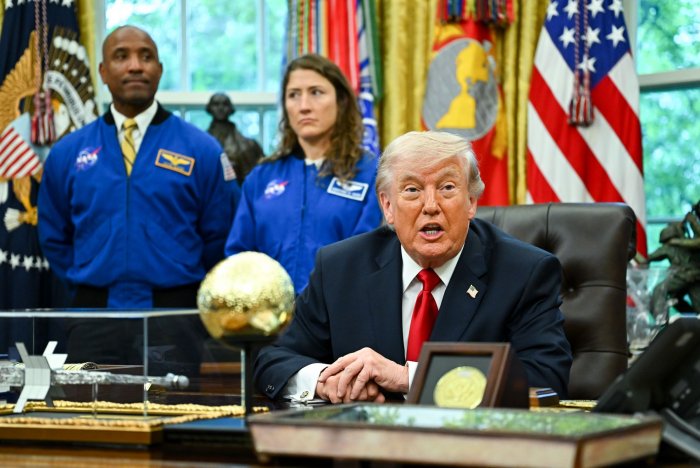
Artemis II pilot Victor Glover (L) and mission specialist Christina Koch meet with President Trump in the Oval Office of the White House on Wednesday. Photo by Graeme Sloan/UPI | License Photo

Source link

UK tourists face travel disruption on May 12 as new strike action confirmed

One airline is reducing its service that day by 60 per cent

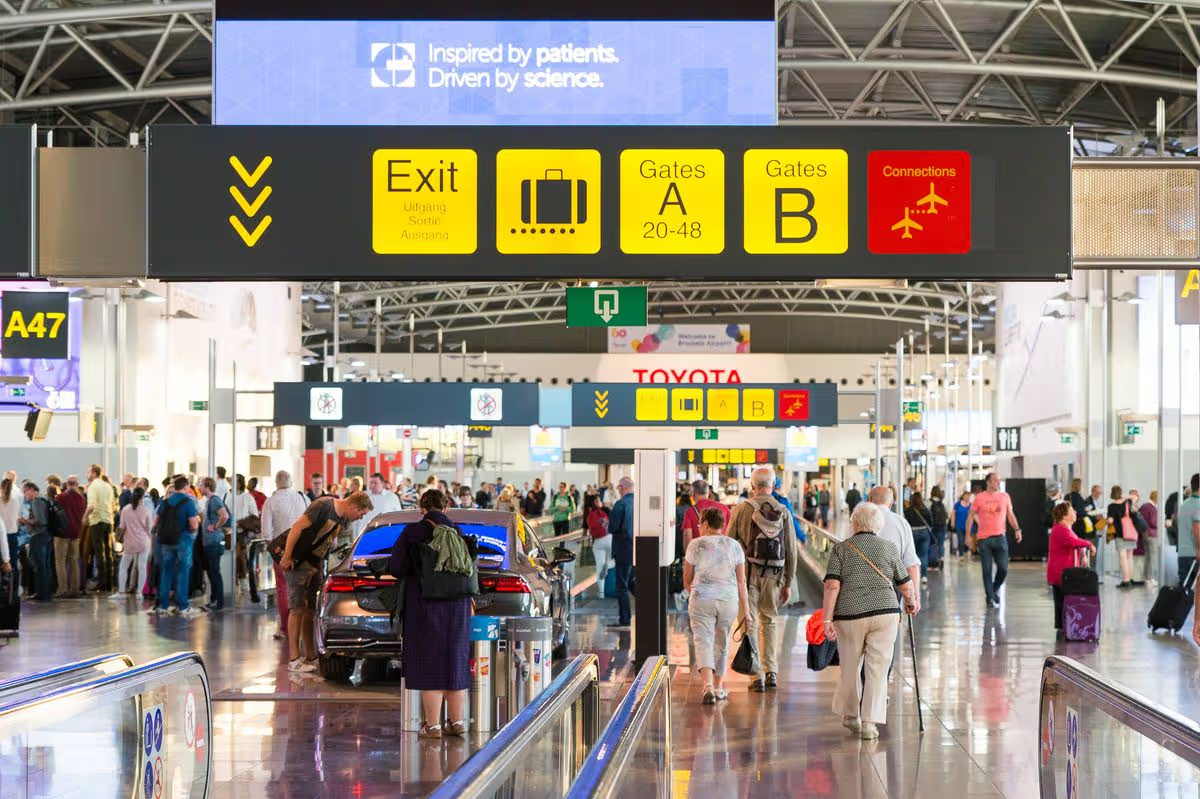
UK holidaymakers are preparing for fresh travel disruption after the announcement of strike action. Media reports today confirm that Brussels Airlines is reducing its service by 60% on May 12. A spokesperson for the carrier confirmed the news on Tuesday.

Disruption that day is a possibility for Brits and others heading there, given that the airline flies regularly to and from London Heathrow, although details of flight cancellations have not yet been disclosed. It also has services to and from Manchester Airport and Edinburgh Airport.

The move follows Brussels Airport’s warning of expected disruption on that date due to nationwide industrial action. Numerous security workers and service providers will be downing tools.

Airlines have been requested to cap the number of departing passenger flights on the day in order to maintain safety and prevent excessive waiting times. The news site 7sur7 reports that the FGTB, CSC, and CGSLB unions are organising another major mobilisation in the streets of Brussels.

It marks the latest wave of strike action to hit the country. No passenger flights took off from Brussels Airport during the previous national demonstration, although commentators say disruptions are expected to be less severe on May 12, according to local media reports. “Just under half of the scheduled departures will be able to operate,” Zaventem Airport estimated.

In addition, strike action is also planned separately in the aviation sector. The Mirror reported on Tuesday that notice was lodged this week that could see strikes involving pilots.

The joint union front (CNE/ACV Puls, CSC Transcom, CGSLB/ACLVB, and Setca/BBTK) has filed a national strike notice for the entire Belgian aviation sector. Approximately 1.3 million Brits visit Belgium annually – suggesting hundreds if not thousands of UK travellers could be impacted on that single day alone. Brussels Airlines is cancelling roughly 60% of its flights that day, Le Soir reported.

Bosses say the long-haul network will bear the brunt, as these flights carry many connecting passengers. For shorter routes, the airline is giving priority to flights with the greatest number of direct passengers. “Further cancellations cannot be ruled out. Passengers whose flights are cancelled can either rebook or request a refund. We continue to monitor the situation closely; further cancellations cannot be ruled out,” says Brussels Airlines.

“Brussels Airlines is not involved in the labour dispute between the unions and the Belgian federal Government. Yet, the consequences always fall on our passengers, our colleagues, and our company. In the current geopolitical context (particularly with high fuel prices, editor’s note), such actions are irresponsible.”

“In collaboration with all relevant partners, Brussels Airport is working to ensure that as many flights as possible can depart that day,” the national airport said in a statement.

The airport, however, anticipates only minimal disruption to incoming flights. Passengers due to land at Brussels Airport that day are still urged to check the latest status of their flight directly with their airline.

The unions announced the fresh mass action at the start of the month. The demonstration forms part of a series of union actions they have been carrying out for over a year in opposition to the federal government’s reforms to policies including pensions.

The most recent national demonstration took place on 12 March. Between 80,000 people (according to the police) and more than 100,000 (according to the unions) took to the streets of Brussels. Not a single passenger flight departed from Zaventem Airport on that occasion.

Your rights as an airline passenger

According to the government’s gov.uk website, your airline, travel agent or tour operator is obliged to give you “clear and easy-to-understand information on the conditions of your travel at the point of booking.” Travellers are urged to check these carefully.

The website says: “Airlines and travel agents selling flight tickets must make clear the full price for all mandatory charges, such as taxes, at the time of booking. They should make clear any additional costs for optional extras. For example, for luggage allowance or seat selection.

“If you have booked a package that includes a flight (such as flight and accommodation or flight and car hire) you may also have both package and ATOL protection. Take your ATOL Certificate with you.”

Source link

Sally Rooney, Greta Thunberg back Palestine Action before court date | Protests News

More than 130 public figures express support for the proscribed group as the UK prepares for another legal fight.

More than 130 public figures have written to the UK’s Court of Appeal expressing support for Palestine Action, days before a hearing to decide on the lawfulness of the government’s ban on the direct action group.

A letter released Friday, bearing 132 signatures and addressed to the UK’s Court of Appeal, read: “We oppose genocide, we support Palestine Action.”

Recommended Stories

list of 4 itemsend of list

The declaration came in advance of hearings scheduled for April 28 and 29, during which the court is slated to hear the government’s appeal to uphold its proscription of Palestine Action.

Internationally known figures, including the writer Sally Rooney, climate campaigner Greta Thunberg and American scholar Judith Butler are among those who signed the declaration.

Others include British musicians Nadine Shah and Brian Eno, writers China Mieville, Lina Meruane and Tariq Ali, along with dozens of professors at leading universities such as Cambridge, Oxford, Yale, Columbia and the London School of Economics.

The letter’s singular sentence has become a well-known slogan used to express support for Palestine Action, which the UK government proscribed as a “terrorist organisation” in July 2025.

That designation – which placed Palestine Action in the same category as Hezbollah and al-Qaeda – makes it illegal to be a member of or express support for the group, offences punishable by up to 14 years in prison.

In February, the UK’s High Court ruled that the government’s ban was unlawful and disproportionate, prompting London’s Metropolitan Police to say it would refrain from arresting demonstrators rallying in support of the group.

But with the government appeal pending, the Met reversed course, and officers arrested more than 500 people at a protest earlier this month.

Defend Our Juries, an activist group that has organised rallies and called for the government to drop its proscription, said in a statement accompanying Friday’s letter that the signatories were vulnerable to “terrorism charges”.

“If the police proceed to arrest these scholars on terrorism charges, the authoritarian nature of the ban will be further exposed,” the group wrote. “But if they don’t, the more than 3,000 previous arrests of people for saying precisely the same thing will be shown to be not just unlawful but arbitrary and discriminatory.”

In their own statements, several signatories expressed solidarity with Palestine Action and called on the government to halt its appeal.

The UK government is “silencing the messenger”, said Neve Gordon, an international law professor at Queen Mary University of London.

“The decision to appeal the ruling rendering the proscription unlawful is yet another sign of the government’s moral bankruptcy,” he added.

Source link

Spain takes action at 24 airports to tackle border control chaos and ease queues – full list

Passengers, especially from Britain, have been facing waits of up to three hours at border control, missing flights after new system was introduced

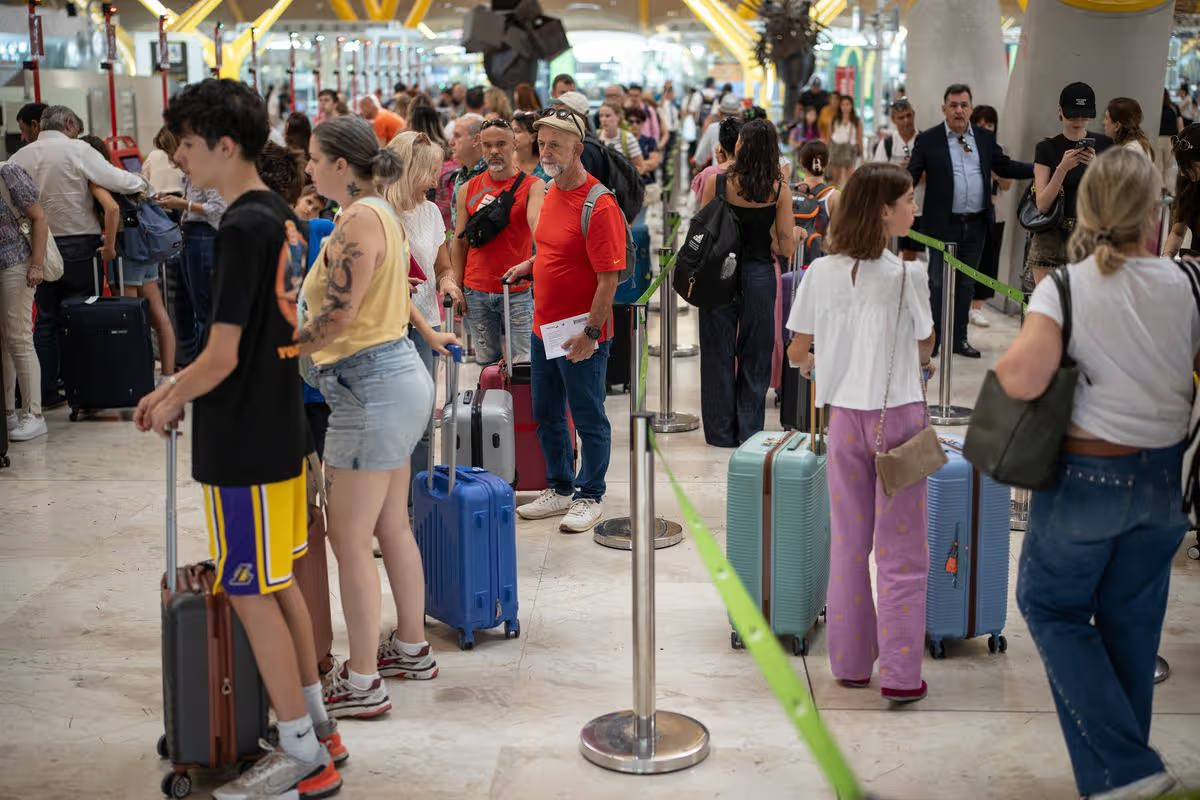
Spanish airports are taking steps to tackle border control chaos affecting British travellers, according to reports from the popular holiday destination. The European Union’s new Entry/Exit System became fully operational on April 10, 2026, and within hours, airports throughout the Schengen zone were plunged into turmoil. Passengers endured waits of up to three hours at border control, missed flights, and were left spending thousands arranging their own journeys home.

Several countries have already responded, with Greece temporarily suspending the new EES entry/exit border control system after non-EU passengers, particularly those from the United Kingdom, encountered lengthy queues. Now the Majorca Daily Bulletin reports that airport authority AENA has apparently directed staff to take whatever measures possible to streamline the process and cut waiting times.

According to VisaHQ, while officials at Madrid-Barajas, Barcelona-El Prat, Málaga, Alicante and Palma airports have confirmed the technology is functioning properly, they have admitted that passenger numbers during peak periods rapidly overwhelmed checkpoint capacity throughout Easter week. Based on guidance issued to frontline personnel on Tuesday evening, airports may temporarily redirect families and travellers with reduced mobility to conventional stamping queues when biometric queue waiting times surpass 25 minutes. They may also stagger flight arrivals through coordination with Aena’s slot management team, a measure already trialled in Málaga. These steps are reportedly “adjustments, not a suspension”, with biometric capture remaining compulsory for first-time registrants.

READ MORE: Spanish airport shuts for five weeks from tomorrow – Ryanair flights cancelled

The new EES system, which was initially introduced back in October, has faced substantial criticism from the travel industry and airlines, and several countries are said to be weighing up whether to follow Greece’s lead with the summer season mere weeks away and the travel sector having to contend with the Middle East crisis alongside threats of fuel shortages and rising airfares, which are doing little to bolster consumer confidence.

AENA airports

  • A Coruña (LCG)
  • Adolfo Suárez Madrid-Barajas (MAD)
  • Albacete (ABC)
  • Algeciras (AEI)
  • Alicante-Elche Miguel Hernández (ALC)
  • Almería (LEI)
  • Asturias (OVD)
  • Badajoz (BJZ)
  • Bilbao (BIO)
  • Burgos (RGS)
  • Ceuta (JCU)
  • César Manrique-Lanzarote (ACE)
  • Córdoba (ODB)
  • El Hierro (VDE)
  • Federico García Lorca Granada-Jaén (GRX)
  • Fuerteventura (FUE)
  • Girona-Costa Brava (GRO)
  • Gran Canaria (LPA)
  • Huesca-Pirineos (HSK)
  • Ibiza (IBZ)
  • Jerez (XRY)
  • Josep Tarradellas Barcelona-El Prat (BCN)
  • La Gomera (GMZ)
  • La Palma (SPC)

Budget carrier Ryanair this week announced that passengers requiring its airport check-in or bag-drop services will need to complete the process 20 minutes earlier. The airline confirmed it will close these services an hour before a flight’s scheduled departure – compared with 40 minutes at present – to allow passengers additional time to navigate security and passport checks. This will cut down on the “very small number of passengers” who miss their flight while caught in queues, the airline added. Ryanair’s website states that passengers who fail to check in on time “may be denied boarding without refund”.

The new policy will take effect from November 10 and follows the introduction of the EES.

The British travel association ABTA has said that alongside implementing the contingency measures, destinations and border authorities must do more to prepare for peak travel periods. This should include deploying additional border guards during the busiest times. Mark Tanzer, Chief Executive of ABTA – The Travel Association said: “The ambition of a project like EES means it was never going to go completely smoothly, and we were prepared for that.

“However, what is frustrating is that border authorities have it within their power to ease queues and deal with issues as they arise – but that doesn’t seem to be happening across the board. As we head towards peak travel periods, we’re urging border authorities to plan for busy periods and use the contingency measure available. It’s critical the Commission keeps a close eye on this.”

Ryanair chief marketing officer Dara Brady said the “small 20-minute change” will “allow these 20% of our customers who check in a bag more time to clear through airport security and passport queues, and get to their departure gate on time”. He added that this will be particularly important “during busy travel periods when some of these airport queues can be longer”. Numerous UK travellers are experiencing hold-ups at airports across continental Europe due to the introduction of new border regulations.

The EU’s Entry/Exit System (EES) requires visitors from non-member countries such as the UK to have their fingerprints recorded and photograph captured to enter the Schengen Area, which comprises 29 European countries, predominantly within the EU.

Earlier this month, over 100 easyJet passengers caught up in lengthy waits at passport control at Milan Linate airport missed their flight to Manchester. Ryanair has announced it is rolling out additional self-service bag drop kiosks throughout its network.

By October, more than 95% of the airports it operates from will be equipped with these facilities.

Source link