250th

Chris Stapleton and Chaka Khan celebrate America’s 250th at the L.A. Coliseum

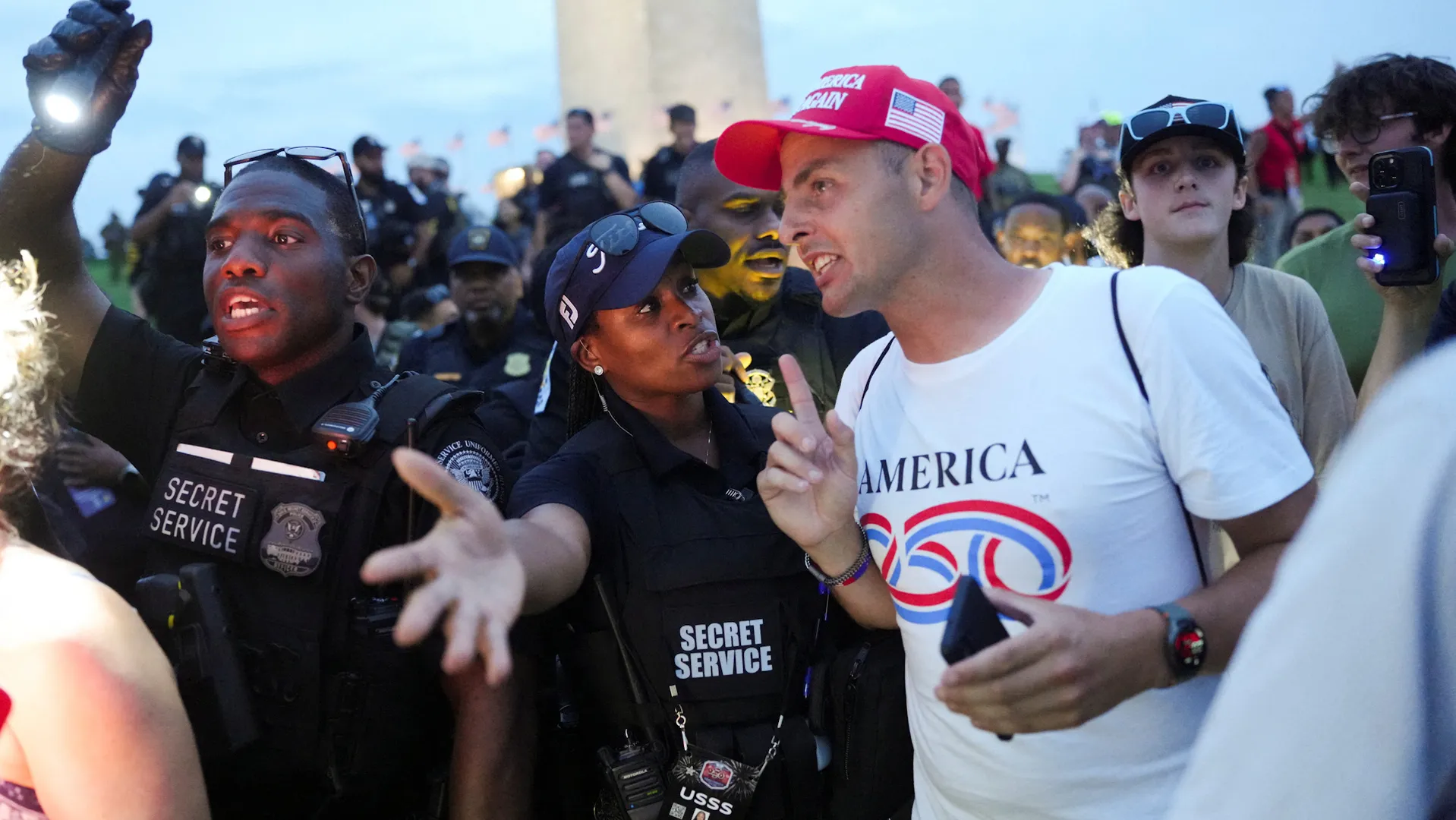
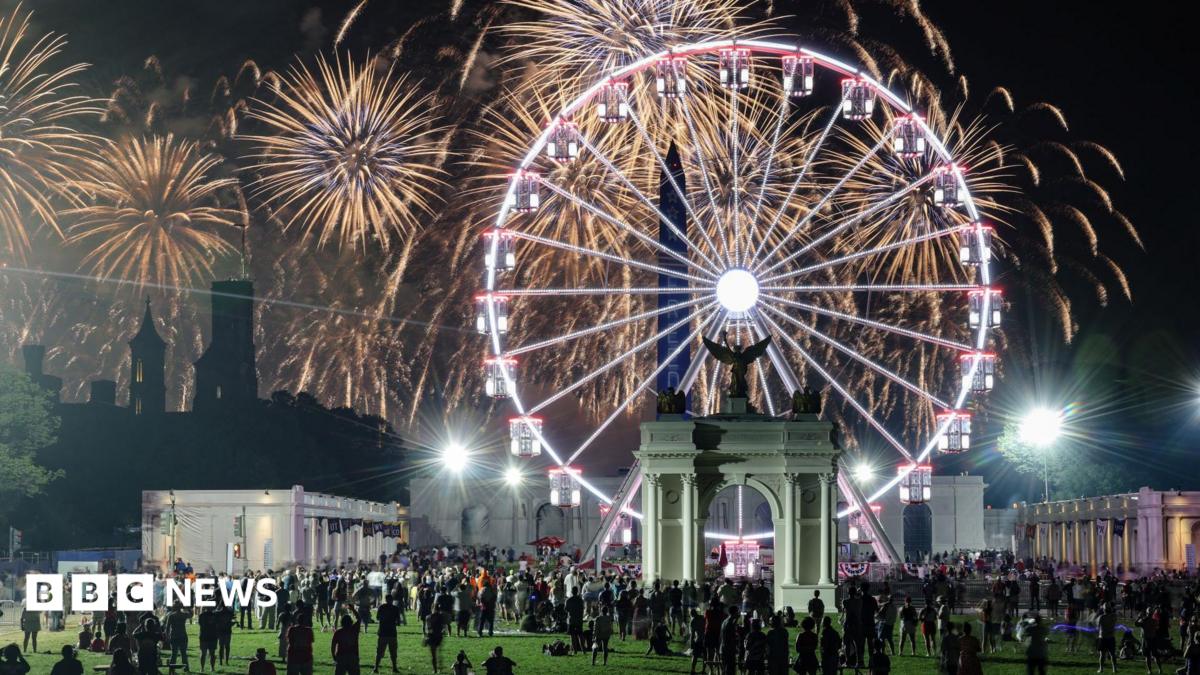
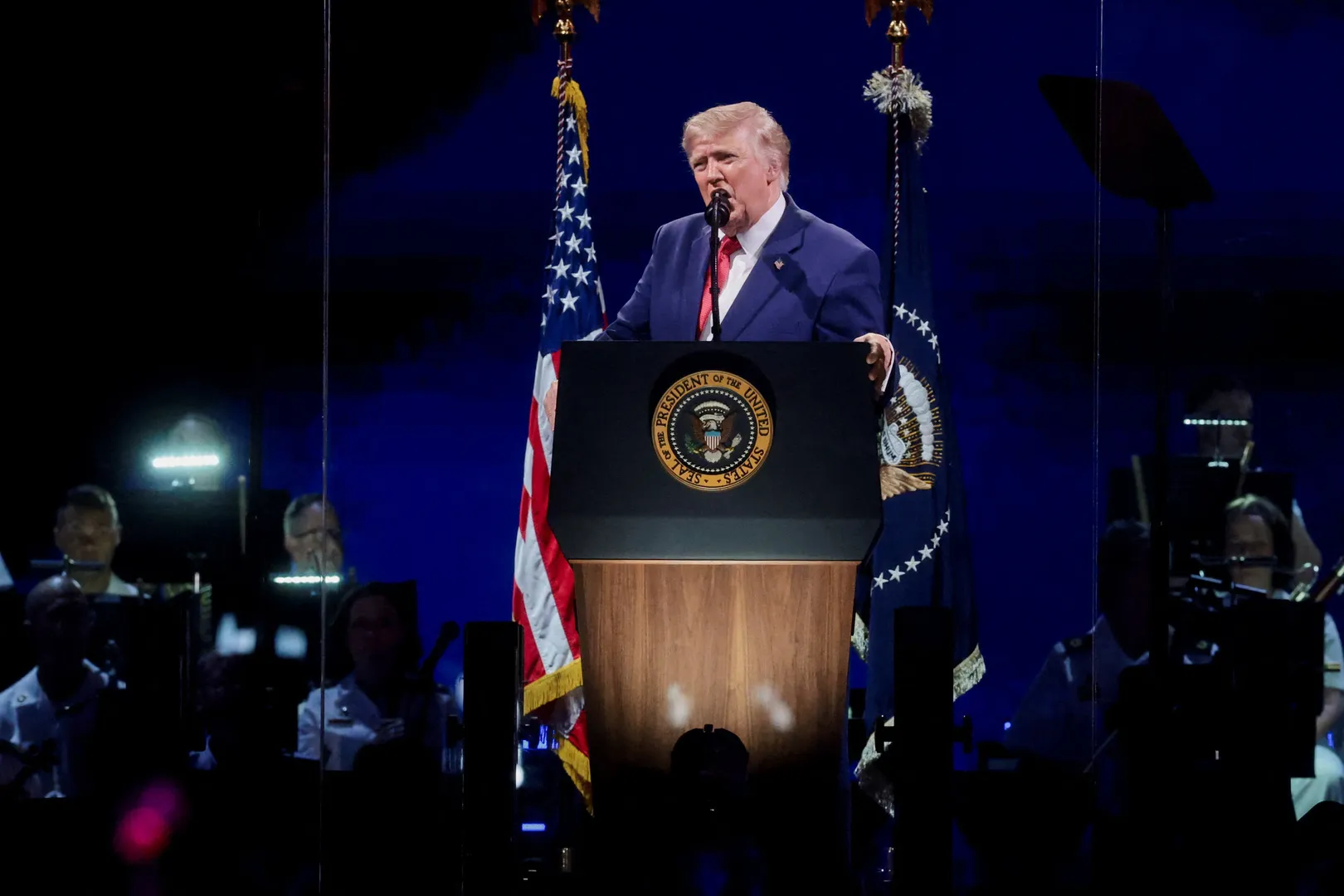
In New York, the Brooklyn Bridge went up in flames briefly during a fireworks display. In Washington D.C., stormy weather delayed a grievance-filled speech by President Trump.

And here in Los Angeles? On Saturday night, tens of thousands of Angelenos joined voices peacefully at the L.A. Memorial Coliseum to sing along with Chris Stapleton as the country star compared a lover to Tennessee whiskey.

A unifying cultural figure beloved by both liberals and conservatives, Stapleton was the headlining act at a Fourth of July benefit concert that also featured Smashing Pumpkins, Chaka Khan, Maren Morris and Queen Latifah. (I’d be surprised if those five names had previously appeared together in the same sentence.) The show, with tickets priced at $17.76, was presented by America250, a bipartisan commission that Congress created in 2016 to plan celebrations for the country’s 250th birthday; proceeds went to Feeding America, which calls itself the largest domestic hunger-relief organization in the United States.

  • Share via

“No politics — just purpose” is how America250 Chair Rosie Rios described the night in remarks from the stage, and it wasn’t hard to interpret the distinction she was seeking to draw between her group and Freedom 250, Trump’s rival semiquincentennial initiative that organized Saturday’s windblown event on the National Mall (not to mention an earlier concert by Vanilla Ice that was called off due to the threat of rain).

But here’s the thing: Compared with the president’s celebration, where he complained about his treatment by the justice system and suggested we should refer to his current term as his third, the show at the Coliseum really did feel like a politics-free zone — the somewhat rare occasion these days when folks from different walks of life come together just to listen to music and drink overpriced micheladas.

Said Stapleton not long into his set: “I won’t waste time talking.”

America250’s success was hardly a sure thing. Despite the relatively low price, tickets moved slowly in the weeks before the concert; one guy I talked to Saturday told me he’d paid six bucks for a discounted pass. Yet to my eyes the Coliseum was close to full by the time Stapleton came on.

The country singer was as solid and soulful as always, snarling gently through “Bad as I Used to Be,” then trading loving harmonies with his wife, Morgane, in “Millionaire.” He closed with “Tennessee Whiskey,” of course — a trusty yet somehow un-shopworn piece of Americana that’s earned a place on the shelf next to Ray Charles’ “Georgia on My Mind” and Willie Nelson’s “Angel Flying Too Close to the Ground.”

Smashing Pumpkins was perhaps a stranger fit for an explicitly patriotic event — “The world is a vampire,” frontman Billy Corgan sneered in “Bullet With Butterfly Wings” — yet the band sounded sharp and punchy in the ’90s alt-rock hits that have brought zoomers and even Gen Alpha kids into its audience.

Billed not inaccurately on the concert’s poster as “the legendary Chaka Khan,” the 73-year-old funk doyenne flexed her vocal chops in jammy renditions of “Ain’t Nobody” and “Tell Me Something Good” and got people hoisting their drinks for “I’m Every Woman.” Morris, who’d flown in from New York after attending her pal Taylor Swift’s wedding on Friday night, made an improbably smooth segue between her and Zedd’s synthed-up “The Middle” and the rustic “My Church.”

As the show’s host, Queen Latifah dispensed uplifting thoughts about American idealism throughout the evening but also got a slot of her own to do her classic “U.N.I.T.Y.” with help from a rambunctious drum line. It’s an unapologetic message song about demanding respect, and what was moving about hearing it here is that nobody seemed put off by that idea.

I’ll wave a flag for that.

Here are more photos from Saturday’s concert:

Chaka Khan performs.

Chaka Khan performs.

(Myung J. Chun / Los Angeles Times)

Queen Latifah hosted the show.

Queen Latifah hosted the show.

(Myung J. Chun / Los Angeles Times)

A couple in patriotic garb share a kiss.

A couple in patriotic garb share a kiss.

(Myung J. Chun / Los Angeles Times)

Smashing Pumpkins performs.

Smashing Pumpkins performs.

(Myung J. Chun / Los Angeles Times)

A concertgoer enjoys confetti.

A concertgoer enjoys confetti.

(Myung J. Chun / Los Angeles Times)

Maren Morris performs.

Maren Morris performs.

(Myung J. Chun / Los Angeles Times)

Source link

Extreme weather disrupts US’s 250th anniversary celebrations | Donald Trump

NewsFeed

Extreme weather disrupted the US’s 250th anniversary celebrations, forcing evacuations, cancellations and delays. Despite setbacks including a National Mall evacuation and a fireworks display setting the Brooklyn Bridge on fire, Trump called the day ‘one of the most joyous and glorious’ in US history.

Source link

America celebrates its 250th birthday after another rough year

Happy Birthday, America!

You turned 250 on Saturday and, honestly, you don’t look a day over 249. (Ha ha.)

Seriously, it’s perfectly understandable why there’s more gray on your scalp and deeper worry lines on your face. This last year has been another challenging one, to say the least. (And we thought the one cataloged 12 months ago in this space was rough.)

The country is caught up in an unpopular, on-again, off-again war with Iran that was recklessly launched by President Trump with far more swagger than foresight. In an utterly predictable move, Iran choked off the the Strait of Hormuz, a vital passageway for the world’s oil, sending gasoline prices skyrocketing. Though they’ve fallen since the announcement of a shaky ceasefire agreement, the cost of filling up is still significantly higher than a year ago.

Of course, costlier oil means virtually everything else has become more expensive. Trump was reelected in good part because he vowed to tame inflation on his very first day in office. Instead, it’s reached a three-year high.

The ground beef served up at many July 4 cookouts costs 75 cents a pound more than it did a year ago. A package of hamburger buns is up 15 cents. The price of hot dogs and other picnic staples have also increased, along with just about every other item at the grocery store.

Chew that over with your corn on the cob. (Up roughly 2.5% from July 2025.)

Meanwhile, Trump enriched himself to the tune of $2.2 billion during his first year in office alone. Treating the U.S. treasury like his personal cash cow, the president has lavished hundreds of millions of taxpayer dollars on vanity projects such as a personally kitted out Air Force One — a “gift” from Qatar that Trump plans to keep after retirement — and a gilded White House ballroom, rising where the demolished East Wing used to stand. Plans are underway for a grand, marble arch in Washington celebrating, well, you know who.

At the same time, Trump has squandered money and resources pursuing political vendettas, persecution of his enemies and fruitless investigations like the one probing “theft” of the 2020 election and “vandalism” at the algae-clogged Reflecting Pool he promised and failed to rehab.

All this while millions of Americans have lost healthcare coverage and/or federal food assistance, all thanks to the One Big Billionaire Bounty bill that Trump signed into law a year ago.

It’s all a bit unnerving isn’t it, America? You’re on edge in a way you haven’t been in at least a generation.

In Minnesota, in the dead of winter, two of your citizens were gunned down by federal officers as they engaged in that most American of exercises, registering dissent against the policies of their government. From sea to shining sea, innocent Americans have been arrested — and sometimes shipped abroad — and immigrant communities cower in fear of federal agents who often seem bent more on meeting deportation quotas than meting out justice.

You’re divided, America, in ways no one alive has ever seen.

It starts at the very top. Trump acts as though he’s president of a favored rump group — his political supporters — rather than the nation as a whole. He’s used your 250th birthday not to celebrate those many grand and glorious things that hold us together as Americans but to bask in the tanning-bed glow of his immeasurable self-regard.

But, heck, if it’s any consolation on this star-spangled holiday weekend, the country has been through worse. Much worse. And you, America, have not only survived but in many ways grown stronger by surmounting obstacles, facing down your flaws and overcoming some knee-buckling, soul-crushing challenges.

Slavery. Civil war. Racist exclusionary laws. Genocide against indigenous peoples. Two worldwide conflicts. Depression. Financial crises. And too many deadly natural disasters — fire, floods, earthquakes, hurricanes — to enumerate.

Your treatment of some Americans, it should be said, hasn’t always been fair and just. It still isn’t.

People are despairing over the Supreme Court and its genuflecting deference to the president. The justices of its conservative majority have done just about everything short of handing Trump a crown and scepter to reign as a virtually untouchable, imperial president.

But it’s worth noting that earlier court majorities held that Black Americans — “beings of an inferior order,” in the words of the wretched Dred Scott decision — could be denied citizenship, that racial segregation was constitutional and that compulsory sterilization based on eugenics was perfectly fine from a legal standpoint.

That ugly, sordid history won’t necessarily make anyone feel better about the current state of affairs, nor should it. But it does offer some perspective and, with it, hope.

This weekend is best celebrated honoring the country’s many good things and the bright, shining place that America aspires to be, with liberty and justice for all. So chin up! Have another slice of birthday cake, America, and don’t worry about the calories — you really do look terrific for 250!

Going forward it’s up to us, your citizens, to keep working toward that more perfect union mentioned in the preamble to the Constitution. Whatever ails you, America, the remedy resides with we the people and the power we hold, particularly at the ballot box.

Unhappy with the wrecking crew that’s heedlessly chain-sawed federal programs and allowed Trump to money-grub with both fists, defile the White House and undermine our rule of law? Send a message and vote ‘em out, starting in November’s midterm election. And bear in mind the damage that’s been wrought come the 2028 presidential race.

Don’t stop believing that, as dark and difficult as things may seem right now, better days lie ahead.

That undimmed and abiding faith is what makes America great.

Source link

Trump lauds Americans in storm-delayed 250th anniversary speech | Newsfeed

NewsFeed

US President Donald Trump has praised the US as the ‘greatest force for peace and justice on Earth’, in a speech marking the 250th anniversary of the nation’s founding. Trump’s speech and the main celebrations were delayed by several hours by extreme thunderstorms.

Source link

MQ-25 Stingray Demonstrator Goes Aboard USS Nimitz For 250th U.S. Anniversary Celebrations

The U.S. Navy has confirmed to TWZ that the MQ-25 Stingray demonstrator drone, also known as T-1, is embarked on the supercarrier USS Nimitz. Pictures of Nimitz with the uncrewed aircraft on its deck had prompted questions about whether the initial production representative MQ-25, which made its maiden flight in April, had now gone aboard a carrier for the first time. We now know that is not the case. Regardless, the images of T-1 aboard Nimitz still underscore just how big the Navy’s first advanced carrier-based drone actually is, especially when placed next to other aircraft in the air wings. Production MQ-25s will be an important and imposing presence when they enter operational service, something the service hopes will finally start next year.

“We do indeed have a Boeing-owned T-1 prototype currently onboard,” a Navy spokesperson told TWZ today when asked about the drone seen on Nimitz‘s deck.

A view of T-1 and other aircraft on the deck of USS Nimitz. USN/Seaman Johnathan McCune

The spokesperson directed us to contact Naval Air Systems Command (NAVAIR) for more information about the current status of the MQ-25 program. T-1 has been flying since 2019 and has taken part in a slew of testing in support of the development of the Stingray in the air and on the ground. This also includes deck handling testing aboard the Nimitz class carrier USS George H.W. Bush in December 2021, something we will come back to later on. T-1 has never taken off from or landed aboard a Navy carrier, and would have had to be transported aboard Nimitz.

Another view of Nimitz, with the T-1 MQ-25 demonstrator and other aircraft on its deck, taking part in a group sail photo op as part of Fleet Exercise 250 on June 25, 2026. USN

“To honor the United States’ 250th anniversary, the MQ-25A T1 prototype is aboard the USS Nimitz, offering a glimpse of the Navy’s carrier air wing of the future,” Boeing has now also written in a post on X. “The special ‘Boeing Backs America’ mark highlights our support for U.S. aviation.”

The USS Nimitz has been sailing in the Atlantic Ocean as part of Fleet Exercise 250 (FLEETEX 250). This is a large, multi-national event that is running concurrently with several celebrations marking the 250th anniversary of the United States. In addition to the United States, Belgium, Brazil, Canada, Cameroon, Côte d’Ivoire, Cyprus, Denmark, France, Germany, Mexico, Morocco, the Netherlands, Norway, Peru, Senegal, Spain, Turkey, and the United Kingdom are also taking part, according to the Navy. As part of FLEETEX 250 activities last week, Nimitz had taken the lead in a group sail photo exercise that included 25 other naval vessels from 13 of the participating countries.

A full view of the ships participating in the FLEETEX 250 group sail photo op on June 25, 2026. USN

“USS Nimitz is underway taking part in Fleet Exercise (FLEETEX) 250 alongside 25 other warships, multi-national aircraft, and their crews, conducting a series of structured training events at-sea,” a Navy spokesperson had also told TWZ last week in response to queries about that ship after it was spotted leaving Mayport, Florida, on June 25. “Following FLEETEX, we are scheduled to take part in another major event celebrating our nation’s 250th birthday.”

The T-1 demonstrator was lashed to the carrier’s deck for the pictures, along with four F/A-18E Super Hornet fighters and two C-2A Greyhound carrier onboard delivery aircraft. The drone notably has new “250” markings written in blue on both sides of the fuselage.

A picture offering a look at the current markings on T-1. US Navy via Boeing
Another view of T-1’s new markings. USN

As noted, T-1’s size stands out when parked next to the F/A-18Es, which are themselves not small aircraft. The production MQ-25 has a wingspan of 75 feet, according to Boeing. With its wings folded, the drone is still 31.3 feet across, as well as 51 feet long. For comparison, the Super Hornet’s wingspan is nearly 45 feet and it is just over 60 feet long, per the Navy.

T-1 looks large even when contrasted with the C-2As, at least with their wings folded. With its wings extended, the Greyhound is 80 feet, seven inches from tip to tip, according to the Navy. It is also 56 feet, 10 inches in length.

A close-up view of T-1 on Nimitz’s deck offering more of a visual comparison to the F/A-18Es parked alongside, as well as the C-2A at bottom left. USN

All of this underscores the amount of work the Navy will have to do to get production MQ-25s ready for routine operational use. As we wrote roughly a year ago, when the start of ground testing of the production representative Stingray was announced:

The Stingrays will also have to be woven into the existing cadence of flight deck operations, including just figuring out how to move them around amid the hustle and bustle of other activity. Carrier decks are very constrained environments physically, and present very different conditions to operate in compared to bases on land. This is true even for crewed aircraft operations, where individuals onboard can provide additional situational awareness. A wearable glove-like system that personnel could use for deck handling was notably used during testing of the X-47B. A different kind of portable control device has been used in testing of the T-1 MQ-25 demonstrator in the past, as well. The video released today does not appear to offer any major new insights into how the Navy plans to maneuver the Stingray around on carrier decks.

T-1 seen during deck handling testing aboard the USS George H.W. Bush. USN

This is on top of more general flight testing, including demonstrating that the drones can safely take off from and land on Navy carriers, as well as integration with the control systems on those ships. The MQ-25 will bring new tactics, techniques, and procedures to the service’s carrier air wings, as well as open the door to further operational developments.

Right now, the MQ-25’s principal mission will be extending the reach of other aircraft in the carrier air wing. This is a critical capability for the Navy as adversary anti-access and area denial bubbles, especially ones that China’s People’s Liberation Army (PLA) has established and continues to expand, threaten to push carriers out of reach of target areas.

By extension, the Stingray will also eliminate the need to use crewed F/A-18F Super Hornets in the tanker role, freeing them up for other missions and reducing wear and tear on those airframes.

The drones will also come with a built-in secondary intelligence, surveillance, and reconnaissance (ISR) capability, thanks primarily to a sensor turret under the nose. The size of the MQ-25, its extreme range potential, and other attributes of the design could well lead it to be adapted to other roles in the future, such as a long-range strike platform, as TWZ has previously explored in detail.

A look at T-1 in flight from below. Boeing

Showcasing the T-1 during FLEETEX 250 does highlight the Stingray program and its importance to the Navy. The effort has faced significant delays and cost growth in recent years, with the original goal being for the MQ-25 to have reached initial operational capability (IOC) in 2024. As noted, the first production representative example only flew in April, despite a major push by the Navy and Boeing to hit that milestone before the end of 2025. When that drone might make its first appearance on a carrier deck remains to be seen, but the Navy is now aiming to reach IOC sometime next year.

As an aside, carrying T-1 for display during FLEETEX 250 and associated events may be the extent to which Nimitz ever embarks any MQ-25s. The Navy has extended the carrier’s service life due to a number of factors, but only into March of next year. The USS George H.W. Bush received a first-of-its-kind drone control center in 2024. The Navy subsequently moved to install that equipment on the USS Carl Vinson, USS Theodore Roosevelt, and USS Ronald Reagan, creating an initial group of Nimitz class carriers that will be able to operate the Stingrays.

USN

The Navy also sees the MQ-25 as a ‘pathfinder’ to future uncrewed additions to its carrier air wings. This is set to include carrier-based Collaborative Combat Aircraft (CCA) drones, an effort that is still very much in its infancy. Navy officials have talked in the past about a goal to see the makeup of future carrier air wings be 60 percent or more uncrewed.

In the meantime, T-1’s latest appearance on the deck of the USS Nimitz has already underscored the big changes coming to Navy carrier air wings, both figuratively and literally.

Contact the author: joe@twz.com

Joseph is TWZ’s Deputy Editor, helping to oversee the site’s highly experienced and dedicated team, while also writing informative and impactful defense and national security content. He lives right in the thick of it in the Washington, D.C. area.


Source link

A politically charged holiday: The US celebrates its 250th anniversary | Arts and Culture News

In many ways, Saturday was a typical July 4 holiday in the United States.

The country marked the anniversary of its Declaration of Independence with hotdog-eating contests, parades, fireworks and baseball games.

But this Independence Day was different, not least because it marked the country’s semiquincentennial: the 250th year since the US’s founding.

It also was one of the most politically charged Independence Day celebrations in recent memory.

President Donald Trump is expected to speak this evening from the National Mall in Washington, DC, right before what has been billed as the “world’s largest fireworks display”.

More than 850,000 fireworks are expected to launch from barges in the Potomac River, lighting up the sky above the capital.

But while Independence Day festivities have long been billed as non-partisan events, Trump has pledged to make the night’s celebration “the most spectacular TRUMP RALLY of them all”.

The event comes as Trump’s Republican Party seeks to defend its control of Congress in November’s midterm elections, with a heated primary season already under way.

Trump’s involvement in the semiquincentennial has long been controversial.

On January 29, 2025 — just nine days into his second term as president — Trump issued an executive order establishing a White House task force to oversee celebrations for the 250th anniversary. Trump named himself its chair.

That task force would eventually set the groundwork for Freedom 250, a public-private partnership that organised some of the biggest events of the semiquincentennial, including the Great American State Fair on the National Mall.

But Freedom 250 was accused of funnelling resources away from America250, a congressionally approved panel that had likewise been charged with planning semiquincentennial celebrations since its founding in 2016.

The existence of the two groups has also spurred confusion. In late May, for instance, a suite of performers dropped out of the Great American State Fair, alleging they had been misled about its affiliation with Trump.

Before Saturday’s events, Democrats in the House of Representatives released a report (PDF) accusing Trump of using Freedom 250 for political purposes, including by awarding contracts to Trump allies.

It also alleges that Freedom 250 has been “operating outside the transparency and accountability requirements” Congress imposes on such celebrations — and that it may even have committed wire fraud by redirecting “unsuspecting donors” away from America250 and towards its own programmes.

“Under President Donald Trump, this anniversary has been hijacked and perverted into a hotbed of corruption and self-enrichment,” the report reads.

But speaking at a naval parade in New York City on Saturday, Vice President JD Vance brushed aside the criticisms. He called on revellers to reject the “small but loud voices” that “speak obsessively” of the US’s “imperfections”.

“What I’d ask you to do, my fellow Americans, on our 250th birthday, is to reject the two-dimensional view of your fellow citizens and reject the two-dimensional view of your country,” he said.

“Reject that America is a place for zero-sum thinking because it is not. Our history is one of people carving a great civilisation out of the wilderness. Reject the view of your nation that sees only its sins but not its grace and its greatness.”

Source link

Trump praises army, rails against communism in US 250th anniversary speech | Donald Trump News

At Mount Rushmore, Trump warns of ‘communist menace’, ties rhetoric to immigration ahead of November midterms.

United States President Donald Trump has used the opening weekend of the nation’s 250th anniversary celebrations to praise the US military and critique democratic socialists, warning of a “communist menace” that he claims poses a major threat to the country.

Speaking beneath the granite monument at Mount Rushmore on the eve of Independence Day on July 4, Trump invoked national identity and ideology ahead of the November midterm elections.

Recommended Stories

list of 3 itemsend of list

“We created the strongest and most powerful military. We won two world wars,” he said, claiming that the Cold War had left the US’s enemies “in the depths of history”.

He also said the US “beat Venezuela in one day” and “knocked the hell out of Iran”.

The address comes amid voter concerns over persistent inflation and elevated energy prices driven by the ongoing US-Israel conflict with Iran.

Briefly addressing the Iran war, Trump said Tehran is “dying to settle” and that Washington had granted “a week off for a funeral because we’re nice”, in reference to the days-long state funeral being held for late Iranian Supreme Leader Ali Khamenei, who was killed in a strike on the first day of the US-Israeli war.

‘Communist menace’

A larger chunk of Trump’s address was focused on what he considers ideological threats at home.

“There is now a resurgence of the communist menace in our land, including from newcomers to our country who embrace ideas totally opposed to our way of life,” the president said, calling communism “the enemy of the Constitution”.

He pledged that “the citizens of the United States of America will vanquish communism quickly.”

Trump tied his anti-communist rhetoric to a hardline immigration stance, suggesting that left-wing political figures and certain undocumented arrivals should be removed from the country.

His remarks followed a string of recent progressive primary victories in US states including New York, Colorado and Texas.

He labelled the rise of democratic socialists the “greatest threat to our country since its founding”, comparing the movement’s potential impact with World War II and the September 11 attacks.

He closed the address by calling the anniversary “the beginning of the golden age of America.”

Trump’s ‘grip on America steadily slipping away’

Speaking to Al Jazeera, Republican strategist Eli Bremer said parts of the speech were unifying enough that they “could have been delivered by Ronald Reagan … 45 years ago,” but added that “the gap between the American left and the American right has really never been wider”.

However, Democratic strategist and former Obama campaign adviser, Ameshia Cross, told Al Jazeera that Trump wants to wipe out the country’s diverse history.

Trump “is upset that there is a younger crop of Democrats who are running and winning across this country,” she said, adding that the speech reflected “a president who sees his grip on America steadily slipping away”.

She noted that it also came “on the heels of him losing a Supreme Court decision just a couple of days ago to eradicate birthright citizenship“.

The address highlighted the contrasting visions framing the country’s milestone anniversary.

In New York, progressive Mayor Zohran Mamdani offered an alternative narrative during a naturalisation ceremony, using a desk once belonging to George Washington to praise immigrants’ contributions and frame civic dissent as patriotism.

Democrats have also criticised the administration’s handling of the anniversary, alleging a conservative group took control of 250th-anniversary planning from a previously bipartisan congressional commission.

Source link

Bunker Talk: Happy 250th Birthday United States Of America Edition!

I hope all our American readers, have a great weekend enjoying the 250th birthday of the United States of America! Sit back, have a brew and a dog, smoke a cigar, enjoy the fireworks! And, above all else, watch tomorrow’s flyby!

Have a great weekend everyone and happy bday Lady Liberty!

This week’s caption reads:

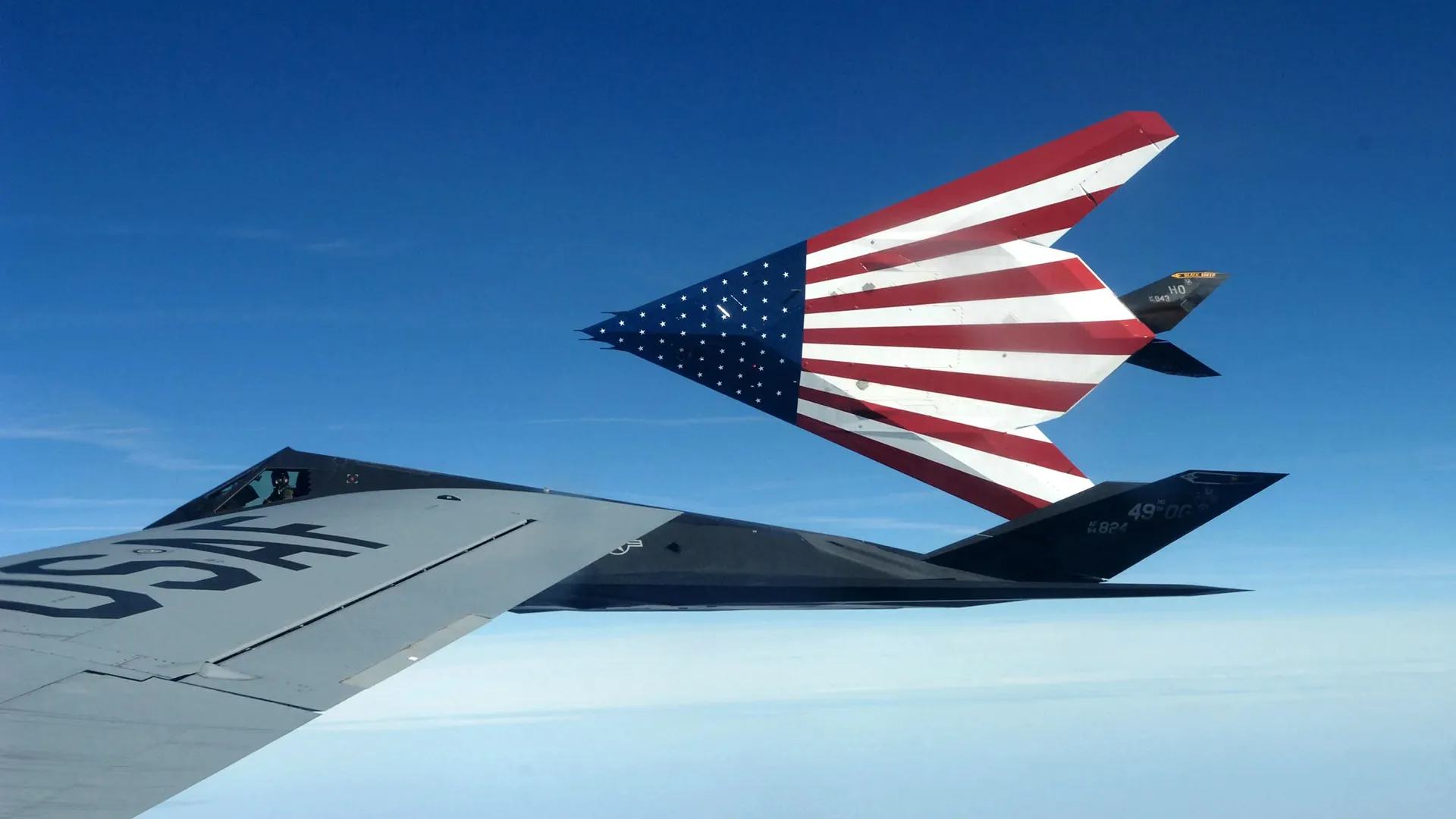
A F-117 Stealth Fighter from the 49th Fighter Wing, based at Holloman Air Force Base in New Mexico, shows off its paint job during a March 12 refueling mission flown by the Columbus-based 121st Air Refueling Wing of the Ohio Air National Guard. (Photo/Senior Master Sgt. Kim Frey)

Prime Directives:

  • If you want to talk politics, do so respectfully and know that there’s always somebody that isn’t going to agree with you. 
  • If you have political differences, hash it out respectfully, stick to the facts, and no childish name-calling or personal attacks of any kind. If you can’t handle yourself in that manner, then please, discuss virtually anything else.
  • No drive-by garbage political memes. No conspiracy theory rants. Links to crackpot sites will be axed, too. Trolling and shitposting will not be tolerated. No obsessive behavior about other users. Just don’t interact with folks you don’t like. 
  • Do not be a sucker and feed trolls! That’s as much on you as on them. Use the mute button if you don’t like what you see.  
  • So unless you have something of quality to say, know how to treat people with respect, understand that everyone isn’t going to subscribe to your exact same worldview, and have come to terms with the reality that there is no perfect solution when it comes to moderation of a community like this, it’s probably best to just move on. 
  • Finally, as always, report offenders, please. This doesn’t mean reporting people who don’t share your political views, but we really need your help in this regard.

Tyler’s passion is the study of military technology, strategy, as well as foreign policy, and he has fostered a dominant voice on those topics in the defense and national security space. Tyler was the creator of the hugely popular defense site Foxtrot Alpha before developing TWZ, which he continues to lead as the Editor-In-Chief to this day.


Source link

Trump refashions America’s 250th as a celebration of himself

Small towns across America had big plans to celebrate the nation’s semiquincentennial this weekend. Local historical societies scheduled town square readings of the Declaration of Independence, hired bands to play patriotic tunes, organized parades and set up themed baking contests.

But many of their most ambitious plans were scrapped after the Trump administration cut $100 million in federal funding for humanities nonprofits and state councils at the start of its term. The decision severely hampered local planning for America’s 250th anniversary, disrupting history projects, museums and educational programs nationwide.

Instead, the Trump administration funneled tens of millions in federal dollars to Event Strategies, the firm behind Trump’s infamous rally at the Ellipse on Jan. 6, 2021, to organize anniversary events throughout the nation’s capital centered on President Trump.

The result, historians say, has become a centralized, more politicized spectacle, marking the national milestone as a celebration of an imperial presidency rather than a revolution from kingly rule.

The spectacular show that Americans will see features Trump at its center, culminating a year of concerted efforts by the president to put his face on passports and currency, national park passes and government buildings.

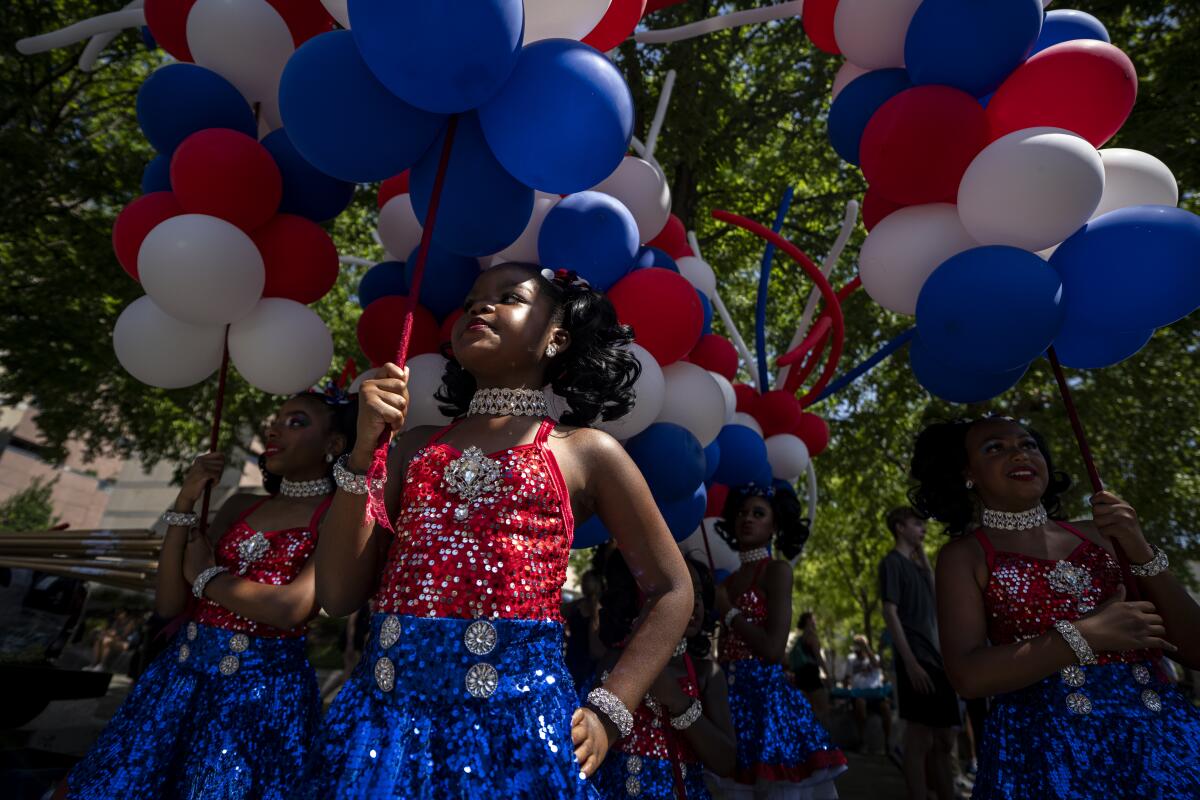
Girls in red and blue sequined dresses hold up red, white and blue balloons.

Members of the Dance4Life studio in Claymont, Del., prepares to march ahead of the Red, White, & Blue To-Do Pomp & Parade on July 2, 2026, in Philadelphia.

(Al Drago / Getty Images)

Yet, beyond the noise of the nation’s capital, historians and teachers, docents and curators, archivists, tour guides and reenactors have sustained the messy, organic discourse of the American story, less funded but no less vocal in their patriotism.

“The way history has been argued since Trump returned to office has been a reminder that governments and political figures have remarkable power to shape a society’s historical memory,” said David Ekbladh, a history professor at Tufts University and author of “Look at the World: The Rise of an American Globalism in the 1930s.”

Trump’s effort to control the anniversary narrative has reminded Ekbladh of one of George Orwell’s most famous quotes: “Who controls the past controls the future. Who controls the present controls the past.”

“The administration’s clear signals that it can and will restrict funding to institutions seems to have muted the way many institutions, like museums and universities, have approached the anniversary,” Ekbladh added. “With this said, Trump’s own direct, personal use of the 250th has been less about articulating a clear view of the nation’s history than using the moment itself to keep attention on him.”

The White House has taken a more active role in the festivities than initially planned, setting up its own Freedom 250 project to supplement America250, a bipartisan congressional effort to celebrate the occasion.

A "detour" sign appears on an image of the Statue of Liberty on screen fencing.

Fencing is seen around the Great American State Fair on the National Mall on Thursday.

(Kevin Dietsch / Getty Images)

The Trump administration has directed funding to events centered on the president’s attendance, primarily around Washington, and partnered with conservative organizations such as PragerU and Hillsdale College to present the country’s founding story through a conservative Christian lens.

Historians are in broad agreement that this year’s celebration has garnered far less attention than the bicentennial, marked in 1976, which generated blanket media coverage and widespread national excitement.

Andrew Rudalevige, a professor of government at Bowdoin College and author of “The New Imperial Presidency,” attributed the lack of enthusiasm this time in part due to a more fragmented media landscape than existed 50 years ago, denying the country a “core curriculum” and a shared story.

“I don’t think it’s a lack of patriotism, so much as a determination that no presidential administration should be able to center itself as the focus of that patriotism,” Rudalevige said.

“There’s a lot to celebrate in the text of the declaration. But that’s not where the focus of the Freedom 250 efforts has been,” Rudalevige said. “It would have been interesting to see what the bipartisan America250 initiative could have come up with if its funding and energies had not been diverted.”

A sign on a chain-link fence says "Coming to you on July 4th."

The Lincoln Memorial Reflecting Pool is fenced off in preparation for Fourth of July fireworks.

(Kevin Dietsch / Getty Images)

Trump has scheduled little national travel around the anniversary, visiting North Dakota this week for an event that allowed him to debut a new version of Air Force One, donated by Qatar and outfitted to the president’s tastes. Trump intends to keep the plane after leaving office for his personal use.

The jet will fly over the National Mall alongside the Defense Department’s most impressive equipment on Saturday, before the president delivers a speech in what is forecast to be a blistering heat wave. The evening will end, according to administration officials, with the largest fireworks display in U.S. history.

“The fundamental challenge that we face now is the fight between the historians — people who have been studying the past and who have been thinking about how to tell that story to the public — and government leaders over who gets to control that story,” said Peter Kastor, chair of the history department at Washington University in St. Louis.

“The people who are really on the front lines are museum professionals, the operators of historic sites and schoolteachers,” he said. “They face the responsibility for explaining the past to a general audience on a day-to-day basis, and they are the ones who most often face the backlash from people who want the story to be told differently.”

Source link

When, unlike our upcoming 250th anniversary, a bicentennial mattered to orchestras

A century and a half ago, Richard Wagner was running out of cash as he was preparing to stage his four momentous nights of opera known as the “Ring Cycle” when he got a message from the Women’s Centennial Executive Committee in Philadelphia. It offered him a princely $5,000 (around $150,000 today) to write a triumphant 12-minute orchestral score to open the Centennial Exposition in Fairmont Park celebrating the 100th anniversary of the Declaration of Independence.

On May 10, 1876, Theodore Thomas, perhaps America’s most famous conductor at the time (he would go on to head the New York Philharmonic and help found the Chicago Symphony), led the premiere of Wagner’s “Grosse Festmarsch” with a 150-member orchestra, its brass and percussion so impressive that the addition of cannon fire Wagner suggested was not needed. The crowd was said to number well over 100,000. President Ulysses S. Grant attended and invited Emperor Dom Pedro II of Brazil to join him along with members of Congress and Supreme Court justices for what remains a unique Declaration of Independence spectacle and debacle.

The “Centennial March,” as it came to be known, turned out to be dreck. Even Wagner, who carelessly tossed it off in a couple of weeks, said the best thing about the score was the fee, which he had demanded to be paid in gold. But what sounds like something AI might come up with if asked to write a pompous march in the style of Wagner began the American obsession with celebrating the Declaration of Independence, the words and deeds of our presidents, our very democracy with the assist of the symphony orchestra and opera.

One hundred years later, the country was awash with federal, state, city and philanthropic funding for a music-happy bicentennial of exceptional ambition. “With millions available in hand and more money to come,” Time Magazine wrote in 1975, “the Bicentennial is the biggest bonanza for the American composer since Hollywood discovered the musical.”

And so it was. The centerpiece was the National Endowment for the Arts Bicentennial Orchestra Commissioning Project. That funded America’s six top orchestras to each commission a major work that all six would play. In addition, the NEA offered further support to 34 American orchestras for dozens more new scores.

Everyone got into the act. The New York State Council of the Arts alone sponsored 68 commissions. Orchestras everywhere came up with striking projects. The Pittsburgh Symphony, for instance, premiered L.A. composer John LaMontaine’s opera/oratorio “Be Glad Then America” that featured the folk singer Odetta as the Muse of Liberty and enlisted ROTC students to reenact the Battle of Lexington overhead the orchestra.

The National Symphony commissioned symphonies from Roy Harris and William Schuman as well as Alan Hovhaness’ “Ode to Freedom,” a lovely short violin concerto written for Yehudi Menuhin. The list goes on.

We are obviously not seeing or hearing much like that in a semiquincentennial year when our government’s green gets the most attention for promoting algae. Even so, the NEA does indeed have an “America250” project (though it does little to publicize it, let alone fund it on the scale of 50 years ago) that is promoting more than 50 artworks. In music, they range from the Montgomery Symphony’s premiere in February of Nkeiru Okoye’s oratorio “A Time for Jubilee,” commemorating the 60th anniversary of the 1965 Selma-to-Montgomery civil rights marches, to a New West Symphony premiere last weekend of Michael Christie’s “A Ronald Reagan Portrait” at the Ronald Reagan Presidential Library and Museum.

The major East Coast orchestras are paying some attention. The New York Philharmonic premiered David Lang’s luminous “the wealth of nations.” The National Symphony got the most attention in its attempt to commission Philip Glass’ “Lincoln” Symphony, which the composer pulled in opposition to an un-Lincoln-like presidential takeover of the Kennedy Center. Glass then gave the rights to the Boston Symphony for a July 5 first performance.

The National Symphony did pull off the premiere of Peter Boyer’s “American Mosaic,” and it was to the Altadena composer that Philadelphia, this time around, entrusted its Declaration of Independence commemoration. Boyer’s multimedia oratorio, “A Hundred Years On,” was given its premiere by the Philadelphia Orchestra last month at the orchestra’s outdoor summer home, the Mann Center.

Upcoming will be a few repeat performances. Next month, “the wealth of nations” lands at the Aspen Festival, as does the “Lincoln” Symphony at the Cabrillo festival (with an L.A. Phil performance next season). “American Mosaic,” of which the Pacific Symphony was a co-commissioner, had its West Coast premiere in Costa Mesa last month and was scheduled to be performed at the Hollywood Bowl by the National Symphony in August, but that has now been replaced by Dvorak’s commonplace “New World Symphony.”

None of this comes close to comparing with the attempted civic zest of 1976. The NEA made it a matter of admirable policy that commissioned new works get multiple performances. Yet despite several of these being substantial works by some of our most noted and venturesome composers, few bicentennial commissions have survived. Even odder is that many of the composers did not necessarily feel compelled to explore nationalist themes. For them, American liberty implied freedom to simply write the kind of music they cared about.

The six works for the six orchestras were David del Tredici’s irresistibly over-the-top “Final Alice” (Chicago Symphony), Elliott Carter’s arrestingly impenetrable-on-first-hearing “Symphony for Three Orchestras” (New York Philharmonic), John Cage’s irrepressibly come-what-may “Renga” (Boston Symphony), Morton Subotnick’s brilliant electronic-landscaped “Before the Butterfly” (Los Angeles Philharmonic), Leslie Bassett’s introspective “Echoes From an Invisible World” and Jacob Druckman’s abstract-modernist “Chiaroscuro” (Cleveland Orchestra).

No orchestra has brought back its commission over the last half century, and only Chicago and New York recorded their commissions. No recording at all exists of L.A.’s, although Subotnick’s inventive uses of electronic music with a standard symphony orchestra went on to have considerable influence. None of these works, it appears, are likely to be heard anywhere in America this year, with one sort-of exception.

An explanation for that may be that, while 1976 was a fraught time for America — the country was recovering from the Vietnam War, we had a president and vice president who were not elected, there was runaway inflation, etc. — the music of the time represented optimism. Many works around the country explored new electronic music technology. It was the year Glass wrote “Einstein on the Beach” and Steve Reich created “Music for 18 Musicians” — the composers’ first masterpieces — demonstrating that Minimalism mattered.

That sense of liberation is clearly behind Del Tredici’s “Final Alice,” an hourlong romp around the ending of “Alice in Wonderland” for superhuman soprano and orchestra. It is so obsessively and addictively wild that its tamest moments sound like Richard Strauss on LSD. It does have a cult following although performances are few and far between.

Cage’s score is an abstract work based on the Japanese form of collective poetry known as renga, in which each poet attempts to write a line that is as distant as possible in meaning from the preceding line. Cage translates that to an independence of instrumental parts. While “Renga” can be performed alone Cage further suggests it be played along with an actual bicentennial work he wrote separately, “Apartment House 1776.” That is what Boston and the other orchestras did.

Indeed, “Apartment House” got the lion’s share of bicentennial attention and ridicule. When Zubin Mehta conducted it at the Dorothy Chandler Pavilion, the L.A. Philharmonic did not take it seriously and many walked out on it.

The work features four vocal soloists who represent Native American, Sephardic, African American and Protestant religious traditions, along with instrumental music based on early American hymn tunes. Everything is cut up and put together through chance operations into what Cage called a Musicircus. Under the circumstances “Renga” was hardly noticed, although two decades later, “Renga” came into its own when Michael Tilson Thomas famously conducted it with the San Francisco Symphony and the surviving members of the Grateful Dead.

Still the idea that “Apartment House” need not stand alone, that our traditions and those of long-ago Japan belong together, represented for Cage a future for America. We need not act like a superpower, he noted, but merely be one nation, no more and no less, among many.

We are obviously not that nation. A half-century later, “Apartment House” tends to exist mainly in its own right. An excellent London new music ensemble calls itself Apartment House. Detroit Opera recently staged it with a 2026 need to give the singers the opportunity to select their own music rather than reflect on our heritage. If American music in 1976 represented a collective, inquisitive, inventive American spirit of discovery, the semiquincentennial in the age of social media has become more about the individual identity.

As a sign of how we think about ourselves, the Los Angeles Philharmonic begins its Hollywood Bowl season five days after the 4th with a program of American music conducted by Thomas Wilkins that opens with Valery Coleman’s “Fanfare for Uncommon Times,” which was written five years ago.

But for now, the work that stands out is Lang’s “the wealth of nations.” It balances harsh thoughts of how the promise of capitalism has failed society and how racism remains with music of stunning beauty and glory, to gently but forcefully show us, in our age of American dissatisfaction, the direction in which we might go to make us proud again. It needs many performances.
Source link

The White House as a stage: Trump’s hosting streak meets America’s 250th birthday and the World Cup

When nearly all the scheduled musical performers pulled out of a concert series marking America’s 250th anniversary — fearing the event had become too closely tied to President Trump — he responded by making it official.

Trump announced he’d now be the headlining act of the Great American State Fair.

That put to rest any possible scenario where a president who has built his personal and political persona on seizing the spotlight might cede the stage to avoid overshadowing a national celebration bigger than himself. It also offered a peek into how the president is likely to approach hosting the upcoming World Cup.

From his reality shows before becoming a politician, to hours spent entertaining at events in ways planned and impromptu, to proudly showing off his various properties and efforts to overhaul the White House, the president relishes hosting. Last year he even jokingly mused about leaving the presidency to do it again full time on TV.

Trump can be a gracious, personable and highly watchable master of ceremonies — but he’s also one who tends to make every event about himself.

“The president has an outsized personality,” said Timothy Naftali, former director of Richard Nixon’s presidential library and professor at Columbia University’s School of International and Public Affairs. “There’s a predictability to the way in which the president frames his actions — or any actions around any event associated with him — and that’s just part of who he is, and his makeup and his professional background.”

Exhibit A is the fair, which begins June 25 and was supposed to feature concerts but now will be kicked off by a Trump rally. That will follow a UFC bout at the White House on June 14. Trump is a longtime cage match fan and the event marks his 80th birthday, but the president has sought to bill it as part of the anniversary festivities.

Many presidents relished hosting — but not like this

Andrew Jackson threw open the White House for an 1829 Inauguration Day bash so unruly that staff eventually dispersed the crowd by moving tubs of whiskey and ice cream to the lawn. Franklin D. Roosevelt mixed pre-dinner cocktails for friends and aides at White House gatherings he playfully dubbed “The Children’s Hour.” Audrey Hepburn was among the luminaries Ronald Reagan hosted at the White House.

Trump frequently had first-term dinners with business leaders but has more fully embraced the role since returning to the White House. He built a patio area similar to one at his Mar-a-Lago estate and frequently travels to Florida and his properties in Bedminster, New Jersey, and Sterling, Virginia, to headline fundraisers and other swanky gatherings.

Asked if Trump might overshadow events meant to bring the country and the world together, White House spokesman Davis Ingle pointed to the president’s efforts to lead extensive renovations at the White House and around Washington. He said in a statement that the “historic beautification” gives the city “the glory it deserves during our nation’s historic semiquincentennial celebration — something everyone should celebrate.”

Still, Trump has found unprecedented ways to inject himself into the anniversary.

The State Department is issuing passports with the president’s picture and officials have designed a new $250 bill with his likeness. The Trump Organization, being run by Trump’s children while he’s president, applied to trademark “Trump 250” logos and other merchandise.

The U.S. Mint is also producing a 24-karat gold commemorative coin with Trump’s face, though that recalls a half-dollar silver coin bearing the likeness of President Calvin Coolidge to help mark America’s 150th anniversary in 1926.

Past presidents had starring anniversary roles

Ulysses S. Grant opened a Centennial Exposition in Philadelphia to mark the 100th anniversary of the signing of the Declaration of Independence in 1876. Richard Nixon, in 1971, inaugurated a five-year “Bicentennial Era” ahead of the 200-year mark, though he resigned before the big day arrived.

Nixon’s successor, Gerald Ford, then in the midst of an ultimately unsuccessful reelection campaign, began the week of July 4, 1976, by inaugurating the Smithsonian Institution’s National Air and Space Museum and attending a Kennedy Center event featuring Bob Hope, OJ Simpson and others reading patriotic texts.

On Independence Day, Ford spoke at historic Valley Forge, then traveled to Philadelphia’s Independence Hall, declaring, “Liberty is a living flame to be fed, not dead ashes to be revered.“ He also went to New York Harbor for a tall ship parade, presided over naturalization ceremonies at Thomas Jefferson’s Monticello estate and hosted a state dinner for Britain’s Queen Elizabeth II.

Still, “while Ford certainly hoped to use the bicentennial to promote his reelection campaign, he didn’t do it in such a self-aggrandizing, self-centered, narcissistic way,” said Marc Stein, a history professor at San Francisco State University and author of “Bicentennial: A Revolutionary History of the 1970s.”

Ford, added Naftali, “knew when to step out of the limelight and make sure the focus was on what mattered, which was the United States of America and the Declaration of Independence.”

Trump, by contrast, “generally has contempt for norms” and rarely mentions “the great sweep of history,” Naftali said.

Dueling anniversary planners as Trump pushes to revise history

Congress charged a national organization, America250, with planning commemorative events. Ahead of the 2024 election, the group drafted a memo asking whomever the incoming president was to mobilize federal agencies and welcoming presidential involvement in events and initiatives.

Asked about Trump, America250 Chair Rosie Rios said the group “has had a very supportive and collaborative relationship with the organizations planning initiatives on behalf of the president.”

But Rios’ organization is separate from Freedom 250, a mix of public and private partnerships which the Trump administration established to fund and prepare anniversary events — which has caused confusion.

America250 aims to “inspire our fellow Americans to reflect on our past, strengthen our love of country, and renew our commitment to the ideals of democracy through programs that educate, engage, and unite us as a nation.”

That might seem a departure from the “Restoring Truth and Sanity to American History” executive order Trump signed last year. It sought to beat back a “revisionist movement” responsible for “replacing objective facts with a distorted narrative driven by ideology rather than truth.”

Stein, now serving a one-year term as president of the Organization of American Historians, is helping organize “We Want More History,” a push to coordinate local events celebrating the public’s love for the subject in fact-based ways.

He said Trump’s version of history is “closer to propaganda, and it’s closer to cheerleading.”

World Cup gives Trump another platform to play host

The president has similarly taken his exceeding-normal-limits approach to the soccer tournament the U.S. is co-hosting with Mexico and Canada.

He created a federal World Cup task force, and leads it. He collected a peace prize from soccer’s governing body, FIFA, and said he’d be on stage to present the tournament’s golden trophy to the winning team.

Trump even oversaw the tournament’s draw at the Kennedy Center, which he’s sought to rename for himself, sparking legal challenges.

He returned to the same building to headline December’s Kennedy Center Honors, noting, “We never had a president hosting the awards before.” He later posted on social media, “Would you like me to leave the Presidency in order to make ‘hosting’ a full time job?”

Naftali noted, “Whatever filters there were in the first term — and there weren’t many — are gone.”

“It’s undiluted Donald Trump.”

Weissert writes for the Associated Press.

Source link

Trump to headline 250th anniversary event after artists drop out

An upcoming celebration of the nation’s 250th anniversary, “The Great American State Fair,” recently had several musical guests back out, partly over the event’s ties to President Trump. Now, Trump himself is slated to headline the festivities.

“I understand Artists are getting ‘the yips’ having to do with their performance,” Trump posted on his social media platform Saturday. With a boastful and derisive flourish, he adding that he was thinking of bringing “the man who some say is the Greatest President in History (THE GOAT!), DONALD J. TRUMP, to take the place of these highly paid, Third Rate ‘Artists.’”

The group organizing the June fair on Washington’s National Mall, Freedom 250, confirmed the billing in a statement Saturday, writing, “We are excited to announce that President Trump will personally kick off this historic celebration on Wednesday, June 24.”

Danielle Alvarez, a spokesperson for Freedom 250, said the fair that is officially scheduled from June 25 through July 10 will feature exhibits, family friendly attractions, flyovers and musical performances — by those still remaining on the program.

Trump was dismissive of the acts that backed out, insulting them and suggesting in a follow-up post that the solution is to “Cancel it.”

“We should have a giant MAKE AMERICA GREAT AGAIN RALLY, for 250, instead of having overpriced singers, who nobody wants to hear, whose music is boring, and yet who do nothing but complain,” he wrote.

Freedom 250 is billed as nonpartisan, but it was launched last year by Trump and is led by a former State Department appointee from the president’s first term. Several artists, including Bret Michaels, the Commodores and Martina McBride dropped out last week.

Michaels and other artists have said that they were misled about the theme of the shows or were otherwise wary of being caught up in a political fight. McBride, in a statement on Instagram, said she had been “presented with an opportunity to perform at a nonpartisan event but that turned out to be misleading.”

Other artists plan to attend, including Flo Rida, Fab Morvan of Milli Vanilli and Vanilla Ice. The latter’s representative previously said that the “Ice Ice Baby” rapper was “proud to help celebrate America’s 250th Anniversary!”

Bedayn and Binkley write for the Associated Press. AP writer Eric Tucker contributed to this report.

Source link

UFC fighting cage rises on White House lawn for bout celebrating America’s 250th anniversary

Yet another White House construction project is underway, though this one is meant to be only temporary.

Crews are erecting an octagon-shaped cage on the South Lawn that will host next month’s UFC bout, helping mark the nation’s 250th anniversary — and President Trump ‘s 80th birthday.

Online renderings depict what the completed, wire-mesh-fence-ringed fight space is expected to look like ahead of the June 14 event. It will be ringed by a red, white and blue stage under a towering arch featuring stars and stripes patterns and two large screens carrying the action live.

The cage and stage will themselves be surrounded by thousands of temporary seats, including ringside space for a full marching band that can set the entire scene to blaring music.

The project is part of a series of events celebrating the semiquincentennial of the Declaration of Independence’s signing on July 4, 1776. Other planned functions include an IndyCar race that will pass by the White House and the Great American State Fair taking place on the National Mall.

Trump has said that the finished UFC project will feature “a 5,000-seat arena right outside the front door of the White House.” Additional large screens broadcasting the fights will be set up in a park at the nearby Ellipse, and the UFC has said it plans to issue as many as 85,000 free tickets to accommodate spectators at both locations.

“I have never seen anybody want anything so much as people want those tickets,” Trump said recently of demand to attend the UFC fight, adding, “That’s gonna be something.”

The card has been panned by fans online as underwhelming, featuring just two championship fights. Brazil’s Alex Pereira will meet France’s Ciryl Gane for the interim UFC heavyweight title. Then Spanish-Georgian lightweight champion Ilia Topuria takes on interim champ Justin Gaethje, one of just two Americans who currently hold even a share of the UFC’s 11 championship belts.

The octagon and surrounding structures are the latest project in the White House building boom Trump is leading.

The president’s other efforts to leave his mark include tearing up part of the Rose Garden to make room for a patio space reminiscent of his Mar-a-Lago estate in Florida, affixing partisan plaques to the wall of the colonnade for a Presidential Walk of Fame, redoing the bathroom attached to the Lincoln Bedroom and renovating the Palm Room, placing new flag poles on the north and south lawns and demolishing the entire East Wing for a sprawling ballroom.

The president also wants to repaint the Eisenhower Executive Office Building beside the White House and build a 250-foot arch at the nearby Lincoln Memorial — the same monument where weigh-ins for the upcoming UFC fight are scheduled to take place, bout organizers say.

Weissert writes for the Associated Press.

Source link

U.S. will issue commemorative passports with Trump’s picture for America’s 250th birthday

The State Department said that it is preparing a limited release of commemorative U.S. passports celebrating America’s 250th birthday that feature a picture of President Trump, who would be the first living president to be featured in the travel document.

The concept for the special passport, including a rendering of Trump’s stern-looking visage, had been under consideration for months before finally being approved late Monday and publicly announced Tuesday. Between 25,000 and 30,000 of the new passports will be available to applicants at the Washington passport office beginning shortly before July 4.

It’s the latest instance of Trump having his name and likeness added to buildings, documents and other highly visible tributes. There are efforts to put Trump’s signature on all new U.S. paper currency, also a first for a sitting president, as well as to include his image on a gold commemorative coin to celebrate the country’s founding.

The commemorative passport will be the default document for people applying in person at the Washington office, although those who want a standard passport will be able to get one by applying online or outside Washington, officials said.

“As the United States celebrates America’s 250th anniversary in July, the State Department is preparing to release a limited number of specially designed U.S. passports to commemorate this historic occasion,” State Department spokesman Tommy Pigott said.

“These passports will feature customized artwork and enhanced imagery while maintaining the same security features that make the U.S. passport the most secure documents in the world,” he said.

The limited release passport will feature Trump’s picture over a gold imprimatur of his signature to an interior page, while the cover will feature the words “United States of America” in bold gold print at the top and “Passport” at the bottom — a reversal of the standard cover.

In addition, a small gold laminate American flag, with the number 250 encircled by stars, will be at the bottom of the back cover.

The Bulwark reported earlier on the commemorative passports.

The only presidents featured in current U.S. passports are in a double-page depiction of Mount Rushmore in South Dakota — George Washington, Thomas Jefferson, Theodore Roosevelt and Abraham Lincoln.

Other depictions include the Statue of Liberty, the Liberty Bell and Independence Hall in Philadelphia, and scenes of the Great Plains, mountains and islands. Current passports also contain quotations from Martin Luther King Jr. as well as Presidents Washington, Jefferson, Roosevelt, John F. Kennedy and Dwight Eisenhower.

The addition of Trump’s picture and signature to the passport book is the newest step his aides have taken to increase the president’s visibility, including adding his name to the U.S. Institute of Peace building and the Kennedy Center performing arts venue.

Trump also has made waves with his plans for a new White House ballroom and a massive arch to be built at one of the entrances to Washington from Virginia.

Lee writes for the Associated Press.

Source link

Trump to feature on limited-edition US passports for 250th anniversary | Donald Trump News

The passports are part of broader plans to celebrate the milestone anniversary of the United States Declaration of Independence.

United States President Donald Trump will feature on a new, limited-edition US passport being issued to mark the country’s 250th anniversary in July, officials said, the latest area of public life to receive Trump’s personal branding.

The commemorative passports are part of broader plans to celebrate the milestone anniversary of the US Declaration of Independence, with events planned across the country next July.

Recommended Stories

list of 4 itemsend of list

Images released by the White House and the Department of State on Tuesday show Trump’s portrait incorporated into the design, set against elements of the Declaration of Independence and the US flag. The rendering also includes the president’s signature in gold.

Another page will feature an illustration of the Founding Fathers signing the Declaration of Independence.

“As the United States marks its 250th anniversary in July, the State Department is preparing to release a limited number of specially designed US passports to commemorate this historic occasion,” said Tommy Piggott, a spokesperson for the US State Department.

The commemorative passports will be available to US citizens applying through the Washington Passport Agency, with distribution set to begin this summer and continue while supplies last.

Current US passports feature images tied to the country’s history and identity. The inside front cover shows a painting of Francis Scott Key after the Battle of Fort McHenry, when he saw the US flag still standing after an attack. This moment inspired him to write a poem that later became the US national anthem, with lines from it printed alongside the image.

Other pages include moments from American history, such as the Apollo 11 Moon landing, and symbols like the Statue of Liberty.

The passport redesign is the latest example of efforts by Trump and his administration to place his name, image or signature on institutions and initiatives across Washington and the country.

Some of those efforts have already been implemented. This year’s national park passes, for example, display Trump’s image alongside George Washington, a departure from the programme’s traditional focus on natural landscapes.

The United States Mint has also released draft designs for a $1 coin featuring Trump’s profile as part of the 250th anniversary commemorations.

Proposed imagery for the coin redesign includes his portrait alongside inscriptions such as “Liberty” and “In God We Trust”. The reverse depicts him raising a clenched fist in front of an American flag with the phrase “FIGHT FIGHT FIGHT”, referencing a chant he used after a 2024 assassination attempt at a campaign rally in Butler, Pennsylvania.

Trump has pushed Democratic Senator Chuck Schumer to rename New York’s Penn Station after him, linking the idea to the release of federal infrastructure funding, but the effort has failed to gain traction.

Trump has also placed his face on government buildings around Washington, DC, in the form of long banners.

Even the architecture of the US capital city is changing to reflect his tastes: Last October, he tore down the White House’s East Wing to build a massive ballroom, and he has plans to build a triumphal arch in the capital, similar to the one in Paris, France.

In December, Trump’s name was added to the Kennedy Center in Washington, DC, just one day after his hand-picked board members controversially voted to rename the art venue, the first time a national institution has been named after a sitting US president.

Within days, workers had added metal lettering to the building’s exterior, renamed as “The Donald J Trump and the John F Kennedy Memorial Center for the Performing Arts”.

Source link