Watts Towers to break ground on a $22-million campus expansion
A 15-year campaign led by the Los Angeles County Museum of Art to conserve Watts Towers has run out of budget at the same time that a $22-million renovation of the campus is poised to take flight. The situation highlights what community organizers and the site’s leadership say is a piecemeal approach to the protection and preservation of one of the city’s most important cultural landmarks.
For decades, the city of Los Angeles and private foundations have invested in preserving the towers, the 102-year-old masterpiece of folk art built by Italian immigrant Sabato “Simon” Rodia. But while the landmark itself underwent years of painstaking conservation, which was recently halted at 90% complete, the arts campus surrounding it evolved in fits and starts.
Now, after 14 years of planning, an equally ambitious investment is being made to transform the Watts Towers Arts Center Campus (WTACC), which has served as an essential cultural and educational center for more than 50 years. The work will mark the first major upgrade of the WTACC since it opened in 1970, and leaders hope the transformation continues uninterrupted until it reaches the finish line.
“This is about investing in the people of Watts and creating a space the community can be proud of,” Mayor Karen Bass wrote in an email. “Thanks to the dedication of our state, county and local partners, philanthropic supporters and community organizations, we’re one step closer to creating a greener, healthier and more vibrant campus that honors the legacy of Watts while serving generations of Angelenos to come.”
The campus renovation is slated to break ground in October, with completion targeted before the 2028 Summer Olympics. The project is funded through a patchwork of public and private sources, including a $10.1 million investment from the Bezos Earth Fund, the climate philanthropy organization founded by Amazon Executive Chair Jeff Bezos.
The redesign will reshape how visitors experience the campus. More than 30,000 square feet of park space will be added along E. 107th Street, while climate-resilient landscaping will reduce flooding, improve stormwater management and create cooler public spaces. More seating and shade will be added to its amphitheater, new public art will be commissioned, and additional walkways, gathering areas and 200 trees will make the towers the physical centerpiece of what will be a 5-acre campus.
“It’s been the right time for a long time,” said WTACC Director Rosie Lee Hooks of the project’s long gestation during a recent interview.

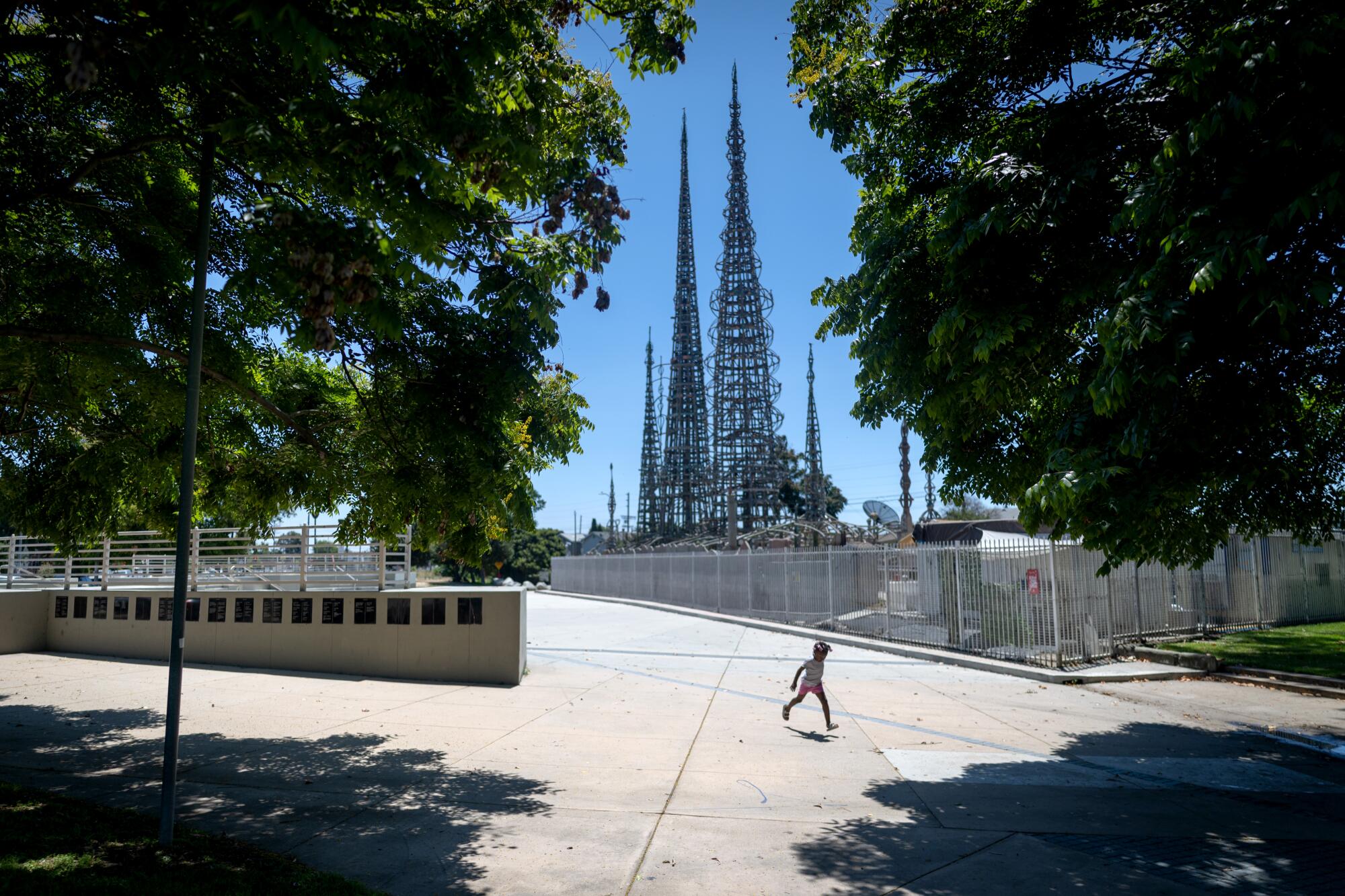
A girl plays near the Watts Towers at the Watts Towers Arts Center Campus, which is poised to undergo a $22-million renovation just as funding for the restoration on the towers themselves has run out.
(Eric Thayer / Los Angeles Times)
The center offers free art, film and music classes for students and seniors, houses an art gallery and hosts two annual music festivals. Thousands of artists, filmmakers and musicians have passed through its doors as students and instructors.
Hooks, who has led the center since 2010, said the project’s long timeline reflects more than bureaucracy.
“It took so long because we’re in Watts,” she said, noting that the neighborhood has faced decades of disinvestment dating back to the 1965 Watts uprising. “People are still scared to come down here. However, our community is very, very rich in culture.”
That history of underinvestment is reflected in the campus itself, supporters say.
“This is the story of development in Watts and other communities of color in Los Angeles, where racist planning practices, combined with a lack of investment in the city’s arts and culture facilities, create a haphazard approach to management and design,” Tori Kjer, executive director of the Los Angeles Neighborhood Land Trust (LANLT), wrote in an email. The organization has partnered with the city on the campus’ redesign since 2012, when planning began to incorporate a vacant lot adjoining the towers into the campus.
The landscape design echoes Rodia’s own artistic process. Over the course of 33 years beginning in 1921, he transformed thousands of disparate objects — including mosaic tiles, plates, glass, shells and pottery — into 17 interconnected structures, one of which rises more than 99 feet.
“Assemblage is the practice of creating something meaningful from many distinct parts,” Sara Zewde, founder and principal of Studio Zewde, the landscape architecture firm designing the campus, wrote in an email. “Rather than erase those histories and make the campus feel as though it had always been a singular space, we wanted the landscape to celebrate them.”

A model created by landscape design firm Studio Zewde of the proposed renovations to the Watts Towers Arts Center Campus. Groundbreaking is set to begin in October on the $22-million project.
(Eric Thayer / Los Angeles Times)
The campus’ landscape has remained largely unchanged since WTACC opened. Since then, several buildings and public artworks have been added, but LANLT’s Kjer described the site as a “hodgepodge of concrete, worn-out planting areas and grass … with a disjointed flow and limited way-finding.”
Around the time that LANLT partnered with the city, a separate proposal to build a skate park on the adjoining lot drew community opposition and, according to Kjer, delayed the project by about four years. The skate park ultimately opened a few blocks away, allowing the parcel to become part of an expanded campus.
The WTACC project gained momentum in 2021 when California’s Proposition 68 Statewide Park Program awarded a $4.5 million grant. The following year, Assemblymember Mike A. Gipson (D-Carson) secured an additional $4 million in the state budget.
Once that funding was committed, “it was just a domino effect,” Gipson said, helping attract additional public and private investment.
“This will be a space that will be nourishing for the soul,” said Daniel Tarica, general manager of the city’s Department of Cultural Affairs, which manages the towers. “We’re finally going to be able to make the whole campus useful.”

A building at the Watts Towers Arts Center Campus, which will receive a $22-million renovation beginning in October. Community members and supporters say the work has been a long time coming.
(Eric Thayer / Los Angeles Times)
Watts Towers attract about 40,000 visitors a year, according to the California Department of Parks and Recreation, and were designated a U.S. National Historic Landmark in 1990. In June, the site was added to the World Monuments Fund’s “Irreplaceable America” list of 10 endangered historic sites in the United States.
While Gipson hopes the renovated campus will attract additional international visitors, he also wants more Angelenos to discover one of the city’s defining cultural landmarks.
“The towers tell a story about Los Angeles,” Gipson said. “We want people to know that the Watts Towers are part of who Los Angeles is.”
Tarica said the project is designed to serve neighborhood residents as much as tourists.
“It’s a huge resource, and we have fought as a department, and as a city, to make sure that we have the funding to continue teaching … and programming,” he said.

A statue of Watts Towers creator Sabato “Simon” Rodia stands at the entrance to the Watts Towers Arts Center Campus, which is getting a $22-million renovation beginning in October, with the goal of completion in time for the 2028 Olympics in Los Angeles.
(Eric Thayer / Los Angeles Times)
For Hooks, however, the renovation’s success will ultimately be measured by its impact on the surrounding community.
She sees the campus as filling a void left by decades of cuts to arts education while providing a place where residents can gather and learn.
“Our community cannot afford art, especially now with all of the issues around health, around food, around jobs, around ICE separating families,” she said.
The project’s funding is restricted to renovating the campus and does not include the conservation of the Watts Towers themselves. LACMA Deputy Director Diana Magaloni said about $412,000 is needed to finish the project. The city has allocated $150,000 for ongoing maintenance and monitoring, and both Magaloni and Tarica said they remain optimistic the conservation campaign and campus transformation will be completed before Los Angeles welcomes the world for the 2028 Summer Olympics.
“It would be amazing to have this funding to be able to do the campus restoration and [the towers restoration] in preparation for us to be on the world stage,” Tarica said.