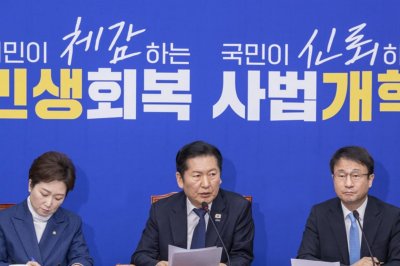

Jung Chung-rae (C), leader of the ruling Democratic Party, speaks during a meeting of its Supreme Council at the National Assembly in Seoul, South Korea, 23 February 2026. Photo by YONHAP / EPA
March 6 (Asia Today) — South Korea’s ruling Democratic Party has recently increased its engagement with major companies and business groups, a shift analysts say reflects growing economic uncertainty and the political importance of economic performance.
Party leaders have held a series of meetings with industry representatives while launching policy initiatives such as a “KOSPI 5000” special committee and a task force reviewing economic criminal penalties and business regulations.
The outreach marks a change from the party’s earlier image as primarily focused on regulation, positioning itself instead as a listener to industry concerns.
The move comes as tensions in the Middle East, potential U.S. tariff measures and volatility in financial markets raise economic risks. Political leaders have increasingly addressed these issues directly, as economic developments quickly translate into political and legislative debates.
On Wednesday, the Democratic Party held a meeting with business leaders to discuss risks stemming from the Middle East conflict and possible U.S. trade tariffs. Participants discussed concerns including potential disruptions to projects in the Middle East, export slowdowns and measures to stabilize financial markets.
Party officials have also held policy discussions with the Korea Chamber of Commerce and Industry while continuing work through the KOSPI 5000 committee on capital market reforms. Another task force has been examining ways to adjust criminal penalties related to economic activity and ease regulations that business groups say hinder corporate operations.
Economic risks increasingly shape political debate
Analysts say economic shocks are now quickly becoming political issues.
Recent disagreements between the ruling party and opposition lawmakers over legislation tied to investment cooperation with the United States delayed discussions in a parliamentary special committee for several weeks, illustrating how economic policy disputes can quickly turn into political battles.
Economic performance influences political approval
Academic research has also shown that economic conditions can influence political approval and election outcomes.
A study published in a Korean academic journal examining presidential approval ratings from 1993 to 2019 found statistically significant links between approval ratings and macroeconomic variables such as interest rates and inflation.
Research by scholars at Seoul National University also found that voting behavior in South Korea cannot be explained solely by regional political loyalties and is strongly influenced by voters’ economic evaluations.
Similar findings appear in international research, including a study from the University of Cambridge that examined how personal economic conditions and perceptions of national economic performance affect voting decisions in South Korea.
Corporate performance tied to government finances
South Korea’s fiscal structure is another reason the ruling party is expanding contact with businesses, analysts say.
According to the National Assembly Budget Office, national tax revenue in 2024 totaled about 336.5 trillion won ($253 billion), down 7.5 trillion won ($5.6 billion) from the previous year.
Corporate tax revenue alone fell by about 17.9 trillion won ($13.5 billion), making it one of the main reasons for the overall decline in tax revenue.
For the administration of President Lee Jae-myung, which has promoted a broader welfare framework described as a “basic society,” maintaining corporate growth and investment has become increasingly important to sustaining tax revenues needed for expanded public spending.
Still, analysts caution that the ruling party’s outreach should not necessarily be interpreted as a shift toward a pro-business policy stance.
Business groups have continued to raise concerns about legislation such as revisions to the Commercial Act and labor-related bills sometimes referred to as the “Yellow Envelope Law,” which they argue could weaken corporate governance protections.
Some lawmakers have therefore adopted what observers describe as a two-track approach – consulting with companies while continuing to pursue regulatory legislation.
Analysts say the recent outreach to business leaders reflects a broader political strategy combining economic crisis management, legislative coordination and efforts to maintain political support.
— Reported by Asia Today; translated by UPI
© Asia Today. Unauthorized reproduction or redistribution prohibited.
Original Korean report: https://www.asiatoday.co.kr/kn/view.php?key=20260306010001790