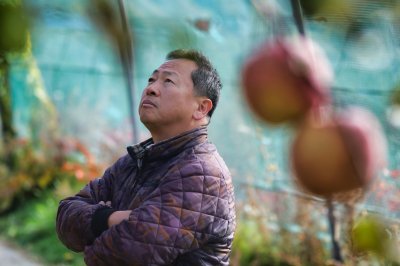

1 of 6 | Farmer Ma Yong-un, seen here in his apple orchard in November, is one of five plaintiffs in a landmark civil suit against state-owned utility KEPCO for climate-related agricultural damages. Photo by Thomas Maresca/UPI
HAMYANG, South Korea, Feb. 23 (UPI) — As harvest season approached last November, farmer Ma Yong-un walked through his apple orchard in southern South Korea with a growing sense of dread.
The Fuji apples hanging from the trees were pale, lacking the deep red color that signals sweetness and commands a good price. To make matters worse, many were splitting open as they ripened.
An unusually rainy fall had blocked the sunlight needed for proper coloring, following one of the hottest summers on record.
“I had never seen this kind of cracking before,” Ma, 55, told UPI on his farm in Hamyang, a rural county in South Gyeongsang Province. “I was so stressed. I was worried about my family’s survival.”
A late dry spell before the harvest helped salvage some color, but another year of punishing weather had taken its toll. Ma estimated that half his apples were not of good quality.
Across South Korea, similar stories have become increasingly common. Farmers are facing mounting losses from heat waves, heavy rainfall, droughts and shifting growing seasons — impacts scientists widely link to climate change.
Now, their experiences are moving from fields and paddies into a courtroom.
Ma is one of five plaintiffs in a civil lawsuit filed against state-owned utility Korea Electric Power Corporation, or KEPCO, and five of its power-generation subsidiaries. The suit seeks financial compensation for climate-related agricultural damages and asks whether a major corporate emitter can be held legally responsible for the downstream effects of climate change.
The case is the first of its kind in South Korea, according to Yeny Kim, an attorney with the Seoul-based nonprofit Solutions for Our Climate, which is representing the plaintiffs.
“Agriculture is an industry that is absolutely dependent on climate conditions,” Kim told UPI. “As the climate changes, we’re reaching a point where certain crops can no longer be grown. That leads to damages to farmland, reduced yields and increased costs just to grow the same amount of crops.”
Filed in August, the lawsuit argues that KEPCO’s greenhouse gas emissions materially contributed to climate change and, in turn, to the plaintiffs’ economic losses.
Quantifying climate damage
The case is based on an analysis estimating $72.9 billion in climate-related economic damages linked to KEPCO’s emissions between 2011 and 2023. During that period, KEPCO and its subsidiaries accounted for roughly 27% of South Korea’s total greenhouse gas emissions, making the utility the single largest corporate emitter in the country.
Globally, the companies’ emissions represented about 0.39% of cumulative worldwide emissions over the same timeframe — a figure the plaintiffs argue is sufficient to establish measurable responsibility for climate-driven harm.
“In a court of law, quantifiable harm means legal liability,” Kim said.
The lawsuit draws on the “polluter pays” principle, which holds that those responsible for pollution should bear the costs of the damage it causes. While widely used in environmental law, applying it to climate change remains largely untested in Korean courts.
Each plaintiff is seeking an initial 5 million won — about $3,400 — in damages, an amount that could be adjusted as the case proceeds. They are also requesting an additional 2,035 won, roughly $1.40, as symbolic compensation for the emotional and psychological toll they say climate change has imposed on their lives.
Hwang Seong-yeol, a rice farmer and fellow plaintiff, said anxiety and a sense of helplessness now shadow every growing season.
“We just look at the sky and wonder what the weather is going to be like,” Hwang said at a press briefing in Seoul in November. “Being stressed from physical labor is something we can endure. But the stress caused by climate change is completely unbearable.”
The suit’s first hearing took place at Gwangju District Court last month. Court records show the defendants have submitted multiple written responses contesting the claims. The next hearing is scheduled for April 23.
KEPCO did not respond to a request for comment. The company has pledged to achieve carbon neutrality by 2050, in line with South Korean government policy.
An economy at risk
South Korea has lagged other developed countries in transitioning away from fossil fuels. Government data show just 10.7% of the country’s electricity came from renewable sources in 2024, well below the global average of roughly 32%.
The country is also particularly exposed to climate disruptions abroad. South Korea imports the vast majority of its food — its calorie self-sufficiency rate stood at just 32.5% in 2023, roughly half the level recorded in 1990, according to the Korea Rural Economic Institute. The broader grain self-sufficiency rate, including animal feed, has fallen to 22.2%, among the lowest of any OECD country.
Nam Jae-Chol, a professor at Seoul National University and former administrator of the Korea Meteorological Administration, told UPI that dependence leaves the country vulnerable when climate shocks hit major exporters.
“When exporting countries begin to limit shipments because of climate impacts, that’s when the problem becomes visible,” Nam said. “If agricultural imports suddenly decline because of climate change, prices will skyrocket. In extreme cases, exports could even stop.”
“In 10 or 20 years, we’re going to face a serious crisis due to climate change,” Nam added. “It’s inevitable.”
In South Korea, warming temperatures have already pushed traditional crop-growing zones northward, forcing farmers to adapt — changing what they grow, how they manage water and how they run their operations, Nam said.
Ma said he first felt the full weight of climate change in 2018, when severe cold and frost tore through his orchard, a moment that convinced him the changes were accelerating.
Since then, he has cut his use of chemical fertilizers and tried more eco-friendly practices to improve soil health. He has also begun to consider whether he may eventually need to change crops or even move his orchard entirely — decisions that carry steep costs and uncertainty.
“The compensation is 5 million won, but the damages I suffered this fall alone were ten times more than that,” Ma said. “So the amount itself doesn’t really mean much.”
What he hopes, he said, is that the lawsuit makes those struggles harder to ignore.
“Climate change is already having a huge impact on our agriculture, and people need to see that,” Ma said. “KEPCO cannot continue operating this way, and Korea needs to change its energy policy toward something more sustainable.”