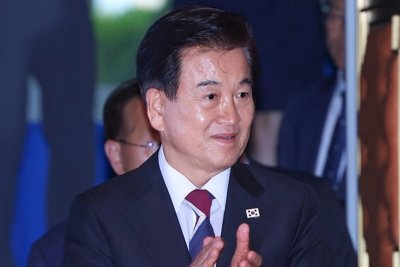

Unification Minister Chung Dong-young, South Korea’s point man on inter-Korean relations, attends a ceremony to mark his inauguration at the government complex in Seoul, South Korea, 25 July 2025. File. Photo by YONHAP / EPA
March 25 (Asia Today) — South Korea’s unification minister called for a shift in policy toward “peaceful coexistence” with North Korea, emphasizing that the approach does not mean abandoning unification but rather institutionalizing peace on the Korean Peninsula.
Unification Minister Chung Dong-young made the remarks Wednesday during an academic conference co-hosted by the ministry and a state-run research institute, where officials and experts discussed ways to end hostilities and establish a lasting peace framework.
Chung said Seoul should redesign its Korean Peninsula policy with peaceful coexistence at the center, arguing that formalizing stable relations between the two Koreas could open the door to broader dialogue.
“This is not about giving up unification, but about institutionalizing peace,” Chung said. “If peaceful coexistence is established politically, economically and legally, any issue between the two sides can be addressed.”
He added that discussions among relevant countries on building a peace regime, alongside a basic inter-Korean agreement, would be key to resolving long-standing tensions.
Chung also described North Korea’s recent push for a “two hostile states” framework as a structural shift that should be turned into an opportunity to move beyond confrontation.
“We must end the hostility and conflict that have devastated inter-Korean relations and create a relationship where there is no need to fight,” he said.
The minister avoided directly using the term “North Korea” during his remarks, instead referring to “the North” and its formal state name, a choice some analysts interpret as reflecting a more conciliatory tone.
Chung reiterated that the Korean Peninsula remains technically at war and said the starting point for peace is formally ending the conflict. He stressed that improving relations between Pyongyang and Washington would be essential and urged North Korea not to miss opportunities for dialogue with the United States.
He also said the South Korean government would act as a “pacesetter” to help sustain momentum for U.S.-North Korea talks while fulfilling its role as a key stakeholder in peninsula affairs.
At the same event, former intelligence chief Seo Hoon underscored the continued relevance of a “top-down” approach centered on leader-level diplomacy.
“The more uncertain and difficult the conditions, the more powerful summit diplomacy becomes,” Seo said, calling for a potential fourth meeting between U.S. and North Korean leaders.
Seo noted that past summit diplomacy led to repeated exchanges between former U.S. President Donald Trump and North Korean leader Kim Jong Un, arguing that even limited agreements or renewed dialogue could be meaningful steps forward.
— Reported by Asia Today; translated by UPI
© Asia Today. Unauthorized reproduction or redistribution prohibited.
Original Korean report: https://www.asiatoday.co.kr/kn/view.php?key=20260325010007733