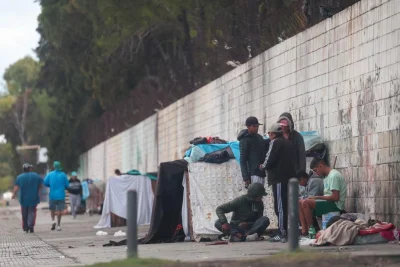

Homeless people congregate in Buenos Aires in March. Poverty in 2024 had climbed to the highest level recorded since the series began in 2005, while it now stands at its lowest point since 2018. File Photo by Juan Roncoroni/EPA
BUENOS AIRES, Dec. 5 (UPI) — Income-based poverty in Argentina fell to 36.3% of the population in the third quarter of this year, down from 45.6% in the same period in 2024, according to a report from the Social Debt Observatory at the Catholic University of Argentina.
Poverty in 2024 had climbed to the highest level recorded since the series began in 2005, while it now stands at its lowest point since 2018.
The report also shows an improvement in the extreme poverty rate, which fell to 6.8% in the third quarter from 11.2% in the same period in 2024, confirming a decline in the share of the population with income too low to meet basic food needs.
“The recent reduction in poverty is explained mainly by slowing inflation and a partial recovery in income, while the drop in extreme poverty is strongly linked to the impact of cash-transfer social programs. Without these policies, the extreme poverty rate would nearly double, even under current conditions,” the report said.
However, the report acknowledges that structural inequalities persist.
“Lower socio-educational groups remain the most affected, but there is also significant deterioration among middle-income sectors. The top 25% remains practically immune to economic hardship,” the report said.
It adds that in the recent period poverty has improved more than what the report calls “economic stress.” “Some households have higher incomes, but not necessarily greater purchasing power or less financial strain,” the report said.
Lucas Gobbo, a professor and researcher at the National University of Avellaneda, told UPI the data show a statistically significant improvement in poverty and extreme poverty indicators.
According to the economist, the most significant policy change was the sharp increase in the Universal Child Allowance — a benefit that was increased shortly after Javier Milei became president.
The same report notes that the Argentine government gave significant weight to this subsidy as its main social assistance policy, doubling its amount in real terms after it had been eroded by accelerating inflation.
“Despite its low amount, the expansion of the child allowance partially eased economic hardship for a significant share of Argentine households, slightly reducing poverty rates and, above all, extreme poverty,” the Catholic University report said.
Beyond that specific adjustment, Gobbo said no additional targeted policies were implemented for low-income sectors afterward.
Another factor behind the improvement is the sharp drop in inflation.
“Today we have year-over-year inflation around 30%, when two years ago it exceeded 200%,” the researcher said.
“That translates into a steep drop in poverty, because inflation hits poorer households the hardest,” he added.
Despite the short-term improvements, Gobbo said Argentina still lacks a comprehensive long-term policy. “What we do not yet see is a model of growth and development with social inclusion,” he said.
“What we are seeing is an economy run almost exclusively by the market, which may balance out through the growth of some sectors and the collapse of others, leaving very high unemployment and informality, with a state that remains distant from these problems,” he warned.
Gobbo said Argentina needs a state that can support productive sectors capable of generating quality jobs. He added that part of the situation “could be eased with a more decisive update of the minimum wage, which has been falling behind.”