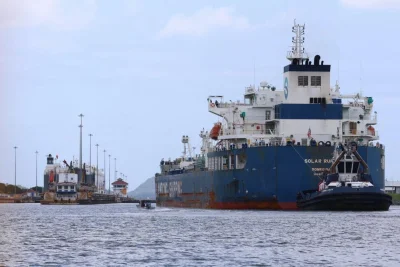

Container ships pass through the Panama Canal in Panama City, Panama, on August 19. The Panama Canal Authority limited daily ship traffic to 32, down from an average of 36, a previous limit imposed to address the drought caused by El Nino. Photo by Carlos Lemos/EPA
Aug. 26 (UPI) — El Salvador and Panama have declared their highest-level alerts nationwide as the effects of El Niño threaten economies and residents’ safety.
In Panama, the climate phenomenon already has brought torrential rains and severe flooding to northern and Caribbean areas, affecting more than 15,600 people.
In El Salvador, it has triggered extreme agricultural drought and unprecedented heat that destroyed 20% of basic grain crops, seriously threatening the country’s food security.
In contrast, Panama’s metropolitan and central regions are facing a rainfall deficit that could persist at least through March, according to forecasts from Panama’s Institute of Meteorology and Hydrology.
Eleven watersheds already are experiencing “water stress,” with the effects expected to persist through May, along with elevated temperatures, Infobae reported. The situation has prompted the Panama Canal Authority to impose preventive restrictions on vessel traffic because of low water levels.
El Niño is a natural climate phenomenon marked by warmer-than-normal surface waters in the central and eastern equatorial Pacific, causing shifts in global wind and rainfall patterns, as well as erratic weather conditions.
The U.S. National Oceanic and Atmospheric Administration issued a historic forecast this month, warning that the current El Niño has a greater than 90% chance of becoming a “very strong” event.
The agency’s official models indicate a nearly 70% chance that it will surpass all events recorded since 1950 in intensity, exceeding the record set by the massive 1982-83 event.
Panama’s Government Minister Dinoska Montalvo said Tuesday the state of emergency was declared to streamline administrative procedures, strengthen operational capacity and prepare “for what is to come,” the Panamanian newspaper La Estrella de Panamá reported.
According to El Salvador’s Environment Ministry, the country is experiencing its third consecutive drought period during the current rainy season, with the eastern and coastal regions hardest hit, the news outlet elsalvador.com reported.
The government declared a nationwide red alert Tuesday because of the risk that the drought could threaten people’s livelihoods and food security.
The Environment and Natural Resources Ministry expects estimated rainfall from August through October to total only about .24 inch, compared with a normal average of 37 millimeters during that period, La Prensa Gráfica reported.
In July, El Salvador experienced a heat wave that pushed temperatures above 104 degrees-F in the country’s eastern and central regions for 12 consecutive days, representing a severe anomaly.
Although those areas are accustomed to hot weather, regular rainfall during the country’s rainy season typically acts as a natural temperature regulator, keeping average highs closer to 91 degrees.