The Trump administration’s efforts to end the war in Ukraine took another turn today, this time with a revised deal reportedly more favorable to Ukraine than an earlier iteration. Meanwhile, Kyiv continues to lose ground at several points across the 600-mile front lines.
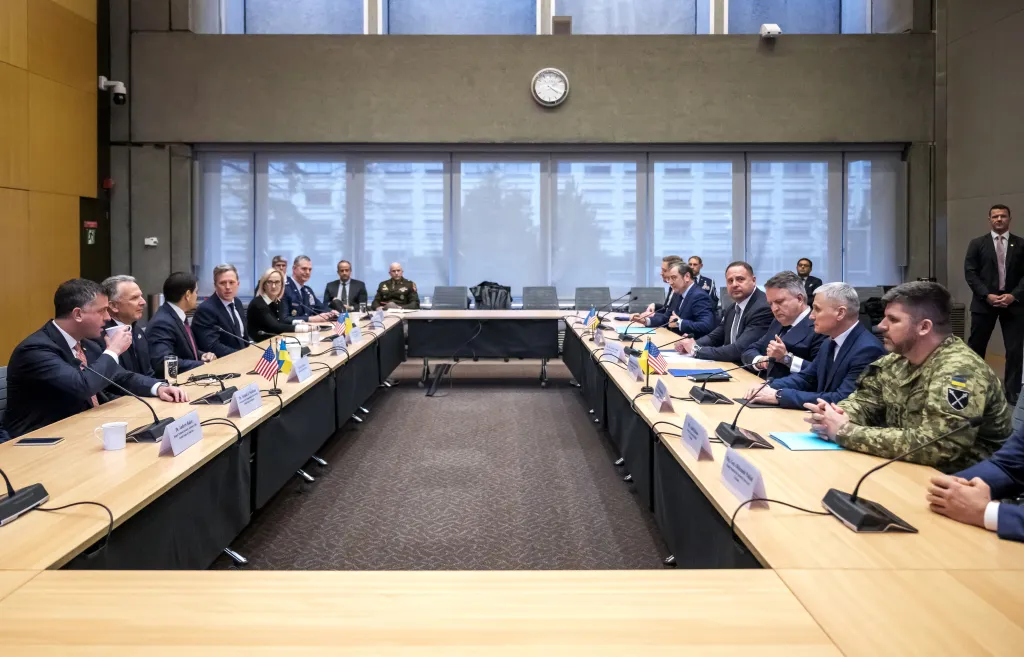
A new plan introduced on Monday reportedly eliminates some, but not all of Ukraine’s major concerns, with a 28-point plan unveiled last week. The revised document was hammered out over the weekend by the U.S. delegation, led by Secretary of State Marco Rubio, and a Ukrainian team, led by the head of the presidential office, Andriy Yermak. The updated peace proposal now contains 19 provisions.
As with the previous peace plan, we cannot independently verify the details of this latest one, which could be preliminary, subject to change, and/or not reported in the proper context.

The reported details of the original 28-point plan that emerged last week were highly controversial, seemingly lopsided in favor of Russia and raised concerns across Europe and even among Ukraine’s staunch Republican supporters in Congress. The backlash was so great that Rubio reportedly assured the lawmakers that the leaked version did not represent the Trump administration’s position. Trump’s special envoy Steve Witkoff reportedly drafted that plan with Russian envoy Kirill Dmitriev.
U.S. Army Secretary Daniel Driscoll, the Trump administration’s top negotiator, on Friday warned that Washington would show little flexibility.
“We are not negotiating details,” he said, Financial Times wrote, citing a senior European official in the meeting at the Kyiv residence of US chargé d’affaires, Julie Davis
Monday’s version of the plan appears to be more amenable to Kyiv.
“Many of the controversial provisions were either softened or at least reshaped” to get closer to a Ukrainian position, said Oleksandr Bevz, an adviser to Yermak who participated in the Geneva summit, The Washington Post reported. “By Monday, while not all the language in the draft was considered entirely ‘acceptable’ to Kyiv, the text was revised to a point that it can at least ‘be considered, whereas before it was an ultimatum,’” Bevz said.
The U.S. had reportedly threatened to cut all support if the deal wasn’t accepted.
“The Ukrainian delegation affirmed that all of their principal concerns—security guarantees, long-term economic development, infrastructure protection, freedom of navigation, and political sovereignty—were thoroughly addressed during the meeting,” the White House said in a statement Sunday night. “They expressed appreciation for the structured approach taken to incorporate their feedback into each component of the emerging settlement framework.”

Ukrainian representatives “stated that, based on the revisions and clarifications presented today, they believe the current draft reflects their national interests and provides credible and enforceable mechanisms to safeguard Ukraine’s security in both the near and long term,” the statement continued. “They underscored that the strengthened security guarantee architecture, combined with commitments on non-aggression, energy stability, and reconstruction, meaningfully addresses their core strategic requirements.”
Among other measures, the U.S. seemed willing to remove a Russian demand to limit Ukraine’s military to 600,000 troops.
However, the biggest sticking point remains. according to reports.
The aforementioned 28-point proposal would have seen Ukraine give up a considerable amount of territory in the east, including land it still controls. That is not something the Ukrainian President Volodomyr Zelensky appears willing to accept, even with the stick of reduced or eliminated support from Washington.
The Ukrainian leader has said his country could face a stark choice between standing up for its sovereign rights and preserving the American support it needs,” The Associated Press noted. “The proposal acquiesced to many Russian demands that Zelensky has categorically rejected on dozens of occasions, including giving up large pieces of territory,” the AP reported.

The Ukrainian leader has vowed that his people “will always defend” their home.
On Monday, Zelensky seemed hopeful that peace could be achieved, but he didn’t specifically address Russia’s lingering demand for land concessions.
“Today our delegation returned from Geneva after negotiations with the American side and European partners, and now the list of necessary steps to end the war can become workable,” Zelensky explained on Telegram. “As of now, after Geneva, there are fewer points, no longer 28, and much of the right has been taken into account in this framework.”
“There is still work to be done together – it is very difficult – to make the final document, and everything must be done properly,” the Ukrainian leader continued. “And we appreciate that most of the world is ready to help us and the American side is constructive. In fact, the whole day yesterday was meetings; it was a difficult, extremely detailed work.”
“I discuss the sensitive issues with President Trump,” Zelensky added.
However, there is no meeting scheduled between the two leaders, White House spokesperson Karoline Leavitt told reporters Monday.
The White House, she said, feels “optimistic” about the president’s proposed peace plan to end the war in Russia. The plan has input from both Russia and Ukraine.
Leavitt also stated that the U.S., which has been selling arms to NATO, ultimately bound for Ukraine, cannot keep that up.
Meanwhile, European nations also introduced their own 28-point peace proposal. Russia, for its part, seems more amenable to the American version.
“Yuri Ushakov, a veteran foreign policy aide to the Russian leader, told reporters in Moscow that the EU’s peace plan, launched in response to the 28-point plan presented by Washington, ‘constructively doesn’t fit us at all,’” Politico reported. “Ushakov added that Trump’s plan, which included several major concessions to Russia, including ceding vast swathes of Ukrainian territory and capping the size of Kyiv’s military, was more ‘acceptable’ to the Kremlin.”
Amid the flurry of diplomatic moves, Russia continues to slowly grind up Ukrainian territory, albeit at a tremendous cost in personnel and equipment.
“Russian forces have broken through Ukrainian defenses north of Huliaipole, creating a rapidly expanding threat to one of Ukraine’s most fortified positions in Zaporizhzhia Oblast,” Euromaidan Press reported on Sunday. “The breakthrough has prompted Ukrainian forces to reposition for a high-stakes defensive battle along the Zarichne River.”
The community, which had a population of about 14,000 in 2016, was originally created in the 1770s as a military bulwark against invading forces. Huliaipole is once again fighting to ward off an encroaching enemy and is “the largest and most fortified Ukrainian stronghold in the region,” Euromaidan Press explained.
The Russians have amassed a force of about 40,000 troops, the publication claimed, adding that they are attacking from the north to try and encircle Ukrainian forces and avoid a costly head-on attack.
“Ukrainian defenders repelled seven attacks by the occupiers near the settlements of Zelenyi Hai, Zatyshshia, Solodke, and towards Varvarivka and Dobropillia,” the Ukrainian Armed Forces General Staff claimed on Monday. “Two clashes are still ongoing. In addition, enemy aviation struck the settlements of Huliaipole and Zaliznychne.”
For its part, the Russian Defense Ministry MoD) claimed it captured a small community about a mile and a half north of Huliaipole
The “liberation of Zatishye has strengthened the position of the Vostok Group of Forces and has become an important step towards further progress in this direction,” the Russian MoD stated on Telegram.
Meanwhile, about 60 miles to the northeast in the hotly contested Donetsk region, Ukrainian forces are still holding out in the embattled city of Pokrovsk; however, “Russian forces will very likely complete the seizure of Pokrovsk and Myrnohrad,” according to the latest Institute for the Study of War (ISW) assessment.

Another 60 miles northeast of Pokrovsk, the Russians are also pushing closer to the town of Siversk, according to ISW.
“Ukrainian 11th Army Corps (AC) spokesperson Lieutenant Colonel Dmytro Zaporozhets reported on November 23 that Russian forces are the most active in the Slovyansk direction and are attacking more specifically toward Siversk,” ISW explained.
“While attention is focused on Huliaipole and Pokrovsk, systemic problems are arising in other directions as well,” Ukrainian activist and noted milblogger Serhii Sternenko posited on Telegram. “Another front line where the crisis will soon become noticeable is Siversk/Yampil. I won’t write the details publicly. In short — the same set of problems as in other areas + increasingly active enemy drone operations against our logistics.”

Lt. Gen. Kyrylo Budanov, head of Ukraine’s Defense Intelligence Directorate, recently suggested that Russia plans to occupy all of Donetsk by next spring
While Budanov called that aspiration “unrealistic,” the ongoing peace process, if successful, could make that a moot point. However, given the tumultuous nature of the negotiations, Russia’s unwavering demands, and Ukraine’s continuing battlefield losses, that’s a pretty big if.
Contact the author: [email protected]